The Digital
Success Stack
Every online business needs a technology stack
and the right people to run it
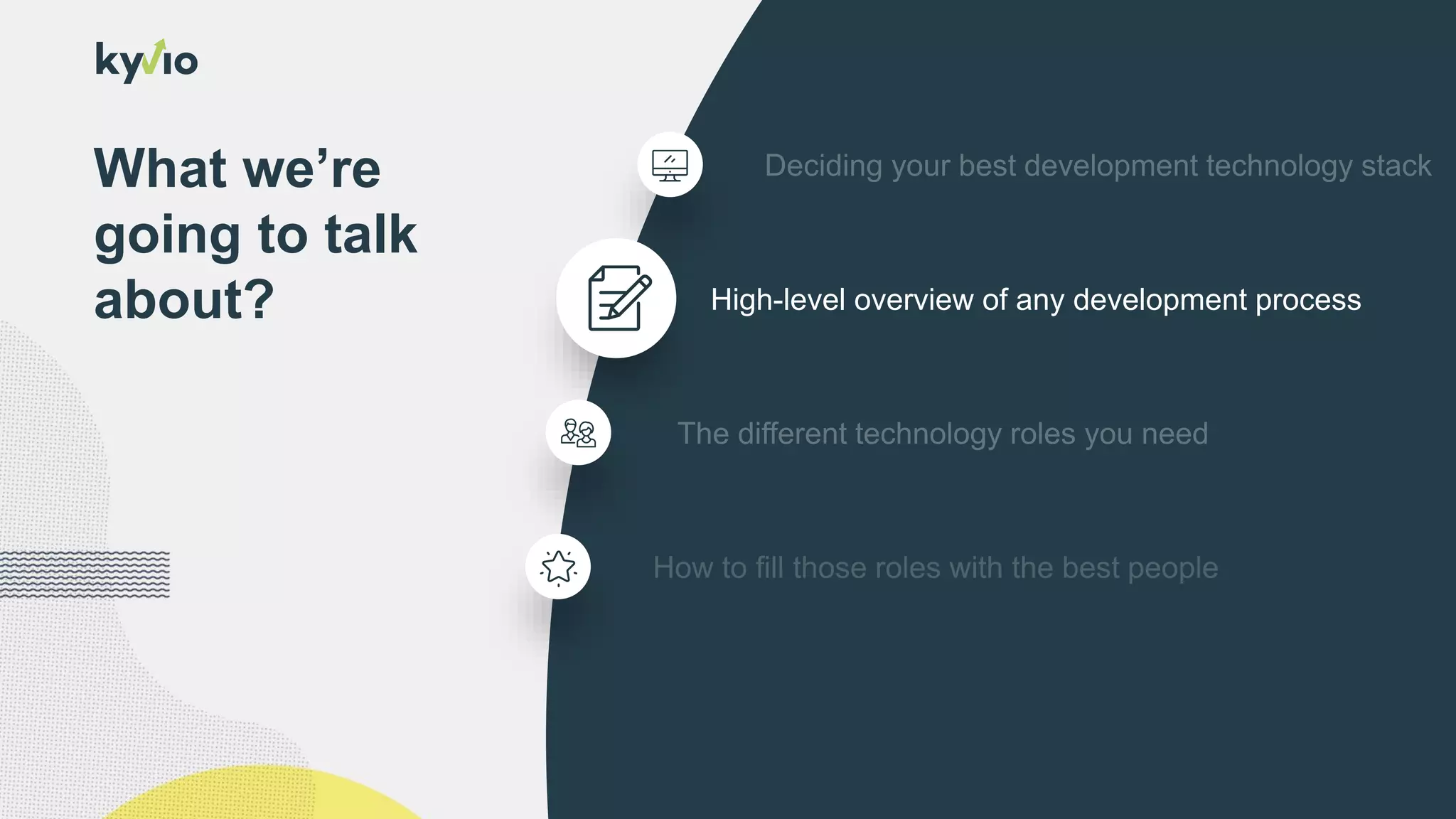
What we’re
going to talk
about?
Deciding your best development
technology stack
High-level overview of any development
process
The different technology roles you
need
How to fill those roles with the best
people
Be ready for scalable growth
(rebuilding from scratch when just getting
traction SUCKS)
How is this going to help you?
Better align business goals & needs
with techical strategy
Better lead your tech team
(or easier to talk to your CTO, Technical PM
or lead dev)
Convince you, you do NOT need to be a tech
master to run a successful online (soft) biz
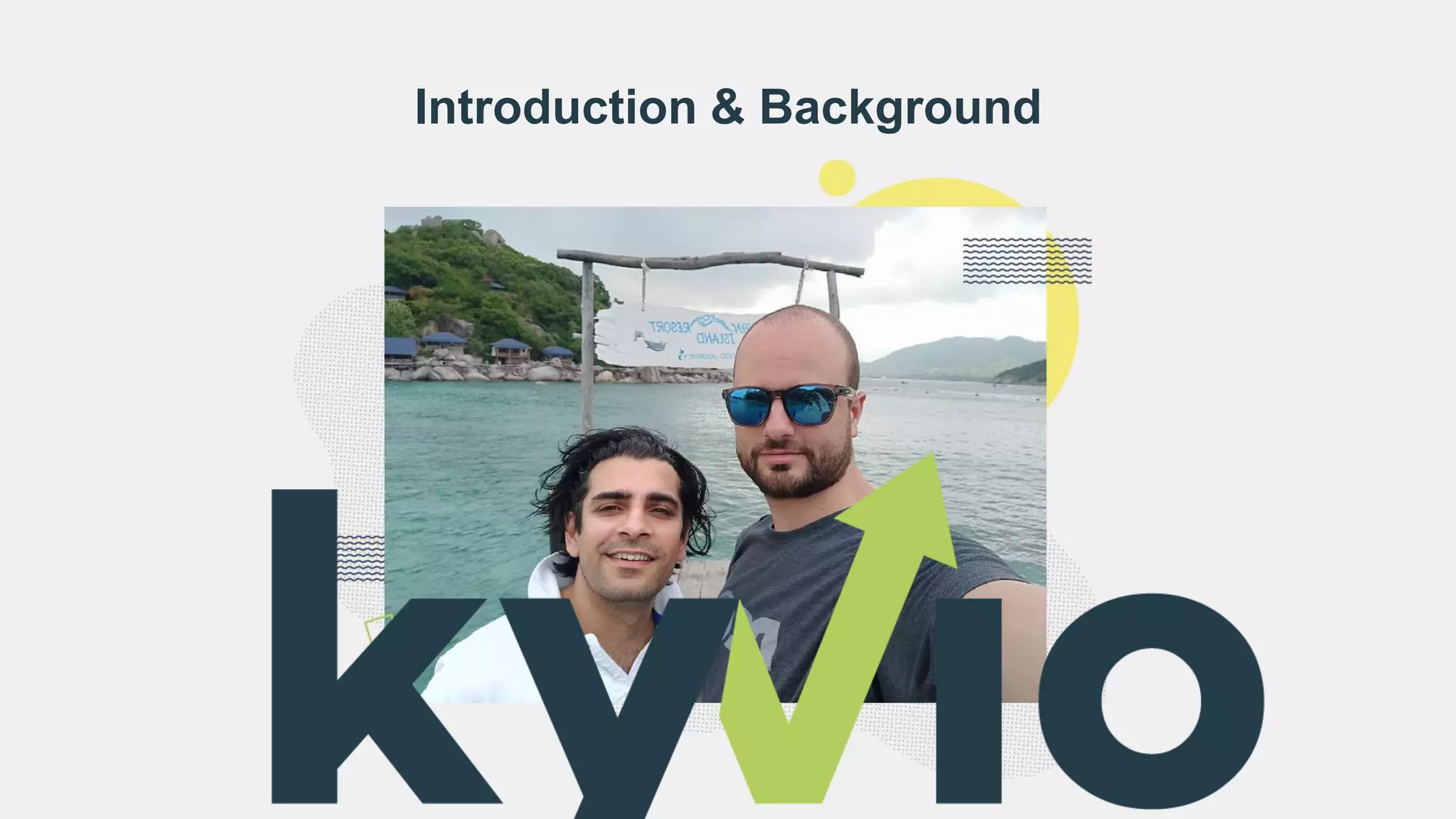
Introduction & Background
We are super-heroes, the people with the invisible capes. We create our
own path. We pursue social, financial and spiritual growth. People ignore
us at their own peril. First they question us, then they follow us. With our
open and abundant mindset, we build businesses that shape a global
society. With one eye on the present, and one on the future, we are
building a legacy for our next generation. Most of all - we do it for our
family, our friends, and ourselves.
We create in the morning, sell in the afternoon, and make the world a
better place in the evening.
What we’re
going to talk
about?
Deciding your best development technology stack
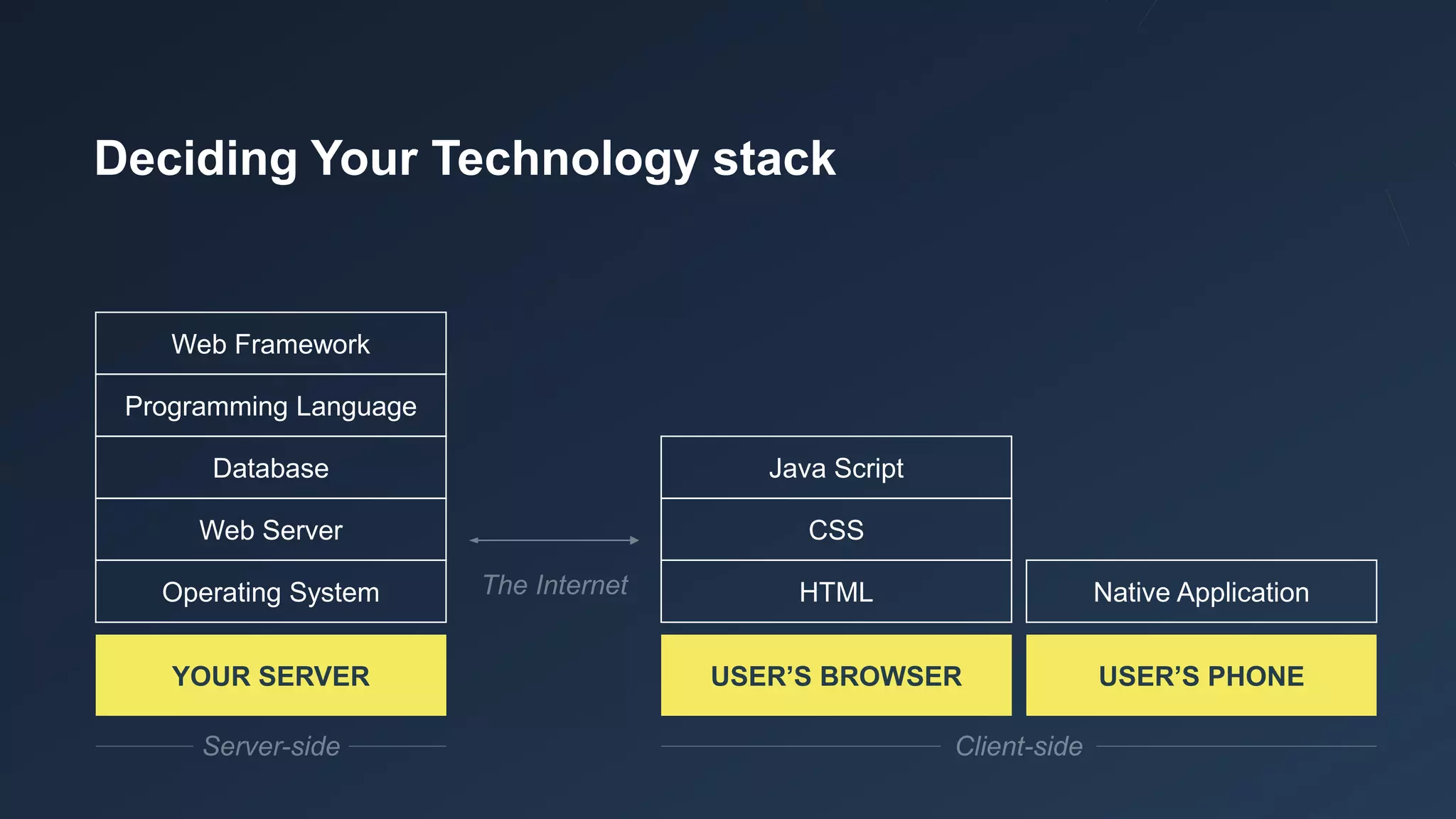
Deciding Your Technology stack
YOUR SERVER
Operating System
Web Server
Database
Programming Language
Web Framework
USER’S BROWSER
HTML
CSS
Java Script
USER’S PHONE
Native Application
What are you building?
Deciding Your Technology Stack
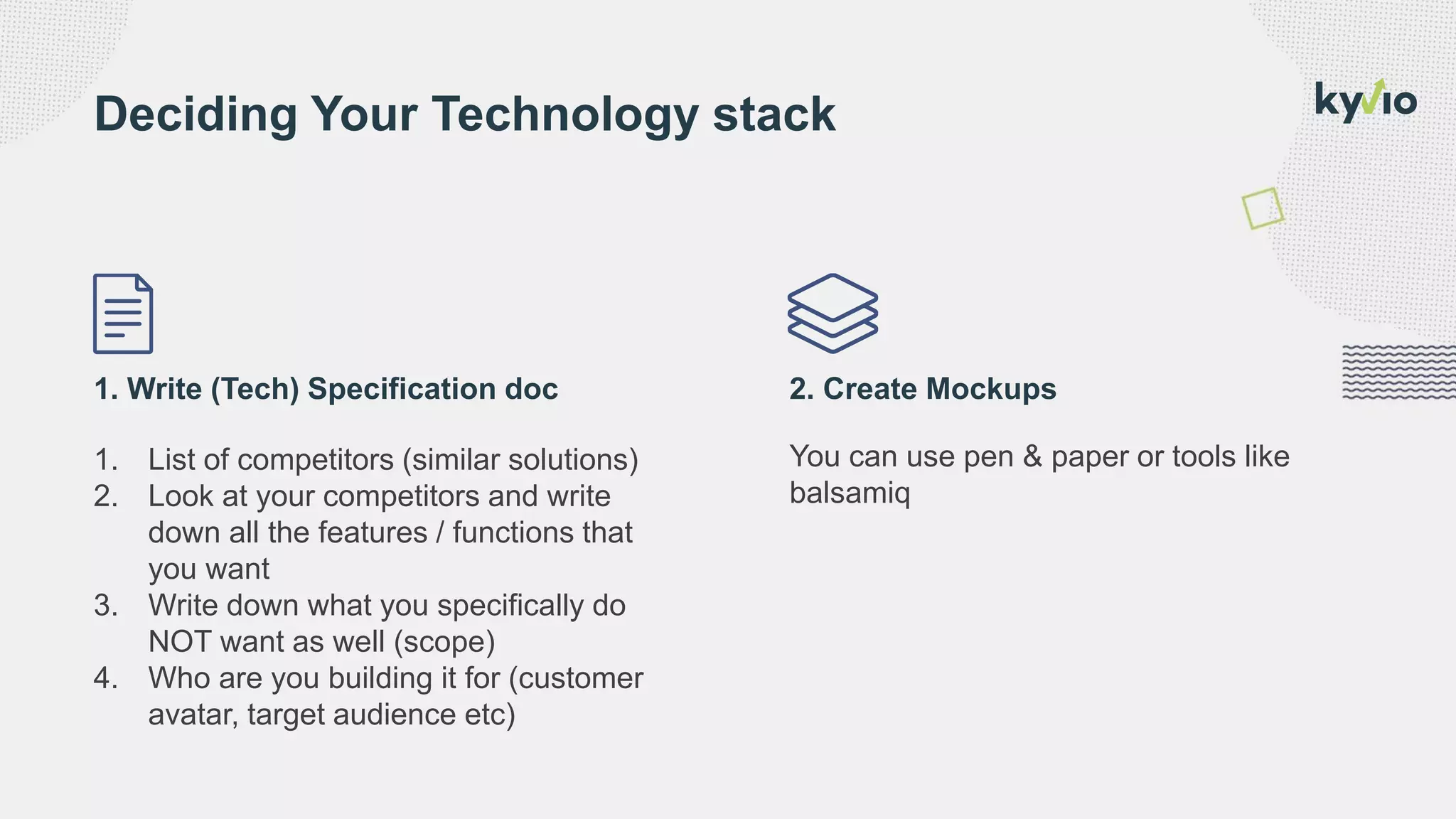
1. Write (Tech) Specification doc 2. Create Mockups
1. List of competitors (similar solutions)
2. Look at your competitors and write
down all the features / functions that
you want
3. Write down what you specifically do
NOT want as well (scope)
4. Who are you building it for (customer
avatar, target audience etc)
You can use pen & paper or tools like
balsamiq
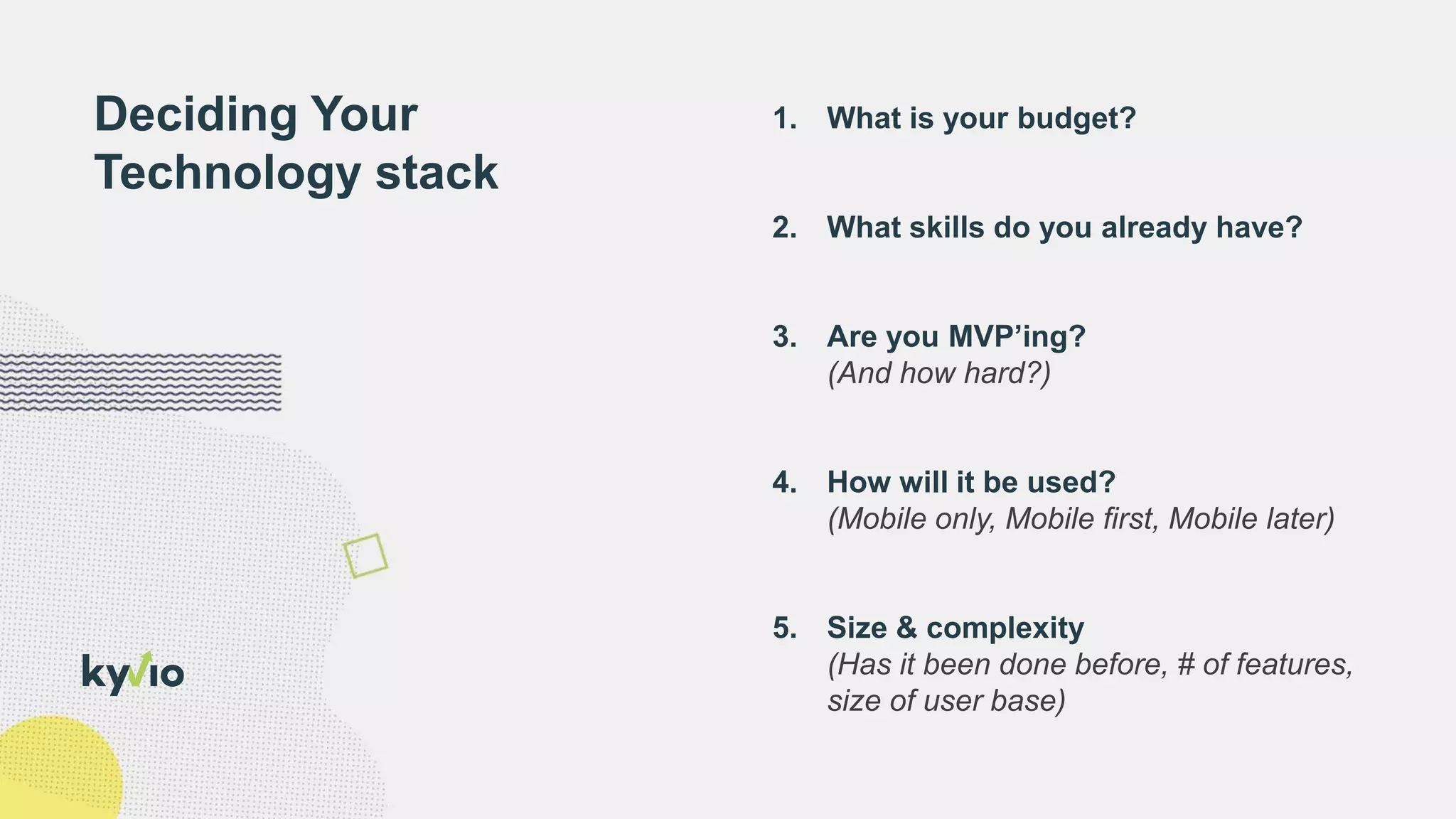
Deciding Your Technology stack
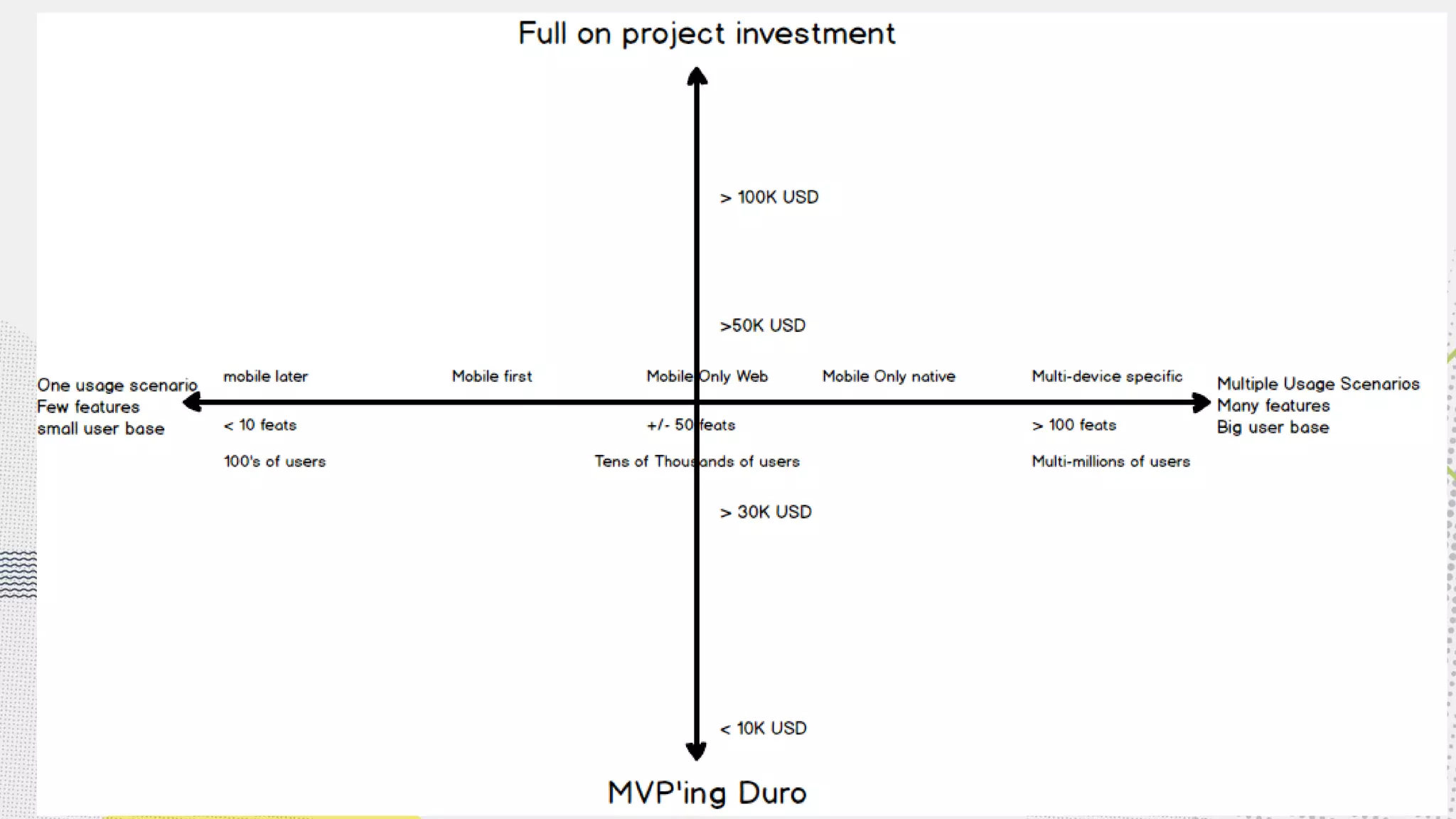
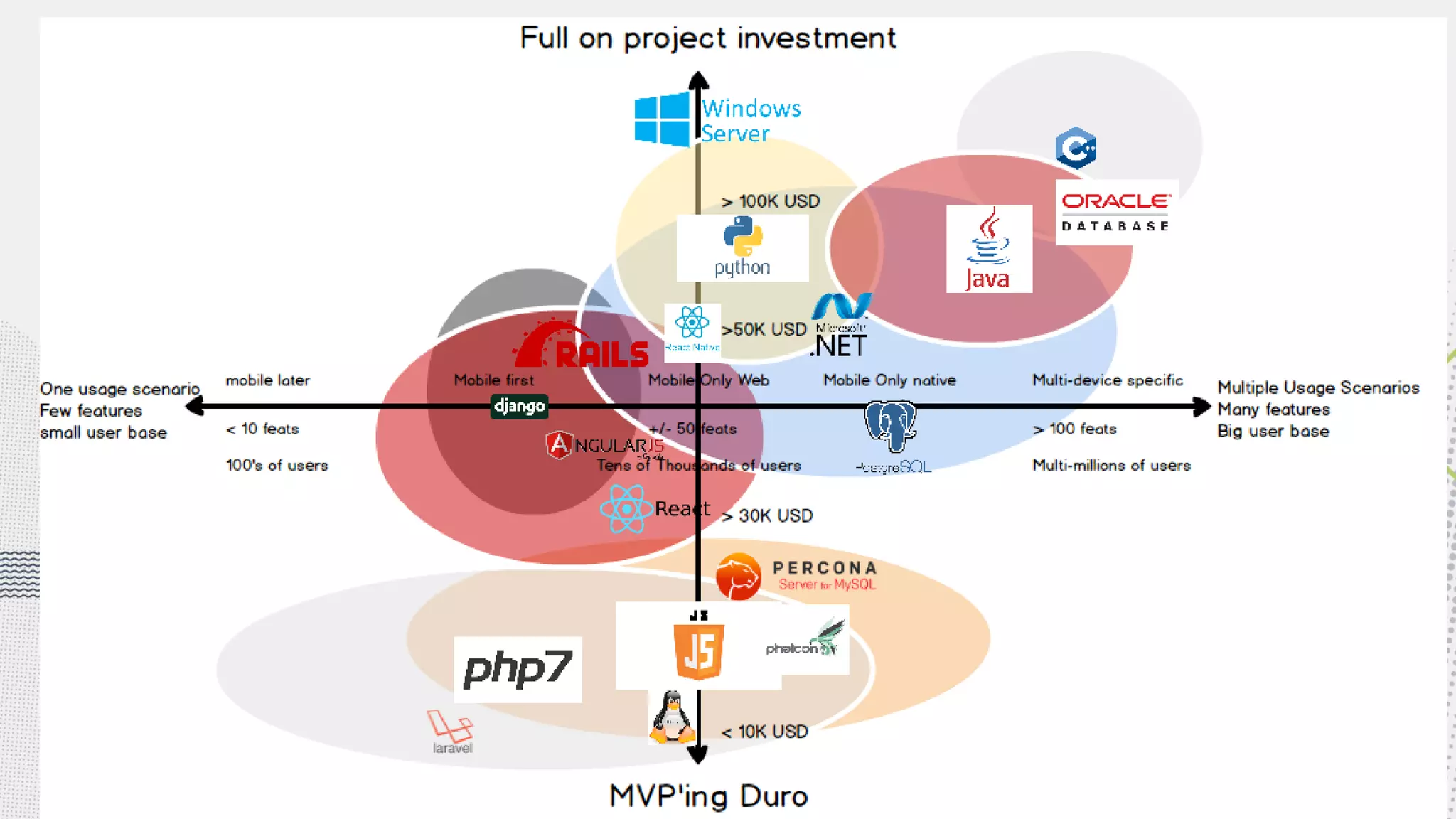
1. What is your budget?
2. What skills do you already have?
3. Are you MVP’ing?
(And how hard?)
4. How will it be used?
(Mobile only, Mobile first, Mobile later)
5. Size & complexity
(Has it been done before, # of features,
size of user base)
Deciding Your
Technology stack
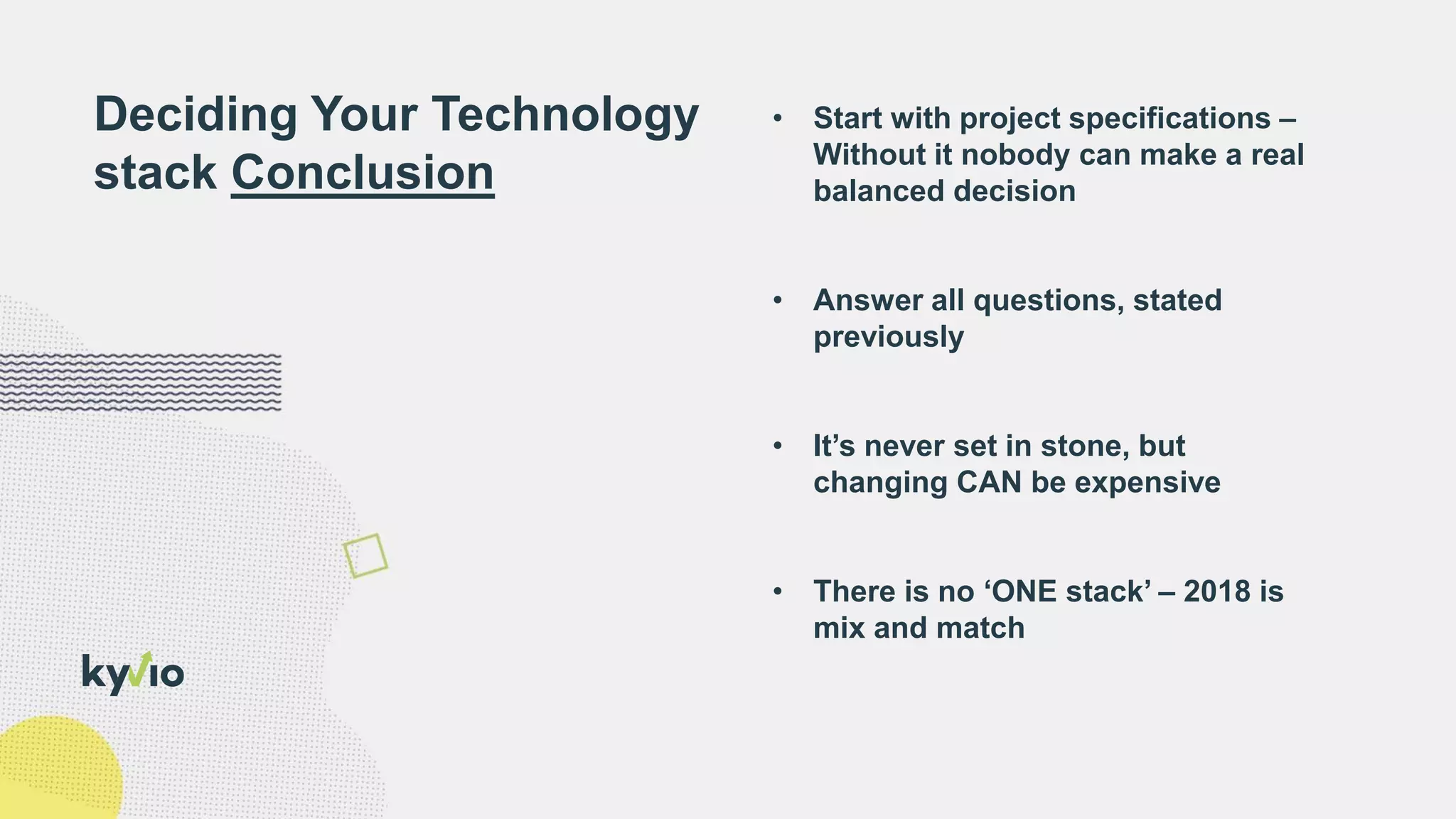
• Start with project specifications –
Without it nobody can make a real
balanced decision
• Answer all questions, stated
previously
• It’s never set in stone, but
changing CAN be expensive
• There is no ‘ONE stack’ – 2018 is
mix and match
Deciding Your Technology
stack Conclusion
What we’re
going to talk
about? High-level overview of any development process
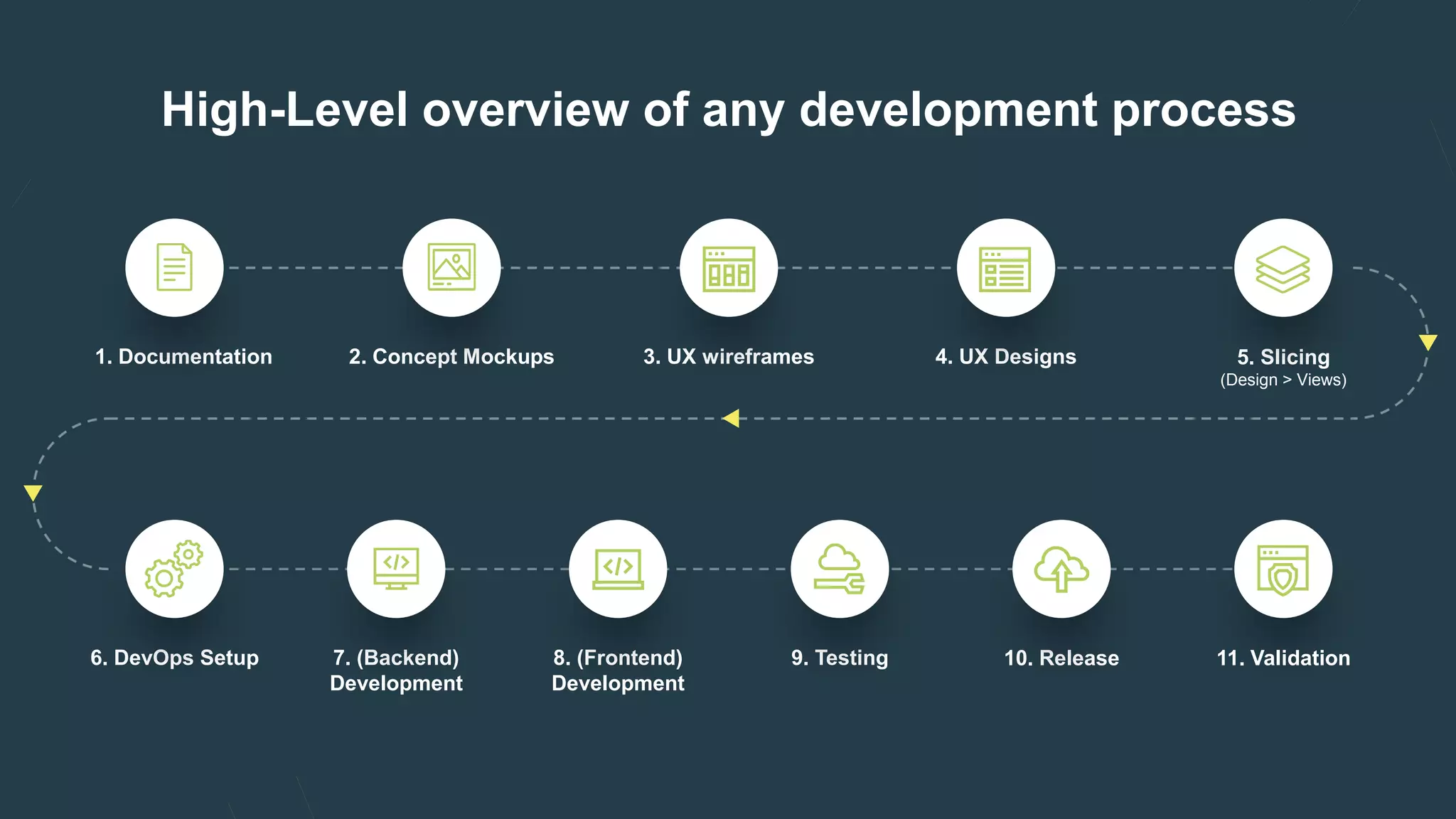
High-Level overview of any development process
1. Documentation 2. Concept Mockups 3. UX wireframes 4. UX Designs 5. Slicing
(Design > Views)
6. DevOps Setup 7. (Backend)
Development
8. (Frontend)
Development
9. Testing 10. Release 11. Validation
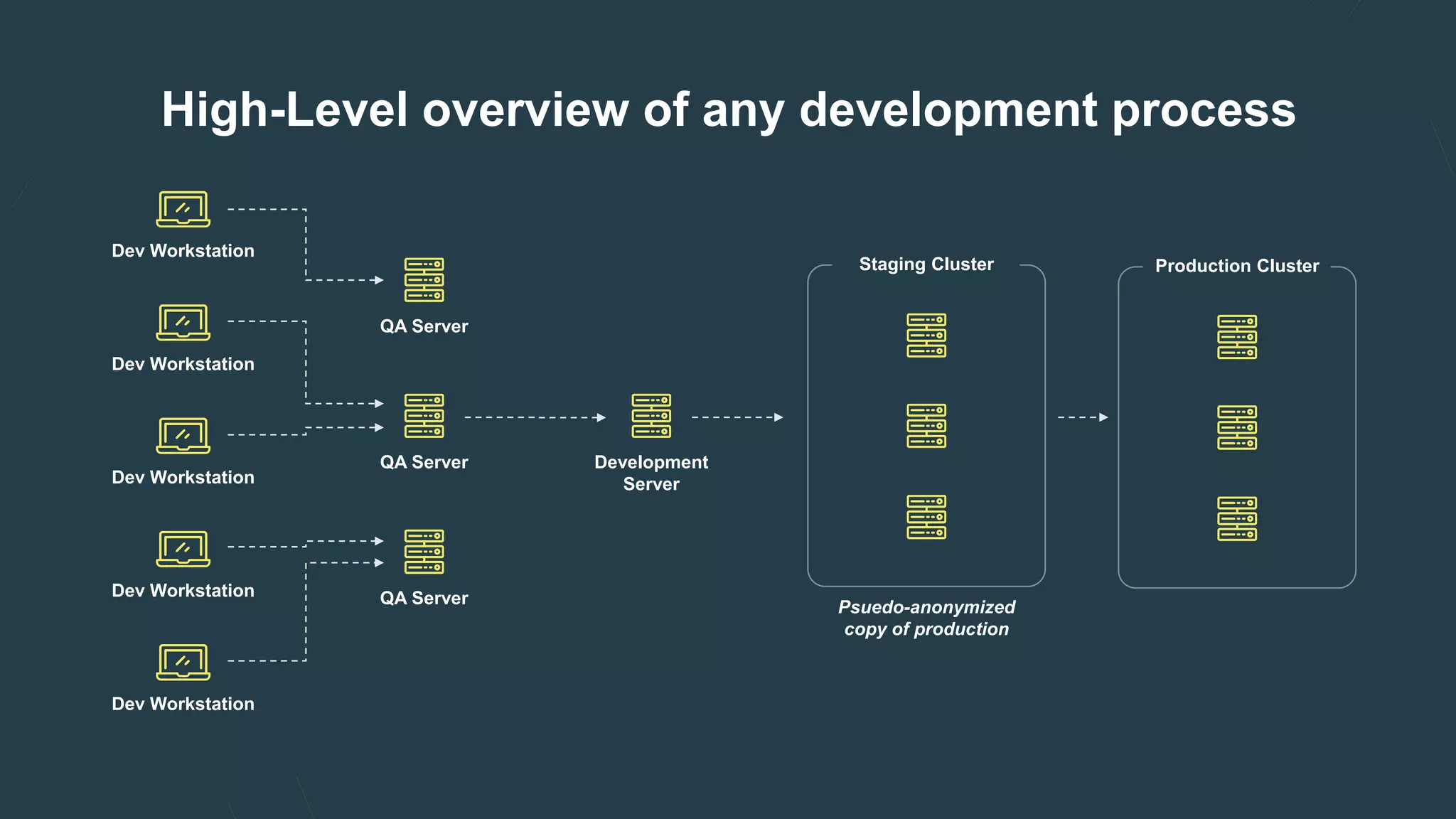
High-Level overview of any development process
Dev Workstation
Dev Workstation
Dev Workstation
Dev Workstation
Dev Workstation
QA Server
QA Server
QA Server
Development
Server
Production ClusterStaging Cluster
Psuedo-anonymized
copy of production
What we’re
going to talk
about?
The different technology roles you need
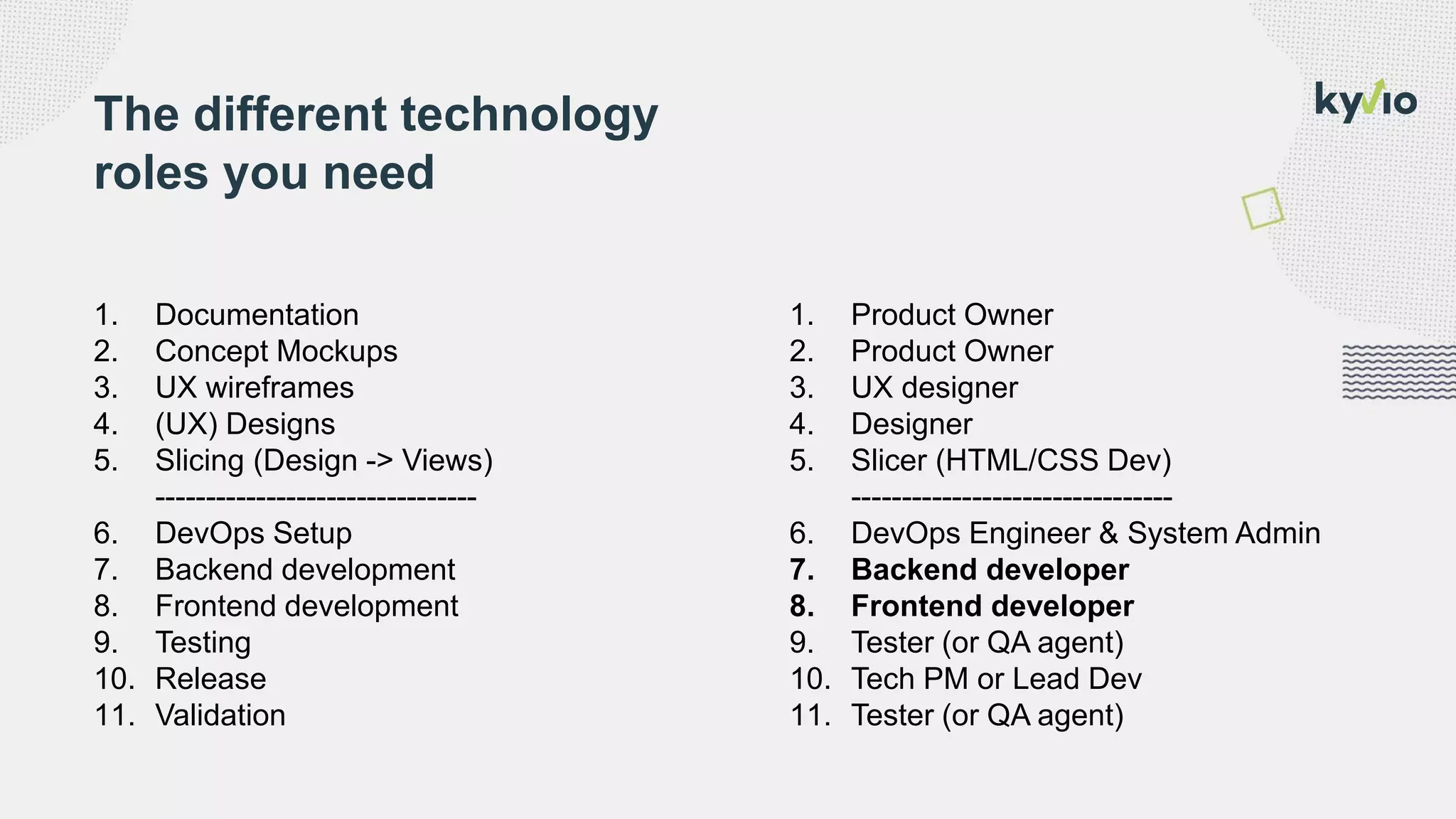
1. Documentation
2. Concept Mockups
3. UX wireframes
4. (UX) Designs
5. Slicing (Design -> Views)
--------------------------------
6. DevOps Setup
7. Backend development
8. Frontend development
9. Testing
10. Release
11. Validation
The different technology
roles you need
1. Product Owner
2. Product Owner
3. UX designer
4. Designer
5. Slicer (HTML/CSS Dev)
--------------------------------
6. DevOps Engineer & System Admin
7. Backend developer
8. Frontend developer
9. Tester (or QA agent)
10. Tech PM or Lead Dev
11. Tester (or QA agent)
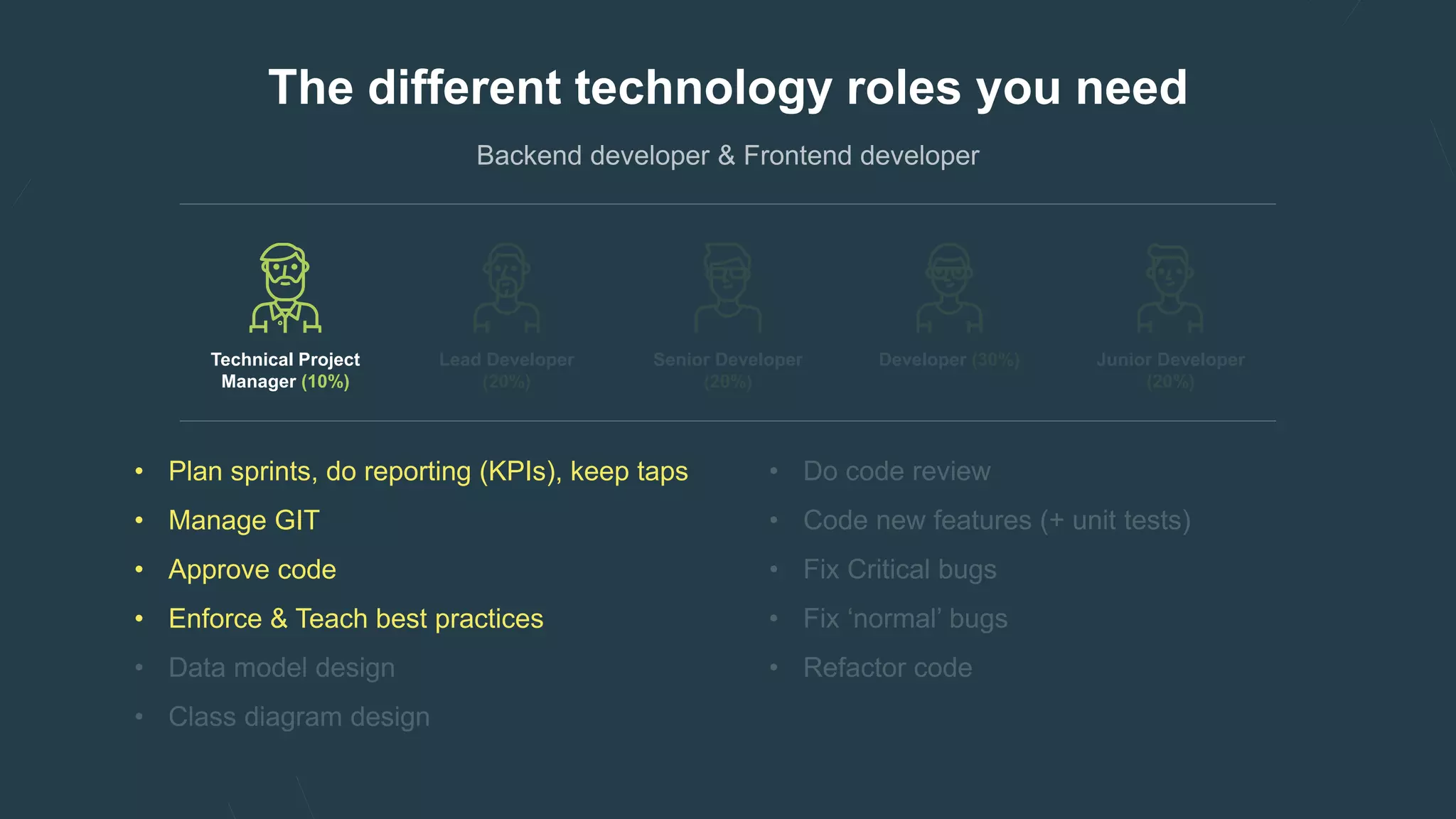
The different technology roles you need
Technical Project
Manager (10%)
Lead Developer
(20%)
Senior Developer
(20%)
Developer (30%) Junior Developer
(20%)
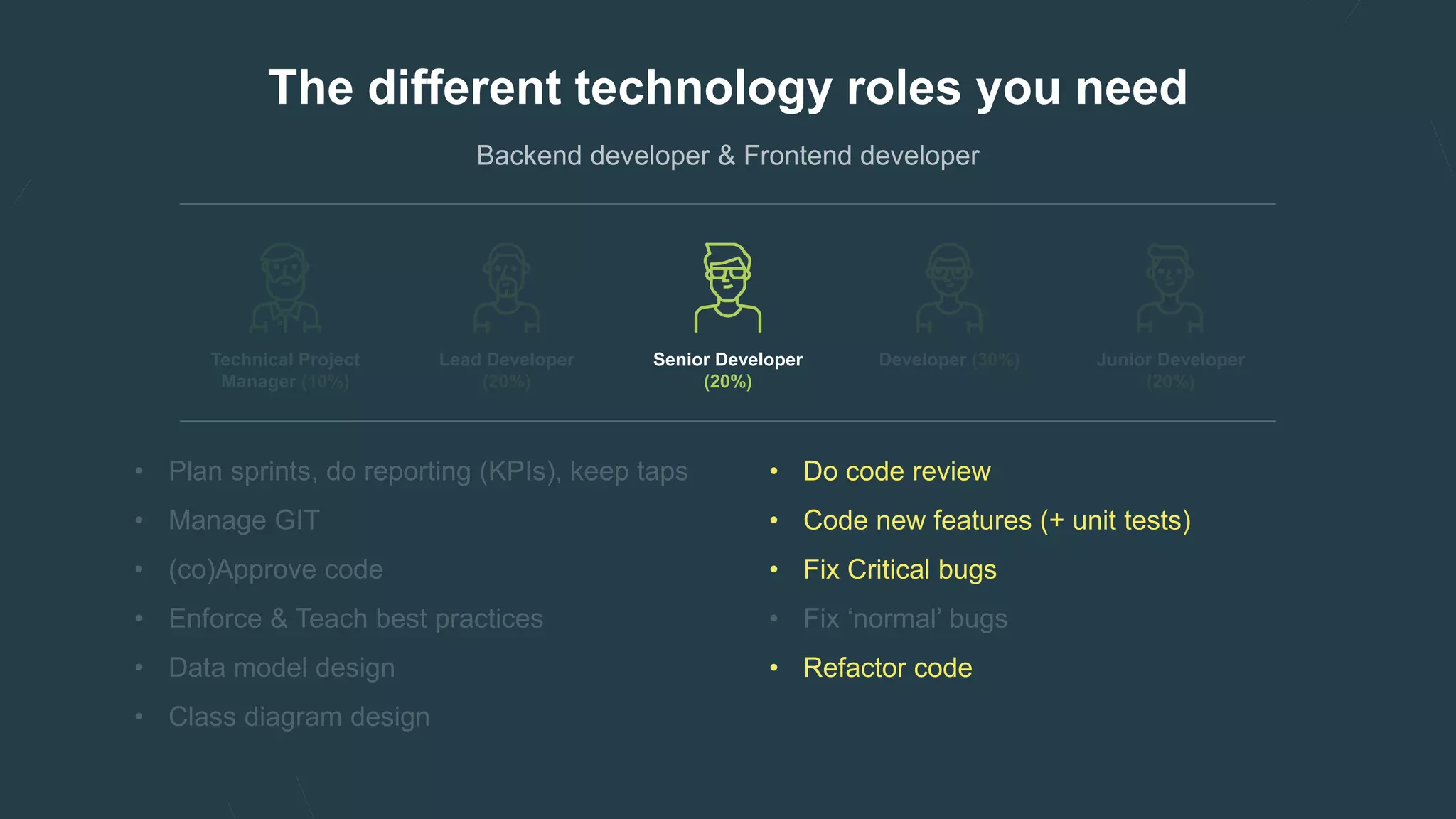
• Plan sprints, do reporting (KPIs), keep taps
• Manage GIT
• Approve code
• Enforce & Teach best practices
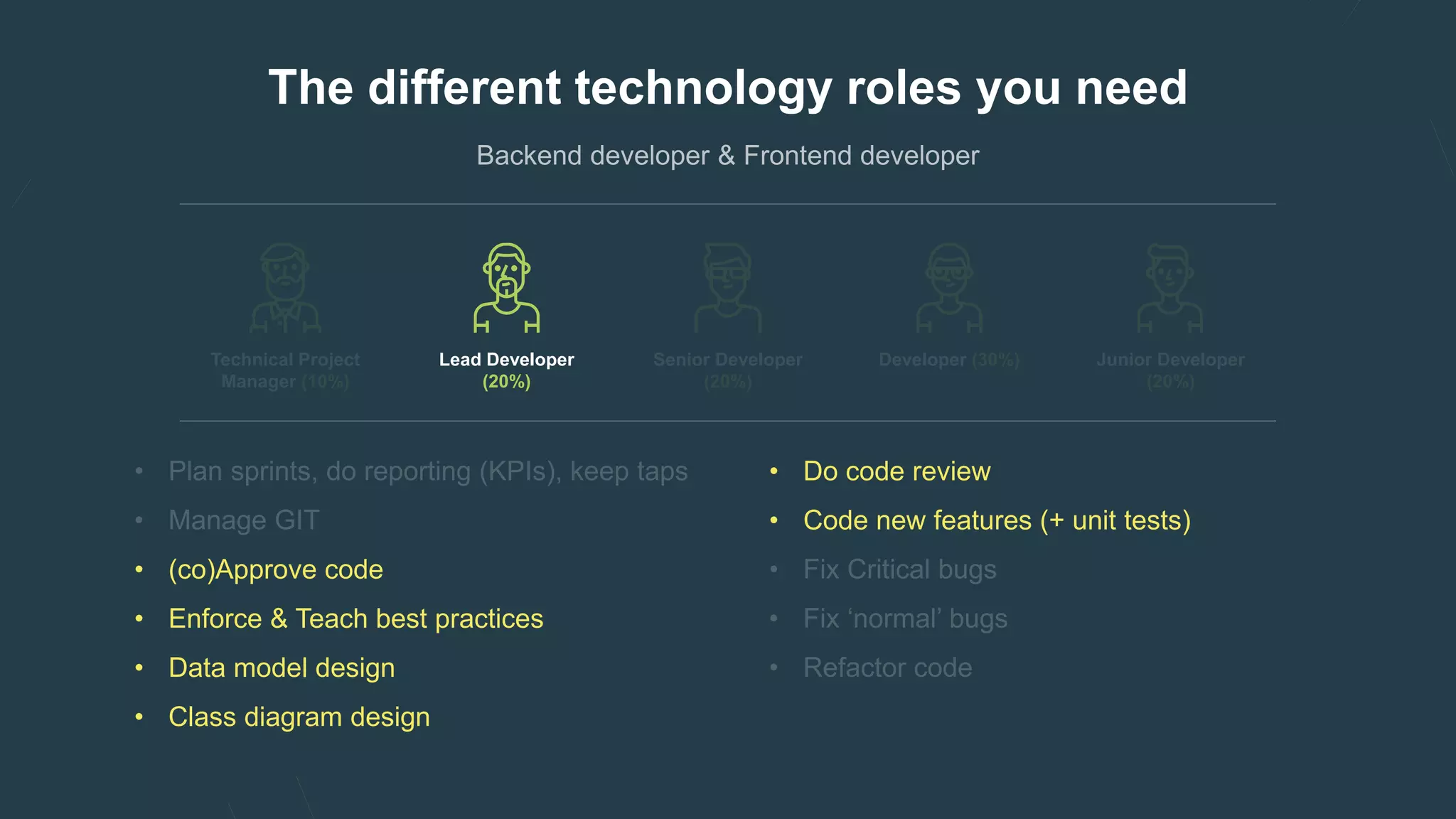
The different technology roles you need
Technical Project
Manager (10%)
Lead Developer
(20%)
Senior Developer
(20%)
Developer (30%) Junior Developer
(20%)
• (co)Approve code
• Enforce & Teach best practices
• Data model design
• Class diagram design
• Do code review
• Code new features (+ unit tests)
The different technology roles you need
Technical Project
Manager (10%)
Lead Developer
(20%)
Senior Developer
(20%)
Developer (30%) Junior Developer
(20%)
• Do code review
• Code new features (+ unit tests)
• Fix Critical bugs
• Refactor code
The different technology roles you need
Technical Project
Manager (10%)
Lead Developer
(20%)
Senior Developer
(20%)
Developer (30%) Junior Developer
(20%)
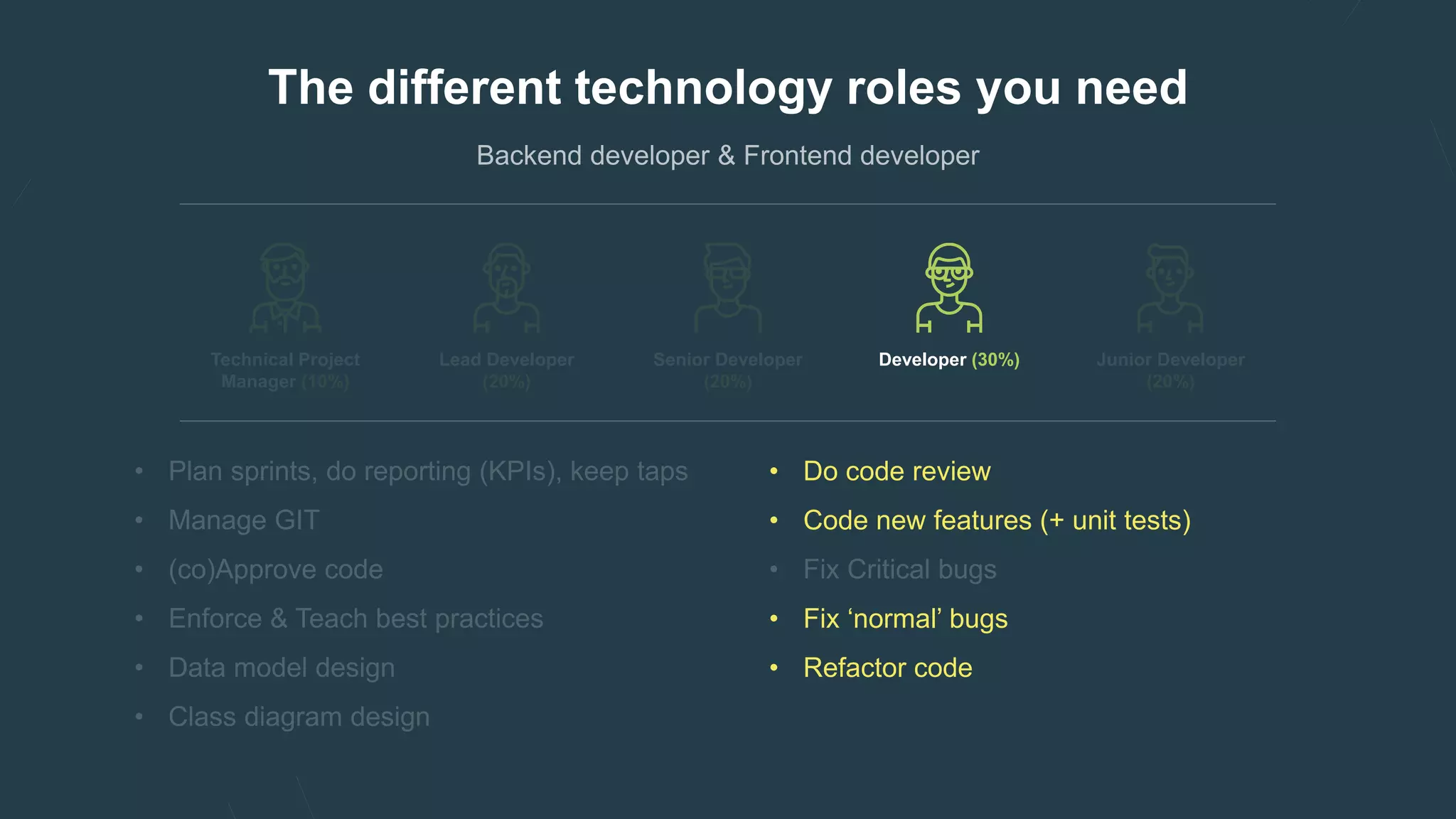
• Do code review
• Code new features (+ unit tests)
• Fix ‘normal’ bugs
• Refactor code
The different technology roles you need
Technical Project
Manager (10%)
Lead Developer
(20%)
Senior Developer
(20%)
Developer (30%) Junior Developer
(20%)
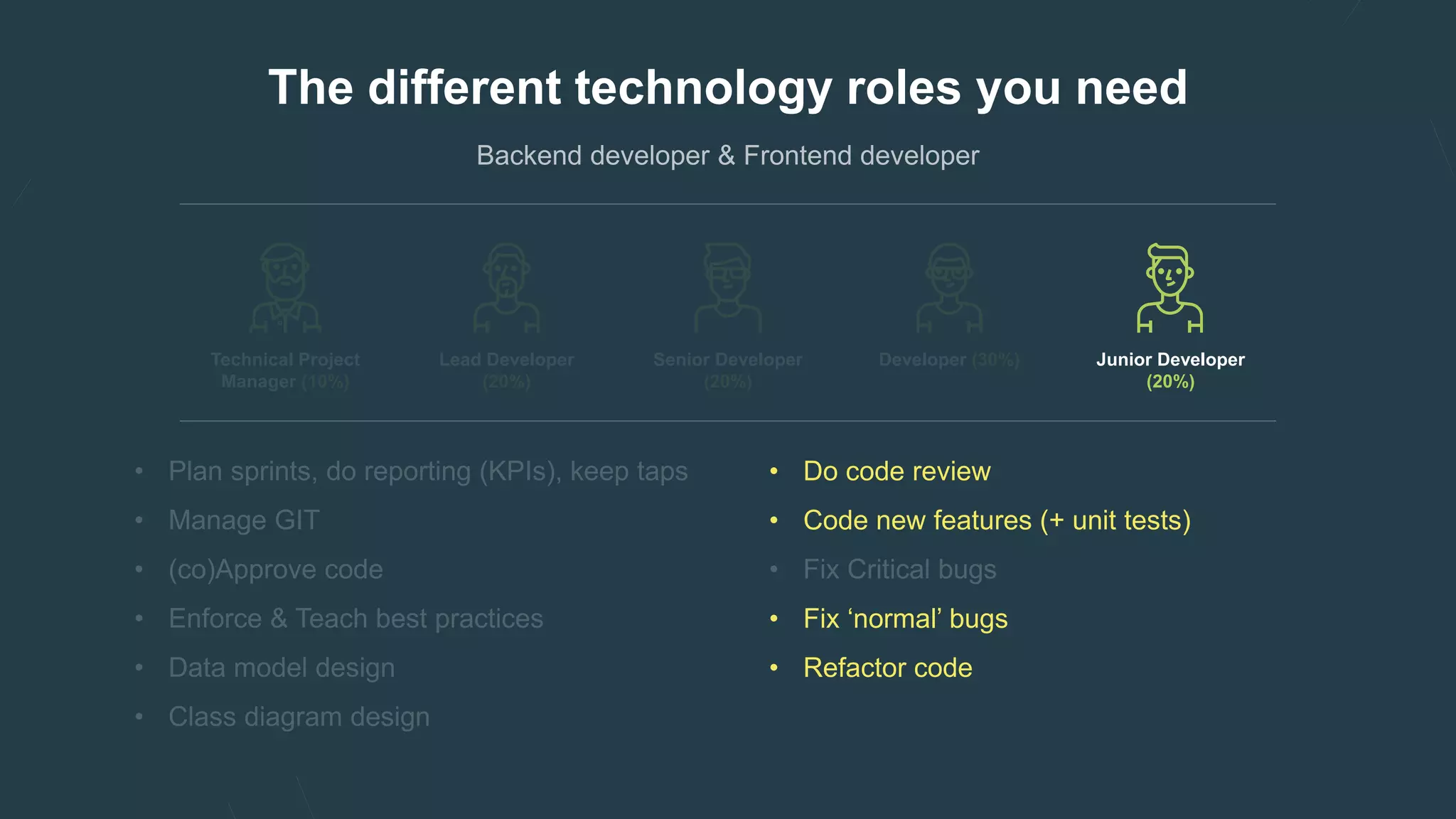
• Do code review
• Code new features (+ unit tests)
• Fix ‘normal’ bugs
• Refactor code
The different technology
roles you need
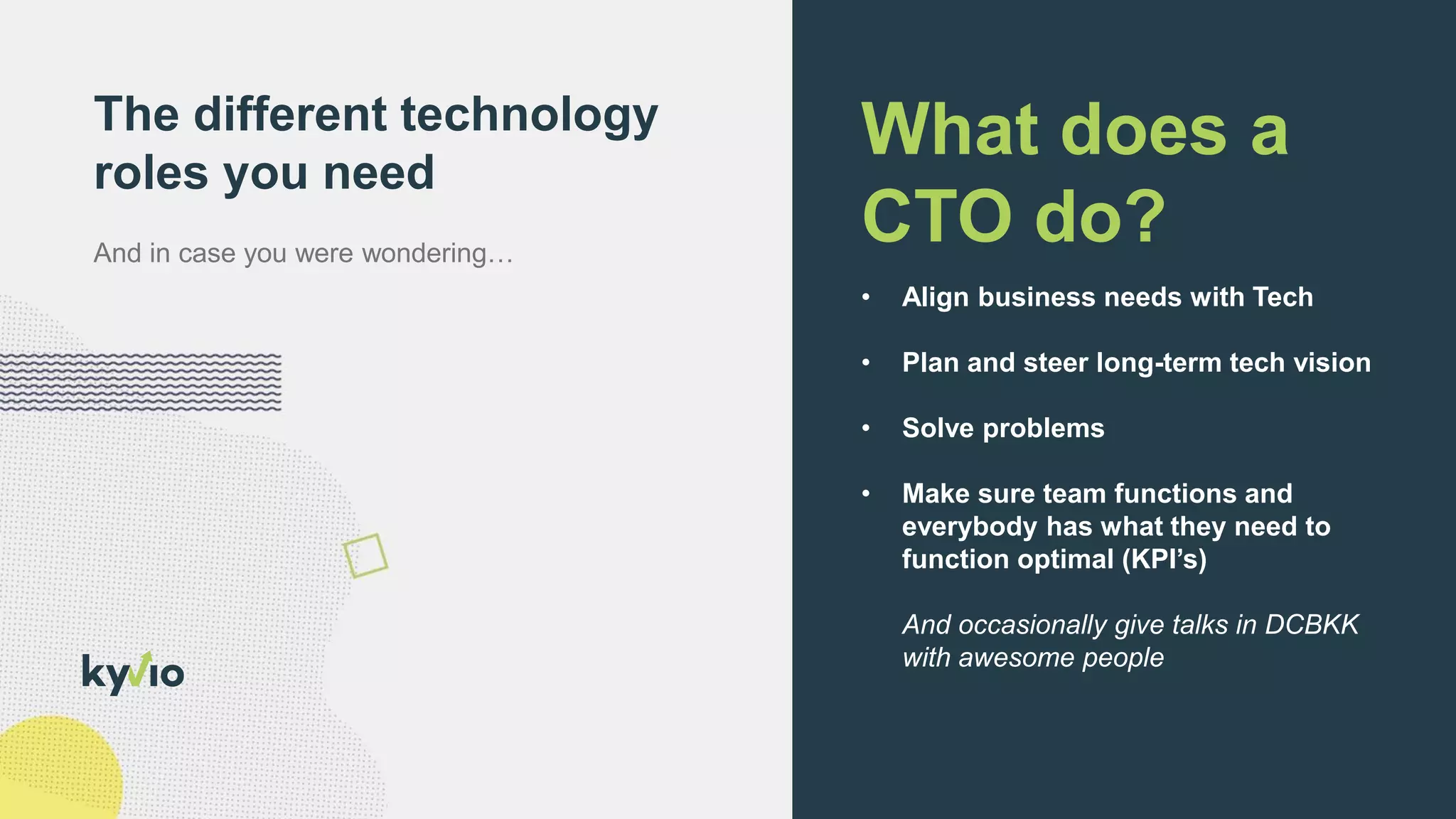
What does a
CTO do?
• Align business needs with Tech
• Plan and steer long-term tech vision
• Solve problems
• Make sure team functions and
everybody has what they need to
function optimal (KPI’s)
And occasionally give talks in DCBKK
with awesome people
What we’re
going to talk
about?
How to fill those roles with the best people
How to fill those roles with
the best people
UX Designers &
Designers
UX Designers
Supply: Very hard to find
Salary: Expensive ($30-$100)
• Please tell me?
Designers
Supply: Easy to find
Salary: Cheap ($3-$15)
• Designers; lot of talent in the Philippines
• Sites like dribbble, 99designs, Awwwards, Behance,
Carbonmade, onlinejobs.ph, even Fiverr.com
How to fill those roles with
the best people
Slicers (HTML devs)
Slicers
Supply: Easy to find
Salary: Cheap ($4-$8)
• Mostly via Upwork
• Always via test. Take 1 design you have and have all applicants
slice it
• Have a dev check the HTML code
• HTML properly indented
• Use of <div…/>
• Low HTML code vs content ratio
• JS code at the bottom
• CSS is pixel perfect (viewing the page in multiple browsers +
make screen big & small)
• CSS code is properly documented (SCSS a plus)
• Low image usage, and images optimized for size
How to fill those roles with
the best people
DevOps Engineer &
System Admin
DevOps Engineer
Supply: Hard to find
Salary: Expensive ($20-$60)
• Ask your devs and fellow entrepreneurs to share.
• You must –really– trust them hence we do by reference only
System Admin
Supply: Easy to find
Salary: mid-range ($10-$25)
• Upwork/serverfault.com, superuser.com, askubuntu.com
• You must trust them so pref by reference or limit access in begin
How to fill those roles with
the best people
Developers
Developers
($20-$60)
• Money is never their biggest motivator!
• Technical challenge => learning/working with new
technologies is
• 2nd is proper management. #1 reason developers leave
current job: poor management
• Working with people they can learn from
• The product itself (they all want actual users, using what
they build!)
• Then salary and the extra’s. Devs love extras.
• Especially with remote workers: stability. A contract.
How to fill those roles with
the best people
Developers
Developers
Supply: heavily depends on skills needed
Salary: wide range ($8-$60)
• Place ads on sites where they go for documentation/help/libraries
(phpclasses.org, stackoverflow, forums)
• Ask referrals from your current devs
• Job sites. JobRack, Upwork, Angel.co, FreeeUp, and many more
• Ask your email list / social network
How to fill those roles with
the best people
Testers
Testers
Supply: Easy to find
Salary: wide range ($5-$30)
Depends on:
• Some companies make testers end-responsible, full task owners
• Do you make testers write unit tests?
• Test scenario creation or not?
• Use standard job sites to find them
Discussion & Questions
Kyvio Platform: https://kyvio.com
Let’s Connect:
https://www.facebook.com/Stevenvanderpeijl
steven@kvsocial.com

Digital Success Stack for DCBKK 2018

  • 1.
    The Digital Success Stack Everyonline business needs a technology stack and the right people to run it
  • 2.
    What we’re going totalk about? Deciding your best development technology stack High-level overview of any development process The different technology roles you need How to fill those roles with the best people
  • 3.
    Be ready forscalable growth (rebuilding from scratch when just getting traction SUCKS) How is this going to help you? Better align business goals & needs with techical strategy Better lead your tech team (or easier to talk to your CTO, Technical PM or lead dev) Convince you, you do NOT need to be a tech master to run a successful online (soft) biz
  • 4.
  • 5.
    We are super-heroes,the people with the invisible capes. We create our own path. We pursue social, financial and spiritual growth. People ignore us at their own peril. First they question us, then they follow us. With our open and abundant mindset, we build businesses that shape a global society. With one eye on the present, and one on the future, we are building a legacy for our next generation. Most of all - we do it for our family, our friends, and ourselves. We create in the morning, sell in the afternoon, and make the world a better place in the evening.
  • 6.
    What we’re going totalk about? Deciding your best development technology stack
  • 7.
    Deciding Your Technologystack YOUR SERVER Operating System Web Server Database Programming Language Web Framework USER’S BROWSER HTML CSS Java Script USER’S PHONE Native Application
  • 8.
    What are youbuilding? Deciding Your Technology Stack
  • 9.
    1. Write (Tech)Specification doc 2. Create Mockups 1. List of competitors (similar solutions) 2. Look at your competitors and write down all the features / functions that you want 3. Write down what you specifically do NOT want as well (scope) 4. Who are you building it for (customer avatar, target audience etc) You can use pen & paper or tools like balsamiq Deciding Your Technology stack
  • 10.
    1. What isyour budget? 2. What skills do you already have? 3. Are you MVP’ing? (And how hard?) 4. How will it be used? (Mobile only, Mobile first, Mobile later) 5. Size & complexity (Has it been done before, # of features, size of user base) Deciding Your Technology stack
  • 13.
    • Start withproject specifications – Without it nobody can make a real balanced decision • Answer all questions, stated previously • It’s never set in stone, but changing CAN be expensive • There is no ‘ONE stack’ – 2018 is mix and match Deciding Your Technology stack Conclusion
  • 15.
    What we’re going totalk about? High-level overview of any development process
  • 16.
    High-Level overview ofany development process 1. Documentation 2. Concept Mockups 3. UX wireframes 4. UX Designs 5. Slicing (Design > Views) 6. DevOps Setup 7. (Backend) Development 8. (Frontend) Development 9. Testing 10. Release 11. Validation
  • 17.
    High-Level overview ofany development process Dev Workstation Dev Workstation Dev Workstation Dev Workstation Dev Workstation QA Server QA Server QA Server Development Server Production ClusterStaging Cluster Psuedo-anonymized copy of production
  • 19.
    What we’re going totalk about? The different technology roles you need
  • 20.
    1. Documentation 2. ConceptMockups 3. UX wireframes 4. (UX) Designs 5. Slicing (Design -> Views) -------------------------------- 6. DevOps Setup 7. Backend development 8. Frontend development 9. Testing 10. Release 11. Validation The different technology roles you need 1. Product Owner 2. Product Owner 3. UX designer 4. Designer 5. Slicer (HTML/CSS Dev) -------------------------------- 6. DevOps Engineer & System Admin 7. Backend developer 8. Frontend developer 9. Tester (or QA agent) 10. Tech PM or Lead Dev 11. Tester (or QA agent)
  • 21.
    The different technologyroles you need Technical Project Manager (10%) Lead Developer (20%) Senior Developer (20%) Developer (30%) Junior Developer (20%) • Plan sprints, do reporting (KPIs), keep taps • Manage GIT • Approve code • Enforce & Teach best practices
  • 22.
    The different technologyroles you need Technical Project Manager (10%) Lead Developer (20%) Senior Developer (20%) Developer (30%) Junior Developer (20%) • (co)Approve code • Enforce & Teach best practices • Data model design • Class diagram design • Do code review • Code new features (+ unit tests)
  • 23.
    The different technologyroles you need Technical Project Manager (10%) Lead Developer (20%) Senior Developer (20%) Developer (30%) Junior Developer (20%) • Do code review • Code new features (+ unit tests) • Fix Critical bugs • Refactor code
  • 24.
    The different technologyroles you need Technical Project Manager (10%) Lead Developer (20%) Senior Developer (20%) Developer (30%) Junior Developer (20%) • Do code review • Code new features (+ unit tests) • Fix ‘normal’ bugs • Refactor code
  • 25.
    The different technologyroles you need Technical Project Manager (10%) Lead Developer (20%) Senior Developer (20%) Developer (30%) Junior Developer (20%) • Do code review • Code new features (+ unit tests) • Fix ‘normal’ bugs • Refactor code
  • 26.
    The different technology rolesyou need What does a CTO do? • Align business needs with Tech • Plan and steer long-term tech vision • Solve problems • Make sure team functions and everybody has what they need to function optimal (KPI’s) And occasionally give talks in DCBKK with awesome people
  • 27.
    What we’re going totalk about? How to fill those roles with the best people
  • 28.
    How to fillthose roles with the best people UX Designers & Designers UX Designers Supply: Very hard to find Salary: Expensive ($30-$100) • Please tell me? Designers Supply: Easy to find Salary: Cheap ($3-$15) • Designers; lot of talent in the Philippines • Sites like dribbble, 99designs, Awwwards, Behance, Carbonmade, onlinejobs.ph, even Fiverr.com
  • 29.
    How to fillthose roles with the best people Slicers (HTML devs) Slicers Supply: Easy to find Salary: Cheap ($4-$8) • Mostly via Upwork • Always via test. Take 1 design you have and have all applicants slice it • Have a dev check the HTML code • HTML properly indented • Use of <div…/> • Low HTML code vs content ratio • JS code at the bottom • CSS is pixel perfect (viewing the page in multiple browsers + make screen big & small) • CSS code is properly documented (SCSS a plus) • Low image usage, and images optimized for size
  • 30.
    How to fillthose roles with the best people DevOps Engineer & System Admin DevOps Engineer Supply: Hard to find Salary: Expensive ($20-$60) • Ask your devs and fellow entrepreneurs to share. • You must –really– trust them hence we do by reference only System Admin Supply: Easy to find Salary: mid-range ($10-$25) • Upwork/serverfault.com, superuser.com, askubuntu.com • You must trust them so pref by reference or limit access in begin
  • 31.
    How to fillthose roles with the best people Developers Developers ($20-$60) • Money is never their biggest motivator! • Technical challenge => learning/working with new technologies is • 2nd is proper management. #1 reason developers leave current job: poor management • Working with people they can learn from • The product itself (they all want actual users, using what they build!) • Then salary and the extra’s. Devs love extras. • Especially with remote workers: stability. A contract.
  • 32.
    How to fillthose roles with the best people Developers Developers Supply: heavily depends on skills needed Salary: wide range ($8-$60) • Place ads on sites where they go for documentation/help/libraries (phpclasses.org, stackoverflow, forums) • Ask referrals from your current devs • Job sites. JobRack, Upwork, Angel.co, FreeeUp, and many more • Ask your email list / social network
  • 33.
    How to fillthose roles with the best people Testers Testers Supply: Easy to find Salary: wide range ($5-$30) Depends on: • Some companies make testers end-responsible, full task owners • Do you make testers write unit tests? • Test scenario creation or not? • Use standard job sites to find them
  • 34.
    Discussion & Questions KyvioPlatform: https://kyvio.com Let’s Connect: https://www.facebook.com/Stevenvanderpeijl steven@kvsocial.com