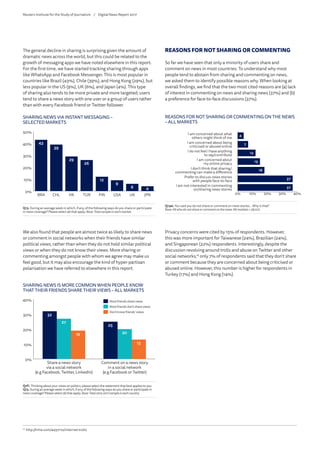
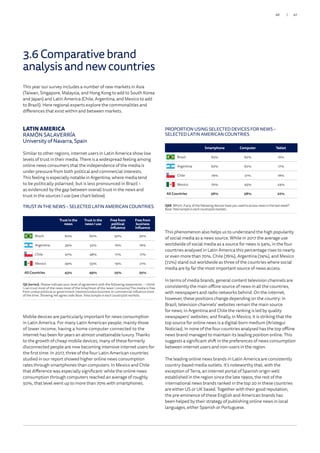
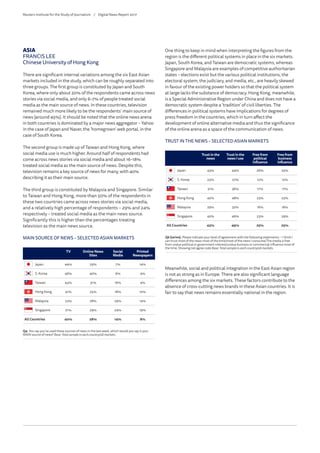
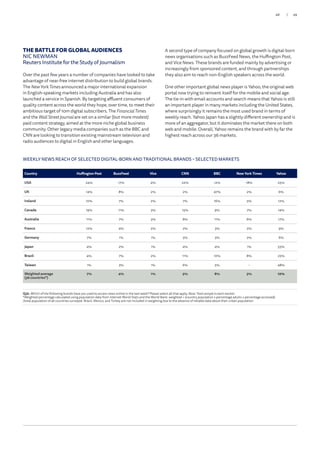
Reuters Institute
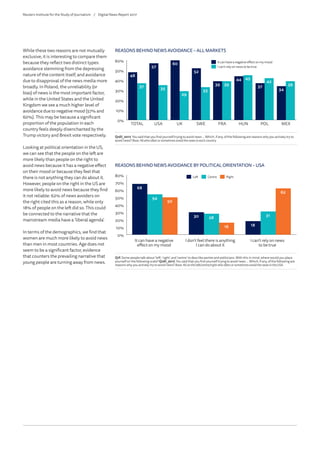
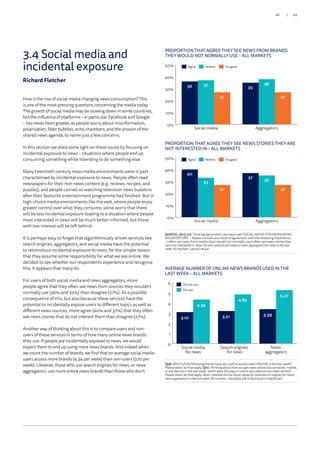
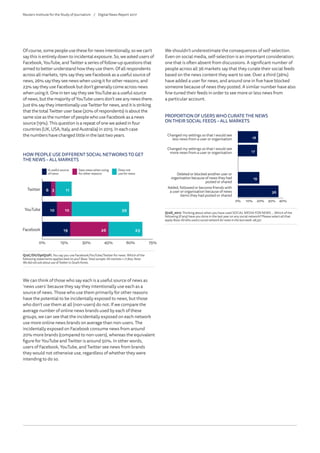
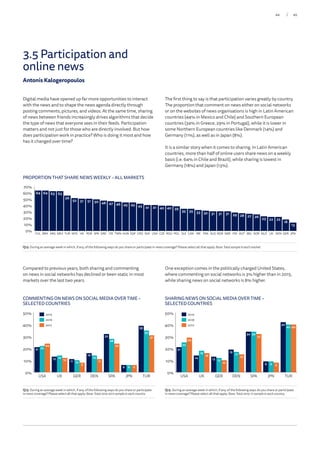
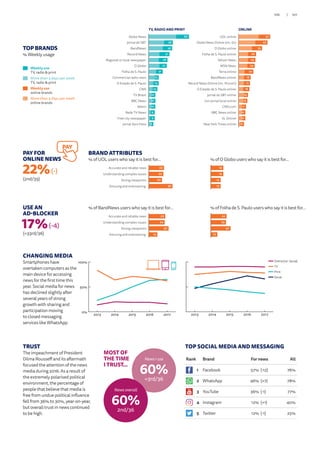
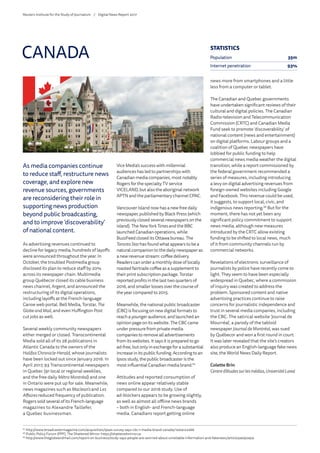
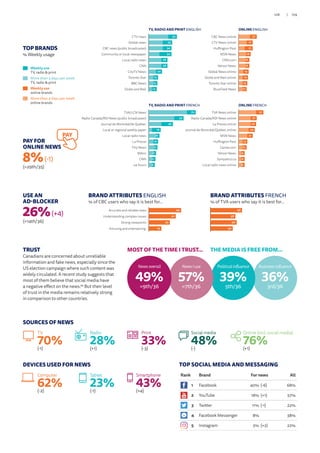
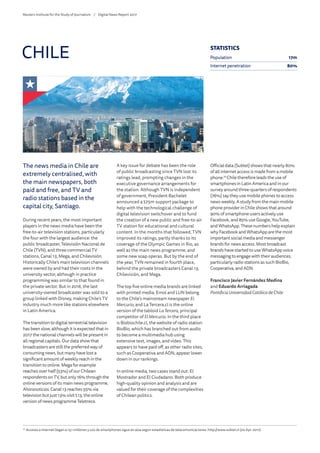
Digital News Report 2017
Reuters Institute
Digital News Report 2017
Nic Newman with Richard Fletcher, Antonis Kalogeropoulos,
David A. L. Levy and Rasmus Kleis Nielsen
© Reuters Institute for the Study of Journalism
Supported by
Surveyed by
3
Foreword by David A. L. Levy 5
Methodology6
Authorship and Research Acknowledgements 7
SECTION 1
Executive Summary and Key Findings – Nic Newman 8
SECTION 2
Viewpoint: We Broke the News – Melissa Bell, Vox Media 28
SECTION 3
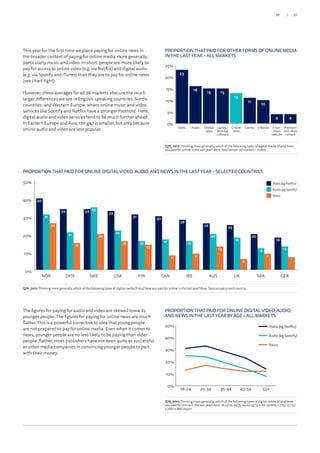
3.1 	 Paying for News  34
3.2	 Polarisation in the News Media 38
3.3	 News Avoidance  41
3.4	 Social Media and Incidental Exposure 43
3.5	 Participation and Online News 45
3.6	 Comparative Brand Analysis and New Countries 47
SECTION 4
Analysis by Country 50
Europe
4.1	 United Kingdom 54
4.2	Austria 56
4.3	Belgium 58
4.4	Croatia 60
4.5	 Czech Republic 62
4.6	Denmark 64
4.7	Finland 66
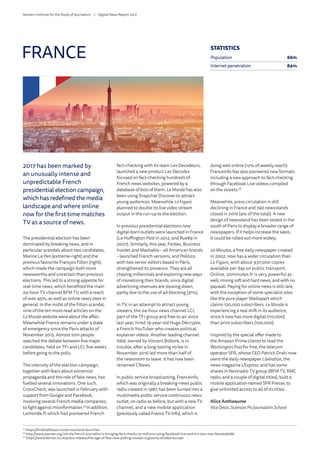
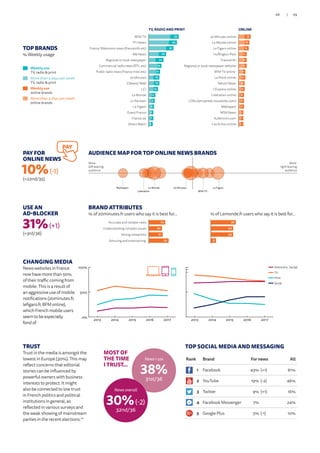
4.8	France 68
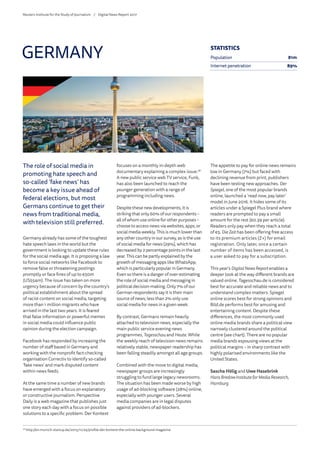
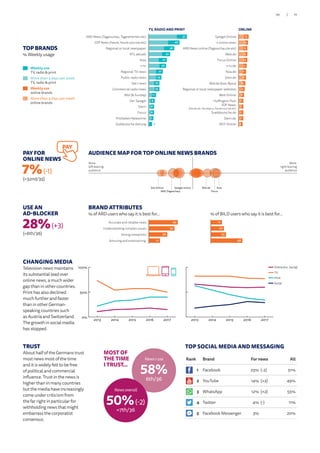
4.9	Germany 70
4.10	Greece 72
4.11	Hungary 74
4.12	Ireland 76
4.13	Italy 78
4.14	Netherlands 80
4.15	Norway 82
4.16	Poland 84
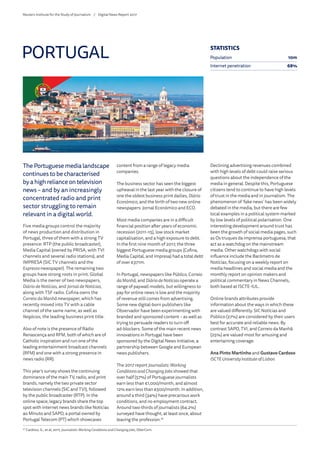
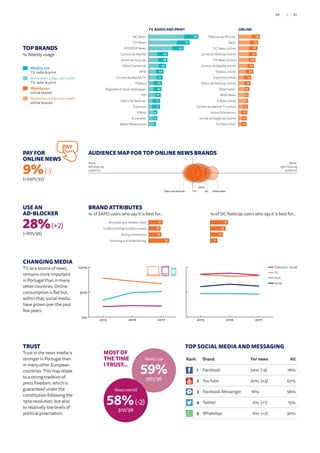
4.17	Portugal 86
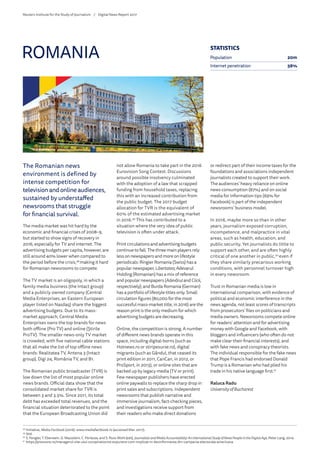
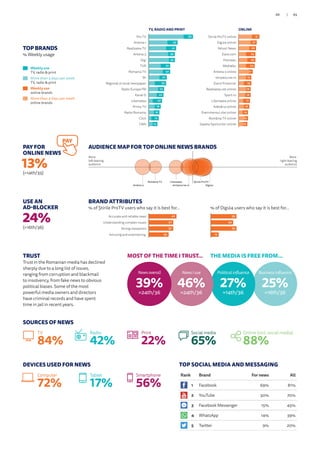
4.18	Romania 88
4.19	Slovakia 90
4.20	Spain 92
4.21	Sweden 94
4.22	Switzerland 96
4.23	Turkey 98
Americas
4.24	 United States 102
4.25	Argentina 104
4.26	Brazil 106
4.27	Canada 108
4.28	Chile 110
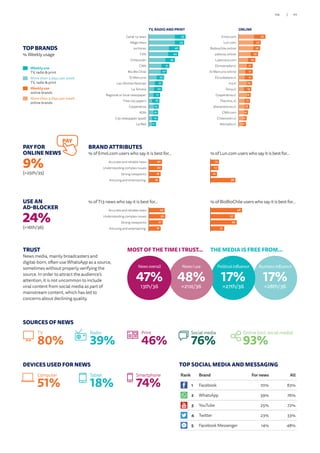
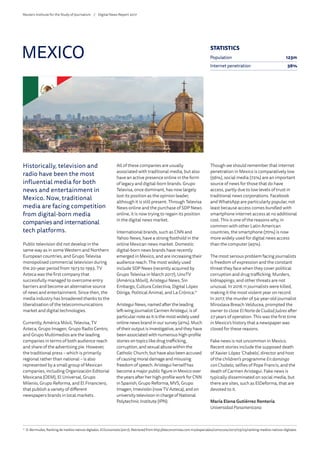
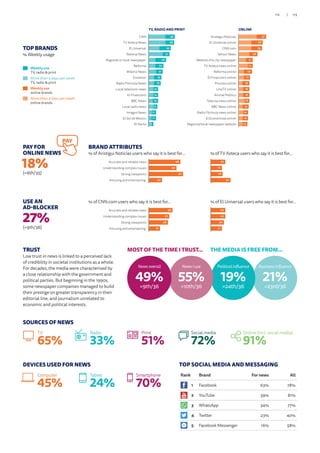
4.29	Mexico 112
Asia Pacific
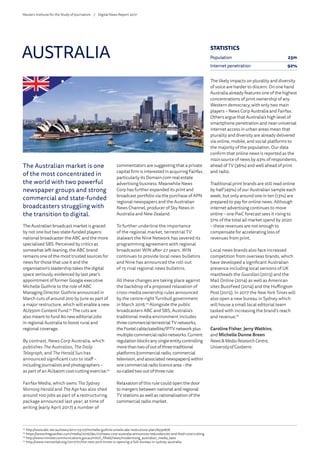
4.30	Australia 116
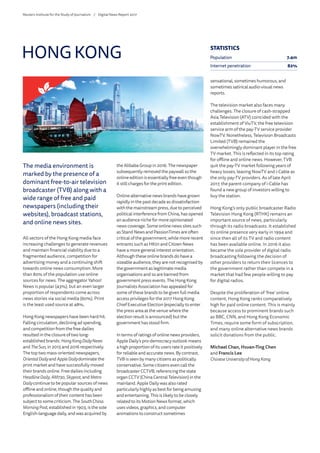
4.31	 Hong Kong 118
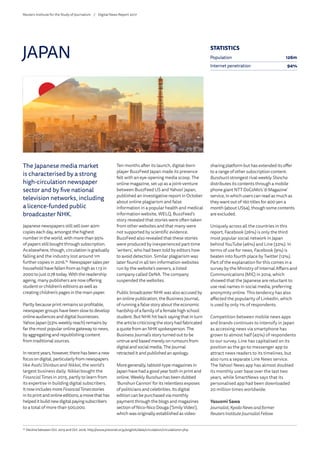
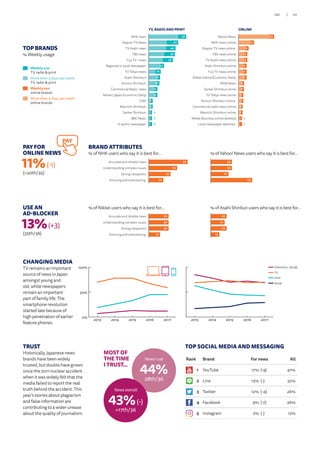
4.32	Japan 120
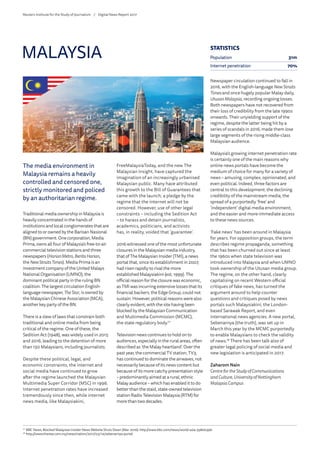
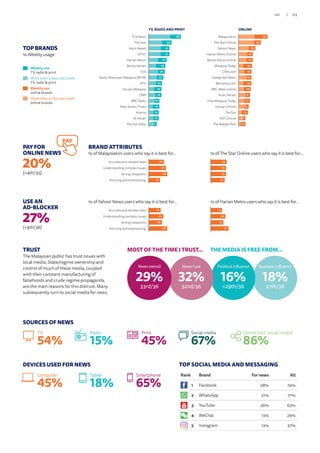
4.33	Malaysia 122
4.34	Singapore 124
4.35	 South Korea 126
4.36	Taiwan 128
Postscript and Further Reading 130
Contents
Reuters Institute for the Study of Journalism /	 Digital News Report 2017
Foreword
Dr David A. L. Levy
Director, Reuters Institute for the Study of Journalism (RISJ)
This is our sixth annual report that explores the changing
environment around news across countries. The report is based
on a survey of more than 70,000 people in 36 markets, along with
additional qualitative research, which together make it the most
comprehensive ongoing comparative study of news consumption
in the world. A key focus remains in Europe where we have added
Slovakia, Croatia, and Romania for the first time – but we have
also added four markets in Asia (Taiwan, Hong Kong, Malaysia,
and Singapore) along with three additional Latin American
countries (Argentina, Chile, and Mexico).
This year’s report comes against the backdrop of continuing
concerns about how to fund journalism and the relations between
news organisations and platforms, but also an intensification in
news about the news, driven by attacks on the US media and
widespread concern about ‘fake news’. We look at issues of truth
and falsehood and trust in this year’s report, where we continue
to see big differences between countries and regions.
We have data on many of these problems, but in particular we
have focused on two areas: (1) the extent to which people are
prepared to pay for news or the different ways journalism might
be funded in the future, and (2) understanding more about some
of the drivers of low, and in some cases declining, trust in the
media. For the first time we’ve attempted to measure and
visualise relative levels of media polarisation across countries and
identify a link between media polarisation and trust. Another focus
has been on the media’s relationship with platforms – in particular
how news is discovered and consumed within distributed
environments such as social media, search, and online aggregators.
We have undertaken a tracking study in the UK to understand how
content flows between these platforms and news brands – and to
try to quantify the level of brand attribution that results.
On the business issues, we have conducted a series of focus
groups this year in four countries (United States, the United
Kingdom, Finland, and Spain) where we talked to both those
who pay for news and those who do not, as well as exploring
consumer attitudes to emerging funding models such as
micropayment, donations, native advertising, sponsored
content, and e-commerce. We reference this additional research
throughout the report, but in order to do it justice we’ll be
publishing much fuller accounts in the coming months.
For an industry perspective we’re delighted to include a viewpoint
on journalism’s current dilemmas from Melissa Bell, co-founder
of Vox Media. Vox has been at the sharp end of explaining the
dramatic political events around the rise of Donald Trump.
It is also actively exploring new business models.
In terms of partnerships we continue to deepen our relationships
across the world with a multiplicity of distinguished academic
institutions. These have helped in a variety of different ways,
from preparing country profiles to in-depth analysis of the results.
Many of our partners are also organising events or country reports
looking in more detail at national themes – adding wider value
to this international project. In the final quarter of 2017 we will
be producing an Asia Pacific Regional Report with our partners
at the Chinese University of Hong Kong.
We continue to make efforts to open up the data as much
as possible via our website (www.digitalnewsreport.org).
This contains slidepacks and charts, along with a licence that
encourages reuse, subject to attribution to the Reuters Institute.
All of the website charts have a feature which allows them to
be used by – or be embedded in – any other website or blog.
The website also includes an interactive charting feature, which
allows anyone to explore and visualise the data by themselves
by country and over time. Raw data tables are also available
on request along with documentation for reuse.
We hope that all of this will continue to build into an invaluable
resource for academics, media owners, journalists, and those
developing policy. A description of the methodology is available
on the website along with the complete questionnaire.
Making all this possible, we are hugely grateful to our sponsors:
Google, the BBC, Ofcom, the Broadcasting Authority of Ireland
(BAI), the Media Industry Research Foundation of Finland, the
Fritt Ord Foundation in Norway, the Korea Press Foundation,
Edelman UK, as well as our academic sponsors at the Hans
Bredow Institute, the University of Navarra, the University of
Canberra, the Centre d’études sur les médias, Université Laval,
Canada and Roskilde University in Denmark.
We are also grateful to YouGov, our polling company, who did
everything possible to accommodate our increasingly complex
requirements and helped our research team analyse and
contextualise the data.
5/4
Methodology
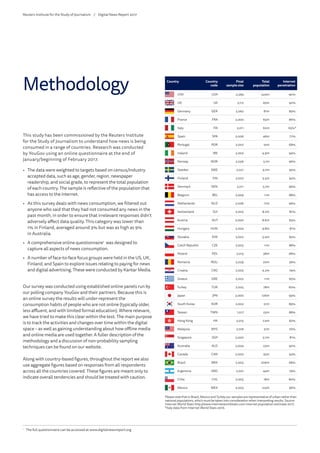
This study has been commissioned by the Reuters Institute
for the Study of Journalism to understand how news is being
consumed in a range of countries. Research was conducted
by YouGov using an online questionnaire at the end of
January/beginning of February 2017.
•	 The data were weighted to targets based on census/industry
accepted data, such as age, gender, region, newspaper
readership, and social grade, to represent the total population
of each country. The sample is reflective of the population that
has access to the internet.
•	 As this survey deals with news consumption, we filtered out
anyone who said that they had not consumed any news in the
past month, in order to ensure that irrelevant responses didn’t
adversely affect data quality. This category was lower than
1% in Finland, averaged around 3% but was as high as 9%
in Australia.
•	 A comprehensive online questionnaire1
was designed to
capture all aspects of news consumption.
•	 A number of face-to-face focus groups were held in the US, UK,
Finland, and Spain to explore issues relating to paying for news
and digital advertising. These were conducted by Kantar Media.
Our survey was conducted using established online panels run by
our polling company YouGov and their partners. Because this is
an online survey the results will under-represent the
consumption habits of people who are not online (typically older,
less affluent, and with limited formal education). Where relevant,
we have tried to make this clear within the text. The main purpose
is to track the activities and changes over time within the digital
space – as well as gaining understanding about how offline media
and online media are used together. A fuller description of the
methodology and a discussion of non-probability sampling
techniques can be found on our website.
Along with country-based figures, throughout the report we also
use aggregate figures based on responses from all respondents
across all the countries covered. These figures are meant only to
indicate overall tendencies and should be treated with caution.
1
	 The full questionnaire can be accessed at www.digitalnewsreport.org
Country Country
code
Final
sample size
Total
population
Internet
penetration
USA USA 2,269 324m 90%
UK UK 2,112 65m 92%
Germany GER 2,062 81m 89%
France FRA 2,000 65m 86%
Italy ITA 2,011 62m 63%*
Spain SPA 2,006 46m 77%
Portugal POR 2,007 10m 68%
Ireland IRE 2,002 4.9m 94%
Norway NOR 2,056 5.1m 96%
Sweden SWE 2,021 9.7m 95%
Finland FIN 2,007 5.5m 92%
Denmark DEN 2,011 5.7m 96%
Belgium BEL 2,009 11m 88%
Netherlands NLD 2,006 17m 96%
Switzerland SUI 2,005 8.2m 87%
Austria AUT 2,000 8.6m 83%
Hungary HUN 2,004 9.8m 81%
Slovakia SVK 2,002 5.4m 83%
Czech Republic CZE 2,003 11m 88%
Poland POL 2,013 38m 68%
Romania ROU 2,029 20m 56%
Croatia CRO 2,005 4.2m 74%
Greece GRE 2,002 11m 65%
Turkey TUR 2,005 78m 60%
Japan JPN 2,000 126m 94%
South Korea KOR 2,002 51m 89%
Taiwan TWN 1,017 23m 88%
Hong Kong HK 2,015 7.4m 82%
Malaysia MYS 2,108 31m 70%
Singapore SGP 2,000 5.7m 81%
Australia AUS 2,004 23m 92%
Canada CAN 2,000 35m 93%
Brazil BRA 2,003 206m 68%
Argentina ARG 2,001 44m 79%
Chile CHL 2,005 18m 80%
Mexico MEX 2,003 123m 56%
REUTERS INSTITUTE FOR THE STUDY OF JOURNALISM
Slide 1
Please note that in Brazil, Mexico and Turkey our samples are representative of urban rather than
national populations, which must be taken into consideration when interpreting results. Source:
Internet World Stats http://www.internetworldstats.com internet population estimate 2017.
*Italy data from Internet World Stats 2016.
Reuters Institute for the Study of Journalism /	 Digital News Report 2017
Authorship and research
acknowledgements
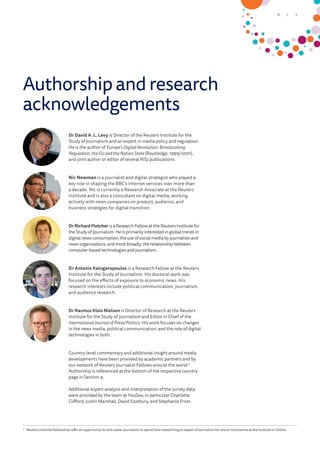
Dr David A. L. Levy is Director of the Reuters Institute for the
Study of Journalism and an expert in media policy and regulation.
He is the author of Europe’s Digital Revolution: Broadcasting
Regulation, the EU and the Nation State (Routledge, 1999/2001),
and joint author or editor of several RISJ publications.
Nic Newman is a journalist and digital strategist who played a
key role in shaping the BBC’s internet services over more than
a decade. Nic is currently a Research Associate at the Reuters
Institute and is also a consultant on digital media, working
actively with news companies on product, audience, and
business strategies for digital transition.
Dr Richard Fletcher is a Research Fellow at the Reuters Institute for
the Study of Journalism. He is primarily interested in global trends in
digital news consumption, the use of social media by journalists and
news organisations, and more broadly, the relationship between
computer-based technologies and journalism.
Dr Antonis Kalogeropoulos is a Research Fellow at the Reuters
Institute for the Study of Journalism. His doctoral work was
focused on the effects of exposure to economic news. His
research interests include political communication, journalism,
and audience research.
Dr Rasmus Kleis Nielsen is Director of Research at the Reuters
Institute for the Study of Journalism and Editor in Chief of the
International Journal of Press/Politics. His work focuses on changes
in the news media, political communication, and the role of digital
technologies in both.
Country-level commentary and additional insight around media
developments have been provided by academic partners and by
our network of Reuters Journalist Fellows around the world.2
Authorship is referenced at the bottom of the respective country
page in Section 4.
Additional expert analysis and interpretation of the survey data
were provided by the team at YouGov, in particular Charlotte
Clifford, Justin Marshall, David Eastbury, and Stephanie Frost.
2
	 Reuters Institute Fellowships offer an opportunity to mid-career journalists to spend time researching an aspect of journalism for one or more terms at the Institute in Oxford.
7/6
Reuters Institute for the Study of Journalism /	 Digital News Report 2017
Section 1
Executive Summary
and Key Findings
Nic Newman
Research Associate, Reuters Institute
9/8
•	 The internet and social media may have exacerbated low
trust and ‘fake news’, but we find that in many countries the
underlying drivers of mistrust are as much to do with
deep-rooted political polarisation and perceived mainstream
media bias.
•	 Echo chambers and filter bubbles are undoubtedly real for
some, but we also find that – on average – users of social
media, aggregators, and search engines experience more
diversity than non-users.
•	 Though the economic outlook for most media companies
remains extremely difficult, not all the indicators are getting
worse. The growth of ad-blocking has stopped while online
subscriptions and donations are picking up in some
countries. Our focus groups provide some encouragement
that more might be prepared to pay in the future if content
is sufficiently valuable, convenient, and relevant.
With data covering more than 30 countries and five continents,
this research is a reminder that the digital revolution is full of
contradictions and exceptions. Countries started in different
places, and are not moving at the same pace. These differences are
captured in individual country pages that can be found towards the
end of this report. They contain critical industry context written
by experts as well as key charts and data points. The overall story
around the key trends is captured in this executive summary with
additional analysis on some subject areas in a separate section.
SOME OF THE KEY FINDINGS FROM OUR
2017 RESEARCH:
•	 Growth in social media for news is flattening out in some
markets, as messaging apps that are (a) more private and (b)
tend not to filter content algorithmically are becoming more
popular. The use of WhatsApp for news is starting to rival
Facebook in a number of markets including Malaysia (51%),
Brazil (46%), and Spain (32%).
•	 Only a quarter (24%) of our respondents think social media do
a good job in separating fact from fiction, compared to 40% for
the news media. Our qualitative data suggest that users feel
the combination of a lack of rules and viral algorithms are
encouraging low quality and ‘fake news’ to spread quickly.
•	 There are wide variations in trust across our 36 countries.
The proportion that says they trust the news is highest in
Finland (62%), but lowest in Greece and South Korea (23%).
•	 In most countries, we find a strong connection between distrust
in the media and perceived political bias. This is particularly
true in countries with high levels of political polarisation like
the United States, Italy, and Hungary.
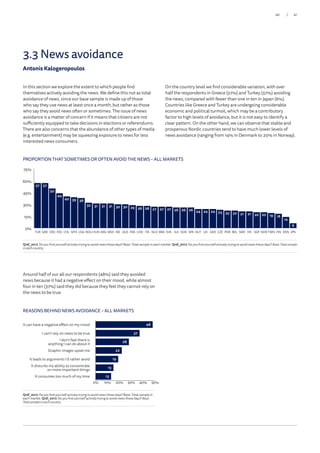
•	 Almost a third of our sample (29%) say they often or sometimes
avoid the news. For many, this is because it can have a negative
effect on mood. For others, it is because they can’t rely on news
to be true.
This year’s report comes amid intense soul-searching in the news industry about fake news,
failing business models, and the power of platforms. And yet our research casts new and
surprising light on some of the prevailing narratives around these issues.
•	 Mobile marches on, outstripping computer access for news in
an increasing number of countries. Mobile news notifications
have grown significantly in the last year, especially in the US
(+8 percentage points), South Korea (+7), and Australia (+4),
becoming an important new route to content and giving
a new lease of life to news apps.
•	 In a related development there has been a significant growth
in mobile news aggregators, notably Apple News, but also
Snapchat Discover for younger audiences. Both have doubled
usage with their target groups in the last year.
•	 Smartphones are now as important for news inside the home
as outside. More smartphone users now access news in bed
(46%) than use the device when commuting to work.
•	 Voice-activated digital assistants like the Amazon Echo are
emerging as a new platform for news, already outstripping
smart watches in the US and UK.
•	 In terms of online news subscriptions, we have seen a very
substantial ‘Trump bump’ in the US (from 9 to 16%) along with a
tripling of news donations. Most of those new payments have
come from the young – a powerful corrective to the idea that
young people are not prepared to pay for online media, let
alone news.
•	 Across all countries, only around one in ten (13%) pay for online
news but some regions (Nordics) are doing much better than
others (Southern Europe and much of Asia).
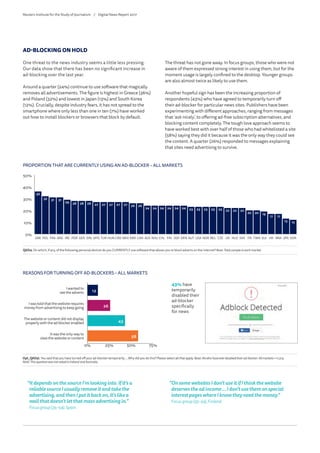
•	 Ad-blocking growth has stalled on desktop (21%) and remains
low on smartphones (7%). Over half say they have temporarily
disabled their ad-blocker for news in countries like Poland
(57%), Denmark (57%), and the United States (52%).
•	 We have new evidence that news brands may be struggling to
cut through on distributed platforms. In an experiment tracking
more than 2,000 respondents in the UK, we found that while
most could remember the path through which they found a
news story (Facebook, Google, etc.), less than half could recall
the name of the news brand itself when coming from search
(37%) and social (47%).
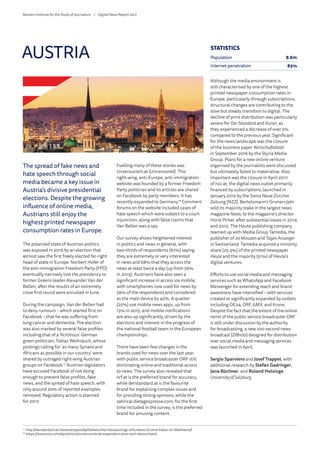
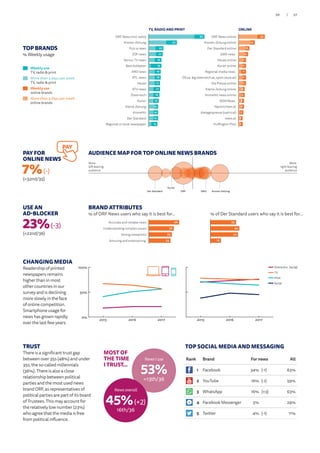
•	 Austrians and Swiss are most wedded to printed newspapers,
Germans and Italians love TV bulletins, while Latin Americans
get more news via social media and chat apps than other parts
of the world.
Reuters Institute for the Study of Journalism /	 Digital News Report 2017
OUR CHANGING MEDIA MIX
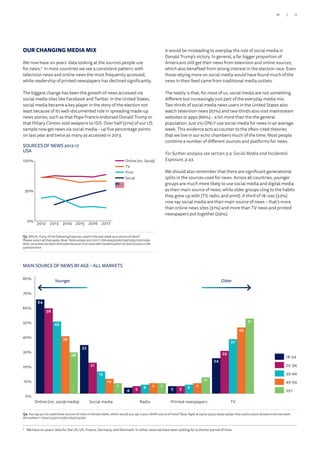
We now have six years’ data looking at the sources people use
for news.3
In most countries we see a consistent pattern, with
television news and online news the most frequently accessed,
while readership of printed newspapers has declined significantly.
The biggest change has been the growth of news accessed via
social media sites like Facebook and Twitter. In the United States,
social media became a key player in the story of the election not
least because of its well-documented role in spreading made-up
news stories, such as that Pope Francis endorsed Donald Trump or
that Hillary Clinton sold weapons to ISIS. Over half (51%) of our US
sample now get news via social media – up five percentage points
on last year and twice as many as accessed in 2013.
It would be misleading to overplay the role of social media in
Donald Trump’s victory. In general, a far bigger proportion of
Americans still get their news from television and online sources,
which also benefited from strong interest in the election race. Even
those relying more on social media would have found much of the
news in their feed came from traditional media outlets.
The reality is that, for most of us, social media are not something
different but increasingly just part of the everyday media mix.
Two-thirds of social media news users in the United States also
watch television news (67%) and two-thirds also visit mainstream
websites or apps (66%) – a bit more than the the general
population. Just 2% ONLY use social media for news in an average
week. This evidence acts as counter to the often-cited theories
that we live in our echo chambers much of the time. Most people
combine a number of different sources and platforms for news.
For further analysis see section 3.4: Social Media and Incidental
Exposure, p.43.
We should also remember that there are significant generational
splits in the sources used for news. Across all countries, younger
groups are much more likely to use social media and digital media
as their main source of news, while older groups cling to the habits
they grew up with (TV, radio, and print). A third of 18–24s (33%)
now say social media are their main source of news – that’s more
than online news sites (31%) and more than TV news and printed
newspapers put together (29%).
0%
10%
20%
30%
40%
50%
60%
70%
80%
28
7 7
11
51
39
10
7 7
45
49
15
6 6
37
58
21
5 5
29
64
33
4 5
24
55+
45-54
35-44
25-34
18-24
TVPrinted newspapersRadioSocial mediaOnline (inc. social media)
MAIN SOURCE OF NEWS BY AGE – ALL MARKETS
Younger Older
18-24
25-34
35-44
45-54
55+
Q4. You say you’ve used these sources of news in the last week, which would you say is your MAIN source of news? Base:Aged18-24/25-34/35-44/45-54/55+thatusedasourceofnewsinthe last week:
Allmarkets=7754/12,332/12,976/12,630/24,620.
REUTERS INSTITUTE FOR THE STUDY OF JOURNALISM
Slide 11
Q3. Which, if any, of the following have you used in the last week as a source of news?
Please select all that apply. Base:Totalsample2012-2017:USA=845/2028/2197/2295/2197/2269.
Note:2014datahasbeenestimatedbecauseofanissuewithrandomisationofnewssourcesinthe
questionnaire.
SOURCES OF NEWS 2012-17
USA
0%
50%
100%
Social
Online (incl. social)
Print
TV
201720162015201420132012
Online (inc. Social)
TV
Print
Social
REUTERS INSTITUTE FOR THE STUDY OF JOURNALISM
Slide 5
3
	 We have six years’ data for the US, UK, France, Germany, and Denmark. In other cases we have been polling for a shorter period of time.
11/10
SOCIAL MEDIA GROWTH SLOWS DOWN,
MESSAGING UP
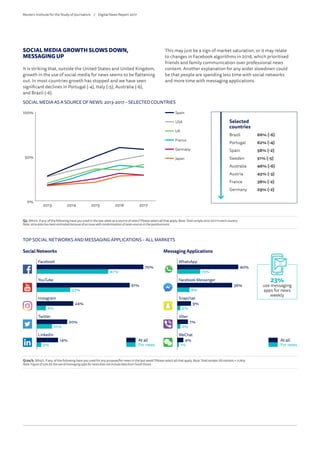
It is striking that, outside the United States and United Kingdom,
growth in the use of social media for news seems to be flattening
out. In most countries growth has stopped and we have seen
significant declines in Portugal (-4), Italy (-5), Australia (-6),
and Brazil (-6).
This may just be a sign of market saturation, or it may relate
to changes in Facebook algorithms in 2016, which prioritised
friends and family communication over professional news
content. Another explanation for any wider slowdown could
be that people are spending less time with social networks
and more time with messaging applications.
0%
50%
100%
Spain
Japan
France
Germany
UK
USA
20172016201520142013
SOCIAL MEDIA AS A SOURCE OF NEWS: 2013-2017 – SELECTED COUNTRIES
Q3. Which, if any, of the following have you used in the last week as a source of news? Please select all that apply. Base:Totalsample2013-2017ineachcountry.
Note:2014datahasbeenestimatedbecauseofanissuewithrandomisationofnewssourcesinthequestionnaire.
Selected
countries
Brazil 66% (-6)
Portugal 62% (-4)
Spain 58% (-2)
Sweden 51% (-5)
Australia 46% (-6)
Austria 45% (-3)
France 38% (-2)
Germany 29% (-2)
Spain
USA
UK
France
Germany
Japan
REUTERS INSTITUTE FOR THE STUDY OF JOURNALISM
Slide 16
61%
22%
YouTube
36%
8%
Facebook Messenger
70%
Facebook
47%
40%
WhatsApp
15%
Instagram
24%
6%
Snapchat
9%
2%
Twitter
20%
10%
Viber
7%
2%
LinkedIn
14% At all At all
3% For news For news
WeChat
4%
1%
TOP SOCIAL NETWORKS AND MESSAGING APPLICATIONS – ALL MARKETS
Social Networks Messaging Applications
Q12a/b. Which, if any, of the following have you used for any purpose/for news in the last week? Please select all that apply. Base:Totalsample:Allmarkets=71,805.
Note.Figureof23%fortheuseofmessagingappsfornewsdoesnotincludedatafromSouthKorea.
23%
use messaging
apps for news
weekly
REUTERS INSTITUTE FOR THE STUDY OF JOURNALISM
Slide 17
Reuters Institute for the Study of Journalism /	 Digital News Report 2017
THE RISE OF MESSAGING APPLICATIONS
FOR NEWS
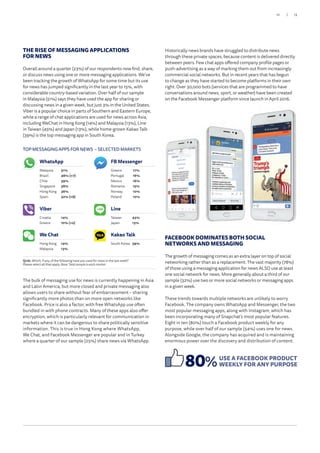
Overall around a quarter (23%) of our respondents now find, share,
or discuss news using one or more messaging applications. We’ve
been tracking the growth of WhatsApp for some time but its use
for news has jumped significantly in the last year to 15%, with
considerable country-based variation. Over half of our sample
in Malaysia (51%) says they have used the app for sharing or
discussing news in a given week, but just 3% in the United States.
Viber is a popular choice in parts of Southern and Eastern Europe,
while a range of chat applications are used for news across Asia,
including WeChat in Hong Kong (14%) and Malaysia (13%), Line
in Taiwan (45%) and Japan (13%), while home-grown Kakao Talk
(39%) is the top messaging app in South Korea.
The bulk of messaging use for news is currently happening in Asia
and Latin America, but more closed and private messaging also
allows users to share without fear of embarrassment – sharing
significantly more photos than on more open networks like
Facebook. Price is also a factor, with free WhatsApp use often
bundled in with phone contracts. Many of these apps also offer
encryption, which is particularly relevant for communication in
markets where it can be dangerous to share politically sensitive
information. This is true in Hong Kong where WhatsApp,
We Chat, and Facebook Messenger are popular and in Turkey
where a quarter of our sample (25%) share news via WhatsApp.
80%USE A FACEBOOK PRODUCT
WEEKLY FOR ANY PURPOSE
Q12b. Which, if any, of the following have you used for news in the last week?
Please select all that apply. Base:Totalsampleineachmarket.
TOP MESSAGING APPS FOR NEWS – SELECTED MARKETS
WhatsApp
Malaysia 51%
Brazil 46% (+7)
Chile 39%
Singapore 38%
Hong Kong 36%
Spain 32% (+8)
FB Messenger
Greece 17%
Portugal 16%
Mexico 16%
Romania 15%
Norway 10%
Poland 10%
Viber
Croatia 14%
Greece 10% (+2)
Line
Taiwan 45%
Japan 13%
We Chat
Hong Kong 14%
Malaysia 13%
Kakao Talk
South Korea 39%
REUTERS INSTITUTE FOR THE STUDY OF JOURNALISM
Slide 18
Historically news brands have struggled to distribute news
through these private spaces, because content is delivered directly
between peers. Few chat apps offered company profile pages or
push-advertising as a way of marking them out from increasingly
commercial social networks. But in recent years that has begun
to change as they have started to become platforms in their own
right. Over 30,000 bots (services that are programmed to have
conversations around news, sport, or weather) have been created
on the Facebook Messenger platform since launch in April 2016.
FACEBOOK DOMINATES BOTH SOCIAL
NETWORKS AND MESSAGING
The growth of messaging comes as an extra layer on top of social
networking rather than as a replacement. The vast majority (78%)
of those using a messaging application for news ALSO use at least
one social network for news. More generally about a third of our
sample (32%) use two or more social networks or messaging apps
in a given week.
These trends towards multiple networks are unlikely to worry
Facebook. The company owns WhatsApp and Messenger, the two
most popular messaging apps, along with Instagram, which has
been incorporating many of Snapchat’s most popular features.
Eight in ten (80%) touch a Facebook product weekly for any
purpose, while over half of our sample (54%) uses one for news.
Alongside Google, the company has acquired and is maintaining
enormous power over the discovery and distribution of content.
80%USE A FACEBOOK PRODUCT
WEEKLY FOR ANY PURPOSE
TOP MESSAGING APPS FOR NEWS – SELECTED MARKETS
WhatsApp
Malaysia 51%
FB Messenger
Greece 17%
REUTERS INSTITUTE FOR THE STUDY OF JOURNALISM
Slide 18
13/12
OTHER FORMS OF NEWS AGGREGATION
PICK UP MOMENTUM
While exposure to news on social media is often incidental, the past
few years have seen the growth of aggregation services that are
more of a destination for news.
On a mobile phone in particular, where it can be difficult to move
quickly between multiple apps and websites, the convenience
of a one-stop-shop can be compelling. Sometimes these news
aggregations are stand-alone products (Flipboard, SmartNews),
at other times they are part of a wider service (Apple News, Google
News, Snapchat Discover, Kakao Channel, and Line News). This
second group – that are both destinations in their own right and
allow content to hook into established eco-systems – are currently
showing the strongest growth in our data.
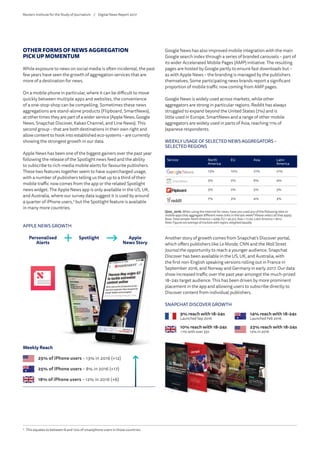
Apple News has been one of the biggest gainers over the past year
following the release of the Spotlight news feed and the ability
to subscribe to rich-media mobile alerts for favourite publishers.
These two features together seem to have supercharged usage,
with a number of publishers telling us that up to a third of their
mobile traffic now comes from the app or the related Spotlight
news widget. The Apple News app is only available in the US, UK,
and Australia, where our survey data suggest it is used by around
a quarter of iPhone users,4
but the Spotlight feature is available
in many more countries.
Google News has also improved mobile integration with the main
Google search index through a series of branded carousels – part of
its wider Accelerated Mobile Pages (AMP) initiative. The resulting
pages are hosted by Google partly to ensure fast downloads but –
as with Apple News – the branding is managed by the publishers
themselves. Some participating news brands report a significant
proportion of mobile traffic now coming from AMP pages.
Google News is widely used across markets, while other
aggregators are strong in particular regions. Reddit has always
struggled to expand beyond the United States (7%) and is
little used in Europe. SmartNews and a range of other mobile
aggregators are widely used in parts of Asia, reaching 11% of
Japanese respondents.
Q10c_2016. When using the internet for news, have you used any of the following sites or
mobile apps that aggregate different news links in the last week? Please select all that apply.
Base:Totalsample:NorthAmerica=4269,EU=40,312,Asia=11,142,LatinAmerica=8012.
Note:Figuresareaverageofmarketswithregion,weightedequally.
WEEKLY USAGE OF SELECTED NEWS AGGREGATORS –
SELECTED REGIONS
Service North
America
EU Asia Latin
America
13% 10% 21% 21%
3% 2% 6% 4%
5% 2% 5% 3%
7% 3% 4% 3%
REUTERS INSTITUTE FOR THE STUDY OF JOURNALISM
Slide 23
Another story of growth comes from Snapchat’s Discover portal,
which offers publishers like LeMonde, CNN and the Wall Street
Journal the opportunity to reach a younger audience. Snapchat
Discover has been available in the US, UK, and Australia, with
the first non-English speaking versions rolling out in France in
September 2016, and Norway and Germany in early 2017. Our data
show increased traffic over the past year amongst the much-prized
18–24s target audience. This has been driven by more prominent
placement in the app and allowing users to subscribe directly to
Discover content from individual publishers.
4
	 This equates to between 8 and 12% of smartphone users in those countries.
APPLE NEWS GROWTH
Personalised
Alerts
Spotlight Apple
News Story
9% reach with 18-24s
Launched Sep 2016
10% reach with 18-24s
1% with over 35s
14% reach with 18-24s
Launched Feb 2016
23% reach with 18-24s
12% in 2016
SNAPCHAT DISCOVER GROWTH
Weekly Reach
25% of iPhone users – 13% in 2016 (+12)
25% of iPhone users – 8% in 2016 (+17)
18% of iPhone users – 12% in 2016 (+6)
Reuters Institute for the Study of Journalism /	 Digital News Report 2017
Q10. Thinking about how you got news online (via computer, mobile or any device) in the last
week, which were the ways in which you came across news stories? Please select all that apply.
Base:Totalsampleineachmarket.Note.Showingselectedmarketswithhighpercentage weekly
usageofeachpathwaytonews.
Direct Social
Finland 67% Chile 64%
Norway 67% Argentina 58%
Sweden 59% Hungary 58%
UK 54% Romania 55%
Search Aggregators
Poland 62% Japan 40%
Turkey 62% South Korea 37%
South Korea 60% Taiwan 31%
Czech Republic 59% Hong Kong 25%
Email Mobile Alerts
Belgium 34% Taiwan 32%
Portugal 30% Hong Kong 27%
United States 23% Turkey 24%
France 22% Sweden 22%
TOP MARKETS FOR EACH GATEWAY – SELECTED MARKETS
REUTERS INSTITUTE FOR THE STUDY OF JOURNALISM
Slide 26
For more on news brands and access see country pages in Section 4.
HOW THE MIX OF GATEWAYS TO NEWS
IS SHIFTING …
Despite the rise of aggregators, social media and search remain
the most important gateways to online content, alongside traffic
coming to their own websites and apps.
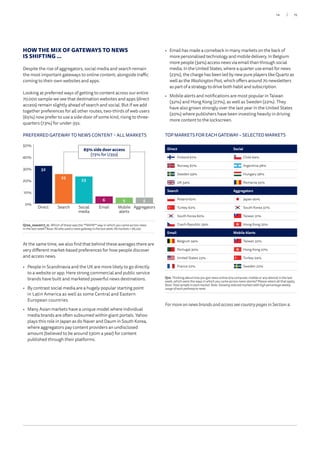
Looking at preferred ways of getting to content across our entire
70,000 sample we see that destination websites and apps (direct
access) remain slightly ahead of search and social. But if we add
together preferences for all other routes, two-thirds of web users
(65%) now prefer to use a side-door of some kind, rising to three-
quarters (73%) for under-35s.
At the same time, we also find that behind these averages there are
very different market-based preferences for how people discover
and access news.
•	 People in Scandinavia and the UK are more likely to go directly
to a website or app. Here strong commercial and public service
brands have built and marketed powerful news destinations.
•	 By contrast social media are a hugely popular starting point
in Latin America as well as some Central and Eastern
European countries.
•	 Many Asian markets have a unique model where individual
media brands are often subsumed within giant portals. Yahoo
plays this role in Japan as do Naver and Daum in South Korea,
where aggregators pay content providers an undisclosed
amount (believed to be around $30m a year) for content
published through their platforms.
0%
10%
20%
30%
40%
50%
32
25
23
6 5 5
AggregatorsMobile
alerts
EmailSocial
media
SearchDirect
PREFERRED GATEWAY TO NEWS CONTENT – ALL MARKETS
65% side door access
(73% for U35s)
Q10a_new2017_rc. Which of these was the **MAIN** way in which you came across news
in the last week? Base:Allwhousedanewsgateway inthelastweek:Allmarkets= 66,230
REUTERS INSTITUTE FOR THE STUDY OF JOURNALISM
Slide 25
•	 Email has made a comeback in many markets on the back of
more personalised technology and mobile delivery. In Belgium
more people (34%) access news via email than through social
media. In the United States, where a quarter use email for news
(23%), the charge has been led by new pure players like Quartz as
well as the WashingtonPost, which offers around 70 newsletters
as part of a strategy to drive both habit and subscription.
•	 Mobile alerts and notifications are most popular in Taiwan
(32%) and Hong Kong (27%), as well as Sweden (22%). They
have also grown strongly over the last year in the United States
(20%) where publishers have been investing heavily in driving
more content to the lockscreen.
15/14
MORE PEOPLE ARE DISCOVERING NEWS
THROUGH ALGORITHMS THAN EDITORS
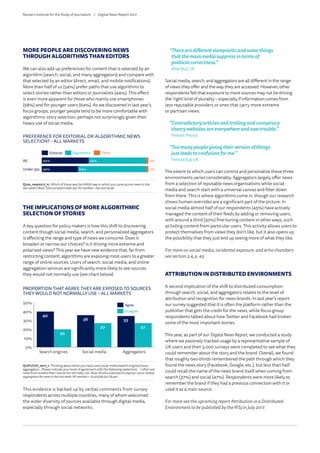
We can also add up preferences for content that is selected by an
algorithm (search, social, and many aggregators) and compare with
that selected by an editor (direct, email, and mobile notifications).
More than half of us (54%) prefer paths that use algorithms to
select stories rather than editors or journalists (44%). This effect
is even more apparent for those who mainly use smartphones
(58%) and for younger users (64%). As we discovered in last year’s
focus groups, younger people tend to be more comfortable with
algorithmic story selection, perhaps not surprisingly given their
heavy use of social media.
THE IMPLICATIONS OF MORE ALGORITHMIC
SELECTION OF STORIES
A key question for policy makers is how this shift to discovering
content though social media, search, and personalised aggregators
is affecting the range and type of news we consume. Does it
broaden or narrow our choices? Is it driving more extreme and
polarised views? This year we have new evidence that, far from
restricting content, algorithms are exposing most users to a greater
range of online sources. Users of search, social media, and online
aggregation services are significantly more likely to see sources
they would not normally use (see chart below).
This evidence is backed up by verbal comments from survey
respondents across multiple countries, many of whom welcomed
the wider diversity of sources available through digital media,
especially through social networks.
44% 54%
34% 64%
2%
OtherEditorial Algorithmic
2%
All
Under 35s
PREFERENCE FOR EDITORIAL OR ALGORITHMIC NEWS
SELECTION? – ALL MARKETS
Q10a_new2017_rc. Which of these was the MAIN way in which you came across news in the
last week? Base:Totalsample/Under35s:Allmarkets= 66,230/19,138.
REUTERS INSTITUTE FOR THE STUDY OF JOURNALISM
Slide 28
PROPORTION THAT AGREE THEY ARE EXPOSED TO SOURCES
THEY WOULD NOT NORMALLY USE – ALL MARKETS
0
10
20
30
40
50
20
27 27
40
36 35
Disagree
Agree
AggregatorsSocial mediaSearch engines
0%
10%
20%
30%
40%
50%
20
27 27
40
36 35
Disagree
Agree
AggregatorsSocial mediaSearch engines
Q12Fi/ii/iii_2017_1. Thinking about when you have used social media/search engines/news
aggregators…Please indicate your level of agreement with the following statement. – I often see
news from outlets that I would not normally use. Base:Allwhousedsearchengines/socialmedia/
aggregatorsfornewsinthelastweek:Allmarkets= 16,925/48,551/28,441.
Agree
Disagree
REUTERS INSTITUTE FOR THE STUDY OF JOURNALISM
Slide 29
“Therearedifferentviewpointsandsomethings
thatthemainmediasuppressintermsof
politicalcorrectness.”
Male(62),UK
Social media, search, and aggregators are all different in the range
of views they offer and the way they are accessed. However, other
respondents felt that exposure to more sources may not be driving
the ‘right’ kind of plurality – especially if information comes from
less reputable providers or ones that carry more extreme
or partisan views.
“Contradictoryarticlesandtrollingandconspiracy
theorywebsitesareeverywhereandsowtrouble.”
Female,France
“Toomanypeoplegivingtheirversionofthings
justleadstoconfusionforme.”
Female(53),UK
The extent to which users can control and personalise these three
environments varies considerably. Aggregators largely offer news
from a selection of reputable news organisations while social
media and search start with a universal canvas and filter down
from there. This is where algorithms come in, though our research
shows human overrides are a significant part of the picture. In
social media almost half of our respondents (45%) have actively
managed the content of their feeds by adding or removing users,
with around a third (30%) fine-tuning content in other ways, such
as hiding content from particular users. This activity allows users to
protect themselves from views they don’t like, but it also opens up
the possibility that they just end up seeing more of what they like.
For more on social media, incidental exposure, and echo chambers
see section 3.4, p. 43.
ATTRIBUTION IN DISTRIBUTED ENVIRONMENTS
A second implication of the shift to distributed consumption
through search, social, and aggregators relates to the level of
attribution and recognition for news brands. In last year’s report
our survey suggested that it is often the platform rather than the
publisher that gets the credit for the news, while focus group
respondents talked about how Twitter and Facebook had broken
some of the most important stories.
This year, as part of our Digital News Report, we conducted a study
where we passively tracked usage by a representative sample of
UK users and then 3,000 surveys were completed to see what they
could remember about the story and the brand. Overall, we found
that roughly two-thirds remembered the path through which they
found the news story (Facebook, Google, etc.), but less than half
could recall the name of the news brand itself when coming from
search (37%) and social (47%). Respondents were more likely to
remember the brand if they had a previous connection with it or
used it as a main source.
For more see the upcoming report Attribution in a Distributed
Environment to be published by the RISJ in July 2017.
Reuters Institute for the Study of Journalism /	 Digital News Report 2017
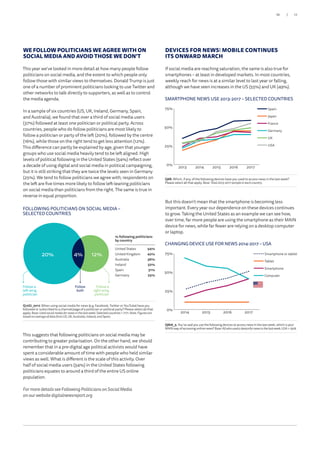
WE FOLLOW POLITICIANS WE AGREE WITH ON
SOCIAL MEDIA AND AVOID THOSE WE DON’T
This year we’ve looked in more detail at how many people follow
politicians on social media, and the extent to which people only
follow those with similar views to themselves. Donald Trump is just
one of a number of prominent politicians looking to use Twitter and
other networks to talk directly to supporters, as well as to control
the media agenda.
In a sample of six countries (US, UK, Ireland, Germany, Spain,
and Australia), we found that over a third of social media users
(37%) followed at least one politician or political party. Across
countries, people who do follow politicians are most likely to
follow a politician or party of the left (20%), followed by the centre
(16%), while those on the right tend to get less attention (12%).
This difference can partly be explained by age, given that younger
groups who use social media heavily tend to be left aligned. High
levels of political following in the United States (54%) reflect over
a decade of using digital and social media in political campaigning,
but it is still striking that they are twice the levels seen in Germany
(25%). We tend to follow politicians we agree with; respondents on
the left are five times more likely to follow left-leaning politicians
on social media than politicians from the right. The same is true in
reverse in equal proportion.
This suggests that following politicians on social media may be
contributing to greater polarisation. On the other hand, we should
remember that in a pre-digital age political activists would have
spent a considerable amount of time with people who held similar
views as well. What is different is the scale of this activity. Over
half of social media users (54%) in the United States following
politicians equates to around a third of the entire US online
population.
For more details see Following Politicians on Social Media
on our website digitalnewsreport.org
DEVICES FOR NEWS: MOBILE CONTINUES
ITS ONWARD MARCH
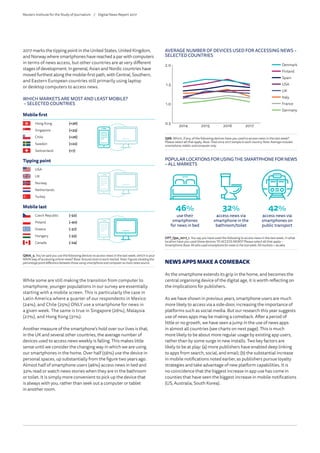
If social media are reaching saturation, the same is also true for
smartphones – at least in developed markets. In most countries,
weekly reach for news is at a similar level to last year or falling,
although we have seen increases in the US (55%) and UK (49%).
But this doesn’t mean that the smartphone is becoming less
important. Every year our dependence on these devices continues
to grow. Taking the United States as an example we can see how,
over time, far more people are using the smartphone as their MAIN
device for news, while far fewer are relying on a desktop computer
or laptop.
FOLLOWING POLITICIANS ON SOCIAL MEDIA –
SELECTED COUNTRIES
Q12Gi_2017. When using social media for news (e.g. Facebook, Twitter or YouTube) have you
followed or subscribed to a channel/page of a politician or political party? Please select all that
apply.Base:Usedsocialmediafornewsinthelastweek:Selectedcountries= 7171.Note.Figuresare
basedonaverageofdatafromUS,UK,Australia,Ireland,andSpain.
% following politicians
by country
United States 54%
United Kingdom 42%
Australia 36%
Ireland 32%
Spain 31%
Germany 25%
Follow a
left-wing
politician
Follow
both
Follow a
right-wing
politician
4%20% 12%
REUTERS INSTITUTE FOR THE STUDY OF JOURNALISM
Slide 30
0%
25%
50%
75%
Spain
Japan
France
Germany
UK
USA
20172016201520142013
0%
25%
50%
75%
Smartphone or tablet
Tablet
Smartphone
Computer
2017201620152014
0%
25%
50%
75%
Spain
Japan
France
Germany
UK
USA
20172016201520142013
0%
25%
50%
75%
Smartphone or tablet
Tablet
Smartphone
Computer
2017201620152014
SMARTPHONE NEWS USE 2013-2017 – SELECTED COUNTRIES
Q8B. Which, if any, of the following devices have you used to access news in the last week?
Please select all that apply. Base:Total2013-2017sampleineachcountry.
Q8b6_5. You’ve said you use the following devices to access news in the last week, which is your
MAIN way of accessing online news? Base:Allwhousedadevicefornewsinthelastweek:USA=1926.
CHANGING DEVICE USE FOR NEWS 2014-2017 – USA
REUTERS INSTITUTE FOR THE STUDY OF JOURNALISM
Slide 31
0%
25%
50%
75%
Spain
Japan
France
Germany
UK
USA
20172016201520142013
0%
25%
50%
75%
Smartphone or tablet
Tablet
Smartphone
Computer
2017201620152014
0%
25%
50%
75%
Spain
Japan
France
Germany
UK
USA
20172016201520142013
0%
25%
50%
75%
Smartphone or tablet
Tablet
Smartphone
Computer
2017201620152014
SMARTPHONE NEWS USE 2013-2017 – SELECTED COUNTRIES
Q8B. Which, if any, of the following devices have you used to access news in the last week?
Please select all that apply. Base:Total2013-2017sampleineachcountry.
Q8b6_5. You’ve said you use the following devices to access news in the last week, which is your
MAIN way of accessing online news? Base:Allwhousedadevicefornewsinthelastweek:USA=1926.
CHANGING DEVICE USE FOR NEWS 2014-2017 – USA
REUTERS INSTITUTE FOR THE STUDY OF JOURNALISM
Slide 31
17/16
AVERAGE NUMBER OF DEVICES USED FOR ACCESSING NEWS –
SELECTED COUNTRIES
Q8B. Which, if any, of the following devices have you used to access news in the last week?
Please select all that apply. Base:Total2014-2017sampleineachcountry.Note:Average includes
smartphone,tablet,andcomputeronly.
0.5
1.0
1.5
2.0
Spain
Italy
Finland
Denmark
Germany
France
USA
UK
2017201620152014
Denmark
Finland
Spain
Italy
USA
France
UK
Germany
POPULAR LOCATIONS FOR USING THE SMARTPHONE FOR NEWS
– ALL MARKETS
46%
use their
smartphones
for news in bed
32%
access news via
smartphone in the
bathroom/toilet
42%
access news via
smartphones on
public transport
OPT_Q9a_2017_1. You say you have used the following to access news in the last week, in what
location have you used these devices TO ACCESS NEWS? Please select all that apply –
Smartphone Base:Allwhousedsmartphonefornewsinthelastweek:Allmarkets=40,464.
REUTERS INSTITUTE FOR THE STUDY OF JOURNALISM
Slide 34
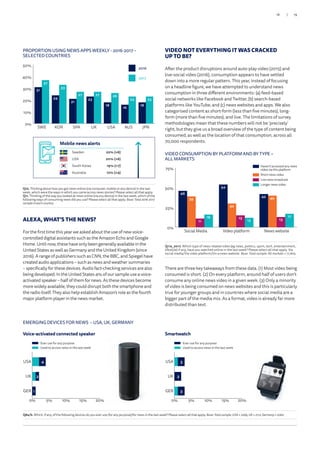
2017 marks the tipping point in the United States, United Kingdom,
and Norway where smartphones have reached a par with computers
in terms of news access, but other countries are at very different
stages of development. In general, Asian and Nordic countries have
moved furthest along the mobile-first path, with Central, Southern,
and Eastern European countries still primarily using laptop
or desktop computers to access news.
While some are still making the transition from computer to
smartphone, younger populations in our survey are essentially
starting with a mobile screen. This is particularly the case in
Latin America where a quarter of our respondents in Mexico
(24%), and Chile (25%) ONLY use a smartphone for news in
a given week. The same is true in Singapore (26%), Malaysia
(27%), and Hong Kong (31%).
Another measure of the smartphone’s hold over our lives is that,
in the UK and several other countries, the average number of
devices used to access news weekly is falling. This makes little
sense until we consider the changing way in which we are using
our smartphones in the home. Over half (56%) use the device in
personal spaces, up substantially from the figure two years ago.
Almost half of smartphone users (46%) access news in bed and
32% read or watch news stories when they are in the bathroom
or toilet. It is simply more convenient to pick up the device that
is always with you, rather than seek out a computer or tablet
in another room.
WHICH MARKETS ARE MOST AND LEAST MOBILE?
– SELECTED COUNTRIES
Q8b6_5. You’ve said you use the following devices to access news in the last week, which is your
MAIN way of accessing online news? Base:Around2000 ineachmarket.Note:Figuresshowingthe
percentagepointdifferencebetweenthoseusingsmartphoneandcomputerasmainnewssource.
Mobile first
Hong Kong (+36)
Singapore (+33)
Chile (+26)
Sweden (+22)
Switzerland (+7)
Tipping point
USA
UK
Norway
Netherlands
Turkey
Mobile last
Czech Republic (-52)
Poland (-40)
Greece (-37)
Hungary (-33)
Canada (-24)
REUTERS INSTITUTE FOR THE STUDY OF JOURNALISM
Slide 32
NEWS APPS MAKE A COMEBACK
As the smartphone extends its grip in the home, and becomes the
central organising device of the digital age, it is worth reflecting on
the implications for publishers.
As we have shown in previous years, smartphone users are much
more likely to access via a side-door, increasing the importance of
platforms such as social media. But our research this year suggests
use of news apps may be making a comeback. After a period of
little or no growth, we have seen a jump in the use of news apps
in almost all countries (see charts on next page). This is much
more likely to be about more regular usage by existing app users,
rather than by some surge in new installs. Two key factors are
likely to be at play: (a) more publishers have enabled deep linking
to apps from search, social, and email; (b) the substantial increase
in mobile notifications noted earlier, as publishers pursue loyalty
strategies and take advantage of new platform capabilities. It is
no coincidence that the biggest increase in app use has come in
counties that have seen the biggest increase in mobile notifications
(US, Australia, South Korea).
Reuters Institute for the Study of Journalism /	 Digital News Report 2017
PROPORTION USING NEWS APPS WEEKLY - 2016-2017 –
SELECTED COUNTRIES
Q10. Thinking about how you got news online (via computer, mobile or any device) in the last
week, which were the ways in which you came across news stories? Please select all that apply.
Q11. Thinking of the way you looked at news online (via any device) in the last week, which of the
following ways of consuming news did you use? Please select all that apply. Base:Total2016-2017
sampleineachcountry.
Mobile news alerts
Sweden 22% (+6)
USA 20% (+8)
South Korea 19% (+7)
Australia 12% (+4)
0%
10%
20%
30%
40%
50%
37
33
27 27 26
23 23
31
24
21
23
18
16
18
2017
2016
JPNAUSUSAUKSPAKORSWE
2016
2017
ALEXA, WHAT’S THE NEWS?
For the first time this year we asked about the use of new voice-
controlled digital assistants such as the Amazon Echo and Google
Home. Until now, these have only been generally available in the
United States as well as Germany and the United Kingdom (since
2016). A range of publishers such as CNN, the BBC, and Spiegel have
created audio applications – such as news and weather summaries
– specifically for these devices. Audio fact-checking services are also
being developed. In the United States 4% of our sample use a voice-
activated speaker – half of them for news. As these devices become
more widely available, they could disrupt both the smartphone and
the radio itself. They also help establish Amazon’s role as the fourth
major platform player in the news market.
VIDEO NOT EVERYTHING IT WAS CRACKED
UP TO BE?
After the product disruptions around auto-play video (2015) and
live-social video (2016), consumption appears to have settled
down into a more regular pattern. This year, instead of focusing
on a headline figure, we have attempted to understand news
consumption in three different environments: (a) feed-based
social networks like Facebook and Twitter, (b) search-based
platforms like YouTube, and (c) news websites and apps. We also
categorised content as short-form (less than five minutes), long-
form (more than five minutes), and live. The limitations of survey
methodologies mean that these numbers will not be ‘precisely’
right, but they give us a broad overview of the type of content being
consumed, as well as the location of that consumption, across all
70,000 respondents.
There are three key takeaways from these data. (1) Most video being
consumed is short. (2) On every platform, around half of users don’t
consume any online news video in a given week. (3) Only a minority
of video is being consumed on news websites and this is particularly
true for younger groups and in countries where social media are a
bigger part of the media mix. As a format, video is already far more
distributed than text.
EMERGING DEVICES FOR NEWS – USA, UK, GERMANY
Voice-activated connected speaker Smartwatch
Ever use for any purpose
Used to access news in the last week
Ever use for any purpose
Used to access news in the last week
Q8a/b. Which, if any, of the following devices do you ever use (for any purpose)/for news in the last week? Please select all that apply. Base:Totalsample:USA=2269,UK=2112,Germany=2062.
0% 5% 10% 15% 20%
4
2
1
Used to access news in the last week
Ever use for any purpose
GER
UK
USA
0% 5% 10% 15% 20%
3
0
3
2
Used to access news in the last week
Ever use for any purpose
GER
UK
USA
0% 5% 10% 15% 20%
3
0
3
2
Used to access news in the last wee
Ever use for any purpose
GER
UK
USA
REUTERS INSTITUTE FOR THE STUDY OF JOURNALISM
Slide 40
VIDEO CONSUMPTION BY PLATFORM AND BY TYPE –
ALL MARKETS
0%
25%
50%
75%
16
12
17
11
15 13
39
30
40
46
54
42
News websiteVideo platformSocial Media
Q11a_2017. Which type of news related video (eg news, politics, sport, tech, entertainment,
lifestyle) if any, have you watched online in the last week? Please select all that apply. Via
social media/Via video platform/On a news website. Base. Total sample: All markets = 71,805.
Haven’t accessed any news
video via this platform
Short news video
Live news broadcast
Longer news video
REUTERS INSTITUTE FOR THE STUDY OF JOURNALISM
Slide 44
19/18
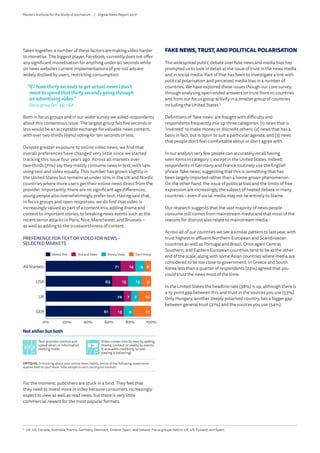
Taken together, a number of these factors are making video harder
to monetise. The biggest player, Facebook, currently does not offer
any significant monetisation for anything under 90 seconds while
on news websites current implementations of pre-roll ads are
widely disliked by users, restricting consumption.
“IfIhavethirtysecondstogetactualnewsIdon’t
wanttospendthatthirtysecondsgoingthrough
anadvertisingvideo.”
Focusgroup(20–34),USA
Both in focus groups and in our wider survey we asked respondents
about this contentious issue. The largest group felt five seconds or
less would be an acceptable exchange for valuable news content,
with over two-thirds (69%) voting for ten seconds or less.
Despite greater exposure to online video news, we find that
overall preferences have changed very little since we started
tracking this issue four years ago. Across all markets over
two-thirds (71%) say they mostly consume news in text, with 14%
using text and video equally. This number has grown slightly in
the United States but remains at under 10% in the UK and Nordic
countries where more users get their online news direct from the
provider. Importantly, there are no significant age differences;
young people also overwhelmingly prefer text. Having said that,
in focus groups and open responses, we do find that video is
increasingly valued as part of a content mix, adding drama and
context to important stories, to breaking news events such as the
recent terror attacks in Paris, Nice, Manchester, and Brussels –
as well as adding to the trustworthiness of content.
For the moment, publishers are stuck in a bind. They feel that
they need to invest more in video because consumers increasingly
expect to view as well as read news, but there is very little
commercial reward for the most popular formats.
PREFERENCE FOR TEXT OR VIDEO FOR NEWS –
SELECTED MARKETS
0% 20% 40% 60% 80% 100%
6
9
12
17
9
13
7
9
14
15
7
13
71
63
74
61
Don't Know
Mostly Video
Text and Video
Mostly Text
GER
UK
USA
All Markets
OPTQ11D. In thinking about your online news habits, which of the following statements
applies best to you? Base: Total sample in each country/all markets.
Text provides control and
speed when in information
seeking mode
Video comes into its own by adding
drama, context or reality to events.
It also adds credibility to text
(seeing is believing).
Not either but both
MostlyText Text and Video Mostly Video Don’t Know
REUTERS INSTITUTE FOR THE STUDY OF JOURNALISM
Slide 45
FAKE NEWS, TRUST, AND POLITICAL POLARISATION
The widespread public debate over fake news and media bias has
prompted us to look in detail at the issue of trust in the news media
and in social media. Part of that has been to investigate a link with
political polarisation and perceived media bias in a number of
countries. We have explored these issues though our core survey,
through analysing open-ended answers on trust from 10 countries
and from our focus group activity in a smaller group of countries
including the United States.5
Definitions of ‘fake news’ are fraught with difficulty and
respondents frequently mix up three categories: (1) news that is
‘invented’ to make money or discredit others; (2) news that has a
basis in fact, but is ‘spun’ to suit a particular agenda; and (3) news
that people don’t feel comfortable about or don’t agree with.
In our analysis very few people can accurately recall having
seen items in category 1, except in the United States. Indeed,
respondents in Germany and France routinely use the English
phrase ‘fake news’, suggesting that this is something that has
been largely imported rather than a home-grown phenomenon.
On the other hand, the issue of political bias and the limits of free
expression are increasingly the subject of heated debate in many
countries – even if social media may not be entirely to blame.
Our research suggests that the vast majority of news people
consume still comes from mainstream media and that most of the
reasons for distrust also relate to mainstream media.
Across all of our countries we see a similar pattern to last year, with
trust highest in affluent Northern European and Scandinavian
countries as well as Portugal and Brazil. Once again Central,
Southern, and Eastern European countries tend to be at the other
end of the scale, along with some Asian countries where media are
considered to be too close to government. In Greece and South
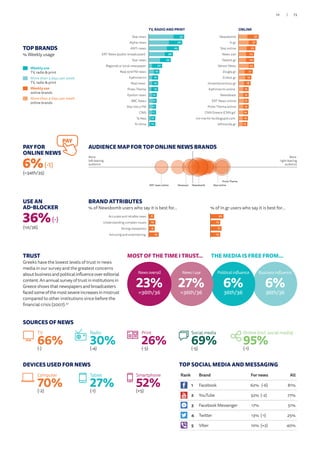
Korea less than a quarter of respondents (23%) agreed that you
could trust the news most of the time.
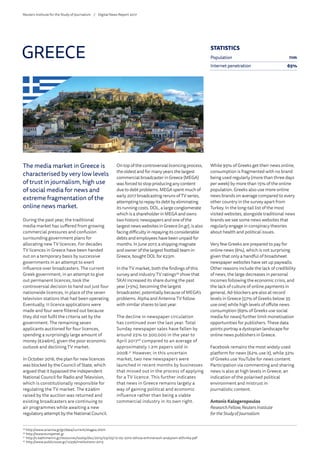
In the United States the headline rate (38%) is up, although there is
a 15-point gap between this and trust in the sources you use (53%).
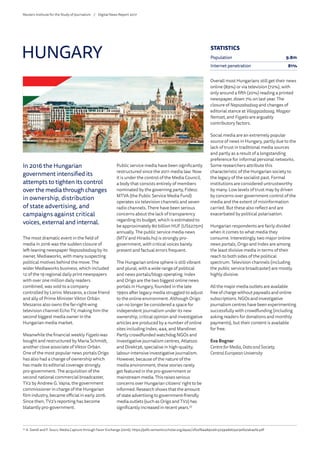
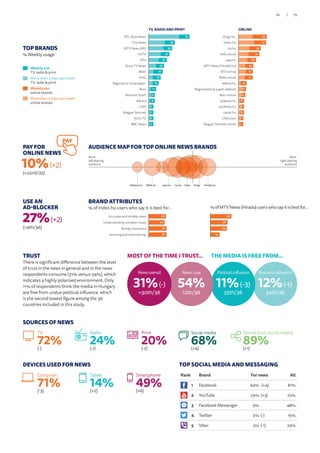
Only Hungary, another deeply polarised country, has a bigger gap
between general trust (31%) and the sources you use (54%).
5
	 UK, US, Canada, Australia, France, Germany, Denmark, Greece, Spain, and Ireland. Focus groups held in UK, US, Finland, and Spain.
Reuters Institute for the Study of Journalism /	 Digital News Report 2017
0%
25%
50%
75%
62 60 58
53 51 51 50 50 49 49 49 48 47 46 46 45 43 43 42 42 42 42 40 39 39 39 39 38
32 31 31 30 29 27
23 23
KORGRESVKMYSFRATWNHUNCZEUSACROROUITAARGTURSGPAUSHKSWEJPNUKAUTIRESUICHLBELMEXNORCANDENGERSPANLDPOLPORBRAFIN
OVERALL TRUST IN NEWS MEDIA – ALL MARKETS
Q6_2016_1/6. Please indicate your level of agreement with the following statements. - I think you can trust most news most of the time/I think I can trust most of the news I consume most of the
time Base:Totalsampleineachmarket.
UK
Trust down 7
percentage
points
USA
53% trust
sources
they use
Hungary
54% trust
sources
they use
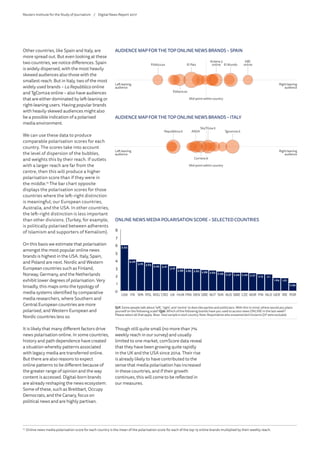
To understand more about polarisation, we have mapped
respondents’ political beliefs on a left–right spectrum and
combined this with the sources of online news they use. The
mid-point represents the mid-point of political opinion of our
respondents; in the country in question the size of each bubble
represents volume of consumption for each brand.6
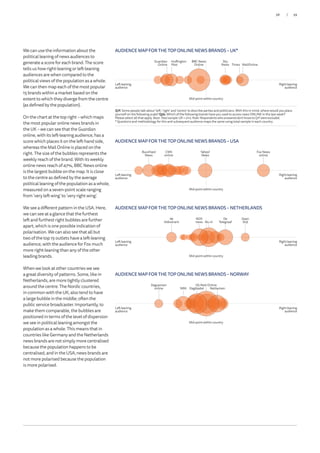
The resulting map for the United States (see below) shows a deeply
polarised media landscape, which reflects an equally polarised
society. The websites of TV networks like ABC, NBC, and CBC are
used far more by people who self-identify as left-wing, along with
the NewYorkTimes and WashingtonPost. By contrast the Fox News
and Breitbart websites are mostly used by people with right-wing
views. Arguably the gap on the right of this map has provided space
for a range of hyper-partisan right-wing sites to emerge over the last
few years. The map shows just online sites, but we should remember
that polarisation also exists in the print and TV markets. Two-thirds
of right-wingers watch the Fox News TV channel but only 11% of
those who identify on the left. The hyper-partisan websites are even
more split, with 19% of those on the right using Breitbart.com but
only 2% on the left.
We can compare the US media and audience landscape with two
very different European countries. The UK online map uses the
same scale but shows less polarisation amongst the top online
sources. A third of those who self-identify on the right read the
Mail Online, 14% in the centre, and 8% on the left. There are a few
hyper-partisan sites (Breitbart and the Canary) but they attract
much smaller audiences than in the United States. The BBC, which
sits in the centre of our chart, is used relatively equally by those
on the left, centre, and the right and provides a common set of
facts with a combined online/offline weekly reach of 77%. Having
said that, the polarising Brexit debate has increased distrust in
the mainstream media generally from those on both ends of the
debate, with the BBC particularly under fire.
“IusedtotrustandvaluetheBBCnewsbutnow
it’sjustamouthpiecefortheliberalleftists.”
Male(52),UK
“EventheBBCtendstosupport[a]
farrightwingedpartynowadays.”
Female(54),UK
AUDIENCE MAP FOR THE TOP ONLINE NEWS BRANDS (INCLUDING NEW POLARISED NEWS BRANDS) – USA
Q1F. Some people talk
about ‘left’, ‘right’ and
‘centre’ to describe parties
and politicians. With this in
mind, where would you
place yourself on the
following scale? Q5b. Which
of the following brands have
you used to access news
ONLINE in the last week?
Please select all that apply.
Base: Total sample: USA =
2269. Note: Respondents who
answered don’t know
to Q1F were excluded.
Left leaning
audience
Right leaning
audience
Mid-point within country
Fox
News
Yahoo!
News
The so called
‘liberal media’
REUTERS INSTITUTE FOR THE STUDY OF JOURNALISM
Slide 48
AUDIENCE MAP FOR THE TOP ONLINE NEWS BRANDS (INCLUDING NEW POLARISED NEWS BRANDS) – UK
Q1F. Some people talk
about ‘left’, ‘right’ and
‘centre’ to describe parties
and politicians. With this in
mind, where would you
place yourself on the
following scale? Q5b. Which
of the following brands have
you used to access news
ONLINE in the last week?
Please select all that apply.
Base: Total sample: UK = 2112.
Note: Respondents who
answered don’t know to Q1F
were excluded.
Left leaning
audience
Right leaning
audience
Mid-point within country
MailOnline
BBC News
Online
Guardian
Online
The Canary
REUTERS INSTITUTE FOR THE STUDY OF JOURNALISM
Slide 49
6
	 Polarisation score for each brand is the difference between the mean ideology (measured on a seven-point scale using Q1F) of the audience for each brand and the mean ideology
of the population as a whole, expressed in multiples of the standard deviation the mean ideology of the population as a whole.
21/20
“Idon’talwaystrustthemedia,especiallyinmatters
relatingtotherefugeecrisis”
Female(56),Germany
“Thereisalotthatishushedupinthemedia.Thereisa
bigdifferencebetweenGermanandArabmediaeven
whentheyreportthesamestory.”
Female(30),Germany
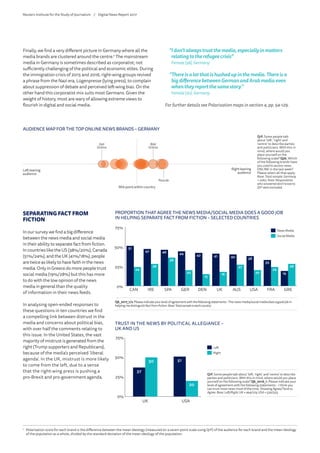
For further details see Polarisation maps in section 4, pp. 54-129.
AUDIENCE MAP FOR THE TOP ONLINE NEWS BRANDS – GERMANY
Q1F. Some people talk
about ‘left’, ‘right’ and
‘centre’ to describe parties
and politicians. With this in
mind, where would you
place yourself on the
following scale? Q5b. Which
of the following brands have
you used to access news
ONLINE in the last week?
Please select all that apply.
Base: Total sample: Germany
= 2062. Note: Respondents
who answered don’t know to
Q1F were excluded.
Left leaning
audience
Right leaning
audience
Mid-point within country
Bild
Online
N24.de
Zeit
Online
REUTERS INSTITUTE FOR THE STUDY OF JOURNALISM
Slide 50
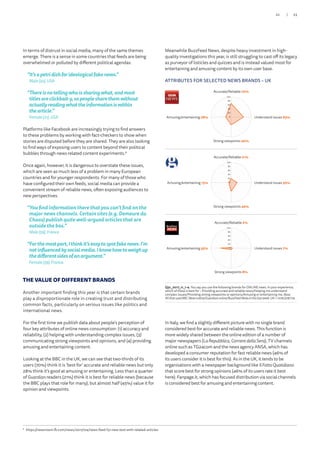
SEPARATING FACT FROM
FICTION
In our survey we find a big difference
between the news media and social media
in their ability to separate fact from fiction.
In countries like the US (38%/20%), Canada
(51%/24%), and the UK (41%/18%), people
are twice as likely to have faith in the news
media. Only in Greece do more people trust
social media (19%/28%) but this has more
to do with the low opinion of the news
media in general than the quality
of information in their news feeds.
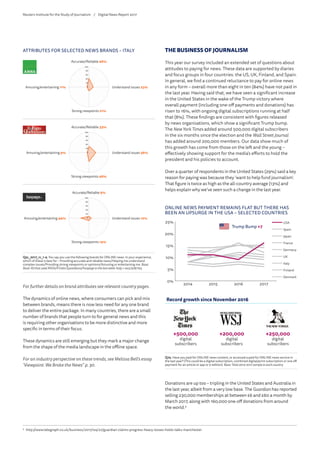
In analysing open-ended responses to
these questions in ten countries we find
a compelling link between distrust in the
media and concerns about political bias,
with over half the comments relating to
this issue. In the United States, the vast
majority of mistrust is generated from the
right (Trump supporters and Republicans),
because of the media’s perceived ‘liberal
agenda’. In the UK, mistrust is more likely
to come from the left, due to a sense
that the right-wing press is pushing a
pro-Brexit and pro-government agenda.
PROPORTION THAT AGREE THE NEWS MEDIA/SOCIAL MEDIA DOES A GOOD JOB
IN HELPING SEPARATE FACT FROM FICTION – SELECTED COUNTRIES
Q6_2017_1/2.Pleaseindicateyourlevelofagreementwiththefollowingstatements-Thenewsmedia/socialmediadoesagoodjobin
helpingmedistinguishfactfromfiction.Base:Totalsampleineachcountry
0%
25%
50%
75%
24
28
36
20
15
18
27
20
24
28
51
47 46 44 42 41 40 38
33
19
GREFRAUSAAUSUKDENGERSPAIRECAN
News Media
Social Media
REUTERS INSTITUTE FOR THE STUDY OF JOURNALISM
Slide 51
TRUST IN THE NEWS BY POLITICAL ALLEGIANCE –
UK AND US
Q1F. Some people talk about ‘left’, ‘right’, and ‘centre’ to describe
parties and politicians. With this in mind, where would you place
yourself on the following scale? Q6_2016_1. Please indicate your
level of agreement with the following statements: - I think you
can trust most news most of the time. Showing Agree/Tend to
Agree. Base:Left/Right:UK=494/274,USA=530/533.
0%
25%
50%
75%
50
20
37
51
Right
Left
USAUK
Left
Right
REUTERS INSTITUTE FOR THE STUDY OF JOURNALISM
Slide 52
7
	 Polarisation score for each brand is the difference between the mean ideology (measured on a seven-point scale using Q1F) of the audience for each brand and the mean ideology
of the population as a whole, divided by the standard deviation of the mean ideology of the population.
Finally, we find a very different picture in Germany where all the
media brands are clustered around the centre.7
The mainstream
media in Germany is sometimes described as corporatist; not
sufficiently challenging of the political and economic elites. During
the immigration crisis of 2015 and 2016, right-wing groups revived
a phrase from the Nazi era, Lügenpresse (lying press), to complain
about suppression of debate and perceived left-wing bias. On the
other hand this corporatist mix suits most Germans. Given the
weight of history, most are wary of allowing extreme views to
flourish in digital and social media.
Reuters Institute for the Study of Journalism /	 Digital News Report 2017
In terms of distrust in social media, many of the same themes
emerge. There is a sense in some countries that feeds are being
overwhelmed or polluted by different political agendas.
“It’sapetridishforideologicalfakenews.”
Male(32),USA
“Thereisnotellingwhoissharingwhat,andmost
titlesareclickbait-y,sopeoplesharethemwithout
actuallyreadingwhattheinformationiswithin
thearticle.”
Female(21),USA
Platforms like Facebook are increasingly trying to find answers
to these problems by working with fact-checkers to show when
stories are disputed before they are shared. They are also looking
to find ways of exposing users to content beyond their political
bubbles through news related content experiments.8
Once again, however, it is dangerous to overstate these issues,
which are seen as much less of a problem in many European
countries and for younger respondents. For many of those who
have configured their own feeds, social media can provide a
convenient stream of reliable news, often exposing audiences to
new perspectives.
“You find information there that you can’t find on the
major news channels. Certain sites (e.g. Demeure du
Chaos) publish quite well-argued articles that are
outside the box.”
Male(59),France
“Forthemostpart,Ithinkit’seasytospotfakenews.I’m
notinfluencedbysocialmedia.Iknowhowtoweighup
thedifferentsidesofanargument.”
Female(59),France.
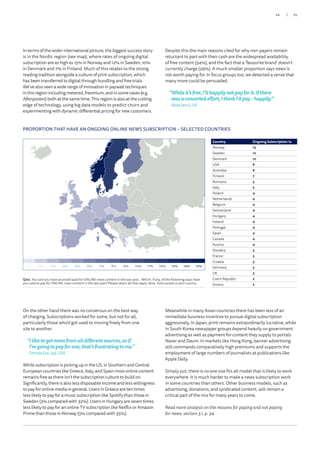
THE VALUE OF DIFFERENT BRANDS
Another important finding this year is that certain brands
play a disproportionate role in creating trust and distributing
common facts, particularly on serious issues like politics and
international news.
For the first time we publish data about people’s perception of
four key attributes of online news consumption: (1) accuracy and
reliability, (2) helping with understanding complex issues, (3)
communicating strong viewpoints and opinions, and (4) providing
amusing and entertaining content.
Looking at the BBC in the UK, we can see that two-thirds of its
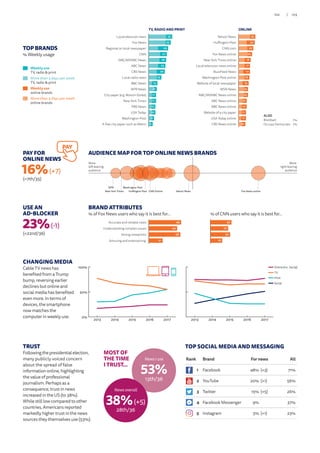
users (70%) think it is ‘best for’ accurate and reliable news but only
28% think it’s good at amusing or entertaining. Less than a quarter
of Guardian readers (21%) think it is best for reliable news (because
the BBC plays that role for many), but almost half (45%) value it for
opinion and viewpoints.
Meanwhile BuzzFeed News, despite heavy investment in high-
quality investigations this year, is still struggling to cast off its legacy
as purveyor of listicles and quizzes and is instead valued most for
entertaining and amusing content by its own user base.
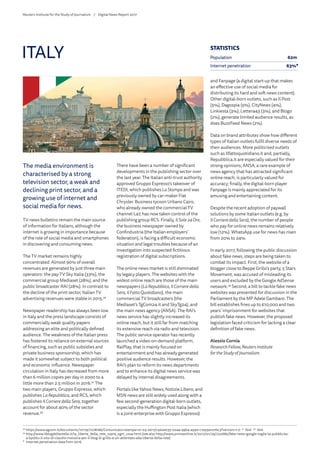
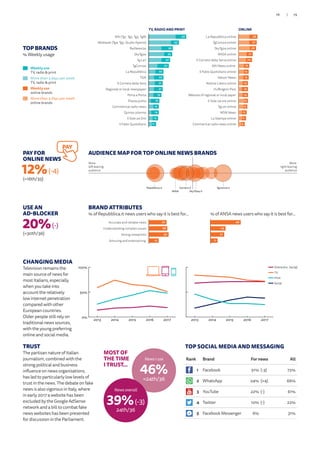
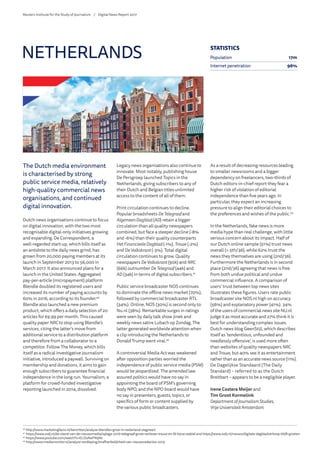
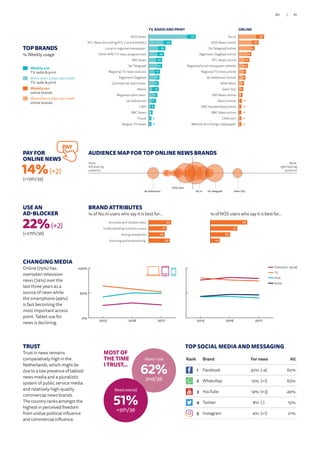
In Italy, we find a slightly different picture with no single brand
considered best for accurate and reliable news. This function is
more widely shared between the online edition of a number of
major newspapers (LaRepubblica, CorrieredellaSera), TV channels
online such as TG24com and the news agency ANSA, which has
developed a consumer reputation for fast reliable news (46% of
its users consider it is best for this). As in the UK, it tends to be
organisations with a newspaper background like IlFattoQuotidiano
that score best for strong opinions (46% of its users rate it best
here). Fanpage.it, which has focused distribution via social channels
is considered best for amusing and entertaining content.
ATTRIBUTES FOR SELECTED NEWS BRANDS – UK ATTRIBUTES FOR SELECTED NEWS BRANDS – UK
20
40
60
80
100 BBC News
Amusing/entertaining
Strong viewpoints
Understand issues
Accurate/reliable
20
40
Amusing/entertaining
Strong viewpoints
Understand issues
100
80
60
40
20
0
100
80
60
40
20
0
100
80
60
40
20
0
20
40
60
80
100 BBC News
Amusing/entertaining
Strong viewpoints
Understand issues
Accurate/reliable
20
40
60
80
100 The Guardian
Amusing/entertaining
Strong viewpoints
Understand issues
Accurate/reliable
20
40
60
80
100 Buzzfeed news
Amusing/entertaining
Strong viewpoints
Understand issues
Accurate/reliable
20
40
60
80
100 BBC News
Accurate/reliable
20
40
60
80
100 The Guardian
Amusing/entertaining
Strong viewpoints
Understand issues
Accurate/reliable
20
40
60
80
100 Buzzfeed news
Amusing/entertaining
Strong viewpoints
Understand issues
Accurate/reliable
Q5c_2017_rc_1-4. You say you use the following brands for **online** news. In your experience,
which of these is best for – Providing accurate and reliable news/Helping me understand
complex issues/Providing strong viewpoints or opinions/Amusing or entertaining me. Base:
AllthatusedBBCNewsonline/Guardianonline/BuzzFeedNewsinthelastweek:UK= 1076/378/174.
Q5c_2017_rc_1-4. You say you use the following brands for ONLINE news. In your experience,
which of these is best for – Providing accurate and reliable news/Helping me understand
complex issues/Providing strong viewpoints or opinions/Amusing or entertaining me. Base:
AllthatusedBBCNewsonline/Guardianonline/BuzzFeedNewsinthelastweek:UK=1076/378/174.
Accurate/Reliable 70%
Accurate/Reliable 21%
Accurate/Reliable 2%
Strong viewpoints 40%
Strong viewpoints 45%
Strong viewpoints 8%
Understand issues 63%
Understand issues 30%
Understand issues 7%
Amusing/entertaining 28%
Amusing/entertaining 13%
Amusing/entertaining 55%
REUTERS INSTITUTE FOR THE STUDY OF JOURNALISM
Slide 53
8
	https://newsroom.fb.com/news/2017/04/news-feed-fyi-new-test-with-related-articles
23/22
Ansa
d issues
Ansa
d issues
Il Fatto Quotidiano
d issues
Fanpage
d issues
Ansa
d issues
Il Fatto Quotidiano
d issues
Fanpage
d issues
perience,
nd
Base:
.
Q5c_2017_rc_1-4. You say you use the following brands for ONLINE news. In your experience,
which of these is best for – Providing accurate and reliable news/Helping me understand
complex issues/Providing strong viewpoints or opinions/Amusing or entertaining me. Base:
Base:AllthatusedANSA/IlFattoQuotidiano/Fanpageinthelastweek:Italy = 422/308/163.
ATTRIBUTES FOR SELECTED NEWS BRANDS – ITALY
100
80
60
40
20
0
100
80
60
40
20
0
100
80
60
40
20
0
Accurate/Reliable 46%
Accurate/Reliable 33%
Accurate/Reliable 9%
Strong viewpoints 21%
Strong viewpoints 46%
Strong viewpoints 14%
Understand issues 23%
Understand issues 36%
Understand issues 12%
Amusing/entertaining 11%
Amusing/entertaining 9%
Amusing/entertaining 44%
For further details on brand attributes see relevant country pages.
The dynamics of online news, where consumers can pick and mix
between brands, means there is now less need for any one brand
to deliver the entire package. In many countries, there are a small
number of brands that people turn to for general news and this
is requiring other organisations to be more distinctive and more
specific in terms of their focus.
These dynamics are still emerging but they mark a major change
from the shape of the media landscape in the offline space.
For an industry perspective on these trends, see Melissa Bell’s essay
‘Viewpoint: We Broke the News” p. 30.
THE BUSINESS OF JOURNALISM
This year our survey included an extended set of questions about
attitudes to paying for news. These data are supported by diaries
and focus groups in four countries: the US, UK, Finland, and Spain.
In general, we find a continued reluctance to pay for online news
in any form – overall more than eight in ten (84%) have not paid in
the last year. Having said that, we have seen a significant increase
in the United States in the wake of the Trump victory where
overall payment (including one-off payments and donations) has
risen to 16%, with ongoing digital subscriptions running at half
that (8%). These findings are consistent with figures released
by news organisations, which show a significant Trump bump.
The New York Times added around 500,000 digital subscribers
in the six months since the election and the Wall Street Journal
has added around 200,000 members. Our data show much of
this growth has come from those on the left and the young –
effectively showing support for the media’s efforts to hold the
president and his policies to account.
Over a quarter of respondents in the United States (29%) said a key
reason for paying was because they ‘want to help fund journalism’.
That figure is twice as high as the all-country average (13%) and
helps explain why we’ve seen such a change in the last year.
Donations are up too – tripling in the United States and Australia in
the last year, albeit from a very low base. The Guardian has reported
selling 230,000 memberships at between £6 and £60 a month by
March 2017, along with 160,000 one-off donations from around
the world.9
ONLINE NEWS PAYMENT REMAINS FLAT BUT THERE HAS
BEEN AN UPSURGE IN THE USA – SELECTED COUNTRIES
Q7a. Have you paid for ONLINE news content, or accessed a paid for ONLINE news service in
the last year? (This could be a digital subscription, combined digital/print subscription or one off
payment for an article or app or e-edition). Base:Total2014-2017sampleineachcountry.
0%
5%
10%
15%
20%
25%
USA
Spain
Japan
France
Germany
UK
Italy
Finland
Denmark
2017201620152014
0%
5%
10%
15%
20%
25%
USA
Spain
Japan
France
Germany
UK
Italy
Finland
Denmark
2017201620152014
Record growth since November 2016
+500,000
digital
subscribers
+200,000
digital
subscribers
+250,000
digital
subscribers
Trump Bump +7
REUTERS INSTITUTE FOR THE STUDY OF JOURNALISM
Slide 57
9
	http://www.telegraph.co.uk/business/2017/04/27/guardian-claims-progress-heavy-losses-holds-talks-manchester
Reuters Institute for the Study of Journalism /	 Digital News Report 2017
In terms of the wider international picture, the biggest success story
is in the Nordic region (see map), where rates of ongoing digital
subscription are as high as 15% in Norway and 12% in Sweden, 10%
in Denmark and 7% in Finland. Much of this relates to the strong
reading tradition alongside a culture of print subscription, which
has been transferred to digital through bundling and free trials.
We’ve also seen a wide range of innovation in paywall techniques
inthisregionincludingmetered,freemium,andinsomecases(e.g.
Aftenposten) both at the same time. This region is also at the cutting
edge of technology, using big data models to predict churn and
experimenting with dynamic differential pricing for new customers.
Despite this the main reasons cited for why non-payers remain
reluctant to part with their cash are the widespread availability
of free content (54%), and the fact that a ‘favourite brand’ doesn’t
currently charge (29%). A much smaller proportion says news is
not worth paying for. In focus groups too, we detected a sense that
many more could be persuaded.
“Whileit’sfree,I’llhappilynotpayforit.Ifthere
wasaconcertedeffort,IthinkI’dpay–happily.”
Male(40+),UK
On the other hand there was no consensus on the best way
of charging. Subscriptions worked for some, but not for all,
particularly those who’d got used to moving freely from one
site to another.
“Iliketogetnewsfromalldifferentsources,soif
I’mgoingtopayforone,that’sfrustratingtome.”
Female(24–35),USA
While subscription is picking up in the US, in Southern and Central
European countries like Greece, Italy, and Spain most online content
remains free as there isn’t the subscription culture to build on.
Significantly, there is also less disposable income and less willingness
to pay for online media in general. Users in Greece are ten times
less likely to pay for a music subscription like Spotify than those in
Sweden (3% compared with 32%). Users in Hungary are seven times
less likely to pay for an online TV subscription like Netflix or Amazon
Prime than those in Norway (5% compared with 35%).
Meanwhile in many Asian countries there has been less of an
immediate business incentive to pursue digital subscription
aggressively. In Japan, print remains extraordinarily lucrative, while
in South Korea newspaper groups depend heavily on government
advertising as well as payment for content they supply to portals
Naver and Daum. In markets like Hong Kong, banner advertising
still commands comparatively high premiums and supports the
employment of large numbers of journalists at publications like
Apple Daily.
Simply put, there is no one size fits all model that is likely to work
everywhere. It is much harder to make a news subscription work
in some countries than others. Other business models, such as
advertising, donations, and syndicated content, will remain a
critical part of the mix for many years to come.
Read more analysis on the reasons for paying and not paying
for news, section 3.1, p. 34.
1% 2% 3% 4% 5% 6% 7% 8% 9% 10% 11% 12% 13% 14% 15%
PROPORTION THAT HAVE AN ONGOING ONLINE NEWS SUBSCRIPTION – SELECTED COUNTRIES
Country Ongoing Subscription %
Norway 15
Sweden 12
Denmark 10
USA 8
Australia 8
Finland 7
Romania 5
Italy 5
Poland 4
Netherlands 4
Belgium 4
Switzerland 4
Hungary 4
Ireland 4
Portugal 4
Spain 4
Canada 4
Austria 4
Slovakia 3
France 3
Croatia 3
Germany 3
UK 3
Czech Republic 2
Greece 2
Q7ai. You said you have accessed paid for ONLINE news content in the last year… Which, if any, of the following ways have
you used to pay for ONLINE news content in the last year? Please select all that apply. Base: Total sample in each country.
REUTERS INSTITUTE FOR THE STUDY OF JOURNALISM
Slide 58
25/24
AD-BLOCKING ON HOLD
One threat to the news industry seems a little less pressing.
Our data show that there has been no significant increase in
ad-blocking over the last year.
Around a quarter (24%) continue to use software that magically
removes all advertisements. The figure is highest in Greece (36%)
and Poland (32%) and lowest in Japan (13%) and South Korea
(12%). Crucially, despite industry fears, it has not spread to the
smartphone where only less than one in ten (7%) have worked
out how to install blockers or browsers that block by default.
The threat has not gone away. In focus groups, those who were not
aware of them expressed strong interest in using them, but for the
moment usage is largely confined to the desktop. Younger groups
are also almost twice as likely to use them.
Another hopeful sign has been the increasing proportion of
respondents (43%) who have agreed to temporarily turn off
their ad-blocker for particular news sites. Publishers have been
experimenting with different approaches, ranging from messages
that ‘ask nicely’, to offering ad-free subscription alternatives, and
blocking content completely. The tough love approach seems to
have worked best with over half of those who had whitelisted a site
(58%) saying they did it because it was the only way they could see
the content. A quarter (26%) responded to messages explaining
that sites need advertising to survive.
0%
10%
20%
30%
40%
50%
36
32 31 31
29 28 28 28 27 27 27 27 27 26 26
24 24 24 24 24 24 23 23 23 23 23 22 22 22
20 20 19
17 17
13 12
KORJPNBRAHKSUITWNITASVKNLDUKCZEBELNORUSAAUTDENSGPFINCHLROUAUSCANSWEMEXCROHUNTURMYSSPAGERPORIREARGFRAPOLGRE
PROPORTION THAT ARE CURRENTLY USING AN AD-BLOCKER – ALL MARKETS
QAD4. On which, if any, of the following personal devices do you CURRENTLY use software that allows you to block adverts on the internet?Base:Totalsampleineachmarket.
REUTERS INSTITUTE FOR THE STUDY OF JOURNALISM
Slide 60
0% 25% 50% 75%
12
26
43
58
REASONS FOR TURNING OFF AD-BLOCKERS – ALL MARKETS
I wanted to
see the adverts
I was told that the website requires
money from advertising to keep going
The website or content did not display
properly with the ad blocker enabled
It was the only way to
view the website or content
43% have
temporarily
disabled their
ad-blocker
for news
REUTERS INSTITUTE FOR THE STUDY OF JOURNALISM
Slide 62
Opt_QAD5i. Base:Allwhohaveeverdisabledtheirad-blocker:Allmarkets=11,513.
Note:ThisquestionwasnotaskedinIrelandandAustralia.
“ItdependsonthesourceI’mlookinginto.Ifit’sa
reliablesourceIusuallyremoveitandtakethe
advertising,andthenIputitbackon,it’slikea
wallthatdoesn’tletthatmassadvertisingin.”
Focusgroup(35–54),Spain
“OnsomewebsitesIdon’tuseitifIthinkthewebsite
deservestheadincome…Idon’tusethemonspecial
interestpageswhereIknowtheyneedthemoney.”
Focusgroup(35–54),Finland
Reuters Institute for the Study of Journalism /	 Digital News Report 2017
CONCLUSION
Journalism is being hit by forces that have been building for some
time but the past year has seen this story break out from its media
bubble to attract the attention of policy makers, politicians, and
even the wider public. The news itself has become the news.
The abundance of content on the internet combined with new
forms of distribution have contributed to a crisis of confidence
in journalism where it is hard to distinguish verified facts
from untruths, ‘alternative facts’, or information that is laced
with extreme agendas. At the same time, the production of
undifferentiated news, often with clickbait-y headlines, is now
being exposed by social distribution where consumers are less
aware of the original sources and don’t go out of their way
to choose a specific news brand.
As a result we are reaching a crisis point where the pressure is
building on both media companies and platforms to come up
with solutions. That’s why we are seeing more news organisations
refocusing on quality, unique journalism that people would
be prepared to pay for,10
as well as ways to demonstrate the
transparency, fairness, and accountability of their journalism
(fact-checking, reader editors, etc.). And there is also a new focus
on audience engagement, on driving ‘quality reach’ rather than
just big numbers, and on building habit though email and mobile
notifications. But these are not universal trends. In Asia, Latin
America, and Southern Europe the focus on advertising income
continues, while the willingness (or ability) of readers to pay
directly is more limited.
From the platform perspective, there is an increased recognition
that algorithms are rarely neutral, nor can they deal with the
nuances and complexities of our modern world. As regulators and
legislators circle in the wings, Google and Facebook are responding
in various ways including – in the news area – through partnerships
with independent fact-checkers and the testing of new algorithms
that attempt to break people out of their bubbles.11
They know too
that their long-term business depends on building far higher levels
of trust than our survey demonstrates people currently have in
social media in particular.
And then, even if those issues are resolved, the business questions
remain. How can news organisations create enough value to
persuade people to pay? Through cooperation and partnership can
they create enough scale to compete with Google and Facebook in
the advertising market, or at least within specific niches? What mix
of models can bring in enough money to sustain quality journalism?
Can the market provide all the solutions or might public subsidy be
required, and if so with what implications for independence in an
increasingly polarised political environment?
This year’s survey does at least include some more optimistic
signs; the emergence of donations and other evidence of public
support for journalism should encourage non-profits. The uptick
in subscriptions in the United States is helpful, but is unlikely to
be enough on its own. Ad-blockers may be in abeyance but the
problem of getting display advertising to work on a mobile screen
is yet to be solved. In parts of the world, membership models are
emerging as just one of a number of potential new revenue sources
while our country pages across 36 countries showcase more
innovation around business models, distribution, and formats than
we’ve seen for some time.
The crisis over fake news could be the best thing that has happened
to journalism – or the worst. It is certainly focusing minds and
wallets. Next year’s chapter in this on-going story will be fascinating
to watch.
10
	Mark Thompson, CEO, New York Times: ‘We want every story we report, every column of opinion we publish, to be worth paying for.’ https://www.theguardian.com/
commentisfree/2016/dec/16/fake-news-journalism-digital
11
	 BuzzFeed, Facebook’s Charm Offensive: https://www.buzzfeed.com/craigsilverman/facebook-charm-offensive
27/26
Reuters Institute for the Study of Journalism /	 Digital News Report 2017
Section 2
Viewpoint:
We broke the news media,
how can we fix them?
Melissa Bell
Publisher and co-founder, Vox Media
29/ 29/28
Let me paint a picture of an industry squeezed from all sides:
•	 When the President of the United States does not like a story
about his work, he calls it fake news.
•	 When the average 18-year-old checks her phone, sometimes
up to 200 times a day, she is bombarded by videos and ads
and stories from uncertain sources, with little to guide her
on how to distinguish between quality and trash, to tell truth
from fiction.
•	 When the Interactive Advertising Bureau counted up all the
online advertising dollars spent in 2016, 49% went to Google,
40% went to Facebook, and ‘everyone else’ split up the last 11%.
•	 When media organisations finally figured out how to bring
their work to mobile websites, the web splintered into many
multiples of media: Instant Articles and AMPs (Accelerated
Mobile Pages) and Snapchat and VR headsets and Amazon
Echoes, to name a few.
The media industry is stretched thin, anxious, and walking a razor’s
edge. And perhaps the biggest threat to our business is not an
external pressure: we have a broken media industry because we
have broken the confidence of our audience.
According to the 2017 Reuters Institute Digital News Report, less
than half the population (43%) trust the media across all the 36
countries surveyed and almost a third (29%) actively avoids the
news, rising to 38% in the United States. Instead of enriching their
lives, our work depresses them. And underlying this loss of trust is
a perception of media bias driven by polarisation. People cluster
to media organisations that fit their belief, and dismiss other
outlets. The internet, once thought to open the world up to all
the information possible and bring people together, has instead
drawn people into their own corners.
“Wehaveabrokenmediaindustry
becausewehavebrokenthe
confidenceofouraudience.”
Q6_2016_1. Please indicate your level of agreement with the following statements. – I think you
can trust most news most of the time Q1di_2017. Do you find yourself actively trying to avoid
news these days? Base:Totalsample:Allcountries=71,805,USA=2269.
BROKEN NEWS?
All Countries USA
43%
Trust the news
in general
38%
Trust the news
in general
29%
Avoid the news
(often or
sometimes)
38%
Avoid the news
(often or
sometimes)
How did we get here? News organisations moved too slowly to
adapt. For too long, we used outmoded approaches built for the
technologies of print and television, in a wholly new medium, the
internet, and in so doing failed to address the problems facing
audiences today.
What were some of those problems? A surfeit of information was
one. Audiences had to contend with too much information, rather
than not having enough. In the cacophony, they sought out voices
they could trust, topics they admired. Rather than shifting towards
developing relationships with audiences in a very real, committed
way, the media tiptoed into community engagement.
Another issue: the media once had a monopoly on information and
the means to distribute it, but that made us a bit too comfortable,
sinking us into a sanctimonious belief that we were the truth
holders instead of truth seekers. We used ‘editorial judgement’ as
a code for ‘what we think is important and think you should know’.
Particularly in the US, this notion of objectivity allowed Roger Ailes
to stroll right in and tell half the US audiences that his Fox News
network would offer up ‘fair and balanced’ news, setting off a battle
between news organisations over who had the more accurate facts.
Viewpoint: We broke
the news media, how
can we fix them?
Melissa Bell
Publisher and co-founder, Vox Media
Reuters Institute for the Study of Journalism /	 Digital News Report 2017
It seems a pretty bleak picture, I know. But there are some small
signs that there may be an answer to our problems in the problem
itself: if we work to rebuild trust with our audiences, we may find
our way to more stable, significant businesses. This Report has
found that in the US, after the election, the news media gained five
points from the prior year in terms of audience trust, at the same
time that subscription rates climbed for the first time in years and
major platforms – from Facebook to Twitter – sought to pay for
quality work.
We started Vox three years ago, worried about how broken the
news had become. We wanted to test ways to create a news
product built for today’s technology and sustained by today’s
business models. We haven’t solved all the problems, but we
have found loyal audiences looking to us for quality work across
platforms. There’s still work to be done, but we’re finding the
beginning of a path by asking ourselves these questions:
•	 What are we missing about audiences these days? And what
are we not providing them?
•	 How do we make our content irresistible and essential to them?
•	 Journalists used to live next door to their sources and their
audience. How do we recreate that sense of community when
our audiences live across the country – or the world?
•	 How do we redefine civic duty in an era when the parameters
of civic life are much narrower or much larger than we’ve
ever known?
•	 No one likes to be told what to think. Most of us appreciate
being invisibly guided to our own understanding and
conclusions. How can we, then, help our audiences seek
knowledge instead of simply publishing information?
•	 Now our audiences can see, in 360 degrees, the suffering in
every corner of the world at any time, the emotional impact
of an overwhelming, never-ending news cycle. What should
we be building when we are all inundated with anxiety and
uncertainty in streams of content every day?
•	 What happens if we face our biases and start to build news
products that show our work and make our evidence part of
the product?
12
	https://www.nytimes.com/2017/04/10/business/media/pulitzer-prizes-2017.html
13
	https://www.theguardian.com/media/2016/dec/08/guardian-announces-partnership-with-vice
This business has long been built on people who love the thrill of
competition, whether it’s an arms race of technology or sales deals
or scoops. But the golden era has long since faded. We don’t have
enough resources to go around and the competition has grown
beyond other media organisations. Instead of fighting over the
same stories, we need to amplify each other’s work, and then push
to discover other stories. You’re seeing that with partnerships
forged around storytelling, such as the recent shared Pulitzer Prize
between the NewYork Daily News and ProPublica12
or the recent
announcement of a content partnership deal between the
Guardian and Vice.13
You see it happening in the technology and advertising space. At
Vox Media, we’ve partnered with Condé Nast and NBC Universal to
build a better approach to premium ad experiences. And you see
it in platforms as well, such as with Google’s open-sourced AMP
project. What happens if we treat the lessons we’re learning as a
way to build each other up instead of tear each other down? Our
audiences deserve – and the speed of change demands – this type
of cooperation, not competition.
“Wehavetoconstantlychallenge
ourselvestobuildsomethingthat
solvesaproblemforouraudience.”
Finally, we have to be seized by a sense of purpose. We have to
know who we are and what we are trying to do, so our audience
can come to know us and what to expect from us. We have to
constantly challenge ourselves to build something that solves a
problem for our audience. This is a choice we all make: you can
try to scale by creating a shallow product that reaches everyone,
or you can try to scale by creating different unique products that
deeply matter to loyal audiences.
This work is too important to move slowly. We need to find
the answers to these questions, to go deep, to matter, to make
a difference every single day. Our audience’s trust, and our
businesses, depend on it.
31/30
Reuters Institute for the Study of Journalism /	 Digital News Report 2017
Section 3
3.1 	 Paying for News  34
3.2	 Polarisation in the News Media 38
3.3	 News Avoidance  41
3.4	 Social Media and Incidental Exposure 43
3.5	 Participation and Online News 45
3.6	 Comparative Brand Analysis and New Countries 47
33/ 33/32
In this section we will analyse the growth in paying for online news
that we see in some countries, and examine some of the reasons why
people pay (and why most don’t). For the first time we are able to
contextualise our figures for paying for online news with comparable
figures for digital audio and video. To complement our survey data
we carried out a series of eight focus groups across four countries
(UK, USA, Spain, and Finland) on the topic of paying for news. We will
refer to some of the findings from these throughout this section.
We start with the headline figures for paying for online news. Here,
we place the focus on people who say they have made an ‘ongoing
payment (subscription) for a digital news service’ in the last year, as
these are often the most lucrative for publishers. Payment figures
tend to be higher in Nordic countries like Denmark (10%), Sweden
(12%), and Norway (15%). However, they fall to just 2% in Greece
and the Czech Republic. Similarly, just 3% in the UK paid for an
ongoing news subscription in the last year.
The brighter shading on the column chart below indicates other
types of payment for online news, including one-off purchases for
single editions, print/digital bundles, and donations. We can see at
a glance that these are more common than ongoing payments in
some markets.
Thinking about all types of payment for online news over time,
we find that in most of the countries we have been tracking for
several years there has been little significant change in the
top-level figures. The clear exception to this rule is the USA,
where the figure has leapt from 9% in 2016 to 16% in 2017.
One thing that has been unclear until now is where this increase
has come from. Who is paying now that wasn’t one year ago?
There is evidence of growth from two sections of society:
younger people and those on the political left. As shown in the
chart opposite, we see some growth across all age groups, but
particularly from the under 35s. In the USA, the proportion of
people aged 18–24 paying for online news rose from 4% in 2016
to 18% in 2017. We see the same pattern by political leaning;
some growth within all groups, but particularly from those
on the left. It is too early to know whether these increases
constitute a groundswell, or simply a knee-jerk reaction to
a political shock.
0%
5%
10%
15%
20%
25%
30%
15
12
10
8 8 8 8 8
7
6 6
5 5
4 4 4 4 4 4 4 4 4 4 4
3 3 3 3 3 3 2 2 2
GRECZECHLUKGERCROARGFRASVKAUTCANSPAPORIREHUNSUIKORBELNLDPOLITAROUJPNTWNFINAUSSGPUSAMYSHKDENSWENOR
Q7ai. You said you have accessed paid for ONLINE news content in the last year… Which, if any, of the following ways have you used to pay for ONLINE news content in the last year?
Please select all that apply. Base:Totalsampleineachcountry.
*Urban samples Turkey, Brazil and Mexico excluded for fair comparison.
PROPORTION THAT PAID FOR ONLINE NEWS IN THE LAST YEAR – ALL MARKETS*
Ongoing subscription
Other types of news payments
PAYINGFORONLINENEWSBYAGEANDPOLITICALLEANING–USA
Q1f. Some people talk about ‘left’, ‘right’ and ‘centre’ to describe parties and politicians. With
this in mind, where would you place yourself on the following scale? Q7a. Have you paid for
ONLINE news content, or accessed a paid for ONLINE news service in the last year? (This could
be a digital subscription, combined digital/print subscription or one off payment for an article or
app or e-edition) Base:18-24/25-34/35-44/45-54/55+Left/Centre/Right:USA=
180/399/402/395/893 530/919/533.
0%
5%
10%
15%
20%
25%
30%
7
11
9
1515
29
20172016
Left Centre Right
0%
5%
10%
15%
20%
10
14
8
12
11
15
8
20
4
18
20172016
18-24
25-34
35-44
45-54
55+
3.1 Paying for news
Richard Fletcher
Reuters Institute for the Study of Journalism /	 Digital News Report 2017
We also asked those who are currently paying for the most
important reasons behind their decision. Interestingly, the USA
(29%) had the highest proportion saying that they wanted to
fund journalism out of all 36 markets studied. A quarter (25%)
said the same in Australia. Here, we have seen donations to news
organisations jump from 1% in both countries in 2016, to 3% in
Australia, and 4% in the USA in the space of a year (amongst the
whole population). But this pattern is not repeated elsewhere.
If we look across all 36 markets, just 13% said they paid because
they wanted to fund journalism.
In our focus groups, people expressed reservations about the idea
of donating money to commercial entities, and were often unclear
on why they were being asked to do so. This is linked to a perfectly
justifiable lack of understanding about the state of the news
business. It is not obvious to outsiders, for example, why publishers
give content away for free at a time when they are losing money, or
why digital advertising should be worth so much less than print
advertising. When the situation was explained in focus group
discussions, it was often met with surprise, followed by sympathy
and concern, but also an undeniable sense of Schadenfreude
amongst those who have lost trust.
“Ineverreallythoughttheywerelosingfunding…
Ithoughtsomanywereaccessingthenewsonlinethat
theymakesomuchmoneyfromadvertising.”
20–34,UK
“They’reatrainwreck…thebickering,thefighting,the
namecalling…they’rejustsobiasedonbothsides,it
justgetsannoying.”
35–54,USA
In almost all countries, the most commonly cited reasons for
paying are to get access on mobile devices, because of a good deal
or print/digital bundle, or because people like to consume news
from a range of sources that includes paid-for providers. However,
there are variations in the reasons for paying between markets.
Mobile access is more important in many of the smartphone-first
markets, such as Sweden, Hong Kong, and Singapore. Whereas in
Norway, Belgium, and the Netherlands, print/digital bundles have
persuaded a significant number of people to pay.
Interestingly, when asked about the type of content that had most
influenced their decision to pay, across all 36 markets breaking
news (41%) and reporting on recent events (38%) come out top.
In-depth analysis (34%) and commentary (29%), which tend to
be distinct to the news source, are next on the list. Comparatively
few people (23%) pay for access to entertaining or amusing news
content. The importance of breaking news is perhaps surprising,
given that in most countries people can get the same breaking
news from a number of free alternatives. This reasoning has
motivated some publishers (such as The Times of London) to stop
providing breaking news to their paying customers. This makes
sense for publishers, and whilst there was some recognition from
our focus groups that social media often does breaking news better,
it may ultimately be hard to explain this to paying customers who
expect to get the full package.
“IfIampayingforitIwouldratherbethefirsttoknow.”
20–34, USA
In our survey we focused on different types of coverage, but the
focus groups allowed for other factors to emerge. People valued
quality content, in particular good writers, exclusives, and behind-
the-scenes access. Additionally, people stressed the importance of
mobile apps that are customisable, easy to use, and can integrate
multiple devices.
“Itshouldfeeluseful,newsthatIcan’tgetanywhere
else,awellthought-outandwellwrittenpiece,not
justsomethingthat’sthrowntogetherandputon
theinternet.”
20–34, Finland
“Somepeoplearemoreengaging,Ifind.Personally,
that’swhyIpayfortheNewYorkTimes.”
20–34, USA
Q7aii.Yousaidthatyouhavepaidforonlinenewsinthelastyear…Whatarethemostimportantreasonsforthis?Plea
Q7aii.Yousaidthatyouhavepaidforonlinenewsinthelastyear…Whatarethemostimportant
reasonsforthis?Pleaseselectallthatapply.Base:Allwhopaidforonlinenewsinthelastyear:All
markets=9434.
00
REASONS FOR PAYING FOR ONLINE NEWS – ALL MARKETS
0% 10% 20% 30%
30
29
23
21
17
17
17
16
16
16
15
13
It allows me to access news
from my smartphone or tablet
I like to consume news
from a range of sources
I was offered
a good deal
I was able to pay for print
and online access together
My favourite news source
does not allow free access
It was the only way I could
access specialist information
I like to have access to information
that most people do not
There were benefits from membership
other than news access
It was cheaper than paying
for offline access
News you pay for is
better than free news
I need particular
information for my job
I want to help
fund journalism
35/34
We also asked these same people why they do not currently pay for
online news. Across all markets, over half said that this is because
so much online news is freely available (54%). This was also the
most noticeable sentiment from our focus group participants. This
does not necessarily mean, however, that individual brands (such as
the public service broadcaster) should be held entirely responsible.
Previous research using our 2015 data from six countries showed
that consuming news from the public service broadcaster had no
negative effect on individual willingness to pay.14
“Thereissomuchaccessibleforfreethatifyoudon’tfind
itononesiteyoufinditonanother.”
20–34,Spain
“Forme,withnews,Idon’tfeellikeI’mmissinganything
bynotpayingforit.”
20–34,UK
Much of the discussion around paying for online news assumes that
people’s reasons for not paying all revolve around news in some way.
Many of them do, but in some cases people are reluctant to pay for
reasons that are more general. Around one in five (18%) say they
don’t pay because they can’t afford it, and one in ten (11%) say that
they don’t like using their bank details online. Around 6% worry that
it might be difficult to cancel an ongoing payment, or that making
the payment in the first place will simply be too much hassle.
LIKELIHOOD OF PAYING FOR ONLINE NEWS IN THE FUTURE –
SELECTED COUNTRIES
0% 20% 40% 60% 80% 100%
3
5
5
6
6
1
4
1
5
1
2
6
5
5
11
10
9
19
17
20
17
22
26
71
69
69
62
61
57
Don't know
Very likely
Somewhat likely
Somewhat unlikely
Very unlikely
SPA
JPN
USA
FIN
UK
GER
6
Very
unlikely
Somewhat
unlikely
Somewhat
likely
Very
likely
Don’t
know
Q7aiv_rc. You said you have not paid for online digital content in the last year... How likely or
unlikely would you be to pay in the next 12 months for online news from particular sources that
you like?Base:Allwhodidnotpayforonlinenewsinthelastyear:Spain= 1784,Japan= 1688,USA=
1816, Finland=1665,UK=1965,Germany = 1826.
These reasons were most commonly given in Mexico (46%), Greece
(45%), and Turkey (45%), where nearly half of those not paying say
it is at least partly related to factors not specific to news. For others,
the money they have already spent on hardware, software, and
getting connected creates the feeling that they have paid already.
“Youhavegottopayforit.”
“Ihavemylimits;Ican’taffordthat.”
“Theyhavegottopaytheirsalaries.”
“Iknow.Iunderstandthat,butIhavegottopaymyrent.”
20–34, USA
“It’slike,God,I’vespentathousanddollars
onelectronicdevices,canyoupleasegiveme
somethingforfree?”
35–54, USA
14
	Richard Fletcher and Rasmus Kleis Nielsen, Paying for Online News: A Comparative Analysis of Six Countries. Digital Journalism 0(0) (2016).
We should always keep in mind that most people still do not pay
for online news. The first two bars from the left in the next chart
represent those who are either very unlikely, or somewhat unlikely,
to pay for online news in the future. However, we can see that the
‘Trump bump’ is mirrored in the figures for willingness to pay, so it
is possible that we could see further growth in the USA in 2018.
Q7avi. You said that you have not paid for online news in the last year…What are the most important reasons for t
Allmarkets=60,029
REASONS FOR NOT PAYING FOR ONLINE NEWS – ALL MARKETS
0
3
4
4
6
I can get online news for free
My favourite news source doesn’t currently charge for access
Online news isn't worth paying for
I prefer to consume news offline
I can’t afford it at the moment
I don’t like using my credit card or bank details online
I’m not interested enough in the news
I’m worried it will be difficult to cancel the payment
Making the payment will be too much hassle
I’m not online enough
I don’t own a smartphone or a tablet
0
3
4
4
6
9
I can get online news for free
My favourite news source doesn’t currently charge for access
Online news isn't worth paying for
I prefer to consume news offline
I can’t afford it at the moment
I don’t like using my credit card or bank details online
I’m not interested enough in the news
I’m worried it will be difficult to cancel the payment
Making the payment will be too much hassle
I’m not online enough
I don’t own a smartphone or a tablet
Q7avi. You said that you have not paid for online news in the last year…What are the most
important reasons for this? Please select all that apply. Base: All who did not pay for online
news in the last year: All markets = 60,029
REASONS FOR NOT PAYING FOR ONLINE NEWS – ALL MARKETS
0% 10% 20% 30% 40% 50% 60%
3
4
4
6
9
11
18
22
25
29
54
I don’t own a
smartphone or a tablet
I’m not
online enough
Making the payment will
be too much hassle
I’m worried it will be difficult
to cancel the payment
I’m not interested
enough in the news
I don’t like using my credit card
or bank details online
I can’t afford it
at the moment
I prefer to consume
news offline
Online news isn’t
worth paying for
My favourite news source doesn’t
currently charge for access
I can get online
news for free
Non-news reasons for not paying
Reuters Institute for the Study of Journalism /	 Digital News Report 2017
Q7b_2017. Thinking more generally, which of the following types of digital media (if any) have
you paid for online in the last year? Base:Totalsample:Allmarkets=71,805.
PROPORTION THAT PAID FOR OTHER FORMS OF ONLINE MEDIA
IN THE LAST YEAR – ALL MARKETS
0%
5%
10%
15%
20%
25%
23
16
15 15
13
11
10
4 4
Video Audio Mobile
apps
Laptop/
desktop
software
Online
news
Games e-Books A non-
news
website
Premium
non-news
content
The figures for paying for audio and video are skewed towards
younger people. The figures for paying for online news are much
flatter. This is a powerful corrective to idea that young people
are not prepared to pay for online media. Even when it comes to
news, younger people are no less likely to be paying than older
people. Rather, news publishers have not been quite as successful
as other media companies in convincing younger people to part
with their money.
0%
10%
20%
30%
40%
50%
26
15
20
16
14
8 9
13
6
9
7
31
21
35
22
16 17 16
20
18
12 13
40
34 34 33
31 30
28
26 25
20
18
GERSPAUKAUSIRECANFINUSASWEDENNOR
Q7b_2017. Thinking more generally, which of the following types of digital media (if any) have you paid for online in the last year? Base:Totalsampleineachcountry.
PROPORTION THAT PAID FOR ONLINE DIGITAL VIDEO, AUDIO, AND NEWS IN THE LAST YEAR – SELECTED COUNTRIES
Video (eg Netflix)
Audio (eg Spotify)
News
Q7b_2017. Thinking more generally, which of the following types of digital media (if any) have
you paid for online in the last year? Base:18-24/25-34/35-44/44-55/55+:Allmarkets = 7791/12,711/1
3,288/12,888/24,927.
PROPORTION THAT PAID FOR ONLINE DIGITAL VIDEO, AUDIO,
AND NEWS IN THE LAST YEAR BY AGE – ALL MARKETS
0%
10%
20%
30%
40%
50%
News
Audio
Video
55+45-5435-4425-3418-24
Video (eg Netflix)
Audio (eg Spotify)
News
This year for the first time we place paying for online news in
the broader context of paying for online media more generally,
particularly music and video. In short, people are more likely to
pay for access to online video (e.g. via Netflix) and digital audio
(e.g. via Spotify and iTunes) than they are to pay for online news
(see chart right).
However, these averages for all 36 markets obscure the much
larger differences we see in English-speaking countries, Nordic
countries, and Western Europe, where online music and video
services like Spotify and Netflix have a stronger foothold. Here,
digital audio and video services tend to be much further ahead.
In Eastern Europe and Asia, the gap is smaller, but only because
online audio and video are less popular.
this? Please select all that apply. Base:Allwhodidnotpay foronlinenewsinthelastyear:
10 20 30 40 50 60
9
11
18
22
25
29
54
10 20 30 40 50 60
9
11
18
22
25
29
54
Non-news reasons for not paying
37/36
We asked our focus groups why they are more willing to pay for
digital audio and video. People felt that they simply offer a different
experience to news; one that is entertaining, relaxing, or enjoyable.
Also, there was a recognition that (unlike news) the content retains
its value over time, and isn’t accompanied by a sense of waste if
not used every day. Moreover, there was a clearer sense that the
companies that provide this service offer something both valuable
and unique, and are associated with innovative approaches and new
ideas. Crucially, the focus groups also identified that many of these
services are built on aggregating content from multiple sources.
Viewed in this way, asking people to pay for online news from a
single provider could feel strikingly old-fashioned and out of sync
with the experience of multiplicity and choice that people have
come to expect from the web.
[Q:]Subscriptions,subscribingtonews?
[A:]Toonlyonemediaoutlet,no.
25–34,Spain
“Whatyoucoulddois…ifyouwantthepolitics
subscriptionyoucanpay£5amonthandyoucanhave
allthepoliticsyoucanread,orthesciencesubscription
…likeNowTVhasgottheentertainmentbundle.”
25–34,UK
Despite the differences, people who pay for other media online
(such as audio and video) are either much more likely to be paying
for online news already, or are much more willing to pay in the
future. The link is particularly strong in Spain and the USA, where
people are five times more likely to be paying for online news if
they are paying for other things (when compared to people who
have not purchased any online media in the past year). Importantly,
this association is present in all of the 36 markets examined, and
remains even after controlling for age, gender, education, and
interest in news.
PAYING FOR NEWS MORE COMMON AMONGST PEOPLE WHO
PAY FOR DIGITAL AUDIO, VIDEO, AND OTHER ONLINE MEDIA –
SELECTED COUNTRIES
Q7b_2017. Which of the following types of digital media (if any) have you paid for online in the
last year? Q7a. Have you paid for ONLINE news content, or accessed a paid for ONLINE news
service in the last year? (This could be a digital subscription, combined digital/print subscription
or one off payment for an article or app or e-edition) Base:Doesnot/paysforotheronlinemedia:
USA =1034/1226,Finland=1004/1003,Spain= 1125/881,UK= 1168/944
0%
5%
10%
15%
20%
25%
30%
5
7
3 3
25
21
17
9
Does not pay for other online media
Pays for other online media
UKSPAFINUSA
Pays for other online media
Does not pay for other online media
We now have some preliminary evidence to suggest that polarisation
is increasing in some countries, but also that there is large national
variation in the degree to which the audiences for the most
popular news brands are polarised along the left–right spectrum.
In this section we will take a more in-depth look at news media
polarisation. We will explain how our measures are computed,
before exploring some of the differences we see across countries.
In the UK, the audience for the Guardian is made up of far more
people on the left than on the right, but the opposite is true of the
Mail Online. Sky News online has around 20% from both camps.
In the USA, we can similarly see that the online audience for the
NewYork Times is left-leaning, but that for Fox News online is right-
leaning. Yahoo, which aggregates news from a number of different
sources as well as authoring its own content, is evenly split.
POLITICAL BREAKDOWN OF NEWS AUDIENCES FOR SELECTED
BRANDS – UK AND USA
Q5b. Which of the following brands have you used to access news ONLINE in the last week?
Please select all that apply. Q1f. Some people talk about ‘left’, ‘right’, and ‘centre’ to describe
parties and politicians. With this in mind, where would you place yourself on the following
scale? Base:AllwhousedGuardianonline/SkyNewsonline/MailOnline/NewYorkTimes online/
Yahoo!News/FoxNewsonlineinthelastweek:UK=364/162/255,USA=403/495/447.Note:
Respondentswhoanswereddon’tknowtoQ1Fwereexcluded.
0%
10%
20%
30%
40%
50%
12
19
30
43
18
13
Mail OnlineSky News onlineGuardian online
Left-wing
Right-wing
0%
10%
20%
30%
40%
50%
7
20
4849
23
9
Fox News onlineYahoo! NewsNew York Times online
Left-wing
Right-wing
3.2 Polarisation in
the news media
Richard Fletcher
Reuters Institute for the Study of Journalism /	 Digital News Report 2017
We can use the information about the
political leaning of news audiences to
generate a score for each brand. The score
tells us how right-leaning or left-leaning
audiences are when compared to the
political views of the population as a whole.
We can then map each of the most popular
15 brands within a market based on the
extent to which they diverge from the centre
(as defined by the population).
On the chart at the top right – which maps
the most popular online news brands in
the UK – we can see that the Guardian
online, with its left-leaning audience, has a
score which places it on the left-hand side,
whereas the Mail Online is placed on the
right. The size of the bubbles represents the
weekly reach of the brand. With its weekly
online news reach of 47%, BBC News online
is the largest bubble on the map. It is close
to the centre as defined by the average
political leaning of the population as a whole,
measured on a seven-point scale ranging
from ‘very left wing’ to ‘very right wing’.
We see a different pattern in the USA. Here,
we can see at a glance that the furthest
left and furthest right bubbles are further
apart, which is one possible indication of
polarisation. We can also see that all but
two of the top 15 outlets have a left-leaning
audience, with the audience for Fox much
more right-leaning than any of the other
leading brands.
When we look at other countries we see
a great diversity of patterns. Some, like in
Netherlands, are more tightly clustered
around the centre. The Nordic countries,
in common with the UK, also tend to have
a large bubble in the middle; often the
public service broadcaster. Importantly, to
make them comparable, the bubbles are
positioned in terms of the level of dispersion
we see in political leaning amongst the
population as a whole. This means that in
countries like Germany and the Netherlands
newsbrandsarenotsimplymorecentralised
because the population happens to be
centralised, and in the USA, news brands are
not more polarised because the population
is more polarised.
AUDIENCE MAP FOR THE TOP ONLINE NEWS BRANDS – UK*
Q1F. Some people talk about ‘left’, ‘right’ and ‘centre’ to describe parties and politicians. With this in mind, where would you place
yourself on the following scale? Q5b. Which of the following brands have you used to access news ONLINE in the last week?
Please select all that apply. Base:Totalsample:UK=2112.Note:Respondentswhoanswereddon’tknowtoQ1Fwereexcluded.
* Questions and methodology for this and subsequent audience maps the same using total sample in each country
Left leaning
audience
Right leaning
audience
Mid-point within country
MailOnlineTimes
BBC News
Online
Guardian
Online
Huffington
Post
Sky
News
AUDIENCE MAP FOR THE TOP ONLINE NEWS BRANDS – USA
Left leaning
audience
Right leaning
audience
Mid-point within country
Fox News
online
Yahoo!
News
BuzzFeed
News
CNN
online
AUDIENCE MAP FOR THE TOP ONLINE NEWS BRANDS – NETHERLANDS
Left leaning
audience
Right leaning
audience
Mid-point within country
Geen
Stijl
De
Telegraaf
NOS
news Nu.nl
de
Volkskrant
AUDIENCE MAP FOR THE TOP ONLINE NEWS BRANDS – NORWAY
Left leaning
audience
Right leaning
audience
Mid-point within country
Nettavisen
Dagsavisen
online NRK Dagbladet
VG Nett Online
39/38
Other countries, like Spain and Italy, are
more spread out. But even looking at these
two countries, we notice differences. Spain
is widely dispersed, with the most heavily
skewed audiences also those with the
smallest reach. But in Italy, two of the most
widely used brands – LaRepubblica online
and TgCom24 online – also have audiences
that are either dominated by left-leaning or
right-leaning users. Having popular brands
with heavily skewed audiences might also
be a possible indication of a polarised
media environment.
We can use these data to produce
comparable polarisation scores for each
country. The scores take into account
the level of dispersion of the bubbles,
and weights this by their reach. If outlets
with a larger reach are far from the
centre, then this will produce a higher
polarisation score than if they were in
the middle.15
The bar chart opposite
displays the polarisation scores for those
countries where the left–right distinction
is meaningful; our European countries,
Australia, and the USA. In other countries,
the left–right distinction is less important
than other divisions. (Turkey, for example,
is politically polarised between adherents
of Islamism and supporters of Kemalism).
On this basis we estimate that polarisation
amongst the most popular online news
brands is highest in the USA. Italy, Spain,
and Poland are next. Nordic and Western
European countries such as Finland,
Norway, Germany, and the Netherlands
exhibit lower degrees of polarisation. Very
broadly, this maps onto the typology of
media systems identified by comparative
media researchers, where Southern and
Central European countries are more
polarised, and Western European and
Nordic countries less so.
AUDIENCE MAP FOR THE TOP ONLINE NEWS BRANDS – ITALY
Left leaning
audience
Right leaning
audience
Mid-point within country
Tgcom24.itANSARepubblica.it
SkyTG24.it
Corriere.it
AUDIENCE MAP FOR THE TOP ONLINE NEWS BRANDS – SPAIN
Left leaning
audience
Right leaning
audience
Mid-point within country
ABC
onlineEl MundoEl PaisPúblico.es
Antena 3
online
Eldiario.es
ONLINE NEWS MEDIA POLARISATION SCORE – SELECTED COUNTRIES
Q1F. Some people talk about ‘left’, ‘right’, and ‘centre’ to describe parties and politicians. With this in mind, where would you place
yourself on the following scale? Q5b. Which of the following brands have you used to access news ONLINE in the last week?
Please select all that apply. Base:Totalsampleineachcountry.Note:Respondentswhoanswereddon’tknowtoQ1Fwereexcluded.
0
1
2
3
4
5
6
7
8
5.93
4.06
3.76 3.65
3.45 3.41
3.18
2.88 2.85 2.82 2.68 2.62 2.49 2.37 2.34 2.34 2.27 2.13 2.1
1.64 1.61
0.99
PORIREGERNLDFINNORCZESWEAUSSVKAUTGREDENFRAHUNUKCROROUPOLSPAITAUSA
15
	Online news media polarisation score for each country is the mean of the polarisation score for each of the top 15 online brands multiplied by their weekly reach.
It is likely that many different factors drive
news polarisation online. In some countries,
history and path dependence have created
a situation whereby patterns associated
with legacy media are transferred online.
But there are also reasons to expect
online patterns to be different because of
the greater range of opinion and the way
content is accessed. Digital-born brands
are already reshaping the news ecosystem.
Some of these, such as Breitbart, Occupy
Democrats, and the Canary, focus on
political news and are highly partisan.
Though still quite small (no more than 7%
weekly reach in our survey) and usually
limited to one market, comScore data reveal
that they have been growing quite rapidly
in the UK and the USA since 2014. Their rise
is already likely to have contributed to the
sense that media polarisation has increased
in these countries, and if their growth
continues, this will come to be reflected in
our measures.
Reuters Institute for the Study of Journalism /	 Digital News Report 2017
In this section we explore the extent to which people find
themselves actively avoiding the news. We define this not as total
avoidance of news, since our base sample is made up of those
who say they use news at least once a month, but rather as those
who say they avoid news often or sometimes. The issue of news
avoidance is a matter of concern if it means that citizens are not
sufficiently equipped to take decisions in elections or referendums.
There are also concerns that the abundance of other types of media
(e.g. entertainment) may be squeezing exposure to news for less
interested news consumers.
On the country level we find considerable variation, with over
half the respondents in Greece (57%) and Turkey (57%) avoiding
the news, compared with fewer than one in ten in Japan (6%).
Countries like Greece and Turkey are undergoing considerable
economic and political turmoil, which may be a contributory
factor to high levels of avoidance, but it is not easy to identify a
clear pattern. On the other hand, we can observe that stable and
prosperous Nordic countries tend to have much lower levels of
news avoidance (ranging from 14% in Denmark to 20% in Norway).
PROPORTION THAT SOMETIMES OR OFTEN AVOID THE NEWS – ALL MARKETS
Q1di_2017. Do you find yourself actively trying to avoid news these days? Base: Total sample in each market. Q1di_2017. Do you find yourself actively trying to avoid news these days? Base:Totalsample
in eachcountry.
Q1di_2017. Do you find yourself actively trying to avoid news these days? Base: Total sample in each market. Q1di_2017. Do you find yourself actively trying to avoid news these days? Base:Totalsample
in eachcountry.
0%
15%
30%
45%
60%
75%
57 57
50
44
40 39 38
32 31 31 31 30 30 29 28 28 27 27 27 26 26 26 24 24 24 23 22 22 21 21 20 20 19 18
14
6
JPNDENFINTWNNORSGPHKSWEBELPORCZEGERUKAUTSPAKORSUISVKBRANLDITACANFRAAUSIREMEXARGHUNROUUSAMYSCHLPOLCROGRETUR
0
10
20
30
40
50
60
57 57
50
44
40 39 38
32 31 31 31 30 30 29 28 28 27 27 27 26 26 26 24 24 24 23 22 22 21 21 20 20 19 18
14
6
JPNDKFINTWNNORSGNHKSWEBELPORCZGERUKAUTSPAKORSWISVKBRANLITACANFRAAUSIREMEXARGHUNROMUSAMYSCHLPOLCROGRETUR
REASONS BEHIND NEWS AVOIDANCE – ALL MARKETS
Q1di_2017. Do you find yourself actively trying to avoid news these days? Base: Total sample in each market. Q1di_2017. Do you find yourself actively trying to avoid news these days? Base:Totalsample
in eachcountry.
0 10 20 30 40 50
48
37
28
22
19
15
13It consumes too much of my time
It disturbs my ability to concentrate on more important things
It leads to arguments I’d rather avoid
Graphic images upset me
I don't feel there is anything I can do about it
I can’t rely on news to be true
It can have a negative effect on my mood
Q1di_2017. Do you find yourself actively trying to avoid news these days? Base: Total sample in
each market. Q1di_2017. Do you find yourself actively trying to avoid news these days? Base:
Totalsampleineachcountry.
REASONS BEHIND NEWS AVOIDANCE – ALL MARKETS
0% 10% 20% 30% 40% 50%
48
37
28
22
19
15
13
It can have a negative effect on my mood
I can’t rely on news to be true
I don’t feel there is
anything I can do about it
Graphic images upset me
It leads to arguments I’d rather avoid
It disturbs my ability to concentrate
on more important things
It consumes too much of my time
3.3 News avoidance
Antonis Kalogeropoulos
Around half of our all our respondents (48%) said they avoided
news because it had a negative effect on their mood, while almost
four in ten (37%) said they did because they feel they cannot rely on
the news to be true.
41/40
While these two reasons are not mutually
exclusive, it is interesting to compare them
because they reflect two distinct types:
avoidance stemming from the depressing
nature of the content itself, and avoidance
due to disapproval of the news media more
broadly. In Poland, the unreliability (or
bias) of news is the most important factor,
while in the United States and the United
Kingdom we see a much higher level of
avoidance due to negative mood (57% and
60%). This may be because a significant
proportion of the population in each
country feels deeply disenchanted by the
Trump victory and Brexit vote respectively.
Looking at political orientation in the US,
we can see that the people on the left are
more likely than people on the right to
avoid news because it has a negative effect
on their mood or because they feel that
there is not anything they can do about it.
However, people on the right in the US are
more likely to avoid news because they find
it not reliable: 62% of news avoiders on
the right cited this as a reason, while only
18% of people on the left did so. This could
be connected to the narrative that the
mainstream media have a ‘liberal agenda’.
In terms of the demographics, we find that
women are much more likely to avoid news
than men in most countries. Age does not
seem to be a significant factor, evidence
that counters the prevailing narrative that
young people are turning away from news.
REASONS BEHIND NEWS AVOIDANCE – ALL MARKETS
Q1dii_2017. You said that you find yourself trying to avoid news ... Which, if any, of the following are reasons why you actively try to
avoid news? Base:Allwhooftenorsometimesavoidthenewsineachcountry.
0%
10%
20%
30%
40%
50%
60%
37 35
29
33
39
45
42
39
48
57
60
52
39
44
37
34
MEXPOLHUNFRASWEUKUSATOTAL
It can have a negative effect on my mood
I can’t rely on news to be true
REASONS BEHIND NEWS AVOIDANCE BY POLITICAL ORIENTATION – USA
Q1F. Some people talk about ‘left’, ‘right’, and ‘centre’ to describe parties and politicians. With this in mind, where would you place
yourself on the following scale? Q1dii_2017. You said that you find yourself trying to avoid news ... Which, if any, of the following are
reasons why you actively try to avoid news? Base:Allontheleft/centre/rightwhooftenorsometimesavoidthenewsinthe USA.
0%
10%
20%
30%
40%
50%
60%
70%
80%
50
16
62
54
28
31
68
30
18
Left Centre Right
It can have a negative
effect on my mood
I can’t rely on news
to be true
I don’t feel there is anything
I can do about it
Reuters Institute for the Study of Journalism /	 Digital News Report 2017
How is the rise of social media changing news consumption? This
is one of the most pressing questions concerning the media today.
The growth of social media may be slowing down in some countries,
but the influence of platforms – in particular Facebook and Google
– has never been greater, as people worry about misinformation,
polarisation, filter bubbles, echo chambers, and the erosion of the
shared news agenda, to name just a few concerns.
In this section we shed some light on these issues by focusing on
incidental exposure to news – situations where people end up
consuming something while intending to do something else.
Many twentieth-century mass media environments were in part
characterised by incidental exposure to news. People often read
newspapers for their non-news content (e.g. reviews, recipes, and
puzzles), and people carried on watching television news bulletins
after their favourite entertainment programme had finished. But in
high-choice media environments like the web, where people enjoy
greater control over what they consume, some worry that there
will be less incidental exposure leading to a situation where people
most interested in news will be much better informed, but those
with low interest will be left behind.
It is perhaps easy to forget that algorithmically driven services like
search engines, aggregators, and social media have the potential
to reintroduce incidental exposure to news, for the simple reason
that they assume some responsibility for what we see online. We
decided to see whether our respondents experience and recognise
this. It appears that many do.
For users of both social media and news aggregators, more
people agree that they often see news from sources they wouldn’t
normally use (36% and 35%) than disagree (27%). As a possible
consequence of this, but also because these services have the
potential to incidentally expose users to different topics as well as
different news sources, more agree (40% and 37%) that they often
see news stories that do not interest them than disagree (27%).
Another way of thinking about this is to compare users and non-
users of these services in terms of how many online news brands
they use. If people are incidentally exposed to news, we would
expect them to end up using more news brands. And indeed when
we count the number of brands, we find that on average social media
users access more brands (4.34 per week) than non-users (3.10 per
week). Likewise, those who use search engines for news, or news
aggregators, use more online news brands than those who don’t.
PROPORTION THAT AGREE THEY SEE NEWS FROM BRANDS
THEY WOULD NOT NORMALLY USE – ALL MARKETS
PROPORTION THAT AGREE THEY SEE NEWS STORIES THEY ARE
NOT INTERESTED IN – ALL MARKETS
Q12Fi/iii_2017_1/2. Thinking about when you have used SOCIAL MEDIA FOR NEWS/NEWS
AGGREGATORS … Please indicate your level of agreement with the following statements.
– I often see news from outlets that I would not normally use/I often see news stories that
I am not interested in. Base:Allwhousedsocialmediaornewsaggregatorsfornews in the last
week:Allmarkets=48,551/28,441.
0%
10%
20%
30%
40%
50%
27 27
37 38
36 35
AggregatorsSocial media
0%
10%
20%
30%
40%
50%
27 27
33
35
40
37
AggregatorsSocial media
Agree Neither Disagree
AVERAGE NUMBER OF ONLINE NEWS BRANDS USED IN THE
LAST WEEK – ALL MARKETS
Q5B. Which of the following brands have you used to access news ONLINE in the last week?
Please select all that apply. Q10. Thinking about how you got news online (via computer, mobile,
or any device) in the last week, which were the ways in which you came across news stories?
Please select all that apply. Base:Used/didnotusesocialmediafornews/searchengines fornews/
newsaggregatorsinthelastweek:Allmarkets=28,557/43,23816,893/54,902 7799/63,997.
0
1
2
3
4
5
6
4.34
4.85
5.27
3.10 3.21 3.39
News
aggregators
Search engines
for news
Social media
for news
Did not use
Did use
3.4 Social media and
incidental exposure
Richard Fletcher
43/42
Of course, some people use these for news intentionally, so we can’t
say this is entirely down to incidental exposure. So, we asked users of
Facebook, YouTube, and Twitter a series of follow-up questions that
aimed to better understand how they use them. Of all respondents
across all markets, 19% say they see Facebook as a useful source of
news, 26% say they see news when using it for other reasons, and
23% say they use Facebook but don’t generally come across news
when using it. One in ten say they see YouTube as a useful source
of news, but the majority of YouTube users don’t see any news there.
Just 6% say they intentionally use Twitter for news, and it is striking
that the total Twitter user base (20% of respondents) is about the
same size as the number of people who use Facebook as a news
source (19%). This question is a repeat of one we asked in four
countries (UK, USA, Italy, and Australia) in 2015. In each case
the numbers have changed little in the last two years.
We can think of those who say each is a useful source of news as
‘news users’ because they say they intentionally use each as a
source of news. Those who use them primarily for other reasons
have the potential to be incidentally exposed to news, but those
who don’t use them at all (non-users) do not. If we compare the
average number of online news brands used by each of these
groups, we can see that the incidentally exposed on each network
use more online news brands on average than non-users. The
incidentally exposed on Facebook consume news from around
20% more brands (compared to non-users), whereas the equivalent
figure for YouTube and Twitter is around 50%. In other words,
users of Facebook, YouTube, and Twitter see news from brands
they would not otherwise use, regardless of whether they were
intending to do so.
HOW PEOPLE USE DIFFERENT SOCIAL NETWORKS TO GET
THE NEWS – ALL MARKETS
Q12C/Dii/OptQ12Fi. You say you use Facebook/YouTube/Twitter for news. Which of the
following statements applies best to you? Base:Totalsample:Allmarkets= 71,805.Note:
WedidnotaskaboutuseofTwitterinSouthKorea.
0% 15% 30% 45% 60% 75%
11
39
23
3
10
26
6
10
19
Does not use for news
Sees news when using for other reasons
A useful source of news
Facebook
YouTube
Twitter
A useful source
of news
Sees news when using
for other reasons
Does not
use for news
We shouldn’t underestimate the consequences of self-selection.
Even on social media, self-selection is an important consideration;
one that is often absent from discussions. A significant number of
people across all 36 markets say that they curate their social feeds
based on the news content they want to see. Over a third (36%)
have added a user for news, and around one in five have blocked
someone because of news they posted. A similar number have also
fine-tuned their feeds in order to see more or less news from
a particular account.
Q12D_2017. Thinking about when you have used **social media for news** … Which of the following (if any) have y
Base:Allwhousedasocialnetworkfornewsinthelastweek:48,551.
0
Added, followed or become friends with a user or organisation because of news items they had posted or shared
Deleted or blocked another user or organisation because of news they had posted or shared
Deleted or blocked another user or organisation
because of news they had posted or shared
Added, followed or become friends with a user or organisation
because of news items they had posted or shared
Q12D_2017. Thinking about when you have used SOCIAL MEDIA FOR NEWS … Which of the
following (if any) have you done in the last year on any social network? Please select all that
apply Base:Allwhousedasocialnetworkfornewsinthelastweek:48,551.
PROPORTION OF USERS WHO CURATE THE NEWS
ON THEIR SOCIAL FEEDS – ALL MARKETS
0% 10% 20% 30% 40%
18
17
19
36
Changed my settings so that I would see
less news from a user or organisation
Deleted or blocked another user or
organisation because of news they had
posted or shared
Changed my settings so that I would see
more news from a user or organisation
Added, followed or become friends with
a user or organisation because of news
items they had posted or shared
Reuters Institute for the Study of Journalism /	 Digital News Report 2017
COMMENTING ON NEWS ON SOCIAL MEDIA OVER TIME –
SELECTED COUNTRIES
0%
10%
20%
30%
40%
50%
24
12
8
11
24
6
31
22
14
10
14
28
6
35
21
13
11
16
32
6
39
2017
2016
2015
TURJPNSPADENGERUKUSA
2015
2016
2017
Q13. During an average week in which, if any, of the following ways do you share or participate
in news coverage? Please select all that apply. Base:Total2015-2017sampleineachcountry
SHARING NEWS ON SOCIAL MEDIA OVER TIME –
SELECTED COUNTRIES
0%
10%
20%
30%
40%
50%
29
16
10
15
32
8
40
25
18
12
17
34
9
40
21
14 13
19
34
9
42
TURJPNSPADENGERUKUSA
2015
2016
2017
Q13. During an average week in which, if any, of the following ways do you share or participate
in news coverage? Please select all that apply. Base:Total2015–17sampleineachcountry.
Digital media have opened up far more opportunities to interact
with the news and to shape the news agenda directly through
posting comments, pictures, and videos. At the same time, sharing
of news between friends increasingly drives algorithms that decide
the type of news that everyone sees in their feeds. Participation
matters and not just for those who are directly involved. But how
does participation work in practice? Who is doing it most and how
has it changed over time?
The first thing to say is that participation varies greatly by country.
The proportion that comment on news either on social networks
or on the websites of news organisations is high in Latin American
countries (44% in Mexico and Chile) and Southern European
countries (34% in Greece, 29% in Portugal), while it is lower in
some Northern European countries like Denmark (14%) and
Germany (11%), as well as in Japan (8%).
It is a similar story when it comes to sharing. In Latin American
countries, more than half of online users share news on a weekly
basis (i.e. 64% in Chile and Brazil), while sharing is lowest in
Germany (18%) and Japan (13%).
PROPORTION THAT SHARE NEWS WEEKLY – ALL MARKETS
Q13. During an average week in which, if any, of the following ways do you share or participate in news coverage? Please select all that apply. Base:Totalsampleineachmarket.
0%
10%
20%
30%
40%
50%
60%
70%
64 64 63 63
56
52 51 51 50 48 47 46 45 45 43 41 41 40 40 39
35 35 33 32 31 31 31 29 28 27 26
23 22 22
18
13
JPNGERDENUKNLDKORBELAUTFINSWENORAUSFRAIRECANSUIPOLROUCZEUSASVKCROSGPHUNTWNITAGRESPAPORHKMYSTURMEXARGBRACHL
Compared to previous years, both sharing and commenting
on news in social networks has declined or been static in most
markets over the last two years.
One exception comes in the politically charged United States,
where commenting on social networks is 3% higher than in 2015,
while sharing news on social networks is 8% higher.
3.5 Participation and
online news
Antonis Kalogeropoulos
you done in the last year on any social network? Please select all that apply
5 10 15 20 25 30 35 40
19
36
45/44
The general decline in sharing is surprising given the amount of
dramatic news across the world, but this could be related to the
growth of messaging apps we have noted elsewhere in this report.
For the first time, we have started tracking sharing through apps
like WhatsApp and Facebook Messenger. This is most popular in
countries like Brazil (43%), Chile (39%), and Hong Kong (29%), but
less popular in the US (9%), UK (6%), and Japan (4%). This type
of sharing also tends to be more private and more targeted; users
tend to share a news story with one user or a group of users rather
than with every Facebook friend or Twitter follower.
We also found that people are almost twice as likely to share news
or comment in social networks when their friends have similar
political views, rather than when they do not hold similar political
views or when they do not know their views. More sharing or
commenting amongst people with whom we agree may make us
feel good, but it may also encourage the kind of hyper-partisan
polarisation we have referred to elsewhere in this report.
SHARING NEWS VIA INSTANT MESSAGING –
SELECTED MARKETS
0%
10%
20%
30%
40%
50%
43
39
29
26
12
9
6 4
JPNUKUSAFINTURHKCHLBRA
Q13. During an average week in which, if any, of the following ways do you share or participate
in news coverage? Please select all that apply. Base:Totalsampleineachmarket.
SHARING NEWS IS MORE COMMON WHEN PEOPLE KNOW
THAT THEIR FRIENDS SHARE THEIR VIEWS – ALL MARKETS
Q1Fi. Thinking about your views on politics, please select the statement that best applies to you.
Q13. During an average week in which, if any, of the following ways do you share or participate in
news coverage? Please select all that apply. Base:Total2015-2017sampleineachcountry
0%
10%
20%
30%
40%
19
13
27
20
32
25
Don’t know friends' views
Most friends don't share views
Most friends share views
Comment on a news story
in a social network
(e.g Facebook or Twitter)
Share a news story
via a social network
(e.g Facebook, Twitter, LinkedIn)
Most friends share views
Most friends don’t share views
Don’t know friends’ views
REASONS FOR NOT SHARING OR COMMENTING
So far we have seen that only a minority of users share and
comment on news in most countries. To understand why most
people tend to abstain from sharing and commenting on news,
we asked them to identify possible reasons why. When looking at
overall findings, we find that the two most cited reasons are (a) lack
of interest in commenting on news and sharing news (37%) and (b)
a preference for face-to-face discussions (37%).
Privacy concerns were cited by 15% of respondents. However,
this was more important for Taiwanese (24%), Brazilian (24%),
and Singaporean (22%) respondents. Interestingly, despite the
discussion revolving around trolls and abuse on Twitter and other
social networks,16
only 7% of respondents said that they don’t share
or comment because they are concerned about being criticised or
abused online. However, this number is higher for respondents in
Turkey (17%) and Hong Kong (14%).
16
	http://time.com/4457110/internet-trolls
Q13ai. You said you do not share or comment on news stories... Why is that? Base:Allwhodonot share orcomment
0
I am concerned about my online privacy
I don’t think that sharing/commenting can make a difference
Prefer to discuss news stories with people face-to-face
I am not interested in commenting on/sharing news stories
Q13ai. You said you do not share or comment on news stories... Why is that?
Base:Allwhodonotshareorcommentonthenews:Allmarkets=38,027.
REASONS FOR NOT SHARING OR COMMENTING ON THE NEWS
– ALL MARKETS
0% 10% 20% 30% 40%
4
7
12
15
18
37
37
I am concerned about what
others might think of me
I am concerned about being
criticised or abused online
I do not feel I have anything
to say/contribute
I am concerned about
my online privacy
I don’t think that sharing/
commenting can make a difference
Prefer to discuss news stories
with people face-to-face
I am not interested in commenting
on/sharing news stories
Reuters Institute for the Study of Journalism /	 Digital News Report 2017
This year our survey includes a number of new markets in Asia
(Taiwan, Singapore, Malaysia, and Hong Kong to add to South Korea
and Japan) and Latin America (Chile, Argentina, and Mexico to add
to Brazil). Here regional experts explore the commonalities and
differences that exist within and between markets.
LATIN AMERICA
RAMÓN SALAVERRÍA
University of Navarra, Spain
Similar to other regions, internet users in Latin America show low
levels of trust in their media. There is a widespread feeling among
online news consumers that the independence of the media is
under pressure from both political and commercial interests.
This feeling is especially notable in Argentina, where media tend
to be politically polarised, but is less pronounced in Brazil –
as evidenced by the gap between overall trust in the news and
trust in the sources I use (see chart below).
Mobile devices are particularly important for news consumption
in Latin America. For many Latin American people, mainly those
of lower income, having a home computer connected to the
internet has been for years an almost unattainable luxury. Thanks
to the growth of cheap mobile devices, many of these formerly
disconnected people are now becoming intensive internet users for
the first time. In 2017, three of the four Latin American countries
studied in our report showed higher online news consumption
rates through smartphones than computers. In Mexico and Chile
that difference was especially significant: while the online news
consumption through computers reached an average of roughly
50%, that level went up to more than 70% with smartphones.
TRUST IN THE NEWS – SELECTED LATIN AMERICAN COUNTRIES
Q6 (series). Please indicate your level of agreement with the following statements: – I think
I can trust most of the news most of the time/most of the news I consume/The media is free
from undue political or government interest/undue business or commercial influence most
of the time. Showing net agree code Base: Total sample in each country/all markets.
Q6 (series). Please indicate your level of agreement with the following statements: – I think
I can trust most of the news most of the time/most of the news I consume/The media is free
from undue political or government interest/undue business or commercial influence most
of the time. Showing net agree code Base: Total sample in each country/all markets.
Brazil Argentina Chile Mexico All
Country
Trust in
the news
60% 39% 47% 49% 43%
Trust in the
news I use
60% 52% 48% 55% 49%
Free from political
influence
30% 16% 17% 19% 25%
Free from economic
influence
30% 16% 17% 21% 25%
Trust in the
news
Trust in the
news I use
Free from
political
influence
Free from
business
influence
Brazil 60% 60% 30% 30%
Argentina 39% 52% 16% 16%
Chile 47% 48% 17% 17%
Mexico 49% 55% 19% 21%
All Countries 43% 49% 25% 25%
Q8B. Which, if any, of the following devices have you used to access news in the last week?
Base:Totalsampleineachcountry/allmarkets.
Smartphone 65% 62% 74% 70% 56%
Computer 62% 62% 51% 45% 58%
Tablet 16% 17% 18% 24% 22%
PROPORTION USING SELECTED DEVICES FOR NEWS –
SELECTED LATIN AMERICAN COUNTRIES
Q8B. Which, if any, of the following devices have you used to access news in the last week?
Base:Totalsampleineachcountry/allmarkets.
Smartphone Computer Tablet
Brazil 65% 62% 16%
Argentina 62% 62% 17%
Chile 74% 51% 18%
Mexico 70% 45% 24%
All Countries 56% 58% 22%
This phenomenon also helps us to understand the high popularity
of social media as a news source. While in 2017 the average use
worldwide of social media as a source for news is 54%, in the four
countries analysed in Latin America this percentage rises to nearly
or even more than 70%. Chile (76%), Argentina (74%), and Mexico
(72%) stand out worldwide as three of the countries where social
media are by far the most important source of news access.
In terms of media brands, general content television channels are
consistently the main offline source of news in all the countries,
with newspapers and radio networks behind. On the internet,
however, these positions change depending on the country: in
Brazil, television channels’ websites remain the main source
for news; in Argentina and Chile the ranking is led by quality
newspapers’ websites; and finally, in Mexico, it is striking that the
top source for online news is a digital-born medium (Aristegui
Noticias). In none of the four countries analysed has the top offline
news brand managed to maintain its leading position online. This
suggests a significant shift in the preferences of news consumption
between internet users and non-users in the region.
The leading online news brands in Latin America are consistently
country-based media outlets. It’s noteworthy that, with the
exception of Terra, an internet portal of Spanish origin well
established in the region since the late 1990s, the rest of the
international news brands ranked in the top 20 in these countries
are either US or UK based. Together with their good reputation,
the pre-eminence of these English and American brands has
been helped by their strategy of publishing online news in local
languages, either Spanish or Portuguese.
3.6 Comparative brand
analysisandnewcountries
47/46
ASIA
FRANCIS LEE
Chinese University of Hong Kong
There are significant internal variations among the six East Asian
markets included in the study, which can be roughly separated into
three groups. The first group is constituted by Japan and South
Korea, where only about 20% of the respondents came across news
stories via social media, and only 6–7% of people treated social
media as the main source of news. In these countries, television
remained much more likely to be the respondents’ main source of
news (around 45%). It should be noted that the online news arena
in both countries is dominated by a major news aggregator – Yahoo
in the case of Japan and Naver, the ‘homegrown’ web portal, in the
case of South Korea.
The second group is made up of Taiwan and Hong Kong, where
social media use is much higher. Around half of respondents had
come across news stories via social media and about 16–18%
treated social media as the main source of news. Despite this,
television remains a key source of news for many, with 40%
describing it as their main source.
The third group is constituted by Malaysia and Singapore. Similar
to Taiwan and Hong Kong, more than 50% of the respondents in
these two countries came across news stories via social media,
and a relatively high percentage of respondents – 29% and 24%
respectively – treated social media as the main news source.
Significantly this is higher than the percentages treating
television as the main news source.
MAIN SOURCE OF NEWS – SELECTED ASIAN MARKETS
Q4. You say you’ve used these sources of news in the last week, which would you say is your MAIN source of news? Base:Totalsample
in each country/allmarkets.
Q4. You say you’ve used these sources of news in the last
week, which would you say is your MAIN source of news?
Base:Totalsampleineachcountry/allmarkets.
Japan S. Korea Taiwan Hong Kong Malaysia Singapore All Country
TV 44% 46% 43% 41% 23% 21% 40%
Online News Sites 29% 40% 31% 25% 28% 29% 28%
Social Media 7% 6% 16% 18% 29% 24% 14%
Printed Newspapers 14% 4% 4% 10% 14% 19% 8%
Japan S. Korea Taiwan Hong Kong Malaysia Singapore All Country
TV 44% 46% 43% 41% 23% 21% 40%
Online News Sites 29% 40% 31% 25% 28% 29% 28%
Social Media 7% 6% 16% 18% 29% 24% 14%
Printed Newspapers 14% 4% 4% 10% 14% 19% 8%
MAIN SOURCE OF NEWS – SELECTED ASIAN MARKETS
Q4. You say you’ve used these sources of news in the last week, which would you say is your
MAIN source of news? Base:Totalsampleineachcountry/allmarkets.
TV Online News
Sites
Social
Media
Printed
Newspapers
Japan 44% 29% 7% 14%
S. Korea 46% 40% 6% 4%
Taiwan 43% 31% 16% 4%
Hong Kong 41% 25% 18% 10%
Malaysia 23% 28% 29% 14%
Singapore 21% 29% 24% 19%
All Countries 40% 28% 14% 8%
One thing to keep in mind when interpreting the figures from the
region is the different political systems in place in the six markets.
Japan, South Korea, and Taiwan are democratic systems, whereas
Singapore and Malaysia are examples of competitive authoritarian
states – elections exist but the various political institutions, the
electoral system, the judiciary, and media, etc., are heavily skewed
in favour of the existing power holders so that the political system
at large lacks the substance of democracy. Hong Kong, meanwhile,
is a Special Administrative Region under China and does not have a
democratic system despite a ‘tradition’ of civil liberties. The
differences in political systems have implications for degrees of
press freedom in the countries, which in turn affect the
development of online alternative media and thus the significance
of the online arena as a space of the communication of news.
Meanwhile, social and political integration in the East Asian region
is not as strong as in Europe. There are also significant language
differences among the six markets. These factors contribute to the
absence of cross-cutting news brands in these Asian countries. It is
fair to say that news remains essentially national in the region.
Trust in the
news
Trust in the
news I use
Free from
political
influence
Free from
business
influence
Japan 43% 44% 26% 25%
S. Korea 23% 27% 12% 12%
Taiwan 31% 36% 17% 17%
Hong Kong 42% 48% 23% 23%
Malaysia 29% 32% 16% 18%
Singapore 42% 46% 23% 29%
All Countries 43% 49% 25% 25%
TRUST IN THE NEWS – SELECTED ASIAN MARKETS
Japan S. Korea Taiwan Hong Kong Malaysia Singapo
Trust in the news 43% 23% 31% 42% 29% 42%
Trust in the news I use 44% 27% 36% 48% 32% 46%
Free from political
influence
26% 12% 17% 23% 16% 23%
Free from economic
influence
25% 12% 17% 23% 18% 29%
TRUST IN THE NEWS – SELECTED ASIAN MARKETS
Q6 (series). Please indicate your level of agreement with the following statements: – I think I
can trust most of the news most of the time/most of the news I consume/The media is free
from undue political or government interest/undue business or commercial influence most of
the time. Showing net agree code Base:Totalsampleineachcountry/allmarkets.
Reuters Institute for the Study of Journalism /	 Digital News Report 2017
WEEKLY NEWS REACH OF SELECTED DIGITAL-BORN AND TRADITIONAL BRANDS – SELECTED MARKETS
Q5b. Which of the following brands have you used to access news online in the last week? Please select all that apply. Base: Total sample in each market.
*Weighted percentage calculated using population data from Internet World Stats and the World Bank: weighted = (country population x percentage adults x percentage accessed)
/total population of all countries surveyed. Brazil, Mexico, and Turkey are not included in weighting due to the absence of reliable data about their urban population.
Country Huffington Post BuzzFeed Vice CNN BBC New York Times Yahoo
USA 24% 17% 4% 22% 12% 18% 25%
UK 14% 8% 2% 2% 47% 2% 6%
Ireland 10% 7% 2% 7% 16% 5% 12%
Canada 19% 11% 3% 15% 9% 7% 14%
Australia 11% 7% 3% 8% 11% 6% 17%
France 12% 4% 2% 2% 3% 2% 9%
Germany 7% 1% 1% 3% 3% 2% 6%
Japan 4% 2% 1% 4% 4% 1% 53%
Brazil 4% 7% 2% 11% 10% 8% 25%
Taiwan 1% 3% 1% 6% 5% – 48%
Weighted average
(36 countries*)
7% 4% 1% 5% 8% 3% 12%
THE BATTLE FOR GLOBAL AUDIENCES
NIC NEWMAN
Reuters Institute for the Study of Journalism
Over the past few years a number of companies have looked to take
advantage of near-free internet distribution to build global brands.
The NewYorkTimes announced a major international expansion
in English-speaking markets including Australia and has also
launched a service in Spanish. By targeting affluent consumers of
quality content across the world they hope, over time, to meet their
ambitious target of 10m digital subscribers. The FinancialTimes
and the WallStreetJournalare set on a similar (but more modest)
paid content strategy, aimed at the more niche global business
community. Other legacy media companies such as the BBC and
CNN are looking to transition existing mainstream television and
radio audiences to digital in English and other languages.
A second type of company focused on global growth is digital-born
news organisations such as BuzzFeed News, the Huffington Post,
and Vice News. These brands are funded mainly by advertising or
increasingly from sponsored content, and through partnerships
they also aim to reach non-English speakers across the world.
One other important global news player is Yahoo, the original web
portal now trying to reinvent itself for the mobile and social age.
The tie-in with email accounts and search means that Yahoo is still
an important player in many markets including the United States,
where surprisingly it remains the most used brand in terms of
weekly reach. Yahoo Japan has a slightly different ownership and is
more of an aggregator, but it dominates the market there on both
web and mobile. Overall, Yahoo remains the brand with by far the
highest reach across our 36 markets.
49/48
Reuters Institute for the Study of Journalism /	 Digital News Report 2017
Europe
4.1	 United Kingdom 54
4.2	Austria 56
4.3	Belgium 58
4.4	Croatia 60
4.5	 Czech Republic 62
4.6	Denmark 64
4.7	Finland 66
4.8	France 68
4.9	Germany 70
4.10	Greece 72
4.11	Hungary 74
4.12	Ireland 76
4.13	Italy 78
4.14	Netherlands 80
4.15	Norway 82
4.16	Poland 84
4.17	Portugal 86
4.18	Romania 88
4.19	Slovakia 90
4.20	Spain 92
4.21	Sweden 94
4.22	Switzerland 96
4.23	Turkey 98
Americas
4.24	 United States 102
4.25	Argentina 104
4.26	Brazil 106
4.27	Canada 108
4.28	Chile 110
4.29	Mexico 112
Asia Pacific
4.30	Australia 116
4.31	 Hong Kong 118
4.32	Japan 120
4.33	Malaysia 122
4.34	Singapore 124
4.35	 South Korea 126
4.36	Taiwan 128
Analysisby
country
In this section we publish country-based
findings, which includes a brief overview
of media characteristics and the most
important data points in terms of digital news.
This includes an overview of consumption in each country, including
details of the most popular news brands – traditional and online.
The pages also contain statistics about the use of new devices such
as smartphones and tablets and the role of different social networks
for news. Information is drawn from the 2017 DigitalNewsReport
survey using the methodology outlined on p. 6, with the exception
of population and internet levels which are drawn from Internet
World Statistics (2017). Where appropriate, our country-based
authors have also referenced industry statistics that supplement
our survey-based approach.
Whilst most of our countries see internet penetration of 80%
or more, Brazil, Mexico, and Turkey in particular have far lower
levels of access. In those countries we are looking at the habits
of around (or less than) half the adult population. It should also
be noted that the Brazilian, Mexican, and Turkish samples are
urban-based samples (and skew far younger, with roughly half the
proportion of over 55s, compared to the other countries surveyed).
Many international comparisons will still be relevant in terms
of understanding differences in the online sphere, but anyone
interpreting these results should be careful not to suggest these
figures represent the total adult population, especially when
considering offline versus online consumption.
In these pages we also include a number of charts showing brands
on a left/right spectrum to illustrate differences in polarisation
within media systems. There are a number of countries where
political systems are not fully defined by this left–right spectrum
and in these cases we have omitted these charts. A brief
explanation of how we have arrived at the content of these maps
is contained in the Polarisation section on p. 38, with a fuller
explanation on our website. The full questionnaire, additional
charts, and tables – plus the raw data – are available from our
website www.digitalnewsreport.org.
Where available, comparison with 2016 data is indicated in
brackets after each data point. Turkish data on paying for news
have not been included this year so all payment figures are ranked
out of 35 countries.
We have ordered the countries by geography (Europe, Americas
and Asia-Pacific) and within each region countries are then ordered
alphabetically – with the exception of the UK at the start of the
Europe section and the United States at the start of the Americas.
51/ 51/50
Reuters Institute for the Study of Journalism /	 Digital News Report 2017
Europe
4.1	 United Kingdom 54
4.2	Austria 56
4.3	Belgium 58
4.4	Croatia 60
4.5	 Czech Republic 62
4.6	Denmark 64
4.7	Finland 66
4.8	France 68
4.9	Germany 70
4.10	Greece 72
4.11	Hungary 74
4.12	Ireland 76
4.13	Italy 78
4.14	Netherlands 80
4.15	Norway 82
4.16	Poland 84
4.17	Portugal 86
4.18	Romania 88
4.19	Slovakia 90
4.20	Spain 92
4.21	Sweden 94
4.22	Switzerland 96
4.23	Turkey 98
53/ 53/52
The UK’s relationship with
Europe has been the central
politicalissuefollowingtheBrexit
vote and a surprise election.
Thishasalsoinfluencedamedia
environment characterised by a
strong public broadcaster (the
BBC) and a highly competitive
national press struggling with
digital transition.
Trust in the UK media took a significant
knock (-7 percentage points) in the wake of
a bruising and polarising Brexit campaign.
The role of the BBC came under particular
scrutiny, with the referendum taking place
when the corporation was seeking a new
charter. Remainers accused the BBC of
pursuing ‘unthinking balance’ and failing to
expose the exaggerations and distortions
of the Leave side. The right-wing press and
websites played a key role as cheerleaders
of the Leave campaign as well as attacking
the BBC for a perceived pro-EU bias. None
of this has enhanced the reputation of
mainstream journalism, at the same time
as the growth of social media (+6) exposed
people to alternative perspectives and
a more emotive form of news. Polarised
news sites such as left-leaning the Canary
(2%) and alt-right Breitbart (2%) have
started to pick up (some) traction in the
UK on the back of increased social media
use. Politicians are becoming increasingly
concerned about the implications of
this rapidly changing media ecosystem.
Parliamentary hearings were getting
underway into fake news before the
election and the Conservative manifesto
promised to crack down on social media
and search engines that fail to tackle
extremism and illegal adult material.
Meanwhile UK news publishers are
pursuing a combination of radical cost-
saving and increased collaboration in the
face of steep declines in print advertising
revenues. Overall, print ad spending fell by
13% in 2016, according to Enders Analysis,
with Facebook and Google being the main
beneficiaries of the move to online. Partly
as a result of these trends the Guardian
newspaper, which has lost over £100m in
the last two years, shed 250 jobs in the UK
and has cut its US staff. At the same time,
it is considering moving to a tabloid format
to save printing costs and announced a
content-sharing deal with Vice which will
see the work of Guardian journalists air on
nightly news programmes in the US and
UK. Other potential collaborations include
the Telegraph Media Group, Trinity Mirror,
and News UK forming a single advertising
sales operation to make it easier for
agencies to buy audiences.
A number of publishers are pursuing
diversified revenue streams including
membership, paid content, e-commerce,
and events. The Financial Times has
around 750,000 paid subscribers, of whom
550,000 subscribe to a digital platform,
while The Times has around 200,000 digital
subscribers paying £6 a week. Perhaps the
most unlikely success of the year came with
the launch of a pop-up printed newspaper,
the New European, which made modest
profits for its publisher Archant.
There is particular concern about the
future of local news as newspapers
scale back coverage of local democratic
institutions such as councils and courts.
Trinity Mirror is looking to deliver cost
savings of around £20m while Johnston
Press, which owns 200 titles across the UK,
including the i, the Yorkshire Post, and The
Scotsman, is selling off some of its smaller
weekly papers. To address concerns of
a democratic deficit, the BBC has been
encouraged by the government to fund
150 local reporters, which other local
newspaper groups can use.
The new BBC charter gives funding
certainty for around a decade but part
of the price has been a commitment to
further efficiencies. Despite this, the BBC
remains Europe’s most successful public
broadcaster with impressive weekly
reach for news online (47%) and via TV
and radio (67%). The BBC has invested in
new formats including new ‘ten to watch’
vertical videos within its mobile app. It has
also experimented with Instant Articles
and Facebook Live and is a global launch
partner of Facebook audio.
Traditional media brands are facing new
competition from a number of digital-
born media brands. BuzzFeed News (8%)
has consolidated its position, with strong
political coverage aimed at millennials.
Its investigative team broke a major story
around match fixing in tennis, in a historic
partnership with the BBC. The Lad Bible
(6%) has gained audience in the past year
with a light-hearted content mix aimed
at young men. The Huffington Post (14%)
continues to build audiences in the UK,
with the range of its coverage and strong
solutions-based journalism.
Nic Newman
ResearchAssociate, Reuters Institute
fortheStudy of Journalism
UNITED KINGDOM STATISTICS
Population 65m
Internet penetration 92%
Reuters Institute for the Study of Journalism /	 Digital News Report 2017
CHANGING MEDIA
More than four in ten
(41%) use social media for
news while smartphone
usage is sharply up again,
matching the computer
as the most important
device for accessing news.
0%
50%
100%
Tablet
Smartphone
Computer
20172016201520142013
0%
50%
100%
Social
Online (incl. socia
Print
TV
20172016201520142013
TOP BRANDS
% Weekly usage
Weekly use
TV, radio  print
More than 3 days per week
TV, radio  print
Weekly use
online brands
More than 3 days per week
online brands
70
63
40
28Amusing and entertaining
Strong viewpoints
Understanding complex issues
Accurate and reliable news 16
24
43
49Amusing and entertaining
Strong viewpoints
Understanding complex issues
Accurate and reliable news
BRAND ATTRIBUTES
% of BBC News users who say it is best for… % of Mail Online users who say it is best for…
USE AN
AD-BLOCKER
22%(+1)
(=27th/36)
PAY FOR
ONLINE NEWS
6%(-1)
(=34th/35)
PAY
TRUST
There has been a significant
fall in those who agree that the
news can be trusted (from 50%
to 43% in the past 12 months)
with under 35s particularly
distrustful. Much of this may be
related to the use of social media
where only 18% say that social
media can be trusted to separate
fact from fiction, compared with
41% for news brands.
News I use
51%
19th/36
MOST OF
THE TIME
I TRUST...
News overall
43%(-7)
=17th/36
TV, RADIO AND PRINT
‘i’
The Express ( Sunday)
The Guardian/Observer
Daily Telegraph ( Sunday)
London Evening Standard
The Times/Sunday Times
C4 News
Commercial radio news
Metro
Daily Mirror ( Sunday/Sunday People)
Daily Mail ( Sunday)
Regional or local newspaper
The Sun ( Sunday)
Sky News
ITV News
BBC News (TV  radio) 67
33
23
16
15
14
12
11
9
8
7
5
5
4
3
3
10
7
4
9
4
4
5
3
3
3
4
3
3
3
2
2Times online
ITV News online
The Sun online
Yahoo! News
Mirror online
The Lad Bible
Independent online
Telegraph online
MSN News
BuzzFeed News
Sky News online
Website of local paper
Huffington Post
Mail online
Guardian online
BBC News online 47
14
14
14
10
10
8
7
6
6
6
6
6
5
4
4
ONLINE
AUDIENCE MAP FOR TOP ONLINE NEWS BRANDS
More
right-leaning
audience
More
left-leaning
audience
Guardian online
Huffington Post BBC News online Sky News Times
Mail Online
Rank Brand For news All
1 Facebook 29% (+1) 65%
2 Twitter 12% (-) 25%
3 YouTube 7% (-) 46%
4 Facebook Messenger 5% 37%
5 WhatsApp 5% (+2) 33%
TOP SOCIAL MEDIA AND MESSAGING
ALSO
Breitbart2%
The Canary 2%
Online (inc. Social)
TV
Print
Social
55/54
The spread of fake news and
hate speech through social
media became a key issue in
Austria’s divisive presidential
elections. Despite the growing
influence of online media,
Austrians still enjoy the
highest printed newspaper
consumption rates in Europe.
The polarised state of Austrian politics
was exposed in 2016 by an election that
almost saw the first freely elected far-right
head of state in Europe. Norbert Hofer of
the anti-immigration Freedom Party (FPÖ)
eventually narrowly lost the presidency to
former Greens leader Alexander Van der
Bellen, after the results of an extremely
close first round were annulled in June.
During the campaign, Van der Bellen had
to deny rumours – which started first on
Facebook – that he was suffering from
lung cancer and dementia. The election
was also marked by several false profiles
including that of a ‘ficititious’ German
green politician, Tobias Weihrauch, whose
postings calling for ‘as many Syrians and
Africans as possible in our country’ were
shared by outraged right-wing Austrian
groups on Facebook.17
Austrian legislators
have accused Facebook of not doing
enough to prevent false profiles, fake
news, and the spread of hate speech, with
only around 20% of reported examples
removed. Regulatory action is planned
for 2017.
Fuelling many of these stories was
Unzensuriert.at (Uncensored). This
right-wing, anti-Europe, anti-immigration
website was founded by a former Freedom
Party politician and its articles are shared
on Facebook by party members. It has
recently expanded to Germany.18
Comment
forums on the website included cases of
hate speech which were subject to a court
injunction, along with false claims that
Van Bellen was a spy.
Our survey shows heightened interest
in politics and news in general, with
two-thirds of respondents (67%) saying
they are extremely or very interested
in news and 68% that they access the
news at least twice a day (up from 56%
in 2015). Austrians have also seen a
significant increase in access via mobile,
with smartphones now used for news by
56% of the respondents and considered
as the main device by 42%. A quarter
(25%) use mobile news apps, up from
13% in 2015, and mobile notifications
are also up significantly, driven by the
elections and interest in the progress of
the national football team in the European
championships.
There have been few changes in the
brands used for news over the last year,
with public service broadcaster ORF still
dominating online and traditional access
to news. The survey also revealed that
orf.at is the preferred brand for accuracy,
while derstandard.at is the favourite
brand for explaining complex issues and
for providing strong opinions, while the
satirical dietagespresse.com, for the first
time included in the survey, is the preferred
brand for amusing content.
Although the media environment is
still characterised by one of the highest
printed newspaper consumption rates in
Europe, particularly through subscriptions,
structural changes are contributing to the
slow but steady transition to digital. The
decline of print distribution was particularly
severe for Der Standard and Kurier, as
they experienced a decrease of over 5%
compared to the previous year. Significant
for the news landscape was the closure
of the business paper Wirtschaftsblatt
in September 2016 by the Styria Media
Group. Plans for a new online venture
organised by the journalists were discussed
but ultimately failed to materialise. Also
important was the closure in April 2017
of nzz.at, the digital news outlet primarily
financed by subscriptions, launched in
January 2015 by the Swiss Neue Zürcher
Zeitung (NZZ). Bertelsmann’s Gruner+Jahr
sold its majority stake in the largest news
magazine News, to the magazine’s director
Horst Pirker, after substantial losses in 2014
and 2015. The Heute publishing company
teamed up with Media Group Tamedia, the
publisher of 20 Minuten and Tages-Anzeiger
in Switzerland. Tamedia acquired a minority
share (25.5%) of the printed newspaper
Heute and the majority (51%) of Heute’s
digital ventures.
Efforts to use social media and messaging
services such as WhatsApp and Facebook
Messenger for extending reach and brand
awareness have intensified – with services
created or significantly expanded by outlets
including OE24, ORF, GMX, and Krone.
Despite the fact that the extent of the online
remit of the public service broadcaster ORF
is still under discussion by the authority
for broadcasting, a new 100-second news
broadcast (ZIB100) designed for distribution
over social media and messaging services
was launched in April.
Sergio Sparviero and Josef Trappel, with
additional research by Stefan Gadringer,
Jana Büchner, and Roland Holzinge
University of Salzburg
AUSTRIA
17
	http://derstandard.at/2000047590089/Gefaelschte-Hasspostings-erfundene-Gruene-Fakes-im-Wahlkampf
18
	https://www.vice.com/alps/article/unzensuriertat-expandiert-jetzt-nach-deutschland
STATISTICS
Population 8.6m
Internet penetration 83%
Reuters Institute for the Study of Journalism /	 Digital News Report 2017
Online (inc. Social)
TV
Print
Social
CHANGING MEDIA
Readership of printed
newspapers remains
higher than in most
other countries in our
survey and is declining
more slowly in the face
of online competition.
Smartphone usage for
news has grown rapidly
over the last few years.
TOP BRANDS
% Weekly usage
Weekly use
TV, radio  print
More than 3 days per week
TV, radio  print
Weekly use
online brands
More than 3 days per week
online brands
BRAND ATTRIBUTES
% of ORF News users who say it is best for… % of Der Standard users who say it is best for…
TRUST
There is a significant trust gap
between over 35s (48%) and under
35s, the so-called millennials
(36%). There is also a close
relationship between political
parties and the most used news
brand ORF, as representatives of
political parties are part of its board
of Trustees. This may account for
the relatively low number (23%)
who agree that the media is free
from political influence.
News I use
53%
=13th/36
MOST OF
THE TIME
I TRUST...
News overall
45%(+2)
16th/36
USE AN
AD-BLOCKER
23%(-3)
(=22nd/36)
PAY FOR
ONLINE NEWS
7%(-)
(=32nd/35)
PAY
0%
50%
100%
Tablet
Smartphone
Computer
201720162015
0%
50%
100%
Social
Online (incl. socia
Print
TV
201720162015
46
38
35
33Amusing and entertaining
Strong viewpoints
Understanding complex issues
Accurate and reliable news 39
44
42
16Amusing and entertaining
Strong viewpoints
Understanding complex issues
Accurate and reliable news
TV, RADIO AND PRINT
15
16
12
10
10
16
9
9
8
10
9
8
5
7
7
9Regional or local newspaper
Der Standard
KroneHit
Kleine Zeitung
Kurier
Österreich
ATV news
Heute
RTL news
ARD news
Bezirksblätter
Servus TV news
ZDF news
Puls 4 news
Kronen Zeitung
ORF News (incl radio) 83
42
22
21
19
19
18
18
17
17
16
15
14
14
14
13
11
7
6
5
4
5
7
5
5
3
5
3
4
5
3
4Huffington Post
news.at
dietagespresse (satirical)
Nachrichten.at
MSN News
KroneHit news online
Kleine Zeitung online
Die Presse online
OE24 (eg österreich.at, sport.oe24.at)
Regional media news
Kurier online
Heute online
GMX news
Der Standard online
Kronen Zeitung online
ORF News online 39
24
16
14
11
11
11
11
11
9
9
8
8
7
6
6
ONLINE
AUDIENCE MAP FOR TOP ONLINE NEWS BRANDS
More
right-leaning
audience
More
left-leaning
audience
Kronen Zeitung
Kurier
GMXDer Standard ORF
TOP SOCIAL MEDIA AND MESSAGING
Rank Brand For news All
1 Facebook 34% (-1) 63%
2 YouTube 16% (-1) 59%
3 WhatsApp 16% (+3) 63%
4 Facebook Messenger 5% 29%
5 Twitter 4% (-1) 11%
57/56
Belgium is a small media market,
further fragmented by language.
It effectively has two distinct
publishing sectors for the
French- and Flemish-speaking
populations, both with strong
public service news media.
In the past year, Belgian media groups
have directed their gaze north and south
of the country. After buying Dutch news
company NRC Media in 2015, Mediahuis
bought out its partners in Media Group
Limburg and is acquiring Telegraaf Media
Group, one of the largest Dutch
publishers. Most Dutch newspapers are
now owned by Belgian publishers
Mediahuis and De Persgroep, who are
pursuing scale as a key strategy for
sustainability. Group Rossel sought to
further strengthen its position in the
north of France, but ultimately failed to
acquire a local newspaper.
All this took place against the backdrop of
yet another decline in readership for all
newspapers. In Flemish-speaking Flanders,
print sales were down by 4.2%. Digital
subscriptions have helped contain losses
but do not make up for an overall revenue
decline (-2.2%). De Morgen is the exception,
compensating a big loss in print (-7.9%)
with digital editions. Other main
broadsheets De Tijd (+1.0%) and De
Standaard (-0.7%) have broadly maintained
revenues. Amongst tabloids, Het
Nieuwsblad (-5.3%) sees an important
decline compared to its main competitor
Het Laatste Nieuws (-0.1%), even though
both remain the top online news brands.
Again, the decline has been steeper
amongst French-language newspaper
groups (-6% in print, -2.7% in print and
digital editions). We should note here the
strong orientation of the public towards
media outlets in France itself – in contrast
to Flanders which has never felt strongly
culturally connected to the Netherlands.
Le Soir (-7.9%) and Sud Presse (-7.2) suffer
the biggest blows in print, but end up at
-3.0% and -2.3% respectively when
including digital editions. La Dernière
Heure (-4.9%) and German-language
GrenzEcho(-3.8%) lost the most in total.19
Public broadcasters VRT (Flemish) and
RTBF (French) continue to consolidate their
position in TV and radio, while trying to
further develop their online and mobile
offerings. After much delay, VRT finally
launched its online media player VRT NU.
It also launched VRT NWS to replace
deredactie.be. VRT NWS aims to become a
cross-channel brand, offering news users an
online starting point from which to branch
out into different channels and formats.
This will be supported by an ongoing
reorganisation of the newsroom into
thematic editorial clusters feeding news
to TV, radio, and online channels.
VRT and RTBF operate in a political context
of cost-cutting and reduced room for
manoeuvre. Pressured by the large
publishing groups, VRT management has
agreed to limit its online scope to video-
centred content in the period to 2020. In a
collaboration agreement with De
Persgroep, VRT short-form videos are now
being published across the print company’s
network of news sites.
When it comes to trust, the public service
broadcasters play an important role, as both
are in the top three news brands offline and
online, and are strongly valued by their
users for accuracy and understanding
complex issues. Roularta, through its sites
Knack.be (Dutch) and levif.be (French), was
the latest in a line of news outlets to close
online comment sections because of the
uncivilised tone of its contributors. Most
controversy, however, surrounded a
€350,000 damages claim issued by a real
estate developer, and a close collaborator of
Bart De Wever, leader of Flanders’ largest
party, the centre-right NVA, against Apache,
a small-scale investigative news site that
scrutinised underhand construction deals.
Journalists and academics strongly reacted
against what they saw as an intimidation
attempt. Mr De Wever from his side called
Apache ‘a slanderous medium’.
One other key development was the
allocation of €200,000 by the Flemish
government for four media innovation
projects, including a digital platform for
freelance journalists to pitch their stories.
This was the first such public media initiative
since the Media Innovation Centre (MiX)
ceased to exist in 2015 and since VRT saw its
funding for media innovation evaporate in its
new management agreement. Ironically, in
early 2017, the big publishers pulled the plug
on Media ID, a single sign-on system across
the big Flemish news sites, regarded as MiX’s
flagship project, which enjoyed over €2m
in subsidies.
Ike Picone
Vrije Universiteit Brussel, Brussels
BELGIUM
19
	http://www.cim.be/nl/pers/echtverklaring-resultaten
STATISTICS
Population 11m
Internet penetration 88%
Reuters Institute for the Study of Journalism /	 Digital News Report 2017
Rank Brand For news (F/W) All (F/W)
1 Facebook 40%(-2)(37/43%) 66%(66/66%)
2 YouTube 15%(11/20%) 50%(49/52%)
3 Facebook Messenger 7%(5/10%) 33%(36/31%)
4 WhatsApp 5%(+1)(5/7%) 27%(32/21%)
5 Twitter 4%(4/4%) 11%(11/11%)
TOP BRANDS
% Weekly usage
Weekly use
TV, radio  print
More than 3 days per week
TV, radio  print
Weekly use
online brands
More than 3 days per week
online brands
TRUST
Newsbrandsenjoyhighlevelsoftrustin
Belgium,whichmightbeduetoageneral
lackofexplicitlypartisanmedia,norecent
pressscandals,andwell-functioningself-
regulationthroughtheCouncilofJournalism.
Flandersshowshigherlevelsoftrustthan
French-speakingWallonia,withFlemish
publishersfiercelyprotectiveoftheireditorial
independenceinreactiontothepartisanimage
theyhadaftertheSecondWorldWar.
USE AN
AD-BLOCKER
23%(-)
(=22nd/35)
Flanders17%
Wallonia  28%
PAY FOR
ONLINE NEWS
12%(-)
(=16th/35)
Flanders11%
Wallonia  14%
PAY
SOURCES OF NEWS
Flanders	73%
Wallonia	75%
Flanders	45%
Wallonia	42%
Flanders	83%
Wallonia	82%
Flanders	47%
Wallonia	36%
TV
74%(-1)
Print
42%(-3)
Social media
43%(-3)
Online (incl. social media)
82%(-)
DEVICES USED FOR NEWS
Flanders	62%
Wallonia	61%
Computer
62%(-8)
Flanders	24%
Wallonia	22%
Tablet
23%(+3)
Flanders	44%
Wallonia	44%
Smartphone
44%(+5)
THE MEDIA IS FREE FROM...MOST OF THE TIME I TRUST...
News overall
48%(-3)
12th/36
Flanders 57%
Wallonia 38%
News I use
53%
=13th/36
Flanders 60%
Wallonia 44%
Politicalinfluence
34%(-4)
=9th/36
Flanders 39%
Wallonia 28%
Businessinfluence
34%(-1)
=8th/36
Flanders 39%
Wallonia 28%
TV, RADIO AND PRINT FLANDERS
Joe FM
Nostalgie
De Standaard
Metro
Gazet van Antwerpen
Qmusic
Het Nieuwsblad
Het Laatste Nieuws
VTM News
VRT News
(incl. Eén, Canvas, Radio 1, 2 etc)
76
43
32
24
14
11
10
10
10
9
11
9
13
7
5
6
6
3
3
4Knack.be (incl. trends.knack.be)
Tijd online
Het Belang van Limburg onine
De Morgen online
Gazet van Antwerpen online
De Standaard Online
VTM News online
VRT News online
Het Nieuwsblad online
Het Laatste News online 55
35
33
19
16
16
14
11
9
9
ONLINE FLANDERS
TV, RADIO AND PRINT WALLONIA
18
13
15
10
7
9
9
9
10
5Radio Contact
Metro
Regional or local newspaper
Le Soir
La Première
French public TV (France Télévisions)
Bel-RTL
TF1
RTL
RTBF News (incl La Une, La Deux, radio etc) 74
51
35
25
21
19
18
17
17
14
9
11
8
9
9
6
6
5
6
4Levif (incl. trends.levif.be)
MSN News
Regional news sites
La Libre
7sur7
Le Soir online
DH online
L'Avenir online
RTBF news online
RTL News online 33
31
25
23
23
21
13
13
12
9
ONLINE WALLONIA
BRAND ATTRIBUTES FLANDERS
% of Het Laatste News users who say it is best for…
BRAND ATTRIBUTES WALLONIA
% of RTL News users who say it is best for…
30
25
33
51Amusing and entertaining
Strong viewpoints
Understanding complex issues
Accurate and reliable news 39
37
34
44Amusing and entertaining
Strong viewpoints
Understanding complex issues
Accurate and reliable news
TOP SOCIAL MEDIA AND MESSAGING
59/58
The Croatian media market is
characterised by a strong
television sector, concentrated
national press with falling print
runs, and a growing sector of
born online and legacy online
news providers.
A key media issue over the past year
has been the threat to the editorial
independence of the public service
broadcaster (HRT) after a large number
of journalists and editors were demoted
or reassigned and the head of HRT was
replaced following parliamentary elections.
Members of the new conservative
government coalition have also threatened
the financial stability of HRT with plans to
reduce its licence fee by the end of this year.
In addition, the government has cut
subsidies to non-profit media.
At the same time, HRT has gradually been
losing its long-held primacy in news to
commercial rivals. Nova TV, owned by
Central European Media Enterprises (CME),
a Bermuda-based company with TV stations
in six Central and Eastern European
countries, leads in terms of weekly news
reach (64%), followed by the German-
owned RTL (60%), and HRT now in third
place (44% for TV broadcasts and 58%
including radio).
In the newspaper market, the most
popular title is the tabloid 24sata (39%)
owned by the Austrian company Styria.
Jutarnji list, Croatia’s largest circulation
daily broadsheet, is also popular (30%)
and is part of the largest Croatian print
media company Hanza Media, formerly
Europa Press Holding. But, as elsewhere,
the role of print has declined rapidly as
online and mobile news becomes more
important, especially for younger groups.
Between 2008 and 2013 print circulation
of daily newspapers fell from 640,000 to
300,000 copies per day.20
Advertising
spending in print media fell from €104m
in 2008 to just €36m in 2015, while online
spending rose from €4m to €22m over the
same period.
In terms of online news, the top brand
(Index.hr) is a digital-born news portal
preferred for its strong (centre-left)
opinions. Legacy media companies are also
popular, notably the website of a tabloid
newspaper 24sata which is valued by its
audiences for amusing and entertaining
content. By contrast Jutarnji.hr is
recognised by its users as the best
for understanding complex issues.
Audiences in Croatia are averse to paying
for the news or being distracted by ads
online, which makes it even harder to
develop a viable online business model for
news, despite increasing online news
audiences. Traditionally low newspaper
subscription habits offline have not been
reversed in the online environment.
Dnevnik.hr (39%) is the digital presence
of offline leader Nova TV news
programme and the largest television
source in the digital media environment.
The online presence of the public service
broadcasters HRTi has a modest 10%
weekly use, reflecting the relative failure
of their online news strategies as well as
possibly disillusion with changing
editorial policies. In the top 10 online
sources legacy outlets (two television
stations and four newspapers) co-exist
with digital-born brands like Index and
Net.hr, which have become an important
part of the digital landscape.
Meanwhile, in an atmosphere of low trust,
increasingly negative news, and political
populism, many Croatians are turning to
social media (56%) as an outlet for their
concerns and as an alternative to
traditional media.
Zrinjka Peruško
Centre for Media and Communication
Research, University of Zagreb
CROATIA
20
	Vozab 2014 https://cimfpzg.files.wordpress.com/2016/10/ms_vol5_br10_09w-4.pdf
STATISTICS
Population 4.2m
Internet penetration 74%
Reuters Institute for the Study of Journalism /	 Digital News Report 2017
Business influence
16%
=30th/36
THE MEDIA IS FREE FROM...
Political influence
15%
32nd/36
TOP BRANDS
% Weekly usage
Weekly use
TV, radio  print
More than 3 days per week
TV, radio  print
Weekly use
online brands
More than 3 days per week
online brands
TRUST
Croatia exhibits overall low levels of institutional
trust in government and political institutions,
but positive correlation exists between regular
television use and trust in government. Our
survey responses place Croatia in the bottom
third of countries both for trust in news overall
39% (24th) and for being free from political
influence 15% (32nd).
Rank Brand For news All
1 Facebook 57% 74%
2 YouTube 26% 72%
3 Viber 14% 52%
4 Facebook Messenger 9% 44%
5 Google Plus 9% 17%
News I use
40%
29th/36
MOST OF THE TIME I TRUST...
TOP SOCIAL MEDIA AND MESSAGING
News overall
39%
=24th/36
USE AN
AD-BLOCKER
27%
(=9th/36)
PAY FOR
ONLINE NEWS
8%
(=29th/35)
PAY
DEVICES USED FOR NEWS
Computer
72%
Tablet
17%
Smartphone
66%
TV, RADIO AND PRINT
15
16
17
19
15
10
12
8
7
9
6
5
5
7
6
3Novi list
Al-Jazeera
Local television news
N1
Slobodna Dalmacija
Antena radio
Regional or local newspaper
Narodni radio
Local radio news
Večernji list
Otvoreni radio
Jutarnji list
24sata
HTV  HR News (public broadcaster)
RTL
NovaTV 64
60
58
39
30
23
22
17
15
14
14
11
11
11
10
7
19
16
16
20
16
16
14
13
13
11
7
5
7
6
4
4Regional or local paper online
Novi list online
Local radio news online
Direktno.hr
Slobodna Dalmacija online
Telegram.hr
RTL news online
HRT News online (Public broadcaster)
Dnevno.hr
Večernji online
Tportal.hr
Net.hr
Dnevnik.hr
Jutarnji onine
24sata online
Index.hr 55
54
46
39
38
36
32
21
20
17
15
14
11
9
9
7
ONLINE
BRAND ATTRIBUTES
% of Index.hr users who say it is best for… % of Dnevnik.hr users who say it is best for…
20
19
31
24Amusing and entertaining
Strong viewpoints
Understanding complex issues
Accurate and reliable news 32
29
25
11Amusing and entertaining
Strong viewpoints
Understanding complex issues
Accurate and reliable news
AUDIENCE MAP FOR TOP ONLINE NEWS BRANDS
More
right-leaning
audience
More
left-leaning
audience
Direktno.hrIndex.hr Dnevno.hr24sataNovi list
SOURCES OF NEWS
TV
79%
Print
43%
Social media
56%
Online (incl. social media)
91%
Radio
28%
61/60
The Czech media landscape is
characterised by the dominance
of commercial television, which
attracts nearly half of the total
advertising spend, and by a
highly concentrated newspaper
sector, mostly in the hands of
local business tycoons.
The continued growth of the Czech
advertising market has significantly
gathered pace in the last year, climbing by
15% in 2016. This was mainly due to rising
spend on TV (+19%). However, online ad
spending has grown the fastest (+31%),
surpassing print for the first time and
increasing its overall share of the
advertising market to 21%.21
The decline in circulation of Czech daily
newspapers, witnessed since the 2009
economic crisis, slowed down last year to
an average 3.5%,22
a trend observed across
both quality papers and the tabloid press.
One of the quality papers, Lidové noviny,
even managed to slightly increase its
circulation. Conversely, the local version
of Newsweek, licensed by its US publisher
IBT Media, closed down its operation in
December, only a year after its launch.
In 2016, two ambitious online news projects
were started by some of the key media
players on the market. The leading web
portal and second-biggest search engine
Seznam.cz launched a news site Seznam
Zpravy in October, a combination of daily
video and text-based news, as well as video
commentaries. Having assembled several
popular and experienced journalists from
other newsrooms, Seznam Zpravy has
quickly established itself as the top online
news media brand in the country. Towards
the end of the year, the media house Czech
News Centre (formerly Ringier Axel
Springer) launched Info.cz, a news server
with the motto ‘The Power of Facts’,
indicating its aim to emphasise quality
and selectiveness over sheer quantity
of information offered to the users.23
Apart from the online news business,
Seznam.cz has also expanded into the
realm of digital television, by launching
Seznam.cz TV, available on smart
televisions via the HbbTV platform. The
hybrid broadcasting format, first launched
by the public service broadcaster Ceska
televize, is currently being explored by an
increasing number of players, including
both of the main commercial channels,
TV Nova and TV Prima, both of which
introduced the ‘Red Button’ in 2016.
Additionally, the music station TV Ocko
became the first to utilise programmatic
advertising via this platform.
The process of convergence of
technological companies and content
providers has continued in the IPTV
market. The hegemony of the leading
Czech telecommunication company O2
was broken when T-mobile launched its
IPTV service, branded T-mobile TV. O2 has
in the meantime significantly expanded
its offer by establishing several new
thematic sports channels, aimed to
compete with TV Nova’s sports stations,
as well as with the localised versions of
the transnational Eurosport franchise.
Czech online users’ news habits have not
changed dramatically in the past year,
although the computer is gradually
becoming less dominant among the
devices used to access news. Tablet use
for news consumption remains low and
stagnating, a tendency which most likely
contributed to the closure of the first
Czech tablet weekly Dotyk in 2016.
Willingness to pay for online news
continues to be among the lowest in
Europe. This is certainly both the cause
and the consequence of the fact that the
majority of Czech online news content
remains free. Most content producers are
wary of discouraging users with hard
paywalls, and instead experiment with
freemium models. This is true of tabloid
Blesk.cz which since 2016 has offered
some exclusive paid content, while its
sister service iSport.cz (also owned by the
Czech News Centre) started charging to
view all football matches from the
national league, previously available for
free. A couple of new projects are
exploring the premium, exclusive business
news, including the website
MotejlekSkocdopole.com, established and
run by two economic journalists, or
BusinessMonitor24, an affiliate of the
online news platform Echo24.cz.
Parlamentni listy, a Czech version of
Breitbart News, is infamous for
disseminating hoaxes and hate speech.
The challenges of fake news and
disinformation campaigns on social media
were heavily discussed in 2016, prompting
a response from the government. In
December they set up a special unit at the
Ministry of Interior, aimed at combating
fake news and state-sponsored
disinformation.
Václav Štětka
Loughborough University
CZECH REPUBLIC
21
	http://www.inzertnivykony.cz
22
	http://www.abccr.cz/overovana-data/periodicky-tisk
23
	https://www.mediaguru.cz/2016/12/medialni-trh-i-letos-prochazel-konsolidaci
STATISTICS
Population 11m
Internet penetration 88%
Reuters Institute for the Study of Journalism /	 Digital News Report 2017
TOP BRANDS
% Weekly usage
Weekly use
TV, radio  print
More than 3 days per week
TV, radio  print
Weekly use
online brands
More than 3 days per week
online brands
TRUST
High levels of distrust in
the mainstream media
relates to the perception
that they act in the interest
of political and economic
actors rather than in the
public interest. This distrust
is further stimulated
and exploited by quickly
growing ‘alternative’
media outlets.
News I use
37%
32nd/36
MOST OF
THE TIME
I TRUST...
News overall
32%
29th/36
USE AN
AD-BLOCKER
23%(+2)
(=22nd/36)
PAY FOR
ONLINE NEWS
8%(+1)
(=29th/35)
PAY
0%
50%
100%
Tablet
Smartphone
Computer
201720162015
0%
50%
100%
Social
Online (incl. socia
Print
TV
201720162015
27
28
22
33Amusing and entertaining
Strong viewpoints
Understanding complex issues
Accurate and reliable news 31
30
28
21Amusing and entertaining
Strong viewpoints
Understanding complex issues
Accurate and reliable news
BRAND ATTRIBUTES
% of Seznam.cz/zpravy users who say it is best for… % of iDnes.cz users who say it is best for…
TV, RADIO AND PRINT
13
10
10
10
12
9
7
7
6
5
6
6
4
3
3
3Pravo
Lidove noviny
Hospodarske noviny
Evropa 2 news
Denik
Frekvence 1 news
TV Barrandov news
Metro
Radio Impuls news
Cesky rozhlas Radiozurnal news
Blesk
A regional or local newspaper
Mlada Fronta DNES
Prima news
TV Nova news
Česká televize news (incl. 1, 2, CT24) 65
33
26
21
20
18
17
15
13
12
11
10
8
6
6
6
9
12
9
15
9
8
9
7
7
5
6
5
5
5
3
4Rozhlas.cz
DVTV.cz
Tyden.cz
Lidovky.cz
iHned.cz
Denik.cz
Parlamentnilisty.cz
Super.cz
Blesk.cz
iPrima.cz
TN.cz
CT (Česká televize) news online
Aktualne.cz
Novinky.cz
iDnes.cz
Seznam.cz/zpravy 54
43
33
31
24
20
19
15
14
13
13
10
10
7
6
6
ONLINE
AUDIENCE MAP FOR TOP ONLINE NEWS BRANDS
More
right-leaning
audience
More
left-leaning
audience
iDnesBlesk.cz
Lidovky.cz  iHned.czSeznam.cz/zpravy Ct24.cz
CHANGING MEDIA
Smartphone use for
news (40%) has grown
more slowly than in
many other European
countries while the
computer still dominates
(72%). Social media
news use (52%) is at
the same level as the
EU average.
TOP SOCIAL MEDIA AND MESSAGING
Online (inc. Social)
TV
Print
Social
Rank Brand For news All
1 Facebook 47% (+1) 69%
2 YouTube 21% (-1) 57%
3 Facebook Messenger 10% 33%
4 WhatsApp 5% (+2) 18%
5 Google Plus 4% (-1) 9%
63/62
The media environment
continues to be characterised
by strong public service
broadcasters (DR and TV2) and
a strong national press, but the
already entrenched debate about
the role of public service media
online is intensifying ahead of
a new remit in 2018.
The Danish media landscape is in a stage
of transition characterised by increasing
international competition, especially in
advertising, and a widening generational
gap between young and old media users.
The dramatic increase in getting news
weekly through social media until 2016
(56%) was halted in 2017 (53%), and fewer
now say that social media are their main
source of news (from 12% to 10%). This
development also holds for young people.
Other social media operators continue to
be dwarfed by Facebook as the unrivalled
market leader in Denmark (but falling
from 43% to 39%), with WhatsApp and
Twitter remaining insignificant among
ordinary users. News on mobile has
overtaken computer use for news for
the first time.
In the newspaper sector, industry figures
indicate that after print readership plateau-
ed in 2015, the downward trend resumed in
2016, with a 10–15% fall for national dailies.24
Niche newspapers with a focus on
background and depth seem less vulnerable
(KristeligtDagblad, Weekendavisen).
Reach for individual news brands is
dominated by the public service institutions
offline as well as online. Overall the balance
between private and public service media
has been stable since 2016, but the online
reach of both public service providers has
decreased significantly. The high 2016 levels
can probably be explained by a surge in
news interest in January–February, due to
several exceptional news stories about
public scandals, one of which threatened
the life of the government.
The acquisition of Denmark’s oldest
newspaper group Berlingske by the
Belgian De Persgroep in 2016 has resulted
in a changed content profile for the
morning daily Berlingske towards more
cultural coverage and a more accessible
approach to its business coverage.
Berlingske’s tabloid BT acquired control of
the only remaining free daily metroxpress
from Swiss Tamedia (November 2016).
The JP/Politiken Group was blocked from
acquiring the daily business paper Børsen
by the state competition regulator,
arguing that a merger would damage the
national print and online market in
relation to both advertisers and
subscribers. Instead Politiken acquired a
49.9% share in Børsen.
The main online-born news actors Zetland
and Føljeton, with a mission to rejuvenate
online journalism through background
and in-depth coverage, are struggling to
reach subscription levels sufficient to
supplement the sizeable public subsidy.
Right-wing online news platforms without
party affiliation are emerging, such as Den
korte avis (est. 2012), NewSpeak Networks
(est. 2015), and 24nyt.dk (est. 2017).
All are increasingly being criticised for
providing services that come perilously
close to fake news. International digital-
born actors like BuzzFeed and the
Huffington Post are hardly measurable
in Danish readership surveys.
The willingness to pay for online news
seems to have plateaued at the level
of 2016. After Politiken and Berlingske
abandoned their metered models for
the freemium model in 2016 to give
subscribers a greater sense of value for
money, all Danish newspapers now see
some form of freemium model as the key
to viability of their online services.
Public service news institutions continue
to lose audiences for their offline products
including news – TV more so than radio
– but still reach almost two-thirds of the
population on a weekly basis. Market
research shows that seven out of ten
Danes use a second screen as an
accompaniment to watching TV. For the
younger group, streaming now exceeds TV
viewing. But the overall decrease is more
than counterbalanced by the continued
growth in users online, where private
newspapers’ fears of being outcompeted
have led to repeated calls to politicians to
curb the online services of public service
media, especially licence-financed DR. The
inclusion of two small right-wing parties
within the liberal-conservative coalition in
November 2016 made the government even
more responsive to the arguments of private
interests, for instance to a shift from
licence-financing to tax-based funding.
Kim Christian Schrøder and Mark Ørsten
Roskilde University
DENMARK
24
	Kantar Gallup, reported by the media news service Mediawatch: http://mediawatch.dk/secure/Medienyt/Aviser/article9399439.ece
STATISTICS
Population 5.7m
Internet penetration 96%
Reuters Institute for the Study of Journalism /	 Digital News Report 2017
Online (inc. Social)
TV
Print
Social
CHANGING MEDIA
Danes have adapted fast
to mobile technology
and are lovers of Apple
products in particular.
The number accessing
news via smartphone has
overtaken those using
computers for the first
time. Print newspapers
sell fewer copies than in
other Nordic countries.
TOP BRANDS
% Weekly usage
Weekly use
TV, radio  print
More than 3 days per week
TV, radio  print
Weekly use
online brands
More than 3 days per week
online brands
TRUST
While Danes have greater trust in the
news media they themselves use,
as in most other countries, they also
have relatively high overall trust in the
news. Journalism in Denmark is seen
as independent and relatively free
from both political and commercial
influence. Despite this, there is some
public concern about fake news, and
Denmark’s first fact-checking service
has been founded by a niche news
magazine/think tank.
News I use
57%
=7th/36
MOST OF
THE TIME
I TRUST...
News overall
50%
=7th/36
USE AN
AD-BLOCKER
24%(-)
(=16th/36)
PAY FOR
ONLINE NEWS
15%(-)
(=10th/35)
PAY
0%
50%
100%
Tablet
Smartphone
Computer
20172016201520142013
0%
50%
100%
Social
Online (incl. socia
Print
TV
20172016201520142013
47
35
24
17Amusing and entertaining
Strong viewpoints
Understanding complex issues
Accurate and reliable news 8
12
29
54Amusing and entertaining
Strong viewpoints
Understanding complex issues
Accurate and reliable news
BRAND ATTRIBUTES
% of DR users who say it is best for… %ofEkstraBladetuserswhosayitisbestfor…
TV, RADIO AND PRINT
16
14
19
9
6
4
7
5
5
4
4
3
2
4
3
3Weekendavisen
CNN
Fagblade
Berlingske
Jyllands Posten
Ekstra Bladet
Radio 24syv news
BT
Commercial radio news
Søndagsavisen
Politiken
Local/regional newspaper
Metroxpres
Local free weekly newspaper
TV2 News (including regional)
DR News (including P1, P4 etc) 66
62
25
16
14
10
9
9
8
8
7
7
6
5
5
5
11
8
7
9
8
7
6
7
5
4
3
4
5
5
2
3Altinget onine
Denkorteavis online
Dagens online
Avisen online
Metroxpress
Information online
Borsen online
Website of paid regional/local paper
Website of free local newspaper
Jyllandsposten online
Berlingske online (B.dk)
Politiken online
BT online
Ekstra-Bladet online
TV2 News online
DR News online 37
31
29
26
19
16
15
12
11
9
7
7
7
6
5
5
ONLINE
AUDIENCE MAP FOR TOP ONLINE NEWS BRANDS
More
right-leaning
audience
More
left-leaning
audience
B.dk (Berlingske) Borsen
DR News BT Jyllandsposten Den Korte Avis
Information Politiken
TV2
Ekstra Bladet
TOP SOCIAL MEDIA AND MESSAGING
Rank Brand For news All
1 Facebook 39% (-4) 74%
2 YouTube 7% (-) 49%
3 Facebook Messenger 7% 47%
4 LinkedIn 5% (-) 24%
5 Twitter 4% (-) 11%
65/64
The media environment is
characterised by a strong
regional press and public
broadcaster (YLE), one important
national daily (Helsingin
Sanomat), and two popular
evening tabloids, both reaching
half of the population online.
Traditional Finnish media companies have
maintained their strong and trusted
audience position offline and online. The
Finnish language and small market seem
to shield national news brands somewhat
against international competition while
homegrown pure players have made little
impact. Other reasons for the popularity
of traditional Finnish media companies
online are the amount of free content still
available (especially the evening tabloids
and YLE) combined with soft paywalls,
bundled subscriptions, and the strong
Finnish reading tradition.
The print circulations of newspapers have
continued their decline in 2016. This is a
serious problem for newspaper companies,
because most of their revenue still comes
from print. The biggest daily newspaper,
HelsinginSanomatlost 5.6% of its print
circulation, and the second biggest daily,
Aamulehti, lost 1.8% (source: Media Audit
Finland). However, the overall situation in
Finnish media business – not necessarily the
news business, though – seems to have
turned more positive. The total media
advertising spend in 2016 grew slightly
(0.9%) – with online advertising up 12.6%
(source: Kantar TNS), and turnover of the
biggest Finnish media companies has also
increased with Sanoma Media Finland
reporting a growth of 1.4% (2015: -10.1%)
and Alma Media 21.2% (2015: -1.3%).
In 2016, Alma strengthened its online
portfolio by buying a popular news and
blog site Uusisuomi.fi (9% weekly reach).
Keskisuomalainen, which has a strong
position in newspaper publishing in
central Finland, continued its growth
strategy by acquiring ESS, a family-owned
publisher of a regional newspaper in Lahti.
In contrast to the positive news from the
advertising market, willingness to pay for
digital news has not grown in Finland during
the last few years – although the proportion
paying (14%) is still higher than in many
other countries. This may be connected to
Finnish newspaper publishers’ strategy of
easing their print-readers’ way into digital
by offering bundled subscriptions at a
similar price, or just a little higher, to
print-only offers. This strategy has made
bundled subscriptions quite popular in
Finland, although room for further growth
may be limited. Only 6% of those who do
not pay for digital news say they are likely
to pay in the next year. This somewhat
bleak outlook has encouraged Finnish
media companies to find business in
new areas, making use of their user data
and marketing skills. Transaction and
marketplace websites such as cars, homes,
and recruitment have become a much more
important part of media companies’
business portfolios.
The media industry in Finland is waiting for
the government’s decision to reduce the
24% VAT for digital media to the same level
as print subscriptions (10%) from the
beginning of 2018, subject to an EU decision
to let member states decide their VAT level.
The discussion about YLE’s position and its
impact on private news media continued in
2016. The proposal from a parliamentary
working group that YLE should support
the Finnish News Agency (STT) by
starting to use its services has now been
implemented. Towards the end of 2016,
YLE was accused of compromising its
journalistic integrity by suppressing critical
reporting of politicians including the Prime
Minister. The leadership of YLE refuted the
accusations and ordered an independent
audit of journalistic decision-making within
the organisation. The audit found signs of
compromised journalistic integrity and
suggested that YLE improves its processes
to protect its independence.
The most famous fake or alt-news site in
Finland is MV-lehti, which is now under
police investigation. The site offers news
with a heavy anti-immigration, anti-Islam,
and anti-legacy media slant, copying and
modifying material from others. This site,
and others like it, seeks to erode trust in
the established news media. Even though
these sites have many users, legacy media
in Finland still occupy a position of trust,
reflected in the high score (first) for
overall trust in news (62%).
Esa Reunanen
University of Tampere, Finland
FINLAND STATISTICS
Population 5.5m
Internet penetration 92%
Reuters Institute for the Study of Journalism /	 Digital News Report 2017
Online (inc. Social)
TV
Print
Social
TOP BRANDS
% Weekly usage
Weekly use
TV, radio  print
More than 3 days per week
TV, radio  print
Weekly use
online brands
More than 3 days per week
online brands
TRUST
Finnish mainstream news media
is not politically divided and the
journalists have a relatively strong
professional culture that values
objectivity and independence.
However, according to a recent
study by the Finnish Newspaper
Association, the trusted image
applies better to the traditional
news media (printed newspapers,
YLE television, and radio) than the
online news media.
News I use
69%
1st/36
MOST OF
THE TIME
I TRUST...
News overall
62%
1st/36
USE AN
AD-BLOCKER
24%(-)
(=16th/36)
PAY FOR
ONLINE NEWS
14%(-1)
(=12th/35)
PAY
0%
50%
100%
Tablet
Smartphone
Computer
2017201620152014
0%
50%
100%
Social
Online (incl. socia
Print
TV
201720162015
49
38
28
14Amusing and entertaining
Strong viewpoints
Understanding complex issues
Accurate and reliable news 16
15
20
33Amusing and entertaining
Strong viewpoints
Understanding complex issues
Accurate and reliable news
BRAND ATTRIBUTES
% of Yle users who say it is best for… % of Ilta Sanomat users who say it is best for…
TV, RADIO AND PRINT
Maaseudun Tulevaisuus
CNN
BBC News
Talouselämä
Foreign TV news channels
Suomen Kuvalehti
Kauppalehti
HS TV news on Channel 4
Commercial radio news
Iltalehti
Helsingin Sanomat
Ilta-Sanomat
Regional or local newspaper
Free city papers
MTV3 News
YLE News (inc. radio) 72
60
36
35
23
21
20
17
8
7
7
5
5
5
4
3
12
12
12
10
11
7
8
8
6
6
5
5
4
3
3
3Other foreign TV news online
Commercial radio news online
BBC News online
MSN News
Foreign newspaper website
Website of a free city paper
Uusisuomi.fi online
Talouselämä online
Taloussanomat online
Kauppalehti online
Regional/local newspaper website
MTV News online (inc. Katsomo news)
Helsingin Sanomat online
YLE news online (inc. Areena news)
Iltalehti online
Ilta-Sanomat online 58
57
32
30
23
19
16
15
11
9
8
7
6
5
5
5
ONLINE
AUDIENCE MAP FOR TOP ONLINE NEWS BRANDS
More
right-leaning
audience
More
left-leaning
audience
Iltalehti Kauppalehti
YLE Ilta-SanomatHuffington Post
Helsingin Sanomat
CHANGING MEDIA
Readership of print
newspapers and
magazines (47%)
continues to decline
but from a much
higher level than other
European countries.
Smartphone usage for
news (56%) is reaching
saturation but remains
above the EU average.
TOP SOCIAL MEDIA AND MESSAGING
Rank Brand For news All
1 Facebook 35% (+1) 69%
2 YouTube 11% (+2) 61%
3 WhatsApp 8% (+2) 49%
4 Twitter 5% (-1) 15%
5 Suomi24 5% (-) 20%
67/66
2017 has been marked by
an unusually intense and
unpredictable French
presidential election campaign,
which has redefined the media
landscape and where online
now for the first time matches
TV as a source of news.
The presidential election has been
dominated by breaking news, and in
particular scandals about two candidates,
Marine Le Pen (extreme-right) and the
previous favourite François Fillon (right),
which made the campaign both more
newsworthy and uncertain than previous
elections. This led to a strong appetite for
real-time news, which benefited the main
24-hour TV channel BFM TV, with a reach
of over 45%, as well as online news sites in
general. In the midst of the Fillon scandal,
nine of the ten most-read articles on the
LeMonde website were about the affair.
Meanwhile France remains under a state
of emergency since the Paris attacks of
November 2015. Almost 10m people
watched the debate between five major
candidates, held on TF1 and LCI, five weeks
before going to the polls.
The intensity of the election campaign,
together with fears about extremist
propaganda and the role of fake news, has
fuelled several innovations. One such,
CrossCheck, was launched in February with
support from Google and Facebook,
involving several French media companies,
to fight against misinformation.25
In addition,
Lemonde.fr which had pioneered French
fact-checking with its team Les Decodeurs,
launched a new product Les Decodex
focused on fact-checking hundreds of
French news websites, powered by a
database of 600 of them. LeMonde has also
been using Snapchat Discover to attract
young audiences. Meanwhile LeFigaro
planned to double its live video stream
output in the run-up to the election.
In previous presidential elections new
digital-born outlets were launched in France
(Le Huffington Post in 2012, and Rue89 in
2007). Similarly, this year, Forbes, Business
Insider, and Mashable – all American brands
– launched French versions, and Politico,
with two senior editors based in Paris,
strengthened its presence. They are all
chasing millennials and exploring new ways
of monetising their brands, since digital
advertising revenues are slowing down,
partly due to the use of ad-blocking (31%).
In TV, in an attempt to attract young
viewers, the 24-hour news channel LCI,
part of the TF1 group and free to air since
last year, hired 19-year-old Hugo Décrypte,
a French YouTuber who creates political
explainer videos. Another leading channel
Itélé, owned by Vincent Bolloré, is in
trouble, after a long-lasting strike in
November 2016 led more than half of
the newsroom to leave. It has now been
renamed CNews.
In public service broadcasting, Franceinfo,
which was originally a breaking-news public
radio created in 1987, has been turned into a
multimedia public service continuous news
outlet, on radio as before, but with a new TV
channel, and a new mobile application
(previously called France TV Info), which is
doing well online (12% of weekly reach).
Franceinfo has also pioneered new formats
including a new approach to fact-checking
through Facebook Live videos compiled
on the streets.26
Meanwhile, press circulation is still
declining in France and 740 newsstands
closed in 2016 (4% of the total). A new
design of newsstand has been tested in the
south of Paris to display a broader range of
newspapers. If it helps increase the sales,
it could be rolled out more widely.
20Minutes, a free daily newspaper created
in 2002, now has a wider circulation than
Le Figaro, with about 937,000 copies
available per day on public transport.
Online, 20minutes.fr is very powerful as
well, mixing soft and hard news, and with no
paywall. Paying for online news is still rare,
with the exception of some specialist sites
like the pure player Mediapart which
claims 120,000 subscribers. LeMonde is
experiencing a real shift in its audience,
since it now has more digital (110,000)
than print subscribers (100,000).
Inspired by the special offer made to
the Amazon Prime clients to read the
Washington Post for free, the telecom
operator SFR, whose CEO Patrick Drahi now
owns the daily newspaper Libération, the
news magazine L’Express, and has some
shares in Nextradio TV group (BFM TV, RMC
radio, and a couple of digital titles), built a
mobile application named SFR Presse, to
give unlimited access to all of its titles.
Alice Antheaume
ViceDean, Sciences Po Journalism School
FRANCE
25
	https://firstdraftnews.com/crosscheck-launches
26
	http://www.poynter.org/2017/a-french-journalist-is-bringing-fact-checks-to-millions-using-facebook-live-and-his-own-two-feet/456086
27	
https://www.demos.co.uk/press-release/the-age-of-fear-new-polling-reveals-a-gloomy-divided-europe
STATISTICS
Population 66m
Internet penetration 84%
Reuters Institute for the Study of Journalism /	 Digital News Report 2017
CHANGING MEDIA
NewswebsitesinFrance
nowhavemorethan50%
oftheirtrafficcomingfrom
mobile. This is a result of
anaggressiveuseofmobile
notifications(20minutes.fr,
lefigaro.fr,BFMonline),
whichFrenchmobileusers
seemtobeespecially
fondof.
TOP BRANDS
% Weekly usage
Weekly use
TV, radio  print
More than 3 days per week
TV, radio  print
Weekly use
online brands
More than 3 days per week
online brands
TRUST
Trust in the media is amongst the
lowest in Europe (30%). This may
reflect concerns that editorial
stories can be influenced by
powerful owners with business
interests to protect. It might
also be connected to low trust
in French politics and political
institutions in general, as
reflected in various surveys and
the weak showing of mainstream
parties in the recent elections.27
News I use
38%
31st/36
MOST OF
THE TIME
I TRUST...
News overall
30%(-2)
32nd/36
USE AN
AD-BLOCKER
31%(+1)
(=3rd/36)
PAY FOR
ONLINE NEWS
10%(-1)
(=22nd/35)
PAY
0%
50%
100%
Tablet
Smartphone
Computer
20172016201520142013
0
50%
100%
Social
Online (incl. socia
Print
TV
20172016201520142013
25
20
21
30Amusing and entertaining
Strong viewpoints
Understanding complex issues
Accurate and reliable news 38
34
34
8Amusing and entertaining
Strong viewpoints
Understanding complex issues
Accurate and reliable news
BRAND ATTRIBUTES
% of 20minutes.fr users who say it is best for… % of Lemonde.fr users who say it is best for…
TV, RADIO AND PRINT
Direct Matin
France 24
Ouest France
Le Figaro
Le Parisien
Le Monde
LCI
CNews(i-Télé)
20 Minutes
Public radio news (France Inter etc)
Commercial radio news (RTL etc)
Regional or local newspaper
M6 News
France Télévisions news (franceinfo etc)
TF1 News
BFM TV 45
42
37
26
22
19
17
16
16
14
10
9
8
7
7
6
9
7
7
6
4
4
4
6
3
5
5
5
5
3
4
4Les Echos online
Aufeminin.com
MSN News
Médiapart
L'Obs (tempsreel.nouvelobs.com)
Libération online
L’Express online
Yahoo! News
Le Point online
BFM TV online
Regional or local newspaper website
Franceinfo
Huffington Post
Le Figaro online
Le Monde online
20 Minutes online 5118
16
15
12
12
12
10
10
9
9
8
8
8
7
7
7
51
ONLINE
AUDIENCE MAP FOR TOP ONLINE NEWS BRANDS
More
right-leaning
audience
More
left-leaning
audience
Mediapart Le Monde 20 Minutes Le Figaro
Libération BFM TV
TOP SOCIAL MEDIA AND MESSAGING
Online (inc. Social)
TV
Print
Social
Rank Brand For news All
1 Facebook 43% (+1) 61%
2 YouTube 19% (-2) 46%
3 Twitter 9% (+1) 16%
4 Facebook Messenger 7% 24%
5 Google Plus 5% (-1) 10%
69/68
The role of social media in
promoting hate speech and
so-called ‘fake news’ has
become a key issue ahead of
federal elections, but most
Germans continue to get their
news from traditional media,
with television still preferred.
Germany already has some of the toughest
hate speech laws in the world but the
government is looking to update these rules
for the social media age. It is proposing a law
to force social networks like Facebook to
remove false or threatening postings
promptly or face fines of up to €50m
(US$54m). The issue has taken on more
urgency because of concern by the country’s
political establishment about the spread
of racist content on social media, targeting
more than 1 million migrants who have
arrived in the last two years. It is feared
that false information or powerful memes
in social media could influence public
opinion during the election campaign.
Facebook has responded by increasing the
number of staff based in Germany and
working with the nonprofit fact-checking
organisation Correctiv to identify so-called
‘fake news’ and mark disputed content
within news feeds.
At the same time a number of new brands
have emerged with a focus on explanatory
or constructive journalism. Perspective
Daily is a web magazine that publishes just
one story each day with a focus on possible
solutions to a specific problem. Der Kontext
focuses on a monthly in-depth web
documentary explaining a complex issue.28
A new public service web TV service, Funk,
has also been launched to reach the
younger generation with a range of
programming including news.
Despite these new developments, it is
striking that only 60% of our respondents –
all of whom use online for other purposes –
choose to access news via websites, apps, or
social media weekly. This is much lower than
any other country in our survey, as is the use
of social media for news (29%), which has
decreased by 2 percentage points in the last
year. This can be partly explained by the
growth of messaging apps like WhatsApp,
which is particularly popular in Germany.
Even so there is a danger of over-estimating
the role of social media and messaging in
political decision-making. Only 7% of our
German respondents say it is their main
source of news; less than 2% only use
social media for news in a given week.
By contrast, Germans remain heavily
attached to television news, especially the
main public service evening news
programmes, Tagesschau and Heute. While
the weekly reach of television news remains
relatively stable, newspaper readership has
been falling steadily amongst all age groups.
Combined with the move to digital media,
newspaper groups are increasingly
struggling to fund large legacy newsrooms.
The situation has been made worse by high
usage of ad-blocking software (28%) online,
especially with younger users. Several
media companies are in legal disputes
against providers of ad-blockers.
The appetite to pay for online news remains
low in Germany (7%) but faced with
declining revenue from print, publishers
have been testing new approaches. Der
Spiegel, one of the most popular brands
online, launched a ‘read now, pay later’
model in June 2016. It hides some of its
articles under a Spiegel Plus brand where
readers are prompted to pay a small
amount for the rest (€0.39 per article).
Readers only pay when they reach a total
of €5. DieZeit has been offering free access
to its premium articles (Z+) for email
registration. Only later, once a certain
number of items has been accessed, is
a user asked to pay for a subscription.
This year’s Digital News Report enables a
deeper look at the way different brands are
valued online. Tagesschau.de is considered
best for accurate and reliable news and to
understand complex matters. Spiegel
online scores best for strong opinions and
Bild.de performs best for amusing and
entertaining content. Despite these
differences, the most commonly used
online media brands share a political view
narrowly clustered around the political
centre (see chart). There are no popular
media brands espousing views at the
political margins – in sharp contrast with
highly polarised environments like the
United States.
Sascha Hölig and Uwe Hasebrink
Hans BredowInstituteforMediaResearch,
Hamburg
GERMANY
28
	http://en.munich-startup.de/2015/11/25/profile-der-kontext-the-online-background-magazine
STATISTICS
Population 81m
Internet penetration 89%
Reuters Institute for the Study of Journalism /	 Digital News Report 2017
CHANGING MEDIA
Television news maintains
its substantial lead over
online news, a much wider
gap than in other countries.
Print has also declined
much further and faster
than in other German-
speaking countries such
as Austria and Switzerland.
The growth in social media
has stopped.
TOP BRANDS
% Weekly usage
Weekly use
TV, radio  print
More than 3 days per week
TV, radio  print
Weekly use
online brands
More than 3 days per week
online brands
TRUST
About half of the Germans trust
most news most of the time
and it is widely felt to be free
of political and commercial
influence. Trust in the news is
higher than in many countries
but the media have increasingly
come under criticism from
the far right in particular for
withholding news that might
embarrass the corporatist
consensus.
News I use
58%
6th/36
MOST OF
THE TIME
I TRUST...
News overall
50%(-2)
=7th/36
USE AN
AD-BLOCKER
28%(+3)
(=6th/36)
PAY FOR
ONLINE NEWS
7%(-1)
(=32nd/35)
PAY
0%
50%
100%
Tablet
Smartphone
Computer
20172016201520142013
0%
50%
100%
Social
Online (incl. socia
Print
TV
20172016201520142013
44
39
28
17Amusing and entertaining
Strong viewpoints
Understanding complex issues
Accurate and reliable news 17
20
23
48Amusing and entertaining
Strong viewpoints
Understanding complex issues
Accurate and reliable news
BRAND ATTRIBUTES
% of ARD users who say it is best for… % of BILD users who say it is best for…
TV, RADIO AND PRINT
Süddeutsche Zeitung
ProSieben Newstime
Focus
Stern
Der Spiegel
Bild ( Sunday)
Commercial radio news
Sat.1 news
Public radio news
Regional TV news
n-tv
N24
RTL aktuell
Regional or local newspaper
ZDF News (heute, heute-journal etc)
ARD News (Tagesschau, Tagesthemen etc) 57
46
38
32
27
26
21
19
16
16
11
9
8
8
7
5
7
4
6
4
5
5
5
3
4
5
4
4
3
4
4
3ZEIT Online
Stern.de
Sueddeutsche.de
ZDF News
(Heute.de, heuteplus, heute journal etc)
Huffington Post
Welt Online
Regional or local newspaper websites
Bild.de (bzw. Byou)
Gmx.de
N24.de
n-tv.de
Focus Online
Web.de
ARD News online (Tagesschau.de etc)
t-online news
Spiegel Online 5115
14
13
13
13
12
11
11
10
9
8
7
7
7
7
6
51
ONLINE
AUDIENCE MAP FOR TOP ONLINE NEWS BRANDS
More
right-leaning
audience
More
left-leaning
audience
Zeit Online Spiegel online Bild.de N24
ARD (Tageschau) Focus
TOP SOCIAL MEDIA AND MESSAGING
Online (inc. Social)
TV
Print
Social
Rank Brand For news All
1 Facebook 25% (-2) 51%
2 YouTube 14% (+2) 49%
3 WhatsApp 12% (+2) 55%
4 Twitter 4% (-) 11%
5 Facebook Messenger 3% 20%
71/70
The media market in Greece is
characterised by very low levels
of trust in journalism, high use
of social media for news and
extreme fragmentation of the
online news market.
During the past year, the traditional
media market has suffered from growing
commercial pressures and confusion
surrounding government plans for
allocating new TV licences. For decades
TV licences in Greece have been handed
out on a temporary basis by successive
governments in an attempt to exert
influence over broadcasters. The current
Greek government, in an attempt to give
out permanent licences, took the
controversial decision to hand out just four
nationwide licences, in place of the seven
television stations that had been operating.
Eventually, 11 licence applications were
made and four were filtered out because
they did not fulfil the criteria set by the
government. The remaining seven
applicants auctioned for four licences,
spending a surprisingly large amount of
money (€246m), given the poor economic
outlook and declining TV market.
In October 2016, the plan for new licences
was blocked by the Council of State, which
argued that it bypassed the independent
National Council for Radio and Television,
which is constitutionally responsible for
regulating the TV market. The €246m
raised by the auction was returned and
existing broadcasters are continuing to
air programmes while awaiting a new
regulatory attempt by the National Council.
On top of the controversial licencing process,
the oldest and for many years the largest
commercial broadcaster in Greece (MEGA)
was forced to stop producing any content
due to debt problems. MEGA spent much of
early 2017 broadcasting reruns of TV series,
attempting to repay its debt by eliminating
its running costs. DOL, a large conglomerate
which is a shareholder in MEGA and owns
two historic newspapers and one of the
largest news websites in Greece (in.gr), is also
facing difficulty in repaying its considerable
debts and employees have been unpaid for
months. In June 2017, a shipping magnate
and owner of the largest football team in
Greece, bought DOL for €23m.
In the TV market, both the findings of this
survey and industry TV ratings29
show that
SKAI increased its share during the past
year (+5%), becoming the largest
broadcaster, potentially because of MEGA’s
problems. Alpha and Antenna TV follow
with similar shares to last year.
The decline in newspaper circulation
has continued over the last year. Total
Sunday newspaper sales have fallen by
around 25% to 300,000 in the year to
April 201730
compared to an average of
approximately 1.2m papers sold in
2008.31
However, in this uncertain
market, two new newspapers were
launched in recent months by businesses
that missed out in the process of applying
for a TV licence. This further indicates
that news in Greece remains largely a
way of gaining political and economic
influence rather than being a viable
commercial industry in its own right.
While 95% of Greeks get their news online,
consumption is fragmented with no brand
being used regularly (more than three days
per week) by more than 15% of the online
population. Greeks also use more online
news brands on average compared to every
other country in the survey apart from
Turkey. In the long-tail list of the most
visited websites, alongside traditional news
brands we see some news websites that
regularly engage in conspiracy theories
about health and political issues.
Very few Greeks are prepared to pay for
online news (6%), which is not surprising
given that only a handful of broadsheet
newspaper websites have set up paywalls.
Other reasons include the lack of credibility
of news, the large decreases in personal
incomes following the economic crisis, and
the lack of culture of online payments in
general. Ad-blockers are also at record
levels in Greece (57% of Greeks below 35
use one) while high levels of offsite news
consumption (69% of Greeks use social
media for news) further limit monetisation
opportunities for publishers. These data
points portray a dystopian landscape for
online news publishers in Greece.
Facebook remains the most widely used
platform for news (62% use it), while 32%
of Greeks use YouTube for news content.
Participation via commenting and sharing
news is also at high levels in Greece, an
indication of the polarised political
environment and mistrust in
journalistic content.
Antonis Kalogeropoulos
ResearchFellow, Reuters Institute
fortheStudy of Journalism
GREECE
29
	http://www.arianna.gr/gr/data/current/stage4.shtm
30
	http://www.europenet.gr
31
	http://s.kathimerini.gr/resources/toolip/doc/2015/03/05/12-05-2010-ethsia-enhmerwsh-analytwn-ellhnika.pdf
32
	http://www.publicissue.gr/12356/institutions-2015
STATISTICS
Population 11m
Internet penetration 65%
Reuters Institute for the Study of Journalism /	 Digital News Report 2017
Rank Brand For news All
1 Facebook 62% (-6) 81%
2 YouTube 32% (-2) 77%
3 Facebook Messenger 17% 51%
4 Twitter 13% (-1) 25%
5 Viber 10% (+2) 40%
TOP BRANDS
% Weekly usage
Weekly use
TV, radio  print
More than 3 days per week
TV, radio  print
Weekly use
online brands
More than 3 days per week
online brands
TRUST
Greeks have the lowest levels of trust in news
media in our survey and the greatest concerns
aboutbusinessandpoliticalinfluenceovereditorial
content.Anannualsurveyoftrustininstitutionsin
Greeceshowsthatnewspapersandbroadcasters
facedsomeofthemostsevereincreasesinmistrust
compared to other institutions since before the
financial crisis (2007).32
USE AN
AD-BLOCKER
36%(-)
(1st/36)
PAY FOR
ONLINE NEWS
6%(-1)
(=34th/35)
PAY
DEVICES USED FOR NEWS
(-2)
Computer
70% (-1)
Tablet
27% (+5)
Smartphone
52%
Business influence
6%
36th/36
THE MEDIA IS FREE FROM...
Political influence
6%
36th/36
News I use
27%
=36th/36
MOST OF THE TIME I TRUST...
News overall
23%
=36th/36
SOURCES OF NEWS
(-)
TV
66%
Print
26% (-5)
Social media
69% (-1)
Online (incl. social media)
95%(-5)
TV, RADIO AND PRINT
16
20
18
12
16
15
8
9
9
10
7
6
5
6
7
8To Vima
Ta Nea
CNN
Skai 100.3 FM
BBC News
Epsilon news
Proto Thema
Real news
Kathimerini
Real 97.8 FM news
Regional or local newspaper
Star news
ERT News (public broadcaster)
ANT1 news
Alpha news
Skai news 53
50
45
36
33
20
16
14
14
14
12
12
11
11
10
10
17
12
13
12
12
8
12
9
10
8
8
7
8
7
8
7Iefimerida.gr
tro-ma-kti-ko.blogspot.com
CNN Greece (CNN.gr)
Proto Thema online
ERT News online
Newsbeast
Kathimerini online
mixanitouxronou.gr
Enikos.gr
Zougla.gr
Yahoo! News
Newsit.gr
News 247
Skai online
In.gr
Newsbomb 30
27
25
23
23
23
21
19
18
15
15
15
15
14
14
13
ONLINE
BRAND ATTRIBUTES
% of Newsbomb users who say it is best for… % of In.gr users who say it is best for…
8
10
9
15Amusing and entertaining
Strong viewpoints
Understanding complex issues
Accurate and reliable news 20
15
17
15Amusing and entertaining
Strong viewpoints
Understanding complex issues
Accurate and reliable news
AUDIENCE MAP FOR TOP ONLINE NEWS BRANDS
More
right-leaning
audience
More
left-leaning
audience
Proto Thema
News247 Skai onlineNewsbombERT news online
TOP SOCIAL MEDIA AND MESSAGING
(-4)
Radio
30%
73/72
In 2016 the Hungarian
government intensified its
attempts to tighten its control
over the media through changes
in ownership, distribution
of state advertising, and
campaigns against critical
voices, external and internal.
The most dramatic event in the field of
media in 2016 was the sudden closure of
left-leaning newspaper Nepszabadsag by its
owner, Mediaworks, with many suspecting
political motives behind the move. The
wider Mediaworks business, which included
12 of the 19 regional daily print newspapers
with over one million daily readers
combined, was sold to a company
controlled by Lorinc Meszaros, a close friend
and ally of Prime Minister Viktor Orbán.
Meszaros also owns the far-right-wing
television channel Echo TV, making him the
second biggest media owner in the
Hungarian media market.
Meanwhile the financial weekly Figyelo was
bought and restructured by Maria Schmidt,
another close associate of Viktor Orbán.
One of the most popular news portals Origo
has also had a change of ownership which
has made its editorial coverage strongly
pro-government. The acquisition of the
second national commercial broadcaster,
TV2 by Andrew G. Vajna, the government
commissioner in charge of the Hungarian
film industry, became official in early 2016.
Since then, TV2’s reporting has become
blatantly pro-government.
Public service media have been significantly
restructured since the 2011 media law. Now
it is under the control of the Media Council,
a body that consists entirely of members
nominated by the governing party, Fidesz.
MTVA (the Public Service Media Fund)
operates six television channels and seven
radio channels. There have been serious
concerns about the lack of transparency
regarding its budget, which is estimated to
be approximately 80 billion HUF (US$275m)
annually. The public service media news
(MTV and Hirado.hu) is strongly pro-
government, with critical voices barely
present and factual errors frequent.
The Hungarian online sphere is still vibrant
and plural, with a wide range of political
and news portals/blogs operating. Index
and Origo are the two biggest online news
portals in Hungary, founded in the late
1990s after legacy media struggled to adjust
to the online environment. Although Origo
can no longer be considered a space for
independent journalism under its new
ownership, critical opinion and investigative
articles are produced by a number of online
sites including Index, 444, and Mandiner.
Partly crowdfunded watchdog NGOs and
investigative journalism centres, Atlatszo
and Direkt36, specialise in high-quality,
labour-intensive investigative journalism.
However, because of the nature of the
media environment, these stories rarely
get featured in the pro-government or
mainstream media. This raises serious
concerns over Hungarian citizens’ right to be
informed. Research shows that the amount
of state advertising to government-friendly
media outlets (such as Origo and TV2) has
significantly increased in recent years.33
Overall most Hungarians still get their news
online (89%) or via television (72%), with
only around a fifth (20%) reading a printed
newspaper, down 7% on last year. The
closure of Nepszabadsag and changes of
editorial stance at Vilaggazdasag, Magyar
Nemzet, and Figyelo are arguably
contributory factors.
Social media are an extremely popular
source of news in Hungary, partly due to the
lack of trust in traditional media sources
and partly as a result of a longstanding
preference for informal personal networks.
Some researchers attribute this
characteristic of the Hungarian society to
the legacy of the socialist past. Formal
institutions are considered untrustworthy
by many. Low levels of trust may by driven
by concerns over government control of the
media and the extent of misinformation
carried. But these also reflect and are
exacerbated by political polarisation.
Hungarian respondents are fairly divided
when it comes to what media they
consume. Interestingly, two major online
news portals, Origo and Index are among
the least divisive media in terms of their
reach to both sides of the political
spectrum. Television channels (including
the public service broadcaster) are mostly
highly divisive.
All the major media outlets are available
free of charge without paywalls and online
subscriptions. NGOs and investigative
journalism centres have been experimenting
successfully with crowdfunding (including
asking readers for donations and monthly
payments), but their content is available
for free.
Eva Bognar
CentreforMedia, Dataand Society,
Central European University
HUNGARY
33
	A. Szeidl and F. Szucs, Media Capture through Favor Exchange (2016): https://pdfs.semanticscholar.org/a942/2f02f6aa890261325948d05a190fa7ab4efa.pdf
STATISTICS
Population 9.8m
Internet penetration 81%
Reuters Institute for the Study of Journalism /	 Digital News Report 2017
TOP BRANDS
% Weekly usage
Weekly use
TV, radio  print
More than 3 days per week
TV, radio  print
Weekly use
online brands
More than 3 days per week
online brands
TRUST
There is significant difference between the level
of trust in the news in general and in the news
respondents consume (31% versus 54%), which
indicates a highly polarised environment. Only
11% of respondents think the media in Hungary
are free from undue political influence, which
is the second lowest figure among the 36
countries included in this study.
USE AN
AD-BLOCKER
27%(+2)
(=9th/36)
PAY FOR
ONLINE NEWS
10%(+2)
(=22nd/35)
PAY
SOURCES OF NEWS
(-)
TV
72% (-7)
Print
20% (+4)
Social media
68% (+1)
Online (incl. social media)
89%
DEVICES USED FOR NEWS
(-3)
Computer
71% (+2)
Tablet
14% (+6)
Smartphone
49%
Business influence
12%(-1)
34th/36
THE MEDIA IS FREE FROM...
Political influence
11%(-3)
35th/36
News I use
54%
12th/36
MOST OF THE TIME I TRUST...
News overall
31%(-)
=30th/36
TV, RADIO AND PRINT
16
15
13
13
12
12
14
12
9
8
5
7
4
5
4
5BBC News
Echo TV
Magyar Nemzet
CNN
168 óra
Nemzeti Sport
Bors
Regional or local paper
HVG
Blikk
Duna TV News
ATV
HírTV
MTV News (M1)
TV2 News
RTL Klub News 61
39
35
31
27
23
21
18
15
11
9
9
7
7
7
7
21
18
17
16
13
12
10
12
9
5
6
6
4
5
4
5Magyar Nemzet online
CNN.com
ripost.hu
portfolio.hu
atlatszo.hu
Bors online
Regional/local paper website
168ora.hu
Blikk online
ATV online
MTV News (Hirado.hu)
444.hu
HVG online
24.hu
Index.hu
Origo.hu 42
41
33
31
26
22
21
21
12
11
10
8
8
8
7
7
ONLINE
BRAND ATTRIBUTES
% of Index.hu users who say it is best for… %ofMTVNews(Hirado)userswhosayitisbestfor…
26
24
27
27Amusing and entertaining
Strong viewpoints
Understanding complex issues
Accurate and reliable news 32
26
25
14Amusing and entertaining
Strong viewpoints
Understanding complex issues
Accurate and reliable news
AUDIENCE MAP FOR TOP ONLINE NEWS BRANDS
More
right-leaning
audience
More
left-leaning
audience
Origo444.hu Hirado.huIndexBlikk.huatlatszo.hu 24.hu
TOP SOCIAL MEDIA AND MESSAGING
(-1)
Radio
24%
Rank Brand For news All
1 Facebook 64% (+4) 81%
2 YouTube 25% (+3) 72%
3 Facebook Messenger 9% 48%
4 Twitter 5% (-) 15%
5 Viber 3% (-1) 25%
75/74
Irish titles have increased their
digital reach with revenue
stabilising, while increasing
numbers are consuming news
on mobile phones and via
closed messenger apps.
The Irish digital media market appears to be
going through a phase of consolidation, with
few major developments over the past 12
months. In terms of yearly comparisons, it is
worth noting that data collection for the
previous report occurred during the 2016
general election campaign and we may
assume that the election increased interest
in, and exposure to, news. Consequently, a
period of consolidation with relatively small
changes is to be expected.
The slow decline of TV and newspaper
consumption continues, particularly among
groups aged between 35 and 45. Online
news consumption remains flat while
mobile is down a little from last year. There
is little change regarding the devices people
use to access news; as in previous years,
there is a slight decrease in the popularity of
computers.
The major consumption shift is in the use of
private messenger apps, such as WhatsApp
and Facebook Messenger, which are used
more prevalently in Ireland than in many
other countries. Other platforms, such as
Facebook and Twitter, have lost some
traction for news consumption since 2015.
The popularity of WhatsApp in particular
has grown significantly over each of the past
three years. In terms of general use, rather
than specifically for news, some 40% now
use WhatsApp (compared with 24% in
2015), 37% use Facebook Messenger, 19%
use Viber, and 15% use Snapchat.
In recent years, the Irish broadcasting
market has undergone a number of
changes. UTV was taken over twice in a
ten-month period: first by ITV in October
2015 and then by Liberty Global in July 2016.
In September, UTV’s radio holdings were
acquired by News UK. The local radio
station TXFM (formerly Phantom), in which
Communicorp had a stake, closed in
October 2016. No other local or regional
radio stations closed and no new stations
were launched.
There were no closures in the newspaper
sector. However, comparing the last six
months of 2016 with the same period a
year earlier, all major news titles suffered
a decline in circulation. The two major
broadsheets, the Irish Times and the Irish
Independent, were both down 10%.34
In
September 2016, Independent News and
Media announced their intention to
acquire the regional newspaper group
Celtic Media. However, the acquisition
remains under review.
Although overall print sales declined by
around 6%, there is strong growth for digital
editions. The Irish Times Digital Edition, a
digital replica of the daily newspaper,
doubled its readership between the first
half of 2015 and the first half of 2016.
Maintaining the metered paywall model,
new subscription packages were introduced
in February 2015. Independent News and
Media increased their digital revenue by
around 20%, which goes some way to offset
the continued decline in print advertising.
Within the digital-only sector, Maximum
Media, owners of Her.ie and Joe.ie, are
expanding into the UK market while
moving away from their original online
magazine formats in favour of video and
podcast content. More broadly, the
central debates about digital media in
Ireland concern the circulation of fake
news, particularly in relation to the UK’s
European Union referendum and the US
presidential election.
Fake news and misinformation received
considerable attention by all major
newspaper titles, with over 100 stories
addressing the issue between October 2016
and March 2017. In addition, a very small
right-wing site, theliberal.ie, was accused of
manufacturing news on race riots, among
other controversies, and is currently the
subject of legal action.35
Another major issue concerns the role
of the Irish data protection commissioner
in protecting the privacy of European
citizens. The court case Data Protection
Commissioner v. Facebook Ireland Limited
 Maximilian Schrems concluded on 15
March 2017, but judgment was reserved
for a later date. In these proceedings, a
reference is sought to the Court of Justice
of the European Union concerning the
validity of allowing the transfer of
personal data from the EU to the US.
Jane Suiter
Dublin City University
IRELAND
34
	http://newsbrandsireland.ie/data-centre/circulation
35
	http://www.irishtimes.com/news/crime-and-law/courts/district-court/copyright-cases-against-theliberal-ie-owner-leo-sherlock-adjourned-1.3008413
STATISTICS
Population 4.9m
Internet penetration 94%
Reuters Institute for the Study of Journalism /	 Digital News Report 2017
CHANGING MEDIA
Online media remain
dominant and stable.
The continuing slow
decline of print and TV
news consumption has
been evident for the past
three years. This decline
is particularly notable in
terms of TV consumption
amongst under 45
age groups.
TOP BRANDS
% Weekly usage
Weekly use
TV, radio  print
More than 3 days per week
TV, radio  print
Weekly use
online brands
More than 3 days per week
online brands
TRUST
Trust in the news has declined
a little and from a fairly low
base over the past year. This is
perhaps not surprising given
the extent of debate about
‘fake news’ following the US
presidential election and Brexit
referendum. Notably, however,
the fall is not as steep
as in the UK.
News I use
52%
=16th/36
MOST OF
THE TIME
I TRUST...
News overall
46%(-4)
=14th/36
USE AN
AD-BLOCKER
29%(-1)
(5th/36)
PAY FOR
ONLINE NEWS
9%(-)
(=25th/35)
PAY
0%
50%
100%
Tablet
Smartphone
Computer
201720162015
0%
50%
100%
Social
Online (incl. socia
Print
TV
201720162015
39
29
23
13Amusing and entertaining
Strong viewpoints
Understanding complex issues
Accurate and reliable news 21
20
27
28Amusing and entertaining
Strong viewpoints
Understanding complex issues
Accurate and reliable news
BRAND ATTRIBUTES
% of RTÉ News users who say it is best for… % of thejournal.ie users who say it is best for…
TV, RADIO AND PRINT
13
12
11
10
9
6
6
5
5
4
6
4
3
3
4
4BuzzFeed News
Mail online
Guardian online
Local radio news online
MSN News
Huffington Post
Irish Examiner online
Her.ie/ joe.ie
Yahoo! News
Sky News online
BBC News online
BreakingNews.ie
Irish Times online
Irish Independent online
RTE News online
thejournal.ie 5132
31
30
23
19
16
14
12
11
10
10
9
8
8
8
7
51
ONLINE
Irish Daily Mail
Irish Examiner
The Sunday Times
CNN
ITV or Channel 4 News
Local or Regional Newspaper
Sunday Independent
Newstalk
Local radio news (e.g. 98 FM, Radio Kerry etc)
Today FM
Irish Times
TV3 News
Irish Independent
BBC News
Sky News
RTE News (TV  radio) 62
34
30
26
23
20
20
19
18
16
13
11
11
10
9
9
AUDIENCE MAP FOR TOP ONLINE NEWS BRANDS
More
right-leaning
audience
More
left-leaning
audience
RTE online
Irish TimesBuzzfeed News Irish Independent
Journal.ie
Joe.ie
TOP SOCIAL MEDIA AND MESSAGING
Online (inc. Social)
TV
Print
Social
Rank Brand For news All
1 Facebook 41% (-4) 68%
2 YouTube 18% (+1) 58%
3 Twitter 11% (-2) 23%
4 WhatsApp 11% (+4) 40%
5 Facebook Messenger 7% 37%
77/76
The media environment is
characterised by a strong
television sector, a weak and
declining print sector, and a
growing use of internet and
social media for news.
TV news bulletins remain the main source
of information for Italians, although the
internet is growing in importance because
of the role of social media and smartphones
in discovering and consuming news.
The TV market remains highly
concentrated. Almost 90% of overall
revenues are generated by just three main
operators: the pay-TV Sky Italia (33%), the
commercial group Mediaset (28%), and the
public broadcaster RAI (28%). In contrast to
the decline of the print sector, Italian TV
advertising revenues were stable in 2015.36
Newspaper readership has always been low
in Italy and the press landscape consists of
commercially weak quality papers
addressing an elite and politically defined
audience. The weakness of the Italian press
has fostered its reliance on external sources
of financing, such as public subsidies and
private business sponsorship, which has
made it somewhat subject to both political
and economic influence. Newspaper
circulation in Italy has decreased from more
than 6 million copies per day in 2000 to a
little more than 2.5 million in 2016.37
The
two main players, Gruppo Espresso, which
publishes LaRepubblica, and RCS, which
publishes IlCorrieredellaSera, together
account for about 40% of the sector
revenue.38
There have been a number of significant
developments in the publishing sector over
the last year. The Italian anti-trust authority
approved Gruppo Espresso’s takeover of
ITEDI, which publishes LaStampa and was
previously owned by car-maker Fiat
Chrysler. Business tycoon Urbano Cairo,
who already owned the commercial TV
channel La7, has now taken control of the
publishing group RCS. Finally, Il Sole24 Ore,
the business newspaper owned by
Confindustria (the Italian employers’
federation), is facing a difficult economic
situation and legal troubles because of an
investigation into suspected fictitious
registration of digital subscriptions.
The online news market is still dominated
by legacy players. The websites with the
widest online reach are those of the main
newspapers (LaRepubblica, Il Corrieredella
Sera, IlFatto Quotidiano), the main
commercial TV broadcasters (the
Mediaset’s TgCom24.it and SkyTg24), and
the main news agency (ANSA). The RAI’s
news service has slightly increased its
online reach, but it still far from matching
its extensive reach via radio and television.
The public service operator has recently
launched a video-on-demand platform,
RaiPlay, that is mainly focused on
entertainment and has already generated
positive audience results. However, the
RAI’s plan to reform its news departments
and to enhance its digital news service was
delayed by internal disagreements.
Portals like Yahoo News, Notizie.Libero, and
MSN news are still widely used along with a
few second-generation digital-born outlets,
especially the Huffington Post Italia (which
is a joint-enterprise with Gruppo Espresso)
and Fanpage (a digital start-up that makes
an effective use of social media for
distributing its hard and soft news content).
Other digital-born outlets, such as Il Post
(5%), Dagospia (5%), CityNews (4%),
Linkiesta (3%), Lettera43 (3%), and Blogo
(2%), generate limited audience results, as
does BuzzFeed News (2%).
Data on brand attributes show how different
types of Italian outlets fulfil diverse needs of
their audiences. More politicised outlets
such as Ilfattoquotidiano.it and, partially,
Repubblica.it are especially valued for their
strong opinions; ANSA, a rare example of
news agency that has attracted significant
online reach, is particularly valued for
accuracy; finally, the digital-born player
Fanpage is mainly appreciated for its
amusing and entertaining content.
Despite the recent adoption of paywall
solutions by some Italian outlets (e.g. by
Il CorrieredellaSera), the number of people
who pay for online news remains relatively
low (12%). WhatsApp use for news has risen
from 20% to 24%.
In early 2017, following the public discussion
about fake news, steps are being taken to
combat its impact. First, the website of a
blogger close to Beppe Grillo’s party, 5 Stars
Movement, was accused of misleading its
users and excluded by the Google AdSense
network.39
Second, a bill to tackle fake news
websites was presented for discussion in the
Parliament by the MP Adele Gambaro. The
bill establishes fines up to €10,000 and two
years’ imprisonment for websites that
publish fake news. However, the proposed
legislation faced criticism for lacking a clear
definition of fake news.
Alessio Cornia
ResearchFellow, Reuters Institute
fortheStudy of Journalism
ITALY
36
	https://www.agcom.it/documents/10179/7278186/Comunicato+stampa+21-03-2017/c5e2e035-02aa-49b4-a590-c7a55ece7bc3?version=1.0 37
Ibid. 38
Ibid.
39
	http://www.ilblogdellestelle.it/la_liberta_della_rete_sopra_ogni_cosa.html (see also http://www.primaonline.it/2017/01/29/252685/fake-news-google-toglie-la-pubblicita-
a-byoblu-il-sito-di-claudio-messora-per-il-blog-di-grillo-e-un-attentato-alla-liberta-della-rete)
*	 Internet penetration data from 2016.
STATISTICS
Population 62m
Internet penetration 63%*
Reuters Institute for the Study of Journalism /	 Digital News Report 2017
CHANGING MEDIA
Television remains the
main source of news for
most Italians, especially
when you take into
account the relatively
low internet penetration
compared with other
European countries.
Older people still rely on
traditional news sources,
with the young preferring
online and social media.
TOP BRANDS
% Weekly usage
Weekly use
TV, radio  print
More than 3 days per week
TV, radio  print
Weekly use
online brands
More than 3 days per week
online brands
TRUST
The partisan nature of Italian
journalism, combined with the
strong political and business
influence on news organisations,
has led to particularly low levels of
trust in the news. The debate on fake
news is also vigorous in Italy, where
in early 2017 a website has been
excluded by the Google AdSense
network and a bill to combat fake
news websites has been presented
for discussion in the Parliament.
News I use
46%
=24th/36
MOST OF
THE TIME
I TRUST...
News overall
39%(-3)
24th/36
USE AN
AD-BLOCKER
20%(-)
(=30th/36)
PAY FOR
ONLINE NEWS
12%(-4)
(=16th/35)
PAY
0%
50%
100%
Tablet
Smartphone
Computer
20172016201520142013
0%
50%
100%
Social
Online (incl. socia
Print
TV
20172016201520142013
27
28
30
15Amusing and entertaining
Strong viewpoints
Understanding complex issues
Accurate and reliable news 46
23
21
11Amusing and entertaining
Strong viewpoints
Understanding complex issues
Accurate and reliable news
BRAND ATTRIBUTES
% of Repubblica.it news users who say it is best for… % of ANSA news users who say it is best for…
TV, RADIO AND PRINT
16
12
17
12
13
17
12
14
12
13
12
13
8
11
8
6Il Fatto Quotidiano
Il Sole 24 Ore
Quinta colonna
Commerical radio news
Piazza pulita
Porta a Porta
Regional or local newspaper
Il Corriere della Sera
TGR
La Repubblica
TgCom24
Tg La7
SkyTg24
RaiNews24
Mediaset (Tg4, Tg5, Studio Aperto)
RAI (Tg1, Tg2, Tg3, TgR) 56
45
36
35
32
30
22
22
21
21
19
16
15
15
14
11
12
11
9
9
9
8
7
8
8
9
8
6
6
7
6
5Commerical radio news online
La Stampa online
MSN News
TgLa7 online
Il Sole 24 ore online
Website of regional or local paper
Huffington Post
Notizie Libero online
Yahoo! News
Il Fatto Quotidiano online
RAI News online
Il Corriere della Serra online
ANSA online
SkyTg24 online
TgCom24 online
La Repubblica online 5128
27
26
21
20
16
15
15
14
14
14
14
13
12
11
9
51
ONLINE
AUDIENCE MAP FOR TOP ONLINE NEWS BRANDS
More
right-leaning
audience
More
left-leaning
audience
Repubblica.it Corriere.it Tgcom24.it
ANSA SkyTG24.it
TOP SOCIAL MEDIA AND MESSAGING
Online (inc. Social)
TV
Print
Social
Rank Brand For news All
1 Facebook 51% (-3) 72%
2 WhatsApp 24% (+4) 66%
3 YouTube 22% (-) 61%
4 Twitter 10% (-) 22%
5 Facebook Messenger 6% 31%
79/78
The Dutch media environment
is characterised by strong
public service media, relatively
high-quality commercial news
organisations, and continued
digital innovation.
Dutch news organisations continue to focus
on digital innovation, with the two most
recognisable digital-only initiatives growing
and expanding. De Correspondent, a
well-regarded start-up, which bills itself as
an antidote to the daily news grind, has
grown from 20,000 paying members at its
launch in September 2013 to 56,000 in
March 2017. It also announced plans for a
launch in the United States. Aggregated
pay-per-article (micropayment) platform
Blendle doubled its registered users and
increased its number of paying accounts by
60% in 2016, according to its founder.40
Blendle also launched a new premium
product, which offers a daily selection of 20
articles for €9.99 per month. This caused
quality paper NRCto stop using Blendle’s
services, citing the latter’s move from
additional service to a distribution platform
and therefore from a collaborator to a
competitor. Follow The Money, which bills
itself as a radical investigative journalism
initiative, introduced a paywall. Surviving on
membership and donations, it aims to gain
enough subscribers to guarantee financial
independence in the long run. Yournalism, a
platform for crowd-funded investigative
reporting launched in 2014, dissolved.
Legacy news organisations also continue to
innovate. Most notably, publishing house
De Persgroep launched Topics in the
Netherlands, giving subscribers to any of
their Dutch and Belgian titles unlimited
access to the content of all of them.
Print circulation continues to decline.
Popular broadsheets DeTelegraaf and
AlgemeenDagblad (AD) retain a bigger
circulation than all quality newspapers
combined, but face a steeper decline (-8%
and -6%) than their quality counterparts
HetFinancieeleDagblad (-1%), Trouw (-2%)
and De Volkskrant (-3%). Total digital
circulation continues to grow. Quality
newspapers DeVolkskrant (90k) and NRC
(66k) outnumber DeTelegraaf (44k) and
AD (34k) in terms of digital subscribers.41
Public service broadcaster NOS continues
to dominate the offline news market (70%),
followed by commercial broadcaster RTL
(34%). Online, NOS (30%) is second only to
Nu.nl (38%). Remarkable surges in ratings
were seen by daily talk show Jinek and
weekly news satire Lubach op Zondag. The
latter generated worldwide attention when
a clip introducing the Netherlands to
Donald Trump went viral.42
A controversial Media Act was weakened
after opposition parties worried the
independence of public service media (PSM)
would be jeopardised. The amended law
assured politics would have no say in
appointing the board of PSM’s governing
body NPO, and the NPO board would have
no say in presenters, guests, topics, or
specifics of form or content supplied by
the various public broadcasters.
As a result of decreasing resources leading
to smaller newsrooms and a bigger
dependency on freelancers, two-thirds of
Dutch editors-in-chief report they fear a
higher risk of violation of editorial
independence than five years ago. In
particular, they expect an increasing
pressure to align their editorial choices to
the preferences and wishes of the public.43
In the Netherlands, fake news is more
media hype than real challenge, with little
serious concern about its impact. Half of
our Dutch online sample (51%) trust news
overall (= 5th/36), while 62% trust the
news they themselves are using (2nd/36).
Furthermore the Netherlands is in second
place (2nd/36) agreeing that news is free
from both undue political and undue
commercial influence. A comparison of
users’ trust between top news sites
illustrates these figures. Users rate public
broadcaster site NOS.nl high on accuracy
(56%) and explanatory power (41%). 34%
of the users of commercial news site NU.nl
judge it as most accurate and 27% think it is
best for understanding complex issues.
Dutch news blog GeenStijl, which describes
itself as ‘tendentious, unfounded and
needlessly offensive’, is used more often
than websites of quality newspapers NRC
and Trouw, but 40% see it as entertainment
rather than as an accurate news source (11%).
De Dagelijkse Standaard (The Daily
Standard) – referred to as the Dutch
Breitbart – appears to be a negligible player.
Irene Costera Meijer and
Tim Groot Kormelink
Department of Journalism Studies,
VrijeUniversiteit Amsterdam
NETHERLANDS
40
	http://www.marketingfacts.nl/berichten/analyse-blendles-groei-in-nederland-stagneert
41
	https://www.svdj.nl/de-stand-van-de-nieuwsmedia/oplage-2016-telegraaf-grote-verliezer-trouw-en-fd-bijna-stabiel and https://www.svdj.nl/nieuws/digitale-dagbladverkoop-blijft-groeien
42
	https://www.youtube.com/watch?v=ELD2AwFN9Nc
43
	http://www.mediamonitor.nl/analyse-verdieping/onafhankelijkheid-van-nieuwsredacties-2015
STATISTICS
Population 17m
Internet penetration 96%
Reuters Institute for the Study of Journalism /	 Digital News Report 2017
TOP BRANDS
% Weekly usage
Weekly use
TV, radio  print
More than 3 days per week
TV, radio  print
Weekly use
online brands
More than 3 days per week
online brands
TRUST
Trust in news remains
comparatively high in the
Netherlands, which might be
due to a low presence of tabloid
news media and a pluralistic
system of public service media
and relatively high-quality
commercial news brands.
The country ranks amongst the
highest in perceived freedom
from undue political influence
and commercial influence.
News I use
62%
2nd/36
MOST OF
THE TIME
I TRUST...
News overall
51%
=5th/36
USE AN
AD-BLOCKER
22%(+2)
(=27th/36)
PAY FOR
ONLINE NEWS
14%(+2)
(=12th/35)
PAY
0%
50%
100%
Tablet
Smartphone
Computer
201720162015
0%
50%
100%
Social
Online (incl. socia
Print
TV
201720162015
34
27
24
32Amusing and entertaining
Strong viewpoints
Understanding complex issues
Accurate and reliable news 56
41
30
14Amusing and entertaining
Strong viewpoints
Understanding complex issues
Accurate and reliable news
BRAND ATTRIBUTES
% of Nu.nl users who say it is best for… % of NOS users who say it is best for…
TV, RADIO AND PRINT
13
12
11
10
9
7
8
5
6
10
5
6
6
3
2
2Belgian TV News
Trouw
BBC News
CNN
de Volkskrant
Regional radio news
Metro
Commercial radio news
Algemeen Dagblad
Regional TV news stations
De Telegraaf
SBS News
Other NPO TV news programmes
Local or regional newspaper
RTL News (including RTL Z and EditieNL)
NOS News 70
34
25
23
20
20
17
16
15
15
13
11
9
6
4
4
12
10
6
6
7
6
4
4
4
4
3
3
2
3
2
2Website of a foreign newspaper
CNN.com
BBC News online
NRC Handelsblad online
Metro online
SBS News online
Geen Stijl
MSN News
de Volkskrant online
Regional TV news online
Regional/local newspaper website
RTL News online
Algemeen Dagblad online
De Telegraaf online
NOS News online
Nu.nl 38
30
24
19
16
14
11
10
8
7
6
5
4
4
4
4
ONLINE
AUDIENCE MAP FOR TOP ONLINE NEWS BRANDS
More
right-leaning
audience
More
left-leaning
audience
De Telegraaf Geen Stijl
NOS news
Nu.nlde Volkskrant
CHANGING MEDIA
Online (79%) has
overtaken television
news (74%) over the
last three years as a
source of news while
the smartphone (49%)
is fast becoming the
most important access
point. Tablet use for
news is declining.
TOP SOCIAL MEDIA AND MESSAGING
Online (inc. Social)
TV
Print
Social
Rank Brand For news All
1 Facebook 32% (-4) 62%
2 WhatsApp 15% (+1) 63%
3 YouTube 14% (+3) 49%
4 Twitter 8% (-) 15%
5 Instagram 4% (+1) 21%
81/80
The Norwegian media
landscape mixes strong
national publishers and public
service media with a reputation
for innovation in content and
business models.
Norwegians’ main news sources are a
combination of the publicly funded
broadcaster (NRK), the nationwide
commercial TV channel TV2, leading quality
newspaper Aftenposten, and tabloids VG and
Dagbladet. However, local and regional
newspapers remain important for many
Norwegians – in print as well as online.
NRK remains the most used provider offline,
in a market where both TV news and print
newspapers are falling significantly. In
terms of online media, tabloid news brands
dominate, with VGreaching over half (55%)
of Norwegians each week, although
digital-born actors also feature in the top
ten (Nettavisen and ABCNyheter).
Almost nine in ten (87%) Norwegians use
online news weekly, one of the highest
figures in our survey, with user patterns
shifting rapidly from computers to
smartphones. Social media are used as a
source of news for many, with Facebook still
ahead in an increasingly saturated market.
Meanwhile Snapchat has significantly
gained popularity with under 35s in Norway
for messaging, but also for news. Due to the
high penetration of Snapchatters in Norway,
the company launched one of the first
non-English-speaking Discover news
channels with tabloid VGin January 2017.
NRK has also experimented with youth-
oriented content on Snapchat, e.g. during
the US election.
Meanwhile Facebook’s decision to remove
a journalist’s posting of an iconic war photo
(Napalm Girl) because it breached its rules
on nudity led to accusations of censorship
and a global outcry. Aftenposten dedicated
its front page to an open letter to
Facebook’s Mark Zuckerberg, which was
supported by the Norwegian Prime
Minister, and eventually led Facebook to
back down. This debate about the
perceived arrogance of US tech giants as
well as the power held by Facebook (and
Google) in the advertising market, has
re-energised attempts by the Norwegian
media industry to create an alliance for ad
sales as an independent alternative.
However, in early 2017, local news owner
Amedia opted to stick with Google’s ad
solutions, for the moment at least.
Trust has been high on the agenda,
especially following the political changes
in the UK and US, with commentators and
politicians also in Norway using the term
‘fake news’ in vague references to
adversaries, or in criticism of journalistic
reporting. In March 2017, NRK joined forces
with Dagbladet’s owner and the Tinius Trust
to launch a non-commercial initiative to
combat fake news across media and online
outlets, staffed by journalists. This signals
a new climate of collaboration in the
Norwegian media landscape.
Norwegians remain world leaders in
persuading people to pay for online news.
The strong tradition for print newspaper
reading has facilitated a transition to digital
subscriptions through hybrid solutions
(access to both paper and digital content).
An example is Amedia’s local newspapers
that now have the majority of their
subscribers using the hybrid version, as well
as a 6.2% growth in digital subscriptions
over the last year. But this increase has not
sufficiently compensated for the loss of
advertising revenue, so cost and staff cuts
have continued across newspapers, as well
as in TV2, this year. One new initiative that
has gained attention is Broen.xyz, headed
by a former Schibsted regional newspaper
editor. The site is envisioned as a Nordic
provider of news and commentary, based
on a membership model with free as well
as pay options.
In media policy, a major report on media
diversity by a commission which included
major stakeholders, was submitted in March
2017. It laid out ambitious proposals to
revamp existing support schemes and add
new ones to help fund journalism through
the digital transition. Proposed measures
include a new, temporary exemption from
the employers’ social security contribution
for news companies, as well as tweaks to
the VAT exemption to accommodate new
business models (such as single-article sales
and niche news publications).
While the publicly funded NRK does see
some pressure concerning the scope of the
remit as well as the funding model,
compared to European counterparts, the
Norwegian institution enjoys high
legitimacy and broad political support.
FM radio will be switched off and replaced by
DAB+ and online distribution. The switch-off
between the two started in the northern part
of Norway in January and is expected to be
complete nationwide by fall 2017.
Hilde Sakariassen and Hallvard Moe
University of Bergen
NORWAY STATISTICS
Population 5.1m
Internet penetration 96%
Reuters Institute for the Study of Journalism /	 Digital News Report 2017
TOP BRANDS
% Weekly usage
Weekly use
TV, radio  print
More than 3 days per week
TV, radio  print
Weekly use
online brands
More than 3 days per week
online brands
TRUST
In Norway trust in the news overall is slightly
up on last year. Our survey backs up other
research that indicates distrust is unevenly
distributed, with those having a political
affiliation to the right as well as a critical stand
towards immigration showing the lowest levels
of trust. Under 35s are also significantly less
likely to trust the news media.
USE AN
AD-BLOCKER
23%(-)
(=22nd/36)
PAY FOR
ONLINE NEWS
26%(-1)
(1st/35)
PAY
SOURCES OF NEWS
(-4)
TV
68% (-5)
Print
36% (-1)
Social media
53% (+1)
Online (incl. social media)
87%(-)
Radio
47%
DEVICES USED FOR NEWS
(-7)
Computer
59% (-4)
Tablet
32% (-2)
Smartphone
62%
Business influence
35%(-2)
=4th/36
THE MEDIA IS FREE FROM...
Political influence
41%(-4)
=2nd/36
News I use
56%
9th/36
MOST OF THE TIME I TRUST...
News overall
49%(+3)
=9th/36
TV, RADIO AND PRINT
Dagsavisen
Adresseavisa
Bergens Tidende
Dagens Næringsliv
CNN
BBC News
Local TV
Dagbladet
Radio Norge
Local radio news
Aftenposten
P4
Local or regional newspaper
VG
TV2 News
NRK News (TV  radio) 61
52
27
27
23
17
16
16
15
13
10
10
8
6
5
5
11
11
13
10
11
7
6
6
5
3
4
2
5
4
4
3P4 online
Dagsavisen online
CNN.com
Huffington Post
Adresseavisen online
BBC News online
Bergens Tidende online
ABCnyheter
Dagens Næringsliv online
NRK News Online
Local/Regional paper websites
Nettavisen
Aftenposten online
TV2 news online
Dagbladet online
VG Nett online 55
36
36
28
26
22
19
12
11
10
7
7
7
7
6
5
ONLINE
BRAND ATTRIBUTES
% of NRK users who say it is best for… % of VG users who say it is best for…
48
33
18
16Amusing and entertaining
Strong viewpoints
Understanding complex issues
Accurate and reliable news 18
16
26
28Amusing and entertaining
Strong viewpoints
Understanding complex issues
Accurate and reliable news
AUDIENCE MAP FOR TOP ONLINE NEWS BRANDS
More
right-leaning
audience
More
left-leaning
audience
VG Nett OnlineDagsavisen online Nettavisen
Dagbladet
NRK
TOP SOCIAL MEDIA AND MESSAGING
Rank Brand For news All
1 Facebook 41% (-4) 75%
2 YouTube 10% (+1) 54%
3 Facebook Messenger 10% 49%
4 Twitter 6% (-1) 15%
5 Snapchat 5% (+1) 37%
83/82
The Polish media environment
is characterised by a highly
competitive broadcasting
sector and a group of large web
portals. A political crisis has
been driving interest in news
since the elections in 2015 but
has shaken the market too, as
the conservative government
has attacked both public and
private media.
Despite mass street demonstrations
supporting freedom of the press, the ruling
Law and Justice party introduced a new bill
on public radio and television in early 2016.
The bill let the government seize direct
control over the broadcasters, and purge
their newsrooms (nearly 230 journalists
have been sacked or have left in protest44
).
Radical changes in programming followed,
with accusations of turning news shows into
the government’s ‘fake news’ factories.
Viewersmighthavenoticedthechange,as
theirmediadietappearstohaveshifted.
AccordingtoNielsenAudience,in2016,the
mainstatechannelsTVP1,TVP2,andTVP
Infolostupto10%oftheiraveragedaily
viewingsharesvs.2015,andupto17%of
viewersaged16–49–amajorconcernfor
advertisers(Polishstatemediaisfundedboth
bylicencefeesandadvertising).Theprivately
ownedbroadcastershavebenefited,atleast
fornow,asPolsathastakenoverfromTVP1
asthemost-watchedgeneralintereststation,
andTVN24hastakenoverfromTVPInfoas
thetopnewschannel.
State institutions and state-controlled
advertisers have cut subscriptions and
advertising spend in media outlets critical
of the government, e.g. in GazetaWyborcza,
the leading quality daily newspaper.45
Late
in 2016, its publisher, Agora, laid off nearly
200 employees. These political pressures
have dealt another blow to press publishers
who had already been struggling with
declining circulation and shrinking
advertising revenues (e.g. all the national
dailies have lost over 50% of print copy
sales since 2007, according to ZKDP data).
Driven by anti-German sentiment, the Law
and Justice party unveiled plans for another
bill that would limit the share of foreign
capital in the media business. So-called
‘repolonisation’, if enforced, could threaten
investments of Ringier Axel Springer (an
owner of the largest internet portal, Onet,
and the biggest tabloid, Fakt), and
Verlagsruppe Passau (a publisher of most
regional newspapers and web portals across
Poland via its subsidiary, Polska Press).
Many news consumers seek refuge online.
Weekly episodes of Ucho Prezesa (The
Chairman’s Ear), a political satire show
launched on YouTube, featuring the Law
and Justice party leaders, achieve up to 8.5
million views. For comparison, the most
popular TV broadcast of 2016, live coverage
of the Poland vs. Portugal football match,
attracted 8 million people. New startups
Oko.Press, BiqData.pl (by GazetaWyborcza)
and TruDat (run by NaTemat.pl, a news
portal) have pursued bold journalistic
investigations, as well as verified statements
by politicians and debunked fake news
in the media.
Online outlets have become the main
source of news in the country in recent
years, our survey confirms. Web portals like
Onet and Wirtualna Polska reach half of the
online population. Last year, the main
portals invested heavily in original video
production, hiring top talent from television
and experimenting with new interactive
formats like the morning live show Onet
Rano. Aiming to further erode the business
of large broadcasters, Wirtualna Polska and
Agora (owner of a Gazeta.pl portal, besides
its flagship newspaper’s site Wyborcza.pl)
have also launched new terrestrial digital
TV channels.
Some newspapers have recently crossed
milestones unimaginable a few years back,
e.g. GazetaWyborczareported 100,000
active digital-only subscribers at the end of
2016. Popular bloggers have been testing
paid content models too, with the launch of
Patronite.pl, a crowdfunding platform for
story-tellers. Meanwhile, many journalists
have been excited by the success of
Finansowy Ninja(Finance Ninja), a self-
published book and a webinar project, by
Michal Szafranski, a journalist turned a
full-time blogger, who reported a €300,000
profit after eight months. Compare this to
the median annual salary for a journalist
in Poland of around €10,000.46
Grzegorz Piechota
ResearchAssociate, Harvard BusinessSchool
POLAND
44
	Towarzystwo Dziennikarskie tracks purges in public radio and television in its ‘“Good change” in media’ online feature at http://towarzystwodziennikarskie.org (accessed Apr. 2017).
45
	Neil Buckley, Long-Term Polish Dissident Braced for Fresh Battle. FinancialTimes(27 Jan. 2017): https://www.ft.com/content/f419ee4a-e3ab-11e6-9645-c9357a75844a (accessed Apr. 2017).
46
	Statistics from Sedlak  Sedlak HR firm.
STATISTICS
Population 38m
Internet penetration 68%
Reuters Institute for the Study of Journalism /	 Digital News Report 2017
CHANGING MEDIA
Polish audiences still
rely on the computer
and on portals more
than smartphones when
compared with other
Europeans. Perhaps
as a result new mobile
messaging apps are
also less popular than
elsewhere.
TOP BRANDS
% Weekly usage
Weekly use
TV, radio  print
More than 3 days per week
TV, radio  print
Weekly use
online brands
More than 3 days per week
online brands
TRUST
Although polarised and
increasingly partisan, the news
media in Poland continue to
be trusted by the public. First,
many journalists and outlets
are transparent about their
world-views and motives, and
attract audiences who think
alike. Secondly, the public
might respect journalists’ role
in holding those in power into
account at a time of erosion of
other democratic institutions.
News I use
60%
=3rd/36
MOST OF
THE TIME
I TRUST...
News overall
53%
4th/36
USE AN
AD-BLOCKER
32%(-6)
(2nd/36)
PAY FOR
ONLINE NEWS
16%(-4)
(=7th/35)
PAY
0%
50%
100%
Tablet
Smartphone
Computer
201720162015
0%
50%
100%
Social
Online (incl. socia
Print
TV
201720162015
18
19
18
26Amusing and entertaining
Strong viewpoints
Understanding complex issues
Accurate and reliable news 46
41
45
18Amusing and entertaining
Strong viewpoints
Understanding complex issues
Accurate and reliable news
BRAND ATTRIBUTES
% of Onet.pl users who say it is best for… % of TVN24.pl users who say it is best for…
TV, RADIO AND PRINT
9
13
12
10
12
11
13
11
8
7
7
4
6
7
6
4Przegląd Sportowy
Dziennik Gazeta Prawna
Polityka
Rzeczpospolita
Polskie Radio (News on Radio 1, 2 or 3)
Newsweek Polska
Super Express
Angora
Fakt
Regional or local newspaper
Gazeta Wyborcza
Radio Zet
TVP (incl TVP Info, TVP1, TVP2)
RMF FM
Polsat News
TVN News (incl. TVN 24, TVN 23) 57
42
40
38
30
22
21
17
12
11
11
10
9
9
8
7
14
14
11
9
13
10
10
7
8
7
6
7
6
7
8
5Sport.pl
GazetaPrawna online
Regional/local newspaper website
Radiozet.pl
Newsweek online
Money.pl
Polsat News online
RMF24
TVP News (TVP.info)
Fakt online
Gazeta Wyborcza online
Gazeta.pl
Interia.pl
TVN24 online
WP.pl
Onet.pl 52
46
37
29
24
19
18
18
16
12
11
11
11
11
11
10
ONLINE
AUDIENCE MAP FOR TOP ONLINE NEWS BRANDS
More
right-leaning
audience
More
left-leaning
audience
WP.pl
Gazeta Wyborcza online
TVP.infoTVN24.pl Onet.pl
TOP SOCIAL MEDIA AND MESSAGING
Online (inc. Social)
TV
Print
Social
Rank Brand For news All
1 Facebook 53% (+3) 73%
2 YouTube 32% (+1) 67%
3 Facebook Messenger 10% 32%
4 Twitter 9% (-) 16%
5 Google Plus 7% (-2) 15%
85/84
The Portuguese media landscape
continues to be characterised
by a high reliance on television
news – and by an increasingly
concentrated radio and print
sector struggling to remain
relevant in a digital world.
Five media groups control the majority
of news production and distribution in
Portugal, three of them with a strong TV
presence: RTP (the public broadcaster),
Media Capital (owned by PRISA, with TVI
channels and several radio stations), and
IMPRESA (SIC TV channels and the
Expresso newspaper). The remaining two
groups have strong roots in print. Global
Media is the owner of two newspapers,
Diário de Notícias, and Jornal de Notícias,
along with TSF radio. Cofina owns the
Correio da Manhã newspaper, which has
recently moved into TV with a cable
channel of the same name, as well as
Negócios, the leading business print title.
Also of note is the presence of Rádio
Renascença and RFM, both of which are of
Catholic inspiration and run one of the
leading entertainment broadcast channels
(RFM) and one with a strong presence in
news radio (RR).
This year’s survey shows the continuing
dominance of the main TV, radio, and print
brands, namely the two private sector
television channels (SIC and TVI), followed
by the public broadcaster (RTP). In the
online space, legacy brands share the top
spot with internet news brands like Notícias
ao Minuto and SAPO, a portal owned by
Portugal Telecom (PT) which showcases
content from a range of legacy media
companies.
The business sector has seen the biggest
upheaval in the last year with the closure of
one the oldest business print dailies, Diário
Económico, and the birth of two new online
newspapers: Jornal Económico and ECO.
Most media companies are in a difficult
financial position after years of economic
recession (2011–15), low stock market
capitalisation, and a high exposure to debt.
In the first nine month of 2017, the three
biggest Portuguese media groups (Cofina,
Media Capital, and Impresa) had a total debt
of over €371m.
In Portugal, newspapers like Público, Correio
daManhã, and Diário deNotícias operate a
range of paywall models, but willingness to
pay for online news is low and the majority
of revenue still comes from advertising.
Some new digital-born publishers like
Observador have been experimenting with
branded and sponsored content – as well as
trying to persuade readers to turn off
ad-blockers. Some of the main recent news
innovations in Portugal have been
sponsored by the Digital News Initiative, a
partnership between Google and European
news publishers.
The 2017 report Journalists: Working
Conditionsand Changing Jobs showed that
over half (57%) of Portuguese journalists
earn less than €1,000/month, and almost
12% earn less than €500/month. In addition,
around a third (34%) have precarious work
conditions, and no employment contract.
Around two-thirds of journalists (64.2%)
surveyed have thought, at least once, about
leaving the profession.47
Declining advertising revenues combined
with high levels of debt could raise serious
questions about the independence of the
media in general. Despite this, Portuguese
citizens tend to continue to have high levels
of trust in the media and in journalism. The
phenomenon of ‘fake news’ has been widely
debated in the media, but there are few
local examples in a political system marked
by low levels of political polarisation. One
interesting development around trust has
been the growth of social media pages, such
as Os truques da imprensa portuguesa, that
act as a watchdog on the mainstream
media. Other watchdogs with social
influence include the Barómetro de
Notícias, focusing on a weekly report on
media headlines and social media and the
monthly report on opinion makers and
political commentary in News Channels,
both based at ISCTE-IUL.
Online brands attributes provide
information about the ways in which these
are valued differently. SIC Notícias and
Público (27%) are considered by their users
best for accurate and reliable news. By
contrast SAPO, TVI, and Correio da Manhã
(25%) are valued most for amusing and
entertaining coverage.
Ana Pinto Martinho and Gustavo Cardoso
ISCTE University Instituteof Lisbon
PORTUGAL STATISTICS
Population 10m
Internet penetration 68%
47
	Cardoso, G., et al, 2017, Journalists: Working Conditions and Changing Jobs, OberCom.
Reuters Institute for the Study of Journalism /	 Digital News Report 2017
CHANGING MEDIA
TV, as a source of news,
remains more important
in Portugal than in many
other countries. Online
consumption is flat but,
within that, social media
have grown over the past
few years.
TOP BRANDS
% Weekly usage
Weekly use
TV, radio  print
More than 3 days per week
TV, radio  print
Weekly use
online brands
More than 3 days per week
online brands
TRUST
Trust in the news media is
stronger in Portugal than
in many other European
countries. This may relate
to a strong tradition of
press freedom, which is
guaranteed under the
constitution following the
1974 revolution, but also
to relatively low levels of
political polarisation.
News I use
59%
5th/36
MOST OF
THE TIME
I TRUST...
News overall
58%(-2)
3rd/36
USE AN
AD-BLOCKER
28%(+2)
(=6th/36)
PAY FOR
ONLINE NEWS
9%(-)
(=25th/35)
PAY
0%
50%
100%
Tablet
Smartphone
Computer
201720162015
0%
50%
100%
Social
Online (incl. socia
Print
TV
201720162015
21
18
19
31Amusing and entertaining
Strong viewpoints
Understanding complex issues
Accurate and reliable news 27
23
19
11Amusing and entertaining
Strong viewpoints
Understanding complex issues
Accurate and reliable news
BRAND ATTRIBUTES
% of SAPO users who say it is best for… % of SIC Notícias users who say it is best for…
TV, RADIO AND PRINT
Rádio Renascença
Euronews
A Bola
Expresso
Diário de Notícias
TSF
Regional or local newspaper
Público
Correio da Manhã TV
RFM
Rádio Comercial
Jornal de Notícias
Correio da Manhã
RTP/RDP News
TVI News
SIC News 74
61
52
29
28
26
22
21
20
19
18
17
17
13
13
11
13
12
12
12
10
10
11
11
9
7
6
5
7
9
7
8Dinheiro Vivo
Jornal de Negócios online
Jornal Económico
Correio da Manhã TV online
A Bola online
MSN News
Observador
Diário de Notícias online
Expresso online
Público online
Correio da Manhã online
TVI News online
Jornal de Notícias online
SIC News online
Sapo
Notícias ao Minuto 5132
29
28
27
25
23
22
19
18
16
15
14
14
13
12
12
51
ONLINE
AUDIENCE MAP FOR TOP ONLINE NEWS BRANDS
More
right-leaning
audience
More
left-leaning
audience
SAPO
SICDiário de Notícias ObservadorTVI
TOP SOCIAL MEDIA AND MESSAGING
Online (inc. Social)
TV
Print
Social
Rank Brand For news All
1 Facebook 54% (-9) 76%
2 YouTube 20% (+3) 62%
3 Facebook Messenger 16% 56%
4 Twitter 6% (+1) 15%
5 WhatsApp 6% (+2) 30%
87/86
The Romanian news
environment is defined by
intense competition for
television and online audiences,
sustained by understaffed
newsrooms that struggle
for financial survival.
The media market was hit hard by the
economic and financial crises of 2008–9,
but started to show signs of recovery in
2016, especially for TV and internet. The
advertising budgets per capita, however, are
still around 40% lower when compared to
the period before the crisis,48
making it hard
for Romanian newsrooms to compete.
The TV market is an oligopoly, in which a
family media business (the Intact group)
and a publicly owned company (Central
Media Enterprises, an Eastern European
player listed on Nasdaq) share the biggest
advertising budgets. Due to its mass-
market approach, Central Media
Enterprises owns the top brands for news
both offline (Pro TV) and online (Știrile
ProTV). The smaller news-only TV market
is crowded, with five national cable stations
that all make the list of top offline news
brands: Realitatea TV, Antena 3 (Intact
group), Digi 24, România TV, and B1.
The Romanian public broadcaster (TVR) is
low down the list of most popular online
news brands. Official data show that the
consolidated market share for TVR is
between 3 and 3.5%. Since 2011, its total
debt has exceeded total revenues, and the
financial situation deteriorated to the point
that the European Broadcasting Union did
not allow Romania to take part in the 2016
Eurovision Song Contest. Discussions
around possible insolvency culminated
with the adoption of a law that scrapped
funding from household taxes, replacing
this with an increased contribution from
the public budget. The 2017 budget
allocation for TVR is the equivalent of
60% of the estimated advertising market
in 2016.49
This has contributed to a
situation where the very idea of public
television is often under attack.
Print circulations and advertising budgets
continue to fall. The three main players rely
less on newspapers and more on lifestyle
periodicals: Ringier Romania (Swiss) has a
popular newspaper, Libertatea; Adevarul
Holding (Romanian) has a mix of reference
and popular newspapers (Adevărul andClick,
respectively); and Burda Romania (German)
has a portfolio of lifestyle titles only. Small
circulation figures (80,000 for the most
successful mass-market title, in 2016) are the
reason print is the only medium for which
advertising budgets are decreasing.
Online, the competition is strong. A number
of different news brands operate in this
space, including digital-borns (such as
Hotnews.ro or stiripesurse.ro), digital
migrants (such as Gândul, that ceased its
print edition in 2011, CanCan, in 2012, or
ProSport, in 2013), or online sites that are
backed up by legacy media (TV or print).
Few newspaper publishers have erected
online paywalls to replace the sharp drop in
print sales and subscriptions. Independent
newsrooms that publish narrative and
immersive journalism, fact-checking pieces,
and investigations receive support from
their readers who make direct donations
or redirect part of their income taxes for the
foundations and associations independent
journalists created to support their work.
The audiences’ heavy reliance on online
news consumption (87%) and on social
media for information tips (69% for
Facebook) is part of the independent
newsrooms’ business model.
In 2016, maybe more so than in other
years, journalism exposed corruption,
incompetence, and malpractice in vital
areas, such as health, education, and
public security. Yet journalists do little to
support each other, and are often highly
critical of one another in public,50
even if
they share similarly precarious working
conditions, with personnel turnover high
in every newsroom.
Trust in Romanian media is low in
international comparison, with evidence of
political and economic interference in the
news agenda, not least scores of transcripts
from prosecutors’ files on politicians and
media owners. Newsrooms compete online
for readers’ attention and for advertising
money with Google and Facebook, with
bloggers and influencers (who often do not
make clear their financial interests), and
with fake news and conspiracy theorists.
The individual responsible for the fake news
that Pope Francis had endorsed Donald
Trump is a Romanian who had plied his
trade in his native language first.51
Raluca Radu
University of Bucharest
ROMANIA
48
	Initiative, Media Factbook (2016): www.mediafactbook.ro (accessed Mar. 2017).
49
	Ibid.
50
	S. Fengler, T. Eberwein, G. Mazzoleni, C. Porlezza, and S. Russ-Mohl (eds), JournalistsandMediaAccountability:AnInternationalStudyofNewsPeopleintheDigitalAge, Peter Lang, 2014.
51
	https://pressone.ro/managerul-site-ului-conspirationist-expunere-com-implicat-in-dezinformarea-din-campania-electorala-americana
STATISTICS
Population 20m
Internet penetration 56%
Reuters Institute for the Study of Journalism /	 Digital News Report 2017
Rank Brand For news All
1 Facebook 69% 81%
2 YouTube 30% 70%
3 Facebook Messenger 15% 45%
4 WhatsApp 14% 39%
5 Twitter 9% 20%
TOP BRANDS
% Weekly usage
Weekly use
TV, radio  print
More than 3 days per week
TV, radio  print
Weekly use
online brands
More than 3 days per week
online brands
TRUST
Trust in the Romanian media has declined
sharply due to a long list of issues,
ranging from corruption and blackmail
to insolvency, from fake news to obvious
political biases. Some of the most
powerful media owners and directors
have criminal records and have spent
time in jail in recent years.
USE AN
AD-BLOCKER
24%
(=16th/36)
PAY FOR
ONLINE NEWS
13%
(=14th/35)
PAY
SOURCES OF NEWS
TV
84%
Print
22%
Social media
65%
Online (incl. social media)
88%
DEVICES USED FOR NEWS
Computer
72%
Tablet
17%
Smartphone
56%
Business influence
25%
=16th/36
THE MEDIA IS FREE FROM...
Political influence
27%
=14th/36
News I use
46%
=24th/36
MOST OF THE TIME I TRUST...
News overall
39%
=24th/36
TV, RADIO AND PRINT
14
15
15
10
9
14
11
11
17
9
10
14
9
8
11
7CNN
Click
Radio Romania
Prima TV
Libertatea
Kanal D
Radio Europa FM
Regional or local newspaper
B1
Romania TV
TVR
Digi
Antena 3
Realitatea TV
Antena 1
Pro TV 66
43
41
39
39
32
32
27
26
23
22
20
18
16
15
13
11
9
10
14
12
13
6
8
11
7
8
10
8
8
5
6Gazeta Sporturilor online
România TV online
Evenimentul zilei online
Adevărul online
Libertatea online
Sport.ro
Realitatea.net online
Ziarul Financiar
stiripesurse.ro
Antena 3 online
Mediafax
Hotnews
Ziare.com
Yahoo! News
Digi24 online
Stirile ProTV online 31
27
26
25
25
24
21
19
19
18
18
17
16
14
14
13
ONLINE
BRAND ATTRIBUTES
% of Știrile ProTV users who say it is best for… % of Digi24 users who say it is best for…
42
37
37
30Amusing and entertaining
Strong viewpoints
Understanding complex issues
Accurate and reliable news 39
34
39
12Amusing and entertaining
Strong viewpoints
Understanding complex issues
Accurate and reliable news
AUDIENCE MAP FOR TOP ONLINE NEWS BRANDS
More
right-leaning
audience
More
left-leaning
audience
Digi24
România TV Libertatea Știrile ProTV
stiripesurse.roAntena 3
TOP SOCIAL MEDIA AND MESSAGING
Radio
42%
89/88
The media environment is
characterised by strong privately
owned TV and newspapers,
including a vigorous tabloid
sector. Relationships between
the media and the government
of Robert Fico have become
increasingly strained over the
last year.
Long-established TV stations Markiza and
Joj are the market leaders offline but the
main public broadcaster (RTVS) is also a key
source of news through its two television
networks and nine radio stations. All the
major newspapers are privately owned, with
the best-selling daily the tabloid NovyCas
(27% weekly reach in our survey).
Slovakia has a constitutionally guaranteed
freedom of the press, but although the
media have been able to present diverse
views and opinions, defamation is a
criminal offence, which is punishable by
imprisonment of up to eight years, making it
the highest penalty in the European
Union.52
These laws have been tested in a
series of rows between the government and
the media (especially the private media).
The Prime Minister, Robert Fico, has
brought libel suits against several
newspapers which have been critical of the
government. In early 2017 he accused the
media of publishing critical and biased
information about the government and
leading pro-opposition campaigns. Fico has
also refused to communicate with or
answer questions from particular media
outlets and has launched verbal attacks on
the media during press conferences. In
November 2016, he called reporters ‘dirty,
anti-Slovak prostitutes’.53
This denigration of
the media may be further undermining trust
in the press and in politics more generally.
More recently, Robert Fico has turned his
attention to the public broadcaster (RTVS)
which he has also accused of supporting
the opposition. He has demanded a change
of leadership at the top, with current head
Václav Mika, in the firing line.54
But concerns about editorial freedom do
not just relate to pressure from politicians.
With the exception of the public broadcaster
(RTVS) and the news agency (TASR), major
media outlets (both newspapers and TV
stations) are owned or co-owned by foreign
companies. The lack of transparency and
cross-platform ownership of media outlets
remain a concern for independent observers.
Additionally, a large number of media outlets
are now controlled directly or indirectly
by local businessmen behind two Slovak
financial groups, Penta and JT, which has
also led to public debate about the risks
to media freedom.
After Penta gained a large stake in the daily
SME in 2014, a number of editors, including
the editor-in-chief, left the newspaper and
established a new independent daily,
Denník N. Senior editors were concerned
that these financial groups might exert
political and economic influence on
editorial coverage.
In terms of online media, the leading outlets
are digital-born news portals. Topky.sk is
owned by Slovak Telecom and is highly
rated in our survey for news that amuses
and entertains. Aktuality.sk is a more serious
publication owned by Ringier Axel Springer.
Unusually, the public broadcaster RTVS does
not operate a news website, although there
are no formal restrictions on this. In the last
year it has launched a smartphone app that
allows access to broadcast programmes.
All other traditional media have an online
presence and leading print titles are trying
to monetise their content. Slovakia is home
to Piano Media, which in 2011 enabled the
first national paywall for online news media,
allowing readers to pay a flat fee for weekly,
monthly, or yearly access to premium
content across a range of websites.
However, over time, a number of publishers
left the system seeking greater flexibility
and the national paywall experiment ended
in the last year.
Although Piano is considered to have taught
many people to pay for news, our survey
shows that only a minority (12%) subscribe
to this or other pay solutions in Slovakia, a
percentage that is close to the European
average. Piano Media continues however
and has gone on to be one of Slovakia’s
best-known companies, acquiring US-based
Press+ to become the world’s biggest
supplier of paywall solutions.
Facebook is the most widely used social
network in Slovakia, but it also has a
homegrown community site called
Pokec.sk, which is popular for news.
Alena Kluknavska
Masaryk University, CzechRepublic
SLOVAKIA
52
	Freedom House, Slovakia (2015): https://freedomhouse.org/report/freedom-press/2015/slovakia
53
	Ryan Heath, Robert Fico Calls Reporters ‘Dirty, Anti-Slovak Prostitutes’. Politico (23 Nov. 2016): http://www.politico.eu/article/robert-fico-calls-reporters-dirty-anti-slovak-
prostitutes-foreign
54
	Fico Criticises Media Again. The Slovak Spectator (4 Apr. 2017): https://spectator.sme.sk/c/20500911/fico-criticises-media-again.html
STATISTICS
Population 5.4m
Internet penetration 83%
Reuters Institute for the Study of Journalism /	 Digital News Report 2017
Rank Brand For news All
1 Facebook 54% 74%
2 YouTube 22% 60%
3 Facebook Messenger 10% 35%
4 Pokec.sk 7% 15%
5 Google Plus 6% 15%
TOP BRANDS
% Weekly usage
Weekly use
TV, radio  print
More than 3 days per week
TV, radio  print
Weekly use
online brands
More than 3 days per week
online brands
TRUST
Trust in the media has been in general
rather low in Slovakia, but the perception
of independent journalists has been recently
declining even more. It has been affected
particularly by the debate on the media
ownership of Slovak news outlets by financial
groups. The mainstream media are considered
biased and the popularity of ‘alternative’ media
has been on the rise.
USE AN
AD-BLOCKER
22%
(=27th/36)
PAY FOR
ONLINE NEWS
12%
(=16th/35)
PAY
SOURCES OF NEWS
TV
79%
Print
29%
Social media
58%
Online (incl. social media)
86%
DEVICES USED FOR NEWS
Computer
64%
Tablet
16%
Smartphone
41%
Business influence
13%
33rd/36
THE MEDIA IS FREE FROM...
Political influence
14%
=33rd/36
News I use
39%
30th/36
MOST OF THE TIME I TRUST...
News overall
27%
34th/36
TV, RADIO AND PRINT
16
15
17
18
15
17
12
12
12
10
6
7
4
5
5
3Denník N
Korzár
Hospodárske noviny
Rádio Jemné
Plus Jeden Deň
Fun rádio
Pravda
Regional or local newspaper
Plus 7 dní
SME
Nový ?as
Rádio Express
TA3
RTVS (TV  radio)
TV Markíza
TV JOJ 61
57
57
46
33
27
18
16
16
16
13
10
8
7
7
5
16
16
13
12
12
12
7
9
7
10
11
6
7
5
4
4korzar.sme.sk
Dennik N online
HNonline.sk
expres.sk
ta3.com
Noviny.sk
pluska.sk
Zoznam.sk
pravda.sk
Azet.sk
Aktualne.sk
tvnoviny.sk
cas.sk
SME online
Aktuality.sk
topky.sk 40
36
30
26
21
21
19
19
17
17
16
14
13
10
9
8
ONLINE
BRAND ATTRIBUTES
% of Topky.sk users who say it is best for… %ofAktuality.skuserswhosayitisbestfor…
10
13
16
40Amusing and entertaining
Strong viewpoints
Understanding complex issues
Accurate and reliable news 30
25
26
16Amusing and entertaining
Strong viewpoints
Understanding complex issues
Accurate and reliable news
AUDIENCE MAP FOR TOP ONLINE NEWS BRANDS
More
right-leaning
audience
More
left-leaning
audience
SME.sktvnoviny.sk dennikn.sktopky.sk Aktuality.sk
TOP SOCIAL MEDIA AND MESSAGING
Radio
42%
91/90
Struggling newspapers face
increased competition online
from broadcasters and a
handful of thriving pure players.
Publishers are joining forces to
create greater commercial scale.
Newspaper circulation continued to decline
last year by almost 10% with daily copies
dipping below 2 million – less than half the
number sold just a decade ago. The leading
titles, ElPaís (-14%), ElMundo(-18.5%), and
ABC (-14%), suffered the sharpest year-on-
year declines in newsstand sales,55
and for
the first time in almost six decades, no
single newspaper sold more than 200,000
daily copies overall, according to OJD, the
Spanish Audit Bureau of Circulation.
El País, El Mundo, and the freesheet
20minutoscontinuetobethemostpopular
newspapers online. El País reshaped its
newsroomintoamore‘reader-focused’one,
withincreaseduseofanalyticstoguidethe
editorialagenda.Itreleasescontentonline
inthreeday-parts(at8am,2pm,and8pm).56
Urbano Cairo became the CEO and chairman
of RCS, the Italian media group that owns
ElMundo as well as Marcaand Expansión, the
leading sport and business papers. In 2016
20minutosredesigneditsprinteditions,which
attract a weekday circulation of 300,000 in
Madrid, Barcelona, Valencia, and Andalusia.
Pedro García Cuartango was appointed
editor of ElMundoafter David Jiménez’s
one-year stint. Their predecessor, Casimiro
García-Abadillo, led the biggest launch of
a digital-native news site in Spain in 2016,
El Independiente, with a capital of €2.25m.
Digital-native sites continue to thrive in
Spain, and reach a bigger mainstream
audience than in most other countries.
The most successful are El Confidencial
(founded in 2001) and Eldiario.es (2012),
and increasingly Público.es, too. The latter
was a print daily from 2007 to 2012,
before becoming online-only.
These pure players tend to focus on a few
areas where they can excel. El Confidencial
has historically concentrated on politics and
business, for a more affluent and influential
audience than the other natives. But it also
diversified early on, with entertainment and
technology portals. Eldiario.es specialises in
new politics, personal/consumer finance,
and culture, but it has now moved into
sport, and world news though a partnership
agreement with the Guardian. In a move
aimed at gaining additional commercial
scale, Eldiario.es also bought Vertele, a
long-established portal specialising in news
about television.
Público, alongside dedicated subjects such
as ‘climate change and animal abuse’ or
‘women, gender and vulnerable groups’, also
publishes the viral vertical #Tremending.
This mix of ‘tremendous and trending’
content, which combines rumour and
humour with surveys and reader reactions,
has become popular on many Spanish
internet sites.
Most online news sites in Spain are still
dependent on advertising with few
publishers operating paywalls, though
newspapers get some online income from
selling e-editions from digital newsstands.
Membership schemes are on the rise.
Eldiario.es reached 20,000 voluntary paying
members in December 2016 and is
developing a platform that allows readers to
fund specific stories or areas of coverage.
Hipertextual, a site founded in 2005 and
focusing on technology and science, and the
leading site in Catalan language,
NacióDigital, also launched voluntary
membership schemes in 2016.
Onlineadvertisingcontinuestobethe
fastest-growingsectorofthemarket(up
14%),butthisinnowaycompensatesforthe
lossofrevenuefromprint.Overalladvertising
revenuesgrew2.9%in2016,upto€4,207m,
accordingtoMediaHotline-ArceMedia,57
withtelevisioncontinuingtotakemorethan
halfthemarket.Newspaperadspendfellby
7.1%,withradioremainingstable.
Daily viewership of television fell for the
fourth year in a row, though one in five
(20%) now use some form of pay TV – a
historic market high. In face of increased
competition, broadcasters are developing
more and more online content. Prisa Radio
(Cadena SER) launched Podium Podcast in
June 2016, offering investigative journalism
series, entertainment, and fiction.
The Spanish have been quick to embrace the
growth of messaging with WhatsApp now
used by around a third (32%) of respondents
for news. It has become one of the main ways
of participation, especially through short
voice recordings for radio, and many sites
have added a WhatsApp share button.
Samuel Negredo, Alfonso Vara,
and Avelino Amoedo
CentreforInternet Studies and DigitalLife,
University of Navarra
SPAIN
55
	http://www.media-tics.com/noticia/7227/medios-de-comunicacion/por-que-los-diarios-espanoles-en-papel-siguen-siendo-identicos-a-los-de-antes-de-la-crisis.html
56
	http://elpais.com/especiales/2016/nueva-redaccion/index_eng.html
57
	http://www.arcemedia.es/dossier-i2p/2016/i2p_2016.pdf
STATISTICS
Population 46m
Internet penetration 77%
Reuters Institute for the Study of Journalism /	 Digital News Report 2017
0%
50%
100%
Tablet
Smartphone
Computer
20172016201520142013
CHANGING MEDIA
Online has increased
steadily in importance as
the role of television has
begun to wane. Social
media use has dipped as
the Spanish experiment
with new messaging
apps like WhatsApp
and Telegram.
TOP BRANDS
% Weekly usage
Weekly use
TV, radio  print
More than 3 days per week
TV, radio  print
Weekly use
online brands
More than 3 days per week
online brands
TRUST
Trust in news continues to
increase after it hit its lowest
level in 2015. One in three users
check five or more online sources
during the week, and 48% use
five or more offline brands.
Governments and opposition
parties, nationally and in some
regions, exchange accusations
of institutional or individual
pressure on journalists.
News I use
52%
=16th/36
MOST OF
THE TIME
I TRUST...
News overall
51%(+4)
=5th/36
USE AN
AD-BLOCKER
28%(-)
(=6th/36)
PAY FOR
ONLINE NEWS
9%(-1)
(=25th/35)
PAY
0%
50%
100%
Social
Online (incl. socia
Print
TV
20172016201520142013
27
30
28
11Amusing and entertaining
Strong viewpoints
Understanding complex issues
Accurate and reliable news 25
22
22
11Amusing and entertaining
Strong viewpoints
Understanding complex issues
Accurate and reliable news
BRAND ATTRIBUTES
% of El País online users who say it is best for… % of El Mundo users who say it is best for…
TV, RADIO AND PRINT
ABC
El Periódico
Onda Cero news
COPE news
Marca
Regional or local newspaper
Cadena SER news
20 Minutos
El Mundo
Regional or local TV news
El País
Cuatro news
Telecinco news
LaSexta news
TVE news
Antena 3 news 56
45
43
34
34
27
22
20
17
17
16
13
13
11
11
11
13
9
9
7
8
8
9
5
6
7
6
6
6
5
5
5Telecinco online
La Vanguardia online
ABC online
RTVE online
Público
Huffington Post
LaSexta online
Yahoo! News
Marca online
Eldiario
ElConfidencial
20 Minutos online
Regional or local newspaper website
Antena 3 online
El Mundo online
El País online 5129
22
19
18
17
16
16
16
14
13
12
12
12
11
11
11
51
ONLINE
AUDIENCE MAP FOR TOP ONLINE NEWS BRANDS
More
right-leaning
audience
More
left-leaning
audience
Eldiario.es El Mundo
El PaisPúblico.es ABC onlineAntena 3 online
TOP SOCIAL MEDIA AND MESSAGING
Online (inc. Social)
TV
Print
Social
Rank Brand For news All
1 Facebook 47% (-2) 73%
2 WhatsApp 32% (+6) 75%
3 YouTube 24% (+5) 67%
4 Twitter 18% (-1) 33%
5 Instagram 6% (+2) 29%
93/92
Quality newspapers and public
service broadcasters have long
played a key role in the Swedish
news ecology, but they now face
increased competition in a
digital landscape marked by
increased use of mobile and
social media.
Public service broadcasters SVT (TV) and SR
(radio) publish news with both local/
regional and national focus, and enjoy a
broad reach for news (alongside commercial
broadcaster TV4). SVT and SR also publish
their news through websites and apps, and
enable distribution via non-proprietary
platforms in social media. They justify their
investments in, and initiatives for, digital
media as a way of providing the widest
possible access to their public service (news)
content, but are repeatedly criticised for
doing this by members of the Swedish
Media Publishers’ Association.
Importantly, the Swedish newspaper
industry, once financially strong and
successful, is under increasing pressure.
Amid substantial disruption to business
models and widespread concerns about the
future of journalism, the Swedish
government held a rigorous governmental
inquiry in 2015. This so-called Media Inquiry
assessed the tensions between commercial
news publishers and public service
broadcasters, as well as the growing
influence of international giants such as
Facebook and Google. The final report was
published in November 2016, and contains
analyses of the Swedish media landscape
with suggestions for future media policy,
most importantly new criteria for future
subsidies to commercial news media in the
digital age.58
In 2016 the circulation for most quality
newspapers in print continued to fall. Our
survey findings similarly report declines in
print readership. Four in ten (37%) read print
newspapers and one in four regularly read a
local or regional newspaper. The use of
computers for online news has fallen to 55%,
whereas mobile news consumption remains
stable at 69%, on a similar level to television
news watching. Sweden thus maintains its
position as a country with one of the highest
levels of mobile news consumption in our
survey. Swedish news publishers invested
relatively early in mobile news apps and
mobile optimised websites.
Overall print advertising revenues in 2016
were 4.5bn SEK (US$0.5bn), down 16% in
two years. At the same time the overall
advertising revenues have increased 9% in
the past two years (from 32 to 34.9bn SEK),
mostly driven by a 45% increase in online
and mobile advertising (from 10.8 to 15.7bn
SEK).59
Similar to the previous year, 26%
reported using an ad-blocker, which
continues to eat into news media
advertising revenues.
Payments for content constitute an
important revenue stream for news media
companies, but newspaper publishers have
long hesitated, and/or struggled, when it
comes to charging for online news content.
In the last couple of years more Swedish
newspapers have started selling
subscriptions for e-paper versions, as well
as implementing some form of paywall.
Typically, paywalls apply only to a selection
of unique or ‘premium’ content, although
some charge for all online news material. In
2017, as in 2016, one in five Swedes say they
pay for online news. While this number is far
lower than what news publishers need, it
still puts Sweden at the top end (fourth out
of 36) of international comparisons.
Bonnier (Dagens Nyheterand Expressen) and
Schibsted (Aftonbladet and Svenska
Dagbladet) remain the two largest
newspaper groups, and continue to report
significant profits. There are many other
profitable newspaper companies, but there
are also several struggling financially. The
third largest newspaper group, the Stampen
Media Group (Göteborgs-Posten and more),
was on the verge of bankruptcy in 2016 after
seeing a turnaround in its reported
financials, from a big loss in 2014, to a
modest profit in 2015. During the first half of
2016 the company had difficulties paying
wages, but by the end of the year a rescue
plan had taken shape, involving new
investors, new agreements with banks and
the Swedish tax authority. Ultimately
Stampen Media Group reported a modest
profit for 2016, but critics have questioned
their financial accounting.
Oscar Westlund
University of Gothenburg
SWEDEN
58
	SOU 2016: 80 (2017) En gränsöverskridande mediepolitik: För upplysning, engagemang och ansvar. Stockholm: Wolter Kluwers förlag.
59
	http://www.irm-media.se
STATISTICS
Population 9.7m
Internet penetration 95%
Reuters Institute for the Study of Journalism /	 Digital News Report 2017
TOP BRANDS
% Weekly usage
Weekly use
TV, radio  print
More than 3 days per week
TV, radio  print
Weekly use
online brands
More than 3 days per week
online brands
TRUST
Around four in ten (42%) of Swedes express
an overall trust in news, but the figure is lower
amongst the young and those who are less
interested in news. Amid intensified discussions
on the prevalence of fake news, there is concern
about so-called news avoiders and also right-
wing sympathisers deserting news media in
favour of so-called alternative media.
USE AN
AD-BLOCKER
26%(-1)
(=14th/36)
PAY FOR
ONLINE NEWS
20%(-)
(=4th/35)
PAY
SOURCES OF NEWS
(-2)
TV
70% (-4)
Print
39% (-5)
Social media
51% (-3)
Online (incl. social media)
86%
DEVICES USED FOR NEWS
(-9)
Computer
55% (-2)
Tablet
32% (-)
Smartphone
69%
Business influence
34%
=8th/36
THE MEDIA IS FREE FROM...
Political influence
36%
8th/36
News I use
49%
20th/36
MOST OF THE TIME I TRUST...
News overall
42%
=19th/36
TV, RADIO AND PRINT
Uppsala Nya Tidning
Media from outside country
Sydsvenska Dagbladet
Dagens Industri
BBC News
CNN
Svenska Dagbladet
Göteborgs-Posten
Expressen
Dagens Nyheter
Metro
Aftonbladet
Regional or local newspaper
Sveriges Radio news (SR)
TV4 News
Sveriges Television (SVT) news 57
49
39
24
17
16
12
11
8
8
8
8
6
5
4
2
11
14
11
9
9
8
11
8
6
4
6
4
4
4
3
4Huffington Post
Metro online
CNN.com
Sydsvenska Dagbladet online
BBC News online
Dagens Industri online
Göteborgs-Posten online
SR News online
Svenska Dagbladet online
Nyheter 24 online
Regional or local newspaper website
TV4 News online
Dagens Nyheter online
Expressen online
SVT News online
Aftonbladet online 48
37
31
20
18
18
16
16
14
13
11
7
7
7
5
5
ONLINE
BRAND ATTRIBUTES
% of Aftonbladet users who say it is best for… %ofSVTNewsuserswhosayitisbestfor…
15
16
25
30Amusing and entertaining
Strong viewpoints
Understanding complex issues
Accurate and reliable news 40
30
25
24Amusing and entertaining
Strong viewpoints
Understanding complex issues
Accurate and reliable news
AUDIENCE MAP FOR TOP ONLINE NEWS BRANDS
More
right-leaning
audience
More
left-leaning
audience
Svenska DagbladetExpressen
Dagens Industri onlineSVT
SR Aftonbladet
TOP SOCIAL MEDIA AND MESSAGING
(-3)
Radio
44%
Rank Brand For news All
1 Facebook 36% (-6) 70%
2 YouTube 12% (+1) 57%
3 Twitter 8% (-) 16%
4 Facebook Messenger 8% 46%
5 Instagram 6% (+1) 42%
95/94
This multilingual media
environment is characterised
by a strong public broadcaster
(SRG SSR), concentrated media
ownership, and a number of
widely read free newspapers,
which are also popular online.
This small media market is fragmented into
a larger German-language, a smaller
French-language, and a tiny Italian-
language media market. However, most of
the larger media organisations operate in
more than one media market.
The broadcasting sector is dominated by the
public service SRG SSR, while the private
media organisations own a few small
regional TV and radio channels but focus on
print and online. Tamedia, Ringier, NZZ
Mediengruppe, and AZ Medien are still
profitable but financing journalism has
becoming increasingly challenging.
Advertising revenue for daily papers fell by
11% in 2016 and although digital advertising
is growing it cannot nearly compensate the
loss in the print sector. In 2017, only 11% of
users pay for online news, which is lower
than many other countries in this survey.
Media organisations have intensified their
strategies of cost-cutting and cooperation.
Ringier, for instance, closed the quality
weekly L’Hebdo in February 2017,
provoking intense criticism in French-
speaking Switzerland. Tamedia also has
substantially cut jobs at several news
outlets (Berner Zeitung, 24heures, Tribune
de Genève, SonntagsZeitung). It also has
strengthened cross-organisational
cooperation. For instance, Tages-Anzeiger,
Tamedia’s flagship newspaper, now shares
its foreign correspondent network with
the German Süddeutsche Zeitung.
Players formerly operating in different fields
have now become competitors in the digital
market. This increases the pressure on the
SRG SSR, with (private) media, political
parties, and pressure groups intensifying this
debate. Especially right-wing populist actors,
among them Switzerland’s largest party SVP,
have launched proposals to weaken the role
of the SRG SSR. The referendum on the ‘No
Billag’ initiative, which demands the
abolition of licence fees, will be held in
summer 2018. Should citizens accept it, this
would not only seriously affect all smaller
private regional radio and TV programmes,
also partially funded by licence fees, but also
the nation-wide PSB, SRG SSR, which now
contributes most to a substantial and diverse
media coverage with its news programmes.60
Controversy also arose when the SRG SSR,
together with the state-owned telecom
company Swisscom, which also offers digital
TV, and Ringier launched the company
Admeira in April 2016, offering a common
advertising platform. While the SRG defends
this move as a necessary fight against global
tech companies, most private media not
participating in this platform criticise it as a
distortion of competition.
Still, private media are also cooperating
with the SRG SSR, especially in the digital
sector. News outlets of Ringier and NZZ
Mediengruppe, for instance, use video
material by the SRG SSR for their own
newspaper internet sites. Furthermore,
private media and the SRG SSR have
announced they will co-finance a new
media technology research center at the
prestigious technical university ETH Zurich.
A similar project is underway in the
French-speaking part at ETH Lausanne.
The crisis in journalism also has led to new
activities on the market that aim at
countering the alleged decline of quality
reporting. Well-known quality journalists
are building a digital news platform
(working title Project R), similar to the
Dutch De Correspondent. In Switzerland,
this is the only news project that has used a
crowdfunding approach to get started.
Later, the platform is supposed to be
financed by subscribers and sponsors.
The survey data this year again highlight the
importance of free media aimed at
commuters. More than 50% say they use
weekly 20Minuten or 20 minuten,
respectively, both the print and the online
version. The shift to online has also enabled
new players which started as email
providers to become established as news
aggregators (e.g. bluewin.ch or gmx.ch). The
PSB, SRG SSR, along with smaller regional
broadcasters, struggle to find similar
audience reach online.
Smartphones remain very important
devices to access news (61%) while social
media appears to have peaked (perhaps
temporarily), with Facebook still
dominating. The role of Facebook is also
discussed critically. One article in the Swiss
Magazin (a weekly supplement to Tages-
Anzeiger) disclosed the alleged
manipulation of Facebook users by the
company Cambridge Analytica, which in
December 2016 triggered a significant
debate in neighbouring Germany as well.
Mario Schranz, Mark Eisenegger
and Linards Udris
ResearchInstituteforthePublic Sphere
 Society, University of Zurich
SWITZERLAND
60
	http://www.foeg.uzh.ch/dam/jcr:3e11e63d-4d8e-4b54-8972-611e94e80546/Broschur_Jahrbuch_foeg_englisch_2016.pdf
61
	http://www.foeg.uzh.ch/de/analyse/medienagenda.html (in German)
STATISTICS
Population 8.2m
Internet penetration 87%
Reuters Institute for the Study of Journalism /	 Digital News Report 2017
TOP BRANDS
% Weekly usage
Weekly use
TV, radio  print
More than 3 days per week
TV, radio  print
Weekly use
online brands
More than 3 days per week
online brands
TRUST
Trust in news media in Switzerland is still
comparatively high even though it has
declined. This decline arguably is an effect
of the debate about ‘fake news’ around
the presidential election in the United
States, which was the topic that dominated
the agendas of Swiss media according to
analysis at our institute.61
USE AN
AD-BLOCKER
19%(-1)
(32nd/36)
PAY FOR
ONLINE NEWS
11%(+1)
(=20th/35)
PAY
SOURCES OF NEWS
(-)
TV
69% (-4)
Print
59% (-2)
Social media
45% (+1)
Online (incl. social media)
83%
DEVICES USED FOR NEWS
(-3)
Computer
57% (-2)
Tablet
27% (-)
Smartphone
61%
Business influence
35%
=4th/36
THE MEDIA IS FREE FROM...
Political influence
38%(-1)
6th/36
News I use
55%
=10th/36
MOST OF THE TIME I TRUST...
News overall
46%(-4)
=14th/36
TV, RADIO AND PRINT GERMAN
19
19
17
13
11
10
11
9
7
7NZZ (Neue Zürcher Zeitung)
Tages Anzeiger
Private radio news
Regional or local newspapers
Other commercial TV (e.g. Tele Züri)
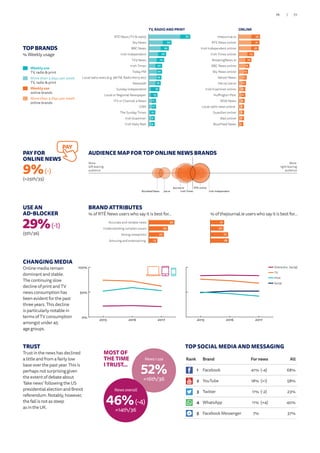
German public TV news (e.g. ARD, ZDF)
German commercial TV news (e.g. RTL)
Blick (incl. evening and Sunday)
20 Minuten
SRF News (including Tagesschau, radio) 70
55
39
30
27
24
20
19
15
13
12
13
13
7
5
6
6
5
6
4NZZ online
Watson
gmx
Blick am Abend online
Teletext online
Tages Anzeiger online
Bluewin news
SRF News Online
Blick and Blick am Abend online
20 Minuten online 52
35
23
22
13
12
11
11
11
9
ONLINE GERMAN
TV, RADIO AND PRINT FRENCH
22
19
16
21
19
10
9
9
6
8News of private broadcasters
Tribune de Genève
Regional or local newspaper
Commercial radio news
24 heures
French public TV news
Le Matin ( incl Sunday Edition)
French commercial TV news (e.g. TF1)
20 Minutes
RTS News (eg Le Journal, radio etc) 77
58
45
43
42
21
18
15
14
13
10
11
12
9
9
9
7
7
4
2LeNouvelliste
Tribune de Genève Online
Yahoo! News
MSN News
Teletext online
24 heures online
Bluewin news
RTS News Online
Le Matin Online (incl Sunday)
20 Minutes online 50
26
24
24
21
19
13
13
12
8
ONLINE FRENCH
BRAND ATTRIBUTES GERMAN
% of 20minuten users who say it is best for…
BRAND ATTRIBUTES FRENCH
% of RTS users who say it is best for…
37
37
38
60Amusing and entertaining
Strong viewpoints
Understanding complex issues
Accurate and reliable news 37
31
37
12Amusing and entertaining
Strong viewpoints
Understanding complex issues
Accurate and reliable news
TOP SOCIAL MEDIA AND MESSAGING
(-1)
Radio
42%
Rank Brand For news All
1 Facebook 35% (-1) 60%
2 YouTube 23% (+4) 59%
3 WhatsApp 21% (+2) 63%
4 Facebook Messenger 6% 29%
5 Google Plus 6% 10%
97/96
In the wake of the failed coup
and subsequent referendum
giving President Erdoğan
sweeping new powers, online
websites, blogs, and social
media have emerged as a centre
of opposition. Mainstream
media remain largely controlled
by the government.
Turkey has been under a state of emergency
since a failed coup of July 2016, in which 248
people were killed and hundreds injured and
the political turmoil has had a significant
effect on the freedom and independence of
the Turkish media. Turkish authorities have
shut down nearly 150 media outlets
including 55 newspapers, 5 news agencies, 16
TV channels, 23 radio stations, 18 magazines,
and 29 publishers by using powers invested
under the state of emergency.
Turks tends to be deeply divided into
supporters or opponents of the ruling AK
party – and the same level of polarisation
applies to the media. People in either camp
prefer to trust what they want to believe
without questioning the reliability and
accuracy of the news. To illustrate this, the
anti-government Sözcü is read mainly by
people who self-identify on the left (50%)
and only a few who identify on the right
(9%). At the same time, around four in ten
(39%) of its readers think it is best for
accurate and reliable news.
The spate of newspaper closures has
surprisingly not adversely impacted general
sales at the newsstand,62
but advertising
revenues for newspapers have taken a hit.
The share of printed media (14.8%)
continued to decrease in 2016 whereas
digital advertising (24.2%) continues
to grow and is now second to television
(51.2%).63
The biggest online news sites, however,
continue to be traditional media brands
using content repackaged from print
(Hürriyet, Milliyet), television (CNN Türk,
NTV), or from news agencies. Digital-born
web-portals, which aggregate stories from
newspapers and agencies, such as Mynet,
Haberler, and EnSonhaber, also play a major
role in Turkey but the range of news outlets
being accessed increases every year.
Indeed mainstream media have been losing
their monopoly in agenda setting as
digital-born news sites and social media
often become the first port of call for news.
The pressure on opposition media outlets
has led to the creation of a number of
small-scale online journalism portals and
platforms where free journalism is
practised. Articles are shared via social
media and increasingly via encrypted
messaging apps.
While the successful digital-born sites like
Odatv (14%), T24 (8%), Diken (6%), and
Bianet (2%) have kept their position in our
survey, the number of digital-born news
brands has increased this year. These
include Duvar, Karınca, Webiztv, and
140journos, a prominent citizen journalism
project, which has gained attention for its
pioneering use of social media to distribute
content. Another approach comes from
Journo, which provides a platform for
freelance journalists and ensures they
are paid via the MATRA human rights
funds. Well-known reporters, many of
whom have lost their jobs with recent
closures, contribute to this portal with
their exclusive stories.
Paying for online news is extremely rare in
Turkey, although most printed media
outlets do provide an option to subscribe to
a pdf format e-edition or pay for web access
without advertising. Some dailies like Birgün
or ÖzgürDüşünce that take a particular
ideological stance have asked their readers
to support their services, but these
approaches have not yet been successful.
There is little prospect for anti-government
publications to make money as it is easy for
the authorities to block websites or find
other ways to cut off funding or readership.
The sharp downturn in the use of Facebook
and Twitter for news may also be related to
fears about government surveillance. Use
of Facebook for news fell by 10 percentage
points in the last year with Twitter down
by 5 points. The rise of closed messaging
services like WhatsApp (+8) as a way of
sharing news may be linked to a climate
where it is not safe for public servants in
particular to criticise the government on
social media. The Ministry of Interior says
that more than 3,000 people were
prosecuted, and over 1,500 arrested
in the second half of 2016.
Servet Yanatma
FormerReuters InstituteJournalist Fellow
TURKEY
62
	http://www.tuik.gov.tr/PreHaberBultenleri.do?id=21543
63
	http://www.mediacatonline.com/reklamcilar-dernegi-2016-reklam-yatirimlari
*	 Data are from urban Turkey, rather than a fully nationally representative sample. This will tend to represent richer and more connected users.
STATISTICS
Population 78m*
Internet penetration 60%
Reuters Institute for the Study of Journalism /	 Digital News Report 2017
TOP BRANDS
% Weekly usage
Weekly use
TV, radio  print
More than 3 days per week
TV, radio  print
Weekly use
online brands
More than 3 days per week
online brands
TRUST
One expects lower trust levels
in a country where the media
are largely controlled by the
government but the ruling party
got 49% of the votes in the last
election in November 2015.
Although the small difference (6%)
between trust in news ‘overall’ and
‘I use’ might suggest low levels of
political polarisation, this is not
the case in Turkey where society
remains deeply divided.
News I use
46%
=24th/36
MOST OF
THE TIME
I TRUST...
News overall
40%(-)
23rd/36
USE AN
AD-BLOCKER
27%(-4)
(=9th/36)
TV, RADIO AND PRINT
15
14
17
16
18
13
13
14
12
14
12
14
12
8
7
12Posta
Halk TV news
Cumhuriyet
Sabah
Milliyet
Show TV news
Star TV news
Sözcü
Habertürk TV news
ATV news
TRT news
Hürriyet
Kanal D news
NTV
CNN Türk
Fox TV news 51
45
42
39
35
34
34
31
30
28
26
23
22
18
18
18
16
11
12
8
12
14
9
10
9
10
11
9
8
8
6
6Haber7
Odatv
AA (Anadolu Ajansi)
Cumhuriyet online
Ensonhaber
İnternethaber
Habertürk online
Ahaber
Sabah
Milliyet
Haberler.com
NTV online
Sözcü online
Hürriyet online
Mynet
CNN Türk online 31
31
30
28
24
24
23
21
20
19
19
16
16
15
14
13
ONLINE
39
36
40
24Amusing and entertaining
Strong viewpoints
Understanding complex issues
Accurate and reliable news
24
26
25
18Amusing and entertaining
Strong viewpoints
Understanding complex issues
Accurate and reliable news
17
19
16
24Amusing and entertaining
Strong viewpoints
Understanding complex issues
Accurate and reliable news
19
23
21
43Amusing and entertaining
Strong viewpoints
Understanding complex issues
Accurate and reliable news
% of Sozcu users who say it is best for…
BRAND ATTRIBUTES
% of CNN Turk users who say it is best for…
% of Hurryet users who say it is best for…
% of Mynet users who say it is best for…
TOP SOCIAL MEDIA AND MESSAGING
0%
50%
100%
Tablet
Smartphone
Computer
201720162015
CHANGING MEDIA
The smartphone has
overtaken the computer
in terms of access to news,
particularly for the young.
TV and online remain the
most important sources
of news while social
media use is declining as
people adopt more secure
messaging apps for
sharing news.
0%
50%
100%
Social
Online (incl. socia
Print
TV
201720162015
Online (inc. Social)
TV
Print
Social
Rank Brand For news All
1 Facebook 54% (-10) 73%
2 YouTube 32% (+1) 66%
3 Twitter 25% (-5) 41%
4 WhatsApp 25% (+8) 64%
5 Instagram 17% (+5) 45%
99/98
Reuters Institute for the Study of Journalism /	 Digital News Report 2017
Americas
4.24	 United States 102
4.25	Argentina 104
4.26	Brazil 106
4.27	Canada 108
4.28	Chile 110
4.29	Mexico 112
101/ 101/100
The fragmented US media
landscape is dominated by
private, for-profit enterprises,
but new commercial challenges
are causing both legacy and
digital-born organisations
to experiment with new
strategies for growth.
The news media in the US remain fiercely
competitive, with many vying for a shrinking
pool of advertising dollars offline and a
seemingly precarious share online – a
market increasingly dominated by the
Silicon Valley giants Google and Facebook.
While business models continue to face
upheaval from mobile devices and social
media, some glimmers of hope appeared
last year with a sudden burst of paid
subscriptions following November’s
presidential election.
Two trends accelerated over the past year
against the backdrop of the election. First,
more than half of Americans (51%) now say
they used social media for news in the
previous week. Twitter in particular, Donald
Trump’s social media platform of choice,
appears to have benefited from the
campaign. Although only a small
percentage say they use Twitter for news
(15%), that figure was up from 10% a year
ago. Second, when Americans get news
online, they increasingly reach for a
smartphone (55%), with computer use
falling significantly.
These dual trends have led a growing
number of organisations to embrace
third-party delivery systems such as
Facebook Instant Articles and Google’s
AMP, which speed up the time it takes for
content to load on mobile devices. But this
growth has also met resistance from some
publishers sceptical of trading traffic for
control. Technology platforms are now
estimated to command nearly two-thirds
of all digital advertising revenue, according
to a Pew study last year.
Adding to these digital disruptions, the
election may have exacerbated polarisation
in news audiences in the US. Trust in news
remains strikingly divided along ideological
lines, with those on the right twice as likely
to say they mistrust the news as those on
the left. While non-ideological outlets such
as local television remain the most used
sources offline, niche partisan outlets like
Breitbart and Occupy Democrats grew their
audiences considerably online. The election
also proved valuable to some legacy
organisations, particularly those with
established reputations. Many more
Americans reported paying for online news
than ever before (16%), a seven percentage
point increase, and institutions such as the
New YorkTimes, the Washington Post, and
the WallStreet Journal all reported
significant post-election boosts in
subscriptions.
This subscription boom overshadowed
otherwise worse-than-expected declines in
the print advertising market in the US. At
the Times, a 16% fall in print advertising
more than offset digital revenue growth
for the year, with overall revenue down 2%.
At McClatchy, which owns 30 regional
newspapers, strong digital growth (+14.8%)
still could not compensate for double-digit
declines offline, with overall revenue down
10.8% for the year. At the Journal, the
advertising market prompted staff
reductions in a newsroom that had once
seemed relatively insulated from the forces
battering the industry.
Uncertainty may have contributed to the
failed merger of two of the largest US
newspaper chains last year. Gannett, which
owns more than 110 properties, proposed
acquiring ‘tronc’, the publisher of the Los
Angeles Times and the Chicago Tribune,
but later withdrew its offer in response
to shareholder scepticism about the
$815m deal.
In October, the NewYork Times added to its
array of lifestyle recommendation products
by purchasing the Wirecutter and the
Sweethome, product review sites which
generate income through affiliate marketing
links. Others have sought to weather the
storm by becoming more indispensable to
advertisers. BuzzFeed and Vox have pursued
partnerships with third-party distribution
platforms and developed in-house studios
for sponsored content.
American media companies remain global
leaders in pioneering new digital revenue
streams, but questions remain over whether
commercial efforts alone will be enough to
support levels of watchdog and investigative
journalism needed to sustain a healthy
democracy. While a select number of
national newspapers and a handful of
nonprofits (ProPublica plans to open their
first regional operation in Illinois this year)
still fund rigorous newsgathering
operations, state and local public affairs
coverage generally remains a shadow of its
former self. The future of news in the US
may ultimately depend on whether the
post-election surge in willingness to pay
proves fleeting or a harbinger of a broad-
based cultural change in public support
for quality journalism.
Benjamin Toff
ResearchFellow,ReutersInstitute
fortheStudyofJournalism
UNITED STATES STATISTICS
Population 324m
Internet penetration 90%
Reuters Institute for the Study of Journalism /	 Digital News Report 2017
CHANGING MEDIA
Cable TV news has
benefited from a Trump
bump, reversing earlier
declines but online and
social media has benefited
even more. In terms of
devices, the smartphone
now matches the
computer in weekly use.
TOP BRANDS
% Weekly usage
Weekly use
TV, radio  print
More than 3 days per week
TV, radio  print
Weekly use
online brands
More than 3 days per week
online brands
TRUST
Followingthepresidentialelection,
many publicly voiced concern
about the spread of false
information online, highlighting
the value of professional
journalism. Perhaps as a
consequence, trust in news
increased in the US (to 38%).
While still low compared to other
countries, Americans reported
markedly higher trust in the news
sources they themselves use (53%).
News I use
53%
13th/36
MOST OF
THE TIME
I TRUST...
News overall
38%(+5)
28th/36
USE AN
AD-BLOCKER
23%(-1)
(=22nd/36)
PAY FOR
ONLINE NEWS
16%(+7)
(=7th/35)
PAY
0%
50%
100%
Tablet
Smartphone
Computer
20172016201520142013
0%
50%
100%
Social
Online (incl. socia
Print
TV
20172016201520142013
49
43
48
21Amusing and entertaining
Strong viewpoints
Understanding complex issues
Accurate and reliable news 32
27
30
18Amusing and entertaining
Strong viewpoints
Understanding complex issues
Accurate and reliable news
BRAND ATTRIBUTES
% of Fox News users who say it is best for… % of CNN users who say it is best for…
TV, RADIO AND PRINT
A free city paper such as Metro
Washington Post
USA Today
PBS News
New York Times
City paper (e.g. Boston Globe)
NPR News
BBC News
Local radio news
CBS News
ABC News
NBC/MSNBC News
CNN
Regional or local newspaper
Fox News
Local televison news 35
33
29
27
26
25
24
19
13
12
11
11
10
10
8
6
8
12
9
7
9
8
10
7
9
6
6
6
7
6
7
5CBS News online
USA Today online
Website of a city paper
BBC News online
ABC News online
NBC/MSNBC News online
MSN News
Website of local newspaper
Washington Post online
BuzzFeed News
Local television news online
New York Times online
Fox News online
CNN.com
Huffington Post
Yahoo! News 5125
24
22
20
18
17
17
16
15
14
14
12
12
11
11
10
51
ONLINE
AUDIENCE MAP FOR TOP ONLINE NEWS BRANDS
More
right-leaning
audience
More
left-leaning
audience
New York Times Huffington Post CNN Online Yahoo! News Fox News online
Washington PostNPR
TOP SOCIAL MEDIA AND MESSAGING
ALSO
Breitbart7%
Occupy Democrats 7%
Online (inc. Social)
TV
Print
Social
Rank Brand For news All
1 Facebook 48% (+3) 71%
2 YouTube 20% (+1) 56%
3 Twitter 15% (+5) 26%
4 Facebook Messenger 9% 37%
5 Instagram 5% (+1) 23%
103/102
The media environment in
Argentina is characterised by a
strong concentration around the
Clarín Group, a weakened public
system, some innovative online
initiatives, and prominent use of
social media for news.
Online media already surpass television as
an information source. News usage on
Facebook is high, and on WhatsApp,
YouTube, and Twitter to a lesser extent.
However, as in most countries, a significant
proportion of this is due to incidental
exposure, where people come across news
whilst using social media for other reasons.
Since 2011, studies have identified Latin
America as a region where users spend
more time on social media. The social and
friendly nature of Latinos often explains this
trend, as well as the existence of a relatively
young population and the widespread use
of smartphones.
Argentina is dominated by news brands from
the Clarín Group, who generally support
President Macri. The news channel TN, the
newspaper Clarín, and radio station Mitre are
amongst the most popular offline brands.
Clarín.com, TN.com.ar, and the sports paper
Oléare important online. The main offline
competitor is the channel C5N, which
opposes the national government, while on
the internet there are Infobae and La Nación.
Regional or local media are also prominent
news sources both online and offline.
The election of Macri in December 2015,
after 12 years of ‘Kirchnerism’, brought
important rearrangements to the structure
of public and private media. Through
decrees, the new government altered the
Law of Audiovisual Communication
Services, and attenuated or eliminated
limits to concentration and cross-ownership
of the communication sector to the benefit
of Clarín and Telefónica. Radio Nacional
modified its programming for the sake of
(alleged) plurality and lost much of its
audience. The Televisión Pública became
less biased but, with the elimination of the
programme Fútbol paraTodos, was left
without television rights for the main
football matches, which were transferred
to private channels. Thus it also lost viewers
and resources.
Brands from the 23 Group, which had
enjoyed generous official advertising
revenue from the Kirchner government,
were left underfunded and entered into
a crisis. Something similar happened to
Radio Del Plata (on the verge of closure)
and Radio America, which was acquired by
Perfil. Either because of layoffs, closing of
media, or voluntary redundancies, 1,285
jobs were lost in the media during 2016 in
Buenos Aires city alone, according to the
Sipreba union.64
In TV, new players are entering the market.
Fox and Turner acquired the rights to
broadcast football and Viacom bought the
channel Telefé. La Nación launched the
news channel LN+ and Perfil is preparing
to broadcast on open television. Printed
newspapers cannot halt a structural
decline in sales that began in the 1970s but
accelerated in the last decade. In 2005,
Clarín sold almost 500,000 copies; in
January 2017 it continued to lead but only
reached 190,000, its lowest figure since
1954. La Nación has suffered less but still
fell from 177,000 to 120,000 copies. As a
result, redesigns have become frequent.
In 2016, both La Nación and La Voz changed
to tabloid format after more than 100
years of broadsheet. In the last year, some
newspapers have closed, such as LaMañana
deCórdobaand Uno of Santa Fe. Others are
no longer published every day, such as
the centennials Buenos Aires Herald and
La Nueva. Clarín closed one printing plant.
Meanwhile, digital editions continue to grow,
although their income far from compensates
for print losses. In Argentina, models based
on free access funded by advertising
predominate; just one in ten online users
paid for news in the last year. There are,
however, sites that try to innovate.
Chequeado is a key reference point for
fact-checking in Latin America. Vorterix Rock
is a cross-platform media source with new
artistic and commercial offerings. Radio Cut
is an aggregator that lets you listen to
different radio stations, trim segments of
audio, and share them on social networks.
UnoAR is smartphone-centric, and narrates
news with memes and gifs. Narrative
journalism is also booming with sites like
Anfibia, Tucumán Zeta, Revista Ajo, La Tinta,
and Salida al Mar. They typically have a more
visual design and longer articles.
Alejandro Rost
UniversidadNacionaldelComahue
ARGENTINA
64
	http://www.sipreba.org/notas/2016-un-ano-de-despidos-precarizacion-y-ajuste-salarial-en-los-medios-de-comunicacion
STATISTICS
Population 44m
Internet penetration 79%
Reuters Institute for the Study of Journalism /	 Digital News Report 2017
TOP BRANDS
% Weekly usage
Weekly use
TV, radio  print
More than 3 days per week
TV, radio  print
Weekly use
online brands
More than 3 days per week
online brands
TRUST
Many Argentines consider news to be unduly
influenced by both commerce and politics.
Fake news frequently circulates on both
social networks and the mainstream media.
Sources have published non-existent deaths,
April Fools jokes, and political propaganda.
The site Chequeado launched the hashtag
#falsoenlasredes in order to identify and
correct them.
USE AN
AD-BLOCKER
31%
(=3rd/36)
PAY FOR
ONLINE NEWS
10%
(=22nd/35)
PAY
SOURCES OF NEWS
TV
81%
Print
45%
Social media
74%
Online (incl. social media)
92%
DEVICES USED FOR NEWS
Computer
62%
Tablet
17%
Smartphone
62%
Business influence
16%
=30th/36
THE MEDIA IS FREE FROM...
Political influence
16%
=29th/36
News I use
52%
=16th/36
MOST OF THE TIME I TRUST...
News overall
39%
=24th/36
TV, RADIO AND PRINT
13
10
17
14
13
7
12
8
6
9
9
5
8
4
4
4Radio 10
Radio La Red
Página/12
Canal 26
Local radio news
CNN
Crónica TV
Radio Mitre
A24
La Nación
Regional or local TV
Public TV
Clarín
A regional or local newspaper
C5N
TN (Todo Noticias) 56
35
34
30
26
24
22
22
21
19
17
17
17
8
7
7
15
14
17
12
7
10
7
8
7
6
6
5
4
4
5
5MSN News
Perfil
Ámbito
La Voz
Cadena 3 online
Public television and radio news online
Página/12
CNN.com
Yahoo! News
Olé
Minuto Uno
Regional/local newspaper website
La Nación online
Infobae
TN online
Clarín online 43
42
41
34
19
18
16
16
14
14
12
10
10
10
10
10
ONLINE
9
6
6
45Amusing and entertaining
Strong viewpoints
Understanding complex issues
Accurate and reliable news
21
23
22
15Amusing and entertaining
Strong viewpoints
Understanding complex issues
Accurate and reliable news
24
25
26
11Amusing and entertaining
Strong viewpoints
Understanding complex issues
Accurate and reliable news
34
31
30
24Amusing and entertaining
Strong viewpoints
Understanding complex issues
Accurate and reliable news
% of Olé users who say it is best for…
BRAND ATTRIBUTES
% of ClarÍn users who say it is best for…
% of La Nación users who say it is best for…
% of TN users who say it is best for…
Rank Brand For news All
1 Facebook 65% 83%
2 WhatsApp 33% 76%
3 YouTube 28% 75%
4 Twitter 19% 32%
5 Facebook Messenger 10% 42%
TOP SOCIAL MEDIA AND MESSAGING
Radio
30%
105/104
Strong commercial television
broadcasters dominate the
media environment in Brazil.
Media ownership is concentrated
in the hands of a few domestic
groups, but social media are
playing an increasingly important
role in news consumption.
Although internet penetration continues to
rise quickly, the web’s popularity is still no
match for television. More than 97% of
Brazilian households have a TV set, but as
recently as 2015 only one in every two
homes was connected to the internet.
Nevertheless, online platforms are already
the main source of information for people in
urban areas, especially those with higher
income and education levels.
The enduring recession – the worst on
record in Brazil – has continued to hurt the
media. By December 2016, the total
circulation of the top five paid-for dailies
had fallen almost 8% when compared to
the average number of copies sold in 2015.65
The harsh economic conditions led to the
closure of at least two radio stations, one
local TV broadcaster, and seven print media
outlets; including the second oldest
newspaper in Brazil,JornaldoCommercio,
founded in Rio de Janeiro in 1827.66
Both
TV and print media lost some of their
importance as news sources in the last year,
according to the respondents to our survey.
Despite the overall decrease in newspaper
circulation, the number of digital
subscribers saw steady growth, as an
increasing number of dailies adopted
paywalls and launched electronic editions.
On August 2016, FolhadeS. Paulo – the
best-selling daily title in the country –
announced that its digital circulation had
surpassed that of its print edition. However,
the overall percentage of our urban
Brazilian respondents that pay for online
news (22%) hasn’t changed from the
previous year.
Legacy news brands remained the most
popular in the online environment but
there’s been a noticeable shift in the devices
used to access journalistic content on the
web. In 2016 smartphones overtook
computers as the prime channel for the
consumption of online news.
Amidst growing unemployment and market
changes, more than 36 million mobile lines
have been disconnected by telecom
operators in the past two years, according to
the federal regulator. This is particularly
important when we consider that –
according to the Brazilian Media Survey,
conducted by the government – 91% of the
internet users in the country access the web
via mobile phone. Nonetheless, online
platforms remain the main source of news
within urban Brazil, since the penetration of
mobile services remains high.
Investment in online advertising rose 26%
when compared to 2015, driven by a 115%
surge in funds spent on video commercials
on the internet (IAB Brasil and comScore).
Ad-blockers are less of a problem (17%)
for the Brazilian digital advertising market
when compared with other countries.
Our survey shows that ad-blockers were
installed on just 8% of smartphones.
Although social media are still extremely
popular in Brazil, their use as a news source
lost momentum last year, just as Facebook
and its peers seemed destined to outstrip TV.
Almost eight in ten Brazilians use Facebook
for any purpose, but the use of paywalls by
the leading Brazilian newspapers may be
slightly reducing social media news sharing.
Already a favourite among Brazilians,
WhatsApp reached new levels of popularity
as telecom operators started to offer special
WhatsApp pay-as-you-go data packages with
almost unlimited messages, boosting its use
as a tool to share news.
In line with the international debate about
fake news, some media outlets – like the
web portal G1 and the newspaper OGlobo
– recently announced fact-checking teams
to investigate news published on the
internet, rumours spread on social media,
and even information taken from official
announcements.
RodrigoCarro
FormerReutersInstituteJournalistFellow
andfinancialjournalist
BRAZIL
65
	Instituto Verificador de Comunicação (IVC) and National Association of Newspapers (Associação Nacional de Jornais).
66
	http://portal.comunique-se.com.br/balanco-de-2016-ao-menos-11-veiculos-de-comunicacao-foram-encerrados-no-brasil
* Data are from urban Brazil, rather than a fully nationally representative sample. This will tend to represent richer and more connected users.
STATISTICS
Population 206m*
Internet penetration 68%
Reuters Institute for the Study of Journalism /	 Digital News Report 2017
CHANGING MEDIA
Smartphones have
overtaken computers as the
main device for accessing
news for the first time this
year. Social media for news
has declined slightly after
several years of strong
growth with sharing and
participation moving
to closed messaging
services like WhatsApp.
TOP BRANDS
% Weekly usage
Weekly use
TV, radio  print
More than 3 days per week
TV, radio  print
Weekly use
online brands
More than 3 days per week
online brands
TRUST
The impeachment of President
Dilma Rousseff and its aftermath
focused the attention of the news
media during 2016. As a result of
the extremely polarised political
environment, the percentage of
people that believe that media is
free from undue political influence
fell from 36% to 30%, year-on-year,
but overall trust in news continued
to be high.
News I use
60%
=3rd/36
MOST OF
THE TIME
I TRUST...
News overall
60%
2nd/36
USE AN
AD-BLOCKER
17%(-4)
(=33rd/36)
PAY
TV, RADIO AND PRINT
19
13
14
15
13
11
10
6
8
7
6
5
6
6
7
3Jornal Zero Hora
Free city newspaper
Rede TV News
Metro
BBC News
TV Brasil
CNN
O Estado de S. Paulo
Commercial radio news
Folha de S. Paulo
O Globo
Regional or local newspaper
Record News
BandNews
Jornal do SBT
Globo News 60
36
35
31
28
27
21
15
15
13
10
10
10
9
9
7
17
18
15
12
11
11
13
10
9
9
6
6
6
5
5
5New York Times online
iG. Online
BBC News online
CNN.com
Um jornal local online
Jornal do SBT online
O Estado de S. Paulo online
Record News Online (inc. R7.com)
BandNews online
Terra online
MSN News
Yahoo! News
Folha de S. Paulo online
O Globo online
Globo News Online (inc. G1)
UOL online 47
43
35
26
25
24
22
18
17
16
14
13
11
10
10
8
ONLINE
25
24
30
13Amusing and entertaining
Strong viewpoints
Understanding complex issues
Accurate and reliable news
23
22
20
36Amusing and entertaining
Strong viewpoints
Understanding complex issues
Accurate and reliable news
24
23
30
10Amusing and entertaining
Strong viewpoints
Understanding complex issues
Accurate and reliable news
19
19
15
15Amusing and entertaining
Strong viewpoints
Understanding complex issues
Accurate and reliable news
% of BandNews users who say it is best for…
BRAND ATTRIBUTES
% of UOL users who say it is best for…
% of Folha de S. Paulo users who say it is best for…
% of O Globo users who say it is best for…
0%
50%
100%
Tablet
Smartphone
Computer
20172016201520142013
0%
50%
100%
Social
Online (incl. socia
Print
TV
20172016201520142013
TOP SOCIAL MEDIA AND MESSAGING
PAY FOR
ONLINE NEWS
22%(-)
(2nd/35)
Online (inc. Social)
TV
Print
Social
Rank Brand For news All
1 Facebook 57% (-12) 76%
2 WhatsApp 46% (+7) 78%
3 YouTube 36% (-1) 77%
4 Instagram 12% (+1) 40%
5 Twitter 12% (-1) 25%
107/106
As media companies continue
to reduce staff, restructure news
coverage, and explore new
revenue sources, governments
are reconsidering their role in
supporting news production
beyond public broadcasting,
and to improve ‘discoverability’
of national content.
As advertising revenues continued to
decline for legacy media, hundreds of layoffs
were announced throughout the year. In
October, the troubled Postmedia group
disclosed its plan to reduce staff by 20%
across its newspaper chain. Multimedia
group Québecor closed its cable business
news channel, Argent, and announced the
restructuring of its digital operations,
including layoffs at the French-language
Canoe web portal. Bell Media, Torstar, The
GlobeandMail, and even Huffington Post
cut jobs as well.
Several weekly community newspapers
either merged or closed. Transcontinental
Media sold all of its 28 publications in
Atlantic Canada to the owners of the
Halifax Chronicle-Herald, whose journalists
have been locked out since January 2016. In
April 2017, 93 Transcontinental newspapers
in Quebec (91 local or regional weeklies,
and the free daily Métro Montréal) and one
in Ontario were put up for sale. Meanwhile,
news magazines such as Maclean’s and Les
Affaires reduced frequency of publication.
Rogers sold several of its French-language
magazines to Alexandre Taillefer,
a Quebec businessman.
Vice Media’s success with millennial
audiences has led to partnerships with
Canadian media companies, most notably
Rogers for the specialty TV service
VICELAND, but also the aboriginal network
APTN and the parliamentary channel CPAC.
Vancouver Island now has a new free daily
newspaper, published by Black Press (which
previously closed several newspapers on the
island). The NewYorkTimes and the BBC
launched Canadian operations, while
BuzzFeed closed its Ottawa bureau. The
TorontoStarhas found what appears to be a
natural companion to the daily newspaper as
a new revenue stream: coffee delivery.
Readers can order a monthly dose of locally
roasted fairtrade coffee as a supplement to
their print subscription package. Torstar
reported profits in the last two quarters of
2016, and smaller losses over the course of
the year compared to 2015.
Meanwhile, the national public broadcaster
(CBC) is focusing on new digital formats to
reach a younger audience, and launched an
opinion page on its website. The CBC came
under pressure from private media
companies to remove all advertisements
from its websites. It says it is prepared to go
ad-free,butonlyin exchangefor a substantial
increase in its public funding. According to an
Ipsos study, the public broadcaster is the
most influential Canadian media brand.67
Attitudes and reported consumption of
news online appear relatively stable
compared to our 2016 study. Use of
ad-blockers appears to be growing slightly,
as well as almost all offline news brands
– both in English- and French-language
media. Canadians report getting online
news more from smartphones and a little
less from a computer or tablet.
The Canadian and Quebec governments
have undertaken significant reviews of their
cultural and digital policies. The Canadian
Radio-television and Telecommunication
Commission (CRTC) and Canadian Media
Fund seek to promote ‘discoverability’ of
national content (news and entertainment)
on digital platforms. Labour groups and a
coalition of Quebec newspapers have
lobbied for public funding to help
commercial news media weather the digital
transition, while a report commissioned by
the federal government recommended a
series of measures, including introducing
a levy on digital advertising revenues from
foreign-owned websites including Google
and Facebook. This revenue could be used,
it suggests, to support local, civic, and
indigenous news reporting.68
But for the
moment, there has not yet been any
significant policy commitment to support
news media, although new measures
introduced by the CRTC allow existing
funding to be shifted to local news, much
of it from community channels run by
commercial networks.
Revelations of electronic surveillance of
journalists by police have recently come to
light. They seem to have been especially
widespread in Quebec, where a commission
of inquiry was created to address the
problem. Sponsored content and native
advertising practices continue to raise
concerns for journalistic independence and
trust in several media companies, including
the CBC. The satirical website ‘Journal de
Mourréal’, a parody of the tabloid
newspaper Journal deMontréal, was sued
by Québecor and won a first round in court.
It was later revealed that the site’s creators
also produce an English-language fake news
site, the World News Daily Report.
Colette Brin
Centred’étudessurlesmédias,UniversitéLaval
CANADA
67
	http://www.broadcastermagazine.com/acquisition/ipsos-survey-says-cbc-1-media-brand-canada/1004122266
68
	Public Policy Forum (PPF), The Shattered Mirror: https://shatteredmirror.ca
69
	http://www.theglobeandmail.com/report-on-business/study-says-people-are-worried-about-unreliable-information-and-fakenews/article34092454
STATISTICS
Population 35m
Internet penetration 93%
Reuters Institute for the Study of Journalism /	 Digital News Report 2017
TOP BRANDS
% Weekly usage
Weekly use
TV, radio  print
More than 3 days per week
TV, radio  print
Weekly use
online brands
More than 3 days per week
online brands
TRUST
Canadians are concerned about unreliable
information and fake news, especially since the
US election campaign where such content was
widely circulated. A recent study suggests that
most of them believe that social media have
a negative effect on the news.69
But their level
of trust in the media remains relatively strong
in comparison to other countries.
USE AN
AD-BLOCKER
26%(+4)
(=14th/36)
PAY FOR
ONLINE NEWS
8%(-1)
(=29th/35)
PAY
SOURCES OF NEWS
(-1)
TV
70% (-3)
Print
33% (-)
Social media
48% (+1)
Online (incl. social media)
76%
DEVICES USED FOR NEWS
(-2)
Computer
62% (-1)
Tablet
23% (+4)
Smartphone
43%
Business influence
36%
3rd/36
THE MEDIA IS FREE FROM...
Political influence
39%
5th/36
News I use
57%
=7th/36
MOST OF THE TIME I TRUST...
News overall
49%
=9th/36
TV, RADIO AND PRINT ENGLISH
13
14
13
18
9
9
9
7
6
7Globe and Mail
BBC News
Toronto Star
CityTV News
CNN
Local radio news
Community or local newspaper
CBC news (public broadcaster)
Global news
CTV news 42
35
34
34
28
28
20
14
13
12
10
9
12
7
6
6
8
8
7
6BuzzFeed News
Toronto Star online
Globe and Mail online
Global News online
Yahoo! News
CNN.com
MSN News
Huffington Post
CTV News online
CBC News online 27
21
21
18
16
16
15
14
13
12
ONLINE ENGLISH
TV, RADIO AND PRINT FRENCH
13
14
17
13
5
7
5
4
5
424 hours
CNN
Métro
TV5 News
La Presse
Local radio news
Local or regional weekly paper
Journal de Montréal/de Québec
Radio-Canada/RDI News (public broadcaster)
TVA/LCN News 70
52
36
18
16
14
13
11
10
9
11
9
8
9
8
7
6
5
5
4Local radio news online
Sympatico.ca
Yahoo! News
Canoe.com
Huffington Post
MSN News
Journal de Montréal/Québec online
La Presse online
Radio-Canada/RDI News online
TVA News online 37
27
26
24
21
13
12
9
9
9
ONLINE FRENCH
BRAND ATTRIBUTES ENGLISH
% of CBC users who say it is best for…
BRAND ATTRIBUTES FRENCH
% of TVA users who say it is best for…
49
41
32
19Amusing and entertaining
Strong viewpoints
Understanding complex issues
Accurate and reliable news 48
38
40
34Amusing and entertaining
Strong viewpoints
Understanding complex issues
Accurate and reliable news
TOP SOCIAL MEDIA AND MESSAGING
(+1)
Radio
28%
Rank Brand For news All
1 Facebook 40% (-6) 68%
2 YouTube 18% (+1) 57%
3 Twitter 11% (-1) 22%
4 Facebook Messenger 8% 38%
5 Instagram 5% (+2) 22%
109/108
The news media in Chile are
extremely centralised, with
the main newspapers, both
paid and free, and TV and
radio stations based in the
capital city, Santiago.
During recent years, the most important
players in the news media have been the
free-to-air television stations, particularly
the four with the largest audience: the
public broadcaster, Televisión Nacional de
Chile (TVN), and three commercial TV
stations, Canal 13, Mega, and Chilevisión.
Historically Chile’s main television channels
were owned by and had their roots in the
university sector, although in practice
programming was similar to that found in
the private sector. But in 2016, the last
university-owned broadcaster was sold to a
group linked with Disney, making Chile’s TV
industry much more like stations elsewhere
in Latin America.
The transition to digital terrestrial television
has been slow, although it is expected that in
2017 the national channels will be present in
all regional capitals. Our data show that
broadcasters are still the preferred way of
consuming news, but many have lost a
significant amount of weekly reach in the
transition to online. Mega for example
reaches over half (53%) of our Chilean
respondents on TV, but only 16% through the
online versions of its main news programme,
Ahoranoticias. Canal 13 reaches 55% via
television but just 13% visit t.13, the online
version of news programme Teletrece.
A key issue for debate has been the role
of public broadcasting since TVN lost its
ratings lead, prompting changes in the
executive governance arrangements for
the station. Although TVN is independent
of government, President Bachelet
announced a $75m support package to
help with the technological challenge of
digital television switchover and to fund
the creation of a new public and free-to-air
TV station for educational and cultural
content. In the months that followed, TVN
improved its ratings, partly thanks to its
coverage of the Olympic Games in Rio, as
well as the main news programme, and
some new soap operas. But by the end of
the year, TVN remained in fourth place,
behind the private broadcasters Canal 13,
Chilevisión, and Mega.
The top five online media brands are linked
with printed media. Emol and LUN belong
to the Chile’s mainstream newspaper El
Mercurio, and La Tercera.cl is the online
version of the tabloid LaTercera, principal
competitor of El Mercurio. In the third place
is Biobiochile.cl, the website of radio station
BioBio, which has branched out from audio
to become a multimedia hub using
extensive text, images, and video. This
appears to have paid off, as other radio sites,
such as Cooperativa and ADN, appear lower
down in our rankings.
In online media, two cases stand out: El
Mostrador and El Ciudadano. Both produce
high-quality opinion and analysis and are
valued for their coverage of the complexities
of Chilean politics.
Official data (Subtel) shows that nearly 80%
of all internet access is made from a mobile
phone.70
Chile therefore leads the use of
smartphones in Latin America and in our
survey around three-quarters of respondents
(76%) say they use mobile phones to access
news weekly. A study from the main mobile
phone provider in Chile shows that around
90% of smartphone users actively use
Facebook, and 85% use Google, YouTube,
and WhatsApp. These numbers help explain
why Facebook and WhatsApp are the most
important social media and messenger
brands for news access. Most broadcast
brands have started to use WhatsApp voice
messaging to engage with their audiences,
particularly radio stations as such BioBio,
Cooperativa, and ADN.
Francisco Javier Fernández Medina
and Eduardo Arriagada
PontificiaUniversidad CatólicadeChile
CHILE
70
	Accesos a Internet llegan a 13,1 millones y uso de smartphones sigue en alza según estadísticas de telecomunicaciones: http://www.subtel.cl (20 Apr. 2017).
STATISTICS
Population 17m
Internet penetration 80%
Reuters Institute for the Study of Journalism /	 Digital News Report 2017
TOP BRANDS
% Weekly usage
Weekly use
TV, radio  print
More than 3 days per week
TV, radio  print
Weekly use
online brands
More than 3 days per week
online brands
TRUST
News media, mainly broadcasters and
digital-born, often use WhatsApp as a source,
sometimes without properly verifying the
source. In order to attract the audience’s
attention, it is not uncommon to include
viral content from social media as part of
mainstream content, which has led to
concerns about declining quality.
USE AN
AD-BLOCKER
24%
(=16th/36)
PAY FOR
ONLINE NEWS
9%
(=25th/35)
PAY
SOURCES OF NEWS
TV
80%
Print
46%
Social media
76%
Online (incl. social media)
93%
DEVICES USED FOR NEWS
Computer
51%
Tablet
18%
Smartphone
74%
Business influence
17%
=28th/36
THE MEDIA IS FREE FROM...
Political influence
17%
=27th/36
News I use
48%
=21st/36
MOST OF THE TIME I TRUST...
News overall
47%
13th/36
16
14
16
15
14
12
9
11
12
12
10
11
7
7
9
6La Red
City newspaper (paid)
ADN
Cooperativa
Free city papers
Regional or local newspaper
La Tercera
Las Últimas Noticias
El Mercurio
Bío Bío Chile
CNN
Chilevisión
TVN
24 Horas
Mega news
Canal 13 news 55
53
46
44
39
31
27
23
21
20
17
16
15
14
14
11
17
11
10
11
11
9
11
12
8
11
6
8
7
6
5
5Adnradio.cl
Chilevisión.cl
CNN.com
ahoranoticias.cl
Theclinic.cl
Cooperativa.cl
Terra.cl
t13.cl
Elciudadano.cl
El Mercurio online
Elmostrador.cl
Latercera.com
24horas online
Biobiochile online
Lun.com
Emol.com 40
33
32
29
25
21
21
21
20
19
18
17
16
14
12
11
24
25
21
18Amusing and entertaining
Strong viewpoints
Understanding complex issues
Accurate and reliable news
20
20
18
16Amusing and entertaining
Strong viewpoints
Understanding complex issues
Accurate and reliable news
48
37
40
21Amusing and entertaining
Strong viewpoints
Understanding complex issues
Accurate and reliable news
13
12
10
38Amusing and entertaining
Strong viewpoints
Understanding complex issues
Accurate and reliable news
% of T13 news who say it is best for…
BRAND ATTRIBUTES
% of Emol.com users who say it is best for…
% of BioBioChile users who say it is best for…
% of Lun.com users who say it is best for…
TV, RADIO AND PRINT ONLINE
Rank Brand For news All
1 Facebook 70% 83%
2 WhatsApp 39% 76%
3 YouTube 25% 72%
4 Twitter 23% 33%
5 Facebook Messenger 14% 48%
TOP SOCIAL MEDIA AND MESSAGING
Radio
39%
111/110
Historically, television and
radio have been the most
influential media for both
news and entertainment in
Mexico. Now, traditional
media are facing competition
from digital-born media
companies and international
tech platforms.
Public television did not develop in the
same way as in some Western and Northern
European countries, and Grupo Televisa
monopolised commercial television during
the 20-year period from 1973 to 1993. TV
Azteca was the first company that
successfully managed to overcome entry
barriers and become an alternative source
of news and entertainment. Since then, the
media industry has broadened thanks to the
liberalisation of the telecommunications
market and digital technologies.
Currently, América Móvil, Televisa, TV
Azteca, Grupo Imagen, Grupo Radio Centro,
and Grupo Multimedios are the leading
companies in terms of both audience reach
and share of the advertising pie. However,
the traditional press – which is primarily
regional rather than national – is also
represented by a small group of Mexican
companies, including Organización Editorial
Mexicana (OEM), El Universal, Grupo
Milenio, Grupo Reforma, and El Financiero,
that publish a variety of different
newspapers brands in local markets.
All of these companies are usually
associated with traditional media, but also
have an active presence online in the form
of legacy and digital-born brands. Grupo
Televisa, once dominant, has now largely
lost its position as the opinion leader,
although it is still present. Through Televisa
News online and the purchase of SDP News
online, it is now trying to regain its position
in the digital news market.
International brands, such as CNN and
Yahoo News, have a strong foothold in the
online Mexican news market. Domestic
digital-born news brands have recently
emerged in Mexico, and are increasing their
audience reach. The most widely used
include SDP News (recently acquired by
Grupo Televisa in March 2017), UnoTV
(América Móvil), Aristegui News, Sin
Embargo, Cultura Colectiva, Digital López
Dóriga, Political Animal, and La Crónica.71
Aristegui News, named after the leading
left-wing journalist Carmen Aristegui, is of
particular note as it is the most widely used
online news brand in our survey (41%). Much
of their output is investigative, and they have
been associated with numerous high-profile
stories on topics like drug trafficking,
corruption, and sexual abuse within the
Catholic Church, but have also been accused
of causing moral damage and misusing
freedom of speech. Aristegui herself has
become a major public figure in Mexico over
the years after her high-profile work for CNN
in Spanish, Grupo Reforma, MVS, Grupo
Imagen, Imevisión (now TV Azteca), and on
university television in charge of National
Polytechnic Institute (IPN).
Though we should remember that internet
penetration in Mexico is comparatively low
(56%), social media (72%) are an important
source of news for those that do have
access, partly due to low levels of trust in
traditional news corporations. Facebook
and WhatsApp are particularly popular, not
least because access comes bundled with
smartphone internet access at no additional
cost. This is one of the reasons why, in
common with other Latin American
countries, the smartphone (70%) is now
more widely used for digital news access
than the computer (45%).
The most serious problem facing journalists
is freedom of expression and the constant
threat they face when they cover political
corruption and drug trafficking. Murders,
kidnappings, and other threats are not
unusual. In 2016 11 journalists were killed,
making it the most violent year on record.
In 2017, the murder of 54-year-old journalist
Miroslava Breach Velducea, prompted the
owner to close El NortedeCiudad Juárez after
27 years of operation. This was the first time
in Mexico’s history that a newspaper was
closed for these reasons.
Fake news is not uncommon in Mexico.
Recent stories include the supposed death
of Xavier López ‘Chabelo’, director and host
of the children’s programme En domingo
con Chabelo, selfies of Pope Francis, and the
death of Carmen Aristegui. Fake news is
typically disseminated on social media, but
there are sites, such as ElDeforma, that are
devoted to it.
María Elena Gutiérrez Rentería
Universidad Panamericana
MEXICO
71
	 D. Bermudez, Ranking de medios nativos digitales. ElEconomista (2017). Retrieved from http://eleconomista.com.mx/especiales/comscore/2017/03/03/ranking-medios-nativos-digitales
STATISTICS
Population 123m
Internet penetration 56%
Reuters Institute for the Study of Journalism /	 Digital News Report 2017
TOP BRANDS
% Weekly usage
Weekly use
TV, radio  print
More than 3 days per week
TV, radio  print
Weekly use
online brands
More than 3 days per week
online brands
TRUST
Low trust in news is linked to a perceived lack
of credibility in societal institutions as a whole.
For decades, the media were characterised by
a close relationship with the government and
political parties. But beginning in the 1990s,
some newspaper companies managed to build
their prestige on greater transparency in their
editorial line, and journalism unrelated to
economic and political interests.
USE AN
AD-BLOCKER
27%
(=9th/36)
PAY FOR
ONLINE NEWS
18%
(=6th/35)
PAY
SOURCES OF NEWS
TV
65%
Print
51%
Social media
72%
Online (incl. social media)
91%
DEVICES USED FOR NEWS
Computer
45%
Tablet
24%
Smartphone
70%
Business influence
21%
=23rd/36
THE MEDIA IS FREE FROM...
Political influence
19%
=24th/36
News I use
55%
=10th/36
MOST OF THE TIME I TRUST...
News overall
49%
=9th/36
14
13
17
10
16
12
10
11
10
7
7
8
6
6
7
3El Norte
El Sol de Mexico
Imagen News
Local radio news
BBC News
El Financiero
Local television news
Radio Fórmula News
Excelsior
Milenio News
Reforma
Regional or local newspaper
Televisa News
El Universal
TV Azteca News
CNN 39
38
33
31
26
22
21
19
18
14
14
14
13
11
11
7
14
17
16
12
10
7
12
9
10
9
9
7
9
7
8
7Regional/local newspaper website
El Economista online
Radio Fórmula news online
BBC News online
Televisa news online
Animal Político
UnoTV online
Proceso online
El Financiero online
Reforma online
TV Azteca news online
Website of a city newspaper
Yahoo! News
CNN.com
El Universal online
Aristegui Noticias 41
36
35
28
21
21
20
17
16
16
16
16
15
14
14
13
36
31
29
17Amusing and entertaining
Strong viewpoints
Understanding complex issues
Accurate and reliable news
48
42
52
20Amusing and entertaining
Strong viewpoints
Understanding complex issues
Accurate and reliable news
22
22
20
17Amusing and entertaining
Strong viewpoints
Understanding complex issues
Accurate and reliable news
22
17
18
30Amusing and entertaining
Strong viewpoints
Understanding complex issues
Accurate and reliable news
% of CNN.com users who say it is best for…
BRAND ATTRIBUTES
% of Aristigui Noticias users who say it is best for…
% of El Universal users who say it is best for…
% of TV Azteca users who say it is best for…
TV, RADIO AND PRINT ONLINE
Rank Brand For news All
1 Facebook 63% 78%
2 YouTube 39% 81%
3 WhatsApp 34% 77%
4 Twitter 23% 40%
5 Facebook Messenger 16% 58%
TOP SOCIAL MEDIA AND MESSAGING
Radio
33%
113/112
Reuters Institute for the Study of Journalism /	 Digital News Report 2017
AsiaPacific
4.30	Australia 116
4.31	 Hong Kong 118
4.32	Japan 120
4.33	Malaysia 122
4.34	Singapore 124
4.35	 South Korea 126
4.36	Taiwan 128
115/ 115/114
The Australian market is one
of the most concentrated in
the world with two powerful
newspaper groups and strong
commercial and state-funded
broadcasters struggling with
the transition to digital.
The Australian broadcast market is graced
by not one but two state-funded players:
national broadcaster the ABC and the more
specialised SBS. Perceived by critics as
somewhat left-leaning, the ABC brand
remains one of the most trusted sources for
news for those that use it and the
organisation’s leadership takes the digital
space seriously, evidenced by last year’s
appointment of former Google executive
Michelle Guthrie to the role of ABC
Managing Director. Guthrie announced in
March cuts of around 200 by June as part of
a major restructure, which will enable a new
AU$50m Content Fund.72
The cuts are
also meant to fund 80 new editorial jobs
in regional Australia to boost rural and
regional coverage.
By contrast, News Corp Australia, which
publishes The Australian, The Daily
Telegraph, and The Herald Sun has
announced significant cuts to staff –
including journalists and photographers –
as part of an AU$40m cost-cutting exercise.73
Fairfax Media, which owns The Sydney
Morning Herald and The Age has also shed
around 100 jobs as part of a restructuring
package announced last year; at time of
writing (early April 2017) a number of
commentators are suggesting that a private
capital firm is interested in acquiring Fairfax,
particularly its Domain.com real estate
advertising business. Meanwhile News
Corp has further expanded its print and
broadcast portfolio via the purchase of APN
regional newspapers and the Australian
News Channel, producer of Sky News in
Australia and New Zealand.
To further underline the importance
of the regional market, terrestrial TV
stalwart the Nine Network has severed its
programming agreement with regional
broadcaster WIN after 27 years. WIN
continues to provide local news bulletins
and Nine has announced the roll-out
of 15 rival regional news bulletins.
All these changes are taking place against
the backdrop of a proposed relaxation of
cross-media ownership rules announced
by the centre-right Turnbull government
in March 2016.74
Alongside the public
broadcasters ABC and SBS, Australia’s
traditional media environment includes
threecommercialterrestrialTVnetworks,
theFoxtelcable/satellite/IPTVnetworkplus
multiplecommercialradionetworks.Current
regulationblocksanysingleentitycontrolling
morethantwoofoutofthreetraditional
platforms(commercialradio,commercial
television,andassociatednewspapers)within
onecommercialradiolicencearea–the
so-calledtwooutofthreerule.
Relaxation of this rule could open the door
to mergers between national and regional
TV stations as well as rationalisation of the
commercial radio market.
The likely impacts on plurality and diversity
of voice are harder to discern. On one hand
Australia already features one of the highest
concentrations of print ownership of any
Western democracy, with only two main
players – News Corp Australia and Fairfax.
Others argue that Australia’s high level of
smartphone penetration and near-universal
internet access in urban areas mean that
plurality and diversity are already delivered
via online, mobile, and social platforms to
the majority of the population. Our data
confirm that online news is reported as the
main source of news by 43% of respondents,
ahead of TV (36%) and well ahead of print
and radio.
Traditional print brands are still read online
by half (49%) of our Australian sample each
week, but only around one in ten (13%) are
prepared to pay for online news. Although
internet advertising continues to move
online – one PwC forecast sees it rising to
51% of the total ad market spend by 2020
– these revenues are not enough to
compensate for accelerating loss of
revenues from print.
Local news brands also face increased
competition from overseas brands, which
have developed a significant Australian
presence including local versions of UK
mastheads the Guardian (2013) and the
Mail Online (2014) as well as American
sites BuzzFeed (2014) and the Huffington
Post (2015). In 2017 the New York Times will
also open a new bureau in Sydney which
will house a small local editorial team
tasked with increasing the brand’s reach
and revenue.75
Caroline Fisher, Jerry Watkins,
and Michelle Dunne Breen
News  MediaResearchCentre,
University of Canberra
AUSTRALIA
72
	http://www.abc.net.au/news/2017-03-07/michelle-guthrie-unveils-abc-restructure-plan/8330878
73
	https://www.theguardian.com/media/2016/dec/07/news-corp-australia-announces-redundancies-and-fresh-cost-cutting
74
	http://www.minister.communications.gov.au/mitch_fifield/news/modernising_australian_media_laws
75
	http://www.niemanlab.org/2017/01/the-new-york-times-is-opening-a-full-bureau-in-sydney-australia
STATISTICS
Population 23m
Internet penetration 92%
Reuters Institute for the Study of Journalism /	 Digital News Report 2017
TOP BRANDS
% Weekly usage
Weekly use
TV, radio  print
More than 3 days per week
TV, radio  print
Weekly use
online brands
More than 3 days per week
online brands
USE AN
AD-BLOCKER
24%(+1)
(=16th/36)
PAY FOR
ONLINE NEWS
13%(+3)
(=14th/35)
PAY
50
41
37
21Amusing and entertaining
Strong viewpoints
Understanding complex issues
Accurate and reliable news 9
10
13
52Amusing and entertaining
Strong viewpoints
Understanding complex issues
Accurate and reliable news
BRAND ATTRIBUTES
% of ABC users who say it is best for… % of BuzzFeed News users who say it is best for…
TV, RADIO AND PRINT
12
13
15
11
14
9
6
5
5
6
4
4
5
3
4
3Sky News
The Age
WIN Television
The Australian
Prime7
CNN
Sydney Morning Herald
Daily Telegraph
BBC News
Herald Sun
SBS news
Regional or local newspaper
Channel TEN news
Channel 9 news
Channel 7 news
ABC News (TV  radio) 39
38
37
26
23
18
13
12
11
11
9
9
9
8
8
8
8
8
8
7
6
4
7
5
6
4
5
5
4
3
4
3Sky News online
BuzzFeed News
Guardian online
CNN.com
The Australian online
Daily Telegraph online
Regional/local newspaper website
Herald Sun online
The Age online
Huffington Post
BBC News online
Sydney Morning Herald online
Yahoo!7
nine.com.au
ABC News Online
News.com.au 24
22
21
17
14
11
11
11
10
9
9
9
8
8
7
7
ONLINE
AUDIENCE MAP FOR TOP ONLINE NEWS BRANDS
More
right-leaning
audience
More
left-leaning
audience
News.com.au Nine.comABC NewsHuffington Post
Guardian
BuzzFeed News
TRUST
The level of general trust in news media
has remained relatively stable at 42%. Over
half (56%) of Australian respondents try to
avoid the news either sometimes, often or
occasionally. Women avoid news more often
than men. A key reason provided for this
avoidance by our respondents is that news
can have a negative impact on mood.
SOURCES OF NEWS
(-2)
TV
63% (-2)
Print
36% (-6)
Social media
46% (-4)
Online (incl. social media)
74%(-4)
Radio
36%
DEVICES USED FOR NEWS
(-7)
Computer
53% (-2)
Tablet
25% (-3)
Smartphone
48%
Business influence
28%(+1)
=14th/36
THE MEDIA IS FREE FROM...
Political influence
31%(-1)
12th/36
News I use
48%
=21st/36
MOST OF THE TIME I TRUST...
News overall
42%(-1)
=19th/36
TOP SOCIAL MEDIA AND MESSAGING
Rank Brand For news All
1 Facebook 39% (-6) 68%
2 YouTube 15% (-) 50%
3 Twitter 8% (-) 17%
4 Facebook Messenger 8% 38%
5 WhatsApp 7% (+3) 20%
117/116
The media environment is
marked by the presence of a
dominant free-to-air television
broadcaster (TVB) along with a
wide range of free and paid
newspapers (including their
websites), broadcast stations,
and online news sites.
All sectors of the Hong Kong media face
increasing challenges to generate revenues
and maintain financial viability due to a
fragmented audience, competition for
advertising money and a continuing shift
towards online news consumption. More
than 80% of the population use online
sources for news. The aggregator Yahoo!
News is popular (43%), but an even larger
proportion of respondents come across
news stories via social media (60%). Print
is the least used source at 48%.
Hong Kong newspapers have been hard hit.
Falling circulation, declining ad spending,
and competition from the free dailies
resulted in the closure of two long-
established brands: HongKongDailyNews
and TheSun, in 2015 and 2016 respectively.
The top two mass-oriented newspapers,
OrientalDaily and AppleDailydominate the
print market and have successfully moved
their brands online. Free dailies including
HeadlineDaily, AM730, Skypost, and Metro
Dailycontinue to be popular sources of news
offline and online, though the quality and
professionalism of their content has been
subject to some criticism. The SouthChina
MorningPost, established in 1903, is the sole
English-language daily, and was acquired by
the Alibaba Group in 2016. The newspaper
subsequently removed the paywall so the
online edition is essentially free even though
it still charges for the print edition.
Online alternative news brands have grown
rapidly in the past decade as dissatisfaction
with the mainstream press, due to perceived
political interference from China, has opened
an audience niche for more opinionated
news coverage. Some online news sites such
as Stand News and PassionTimes are often
critical of the government, while more recent
entrants such as HK01 and Citizen News
have a more general interest orientation.
Although these online brands do have a
sizeable audience, they are not recognised by
the government as legitimate media
organisations and so are banned from
government press events. The Hong Kong
Journalists Association has appealed for
some of these brands to be given full media
access privileges for the 2017 Hong Kong
Chief Executive Election (especially to enter
the press area at the venue where the
election result is announced) but the
government has stood firm.
In terms of ratings of online news providers,
Apple Daily’s pro-democracy outlook means
a high proportion of its users rate it positively
for reliable and accurate news. By contrast,
TVB is seen by many citizens as politically
conservative. Some citizens even call the
broadcaster CCTVB, referencing the state
organ CCTV (China Central Television) in the
mainland. Apple Daily was also rated
particularly highly as best for being amusing
and entertaining. This is likely to be closely
related to its Motion News format, which
uses videos, graphics, and computer
animations to construct sometimes
sensational, sometimes humorous, and
sometimes satirical audio-visual news
reports.
The television market also faces many
challenges. The closure of cash-strapped
Asia Television (ATV) coincided with the
establishment of ViuTV, the free television
service arm of the pay-TV service provider
NowTV. Nonetheless, Television Broadcasts
Limited (TVB) remained the
overwhelmingly dominant player in the free
TV market. This is reflected in its top rating
for offline and online news. However, TVB
quit the pay-TV market following years of
heavy losses, leaving NowTV and i-Cable as
the only pay-TV providers. As of late April
2017, the parent company of i-Cable has
found a new group of investors willing to
buy the station.
Hong Kong’s only public broadcaster Radio
Television Hong Kong (RTHK) remains an
important source of news, particularly
through its radio broadcasts. It established
its online presence very early in 1994 and
since then all of its TV and radio content
has been available online. In 2016 it also
became the sole provider of digital radio
broadcasting following the decision of
other providers to return their licences to
the government rather than compete in a
market that had few people willing to pay
for digital radios.
Despite the proliferation of ‘free’ online
content, Hong Kong ranks comparatively
high for paid online content. This is mainly
because access to prominent brands such
as BBC, CNN, and Hong Kong Economic
Times, require some form of subscription,
and many online alternative news brands
solicit donations from the public.
Michael Chan, Hsuan-Ting Chen
and Francis Lee
ChineseUniversity of Hong Kong
HONG KONG STATISTICS
Population 7.4m
Internet penetration 82%
Reuters Institute for the Study of Journalism /	 Digital News Report 2017
Rank Brand For news All
1 Facebook 54% 80%
2 WhatsApp 36% 80%
3 YouTube 29% 66%
4 WeChat 14% 46%
5 Instagram 7% 32%
TOP BRANDS
% Weekly usage
Weekly use
TV, radio  print
More than 3 days per week
TV, radio  print
Weekly use
online brands
More than 3 days per week
online brands
TRUST
In longitudinal polls, the perceived credibility
of most news organisations has been declining.
While perceived commercial influence also
affected people’s trust in news brands, in recent
years, trust in news brands has been affected
mainly by perceptions of political pressure and
media self-censorship, with several mainstream
media organisations being criticised particularly
heavily by citizens.
USE AN
AD-BLOCKER
17%
(=33rd/36)
PAY FOR
ONLINE NEWS
21%
(3rd/35)
PAY
SOURCES OF NEWS
TV
74%
Print
48%
Social media
60%
Online (incl. social media)
84%
DEVICES USED FOR NEWS
Computer
37%
Tablet
26%
Smartphone
67%
Business influence
23%
=20th/36
THE MEDIA IS FREE FROM...
Political influence
23%
=18th/36
News I use
48%
=21st/36
MOST OF THE TIME I TRUST...
News overall
42%
=19th/36
12
14
10
9
7
9
8
9
7
6
4
6
5
6
5
4Hong Kong Economic Times
Ming Pao
Sing Tao Daily
CNN
BBC News
i-CABLE
Commercial Radio
Metro Daily
Oriental Daily News
NowTV news
Sky Post
Apple Daily
AM730
RTHK (public broadcaster)
Headline Daily
TVB News 71
43
28
27
26
24
23
21
18
16
13
12
10
10
10
9
11
12
8
9
7
7
6
6
6
8
5
5
7
3
4
4CNN.com
BBC News online
Commercial Radio
Stand News online
Ming Pao online
Metro Daily online
Bastillepost
Sky Post online
Now TV news online
AM730 online
RTHK news online
Oriental Daily News online
Headline Daily online
Apple Daily online
Yahoo! News
TVB News online 44
43
37
27
21
20
17
16
15
14
11
11
11
9
9
9
34
36
34
56Amusing and entertaining
Strong viewpoints
Understanding complex issues
Accurate and reliable news
28
26
21
30Amusing and entertaining
Strong viewpoints
Understanding complex issues
Accurate and reliable news
16
16
19
18Amusing and entertaining
Strong viewpoints
Understanding complex issues
Accurate and reliable news
27
25
22
30Amusing and entertaining
Strong viewpoints
Understanding complex issues
Accurate and reliable news
% of Apple Daily users who say it is best for…
BRAND ATTRIBUTES
% of TVB News users who say it is best for…
% of Headline Daily users who say it is best for…
% of Yahoo! News users who say it is best for…
TV, RADIO AND PRINT ONLINE
TOP SOCIAL MEDIA AND MESSAGING
Radio
29%
119/118
The Japanese media market
is characterised by a strong
high-circulation newspaper
sector and by five national
television networks, including
a licence-funded public
broadcaster NHK.
Japanese newspapers still sell over 40m
copies each day, amongst the highest
number in the world, with more than 95%
of papers still bought through subscription.
As elsewhere, though, circulation is gradually
falling and the industry lost around 1m
further copies in 2016.76
Newspaper sales per
household have fallen from as high as 1.13 in
2000 to just 0.78 today. With the readership
ageing, many publishers are now offering
student or children’s editions as well as
creating children’s pages in the main paper.
Partly because print remains so profitable,
newspaper groups have been slow to develop
online audiences and digital businesses.
Yahoo Japan (53% weekly reach) remains by
far the most popular online gateway to news,
by aggregating and republishing content
from traditional sources.
Inrecentyears,however,therehasbeenanew
focusondigital,particularlyfromnewspapers
like Asahi Shinbun and Nikkei, the world’s
largest business daily. Nikkei bought the
FinancialTimes in 2015, partly to learn from
its expertise in building digital subscribers.
ItnowincludesmoreFinancialTimesstories
initsprintandonlineeditions,amovethathas
helpeditbuildnewdigitalpayingsubscribers
to a total of more than 500,000.
Ten months after its launch, digital-born
player BuzzFeed Japan made its presence
felt with an eye-opening media scoop. The
online magazine, set up as a joint-venture
between BuzzFeed US and Yahoo! Japan,
published an investigative report in October
about online plagiarism and false
information in a popular health and medical
information website, WELQ. BuzzFeed’s
story revealed that stories were often taken
from other websites and that many were
not supported by scientific evidence.
BuzzFeed also revealed that these stories
were produced by inexperienced part-time
‘writers’, who had been told by editors how
to avoid detection. Similar plagiarism was
later found in all ten information websites
run by the website’s owners, a listed
company called DeNA. The company
suspended the websites.
Public broadcaster NHK was also accused by
an online publication, the Business Journal,
of running a false story about the economic
hardship of a family of a female high school
student. But NHK hit back saying that in turn
the article criticising the story had fabricated
a quote from an NHK spokesperson. The
Business Journal’s story turned out to be
untrue and based merely on rumours from
digital and social media. The Journal
retracted it and published an apology.
More generally, tabloid-type magazines in
Japan have had a good year both in print and
online. Weekly Bunshun has been dubbed
‘Bunshun Cannon’ for its relentless exposes
of politicians and celebrities. Its digital
edition can be purchased via monthly
payment through the blogs and magazines
section of Nico-Nico Douga (‘Smily Video’),
which was originally established as video-
sharing platform but has extended its offer
to a range of other subscription content.
Bunshun’s strongest rival weekly Shincho
distributes its contents through a mobile
phone giant NTT DoCoMo’s ‘d-Magazine’
service, in which users can read as much as
they want out of 160 titles for 400 yen a
month (about US$4), though some contents
are excluded.
Uniquely across all the countries in this
report, Facebook (26%) is only the third
most popular social network in Japan
behind YouTube (46%) and Line (32%). In
terms of use for news, Facebook (9%) is
beaten into fourth place by Twitter (12%).
Part of the explanation for this comes in a
survey by the Ministry of Internal Affairs and
Communications (MIC) in 2014, which
showed that the Japanese are reluctant to
use real names in social media, preferring
anonymity online. This tendency has also
affected the popularity of LinkedIn, which
is used by only 1% of respondents.
Competition between mobile news apps
and brands continues to intensify in Japan
as accessing news via smartphone has
grown to almost half (45%) of respondents
to our survey. Line has capitalised on its
position as the go-to messenger app to
attract news readers to its timelines, but
also runs a separate Line News service.
The Yahoo! News app has almost doubled
its monthly user base over the last two
years, while SmartNews says that its
personalised app had been downloaded
20 million times worldwide.
Yasuomi Sawa
Journalist, Kyodo News and former
Reuters InstituteJournalist Fellow
JAPAN
76
	Decline between Oct. 2015 and Oct. 2016. http://www.pressnet.or.jp/english/data/circulation/circulation01.php
STATISTICS
Population 126m
Internet penetration 94%
Reuters Institute for the Study of Journalism /	 Digital News Report 2017
CHANGING MEDIA
TV remains an important
source of news in Japan
amongst young and
old, while newspapers
remain an important
part of family life. The
smartphone revolution
started late because of
high penetration of earlier
feature phones.
TOP BRANDS
% Weekly usage
Weekly use
TV, radio  print
More than 3 days per week
TV, radio  print
Weekly use
online brands
More than 3 days per week
online brands
News I use
44%
28th/36
MOST OF
THE TIME
I TRUST...
News overall
43%(-)
=17th/36
USE AN
AD-BLOCKER
13%(+3)
(35th/36)
PAY FOR
ONLINE NEWS
11%(-1)
(=20th/35)
PAY
TV, RADIO AND PRINT
12
17
14
16
15
6
8
4
4
5
4
3
2
2
2
3A sports newspaper
BBC News
Sankei Shimbun
Mainichi Shimbun
CNN
Nikkei ( Japan Economic Daily)
Commercial Radio news
Yomiuri Shimbun
Asahi Shimbun
TV Tokyo news
Regional or local newspaper
Fuji TV ’ news
TBS news
TV Asahi news
Nippon TV News
NHK news 56
44
40
39
36
23
18
17
16
13
13
6
6
5
5
5
7
6
5
5
5
5
5
4
3
4
3
3
2
3
2
3Local newspaper websites
Nikkei Business online (weekly)
Mainichi Shimbun online
Commercial radio news online
Yomiuri Shimbun online
TV Tokyo news onine
Sankei Shimbun onine
MSN News
Nikkei online (Economic Daily)
Fuji TV news online
Asahi Shimbun online
TV Asahi news online
TBS news online
Nippon TV news online
NHK news online
Yahoo! News 53
23
15
13
13
12
12
12
8
8
7
7
6
6
5
5
ONLINE
30
30
30
17Amusing and entertaining
Strong viewpoints
Understanding complex issues
Accurate and reliable news
59
43
33
22Amusing and entertaining
Strong viewpoints
Understanding complex issues
Accurate and reliable news
24
21
24
13Amusing and entertaining
Strong viewpoints
Understanding complex issues
Accurate and reliable news
32
32
27
63Amusing and entertaining
Strong viewpoints
Understanding complex issues
Accurate and reliable news
% of Nikkei users who say it is best for…
BRAND ATTRIBUTES
% of NHK users who say it is best for…
% of Asahi Shinbun users who say it is best for…
% of Yahoo! News users who say it is best for…
0%
50%
100%
Tablet
Smartphone
Computer
20172016201520142013
0%
50%
100%
Social
Online (incl. socia
Print
TV
20172016201520142013
TOP SOCIAL MEDIA AND MESSAGINGTRUST
Historically, Japanese news
brands have been widely
trusted, but doubts have grown
since the 2011 nuclear accident
when it was widely felt that the
media failed to report the real
truth behind the accident. This
year’s stories about plagiarism
and false information are
contributing to a wider unease
about the quality of journalism.
Online (inc. Social)
TV
Print
Social
Rank Brand For news All
1 YouTube 17% (-9) 47%
2 Line 13% (-) 32%
3 Twitter 12% (-4) 26%
4 Facebook 9% (-7) 26%
5 Instagram 2% (-) 12%
121/120
The media environment in
Malaysia remains a heavily
controlled and censored one,
strictly monitored and policed
by an authoritarian regime.
Traditional media ownership in Malaysia is
heavily concentrated in the hands of
institutions and local conglomerates that are
aligned to or owned by the Barisan Nasional
(BN) government. One corporation, Media
Prima, owns all four of Malaysia’s free-to-air
commercial television stations and three
newspapers (HarianMetro, BeritaHarian,
the NewStraitsTimes). Media Prima is an
investment company of the United Malays
National Organisation (UMNO), the
dominant political party in the ruling BN
coalition. The largest circulation English-
language newspaper, TheStar, is owned by
the Malaysian Chinese Association (MCA),
another key party of the BN.
There is a slew of laws that constrain both
traditional and online media from being
critical of the regime. One of these, the
Sedition Act (1948), was widely used in 2015
and 2016, leading to the detention of more
than 150 Malaysians, including journalists.
Despite these political, legal, and
economic constraints, the internet and
social media have continued to grow
after the regime launched the Malaysian
Multimedia Super Corridor (MSC) in 1996.
Internet penetration rates have increased
tremendously since then, while internet
news media, like Malaysiakini,
FreeMalaysiaToday, and the new The
Malaysian Insight, have captured the
imagination of an increasingly urbanised
Malaysian public. Many have attributed
this growth to the Bill of Guarantees that
came with the launch; a pledge by the
regime that the internet will not be
censored. However, use of other legal
constraints – including the Sedition Act
– to harass and detain journalists,
academics, politicians, and activists
has, in reality, voided that ‘guarantee’.
2016 witnessed one of the most unfortunate
closures in the Malaysian media industry,
that of The Malaysian Insider (TMI), a news
portal that, since its establishment in 2007,
had risen rapidly to rival the more
established Malaysiakini (est. 1999). The
official reason for the closure was economic,
as TMI was incurring extensive losses that its
financial backers, the Edge Group, could not
sustain. However, political reasons were also
clearly evident, with the site having been
blocked by the Malaysian Communication
and Multimedia Commission (MCMC),
the state regulatory body.77
Television news continues to hold on to
audiences, especially in the rural areas, often
described as ‘the Malay heartland’. Over the
past year, the commercial TV station, TV3,
has continued to dominate the airwaves, not
necessarily because of its news content but
because of its more catchy presentation style
– predominantly aimed at a rural, ethnic
Malay audience – which has enabled it to do
better than the staid, state-owned television
station Radio Television Malaysia (RTM) for
more than two decades.
Newspaper circulation continued to fall in
2016, with the English-language New Straits
Times and once hugely popular Malay daily,
Utusan Malaysia, recording ongoing losses.
Both newspapers have not recovered from
their loss of credibility from the late 1990s
onwards. Their unyielding support of the
regime, despite the latter being hit by a
series of scandals in 2016, made them lose
large segments of the rising middle-class
Malaysian audience.
Malaysia’s growing internet penetration rate
is certainly one of the main reasons why
online news portals have become the
medium of choice for many for a variety of
news – amusing, complex, opinionated, and
even political. Indeed, three factors are
central to this development: the declining
credibility of the mainstream media, the
spread of a purportedly ‘free’ and
‘independent’ digital media environment,
and the easier and more-immediate access
to these news sources.
‘Fake news’ has been around in Malaysia
for years. For opposition groups, the term
describes regime propaganda; something
that has been churned out since at least
the 1960s when state television was
introduced into Malaysia and when UMNO
took ownership of the Utusan media group.
The regime, on the other hand, clearly
capitalising on recent Western official
critiques of fake news, has turned the
argument around to help counter
questions and critiques posed by news
portals such Malaysiakini, the London-
based Sarawak Report, and even
international news agencies. A new portal,
Sebenarnya (the truth), was set up in
March this year by the MCMC purportedly
to enable Malaysians to check the validity
of news.78
There has been talk also of
greater legal policing of social media and
new legislation is anticipated in 2017.
Zaharom Nain
CentrefortheStudy of Communications
and Culture, University of Nottingham
MalaysiaCampus
MALAYSIA
77
	BBC News, Blocked Malaysian Insider News Website Shuts Down (Mar. 2016): http://www.bbc.com/news/world-asia-35800396
78
	http://www.thestar.com.my/news/nation/2017/03/14/sebenarnya-portal
STATISTICS
Population 31m
Internet penetration 70%
Reuters Institute for the Study of Journalism /	 Digital News Report 2017
TOP BRANDS
% Weekly usage
Weekly use
TV, radio  print
More than 3 days per week
TV, radio  print
Weekly use
online brands
More than 3 days per week
online brands
TRUST
The Malaysian public has trust issues with
local media. State/regime ownership and
control of much of these media, coupled
with their constant manufacturing of
falsehoods and crude regime propaganda,
are the main reasons for this distrust. Many
subsequently turn to social media for news.
USE AN
AD-BLOCKER
27%
(=9th/36)
PAY FOR
ONLINE NEWS
20%
(=4th/35)
PAY
SOURCES OF NEWS
TV
54%
Print
45%
Social media
67%
Online (incl. social media)
86%
DEVICES USED FOR NEWS
Computer
45%
Tablet
18%
Smartphone
65%
Business influence
18%
27th/36
THE MEDIA IS FREE FROM...
Political influence
16%
=29th/36
News I use
32%
32nd/36
MOST OF THE TIME I TRUST...
News overall
29%
33rd/36
TV, RADIO AND PRINT
16
14
13
13
13
14
10
10
9
11
9
7
10
8
8
5The Sun Daily
Al-Hijrah
Kosmo
New Straits Times
BBC News
CNN
Utusan Malaysia
8TV
Radio Televisyen Malaysia (MTM)
TV9
Berita Harian
Harian Metro
NTV7
Astro Awani
The Star
TV3 News 48
34
31
31
27
25
24
22
20
19
19
16
16
15
15
12
19
10
10
8
9
13
10
7
12
10
7
8
6
9
4
7The Rakyat Post
NST Online
TonTon
Utusan Online
Free Malaysia Today
Sinar Harian
BBC News online
Bernama.com
Siakap Keli News
CNN.com
Malaysia Today
Berita Harian online
Harian Metro Online
Yahoo! News
The Star Online
Malaysiakini 43
33
25
21
21
20
19
19
19
18
17
17
15
14
10
10
ONLINE
18
22
20
28Amusing and entertaining
Strong viewpoints
Understanding complex issues
Accurate and reliable news
23
26
28
17Amusing and entertaining
Strong viewpoints
Understanding complex issues
Accurate and reliable news
17
22
19
27Amusing and entertaining
Strong viewpoints
Understanding complex issues
Accurate and reliable news
24
23
23
21Amusing and entertaining
Strong viewpoints
Understanding complex issues
Accurate and reliable news
% of Yahoo! News users who say it is best for…
BRAND ATTRIBUTES
% of Malaysiakini users who say it is best for…
% of Harian Metro users who say it is best for…
% of The Star Online users who say it is best for…
Rank Brand For news All
1 Facebook 58% 74%
2 WhatsApp 51% 77%
3 YouTube 26% 63%
4 WeChat 13% 29%
5 Instagram 13% 37%
TOP SOCIAL MEDIA AND MESSAGING
15%
Radio
123/122
Digital news sites and social
media serve as Singapore’s
primary sources of news, with
three-quarters of the country
accessing news through
smartphones.
Singapore has two main legacy media
organisations, the commercial Singapore
Press Holdings (SPH) and the state-owned
MediaCorp. Both of these conglomerates
dominate the traditional and digital news
market. SPH publishes most of Singapore’s
local newspapers, including the flagship
English-language StraitsTimes and Chinese-
language LianheZaobao, Malay-language
BeritaHarian, and Tamil-language
TamilMurasu. Overall readership of SPH
newspapers fell slightly to 2.43 million in
2016, from 2.6 million in 2015. However,
digital circulation for most of its newspapers
increased, offsetting decreases in print.
During the past year, combined print and
digital circulation increased for newspapers
such as TheStraitsTimes, BusinessTimes,
and TheNewPaper. 79
SPH’s strategy involves a push towards
more digital offerings, while providing
advertisers audience reach across
multiple platforms. In 2016, SPH
revamped Zaobao and its English-
language tabloid, The New Paper (TNP).
Zaobao created a new mobile-responsive
website and an app that reads articles
aloud, catering to readers who
understand but have difficulty reading
Chinese. TNP merged with SPH’s free
bilingual morning commute MyPaper.
Though StraitsTimes remains ahead as the
leader among news brands, other SPH
newspapers face stiff competition from
MediaCorp, local news sites, and
international news organisations including
BBC News, CNN, Huffington Post, and
BuzzFeed news. In 2016, SPH announced a
staff cut of up to 10% over two years through
attrition, retirement, non-renewal of
contracts, outplacement, and retrenchment.
Thestate-ownedMediaCorpproduces
ChannelNewsAsia,a24-hourEnglishnews
channel,aswellasnewsinChinese,Malay,
andTamilforlocalTVandradiobroadcast.
ItalsopublishesthefreeTodaynewspaper.
In August 2016, Mediacorp’s Toggle, its
over-the-top (OTT) service, recorded over
11 million video views for live and repeat
telecasts of four large events such as the
NationalDayParade.Thestrongviewership
indicates growing demand for the use of
digital, on-demand platforms to access
live events.
The online news landscape in Singapore
operates on a licence basis. All internet
content providers are automatically licensed
under the Broadcasting Act, and must
comply with Class Licence conditions and
the Internet Code of Practice. In 2013, the
Online News Licensing Scheme was
introduced to require news websites to be
individually licensed if they report an average
of at least one article per week on Singapore
news and current affairs over a period of two
months and are visited by at least 50,000
unique IP addresses from Singapore each
month over the same period. Websites are
then required to remove content which is in
breach of content standards within 24 hours
and post a performance bond of SG$50,000.
Apart from large news sites that fall under
the requirement, like SPH and Mediacorp
news units, independent news sites whose
smaller readership do not meet licensing
criteria have also been asked to register for
a class licence under the Broadcasting Act.
Socio-political news sites Mothership.sg,
Independent.sg, The Middle Ground, and The
Online Citizen were among the independent
outlets licensed. Since then, these sites have
become mainstays in Singapore’s digital
news landscape – e.g. the monthly
readership of Mothership.sg has increased
to 3.8 million.
In 2016, the co-founders of the popular
website The Real Singapore were convicted
for fabricating news that sowed discord
between Singaporeans and foreigners.
Such examples have alarmed the Singapore
government, which announced in April 2017
that it is reviewing laws to tackle false
news reporting.
More broadly, the majority (85%) of
Singaporeans reported going online for news,
with 61% obtaining news from social media.
Only slightly more than half turn to print
(53%) and TV (57%) for news. Three-quarters
of Singaporeans access news on their
smartphones. Despite their preference for
digital news, only a small percentage (16%)
were willing to pay for online access. SPH
operates different paywalls including a
metered paywall for TheStraitsTimesand
a freemium model for TheBusinessTimes.
Other publications includingZaobao and
TNPare free. MediaCorp news sites are free.
Debbie Goh Pei Chin
AssistantProfessor,NanyangTechnological
University,Singapore
SINGAPORE
79
	http://sph.listedcompany.com/misc/annualreport/2016b/SPH_AR2016_daily_average.pdf
80
	C. Soon and N. Samsudin, Media Use and Political Participation. In C. Soon, T. H. Tan, and N. Samsudin (eds), Media and Internet Use during General Election 2015. Singapore:
Institute of Policy Studies, 2016, pp. 27–55.
STATISTICS
Population 5.7m
Internet penetration 81%
Reuters Institute for the Study of Journalism /	 Digital News Report 2017
Rank Brand For news All
1 Facebook 55% 77%
2 WhatsApp 38% 80%
3 YouTube 26% 70%
4 Instagram 9% 42%
5 Facebook Messenger 8% 33%
TOP BRANDS
% Weekly usage
Weekly use
TV, radio  print
More than 3 days per week
TV, radio  print
Weekly use
online brands
More than 3 days per week
online brands
TRUST
Singaporeans have relatively low trust in the
news compared to other countries (42%)
and only a quarter perceive news to be free
from political or commercial influences.
For election news, however, Singaporeans
trust the traditional news outlets more than
alternative news sources like social media
and digital-born outlets.80
USE AN
AD-BLOCKER
24%
(=16th/36)
PAY FOR
ONLINE NEWS
16%
(=7th/35)
PAY
SOURCES OF NEWS
TV
57%
Print
53%
Social media
61%
Online (incl. social media)
85%
DEVICES USED FOR NEWS
Computer
52%
Tablet
21%
Smartphone
72%
Business influence
29%
=12th/36
THE MEDIA IS FREE FROM...
Political influence
23%
=18th/36
News I use
46%
=24th/36
MOST OF THE TIME I TRUST...
News overall
42%
=19th/36
TV, RADIO AND PRINT
16
15
14
13
13
8
8
6
7
6
4
4
3
3
2
Foreign TV  Newspapers
Berita Harian
Regional or local newspaper
MediaCorp Suria Berita
Shin Min Daily
Lianhe Wanbao
Lianhe Zaobao
MediaCorp Radio News
BBC News
CNN
MediaCorp Today newspaper
The New Paper
MediaCorp Channel 8 news
MediaCorp Channel 5 news
MediaCorp Channel News Asia
The Straits Times 52
39
33
33
27
18
18
16
15
11
8
7
6
5
4
3
15
16
14
10
8
11
10
8
10
7
7
6
5
4
4
4Zaobao online
Guardian online
New York Times online
TNP online
The Independent
The Online Citizen
BuzzFeed News
Huffington Post
CNN.com
Mothership.sg
All Singapore Stuff
BBC News online
Today online
Yahoo! News
Channel News Asia online
Straits Times online 44
41
40
22
20
19
18
18
16
14
11
9
9
8
7
7
ONLINE
22
24
23
41Amusing and entertaining
Strong viewpoints
Understanding complex issues
Accurate and reliable news
39
34
28
17Amusing and entertaining
Strong viewpoints
Understanding complex issues
Accurate and reliable news
5
11
11
34Amusing and entertaining
Strong viewpoints
Understanding complex issues
Accurate and reliable news
42
34
31
19Amusing and entertaining
Strong viewpoints
Understanding complex issues
Accurate and reliable news
% of Yahoo! News users who say it is best for…
BRAND ATTRIBUTES
% of Straits Times users who say it is best for…
% of Mothership.sg users who say it is best for…
%ofChannelNewsAsiauserswhosayitisbestfor…
TOP SOCIAL MEDIA AND MESSAGING
Radio
27%
125/124
Korean broadcasters and
newspapers played a key role in
the recent impeachment of the
president, but their business is
struggling online as powerful
Korean-owned online portals,
social networks, and messaging
apps control access to news.
Portal sites such as Naver (64%) and Daum
(36%) are the most popular news outlets in
South Korea, eclipsing the websites of
newspapers and broadcasters as well as
social networks like Facebook (28%). These
companies also dominate advertising
revenue. In 2016 Naver alone generated
US$2.7bn, which is more than newspapers
(US$1.5bn) and terrestrial broadcasters
(US$1.1bn) put together. In addition to news,
portals offer web search, email, computer
games, and shopping. Naver is also the
creator of the messaging app Line, while
Daum operates chat app Kakao Talk along
with the social networking site Kakao Story.
Two years ago, Naver and Daum jointly
formed a Committee for the Evaluation of
News Partnership to manage the quality of
news displayed on their websites. The
Committee determines the eligibility of news
providers who want to supply content, and
penalises those that are judged to violate
ethical standards. This process has helped to
significantly reduce the manipulation of
search results through keyword stuffing and
other bad practices. However, the Committee
has been criticised for prioritising the
interests of platforms over publishers. As one
example, news providers are still not able to
publish sponsored content through these
portal sites.
As a result, calls for transparency and
accountability of platforms are becoming
louder. News providers in particular would
like to understand more about how their
powerful recommendation algorithms
work. In 2016, the Korea Press Foundation
launched a News Trust project to
investigate ways in which high-quality
content is prioritised in news
recommendation algorithms.
With the print business in decline, legacy
newspapers are rushing to transform
themselves into digital-first enterprises.
Newspaper Joongang Ilbo has built an
integrated newsroom consisting of three
sections – Command, Intake, and Output.
It now encourages reporters to publish
news articles online-first, with print
coming later in the process. Similar
strategies are being planned by Hankyoreh
Shinmun, Hankook Ilbo, Donga Ilbo, etc.
By contrast broadcast brands have tended
to shun integration, building dedicated
digital teams instead. KBS has created a unit
to adapt its television news video for online.
SBS has established an independent digital
brand Subusu News on Facebook to appeal
to the younger generation, while cable
channel YTN has also been successful
in engaging users with video content
on Facebook.
In an effort to diversify revenue streams,
some newspapers have been working with
Naver to build new services based on
information and data such as jobs, travel,
movies, and agriculture. Chosun Ilbo created
a recruitment service called ‘Job ’ that
attracted more than one million job-seeking
subscribers in a month. Hankyoreh Shinmun
and Naver started a movie information
service based on content and listings from
its cinema magazine. Chosun Ilbo and Maeil
Business Newspaper are testing the potential
of Virtual Reality (VR) and Augmented
Reality (AR) for enhanced storytelling and
for business opportunities.
The news media have played a critical role
in South Korea’s dramatic recent political
crisis. Broadcaster JTBC, along with
newspapers Chosun Ilbo and Hankyoreh
Shinmun, led in accusing the Park
administration of pervasive political
corruption, and this resulted in the
unprecedented impeachment of a
president. By disclosing evidence of
corruption and cronyism, cable channel
JTBC has become the most trusted and
popular offline brand (60%), leaving the
public service channel KBS (44%) a
considerable distance behind. Public service
broadcasters (KBS, MBC) were criticised for
having their news agenda influenced by
Park’s administration and are under
pressure to reform their governance
structures to restore public trust.
In the run-up to the presidential election,
concerns about fake and partisan news
escalated, as did initiatives to limit its
impact on voters. Seoul National University
launched a fact-check system called SNU
Fact-Check in partnership with Naver and
15 other news organisations. Journalists
checked the accuracy of campaign
messages and investigated suspicious
claims reported by audiences. The results
were released both on Naver and through
news websites. During the election period,
journalists also experimented with new
formats such as data journalism, election-
related quizzes, and live social video.
Sonho Kim
SeniorResearcher,KoreaPressFoundation
SOUTH KOREA STATISTICS
Population 51m
Internet penetration 89%
Reuters Institute for the Study of Journalism /	 Digital News Report 2017
TOP BRANDS
% Weekly usage
Weekly use
TV, radio  print
More than 3 days per week
TV, radio  print
Weekly use
online brands
More than 3 days per week
online brands
TRUST
Overall trust in the news remains lowest
among the countries surveyed, even if some
(JTBC) have had their reputations enhanced
by their pursuit of political corruption. The
small difference between overall trust and
trust in the news I use, relates to the heavy
use of portals, where people often don’t
remember specific news brands.
PAY FOR
ONLINE NEWS
12%
(=16th/35)
PAY
SOURCES OF NEWS
DEVICES USED FOR NEWS
(-2)
Computer
58% (+1)
Tablet
13% (-1)
Smartphone
65%
THE MEDIA IS FREE FROM...MOST OF THE TIME I TRUST...
(+3)
TV
74% (-2)
Print
26% (-2)
Social media
30% (-3)
Online (incl. social media)
83%(-)
Radio
12%
USE AN
AD-BLOCKER
12%(-)
(36th/36)
Business influence
12%(-1)
=34th/36
Political influence
12%(-2)
34th/36
News I use
27%
=36th/36
News overall
23%(+1)
=36th/36
*These figures were based on a resurvey of 1,003 respondents done in April 2017.
TV, RADIO AND PRINT
11
13
15
15
15
11
9
9
10
10
9
7
6
5
5
6Regional or local newspaper
Maeil Business Newspaper
Kyunghyang Shinmun
Dong-a Ilbo
Hankyoreh Shinmun
Joongang Ilbo
Chosun Ilbo
Channel A news
MBN news
TV Chosun news
Yonhap News TV
MBC news
SBS news
YTN
KBS news
JTBC news 60
44
43
38
34
24
21
21
20
19
18
13
11
10
8
8
11
10
7
9
8
6
8
6
7
5
6
6
3
5
4
5Nocut News
Channel A online
Yonhap News online
Nate news
Hankyoreh Shinmun onine
OhMyNews
TV Chosun online
Joongang Ilbo online
MBC online
Chosun Ilbo online
SBS online
KBS online
YTN online
JTBC online
Daum
Naver 64
36
33
22
19
14
14
13
12
11
11
11
10
10
9
8
ONLINE
26
36
27
42Amusing and entertaining
Strong viewpoints
Understanding complex issues
Accurate and reliable news
27
19
21
16Amusing and entertaining
Strong viewpoints
Understanding complex issues
Accurate and reliable news
17
21
18
24Amusing and entertaining
Strong viewpoints
Understanding complex issues
Accurate and reliable news
67
59
67
43Amusing and entertaining
Strong viewpoints
Understanding complex issues
Accurate and reliable news
% of Naver users who say it is best for…
BRAND ATTRIBUTES
% of KBS users who say it is best for…
% of DAUM users who say it is best for…
%ofJTBSuserswhosayitisbestfor…
TOP SOCIAL MEDIA AND MESSAGING
Rank Brand For news All
1 Kakao Talk* 39% 84%
2 Facebook 28% (+4) 51%
3 YouTube 28% (+12) 57%
4 Kakao Story* 17% 46%
5 Band 9% (+2) 27%
127/126
The Taiwanese media market is
characterised by some of the
highest penetration of pay TV in
the world. The democratic role
of the media is threatened by a
weakly regulated commercial
sector and the fear of Chinese
influence.
Taiwan’s media system has changed
considerably since two newspaper groups
and three terrestrial television stations
enjoyed oligopoly status in the days of
authoritarian rule. In the 1990s, the
Taiwanese government adopted a
deregulation media policy, which led to
multi-channel TV becoming the dominant
platform, reaching 85% of households.
The newspaper industry, on the other
hand, has suffered a steep decline, losing
more than half of its readership from
76% in 1992 to just 30% in 2015.81
Over the last decade Taiwan’s traditional
news media have been forced to migrate to
online platforms, not least because the
online advertising market has been growing
at around 20% per year.82
A key challenge,
however, has been the popularity of online
portals and aggregators. Yahoo! News is the
most used online news brand. It curates
news from multiple sources and combines
this with a range of popular services such as
email, auction sites, and community-driven
question-and-answer (QA) forums.
Apple Daily online is the second most used
online news brand in Taiwan. It was founded
by controversial businessman Jimmy Lai in
Hong Kong, where it established a reputation
for celebrity coverage, and sensationalist
news as well as a pro-democracy stance.
The Taiwanese version has its own identity
and adjusts itself to the local market.
A key issue is the alleged influence over
politics from mainland China via Taiwanese
tycoons who have commercial interests
there. As one example, the Want Want
group bought the China Times media group
in 2009, after which it adopted a pro-China
editorial line. The Want Want group also
proposed to buy the largest cable system
operator, triggering a student-led Anti-
Media Monopoly Movement in 2012. But
while legislation stalled, other tycoons
have continued to invest in Taiwan, with
Foxconn Technology Group buying another
cable system in February 2017. The ‘China
factor’ along with the influence of powerful
business leaders casts a long shadow over
the Taiwanese news media and their ability
to report freely.
Concerns over the independence of
commercial media led media scholars and
professionals to advocate for a public
television system in the 1990s. Taiwan public
television (PTS) was established in 1998, and
developed into a wider public media
consortium after the addition of a terrestrial
channel and Hakka TV (a minority-language
channel) in 2006. PTS continues to suffer
from lack of money, limited viewership, and
is subject to some political interference, but
PTS news stories are generally trusted by
media professionals.83
The PTS online news
website Peopo, not only cultivates citizen
journalists but also accounts for around
one-third of PTS’s total online visitors.
New models for independent media are
emerging through digital-born news
websites, such as Storm Media and New
Talk, established by well-regarded
journalists. Most online news media in
Taiwan are ad-supported. Some have
introduced paywalls for premium content
such as in-depth reports or information
graphics. Still others maintain their
financial stability through seeking reader
donations or using crowdfunding, looking
to non-profit status as way of creating
sustainable journalistic operations. Even
so only a minority (15%) of Taiwanese are
prepared to pay for online news.
More than half (57%) of Taiwanese citizens
use social media for news each week,
mainly Facebook, Line, and YouTube. Like
many other Asian countries, Taiwan also has
a tradition of online bulletin boards (BBS).
The most widely used service, PPT, is a
non-commercial open source BBS which
was founded by students from the National
Taiwan University in 1995, and has since
attracted 1.5 million registered users. The
BBS has over 20,000 boards covering a
multitude of topics engaging young people
in particular.
In a move that will be studied carefully
elsewhere, the government has recently
passed a law that would impose additional
taxes on foreign (non-Taiwanese) online
commercial operators including social
media. Some media scholars have suggested
that any money raised from these taxes
should be spent on supporting independent
high-quality journalism.
Lihyun Lin
NationalTaiwanUniversity
TAIWAN
81
	Calculated from MediaBook2016, published by Media Agency Taiwan, retrieved from www.maataipei.org/upload/1472117411.docx. Readership data from: Advertising Revenues
of Newspapers.BrainMonthly349: 66–75. 82
Calculated from MediaBook2016, published by Media Agency Taiwan, retrieved from www.maataipei.org/upload/1472117411.docx
83
	MediacredibilityReport2015, Media Watch Taiwan, retrieved from, http://mediawatch.org.tw/sites/default/files/20150210%E5%AA%92%E9%AB%94%E5%8F%AF%E4%BF%A1%E5%
BA%A6%E7%A0%94% E7%A9%B6%E5%A0%B1%E5%91%8A%E5%AF%A6%E5%8B%99%E7%89%88new.pdf
STATISTICS
Population 23m
Internet penetration 88%
Reuters Institute for the Study of Journalism /	 Digital News Report 2017
TOP BRANDS
% Weekly usage
Weekly use
TV, radio  print
More than 3 days per week
TV, radio  print
Weekly use
online brands
More than 3 days per week
online brands
TRUST
Reflecting previous authoritarian rule,
vicious competition in the media market,
and the interventions of owners, Taiwanese
people have low trust in the news they
read. Recently some lawmakers proposed
imposing a law against fake news, but NGO
groups protested because of the fear
of restricting freedom of speech.
USE AN
AD-BLOCKER
20%
(=30th/36)
PAY FOR
ONLINE NEWS
15%
(=10th/35)
PAY
SOURCES OF NEWS
TV
77%
Print
41%
Social media
57%
Online (incl. social media)
88%
DEVICES USED FOR NEWS
Computer
55%
Tablet
20%
Smartphone
65%
Business influence
17%
=28th/36
THE MEDIA IS FREE FROM...
Political influence
17%
=27th/36
News I use
36%
33rd/36
MOST OF THE TIME I TRUST...
News overall
31%
=30th/36
TV, RADIO AND PRINT
15
15
16
17
15
13
11
12
10
11
9
9
10
11
8
8China Times
Chinese Television System News
Business Weekly
Unique TV News
China TV News
United Daily News
Taiwan Television News
Next TV News
ERA News
Liberty Times
Formosa TV News
Chung Tien News
Apple Daily
Sanlih E-Television News
Eastern Broadcasting News Channel
TVBS News 52
44
40
39
39
37
30
26
25
24
23
23
23
17
16
15
15
13
12
11
10
9
9
8
8
8
8
7
5
6
7
4Chinese Television System online
Nownews
Next Magazine online
China TV online
Common Wealth Magazine online
Business Weekly online
Storm Media
China Times online
Liberty Times online
cnYes.com
United Daily online
Sanlih News online
TVBS online
ETtoday.net
Apple Daily online
Yahoo! News 48
37
36
29
24
23
18
18
16
14
14
13
12
12
11
10
ONLINE
22
22
19
35Amusing and entertaining
Strong viewpoints
Understanding complex issues
Accurate and reliable news
28
27
25
34Amusing and entertaining
Strong viewpoints
Understanding complex issues
Accurate and reliable news
25
24
26
21Amusing and entertaining
Strong viewpoints
Understanding complex issues
Accurate and reliable news
22
25
21
44Amusing and entertaining
Strong viewpoints
Understanding complex issues
Accurate and reliable news
% of ETtoday users who say it is best for…
BRAND ATTRIBUTES
% of Yahoo! News users who say it is best for…
% of TVBS users who say it is best for…
%ofAppleDailyuserswhosayitisbestfor…
Rank Brand For news All
1 Facebook 55% 76%
2 Line 45% 76%
3 YouTube 36% 69%
4 PTT (bulletin board) 11% 20%
5 Facebook Messenger 6% 32%
TOP SOCIAL MEDIA AND MESSAGING
Radio
23%
129/128
Reuters Institute for the Study of Journalism /	 Digital News Report 2017
Postscriptand
furtherreading
131/ 131/130
Reuters Institute for the Study of Journalism /	 Digital News Report 2017
The authors welcome feedback on this report and suggestions on how to improve our work via
reuters.institute@politics.ox.ac.uk as well as potential partnerships and support for our ongoing work.
OTHER RELEVANT ARTICLES AND SURVEYS
Emily Bell, Facebook is Eating the World. ColombiaJournalism Review (Mar. 2016) https://www.cjr.org/analysis/facebook_and_media.php
Melissa Bell, NineWaysMediaBroke the Newsand How toFixit. http://reutersinstitute.politics.ox.ac.uk/news/nine-ways-media-broke-news-
%E2%80%93-and-how-fix-it
Ofcom, TheCommunicationsMarketReport(Aug. 2016): https://www.ofcom.org.uk/research-and-data/cmr/cmr16
InternationalCommunicationsMarketReport(Dec. 2016): https://www.ofcom.org.uk/research-and-data/cmr/cmr16/international
Pew Research Center’s Project for Excellence in Journalism, TheStateof theNews Media (2017): http://stateofthemedia.org
DIGITAL NEWS PROJECT PUBLICATIONS
Zillah Watson, VRforNews:The New Reality?(Apr. 2017)
Annika Sehl, Alessio Cornia, and Rasmus Kleis Nielsen, DevelopingDigitalNewsinPublicServiceMedia (Mar. 2017)
Kevin Anderson, Beyondthe Article:Frontiersof EditorialandCommercial Innovation (Feb. 2017)
Nic Newman, MediaJournalismand TechnologyPredictions(Jan. 2017)
Tom Nicholls, Nabeelah Shabbir, and Rasmus Kleis Nielsen, Digital-Born News Mediain Europe(Dec. 2016)
Nic Newman, NewsAlertsand the Battle for Lockscreen(Nov. 2016)
Lucas Graves, and Federica Cherubini, The Rise of Fact-Checking Sites in Europe (Nov. 2016)
Jason Vir, and Andrew Dodds (Kantar Media), Brand and Trust in aFragmented News Environment (Oct. 2016)
Antonis Kalogeropoulos, Federica Cherubini, and Nic Newman, TheFutureof OnlineVideo (June 2016)
Federica Cherubini and Rasmus Kleis Nielsen, EditorialAnalytics:HowNewsMediaareDevelopingandUsingAudienceDataandMetrics (Feb. 2016)
Postscript and further reading
133/132
Reuters Institute for the Study of Journalism
e:	 reuters.institute@politics.ox.ac.uk
w:	 reutersinstitute.politics.ox.ac.uk
w:	www.digitalnewsreport.org
Supported by
Surveyed by

Digital news report 2017

  • 1.
  • 3.
    Reuters Institute Digital NewsReport 2017 Nic Newman with Richard Fletcher, Antonis Kalogeropoulos, David A. L. Levy and Rasmus Kleis Nielsen © Reuters Institute for the Study of Journalism Supported by Surveyed by 3
  • 4.
    Foreword by DavidA. L. Levy 5 Methodology6 Authorship and Research Acknowledgements 7 SECTION 1 Executive Summary and Key Findings – Nic Newman 8 SECTION 2 Viewpoint: We Broke the News – Melissa Bell, Vox Media 28 SECTION 3 3.1 Paying for News 34 3.2 Polarisation in the News Media 38 3.3 News Avoidance 41 3.4 Social Media and Incidental Exposure 43 3.5 Participation and Online News 45 3.6 Comparative Brand Analysis and New Countries 47 SECTION 4 Analysis by Country 50 Europe 4.1 United Kingdom 54 4.2 Austria 56 4.3 Belgium 58 4.4 Croatia 60 4.5 Czech Republic 62 4.6 Denmark 64 4.7 Finland 66 4.8 France 68 4.9 Germany 70 4.10 Greece 72 4.11 Hungary 74 4.12 Ireland 76 4.13 Italy 78 4.14 Netherlands 80 4.15 Norway 82 4.16 Poland 84 4.17 Portugal 86 4.18 Romania 88 4.19 Slovakia 90 4.20 Spain 92 4.21 Sweden 94 4.22 Switzerland 96 4.23 Turkey 98 Americas 4.24 United States 102 4.25 Argentina 104 4.26 Brazil 106 4.27 Canada 108 4.28 Chile 110 4.29 Mexico 112 Asia Pacific 4.30 Australia 116 4.31 Hong Kong 118 4.32 Japan 120 4.33 Malaysia 122 4.34 Singapore 124 4.35 South Korea 126 4.36 Taiwan 128 Postscript and Further Reading 130 Contents Reuters Institute for the Study of Journalism / Digital News Report 2017
  • 5.
    Foreword Dr David A.L. Levy Director, Reuters Institute for the Study of Journalism (RISJ) This is our sixth annual report that explores the changing environment around news across countries. The report is based on a survey of more than 70,000 people in 36 markets, along with additional qualitative research, which together make it the most comprehensive ongoing comparative study of news consumption in the world. A key focus remains in Europe where we have added Slovakia, Croatia, and Romania for the first time – but we have also added four markets in Asia (Taiwan, Hong Kong, Malaysia, and Singapore) along with three additional Latin American countries (Argentina, Chile, and Mexico). This year’s report comes against the backdrop of continuing concerns about how to fund journalism and the relations between news organisations and platforms, but also an intensification in news about the news, driven by attacks on the US media and widespread concern about ‘fake news’. We look at issues of truth and falsehood and trust in this year’s report, where we continue to see big differences between countries and regions. We have data on many of these problems, but in particular we have focused on two areas: (1) the extent to which people are prepared to pay for news or the different ways journalism might be funded in the future, and (2) understanding more about some of the drivers of low, and in some cases declining, trust in the media. For the first time we’ve attempted to measure and visualise relative levels of media polarisation across countries and identify a link between media polarisation and trust. Another focus has been on the media’s relationship with platforms – in particular how news is discovered and consumed within distributed environments such as social media, search, and online aggregators. We have undertaken a tracking study in the UK to understand how content flows between these platforms and news brands – and to try to quantify the level of brand attribution that results. On the business issues, we have conducted a series of focus groups this year in four countries (United States, the United Kingdom, Finland, and Spain) where we talked to both those who pay for news and those who do not, as well as exploring consumer attitudes to emerging funding models such as micropayment, donations, native advertising, sponsored content, and e-commerce. We reference this additional research throughout the report, but in order to do it justice we’ll be publishing much fuller accounts in the coming months. For an industry perspective we’re delighted to include a viewpoint on journalism’s current dilemmas from Melissa Bell, co-founder of Vox Media. Vox has been at the sharp end of explaining the dramatic political events around the rise of Donald Trump. It is also actively exploring new business models. In terms of partnerships we continue to deepen our relationships across the world with a multiplicity of distinguished academic institutions. These have helped in a variety of different ways, from preparing country profiles to in-depth analysis of the results. Many of our partners are also organising events or country reports looking in more detail at national themes – adding wider value to this international project. In the final quarter of 2017 we will be producing an Asia Pacific Regional Report with our partners at the Chinese University of Hong Kong. We continue to make efforts to open up the data as much as possible via our website (www.digitalnewsreport.org). This contains slidepacks and charts, along with a licence that encourages reuse, subject to attribution to the Reuters Institute. All of the website charts have a feature which allows them to be used by – or be embedded in – any other website or blog. The website also includes an interactive charting feature, which allows anyone to explore and visualise the data by themselves by country and over time. Raw data tables are also available on request along with documentation for reuse. We hope that all of this will continue to build into an invaluable resource for academics, media owners, journalists, and those developing policy. A description of the methodology is available on the website along with the complete questionnaire. Making all this possible, we are hugely grateful to our sponsors: Google, the BBC, Ofcom, the Broadcasting Authority of Ireland (BAI), the Media Industry Research Foundation of Finland, the Fritt Ord Foundation in Norway, the Korea Press Foundation, Edelman UK, as well as our academic sponsors at the Hans Bredow Institute, the University of Navarra, the University of Canberra, the Centre d’études sur les médias, Université Laval, Canada and Roskilde University in Denmark. We are also grateful to YouGov, our polling company, who did everything possible to accommodate our increasingly complex requirements and helped our research team analyse and contextualise the data. 5/4
  • 6.
    Methodology This study hasbeen commissioned by the Reuters Institute for the Study of Journalism to understand how news is being consumed in a range of countries. Research was conducted by YouGov using an online questionnaire at the end of January/beginning of February 2017. • The data were weighted to targets based on census/industry accepted data, such as age, gender, region, newspaper readership, and social grade, to represent the total population of each country. The sample is reflective of the population that has access to the internet. • As this survey deals with news consumption, we filtered out anyone who said that they had not consumed any news in the past month, in order to ensure that irrelevant responses didn’t adversely affect data quality. This category was lower than 1% in Finland, averaged around 3% but was as high as 9% in Australia. • A comprehensive online questionnaire1 was designed to capture all aspects of news consumption. • A number of face-to-face focus groups were held in the US, UK, Finland, and Spain to explore issues relating to paying for news and digital advertising. These were conducted by Kantar Media. Our survey was conducted using established online panels run by our polling company YouGov and their partners. Because this is an online survey the results will under-represent the consumption habits of people who are not online (typically older, less affluent, and with limited formal education). Where relevant, we have tried to make this clear within the text. The main purpose is to track the activities and changes over time within the digital space – as well as gaining understanding about how offline media and online media are used together. A fuller description of the methodology and a discussion of non-probability sampling techniques can be found on our website. Along with country-based figures, throughout the report we also use aggregate figures based on responses from all respondents across all the countries covered. These figures are meant only to indicate overall tendencies and should be treated with caution. 1 The full questionnaire can be accessed at www.digitalnewsreport.org Country Country code Final sample size Total population Internet penetration USA USA 2,269 324m 90% UK UK 2,112 65m 92% Germany GER 2,062 81m 89% France FRA 2,000 65m 86% Italy ITA 2,011 62m 63%* Spain SPA 2,006 46m 77% Portugal POR 2,007 10m 68% Ireland IRE 2,002 4.9m 94% Norway NOR 2,056 5.1m 96% Sweden SWE 2,021 9.7m 95% Finland FIN 2,007 5.5m 92% Denmark DEN 2,011 5.7m 96% Belgium BEL 2,009 11m 88% Netherlands NLD 2,006 17m 96% Switzerland SUI 2,005 8.2m 87% Austria AUT 2,000 8.6m 83% Hungary HUN 2,004 9.8m 81% Slovakia SVK 2,002 5.4m 83% Czech Republic CZE 2,003 11m 88% Poland POL 2,013 38m 68% Romania ROU 2,029 20m 56% Croatia CRO 2,005 4.2m 74% Greece GRE 2,002 11m 65% Turkey TUR 2,005 78m 60% Japan JPN 2,000 126m 94% South Korea KOR 2,002 51m 89% Taiwan TWN 1,017 23m 88% Hong Kong HK 2,015 7.4m 82% Malaysia MYS 2,108 31m 70% Singapore SGP 2,000 5.7m 81% Australia AUS 2,004 23m 92% Canada CAN 2,000 35m 93% Brazil BRA 2,003 206m 68% Argentina ARG 2,001 44m 79% Chile CHL 2,005 18m 80% Mexico MEX 2,003 123m 56% REUTERS INSTITUTE FOR THE STUDY OF JOURNALISM Slide 1 Please note that in Brazil, Mexico and Turkey our samples are representative of urban rather than national populations, which must be taken into consideration when interpreting results. Source: Internet World Stats http://www.internetworldstats.com internet population estimate 2017. *Italy data from Internet World Stats 2016. Reuters Institute for the Study of Journalism / Digital News Report 2017
  • 7.
    Authorship and research acknowledgements DrDavid A. L. Levy is Director of the Reuters Institute for the Study of Journalism and an expert in media policy and regulation. He is the author of Europe’s Digital Revolution: Broadcasting Regulation, the EU and the Nation State (Routledge, 1999/2001), and joint author or editor of several RISJ publications. Nic Newman is a journalist and digital strategist who played a key role in shaping the BBC’s internet services over more than a decade. Nic is currently a Research Associate at the Reuters Institute and is also a consultant on digital media, working actively with news companies on product, audience, and business strategies for digital transition. Dr Richard Fletcher is a Research Fellow at the Reuters Institute for the Study of Journalism. He is primarily interested in global trends in digital news consumption, the use of social media by journalists and news organisations, and more broadly, the relationship between computer-based technologies and journalism. Dr Antonis Kalogeropoulos is a Research Fellow at the Reuters Institute for the Study of Journalism. His doctoral work was focused on the effects of exposure to economic news. His research interests include political communication, journalism, and audience research. Dr Rasmus Kleis Nielsen is Director of Research at the Reuters Institute for the Study of Journalism and Editor in Chief of the International Journal of Press/Politics. His work focuses on changes in the news media, political communication, and the role of digital technologies in both. Country-level commentary and additional insight around media developments have been provided by academic partners and by our network of Reuters Journalist Fellows around the world.2 Authorship is referenced at the bottom of the respective country page in Section 4. Additional expert analysis and interpretation of the survey data were provided by the team at YouGov, in particular Charlotte Clifford, Justin Marshall, David Eastbury, and Stephanie Frost. 2 Reuters Institute Fellowships offer an opportunity to mid-career journalists to spend time researching an aspect of journalism for one or more terms at the Institute in Oxford. 7/6
  • 8.
    Reuters Institute forthe Study of Journalism / Digital News Report 2017
  • 9.
    Section 1 Executive Summary andKey Findings Nic Newman Research Associate, Reuters Institute 9/8
  • 10.
    • The internetand social media may have exacerbated low trust and ‘fake news’, but we find that in many countries the underlying drivers of mistrust are as much to do with deep-rooted political polarisation and perceived mainstream media bias. • Echo chambers and filter bubbles are undoubtedly real for some, but we also find that – on average – users of social media, aggregators, and search engines experience more diversity than non-users. • Though the economic outlook for most media companies remains extremely difficult, not all the indicators are getting worse. The growth of ad-blocking has stopped while online subscriptions and donations are picking up in some countries. Our focus groups provide some encouragement that more might be prepared to pay in the future if content is sufficiently valuable, convenient, and relevant. With data covering more than 30 countries and five continents, this research is a reminder that the digital revolution is full of contradictions and exceptions. Countries started in different places, and are not moving at the same pace. These differences are captured in individual country pages that can be found towards the end of this report. They contain critical industry context written by experts as well as key charts and data points. The overall story around the key trends is captured in this executive summary with additional analysis on some subject areas in a separate section. SOME OF THE KEY FINDINGS FROM OUR 2017 RESEARCH: • Growth in social media for news is flattening out in some markets, as messaging apps that are (a) more private and (b) tend not to filter content algorithmically are becoming more popular. The use of WhatsApp for news is starting to rival Facebook in a number of markets including Malaysia (51%), Brazil (46%), and Spain (32%). • Only a quarter (24%) of our respondents think social media do a good job in separating fact from fiction, compared to 40% for the news media. Our qualitative data suggest that users feel the combination of a lack of rules and viral algorithms are encouraging low quality and ‘fake news’ to spread quickly. • There are wide variations in trust across our 36 countries. The proportion that says they trust the news is highest in Finland (62%), but lowest in Greece and South Korea (23%). • In most countries, we find a strong connection between distrust in the media and perceived political bias. This is particularly true in countries with high levels of political polarisation like the United States, Italy, and Hungary. • Almost a third of our sample (29%) say they often or sometimes avoid the news. For many, this is because it can have a negative effect on mood. For others, it is because they can’t rely on news to be true. This year’s report comes amid intense soul-searching in the news industry about fake news, failing business models, and the power of platforms. And yet our research casts new and surprising light on some of the prevailing narratives around these issues. • Mobile marches on, outstripping computer access for news in an increasing number of countries. Mobile news notifications have grown significantly in the last year, especially in the US (+8 percentage points), South Korea (+7), and Australia (+4), becoming an important new route to content and giving a new lease of life to news apps. • In a related development there has been a significant growth in mobile news aggregators, notably Apple News, but also Snapchat Discover for younger audiences. Both have doubled usage with their target groups in the last year. • Smartphones are now as important for news inside the home as outside. More smartphone users now access news in bed (46%) than use the device when commuting to work. • Voice-activated digital assistants like the Amazon Echo are emerging as a new platform for news, already outstripping smart watches in the US and UK. • In terms of online news subscriptions, we have seen a very substantial ‘Trump bump’ in the US (from 9 to 16%) along with a tripling of news donations. Most of those new payments have come from the young – a powerful corrective to the idea that young people are not prepared to pay for online media, let alone news. • Across all countries, only around one in ten (13%) pay for online news but some regions (Nordics) are doing much better than others (Southern Europe and much of Asia). • Ad-blocking growth has stalled on desktop (21%) and remains low on smartphones (7%). Over half say they have temporarily disabled their ad-blocker for news in countries like Poland (57%), Denmark (57%), and the United States (52%). • We have new evidence that news brands may be struggling to cut through on distributed platforms. In an experiment tracking more than 2,000 respondents in the UK, we found that while most could remember the path through which they found a news story (Facebook, Google, etc.), less than half could recall the name of the news brand itself when coming from search (37%) and social (47%). • Austrians and Swiss are most wedded to printed newspapers, Germans and Italians love TV bulletins, while Latin Americans get more news via social media and chat apps than other parts of the world. Reuters Institute for the Study of Journalism / Digital News Report 2017
  • 11.
    OUR CHANGING MEDIAMIX We now have six years’ data looking at the sources people use for news.3 In most countries we see a consistent pattern, with television news and online news the most frequently accessed, while readership of printed newspapers has declined significantly. The biggest change has been the growth of news accessed via social media sites like Facebook and Twitter. In the United States, social media became a key player in the story of the election not least because of its well-documented role in spreading made-up news stories, such as that Pope Francis endorsed Donald Trump or that Hillary Clinton sold weapons to ISIS. Over half (51%) of our US sample now get news via social media – up five percentage points on last year and twice as many as accessed in 2013. It would be misleading to overplay the role of social media in Donald Trump’s victory. In general, a far bigger proportion of Americans still get their news from television and online sources, which also benefited from strong interest in the election race. Even those relying more on social media would have found much of the news in their feed came from traditional media outlets. The reality is that, for most of us, social media are not something different but increasingly just part of the everyday media mix. Two-thirds of social media news users in the United States also watch television news (67%) and two-thirds also visit mainstream websites or apps (66%) – a bit more than the the general population. Just 2% ONLY use social media for news in an average week. This evidence acts as counter to the often-cited theories that we live in our echo chambers much of the time. Most people combine a number of different sources and platforms for news. For further analysis see section 3.4: Social Media and Incidental Exposure, p.43. We should also remember that there are significant generational splits in the sources used for news. Across all countries, younger groups are much more likely to use social media and digital media as their main source of news, while older groups cling to the habits they grew up with (TV, radio, and print). A third of 18–24s (33%) now say social media are their main source of news – that’s more than online news sites (31%) and more than TV news and printed newspapers put together (29%). 0% 10% 20% 30% 40% 50% 60% 70% 80% 28 7 7 11 51 39 10 7 7 45 49 15 6 6 37 58 21 5 5 29 64 33 4 5 24 55+ 45-54 35-44 25-34 18-24 TVPrinted newspapersRadioSocial mediaOnline (inc. social media) MAIN SOURCE OF NEWS BY AGE – ALL MARKETS Younger Older 18-24 25-34 35-44 45-54 55+ Q4. You say you’ve used these sources of news in the last week, which would you say is your MAIN source of news? Base:Aged18-24/25-34/35-44/45-54/55+thatusedasourceofnewsinthe last week: Allmarkets=7754/12,332/12,976/12,630/24,620. REUTERS INSTITUTE FOR THE STUDY OF JOURNALISM Slide 11 Q3. Which, if any, of the following have you used in the last week as a source of news? Please select all that apply. Base:Totalsample2012-2017:USA=845/2028/2197/2295/2197/2269. Note:2014datahasbeenestimatedbecauseofanissuewithrandomisationofnewssourcesinthe questionnaire. SOURCES OF NEWS 2012-17 USA 0% 50% 100% Social Online (incl. social) Print TV 201720162015201420132012 Online (inc. Social) TV Print Social REUTERS INSTITUTE FOR THE STUDY OF JOURNALISM Slide 5 3 We have six years’ data for the US, UK, France, Germany, and Denmark. In other cases we have been polling for a shorter period of time. 11/10
  • 12.
    SOCIAL MEDIA GROWTHSLOWS DOWN, MESSAGING UP It is striking that, outside the United States and United Kingdom, growth in the use of social media for news seems to be flattening out. In most countries growth has stopped and we have seen significant declines in Portugal (-4), Italy (-5), Australia (-6), and Brazil (-6). This may just be a sign of market saturation, or it may relate to changes in Facebook algorithms in 2016, which prioritised friends and family communication over professional news content. Another explanation for any wider slowdown could be that people are spending less time with social networks and more time with messaging applications. 0% 50% 100% Spain Japan France Germany UK USA 20172016201520142013 SOCIAL MEDIA AS A SOURCE OF NEWS: 2013-2017 – SELECTED COUNTRIES Q3. Which, if any, of the following have you used in the last week as a source of news? Please select all that apply. Base:Totalsample2013-2017ineachcountry. Note:2014datahasbeenestimatedbecauseofanissuewithrandomisationofnewssourcesinthequestionnaire. Selected countries Brazil 66% (-6) Portugal 62% (-4) Spain 58% (-2) Sweden 51% (-5) Australia 46% (-6) Austria 45% (-3) France 38% (-2) Germany 29% (-2) Spain USA UK France Germany Japan REUTERS INSTITUTE FOR THE STUDY OF JOURNALISM Slide 16 61% 22% YouTube 36% 8% Facebook Messenger 70% Facebook 47% 40% WhatsApp 15% Instagram 24% 6% Snapchat 9% 2% Twitter 20% 10% Viber 7% 2% LinkedIn 14% At all At all 3% For news For news WeChat 4% 1% TOP SOCIAL NETWORKS AND MESSAGING APPLICATIONS – ALL MARKETS Social Networks Messaging Applications Q12a/b. Which, if any, of the following have you used for any purpose/for news in the last week? Please select all that apply. Base:Totalsample:Allmarkets=71,805. Note.Figureof23%fortheuseofmessagingappsfornewsdoesnotincludedatafromSouthKorea. 23% use messaging apps for news weekly REUTERS INSTITUTE FOR THE STUDY OF JOURNALISM Slide 17 Reuters Institute for the Study of Journalism / Digital News Report 2017
  • 13.
    THE RISE OFMESSAGING APPLICATIONS FOR NEWS Overall around a quarter (23%) of our respondents now find, share, or discuss news using one or more messaging applications. We’ve been tracking the growth of WhatsApp for some time but its use for news has jumped significantly in the last year to 15%, with considerable country-based variation. Over half of our sample in Malaysia (51%) says they have used the app for sharing or discussing news in a given week, but just 3% in the United States. Viber is a popular choice in parts of Southern and Eastern Europe, while a range of chat applications are used for news across Asia, including WeChat in Hong Kong (14%) and Malaysia (13%), Line in Taiwan (45%) and Japan (13%), while home-grown Kakao Talk (39%) is the top messaging app in South Korea. The bulk of messaging use for news is currently happening in Asia and Latin America, but more closed and private messaging also allows users to share without fear of embarrassment – sharing significantly more photos than on more open networks like Facebook. Price is also a factor, with free WhatsApp use often bundled in with phone contracts. Many of these apps also offer encryption, which is particularly relevant for communication in markets where it can be dangerous to share politically sensitive information. This is true in Hong Kong where WhatsApp, We Chat, and Facebook Messenger are popular and in Turkey where a quarter of our sample (25%) share news via WhatsApp. 80%USE A FACEBOOK PRODUCT WEEKLY FOR ANY PURPOSE Q12b. Which, if any, of the following have you used for news in the last week? Please select all that apply. Base:Totalsampleineachmarket. TOP MESSAGING APPS FOR NEWS – SELECTED MARKETS WhatsApp Malaysia 51% Brazil 46% (+7) Chile 39% Singapore 38% Hong Kong 36% Spain 32% (+8) FB Messenger Greece 17% Portugal 16% Mexico 16% Romania 15% Norway 10% Poland 10% Viber Croatia 14% Greece 10% (+2) Line Taiwan 45% Japan 13% We Chat Hong Kong 14% Malaysia 13% Kakao Talk South Korea 39% REUTERS INSTITUTE FOR THE STUDY OF JOURNALISM Slide 18 Historically news brands have struggled to distribute news through these private spaces, because content is delivered directly between peers. Few chat apps offered company profile pages or push-advertising as a way of marking them out from increasingly commercial social networks. But in recent years that has begun to change as they have started to become platforms in their own right. Over 30,000 bots (services that are programmed to have conversations around news, sport, or weather) have been created on the Facebook Messenger platform since launch in April 2016. FACEBOOK DOMINATES BOTH SOCIAL NETWORKS AND MESSAGING The growth of messaging comes as an extra layer on top of social networking rather than as a replacement. The vast majority (78%) of those using a messaging application for news ALSO use at least one social network for news. More generally about a third of our sample (32%) use two or more social networks or messaging apps in a given week. These trends towards multiple networks are unlikely to worry Facebook. The company owns WhatsApp and Messenger, the two most popular messaging apps, along with Instagram, which has been incorporating many of Snapchat’s most popular features. Eight in ten (80%) touch a Facebook product weekly for any purpose, while over half of our sample (54%) uses one for news. Alongside Google, the company has acquired and is maintaining enormous power over the discovery and distribution of content. 80%USE A FACEBOOK PRODUCT WEEKLY FOR ANY PURPOSE TOP MESSAGING APPS FOR NEWS – SELECTED MARKETS WhatsApp Malaysia 51% FB Messenger Greece 17% REUTERS INSTITUTE FOR THE STUDY OF JOURNALISM Slide 18 13/12
  • 14.
    OTHER FORMS OFNEWS AGGREGATION PICK UP MOMENTUM While exposure to news on social media is often incidental, the past few years have seen the growth of aggregation services that are more of a destination for news. On a mobile phone in particular, where it can be difficult to move quickly between multiple apps and websites, the convenience of a one-stop-shop can be compelling. Sometimes these news aggregations are stand-alone products (Flipboard, SmartNews), at other times they are part of a wider service (Apple News, Google News, Snapchat Discover, Kakao Channel, and Line News). This second group – that are both destinations in their own right and allow content to hook into established eco-systems – are currently showing the strongest growth in our data. Apple News has been one of the biggest gainers over the past year following the release of the Spotlight news feed and the ability to subscribe to rich-media mobile alerts for favourite publishers. These two features together seem to have supercharged usage, with a number of publishers telling us that up to a third of their mobile traffic now comes from the app or the related Spotlight news widget. The Apple News app is only available in the US, UK, and Australia, where our survey data suggest it is used by around a quarter of iPhone users,4 but the Spotlight feature is available in many more countries. Google News has also improved mobile integration with the main Google search index through a series of branded carousels – part of its wider Accelerated Mobile Pages (AMP) initiative. The resulting pages are hosted by Google partly to ensure fast downloads but – as with Apple News – the branding is managed by the publishers themselves. Some participating news brands report a significant proportion of mobile traffic now coming from AMP pages. Google News is widely used across markets, while other aggregators are strong in particular regions. Reddit has always struggled to expand beyond the United States (7%) and is little used in Europe. SmartNews and a range of other mobile aggregators are widely used in parts of Asia, reaching 11% of Japanese respondents. Q10c_2016. When using the internet for news, have you used any of the following sites or mobile apps that aggregate different news links in the last week? Please select all that apply. Base:Totalsample:NorthAmerica=4269,EU=40,312,Asia=11,142,LatinAmerica=8012. Note:Figuresareaverageofmarketswithregion,weightedequally. WEEKLY USAGE OF SELECTED NEWS AGGREGATORS – SELECTED REGIONS Service North America EU Asia Latin America 13% 10% 21% 21% 3% 2% 6% 4% 5% 2% 5% 3% 7% 3% 4% 3% REUTERS INSTITUTE FOR THE STUDY OF JOURNALISM Slide 23 Another story of growth comes from Snapchat’s Discover portal, which offers publishers like LeMonde, CNN and the Wall Street Journal the opportunity to reach a younger audience. Snapchat Discover has been available in the US, UK, and Australia, with the first non-English speaking versions rolling out in France in September 2016, and Norway and Germany in early 2017. Our data show increased traffic over the past year amongst the much-prized 18–24s target audience. This has been driven by more prominent placement in the app and allowing users to subscribe directly to Discover content from individual publishers. 4 This equates to between 8 and 12% of smartphone users in those countries. APPLE NEWS GROWTH Personalised Alerts Spotlight Apple News Story 9% reach with 18-24s Launched Sep 2016 10% reach with 18-24s 1% with over 35s 14% reach with 18-24s Launched Feb 2016 23% reach with 18-24s 12% in 2016 SNAPCHAT DISCOVER GROWTH Weekly Reach 25% of iPhone users – 13% in 2016 (+12) 25% of iPhone users – 8% in 2016 (+17) 18% of iPhone users – 12% in 2016 (+6) Reuters Institute for the Study of Journalism / Digital News Report 2017
  • 15.
    Q10. Thinking abouthow you got news online (via computer, mobile or any device) in the last week, which were the ways in which you came across news stories? Please select all that apply. Base:Totalsampleineachmarket.Note.Showingselectedmarketswithhighpercentage weekly usageofeachpathwaytonews. Direct Social Finland 67% Chile 64% Norway 67% Argentina 58% Sweden 59% Hungary 58% UK 54% Romania 55% Search Aggregators Poland 62% Japan 40% Turkey 62% South Korea 37% South Korea 60% Taiwan 31% Czech Republic 59% Hong Kong 25% Email Mobile Alerts Belgium 34% Taiwan 32% Portugal 30% Hong Kong 27% United States 23% Turkey 24% France 22% Sweden 22% TOP MARKETS FOR EACH GATEWAY – SELECTED MARKETS REUTERS INSTITUTE FOR THE STUDY OF JOURNALISM Slide 26 For more on news brands and access see country pages in Section 4. HOW THE MIX OF GATEWAYS TO NEWS IS SHIFTING … Despite the rise of aggregators, social media and search remain the most important gateways to online content, alongside traffic coming to their own websites and apps. Looking at preferred ways of getting to content across our entire 70,000 sample we see that destination websites and apps (direct access) remain slightly ahead of search and social. But if we add together preferences for all other routes, two-thirds of web users (65%) now prefer to use a side-door of some kind, rising to three- quarters (73%) for under-35s. At the same time, we also find that behind these averages there are very different market-based preferences for how people discover and access news. • People in Scandinavia and the UK are more likely to go directly to a website or app. Here strong commercial and public service brands have built and marketed powerful news destinations. • By contrast social media are a hugely popular starting point in Latin America as well as some Central and Eastern European countries. • Many Asian markets have a unique model where individual media brands are often subsumed within giant portals. Yahoo plays this role in Japan as do Naver and Daum in South Korea, where aggregators pay content providers an undisclosed amount (believed to be around $30m a year) for content published through their platforms. 0% 10% 20% 30% 40% 50% 32 25 23 6 5 5 AggregatorsMobile alerts EmailSocial media SearchDirect PREFERRED GATEWAY TO NEWS CONTENT – ALL MARKETS 65% side door access (73% for U35s) Q10a_new2017_rc. Which of these was the **MAIN** way in which you came across news in the last week? Base:Allwhousedanewsgateway inthelastweek:Allmarkets= 66,230 REUTERS INSTITUTE FOR THE STUDY OF JOURNALISM Slide 25 • Email has made a comeback in many markets on the back of more personalised technology and mobile delivery. In Belgium more people (34%) access news via email than through social media. In the United States, where a quarter use email for news (23%), the charge has been led by new pure players like Quartz as well as the WashingtonPost, which offers around 70 newsletters as part of a strategy to drive both habit and subscription. • Mobile alerts and notifications are most popular in Taiwan (32%) and Hong Kong (27%), as well as Sweden (22%). They have also grown strongly over the last year in the United States (20%) where publishers have been investing heavily in driving more content to the lockscreen. 15/14
  • 16.
    MORE PEOPLE AREDISCOVERING NEWS THROUGH ALGORITHMS THAN EDITORS We can also add up preferences for content that is selected by an algorithm (search, social, and many aggregators) and compare with that selected by an editor (direct, email, and mobile notifications). More than half of us (54%) prefer paths that use algorithms to select stories rather than editors or journalists (44%). This effect is even more apparent for those who mainly use smartphones (58%) and for younger users (64%). As we discovered in last year’s focus groups, younger people tend to be more comfortable with algorithmic story selection, perhaps not surprisingly given their heavy use of social media. THE IMPLICATIONS OF MORE ALGORITHMIC SELECTION OF STORIES A key question for policy makers is how this shift to discovering content though social media, search, and personalised aggregators is affecting the range and type of news we consume. Does it broaden or narrow our choices? Is it driving more extreme and polarised views? This year we have new evidence that, far from restricting content, algorithms are exposing most users to a greater range of online sources. Users of search, social media, and online aggregation services are significantly more likely to see sources they would not normally use (see chart below). This evidence is backed up by verbal comments from survey respondents across multiple countries, many of whom welcomed the wider diversity of sources available through digital media, especially through social networks. 44% 54% 34% 64% 2% OtherEditorial Algorithmic 2% All Under 35s PREFERENCE FOR EDITORIAL OR ALGORITHMIC NEWS SELECTION? – ALL MARKETS Q10a_new2017_rc. Which of these was the MAIN way in which you came across news in the last week? Base:Totalsample/Under35s:Allmarkets= 66,230/19,138. REUTERS INSTITUTE FOR THE STUDY OF JOURNALISM Slide 28 PROPORTION THAT AGREE THEY ARE EXPOSED TO SOURCES THEY WOULD NOT NORMALLY USE – ALL MARKETS 0 10 20 30 40 50 20 27 27 40 36 35 Disagree Agree AggregatorsSocial mediaSearch engines 0% 10% 20% 30% 40% 50% 20 27 27 40 36 35 Disagree Agree AggregatorsSocial mediaSearch engines Q12Fi/ii/iii_2017_1. Thinking about when you have used social media/search engines/news aggregators…Please indicate your level of agreement with the following statement. – I often see news from outlets that I would not normally use. Base:Allwhousedsearchengines/socialmedia/ aggregatorsfornewsinthelastweek:Allmarkets= 16,925/48,551/28,441. Agree Disagree REUTERS INSTITUTE FOR THE STUDY OF JOURNALISM Slide 29 “Therearedifferentviewpointsandsomethings thatthemainmediasuppressintermsof politicalcorrectness.” Male(62),UK Social media, search, and aggregators are all different in the range of views they offer and the way they are accessed. However, other respondents felt that exposure to more sources may not be driving the ‘right’ kind of plurality – especially if information comes from less reputable providers or ones that carry more extreme or partisan views. “Contradictoryarticlesandtrollingandconspiracy theorywebsitesareeverywhereandsowtrouble.” Female,France “Toomanypeoplegivingtheirversionofthings justleadstoconfusionforme.” Female(53),UK The extent to which users can control and personalise these three environments varies considerably. Aggregators largely offer news from a selection of reputable news organisations while social media and search start with a universal canvas and filter down from there. This is where algorithms come in, though our research shows human overrides are a significant part of the picture. In social media almost half of our respondents (45%) have actively managed the content of their feeds by adding or removing users, with around a third (30%) fine-tuning content in other ways, such as hiding content from particular users. This activity allows users to protect themselves from views they don’t like, but it also opens up the possibility that they just end up seeing more of what they like. For more on social media, incidental exposure, and echo chambers see section 3.4, p. 43. ATTRIBUTION IN DISTRIBUTED ENVIRONMENTS A second implication of the shift to distributed consumption through search, social, and aggregators relates to the level of attribution and recognition for news brands. In last year’s report our survey suggested that it is often the platform rather than the publisher that gets the credit for the news, while focus group respondents talked about how Twitter and Facebook had broken some of the most important stories. This year, as part of our Digital News Report, we conducted a study where we passively tracked usage by a representative sample of UK users and then 3,000 surveys were completed to see what they could remember about the story and the brand. Overall, we found that roughly two-thirds remembered the path through which they found the news story (Facebook, Google, etc.), but less than half could recall the name of the news brand itself when coming from search (37%) and social (47%). Respondents were more likely to remember the brand if they had a previous connection with it or used it as a main source. For more see the upcoming report Attribution in a Distributed Environment to be published by the RISJ in July 2017. Reuters Institute for the Study of Journalism / Digital News Report 2017
  • 17.
    WE FOLLOW POLITICIANSWE AGREE WITH ON SOCIAL MEDIA AND AVOID THOSE WE DON’T This year we’ve looked in more detail at how many people follow politicians on social media, and the extent to which people only follow those with similar views to themselves. Donald Trump is just one of a number of prominent politicians looking to use Twitter and other networks to talk directly to supporters, as well as to control the media agenda. In a sample of six countries (US, UK, Ireland, Germany, Spain, and Australia), we found that over a third of social media users (37%) followed at least one politician or political party. Across countries, people who do follow politicians are most likely to follow a politician or party of the left (20%), followed by the centre (16%), while those on the right tend to get less attention (12%). This difference can partly be explained by age, given that younger groups who use social media heavily tend to be left aligned. High levels of political following in the United States (54%) reflect over a decade of using digital and social media in political campaigning, but it is still striking that they are twice the levels seen in Germany (25%). We tend to follow politicians we agree with; respondents on the left are five times more likely to follow left-leaning politicians on social media than politicians from the right. The same is true in reverse in equal proportion. This suggests that following politicians on social media may be contributing to greater polarisation. On the other hand, we should remember that in a pre-digital age political activists would have spent a considerable amount of time with people who held similar views as well. What is different is the scale of this activity. Over half of social media users (54%) in the United States following politicians equates to around a third of the entire US online population. For more details see Following Politicians on Social Media on our website digitalnewsreport.org DEVICES FOR NEWS: MOBILE CONTINUES ITS ONWARD MARCH If social media are reaching saturation, the same is also true for smartphones – at least in developed markets. In most countries, weekly reach for news is at a similar level to last year or falling, although we have seen increases in the US (55%) and UK (49%). But this doesn’t mean that the smartphone is becoming less important. Every year our dependence on these devices continues to grow. Taking the United States as an example we can see how, over time, far more people are using the smartphone as their MAIN device for news, while far fewer are relying on a desktop computer or laptop. FOLLOWING POLITICIANS ON SOCIAL MEDIA – SELECTED COUNTRIES Q12Gi_2017. When using social media for news (e.g. Facebook, Twitter or YouTube) have you followed or subscribed to a channel/page of a politician or political party? Please select all that apply.Base:Usedsocialmediafornewsinthelastweek:Selectedcountries= 7171.Note.Figuresare basedonaverageofdatafromUS,UK,Australia,Ireland,andSpain. % following politicians by country United States 54% United Kingdom 42% Australia 36% Ireland 32% Spain 31% Germany 25% Follow a left-wing politician Follow both Follow a right-wing politician 4%20% 12% REUTERS INSTITUTE FOR THE STUDY OF JOURNALISM Slide 30 0% 25% 50% 75% Spain Japan France Germany UK USA 20172016201520142013 0% 25% 50% 75% Smartphone or tablet Tablet Smartphone Computer 2017201620152014 0% 25% 50% 75% Spain Japan France Germany UK USA 20172016201520142013 0% 25% 50% 75% Smartphone or tablet Tablet Smartphone Computer 2017201620152014 SMARTPHONE NEWS USE 2013-2017 – SELECTED COUNTRIES Q8B. Which, if any, of the following devices have you used to access news in the last week? Please select all that apply. Base:Total2013-2017sampleineachcountry. Q8b6_5. You’ve said you use the following devices to access news in the last week, which is your MAIN way of accessing online news? Base:Allwhousedadevicefornewsinthelastweek:USA=1926. CHANGING DEVICE USE FOR NEWS 2014-2017 – USA REUTERS INSTITUTE FOR THE STUDY OF JOURNALISM Slide 31 0% 25% 50% 75% Spain Japan France Germany UK USA 20172016201520142013 0% 25% 50% 75% Smartphone or tablet Tablet Smartphone Computer 2017201620152014 0% 25% 50% 75% Spain Japan France Germany UK USA 20172016201520142013 0% 25% 50% 75% Smartphone or tablet Tablet Smartphone Computer 2017201620152014 SMARTPHONE NEWS USE 2013-2017 – SELECTED COUNTRIES Q8B. Which, if any, of the following devices have you used to access news in the last week? Please select all that apply. Base:Total2013-2017sampleineachcountry. Q8b6_5. You’ve said you use the following devices to access news in the last week, which is your MAIN way of accessing online news? Base:Allwhousedadevicefornewsinthelastweek:USA=1926. CHANGING DEVICE USE FOR NEWS 2014-2017 – USA REUTERS INSTITUTE FOR THE STUDY OF JOURNALISM Slide 31 17/16
  • 18.
    AVERAGE NUMBER OFDEVICES USED FOR ACCESSING NEWS – SELECTED COUNTRIES Q8B. Which, if any, of the following devices have you used to access news in the last week? Please select all that apply. Base:Total2014-2017sampleineachcountry.Note:Average includes smartphone,tablet,andcomputeronly. 0.5 1.0 1.5 2.0 Spain Italy Finland Denmark Germany France USA UK 2017201620152014 Denmark Finland Spain Italy USA France UK Germany POPULAR LOCATIONS FOR USING THE SMARTPHONE FOR NEWS – ALL MARKETS 46% use their smartphones for news in bed 32% access news via smartphone in the bathroom/toilet 42% access news via smartphones on public transport OPT_Q9a_2017_1. You say you have used the following to access news in the last week, in what location have you used these devices TO ACCESS NEWS? Please select all that apply – Smartphone Base:Allwhousedsmartphonefornewsinthelastweek:Allmarkets=40,464. REUTERS INSTITUTE FOR THE STUDY OF JOURNALISM Slide 34 2017 marks the tipping point in the United States, United Kingdom, and Norway where smartphones have reached a par with computers in terms of news access, but other countries are at very different stages of development. In general, Asian and Nordic countries have moved furthest along the mobile-first path, with Central, Southern, and Eastern European countries still primarily using laptop or desktop computers to access news. While some are still making the transition from computer to smartphone, younger populations in our survey are essentially starting with a mobile screen. This is particularly the case in Latin America where a quarter of our respondents in Mexico (24%), and Chile (25%) ONLY use a smartphone for news in a given week. The same is true in Singapore (26%), Malaysia (27%), and Hong Kong (31%). Another measure of the smartphone’s hold over our lives is that, in the UK and several other countries, the average number of devices used to access news weekly is falling. This makes little sense until we consider the changing way in which we are using our smartphones in the home. Over half (56%) use the device in personal spaces, up substantially from the figure two years ago. Almost half of smartphone users (46%) access news in bed and 32% read or watch news stories when they are in the bathroom or toilet. It is simply more convenient to pick up the device that is always with you, rather than seek out a computer or tablet in another room. WHICH MARKETS ARE MOST AND LEAST MOBILE? – SELECTED COUNTRIES Q8b6_5. You’ve said you use the following devices to access news in the last week, which is your MAIN way of accessing online news? Base:Around2000 ineachmarket.Note:Figuresshowingthe percentagepointdifferencebetweenthoseusingsmartphoneandcomputerasmainnewssource. Mobile first Hong Kong (+36) Singapore (+33) Chile (+26) Sweden (+22) Switzerland (+7) Tipping point USA UK Norway Netherlands Turkey Mobile last Czech Republic (-52) Poland (-40) Greece (-37) Hungary (-33) Canada (-24) REUTERS INSTITUTE FOR THE STUDY OF JOURNALISM Slide 32 NEWS APPS MAKE A COMEBACK As the smartphone extends its grip in the home, and becomes the central organising device of the digital age, it is worth reflecting on the implications for publishers. As we have shown in previous years, smartphone users are much more likely to access via a side-door, increasing the importance of platforms such as social media. But our research this year suggests use of news apps may be making a comeback. After a period of little or no growth, we have seen a jump in the use of news apps in almost all countries (see charts on next page). This is much more likely to be about more regular usage by existing app users, rather than by some surge in new installs. Two key factors are likely to be at play: (a) more publishers have enabled deep linking to apps from search, social, and email; (b) the substantial increase in mobile notifications noted earlier, as publishers pursue loyalty strategies and take advantage of new platform capabilities. It is no coincidence that the biggest increase in app use has come in counties that have seen the biggest increase in mobile notifications (US, Australia, South Korea). Reuters Institute for the Study of Journalism / Digital News Report 2017
  • 19.
    PROPORTION USING NEWSAPPS WEEKLY - 2016-2017 – SELECTED COUNTRIES Q10. Thinking about how you got news online (via computer, mobile or any device) in the last week, which were the ways in which you came across news stories? Please select all that apply. Q11. Thinking of the way you looked at news online (via any device) in the last week, which of the following ways of consuming news did you use? Please select all that apply. Base:Total2016-2017 sampleineachcountry. Mobile news alerts Sweden 22% (+6) USA 20% (+8) South Korea 19% (+7) Australia 12% (+4) 0% 10% 20% 30% 40% 50% 37 33 27 27 26 23 23 31 24 21 23 18 16 18 2017 2016 JPNAUSUSAUKSPAKORSWE 2016 2017 ALEXA, WHAT’S THE NEWS? For the first time this year we asked about the use of new voice- controlled digital assistants such as the Amazon Echo and Google Home. Until now, these have only been generally available in the United States as well as Germany and the United Kingdom (since 2016). A range of publishers such as CNN, the BBC, and Spiegel have created audio applications – such as news and weather summaries – specifically for these devices. Audio fact-checking services are also being developed. In the United States 4% of our sample use a voice- activated speaker – half of them for news. As these devices become more widely available, they could disrupt both the smartphone and the radio itself. They also help establish Amazon’s role as the fourth major platform player in the news market. VIDEO NOT EVERYTHING IT WAS CRACKED UP TO BE? After the product disruptions around auto-play video (2015) and live-social video (2016), consumption appears to have settled down into a more regular pattern. This year, instead of focusing on a headline figure, we have attempted to understand news consumption in three different environments: (a) feed-based social networks like Facebook and Twitter, (b) search-based platforms like YouTube, and (c) news websites and apps. We also categorised content as short-form (less than five minutes), long- form (more than five minutes), and live. The limitations of survey methodologies mean that these numbers will not be ‘precisely’ right, but they give us a broad overview of the type of content being consumed, as well as the location of that consumption, across all 70,000 respondents. There are three key takeaways from these data. (1) Most video being consumed is short. (2) On every platform, around half of users don’t consume any online news video in a given week. (3) Only a minority of video is being consumed on news websites and this is particularly true for younger groups and in countries where social media are a bigger part of the media mix. As a format, video is already far more distributed than text. EMERGING DEVICES FOR NEWS – USA, UK, GERMANY Voice-activated connected speaker Smartwatch Ever use for any purpose Used to access news in the last week Ever use for any purpose Used to access news in the last week Q8a/b. Which, if any, of the following devices do you ever use (for any purpose)/for news in the last week? Please select all that apply. Base:Totalsample:USA=2269,UK=2112,Germany=2062. 0% 5% 10% 15% 20% 4 2 1 Used to access news in the last week Ever use for any purpose GER UK USA 0% 5% 10% 15% 20% 3 0 3 2 Used to access news in the last week Ever use for any purpose GER UK USA 0% 5% 10% 15% 20% 3 0 3 2 Used to access news in the last wee Ever use for any purpose GER UK USA REUTERS INSTITUTE FOR THE STUDY OF JOURNALISM Slide 40 VIDEO CONSUMPTION BY PLATFORM AND BY TYPE – ALL MARKETS 0% 25% 50% 75% 16 12 17 11 15 13 39 30 40 46 54 42 News websiteVideo platformSocial Media Q11a_2017. Which type of news related video (eg news, politics, sport, tech, entertainment, lifestyle) if any, have you watched online in the last week? Please select all that apply. Via social media/Via video platform/On a news website. Base. Total sample: All markets = 71,805. Haven’t accessed any news video via this platform Short news video Live news broadcast Longer news video REUTERS INSTITUTE FOR THE STUDY OF JOURNALISM Slide 44 19/18
  • 20.
    Taken together, anumber of these factors are making video harder to monetise. The biggest player, Facebook, currently does not offer any significant monetisation for anything under 90 seconds while on news websites current implementations of pre-roll ads are widely disliked by users, restricting consumption. “IfIhavethirtysecondstogetactualnewsIdon’t wanttospendthatthirtysecondsgoingthrough anadvertisingvideo.” Focusgroup(20–34),USA Both in focus groups and in our wider survey we asked respondents about this contentious issue. The largest group felt five seconds or less would be an acceptable exchange for valuable news content, with over two-thirds (69%) voting for ten seconds or less. Despite greater exposure to online video news, we find that overall preferences have changed very little since we started tracking this issue four years ago. Across all markets over two-thirds (71%) say they mostly consume news in text, with 14% using text and video equally. This number has grown slightly in the United States but remains at under 10% in the UK and Nordic countries where more users get their online news direct from the provider. Importantly, there are no significant age differences; young people also overwhelmingly prefer text. Having said that, in focus groups and open responses, we do find that video is increasingly valued as part of a content mix, adding drama and context to important stories, to breaking news events such as the recent terror attacks in Paris, Nice, Manchester, and Brussels – as well as adding to the trustworthiness of content. For the moment, publishers are stuck in a bind. They feel that they need to invest more in video because consumers increasingly expect to view as well as read news, but there is very little commercial reward for the most popular formats. PREFERENCE FOR TEXT OR VIDEO FOR NEWS – SELECTED MARKETS 0% 20% 40% 60% 80% 100% 6 9 12 17 9 13 7 9 14 15 7 13 71 63 74 61 Don't Know Mostly Video Text and Video Mostly Text GER UK USA All Markets OPTQ11D. In thinking about your online news habits, which of the following statements applies best to you? Base: Total sample in each country/all markets. Text provides control and speed when in information seeking mode Video comes into its own by adding drama, context or reality to events. It also adds credibility to text (seeing is believing). Not either but both MostlyText Text and Video Mostly Video Don’t Know REUTERS INSTITUTE FOR THE STUDY OF JOURNALISM Slide 45 FAKE NEWS, TRUST, AND POLITICAL POLARISATION The widespread public debate over fake news and media bias has prompted us to look in detail at the issue of trust in the news media and in social media. Part of that has been to investigate a link with political polarisation and perceived media bias in a number of countries. We have explored these issues though our core survey, through analysing open-ended answers on trust from 10 countries and from our focus group activity in a smaller group of countries including the United States.5 Definitions of ‘fake news’ are fraught with difficulty and respondents frequently mix up three categories: (1) news that is ‘invented’ to make money or discredit others; (2) news that has a basis in fact, but is ‘spun’ to suit a particular agenda; and (3) news that people don’t feel comfortable about or don’t agree with. In our analysis very few people can accurately recall having seen items in category 1, except in the United States. Indeed, respondents in Germany and France routinely use the English phrase ‘fake news’, suggesting that this is something that has been largely imported rather than a home-grown phenomenon. On the other hand, the issue of political bias and the limits of free expression are increasingly the subject of heated debate in many countries – even if social media may not be entirely to blame. Our research suggests that the vast majority of news people consume still comes from mainstream media and that most of the reasons for distrust also relate to mainstream media. Across all of our countries we see a similar pattern to last year, with trust highest in affluent Northern European and Scandinavian countries as well as Portugal and Brazil. Once again Central, Southern, and Eastern European countries tend to be at the other end of the scale, along with some Asian countries where media are considered to be too close to government. In Greece and South Korea less than a quarter of respondents (23%) agreed that you could trust the news most of the time. In the United States the headline rate (38%) is up, although there is a 15-point gap between this and trust in the sources you use (53%). Only Hungary, another deeply polarised country, has a bigger gap between general trust (31%) and the sources you use (54%). 5 UK, US, Canada, Australia, France, Germany, Denmark, Greece, Spain, and Ireland. Focus groups held in UK, US, Finland, and Spain. Reuters Institute for the Study of Journalism / Digital News Report 2017
  • 21.
    0% 25% 50% 75% 62 60 58 5351 51 50 50 49 49 49 48 47 46 46 45 43 43 42 42 42 42 40 39 39 39 39 38 32 31 31 30 29 27 23 23 KORGRESVKMYSFRATWNHUNCZEUSACROROUITAARGTURSGPAUSHKSWEJPNUKAUTIRESUICHLBELMEXNORCANDENGERSPANLDPOLPORBRAFIN OVERALL TRUST IN NEWS MEDIA – ALL MARKETS Q6_2016_1/6. Please indicate your level of agreement with the following statements. - I think you can trust most news most of the time/I think I can trust most of the news I consume most of the time Base:Totalsampleineachmarket. UK Trust down 7 percentage points USA 53% trust sources they use Hungary 54% trust sources they use To understand more about polarisation, we have mapped respondents’ political beliefs on a left–right spectrum and combined this with the sources of online news they use. The mid-point represents the mid-point of political opinion of our respondents; in the country in question the size of each bubble represents volume of consumption for each brand.6 The resulting map for the United States (see below) shows a deeply polarised media landscape, which reflects an equally polarised society. The websites of TV networks like ABC, NBC, and CBC are used far more by people who self-identify as left-wing, along with the NewYorkTimes and WashingtonPost. By contrast the Fox News and Breitbart websites are mostly used by people with right-wing views. Arguably the gap on the right of this map has provided space for a range of hyper-partisan right-wing sites to emerge over the last few years. The map shows just online sites, but we should remember that polarisation also exists in the print and TV markets. Two-thirds of right-wingers watch the Fox News TV channel but only 11% of those who identify on the left. The hyper-partisan websites are even more split, with 19% of those on the right using Breitbart.com but only 2% on the left. We can compare the US media and audience landscape with two very different European countries. The UK online map uses the same scale but shows less polarisation amongst the top online sources. A third of those who self-identify on the right read the Mail Online, 14% in the centre, and 8% on the left. There are a few hyper-partisan sites (Breitbart and the Canary) but they attract much smaller audiences than in the United States. The BBC, which sits in the centre of our chart, is used relatively equally by those on the left, centre, and the right and provides a common set of facts with a combined online/offline weekly reach of 77%. Having said that, the polarising Brexit debate has increased distrust in the mainstream media generally from those on both ends of the debate, with the BBC particularly under fire. “IusedtotrustandvaluetheBBCnewsbutnow it’sjustamouthpiecefortheliberalleftists.” Male(52),UK “EventheBBCtendstosupport[a] farrightwingedpartynowadays.” Female(54),UK AUDIENCE MAP FOR THE TOP ONLINE NEWS BRANDS (INCLUDING NEW POLARISED NEWS BRANDS) – USA Q1F. Some people talk about ‘left’, ‘right’ and ‘centre’ to describe parties and politicians. With this in mind, where would you place yourself on the following scale? Q5b. Which of the following brands have you used to access news ONLINE in the last week? Please select all that apply. Base: Total sample: USA = 2269. Note: Respondents who answered don’t know to Q1F were excluded. Left leaning audience Right leaning audience Mid-point within country Fox News Yahoo! News The so called ‘liberal media’ REUTERS INSTITUTE FOR THE STUDY OF JOURNALISM Slide 48 AUDIENCE MAP FOR THE TOP ONLINE NEWS BRANDS (INCLUDING NEW POLARISED NEWS BRANDS) – UK Q1F. Some people talk about ‘left’, ‘right’ and ‘centre’ to describe parties and politicians. With this in mind, where would you place yourself on the following scale? Q5b. Which of the following brands have you used to access news ONLINE in the last week? Please select all that apply. Base: Total sample: UK = 2112. Note: Respondents who answered don’t know to Q1F were excluded. Left leaning audience Right leaning audience Mid-point within country MailOnline BBC News Online Guardian Online The Canary REUTERS INSTITUTE FOR THE STUDY OF JOURNALISM Slide 49 6 Polarisation score for each brand is the difference between the mean ideology (measured on a seven-point scale using Q1F) of the audience for each brand and the mean ideology of the population as a whole, expressed in multiples of the standard deviation the mean ideology of the population as a whole. 21/20
  • 22.
    “Idon’talwaystrustthemedia,especiallyinmatters relatingtotherefugeecrisis” Female(56),Germany “Thereisalotthatishushedupinthemedia.Thereisa bigdifferencebetweenGermanandArabmediaeven whentheyreportthesamestory.” Female(30),Germany For further detailssee Polarisation maps in section 4, pp. 54-129. AUDIENCE MAP FOR THE TOP ONLINE NEWS BRANDS – GERMANY Q1F. Some people talk about ‘left’, ‘right’ and ‘centre’ to describe parties and politicians. With this in mind, where would you place yourself on the following scale? Q5b. Which of the following brands have you used to access news ONLINE in the last week? Please select all that apply. Base: Total sample: Germany = 2062. Note: Respondents who answered don’t know to Q1F were excluded. Left leaning audience Right leaning audience Mid-point within country Bild Online N24.de Zeit Online REUTERS INSTITUTE FOR THE STUDY OF JOURNALISM Slide 50 SEPARATING FACT FROM FICTION In our survey we find a big difference between the news media and social media in their ability to separate fact from fiction. In countries like the US (38%/20%), Canada (51%/24%), and the UK (41%/18%), people are twice as likely to have faith in the news media. Only in Greece do more people trust social media (19%/28%) but this has more to do with the low opinion of the news media in general than the quality of information in their news feeds. In analysing open-ended responses to these questions in ten countries we find a compelling link between distrust in the media and concerns about political bias, with over half the comments relating to this issue. In the United States, the vast majority of mistrust is generated from the right (Trump supporters and Republicans), because of the media’s perceived ‘liberal agenda’. In the UK, mistrust is more likely to come from the left, due to a sense that the right-wing press is pushing a pro-Brexit and pro-government agenda. PROPORTION THAT AGREE THE NEWS MEDIA/SOCIAL MEDIA DOES A GOOD JOB IN HELPING SEPARATE FACT FROM FICTION – SELECTED COUNTRIES Q6_2017_1/2.Pleaseindicateyourlevelofagreementwiththefollowingstatements-Thenewsmedia/socialmediadoesagoodjobin helpingmedistinguishfactfromfiction.Base:Totalsampleineachcountry 0% 25% 50% 75% 24 28 36 20 15 18 27 20 24 28 51 47 46 44 42 41 40 38 33 19 GREFRAUSAAUSUKDENGERSPAIRECAN News Media Social Media REUTERS INSTITUTE FOR THE STUDY OF JOURNALISM Slide 51 TRUST IN THE NEWS BY POLITICAL ALLEGIANCE – UK AND US Q1F. Some people talk about ‘left’, ‘right’, and ‘centre’ to describe parties and politicians. With this in mind, where would you place yourself on the following scale? Q6_2016_1. Please indicate your level of agreement with the following statements: - I think you can trust most news most of the time. Showing Agree/Tend to Agree. Base:Left/Right:UK=494/274,USA=530/533. 0% 25% 50% 75% 50 20 37 51 Right Left USAUK Left Right REUTERS INSTITUTE FOR THE STUDY OF JOURNALISM Slide 52 7 Polarisation score for each brand is the difference between the mean ideology (measured on a seven-point scale using Q1F) of the audience for each brand and the mean ideology of the population as a whole, divided by the standard deviation of the mean ideology of the population. Finally, we find a very different picture in Germany where all the media brands are clustered around the centre.7 The mainstream media in Germany is sometimes described as corporatist; not sufficiently challenging of the political and economic elites. During the immigration crisis of 2015 and 2016, right-wing groups revived a phrase from the Nazi era, Lügenpresse (lying press), to complain about suppression of debate and perceived left-wing bias. On the other hand this corporatist mix suits most Germans. Given the weight of history, most are wary of allowing extreme views to flourish in digital and social media. Reuters Institute for the Study of Journalism / Digital News Report 2017
  • 23.
    In terms ofdistrust in social media, many of the same themes emerge. There is a sense in some countries that feeds are being overwhelmed or polluted by different political agendas. “It’sapetridishforideologicalfakenews.” Male(32),USA “Thereisnotellingwhoissharingwhat,andmost titlesareclickbait-y,sopeoplesharethemwithout actuallyreadingwhattheinformationiswithin thearticle.” Female(21),USA Platforms like Facebook are increasingly trying to find answers to these problems by working with fact-checkers to show when stories are disputed before they are shared. They are also looking to find ways of exposing users to content beyond their political bubbles through news related content experiments.8 Once again, however, it is dangerous to overstate these issues, which are seen as much less of a problem in many European countries and for younger respondents. For many of those who have configured their own feeds, social media can provide a convenient stream of reliable news, often exposing audiences to new perspectives. “You find information there that you can’t find on the major news channels. Certain sites (e.g. Demeure du Chaos) publish quite well-argued articles that are outside the box.” Male(59),France “Forthemostpart,Ithinkit’seasytospotfakenews.I’m notinfluencedbysocialmedia.Iknowhowtoweighup thedifferentsidesofanargument.” Female(59),France. THE VALUE OF DIFFERENT BRANDS Another important finding this year is that certain brands play a disproportionate role in creating trust and distributing common facts, particularly on serious issues like politics and international news. For the first time we publish data about people’s perception of four key attributes of online news consumption: (1) accuracy and reliability, (2) helping with understanding complex issues, (3) communicating strong viewpoints and opinions, and (4) providing amusing and entertaining content. Looking at the BBC in the UK, we can see that two-thirds of its users (70%) think it is ‘best for’ accurate and reliable news but only 28% think it’s good at amusing or entertaining. Less than a quarter of Guardian readers (21%) think it is best for reliable news (because the BBC plays that role for many), but almost half (45%) value it for opinion and viewpoints. Meanwhile BuzzFeed News, despite heavy investment in high- quality investigations this year, is still struggling to cast off its legacy as purveyor of listicles and quizzes and is instead valued most for entertaining and amusing content by its own user base. In Italy, we find a slightly different picture with no single brand considered best for accurate and reliable news. This function is more widely shared between the online edition of a number of major newspapers (LaRepubblica, CorrieredellaSera), TV channels online such as TG24com and the news agency ANSA, which has developed a consumer reputation for fast reliable news (46% of its users consider it is best for this). As in the UK, it tends to be organisations with a newspaper background like IlFattoQuotidiano that score best for strong opinions (46% of its users rate it best here). Fanpage.it, which has focused distribution via social channels is considered best for amusing and entertaining content. ATTRIBUTES FOR SELECTED NEWS BRANDS – UK ATTRIBUTES FOR SELECTED NEWS BRANDS – UK 20 40 60 80 100 BBC News Amusing/entertaining Strong viewpoints Understand issues Accurate/reliable 20 40 Amusing/entertaining Strong viewpoints Understand issues 100 80 60 40 20 0 100 80 60 40 20 0 100 80 60 40 20 0 20 40 60 80 100 BBC News Amusing/entertaining Strong viewpoints Understand issues Accurate/reliable 20 40 60 80 100 The Guardian Amusing/entertaining Strong viewpoints Understand issues Accurate/reliable 20 40 60 80 100 Buzzfeed news Amusing/entertaining Strong viewpoints Understand issues Accurate/reliable 20 40 60 80 100 BBC News Accurate/reliable 20 40 60 80 100 The Guardian Amusing/entertaining Strong viewpoints Understand issues Accurate/reliable 20 40 60 80 100 Buzzfeed news Amusing/entertaining Strong viewpoints Understand issues Accurate/reliable Q5c_2017_rc_1-4. You say you use the following brands for **online** news. In your experience, which of these is best for – Providing accurate and reliable news/Helping me understand complex issues/Providing strong viewpoints or opinions/Amusing or entertaining me. Base: AllthatusedBBCNewsonline/Guardianonline/BuzzFeedNewsinthelastweek:UK= 1076/378/174. Q5c_2017_rc_1-4. You say you use the following brands for ONLINE news. In your experience, which of these is best for – Providing accurate and reliable news/Helping me understand complex issues/Providing strong viewpoints or opinions/Amusing or entertaining me. Base: AllthatusedBBCNewsonline/Guardianonline/BuzzFeedNewsinthelastweek:UK=1076/378/174. Accurate/Reliable 70% Accurate/Reliable 21% Accurate/Reliable 2% Strong viewpoints 40% Strong viewpoints 45% Strong viewpoints 8% Understand issues 63% Understand issues 30% Understand issues 7% Amusing/entertaining 28% Amusing/entertaining 13% Amusing/entertaining 55% REUTERS INSTITUTE FOR THE STUDY OF JOURNALISM Slide 53 8 https://newsroom.fb.com/news/2017/04/news-feed-fyi-new-test-with-related-articles 23/22
  • 24.
    Ansa d issues Ansa d issues IlFatto Quotidiano d issues Fanpage d issues Ansa d issues Il Fatto Quotidiano d issues Fanpage d issues perience, nd Base: . Q5c_2017_rc_1-4. You say you use the following brands for ONLINE news. In your experience, which of these is best for – Providing accurate and reliable news/Helping me understand complex issues/Providing strong viewpoints or opinions/Amusing or entertaining me. Base: Base:AllthatusedANSA/IlFattoQuotidiano/Fanpageinthelastweek:Italy = 422/308/163. ATTRIBUTES FOR SELECTED NEWS BRANDS – ITALY 100 80 60 40 20 0 100 80 60 40 20 0 100 80 60 40 20 0 Accurate/Reliable 46% Accurate/Reliable 33% Accurate/Reliable 9% Strong viewpoints 21% Strong viewpoints 46% Strong viewpoints 14% Understand issues 23% Understand issues 36% Understand issues 12% Amusing/entertaining 11% Amusing/entertaining 9% Amusing/entertaining 44% For further details on brand attributes see relevant country pages. The dynamics of online news, where consumers can pick and mix between brands, means there is now less need for any one brand to deliver the entire package. In many countries, there are a small number of brands that people turn to for general news and this is requiring other organisations to be more distinctive and more specific in terms of their focus. These dynamics are still emerging but they mark a major change from the shape of the media landscape in the offline space. For an industry perspective on these trends, see Melissa Bell’s essay ‘Viewpoint: We Broke the News” p. 30. THE BUSINESS OF JOURNALISM This year our survey included an extended set of questions about attitudes to paying for news. These data are supported by diaries and focus groups in four countries: the US, UK, Finland, and Spain. In general, we find a continued reluctance to pay for online news in any form – overall more than eight in ten (84%) have not paid in the last year. Having said that, we have seen a significant increase in the United States in the wake of the Trump victory where overall payment (including one-off payments and donations) has risen to 16%, with ongoing digital subscriptions running at half that (8%). These findings are consistent with figures released by news organisations, which show a significant Trump bump. The New York Times added around 500,000 digital subscribers in the six months since the election and the Wall Street Journal has added around 200,000 members. Our data show much of this growth has come from those on the left and the young – effectively showing support for the media’s efforts to hold the president and his policies to account. Over a quarter of respondents in the United States (29%) said a key reason for paying was because they ‘want to help fund journalism’. That figure is twice as high as the all-country average (13%) and helps explain why we’ve seen such a change in the last year. Donations are up too – tripling in the United States and Australia in the last year, albeit from a very low base. The Guardian has reported selling 230,000 memberships at between £6 and £60 a month by March 2017, along with 160,000 one-off donations from around the world.9 ONLINE NEWS PAYMENT REMAINS FLAT BUT THERE HAS BEEN AN UPSURGE IN THE USA – SELECTED COUNTRIES Q7a. Have you paid for ONLINE news content, or accessed a paid for ONLINE news service in the last year? (This could be a digital subscription, combined digital/print subscription or one off payment for an article or app or e-edition). Base:Total2014-2017sampleineachcountry. 0% 5% 10% 15% 20% 25% USA Spain Japan France Germany UK Italy Finland Denmark 2017201620152014 0% 5% 10% 15% 20% 25% USA Spain Japan France Germany UK Italy Finland Denmark 2017201620152014 Record growth since November 2016 +500,000 digital subscribers +200,000 digital subscribers +250,000 digital subscribers Trump Bump +7 REUTERS INSTITUTE FOR THE STUDY OF JOURNALISM Slide 57 9 http://www.telegraph.co.uk/business/2017/04/27/guardian-claims-progress-heavy-losses-holds-talks-manchester Reuters Institute for the Study of Journalism / Digital News Report 2017
  • 25.
    In terms ofthe wider international picture, the biggest success story is in the Nordic region (see map), where rates of ongoing digital subscription are as high as 15% in Norway and 12% in Sweden, 10% in Denmark and 7% in Finland. Much of this relates to the strong reading tradition alongside a culture of print subscription, which has been transferred to digital through bundling and free trials. We’ve also seen a wide range of innovation in paywall techniques inthisregionincludingmetered,freemium,andinsomecases(e.g. Aftenposten) both at the same time. This region is also at the cutting edge of technology, using big data models to predict churn and experimenting with dynamic differential pricing for new customers. Despite this the main reasons cited for why non-payers remain reluctant to part with their cash are the widespread availability of free content (54%), and the fact that a ‘favourite brand’ doesn’t currently charge (29%). A much smaller proportion says news is not worth paying for. In focus groups too, we detected a sense that many more could be persuaded. “Whileit’sfree,I’llhappilynotpayforit.Ifthere wasaconcertedeffort,IthinkI’dpay–happily.” Male(40+),UK On the other hand there was no consensus on the best way of charging. Subscriptions worked for some, but not for all, particularly those who’d got used to moving freely from one site to another. “Iliketogetnewsfromalldifferentsources,soif I’mgoingtopayforone,that’sfrustratingtome.” Female(24–35),USA While subscription is picking up in the US, in Southern and Central European countries like Greece, Italy, and Spain most online content remains free as there isn’t the subscription culture to build on. Significantly, there is also less disposable income and less willingness to pay for online media in general. Users in Greece are ten times less likely to pay for a music subscription like Spotify than those in Sweden (3% compared with 32%). Users in Hungary are seven times less likely to pay for an online TV subscription like Netflix or Amazon Prime than those in Norway (5% compared with 35%). Meanwhile in many Asian countries there has been less of an immediate business incentive to pursue digital subscription aggressively. In Japan, print remains extraordinarily lucrative, while in South Korea newspaper groups depend heavily on government advertising as well as payment for content they supply to portals Naver and Daum. In markets like Hong Kong, banner advertising still commands comparatively high premiums and supports the employment of large numbers of journalists at publications like Apple Daily. Simply put, there is no one size fits all model that is likely to work everywhere. It is much harder to make a news subscription work in some countries than others. Other business models, such as advertising, donations, and syndicated content, will remain a critical part of the mix for many years to come. Read more analysis on the reasons for paying and not paying for news, section 3.1, p. 34. 1% 2% 3% 4% 5% 6% 7% 8% 9% 10% 11% 12% 13% 14% 15% PROPORTION THAT HAVE AN ONGOING ONLINE NEWS SUBSCRIPTION – SELECTED COUNTRIES Country Ongoing Subscription % Norway 15 Sweden 12 Denmark 10 USA 8 Australia 8 Finland 7 Romania 5 Italy 5 Poland 4 Netherlands 4 Belgium 4 Switzerland 4 Hungary 4 Ireland 4 Portugal 4 Spain 4 Canada 4 Austria 4 Slovakia 3 France 3 Croatia 3 Germany 3 UK 3 Czech Republic 2 Greece 2 Q7ai. You said you have accessed paid for ONLINE news content in the last year… Which, if any, of the following ways have you used to pay for ONLINE news content in the last year? Please select all that apply. Base: Total sample in each country. REUTERS INSTITUTE FOR THE STUDY OF JOURNALISM Slide 58 25/24
  • 26.
    AD-BLOCKING ON HOLD Onethreat to the news industry seems a little less pressing. Our data show that there has been no significant increase in ad-blocking over the last year. Around a quarter (24%) continue to use software that magically removes all advertisements. The figure is highest in Greece (36%) and Poland (32%) and lowest in Japan (13%) and South Korea (12%). Crucially, despite industry fears, it has not spread to the smartphone where only less than one in ten (7%) have worked out how to install blockers or browsers that block by default. The threat has not gone away. In focus groups, those who were not aware of them expressed strong interest in using them, but for the moment usage is largely confined to the desktop. Younger groups are also almost twice as likely to use them. Another hopeful sign has been the increasing proportion of respondents (43%) who have agreed to temporarily turn off their ad-blocker for particular news sites. Publishers have been experimenting with different approaches, ranging from messages that ‘ask nicely’, to offering ad-free subscription alternatives, and blocking content completely. The tough love approach seems to have worked best with over half of those who had whitelisted a site (58%) saying they did it because it was the only way they could see the content. A quarter (26%) responded to messages explaining that sites need advertising to survive. 0% 10% 20% 30% 40% 50% 36 32 31 31 29 28 28 28 27 27 27 27 27 26 26 24 24 24 24 24 24 23 23 23 23 23 22 22 22 20 20 19 17 17 13 12 KORJPNBRAHKSUITWNITASVKNLDUKCZEBELNORUSAAUTDENSGPFINCHLROUAUSCANSWEMEXCROHUNTURMYSSPAGERPORIREARGFRAPOLGRE PROPORTION THAT ARE CURRENTLY USING AN AD-BLOCKER – ALL MARKETS QAD4. On which, if any, of the following personal devices do you CURRENTLY use software that allows you to block adverts on the internet?Base:Totalsampleineachmarket. REUTERS INSTITUTE FOR THE STUDY OF JOURNALISM Slide 60 0% 25% 50% 75% 12 26 43 58 REASONS FOR TURNING OFF AD-BLOCKERS – ALL MARKETS I wanted to see the adverts I was told that the website requires money from advertising to keep going The website or content did not display properly with the ad blocker enabled It was the only way to view the website or content 43% have temporarily disabled their ad-blocker for news REUTERS INSTITUTE FOR THE STUDY OF JOURNALISM Slide 62 Opt_QAD5i. Base:Allwhohaveeverdisabledtheirad-blocker:Allmarkets=11,513. Note:ThisquestionwasnotaskedinIrelandandAustralia. “ItdependsonthesourceI’mlookinginto.Ifit’sa reliablesourceIusuallyremoveitandtakethe advertising,andthenIputitbackon,it’slikea wallthatdoesn’tletthatmassadvertisingin.” Focusgroup(35–54),Spain “OnsomewebsitesIdon’tuseitifIthinkthewebsite deservestheadincome…Idon’tusethemonspecial interestpageswhereIknowtheyneedthemoney.” Focusgroup(35–54),Finland Reuters Institute for the Study of Journalism / Digital News Report 2017
  • 27.
    CONCLUSION Journalism is beinghit by forces that have been building for some time but the past year has seen this story break out from its media bubble to attract the attention of policy makers, politicians, and even the wider public. The news itself has become the news. The abundance of content on the internet combined with new forms of distribution have contributed to a crisis of confidence in journalism where it is hard to distinguish verified facts from untruths, ‘alternative facts’, or information that is laced with extreme agendas. At the same time, the production of undifferentiated news, often with clickbait-y headlines, is now being exposed by social distribution where consumers are less aware of the original sources and don’t go out of their way to choose a specific news brand. As a result we are reaching a crisis point where the pressure is building on both media companies and platforms to come up with solutions. That’s why we are seeing more news organisations refocusing on quality, unique journalism that people would be prepared to pay for,10 as well as ways to demonstrate the transparency, fairness, and accountability of their journalism (fact-checking, reader editors, etc.). And there is also a new focus on audience engagement, on driving ‘quality reach’ rather than just big numbers, and on building habit though email and mobile notifications. But these are not universal trends. In Asia, Latin America, and Southern Europe the focus on advertising income continues, while the willingness (or ability) of readers to pay directly is more limited. From the platform perspective, there is an increased recognition that algorithms are rarely neutral, nor can they deal with the nuances and complexities of our modern world. As regulators and legislators circle in the wings, Google and Facebook are responding in various ways including – in the news area – through partnerships with independent fact-checkers and the testing of new algorithms that attempt to break people out of their bubbles.11 They know too that their long-term business depends on building far higher levels of trust than our survey demonstrates people currently have in social media in particular. And then, even if those issues are resolved, the business questions remain. How can news organisations create enough value to persuade people to pay? Through cooperation and partnership can they create enough scale to compete with Google and Facebook in the advertising market, or at least within specific niches? What mix of models can bring in enough money to sustain quality journalism? Can the market provide all the solutions or might public subsidy be required, and if so with what implications for independence in an increasingly polarised political environment? This year’s survey does at least include some more optimistic signs; the emergence of donations and other evidence of public support for journalism should encourage non-profits. The uptick in subscriptions in the United States is helpful, but is unlikely to be enough on its own. Ad-blockers may be in abeyance but the problem of getting display advertising to work on a mobile screen is yet to be solved. In parts of the world, membership models are emerging as just one of a number of potential new revenue sources while our country pages across 36 countries showcase more innovation around business models, distribution, and formats than we’ve seen for some time. The crisis over fake news could be the best thing that has happened to journalism – or the worst. It is certainly focusing minds and wallets. Next year’s chapter in this on-going story will be fascinating to watch. 10 Mark Thompson, CEO, New York Times: ‘We want every story we report, every column of opinion we publish, to be worth paying for.’ https://www.theguardian.com/ commentisfree/2016/dec/16/fake-news-journalism-digital 11 BuzzFeed, Facebook’s Charm Offensive: https://www.buzzfeed.com/craigsilverman/facebook-charm-offensive 27/26
  • 28.
    Reuters Institute forthe Study of Journalism / Digital News Report 2017
  • 29.
    Section 2 Viewpoint: We brokethe news media, how can we fix them? Melissa Bell Publisher and co-founder, Vox Media 29/ 29/28
  • 30.
    Let me painta picture of an industry squeezed from all sides: • When the President of the United States does not like a story about his work, he calls it fake news. • When the average 18-year-old checks her phone, sometimes up to 200 times a day, she is bombarded by videos and ads and stories from uncertain sources, with little to guide her on how to distinguish between quality and trash, to tell truth from fiction. • When the Interactive Advertising Bureau counted up all the online advertising dollars spent in 2016, 49% went to Google, 40% went to Facebook, and ‘everyone else’ split up the last 11%. • When media organisations finally figured out how to bring their work to mobile websites, the web splintered into many multiples of media: Instant Articles and AMPs (Accelerated Mobile Pages) and Snapchat and VR headsets and Amazon Echoes, to name a few. The media industry is stretched thin, anxious, and walking a razor’s edge. And perhaps the biggest threat to our business is not an external pressure: we have a broken media industry because we have broken the confidence of our audience. According to the 2017 Reuters Institute Digital News Report, less than half the population (43%) trust the media across all the 36 countries surveyed and almost a third (29%) actively avoids the news, rising to 38% in the United States. Instead of enriching their lives, our work depresses them. And underlying this loss of trust is a perception of media bias driven by polarisation. People cluster to media organisations that fit their belief, and dismiss other outlets. The internet, once thought to open the world up to all the information possible and bring people together, has instead drawn people into their own corners. “Wehaveabrokenmediaindustry becausewehavebrokenthe confidenceofouraudience.” Q6_2016_1. Please indicate your level of agreement with the following statements. – I think you can trust most news most of the time Q1di_2017. Do you find yourself actively trying to avoid news these days? Base:Totalsample:Allcountries=71,805,USA=2269. BROKEN NEWS? All Countries USA 43% Trust the news in general 38% Trust the news in general 29% Avoid the news (often or sometimes) 38% Avoid the news (often or sometimes) How did we get here? News organisations moved too slowly to adapt. For too long, we used outmoded approaches built for the technologies of print and television, in a wholly new medium, the internet, and in so doing failed to address the problems facing audiences today. What were some of those problems? A surfeit of information was one. Audiences had to contend with too much information, rather than not having enough. In the cacophony, they sought out voices they could trust, topics they admired. Rather than shifting towards developing relationships with audiences in a very real, committed way, the media tiptoed into community engagement. Another issue: the media once had a monopoly on information and the means to distribute it, but that made us a bit too comfortable, sinking us into a sanctimonious belief that we were the truth holders instead of truth seekers. We used ‘editorial judgement’ as a code for ‘what we think is important and think you should know’. Particularly in the US, this notion of objectivity allowed Roger Ailes to stroll right in and tell half the US audiences that his Fox News network would offer up ‘fair and balanced’ news, setting off a battle between news organisations over who had the more accurate facts. Viewpoint: We broke the news media, how can we fix them? Melissa Bell Publisher and co-founder, Vox Media Reuters Institute for the Study of Journalism / Digital News Report 2017
  • 31.
    It seems apretty bleak picture, I know. But there are some small signs that there may be an answer to our problems in the problem itself: if we work to rebuild trust with our audiences, we may find our way to more stable, significant businesses. This Report has found that in the US, after the election, the news media gained five points from the prior year in terms of audience trust, at the same time that subscription rates climbed for the first time in years and major platforms – from Facebook to Twitter – sought to pay for quality work. We started Vox three years ago, worried about how broken the news had become. We wanted to test ways to create a news product built for today’s technology and sustained by today’s business models. We haven’t solved all the problems, but we have found loyal audiences looking to us for quality work across platforms. There’s still work to be done, but we’re finding the beginning of a path by asking ourselves these questions: • What are we missing about audiences these days? And what are we not providing them? • How do we make our content irresistible and essential to them? • Journalists used to live next door to their sources and their audience. How do we recreate that sense of community when our audiences live across the country – or the world? • How do we redefine civic duty in an era when the parameters of civic life are much narrower or much larger than we’ve ever known? • No one likes to be told what to think. Most of us appreciate being invisibly guided to our own understanding and conclusions. How can we, then, help our audiences seek knowledge instead of simply publishing information? • Now our audiences can see, in 360 degrees, the suffering in every corner of the world at any time, the emotional impact of an overwhelming, never-ending news cycle. What should we be building when we are all inundated with anxiety and uncertainty in streams of content every day? • What happens if we face our biases and start to build news products that show our work and make our evidence part of the product? 12 https://www.nytimes.com/2017/04/10/business/media/pulitzer-prizes-2017.html 13 https://www.theguardian.com/media/2016/dec/08/guardian-announces-partnership-with-vice This business has long been built on people who love the thrill of competition, whether it’s an arms race of technology or sales deals or scoops. But the golden era has long since faded. We don’t have enough resources to go around and the competition has grown beyond other media organisations. Instead of fighting over the same stories, we need to amplify each other’s work, and then push to discover other stories. You’re seeing that with partnerships forged around storytelling, such as the recent shared Pulitzer Prize between the NewYork Daily News and ProPublica12 or the recent announcement of a content partnership deal between the Guardian and Vice.13 You see it happening in the technology and advertising space. At Vox Media, we’ve partnered with Condé Nast and NBC Universal to build a better approach to premium ad experiences. And you see it in platforms as well, such as with Google’s open-sourced AMP project. What happens if we treat the lessons we’re learning as a way to build each other up instead of tear each other down? Our audiences deserve – and the speed of change demands – this type of cooperation, not competition. “Wehavetoconstantlychallenge ourselvestobuildsomethingthat solvesaproblemforouraudience.” Finally, we have to be seized by a sense of purpose. We have to know who we are and what we are trying to do, so our audience can come to know us and what to expect from us. We have to constantly challenge ourselves to build something that solves a problem for our audience. This is a choice we all make: you can try to scale by creating a shallow product that reaches everyone, or you can try to scale by creating different unique products that deeply matter to loyal audiences. This work is too important to move slowly. We need to find the answers to these questions, to go deep, to matter, to make a difference every single day. Our audience’s trust, and our businesses, depend on it. 31/30
  • 32.
    Reuters Institute forthe Study of Journalism / Digital News Report 2017
  • 33.
    Section 3 3.1 Paying for News 34 3.2 Polarisation in the News Media 38 3.3 News Avoidance 41 3.4 Social Media and Incidental Exposure 43 3.5 Participation and Online News 45 3.6 Comparative Brand Analysis and New Countries 47 33/ 33/32
  • 34.
    In this sectionwe will analyse the growth in paying for online news that we see in some countries, and examine some of the reasons why people pay (and why most don’t). For the first time we are able to contextualise our figures for paying for online news with comparable figures for digital audio and video. To complement our survey data we carried out a series of eight focus groups across four countries (UK, USA, Spain, and Finland) on the topic of paying for news. We will refer to some of the findings from these throughout this section. We start with the headline figures for paying for online news. Here, we place the focus on people who say they have made an ‘ongoing payment (subscription) for a digital news service’ in the last year, as these are often the most lucrative for publishers. Payment figures tend to be higher in Nordic countries like Denmark (10%), Sweden (12%), and Norway (15%). However, they fall to just 2% in Greece and the Czech Republic. Similarly, just 3% in the UK paid for an ongoing news subscription in the last year. The brighter shading on the column chart below indicates other types of payment for online news, including one-off purchases for single editions, print/digital bundles, and donations. We can see at a glance that these are more common than ongoing payments in some markets. Thinking about all types of payment for online news over time, we find that in most of the countries we have been tracking for several years there has been little significant change in the top-level figures. The clear exception to this rule is the USA, where the figure has leapt from 9% in 2016 to 16% in 2017. One thing that has been unclear until now is where this increase has come from. Who is paying now that wasn’t one year ago? There is evidence of growth from two sections of society: younger people and those on the political left. As shown in the chart opposite, we see some growth across all age groups, but particularly from the under 35s. In the USA, the proportion of people aged 18–24 paying for online news rose from 4% in 2016 to 18% in 2017. We see the same pattern by political leaning; some growth within all groups, but particularly from those on the left. It is too early to know whether these increases constitute a groundswell, or simply a knee-jerk reaction to a political shock. 0% 5% 10% 15% 20% 25% 30% 15 12 10 8 8 8 8 8 7 6 6 5 5 4 4 4 4 4 4 4 4 4 4 4 3 3 3 3 3 3 2 2 2 GRECZECHLUKGERCROARGFRASVKAUTCANSPAPORIREHUNSUIKORBELNLDPOLITAROUJPNTWNFINAUSSGPUSAMYSHKDENSWENOR Q7ai. You said you have accessed paid for ONLINE news content in the last year… Which, if any, of the following ways have you used to pay for ONLINE news content in the last year? Please select all that apply. Base:Totalsampleineachcountry. *Urban samples Turkey, Brazil and Mexico excluded for fair comparison. PROPORTION THAT PAID FOR ONLINE NEWS IN THE LAST YEAR – ALL MARKETS* Ongoing subscription Other types of news payments PAYINGFORONLINENEWSBYAGEANDPOLITICALLEANING–USA Q1f. Some people talk about ‘left’, ‘right’ and ‘centre’ to describe parties and politicians. With this in mind, where would you place yourself on the following scale? Q7a. Have you paid for ONLINE news content, or accessed a paid for ONLINE news service in the last year? (This could be a digital subscription, combined digital/print subscription or one off payment for an article or app or e-edition) Base:18-24/25-34/35-44/45-54/55+Left/Centre/Right:USA= 180/399/402/395/893 530/919/533. 0% 5% 10% 15% 20% 25% 30% 7 11 9 1515 29 20172016 Left Centre Right 0% 5% 10% 15% 20% 10 14 8 12 11 15 8 20 4 18 20172016 18-24 25-34 35-44 45-54 55+ 3.1 Paying for news Richard Fletcher Reuters Institute for the Study of Journalism / Digital News Report 2017
  • 35.
    We also askedthose who are currently paying for the most important reasons behind their decision. Interestingly, the USA (29%) had the highest proportion saying that they wanted to fund journalism out of all 36 markets studied. A quarter (25%) said the same in Australia. Here, we have seen donations to news organisations jump from 1% in both countries in 2016, to 3% in Australia, and 4% in the USA in the space of a year (amongst the whole population). But this pattern is not repeated elsewhere. If we look across all 36 markets, just 13% said they paid because they wanted to fund journalism. In our focus groups, people expressed reservations about the idea of donating money to commercial entities, and were often unclear on why they were being asked to do so. This is linked to a perfectly justifiable lack of understanding about the state of the news business. It is not obvious to outsiders, for example, why publishers give content away for free at a time when they are losing money, or why digital advertising should be worth so much less than print advertising. When the situation was explained in focus group discussions, it was often met with surprise, followed by sympathy and concern, but also an undeniable sense of Schadenfreude amongst those who have lost trust. “Ineverreallythoughttheywerelosingfunding… Ithoughtsomanywereaccessingthenewsonlinethat theymakesomuchmoneyfromadvertising.” 20–34,UK “They’reatrainwreck…thebickering,thefighting,the namecalling…they’rejustsobiasedonbothsides,it justgetsannoying.” 35–54,USA In almost all countries, the most commonly cited reasons for paying are to get access on mobile devices, because of a good deal or print/digital bundle, or because people like to consume news from a range of sources that includes paid-for providers. However, there are variations in the reasons for paying between markets. Mobile access is more important in many of the smartphone-first markets, such as Sweden, Hong Kong, and Singapore. Whereas in Norway, Belgium, and the Netherlands, print/digital bundles have persuaded a significant number of people to pay. Interestingly, when asked about the type of content that had most influenced their decision to pay, across all 36 markets breaking news (41%) and reporting on recent events (38%) come out top. In-depth analysis (34%) and commentary (29%), which tend to be distinct to the news source, are next on the list. Comparatively few people (23%) pay for access to entertaining or amusing news content. The importance of breaking news is perhaps surprising, given that in most countries people can get the same breaking news from a number of free alternatives. This reasoning has motivated some publishers (such as The Times of London) to stop providing breaking news to their paying customers. This makes sense for publishers, and whilst there was some recognition from our focus groups that social media often does breaking news better, it may ultimately be hard to explain this to paying customers who expect to get the full package. “IfIampayingforitIwouldratherbethefirsttoknow.” 20–34, USA In our survey we focused on different types of coverage, but the focus groups allowed for other factors to emerge. People valued quality content, in particular good writers, exclusives, and behind- the-scenes access. Additionally, people stressed the importance of mobile apps that are customisable, easy to use, and can integrate multiple devices. “Itshouldfeeluseful,newsthatIcan’tgetanywhere else,awellthought-outandwellwrittenpiece,not justsomethingthat’sthrowntogetherandputon theinternet.” 20–34, Finland “Somepeoplearemoreengaging,Ifind.Personally, that’swhyIpayfortheNewYorkTimes.” 20–34, USA Q7aii.Yousaidthatyouhavepaidforonlinenewsinthelastyear…Whatarethemostimportantreasonsforthis?Plea Q7aii.Yousaidthatyouhavepaidforonlinenewsinthelastyear…Whatarethemostimportant reasonsforthis?Pleaseselectallthatapply.Base:Allwhopaidforonlinenewsinthelastyear:All markets=9434. 00 REASONS FOR PAYING FOR ONLINE NEWS – ALL MARKETS 0% 10% 20% 30% 30 29 23 21 17 17 17 16 16 16 15 13 It allows me to access news from my smartphone or tablet I like to consume news from a range of sources I was offered a good deal I was able to pay for print and online access together My favourite news source does not allow free access It was the only way I could access specialist information I like to have access to information that most people do not There were benefits from membership other than news access It was cheaper than paying for offline access News you pay for is better than free news I need particular information for my job I want to help fund journalism 35/34
  • 36.
    We also askedthese same people why they do not currently pay for online news. Across all markets, over half said that this is because so much online news is freely available (54%). This was also the most noticeable sentiment from our focus group participants. This does not necessarily mean, however, that individual brands (such as the public service broadcaster) should be held entirely responsible. Previous research using our 2015 data from six countries showed that consuming news from the public service broadcaster had no negative effect on individual willingness to pay.14 “Thereissomuchaccessibleforfreethatifyoudon’tfind itononesiteyoufinditonanother.” 20–34,Spain “Forme,withnews,Idon’tfeellikeI’mmissinganything bynotpayingforit.” 20–34,UK Much of the discussion around paying for online news assumes that people’s reasons for not paying all revolve around news in some way. Many of them do, but in some cases people are reluctant to pay for reasons that are more general. Around one in five (18%) say they don’t pay because they can’t afford it, and one in ten (11%) say that they don’t like using their bank details online. Around 6% worry that it might be difficult to cancel an ongoing payment, or that making the payment in the first place will simply be too much hassle. LIKELIHOOD OF PAYING FOR ONLINE NEWS IN THE FUTURE – SELECTED COUNTRIES 0% 20% 40% 60% 80% 100% 3 5 5 6 6 1 4 1 5 1 2 6 5 5 11 10 9 19 17 20 17 22 26 71 69 69 62 61 57 Don't know Very likely Somewhat likely Somewhat unlikely Very unlikely SPA JPN USA FIN UK GER 6 Very unlikely Somewhat unlikely Somewhat likely Very likely Don’t know Q7aiv_rc. You said you have not paid for online digital content in the last year... How likely or unlikely would you be to pay in the next 12 months for online news from particular sources that you like?Base:Allwhodidnotpayforonlinenewsinthelastyear:Spain= 1784,Japan= 1688,USA= 1816, Finland=1665,UK=1965,Germany = 1826. These reasons were most commonly given in Mexico (46%), Greece (45%), and Turkey (45%), where nearly half of those not paying say it is at least partly related to factors not specific to news. For others, the money they have already spent on hardware, software, and getting connected creates the feeling that they have paid already. “Youhavegottopayforit.” “Ihavemylimits;Ican’taffordthat.” “Theyhavegottopaytheirsalaries.” “Iknow.Iunderstandthat,butIhavegottopaymyrent.” 20–34, USA “It’slike,God,I’vespentathousanddollars onelectronicdevices,canyoupleasegiveme somethingforfree?” 35–54, USA 14 Richard Fletcher and Rasmus Kleis Nielsen, Paying for Online News: A Comparative Analysis of Six Countries. Digital Journalism 0(0) (2016). We should always keep in mind that most people still do not pay for online news. The first two bars from the left in the next chart represent those who are either very unlikely, or somewhat unlikely, to pay for online news in the future. However, we can see that the ‘Trump bump’ is mirrored in the figures for willingness to pay, so it is possible that we could see further growth in the USA in 2018. Q7avi. You said that you have not paid for online news in the last year…What are the most important reasons for t Allmarkets=60,029 REASONS FOR NOT PAYING FOR ONLINE NEWS – ALL MARKETS 0 3 4 4 6 I can get online news for free My favourite news source doesn’t currently charge for access Online news isn't worth paying for I prefer to consume news offline I can’t afford it at the moment I don’t like using my credit card or bank details online I’m not interested enough in the news I’m worried it will be difficult to cancel the payment Making the payment will be too much hassle I’m not online enough I don’t own a smartphone or a tablet 0 3 4 4 6 9 I can get online news for free My favourite news source doesn’t currently charge for access Online news isn't worth paying for I prefer to consume news offline I can’t afford it at the moment I don’t like using my credit card or bank details online I’m not interested enough in the news I’m worried it will be difficult to cancel the payment Making the payment will be too much hassle I’m not online enough I don’t own a smartphone or a tablet Q7avi. You said that you have not paid for online news in the last year…What are the most important reasons for this? Please select all that apply. Base: All who did not pay for online news in the last year: All markets = 60,029 REASONS FOR NOT PAYING FOR ONLINE NEWS – ALL MARKETS 0% 10% 20% 30% 40% 50% 60% 3 4 4 6 9 11 18 22 25 29 54 I don’t own a smartphone or a tablet I’m not online enough Making the payment will be too much hassle I’m worried it will be difficult to cancel the payment I’m not interested enough in the news I don’t like using my credit card or bank details online I can’t afford it at the moment I prefer to consume news offline Online news isn’t worth paying for My favourite news source doesn’t currently charge for access I can get online news for free Non-news reasons for not paying Reuters Institute for the Study of Journalism / Digital News Report 2017
  • 37.
    Q7b_2017. Thinking moregenerally, which of the following types of digital media (if any) have you paid for online in the last year? Base:Totalsample:Allmarkets=71,805. PROPORTION THAT PAID FOR OTHER FORMS OF ONLINE MEDIA IN THE LAST YEAR – ALL MARKETS 0% 5% 10% 15% 20% 25% 23 16 15 15 13 11 10 4 4 Video Audio Mobile apps Laptop/ desktop software Online news Games e-Books A non- news website Premium non-news content The figures for paying for audio and video are skewed towards younger people. The figures for paying for online news are much flatter. This is a powerful corrective to idea that young people are not prepared to pay for online media. Even when it comes to news, younger people are no less likely to be paying than older people. Rather, news publishers have not been quite as successful as other media companies in convincing younger people to part with their money. 0% 10% 20% 30% 40% 50% 26 15 20 16 14 8 9 13 6 9 7 31 21 35 22 16 17 16 20 18 12 13 40 34 34 33 31 30 28 26 25 20 18 GERSPAUKAUSIRECANFINUSASWEDENNOR Q7b_2017. Thinking more generally, which of the following types of digital media (if any) have you paid for online in the last year? Base:Totalsampleineachcountry. PROPORTION THAT PAID FOR ONLINE DIGITAL VIDEO, AUDIO, AND NEWS IN THE LAST YEAR – SELECTED COUNTRIES Video (eg Netflix) Audio (eg Spotify) News Q7b_2017. Thinking more generally, which of the following types of digital media (if any) have you paid for online in the last year? Base:18-24/25-34/35-44/44-55/55+:Allmarkets = 7791/12,711/1 3,288/12,888/24,927. PROPORTION THAT PAID FOR ONLINE DIGITAL VIDEO, AUDIO, AND NEWS IN THE LAST YEAR BY AGE – ALL MARKETS 0% 10% 20% 30% 40% 50% News Audio Video 55+45-5435-4425-3418-24 Video (eg Netflix) Audio (eg Spotify) News This year for the first time we place paying for online news in the broader context of paying for online media more generally, particularly music and video. In short, people are more likely to pay for access to online video (e.g. via Netflix) and digital audio (e.g. via Spotify and iTunes) than they are to pay for online news (see chart right). However, these averages for all 36 markets obscure the much larger differences we see in English-speaking countries, Nordic countries, and Western Europe, where online music and video services like Spotify and Netflix have a stronger foothold. Here, digital audio and video services tend to be much further ahead. In Eastern Europe and Asia, the gap is smaller, but only because online audio and video are less popular. this? Please select all that apply. Base:Allwhodidnotpay foronlinenewsinthelastyear: 10 20 30 40 50 60 9 11 18 22 25 29 54 10 20 30 40 50 60 9 11 18 22 25 29 54 Non-news reasons for not paying 37/36
  • 38.
    We asked ourfocus groups why they are more willing to pay for digital audio and video. People felt that they simply offer a different experience to news; one that is entertaining, relaxing, or enjoyable. Also, there was a recognition that (unlike news) the content retains its value over time, and isn’t accompanied by a sense of waste if not used every day. Moreover, there was a clearer sense that the companies that provide this service offer something both valuable and unique, and are associated with innovative approaches and new ideas. Crucially, the focus groups also identified that many of these services are built on aggregating content from multiple sources. Viewed in this way, asking people to pay for online news from a single provider could feel strikingly old-fashioned and out of sync with the experience of multiplicity and choice that people have come to expect from the web. [Q:]Subscriptions,subscribingtonews? [A:]Toonlyonemediaoutlet,no. 25–34,Spain “Whatyoucoulddois…ifyouwantthepolitics subscriptionyoucanpay£5amonthandyoucanhave allthepoliticsyoucanread,orthesciencesubscription …likeNowTVhasgottheentertainmentbundle.” 25–34,UK Despite the differences, people who pay for other media online (such as audio and video) are either much more likely to be paying for online news already, or are much more willing to pay in the future. The link is particularly strong in Spain and the USA, where people are five times more likely to be paying for online news if they are paying for other things (when compared to people who have not purchased any online media in the past year). Importantly, this association is present in all of the 36 markets examined, and remains even after controlling for age, gender, education, and interest in news. PAYING FOR NEWS MORE COMMON AMONGST PEOPLE WHO PAY FOR DIGITAL AUDIO, VIDEO, AND OTHER ONLINE MEDIA – SELECTED COUNTRIES Q7b_2017. Which of the following types of digital media (if any) have you paid for online in the last year? Q7a. Have you paid for ONLINE news content, or accessed a paid for ONLINE news service in the last year? (This could be a digital subscription, combined digital/print subscription or one off payment for an article or app or e-edition) Base:Doesnot/paysforotheronlinemedia: USA =1034/1226,Finland=1004/1003,Spain= 1125/881,UK= 1168/944 0% 5% 10% 15% 20% 25% 30% 5 7 3 3 25 21 17 9 Does not pay for other online media Pays for other online media UKSPAFINUSA Pays for other online media Does not pay for other online media We now have some preliminary evidence to suggest that polarisation is increasing in some countries, but also that there is large national variation in the degree to which the audiences for the most popular news brands are polarised along the left–right spectrum. In this section we will take a more in-depth look at news media polarisation. We will explain how our measures are computed, before exploring some of the differences we see across countries. In the UK, the audience for the Guardian is made up of far more people on the left than on the right, but the opposite is true of the Mail Online. Sky News online has around 20% from both camps. In the USA, we can similarly see that the online audience for the NewYork Times is left-leaning, but that for Fox News online is right- leaning. Yahoo, which aggregates news from a number of different sources as well as authoring its own content, is evenly split. POLITICAL BREAKDOWN OF NEWS AUDIENCES FOR SELECTED BRANDS – UK AND USA Q5b. Which of the following brands have you used to access news ONLINE in the last week? Please select all that apply. Q1f. Some people talk about ‘left’, ‘right’, and ‘centre’ to describe parties and politicians. With this in mind, where would you place yourself on the following scale? Base:AllwhousedGuardianonline/SkyNewsonline/MailOnline/NewYorkTimes online/ Yahoo!News/FoxNewsonlineinthelastweek:UK=364/162/255,USA=403/495/447.Note: Respondentswhoanswereddon’tknowtoQ1Fwereexcluded. 0% 10% 20% 30% 40% 50% 12 19 30 43 18 13 Mail OnlineSky News onlineGuardian online Left-wing Right-wing 0% 10% 20% 30% 40% 50% 7 20 4849 23 9 Fox News onlineYahoo! NewsNew York Times online Left-wing Right-wing 3.2 Polarisation in the news media Richard Fletcher Reuters Institute for the Study of Journalism / Digital News Report 2017
  • 39.
    We can usethe information about the political leaning of news audiences to generate a score for each brand. The score tells us how right-leaning or left-leaning audiences are when compared to the political views of the population as a whole. We can then map each of the most popular 15 brands within a market based on the extent to which they diverge from the centre (as defined by the population). On the chart at the top right – which maps the most popular online news brands in the UK – we can see that the Guardian online, with its left-leaning audience, has a score which places it on the left-hand side, whereas the Mail Online is placed on the right. The size of the bubbles represents the weekly reach of the brand. With its weekly online news reach of 47%, BBC News online is the largest bubble on the map. It is close to the centre as defined by the average political leaning of the population as a whole, measured on a seven-point scale ranging from ‘very left wing’ to ‘very right wing’. We see a different pattern in the USA. Here, we can see at a glance that the furthest left and furthest right bubbles are further apart, which is one possible indication of polarisation. We can also see that all but two of the top 15 outlets have a left-leaning audience, with the audience for Fox much more right-leaning than any of the other leading brands. When we look at other countries we see a great diversity of patterns. Some, like in Netherlands, are more tightly clustered around the centre. The Nordic countries, in common with the UK, also tend to have a large bubble in the middle; often the public service broadcaster. Importantly, to make them comparable, the bubbles are positioned in terms of the level of dispersion we see in political leaning amongst the population as a whole. This means that in countries like Germany and the Netherlands newsbrandsarenotsimplymorecentralised because the population happens to be centralised, and in the USA, news brands are not more polarised because the population is more polarised. AUDIENCE MAP FOR THE TOP ONLINE NEWS BRANDS – UK* Q1F. Some people talk about ‘left’, ‘right’ and ‘centre’ to describe parties and politicians. With this in mind, where would you place yourself on the following scale? Q5b. Which of the following brands have you used to access news ONLINE in the last week? Please select all that apply. Base:Totalsample:UK=2112.Note:Respondentswhoanswereddon’tknowtoQ1Fwereexcluded. * Questions and methodology for this and subsequent audience maps the same using total sample in each country Left leaning audience Right leaning audience Mid-point within country MailOnlineTimes BBC News Online Guardian Online Huffington Post Sky News AUDIENCE MAP FOR THE TOP ONLINE NEWS BRANDS – USA Left leaning audience Right leaning audience Mid-point within country Fox News online Yahoo! News BuzzFeed News CNN online AUDIENCE MAP FOR THE TOP ONLINE NEWS BRANDS – NETHERLANDS Left leaning audience Right leaning audience Mid-point within country Geen Stijl De Telegraaf NOS news Nu.nl de Volkskrant AUDIENCE MAP FOR THE TOP ONLINE NEWS BRANDS – NORWAY Left leaning audience Right leaning audience Mid-point within country Nettavisen Dagsavisen online NRK Dagbladet VG Nett Online 39/38
  • 40.
    Other countries, likeSpain and Italy, are more spread out. But even looking at these two countries, we notice differences. Spain is widely dispersed, with the most heavily skewed audiences also those with the smallest reach. But in Italy, two of the most widely used brands – LaRepubblica online and TgCom24 online – also have audiences that are either dominated by left-leaning or right-leaning users. Having popular brands with heavily skewed audiences might also be a possible indication of a polarised media environment. We can use these data to produce comparable polarisation scores for each country. The scores take into account the level of dispersion of the bubbles, and weights this by their reach. If outlets with a larger reach are far from the centre, then this will produce a higher polarisation score than if they were in the middle.15 The bar chart opposite displays the polarisation scores for those countries where the left–right distinction is meaningful; our European countries, Australia, and the USA. In other countries, the left–right distinction is less important than other divisions. (Turkey, for example, is politically polarised between adherents of Islamism and supporters of Kemalism). On this basis we estimate that polarisation amongst the most popular online news brands is highest in the USA. Italy, Spain, and Poland are next. Nordic and Western European countries such as Finland, Norway, Germany, and the Netherlands exhibit lower degrees of polarisation. Very broadly, this maps onto the typology of media systems identified by comparative media researchers, where Southern and Central European countries are more polarised, and Western European and Nordic countries less so. AUDIENCE MAP FOR THE TOP ONLINE NEWS BRANDS – ITALY Left leaning audience Right leaning audience Mid-point within country Tgcom24.itANSARepubblica.it SkyTG24.it Corriere.it AUDIENCE MAP FOR THE TOP ONLINE NEWS BRANDS – SPAIN Left leaning audience Right leaning audience Mid-point within country ABC onlineEl MundoEl PaisPúblico.es Antena 3 online Eldiario.es ONLINE NEWS MEDIA POLARISATION SCORE – SELECTED COUNTRIES Q1F. Some people talk about ‘left’, ‘right’, and ‘centre’ to describe parties and politicians. With this in mind, where would you place yourself on the following scale? Q5b. Which of the following brands have you used to access news ONLINE in the last week? Please select all that apply. Base:Totalsampleineachcountry.Note:Respondentswhoanswereddon’tknowtoQ1Fwereexcluded. 0 1 2 3 4 5 6 7 8 5.93 4.06 3.76 3.65 3.45 3.41 3.18 2.88 2.85 2.82 2.68 2.62 2.49 2.37 2.34 2.34 2.27 2.13 2.1 1.64 1.61 0.99 PORIREGERNLDFINNORCZESWEAUSSVKAUTGREDENFRAHUNUKCROROUPOLSPAITAUSA 15 Online news media polarisation score for each country is the mean of the polarisation score for each of the top 15 online brands multiplied by their weekly reach. It is likely that many different factors drive news polarisation online. In some countries, history and path dependence have created a situation whereby patterns associated with legacy media are transferred online. But there are also reasons to expect online patterns to be different because of the greater range of opinion and the way content is accessed. Digital-born brands are already reshaping the news ecosystem. Some of these, such as Breitbart, Occupy Democrats, and the Canary, focus on political news and are highly partisan. Though still quite small (no more than 7% weekly reach in our survey) and usually limited to one market, comScore data reveal that they have been growing quite rapidly in the UK and the USA since 2014. Their rise is already likely to have contributed to the sense that media polarisation has increased in these countries, and if their growth continues, this will come to be reflected in our measures. Reuters Institute for the Study of Journalism / Digital News Report 2017
  • 41.
    In this sectionwe explore the extent to which people find themselves actively avoiding the news. We define this not as total avoidance of news, since our base sample is made up of those who say they use news at least once a month, but rather as those who say they avoid news often or sometimes. The issue of news avoidance is a matter of concern if it means that citizens are not sufficiently equipped to take decisions in elections or referendums. There are also concerns that the abundance of other types of media (e.g. entertainment) may be squeezing exposure to news for less interested news consumers. On the country level we find considerable variation, with over half the respondents in Greece (57%) and Turkey (57%) avoiding the news, compared with fewer than one in ten in Japan (6%). Countries like Greece and Turkey are undergoing considerable economic and political turmoil, which may be a contributory factor to high levels of avoidance, but it is not easy to identify a clear pattern. On the other hand, we can observe that stable and prosperous Nordic countries tend to have much lower levels of news avoidance (ranging from 14% in Denmark to 20% in Norway). PROPORTION THAT SOMETIMES OR OFTEN AVOID THE NEWS – ALL MARKETS PROPORTION THAT SOMETIMES OR OFTEN AVOID THE NEWS – ALL MARKETS Q1di_2017. Do you find yourself actively trying to avoid news these days? Base: Total sample in each market. Q1di_2017. Do you find yourself actively trying to avoid news these days? Base:Totalsample in eachcountry. Q1di_2017. Do you find yourself actively trying to avoid news these days? Base: Total sample in each market. Q1di_2017. Do you find yourself actively trying to avoid news these days? Base:Totalsample in eachcountry. 0% 15% 30% 45% 60% 75% 57 57 50 44 40 39 38 32 31 31 31 30 30 29 28 28 27 27 27 26 26 26 24 24 24 23 22 22 21 21 20 20 19 18 14 6 JPNDENFINTWNNORSGPHKSWEBELPORCZEGERUKAUTSPAKORSUISVKBRANLDITACANFRAAUSIREMEXARGHUNROUUSAMYSCHLPOLCROGRETUR 0 10 20 30 40 50 60 57 57 50 44 40 39 38 32 31 31 31 30 30 29 28 28 27 27 27 26 26 26 24 24 24 23 22 22 21 21 20 20 19 18 14 6 JPNDKFINTWNNORSGNHKSWEBELPORCZGERUKAUTSPAKORSWISVKBRANLITACANFRAAUSIREMEXARGHUNROMUSAMYSCHLPOLCROGRETUR REASONS BEHIND NEWS AVOIDANCE – ALL MARKETS Q1di_2017. Do you find yourself actively trying to avoid news these days? Base: Total sample in each market. Q1di_2017. Do you find yourself actively trying to avoid news these days? Base:Totalsample in eachcountry. 0 10 20 30 40 50 48 37 28 22 19 15 13It consumes too much of my time It disturbs my ability to concentrate on more important things It leads to arguments I’d rather avoid Graphic images upset me I don't feel there is anything I can do about it I can’t rely on news to be true It can have a negative effect on my mood Q1di_2017. Do you find yourself actively trying to avoid news these days? Base: Total sample in each market. Q1di_2017. Do you find yourself actively trying to avoid news these days? Base: Totalsampleineachcountry. REASONS BEHIND NEWS AVOIDANCE – ALL MARKETS 0% 10% 20% 30% 40% 50% 48 37 28 22 19 15 13 It can have a negative effect on my mood I can’t rely on news to be true I don’t feel there is anything I can do about it Graphic images upset me It leads to arguments I’d rather avoid It disturbs my ability to concentrate on more important things It consumes too much of my time 3.3 News avoidance Antonis Kalogeropoulos Around half of our all our respondents (48%) said they avoided news because it had a negative effect on their mood, while almost four in ten (37%) said they did because they feel they cannot rely on the news to be true. 41/40
  • 42.
    While these tworeasons are not mutually exclusive, it is interesting to compare them because they reflect two distinct types: avoidance stemming from the depressing nature of the content itself, and avoidance due to disapproval of the news media more broadly. In Poland, the unreliability (or bias) of news is the most important factor, while in the United States and the United Kingdom we see a much higher level of avoidance due to negative mood (57% and 60%). This may be because a significant proportion of the population in each country feels deeply disenchanted by the Trump victory and Brexit vote respectively. Looking at political orientation in the US, we can see that the people on the left are more likely than people on the right to avoid news because it has a negative effect on their mood or because they feel that there is not anything they can do about it. However, people on the right in the US are more likely to avoid news because they find it not reliable: 62% of news avoiders on the right cited this as a reason, while only 18% of people on the left did so. This could be connected to the narrative that the mainstream media have a ‘liberal agenda’. In terms of the demographics, we find that women are much more likely to avoid news than men in most countries. Age does not seem to be a significant factor, evidence that counters the prevailing narrative that young people are turning away from news. REASONS BEHIND NEWS AVOIDANCE – ALL MARKETS Q1dii_2017. You said that you find yourself trying to avoid news ... Which, if any, of the following are reasons why you actively try to avoid news? Base:Allwhooftenorsometimesavoidthenewsineachcountry. 0% 10% 20% 30% 40% 50% 60% 37 35 29 33 39 45 42 39 48 57 60 52 39 44 37 34 MEXPOLHUNFRASWEUKUSATOTAL It can have a negative effect on my mood I can’t rely on news to be true REASONS BEHIND NEWS AVOIDANCE BY POLITICAL ORIENTATION – USA Q1F. Some people talk about ‘left’, ‘right’, and ‘centre’ to describe parties and politicians. With this in mind, where would you place yourself on the following scale? Q1dii_2017. You said that you find yourself trying to avoid news ... Which, if any, of the following are reasons why you actively try to avoid news? Base:Allontheleft/centre/rightwhooftenorsometimesavoidthenewsinthe USA. 0% 10% 20% 30% 40% 50% 60% 70% 80% 50 16 62 54 28 31 68 30 18 Left Centre Right It can have a negative effect on my mood I can’t rely on news to be true I don’t feel there is anything I can do about it Reuters Institute for the Study of Journalism / Digital News Report 2017
  • 43.
    How is therise of social media changing news consumption? This is one of the most pressing questions concerning the media today. The growth of social media may be slowing down in some countries, but the influence of platforms – in particular Facebook and Google – has never been greater, as people worry about misinformation, polarisation, filter bubbles, echo chambers, and the erosion of the shared news agenda, to name just a few concerns. In this section we shed some light on these issues by focusing on incidental exposure to news – situations where people end up consuming something while intending to do something else. Many twentieth-century mass media environments were in part characterised by incidental exposure to news. People often read newspapers for their non-news content (e.g. reviews, recipes, and puzzles), and people carried on watching television news bulletins after their favourite entertainment programme had finished. But in high-choice media environments like the web, where people enjoy greater control over what they consume, some worry that there will be less incidental exposure leading to a situation where people most interested in news will be much better informed, but those with low interest will be left behind. It is perhaps easy to forget that algorithmically driven services like search engines, aggregators, and social media have the potential to reintroduce incidental exposure to news, for the simple reason that they assume some responsibility for what we see online. We decided to see whether our respondents experience and recognise this. It appears that many do. For users of both social media and news aggregators, more people agree that they often see news from sources they wouldn’t normally use (36% and 35%) than disagree (27%). As a possible consequence of this, but also because these services have the potential to incidentally expose users to different topics as well as different news sources, more agree (40% and 37%) that they often see news stories that do not interest them than disagree (27%). Another way of thinking about this is to compare users and non- users of these services in terms of how many online news brands they use. If people are incidentally exposed to news, we would expect them to end up using more news brands. And indeed when we count the number of brands, we find that on average social media users access more brands (4.34 per week) than non-users (3.10 per week). Likewise, those who use search engines for news, or news aggregators, use more online news brands than those who don’t. PROPORTION THAT AGREE THEY SEE NEWS FROM BRANDS THEY WOULD NOT NORMALLY USE – ALL MARKETS PROPORTION THAT AGREE THEY SEE NEWS STORIES THEY ARE NOT INTERESTED IN – ALL MARKETS Q12Fi/iii_2017_1/2. Thinking about when you have used SOCIAL MEDIA FOR NEWS/NEWS AGGREGATORS … Please indicate your level of agreement with the following statements. – I often see news from outlets that I would not normally use/I often see news stories that I am not interested in. Base:Allwhousedsocialmediaornewsaggregatorsfornews in the last week:Allmarkets=48,551/28,441. 0% 10% 20% 30% 40% 50% 27 27 37 38 36 35 AggregatorsSocial media 0% 10% 20% 30% 40% 50% 27 27 33 35 40 37 AggregatorsSocial media Agree Neither Disagree Agree Neither Disagree AVERAGE NUMBER OF ONLINE NEWS BRANDS USED IN THE LAST WEEK – ALL MARKETS Q5B. Which of the following brands have you used to access news ONLINE in the last week? Please select all that apply. Q10. Thinking about how you got news online (via computer, mobile, or any device) in the last week, which were the ways in which you came across news stories? Please select all that apply. Base:Used/didnotusesocialmediafornews/searchengines fornews/ newsaggregatorsinthelastweek:Allmarkets=28,557/43,23816,893/54,902 7799/63,997. 0 1 2 3 4 5 6 4.34 4.85 5.27 3.10 3.21 3.39 News aggregators Search engines for news Social media for news Did not use Did use 3.4 Social media and incidental exposure Richard Fletcher 43/42
  • 44.
    Of course, somepeople use these for news intentionally, so we can’t say this is entirely down to incidental exposure. So, we asked users of Facebook, YouTube, and Twitter a series of follow-up questions that aimed to better understand how they use them. Of all respondents across all markets, 19% say they see Facebook as a useful source of news, 26% say they see news when using it for other reasons, and 23% say they use Facebook but don’t generally come across news when using it. One in ten say they see YouTube as a useful source of news, but the majority of YouTube users don’t see any news there. Just 6% say they intentionally use Twitter for news, and it is striking that the total Twitter user base (20% of respondents) is about the same size as the number of people who use Facebook as a news source (19%). This question is a repeat of one we asked in four countries (UK, USA, Italy, and Australia) in 2015. In each case the numbers have changed little in the last two years. We can think of those who say each is a useful source of news as ‘news users’ because they say they intentionally use each as a source of news. Those who use them primarily for other reasons have the potential to be incidentally exposed to news, but those who don’t use them at all (non-users) do not. If we compare the average number of online news brands used by each of these groups, we can see that the incidentally exposed on each network use more online news brands on average than non-users. The incidentally exposed on Facebook consume news from around 20% more brands (compared to non-users), whereas the equivalent figure for YouTube and Twitter is around 50%. In other words, users of Facebook, YouTube, and Twitter see news from brands they would not otherwise use, regardless of whether they were intending to do so. HOW PEOPLE USE DIFFERENT SOCIAL NETWORKS TO GET THE NEWS – ALL MARKETS Q12C/Dii/OptQ12Fi. You say you use Facebook/YouTube/Twitter for news. Which of the following statements applies best to you? Base:Totalsample:Allmarkets= 71,805.Note: WedidnotaskaboutuseofTwitterinSouthKorea. 0% 15% 30% 45% 60% 75% 11 39 23 3 10 26 6 10 19 Does not use for news Sees news when using for other reasons A useful source of news Facebook YouTube Twitter A useful source of news Sees news when using for other reasons Does not use for news We shouldn’t underestimate the consequences of self-selection. Even on social media, self-selection is an important consideration; one that is often absent from discussions. A significant number of people across all 36 markets say that they curate their social feeds based on the news content they want to see. Over a third (36%) have added a user for news, and around one in five have blocked someone because of news they posted. A similar number have also fine-tuned their feeds in order to see more or less news from a particular account. Q12D_2017. Thinking about when you have used **social media for news** … Which of the following (if any) have y Base:Allwhousedasocialnetworkfornewsinthelastweek:48,551. 0 Added, followed or become friends with a user or organisation because of news items they had posted or shared Deleted or blocked another user or organisation because of news they had posted or shared Deleted or blocked another user or organisation because of news they had posted or shared Added, followed or become friends with a user or organisation because of news items they had posted or shared Q12D_2017. Thinking about when you have used SOCIAL MEDIA FOR NEWS … Which of the following (if any) have you done in the last year on any social network? Please select all that apply Base:Allwhousedasocialnetworkfornewsinthelastweek:48,551. PROPORTION OF USERS WHO CURATE THE NEWS ON THEIR SOCIAL FEEDS – ALL MARKETS 0% 10% 20% 30% 40% 18 17 19 36 Changed my settings so that I would see less news from a user or organisation Deleted or blocked another user or organisation because of news they had posted or shared Changed my settings so that I would see more news from a user or organisation Added, followed or become friends with a user or organisation because of news items they had posted or shared Reuters Institute for the Study of Journalism / Digital News Report 2017
  • 45.
    COMMENTING ON NEWSON SOCIAL MEDIA OVER TIME – SELECTED COUNTRIES 0% 10% 20% 30% 40% 50% 24 12 8 11 24 6 31 22 14 10 14 28 6 35 21 13 11 16 32 6 39 2017 2016 2015 TURJPNSPADENGERUKUSA 2015 2016 2017 Q13. During an average week in which, if any, of the following ways do you share or participate in news coverage? Please select all that apply. Base:Total2015-2017sampleineachcountry SHARING NEWS ON SOCIAL MEDIA OVER TIME – SELECTED COUNTRIES 0% 10% 20% 30% 40% 50% 29 16 10 15 32 8 40 25 18 12 17 34 9 40 21 14 13 19 34 9 42 TURJPNSPADENGERUKUSA 2015 2016 2017 Q13. During an average week in which, if any, of the following ways do you share or participate in news coverage? Please select all that apply. Base:Total2015–17sampleineachcountry. Digital media have opened up far more opportunities to interact with the news and to shape the news agenda directly through posting comments, pictures, and videos. At the same time, sharing of news between friends increasingly drives algorithms that decide the type of news that everyone sees in their feeds. Participation matters and not just for those who are directly involved. But how does participation work in practice? Who is doing it most and how has it changed over time? The first thing to say is that participation varies greatly by country. The proportion that comment on news either on social networks or on the websites of news organisations is high in Latin American countries (44% in Mexico and Chile) and Southern European countries (34% in Greece, 29% in Portugal), while it is lower in some Northern European countries like Denmark (14%) and Germany (11%), as well as in Japan (8%). It is a similar story when it comes to sharing. In Latin American countries, more than half of online users share news on a weekly basis (i.e. 64% in Chile and Brazil), while sharing is lowest in Germany (18%) and Japan (13%). PROPORTION THAT SHARE NEWS WEEKLY – ALL MARKETS Q13. During an average week in which, if any, of the following ways do you share or participate in news coverage? Please select all that apply. Base:Totalsampleineachmarket. 0% 10% 20% 30% 40% 50% 60% 70% 64 64 63 63 56 52 51 51 50 48 47 46 45 45 43 41 41 40 40 39 35 35 33 32 31 31 31 29 28 27 26 23 22 22 18 13 JPNGERDENUKNLDKORBELAUTFINSWENORAUSFRAIRECANSUIPOLROUCZEUSASVKCROSGPHUNTWNITAGRESPAPORHKMYSTURMEXARGBRACHL Compared to previous years, both sharing and commenting on news in social networks has declined or been static in most markets over the last two years. One exception comes in the politically charged United States, where commenting on social networks is 3% higher than in 2015, while sharing news on social networks is 8% higher. 3.5 Participation and online news Antonis Kalogeropoulos you done in the last year on any social network? Please select all that apply 5 10 15 20 25 30 35 40 19 36 45/44
  • 46.
    The general declinein sharing is surprising given the amount of dramatic news across the world, but this could be related to the growth of messaging apps we have noted elsewhere in this report. For the first time, we have started tracking sharing through apps like WhatsApp and Facebook Messenger. This is most popular in countries like Brazil (43%), Chile (39%), and Hong Kong (29%), but less popular in the US (9%), UK (6%), and Japan (4%). This type of sharing also tends to be more private and more targeted; users tend to share a news story with one user or a group of users rather than with every Facebook friend or Twitter follower. We also found that people are almost twice as likely to share news or comment in social networks when their friends have similar political views, rather than when they do not hold similar political views or when they do not know their views. More sharing or commenting amongst people with whom we agree may make us feel good, but it may also encourage the kind of hyper-partisan polarisation we have referred to elsewhere in this report. SHARING NEWS VIA INSTANT MESSAGING – SELECTED MARKETS 0% 10% 20% 30% 40% 50% 43 39 29 26 12 9 6 4 JPNUKUSAFINTURHKCHLBRA Q13. During an average week in which, if any, of the following ways do you share or participate in news coverage? Please select all that apply. Base:Totalsampleineachmarket. SHARING NEWS IS MORE COMMON WHEN PEOPLE KNOW THAT THEIR FRIENDS SHARE THEIR VIEWS – ALL MARKETS Q1Fi. Thinking about your views on politics, please select the statement that best applies to you. Q13. During an average week in which, if any, of the following ways do you share or participate in news coverage? Please select all that apply. Base:Total2015-2017sampleineachcountry 0% 10% 20% 30% 40% 19 13 27 20 32 25 Don’t know friends' views Most friends don't share views Most friends share views Comment on a news story in a social network (e.g Facebook or Twitter) Share a news story via a social network (e.g Facebook, Twitter, LinkedIn) Most friends share views Most friends don’t share views Don’t know friends’ views REASONS FOR NOT SHARING OR COMMENTING So far we have seen that only a minority of users share and comment on news in most countries. To understand why most people tend to abstain from sharing and commenting on news, we asked them to identify possible reasons why. When looking at overall findings, we find that the two most cited reasons are (a) lack of interest in commenting on news and sharing news (37%) and (b) a preference for face-to-face discussions (37%). Privacy concerns were cited by 15% of respondents. However, this was more important for Taiwanese (24%), Brazilian (24%), and Singaporean (22%) respondents. Interestingly, despite the discussion revolving around trolls and abuse on Twitter and other social networks,16 only 7% of respondents said that they don’t share or comment because they are concerned about being criticised or abused online. However, this number is higher for respondents in Turkey (17%) and Hong Kong (14%). 16 http://time.com/4457110/internet-trolls Q13ai. You said you do not share or comment on news stories... Why is that? Base:Allwhodonot share orcomment 0 I am concerned about my online privacy I don’t think that sharing/commenting can make a difference Prefer to discuss news stories with people face-to-face I am not interested in commenting on/sharing news stories Q13ai. You said you do not share or comment on news stories... Why is that? Base:Allwhodonotshareorcommentonthenews:Allmarkets=38,027. REASONS FOR NOT SHARING OR COMMENTING ON THE NEWS – ALL MARKETS 0% 10% 20% 30% 40% 4 7 12 15 18 37 37 I am concerned about what others might think of me I am concerned about being criticised or abused online I do not feel I have anything to say/contribute I am concerned about my online privacy I don’t think that sharing/ commenting can make a difference Prefer to discuss news stories with people face-to-face I am not interested in commenting on/sharing news stories Reuters Institute for the Study of Journalism / Digital News Report 2017
  • 47.
    This year oursurvey includes a number of new markets in Asia (Taiwan, Singapore, Malaysia, and Hong Kong to add to South Korea and Japan) and Latin America (Chile, Argentina, and Mexico to add to Brazil). Here regional experts explore the commonalities and differences that exist within and between markets. LATIN AMERICA RAMÓN SALAVERRÍA University of Navarra, Spain Similar to other regions, internet users in Latin America show low levels of trust in their media. There is a widespread feeling among online news consumers that the independence of the media is under pressure from both political and commercial interests. This feeling is especially notable in Argentina, where media tend to be politically polarised, but is less pronounced in Brazil – as evidenced by the gap between overall trust in the news and trust in the sources I use (see chart below). Mobile devices are particularly important for news consumption in Latin America. For many Latin American people, mainly those of lower income, having a home computer connected to the internet has been for years an almost unattainable luxury. Thanks to the growth of cheap mobile devices, many of these formerly disconnected people are now becoming intensive internet users for the first time. In 2017, three of the four Latin American countries studied in our report showed higher online news consumption rates through smartphones than computers. In Mexico and Chile that difference was especially significant: while the online news consumption through computers reached an average of roughly 50%, that level went up to more than 70% with smartphones. TRUST IN THE NEWS – SELECTED LATIN AMERICAN COUNTRIES TRUST IN THE NEWS – SELECTED LATIN AMERICAN COUNTRIES Q6 (series). Please indicate your level of agreement with the following statements: – I think I can trust most of the news most of the time/most of the news I consume/The media is free from undue political or government interest/undue business or commercial influence most of the time. Showing net agree code Base: Total sample in each country/all markets. Q6 (series). Please indicate your level of agreement with the following statements: – I think I can trust most of the news most of the time/most of the news I consume/The media is free from undue political or government interest/undue business or commercial influence most of the time. Showing net agree code Base: Total sample in each country/all markets. Brazil Argentina Chile Mexico All Country Trust in the news 60% 39% 47% 49% 43% Trust in the news I use 60% 52% 48% 55% 49% Free from political influence 30% 16% 17% 19% 25% Free from economic influence 30% 16% 17% 21% 25% Trust in the news Trust in the news I use Free from political influence Free from business influence Brazil 60% 60% 30% 30% Argentina 39% 52% 16% 16% Chile 47% 48% 17% 17% Mexico 49% 55% 19% 21% All Countries 43% 49% 25% 25% Q8B. Which, if any, of the following devices have you used to access news in the last week? Base:Totalsampleineachcountry/allmarkets. Smartphone 65% 62% 74% 70% 56% Computer 62% 62% 51% 45% 58% Tablet 16% 17% 18% 24% 22% PROPORTION USING SELECTED DEVICES FOR NEWS – SELECTED LATIN AMERICAN COUNTRIES Q8B. Which, if any, of the following devices have you used to access news in the last week? Base:Totalsampleineachcountry/allmarkets. Smartphone Computer Tablet Brazil 65% 62% 16% Argentina 62% 62% 17% Chile 74% 51% 18% Mexico 70% 45% 24% All Countries 56% 58% 22% This phenomenon also helps us to understand the high popularity of social media as a news source. While in 2017 the average use worldwide of social media as a source for news is 54%, in the four countries analysed in Latin America this percentage rises to nearly or even more than 70%. Chile (76%), Argentina (74%), and Mexico (72%) stand out worldwide as three of the countries where social media are by far the most important source of news access. In terms of media brands, general content television channels are consistently the main offline source of news in all the countries, with newspapers and radio networks behind. On the internet, however, these positions change depending on the country: in Brazil, television channels’ websites remain the main source for news; in Argentina and Chile the ranking is led by quality newspapers’ websites; and finally, in Mexico, it is striking that the top source for online news is a digital-born medium (Aristegui Noticias). In none of the four countries analysed has the top offline news brand managed to maintain its leading position online. This suggests a significant shift in the preferences of news consumption between internet users and non-users in the region. The leading online news brands in Latin America are consistently country-based media outlets. It’s noteworthy that, with the exception of Terra, an internet portal of Spanish origin well established in the region since the late 1990s, the rest of the international news brands ranked in the top 20 in these countries are either US or UK based. Together with their good reputation, the pre-eminence of these English and American brands has been helped by their strategy of publishing online news in local languages, either Spanish or Portuguese. 3.6 Comparative brand analysisandnewcountries 47/46
  • 48.
    ASIA FRANCIS LEE Chinese Universityof Hong Kong There are significant internal variations among the six East Asian markets included in the study, which can be roughly separated into three groups. The first group is constituted by Japan and South Korea, where only about 20% of the respondents came across news stories via social media, and only 6–7% of people treated social media as the main source of news. In these countries, television remained much more likely to be the respondents’ main source of news (around 45%). It should be noted that the online news arena in both countries is dominated by a major news aggregator – Yahoo in the case of Japan and Naver, the ‘homegrown’ web portal, in the case of South Korea. The second group is made up of Taiwan and Hong Kong, where social media use is much higher. Around half of respondents had come across news stories via social media and about 16–18% treated social media as the main source of news. Despite this, television remains a key source of news for many, with 40% describing it as their main source. The third group is constituted by Malaysia and Singapore. Similar to Taiwan and Hong Kong, more than 50% of the respondents in these two countries came across news stories via social media, and a relatively high percentage of respondents – 29% and 24% respectively – treated social media as the main news source. Significantly this is higher than the percentages treating television as the main news source. MAIN SOURCE OF NEWS – SELECTED ASIAN MARKETS MAIN SOURCE OF NEWS – SELECTED ASIAN MARKETS Q4. You say you’ve used these sources of news in the last week, which would you say is your MAIN source of news? Base:Totalsample in each country/allmarkets. Q4. You say you’ve used these sources of news in the last week, which would you say is your MAIN source of news? Base:Totalsampleineachcountry/allmarkets. Japan S. Korea Taiwan Hong Kong Malaysia Singapore All Country TV 44% 46% 43% 41% 23% 21% 40% Online News Sites 29% 40% 31% 25% 28% 29% 28% Social Media 7% 6% 16% 18% 29% 24% 14% Printed Newspapers 14% 4% 4% 10% 14% 19% 8% Japan S. Korea Taiwan Hong Kong Malaysia Singapore All Country TV 44% 46% 43% 41% 23% 21% 40% Online News Sites 29% 40% 31% 25% 28% 29% 28% Social Media 7% 6% 16% 18% 29% 24% 14% Printed Newspapers 14% 4% 4% 10% 14% 19% 8% MAIN SOURCE OF NEWS – SELECTED ASIAN MARKETS Q4. You say you’ve used these sources of news in the last week, which would you say is your MAIN source of news? Base:Totalsampleineachcountry/allmarkets. TV Online News Sites Social Media Printed Newspapers Japan 44% 29% 7% 14% S. Korea 46% 40% 6% 4% Taiwan 43% 31% 16% 4% Hong Kong 41% 25% 18% 10% Malaysia 23% 28% 29% 14% Singapore 21% 29% 24% 19% All Countries 40% 28% 14% 8% One thing to keep in mind when interpreting the figures from the region is the different political systems in place in the six markets. Japan, South Korea, and Taiwan are democratic systems, whereas Singapore and Malaysia are examples of competitive authoritarian states – elections exist but the various political institutions, the electoral system, the judiciary, and media, etc., are heavily skewed in favour of the existing power holders so that the political system at large lacks the substance of democracy. Hong Kong, meanwhile, is a Special Administrative Region under China and does not have a democratic system despite a ‘tradition’ of civil liberties. The differences in political systems have implications for degrees of press freedom in the countries, which in turn affect the development of online alternative media and thus the significance of the online arena as a space of the communication of news. Meanwhile, social and political integration in the East Asian region is not as strong as in Europe. There are also significant language differences among the six markets. These factors contribute to the absence of cross-cutting news brands in these Asian countries. It is fair to say that news remains essentially national in the region. Trust in the news Trust in the news I use Free from political influence Free from business influence Japan 43% 44% 26% 25% S. Korea 23% 27% 12% 12% Taiwan 31% 36% 17% 17% Hong Kong 42% 48% 23% 23% Malaysia 29% 32% 16% 18% Singapore 42% 46% 23% 29% All Countries 43% 49% 25% 25% TRUST IN THE NEWS – SELECTED ASIAN MARKETS Japan S. Korea Taiwan Hong Kong Malaysia Singapo Trust in the news 43% 23% 31% 42% 29% 42% Trust in the news I use 44% 27% 36% 48% 32% 46% Free from political influence 26% 12% 17% 23% 16% 23% Free from economic influence 25% 12% 17% 23% 18% 29% TRUST IN THE NEWS – SELECTED ASIAN MARKETS Q6 (series). Please indicate your level of agreement with the following statements: – I think I can trust most of the news most of the time/most of the news I consume/The media is free from undue political or government interest/undue business or commercial influence most of the time. Showing net agree code Base:Totalsampleineachcountry/allmarkets. Reuters Institute for the Study of Journalism / Digital News Report 2017
  • 49.
    WEEKLY NEWS REACHOF SELECTED DIGITAL-BORN AND TRADITIONAL BRANDS – SELECTED MARKETS Q5b. Which of the following brands have you used to access news online in the last week? Please select all that apply. Base: Total sample in each market. *Weighted percentage calculated using population data from Internet World Stats and the World Bank: weighted = (country population x percentage adults x percentage accessed) /total population of all countries surveyed. Brazil, Mexico, and Turkey are not included in weighting due to the absence of reliable data about their urban population. Country Huffington Post BuzzFeed Vice CNN BBC New York Times Yahoo USA 24% 17% 4% 22% 12% 18% 25% UK 14% 8% 2% 2% 47% 2% 6% Ireland 10% 7% 2% 7% 16% 5% 12% Canada 19% 11% 3% 15% 9% 7% 14% Australia 11% 7% 3% 8% 11% 6% 17% France 12% 4% 2% 2% 3% 2% 9% Germany 7% 1% 1% 3% 3% 2% 6% Japan 4% 2% 1% 4% 4% 1% 53% Brazil 4% 7% 2% 11% 10% 8% 25% Taiwan 1% 3% 1% 6% 5% – 48% Weighted average (36 countries*) 7% 4% 1% 5% 8% 3% 12% THE BATTLE FOR GLOBAL AUDIENCES NIC NEWMAN Reuters Institute for the Study of Journalism Over the past few years a number of companies have looked to take advantage of near-free internet distribution to build global brands. The NewYorkTimes announced a major international expansion in English-speaking markets including Australia and has also launched a service in Spanish. By targeting affluent consumers of quality content across the world they hope, over time, to meet their ambitious target of 10m digital subscribers. The FinancialTimes and the WallStreetJournalare set on a similar (but more modest) paid content strategy, aimed at the more niche global business community. Other legacy media companies such as the BBC and CNN are looking to transition existing mainstream television and radio audiences to digital in English and other languages. A second type of company focused on global growth is digital-born news organisations such as BuzzFeed News, the Huffington Post, and Vice News. These brands are funded mainly by advertising or increasingly from sponsored content, and through partnerships they also aim to reach non-English speakers across the world. One other important global news player is Yahoo, the original web portal now trying to reinvent itself for the mobile and social age. The tie-in with email accounts and search means that Yahoo is still an important player in many markets including the United States, where surprisingly it remains the most used brand in terms of weekly reach. Yahoo Japan has a slightly different ownership and is more of an aggregator, but it dominates the market there on both web and mobile. Overall, Yahoo remains the brand with by far the highest reach across our 36 markets. 49/48
  • 50.
    Reuters Institute forthe Study of Journalism / Digital News Report 2017
  • 51.
    Europe 4.1 United Kingdom54 4.2 Austria 56 4.3 Belgium 58 4.4 Croatia 60 4.5 Czech Republic 62 4.6 Denmark 64 4.7 Finland 66 4.8 France 68 4.9 Germany 70 4.10 Greece 72 4.11 Hungary 74 4.12 Ireland 76 4.13 Italy 78 4.14 Netherlands 80 4.15 Norway 82 4.16 Poland 84 4.17 Portugal 86 4.18 Romania 88 4.19 Slovakia 90 4.20 Spain 92 4.21 Sweden 94 4.22 Switzerland 96 4.23 Turkey 98 Americas 4.24 United States 102 4.25 Argentina 104 4.26 Brazil 106 4.27 Canada 108 4.28 Chile 110 4.29 Mexico 112 Asia Pacific 4.30 Australia 116 4.31 Hong Kong 118 4.32 Japan 120 4.33 Malaysia 122 4.34 Singapore 124 4.35 South Korea 126 4.36 Taiwan 128 Analysisby country In this section we publish country-based findings, which includes a brief overview of media characteristics and the most important data points in terms of digital news. This includes an overview of consumption in each country, including details of the most popular news brands – traditional and online. The pages also contain statistics about the use of new devices such as smartphones and tablets and the role of different social networks for news. Information is drawn from the 2017 DigitalNewsReport survey using the methodology outlined on p. 6, with the exception of population and internet levels which are drawn from Internet World Statistics (2017). Where appropriate, our country-based authors have also referenced industry statistics that supplement our survey-based approach. Whilst most of our countries see internet penetration of 80% or more, Brazil, Mexico, and Turkey in particular have far lower levels of access. In those countries we are looking at the habits of around (or less than) half the adult population. It should also be noted that the Brazilian, Mexican, and Turkish samples are urban-based samples (and skew far younger, with roughly half the proportion of over 55s, compared to the other countries surveyed). Many international comparisons will still be relevant in terms of understanding differences in the online sphere, but anyone interpreting these results should be careful not to suggest these figures represent the total adult population, especially when considering offline versus online consumption. In these pages we also include a number of charts showing brands on a left/right spectrum to illustrate differences in polarisation within media systems. There are a number of countries where political systems are not fully defined by this left–right spectrum and in these cases we have omitted these charts. A brief explanation of how we have arrived at the content of these maps is contained in the Polarisation section on p. 38, with a fuller explanation on our website. The full questionnaire, additional charts, and tables – plus the raw data – are available from our website www.digitalnewsreport.org. Where available, comparison with 2016 data is indicated in brackets after each data point. Turkish data on paying for news have not been included this year so all payment figures are ranked out of 35 countries. We have ordered the countries by geography (Europe, Americas and Asia-Pacific) and within each region countries are then ordered alphabetically – with the exception of the UK at the start of the Europe section and the United States at the start of the Americas. 51/ 51/50
  • 52.
    Reuters Institute forthe Study of Journalism / Digital News Report 2017
  • 53.
    Europe 4.1 United Kingdom54 4.2 Austria 56 4.3 Belgium 58 4.4 Croatia 60 4.5 Czech Republic 62 4.6 Denmark 64 4.7 Finland 66 4.8 France 68 4.9 Germany 70 4.10 Greece 72 4.11 Hungary 74 4.12 Ireland 76 4.13 Italy 78 4.14 Netherlands 80 4.15 Norway 82 4.16 Poland 84 4.17 Portugal 86 4.18 Romania 88 4.19 Slovakia 90 4.20 Spain 92 4.21 Sweden 94 4.22 Switzerland 96 4.23 Turkey 98 53/ 53/52
  • 54.
    The UK’s relationshipwith Europe has been the central politicalissuefollowingtheBrexit vote and a surprise election. Thishasalsoinfluencedamedia environment characterised by a strong public broadcaster (the BBC) and a highly competitive national press struggling with digital transition. Trust in the UK media took a significant knock (-7 percentage points) in the wake of a bruising and polarising Brexit campaign. The role of the BBC came under particular scrutiny, with the referendum taking place when the corporation was seeking a new charter. Remainers accused the BBC of pursuing ‘unthinking balance’ and failing to expose the exaggerations and distortions of the Leave side. The right-wing press and websites played a key role as cheerleaders of the Leave campaign as well as attacking the BBC for a perceived pro-EU bias. None of this has enhanced the reputation of mainstream journalism, at the same time as the growth of social media (+6) exposed people to alternative perspectives and a more emotive form of news. Polarised news sites such as left-leaning the Canary (2%) and alt-right Breitbart (2%) have started to pick up (some) traction in the UK on the back of increased social media use. Politicians are becoming increasingly concerned about the implications of this rapidly changing media ecosystem. Parliamentary hearings were getting underway into fake news before the election and the Conservative manifesto promised to crack down on social media and search engines that fail to tackle extremism and illegal adult material. Meanwhile UK news publishers are pursuing a combination of radical cost- saving and increased collaboration in the face of steep declines in print advertising revenues. Overall, print ad spending fell by 13% in 2016, according to Enders Analysis, with Facebook and Google being the main beneficiaries of the move to online. Partly as a result of these trends the Guardian newspaper, which has lost over £100m in the last two years, shed 250 jobs in the UK and has cut its US staff. At the same time, it is considering moving to a tabloid format to save printing costs and announced a content-sharing deal with Vice which will see the work of Guardian journalists air on nightly news programmes in the US and UK. Other potential collaborations include the Telegraph Media Group, Trinity Mirror, and News UK forming a single advertising sales operation to make it easier for agencies to buy audiences. A number of publishers are pursuing diversified revenue streams including membership, paid content, e-commerce, and events. The Financial Times has around 750,000 paid subscribers, of whom 550,000 subscribe to a digital platform, while The Times has around 200,000 digital subscribers paying £6 a week. Perhaps the most unlikely success of the year came with the launch of a pop-up printed newspaper, the New European, which made modest profits for its publisher Archant. There is particular concern about the future of local news as newspapers scale back coverage of local democratic institutions such as councils and courts. Trinity Mirror is looking to deliver cost savings of around £20m while Johnston Press, which owns 200 titles across the UK, including the i, the Yorkshire Post, and The Scotsman, is selling off some of its smaller weekly papers. To address concerns of a democratic deficit, the BBC has been encouraged by the government to fund 150 local reporters, which other local newspaper groups can use. The new BBC charter gives funding certainty for around a decade but part of the price has been a commitment to further efficiencies. Despite this, the BBC remains Europe’s most successful public broadcaster with impressive weekly reach for news online (47%) and via TV and radio (67%). The BBC has invested in new formats including new ‘ten to watch’ vertical videos within its mobile app. It has also experimented with Instant Articles and Facebook Live and is a global launch partner of Facebook audio. Traditional media brands are facing new competition from a number of digital- born media brands. BuzzFeed News (8%) has consolidated its position, with strong political coverage aimed at millennials. Its investigative team broke a major story around match fixing in tennis, in a historic partnership with the BBC. The Lad Bible (6%) has gained audience in the past year with a light-hearted content mix aimed at young men. The Huffington Post (14%) continues to build audiences in the UK, with the range of its coverage and strong solutions-based journalism. Nic Newman ResearchAssociate, Reuters Institute fortheStudy of Journalism UNITED KINGDOM STATISTICS Population 65m Internet penetration 92% Reuters Institute for the Study of Journalism / Digital News Report 2017
  • 55.
    CHANGING MEDIA More thanfour in ten (41%) use social media for news while smartphone usage is sharply up again, matching the computer as the most important device for accessing news. 0% 50% 100% Tablet Smartphone Computer 20172016201520142013 0% 50% 100% Social Online (incl. socia Print TV 20172016201520142013 TOP BRANDS % Weekly usage Weekly use TV, radio print More than 3 days per week TV, radio print Weekly use online brands More than 3 days per week online brands 70 63 40 28Amusing and entertaining Strong viewpoints Understanding complex issues Accurate and reliable news 16 24 43 49Amusing and entertaining Strong viewpoints Understanding complex issues Accurate and reliable news BRAND ATTRIBUTES % of BBC News users who say it is best for… % of Mail Online users who say it is best for… USE AN AD-BLOCKER 22%(+1) (=27th/36) PAY FOR ONLINE NEWS 6%(-1) (=34th/35) PAY TRUST There has been a significant fall in those who agree that the news can be trusted (from 50% to 43% in the past 12 months) with under 35s particularly distrustful. Much of this may be related to the use of social media where only 18% say that social media can be trusted to separate fact from fiction, compared with 41% for news brands. News I use 51% 19th/36 MOST OF THE TIME I TRUST... News overall 43%(-7) =17th/36 TV, RADIO AND PRINT ‘i’ The Express ( Sunday) The Guardian/Observer Daily Telegraph ( Sunday) London Evening Standard The Times/Sunday Times C4 News Commercial radio news Metro Daily Mirror ( Sunday/Sunday People) Daily Mail ( Sunday) Regional or local newspaper The Sun ( Sunday) Sky News ITV News BBC News (TV radio) 67 33 23 16 15 14 12 11 9 8 7 5 5 4 3 3 10 7 4 9 4 4 5 3 3 3 4 3 3 3 2 2Times online ITV News online The Sun online Yahoo! News Mirror online The Lad Bible Independent online Telegraph online MSN News BuzzFeed News Sky News online Website of local paper Huffington Post Mail online Guardian online BBC News online 47 14 14 14 10 10 8 7 6 6 6 6 6 5 4 4 ONLINE AUDIENCE MAP FOR TOP ONLINE NEWS BRANDS More right-leaning audience More left-leaning audience Guardian online Huffington Post BBC News online Sky News Times Mail Online Rank Brand For news All 1 Facebook 29% (+1) 65% 2 Twitter 12% (-) 25% 3 YouTube 7% (-) 46% 4 Facebook Messenger 5% 37% 5 WhatsApp 5% (+2) 33% TOP SOCIAL MEDIA AND MESSAGING ALSO Breitbart2% The Canary 2% Online (inc. Social) TV Print Social 55/54
  • 56.
    The spread offake news and hate speech through social media became a key issue in Austria’s divisive presidential elections. Despite the growing influence of online media, Austrians still enjoy the highest printed newspaper consumption rates in Europe. The polarised state of Austrian politics was exposed in 2016 by an election that almost saw the first freely elected far-right head of state in Europe. Norbert Hofer of the anti-immigration Freedom Party (FPÖ) eventually narrowly lost the presidency to former Greens leader Alexander Van der Bellen, after the results of an extremely close first round were annulled in June. During the campaign, Van der Bellen had to deny rumours – which started first on Facebook – that he was suffering from lung cancer and dementia. The election was also marked by several false profiles including that of a ‘ficititious’ German green politician, Tobias Weihrauch, whose postings calling for ‘as many Syrians and Africans as possible in our country’ were shared by outraged right-wing Austrian groups on Facebook.17 Austrian legislators have accused Facebook of not doing enough to prevent false profiles, fake news, and the spread of hate speech, with only around 20% of reported examples removed. Regulatory action is planned for 2017. Fuelling many of these stories was Unzensuriert.at (Uncensored). This right-wing, anti-Europe, anti-immigration website was founded by a former Freedom Party politician and its articles are shared on Facebook by party members. It has recently expanded to Germany.18 Comment forums on the website included cases of hate speech which were subject to a court injunction, along with false claims that Van Bellen was a spy. Our survey shows heightened interest in politics and news in general, with two-thirds of respondents (67%) saying they are extremely or very interested in news and 68% that they access the news at least twice a day (up from 56% in 2015). Austrians have also seen a significant increase in access via mobile, with smartphones now used for news by 56% of the respondents and considered as the main device by 42%. A quarter (25%) use mobile news apps, up from 13% in 2015, and mobile notifications are also up significantly, driven by the elections and interest in the progress of the national football team in the European championships. There have been few changes in the brands used for news over the last year, with public service broadcaster ORF still dominating online and traditional access to news. The survey also revealed that orf.at is the preferred brand for accuracy, while derstandard.at is the favourite brand for explaining complex issues and for providing strong opinions, while the satirical dietagespresse.com, for the first time included in the survey, is the preferred brand for amusing content. Although the media environment is still characterised by one of the highest printed newspaper consumption rates in Europe, particularly through subscriptions, structural changes are contributing to the slow but steady transition to digital. The decline of print distribution was particularly severe for Der Standard and Kurier, as they experienced a decrease of over 5% compared to the previous year. Significant for the news landscape was the closure of the business paper Wirtschaftsblatt in September 2016 by the Styria Media Group. Plans for a new online venture organised by the journalists were discussed but ultimately failed to materialise. Also important was the closure in April 2017 of nzz.at, the digital news outlet primarily financed by subscriptions, launched in January 2015 by the Swiss Neue Zürcher Zeitung (NZZ). Bertelsmann’s Gruner+Jahr sold its majority stake in the largest news magazine News, to the magazine’s director Horst Pirker, after substantial losses in 2014 and 2015. The Heute publishing company teamed up with Media Group Tamedia, the publisher of 20 Minuten and Tages-Anzeiger in Switzerland. Tamedia acquired a minority share (25.5%) of the printed newspaper Heute and the majority (51%) of Heute’s digital ventures. Efforts to use social media and messaging services such as WhatsApp and Facebook Messenger for extending reach and brand awareness have intensified – with services created or significantly expanded by outlets including OE24, ORF, GMX, and Krone. Despite the fact that the extent of the online remit of the public service broadcaster ORF is still under discussion by the authority for broadcasting, a new 100-second news broadcast (ZIB100) designed for distribution over social media and messaging services was launched in April. Sergio Sparviero and Josef Trappel, with additional research by Stefan Gadringer, Jana Büchner, and Roland Holzinge University of Salzburg AUSTRIA 17 http://derstandard.at/2000047590089/Gefaelschte-Hasspostings-erfundene-Gruene-Fakes-im-Wahlkampf 18 https://www.vice.com/alps/article/unzensuriertat-expandiert-jetzt-nach-deutschland STATISTICS Population 8.6m Internet penetration 83% Reuters Institute for the Study of Journalism / Digital News Report 2017
  • 57.
    Online (inc. Social) TV Print Social CHANGINGMEDIA Readership of printed newspapers remains higher than in most other countries in our survey and is declining more slowly in the face of online competition. Smartphone usage for news has grown rapidly over the last few years. TOP BRANDS % Weekly usage Weekly use TV, radio print More than 3 days per week TV, radio print Weekly use online brands More than 3 days per week online brands BRAND ATTRIBUTES % of ORF News users who say it is best for… % of Der Standard users who say it is best for… TRUST There is a significant trust gap between over 35s (48%) and under 35s, the so-called millennials (36%). There is also a close relationship between political parties and the most used news brand ORF, as representatives of political parties are part of its board of Trustees. This may account for the relatively low number (23%) who agree that the media is free from political influence. News I use 53% =13th/36 MOST OF THE TIME I TRUST... News overall 45%(+2) 16th/36 USE AN AD-BLOCKER 23%(-3) (=22nd/36) PAY FOR ONLINE NEWS 7%(-) (=32nd/35) PAY 0% 50% 100% Tablet Smartphone Computer 201720162015 0% 50% 100% Social Online (incl. socia Print TV 201720162015 46 38 35 33Amusing and entertaining Strong viewpoints Understanding complex issues Accurate and reliable news 39 44 42 16Amusing and entertaining Strong viewpoints Understanding complex issues Accurate and reliable news TV, RADIO AND PRINT 15 16 12 10 10 16 9 9 8 10 9 8 5 7 7 9Regional or local newspaper Der Standard KroneHit Kleine Zeitung Kurier Österreich ATV news Heute RTL news ARD news Bezirksblätter Servus TV news ZDF news Puls 4 news Kronen Zeitung ORF News (incl radio) 83 42 22 21 19 19 18 18 17 17 16 15 14 14 14 13 11 7 6 5 4 5 7 5 5 3 5 3 4 5 3 4Huffington Post news.at dietagespresse (satirical) Nachrichten.at MSN News KroneHit news online Kleine Zeitung online Die Presse online OE24 (eg österreich.at, sport.oe24.at) Regional media news Kurier online Heute online GMX news Der Standard online Kronen Zeitung online ORF News online 39 24 16 14 11 11 11 11 11 9 9 8 8 7 6 6 ONLINE AUDIENCE MAP FOR TOP ONLINE NEWS BRANDS More right-leaning audience More left-leaning audience Kronen Zeitung Kurier GMXDer Standard ORF TOP SOCIAL MEDIA AND MESSAGING Rank Brand For news All 1 Facebook 34% (-1) 63% 2 YouTube 16% (-1) 59% 3 WhatsApp 16% (+3) 63% 4 Facebook Messenger 5% 29% 5 Twitter 4% (-1) 11% 57/56
  • 58.
    Belgium is asmall media market, further fragmented by language. It effectively has two distinct publishing sectors for the French- and Flemish-speaking populations, both with strong public service news media. In the past year, Belgian media groups have directed their gaze north and south of the country. After buying Dutch news company NRC Media in 2015, Mediahuis bought out its partners in Media Group Limburg and is acquiring Telegraaf Media Group, one of the largest Dutch publishers. Most Dutch newspapers are now owned by Belgian publishers Mediahuis and De Persgroep, who are pursuing scale as a key strategy for sustainability. Group Rossel sought to further strengthen its position in the north of France, but ultimately failed to acquire a local newspaper. All this took place against the backdrop of yet another decline in readership for all newspapers. In Flemish-speaking Flanders, print sales were down by 4.2%. Digital subscriptions have helped contain losses but do not make up for an overall revenue decline (-2.2%). De Morgen is the exception, compensating a big loss in print (-7.9%) with digital editions. Other main broadsheets De Tijd (+1.0%) and De Standaard (-0.7%) have broadly maintained revenues. Amongst tabloids, Het Nieuwsblad (-5.3%) sees an important decline compared to its main competitor Het Laatste Nieuws (-0.1%), even though both remain the top online news brands. Again, the decline has been steeper amongst French-language newspaper groups (-6% in print, -2.7% in print and digital editions). We should note here the strong orientation of the public towards media outlets in France itself – in contrast to Flanders which has never felt strongly culturally connected to the Netherlands. Le Soir (-7.9%) and Sud Presse (-7.2) suffer the biggest blows in print, but end up at -3.0% and -2.3% respectively when including digital editions. La Dernière Heure (-4.9%) and German-language GrenzEcho(-3.8%) lost the most in total.19 Public broadcasters VRT (Flemish) and RTBF (French) continue to consolidate their position in TV and radio, while trying to further develop their online and mobile offerings. After much delay, VRT finally launched its online media player VRT NU. It also launched VRT NWS to replace deredactie.be. VRT NWS aims to become a cross-channel brand, offering news users an online starting point from which to branch out into different channels and formats. This will be supported by an ongoing reorganisation of the newsroom into thematic editorial clusters feeding news to TV, radio, and online channels. VRT and RTBF operate in a political context of cost-cutting and reduced room for manoeuvre. Pressured by the large publishing groups, VRT management has agreed to limit its online scope to video- centred content in the period to 2020. In a collaboration agreement with De Persgroep, VRT short-form videos are now being published across the print company’s network of news sites. When it comes to trust, the public service broadcasters play an important role, as both are in the top three news brands offline and online, and are strongly valued by their users for accuracy and understanding complex issues. Roularta, through its sites Knack.be (Dutch) and levif.be (French), was the latest in a line of news outlets to close online comment sections because of the uncivilised tone of its contributors. Most controversy, however, surrounded a €350,000 damages claim issued by a real estate developer, and a close collaborator of Bart De Wever, leader of Flanders’ largest party, the centre-right NVA, against Apache, a small-scale investigative news site that scrutinised underhand construction deals. Journalists and academics strongly reacted against what they saw as an intimidation attempt. Mr De Wever from his side called Apache ‘a slanderous medium’. One other key development was the allocation of €200,000 by the Flemish government for four media innovation projects, including a digital platform for freelance journalists to pitch their stories. This was the first such public media initiative since the Media Innovation Centre (MiX) ceased to exist in 2015 and since VRT saw its funding for media innovation evaporate in its new management agreement. Ironically, in early 2017, the big publishers pulled the plug on Media ID, a single sign-on system across the big Flemish news sites, regarded as MiX’s flagship project, which enjoyed over €2m in subsidies. Ike Picone Vrije Universiteit Brussel, Brussels BELGIUM 19 http://www.cim.be/nl/pers/echtverklaring-resultaten STATISTICS Population 11m Internet penetration 88% Reuters Institute for the Study of Journalism / Digital News Report 2017
  • 59.
    Rank Brand Fornews (F/W) All (F/W) 1 Facebook 40%(-2)(37/43%) 66%(66/66%) 2 YouTube 15%(11/20%) 50%(49/52%) 3 Facebook Messenger 7%(5/10%) 33%(36/31%) 4 WhatsApp 5%(+1)(5/7%) 27%(32/21%) 5 Twitter 4%(4/4%) 11%(11/11%) TOP BRANDS % Weekly usage Weekly use TV, radio print More than 3 days per week TV, radio print Weekly use online brands More than 3 days per week online brands TRUST Newsbrandsenjoyhighlevelsoftrustin Belgium,whichmightbeduetoageneral lackofexplicitlypartisanmedia,norecent pressscandals,andwell-functioningself- regulationthroughtheCouncilofJournalism. Flandersshowshigherlevelsoftrustthan French-speakingWallonia,withFlemish publishersfiercelyprotectiveoftheireditorial independenceinreactiontothepartisanimage theyhadaftertheSecondWorldWar. USE AN AD-BLOCKER 23%(-) (=22nd/35) Flanders17% Wallonia 28% PAY FOR ONLINE NEWS 12%(-) (=16th/35) Flanders11% Wallonia 14% PAY SOURCES OF NEWS Flanders 73% Wallonia 75% Flanders 45% Wallonia 42% Flanders 83% Wallonia 82% Flanders 47% Wallonia 36% TV 74%(-1) Print 42%(-3) Social media 43%(-3) Online (incl. social media) 82%(-) DEVICES USED FOR NEWS Flanders 62% Wallonia 61% Computer 62%(-8) Flanders 24% Wallonia 22% Tablet 23%(+3) Flanders 44% Wallonia 44% Smartphone 44%(+5) THE MEDIA IS FREE FROM...MOST OF THE TIME I TRUST... News overall 48%(-3) 12th/36 Flanders 57% Wallonia 38% News I use 53% =13th/36 Flanders 60% Wallonia 44% Politicalinfluence 34%(-4) =9th/36 Flanders 39% Wallonia 28% Businessinfluence 34%(-1) =8th/36 Flanders 39% Wallonia 28% TV, RADIO AND PRINT FLANDERS Joe FM Nostalgie De Standaard Metro Gazet van Antwerpen Qmusic Het Nieuwsblad Het Laatste Nieuws VTM News VRT News (incl. Eén, Canvas, Radio 1, 2 etc) 76 43 32 24 14 11 10 10 10 9 11 9 13 7 5 6 6 3 3 4Knack.be (incl. trends.knack.be) Tijd online Het Belang van Limburg onine De Morgen online Gazet van Antwerpen online De Standaard Online VTM News online VRT News online Het Nieuwsblad online Het Laatste News online 55 35 33 19 16 16 14 11 9 9 ONLINE FLANDERS TV, RADIO AND PRINT WALLONIA 18 13 15 10 7 9 9 9 10 5Radio Contact Metro Regional or local newspaper Le Soir La Première French public TV (France Télévisions) Bel-RTL TF1 RTL RTBF News (incl La Une, La Deux, radio etc) 74 51 35 25 21 19 18 17 17 14 9 11 8 9 9 6 6 5 6 4Levif (incl. trends.levif.be) MSN News Regional news sites La Libre 7sur7 Le Soir online DH online L'Avenir online RTBF news online RTL News online 33 31 25 23 23 21 13 13 12 9 ONLINE WALLONIA BRAND ATTRIBUTES FLANDERS % of Het Laatste News users who say it is best for… BRAND ATTRIBUTES WALLONIA % of RTL News users who say it is best for… 30 25 33 51Amusing and entertaining Strong viewpoints Understanding complex issues Accurate and reliable news 39 37 34 44Amusing and entertaining Strong viewpoints Understanding complex issues Accurate and reliable news TOP SOCIAL MEDIA AND MESSAGING 59/58
  • 60.
    The Croatian mediamarket is characterised by a strong television sector, concentrated national press with falling print runs, and a growing sector of born online and legacy online news providers. A key media issue over the past year has been the threat to the editorial independence of the public service broadcaster (HRT) after a large number of journalists and editors were demoted or reassigned and the head of HRT was replaced following parliamentary elections. Members of the new conservative government coalition have also threatened the financial stability of HRT with plans to reduce its licence fee by the end of this year. In addition, the government has cut subsidies to non-profit media. At the same time, HRT has gradually been losing its long-held primacy in news to commercial rivals. Nova TV, owned by Central European Media Enterprises (CME), a Bermuda-based company with TV stations in six Central and Eastern European countries, leads in terms of weekly news reach (64%), followed by the German- owned RTL (60%), and HRT now in third place (44% for TV broadcasts and 58% including radio). In the newspaper market, the most popular title is the tabloid 24sata (39%) owned by the Austrian company Styria. Jutarnji list, Croatia’s largest circulation daily broadsheet, is also popular (30%) and is part of the largest Croatian print media company Hanza Media, formerly Europa Press Holding. But, as elsewhere, the role of print has declined rapidly as online and mobile news becomes more important, especially for younger groups. Between 2008 and 2013 print circulation of daily newspapers fell from 640,000 to 300,000 copies per day.20 Advertising spending in print media fell from €104m in 2008 to just €36m in 2015, while online spending rose from €4m to €22m over the same period. In terms of online news, the top brand (Index.hr) is a digital-born news portal preferred for its strong (centre-left) opinions. Legacy media companies are also popular, notably the website of a tabloid newspaper 24sata which is valued by its audiences for amusing and entertaining content. By contrast Jutarnji.hr is recognised by its users as the best for understanding complex issues. Audiences in Croatia are averse to paying for the news or being distracted by ads online, which makes it even harder to develop a viable online business model for news, despite increasing online news audiences. Traditionally low newspaper subscription habits offline have not been reversed in the online environment. Dnevnik.hr (39%) is the digital presence of offline leader Nova TV news programme and the largest television source in the digital media environment. The online presence of the public service broadcasters HRTi has a modest 10% weekly use, reflecting the relative failure of their online news strategies as well as possibly disillusion with changing editorial policies. In the top 10 online sources legacy outlets (two television stations and four newspapers) co-exist with digital-born brands like Index and Net.hr, which have become an important part of the digital landscape. Meanwhile, in an atmosphere of low trust, increasingly negative news, and political populism, many Croatians are turning to social media (56%) as an outlet for their concerns and as an alternative to traditional media. Zrinjka Peruško Centre for Media and Communication Research, University of Zagreb CROATIA 20 Vozab 2014 https://cimfpzg.files.wordpress.com/2016/10/ms_vol5_br10_09w-4.pdf STATISTICS Population 4.2m Internet penetration 74% Reuters Institute for the Study of Journalism / Digital News Report 2017
  • 61.
    Business influence 16% =30th/36 THE MEDIAIS FREE FROM... Political influence 15% 32nd/36 TOP BRANDS % Weekly usage Weekly use TV, radio print More than 3 days per week TV, radio print Weekly use online brands More than 3 days per week online brands TRUST Croatia exhibits overall low levels of institutional trust in government and political institutions, but positive correlation exists between regular television use and trust in government. Our survey responses place Croatia in the bottom third of countries both for trust in news overall 39% (24th) and for being free from political influence 15% (32nd). Rank Brand For news All 1 Facebook 57% 74% 2 YouTube 26% 72% 3 Viber 14% 52% 4 Facebook Messenger 9% 44% 5 Google Plus 9% 17% News I use 40% 29th/36 MOST OF THE TIME I TRUST... TOP SOCIAL MEDIA AND MESSAGING News overall 39% =24th/36 USE AN AD-BLOCKER 27% (=9th/36) PAY FOR ONLINE NEWS 8% (=29th/35) PAY DEVICES USED FOR NEWS Computer 72% Tablet 17% Smartphone 66% TV, RADIO AND PRINT 15 16 17 19 15 10 12 8 7 9 6 5 5 7 6 3Novi list Al-Jazeera Local television news N1 Slobodna Dalmacija Antena radio Regional or local newspaper Narodni radio Local radio news Večernji list Otvoreni radio Jutarnji list 24sata HTV HR News (public broadcaster) RTL NovaTV 64 60 58 39 30 23 22 17 15 14 14 11 11 11 10 7 19 16 16 20 16 16 14 13 13 11 7 5 7 6 4 4Regional or local paper online Novi list online Local radio news online Direktno.hr Slobodna Dalmacija online Telegram.hr RTL news online HRT News online (Public broadcaster) Dnevno.hr Večernji online Tportal.hr Net.hr Dnevnik.hr Jutarnji onine 24sata online Index.hr 55 54 46 39 38 36 32 21 20 17 15 14 11 9 9 7 ONLINE BRAND ATTRIBUTES % of Index.hr users who say it is best for… % of Dnevnik.hr users who say it is best for… 20 19 31 24Amusing and entertaining Strong viewpoints Understanding complex issues Accurate and reliable news 32 29 25 11Amusing and entertaining Strong viewpoints Understanding complex issues Accurate and reliable news AUDIENCE MAP FOR TOP ONLINE NEWS BRANDS More right-leaning audience More left-leaning audience Direktno.hrIndex.hr Dnevno.hr24sataNovi list SOURCES OF NEWS TV 79% Print 43% Social media 56% Online (incl. social media) 91% Radio 28% 61/60
  • 62.
    The Czech medialandscape is characterised by the dominance of commercial television, which attracts nearly half of the total advertising spend, and by a highly concentrated newspaper sector, mostly in the hands of local business tycoons. The continued growth of the Czech advertising market has significantly gathered pace in the last year, climbing by 15% in 2016. This was mainly due to rising spend on TV (+19%). However, online ad spending has grown the fastest (+31%), surpassing print for the first time and increasing its overall share of the advertising market to 21%.21 The decline in circulation of Czech daily newspapers, witnessed since the 2009 economic crisis, slowed down last year to an average 3.5%,22 a trend observed across both quality papers and the tabloid press. One of the quality papers, Lidové noviny, even managed to slightly increase its circulation. Conversely, the local version of Newsweek, licensed by its US publisher IBT Media, closed down its operation in December, only a year after its launch. In 2016, two ambitious online news projects were started by some of the key media players on the market. The leading web portal and second-biggest search engine Seznam.cz launched a news site Seznam Zpravy in October, a combination of daily video and text-based news, as well as video commentaries. Having assembled several popular and experienced journalists from other newsrooms, Seznam Zpravy has quickly established itself as the top online news media brand in the country. Towards the end of the year, the media house Czech News Centre (formerly Ringier Axel Springer) launched Info.cz, a news server with the motto ‘The Power of Facts’, indicating its aim to emphasise quality and selectiveness over sheer quantity of information offered to the users.23 Apart from the online news business, Seznam.cz has also expanded into the realm of digital television, by launching Seznam.cz TV, available on smart televisions via the HbbTV platform. The hybrid broadcasting format, first launched by the public service broadcaster Ceska televize, is currently being explored by an increasing number of players, including both of the main commercial channels, TV Nova and TV Prima, both of which introduced the ‘Red Button’ in 2016. Additionally, the music station TV Ocko became the first to utilise programmatic advertising via this platform. The process of convergence of technological companies and content providers has continued in the IPTV market. The hegemony of the leading Czech telecommunication company O2 was broken when T-mobile launched its IPTV service, branded T-mobile TV. O2 has in the meantime significantly expanded its offer by establishing several new thematic sports channels, aimed to compete with TV Nova’s sports stations, as well as with the localised versions of the transnational Eurosport franchise. Czech online users’ news habits have not changed dramatically in the past year, although the computer is gradually becoming less dominant among the devices used to access news. Tablet use for news consumption remains low and stagnating, a tendency which most likely contributed to the closure of the first Czech tablet weekly Dotyk in 2016. Willingness to pay for online news continues to be among the lowest in Europe. This is certainly both the cause and the consequence of the fact that the majority of Czech online news content remains free. Most content producers are wary of discouraging users with hard paywalls, and instead experiment with freemium models. This is true of tabloid Blesk.cz which since 2016 has offered some exclusive paid content, while its sister service iSport.cz (also owned by the Czech News Centre) started charging to view all football matches from the national league, previously available for free. A couple of new projects are exploring the premium, exclusive business news, including the website MotejlekSkocdopole.com, established and run by two economic journalists, or BusinessMonitor24, an affiliate of the online news platform Echo24.cz. Parlamentni listy, a Czech version of Breitbart News, is infamous for disseminating hoaxes and hate speech. The challenges of fake news and disinformation campaigns on social media were heavily discussed in 2016, prompting a response from the government. In December they set up a special unit at the Ministry of Interior, aimed at combating fake news and state-sponsored disinformation. Václav Štětka Loughborough University CZECH REPUBLIC 21 http://www.inzertnivykony.cz 22 http://www.abccr.cz/overovana-data/periodicky-tisk 23 https://www.mediaguru.cz/2016/12/medialni-trh-i-letos-prochazel-konsolidaci STATISTICS Population 11m Internet penetration 88% Reuters Institute for the Study of Journalism / Digital News Report 2017
  • 63.
    TOP BRANDS % Weeklyusage Weekly use TV, radio print More than 3 days per week TV, radio print Weekly use online brands More than 3 days per week online brands TRUST High levels of distrust in the mainstream media relates to the perception that they act in the interest of political and economic actors rather than in the public interest. This distrust is further stimulated and exploited by quickly growing ‘alternative’ media outlets. News I use 37% 32nd/36 MOST OF THE TIME I TRUST... News overall 32% 29th/36 USE AN AD-BLOCKER 23%(+2) (=22nd/36) PAY FOR ONLINE NEWS 8%(+1) (=29th/35) PAY 0% 50% 100% Tablet Smartphone Computer 201720162015 0% 50% 100% Social Online (incl. socia Print TV 201720162015 27 28 22 33Amusing and entertaining Strong viewpoints Understanding complex issues Accurate and reliable news 31 30 28 21Amusing and entertaining Strong viewpoints Understanding complex issues Accurate and reliable news BRAND ATTRIBUTES % of Seznam.cz/zpravy users who say it is best for… % of iDnes.cz users who say it is best for… TV, RADIO AND PRINT 13 10 10 10 12 9 7 7 6 5 6 6 4 3 3 3Pravo Lidove noviny Hospodarske noviny Evropa 2 news Denik Frekvence 1 news TV Barrandov news Metro Radio Impuls news Cesky rozhlas Radiozurnal news Blesk A regional or local newspaper Mlada Fronta DNES Prima news TV Nova news Česká televize news (incl. 1, 2, CT24) 65 33 26 21 20 18 17 15 13 12 11 10 8 6 6 6 9 12 9 15 9 8 9 7 7 5 6 5 5 5 3 4Rozhlas.cz DVTV.cz Tyden.cz Lidovky.cz iHned.cz Denik.cz Parlamentnilisty.cz Super.cz Blesk.cz iPrima.cz TN.cz CT (Česká televize) news online Aktualne.cz Novinky.cz iDnes.cz Seznam.cz/zpravy 54 43 33 31 24 20 19 15 14 13 13 10 10 7 6 6 ONLINE AUDIENCE MAP FOR TOP ONLINE NEWS BRANDS More right-leaning audience More left-leaning audience iDnesBlesk.cz Lidovky.cz iHned.czSeznam.cz/zpravy Ct24.cz CHANGING MEDIA Smartphone use for news (40%) has grown more slowly than in many other European countries while the computer still dominates (72%). Social media news use (52%) is at the same level as the EU average. TOP SOCIAL MEDIA AND MESSAGING Online (inc. Social) TV Print Social Rank Brand For news All 1 Facebook 47% (+1) 69% 2 YouTube 21% (-1) 57% 3 Facebook Messenger 10% 33% 4 WhatsApp 5% (+2) 18% 5 Google Plus 4% (-1) 9% 63/62
  • 64.
    The media environment continuesto be characterised by strong public service broadcasters (DR and TV2) and a strong national press, but the already entrenched debate about the role of public service media online is intensifying ahead of a new remit in 2018. The Danish media landscape is in a stage of transition characterised by increasing international competition, especially in advertising, and a widening generational gap between young and old media users. The dramatic increase in getting news weekly through social media until 2016 (56%) was halted in 2017 (53%), and fewer now say that social media are their main source of news (from 12% to 10%). This development also holds for young people. Other social media operators continue to be dwarfed by Facebook as the unrivalled market leader in Denmark (but falling from 43% to 39%), with WhatsApp and Twitter remaining insignificant among ordinary users. News on mobile has overtaken computer use for news for the first time. In the newspaper sector, industry figures indicate that after print readership plateau- ed in 2015, the downward trend resumed in 2016, with a 10–15% fall for national dailies.24 Niche newspapers with a focus on background and depth seem less vulnerable (KristeligtDagblad, Weekendavisen). Reach for individual news brands is dominated by the public service institutions offline as well as online. Overall the balance between private and public service media has been stable since 2016, but the online reach of both public service providers has decreased significantly. The high 2016 levels can probably be explained by a surge in news interest in January–February, due to several exceptional news stories about public scandals, one of which threatened the life of the government. The acquisition of Denmark’s oldest newspaper group Berlingske by the Belgian De Persgroep in 2016 has resulted in a changed content profile for the morning daily Berlingske towards more cultural coverage and a more accessible approach to its business coverage. Berlingske’s tabloid BT acquired control of the only remaining free daily metroxpress from Swiss Tamedia (November 2016). The JP/Politiken Group was blocked from acquiring the daily business paper Børsen by the state competition regulator, arguing that a merger would damage the national print and online market in relation to both advertisers and subscribers. Instead Politiken acquired a 49.9% share in Børsen. The main online-born news actors Zetland and Føljeton, with a mission to rejuvenate online journalism through background and in-depth coverage, are struggling to reach subscription levels sufficient to supplement the sizeable public subsidy. Right-wing online news platforms without party affiliation are emerging, such as Den korte avis (est. 2012), NewSpeak Networks (est. 2015), and 24nyt.dk (est. 2017). All are increasingly being criticised for providing services that come perilously close to fake news. International digital- born actors like BuzzFeed and the Huffington Post are hardly measurable in Danish readership surveys. The willingness to pay for online news seems to have plateaued at the level of 2016. After Politiken and Berlingske abandoned their metered models for the freemium model in 2016 to give subscribers a greater sense of value for money, all Danish newspapers now see some form of freemium model as the key to viability of their online services. Public service news institutions continue to lose audiences for their offline products including news – TV more so than radio – but still reach almost two-thirds of the population on a weekly basis. Market research shows that seven out of ten Danes use a second screen as an accompaniment to watching TV. For the younger group, streaming now exceeds TV viewing. But the overall decrease is more than counterbalanced by the continued growth in users online, where private newspapers’ fears of being outcompeted have led to repeated calls to politicians to curb the online services of public service media, especially licence-financed DR. The inclusion of two small right-wing parties within the liberal-conservative coalition in November 2016 made the government even more responsive to the arguments of private interests, for instance to a shift from licence-financing to tax-based funding. Kim Christian Schrøder and Mark Ørsten Roskilde University DENMARK 24 Kantar Gallup, reported by the media news service Mediawatch: http://mediawatch.dk/secure/Medienyt/Aviser/article9399439.ece STATISTICS Population 5.7m Internet penetration 96% Reuters Institute for the Study of Journalism / Digital News Report 2017
  • 65.
    Online (inc. Social) TV Print Social CHANGINGMEDIA Danes have adapted fast to mobile technology and are lovers of Apple products in particular. The number accessing news via smartphone has overtaken those using computers for the first time. Print newspapers sell fewer copies than in other Nordic countries. TOP BRANDS % Weekly usage Weekly use TV, radio print More than 3 days per week TV, radio print Weekly use online brands More than 3 days per week online brands TRUST While Danes have greater trust in the news media they themselves use, as in most other countries, they also have relatively high overall trust in the news. Journalism in Denmark is seen as independent and relatively free from both political and commercial influence. Despite this, there is some public concern about fake news, and Denmark’s first fact-checking service has been founded by a niche news magazine/think tank. News I use 57% =7th/36 MOST OF THE TIME I TRUST... News overall 50% =7th/36 USE AN AD-BLOCKER 24%(-) (=16th/36) PAY FOR ONLINE NEWS 15%(-) (=10th/35) PAY 0% 50% 100% Tablet Smartphone Computer 20172016201520142013 0% 50% 100% Social Online (incl. socia Print TV 20172016201520142013 47 35 24 17Amusing and entertaining Strong viewpoints Understanding complex issues Accurate and reliable news 8 12 29 54Amusing and entertaining Strong viewpoints Understanding complex issues Accurate and reliable news BRAND ATTRIBUTES % of DR users who say it is best for… %ofEkstraBladetuserswhosayitisbestfor… TV, RADIO AND PRINT 16 14 19 9 6 4 7 5 5 4 4 3 2 4 3 3Weekendavisen CNN Fagblade Berlingske Jyllands Posten Ekstra Bladet Radio 24syv news BT Commercial radio news Søndagsavisen Politiken Local/regional newspaper Metroxpres Local free weekly newspaper TV2 News (including regional) DR News (including P1, P4 etc) 66 62 25 16 14 10 9 9 8 8 7 7 6 5 5 5 11 8 7 9 8 7 6 7 5 4 3 4 5 5 2 3Altinget onine Denkorteavis online Dagens online Avisen online Metroxpress Information online Borsen online Website of paid regional/local paper Website of free local newspaper Jyllandsposten online Berlingske online (B.dk) Politiken online BT online Ekstra-Bladet online TV2 News online DR News online 37 31 29 26 19 16 15 12 11 9 7 7 7 6 5 5 ONLINE AUDIENCE MAP FOR TOP ONLINE NEWS BRANDS More right-leaning audience More left-leaning audience B.dk (Berlingske) Borsen DR News BT Jyllandsposten Den Korte Avis Information Politiken TV2 Ekstra Bladet TOP SOCIAL MEDIA AND MESSAGING Rank Brand For news All 1 Facebook 39% (-4) 74% 2 YouTube 7% (-) 49% 3 Facebook Messenger 7% 47% 4 LinkedIn 5% (-) 24% 5 Twitter 4% (-) 11% 65/64
  • 66.
    The media environmentis characterised by a strong regional press and public broadcaster (YLE), one important national daily (Helsingin Sanomat), and two popular evening tabloids, both reaching half of the population online. Traditional Finnish media companies have maintained their strong and trusted audience position offline and online. The Finnish language and small market seem to shield national news brands somewhat against international competition while homegrown pure players have made little impact. Other reasons for the popularity of traditional Finnish media companies online are the amount of free content still available (especially the evening tabloids and YLE) combined with soft paywalls, bundled subscriptions, and the strong Finnish reading tradition. The print circulations of newspapers have continued their decline in 2016. This is a serious problem for newspaper companies, because most of their revenue still comes from print. The biggest daily newspaper, HelsinginSanomatlost 5.6% of its print circulation, and the second biggest daily, Aamulehti, lost 1.8% (source: Media Audit Finland). However, the overall situation in Finnish media business – not necessarily the news business, though – seems to have turned more positive. The total media advertising spend in 2016 grew slightly (0.9%) – with online advertising up 12.6% (source: Kantar TNS), and turnover of the biggest Finnish media companies has also increased with Sanoma Media Finland reporting a growth of 1.4% (2015: -10.1%) and Alma Media 21.2% (2015: -1.3%). In 2016, Alma strengthened its online portfolio by buying a popular news and blog site Uusisuomi.fi (9% weekly reach). Keskisuomalainen, which has a strong position in newspaper publishing in central Finland, continued its growth strategy by acquiring ESS, a family-owned publisher of a regional newspaper in Lahti. In contrast to the positive news from the advertising market, willingness to pay for digital news has not grown in Finland during the last few years – although the proportion paying (14%) is still higher than in many other countries. This may be connected to Finnish newspaper publishers’ strategy of easing their print-readers’ way into digital by offering bundled subscriptions at a similar price, or just a little higher, to print-only offers. This strategy has made bundled subscriptions quite popular in Finland, although room for further growth may be limited. Only 6% of those who do not pay for digital news say they are likely to pay in the next year. This somewhat bleak outlook has encouraged Finnish media companies to find business in new areas, making use of their user data and marketing skills. Transaction and marketplace websites such as cars, homes, and recruitment have become a much more important part of media companies’ business portfolios. The media industry in Finland is waiting for the government’s decision to reduce the 24% VAT for digital media to the same level as print subscriptions (10%) from the beginning of 2018, subject to an EU decision to let member states decide their VAT level. The discussion about YLE’s position and its impact on private news media continued in 2016. The proposal from a parliamentary working group that YLE should support the Finnish News Agency (STT) by starting to use its services has now been implemented. Towards the end of 2016, YLE was accused of compromising its journalistic integrity by suppressing critical reporting of politicians including the Prime Minister. The leadership of YLE refuted the accusations and ordered an independent audit of journalistic decision-making within the organisation. The audit found signs of compromised journalistic integrity and suggested that YLE improves its processes to protect its independence. The most famous fake or alt-news site in Finland is MV-lehti, which is now under police investigation. The site offers news with a heavy anti-immigration, anti-Islam, and anti-legacy media slant, copying and modifying material from others. This site, and others like it, seeks to erode trust in the established news media. Even though these sites have many users, legacy media in Finland still occupy a position of trust, reflected in the high score (first) for overall trust in news (62%). Esa Reunanen University of Tampere, Finland FINLAND STATISTICS Population 5.5m Internet penetration 92% Reuters Institute for the Study of Journalism / Digital News Report 2017
  • 67.
    Online (inc. Social) TV Print Social TOPBRANDS % Weekly usage Weekly use TV, radio print More than 3 days per week TV, radio print Weekly use online brands More than 3 days per week online brands TRUST Finnish mainstream news media is not politically divided and the journalists have a relatively strong professional culture that values objectivity and independence. However, according to a recent study by the Finnish Newspaper Association, the trusted image applies better to the traditional news media (printed newspapers, YLE television, and radio) than the online news media. News I use 69% 1st/36 MOST OF THE TIME I TRUST... News overall 62% 1st/36 USE AN AD-BLOCKER 24%(-) (=16th/36) PAY FOR ONLINE NEWS 14%(-1) (=12th/35) PAY 0% 50% 100% Tablet Smartphone Computer 2017201620152014 0% 50% 100% Social Online (incl. socia Print TV 201720162015 49 38 28 14Amusing and entertaining Strong viewpoints Understanding complex issues Accurate and reliable news 16 15 20 33Amusing and entertaining Strong viewpoints Understanding complex issues Accurate and reliable news BRAND ATTRIBUTES % of Yle users who say it is best for… % of Ilta Sanomat users who say it is best for… TV, RADIO AND PRINT Maaseudun Tulevaisuus CNN BBC News Talouselämä Foreign TV news channels Suomen Kuvalehti Kauppalehti HS TV news on Channel 4 Commercial radio news Iltalehti Helsingin Sanomat Ilta-Sanomat Regional or local newspaper Free city papers MTV3 News YLE News (inc. radio) 72 60 36 35 23 21 20 17 8 7 7 5 5 5 4 3 12 12 12 10 11 7 8 8 6 6 5 5 4 3 3 3Other foreign TV news online Commercial radio news online BBC News online MSN News Foreign newspaper website Website of a free city paper Uusisuomi.fi online Talouselämä online Taloussanomat online Kauppalehti online Regional/local newspaper website MTV News online (inc. Katsomo news) Helsingin Sanomat online YLE news online (inc. Areena news) Iltalehti online Ilta-Sanomat online 58 57 32 30 23 19 16 15 11 9 8 7 6 5 5 5 ONLINE AUDIENCE MAP FOR TOP ONLINE NEWS BRANDS More right-leaning audience More left-leaning audience Iltalehti Kauppalehti YLE Ilta-SanomatHuffington Post Helsingin Sanomat CHANGING MEDIA Readership of print newspapers and magazines (47%) continues to decline but from a much higher level than other European countries. Smartphone usage for news (56%) is reaching saturation but remains above the EU average. TOP SOCIAL MEDIA AND MESSAGING Rank Brand For news All 1 Facebook 35% (+1) 69% 2 YouTube 11% (+2) 61% 3 WhatsApp 8% (+2) 49% 4 Twitter 5% (-1) 15% 5 Suomi24 5% (-) 20% 67/66
  • 68.
    2017 has beenmarked by an unusually intense and unpredictable French presidential election campaign, which has redefined the media landscape and where online now for the first time matches TV as a source of news. The presidential election has been dominated by breaking news, and in particular scandals about two candidates, Marine Le Pen (extreme-right) and the previous favourite François Fillon (right), which made the campaign both more newsworthy and uncertain than previous elections. This led to a strong appetite for real-time news, which benefited the main 24-hour TV channel BFM TV, with a reach of over 45%, as well as online news sites in general. In the midst of the Fillon scandal, nine of the ten most-read articles on the LeMonde website were about the affair. Meanwhile France remains under a state of emergency since the Paris attacks of November 2015. Almost 10m people watched the debate between five major candidates, held on TF1 and LCI, five weeks before going to the polls. The intensity of the election campaign, together with fears about extremist propaganda and the role of fake news, has fuelled several innovations. One such, CrossCheck, was launched in February with support from Google and Facebook, involving several French media companies, to fight against misinformation.25 In addition, Lemonde.fr which had pioneered French fact-checking with its team Les Decodeurs, launched a new product Les Decodex focused on fact-checking hundreds of French news websites, powered by a database of 600 of them. LeMonde has also been using Snapchat Discover to attract young audiences. Meanwhile LeFigaro planned to double its live video stream output in the run-up to the election. In previous presidential elections new digital-born outlets were launched in France (Le Huffington Post in 2012, and Rue89 in 2007). Similarly, this year, Forbes, Business Insider, and Mashable – all American brands – launched French versions, and Politico, with two senior editors based in Paris, strengthened its presence. They are all chasing millennials and exploring new ways of monetising their brands, since digital advertising revenues are slowing down, partly due to the use of ad-blocking (31%). In TV, in an attempt to attract young viewers, the 24-hour news channel LCI, part of the TF1 group and free to air since last year, hired 19-year-old Hugo Décrypte, a French YouTuber who creates political explainer videos. Another leading channel Itélé, owned by Vincent Bolloré, is in trouble, after a long-lasting strike in November 2016 led more than half of the newsroom to leave. It has now been renamed CNews. In public service broadcasting, Franceinfo, which was originally a breaking-news public radio created in 1987, has been turned into a multimedia public service continuous news outlet, on radio as before, but with a new TV channel, and a new mobile application (previously called France TV Info), which is doing well online (12% of weekly reach). Franceinfo has also pioneered new formats including a new approach to fact-checking through Facebook Live videos compiled on the streets.26 Meanwhile, press circulation is still declining in France and 740 newsstands closed in 2016 (4% of the total). A new design of newsstand has been tested in the south of Paris to display a broader range of newspapers. If it helps increase the sales, it could be rolled out more widely. 20Minutes, a free daily newspaper created in 2002, now has a wider circulation than Le Figaro, with about 937,000 copies available per day on public transport. Online, 20minutes.fr is very powerful as well, mixing soft and hard news, and with no paywall. Paying for online news is still rare, with the exception of some specialist sites like the pure player Mediapart which claims 120,000 subscribers. LeMonde is experiencing a real shift in its audience, since it now has more digital (110,000) than print subscribers (100,000). Inspired by the special offer made to the Amazon Prime clients to read the Washington Post for free, the telecom operator SFR, whose CEO Patrick Drahi now owns the daily newspaper Libération, the news magazine L’Express, and has some shares in Nextradio TV group (BFM TV, RMC radio, and a couple of digital titles), built a mobile application named SFR Presse, to give unlimited access to all of its titles. Alice Antheaume ViceDean, Sciences Po Journalism School FRANCE 25 https://firstdraftnews.com/crosscheck-launches 26 http://www.poynter.org/2017/a-french-journalist-is-bringing-fact-checks-to-millions-using-facebook-live-and-his-own-two-feet/456086 27 https://www.demos.co.uk/press-release/the-age-of-fear-new-polling-reveals-a-gloomy-divided-europe STATISTICS Population 66m Internet penetration 84% Reuters Institute for the Study of Journalism / Digital News Report 2017
  • 69.
    CHANGING MEDIA NewswebsitesinFrance nowhavemorethan50% oftheirtrafficcomingfrom mobile. Thisis a result of anaggressiveuseofmobile notifications(20minutes.fr, lefigaro.fr,BFMonline), whichFrenchmobileusers seemtobeespecially fondof. TOP BRANDS % Weekly usage Weekly use TV, radio print More than 3 days per week TV, radio print Weekly use online brands More than 3 days per week online brands TRUST Trust in the media is amongst the lowest in Europe (30%). This may reflect concerns that editorial stories can be influenced by powerful owners with business interests to protect. It might also be connected to low trust in French politics and political institutions in general, as reflected in various surveys and the weak showing of mainstream parties in the recent elections.27 News I use 38% 31st/36 MOST OF THE TIME I TRUST... News overall 30%(-2) 32nd/36 USE AN AD-BLOCKER 31%(+1) (=3rd/36) PAY FOR ONLINE NEWS 10%(-1) (=22nd/35) PAY 0% 50% 100% Tablet Smartphone Computer 20172016201520142013 0 50% 100% Social Online (incl. socia Print TV 20172016201520142013 25 20 21 30Amusing and entertaining Strong viewpoints Understanding complex issues Accurate and reliable news 38 34 34 8Amusing and entertaining Strong viewpoints Understanding complex issues Accurate and reliable news BRAND ATTRIBUTES % of 20minutes.fr users who say it is best for… % of Lemonde.fr users who say it is best for… TV, RADIO AND PRINT Direct Matin France 24 Ouest France Le Figaro Le Parisien Le Monde LCI CNews(i-Télé) 20 Minutes Public radio news (France Inter etc) Commercial radio news (RTL etc) Regional or local newspaper M6 News France Télévisions news (franceinfo etc) TF1 News BFM TV 45 42 37 26 22 19 17 16 16 14 10 9 8 7 7 6 9 7 7 6 4 4 4 6 3 5 5 5 5 3 4 4Les Echos online Aufeminin.com MSN News Médiapart L'Obs (tempsreel.nouvelobs.com) Libération online L’Express online Yahoo! News Le Point online BFM TV online Regional or local newspaper website Franceinfo Huffington Post Le Figaro online Le Monde online 20 Minutes online 5118 16 15 12 12 12 10 10 9 9 8 8 8 7 7 7 51 ONLINE AUDIENCE MAP FOR TOP ONLINE NEWS BRANDS More right-leaning audience More left-leaning audience Mediapart Le Monde 20 Minutes Le Figaro Libération BFM TV TOP SOCIAL MEDIA AND MESSAGING Online (inc. Social) TV Print Social Rank Brand For news All 1 Facebook 43% (+1) 61% 2 YouTube 19% (-2) 46% 3 Twitter 9% (+1) 16% 4 Facebook Messenger 7% 24% 5 Google Plus 5% (-1) 10% 69/68
  • 70.
    The role ofsocial media in promoting hate speech and so-called ‘fake news’ has become a key issue ahead of federal elections, but most Germans continue to get their news from traditional media, with television still preferred. Germany already has some of the toughest hate speech laws in the world but the government is looking to update these rules for the social media age. It is proposing a law to force social networks like Facebook to remove false or threatening postings promptly or face fines of up to €50m (US$54m). The issue has taken on more urgency because of concern by the country’s political establishment about the spread of racist content on social media, targeting more than 1 million migrants who have arrived in the last two years. It is feared that false information or powerful memes in social media could influence public opinion during the election campaign. Facebook has responded by increasing the number of staff based in Germany and working with the nonprofit fact-checking organisation Correctiv to identify so-called ‘fake news’ and mark disputed content within news feeds. At the same time a number of new brands have emerged with a focus on explanatory or constructive journalism. Perspective Daily is a web magazine that publishes just one story each day with a focus on possible solutions to a specific problem. Der Kontext focuses on a monthly in-depth web documentary explaining a complex issue.28 A new public service web TV service, Funk, has also been launched to reach the younger generation with a range of programming including news. Despite these new developments, it is striking that only 60% of our respondents – all of whom use online for other purposes – choose to access news via websites, apps, or social media weekly. This is much lower than any other country in our survey, as is the use of social media for news (29%), which has decreased by 2 percentage points in the last year. This can be partly explained by the growth of messaging apps like WhatsApp, which is particularly popular in Germany. Even so there is a danger of over-estimating the role of social media and messaging in political decision-making. Only 7% of our German respondents say it is their main source of news; less than 2% only use social media for news in a given week. By contrast, Germans remain heavily attached to television news, especially the main public service evening news programmes, Tagesschau and Heute. While the weekly reach of television news remains relatively stable, newspaper readership has been falling steadily amongst all age groups. Combined with the move to digital media, newspaper groups are increasingly struggling to fund large legacy newsrooms. The situation has been made worse by high usage of ad-blocking software (28%) online, especially with younger users. Several media companies are in legal disputes against providers of ad-blockers. The appetite to pay for online news remains low in Germany (7%) but faced with declining revenue from print, publishers have been testing new approaches. Der Spiegel, one of the most popular brands online, launched a ‘read now, pay later’ model in June 2016. It hides some of its articles under a Spiegel Plus brand where readers are prompted to pay a small amount for the rest (€0.39 per article). Readers only pay when they reach a total of €5. DieZeit has been offering free access to its premium articles (Z+) for email registration. Only later, once a certain number of items has been accessed, is a user asked to pay for a subscription. This year’s Digital News Report enables a deeper look at the way different brands are valued online. Tagesschau.de is considered best for accurate and reliable news and to understand complex matters. Spiegel online scores best for strong opinions and Bild.de performs best for amusing and entertaining content. Despite these differences, the most commonly used online media brands share a political view narrowly clustered around the political centre (see chart). There are no popular media brands espousing views at the political margins – in sharp contrast with highly polarised environments like the United States. Sascha Hölig and Uwe Hasebrink Hans BredowInstituteforMediaResearch, Hamburg GERMANY 28 http://en.munich-startup.de/2015/11/25/profile-der-kontext-the-online-background-magazine STATISTICS Population 81m Internet penetration 89% Reuters Institute for the Study of Journalism / Digital News Report 2017
  • 71.
    CHANGING MEDIA Television newsmaintains its substantial lead over online news, a much wider gap than in other countries. Print has also declined much further and faster than in other German- speaking countries such as Austria and Switzerland. The growth in social media has stopped. TOP BRANDS % Weekly usage Weekly use TV, radio print More than 3 days per week TV, radio print Weekly use online brands More than 3 days per week online brands TRUST About half of the Germans trust most news most of the time and it is widely felt to be free of political and commercial influence. Trust in the news is higher than in many countries but the media have increasingly come under criticism from the far right in particular for withholding news that might embarrass the corporatist consensus. News I use 58% 6th/36 MOST OF THE TIME I TRUST... News overall 50%(-2) =7th/36 USE AN AD-BLOCKER 28%(+3) (=6th/36) PAY FOR ONLINE NEWS 7%(-1) (=32nd/35) PAY 0% 50% 100% Tablet Smartphone Computer 20172016201520142013 0% 50% 100% Social Online (incl. socia Print TV 20172016201520142013 44 39 28 17Amusing and entertaining Strong viewpoints Understanding complex issues Accurate and reliable news 17 20 23 48Amusing and entertaining Strong viewpoints Understanding complex issues Accurate and reliable news BRAND ATTRIBUTES % of ARD users who say it is best for… % of BILD users who say it is best for… TV, RADIO AND PRINT Süddeutsche Zeitung ProSieben Newstime Focus Stern Der Spiegel Bild ( Sunday) Commercial radio news Sat.1 news Public radio news Regional TV news n-tv N24 RTL aktuell Regional or local newspaper ZDF News (heute, heute-journal etc) ARD News (Tagesschau, Tagesthemen etc) 57 46 38 32 27 26 21 19 16 16 11 9 8 8 7 5 7 4 6 4 5 5 5 3 4 5 4 4 3 4 4 3ZEIT Online Stern.de Sueddeutsche.de ZDF News (Heute.de, heuteplus, heute journal etc) Huffington Post Welt Online Regional or local newspaper websites Bild.de (bzw. Byou) Gmx.de N24.de n-tv.de Focus Online Web.de ARD News online (Tagesschau.de etc) t-online news Spiegel Online 5115 14 13 13 13 12 11 11 10 9 8 7 7 7 7 6 51 ONLINE AUDIENCE MAP FOR TOP ONLINE NEWS BRANDS More right-leaning audience More left-leaning audience Zeit Online Spiegel online Bild.de N24 ARD (Tageschau) Focus TOP SOCIAL MEDIA AND MESSAGING Online (inc. Social) TV Print Social Rank Brand For news All 1 Facebook 25% (-2) 51% 2 YouTube 14% (+2) 49% 3 WhatsApp 12% (+2) 55% 4 Twitter 4% (-) 11% 5 Facebook Messenger 3% 20% 71/70
  • 72.
    The media marketin Greece is characterised by very low levels of trust in journalism, high use of social media for news and extreme fragmentation of the online news market. During the past year, the traditional media market has suffered from growing commercial pressures and confusion surrounding government plans for allocating new TV licences. For decades TV licences in Greece have been handed out on a temporary basis by successive governments in an attempt to exert influence over broadcasters. The current Greek government, in an attempt to give out permanent licences, took the controversial decision to hand out just four nationwide licences, in place of the seven television stations that had been operating. Eventually, 11 licence applications were made and four were filtered out because they did not fulfil the criteria set by the government. The remaining seven applicants auctioned for four licences, spending a surprisingly large amount of money (€246m), given the poor economic outlook and declining TV market. In October 2016, the plan for new licences was blocked by the Council of State, which argued that it bypassed the independent National Council for Radio and Television, which is constitutionally responsible for regulating the TV market. The €246m raised by the auction was returned and existing broadcasters are continuing to air programmes while awaiting a new regulatory attempt by the National Council. On top of the controversial licencing process, the oldest and for many years the largest commercial broadcaster in Greece (MEGA) was forced to stop producing any content due to debt problems. MEGA spent much of early 2017 broadcasting reruns of TV series, attempting to repay its debt by eliminating its running costs. DOL, a large conglomerate which is a shareholder in MEGA and owns two historic newspapers and one of the largest news websites in Greece (in.gr), is also facing difficulty in repaying its considerable debts and employees have been unpaid for months. In June 2017, a shipping magnate and owner of the largest football team in Greece, bought DOL for €23m. In the TV market, both the findings of this survey and industry TV ratings29 show that SKAI increased its share during the past year (+5%), becoming the largest broadcaster, potentially because of MEGA’s problems. Alpha and Antenna TV follow with similar shares to last year. The decline in newspaper circulation has continued over the last year. Total Sunday newspaper sales have fallen by around 25% to 300,000 in the year to April 201730 compared to an average of approximately 1.2m papers sold in 2008.31 However, in this uncertain market, two new newspapers were launched in recent months by businesses that missed out in the process of applying for a TV licence. This further indicates that news in Greece remains largely a way of gaining political and economic influence rather than being a viable commercial industry in its own right. While 95% of Greeks get their news online, consumption is fragmented with no brand being used regularly (more than three days per week) by more than 15% of the online population. Greeks also use more online news brands on average compared to every other country in the survey apart from Turkey. In the long-tail list of the most visited websites, alongside traditional news brands we see some news websites that regularly engage in conspiracy theories about health and political issues. Very few Greeks are prepared to pay for online news (6%), which is not surprising given that only a handful of broadsheet newspaper websites have set up paywalls. Other reasons include the lack of credibility of news, the large decreases in personal incomes following the economic crisis, and the lack of culture of online payments in general. Ad-blockers are also at record levels in Greece (57% of Greeks below 35 use one) while high levels of offsite news consumption (69% of Greeks use social media for news) further limit monetisation opportunities for publishers. These data points portray a dystopian landscape for online news publishers in Greece. Facebook remains the most widely used platform for news (62% use it), while 32% of Greeks use YouTube for news content. Participation via commenting and sharing news is also at high levels in Greece, an indication of the polarised political environment and mistrust in journalistic content. Antonis Kalogeropoulos ResearchFellow, Reuters Institute fortheStudy of Journalism GREECE 29 http://www.arianna.gr/gr/data/current/stage4.shtm 30 http://www.europenet.gr 31 http://s.kathimerini.gr/resources/toolip/doc/2015/03/05/12-05-2010-ethsia-enhmerwsh-analytwn-ellhnika.pdf 32 http://www.publicissue.gr/12356/institutions-2015 STATISTICS Population 11m Internet penetration 65% Reuters Institute for the Study of Journalism / Digital News Report 2017
  • 73.
    Rank Brand Fornews All 1 Facebook 62% (-6) 81% 2 YouTube 32% (-2) 77% 3 Facebook Messenger 17% 51% 4 Twitter 13% (-1) 25% 5 Viber 10% (+2) 40% TOP BRANDS % Weekly usage Weekly use TV, radio print More than 3 days per week TV, radio print Weekly use online brands More than 3 days per week online brands TRUST Greeks have the lowest levels of trust in news media in our survey and the greatest concerns aboutbusinessandpoliticalinfluenceovereditorial content.Anannualsurveyoftrustininstitutionsin Greeceshowsthatnewspapersandbroadcasters facedsomeofthemostsevereincreasesinmistrust compared to other institutions since before the financial crisis (2007).32 USE AN AD-BLOCKER 36%(-) (1st/36) PAY FOR ONLINE NEWS 6%(-1) (=34th/35) PAY DEVICES USED FOR NEWS (-2) Computer 70% (-1) Tablet 27% (+5) Smartphone 52% Business influence 6% 36th/36 THE MEDIA IS FREE FROM... Political influence 6% 36th/36 News I use 27% =36th/36 MOST OF THE TIME I TRUST... News overall 23% =36th/36 SOURCES OF NEWS (-) TV 66% Print 26% (-5) Social media 69% (-1) Online (incl. social media) 95%(-5) TV, RADIO AND PRINT 16 20 18 12 16 15 8 9 9 10 7 6 5 6 7 8To Vima Ta Nea CNN Skai 100.3 FM BBC News Epsilon news Proto Thema Real news Kathimerini Real 97.8 FM news Regional or local newspaper Star news ERT News (public broadcaster) ANT1 news Alpha news Skai news 53 50 45 36 33 20 16 14 14 14 12 12 11 11 10 10 17 12 13 12 12 8 12 9 10 8 8 7 8 7 8 7Iefimerida.gr tro-ma-kti-ko.blogspot.com CNN Greece (CNN.gr) Proto Thema online ERT News online Newsbeast Kathimerini online mixanitouxronou.gr Enikos.gr Zougla.gr Yahoo! News Newsit.gr News 247 Skai online In.gr Newsbomb 30 27 25 23 23 23 21 19 18 15 15 15 15 14 14 13 ONLINE BRAND ATTRIBUTES % of Newsbomb users who say it is best for… % of In.gr users who say it is best for… 8 10 9 15Amusing and entertaining Strong viewpoints Understanding complex issues Accurate and reliable news 20 15 17 15Amusing and entertaining Strong viewpoints Understanding complex issues Accurate and reliable news AUDIENCE MAP FOR TOP ONLINE NEWS BRANDS More right-leaning audience More left-leaning audience Proto Thema News247 Skai onlineNewsbombERT news online TOP SOCIAL MEDIA AND MESSAGING (-4) Radio 30% 73/72
  • 74.
    In 2016 theHungarian government intensified its attempts to tighten its control over the media through changes in ownership, distribution of state advertising, and campaigns against critical voices, external and internal. The most dramatic event in the field of media in 2016 was the sudden closure of left-leaning newspaper Nepszabadsag by its owner, Mediaworks, with many suspecting political motives behind the move. The wider Mediaworks business, which included 12 of the 19 regional daily print newspapers with over one million daily readers combined, was sold to a company controlled by Lorinc Meszaros, a close friend and ally of Prime Minister Viktor Orbán. Meszaros also owns the far-right-wing television channel Echo TV, making him the second biggest media owner in the Hungarian media market. Meanwhile the financial weekly Figyelo was bought and restructured by Maria Schmidt, another close associate of Viktor Orbán. One of the most popular news portals Origo has also had a change of ownership which has made its editorial coverage strongly pro-government. The acquisition of the second national commercial broadcaster, TV2 by Andrew G. Vajna, the government commissioner in charge of the Hungarian film industry, became official in early 2016. Since then, TV2’s reporting has become blatantly pro-government. Public service media have been significantly restructured since the 2011 media law. Now it is under the control of the Media Council, a body that consists entirely of members nominated by the governing party, Fidesz. MTVA (the Public Service Media Fund) operates six television channels and seven radio channels. There have been serious concerns about the lack of transparency regarding its budget, which is estimated to be approximately 80 billion HUF (US$275m) annually. The public service media news (MTV and Hirado.hu) is strongly pro- government, with critical voices barely present and factual errors frequent. The Hungarian online sphere is still vibrant and plural, with a wide range of political and news portals/blogs operating. Index and Origo are the two biggest online news portals in Hungary, founded in the late 1990s after legacy media struggled to adjust to the online environment. Although Origo can no longer be considered a space for independent journalism under its new ownership, critical opinion and investigative articles are produced by a number of online sites including Index, 444, and Mandiner. Partly crowdfunded watchdog NGOs and investigative journalism centres, Atlatszo and Direkt36, specialise in high-quality, labour-intensive investigative journalism. However, because of the nature of the media environment, these stories rarely get featured in the pro-government or mainstream media. This raises serious concerns over Hungarian citizens’ right to be informed. Research shows that the amount of state advertising to government-friendly media outlets (such as Origo and TV2) has significantly increased in recent years.33 Overall most Hungarians still get their news online (89%) or via television (72%), with only around a fifth (20%) reading a printed newspaper, down 7% on last year. The closure of Nepszabadsag and changes of editorial stance at Vilaggazdasag, Magyar Nemzet, and Figyelo are arguably contributory factors. Social media are an extremely popular source of news in Hungary, partly due to the lack of trust in traditional media sources and partly as a result of a longstanding preference for informal personal networks. Some researchers attribute this characteristic of the Hungarian society to the legacy of the socialist past. Formal institutions are considered untrustworthy by many. Low levels of trust may by driven by concerns over government control of the media and the extent of misinformation carried. But these also reflect and are exacerbated by political polarisation. Hungarian respondents are fairly divided when it comes to what media they consume. Interestingly, two major online news portals, Origo and Index are among the least divisive media in terms of their reach to both sides of the political spectrum. Television channels (including the public service broadcaster) are mostly highly divisive. All the major media outlets are available free of charge without paywalls and online subscriptions. NGOs and investigative journalism centres have been experimenting successfully with crowdfunding (including asking readers for donations and monthly payments), but their content is available for free. Eva Bognar CentreforMedia, Dataand Society, Central European University HUNGARY 33 A. Szeidl and F. Szucs, Media Capture through Favor Exchange (2016): https://pdfs.semanticscholar.org/a942/2f02f6aa890261325948d05a190fa7ab4efa.pdf STATISTICS Population 9.8m Internet penetration 81% Reuters Institute for the Study of Journalism / Digital News Report 2017
  • 75.
    TOP BRANDS % Weeklyusage Weekly use TV, radio print More than 3 days per week TV, radio print Weekly use online brands More than 3 days per week online brands TRUST There is significant difference between the level of trust in the news in general and in the news respondents consume (31% versus 54%), which indicates a highly polarised environment. Only 11% of respondents think the media in Hungary are free from undue political influence, which is the second lowest figure among the 36 countries included in this study. USE AN AD-BLOCKER 27%(+2) (=9th/36) PAY FOR ONLINE NEWS 10%(+2) (=22nd/35) PAY SOURCES OF NEWS (-) TV 72% (-7) Print 20% (+4) Social media 68% (+1) Online (incl. social media) 89% DEVICES USED FOR NEWS (-3) Computer 71% (+2) Tablet 14% (+6) Smartphone 49% Business influence 12%(-1) 34th/36 THE MEDIA IS FREE FROM... Political influence 11%(-3) 35th/36 News I use 54% 12th/36 MOST OF THE TIME I TRUST... News overall 31%(-) =30th/36 TV, RADIO AND PRINT 16 15 13 13 12 12 14 12 9 8 5 7 4 5 4 5BBC News Echo TV Magyar Nemzet CNN 168 óra Nemzeti Sport Bors Regional or local paper HVG Blikk Duna TV News ATV HírTV MTV News (M1) TV2 News RTL Klub News 61 39 35 31 27 23 21 18 15 11 9 9 7 7 7 7 21 18 17 16 13 12 10 12 9 5 6 6 4 5 4 5Magyar Nemzet online CNN.com ripost.hu portfolio.hu atlatszo.hu Bors online Regional/local paper website 168ora.hu Blikk online ATV online MTV News (Hirado.hu) 444.hu HVG online 24.hu Index.hu Origo.hu 42 41 33 31 26 22 21 21 12 11 10 8 8 8 7 7 ONLINE BRAND ATTRIBUTES % of Index.hu users who say it is best for… %ofMTVNews(Hirado)userswhosayitisbestfor… 26 24 27 27Amusing and entertaining Strong viewpoints Understanding complex issues Accurate and reliable news 32 26 25 14Amusing and entertaining Strong viewpoints Understanding complex issues Accurate and reliable news AUDIENCE MAP FOR TOP ONLINE NEWS BRANDS More right-leaning audience More left-leaning audience Origo444.hu Hirado.huIndexBlikk.huatlatszo.hu 24.hu TOP SOCIAL MEDIA AND MESSAGING (-1) Radio 24% Rank Brand For news All 1 Facebook 64% (+4) 81% 2 YouTube 25% (+3) 72% 3 Facebook Messenger 9% 48% 4 Twitter 5% (-) 15% 5 Viber 3% (-1) 25% 75/74
  • 76.
    Irish titles haveincreased their digital reach with revenue stabilising, while increasing numbers are consuming news on mobile phones and via closed messenger apps. The Irish digital media market appears to be going through a phase of consolidation, with few major developments over the past 12 months. In terms of yearly comparisons, it is worth noting that data collection for the previous report occurred during the 2016 general election campaign and we may assume that the election increased interest in, and exposure to, news. Consequently, a period of consolidation with relatively small changes is to be expected. The slow decline of TV and newspaper consumption continues, particularly among groups aged between 35 and 45. Online news consumption remains flat while mobile is down a little from last year. There is little change regarding the devices people use to access news; as in previous years, there is a slight decrease in the popularity of computers. The major consumption shift is in the use of private messenger apps, such as WhatsApp and Facebook Messenger, which are used more prevalently in Ireland than in many other countries. Other platforms, such as Facebook and Twitter, have lost some traction for news consumption since 2015. The popularity of WhatsApp in particular has grown significantly over each of the past three years. In terms of general use, rather than specifically for news, some 40% now use WhatsApp (compared with 24% in 2015), 37% use Facebook Messenger, 19% use Viber, and 15% use Snapchat. In recent years, the Irish broadcasting market has undergone a number of changes. UTV was taken over twice in a ten-month period: first by ITV in October 2015 and then by Liberty Global in July 2016. In September, UTV’s radio holdings were acquired by News UK. The local radio station TXFM (formerly Phantom), in which Communicorp had a stake, closed in October 2016. No other local or regional radio stations closed and no new stations were launched. There were no closures in the newspaper sector. However, comparing the last six months of 2016 with the same period a year earlier, all major news titles suffered a decline in circulation. The two major broadsheets, the Irish Times and the Irish Independent, were both down 10%.34 In September 2016, Independent News and Media announced their intention to acquire the regional newspaper group Celtic Media. However, the acquisition remains under review. Although overall print sales declined by around 6%, there is strong growth for digital editions. The Irish Times Digital Edition, a digital replica of the daily newspaper, doubled its readership between the first half of 2015 and the first half of 2016. Maintaining the metered paywall model, new subscription packages were introduced in February 2015. Independent News and Media increased their digital revenue by around 20%, which goes some way to offset the continued decline in print advertising. Within the digital-only sector, Maximum Media, owners of Her.ie and Joe.ie, are expanding into the UK market while moving away from their original online magazine formats in favour of video and podcast content. More broadly, the central debates about digital media in Ireland concern the circulation of fake news, particularly in relation to the UK’s European Union referendum and the US presidential election. Fake news and misinformation received considerable attention by all major newspaper titles, with over 100 stories addressing the issue between October 2016 and March 2017. In addition, a very small right-wing site, theliberal.ie, was accused of manufacturing news on race riots, among other controversies, and is currently the subject of legal action.35 Another major issue concerns the role of the Irish data protection commissioner in protecting the privacy of European citizens. The court case Data Protection Commissioner v. Facebook Ireland Limited Maximilian Schrems concluded on 15 March 2017, but judgment was reserved for a later date. In these proceedings, a reference is sought to the Court of Justice of the European Union concerning the validity of allowing the transfer of personal data from the EU to the US. Jane Suiter Dublin City University IRELAND 34 http://newsbrandsireland.ie/data-centre/circulation 35 http://www.irishtimes.com/news/crime-and-law/courts/district-court/copyright-cases-against-theliberal-ie-owner-leo-sherlock-adjourned-1.3008413 STATISTICS Population 4.9m Internet penetration 94% Reuters Institute for the Study of Journalism / Digital News Report 2017
  • 77.
    CHANGING MEDIA Online mediaremain dominant and stable. The continuing slow decline of print and TV news consumption has been evident for the past three years. This decline is particularly notable in terms of TV consumption amongst under 45 age groups. TOP BRANDS % Weekly usage Weekly use TV, radio print More than 3 days per week TV, radio print Weekly use online brands More than 3 days per week online brands TRUST Trust in the news has declined a little and from a fairly low base over the past year. This is perhaps not surprising given the extent of debate about ‘fake news’ following the US presidential election and Brexit referendum. Notably, however, the fall is not as steep as in the UK. News I use 52% =16th/36 MOST OF THE TIME I TRUST... News overall 46%(-4) =14th/36 USE AN AD-BLOCKER 29%(-1) (5th/36) PAY FOR ONLINE NEWS 9%(-) (=25th/35) PAY 0% 50% 100% Tablet Smartphone Computer 201720162015 0% 50% 100% Social Online (incl. socia Print TV 201720162015 39 29 23 13Amusing and entertaining Strong viewpoints Understanding complex issues Accurate and reliable news 21 20 27 28Amusing and entertaining Strong viewpoints Understanding complex issues Accurate and reliable news BRAND ATTRIBUTES % of RTÉ News users who say it is best for… % of thejournal.ie users who say it is best for… TV, RADIO AND PRINT 13 12 11 10 9 6 6 5 5 4 6 4 3 3 4 4BuzzFeed News Mail online Guardian online Local radio news online MSN News Huffington Post Irish Examiner online Her.ie/ joe.ie Yahoo! News Sky News online BBC News online BreakingNews.ie Irish Times online Irish Independent online RTE News online thejournal.ie 5132 31 30 23 19 16 14 12 11 10 10 9 8 8 8 7 51 ONLINE Irish Daily Mail Irish Examiner The Sunday Times CNN ITV or Channel 4 News Local or Regional Newspaper Sunday Independent Newstalk Local radio news (e.g. 98 FM, Radio Kerry etc) Today FM Irish Times TV3 News Irish Independent BBC News Sky News RTE News (TV radio) 62 34 30 26 23 20 20 19 18 16 13 11 11 10 9 9 AUDIENCE MAP FOR TOP ONLINE NEWS BRANDS More right-leaning audience More left-leaning audience RTE online Irish TimesBuzzfeed News Irish Independent Journal.ie Joe.ie TOP SOCIAL MEDIA AND MESSAGING Online (inc. Social) TV Print Social Rank Brand For news All 1 Facebook 41% (-4) 68% 2 YouTube 18% (+1) 58% 3 Twitter 11% (-2) 23% 4 WhatsApp 11% (+4) 40% 5 Facebook Messenger 7% 37% 77/76
  • 78.
    The media environmentis characterised by a strong television sector, a weak and declining print sector, and a growing use of internet and social media for news. TV news bulletins remain the main source of information for Italians, although the internet is growing in importance because of the role of social media and smartphones in discovering and consuming news. The TV market remains highly concentrated. Almost 90% of overall revenues are generated by just three main operators: the pay-TV Sky Italia (33%), the commercial group Mediaset (28%), and the public broadcaster RAI (28%). In contrast to the decline of the print sector, Italian TV advertising revenues were stable in 2015.36 Newspaper readership has always been low in Italy and the press landscape consists of commercially weak quality papers addressing an elite and politically defined audience. The weakness of the Italian press has fostered its reliance on external sources of financing, such as public subsidies and private business sponsorship, which has made it somewhat subject to both political and economic influence. Newspaper circulation in Italy has decreased from more than 6 million copies per day in 2000 to a little more than 2.5 million in 2016.37 The two main players, Gruppo Espresso, which publishes LaRepubblica, and RCS, which publishes IlCorrieredellaSera, together account for about 40% of the sector revenue.38 There have been a number of significant developments in the publishing sector over the last year. The Italian anti-trust authority approved Gruppo Espresso’s takeover of ITEDI, which publishes LaStampa and was previously owned by car-maker Fiat Chrysler. Business tycoon Urbano Cairo, who already owned the commercial TV channel La7, has now taken control of the publishing group RCS. Finally, Il Sole24 Ore, the business newspaper owned by Confindustria (the Italian employers’ federation), is facing a difficult economic situation and legal troubles because of an investigation into suspected fictitious registration of digital subscriptions. The online news market is still dominated by legacy players. The websites with the widest online reach are those of the main newspapers (LaRepubblica, Il Corrieredella Sera, IlFatto Quotidiano), the main commercial TV broadcasters (the Mediaset’s TgCom24.it and SkyTg24), and the main news agency (ANSA). The RAI’s news service has slightly increased its online reach, but it still far from matching its extensive reach via radio and television. The public service operator has recently launched a video-on-demand platform, RaiPlay, that is mainly focused on entertainment and has already generated positive audience results. However, the RAI’s plan to reform its news departments and to enhance its digital news service was delayed by internal disagreements. Portals like Yahoo News, Notizie.Libero, and MSN news are still widely used along with a few second-generation digital-born outlets, especially the Huffington Post Italia (which is a joint-enterprise with Gruppo Espresso) and Fanpage (a digital start-up that makes an effective use of social media for distributing its hard and soft news content). Other digital-born outlets, such as Il Post (5%), Dagospia (5%), CityNews (4%), Linkiesta (3%), Lettera43 (3%), and Blogo (2%), generate limited audience results, as does BuzzFeed News (2%). Data on brand attributes show how different types of Italian outlets fulfil diverse needs of their audiences. More politicised outlets such as Ilfattoquotidiano.it and, partially, Repubblica.it are especially valued for their strong opinions; ANSA, a rare example of news agency that has attracted significant online reach, is particularly valued for accuracy; finally, the digital-born player Fanpage is mainly appreciated for its amusing and entertaining content. Despite the recent adoption of paywall solutions by some Italian outlets (e.g. by Il CorrieredellaSera), the number of people who pay for online news remains relatively low (12%). WhatsApp use for news has risen from 20% to 24%. In early 2017, following the public discussion about fake news, steps are being taken to combat its impact. First, the website of a blogger close to Beppe Grillo’s party, 5 Stars Movement, was accused of misleading its users and excluded by the Google AdSense network.39 Second, a bill to tackle fake news websites was presented for discussion in the Parliament by the MP Adele Gambaro. The bill establishes fines up to €10,000 and two years’ imprisonment for websites that publish fake news. However, the proposed legislation faced criticism for lacking a clear definition of fake news. Alessio Cornia ResearchFellow, Reuters Institute fortheStudy of Journalism ITALY 36 https://www.agcom.it/documents/10179/7278186/Comunicato+stampa+21-03-2017/c5e2e035-02aa-49b4-a590-c7a55ece7bc3?version=1.0 37 Ibid. 38 Ibid. 39 http://www.ilblogdellestelle.it/la_liberta_della_rete_sopra_ogni_cosa.html (see also http://www.primaonline.it/2017/01/29/252685/fake-news-google-toglie-la-pubblicita- a-byoblu-il-sito-di-claudio-messora-per-il-blog-di-grillo-e-un-attentato-alla-liberta-della-rete) * Internet penetration data from 2016. STATISTICS Population 62m Internet penetration 63%* Reuters Institute for the Study of Journalism / Digital News Report 2017
  • 79.
    CHANGING MEDIA Television remainsthe main source of news for most Italians, especially when you take into account the relatively low internet penetration compared with other European countries. Older people still rely on traditional news sources, with the young preferring online and social media. TOP BRANDS % Weekly usage Weekly use TV, radio print More than 3 days per week TV, radio print Weekly use online brands More than 3 days per week online brands TRUST The partisan nature of Italian journalism, combined with the strong political and business influence on news organisations, has led to particularly low levels of trust in the news. The debate on fake news is also vigorous in Italy, where in early 2017 a website has been excluded by the Google AdSense network and a bill to combat fake news websites has been presented for discussion in the Parliament. News I use 46% =24th/36 MOST OF THE TIME I TRUST... News overall 39%(-3) 24th/36 USE AN AD-BLOCKER 20%(-) (=30th/36) PAY FOR ONLINE NEWS 12%(-4) (=16th/35) PAY 0% 50% 100% Tablet Smartphone Computer 20172016201520142013 0% 50% 100% Social Online (incl. socia Print TV 20172016201520142013 27 28 30 15Amusing and entertaining Strong viewpoints Understanding complex issues Accurate and reliable news 46 23 21 11Amusing and entertaining Strong viewpoints Understanding complex issues Accurate and reliable news BRAND ATTRIBUTES % of Repubblica.it news users who say it is best for… % of ANSA news users who say it is best for… TV, RADIO AND PRINT 16 12 17 12 13 17 12 14 12 13 12 13 8 11 8 6Il Fatto Quotidiano Il Sole 24 Ore Quinta colonna Commerical radio news Piazza pulita Porta a Porta Regional or local newspaper Il Corriere della Sera TGR La Repubblica TgCom24 Tg La7 SkyTg24 RaiNews24 Mediaset (Tg4, Tg5, Studio Aperto) RAI (Tg1, Tg2, Tg3, TgR) 56 45 36 35 32 30 22 22 21 21 19 16 15 15 14 11 12 11 9 9 9 8 7 8 8 9 8 6 6 7 6 5Commerical radio news online La Stampa online MSN News TgLa7 online Il Sole 24 ore online Website of regional or local paper Huffington Post Notizie Libero online Yahoo! News Il Fatto Quotidiano online RAI News online Il Corriere della Serra online ANSA online SkyTg24 online TgCom24 online La Repubblica online 5128 27 26 21 20 16 15 15 14 14 14 14 13 12 11 9 51 ONLINE AUDIENCE MAP FOR TOP ONLINE NEWS BRANDS More right-leaning audience More left-leaning audience Repubblica.it Corriere.it Tgcom24.it ANSA SkyTG24.it TOP SOCIAL MEDIA AND MESSAGING Online (inc. Social) TV Print Social Rank Brand For news All 1 Facebook 51% (-3) 72% 2 WhatsApp 24% (+4) 66% 3 YouTube 22% (-) 61% 4 Twitter 10% (-) 22% 5 Facebook Messenger 6% 31% 79/78
  • 80.
    The Dutch mediaenvironment is characterised by strong public service media, relatively high-quality commercial news organisations, and continued digital innovation. Dutch news organisations continue to focus on digital innovation, with the two most recognisable digital-only initiatives growing and expanding. De Correspondent, a well-regarded start-up, which bills itself as an antidote to the daily news grind, has grown from 20,000 paying members at its launch in September 2013 to 56,000 in March 2017. It also announced plans for a launch in the United States. Aggregated pay-per-article (micropayment) platform Blendle doubled its registered users and increased its number of paying accounts by 60% in 2016, according to its founder.40 Blendle also launched a new premium product, which offers a daily selection of 20 articles for €9.99 per month. This caused quality paper NRCto stop using Blendle’s services, citing the latter’s move from additional service to a distribution platform and therefore from a collaborator to a competitor. Follow The Money, which bills itself as a radical investigative journalism initiative, introduced a paywall. Surviving on membership and donations, it aims to gain enough subscribers to guarantee financial independence in the long run. Yournalism, a platform for crowd-funded investigative reporting launched in 2014, dissolved. Legacy news organisations also continue to innovate. Most notably, publishing house De Persgroep launched Topics in the Netherlands, giving subscribers to any of their Dutch and Belgian titles unlimited access to the content of all of them. Print circulation continues to decline. Popular broadsheets DeTelegraaf and AlgemeenDagblad (AD) retain a bigger circulation than all quality newspapers combined, but face a steeper decline (-8% and -6%) than their quality counterparts HetFinancieeleDagblad (-1%), Trouw (-2%) and De Volkskrant (-3%). Total digital circulation continues to grow. Quality newspapers DeVolkskrant (90k) and NRC (66k) outnumber DeTelegraaf (44k) and AD (34k) in terms of digital subscribers.41 Public service broadcaster NOS continues to dominate the offline news market (70%), followed by commercial broadcaster RTL (34%). Online, NOS (30%) is second only to Nu.nl (38%). Remarkable surges in ratings were seen by daily talk show Jinek and weekly news satire Lubach op Zondag. The latter generated worldwide attention when a clip introducing the Netherlands to Donald Trump went viral.42 A controversial Media Act was weakened after opposition parties worried the independence of public service media (PSM) would be jeopardised. The amended law assured politics would have no say in appointing the board of PSM’s governing body NPO, and the NPO board would have no say in presenters, guests, topics, or specifics of form or content supplied by the various public broadcasters. As a result of decreasing resources leading to smaller newsrooms and a bigger dependency on freelancers, two-thirds of Dutch editors-in-chief report they fear a higher risk of violation of editorial independence than five years ago. In particular, they expect an increasing pressure to align their editorial choices to the preferences and wishes of the public.43 In the Netherlands, fake news is more media hype than real challenge, with little serious concern about its impact. Half of our Dutch online sample (51%) trust news overall (= 5th/36), while 62% trust the news they themselves are using (2nd/36). Furthermore the Netherlands is in second place (2nd/36) agreeing that news is free from both undue political and undue commercial influence. A comparison of users’ trust between top news sites illustrates these figures. Users rate public broadcaster site NOS.nl high on accuracy (56%) and explanatory power (41%). 34% of the users of commercial news site NU.nl judge it as most accurate and 27% think it is best for understanding complex issues. Dutch news blog GeenStijl, which describes itself as ‘tendentious, unfounded and needlessly offensive’, is used more often than websites of quality newspapers NRC and Trouw, but 40% see it as entertainment rather than as an accurate news source (11%). De Dagelijkse Standaard (The Daily Standard) – referred to as the Dutch Breitbart – appears to be a negligible player. Irene Costera Meijer and Tim Groot Kormelink Department of Journalism Studies, VrijeUniversiteit Amsterdam NETHERLANDS 40 http://www.marketingfacts.nl/berichten/analyse-blendles-groei-in-nederland-stagneert 41 https://www.svdj.nl/de-stand-van-de-nieuwsmedia/oplage-2016-telegraaf-grote-verliezer-trouw-en-fd-bijna-stabiel and https://www.svdj.nl/nieuws/digitale-dagbladverkoop-blijft-groeien 42 https://www.youtube.com/watch?v=ELD2AwFN9Nc 43 http://www.mediamonitor.nl/analyse-verdieping/onafhankelijkheid-van-nieuwsredacties-2015 STATISTICS Population 17m Internet penetration 96% Reuters Institute for the Study of Journalism / Digital News Report 2017
  • 81.
    TOP BRANDS % Weeklyusage Weekly use TV, radio print More than 3 days per week TV, radio print Weekly use online brands More than 3 days per week online brands TRUST Trust in news remains comparatively high in the Netherlands, which might be due to a low presence of tabloid news media and a pluralistic system of public service media and relatively high-quality commercial news brands. The country ranks amongst the highest in perceived freedom from undue political influence and commercial influence. News I use 62% 2nd/36 MOST OF THE TIME I TRUST... News overall 51% =5th/36 USE AN AD-BLOCKER 22%(+2) (=27th/36) PAY FOR ONLINE NEWS 14%(+2) (=12th/35) PAY 0% 50% 100% Tablet Smartphone Computer 201720162015 0% 50% 100% Social Online (incl. socia Print TV 201720162015 34 27 24 32Amusing and entertaining Strong viewpoints Understanding complex issues Accurate and reliable news 56 41 30 14Amusing and entertaining Strong viewpoints Understanding complex issues Accurate and reliable news BRAND ATTRIBUTES % of Nu.nl users who say it is best for… % of NOS users who say it is best for… TV, RADIO AND PRINT 13 12 11 10 9 7 8 5 6 10 5 6 6 3 2 2Belgian TV News Trouw BBC News CNN de Volkskrant Regional radio news Metro Commercial radio news Algemeen Dagblad Regional TV news stations De Telegraaf SBS News Other NPO TV news programmes Local or regional newspaper RTL News (including RTL Z and EditieNL) NOS News 70 34 25 23 20 20 17 16 15 15 13 11 9 6 4 4 12 10 6 6 7 6 4 4 4 4 3 3 2 3 2 2Website of a foreign newspaper CNN.com BBC News online NRC Handelsblad online Metro online SBS News online Geen Stijl MSN News de Volkskrant online Regional TV news online Regional/local newspaper website RTL News online Algemeen Dagblad online De Telegraaf online NOS News online Nu.nl 38 30 24 19 16 14 11 10 8 7 6 5 4 4 4 4 ONLINE AUDIENCE MAP FOR TOP ONLINE NEWS BRANDS More right-leaning audience More left-leaning audience De Telegraaf Geen Stijl NOS news Nu.nlde Volkskrant CHANGING MEDIA Online (79%) has overtaken television news (74%) over the last three years as a source of news while the smartphone (49%) is fast becoming the most important access point. Tablet use for news is declining. TOP SOCIAL MEDIA AND MESSAGING Online (inc. Social) TV Print Social Rank Brand For news All 1 Facebook 32% (-4) 62% 2 WhatsApp 15% (+1) 63% 3 YouTube 14% (+3) 49% 4 Twitter 8% (-) 15% 5 Instagram 4% (+1) 21% 81/80
  • 82.
    The Norwegian media landscapemixes strong national publishers and public service media with a reputation for innovation in content and business models. Norwegians’ main news sources are a combination of the publicly funded broadcaster (NRK), the nationwide commercial TV channel TV2, leading quality newspaper Aftenposten, and tabloids VG and Dagbladet. However, local and regional newspapers remain important for many Norwegians – in print as well as online. NRK remains the most used provider offline, in a market where both TV news and print newspapers are falling significantly. In terms of online media, tabloid news brands dominate, with VGreaching over half (55%) of Norwegians each week, although digital-born actors also feature in the top ten (Nettavisen and ABCNyheter). Almost nine in ten (87%) Norwegians use online news weekly, one of the highest figures in our survey, with user patterns shifting rapidly from computers to smartphones. Social media are used as a source of news for many, with Facebook still ahead in an increasingly saturated market. Meanwhile Snapchat has significantly gained popularity with under 35s in Norway for messaging, but also for news. Due to the high penetration of Snapchatters in Norway, the company launched one of the first non-English-speaking Discover news channels with tabloid VGin January 2017. NRK has also experimented with youth- oriented content on Snapchat, e.g. during the US election. Meanwhile Facebook’s decision to remove a journalist’s posting of an iconic war photo (Napalm Girl) because it breached its rules on nudity led to accusations of censorship and a global outcry. Aftenposten dedicated its front page to an open letter to Facebook’s Mark Zuckerberg, which was supported by the Norwegian Prime Minister, and eventually led Facebook to back down. This debate about the perceived arrogance of US tech giants as well as the power held by Facebook (and Google) in the advertising market, has re-energised attempts by the Norwegian media industry to create an alliance for ad sales as an independent alternative. However, in early 2017, local news owner Amedia opted to stick with Google’s ad solutions, for the moment at least. Trust has been high on the agenda, especially following the political changes in the UK and US, with commentators and politicians also in Norway using the term ‘fake news’ in vague references to adversaries, or in criticism of journalistic reporting. In March 2017, NRK joined forces with Dagbladet’s owner and the Tinius Trust to launch a non-commercial initiative to combat fake news across media and online outlets, staffed by journalists. This signals a new climate of collaboration in the Norwegian media landscape. Norwegians remain world leaders in persuading people to pay for online news. The strong tradition for print newspaper reading has facilitated a transition to digital subscriptions through hybrid solutions (access to both paper and digital content). An example is Amedia’s local newspapers that now have the majority of their subscribers using the hybrid version, as well as a 6.2% growth in digital subscriptions over the last year. But this increase has not sufficiently compensated for the loss of advertising revenue, so cost and staff cuts have continued across newspapers, as well as in TV2, this year. One new initiative that has gained attention is Broen.xyz, headed by a former Schibsted regional newspaper editor. The site is envisioned as a Nordic provider of news and commentary, based on a membership model with free as well as pay options. In media policy, a major report on media diversity by a commission which included major stakeholders, was submitted in March 2017. It laid out ambitious proposals to revamp existing support schemes and add new ones to help fund journalism through the digital transition. Proposed measures include a new, temporary exemption from the employers’ social security contribution for news companies, as well as tweaks to the VAT exemption to accommodate new business models (such as single-article sales and niche news publications). While the publicly funded NRK does see some pressure concerning the scope of the remit as well as the funding model, compared to European counterparts, the Norwegian institution enjoys high legitimacy and broad political support. FM radio will be switched off and replaced by DAB+ and online distribution. The switch-off between the two started in the northern part of Norway in January and is expected to be complete nationwide by fall 2017. Hilde Sakariassen and Hallvard Moe University of Bergen NORWAY STATISTICS Population 5.1m Internet penetration 96% Reuters Institute for the Study of Journalism / Digital News Report 2017
  • 83.
    TOP BRANDS % Weeklyusage Weekly use TV, radio print More than 3 days per week TV, radio print Weekly use online brands More than 3 days per week online brands TRUST In Norway trust in the news overall is slightly up on last year. Our survey backs up other research that indicates distrust is unevenly distributed, with those having a political affiliation to the right as well as a critical stand towards immigration showing the lowest levels of trust. Under 35s are also significantly less likely to trust the news media. USE AN AD-BLOCKER 23%(-) (=22nd/36) PAY FOR ONLINE NEWS 26%(-1) (1st/35) PAY SOURCES OF NEWS (-4) TV 68% (-5) Print 36% (-1) Social media 53% (+1) Online (incl. social media) 87%(-) Radio 47% DEVICES USED FOR NEWS (-7) Computer 59% (-4) Tablet 32% (-2) Smartphone 62% Business influence 35%(-2) =4th/36 THE MEDIA IS FREE FROM... Political influence 41%(-4) =2nd/36 News I use 56% 9th/36 MOST OF THE TIME I TRUST... News overall 49%(+3) =9th/36 TV, RADIO AND PRINT Dagsavisen Adresseavisa Bergens Tidende Dagens Næringsliv CNN BBC News Local TV Dagbladet Radio Norge Local radio news Aftenposten P4 Local or regional newspaper VG TV2 News NRK News (TV radio) 61 52 27 27 23 17 16 16 15 13 10 10 8 6 5 5 11 11 13 10 11 7 6 6 5 3 4 2 5 4 4 3P4 online Dagsavisen online CNN.com Huffington Post Adresseavisen online BBC News online Bergens Tidende online ABCnyheter Dagens Næringsliv online NRK News Online Local/Regional paper websites Nettavisen Aftenposten online TV2 news online Dagbladet online VG Nett online 55 36 36 28 26 22 19 12 11 10 7 7 7 7 6 5 ONLINE BRAND ATTRIBUTES % of NRK users who say it is best for… % of VG users who say it is best for… 48 33 18 16Amusing and entertaining Strong viewpoints Understanding complex issues Accurate and reliable news 18 16 26 28Amusing and entertaining Strong viewpoints Understanding complex issues Accurate and reliable news AUDIENCE MAP FOR TOP ONLINE NEWS BRANDS More right-leaning audience More left-leaning audience VG Nett OnlineDagsavisen online Nettavisen Dagbladet NRK TOP SOCIAL MEDIA AND MESSAGING Rank Brand For news All 1 Facebook 41% (-4) 75% 2 YouTube 10% (+1) 54% 3 Facebook Messenger 10% 49% 4 Twitter 6% (-1) 15% 5 Snapchat 5% (+1) 37% 83/82
  • 84.
    The Polish mediaenvironment is characterised by a highly competitive broadcasting sector and a group of large web portals. A political crisis has been driving interest in news since the elections in 2015 but has shaken the market too, as the conservative government has attacked both public and private media. Despite mass street demonstrations supporting freedom of the press, the ruling Law and Justice party introduced a new bill on public radio and television in early 2016. The bill let the government seize direct control over the broadcasters, and purge their newsrooms (nearly 230 journalists have been sacked or have left in protest44 ). Radical changes in programming followed, with accusations of turning news shows into the government’s ‘fake news’ factories. Viewersmighthavenoticedthechange,as theirmediadietappearstohaveshifted. AccordingtoNielsenAudience,in2016,the mainstatechannelsTVP1,TVP2,andTVP Infolostupto10%oftheiraveragedaily viewingsharesvs.2015,andupto17%of viewersaged16–49–amajorconcernfor advertisers(Polishstatemediaisfundedboth bylicencefeesandadvertising).Theprivately ownedbroadcastershavebenefited,atleast fornow,asPolsathastakenoverfromTVP1 asthemost-watchedgeneralintereststation, andTVN24hastakenoverfromTVPInfoas thetopnewschannel. State institutions and state-controlled advertisers have cut subscriptions and advertising spend in media outlets critical of the government, e.g. in GazetaWyborcza, the leading quality daily newspaper.45 Late in 2016, its publisher, Agora, laid off nearly 200 employees. These political pressures have dealt another blow to press publishers who had already been struggling with declining circulation and shrinking advertising revenues (e.g. all the national dailies have lost over 50% of print copy sales since 2007, according to ZKDP data). Driven by anti-German sentiment, the Law and Justice party unveiled plans for another bill that would limit the share of foreign capital in the media business. So-called ‘repolonisation’, if enforced, could threaten investments of Ringier Axel Springer (an owner of the largest internet portal, Onet, and the biggest tabloid, Fakt), and Verlagsruppe Passau (a publisher of most regional newspapers and web portals across Poland via its subsidiary, Polska Press). Many news consumers seek refuge online. Weekly episodes of Ucho Prezesa (The Chairman’s Ear), a political satire show launched on YouTube, featuring the Law and Justice party leaders, achieve up to 8.5 million views. For comparison, the most popular TV broadcast of 2016, live coverage of the Poland vs. Portugal football match, attracted 8 million people. New startups Oko.Press, BiqData.pl (by GazetaWyborcza) and TruDat (run by NaTemat.pl, a news portal) have pursued bold journalistic investigations, as well as verified statements by politicians and debunked fake news in the media. Online outlets have become the main source of news in the country in recent years, our survey confirms. Web portals like Onet and Wirtualna Polska reach half of the online population. Last year, the main portals invested heavily in original video production, hiring top talent from television and experimenting with new interactive formats like the morning live show Onet Rano. Aiming to further erode the business of large broadcasters, Wirtualna Polska and Agora (owner of a Gazeta.pl portal, besides its flagship newspaper’s site Wyborcza.pl) have also launched new terrestrial digital TV channels. Some newspapers have recently crossed milestones unimaginable a few years back, e.g. GazetaWyborczareported 100,000 active digital-only subscribers at the end of 2016. Popular bloggers have been testing paid content models too, with the launch of Patronite.pl, a crowdfunding platform for story-tellers. Meanwhile, many journalists have been excited by the success of Finansowy Ninja(Finance Ninja), a self- published book and a webinar project, by Michal Szafranski, a journalist turned a full-time blogger, who reported a €300,000 profit after eight months. Compare this to the median annual salary for a journalist in Poland of around €10,000.46 Grzegorz Piechota ResearchAssociate, Harvard BusinessSchool POLAND 44 Towarzystwo Dziennikarskie tracks purges in public radio and television in its ‘“Good change” in media’ online feature at http://towarzystwodziennikarskie.org (accessed Apr. 2017). 45 Neil Buckley, Long-Term Polish Dissident Braced for Fresh Battle. FinancialTimes(27 Jan. 2017): https://www.ft.com/content/f419ee4a-e3ab-11e6-9645-c9357a75844a (accessed Apr. 2017). 46 Statistics from Sedlak Sedlak HR firm. STATISTICS Population 38m Internet penetration 68% Reuters Institute for the Study of Journalism / Digital News Report 2017
  • 85.
    CHANGING MEDIA Polish audiencesstill rely on the computer and on portals more than smartphones when compared with other Europeans. Perhaps as a result new mobile messaging apps are also less popular than elsewhere. TOP BRANDS % Weekly usage Weekly use TV, radio print More than 3 days per week TV, radio print Weekly use online brands More than 3 days per week online brands TRUST Although polarised and increasingly partisan, the news media in Poland continue to be trusted by the public. First, many journalists and outlets are transparent about their world-views and motives, and attract audiences who think alike. Secondly, the public might respect journalists’ role in holding those in power into account at a time of erosion of other democratic institutions. News I use 60% =3rd/36 MOST OF THE TIME I TRUST... News overall 53% 4th/36 USE AN AD-BLOCKER 32%(-6) (2nd/36) PAY FOR ONLINE NEWS 16%(-4) (=7th/35) PAY 0% 50% 100% Tablet Smartphone Computer 201720162015 0% 50% 100% Social Online (incl. socia Print TV 201720162015 18 19 18 26Amusing and entertaining Strong viewpoints Understanding complex issues Accurate and reliable news 46 41 45 18Amusing and entertaining Strong viewpoints Understanding complex issues Accurate and reliable news BRAND ATTRIBUTES % of Onet.pl users who say it is best for… % of TVN24.pl users who say it is best for… TV, RADIO AND PRINT 9 13 12 10 12 11 13 11 8 7 7 4 6 7 6 4Przegląd Sportowy Dziennik Gazeta Prawna Polityka Rzeczpospolita Polskie Radio (News on Radio 1, 2 or 3) Newsweek Polska Super Express Angora Fakt Regional or local newspaper Gazeta Wyborcza Radio Zet TVP (incl TVP Info, TVP1, TVP2) RMF FM Polsat News TVN News (incl. TVN 24, TVN 23) 57 42 40 38 30 22 21 17 12 11 11 10 9 9 8 7 14 14 11 9 13 10 10 7 8 7 6 7 6 7 8 5Sport.pl GazetaPrawna online Regional/local newspaper website Radiozet.pl Newsweek online Money.pl Polsat News online RMF24 TVP News (TVP.info) Fakt online Gazeta Wyborcza online Gazeta.pl Interia.pl TVN24 online WP.pl Onet.pl 52 46 37 29 24 19 18 18 16 12 11 11 11 11 11 10 ONLINE AUDIENCE MAP FOR TOP ONLINE NEWS BRANDS More right-leaning audience More left-leaning audience WP.pl Gazeta Wyborcza online TVP.infoTVN24.pl Onet.pl TOP SOCIAL MEDIA AND MESSAGING Online (inc. Social) TV Print Social Rank Brand For news All 1 Facebook 53% (+3) 73% 2 YouTube 32% (+1) 67% 3 Facebook Messenger 10% 32% 4 Twitter 9% (-) 16% 5 Google Plus 7% (-2) 15% 85/84
  • 86.
    The Portuguese medialandscape continues to be characterised by a high reliance on television news – and by an increasingly concentrated radio and print sector struggling to remain relevant in a digital world. Five media groups control the majority of news production and distribution in Portugal, three of them with a strong TV presence: RTP (the public broadcaster), Media Capital (owned by PRISA, with TVI channels and several radio stations), and IMPRESA (SIC TV channels and the Expresso newspaper). The remaining two groups have strong roots in print. Global Media is the owner of two newspapers, Diário de Notícias, and Jornal de Notícias, along with TSF radio. Cofina owns the Correio da Manhã newspaper, which has recently moved into TV with a cable channel of the same name, as well as Negócios, the leading business print title. Also of note is the presence of Rádio Renascença and RFM, both of which are of Catholic inspiration and run one of the leading entertainment broadcast channels (RFM) and one with a strong presence in news radio (RR). This year’s survey shows the continuing dominance of the main TV, radio, and print brands, namely the two private sector television channels (SIC and TVI), followed by the public broadcaster (RTP). In the online space, legacy brands share the top spot with internet news brands like Notícias ao Minuto and SAPO, a portal owned by Portugal Telecom (PT) which showcases content from a range of legacy media companies. The business sector has seen the biggest upheaval in the last year with the closure of one the oldest business print dailies, Diário Económico, and the birth of two new online newspapers: Jornal Económico and ECO. Most media companies are in a difficult financial position after years of economic recession (2011–15), low stock market capitalisation, and a high exposure to debt. In the first nine month of 2017, the three biggest Portuguese media groups (Cofina, Media Capital, and Impresa) had a total debt of over €371m. In Portugal, newspapers like Público, Correio daManhã, and Diário deNotícias operate a range of paywall models, but willingness to pay for online news is low and the majority of revenue still comes from advertising. Some new digital-born publishers like Observador have been experimenting with branded and sponsored content – as well as trying to persuade readers to turn off ad-blockers. Some of the main recent news innovations in Portugal have been sponsored by the Digital News Initiative, a partnership between Google and European news publishers. The 2017 report Journalists: Working Conditionsand Changing Jobs showed that over half (57%) of Portuguese journalists earn less than €1,000/month, and almost 12% earn less than €500/month. In addition, around a third (34%) have precarious work conditions, and no employment contract. Around two-thirds of journalists (64.2%) surveyed have thought, at least once, about leaving the profession.47 Declining advertising revenues combined with high levels of debt could raise serious questions about the independence of the media in general. Despite this, Portuguese citizens tend to continue to have high levels of trust in the media and in journalism. The phenomenon of ‘fake news’ has been widely debated in the media, but there are few local examples in a political system marked by low levels of political polarisation. One interesting development around trust has been the growth of social media pages, such as Os truques da imprensa portuguesa, that act as a watchdog on the mainstream media. Other watchdogs with social influence include the Barómetro de Notícias, focusing on a weekly report on media headlines and social media and the monthly report on opinion makers and political commentary in News Channels, both based at ISCTE-IUL. Online brands attributes provide information about the ways in which these are valued differently. SIC Notícias and Público (27%) are considered by their users best for accurate and reliable news. By contrast SAPO, TVI, and Correio da Manhã (25%) are valued most for amusing and entertaining coverage. Ana Pinto Martinho and Gustavo Cardoso ISCTE University Instituteof Lisbon PORTUGAL STATISTICS Population 10m Internet penetration 68% 47 Cardoso, G., et al, 2017, Journalists: Working Conditions and Changing Jobs, OberCom. Reuters Institute for the Study of Journalism / Digital News Report 2017
  • 87.
    CHANGING MEDIA TV, asa source of news, remains more important in Portugal than in many other countries. Online consumption is flat but, within that, social media have grown over the past few years. TOP BRANDS % Weekly usage Weekly use TV, radio print More than 3 days per week TV, radio print Weekly use online brands More than 3 days per week online brands TRUST Trust in the news media is stronger in Portugal than in many other European countries. This may relate to a strong tradition of press freedom, which is guaranteed under the constitution following the 1974 revolution, but also to relatively low levels of political polarisation. News I use 59% 5th/36 MOST OF THE TIME I TRUST... News overall 58%(-2) 3rd/36 USE AN AD-BLOCKER 28%(+2) (=6th/36) PAY FOR ONLINE NEWS 9%(-) (=25th/35) PAY 0% 50% 100% Tablet Smartphone Computer 201720162015 0% 50% 100% Social Online (incl. socia Print TV 201720162015 21 18 19 31Amusing and entertaining Strong viewpoints Understanding complex issues Accurate and reliable news 27 23 19 11Amusing and entertaining Strong viewpoints Understanding complex issues Accurate and reliable news BRAND ATTRIBUTES % of SAPO users who say it is best for… % of SIC Notícias users who say it is best for… TV, RADIO AND PRINT Rádio Renascença Euronews A Bola Expresso Diário de Notícias TSF Regional or local newspaper Público Correio da Manhã TV RFM Rádio Comercial Jornal de Notícias Correio da Manhã RTP/RDP News TVI News SIC News 74 61 52 29 28 26 22 21 20 19 18 17 17 13 13 11 13 12 12 12 10 10 11 11 9 7 6 5 7 9 7 8Dinheiro Vivo Jornal de Negócios online Jornal Económico Correio da Manhã TV online A Bola online MSN News Observador Diário de Notícias online Expresso online Público online Correio da Manhã online TVI News online Jornal de Notícias online SIC News online Sapo Notícias ao Minuto 5132 29 28 27 25 23 22 19 18 16 15 14 14 13 12 12 51 ONLINE AUDIENCE MAP FOR TOP ONLINE NEWS BRANDS More right-leaning audience More left-leaning audience SAPO SICDiário de Notícias ObservadorTVI TOP SOCIAL MEDIA AND MESSAGING Online (inc. Social) TV Print Social Rank Brand For news All 1 Facebook 54% (-9) 76% 2 YouTube 20% (+3) 62% 3 Facebook Messenger 16% 56% 4 Twitter 6% (+1) 15% 5 WhatsApp 6% (+2) 30% 87/86
  • 88.
    The Romanian news environmentis defined by intense competition for television and online audiences, sustained by understaffed newsrooms that struggle for financial survival. The media market was hit hard by the economic and financial crises of 2008–9, but started to show signs of recovery in 2016, especially for TV and internet. The advertising budgets per capita, however, are still around 40% lower when compared to the period before the crisis,48 making it hard for Romanian newsrooms to compete. The TV market is an oligopoly, in which a family media business (the Intact group) and a publicly owned company (Central Media Enterprises, an Eastern European player listed on Nasdaq) share the biggest advertising budgets. Due to its mass- market approach, Central Media Enterprises owns the top brands for news both offline (Pro TV) and online (Știrile ProTV). The smaller news-only TV market is crowded, with five national cable stations that all make the list of top offline news brands: Realitatea TV, Antena 3 (Intact group), Digi 24, România TV, and B1. The Romanian public broadcaster (TVR) is low down the list of most popular online news brands. Official data show that the consolidated market share for TVR is between 3 and 3.5%. Since 2011, its total debt has exceeded total revenues, and the financial situation deteriorated to the point that the European Broadcasting Union did not allow Romania to take part in the 2016 Eurovision Song Contest. Discussions around possible insolvency culminated with the adoption of a law that scrapped funding from household taxes, replacing this with an increased contribution from the public budget. The 2017 budget allocation for TVR is the equivalent of 60% of the estimated advertising market in 2016.49 This has contributed to a situation where the very idea of public television is often under attack. Print circulations and advertising budgets continue to fall. The three main players rely less on newspapers and more on lifestyle periodicals: Ringier Romania (Swiss) has a popular newspaper, Libertatea; Adevarul Holding (Romanian) has a mix of reference and popular newspapers (Adevărul andClick, respectively); and Burda Romania (German) has a portfolio of lifestyle titles only. Small circulation figures (80,000 for the most successful mass-market title, in 2016) are the reason print is the only medium for which advertising budgets are decreasing. Online, the competition is strong. A number of different news brands operate in this space, including digital-borns (such as Hotnews.ro or stiripesurse.ro), digital migrants (such as Gândul, that ceased its print edition in 2011, CanCan, in 2012, or ProSport, in 2013), or online sites that are backed up by legacy media (TV or print). Few newspaper publishers have erected online paywalls to replace the sharp drop in print sales and subscriptions. Independent newsrooms that publish narrative and immersive journalism, fact-checking pieces, and investigations receive support from their readers who make direct donations or redirect part of their income taxes for the foundations and associations independent journalists created to support their work. The audiences’ heavy reliance on online news consumption (87%) and on social media for information tips (69% for Facebook) is part of the independent newsrooms’ business model. In 2016, maybe more so than in other years, journalism exposed corruption, incompetence, and malpractice in vital areas, such as health, education, and public security. Yet journalists do little to support each other, and are often highly critical of one another in public,50 even if they share similarly precarious working conditions, with personnel turnover high in every newsroom. Trust in Romanian media is low in international comparison, with evidence of political and economic interference in the news agenda, not least scores of transcripts from prosecutors’ files on politicians and media owners. Newsrooms compete online for readers’ attention and for advertising money with Google and Facebook, with bloggers and influencers (who often do not make clear their financial interests), and with fake news and conspiracy theorists. The individual responsible for the fake news that Pope Francis had endorsed Donald Trump is a Romanian who had plied his trade in his native language first.51 Raluca Radu University of Bucharest ROMANIA 48 Initiative, Media Factbook (2016): www.mediafactbook.ro (accessed Mar. 2017). 49 Ibid. 50 S. Fengler, T. Eberwein, G. Mazzoleni, C. Porlezza, and S. Russ-Mohl (eds), JournalistsandMediaAccountability:AnInternationalStudyofNewsPeopleintheDigitalAge, Peter Lang, 2014. 51 https://pressone.ro/managerul-site-ului-conspirationist-expunere-com-implicat-in-dezinformarea-din-campania-electorala-americana STATISTICS Population 20m Internet penetration 56% Reuters Institute for the Study of Journalism / Digital News Report 2017
  • 89.
    Rank Brand Fornews All 1 Facebook 69% 81% 2 YouTube 30% 70% 3 Facebook Messenger 15% 45% 4 WhatsApp 14% 39% 5 Twitter 9% 20% TOP BRANDS % Weekly usage Weekly use TV, radio print More than 3 days per week TV, radio print Weekly use online brands More than 3 days per week online brands TRUST Trust in the Romanian media has declined sharply due to a long list of issues, ranging from corruption and blackmail to insolvency, from fake news to obvious political biases. Some of the most powerful media owners and directors have criminal records and have spent time in jail in recent years. USE AN AD-BLOCKER 24% (=16th/36) PAY FOR ONLINE NEWS 13% (=14th/35) PAY SOURCES OF NEWS TV 84% Print 22% Social media 65% Online (incl. social media) 88% DEVICES USED FOR NEWS Computer 72% Tablet 17% Smartphone 56% Business influence 25% =16th/36 THE MEDIA IS FREE FROM... Political influence 27% =14th/36 News I use 46% =24th/36 MOST OF THE TIME I TRUST... News overall 39% =24th/36 TV, RADIO AND PRINT 14 15 15 10 9 14 11 11 17 9 10 14 9 8 11 7CNN Click Radio Romania Prima TV Libertatea Kanal D Radio Europa FM Regional or local newspaper B1 Romania TV TVR Digi Antena 3 Realitatea TV Antena 1 Pro TV 66 43 41 39 39 32 32 27 26 23 22 20 18 16 15 13 11 9 10 14 12 13 6 8 11 7 8 10 8 8 5 6Gazeta Sporturilor online România TV online Evenimentul zilei online Adevărul online Libertatea online Sport.ro Realitatea.net online Ziarul Financiar stiripesurse.ro Antena 3 online Mediafax Hotnews Ziare.com Yahoo! News Digi24 online Stirile ProTV online 31 27 26 25 25 24 21 19 19 18 18 17 16 14 14 13 ONLINE BRAND ATTRIBUTES % of Știrile ProTV users who say it is best for… % of Digi24 users who say it is best for… 42 37 37 30Amusing and entertaining Strong viewpoints Understanding complex issues Accurate and reliable news 39 34 39 12Amusing and entertaining Strong viewpoints Understanding complex issues Accurate and reliable news AUDIENCE MAP FOR TOP ONLINE NEWS BRANDS More right-leaning audience More left-leaning audience Digi24 România TV Libertatea Știrile ProTV stiripesurse.roAntena 3 TOP SOCIAL MEDIA AND MESSAGING Radio 42% 89/88
  • 90.
    The media environmentis characterised by strong privately owned TV and newspapers, including a vigorous tabloid sector. Relationships between the media and the government of Robert Fico have become increasingly strained over the last year. Long-established TV stations Markiza and Joj are the market leaders offline but the main public broadcaster (RTVS) is also a key source of news through its two television networks and nine radio stations. All the major newspapers are privately owned, with the best-selling daily the tabloid NovyCas (27% weekly reach in our survey). Slovakia has a constitutionally guaranteed freedom of the press, but although the media have been able to present diverse views and opinions, defamation is a criminal offence, which is punishable by imprisonment of up to eight years, making it the highest penalty in the European Union.52 These laws have been tested in a series of rows between the government and the media (especially the private media). The Prime Minister, Robert Fico, has brought libel suits against several newspapers which have been critical of the government. In early 2017 he accused the media of publishing critical and biased information about the government and leading pro-opposition campaigns. Fico has also refused to communicate with or answer questions from particular media outlets and has launched verbal attacks on the media during press conferences. In November 2016, he called reporters ‘dirty, anti-Slovak prostitutes’.53 This denigration of the media may be further undermining trust in the press and in politics more generally. More recently, Robert Fico has turned his attention to the public broadcaster (RTVS) which he has also accused of supporting the opposition. He has demanded a change of leadership at the top, with current head Václav Mika, in the firing line.54 But concerns about editorial freedom do not just relate to pressure from politicians. With the exception of the public broadcaster (RTVS) and the news agency (TASR), major media outlets (both newspapers and TV stations) are owned or co-owned by foreign companies. The lack of transparency and cross-platform ownership of media outlets remain a concern for independent observers. Additionally, a large number of media outlets are now controlled directly or indirectly by local businessmen behind two Slovak financial groups, Penta and JT, which has also led to public debate about the risks to media freedom. After Penta gained a large stake in the daily SME in 2014, a number of editors, including the editor-in-chief, left the newspaper and established a new independent daily, Denník N. Senior editors were concerned that these financial groups might exert political and economic influence on editorial coverage. In terms of online media, the leading outlets are digital-born news portals. Topky.sk is owned by Slovak Telecom and is highly rated in our survey for news that amuses and entertains. Aktuality.sk is a more serious publication owned by Ringier Axel Springer. Unusually, the public broadcaster RTVS does not operate a news website, although there are no formal restrictions on this. In the last year it has launched a smartphone app that allows access to broadcast programmes. All other traditional media have an online presence and leading print titles are trying to monetise their content. Slovakia is home to Piano Media, which in 2011 enabled the first national paywall for online news media, allowing readers to pay a flat fee for weekly, monthly, or yearly access to premium content across a range of websites. However, over time, a number of publishers left the system seeking greater flexibility and the national paywall experiment ended in the last year. Although Piano is considered to have taught many people to pay for news, our survey shows that only a minority (12%) subscribe to this or other pay solutions in Slovakia, a percentage that is close to the European average. Piano Media continues however and has gone on to be one of Slovakia’s best-known companies, acquiring US-based Press+ to become the world’s biggest supplier of paywall solutions. Facebook is the most widely used social network in Slovakia, but it also has a homegrown community site called Pokec.sk, which is popular for news. Alena Kluknavska Masaryk University, CzechRepublic SLOVAKIA 52 Freedom House, Slovakia (2015): https://freedomhouse.org/report/freedom-press/2015/slovakia 53 Ryan Heath, Robert Fico Calls Reporters ‘Dirty, Anti-Slovak Prostitutes’. Politico (23 Nov. 2016): http://www.politico.eu/article/robert-fico-calls-reporters-dirty-anti-slovak- prostitutes-foreign 54 Fico Criticises Media Again. The Slovak Spectator (4 Apr. 2017): https://spectator.sme.sk/c/20500911/fico-criticises-media-again.html STATISTICS Population 5.4m Internet penetration 83% Reuters Institute for the Study of Journalism / Digital News Report 2017
  • 91.
    Rank Brand Fornews All 1 Facebook 54% 74% 2 YouTube 22% 60% 3 Facebook Messenger 10% 35% 4 Pokec.sk 7% 15% 5 Google Plus 6% 15% TOP BRANDS % Weekly usage Weekly use TV, radio print More than 3 days per week TV, radio print Weekly use online brands More than 3 days per week online brands TRUST Trust in the media has been in general rather low in Slovakia, but the perception of independent journalists has been recently declining even more. It has been affected particularly by the debate on the media ownership of Slovak news outlets by financial groups. The mainstream media are considered biased and the popularity of ‘alternative’ media has been on the rise. USE AN AD-BLOCKER 22% (=27th/36) PAY FOR ONLINE NEWS 12% (=16th/35) PAY SOURCES OF NEWS TV 79% Print 29% Social media 58% Online (incl. social media) 86% DEVICES USED FOR NEWS Computer 64% Tablet 16% Smartphone 41% Business influence 13% 33rd/36 THE MEDIA IS FREE FROM... Political influence 14% =33rd/36 News I use 39% 30th/36 MOST OF THE TIME I TRUST... News overall 27% 34th/36 TV, RADIO AND PRINT 16 15 17 18 15 17 12 12 12 10 6 7 4 5 5 3Denník N Korzár Hospodárske noviny Rádio Jemné Plus Jeden Deň Fun rádio Pravda Regional or local newspaper Plus 7 dní SME Nový ?as Rádio Express TA3 RTVS (TV radio) TV Markíza TV JOJ 61 57 57 46 33 27 18 16 16 16 13 10 8 7 7 5 16 16 13 12 12 12 7 9 7 10 11 6 7 5 4 4korzar.sme.sk Dennik N online HNonline.sk expres.sk ta3.com Noviny.sk pluska.sk Zoznam.sk pravda.sk Azet.sk Aktualne.sk tvnoviny.sk cas.sk SME online Aktuality.sk topky.sk 40 36 30 26 21 21 19 19 17 17 16 14 13 10 9 8 ONLINE BRAND ATTRIBUTES % of Topky.sk users who say it is best for… %ofAktuality.skuserswhosayitisbestfor… 10 13 16 40Amusing and entertaining Strong viewpoints Understanding complex issues Accurate and reliable news 30 25 26 16Amusing and entertaining Strong viewpoints Understanding complex issues Accurate and reliable news AUDIENCE MAP FOR TOP ONLINE NEWS BRANDS More right-leaning audience More left-leaning audience SME.sktvnoviny.sk dennikn.sktopky.sk Aktuality.sk TOP SOCIAL MEDIA AND MESSAGING Radio 42% 91/90
  • 92.
    Struggling newspapers face increasedcompetition online from broadcasters and a handful of thriving pure players. Publishers are joining forces to create greater commercial scale. Newspaper circulation continued to decline last year by almost 10% with daily copies dipping below 2 million – less than half the number sold just a decade ago. The leading titles, ElPaís (-14%), ElMundo(-18.5%), and ABC (-14%), suffered the sharpest year-on- year declines in newsstand sales,55 and for the first time in almost six decades, no single newspaper sold more than 200,000 daily copies overall, according to OJD, the Spanish Audit Bureau of Circulation. El País, El Mundo, and the freesheet 20minutoscontinuetobethemostpopular newspapers online. El País reshaped its newsroomintoamore‘reader-focused’one, withincreaseduseofanalyticstoguidethe editorialagenda.Itreleasescontentonline inthreeday-parts(at8am,2pm,and8pm).56 Urbano Cairo became the CEO and chairman of RCS, the Italian media group that owns ElMundo as well as Marcaand Expansión, the leading sport and business papers. In 2016 20minutosredesigneditsprinteditions,which attract a weekday circulation of 300,000 in Madrid, Barcelona, Valencia, and Andalusia. Pedro García Cuartango was appointed editor of ElMundoafter David Jiménez’s one-year stint. Their predecessor, Casimiro García-Abadillo, led the biggest launch of a digital-native news site in Spain in 2016, El Independiente, with a capital of €2.25m. Digital-native sites continue to thrive in Spain, and reach a bigger mainstream audience than in most other countries. The most successful are El Confidencial (founded in 2001) and Eldiario.es (2012), and increasingly Público.es, too. The latter was a print daily from 2007 to 2012, before becoming online-only. These pure players tend to focus on a few areas where they can excel. El Confidencial has historically concentrated on politics and business, for a more affluent and influential audience than the other natives. But it also diversified early on, with entertainment and technology portals. Eldiario.es specialises in new politics, personal/consumer finance, and culture, but it has now moved into sport, and world news though a partnership agreement with the Guardian. In a move aimed at gaining additional commercial scale, Eldiario.es also bought Vertele, a long-established portal specialising in news about television. Público, alongside dedicated subjects such as ‘climate change and animal abuse’ or ‘women, gender and vulnerable groups’, also publishes the viral vertical #Tremending. This mix of ‘tremendous and trending’ content, which combines rumour and humour with surveys and reader reactions, has become popular on many Spanish internet sites. Most online news sites in Spain are still dependent on advertising with few publishers operating paywalls, though newspapers get some online income from selling e-editions from digital newsstands. Membership schemes are on the rise. Eldiario.es reached 20,000 voluntary paying members in December 2016 and is developing a platform that allows readers to fund specific stories or areas of coverage. Hipertextual, a site founded in 2005 and focusing on technology and science, and the leading site in Catalan language, NacióDigital, also launched voluntary membership schemes in 2016. Onlineadvertisingcontinuestobethe fastest-growingsectorofthemarket(up 14%),butthisinnowaycompensatesforthe lossofrevenuefromprint.Overalladvertising revenuesgrew2.9%in2016,upto€4,207m, accordingtoMediaHotline-ArceMedia,57 withtelevisioncontinuingtotakemorethan halfthemarket.Newspaperadspendfellby 7.1%,withradioremainingstable. Daily viewership of television fell for the fourth year in a row, though one in five (20%) now use some form of pay TV – a historic market high. In face of increased competition, broadcasters are developing more and more online content. Prisa Radio (Cadena SER) launched Podium Podcast in June 2016, offering investigative journalism series, entertainment, and fiction. The Spanish have been quick to embrace the growth of messaging with WhatsApp now used by around a third (32%) of respondents for news. It has become one of the main ways of participation, especially through short voice recordings for radio, and many sites have added a WhatsApp share button. Samuel Negredo, Alfonso Vara, and Avelino Amoedo CentreforInternet Studies and DigitalLife, University of Navarra SPAIN 55 http://www.media-tics.com/noticia/7227/medios-de-comunicacion/por-que-los-diarios-espanoles-en-papel-siguen-siendo-identicos-a-los-de-antes-de-la-crisis.html 56 http://elpais.com/especiales/2016/nueva-redaccion/index_eng.html 57 http://www.arcemedia.es/dossier-i2p/2016/i2p_2016.pdf STATISTICS Population 46m Internet penetration 77% Reuters Institute for the Study of Journalism / Digital News Report 2017
  • 93.
    0% 50% 100% Tablet Smartphone Computer 20172016201520142013 CHANGING MEDIA Online hasincreased steadily in importance as the role of television has begun to wane. Social media use has dipped as the Spanish experiment with new messaging apps like WhatsApp and Telegram. TOP BRANDS % Weekly usage Weekly use TV, radio print More than 3 days per week TV, radio print Weekly use online brands More than 3 days per week online brands TRUST Trust in news continues to increase after it hit its lowest level in 2015. One in three users check five or more online sources during the week, and 48% use five or more offline brands. Governments and opposition parties, nationally and in some regions, exchange accusations of institutional or individual pressure on journalists. News I use 52% =16th/36 MOST OF THE TIME I TRUST... News overall 51%(+4) =5th/36 USE AN AD-BLOCKER 28%(-) (=6th/36) PAY FOR ONLINE NEWS 9%(-1) (=25th/35) PAY 0% 50% 100% Social Online (incl. socia Print TV 20172016201520142013 27 30 28 11Amusing and entertaining Strong viewpoints Understanding complex issues Accurate and reliable news 25 22 22 11Amusing and entertaining Strong viewpoints Understanding complex issues Accurate and reliable news BRAND ATTRIBUTES % of El País online users who say it is best for… % of El Mundo users who say it is best for… TV, RADIO AND PRINT ABC El Periódico Onda Cero news COPE news Marca Regional or local newspaper Cadena SER news 20 Minutos El Mundo Regional or local TV news El País Cuatro news Telecinco news LaSexta news TVE news Antena 3 news 56 45 43 34 34 27 22 20 17 17 16 13 13 11 11 11 13 9 9 7 8 8 9 5 6 7 6 6 6 5 5 5Telecinco online La Vanguardia online ABC online RTVE online Público Huffington Post LaSexta online Yahoo! News Marca online Eldiario ElConfidencial 20 Minutos online Regional or local newspaper website Antena 3 online El Mundo online El País online 5129 22 19 18 17 16 16 16 14 13 12 12 12 11 11 11 51 ONLINE AUDIENCE MAP FOR TOP ONLINE NEWS BRANDS More right-leaning audience More left-leaning audience Eldiario.es El Mundo El PaisPúblico.es ABC onlineAntena 3 online TOP SOCIAL MEDIA AND MESSAGING Online (inc. Social) TV Print Social Rank Brand For news All 1 Facebook 47% (-2) 73% 2 WhatsApp 32% (+6) 75% 3 YouTube 24% (+5) 67% 4 Twitter 18% (-1) 33% 5 Instagram 6% (+2) 29% 93/92
  • 94.
    Quality newspapers andpublic service broadcasters have long played a key role in the Swedish news ecology, but they now face increased competition in a digital landscape marked by increased use of mobile and social media. Public service broadcasters SVT (TV) and SR (radio) publish news with both local/ regional and national focus, and enjoy a broad reach for news (alongside commercial broadcaster TV4). SVT and SR also publish their news through websites and apps, and enable distribution via non-proprietary platforms in social media. They justify their investments in, and initiatives for, digital media as a way of providing the widest possible access to their public service (news) content, but are repeatedly criticised for doing this by members of the Swedish Media Publishers’ Association. Importantly, the Swedish newspaper industry, once financially strong and successful, is under increasing pressure. Amid substantial disruption to business models and widespread concerns about the future of journalism, the Swedish government held a rigorous governmental inquiry in 2015. This so-called Media Inquiry assessed the tensions between commercial news publishers and public service broadcasters, as well as the growing influence of international giants such as Facebook and Google. The final report was published in November 2016, and contains analyses of the Swedish media landscape with suggestions for future media policy, most importantly new criteria for future subsidies to commercial news media in the digital age.58 In 2016 the circulation for most quality newspapers in print continued to fall. Our survey findings similarly report declines in print readership. Four in ten (37%) read print newspapers and one in four regularly read a local or regional newspaper. The use of computers for online news has fallen to 55%, whereas mobile news consumption remains stable at 69%, on a similar level to television news watching. Sweden thus maintains its position as a country with one of the highest levels of mobile news consumption in our survey. Swedish news publishers invested relatively early in mobile news apps and mobile optimised websites. Overall print advertising revenues in 2016 were 4.5bn SEK (US$0.5bn), down 16% in two years. At the same time the overall advertising revenues have increased 9% in the past two years (from 32 to 34.9bn SEK), mostly driven by a 45% increase in online and mobile advertising (from 10.8 to 15.7bn SEK).59 Similar to the previous year, 26% reported using an ad-blocker, which continues to eat into news media advertising revenues. Payments for content constitute an important revenue stream for news media companies, but newspaper publishers have long hesitated, and/or struggled, when it comes to charging for online news content. In the last couple of years more Swedish newspapers have started selling subscriptions for e-paper versions, as well as implementing some form of paywall. Typically, paywalls apply only to a selection of unique or ‘premium’ content, although some charge for all online news material. In 2017, as in 2016, one in five Swedes say they pay for online news. While this number is far lower than what news publishers need, it still puts Sweden at the top end (fourth out of 36) of international comparisons. Bonnier (Dagens Nyheterand Expressen) and Schibsted (Aftonbladet and Svenska Dagbladet) remain the two largest newspaper groups, and continue to report significant profits. There are many other profitable newspaper companies, but there are also several struggling financially. The third largest newspaper group, the Stampen Media Group (Göteborgs-Posten and more), was on the verge of bankruptcy in 2016 after seeing a turnaround in its reported financials, from a big loss in 2014, to a modest profit in 2015. During the first half of 2016 the company had difficulties paying wages, but by the end of the year a rescue plan had taken shape, involving new investors, new agreements with banks and the Swedish tax authority. Ultimately Stampen Media Group reported a modest profit for 2016, but critics have questioned their financial accounting. Oscar Westlund University of Gothenburg SWEDEN 58 SOU 2016: 80 (2017) En gränsöverskridande mediepolitik: För upplysning, engagemang och ansvar. Stockholm: Wolter Kluwers förlag. 59 http://www.irm-media.se STATISTICS Population 9.7m Internet penetration 95% Reuters Institute for the Study of Journalism / Digital News Report 2017
  • 95.
    TOP BRANDS % Weeklyusage Weekly use TV, radio print More than 3 days per week TV, radio print Weekly use online brands More than 3 days per week online brands TRUST Around four in ten (42%) of Swedes express an overall trust in news, but the figure is lower amongst the young and those who are less interested in news. Amid intensified discussions on the prevalence of fake news, there is concern about so-called news avoiders and also right- wing sympathisers deserting news media in favour of so-called alternative media. USE AN AD-BLOCKER 26%(-1) (=14th/36) PAY FOR ONLINE NEWS 20%(-) (=4th/35) PAY SOURCES OF NEWS (-2) TV 70% (-4) Print 39% (-5) Social media 51% (-3) Online (incl. social media) 86% DEVICES USED FOR NEWS (-9) Computer 55% (-2) Tablet 32% (-) Smartphone 69% Business influence 34% =8th/36 THE MEDIA IS FREE FROM... Political influence 36% 8th/36 News I use 49% 20th/36 MOST OF THE TIME I TRUST... News overall 42% =19th/36 TV, RADIO AND PRINT Uppsala Nya Tidning Media from outside country Sydsvenska Dagbladet Dagens Industri BBC News CNN Svenska Dagbladet Göteborgs-Posten Expressen Dagens Nyheter Metro Aftonbladet Regional or local newspaper Sveriges Radio news (SR) TV4 News Sveriges Television (SVT) news 57 49 39 24 17 16 12 11 8 8 8 8 6 5 4 2 11 14 11 9 9 8 11 8 6 4 6 4 4 4 3 4Huffington Post Metro online CNN.com Sydsvenska Dagbladet online BBC News online Dagens Industri online Göteborgs-Posten online SR News online Svenska Dagbladet online Nyheter 24 online Regional or local newspaper website TV4 News online Dagens Nyheter online Expressen online SVT News online Aftonbladet online 48 37 31 20 18 18 16 16 14 13 11 7 7 7 5 5 ONLINE BRAND ATTRIBUTES % of Aftonbladet users who say it is best for… %ofSVTNewsuserswhosayitisbestfor… 15 16 25 30Amusing and entertaining Strong viewpoints Understanding complex issues Accurate and reliable news 40 30 25 24Amusing and entertaining Strong viewpoints Understanding complex issues Accurate and reliable news AUDIENCE MAP FOR TOP ONLINE NEWS BRANDS More right-leaning audience More left-leaning audience Svenska DagbladetExpressen Dagens Industri onlineSVT SR Aftonbladet TOP SOCIAL MEDIA AND MESSAGING (-3) Radio 44% Rank Brand For news All 1 Facebook 36% (-6) 70% 2 YouTube 12% (+1) 57% 3 Twitter 8% (-) 16% 4 Facebook Messenger 8% 46% 5 Instagram 6% (+1) 42% 95/94
  • 96.
    This multilingual media environmentis characterised by a strong public broadcaster (SRG SSR), concentrated media ownership, and a number of widely read free newspapers, which are also popular online. This small media market is fragmented into a larger German-language, a smaller French-language, and a tiny Italian- language media market. However, most of the larger media organisations operate in more than one media market. The broadcasting sector is dominated by the public service SRG SSR, while the private media organisations own a few small regional TV and radio channels but focus on print and online. Tamedia, Ringier, NZZ Mediengruppe, and AZ Medien are still profitable but financing journalism has becoming increasingly challenging. Advertising revenue for daily papers fell by 11% in 2016 and although digital advertising is growing it cannot nearly compensate the loss in the print sector. In 2017, only 11% of users pay for online news, which is lower than many other countries in this survey. Media organisations have intensified their strategies of cost-cutting and cooperation. Ringier, for instance, closed the quality weekly L’Hebdo in February 2017, provoking intense criticism in French- speaking Switzerland. Tamedia also has substantially cut jobs at several news outlets (Berner Zeitung, 24heures, Tribune de Genève, SonntagsZeitung). It also has strengthened cross-organisational cooperation. For instance, Tages-Anzeiger, Tamedia’s flagship newspaper, now shares its foreign correspondent network with the German Süddeutsche Zeitung. Players formerly operating in different fields have now become competitors in the digital market. This increases the pressure on the SRG SSR, with (private) media, political parties, and pressure groups intensifying this debate. Especially right-wing populist actors, among them Switzerland’s largest party SVP, have launched proposals to weaken the role of the SRG SSR. The referendum on the ‘No Billag’ initiative, which demands the abolition of licence fees, will be held in summer 2018. Should citizens accept it, this would not only seriously affect all smaller private regional radio and TV programmes, also partially funded by licence fees, but also the nation-wide PSB, SRG SSR, which now contributes most to a substantial and diverse media coverage with its news programmes.60 Controversy also arose when the SRG SSR, together with the state-owned telecom company Swisscom, which also offers digital TV, and Ringier launched the company Admeira in April 2016, offering a common advertising platform. While the SRG defends this move as a necessary fight against global tech companies, most private media not participating in this platform criticise it as a distortion of competition. Still, private media are also cooperating with the SRG SSR, especially in the digital sector. News outlets of Ringier and NZZ Mediengruppe, for instance, use video material by the SRG SSR for their own newspaper internet sites. Furthermore, private media and the SRG SSR have announced they will co-finance a new media technology research center at the prestigious technical university ETH Zurich. A similar project is underway in the French-speaking part at ETH Lausanne. The crisis in journalism also has led to new activities on the market that aim at countering the alleged decline of quality reporting. Well-known quality journalists are building a digital news platform (working title Project R), similar to the Dutch De Correspondent. In Switzerland, this is the only news project that has used a crowdfunding approach to get started. Later, the platform is supposed to be financed by subscribers and sponsors. The survey data this year again highlight the importance of free media aimed at commuters. More than 50% say they use weekly 20Minuten or 20 minuten, respectively, both the print and the online version. The shift to online has also enabled new players which started as email providers to become established as news aggregators (e.g. bluewin.ch or gmx.ch). The PSB, SRG SSR, along with smaller regional broadcasters, struggle to find similar audience reach online. Smartphones remain very important devices to access news (61%) while social media appears to have peaked (perhaps temporarily), with Facebook still dominating. The role of Facebook is also discussed critically. One article in the Swiss Magazin (a weekly supplement to Tages- Anzeiger) disclosed the alleged manipulation of Facebook users by the company Cambridge Analytica, which in December 2016 triggered a significant debate in neighbouring Germany as well. Mario Schranz, Mark Eisenegger and Linards Udris ResearchInstituteforthePublic Sphere Society, University of Zurich SWITZERLAND 60 http://www.foeg.uzh.ch/dam/jcr:3e11e63d-4d8e-4b54-8972-611e94e80546/Broschur_Jahrbuch_foeg_englisch_2016.pdf 61 http://www.foeg.uzh.ch/de/analyse/medienagenda.html (in German) STATISTICS Population 8.2m Internet penetration 87% Reuters Institute for the Study of Journalism / Digital News Report 2017
  • 97.
    TOP BRANDS % Weeklyusage Weekly use TV, radio print More than 3 days per week TV, radio print Weekly use online brands More than 3 days per week online brands TRUST Trust in news media in Switzerland is still comparatively high even though it has declined. This decline arguably is an effect of the debate about ‘fake news’ around the presidential election in the United States, which was the topic that dominated the agendas of Swiss media according to analysis at our institute.61 USE AN AD-BLOCKER 19%(-1) (32nd/36) PAY FOR ONLINE NEWS 11%(+1) (=20th/35) PAY SOURCES OF NEWS (-) TV 69% (-4) Print 59% (-2) Social media 45% (+1) Online (incl. social media) 83% DEVICES USED FOR NEWS (-3) Computer 57% (-2) Tablet 27% (-) Smartphone 61% Business influence 35% =4th/36 THE MEDIA IS FREE FROM... Political influence 38%(-1) 6th/36 News I use 55% =10th/36 MOST OF THE TIME I TRUST... News overall 46%(-4) =14th/36 TV, RADIO AND PRINT GERMAN 19 19 17 13 11 10 11 9 7 7NZZ (Neue Zürcher Zeitung) Tages Anzeiger Private radio news Regional or local newspapers Other commercial TV (e.g. Tele Züri) German public TV news (e.g. ARD, ZDF) German commercial TV news (e.g. RTL) Blick (incl. evening and Sunday) 20 Minuten SRF News (including Tagesschau, radio) 70 55 39 30 27 24 20 19 15 13 12 13 13 7 5 6 6 5 6 4NZZ online Watson gmx Blick am Abend online Teletext online Tages Anzeiger online Bluewin news SRF News Online Blick and Blick am Abend online 20 Minuten online 52 35 23 22 13 12 11 11 11 9 ONLINE GERMAN TV, RADIO AND PRINT FRENCH 22 19 16 21 19 10 9 9 6 8News of private broadcasters Tribune de Genève Regional or local newspaper Commercial radio news 24 heures French public TV news Le Matin ( incl Sunday Edition) French commercial TV news (e.g. TF1) 20 Minutes RTS News (eg Le Journal, radio etc) 77 58 45 43 42 21 18 15 14 13 10 11 12 9 9 9 7 7 4 2LeNouvelliste Tribune de Genève Online Yahoo! News MSN News Teletext online 24 heures online Bluewin news RTS News Online Le Matin Online (incl Sunday) 20 Minutes online 50 26 24 24 21 19 13 13 12 8 ONLINE FRENCH BRAND ATTRIBUTES GERMAN % of 20minuten users who say it is best for… BRAND ATTRIBUTES FRENCH % of RTS users who say it is best for… 37 37 38 60Amusing and entertaining Strong viewpoints Understanding complex issues Accurate and reliable news 37 31 37 12Amusing and entertaining Strong viewpoints Understanding complex issues Accurate and reliable news TOP SOCIAL MEDIA AND MESSAGING (-1) Radio 42% Rank Brand For news All 1 Facebook 35% (-1) 60% 2 YouTube 23% (+4) 59% 3 WhatsApp 21% (+2) 63% 4 Facebook Messenger 6% 29% 5 Google Plus 6% 10% 97/96
  • 98.
    In the wakeof the failed coup and subsequent referendum giving President Erdoğan sweeping new powers, online websites, blogs, and social media have emerged as a centre of opposition. Mainstream media remain largely controlled by the government. Turkey has been under a state of emergency since a failed coup of July 2016, in which 248 people were killed and hundreds injured and the political turmoil has had a significant effect on the freedom and independence of the Turkish media. Turkish authorities have shut down nearly 150 media outlets including 55 newspapers, 5 news agencies, 16 TV channels, 23 radio stations, 18 magazines, and 29 publishers by using powers invested under the state of emergency. Turks tends to be deeply divided into supporters or opponents of the ruling AK party – and the same level of polarisation applies to the media. People in either camp prefer to trust what they want to believe without questioning the reliability and accuracy of the news. To illustrate this, the anti-government Sözcü is read mainly by people who self-identify on the left (50%) and only a few who identify on the right (9%). At the same time, around four in ten (39%) of its readers think it is best for accurate and reliable news. The spate of newspaper closures has surprisingly not adversely impacted general sales at the newsstand,62 but advertising revenues for newspapers have taken a hit. The share of printed media (14.8%) continued to decrease in 2016 whereas digital advertising (24.2%) continues to grow and is now second to television (51.2%).63 The biggest online news sites, however, continue to be traditional media brands using content repackaged from print (Hürriyet, Milliyet), television (CNN Türk, NTV), or from news agencies. Digital-born web-portals, which aggregate stories from newspapers and agencies, such as Mynet, Haberler, and EnSonhaber, also play a major role in Turkey but the range of news outlets being accessed increases every year. Indeed mainstream media have been losing their monopoly in agenda setting as digital-born news sites and social media often become the first port of call for news. The pressure on opposition media outlets has led to the creation of a number of small-scale online journalism portals and platforms where free journalism is practised. Articles are shared via social media and increasingly via encrypted messaging apps. While the successful digital-born sites like Odatv (14%), T24 (8%), Diken (6%), and Bianet (2%) have kept their position in our survey, the number of digital-born news brands has increased this year. These include Duvar, Karınca, Webiztv, and 140journos, a prominent citizen journalism project, which has gained attention for its pioneering use of social media to distribute content. Another approach comes from Journo, which provides a platform for freelance journalists and ensures they are paid via the MATRA human rights funds. Well-known reporters, many of whom have lost their jobs with recent closures, contribute to this portal with their exclusive stories. Paying for online news is extremely rare in Turkey, although most printed media outlets do provide an option to subscribe to a pdf format e-edition or pay for web access without advertising. Some dailies like Birgün or ÖzgürDüşünce that take a particular ideological stance have asked their readers to support their services, but these approaches have not yet been successful. There is little prospect for anti-government publications to make money as it is easy for the authorities to block websites or find other ways to cut off funding or readership. The sharp downturn in the use of Facebook and Twitter for news may also be related to fears about government surveillance. Use of Facebook for news fell by 10 percentage points in the last year with Twitter down by 5 points. The rise of closed messaging services like WhatsApp (+8) as a way of sharing news may be linked to a climate where it is not safe for public servants in particular to criticise the government on social media. The Ministry of Interior says that more than 3,000 people were prosecuted, and over 1,500 arrested in the second half of 2016. Servet Yanatma FormerReuters InstituteJournalist Fellow TURKEY 62 http://www.tuik.gov.tr/PreHaberBultenleri.do?id=21543 63 http://www.mediacatonline.com/reklamcilar-dernegi-2016-reklam-yatirimlari * Data are from urban Turkey, rather than a fully nationally representative sample. This will tend to represent richer and more connected users. STATISTICS Population 78m* Internet penetration 60% Reuters Institute for the Study of Journalism / Digital News Report 2017
  • 99.
    TOP BRANDS % Weeklyusage Weekly use TV, radio print More than 3 days per week TV, radio print Weekly use online brands More than 3 days per week online brands TRUST One expects lower trust levels in a country where the media are largely controlled by the government but the ruling party got 49% of the votes in the last election in November 2015. Although the small difference (6%) between trust in news ‘overall’ and ‘I use’ might suggest low levels of political polarisation, this is not the case in Turkey where society remains deeply divided. News I use 46% =24th/36 MOST OF THE TIME I TRUST... News overall 40%(-) 23rd/36 USE AN AD-BLOCKER 27%(-4) (=9th/36) TV, RADIO AND PRINT 15 14 17 16 18 13 13 14 12 14 12 14 12 8 7 12Posta Halk TV news Cumhuriyet Sabah Milliyet Show TV news Star TV news Sözcü Habertürk TV news ATV news TRT news Hürriyet Kanal D news NTV CNN Türk Fox TV news 51 45 42 39 35 34 34 31 30 28 26 23 22 18 18 18 16 11 12 8 12 14 9 10 9 10 11 9 8 8 6 6Haber7 Odatv AA (Anadolu Ajansi) Cumhuriyet online Ensonhaber İnternethaber Habertürk online Ahaber Sabah Milliyet Haberler.com NTV online Sözcü online Hürriyet online Mynet CNN Türk online 31 31 30 28 24 24 23 21 20 19 19 16 16 15 14 13 ONLINE 39 36 40 24Amusing and entertaining Strong viewpoints Understanding complex issues Accurate and reliable news 24 26 25 18Amusing and entertaining Strong viewpoints Understanding complex issues Accurate and reliable news 17 19 16 24Amusing and entertaining Strong viewpoints Understanding complex issues Accurate and reliable news 19 23 21 43Amusing and entertaining Strong viewpoints Understanding complex issues Accurate and reliable news % of Sozcu users who say it is best for… BRAND ATTRIBUTES % of CNN Turk users who say it is best for… % of Hurryet users who say it is best for… % of Mynet users who say it is best for… TOP SOCIAL MEDIA AND MESSAGING 0% 50% 100% Tablet Smartphone Computer 201720162015 CHANGING MEDIA The smartphone has overtaken the computer in terms of access to news, particularly for the young. TV and online remain the most important sources of news while social media use is declining as people adopt more secure messaging apps for sharing news. 0% 50% 100% Social Online (incl. socia Print TV 201720162015 Online (inc. Social) TV Print Social Rank Brand For news All 1 Facebook 54% (-10) 73% 2 YouTube 32% (+1) 66% 3 Twitter 25% (-5) 41% 4 WhatsApp 25% (+8) 64% 5 Instagram 17% (+5) 45% 99/98
  • 100.
    Reuters Institute forthe Study of Journalism / Digital News Report 2017
  • 101.
    Americas 4.24 United States102 4.25 Argentina 104 4.26 Brazil 106 4.27 Canada 108 4.28 Chile 110 4.29 Mexico 112 101/ 101/100
  • 102.
    The fragmented USmedia landscape is dominated by private, for-profit enterprises, but new commercial challenges are causing both legacy and digital-born organisations to experiment with new strategies for growth. The news media in the US remain fiercely competitive, with many vying for a shrinking pool of advertising dollars offline and a seemingly precarious share online – a market increasingly dominated by the Silicon Valley giants Google and Facebook. While business models continue to face upheaval from mobile devices and social media, some glimmers of hope appeared last year with a sudden burst of paid subscriptions following November’s presidential election. Two trends accelerated over the past year against the backdrop of the election. First, more than half of Americans (51%) now say they used social media for news in the previous week. Twitter in particular, Donald Trump’s social media platform of choice, appears to have benefited from the campaign. Although only a small percentage say they use Twitter for news (15%), that figure was up from 10% a year ago. Second, when Americans get news online, they increasingly reach for a smartphone (55%), with computer use falling significantly. These dual trends have led a growing number of organisations to embrace third-party delivery systems such as Facebook Instant Articles and Google’s AMP, which speed up the time it takes for content to load on mobile devices. But this growth has also met resistance from some publishers sceptical of trading traffic for control. Technology platforms are now estimated to command nearly two-thirds of all digital advertising revenue, according to a Pew study last year. Adding to these digital disruptions, the election may have exacerbated polarisation in news audiences in the US. Trust in news remains strikingly divided along ideological lines, with those on the right twice as likely to say they mistrust the news as those on the left. While non-ideological outlets such as local television remain the most used sources offline, niche partisan outlets like Breitbart and Occupy Democrats grew their audiences considerably online. The election also proved valuable to some legacy organisations, particularly those with established reputations. Many more Americans reported paying for online news than ever before (16%), a seven percentage point increase, and institutions such as the New YorkTimes, the Washington Post, and the WallStreet Journal all reported significant post-election boosts in subscriptions. This subscription boom overshadowed otherwise worse-than-expected declines in the print advertising market in the US. At the Times, a 16% fall in print advertising more than offset digital revenue growth for the year, with overall revenue down 2%. At McClatchy, which owns 30 regional newspapers, strong digital growth (+14.8%) still could not compensate for double-digit declines offline, with overall revenue down 10.8% for the year. At the Journal, the advertising market prompted staff reductions in a newsroom that had once seemed relatively insulated from the forces battering the industry. Uncertainty may have contributed to the failed merger of two of the largest US newspaper chains last year. Gannett, which owns more than 110 properties, proposed acquiring ‘tronc’, the publisher of the Los Angeles Times and the Chicago Tribune, but later withdrew its offer in response to shareholder scepticism about the $815m deal. In October, the NewYork Times added to its array of lifestyle recommendation products by purchasing the Wirecutter and the Sweethome, product review sites which generate income through affiliate marketing links. Others have sought to weather the storm by becoming more indispensable to advertisers. BuzzFeed and Vox have pursued partnerships with third-party distribution platforms and developed in-house studios for sponsored content. American media companies remain global leaders in pioneering new digital revenue streams, but questions remain over whether commercial efforts alone will be enough to support levels of watchdog and investigative journalism needed to sustain a healthy democracy. While a select number of national newspapers and a handful of nonprofits (ProPublica plans to open their first regional operation in Illinois this year) still fund rigorous newsgathering operations, state and local public affairs coverage generally remains a shadow of its former self. The future of news in the US may ultimately depend on whether the post-election surge in willingness to pay proves fleeting or a harbinger of a broad- based cultural change in public support for quality journalism. Benjamin Toff ResearchFellow,ReutersInstitute fortheStudyofJournalism UNITED STATES STATISTICS Population 324m Internet penetration 90% Reuters Institute for the Study of Journalism / Digital News Report 2017
  • 103.
    CHANGING MEDIA Cable TVnews has benefited from a Trump bump, reversing earlier declines but online and social media has benefited even more. In terms of devices, the smartphone now matches the computer in weekly use. TOP BRANDS % Weekly usage Weekly use TV, radio print More than 3 days per week TV, radio print Weekly use online brands More than 3 days per week online brands TRUST Followingthepresidentialelection, many publicly voiced concern about the spread of false information online, highlighting the value of professional journalism. Perhaps as a consequence, trust in news increased in the US (to 38%). While still low compared to other countries, Americans reported markedly higher trust in the news sources they themselves use (53%). News I use 53% 13th/36 MOST OF THE TIME I TRUST... News overall 38%(+5) 28th/36 USE AN AD-BLOCKER 23%(-1) (=22nd/36) PAY FOR ONLINE NEWS 16%(+7) (=7th/35) PAY 0% 50% 100% Tablet Smartphone Computer 20172016201520142013 0% 50% 100% Social Online (incl. socia Print TV 20172016201520142013 49 43 48 21Amusing and entertaining Strong viewpoints Understanding complex issues Accurate and reliable news 32 27 30 18Amusing and entertaining Strong viewpoints Understanding complex issues Accurate and reliable news BRAND ATTRIBUTES % of Fox News users who say it is best for… % of CNN users who say it is best for… TV, RADIO AND PRINT A free city paper such as Metro Washington Post USA Today PBS News New York Times City paper (e.g. Boston Globe) NPR News BBC News Local radio news CBS News ABC News NBC/MSNBC News CNN Regional or local newspaper Fox News Local televison news 35 33 29 27 26 25 24 19 13 12 11 11 10 10 8 6 8 12 9 7 9 8 10 7 9 6 6 6 7 6 7 5CBS News online USA Today online Website of a city paper BBC News online ABC News online NBC/MSNBC News online MSN News Website of local newspaper Washington Post online BuzzFeed News Local television news online New York Times online Fox News online CNN.com Huffington Post Yahoo! News 5125 24 22 20 18 17 17 16 15 14 14 12 12 11 11 10 51 ONLINE AUDIENCE MAP FOR TOP ONLINE NEWS BRANDS More right-leaning audience More left-leaning audience New York Times Huffington Post CNN Online Yahoo! News Fox News online Washington PostNPR TOP SOCIAL MEDIA AND MESSAGING ALSO Breitbart7% Occupy Democrats 7% Online (inc. Social) TV Print Social Rank Brand For news All 1 Facebook 48% (+3) 71% 2 YouTube 20% (+1) 56% 3 Twitter 15% (+5) 26% 4 Facebook Messenger 9% 37% 5 Instagram 5% (+1) 23% 103/102
  • 104.
    The media environmentin Argentina is characterised by a strong concentration around the Clarín Group, a weakened public system, some innovative online initiatives, and prominent use of social media for news. Online media already surpass television as an information source. News usage on Facebook is high, and on WhatsApp, YouTube, and Twitter to a lesser extent. However, as in most countries, a significant proportion of this is due to incidental exposure, where people come across news whilst using social media for other reasons. Since 2011, studies have identified Latin America as a region where users spend more time on social media. The social and friendly nature of Latinos often explains this trend, as well as the existence of a relatively young population and the widespread use of smartphones. Argentina is dominated by news brands from the Clarín Group, who generally support President Macri. The news channel TN, the newspaper Clarín, and radio station Mitre are amongst the most popular offline brands. Clarín.com, TN.com.ar, and the sports paper Oléare important online. The main offline competitor is the channel C5N, which opposes the national government, while on the internet there are Infobae and La Nación. Regional or local media are also prominent news sources both online and offline. The election of Macri in December 2015, after 12 years of ‘Kirchnerism’, brought important rearrangements to the structure of public and private media. Through decrees, the new government altered the Law of Audiovisual Communication Services, and attenuated or eliminated limits to concentration and cross-ownership of the communication sector to the benefit of Clarín and Telefónica. Radio Nacional modified its programming for the sake of (alleged) plurality and lost much of its audience. The Televisión Pública became less biased but, with the elimination of the programme Fútbol paraTodos, was left without television rights for the main football matches, which were transferred to private channels. Thus it also lost viewers and resources. Brands from the 23 Group, which had enjoyed generous official advertising revenue from the Kirchner government, were left underfunded and entered into a crisis. Something similar happened to Radio Del Plata (on the verge of closure) and Radio America, which was acquired by Perfil. Either because of layoffs, closing of media, or voluntary redundancies, 1,285 jobs were lost in the media during 2016 in Buenos Aires city alone, according to the Sipreba union.64 In TV, new players are entering the market. Fox and Turner acquired the rights to broadcast football and Viacom bought the channel Telefé. La Nación launched the news channel LN+ and Perfil is preparing to broadcast on open television. Printed newspapers cannot halt a structural decline in sales that began in the 1970s but accelerated in the last decade. In 2005, Clarín sold almost 500,000 copies; in January 2017 it continued to lead but only reached 190,000, its lowest figure since 1954. La Nación has suffered less but still fell from 177,000 to 120,000 copies. As a result, redesigns have become frequent. In 2016, both La Nación and La Voz changed to tabloid format after more than 100 years of broadsheet. In the last year, some newspapers have closed, such as LaMañana deCórdobaand Uno of Santa Fe. Others are no longer published every day, such as the centennials Buenos Aires Herald and La Nueva. Clarín closed one printing plant. Meanwhile, digital editions continue to grow, although their income far from compensates for print losses. In Argentina, models based on free access funded by advertising predominate; just one in ten online users paid for news in the last year. There are, however, sites that try to innovate. Chequeado is a key reference point for fact-checking in Latin America. Vorterix Rock is a cross-platform media source with new artistic and commercial offerings. Radio Cut is an aggregator that lets you listen to different radio stations, trim segments of audio, and share them on social networks. UnoAR is smartphone-centric, and narrates news with memes and gifs. Narrative journalism is also booming with sites like Anfibia, Tucumán Zeta, Revista Ajo, La Tinta, and Salida al Mar. They typically have a more visual design and longer articles. Alejandro Rost UniversidadNacionaldelComahue ARGENTINA 64 http://www.sipreba.org/notas/2016-un-ano-de-despidos-precarizacion-y-ajuste-salarial-en-los-medios-de-comunicacion STATISTICS Population 44m Internet penetration 79% Reuters Institute for the Study of Journalism / Digital News Report 2017
  • 105.
    TOP BRANDS % Weeklyusage Weekly use TV, radio print More than 3 days per week TV, radio print Weekly use online brands More than 3 days per week online brands TRUST Many Argentines consider news to be unduly influenced by both commerce and politics. Fake news frequently circulates on both social networks and the mainstream media. Sources have published non-existent deaths, April Fools jokes, and political propaganda. The site Chequeado launched the hashtag #falsoenlasredes in order to identify and correct them. USE AN AD-BLOCKER 31% (=3rd/36) PAY FOR ONLINE NEWS 10% (=22nd/35) PAY SOURCES OF NEWS TV 81% Print 45% Social media 74% Online (incl. social media) 92% DEVICES USED FOR NEWS Computer 62% Tablet 17% Smartphone 62% Business influence 16% =30th/36 THE MEDIA IS FREE FROM... Political influence 16% =29th/36 News I use 52% =16th/36 MOST OF THE TIME I TRUST... News overall 39% =24th/36 TV, RADIO AND PRINT 13 10 17 14 13 7 12 8 6 9 9 5 8 4 4 4Radio 10 Radio La Red Página/12 Canal 26 Local radio news CNN Crónica TV Radio Mitre A24 La Nación Regional or local TV Public TV Clarín A regional or local newspaper C5N TN (Todo Noticias) 56 35 34 30 26 24 22 22 21 19 17 17 17 8 7 7 15 14 17 12 7 10 7 8 7 6 6 5 4 4 5 5MSN News Perfil Ámbito La Voz Cadena 3 online Public television and radio news online Página/12 CNN.com Yahoo! News Olé Minuto Uno Regional/local newspaper website La Nación online Infobae TN online Clarín online 43 42 41 34 19 18 16 16 14 14 12 10 10 10 10 10 ONLINE 9 6 6 45Amusing and entertaining Strong viewpoints Understanding complex issues Accurate and reliable news 21 23 22 15Amusing and entertaining Strong viewpoints Understanding complex issues Accurate and reliable news 24 25 26 11Amusing and entertaining Strong viewpoints Understanding complex issues Accurate and reliable news 34 31 30 24Amusing and entertaining Strong viewpoints Understanding complex issues Accurate and reliable news % of Olé users who say it is best for… BRAND ATTRIBUTES % of ClarÍn users who say it is best for… % of La Nación users who say it is best for… % of TN users who say it is best for… Rank Brand For news All 1 Facebook 65% 83% 2 WhatsApp 33% 76% 3 YouTube 28% 75% 4 Twitter 19% 32% 5 Facebook Messenger 10% 42% TOP SOCIAL MEDIA AND MESSAGING Radio 30% 105/104
  • 106.
    Strong commercial television broadcastersdominate the media environment in Brazil. Media ownership is concentrated in the hands of a few domestic groups, but social media are playing an increasingly important role in news consumption. Although internet penetration continues to rise quickly, the web’s popularity is still no match for television. More than 97% of Brazilian households have a TV set, but as recently as 2015 only one in every two homes was connected to the internet. Nevertheless, online platforms are already the main source of information for people in urban areas, especially those with higher income and education levels. The enduring recession – the worst on record in Brazil – has continued to hurt the media. By December 2016, the total circulation of the top five paid-for dailies had fallen almost 8% when compared to the average number of copies sold in 2015.65 The harsh economic conditions led to the closure of at least two radio stations, one local TV broadcaster, and seven print media outlets; including the second oldest newspaper in Brazil,JornaldoCommercio, founded in Rio de Janeiro in 1827.66 Both TV and print media lost some of their importance as news sources in the last year, according to the respondents to our survey. Despite the overall decrease in newspaper circulation, the number of digital subscribers saw steady growth, as an increasing number of dailies adopted paywalls and launched electronic editions. On August 2016, FolhadeS. Paulo – the best-selling daily title in the country – announced that its digital circulation had surpassed that of its print edition. However, the overall percentage of our urban Brazilian respondents that pay for online news (22%) hasn’t changed from the previous year. Legacy news brands remained the most popular in the online environment but there’s been a noticeable shift in the devices used to access journalistic content on the web. In 2016 smartphones overtook computers as the prime channel for the consumption of online news. Amidst growing unemployment and market changes, more than 36 million mobile lines have been disconnected by telecom operators in the past two years, according to the federal regulator. This is particularly important when we consider that – according to the Brazilian Media Survey, conducted by the government – 91% of the internet users in the country access the web via mobile phone. Nonetheless, online platforms remain the main source of news within urban Brazil, since the penetration of mobile services remains high. Investment in online advertising rose 26% when compared to 2015, driven by a 115% surge in funds spent on video commercials on the internet (IAB Brasil and comScore). Ad-blockers are less of a problem (17%) for the Brazilian digital advertising market when compared with other countries. Our survey shows that ad-blockers were installed on just 8% of smartphones. Although social media are still extremely popular in Brazil, their use as a news source lost momentum last year, just as Facebook and its peers seemed destined to outstrip TV. Almost eight in ten Brazilians use Facebook for any purpose, but the use of paywalls by the leading Brazilian newspapers may be slightly reducing social media news sharing. Already a favourite among Brazilians, WhatsApp reached new levels of popularity as telecom operators started to offer special WhatsApp pay-as-you-go data packages with almost unlimited messages, boosting its use as a tool to share news. In line with the international debate about fake news, some media outlets – like the web portal G1 and the newspaper OGlobo – recently announced fact-checking teams to investigate news published on the internet, rumours spread on social media, and even information taken from official announcements. RodrigoCarro FormerReutersInstituteJournalistFellow andfinancialjournalist BRAZIL 65 Instituto Verificador de Comunicação (IVC) and National Association of Newspapers (Associação Nacional de Jornais). 66 http://portal.comunique-se.com.br/balanco-de-2016-ao-menos-11-veiculos-de-comunicacao-foram-encerrados-no-brasil * Data are from urban Brazil, rather than a fully nationally representative sample. This will tend to represent richer and more connected users. STATISTICS Population 206m* Internet penetration 68% Reuters Institute for the Study of Journalism / Digital News Report 2017
  • 107.
    CHANGING MEDIA Smartphones have overtakencomputers as the main device for accessing news for the first time this year. Social media for news has declined slightly after several years of strong growth with sharing and participation moving to closed messaging services like WhatsApp. TOP BRANDS % Weekly usage Weekly use TV, radio print More than 3 days per week TV, radio print Weekly use online brands More than 3 days per week online brands TRUST The impeachment of President Dilma Rousseff and its aftermath focused the attention of the news media during 2016. As a result of the extremely polarised political environment, the percentage of people that believe that media is free from undue political influence fell from 36% to 30%, year-on-year, but overall trust in news continued to be high. News I use 60% =3rd/36 MOST OF THE TIME I TRUST... News overall 60% 2nd/36 USE AN AD-BLOCKER 17%(-4) (=33rd/36) PAY TV, RADIO AND PRINT 19 13 14 15 13 11 10 6 8 7 6 5 6 6 7 3Jornal Zero Hora Free city newspaper Rede TV News Metro BBC News TV Brasil CNN O Estado de S. Paulo Commercial radio news Folha de S. Paulo O Globo Regional or local newspaper Record News BandNews Jornal do SBT Globo News 60 36 35 31 28 27 21 15 15 13 10 10 10 9 9 7 17 18 15 12 11 11 13 10 9 9 6 6 6 5 5 5New York Times online iG. Online BBC News online CNN.com Um jornal local online Jornal do SBT online O Estado de S. Paulo online Record News Online (inc. R7.com) BandNews online Terra online MSN News Yahoo! News Folha de S. Paulo online O Globo online Globo News Online (inc. G1) UOL online 47 43 35 26 25 24 22 18 17 16 14 13 11 10 10 8 ONLINE 25 24 30 13Amusing and entertaining Strong viewpoints Understanding complex issues Accurate and reliable news 23 22 20 36Amusing and entertaining Strong viewpoints Understanding complex issues Accurate and reliable news 24 23 30 10Amusing and entertaining Strong viewpoints Understanding complex issues Accurate and reliable news 19 19 15 15Amusing and entertaining Strong viewpoints Understanding complex issues Accurate and reliable news % of BandNews users who say it is best for… BRAND ATTRIBUTES % of UOL users who say it is best for… % of Folha de S. Paulo users who say it is best for… % of O Globo users who say it is best for… 0% 50% 100% Tablet Smartphone Computer 20172016201520142013 0% 50% 100% Social Online (incl. socia Print TV 20172016201520142013 TOP SOCIAL MEDIA AND MESSAGING PAY FOR ONLINE NEWS 22%(-) (2nd/35) Online (inc. Social) TV Print Social Rank Brand For news All 1 Facebook 57% (-12) 76% 2 WhatsApp 46% (+7) 78% 3 YouTube 36% (-1) 77% 4 Instagram 12% (+1) 40% 5 Twitter 12% (-1) 25% 107/106
  • 108.
    As media companiescontinue to reduce staff, restructure news coverage, and explore new revenue sources, governments are reconsidering their role in supporting news production beyond public broadcasting, and to improve ‘discoverability’ of national content. As advertising revenues continued to decline for legacy media, hundreds of layoffs were announced throughout the year. In October, the troubled Postmedia group disclosed its plan to reduce staff by 20% across its newspaper chain. Multimedia group Québecor closed its cable business news channel, Argent, and announced the restructuring of its digital operations, including layoffs at the French-language Canoe web portal. Bell Media, Torstar, The GlobeandMail, and even Huffington Post cut jobs as well. Several weekly community newspapers either merged or closed. Transcontinental Media sold all of its 28 publications in Atlantic Canada to the owners of the Halifax Chronicle-Herald, whose journalists have been locked out since January 2016. In April 2017, 93 Transcontinental newspapers in Quebec (91 local or regional weeklies, and the free daily Métro Montréal) and one in Ontario were put up for sale. Meanwhile, news magazines such as Maclean’s and Les Affaires reduced frequency of publication. Rogers sold several of its French-language magazines to Alexandre Taillefer, a Quebec businessman. Vice Media’s success with millennial audiences has led to partnerships with Canadian media companies, most notably Rogers for the specialty TV service VICELAND, but also the aboriginal network APTN and the parliamentary channel CPAC. Vancouver Island now has a new free daily newspaper, published by Black Press (which previously closed several newspapers on the island). The NewYorkTimes and the BBC launched Canadian operations, while BuzzFeed closed its Ottawa bureau. The TorontoStarhas found what appears to be a natural companion to the daily newspaper as a new revenue stream: coffee delivery. Readers can order a monthly dose of locally roasted fairtrade coffee as a supplement to their print subscription package. Torstar reported profits in the last two quarters of 2016, and smaller losses over the course of the year compared to 2015. Meanwhile, the national public broadcaster (CBC) is focusing on new digital formats to reach a younger audience, and launched an opinion page on its website. The CBC came under pressure from private media companies to remove all advertisements from its websites. It says it is prepared to go ad-free,butonlyin exchangefor a substantial increase in its public funding. According to an Ipsos study, the public broadcaster is the most influential Canadian media brand.67 Attitudes and reported consumption of news online appear relatively stable compared to our 2016 study. Use of ad-blockers appears to be growing slightly, as well as almost all offline news brands – both in English- and French-language media. Canadians report getting online news more from smartphones and a little less from a computer or tablet. The Canadian and Quebec governments have undertaken significant reviews of their cultural and digital policies. The Canadian Radio-television and Telecommunication Commission (CRTC) and Canadian Media Fund seek to promote ‘discoverability’ of national content (news and entertainment) on digital platforms. Labour groups and a coalition of Quebec newspapers have lobbied for public funding to help commercial news media weather the digital transition, while a report commissioned by the federal government recommended a series of measures, including introducing a levy on digital advertising revenues from foreign-owned websites including Google and Facebook. This revenue could be used, it suggests, to support local, civic, and indigenous news reporting.68 But for the moment, there has not yet been any significant policy commitment to support news media, although new measures introduced by the CRTC allow existing funding to be shifted to local news, much of it from community channels run by commercial networks. Revelations of electronic surveillance of journalists by police have recently come to light. They seem to have been especially widespread in Quebec, where a commission of inquiry was created to address the problem. Sponsored content and native advertising practices continue to raise concerns for journalistic independence and trust in several media companies, including the CBC. The satirical website ‘Journal de Mourréal’, a parody of the tabloid newspaper Journal deMontréal, was sued by Québecor and won a first round in court. It was later revealed that the site’s creators also produce an English-language fake news site, the World News Daily Report. Colette Brin Centred’étudessurlesmédias,UniversitéLaval CANADA 67 http://www.broadcastermagazine.com/acquisition/ipsos-survey-says-cbc-1-media-brand-canada/1004122266 68 Public Policy Forum (PPF), The Shattered Mirror: https://shatteredmirror.ca 69 http://www.theglobeandmail.com/report-on-business/study-says-people-are-worried-about-unreliable-information-and-fakenews/article34092454 STATISTICS Population 35m Internet penetration 93% Reuters Institute for the Study of Journalism / Digital News Report 2017
  • 109.
    TOP BRANDS % Weeklyusage Weekly use TV, radio print More than 3 days per week TV, radio print Weekly use online brands More than 3 days per week online brands TRUST Canadians are concerned about unreliable information and fake news, especially since the US election campaign where such content was widely circulated. A recent study suggests that most of them believe that social media have a negative effect on the news.69 But their level of trust in the media remains relatively strong in comparison to other countries. USE AN AD-BLOCKER 26%(+4) (=14th/36) PAY FOR ONLINE NEWS 8%(-1) (=29th/35) PAY SOURCES OF NEWS (-1) TV 70% (-3) Print 33% (-) Social media 48% (+1) Online (incl. social media) 76% DEVICES USED FOR NEWS (-2) Computer 62% (-1) Tablet 23% (+4) Smartphone 43% Business influence 36% 3rd/36 THE MEDIA IS FREE FROM... Political influence 39% 5th/36 News I use 57% =7th/36 MOST OF THE TIME I TRUST... News overall 49% =9th/36 TV, RADIO AND PRINT ENGLISH 13 14 13 18 9 9 9 7 6 7Globe and Mail BBC News Toronto Star CityTV News CNN Local radio news Community or local newspaper CBC news (public broadcaster) Global news CTV news 42 35 34 34 28 28 20 14 13 12 10 9 12 7 6 6 8 8 7 6BuzzFeed News Toronto Star online Globe and Mail online Global News online Yahoo! News CNN.com MSN News Huffington Post CTV News online CBC News online 27 21 21 18 16 16 15 14 13 12 ONLINE ENGLISH TV, RADIO AND PRINT FRENCH 13 14 17 13 5 7 5 4 5 424 hours CNN Métro TV5 News La Presse Local radio news Local or regional weekly paper Journal de Montréal/de Québec Radio-Canada/RDI News (public broadcaster) TVA/LCN News 70 52 36 18 16 14 13 11 10 9 11 9 8 9 8 7 6 5 5 4Local radio news online Sympatico.ca Yahoo! News Canoe.com Huffington Post MSN News Journal de Montréal/Québec online La Presse online Radio-Canada/RDI News online TVA News online 37 27 26 24 21 13 12 9 9 9 ONLINE FRENCH BRAND ATTRIBUTES ENGLISH % of CBC users who say it is best for… BRAND ATTRIBUTES FRENCH % of TVA users who say it is best for… 49 41 32 19Amusing and entertaining Strong viewpoints Understanding complex issues Accurate and reliable news 48 38 40 34Amusing and entertaining Strong viewpoints Understanding complex issues Accurate and reliable news TOP SOCIAL MEDIA AND MESSAGING (+1) Radio 28% Rank Brand For news All 1 Facebook 40% (-6) 68% 2 YouTube 18% (+1) 57% 3 Twitter 11% (-1) 22% 4 Facebook Messenger 8% 38% 5 Instagram 5% (+2) 22% 109/108
  • 110.
    The news mediain Chile are extremely centralised, with the main newspapers, both paid and free, and TV and radio stations based in the capital city, Santiago. During recent years, the most important players in the news media have been the free-to-air television stations, particularly the four with the largest audience: the public broadcaster, Televisión Nacional de Chile (TVN), and three commercial TV stations, Canal 13, Mega, and Chilevisión. Historically Chile’s main television channels were owned by and had their roots in the university sector, although in practice programming was similar to that found in the private sector. But in 2016, the last university-owned broadcaster was sold to a group linked with Disney, making Chile’s TV industry much more like stations elsewhere in Latin America. The transition to digital terrestrial television has been slow, although it is expected that in 2017 the national channels will be present in all regional capitals. Our data show that broadcasters are still the preferred way of consuming news, but many have lost a significant amount of weekly reach in the transition to online. Mega for example reaches over half (53%) of our Chilean respondents on TV, but only 16% through the online versions of its main news programme, Ahoranoticias. Canal 13 reaches 55% via television but just 13% visit t.13, the online version of news programme Teletrece. A key issue for debate has been the role of public broadcasting since TVN lost its ratings lead, prompting changes in the executive governance arrangements for the station. Although TVN is independent of government, President Bachelet announced a $75m support package to help with the technological challenge of digital television switchover and to fund the creation of a new public and free-to-air TV station for educational and cultural content. In the months that followed, TVN improved its ratings, partly thanks to its coverage of the Olympic Games in Rio, as well as the main news programme, and some new soap operas. But by the end of the year, TVN remained in fourth place, behind the private broadcasters Canal 13, Chilevisión, and Mega. The top five online media brands are linked with printed media. Emol and LUN belong to the Chile’s mainstream newspaper El Mercurio, and La Tercera.cl is the online version of the tabloid LaTercera, principal competitor of El Mercurio. In the third place is Biobiochile.cl, the website of radio station BioBio, which has branched out from audio to become a multimedia hub using extensive text, images, and video. This appears to have paid off, as other radio sites, such as Cooperativa and ADN, appear lower down in our rankings. In online media, two cases stand out: El Mostrador and El Ciudadano. Both produce high-quality opinion and analysis and are valued for their coverage of the complexities of Chilean politics. Official data (Subtel) shows that nearly 80% of all internet access is made from a mobile phone.70 Chile therefore leads the use of smartphones in Latin America and in our survey around three-quarters of respondents (76%) say they use mobile phones to access news weekly. A study from the main mobile phone provider in Chile shows that around 90% of smartphone users actively use Facebook, and 85% use Google, YouTube, and WhatsApp. These numbers help explain why Facebook and WhatsApp are the most important social media and messenger brands for news access. Most broadcast brands have started to use WhatsApp voice messaging to engage with their audiences, particularly radio stations as such BioBio, Cooperativa, and ADN. Francisco Javier Fernández Medina and Eduardo Arriagada PontificiaUniversidad CatólicadeChile CHILE 70 Accesos a Internet llegan a 13,1 millones y uso de smartphones sigue en alza según estadísticas de telecomunicaciones: http://www.subtel.cl (20 Apr. 2017). STATISTICS Population 17m Internet penetration 80% Reuters Institute for the Study of Journalism / Digital News Report 2017
  • 111.
    TOP BRANDS % Weeklyusage Weekly use TV, radio print More than 3 days per week TV, radio print Weekly use online brands More than 3 days per week online brands TRUST News media, mainly broadcasters and digital-born, often use WhatsApp as a source, sometimes without properly verifying the source. In order to attract the audience’s attention, it is not uncommon to include viral content from social media as part of mainstream content, which has led to concerns about declining quality. USE AN AD-BLOCKER 24% (=16th/36) PAY FOR ONLINE NEWS 9% (=25th/35) PAY SOURCES OF NEWS TV 80% Print 46% Social media 76% Online (incl. social media) 93% DEVICES USED FOR NEWS Computer 51% Tablet 18% Smartphone 74% Business influence 17% =28th/36 THE MEDIA IS FREE FROM... Political influence 17% =27th/36 News I use 48% =21st/36 MOST OF THE TIME I TRUST... News overall 47% 13th/36 16 14 16 15 14 12 9 11 12 12 10 11 7 7 9 6La Red City newspaper (paid) ADN Cooperativa Free city papers Regional or local newspaper La Tercera Las Últimas Noticias El Mercurio Bío Bío Chile CNN Chilevisión TVN 24 Horas Mega news Canal 13 news 55 53 46 44 39 31 27 23 21 20 17 16 15 14 14 11 17 11 10 11 11 9 11 12 8 11 6 8 7 6 5 5Adnradio.cl Chilevisión.cl CNN.com ahoranoticias.cl Theclinic.cl Cooperativa.cl Terra.cl t13.cl Elciudadano.cl El Mercurio online Elmostrador.cl Latercera.com 24horas online Biobiochile online Lun.com Emol.com 40 33 32 29 25 21 21 21 20 19 18 17 16 14 12 11 24 25 21 18Amusing and entertaining Strong viewpoints Understanding complex issues Accurate and reliable news 20 20 18 16Amusing and entertaining Strong viewpoints Understanding complex issues Accurate and reliable news 48 37 40 21Amusing and entertaining Strong viewpoints Understanding complex issues Accurate and reliable news 13 12 10 38Amusing and entertaining Strong viewpoints Understanding complex issues Accurate and reliable news % of T13 news who say it is best for… BRAND ATTRIBUTES % of Emol.com users who say it is best for… % of BioBioChile users who say it is best for… % of Lun.com users who say it is best for… TV, RADIO AND PRINT ONLINE Rank Brand For news All 1 Facebook 70% 83% 2 WhatsApp 39% 76% 3 YouTube 25% 72% 4 Twitter 23% 33% 5 Facebook Messenger 14% 48% TOP SOCIAL MEDIA AND MESSAGING Radio 39% 111/110
  • 112.
    Historically, television and radiohave been the most influential media for both news and entertainment in Mexico. Now, traditional media are facing competition from digital-born media companies and international tech platforms. Public television did not develop in the same way as in some Western and Northern European countries, and Grupo Televisa monopolised commercial television during the 20-year period from 1973 to 1993. TV Azteca was the first company that successfully managed to overcome entry barriers and become an alternative source of news and entertainment. Since then, the media industry has broadened thanks to the liberalisation of the telecommunications market and digital technologies. Currently, América Móvil, Televisa, TV Azteca, Grupo Imagen, Grupo Radio Centro, and Grupo Multimedios are the leading companies in terms of both audience reach and share of the advertising pie. However, the traditional press – which is primarily regional rather than national – is also represented by a small group of Mexican companies, including Organización Editorial Mexicana (OEM), El Universal, Grupo Milenio, Grupo Reforma, and El Financiero, that publish a variety of different newspapers brands in local markets. All of these companies are usually associated with traditional media, but also have an active presence online in the form of legacy and digital-born brands. Grupo Televisa, once dominant, has now largely lost its position as the opinion leader, although it is still present. Through Televisa News online and the purchase of SDP News online, it is now trying to regain its position in the digital news market. International brands, such as CNN and Yahoo News, have a strong foothold in the online Mexican news market. Domestic digital-born news brands have recently emerged in Mexico, and are increasing their audience reach. The most widely used include SDP News (recently acquired by Grupo Televisa in March 2017), UnoTV (América Móvil), Aristegui News, Sin Embargo, Cultura Colectiva, Digital López Dóriga, Political Animal, and La Crónica.71 Aristegui News, named after the leading left-wing journalist Carmen Aristegui, is of particular note as it is the most widely used online news brand in our survey (41%). Much of their output is investigative, and they have been associated with numerous high-profile stories on topics like drug trafficking, corruption, and sexual abuse within the Catholic Church, but have also been accused of causing moral damage and misusing freedom of speech. Aristegui herself has become a major public figure in Mexico over the years after her high-profile work for CNN in Spanish, Grupo Reforma, MVS, Grupo Imagen, Imevisión (now TV Azteca), and on university television in charge of National Polytechnic Institute (IPN). Though we should remember that internet penetration in Mexico is comparatively low (56%), social media (72%) are an important source of news for those that do have access, partly due to low levels of trust in traditional news corporations. Facebook and WhatsApp are particularly popular, not least because access comes bundled with smartphone internet access at no additional cost. This is one of the reasons why, in common with other Latin American countries, the smartphone (70%) is now more widely used for digital news access than the computer (45%). The most serious problem facing journalists is freedom of expression and the constant threat they face when they cover political corruption and drug trafficking. Murders, kidnappings, and other threats are not unusual. In 2016 11 journalists were killed, making it the most violent year on record. In 2017, the murder of 54-year-old journalist Miroslava Breach Velducea, prompted the owner to close El NortedeCiudad Juárez after 27 years of operation. This was the first time in Mexico’s history that a newspaper was closed for these reasons. Fake news is not uncommon in Mexico. Recent stories include the supposed death of Xavier López ‘Chabelo’, director and host of the children’s programme En domingo con Chabelo, selfies of Pope Francis, and the death of Carmen Aristegui. Fake news is typically disseminated on social media, but there are sites, such as ElDeforma, that are devoted to it. María Elena Gutiérrez Rentería Universidad Panamericana MEXICO 71 D. Bermudez, Ranking de medios nativos digitales. ElEconomista (2017). Retrieved from http://eleconomista.com.mx/especiales/comscore/2017/03/03/ranking-medios-nativos-digitales STATISTICS Population 123m Internet penetration 56% Reuters Institute for the Study of Journalism / Digital News Report 2017
  • 113.
    TOP BRANDS % Weeklyusage Weekly use TV, radio print More than 3 days per week TV, radio print Weekly use online brands More than 3 days per week online brands TRUST Low trust in news is linked to a perceived lack of credibility in societal institutions as a whole. For decades, the media were characterised by a close relationship with the government and political parties. But beginning in the 1990s, some newspaper companies managed to build their prestige on greater transparency in their editorial line, and journalism unrelated to economic and political interests. USE AN AD-BLOCKER 27% (=9th/36) PAY FOR ONLINE NEWS 18% (=6th/35) PAY SOURCES OF NEWS TV 65% Print 51% Social media 72% Online (incl. social media) 91% DEVICES USED FOR NEWS Computer 45% Tablet 24% Smartphone 70% Business influence 21% =23rd/36 THE MEDIA IS FREE FROM... Political influence 19% =24th/36 News I use 55% =10th/36 MOST OF THE TIME I TRUST... News overall 49% =9th/36 14 13 17 10 16 12 10 11 10 7 7 8 6 6 7 3El Norte El Sol de Mexico Imagen News Local radio news BBC News El Financiero Local television news Radio Fórmula News Excelsior Milenio News Reforma Regional or local newspaper Televisa News El Universal TV Azteca News CNN 39 38 33 31 26 22 21 19 18 14 14 14 13 11 11 7 14 17 16 12 10 7 12 9 10 9 9 7 9 7 8 7Regional/local newspaper website El Economista online Radio Fórmula news online BBC News online Televisa news online Animal Político UnoTV online Proceso online El Financiero online Reforma online TV Azteca news online Website of a city newspaper Yahoo! News CNN.com El Universal online Aristegui Noticias 41 36 35 28 21 21 20 17 16 16 16 16 15 14 14 13 36 31 29 17Amusing and entertaining Strong viewpoints Understanding complex issues Accurate and reliable news 48 42 52 20Amusing and entertaining Strong viewpoints Understanding complex issues Accurate and reliable news 22 22 20 17Amusing and entertaining Strong viewpoints Understanding complex issues Accurate and reliable news 22 17 18 30Amusing and entertaining Strong viewpoints Understanding complex issues Accurate and reliable news % of CNN.com users who say it is best for… BRAND ATTRIBUTES % of Aristigui Noticias users who say it is best for… % of El Universal users who say it is best for… % of TV Azteca users who say it is best for… TV, RADIO AND PRINT ONLINE Rank Brand For news All 1 Facebook 63% 78% 2 YouTube 39% 81% 3 WhatsApp 34% 77% 4 Twitter 23% 40% 5 Facebook Messenger 16% 58% TOP SOCIAL MEDIA AND MESSAGING Radio 33% 113/112
  • 114.
    Reuters Institute forthe Study of Journalism / Digital News Report 2017
  • 115.
    AsiaPacific 4.30 Australia 116 4.31 HongKong 118 4.32 Japan 120 4.33 Malaysia 122 4.34 Singapore 124 4.35 South Korea 126 4.36 Taiwan 128 115/ 115/114
  • 116.
    The Australian marketis one of the most concentrated in the world with two powerful newspaper groups and strong commercial and state-funded broadcasters struggling with the transition to digital. The Australian broadcast market is graced by not one but two state-funded players: national broadcaster the ABC and the more specialised SBS. Perceived by critics as somewhat left-leaning, the ABC brand remains one of the most trusted sources for news for those that use it and the organisation’s leadership takes the digital space seriously, evidenced by last year’s appointment of former Google executive Michelle Guthrie to the role of ABC Managing Director. Guthrie announced in March cuts of around 200 by June as part of a major restructure, which will enable a new AU$50m Content Fund.72 The cuts are also meant to fund 80 new editorial jobs in regional Australia to boost rural and regional coverage. By contrast, News Corp Australia, which publishes The Australian, The Daily Telegraph, and The Herald Sun has announced significant cuts to staff – including journalists and photographers – as part of an AU$40m cost-cutting exercise.73 Fairfax Media, which owns The Sydney Morning Herald and The Age has also shed around 100 jobs as part of a restructuring package announced last year; at time of writing (early April 2017) a number of commentators are suggesting that a private capital firm is interested in acquiring Fairfax, particularly its Domain.com real estate advertising business. Meanwhile News Corp has further expanded its print and broadcast portfolio via the purchase of APN regional newspapers and the Australian News Channel, producer of Sky News in Australia and New Zealand. To further underline the importance of the regional market, terrestrial TV stalwart the Nine Network has severed its programming agreement with regional broadcaster WIN after 27 years. WIN continues to provide local news bulletins and Nine has announced the roll-out of 15 rival regional news bulletins. All these changes are taking place against the backdrop of a proposed relaxation of cross-media ownership rules announced by the centre-right Turnbull government in March 2016.74 Alongside the public broadcasters ABC and SBS, Australia’s traditional media environment includes threecommercialterrestrialTVnetworks, theFoxtelcable/satellite/IPTVnetworkplus multiplecommercialradionetworks.Current regulationblocksanysingleentitycontrolling morethantwoofoutofthreetraditional platforms(commercialradio,commercial television,andassociatednewspapers)within onecommercialradiolicencearea–the so-calledtwooutofthreerule. Relaxation of this rule could open the door to mergers between national and regional TV stations as well as rationalisation of the commercial radio market. The likely impacts on plurality and diversity of voice are harder to discern. On one hand Australia already features one of the highest concentrations of print ownership of any Western democracy, with only two main players – News Corp Australia and Fairfax. Others argue that Australia’s high level of smartphone penetration and near-universal internet access in urban areas mean that plurality and diversity are already delivered via online, mobile, and social platforms to the majority of the population. Our data confirm that online news is reported as the main source of news by 43% of respondents, ahead of TV (36%) and well ahead of print and radio. Traditional print brands are still read online by half (49%) of our Australian sample each week, but only around one in ten (13%) are prepared to pay for online news. Although internet advertising continues to move online – one PwC forecast sees it rising to 51% of the total ad market spend by 2020 – these revenues are not enough to compensate for accelerating loss of revenues from print. Local news brands also face increased competition from overseas brands, which have developed a significant Australian presence including local versions of UK mastheads the Guardian (2013) and the Mail Online (2014) as well as American sites BuzzFeed (2014) and the Huffington Post (2015). In 2017 the New York Times will also open a new bureau in Sydney which will house a small local editorial team tasked with increasing the brand’s reach and revenue.75 Caroline Fisher, Jerry Watkins, and Michelle Dunne Breen News MediaResearchCentre, University of Canberra AUSTRALIA 72 http://www.abc.net.au/news/2017-03-07/michelle-guthrie-unveils-abc-restructure-plan/8330878 73 https://www.theguardian.com/media/2016/dec/07/news-corp-australia-announces-redundancies-and-fresh-cost-cutting 74 http://www.minister.communications.gov.au/mitch_fifield/news/modernising_australian_media_laws 75 http://www.niemanlab.org/2017/01/the-new-york-times-is-opening-a-full-bureau-in-sydney-australia STATISTICS Population 23m Internet penetration 92% Reuters Institute for the Study of Journalism / Digital News Report 2017
  • 117.
    TOP BRANDS % Weeklyusage Weekly use TV, radio print More than 3 days per week TV, radio print Weekly use online brands More than 3 days per week online brands USE AN AD-BLOCKER 24%(+1) (=16th/36) PAY FOR ONLINE NEWS 13%(+3) (=14th/35) PAY 50 41 37 21Amusing and entertaining Strong viewpoints Understanding complex issues Accurate and reliable news 9 10 13 52Amusing and entertaining Strong viewpoints Understanding complex issues Accurate and reliable news BRAND ATTRIBUTES % of ABC users who say it is best for… % of BuzzFeed News users who say it is best for… TV, RADIO AND PRINT 12 13 15 11 14 9 6 5 5 6 4 4 5 3 4 3Sky News The Age WIN Television The Australian Prime7 CNN Sydney Morning Herald Daily Telegraph BBC News Herald Sun SBS news Regional or local newspaper Channel TEN news Channel 9 news Channel 7 news ABC News (TV radio) 39 38 37 26 23 18 13 12 11 11 9 9 9 8 8 8 8 8 8 7 6 4 7 5 6 4 5 5 4 3 4 3Sky News online BuzzFeed News Guardian online CNN.com The Australian online Daily Telegraph online Regional/local newspaper website Herald Sun online The Age online Huffington Post BBC News online Sydney Morning Herald online Yahoo!7 nine.com.au ABC News Online News.com.au 24 22 21 17 14 11 11 11 10 9 9 9 8 8 7 7 ONLINE AUDIENCE MAP FOR TOP ONLINE NEWS BRANDS More right-leaning audience More left-leaning audience News.com.au Nine.comABC NewsHuffington Post Guardian BuzzFeed News TRUST The level of general trust in news media has remained relatively stable at 42%. Over half (56%) of Australian respondents try to avoid the news either sometimes, often or occasionally. Women avoid news more often than men. A key reason provided for this avoidance by our respondents is that news can have a negative impact on mood. SOURCES OF NEWS (-2) TV 63% (-2) Print 36% (-6) Social media 46% (-4) Online (incl. social media) 74%(-4) Radio 36% DEVICES USED FOR NEWS (-7) Computer 53% (-2) Tablet 25% (-3) Smartphone 48% Business influence 28%(+1) =14th/36 THE MEDIA IS FREE FROM... Political influence 31%(-1) 12th/36 News I use 48% =21st/36 MOST OF THE TIME I TRUST... News overall 42%(-1) =19th/36 TOP SOCIAL MEDIA AND MESSAGING Rank Brand For news All 1 Facebook 39% (-6) 68% 2 YouTube 15% (-) 50% 3 Twitter 8% (-) 17% 4 Facebook Messenger 8% 38% 5 WhatsApp 7% (+3) 20% 117/116
  • 118.
    The media environmentis marked by the presence of a dominant free-to-air television broadcaster (TVB) along with a wide range of free and paid newspapers (including their websites), broadcast stations, and online news sites. All sectors of the Hong Kong media face increasing challenges to generate revenues and maintain financial viability due to a fragmented audience, competition for advertising money and a continuing shift towards online news consumption. More than 80% of the population use online sources for news. The aggregator Yahoo! News is popular (43%), but an even larger proportion of respondents come across news stories via social media (60%). Print is the least used source at 48%. Hong Kong newspapers have been hard hit. Falling circulation, declining ad spending, and competition from the free dailies resulted in the closure of two long- established brands: HongKongDailyNews and TheSun, in 2015 and 2016 respectively. The top two mass-oriented newspapers, OrientalDaily and AppleDailydominate the print market and have successfully moved their brands online. Free dailies including HeadlineDaily, AM730, Skypost, and Metro Dailycontinue to be popular sources of news offline and online, though the quality and professionalism of their content has been subject to some criticism. The SouthChina MorningPost, established in 1903, is the sole English-language daily, and was acquired by the Alibaba Group in 2016. The newspaper subsequently removed the paywall so the online edition is essentially free even though it still charges for the print edition. Online alternative news brands have grown rapidly in the past decade as dissatisfaction with the mainstream press, due to perceived political interference from China, has opened an audience niche for more opinionated news coverage. Some online news sites such as Stand News and PassionTimes are often critical of the government, while more recent entrants such as HK01 and Citizen News have a more general interest orientation. Although these online brands do have a sizeable audience, they are not recognised by the government as legitimate media organisations and so are banned from government press events. The Hong Kong Journalists Association has appealed for some of these brands to be given full media access privileges for the 2017 Hong Kong Chief Executive Election (especially to enter the press area at the venue where the election result is announced) but the government has stood firm. In terms of ratings of online news providers, Apple Daily’s pro-democracy outlook means a high proportion of its users rate it positively for reliable and accurate news. By contrast, TVB is seen by many citizens as politically conservative. Some citizens even call the broadcaster CCTVB, referencing the state organ CCTV (China Central Television) in the mainland. Apple Daily was also rated particularly highly as best for being amusing and entertaining. This is likely to be closely related to its Motion News format, which uses videos, graphics, and computer animations to construct sometimes sensational, sometimes humorous, and sometimes satirical audio-visual news reports. The television market also faces many challenges. The closure of cash-strapped Asia Television (ATV) coincided with the establishment of ViuTV, the free television service arm of the pay-TV service provider NowTV. Nonetheless, Television Broadcasts Limited (TVB) remained the overwhelmingly dominant player in the free TV market. This is reflected in its top rating for offline and online news. However, TVB quit the pay-TV market following years of heavy losses, leaving NowTV and i-Cable as the only pay-TV providers. As of late April 2017, the parent company of i-Cable has found a new group of investors willing to buy the station. Hong Kong’s only public broadcaster Radio Television Hong Kong (RTHK) remains an important source of news, particularly through its radio broadcasts. It established its online presence very early in 1994 and since then all of its TV and radio content has been available online. In 2016 it also became the sole provider of digital radio broadcasting following the decision of other providers to return their licences to the government rather than compete in a market that had few people willing to pay for digital radios. Despite the proliferation of ‘free’ online content, Hong Kong ranks comparatively high for paid online content. This is mainly because access to prominent brands such as BBC, CNN, and Hong Kong Economic Times, require some form of subscription, and many online alternative news brands solicit donations from the public. Michael Chan, Hsuan-Ting Chen and Francis Lee ChineseUniversity of Hong Kong HONG KONG STATISTICS Population 7.4m Internet penetration 82% Reuters Institute for the Study of Journalism / Digital News Report 2017
  • 119.
    Rank Brand Fornews All 1 Facebook 54% 80% 2 WhatsApp 36% 80% 3 YouTube 29% 66% 4 WeChat 14% 46% 5 Instagram 7% 32% TOP BRANDS % Weekly usage Weekly use TV, radio print More than 3 days per week TV, radio print Weekly use online brands More than 3 days per week online brands TRUST In longitudinal polls, the perceived credibility of most news organisations has been declining. While perceived commercial influence also affected people’s trust in news brands, in recent years, trust in news brands has been affected mainly by perceptions of political pressure and media self-censorship, with several mainstream media organisations being criticised particularly heavily by citizens. USE AN AD-BLOCKER 17% (=33rd/36) PAY FOR ONLINE NEWS 21% (3rd/35) PAY SOURCES OF NEWS TV 74% Print 48% Social media 60% Online (incl. social media) 84% DEVICES USED FOR NEWS Computer 37% Tablet 26% Smartphone 67% Business influence 23% =20th/36 THE MEDIA IS FREE FROM... Political influence 23% =18th/36 News I use 48% =21st/36 MOST OF THE TIME I TRUST... News overall 42% =19th/36 12 14 10 9 7 9 8 9 7 6 4 6 5 6 5 4Hong Kong Economic Times Ming Pao Sing Tao Daily CNN BBC News i-CABLE Commercial Radio Metro Daily Oriental Daily News NowTV news Sky Post Apple Daily AM730 RTHK (public broadcaster) Headline Daily TVB News 71 43 28 27 26 24 23 21 18 16 13 12 10 10 10 9 11 12 8 9 7 7 6 6 6 8 5 5 7 3 4 4CNN.com BBC News online Commercial Radio Stand News online Ming Pao online Metro Daily online Bastillepost Sky Post online Now TV news online AM730 online RTHK news online Oriental Daily News online Headline Daily online Apple Daily online Yahoo! News TVB News online 44 43 37 27 21 20 17 16 15 14 11 11 11 9 9 9 34 36 34 56Amusing and entertaining Strong viewpoints Understanding complex issues Accurate and reliable news 28 26 21 30Amusing and entertaining Strong viewpoints Understanding complex issues Accurate and reliable news 16 16 19 18Amusing and entertaining Strong viewpoints Understanding complex issues Accurate and reliable news 27 25 22 30Amusing and entertaining Strong viewpoints Understanding complex issues Accurate and reliable news % of Apple Daily users who say it is best for… BRAND ATTRIBUTES % of TVB News users who say it is best for… % of Headline Daily users who say it is best for… % of Yahoo! News users who say it is best for… TV, RADIO AND PRINT ONLINE TOP SOCIAL MEDIA AND MESSAGING Radio 29% 119/118
  • 120.
    The Japanese mediamarket is characterised by a strong high-circulation newspaper sector and by five national television networks, including a licence-funded public broadcaster NHK. Japanese newspapers still sell over 40m copies each day, amongst the highest number in the world, with more than 95% of papers still bought through subscription. As elsewhere, though, circulation is gradually falling and the industry lost around 1m further copies in 2016.76 Newspaper sales per household have fallen from as high as 1.13 in 2000 to just 0.78 today. With the readership ageing, many publishers are now offering student or children’s editions as well as creating children’s pages in the main paper. Partly because print remains so profitable, newspaper groups have been slow to develop online audiences and digital businesses. Yahoo Japan (53% weekly reach) remains by far the most popular online gateway to news, by aggregating and republishing content from traditional sources. Inrecentyears,however,therehasbeenanew focusondigital,particularlyfromnewspapers like Asahi Shinbun and Nikkei, the world’s largest business daily. Nikkei bought the FinancialTimes in 2015, partly to learn from its expertise in building digital subscribers. ItnowincludesmoreFinancialTimesstories initsprintandonlineeditions,amovethathas helpeditbuildnewdigitalpayingsubscribers to a total of more than 500,000. Ten months after its launch, digital-born player BuzzFeed Japan made its presence felt with an eye-opening media scoop. The online magazine, set up as a joint-venture between BuzzFeed US and Yahoo! Japan, published an investigative report in October about online plagiarism and false information in a popular health and medical information website, WELQ. BuzzFeed’s story revealed that stories were often taken from other websites and that many were not supported by scientific evidence. BuzzFeed also revealed that these stories were produced by inexperienced part-time ‘writers’, who had been told by editors how to avoid detection. Similar plagiarism was later found in all ten information websites run by the website’s owners, a listed company called DeNA. The company suspended the websites. Public broadcaster NHK was also accused by an online publication, the Business Journal, of running a false story about the economic hardship of a family of a female high school student. But NHK hit back saying that in turn the article criticising the story had fabricated a quote from an NHK spokesperson. The Business Journal’s story turned out to be untrue and based merely on rumours from digital and social media. The Journal retracted it and published an apology. More generally, tabloid-type magazines in Japan have had a good year both in print and online. Weekly Bunshun has been dubbed ‘Bunshun Cannon’ for its relentless exposes of politicians and celebrities. Its digital edition can be purchased via monthly payment through the blogs and magazines section of Nico-Nico Douga (‘Smily Video’), which was originally established as video- sharing platform but has extended its offer to a range of other subscription content. Bunshun’s strongest rival weekly Shincho distributes its contents through a mobile phone giant NTT DoCoMo’s ‘d-Magazine’ service, in which users can read as much as they want out of 160 titles for 400 yen a month (about US$4), though some contents are excluded. Uniquely across all the countries in this report, Facebook (26%) is only the third most popular social network in Japan behind YouTube (46%) and Line (32%). In terms of use for news, Facebook (9%) is beaten into fourth place by Twitter (12%). Part of the explanation for this comes in a survey by the Ministry of Internal Affairs and Communications (MIC) in 2014, which showed that the Japanese are reluctant to use real names in social media, preferring anonymity online. This tendency has also affected the popularity of LinkedIn, which is used by only 1% of respondents. Competition between mobile news apps and brands continues to intensify in Japan as accessing news via smartphone has grown to almost half (45%) of respondents to our survey. Line has capitalised on its position as the go-to messenger app to attract news readers to its timelines, but also runs a separate Line News service. The Yahoo! News app has almost doubled its monthly user base over the last two years, while SmartNews says that its personalised app had been downloaded 20 million times worldwide. Yasuomi Sawa Journalist, Kyodo News and former Reuters InstituteJournalist Fellow JAPAN 76 Decline between Oct. 2015 and Oct. 2016. http://www.pressnet.or.jp/english/data/circulation/circulation01.php STATISTICS Population 126m Internet penetration 94% Reuters Institute for the Study of Journalism / Digital News Report 2017
  • 121.
    CHANGING MEDIA TV remainsan important source of news in Japan amongst young and old, while newspapers remain an important part of family life. The smartphone revolution started late because of high penetration of earlier feature phones. TOP BRANDS % Weekly usage Weekly use TV, radio print More than 3 days per week TV, radio print Weekly use online brands More than 3 days per week online brands News I use 44% 28th/36 MOST OF THE TIME I TRUST... News overall 43%(-) =17th/36 USE AN AD-BLOCKER 13%(+3) (35th/36) PAY FOR ONLINE NEWS 11%(-1) (=20th/35) PAY TV, RADIO AND PRINT 12 17 14 16 15 6 8 4 4 5 4 3 2 2 2 3A sports newspaper BBC News Sankei Shimbun Mainichi Shimbun CNN Nikkei ( Japan Economic Daily) Commercial Radio news Yomiuri Shimbun Asahi Shimbun TV Tokyo news Regional or local newspaper Fuji TV ’ news TBS news TV Asahi news Nippon TV News NHK news 56 44 40 39 36 23 18 17 16 13 13 6 6 5 5 5 7 6 5 5 5 5 5 4 3 4 3 3 2 3 2 3Local newspaper websites Nikkei Business online (weekly) Mainichi Shimbun online Commercial radio news online Yomiuri Shimbun online TV Tokyo news onine Sankei Shimbun onine MSN News Nikkei online (Economic Daily) Fuji TV news online Asahi Shimbun online TV Asahi news online TBS news online Nippon TV news online NHK news online Yahoo! News 53 23 15 13 13 12 12 12 8 8 7 7 6 6 5 5 ONLINE 30 30 30 17Amusing and entertaining Strong viewpoints Understanding complex issues Accurate and reliable news 59 43 33 22Amusing and entertaining Strong viewpoints Understanding complex issues Accurate and reliable news 24 21 24 13Amusing and entertaining Strong viewpoints Understanding complex issues Accurate and reliable news 32 32 27 63Amusing and entertaining Strong viewpoints Understanding complex issues Accurate and reliable news % of Nikkei users who say it is best for… BRAND ATTRIBUTES % of NHK users who say it is best for… % of Asahi Shinbun users who say it is best for… % of Yahoo! News users who say it is best for… 0% 50% 100% Tablet Smartphone Computer 20172016201520142013 0% 50% 100% Social Online (incl. socia Print TV 20172016201520142013 TOP SOCIAL MEDIA AND MESSAGINGTRUST Historically, Japanese news brands have been widely trusted, but doubts have grown since the 2011 nuclear accident when it was widely felt that the media failed to report the real truth behind the accident. This year’s stories about plagiarism and false information are contributing to a wider unease about the quality of journalism. Online (inc. Social) TV Print Social Rank Brand For news All 1 YouTube 17% (-9) 47% 2 Line 13% (-) 32% 3 Twitter 12% (-4) 26% 4 Facebook 9% (-7) 26% 5 Instagram 2% (-) 12% 121/120
  • 122.
    The media environmentin Malaysia remains a heavily controlled and censored one, strictly monitored and policed by an authoritarian regime. Traditional media ownership in Malaysia is heavily concentrated in the hands of institutions and local conglomerates that are aligned to or owned by the Barisan Nasional (BN) government. One corporation, Media Prima, owns all four of Malaysia’s free-to-air commercial television stations and three newspapers (HarianMetro, BeritaHarian, the NewStraitsTimes). Media Prima is an investment company of the United Malays National Organisation (UMNO), the dominant political party in the ruling BN coalition. The largest circulation English- language newspaper, TheStar, is owned by the Malaysian Chinese Association (MCA), another key party of the BN. There is a slew of laws that constrain both traditional and online media from being critical of the regime. One of these, the Sedition Act (1948), was widely used in 2015 and 2016, leading to the detention of more than 150 Malaysians, including journalists. Despite these political, legal, and economic constraints, the internet and social media have continued to grow after the regime launched the Malaysian Multimedia Super Corridor (MSC) in 1996. Internet penetration rates have increased tremendously since then, while internet news media, like Malaysiakini, FreeMalaysiaToday, and the new The Malaysian Insight, have captured the imagination of an increasingly urbanised Malaysian public. Many have attributed this growth to the Bill of Guarantees that came with the launch; a pledge by the regime that the internet will not be censored. However, use of other legal constraints – including the Sedition Act – to harass and detain journalists, academics, politicians, and activists has, in reality, voided that ‘guarantee’. 2016 witnessed one of the most unfortunate closures in the Malaysian media industry, that of The Malaysian Insider (TMI), a news portal that, since its establishment in 2007, had risen rapidly to rival the more established Malaysiakini (est. 1999). The official reason for the closure was economic, as TMI was incurring extensive losses that its financial backers, the Edge Group, could not sustain. However, political reasons were also clearly evident, with the site having been blocked by the Malaysian Communication and Multimedia Commission (MCMC), the state regulatory body.77 Television news continues to hold on to audiences, especially in the rural areas, often described as ‘the Malay heartland’. Over the past year, the commercial TV station, TV3, has continued to dominate the airwaves, not necessarily because of its news content but because of its more catchy presentation style – predominantly aimed at a rural, ethnic Malay audience – which has enabled it to do better than the staid, state-owned television station Radio Television Malaysia (RTM) for more than two decades. Newspaper circulation continued to fall in 2016, with the English-language New Straits Times and once hugely popular Malay daily, Utusan Malaysia, recording ongoing losses. Both newspapers have not recovered from their loss of credibility from the late 1990s onwards. Their unyielding support of the regime, despite the latter being hit by a series of scandals in 2016, made them lose large segments of the rising middle-class Malaysian audience. Malaysia’s growing internet penetration rate is certainly one of the main reasons why online news portals have become the medium of choice for many for a variety of news – amusing, complex, opinionated, and even political. Indeed, three factors are central to this development: the declining credibility of the mainstream media, the spread of a purportedly ‘free’ and ‘independent’ digital media environment, and the easier and more-immediate access to these news sources. ‘Fake news’ has been around in Malaysia for years. For opposition groups, the term describes regime propaganda; something that has been churned out since at least the 1960s when state television was introduced into Malaysia and when UMNO took ownership of the Utusan media group. The regime, on the other hand, clearly capitalising on recent Western official critiques of fake news, has turned the argument around to help counter questions and critiques posed by news portals such Malaysiakini, the London- based Sarawak Report, and even international news agencies. A new portal, Sebenarnya (the truth), was set up in March this year by the MCMC purportedly to enable Malaysians to check the validity of news.78 There has been talk also of greater legal policing of social media and new legislation is anticipated in 2017. Zaharom Nain CentrefortheStudy of Communications and Culture, University of Nottingham MalaysiaCampus MALAYSIA 77 BBC News, Blocked Malaysian Insider News Website Shuts Down (Mar. 2016): http://www.bbc.com/news/world-asia-35800396 78 http://www.thestar.com.my/news/nation/2017/03/14/sebenarnya-portal STATISTICS Population 31m Internet penetration 70% Reuters Institute for the Study of Journalism / Digital News Report 2017
  • 123.
    TOP BRANDS % Weeklyusage Weekly use TV, radio print More than 3 days per week TV, radio print Weekly use online brands More than 3 days per week online brands TRUST The Malaysian public has trust issues with local media. State/regime ownership and control of much of these media, coupled with their constant manufacturing of falsehoods and crude regime propaganda, are the main reasons for this distrust. Many subsequently turn to social media for news. USE AN AD-BLOCKER 27% (=9th/36) PAY FOR ONLINE NEWS 20% (=4th/35) PAY SOURCES OF NEWS TV 54% Print 45% Social media 67% Online (incl. social media) 86% DEVICES USED FOR NEWS Computer 45% Tablet 18% Smartphone 65% Business influence 18% 27th/36 THE MEDIA IS FREE FROM... Political influence 16% =29th/36 News I use 32% 32nd/36 MOST OF THE TIME I TRUST... News overall 29% 33rd/36 TV, RADIO AND PRINT 16 14 13 13 13 14 10 10 9 11 9 7 10 8 8 5The Sun Daily Al-Hijrah Kosmo New Straits Times BBC News CNN Utusan Malaysia 8TV Radio Televisyen Malaysia (MTM) TV9 Berita Harian Harian Metro NTV7 Astro Awani The Star TV3 News 48 34 31 31 27 25 24 22 20 19 19 16 16 15 15 12 19 10 10 8 9 13 10 7 12 10 7 8 6 9 4 7The Rakyat Post NST Online TonTon Utusan Online Free Malaysia Today Sinar Harian BBC News online Bernama.com Siakap Keli News CNN.com Malaysia Today Berita Harian online Harian Metro Online Yahoo! News The Star Online Malaysiakini 43 33 25 21 21 20 19 19 19 18 17 17 15 14 10 10 ONLINE 18 22 20 28Amusing and entertaining Strong viewpoints Understanding complex issues Accurate and reliable news 23 26 28 17Amusing and entertaining Strong viewpoints Understanding complex issues Accurate and reliable news 17 22 19 27Amusing and entertaining Strong viewpoints Understanding complex issues Accurate and reliable news 24 23 23 21Amusing and entertaining Strong viewpoints Understanding complex issues Accurate and reliable news % of Yahoo! News users who say it is best for… BRAND ATTRIBUTES % of Malaysiakini users who say it is best for… % of Harian Metro users who say it is best for… % of The Star Online users who say it is best for… Rank Brand For news All 1 Facebook 58% 74% 2 WhatsApp 51% 77% 3 YouTube 26% 63% 4 WeChat 13% 29% 5 Instagram 13% 37% TOP SOCIAL MEDIA AND MESSAGING 15% Radio 123/122
  • 124.
    Digital news sitesand social media serve as Singapore’s primary sources of news, with three-quarters of the country accessing news through smartphones. Singapore has two main legacy media organisations, the commercial Singapore Press Holdings (SPH) and the state-owned MediaCorp. Both of these conglomerates dominate the traditional and digital news market. SPH publishes most of Singapore’s local newspapers, including the flagship English-language StraitsTimes and Chinese- language LianheZaobao, Malay-language BeritaHarian, and Tamil-language TamilMurasu. Overall readership of SPH newspapers fell slightly to 2.43 million in 2016, from 2.6 million in 2015. However, digital circulation for most of its newspapers increased, offsetting decreases in print. During the past year, combined print and digital circulation increased for newspapers such as TheStraitsTimes, BusinessTimes, and TheNewPaper. 79 SPH’s strategy involves a push towards more digital offerings, while providing advertisers audience reach across multiple platforms. In 2016, SPH revamped Zaobao and its English- language tabloid, The New Paper (TNP). Zaobao created a new mobile-responsive website and an app that reads articles aloud, catering to readers who understand but have difficulty reading Chinese. TNP merged with SPH’s free bilingual morning commute MyPaper. Though StraitsTimes remains ahead as the leader among news brands, other SPH newspapers face stiff competition from MediaCorp, local news sites, and international news organisations including BBC News, CNN, Huffington Post, and BuzzFeed news. In 2016, SPH announced a staff cut of up to 10% over two years through attrition, retirement, non-renewal of contracts, outplacement, and retrenchment. Thestate-ownedMediaCorpproduces ChannelNewsAsia,a24-hourEnglishnews channel,aswellasnewsinChinese,Malay, andTamilforlocalTVandradiobroadcast. ItalsopublishesthefreeTodaynewspaper. In August 2016, Mediacorp’s Toggle, its over-the-top (OTT) service, recorded over 11 million video views for live and repeat telecasts of four large events such as the NationalDayParade.Thestrongviewership indicates growing demand for the use of digital, on-demand platforms to access live events. The online news landscape in Singapore operates on a licence basis. All internet content providers are automatically licensed under the Broadcasting Act, and must comply with Class Licence conditions and the Internet Code of Practice. In 2013, the Online News Licensing Scheme was introduced to require news websites to be individually licensed if they report an average of at least one article per week on Singapore news and current affairs over a period of two months and are visited by at least 50,000 unique IP addresses from Singapore each month over the same period. Websites are then required to remove content which is in breach of content standards within 24 hours and post a performance bond of SG$50,000. Apart from large news sites that fall under the requirement, like SPH and Mediacorp news units, independent news sites whose smaller readership do not meet licensing criteria have also been asked to register for a class licence under the Broadcasting Act. Socio-political news sites Mothership.sg, Independent.sg, The Middle Ground, and The Online Citizen were among the independent outlets licensed. Since then, these sites have become mainstays in Singapore’s digital news landscape – e.g. the monthly readership of Mothership.sg has increased to 3.8 million. In 2016, the co-founders of the popular website The Real Singapore were convicted for fabricating news that sowed discord between Singaporeans and foreigners. Such examples have alarmed the Singapore government, which announced in April 2017 that it is reviewing laws to tackle false news reporting. More broadly, the majority (85%) of Singaporeans reported going online for news, with 61% obtaining news from social media. Only slightly more than half turn to print (53%) and TV (57%) for news. Three-quarters of Singaporeans access news on their smartphones. Despite their preference for digital news, only a small percentage (16%) were willing to pay for online access. SPH operates different paywalls including a metered paywall for TheStraitsTimesand a freemium model for TheBusinessTimes. Other publications includingZaobao and TNPare free. MediaCorp news sites are free. Debbie Goh Pei Chin AssistantProfessor,NanyangTechnological University,Singapore SINGAPORE 79 http://sph.listedcompany.com/misc/annualreport/2016b/SPH_AR2016_daily_average.pdf 80 C. Soon and N. Samsudin, Media Use and Political Participation. In C. Soon, T. H. Tan, and N. Samsudin (eds), Media and Internet Use during General Election 2015. Singapore: Institute of Policy Studies, 2016, pp. 27–55. STATISTICS Population 5.7m Internet penetration 81% Reuters Institute for the Study of Journalism / Digital News Report 2017
  • 125.
    Rank Brand Fornews All 1 Facebook 55% 77% 2 WhatsApp 38% 80% 3 YouTube 26% 70% 4 Instagram 9% 42% 5 Facebook Messenger 8% 33% TOP BRANDS % Weekly usage Weekly use TV, radio print More than 3 days per week TV, radio print Weekly use online brands More than 3 days per week online brands TRUST Singaporeans have relatively low trust in the news compared to other countries (42%) and only a quarter perceive news to be free from political or commercial influences. For election news, however, Singaporeans trust the traditional news outlets more than alternative news sources like social media and digital-born outlets.80 USE AN AD-BLOCKER 24% (=16th/36) PAY FOR ONLINE NEWS 16% (=7th/35) PAY SOURCES OF NEWS TV 57% Print 53% Social media 61% Online (incl. social media) 85% DEVICES USED FOR NEWS Computer 52% Tablet 21% Smartphone 72% Business influence 29% =12th/36 THE MEDIA IS FREE FROM... Political influence 23% =18th/36 News I use 46% =24th/36 MOST OF THE TIME I TRUST... News overall 42% =19th/36 TV, RADIO AND PRINT 16 15 14 13 13 8 8 6 7 6 4 4 3 3 2 Foreign TV Newspapers Berita Harian Regional or local newspaper MediaCorp Suria Berita Shin Min Daily Lianhe Wanbao Lianhe Zaobao MediaCorp Radio News BBC News CNN MediaCorp Today newspaper The New Paper MediaCorp Channel 8 news MediaCorp Channel 5 news MediaCorp Channel News Asia The Straits Times 52 39 33 33 27 18 18 16 15 11 8 7 6 5 4 3 15 16 14 10 8 11 10 8 10 7 7 6 5 4 4 4Zaobao online Guardian online New York Times online TNP online The Independent The Online Citizen BuzzFeed News Huffington Post CNN.com Mothership.sg All Singapore Stuff BBC News online Today online Yahoo! News Channel News Asia online Straits Times online 44 41 40 22 20 19 18 18 16 14 11 9 9 8 7 7 ONLINE 22 24 23 41Amusing and entertaining Strong viewpoints Understanding complex issues Accurate and reliable news 39 34 28 17Amusing and entertaining Strong viewpoints Understanding complex issues Accurate and reliable news 5 11 11 34Amusing and entertaining Strong viewpoints Understanding complex issues Accurate and reliable news 42 34 31 19Amusing and entertaining Strong viewpoints Understanding complex issues Accurate and reliable news % of Yahoo! News users who say it is best for… BRAND ATTRIBUTES % of Straits Times users who say it is best for… % of Mothership.sg users who say it is best for… %ofChannelNewsAsiauserswhosayitisbestfor… TOP SOCIAL MEDIA AND MESSAGING Radio 27% 125/124
  • 126.
    Korean broadcasters and newspapersplayed a key role in the recent impeachment of the president, but their business is struggling online as powerful Korean-owned online portals, social networks, and messaging apps control access to news. Portal sites such as Naver (64%) and Daum (36%) are the most popular news outlets in South Korea, eclipsing the websites of newspapers and broadcasters as well as social networks like Facebook (28%). These companies also dominate advertising revenue. In 2016 Naver alone generated US$2.7bn, which is more than newspapers (US$1.5bn) and terrestrial broadcasters (US$1.1bn) put together. In addition to news, portals offer web search, email, computer games, and shopping. Naver is also the creator of the messaging app Line, while Daum operates chat app Kakao Talk along with the social networking site Kakao Story. Two years ago, Naver and Daum jointly formed a Committee for the Evaluation of News Partnership to manage the quality of news displayed on their websites. The Committee determines the eligibility of news providers who want to supply content, and penalises those that are judged to violate ethical standards. This process has helped to significantly reduce the manipulation of search results through keyword stuffing and other bad practices. However, the Committee has been criticised for prioritising the interests of platforms over publishers. As one example, news providers are still not able to publish sponsored content through these portal sites. As a result, calls for transparency and accountability of platforms are becoming louder. News providers in particular would like to understand more about how their powerful recommendation algorithms work. In 2016, the Korea Press Foundation launched a News Trust project to investigate ways in which high-quality content is prioritised in news recommendation algorithms. With the print business in decline, legacy newspapers are rushing to transform themselves into digital-first enterprises. Newspaper Joongang Ilbo has built an integrated newsroom consisting of three sections – Command, Intake, and Output. It now encourages reporters to publish news articles online-first, with print coming later in the process. Similar strategies are being planned by Hankyoreh Shinmun, Hankook Ilbo, Donga Ilbo, etc. By contrast broadcast brands have tended to shun integration, building dedicated digital teams instead. KBS has created a unit to adapt its television news video for online. SBS has established an independent digital brand Subusu News on Facebook to appeal to the younger generation, while cable channel YTN has also been successful in engaging users with video content on Facebook. In an effort to diversify revenue streams, some newspapers have been working with Naver to build new services based on information and data such as jobs, travel, movies, and agriculture. Chosun Ilbo created a recruitment service called ‘Job ’ that attracted more than one million job-seeking subscribers in a month. Hankyoreh Shinmun and Naver started a movie information service based on content and listings from its cinema magazine. Chosun Ilbo and Maeil Business Newspaper are testing the potential of Virtual Reality (VR) and Augmented Reality (AR) for enhanced storytelling and for business opportunities. The news media have played a critical role in South Korea’s dramatic recent political crisis. Broadcaster JTBC, along with newspapers Chosun Ilbo and Hankyoreh Shinmun, led in accusing the Park administration of pervasive political corruption, and this resulted in the unprecedented impeachment of a president. By disclosing evidence of corruption and cronyism, cable channel JTBC has become the most trusted and popular offline brand (60%), leaving the public service channel KBS (44%) a considerable distance behind. Public service broadcasters (KBS, MBC) were criticised for having their news agenda influenced by Park’s administration and are under pressure to reform their governance structures to restore public trust. In the run-up to the presidential election, concerns about fake and partisan news escalated, as did initiatives to limit its impact on voters. Seoul National University launched a fact-check system called SNU Fact-Check in partnership with Naver and 15 other news organisations. Journalists checked the accuracy of campaign messages and investigated suspicious claims reported by audiences. The results were released both on Naver and through news websites. During the election period, journalists also experimented with new formats such as data journalism, election- related quizzes, and live social video. Sonho Kim SeniorResearcher,KoreaPressFoundation SOUTH KOREA STATISTICS Population 51m Internet penetration 89% Reuters Institute for the Study of Journalism / Digital News Report 2017
  • 127.
    TOP BRANDS % Weeklyusage Weekly use TV, radio print More than 3 days per week TV, radio print Weekly use online brands More than 3 days per week online brands TRUST Overall trust in the news remains lowest among the countries surveyed, even if some (JTBC) have had their reputations enhanced by their pursuit of political corruption. The small difference between overall trust and trust in the news I use, relates to the heavy use of portals, where people often don’t remember specific news brands. PAY FOR ONLINE NEWS 12% (=16th/35) PAY SOURCES OF NEWS DEVICES USED FOR NEWS (-2) Computer 58% (+1) Tablet 13% (-1) Smartphone 65% THE MEDIA IS FREE FROM...MOST OF THE TIME I TRUST... (+3) TV 74% (-2) Print 26% (-2) Social media 30% (-3) Online (incl. social media) 83%(-) Radio 12% USE AN AD-BLOCKER 12%(-) (36th/36) Business influence 12%(-1) =34th/36 Political influence 12%(-2) 34th/36 News I use 27% =36th/36 News overall 23%(+1) =36th/36 *These figures were based on a resurvey of 1,003 respondents done in April 2017. TV, RADIO AND PRINT 11 13 15 15 15 11 9 9 10 10 9 7 6 5 5 6Regional or local newspaper Maeil Business Newspaper Kyunghyang Shinmun Dong-a Ilbo Hankyoreh Shinmun Joongang Ilbo Chosun Ilbo Channel A news MBN news TV Chosun news Yonhap News TV MBC news SBS news YTN KBS news JTBC news 60 44 43 38 34 24 21 21 20 19 18 13 11 10 8 8 11 10 7 9 8 6 8 6 7 5 6 6 3 5 4 5Nocut News Channel A online Yonhap News online Nate news Hankyoreh Shinmun onine OhMyNews TV Chosun online Joongang Ilbo online MBC online Chosun Ilbo online SBS online KBS online YTN online JTBC online Daum Naver 64 36 33 22 19 14 14 13 12 11 11 11 10 10 9 8 ONLINE 26 36 27 42Amusing and entertaining Strong viewpoints Understanding complex issues Accurate and reliable news 27 19 21 16Amusing and entertaining Strong viewpoints Understanding complex issues Accurate and reliable news 17 21 18 24Amusing and entertaining Strong viewpoints Understanding complex issues Accurate and reliable news 67 59 67 43Amusing and entertaining Strong viewpoints Understanding complex issues Accurate and reliable news % of Naver users who say it is best for… BRAND ATTRIBUTES % of KBS users who say it is best for… % of DAUM users who say it is best for… %ofJTBSuserswhosayitisbestfor… TOP SOCIAL MEDIA AND MESSAGING Rank Brand For news All 1 Kakao Talk* 39% 84% 2 Facebook 28% (+4) 51% 3 YouTube 28% (+12) 57% 4 Kakao Story* 17% 46% 5 Band 9% (+2) 27% 127/126
  • 128.
    The Taiwanese mediamarket is characterised by some of the highest penetration of pay TV in the world. The democratic role of the media is threatened by a weakly regulated commercial sector and the fear of Chinese influence. Taiwan’s media system has changed considerably since two newspaper groups and three terrestrial television stations enjoyed oligopoly status in the days of authoritarian rule. In the 1990s, the Taiwanese government adopted a deregulation media policy, which led to multi-channel TV becoming the dominant platform, reaching 85% of households. The newspaper industry, on the other hand, has suffered a steep decline, losing more than half of its readership from 76% in 1992 to just 30% in 2015.81 Over the last decade Taiwan’s traditional news media have been forced to migrate to online platforms, not least because the online advertising market has been growing at around 20% per year.82 A key challenge, however, has been the popularity of online portals and aggregators. Yahoo! News is the most used online news brand. It curates news from multiple sources and combines this with a range of popular services such as email, auction sites, and community-driven question-and-answer (QA) forums. Apple Daily online is the second most used online news brand in Taiwan. It was founded by controversial businessman Jimmy Lai in Hong Kong, where it established a reputation for celebrity coverage, and sensationalist news as well as a pro-democracy stance. The Taiwanese version has its own identity and adjusts itself to the local market. A key issue is the alleged influence over politics from mainland China via Taiwanese tycoons who have commercial interests there. As one example, the Want Want group bought the China Times media group in 2009, after which it adopted a pro-China editorial line. The Want Want group also proposed to buy the largest cable system operator, triggering a student-led Anti- Media Monopoly Movement in 2012. But while legislation stalled, other tycoons have continued to invest in Taiwan, with Foxconn Technology Group buying another cable system in February 2017. The ‘China factor’ along with the influence of powerful business leaders casts a long shadow over the Taiwanese news media and their ability to report freely. Concerns over the independence of commercial media led media scholars and professionals to advocate for a public television system in the 1990s. Taiwan public television (PTS) was established in 1998, and developed into a wider public media consortium after the addition of a terrestrial channel and Hakka TV (a minority-language channel) in 2006. PTS continues to suffer from lack of money, limited viewership, and is subject to some political interference, but PTS news stories are generally trusted by media professionals.83 The PTS online news website Peopo, not only cultivates citizen journalists but also accounts for around one-third of PTS’s total online visitors. New models for independent media are emerging through digital-born news websites, such as Storm Media and New Talk, established by well-regarded journalists. Most online news media in Taiwan are ad-supported. Some have introduced paywalls for premium content such as in-depth reports or information graphics. Still others maintain their financial stability through seeking reader donations or using crowdfunding, looking to non-profit status as way of creating sustainable journalistic operations. Even so only a minority (15%) of Taiwanese are prepared to pay for online news. More than half (57%) of Taiwanese citizens use social media for news each week, mainly Facebook, Line, and YouTube. Like many other Asian countries, Taiwan also has a tradition of online bulletin boards (BBS). The most widely used service, PPT, is a non-commercial open source BBS which was founded by students from the National Taiwan University in 1995, and has since attracted 1.5 million registered users. The BBS has over 20,000 boards covering a multitude of topics engaging young people in particular. In a move that will be studied carefully elsewhere, the government has recently passed a law that would impose additional taxes on foreign (non-Taiwanese) online commercial operators including social media. Some media scholars have suggested that any money raised from these taxes should be spent on supporting independent high-quality journalism. Lihyun Lin NationalTaiwanUniversity TAIWAN 81 Calculated from MediaBook2016, published by Media Agency Taiwan, retrieved from www.maataipei.org/upload/1472117411.docx. Readership data from: Advertising Revenues of Newspapers.BrainMonthly349: 66–75. 82 Calculated from MediaBook2016, published by Media Agency Taiwan, retrieved from www.maataipei.org/upload/1472117411.docx 83 MediacredibilityReport2015, Media Watch Taiwan, retrieved from, http://mediawatch.org.tw/sites/default/files/20150210%E5%AA%92%E9%AB%94%E5%8F%AF%E4%BF%A1%E5% BA%A6%E7%A0%94% E7%A9%B6%E5%A0%B1%E5%91%8A%E5%AF%A6%E5%8B%99%E7%89%88new.pdf STATISTICS Population 23m Internet penetration 88% Reuters Institute for the Study of Journalism / Digital News Report 2017
  • 129.
    TOP BRANDS % Weeklyusage Weekly use TV, radio print More than 3 days per week TV, radio print Weekly use online brands More than 3 days per week online brands TRUST Reflecting previous authoritarian rule, vicious competition in the media market, and the interventions of owners, Taiwanese people have low trust in the news they read. Recently some lawmakers proposed imposing a law against fake news, but NGO groups protested because of the fear of restricting freedom of speech. USE AN AD-BLOCKER 20% (=30th/36) PAY FOR ONLINE NEWS 15% (=10th/35) PAY SOURCES OF NEWS TV 77% Print 41% Social media 57% Online (incl. social media) 88% DEVICES USED FOR NEWS Computer 55% Tablet 20% Smartphone 65% Business influence 17% =28th/36 THE MEDIA IS FREE FROM... Political influence 17% =27th/36 News I use 36% 33rd/36 MOST OF THE TIME I TRUST... News overall 31% =30th/36 TV, RADIO AND PRINT 15 15 16 17 15 13 11 12 10 11 9 9 10 11 8 8China Times Chinese Television System News Business Weekly Unique TV News China TV News United Daily News Taiwan Television News Next TV News ERA News Liberty Times Formosa TV News Chung Tien News Apple Daily Sanlih E-Television News Eastern Broadcasting News Channel TVBS News 52 44 40 39 39 37 30 26 25 24 23 23 23 17 16 15 15 13 12 11 10 9 9 8 8 8 8 7 5 6 7 4Chinese Television System online Nownews Next Magazine online China TV online Common Wealth Magazine online Business Weekly online Storm Media China Times online Liberty Times online cnYes.com United Daily online Sanlih News online TVBS online ETtoday.net Apple Daily online Yahoo! News 48 37 36 29 24 23 18 18 16 14 14 13 12 12 11 10 ONLINE 22 22 19 35Amusing and entertaining Strong viewpoints Understanding complex issues Accurate and reliable news 28 27 25 34Amusing and entertaining Strong viewpoints Understanding complex issues Accurate and reliable news 25 24 26 21Amusing and entertaining Strong viewpoints Understanding complex issues Accurate and reliable news 22 25 21 44Amusing and entertaining Strong viewpoints Understanding complex issues Accurate and reliable news % of ETtoday users who say it is best for… BRAND ATTRIBUTES % of Yahoo! News users who say it is best for… % of TVBS users who say it is best for… %ofAppleDailyuserswhosayitisbestfor… Rank Brand For news All 1 Facebook 55% 76% 2 Line 45% 76% 3 YouTube 36% 69% 4 PTT (bulletin board) 11% 20% 5 Facebook Messenger 6% 32% TOP SOCIAL MEDIA AND MESSAGING Radio 23% 129/128
  • 130.
    Reuters Institute forthe Study of Journalism / Digital News Report 2017
  • 131.
  • 132.
    Reuters Institute forthe Study of Journalism / Digital News Report 2017
  • 133.
    The authors welcomefeedback on this report and suggestions on how to improve our work via reuters.institute@politics.ox.ac.uk as well as potential partnerships and support for our ongoing work. OTHER RELEVANT ARTICLES AND SURVEYS Emily Bell, Facebook is Eating the World. ColombiaJournalism Review (Mar. 2016) https://www.cjr.org/analysis/facebook_and_media.php Melissa Bell, NineWaysMediaBroke the Newsand How toFixit. http://reutersinstitute.politics.ox.ac.uk/news/nine-ways-media-broke-news- %E2%80%93-and-how-fix-it Ofcom, TheCommunicationsMarketReport(Aug. 2016): https://www.ofcom.org.uk/research-and-data/cmr/cmr16 InternationalCommunicationsMarketReport(Dec. 2016): https://www.ofcom.org.uk/research-and-data/cmr/cmr16/international Pew Research Center’s Project for Excellence in Journalism, TheStateof theNews Media (2017): http://stateofthemedia.org DIGITAL NEWS PROJECT PUBLICATIONS Zillah Watson, VRforNews:The New Reality?(Apr. 2017) Annika Sehl, Alessio Cornia, and Rasmus Kleis Nielsen, DevelopingDigitalNewsinPublicServiceMedia (Mar. 2017) Kevin Anderson, Beyondthe Article:Frontiersof EditorialandCommercial Innovation (Feb. 2017) Nic Newman, MediaJournalismand TechnologyPredictions(Jan. 2017) Tom Nicholls, Nabeelah Shabbir, and Rasmus Kleis Nielsen, Digital-Born News Mediain Europe(Dec. 2016) Nic Newman, NewsAlertsand the Battle for Lockscreen(Nov. 2016) Lucas Graves, and Federica Cherubini, The Rise of Fact-Checking Sites in Europe (Nov. 2016) Jason Vir, and Andrew Dodds (Kantar Media), Brand and Trust in aFragmented News Environment (Oct. 2016) Antonis Kalogeropoulos, Federica Cherubini, and Nic Newman, TheFutureof OnlineVideo (June 2016) Federica Cherubini and Rasmus Kleis Nielsen, EditorialAnalytics:HowNewsMediaareDevelopingandUsingAudienceDataandMetrics (Feb. 2016) Postscript and further reading 133/132
  • 136.
    Reuters Institute forthe Study of Journalism e: reuters.institute@politics.ox.ac.uk w: reutersinstitute.politics.ox.ac.uk w: www.digitalnewsreport.org Supported by Surveyed by