

Unit - III
S. S. SARAVANA KUMAR
ASSISTANT PROFESSOR
Department of Computer Applications
Sri Ramakrishna College of Arts and Science
Coimbatore - 641 006
Tamil Nadu, India
Email Marketing
• Promoting a business by sending emails and newsletters is what we call email
marketing.
• Today’s marketers need to do more with less.
• They need to connect with their audience in a highly personalized way, while
staying on budget.
• Marketers who are good at email marketing can connect with their customers in
a highly targeted way.
• Email marketing is a digital marketing strategy that involves sending promotional
messages or content to subscribers via email.
• This allows marketers to nurture relationships, generate leads, and drive sales.
Why email marketing?
• Affordable
• Consumers prefer email
• Email addresses are valuable pieces of information
Content Creation
• Content creation is the foundation of all modern digital marketing efforts.
• It’s defined as the process of conducting research, generating strategic ideas,
crafting those ideas into high-value collateral and then promoting those pieces
to a target audience.
• Digital content takes many forms, including web pages, blogs, infographics,
videos and social media posts.
• Content creation also helps people discover your business, brand, and products.
Content Creation
• The main objective of content creation is to attract new and returning
customers.
• Inbound marketing strategies give away high-value digital media for free.
• This content establishes your brand’s thought leadership while providing readers
with the information they need to make a purchasing decision.
• Brands use different types of content at each stage of the marketing funnel.
• At the top of the funnel, search engine optimized (SEO) blogs organically attract
new visitors. Mid-funnel landing pages keep readers engaged, and highly
detailed content like white papers and eBooks drive conversions.
Content Creation
• The amount of effort you put into your brand’s content is directly proportional
to the value you get from it. High-quality content will help you:
• Stand out as an authoritative thought leader.
• Grow your subscribers and email list.
• Increase your website traffic.
• Keep your customers engaged.
• Generate revenue.
Types of Content
• Content comes in all shapes and sizes. It can be a piece of writing, audio, video
or an image.
• Some of the types of content you’ll find in marketing include:
• Written content: Blogs, SEO articles, white papers, eBooks, emails,
social media posts.
• Imagery: Infographics, GIFs.
• Audio: Podcasts, audiobooks.
• Video: Animations, webinars, talking heads.
Content Creation for SEO
• When you create a piece of content, you’re always making it for two main
audiences: your customers and search algorithms.
• When creating content, ask yourself these questions to help you focus on a
specific search intent:
• What information would be most valuable to my target audience?
• What sets my brand apart from the competition?
• What would convince my audience to make a purchase today?
• How can I help my audience reach the next stage of the decision-making
process?
Content Creation for Social Media
• While social media posts have a much shorter lifespan than other types of
content, they are extremely valuable.
Website Content Creation
• When developing content for your website, there’s a lot to think about. You
need to do your research to understand how your customers make decisions
and what kind of content appeals to them the most.
• All of your website content should work together strategically to form a lead
generation engine.
• A website on its own will only get your brand so far, however. You also need to
promote your content through social media channels, influencers and emails.
Content Formats
• Content is a broad term that can take many forms.
• For promoting brands, some of the most effective content formats include:
• Infographics: Best for visualizing processes or displaying statistics, infographics
are valuable top-of-funnel content that provide readers with quick, actionable
insights.
• Blogging: Blogs and articles often form the heart of content marketing
campaigns because they are bite-sized enough for readers to consume in a
single sitting while also providing the time and space to dive deeply into a
particular topic.
Content Formats
• Podcasts: Audio formats like podcasts enable brands to add a personal touch to
their web presence. Plus, they’re great for repurposing written content.
• Videos: Animations, interviews and other video content is highly engaging for
both B2C and B2B customers.
• Case studies: Providing third-party evidence of your brand’s value, case studies
offer decision-makers useful information.
• Webinars: This type of visual content provides your audience with detailed
information on a single topic while giving viewers the opportunity to ask
questions and interact with you directly.
• White papers: Another form of written content, white papers typically involve
more research than the average blog
Content Creation Process
• While there’s no one standard way to create content, there are some tried and
tested methods that have proven to be successful.
• An optimized creation process provides creators with room for creativity while
still adhering to the best practices mentioned above.
• Ultimately, an ideal content creation process gets content moving in a timely
manner, producing an end product that gets results.
How to Optimize Your Content Creation Process
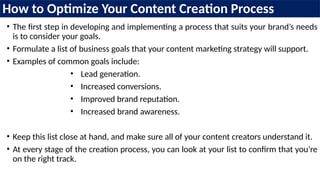
• The first step in developing and implementing a process that suits your brand’s needs
is to consider your goals.
• Formulate a list of business goals that your content marketing strategy will support.
• Examples of common goals include:
• Lead generation.
• Increased conversions.
• Improved brand reputation.
• Increased brand awareness.
• Keep this list close at hand, and make sure all of your content creators understand it.
• At every stage of the creation process, you can look at your list to confirm that you’re
on the right track.
A Step-by-Step Workflow for Creating Effective Content
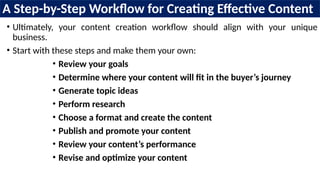
• Ultimately, your content creation workflow should align with your unique
business.
• Start with these steps and make them your own:
• Review your goals
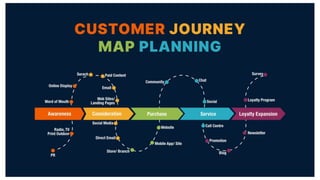
• Determine where your content will fit in the buyer’s journey
• Generate topic ideas
• Perform research
• Choose a format and create the content
• Publish and promote your content
• Review your content’s performance
• Revise and optimize your content
Content Creation Tools and Templates
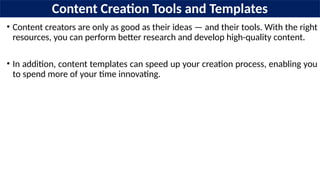
• Content creators are only as good as their ideas — and their tools. With the right
resources, you can perform better research and develop high-quality content.
• In addition, content templates can speed up your creation process, enabling you
to spend more of your time innovating.
Content Creation Tools and Templates
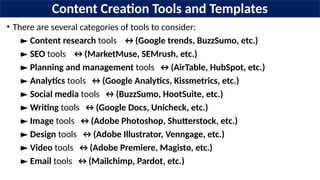
• There are several categories of tools to consider:
► Content research tools ↔(Google trends, BuzzSumo, etc.)
► SEO tools ↔(MarketMuse, SEMrush, etc.)
► Planning and management tools ↔(AirTable, HubSpot, etc.)
► Analytics tools ↔(Google Analytics, Kissmetrics, etc.)
► Social media tools ↔(BuzzSumo, HootSuite, etc.)
► Writing tools ↔(Google Docs, Unicheck, etc.)
► Image tools ↔(Adobe Photoshop, Shutterstock, etc.)
► Design tools ↔(Adobe Illustrator, Venngage, etc.)
► Video tools ↔(Adobe Premiere, Magisto, etc.)
► Email tools ↔(Mailchimp, Pardot, etc.)
Content Marketing
• Content marketing is a marketing strategy used to attract, engage, and retain an
audience by creating and sharing relevant articles, videos, podcasts, and other
media.
• This approach establishes expertise, promotes brand awareness, and keeps your
business top of mind when it’s time to buy what you sell.
• A content marketing strategy establishes your brand as a thought leader,
boosting trust among your audience by creating and distributing content in
various ways.
• Content marketing is a type of inbound marketing that attracts customers and
builds loyalty, making it effective for customer retention.
Content Marketing
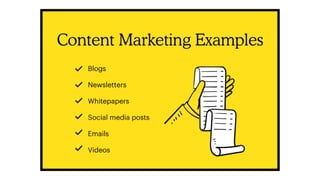
• Content marketing is the development and distribution of relevant, useful
content—blogs, newsletters, white papers, social media posts, emails, videos,
and the like—to current and potential customers.
• When it’s done right, this content conveys expertise and makes it clear that a
company values the people to whom it sells.
• The consistent use of content marketing establishes and nurtures relationships
with your prospective and existing customers.
• When your audience thinks of your company as a partner interested in their
success and a valuable source of advice and guidance, they’re more likely to
choose you when it’s time to buy.
Why is content marketing important?
• Content marketing is a go-to tactic that’s proven to work. Also, it provides a
competitive advantage.
• Take a look at what the data says about content marketing:
• Businesses with blogs get 67% more leads than other companies.
• 67% of business to business (B2B) marketers say B2B content marketing
increases engagement and the number of leads they generate.
• 88% of people credit branded videos for convincing them to purchase a product
or service.
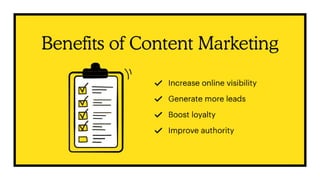
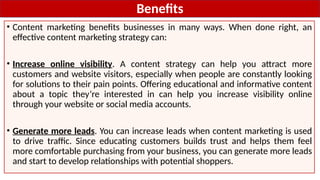
Benefits
• Content marketing benefits businesses in many ways. When done right, an
effective content marketing strategy can:
• Increase online visibility. A content strategy can help you attract more
customers and website visitors, especially when people are constantly looking
for solutions to their pain points. Offering educational and informative content
about a topic they’re interested in can help you increase visibility online
through your website or social media accounts.
• Generate more leads. You can increase leads when content marketing is used
to drive traffic. Since educating customers builds trust and helps them feel
more comfortable purchasing from your business, you can generate more leads
and start to develop relationships with potential shoppers.
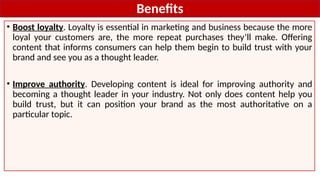
Benefits
• Boost loyalty. Loyalty is essential in marketing and business because the more
loyal your customers are, the more repeat purchases they’ll make. Offering
content that informs consumers can help them begin to build trust with your
brand and see you as a thought leader.
• Improve authority. Developing content is ideal for improving authority and
becoming a thought leader in your industry. Not only does content help you
build trust, but it can position your brand as the most authoritative on a
particular topic.
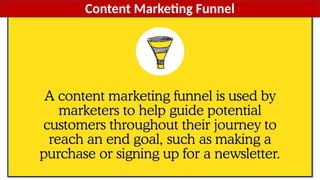
Content Marketing Funnel
content marketing funnel
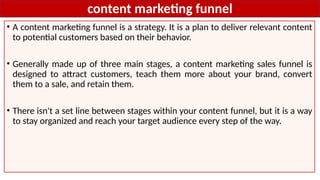
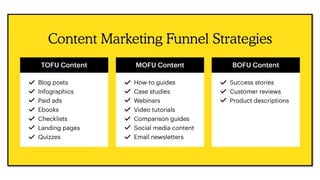
• A content marketing funnel is a strategy. It is a plan to deliver relevant content
to potential customers based on their behavior.
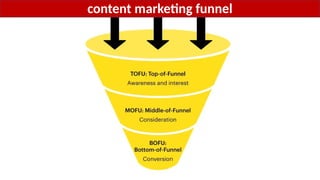
• Generally made up of three main stages, a content marketing sales funnel is
designed to attract customers, teach them more about your brand, convert
them to a sale, and retain them.
• There isn't a set line between stages within your content funnel, but it is a way
to stay organized and reach your target audience every step of the way.
content marketing funnel
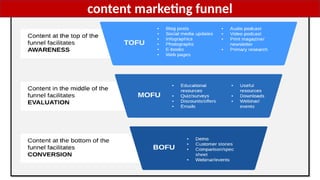
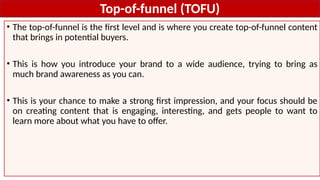
Top-of-funnel (TOFU)
• The top-of-funnel is the first level and is where you create top-of-funnel content
that brings in potential buyers.
• This is how you introduce your brand to a wide audience, trying to bring as
much brand awareness as you can.
• This is your chance to make a strong first impression, and your focus should be
on creating content that is engaging, interesting, and gets people to want to
learn more about what you have to offer.
Middle-of-funnel (MOFU)
• The middle-of-the-funnel level is the stage where potential buyers are
considering your brand and trying to learn more about you as a business.
• They might be reading customer success stories, reviewing social media posts,
or reading comparison guides about your business's products or services.
• Your goal here is to educate customers about your products or services so that
they can make the right decision to choose you as their company to work with.
Bottom-of-funnel (BOFU)
• The bottom-of-the-funnel level is the end stage or final decision-making stage.
• This is where you work with customers who are ready to make a decision but
don't know what step to take next.
• Your goal here is to convert a buyer that is ready to become a paying customer.
• Understand that customers might go through the content funnel within
minutes or take weeks to make a final decision.
• Your job is to identify where the customer is in the process and to nurture
them with targeted content.
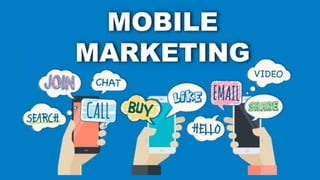
• Mobile marketing is a digital marketing strategy that uses multiple channels to
reach target audiences including smartphones, tablets, mobile devices, social
media, and apps.
• Mobile marketing is any advertising or marketing campaign that promotes
products or services through mobile devices. By connecting with customers
through mobile devices, you can create a cohesive customer experience.
• Most people always have their phones with them, allowing you to connect with
customers in real time.
• Mobile marketing is used to attract customers in an interactive and
personalized way.
Mobile Marketing
• Mobile marketing works by connecting with customers through their mobile
devices encouraging them to interact with your brand.
• Here are some types of mobile marketing:
• In-App Marketing
• In-app marketing is marketing through mobile apps. In-app marketing can be
either for your own brand or for other brands. For your own brand, In-App
marketing refers to the use of banners, overlays, and inbox messaging to market
your products to your app users.
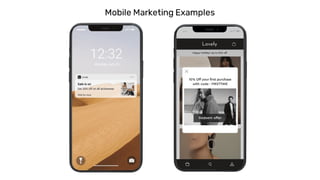
• Mobile Push Marketing
• Mobile push marketing sends marketing messages on mobile devices using push
technology. It allows you to deliver relevant information to users even if they are
not on your website or app. Mobile push notifications allow you to
communicate with existing and potential customers in a simple and effective
way.
Types of Mobile Marketing
• SMS Marketing
• SMS marketing is a marketing campaign via text message. You can send
promotions, alerts, offers, and more to current and potential customers’
phones. Text marketing campaigns can be successful because most people
have their phones with them, and it is difficult to ignore push notifications.
• Social Media Marketing
• Social media platforms typically have billions of users, making social media a
great place to advertise and promote your business. Social media marketing
allows you to make a more personal connection with consumers through
Facebook ads, promoted tweets, or shoppable pins on Pinterest.
Types of Mobile Marketing
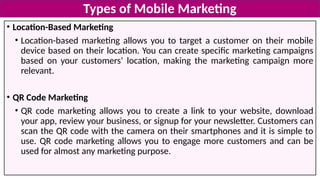
• Location-Based Marketing
• Location-based marketing allows you to target a customer on their mobile
device based on their location. You can create specific marketing campaigns
based on your customers’ location, making the marketing campaign more
relevant.
• QR Code Marketing
• QR code marketing allows you to create a link to your website, download
your app, review your business, or signup for your newsletter. Customers can
scan the QR code with the camera on their smartphones and it is simple to
use. QR code marketing allows you to engage more customers and can be
used for almost any marketing purpose.
Types of Mobile Marketing
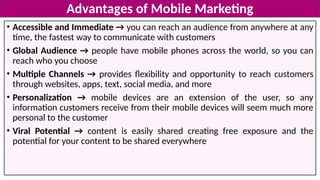
• Accessible and Immediate → you can reach an audience from anywhere at any
time, the fastest way to communicate with customers
• Global Audience → people have mobile phones across the world, so you can
reach who you choose
• Multiple Channels → provides flexibility and opportunity to reach customers
through websites, apps, text, social media, and more
• Personalization → mobile devices are an extension of the user, so any
information customers receive from their mobile devices will seem much more
personal to the customer
• Viral Potential → content is easily shared creating free exposure and the
potential for your content to be shared everywhere
Advantages of Mobile Marketing
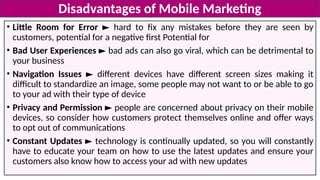
• Little Room for Error ► hard to fix any mistakes before they are seen by
customers, potential for a negative first Potential for
• Bad User Experiences ► bad ads can also go viral, which can be detrimental to
your business
• Navigation Issues ► different devices have different screen sizes making it
difficult to standardize an image, some people may not want to or be able to go
to your ad with their type of device
• Privacy and Permission ► people are concerned about privacy on their mobile
devices, so consider how customers protect themselves online and offer ways
to opt out of communications
• Constant Updates ► technology is continually updated, so you will constantly
have to educate your team on how to use the latest updates and ensure your
customers also know how to access your ad with new updates
Disadvantages of Mobile Marketing
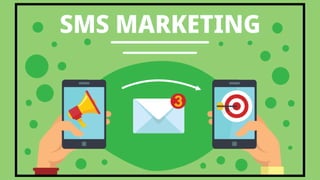
• SMS marketing, or short message service marketing, is a type of direct
marketing strategy.
• It involves communicating with customers via text messages on their mobile
devices.
• These messages are mostly meant to communicate time-sensitive offers,
updates, and alerts to people who have consented to receive text messages
from your business.
SMS marketing
• Promotional SMS. → Promotional messages focus on driving sales by sharing
special offers, new product drops, or limited-time deals. For instance, a retail
store might send a 20% off code to customers during the holiday season. They
tend to be one-to-many bulk SMS messages.
• Transactional SMS. → Transactional text messages are one-to-one messages that
are triggered by a certain event or behavior. An example of this would be an
order confirmation or shipping notification for an ecommerce purchase. These
messages communicate relevant and timely information at key points across the
customer journey.
• Customer engagement SMS. → These SMS campaigns include things like
feedback requests, customer loyalty program updates, and surveys or polls to
garner insights.
Types of SMS marketing
YouTube Marketing
• YouTube Marketing is the practice of promoting businesses and products on
YouTube’s platform, by uploading valuable videos on a company’s YouTube
channel or using YouTube ads.
• YouTube marketing is the process of promoting your brand, product or service
on YouTube.
• It involves a mix of various organic and paid approaches such as uploading your
own videos or paying for YouTube ads.
• Additionally, brands may even include influencers in their YouTube marketing
mix.
YouTube Marketing
• A typical YouTube marketing strategy may involve one or a combination of the
following methods:
• Video creation: YouTube is primarily a video hosting platform. So creating and
uploading original content is the best way to engage your YouTube audience.
• YouTube influencer marketing: YouTube is the second-most popular platform to
work with influencers based on the latest influencer marketing stats. 70% of
marketers find the platform important for their influencer marketing.
• YouTube advertising: 70% of consumers say they’ve bought a product after
seeing it on YouTube. Running ads on the platform can deliver high returns for
your brand.
YouTube Marketing
• YouTube is also the second-most visited website next to Google.
• This makes it the world’s second-largest search engine.
• But ranking on the platform is highly competitive, with 500+ hours of content
uploaded every minute.
• Understanding how the YouTube algorithm works will help you optimize your
videos for visibility.
Why is YouTube marketing important?
• The latest YouTube stats all point to one truth—marketers and consumers love
video.
• YouTube marketing has tons of benefits for your business. Below are a few
reasons investing in YouTube should be your top priority:
• Reach a large audience
• Improve search visibility
• Increase brand awareness
• Build trust and credibility
• Drive sales and traffic
• Generate leads
• Make extra revenue
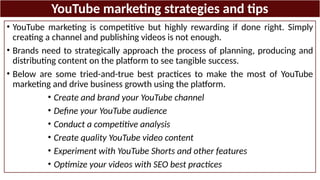
YouTube marketing strategies and tips
• YouTube marketing is competitive but highly rewarding if done right. Simply
creating a channel and publishing videos is not enough.
• Brands need to strategically approach the process of planning, producing and
distributing content on the platform to see tangible success.
• Below are some tried-and-true best practices to make the most of YouTube
marketing and drive business growth using the platform.
• Create and brand your YouTube channel
• Define your YouTube audience
• Conduct a competitive analysis
• Create quality YouTube video content
• Experiment with YouTube Shorts and other features
• Optimize your videos with SEO best practices
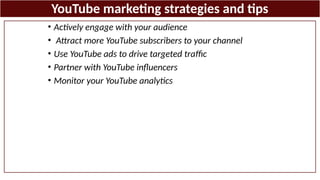
YouTube marketing strategies and tips
• Actively engage with your audience
• Attract more YouTube subscribers to your channel
• Use YouTube ads to drive targeted traffic
• Partner with YouTube influencers
• Monitor your YouTube analytics
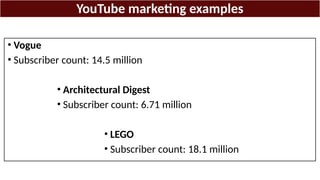
YouTube marketing examples
• Vogue
• Subscriber count: 14.5 million
• Architectural Digest
• Subscriber count: 6.71 million
• LEGO
• Subscriber count: 18.1 million
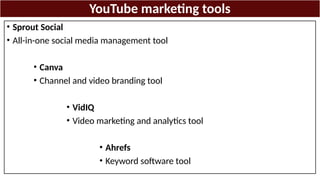
YouTube marketing tools
• Sprout Social
• All-in-one social media management tool
• Canva
• Channel and video branding tool
• VidIQ
• Video marketing and analytics tool
• Ahrefs
• Keyword software tool

Digital Marketing - Unit III for students.

  • 1.
    Unit - III S.S. SARAVANA KUMAR ASSISTANT PROFESSOR Department of Computer Applications Sri Ramakrishna College of Arts and Science Coimbatore - 641 006 Tamil Nadu, India
  • 3.
    Email Marketing • Promotinga business by sending emails and newsletters is what we call email marketing. • Today’s marketers need to do more with less. • They need to connect with their audience in a highly personalized way, while staying on budget. • Marketers who are good at email marketing can connect with their customers in a highly targeted way. • Email marketing is a digital marketing strategy that involves sending promotional messages or content to subscribers via email. • This allows marketers to nurture relationships, generate leads, and drive sales.
  • 4.
    Why email marketing? •Affordable • Consumers prefer email • Email addresses are valuable pieces of information
  • 5.
    Content Creation • Contentcreation is the foundation of all modern digital marketing efforts. • It’s defined as the process of conducting research, generating strategic ideas, crafting those ideas into high-value collateral and then promoting those pieces to a target audience. • Digital content takes many forms, including web pages, blogs, infographics, videos and social media posts. • Content creation also helps people discover your business, brand, and products.
  • 6.
    Content Creation • Themain objective of content creation is to attract new and returning customers. • Inbound marketing strategies give away high-value digital media for free. • This content establishes your brand’s thought leadership while providing readers with the information they need to make a purchasing decision. • Brands use different types of content at each stage of the marketing funnel. • At the top of the funnel, search engine optimized (SEO) blogs organically attract new visitors. Mid-funnel landing pages keep readers engaged, and highly detailed content like white papers and eBooks drive conversions.
  • 7.
    Content Creation • Theamount of effort you put into your brand’s content is directly proportional to the value you get from it. High-quality content will help you: • Stand out as an authoritative thought leader. • Grow your subscribers and email list. • Increase your website traffic. • Keep your customers engaged. • Generate revenue.
  • 8.
    Types of Content •Content comes in all shapes and sizes. It can be a piece of writing, audio, video or an image. • Some of the types of content you’ll find in marketing include: • Written content: Blogs, SEO articles, white papers, eBooks, emails, social media posts. • Imagery: Infographics, GIFs. • Audio: Podcasts, audiobooks. • Video: Animations, webinars, talking heads.
  • 9.
    Content Creation forSEO • When you create a piece of content, you’re always making it for two main audiences: your customers and search algorithms. • When creating content, ask yourself these questions to help you focus on a specific search intent: • What information would be most valuable to my target audience? • What sets my brand apart from the competition? • What would convince my audience to make a purchase today? • How can I help my audience reach the next stage of the decision-making process?
  • 10.
    Content Creation forSocial Media • While social media posts have a much shorter lifespan than other types of content, they are extremely valuable. Website Content Creation • When developing content for your website, there’s a lot to think about. You need to do your research to understand how your customers make decisions and what kind of content appeals to them the most. • All of your website content should work together strategically to form a lead generation engine. • A website on its own will only get your brand so far, however. You also need to promote your content through social media channels, influencers and emails.
  • 11.
    Content Formats • Contentis a broad term that can take many forms. • For promoting brands, some of the most effective content formats include: • Infographics: Best for visualizing processes or displaying statistics, infographics are valuable top-of-funnel content that provide readers with quick, actionable insights. • Blogging: Blogs and articles often form the heart of content marketing campaigns because they are bite-sized enough for readers to consume in a single sitting while also providing the time and space to dive deeply into a particular topic.
  • 12.
    Content Formats • Podcasts:Audio formats like podcasts enable brands to add a personal touch to their web presence. Plus, they’re great for repurposing written content. • Videos: Animations, interviews and other video content is highly engaging for both B2C and B2B customers. • Case studies: Providing third-party evidence of your brand’s value, case studies offer decision-makers useful information. • Webinars: This type of visual content provides your audience with detailed information on a single topic while giving viewers the opportunity to ask questions and interact with you directly. • White papers: Another form of written content, white papers typically involve more research than the average blog
  • 13.
    Content Creation Process •While there’s no one standard way to create content, there are some tried and tested methods that have proven to be successful. • An optimized creation process provides creators with room for creativity while still adhering to the best practices mentioned above. • Ultimately, an ideal content creation process gets content moving in a timely manner, producing an end product that gets results.
  • 14.
    How to OptimizeYour Content Creation Process • The first step in developing and implementing a process that suits your brand’s needs is to consider your goals. • Formulate a list of business goals that your content marketing strategy will support. • Examples of common goals include: • Lead generation. • Increased conversions. • Improved brand reputation. • Increased brand awareness. • Keep this list close at hand, and make sure all of your content creators understand it. • At every stage of the creation process, you can look at your list to confirm that you’re on the right track.
  • 15.
    A Step-by-Step Workflowfor Creating Effective Content • Ultimately, your content creation workflow should align with your unique business. • Start with these steps and make them your own: • Review your goals • Determine where your content will fit in the buyer’s journey • Generate topic ideas • Perform research • Choose a format and create the content • Publish and promote your content • Review your content’s performance • Revise and optimize your content
  • 16.
    Content Creation Toolsand Templates • Content creators are only as good as their ideas — and their tools. With the right resources, you can perform better research and develop high-quality content. • In addition, content templates can speed up your creation process, enabling you to spend more of your time innovating.
  • 17.
    Content Creation Toolsand Templates • There are several categories of tools to consider: ► Content research tools ↔(Google trends, BuzzSumo, etc.) ► SEO tools ↔(MarketMuse, SEMrush, etc.) ► Planning and management tools ↔(AirTable, HubSpot, etc.) ► Analytics tools ↔(Google Analytics, Kissmetrics, etc.) ► Social media tools ↔(BuzzSumo, HootSuite, etc.) ► Writing tools ↔(Google Docs, Unicheck, etc.) ► Image tools ↔(Adobe Photoshop, Shutterstock, etc.) ► Design tools ↔(Adobe Illustrator, Venngage, etc.) ► Video tools ↔(Adobe Premiere, Magisto, etc.) ► Email tools ↔(Mailchimp, Pardot, etc.)
  • 19.
    Content Marketing • Contentmarketing is a marketing strategy used to attract, engage, and retain an audience by creating and sharing relevant articles, videos, podcasts, and other media. • This approach establishes expertise, promotes brand awareness, and keeps your business top of mind when it’s time to buy what you sell. • A content marketing strategy establishes your brand as a thought leader, boosting trust among your audience by creating and distributing content in various ways. • Content marketing is a type of inbound marketing that attracts customers and builds loyalty, making it effective for customer retention.
  • 21.
    Content Marketing • Contentmarketing is the development and distribution of relevant, useful content—blogs, newsletters, white papers, social media posts, emails, videos, and the like—to current and potential customers. • When it’s done right, this content conveys expertise and makes it clear that a company values the people to whom it sells. • The consistent use of content marketing establishes and nurtures relationships with your prospective and existing customers. • When your audience thinks of your company as a partner interested in their success and a valuable source of advice and guidance, they’re more likely to choose you when it’s time to buy.
  • 22.
    Why is contentmarketing important? • Content marketing is a go-to tactic that’s proven to work. Also, it provides a competitive advantage. • Take a look at what the data says about content marketing: • Businesses with blogs get 67% more leads than other companies. • 67% of business to business (B2B) marketers say B2B content marketing increases engagement and the number of leads they generate. • 88% of people credit branded videos for convincing them to purchase a product or service.
  • 24.
    Benefits • Content marketingbenefits businesses in many ways. When done right, an effective content marketing strategy can: • Increase online visibility. A content strategy can help you attract more customers and website visitors, especially when people are constantly looking for solutions to their pain points. Offering educational and informative content about a topic they’re interested in can help you increase visibility online through your website or social media accounts. • Generate more leads. You can increase leads when content marketing is used to drive traffic. Since educating customers builds trust and helps them feel more comfortable purchasing from your business, you can generate more leads and start to develop relationships with potential shoppers.
  • 25.
    Benefits • Boost loyalty.Loyalty is essential in marketing and business because the more loyal your customers are, the more repeat purchases they’ll make. Offering content that informs consumers can help them begin to build trust with your brand and see you as a thought leader. • Improve authority. Developing content is ideal for improving authority and becoming a thought leader in your industry. Not only does content help you build trust, but it can position your brand as the most authoritative on a particular topic.
  • 26.
  • 27.
    content marketing funnel •A content marketing funnel is a strategy. It is a plan to deliver relevant content to potential customers based on their behavior. • Generally made up of three main stages, a content marketing sales funnel is designed to attract customers, teach them more about your brand, convert them to a sale, and retain them. • There isn't a set line between stages within your content funnel, but it is a way to stay organized and reach your target audience every step of the way.
  • 28.
  • 29.
  • 30.
    Top-of-funnel (TOFU) • Thetop-of-funnel is the first level and is where you create top-of-funnel content that brings in potential buyers. • This is how you introduce your brand to a wide audience, trying to bring as much brand awareness as you can. • This is your chance to make a strong first impression, and your focus should be on creating content that is engaging, interesting, and gets people to want to learn more about what you have to offer.
  • 31.
    Middle-of-funnel (MOFU) • Themiddle-of-the-funnel level is the stage where potential buyers are considering your brand and trying to learn more about you as a business. • They might be reading customer success stories, reviewing social media posts, or reading comparison guides about your business's products or services. • Your goal here is to educate customers about your products or services so that they can make the right decision to choose you as their company to work with.
  • 32.
    Bottom-of-funnel (BOFU) • Thebottom-of-the-funnel level is the end stage or final decision-making stage. • This is where you work with customers who are ready to make a decision but don't know what step to take next. • Your goal here is to convert a buyer that is ready to become a paying customer. • Understand that customers might go through the content funnel within minutes or take weeks to make a final decision. • Your job is to identify where the customer is in the process and to nurture them with targeted content.
  • 36.
    • Mobile marketingis a digital marketing strategy that uses multiple channels to reach target audiences including smartphones, tablets, mobile devices, social media, and apps. • Mobile marketing is any advertising or marketing campaign that promotes products or services through mobile devices. By connecting with customers through mobile devices, you can create a cohesive customer experience. • Most people always have their phones with them, allowing you to connect with customers in real time. • Mobile marketing is used to attract customers in an interactive and personalized way. Mobile Marketing
  • 37.
    • Mobile marketingworks by connecting with customers through their mobile devices encouraging them to interact with your brand. • Here are some types of mobile marketing: • In-App Marketing • In-app marketing is marketing through mobile apps. In-app marketing can be either for your own brand or for other brands. For your own brand, In-App marketing refers to the use of banners, overlays, and inbox messaging to market your products to your app users. • Mobile Push Marketing • Mobile push marketing sends marketing messages on mobile devices using push technology. It allows you to deliver relevant information to users even if they are not on your website or app. Mobile push notifications allow you to communicate with existing and potential customers in a simple and effective way. Types of Mobile Marketing
  • 38.
    • SMS Marketing •SMS marketing is a marketing campaign via text message. You can send promotions, alerts, offers, and more to current and potential customers’ phones. Text marketing campaigns can be successful because most people have their phones with them, and it is difficult to ignore push notifications. • Social Media Marketing • Social media platforms typically have billions of users, making social media a great place to advertise and promote your business. Social media marketing allows you to make a more personal connection with consumers through Facebook ads, promoted tweets, or shoppable pins on Pinterest. Types of Mobile Marketing
  • 39.
    • Location-Based Marketing •Location-based marketing allows you to target a customer on their mobile device based on their location. You can create specific marketing campaigns based on your customers’ location, making the marketing campaign more relevant. • QR Code Marketing • QR code marketing allows you to create a link to your website, download your app, review your business, or signup for your newsletter. Customers can scan the QR code with the camera on their smartphones and it is simple to use. QR code marketing allows you to engage more customers and can be used for almost any marketing purpose. Types of Mobile Marketing
  • 41.
    • Accessible andImmediate → you can reach an audience from anywhere at any time, the fastest way to communicate with customers • Global Audience → people have mobile phones across the world, so you can reach who you choose • Multiple Channels → provides flexibility and opportunity to reach customers through websites, apps, text, social media, and more • Personalization → mobile devices are an extension of the user, so any information customers receive from their mobile devices will seem much more personal to the customer • Viral Potential → content is easily shared creating free exposure and the potential for your content to be shared everywhere Advantages of Mobile Marketing
  • 42.
    • Little Roomfor Error ► hard to fix any mistakes before they are seen by customers, potential for a negative first Potential for • Bad User Experiences ► bad ads can also go viral, which can be detrimental to your business • Navigation Issues ► different devices have different screen sizes making it difficult to standardize an image, some people may not want to or be able to go to your ad with their type of device • Privacy and Permission ► people are concerned about privacy on their mobile devices, so consider how customers protect themselves online and offer ways to opt out of communications • Constant Updates ► technology is continually updated, so you will constantly have to educate your team on how to use the latest updates and ensure your customers also know how to access your ad with new updates Disadvantages of Mobile Marketing
  • 44.
    • SMS marketing,or short message service marketing, is a type of direct marketing strategy. • It involves communicating with customers via text messages on their mobile devices. • These messages are mostly meant to communicate time-sensitive offers, updates, and alerts to people who have consented to receive text messages from your business. SMS marketing
  • 45.
    • Promotional SMS.→ Promotional messages focus on driving sales by sharing special offers, new product drops, or limited-time deals. For instance, a retail store might send a 20% off code to customers during the holiday season. They tend to be one-to-many bulk SMS messages. • Transactional SMS. → Transactional text messages are one-to-one messages that are triggered by a certain event or behavior. An example of this would be an order confirmation or shipping notification for an ecommerce purchase. These messages communicate relevant and timely information at key points across the customer journey. • Customer engagement SMS. → These SMS campaigns include things like feedback requests, customer loyalty program updates, and surveys or polls to garner insights. Types of SMS marketing
  • 47.
    YouTube Marketing • YouTubeMarketing is the practice of promoting businesses and products on YouTube’s platform, by uploading valuable videos on a company’s YouTube channel or using YouTube ads. • YouTube marketing is the process of promoting your brand, product or service on YouTube. • It involves a mix of various organic and paid approaches such as uploading your own videos or paying for YouTube ads. • Additionally, brands may even include influencers in their YouTube marketing mix.
  • 48.
    YouTube Marketing • Atypical YouTube marketing strategy may involve one or a combination of the following methods: • Video creation: YouTube is primarily a video hosting platform. So creating and uploading original content is the best way to engage your YouTube audience. • YouTube influencer marketing: YouTube is the second-most popular platform to work with influencers based on the latest influencer marketing stats. 70% of marketers find the platform important for their influencer marketing. • YouTube advertising: 70% of consumers say they’ve bought a product after seeing it on YouTube. Running ads on the platform can deliver high returns for your brand.
  • 49.
    YouTube Marketing • YouTubeis also the second-most visited website next to Google. • This makes it the world’s second-largest search engine. • But ranking on the platform is highly competitive, with 500+ hours of content uploaded every minute. • Understanding how the YouTube algorithm works will help you optimize your videos for visibility.
  • 50.
    Why is YouTubemarketing important? • The latest YouTube stats all point to one truth—marketers and consumers love video. • YouTube marketing has tons of benefits for your business. Below are a few reasons investing in YouTube should be your top priority: • Reach a large audience • Improve search visibility • Increase brand awareness • Build trust and credibility • Drive sales and traffic • Generate leads • Make extra revenue
  • 51.
    YouTube marketing strategiesand tips • YouTube marketing is competitive but highly rewarding if done right. Simply creating a channel and publishing videos is not enough. • Brands need to strategically approach the process of planning, producing and distributing content on the platform to see tangible success. • Below are some tried-and-true best practices to make the most of YouTube marketing and drive business growth using the platform. • Create and brand your YouTube channel • Define your YouTube audience • Conduct a competitive analysis • Create quality YouTube video content • Experiment with YouTube Shorts and other features • Optimize your videos with SEO best practices
  • 52.
    YouTube marketing strategiesand tips • Actively engage with your audience • Attract more YouTube subscribers to your channel • Use YouTube ads to drive targeted traffic • Partner with YouTube influencers • Monitor your YouTube analytics
  • 53.
    YouTube marketing examples •Vogue • Subscriber count: 14.5 million • Architectural Digest • Subscriber count: 6.71 million • LEGO • Subscriber count: 18.1 million
  • 54.
    YouTube marketing tools •Sprout Social • All-in-one social media management tool • Canva • Channel and video branding tool • VidIQ • Video marketing and analytics tool • Ahrefs • Keyword software tool