Report On “Transformation of rural India through Digitization.”
INSTITIUTE NAME-
Bharti Vidyapeeth’s Institute of Technology (Polytechnic) Palus.
AUTHORS:-
1. Shete Ketan Nitin.(ketanshete95@gmail.com)
2. Dahane Swapnil Satyawan.(swapnildhane98@gmail.com)
 Abstract: -
The principal object of this paper is to demonstrate the power of digitalization in
India and mainly in rural India. This paper also provides with the detail information about
“How Digitalization can change INDIA?”. In this paper there is information collected from
various sites & PDF from Google. The Government’s ambitious “Digital India” plan aims to
digitally connect all of India's villages and gram panchayats by broadband internet, promote
e-governance and transform India into a connected knowledge economy. This digitalization
would increase the approach of people from rural areas and there various businesses, which
would increase the economy of India at greater extent!
 Introduction:-
The digital penetration in the Indian hinterland is growing silently but rapidly.
Several initiatives taken by the government, NGOS, private social groups are now using
technology for efficient delivery of a variety of services that is showing remarkable results.
India’s population now exceeds 1.21 billion with 69% of the population located in rural
areas. Internet penetration is increasing with Mobile playing the major catalyst. Studies
conducted by IAMAI reflect some interesting patterns. 90% of those accessing the internet
were using it for entertainment, 80% were using it for communications, 67% for online
services, 65% for e-commerce and 60% for social networking. The number of Internet users
in rural India is estimated to cross 85 million by June 2014 making India the world’s second
largest market for Internet users. All these put together is now changing attitudes, awareness
and lifestyles in rural India. A decade ago, the awareness, information and knowledge gap
between the rural youth and his urban counterpart was significant. This has now rapidly
narrowed and the gap is closing.
 Content:-
In any developing economy, the success of any social development initiative depends
on not only the government’s involvement but active participation from both the private
sector, as well as, people themselves. India is continuing to demonstrate several success
stories that can lead to other initiatives by various interest groups. Bottom line: people
participation.
The use of Digital technology to better lives is now beginning to unfold in the Indian
hinterland. Some of the interesting experiences come from the Rural Health Connect
initiative of NewDigm Healthcare Technologies. They have taken the initiative to utilize the
large pool of Village Health Workers (VHW) that provides a wide variety of health care
support to the last mile areas of rural India. Creating a mobile platform to collect, streamline,
analyze, offer medical advice and the next course of possible action to the VHW. The results
are well documented. In a field trial conducted with the National Rural Health Mission,
Tamil Nadu saw 95% pregnancies registered and monitored, 20% reduction in outpatient
costs including drugs, 75% VHWs registering an increase in diagnostic efficiency and ease of
operation. In the next three years, the target market penetration is going to significantly
increase with its impact on both healthcare and rural incomes.
Google has launched an initiative to introduce women to the internet especially those in the
rural areas. They have launched a website ‘Helping Women Get Online’. They have
partnered with leading companies like Hindustan Levers, Axis Bank, Intel, Johnson &
Johnson, Shaadi.com, Babyoye & iDiva. The website offers a step-by-step guide to computer
basics, internet skills, chat & email and watching videos online. Each topic has different
topics ranging from how to start and shut down your computer, how to create an email
account. In addition, the site also offers information on a variety of topics such as cooking
recipes, childcare, financial, healthcare, maternity, relationship and style & beauty. They also
offer a Toll-free helpline.
education hubs etc. Their other well recognized projects are PES Project, Global Fund for
Children, e-NGO National Program and Rajiv Gandhi Foundation amongst others.
Launched in June 2000, ITC’s e-choupal initiative has emerged as the largest internet based
intervention in rural India, reaching out to 4 million farmers in over 40,000 villages through
6,500 internet kiosks. The initiative leverages technology through internet kiosks managed
by farmers themselves and providing all relevant information to the farming community
covering weather, market prices, information on best farming practices and risk management,
while providing all information to facilitate sale and optimizing farmer profitability. A fact
that the rural farming community has wholeheartedly accepted and adopted best practices
using technology has shown its impact and success on rising agricultural production and
income.
Those of us in urban areas often desire to reach out and do something that can make a
difference to someone’s life but never get around to taking that first step. It just may be a
great idea to take inspiration from the above and see what you could offer based on your
time, talent and skill set. Technology can help you reach out to a larger number more
efficiently. Remember we all have something positive to offer we just need the right
platform.
By the year 2019, the ‘Digital India’ program of the Government of India (GOI),
envisages that 250,000 Indian villages will enjoy broadband connectivity, and universal
phone connectivity. This is a truly visionary and commendable initiative. However, to
implement this vision in a country where most of the population resides in rural areas is very
challenging. It can best be done by creating Digital “Town Squares” – which will be tower-
based sites that enable the Smart Village and would become the focal point for the providing
information, social, e-learning and e-governance services to villages. This can become the
spring board for rapid economic growth in the rural areas.
Global case-studies have demonstrated how wireless broadband plays a key role in rural
society, impacting GDP, productivity and employment. In a study undertaken across 26 Latin
American countries between 2003 and 2009, it was observed that a 10 per cent increase in
broadband penetration resulted in an average increase of 3.19 per cent in per capita GDP. In
Africa, 90% of the total broadband penetration is mobile-based. E-commerce, e-
health/education and e-governance are already the key applications. For example, M-Pesa
mobile banking service in Kenya carries 20% of the country’s GDP.
The E-Commerce is prospered and stands for booming growth in Rural India. Their
success depends on the understanding of the market, quantity of consumers and offering
various features. This paper gives an impact of digital India in the future of E-Commerce in
Rural India; represent the various opportunities for vendors, consumers, E-Commerce
Industries and factors influencing trust in rural Indians. We found that the Overall E-
Commerce will increase drastically coming years in the emerging market. While rural area
availability of internet or broadband is lower as compare to urban area but Government’s
dream project Digital India will control or fixed this gap which increases the mass of
consumers for E-Commerce world through spreading business using social commerce
(Facebook Commerce, Twitter Commerce), mobile commerce etc. with adopting Digital
India project features like creation of digital infrastructure and digital literacy. Combination
of E-Commerce and Digital India project make easier contact can be made to anywhere in
the world in seconds. By online trading, businesses open themselves in global marketplace.
Indians should call Digital India Vision or Digital Bharat Vision or Digital Hindustan Vision
projects moving forward. This paper is concerned with current scenario of internet users in
India, how government campaign ― Digital India‖ can connect maximum number of rural
Indians to all over the world through Internet and how E-Commerce Industries can convert
this mass of rural Indians for trading.
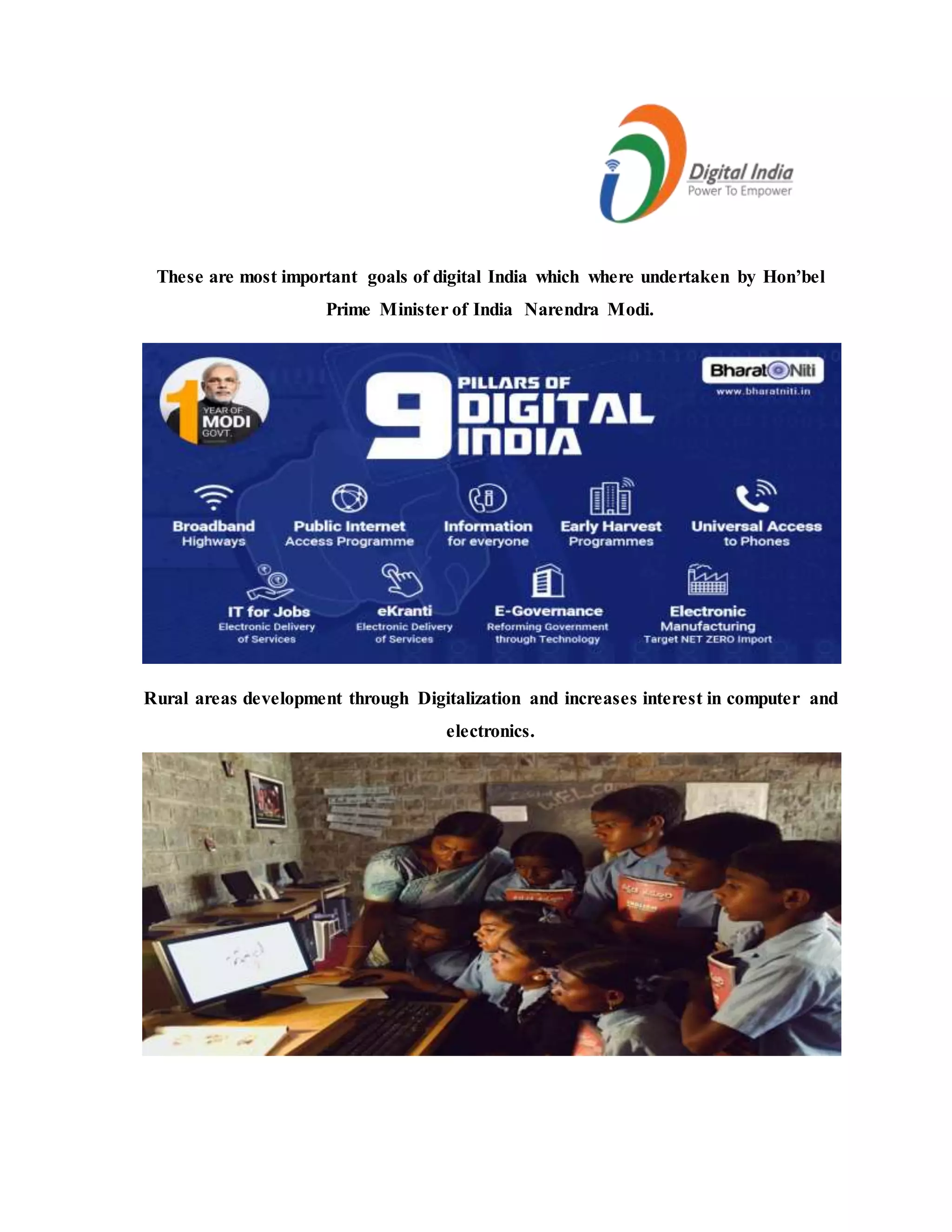
These are most important goals of digital India which where undertaken by Hon’bel
Prime Minister of India Narendra Modi.
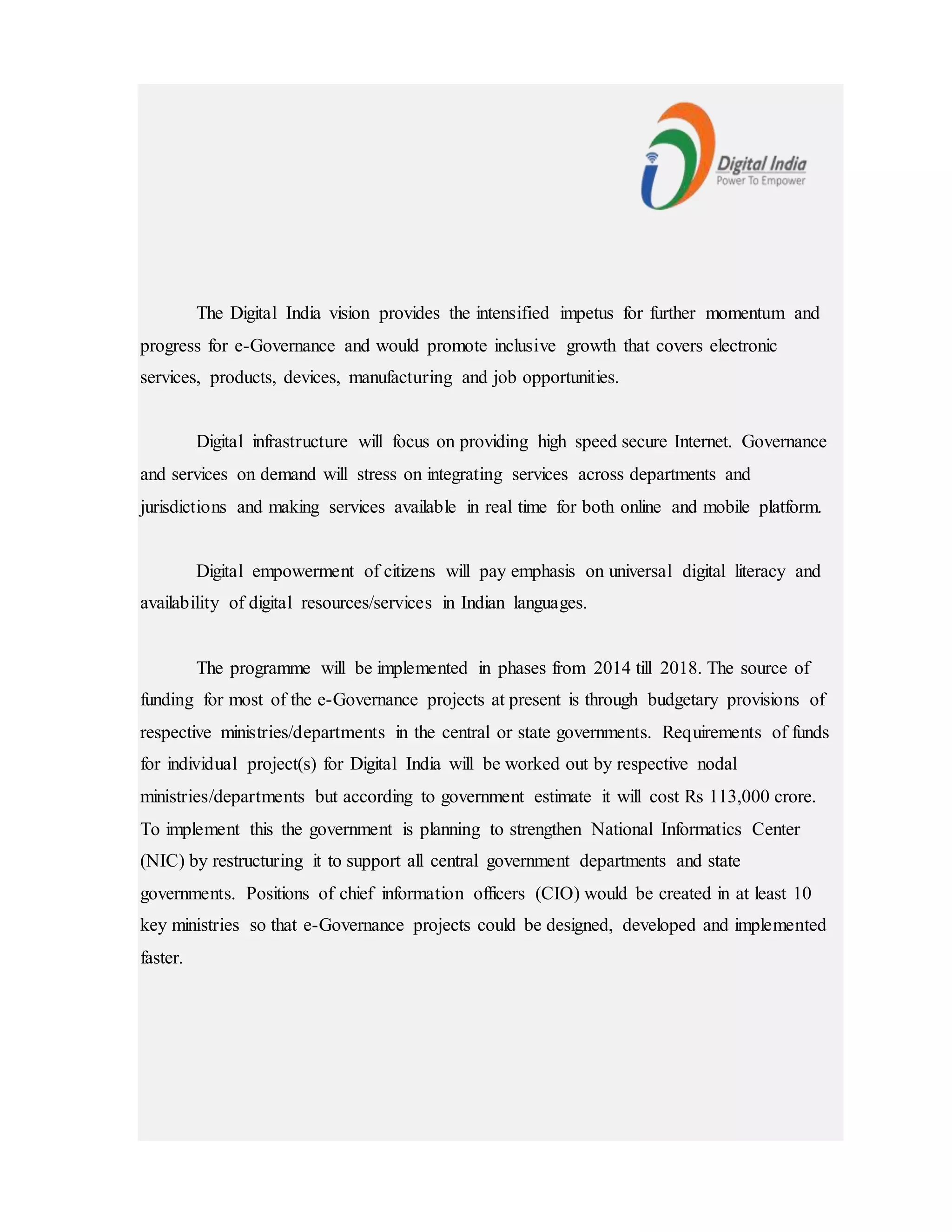
Rural areas development through Digitalization and increases interest in computer and
electronics.
 What Is Digital India?
Digital India is a Programmed to prepare India for a knowledge future. Hon'ble
Shri Narender Modi, Prime Minister of India has laid emphasis on National e- governance
plan and has gave it’s approval for Digital India – A programmed to transform India into
digital empowered society and knowledge economy.
Digital India is an ambitious programme of Government of India projected at Rs
1,13,000 crores. This will be for preparing the India for the knowledge based transformation
and delivering good governance to citizens by synchronized and co-ordinated engagement
with both Central Government and State Government.
It would ensure that government services are available to citizens electronically. It
would also bring in public accountability through mandated delivery of government’s
services electronically.
The Digital India vision provides the intensified impetus for further momentum and
progress for e-Governance and would promote inclusive growth that covers electronic
services, products, devices, manufacturing and job opportunities.
Digital infrastructure will focus on providing high speed secure Internet. Governance
and services on demand will stress on integrating services across departments and
jurisdictions and making services available in real time for both online and mobile platform.
Digital empowerment of citizens will pay emphasis on universal digital literacy and
availability of digital resources/services in Indian languages.
The programme will be implemented in phases from 2014 till 2018. The source of
funding for most of the e-Governance projects at present is through budgetary provisions of
respective ministries/departments in the central or state governments. Requirements of funds
for individual project(s) for Digital India will be worked out by respective nodal
ministries/departments but according to government estimate it will cost Rs 113,000 crore.
To implement this the government is planning to strengthen National Informatics Center
(NIC) by restructuring it to support all central government departments and state
governments. Positions of chief information officers (CIO) would be created in at least 10
key ministries so that e-Governance projects could be designed, developed and implemented
faster.
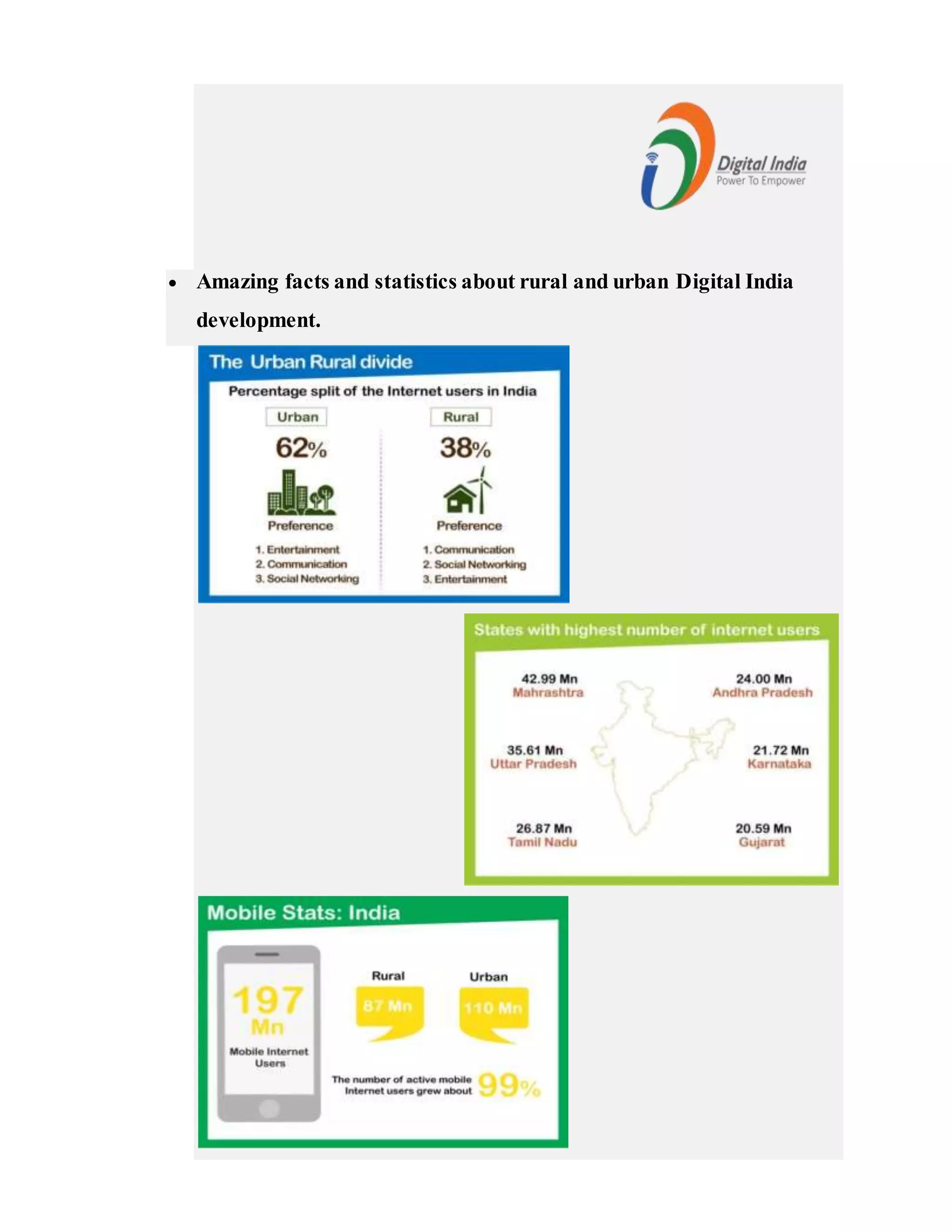
 Amazing facts and statistics about rural and urban Digital India
development.
 Conclusion:-
Digital India i.e Digitization can take India into the list of Developed nations rather
than from Developing Nation. Business in India would increase at much extent, GDP will
also increase to much level. Lacks of people will come in contact with social media and the
Internet and as a result India would soon become super power in the world of electronics.The
derem of our
References:-
1. http://www.cmai.asia/digitalindia/
2. http://www.mapsofindia.com/
3. http://telecom.economictimes.indiatimes.com/
4. www.goolge.com
5. www.youtube.com
6. www.digitalindia.gov.in
7. www.googleimages.com
Digital India

Digital India

  • 1.
    Report On “Transformationof rural India through Digitization.” INSTITIUTE NAME- Bharti Vidyapeeth’s Institute of Technology (Polytechnic) Palus. AUTHORS:- 1. Shete Ketan Nitin.(ketanshete95@gmail.com) 2. Dahane Swapnil Satyawan.(swapnildhane98@gmail.com)
  • 2.
     Abstract: - Theprincipal object of this paper is to demonstrate the power of digitalization in India and mainly in rural India. This paper also provides with the detail information about “How Digitalization can change INDIA?”. In this paper there is information collected from various sites & PDF from Google. The Government’s ambitious “Digital India” plan aims to digitally connect all of India's villages and gram panchayats by broadband internet, promote e-governance and transform India into a connected knowledge economy. This digitalization would increase the approach of people from rural areas and there various businesses, which would increase the economy of India at greater extent!  Introduction:- The digital penetration in the Indian hinterland is growing silently but rapidly. Several initiatives taken by the government, NGOS, private social groups are now using technology for efficient delivery of a variety of services that is showing remarkable results. India’s population now exceeds 1.21 billion with 69% of the population located in rural areas. Internet penetration is increasing with Mobile playing the major catalyst. Studies conducted by IAMAI reflect some interesting patterns. 90% of those accessing the internet were using it for entertainment, 80% were using it for communications, 67% for online services, 65% for e-commerce and 60% for social networking. The number of Internet users in rural India is estimated to cross 85 million by June 2014 making India the world’s second largest market for Internet users. All these put together is now changing attitudes, awareness and lifestyles in rural India. A decade ago, the awareness, information and knowledge gap between the rural youth and his urban counterpart was significant. This has now rapidly narrowed and the gap is closing.
  • 3.
     Content:- In anydeveloping economy, the success of any social development initiative depends on not only the government’s involvement but active participation from both the private sector, as well as, people themselves. India is continuing to demonstrate several success stories that can lead to other initiatives by various interest groups. Bottom line: people participation. The use of Digital technology to better lives is now beginning to unfold in the Indian hinterland. Some of the interesting experiences come from the Rural Health Connect initiative of NewDigm Healthcare Technologies. They have taken the initiative to utilize the large pool of Village Health Workers (VHW) that provides a wide variety of health care support to the last mile areas of rural India. Creating a mobile platform to collect, streamline, analyze, offer medical advice and the next course of possible action to the VHW. The results are well documented. In a field trial conducted with the National Rural Health Mission, Tamil Nadu saw 95% pregnancies registered and monitored, 20% reduction in outpatient costs including drugs, 75% VHWs registering an increase in diagnostic efficiency and ease of operation. In the next three years, the target market penetration is going to significantly increase with its impact on both healthcare and rural incomes. Google has launched an initiative to introduce women to the internet especially those in the rural areas. They have launched a website ‘Helping Women Get Online’. They have partnered with leading companies like Hindustan Levers, Axis Bank, Intel, Johnson & Johnson, Shaadi.com, Babyoye & iDiva. The website offers a step-by-step guide to computer basics, internet skills, chat & email and watching videos online. Each topic has different topics ranging from how to start and shut down your computer, how to create an email account. In addition, the site also offers information on a variety of topics such as cooking recipes, childcare, financial, healthcare, maternity, relationship and style & beauty. They also offer a Toll-free helpline.
  • 4.
    education hubs etc.Their other well recognized projects are PES Project, Global Fund for Children, e-NGO National Program and Rajiv Gandhi Foundation amongst others. Launched in June 2000, ITC’s e-choupal initiative has emerged as the largest internet based intervention in rural India, reaching out to 4 million farmers in over 40,000 villages through 6,500 internet kiosks. The initiative leverages technology through internet kiosks managed by farmers themselves and providing all relevant information to the farming community covering weather, market prices, information on best farming practices and risk management, while providing all information to facilitate sale and optimizing farmer profitability. A fact that the rural farming community has wholeheartedly accepted and adopted best practices using technology has shown its impact and success on rising agricultural production and income. Those of us in urban areas often desire to reach out and do something that can make a difference to someone’s life but never get around to taking that first step. It just may be a great idea to take inspiration from the above and see what you could offer based on your time, talent and skill set. Technology can help you reach out to a larger number more efficiently. Remember we all have something positive to offer we just need the right platform. By the year 2019, the ‘Digital India’ program of the Government of India (GOI), envisages that 250,000 Indian villages will enjoy broadband connectivity, and universal phone connectivity. This is a truly visionary and commendable initiative. However, to implement this vision in a country where most of the population resides in rural areas is very challenging. It can best be done by creating Digital “Town Squares” – which will be tower- based sites that enable the Smart Village and would become the focal point for the providing information, social, e-learning and e-governance services to villages. This can become the spring board for rapid economic growth in the rural areas. Global case-studies have demonstrated how wireless broadband plays a key role in rural society, impacting GDP, productivity and employment. In a study undertaken across 26 Latin
  • 5.
    American countries between2003 and 2009, it was observed that a 10 per cent increase in broadband penetration resulted in an average increase of 3.19 per cent in per capita GDP. In Africa, 90% of the total broadband penetration is mobile-based. E-commerce, e- health/education and e-governance are already the key applications. For example, M-Pesa mobile banking service in Kenya carries 20% of the country’s GDP. The E-Commerce is prospered and stands for booming growth in Rural India. Their success depends on the understanding of the market, quantity of consumers and offering various features. This paper gives an impact of digital India in the future of E-Commerce in Rural India; represent the various opportunities for vendors, consumers, E-Commerce Industries and factors influencing trust in rural Indians. We found that the Overall E- Commerce will increase drastically coming years in the emerging market. While rural area availability of internet or broadband is lower as compare to urban area but Government’s dream project Digital India will control or fixed this gap which increases the mass of consumers for E-Commerce world through spreading business using social commerce (Facebook Commerce, Twitter Commerce), mobile commerce etc. with adopting Digital India project features like creation of digital infrastructure and digital literacy. Combination of E-Commerce and Digital India project make easier contact can be made to anywhere in the world in seconds. By online trading, businesses open themselves in global marketplace. Indians should call Digital India Vision or Digital Bharat Vision or Digital Hindustan Vision projects moving forward. This paper is concerned with current scenario of internet users in India, how government campaign ― Digital India‖ can connect maximum number of rural Indians to all over the world through Internet and how E-Commerce Industries can convert this mass of rural Indians for trading.
  • 6.
    These are mostimportant goals of digital India which where undertaken by Hon’bel Prime Minister of India Narendra Modi. Rural areas development through Digitalization and increases interest in computer and electronics.
  • 7.
     What IsDigital India? Digital India is a Programmed to prepare India for a knowledge future. Hon'ble Shri Narender Modi, Prime Minister of India has laid emphasis on National e- governance plan and has gave it’s approval for Digital India – A programmed to transform India into digital empowered society and knowledge economy. Digital India is an ambitious programme of Government of India projected at Rs 1,13,000 crores. This will be for preparing the India for the knowledge based transformation and delivering good governance to citizens by synchronized and co-ordinated engagement with both Central Government and State Government. It would ensure that government services are available to citizens electronically. It would also bring in public accountability through mandated delivery of government’s services electronically.
  • 8.
    The Digital Indiavision provides the intensified impetus for further momentum and progress for e-Governance and would promote inclusive growth that covers electronic services, products, devices, manufacturing and job opportunities. Digital infrastructure will focus on providing high speed secure Internet. Governance and services on demand will stress on integrating services across departments and jurisdictions and making services available in real time for both online and mobile platform. Digital empowerment of citizens will pay emphasis on universal digital literacy and availability of digital resources/services in Indian languages. The programme will be implemented in phases from 2014 till 2018. The source of funding for most of the e-Governance projects at present is through budgetary provisions of respective ministries/departments in the central or state governments. Requirements of funds for individual project(s) for Digital India will be worked out by respective nodal ministries/departments but according to government estimate it will cost Rs 113,000 crore. To implement this the government is planning to strengthen National Informatics Center (NIC) by restructuring it to support all central government departments and state governments. Positions of chief information officers (CIO) would be created in at least 10 key ministries so that e-Governance projects could be designed, developed and implemented faster.
  • 9.
     Amazing factsand statistics about rural and urban Digital India development.
  • 10.
     Conclusion:- Digital Indiai.e Digitization can take India into the list of Developed nations rather than from Developing Nation. Business in India would increase at much extent, GDP will also increase to much level. Lacks of people will come in contact with social media and the Internet and as a result India would soon become super power in the world of electronics.The derem of our References:- 1. http://www.cmai.asia/digitalindia/ 2. http://www.mapsofindia.com/ 3. http://telecom.economictimes.indiatimes.com/ 4. www.goolge.com 5. www.youtube.com 6. www.digitalindia.gov.in 7. www.googleimages.com