Digital Fluoroscopy
Muhammad Arif Afridi
Lecturer In Medical Imaging
Email: drarifafridi@gmail.com
MUHAMMAD ARIF AFRIDI | LECTURER IN MEDICAL IMAGING | DRARIFAFRIDI@GMAIL.COM 1
Conventional Fluoroscopy System
2MUHAMMAD ARIF AFRIDI | LECTURER IN MEDICAL IMAGING | DRARIFAFRIDI@GMAIL.COM
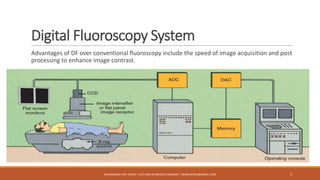
Advantages of DF over conventional fluoroscopy include the speed of image acquisition and post
processing to enhance image contrast.
Digital Fluoroscopy System
3MUHAMMAD ARIF AFRIDI | LECTURER IN MEDICAL IMAGING | DRARIFAFRIDI@GMAIL.COM
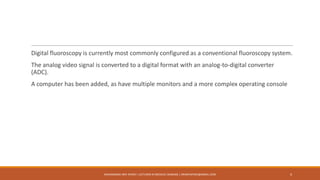
Digital fluoroscopy is currently most commonly configured as a conventional fluoroscopy system.
The analog video signal is converted to a digital format with an analog-to-digital converter
(ADC).
A computer has been added, as have multiple monitors and a more complex operating console
4MUHAMMAD ARIF AFRIDI | LECTURER IN MEDICAL IMAGING | DRARIFAFRIDI@GMAIL.COM
A major change from conventional fluoroscopy to DF is the use of a charge-coupled device (CCD)
instead of a TV camera tube.
The sensitive component of a CCD is a layer of crystalline silicon.
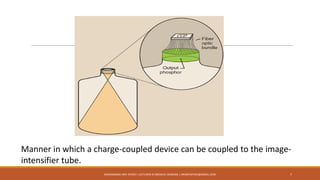
The CCD is mounted on the output phosphor of the image-intensifier tube and is coupled
through fiber optics.
The CCD has greater sensitivity to light a lower level of electronic noise than a television camera
tube.
Charge-Coupled Device
5MUHAMMAD ARIF AFRIDI | LECTURER IN MEDICAL IMAGING | DRARIFAFRIDI@GMAIL.COM
The response of the CCD to light is very stable. Warm up of the CCD is not required.
“DF with CCD results in wider dynamic range and better contrast resolution than conventional
fluoroscopy.”
6MUHAMMAD ARIF AFRIDI | LECTURER IN MEDICAL IMAGING | DRARIFAFRIDI@GMAIL.COM
Manner in which a charge-coupled device can be coupled to the image-
intensifier tube.
7MUHAMMAD ARIF AFRIDI | LECTURER IN MEDICAL IMAGING | DRARIFAFRIDI@GMAIL.COM
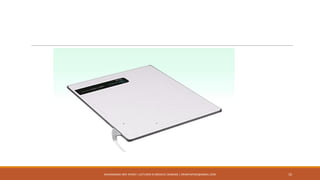
The further improvement of DF imaging is developing the flat panel image receptor (FPIR).
Such an image receptor is composed of cesium iodide (CsI)/amorphous silicon (a-Si) pixels.
The FPIR is much smaller and lighter and is manipulated more easily than an image intensifier.
Flat-panel detectors are more sensitive and faster than film.
Their sensitivity allows a lower dose of radiation for a given picture quality than film.
Flat Panel Image Receptor
8MUHAMMAD ARIF AFRIDI | LECTURER IN MEDICAL IMAGING | DRARIFAFRIDI@GMAIL.COM
As tubes were replaced by CCD, now, CCD will be by FPIRs
FPIR is smaller, lighter and manipulated more easily
It provides easy manipulation of patient, radiologist/radiographer
No cassette is required
9MUHAMMAD ARIF AFRIDI | LECTURER IN MEDICAL IMAGING | DRARIFAFRIDI@GMAIL.COM
10MUHAMMAD ARIF AFRIDI | LECTURER IN MEDICAL IMAGING | DRARIFAFRIDI@GMAIL.COM
IMAGE DISPLAY
11MUHAMMAD ARIF AFRIDI | LECTURER IN MEDICAL IMAGING | DRARIFAFRIDI@GMAIL.COM
Flat panel display technology is rapidly replacing the cathode ray tube (CRT) in all applications.
Flat panel monitors are easier to view and easier to manipulate, and they provide better images.
Flat Panel Image Display
12MUHAMMAD ARIF AFRIDI | LECTURER IN MEDICAL IMAGING | DRARIFAFRIDI@GMAIL.COM
Digital Subtraction Angiography
13MUHAMMAD ARIF AFRIDI | LECTURER IN MEDICAL IMAGING | DRARIFAFRIDI@GMAIL.COM
In DF, microcomputers and microprocessors are used
Computers are vital for image quality and speed of image formation
It also determine image matrix size, system dynamic range and image acquisition range, also image
acquisition rate
The output signal from image-intensified digital image receptor is transmitted to an analog-to-digital
converter (ADC)
ADC converts analog signal into digital signal
8-bit ADC convert the analog signal into values (0-255)
10-bit ADC is more precise (0-1023)
The output of the ADC is transferred to main memory and is manipulated so that a digital image in matrix
form is stored
In primary memory, data acquisition and transfer is rapid 30 images per second
Introduction
14MUHAMMAD ARIF AFRIDI | LECTURER IN MEDICAL IMAGING | DRARIFAFRIDI@GMAIL.COM
Image formation in DSA
Principal advantage of DF is image subtraction technique
An enhanced visualisation of vasculature as a results from
venous injection of contrast material
Image contrast is improved by subtraction techniques
allowing to view subtracted image during passage of a bolus
of contrast medium
15MUHAMMAD ARIF AFRIDI | LECTURER IN MEDICAL IMAGING | DRARIFAFRIDI@GMAIL.COM
Temporal subtraction is an image processing technique that facilitates the visualization of
pathologic change across serial chest radiographic images acquired from the same patient
Temporal Subtraction
16MUHAMMAD ARIF AFRIDI | LECTURER IN MEDICAL IMAGING | DRARIFAFRIDI@GMAIL.COM
Methods of Subtraction
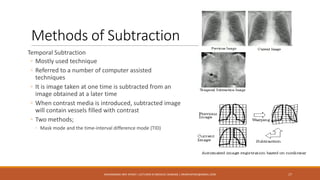
Temporal Subtraction
◦ Mostly used technique
◦ Referred to a number of computer assisted
techniques
◦ It is image taken at one time is subtracted from an
image obtained at a later time
◦ When contrast media is introduced, subtracted image
will contain vessels filled with contrast
◦ Two methods;
◦ Mask mode and the time-interval difference mode (TID)
17MUHAMMAD ARIF AFRIDI | LECTURER IN MEDICAL IMAGING | DRARIFAFRIDI@GMAIL.COM
Mask mode
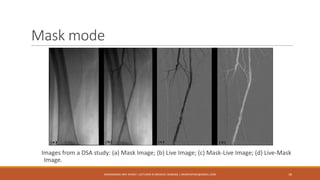
Images from a DSA study: (a) Mask Image; (b) Live Image; (c) Mask-Live Image; (d) Live-Mask
Image.
18MUHAMMAD ARIF AFRIDI | LECTURER IN MEDICAL IMAGING | DRARIFAFRIDI@GMAIL.COM
Mask mode
Patient is positioned under normal fluoroscopic control to ensure region of anatomy is in FOV
Power injector is armed and readied to deliver 30 -50 ml of contrast at rate of 15-20ml/s through venous entry
On arterial, 10-25ml of diluted contrast material at 10-12 ml/s
Imaging system is changed from fluoroscopic mode to DF mode
This requires increase in x-ray tube current 20-100 times
Activation of a programme for pulse image acquisition as well
Injector is fired, after a delay of 4-10 s before bolus of contrast medium reaches anatomical site
An initial x-ray pulsed exposure is made
Image obtained is stored in primary memory
Image is displayed on video monitor, this is the mask image
19MUHAMMAD ARIF AFRIDI | LECTURER IN MEDICAL IMAGING | DRARIFAFRIDI@GMAIL.COM
Mask image is followed by series of additional images
The masked image is subtracted from each other and result is stored in primary memory
At same time, subtracted image is displayed on video monitor
Subtracted images are displayed in real time
Image integration is summing up four to eight images to form single image for improving
contrast resolution
Remasking is possible if patient moved or improper technique
A typical examination requires total of 30 images in additional to mask image
Unacceptable mask images can be caused by noise, motion and technical factors
MUHAMMAD ARIF AFRIDI | LECTURER IN MEDICAL IMAGING | DRARIFAFRIDI@GMAIL.COM 20
Time-Interval Difference mode
Images are made from different mask and follow-up frame
In cardiac study, image acquisition begins 5s after injection at the rate of 15 images per second for
4s
Total of 60 images are obtained
These images are identified as image no.1 to no.60
If a TID of four images is selected
First image produced by subtracting frame 1 from frame 5
Second image produced subtracting frame 2 from frame 6
Third image produced subtracting frame 3 from frame 7
And so on……. This is called progressive masking
Such images are free of motion artifacts
MUHAMMAD ARIF AFRIDI | LECTURER IN MEDICAL IMAGING | DRARIFAFRIDI@GMAIL.COM 21
Conventional & Digital Fluoroscopy Differ
primarily in the imaging system, i.e., an image intensifier-video camera system versus a digital
imaging chain which may have neither an image intensifier nor video camera. In general, all
other portions of the equipment are similar.
22MUHAMMAD ARIF AFRIDI | LECTURER IN MEDICAL IMAGING | DRARIFAFRIDI@GMAIL.COM
Thank you!
MUHAMMAD ARIF AFRIDI | LECTURER IN MEDICAL IMAGING | DRARIFAFRIDI@GMAIL.COM 23

Digital Fluoroscopy Imaging System

  • 1.
    Digital Fluoroscopy Muhammad ArifAfridi Lecturer In Medical Imaging Email: drarifafridi@gmail.com MUHAMMAD ARIF AFRIDI | LECTURER IN MEDICAL IMAGING | DRARIFAFRIDI@GMAIL.COM 1
  • 2.
    Conventional Fluoroscopy System 2MUHAMMADARIF AFRIDI | LECTURER IN MEDICAL IMAGING | DRARIFAFRIDI@GMAIL.COM
  • 3.
    Advantages of DFover conventional fluoroscopy include the speed of image acquisition and post processing to enhance image contrast. Digital Fluoroscopy System 3MUHAMMAD ARIF AFRIDI | LECTURER IN MEDICAL IMAGING | DRARIFAFRIDI@GMAIL.COM
  • 4.
    Digital fluoroscopy iscurrently most commonly configured as a conventional fluoroscopy system. The analog video signal is converted to a digital format with an analog-to-digital converter (ADC). A computer has been added, as have multiple monitors and a more complex operating console 4MUHAMMAD ARIF AFRIDI | LECTURER IN MEDICAL IMAGING | DRARIFAFRIDI@GMAIL.COM
  • 5.
    A major changefrom conventional fluoroscopy to DF is the use of a charge-coupled device (CCD) instead of a TV camera tube. The sensitive component of a CCD is a layer of crystalline silicon. The CCD is mounted on the output phosphor of the image-intensifier tube and is coupled through fiber optics. The CCD has greater sensitivity to light a lower level of electronic noise than a television camera tube. Charge-Coupled Device 5MUHAMMAD ARIF AFRIDI | LECTURER IN MEDICAL IMAGING | DRARIFAFRIDI@GMAIL.COM
  • 6.
    The response ofthe CCD to light is very stable. Warm up of the CCD is not required. “DF with CCD results in wider dynamic range and better contrast resolution than conventional fluoroscopy.” 6MUHAMMAD ARIF AFRIDI | LECTURER IN MEDICAL IMAGING | DRARIFAFRIDI@GMAIL.COM
  • 7.
    Manner in whicha charge-coupled device can be coupled to the image- intensifier tube. 7MUHAMMAD ARIF AFRIDI | LECTURER IN MEDICAL IMAGING | DRARIFAFRIDI@GMAIL.COM
  • 8.
    The further improvementof DF imaging is developing the flat panel image receptor (FPIR). Such an image receptor is composed of cesium iodide (CsI)/amorphous silicon (a-Si) pixels. The FPIR is much smaller and lighter and is manipulated more easily than an image intensifier. Flat-panel detectors are more sensitive and faster than film. Their sensitivity allows a lower dose of radiation for a given picture quality than film. Flat Panel Image Receptor 8MUHAMMAD ARIF AFRIDI | LECTURER IN MEDICAL IMAGING | DRARIFAFRIDI@GMAIL.COM
  • 9.
    As tubes werereplaced by CCD, now, CCD will be by FPIRs FPIR is smaller, lighter and manipulated more easily It provides easy manipulation of patient, radiologist/radiographer No cassette is required 9MUHAMMAD ARIF AFRIDI | LECTURER IN MEDICAL IMAGING | DRARIFAFRIDI@GMAIL.COM
  • 10.
    10MUHAMMAD ARIF AFRIDI| LECTURER IN MEDICAL IMAGING | DRARIFAFRIDI@GMAIL.COM
  • 11.
    IMAGE DISPLAY 11MUHAMMAD ARIFAFRIDI | LECTURER IN MEDICAL IMAGING | DRARIFAFRIDI@GMAIL.COM
  • 12.
    Flat panel displaytechnology is rapidly replacing the cathode ray tube (CRT) in all applications. Flat panel monitors are easier to view and easier to manipulate, and they provide better images. Flat Panel Image Display 12MUHAMMAD ARIF AFRIDI | LECTURER IN MEDICAL IMAGING | DRARIFAFRIDI@GMAIL.COM
  • 13.
    Digital Subtraction Angiography 13MUHAMMADARIF AFRIDI | LECTURER IN MEDICAL IMAGING | DRARIFAFRIDI@GMAIL.COM
  • 14.
    In DF, microcomputersand microprocessors are used Computers are vital for image quality and speed of image formation It also determine image matrix size, system dynamic range and image acquisition range, also image acquisition rate The output signal from image-intensified digital image receptor is transmitted to an analog-to-digital converter (ADC) ADC converts analog signal into digital signal 8-bit ADC convert the analog signal into values (0-255) 10-bit ADC is more precise (0-1023) The output of the ADC is transferred to main memory and is manipulated so that a digital image in matrix form is stored In primary memory, data acquisition and transfer is rapid 30 images per second Introduction 14MUHAMMAD ARIF AFRIDI | LECTURER IN MEDICAL IMAGING | DRARIFAFRIDI@GMAIL.COM
  • 15.
    Image formation inDSA Principal advantage of DF is image subtraction technique An enhanced visualisation of vasculature as a results from venous injection of contrast material Image contrast is improved by subtraction techniques allowing to view subtracted image during passage of a bolus of contrast medium 15MUHAMMAD ARIF AFRIDI | LECTURER IN MEDICAL IMAGING | DRARIFAFRIDI@GMAIL.COM
  • 16.
    Temporal subtraction isan image processing technique that facilitates the visualization of pathologic change across serial chest radiographic images acquired from the same patient Temporal Subtraction 16MUHAMMAD ARIF AFRIDI | LECTURER IN MEDICAL IMAGING | DRARIFAFRIDI@GMAIL.COM
  • 17.
    Methods of Subtraction TemporalSubtraction ◦ Mostly used technique ◦ Referred to a number of computer assisted techniques ◦ It is image taken at one time is subtracted from an image obtained at a later time ◦ When contrast media is introduced, subtracted image will contain vessels filled with contrast ◦ Two methods; ◦ Mask mode and the time-interval difference mode (TID) 17MUHAMMAD ARIF AFRIDI | LECTURER IN MEDICAL IMAGING | DRARIFAFRIDI@GMAIL.COM
  • 18.
    Mask mode Images froma DSA study: (a) Mask Image; (b) Live Image; (c) Mask-Live Image; (d) Live-Mask Image. 18MUHAMMAD ARIF AFRIDI | LECTURER IN MEDICAL IMAGING | DRARIFAFRIDI@GMAIL.COM
  • 19.
    Mask mode Patient ispositioned under normal fluoroscopic control to ensure region of anatomy is in FOV Power injector is armed and readied to deliver 30 -50 ml of contrast at rate of 15-20ml/s through venous entry On arterial, 10-25ml of diluted contrast material at 10-12 ml/s Imaging system is changed from fluoroscopic mode to DF mode This requires increase in x-ray tube current 20-100 times Activation of a programme for pulse image acquisition as well Injector is fired, after a delay of 4-10 s before bolus of contrast medium reaches anatomical site An initial x-ray pulsed exposure is made Image obtained is stored in primary memory Image is displayed on video monitor, this is the mask image 19MUHAMMAD ARIF AFRIDI | LECTURER IN MEDICAL IMAGING | DRARIFAFRIDI@GMAIL.COM
  • 20.
    Mask image isfollowed by series of additional images The masked image is subtracted from each other and result is stored in primary memory At same time, subtracted image is displayed on video monitor Subtracted images are displayed in real time Image integration is summing up four to eight images to form single image for improving contrast resolution Remasking is possible if patient moved or improper technique A typical examination requires total of 30 images in additional to mask image Unacceptable mask images can be caused by noise, motion and technical factors MUHAMMAD ARIF AFRIDI | LECTURER IN MEDICAL IMAGING | DRARIFAFRIDI@GMAIL.COM 20
  • 21.
    Time-Interval Difference mode Imagesare made from different mask and follow-up frame In cardiac study, image acquisition begins 5s after injection at the rate of 15 images per second for 4s Total of 60 images are obtained These images are identified as image no.1 to no.60 If a TID of four images is selected First image produced by subtracting frame 1 from frame 5 Second image produced subtracting frame 2 from frame 6 Third image produced subtracting frame 3 from frame 7 And so on……. This is called progressive masking Such images are free of motion artifacts MUHAMMAD ARIF AFRIDI | LECTURER IN MEDICAL IMAGING | DRARIFAFRIDI@GMAIL.COM 21
  • 22.
    Conventional & DigitalFluoroscopy Differ primarily in the imaging system, i.e., an image intensifier-video camera system versus a digital imaging chain which may have neither an image intensifier nor video camera. In general, all other portions of the equipment are similar. 22MUHAMMAD ARIF AFRIDI | LECTURER IN MEDICAL IMAGING | DRARIFAFRIDI@GMAIL.COM
  • 23.
    Thank you! MUHAMMAD ARIFAFRIDI | LECTURER IN MEDICAL IMAGING | DRARIFAFRIDI@GMAIL.COM 23