Multi section and Trans
axial Tomography
Presented By- Sarbari Saha
Asst.Professor Radiology
Introduction
The tomography have evolved to overcome the
superimposition of the structures on the area of
interest.
But due to gradual sections by section imaging
these not only increases our time but huge doses
to the staffs and patient too.
So keeping same technique new evolution took so
that scan time can be reduced drastically with
doses.
Multi section Tomography
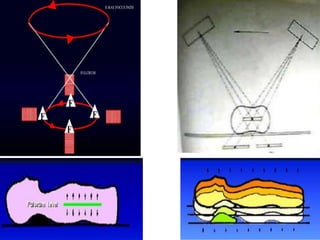
These is a tomography method where multiple
layers or section of the body are used to from the
planiography with single movement.
The principle is that various layers of the body
section can be recorded with single exposure.
Here there is one fulcrum and various axis for
every film.
And all the layers can be equally magnified.
Multi section Tomographic
cassette
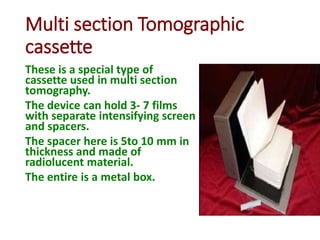
These is a special type of
cassette used in multi section
tomography.
The device can hold 3- 7 films
with separate intensifying screen
and spacers.
The spacer here is 5to 10 mm in
thickness and made of
radiolucent material.
The entire is a metal box.
Advantage
‱ Dose is drastically reduced ,as separate films can be
achieved with single exposure.
‱ Each layer of the film are recorded on seperate film.
‱ Each radiograph has same movement in respiration
and physiological equal.
‱ It gives fine details study of anatomical structures
and exposures load of the tube is reduced.
‱ Its save time for both patient and xray department.
Disadvantages
‱ Its has uncontrolled scattered radiation.
‱ Film quality is not so good.
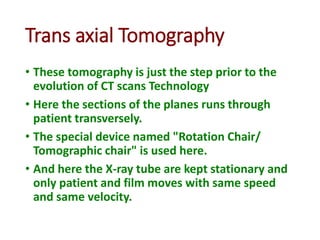
Trans axial Tomography
‱ These tomography is just the step prior to the
evolution of CT scans Technology
‱ Here the sections of the planes runs through
patient transversely.
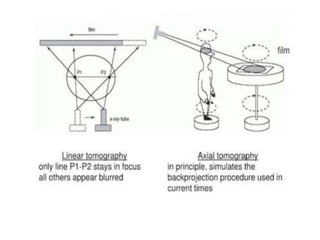
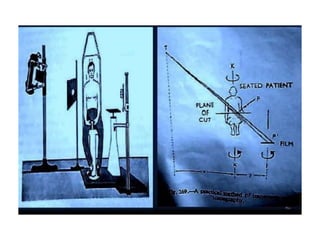
‱ The special device named "Rotation Chair/
Tomographic chair" is used here.
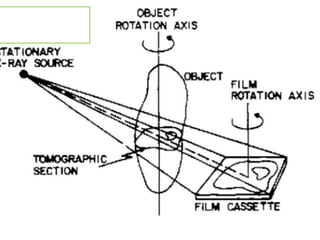
‱ And here the X-ray tube are kept stationary and
only patient and film moves with same speed
and same velocity.
‱ In trans axial tomography the x-ray film lies flat
along with the rotating chair along with the
patient.
‱ As the X-ray beam falls obliequely through the
patient and flim the chair is positioned a little
below the focal plane.
‱ Section thickness is determined by angle
between x-ray tube and film.
‱ Patient sits upright position and takes images
in both coronal and sagital plane.
‱ When the patient is facing towards and
opposite , there coronal cut.
‱ When patient turned sideways, there is
sagittal cut sections.
Skip Tomography
‱ These a method of tomography where the
exposure is stopped through a portion of tube
motion.
‱ It can skip almost 20degree angle of exposure.
‱ Its mainly used to skip the dense vertebral
structure from getting superimposed.
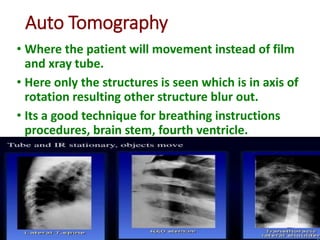
Auto Tomography
‱ Where the patient will movement instead of film
and xray tube.
‱ Here only the structures is seen which is in axis of
rotation resulting other structure blur out.
‱ Its a good technique for breathing instructions
procedures, brain stem, fourth ventricle.
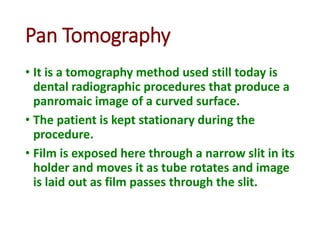
Pan Tomography
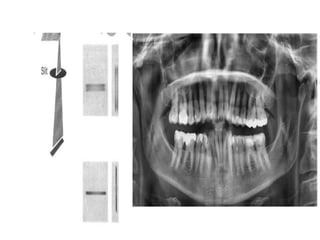
‱ It is a tomography method used still today is
dental radiographic procedures that produce a
panromaic image of a curved surface.
‱ The patient is kept stationary during the
procedure.
‱ Film is exposed here through a narrow slit in its
holder and moves it as tube rotates and image
is laid out as film passes through the slit.
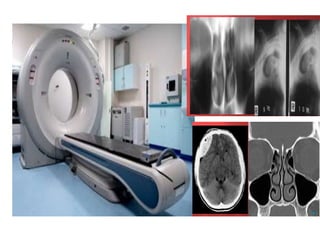
‱ Computerized Transverse Axial Tomography
(CTAT)
‱ Computer assissted Tomography (CAT)
‱ Computer Axial Tomography (CAT)
‱ Reconstruction Tomography(RT)
‱ Computer Tomography (CT)
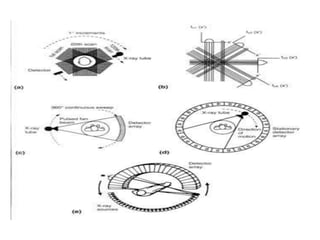
Evolution of CT scan
Pioneers
‱ The main purpose of evolution was in its
reconstruction technique and there were
5pioneers.
1917 - Johann Radon.
1956- Ronald Brace well.
1963- William Oldendorf.
1963- Edward Allan Cormack.
1967- Godfrey Newbold Hounsfield.
Thank you

Multisection tomography and Transaxial Tomography

  • 1.
    Multi section andTrans axial Tomography Presented By- Sarbari Saha Asst.Professor Radiology
  • 2.
    Introduction The tomography haveevolved to overcome the superimposition of the structures on the area of interest. But due to gradual sections by section imaging these not only increases our time but huge doses to the staffs and patient too. So keeping same technique new evolution took so that scan time can be reduced drastically with doses.
  • 3.
    Multi section Tomography Theseis a tomography method where multiple layers or section of the body are used to from the planiography with single movement. The principle is that various layers of the body section can be recorded with single exposure. Here there is one fulcrum and various axis for every film. And all the layers can be equally magnified.
  • 5.
    Multi section Tomographic cassette Theseis a special type of cassette used in multi section tomography. The device can hold 3- 7 films with separate intensifying screen and spacers. The spacer here is 5to 10 mm in thickness and made of radiolucent material. The entire is a metal box.
  • 6.
    Advantage ‱ Dose isdrastically reduced ,as separate films can be achieved with single exposure. ‱ Each layer of the film are recorded on seperate film. ‱ Each radiograph has same movement in respiration and physiological equal. ‱ It gives fine details study of anatomical structures and exposures load of the tube is reduced. ‱ Its save time for both patient and xray department.
  • 7.
    Disadvantages ‱ Its hasuncontrolled scattered radiation. ‱ Film quality is not so good.
  • 8.
  • 9.
    Trans axial Tomography ‱These tomography is just the step prior to the evolution of CT scans Technology ‱ Here the sections of the planes runs through patient transversely. ‱ The special device named "Rotation Chair/ Tomographic chair" is used here. ‱ And here the X-ray tube are kept stationary and only patient and film moves with same speed and same velocity.
  • 11.
    ‱ In transaxial tomography the x-ray film lies flat along with the rotating chair along with the patient. ‱ As the X-ray beam falls obliequely through the patient and flim the chair is positioned a little below the focal plane. ‱ Section thickness is determined by angle between x-ray tube and film.
  • 13.
    ‱ Patient sitsupright position and takes images in both coronal and sagital plane. ‱ When the patient is facing towards and opposite , there coronal cut. ‱ When patient turned sideways, there is sagittal cut sections.
  • 15.
    Skip Tomography ‱ Thesea method of tomography where the exposure is stopped through a portion of tube motion. ‱ It can skip almost 20degree angle of exposure. ‱ Its mainly used to skip the dense vertebral structure from getting superimposed.
  • 16.
    Auto Tomography ‱ Wherethe patient will movement instead of film and xray tube. ‱ Here only the structures is seen which is in axis of rotation resulting other structure blur out. ‱ Its a good technique for breathing instructions procedures, brain stem, fourth ventricle.
  • 17.
    Pan Tomography ‱ Itis a tomography method used still today is dental radiographic procedures that produce a panromaic image of a curved surface. ‱ The patient is kept stationary during the procedure. ‱ Film is exposed here through a narrow slit in its holder and moves it as tube rotates and image is laid out as film passes through the slit.
  • 19.
    ‱ Computerized TransverseAxial Tomography (CTAT) ‱ Computer assissted Tomography (CAT) ‱ Computer Axial Tomography (CAT) ‱ Reconstruction Tomography(RT) ‱ Computer Tomography (CT) Evolution of CT scan
  • 20.
    Pioneers ‱ The mainpurpose of evolution was in its reconstruction technique and there were 5pioneers. 1917 - Johann Radon. 1956- Ronald Brace well. 1963- William Oldendorf. 1963- Edward Allan Cormack. 1967- Godfrey Newbold Hounsfield.
  • 23.