The X-ray Imaging System
Muhammad Arif Afridi
Lecturer in Medical Imaging
Medical Imaging Technologist (MIT) - Radiology
Master in Public Health (MPH)
Email: RFafridi@hotmail.com
Muhammad Arif Afridi
Lecturer in Medical Imaging | RFafridi@hotmail.com
1
X-ray Examination Room
❑The general purpose x-ray examination room contains a radiographic
imaging system and a fluoroscopic imaging system.
❑These systems are usually operated at voltages of 25 to 150 kVp and
at tube currents of 100 to 1200 mA.
❑The fluoroscopic x-ray tube is usually located under the examination
table; the radiographic x-ray tube is attached to an overhead movable
crane assembly that permits easy positioning of the tube and aiming
of the x-ray beam.
Muhammad Arif Afridi
Lecturer in Medical Imaging | RFafridi@hotmail.com
2
X-ray imaging system has three principal sections:
• (1) the operating console
• (2) the x-ray tube
• (3) the high-voltage generator
Muhammad Arif Afridi
Lecturer in Medical Imaging | RFafridi@hotmail.com
3
OPERATING CONSOLE
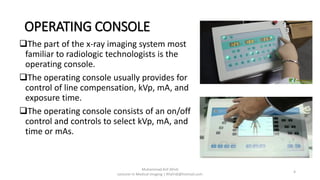
❑The part of the x-ray imaging system most
familiar to radiologic technologists is the
operating console.
❑The operating console usually provides for
control of line compensation, kVp, mA, and
exposure time.
❑The operating console consists of an on/off
control and controls to select kVp, mA, and
time or mAs.
Muhammad Arif Afridi
Lecturer in Medical Imaging | RFafridi@hotmail.com
4
X-ray Tube
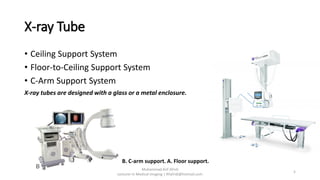
• Ceiling Support System
• Floor-to-Ceiling Support System
• C-Arm Support System
X-ray tubes are designed with a glass or a metal enclosure.
Muhammad Arif Afridi
Lecturer in Medical Imaging | RFafridi@hotmail.com
5
B. C-arm support. A. Floor support.
X-ray Tube
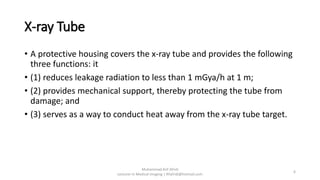
• A protective housing covers the x-ray tube and provides the following
three functions: it
• (1) reduces leakage radiation to less than 1 mGya/h at 1 m;
• (2) provides mechanical support, thereby protecting the tube from
damage; and
• (3) serves as a way to conduct heat away from the x-ray tube target.
Muhammad Arif Afridi
Lecturer in Medical Imaging | RFafridi@hotmail.com
6
Image Formation
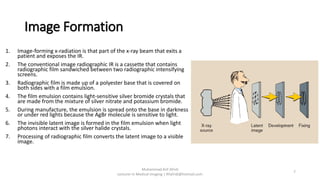
1. Image-forming x-radiation is that part of the x-ray beam that exits a
patient and exposes the IR.
2. The conventional image radiographic IR is a cassette that contains
radiographic film sandwiched between two radiographic intensifying
screens.
3. Radiographic film is made up of a polyester base that is covered on
both sides with a film emulsion.
4. The film emulsion contains light-sensitive silver bromide crystals that
are made from the mixture of silver nitrate and potassium bromide.
5. During manufacture, the emulsion is spread onto the base in darkness
or under red lights because the AgBr molecule is sensitive to light.
6. The invisible latent image is formed in the film emulsion when light
photons interact with the silver halide crystals.
7. Processing of radiographic film converts the latent image to a visible
image.
Muhammad Arif Afridi
Lecturer in Medical Imaging | RFafridi@hotmail.com
7
Thank you
Muhammad Arif Afridi
Lecturer in Medical Imaging | RFafridi@hotmail.com
8

x ray imaging system overview

  • 1.
    The X-ray ImagingSystem Muhammad Arif Afridi Lecturer in Medical Imaging Medical Imaging Technologist (MIT) - Radiology Master in Public Health (MPH) Email: RFafridi@hotmail.com Muhammad Arif Afridi Lecturer in Medical Imaging | RFafridi@hotmail.com 1
  • 2.
    X-ray Examination Room ❑Thegeneral purpose x-ray examination room contains a radiographic imaging system and a fluoroscopic imaging system. ❑These systems are usually operated at voltages of 25 to 150 kVp and at tube currents of 100 to 1200 mA. ❑The fluoroscopic x-ray tube is usually located under the examination table; the radiographic x-ray tube is attached to an overhead movable crane assembly that permits easy positioning of the tube and aiming of the x-ray beam. Muhammad Arif Afridi Lecturer in Medical Imaging | RFafridi@hotmail.com 2
  • 3.
    X-ray imaging systemhas three principal sections: • (1) the operating console • (2) the x-ray tube • (3) the high-voltage generator Muhammad Arif Afridi Lecturer in Medical Imaging | RFafridi@hotmail.com 3
  • 4.
    OPERATING CONSOLE ❑The partof the x-ray imaging system most familiar to radiologic technologists is the operating console. ❑The operating console usually provides for control of line compensation, kVp, mA, and exposure time. ❑The operating console consists of an on/off control and controls to select kVp, mA, and time or mAs. Muhammad Arif Afridi Lecturer in Medical Imaging | RFafridi@hotmail.com 4
  • 5.
    X-ray Tube • CeilingSupport System • Floor-to-Ceiling Support System • C-Arm Support System X-ray tubes are designed with a glass or a metal enclosure. Muhammad Arif Afridi Lecturer in Medical Imaging | RFafridi@hotmail.com 5 B. C-arm support. A. Floor support.
  • 6.
    X-ray Tube • Aprotective housing covers the x-ray tube and provides the following three functions: it • (1) reduces leakage radiation to less than 1 mGya/h at 1 m; • (2) provides mechanical support, thereby protecting the tube from damage; and • (3) serves as a way to conduct heat away from the x-ray tube target. Muhammad Arif Afridi Lecturer in Medical Imaging | RFafridi@hotmail.com 6
  • 7.
    Image Formation 1. Image-formingx-radiation is that part of the x-ray beam that exits a patient and exposes the IR. 2. The conventional image radiographic IR is a cassette that contains radiographic film sandwiched between two radiographic intensifying screens. 3. Radiographic film is made up of a polyester base that is covered on both sides with a film emulsion. 4. The film emulsion contains light-sensitive silver bromide crystals that are made from the mixture of silver nitrate and potassium bromide. 5. During manufacture, the emulsion is spread onto the base in darkness or under red lights because the AgBr molecule is sensitive to light. 6. The invisible latent image is formed in the film emulsion when light photons interact with the silver halide crystals. 7. Processing of radiographic film converts the latent image to a visible image. Muhammad Arif Afridi Lecturer in Medical Imaging | RFafridi@hotmail.com 7
  • 8.
    Thank you Muhammad ArifAfridi Lecturer in Medical Imaging | RFafridi@hotmail.com 8