Digital Assets: Tokens & Coins
Florian Huber (Signature Ventures, chainEurope.org)
October, 15th 2020
1. Definition of Token
Outline
2Florian Huber
Florian Huber
3
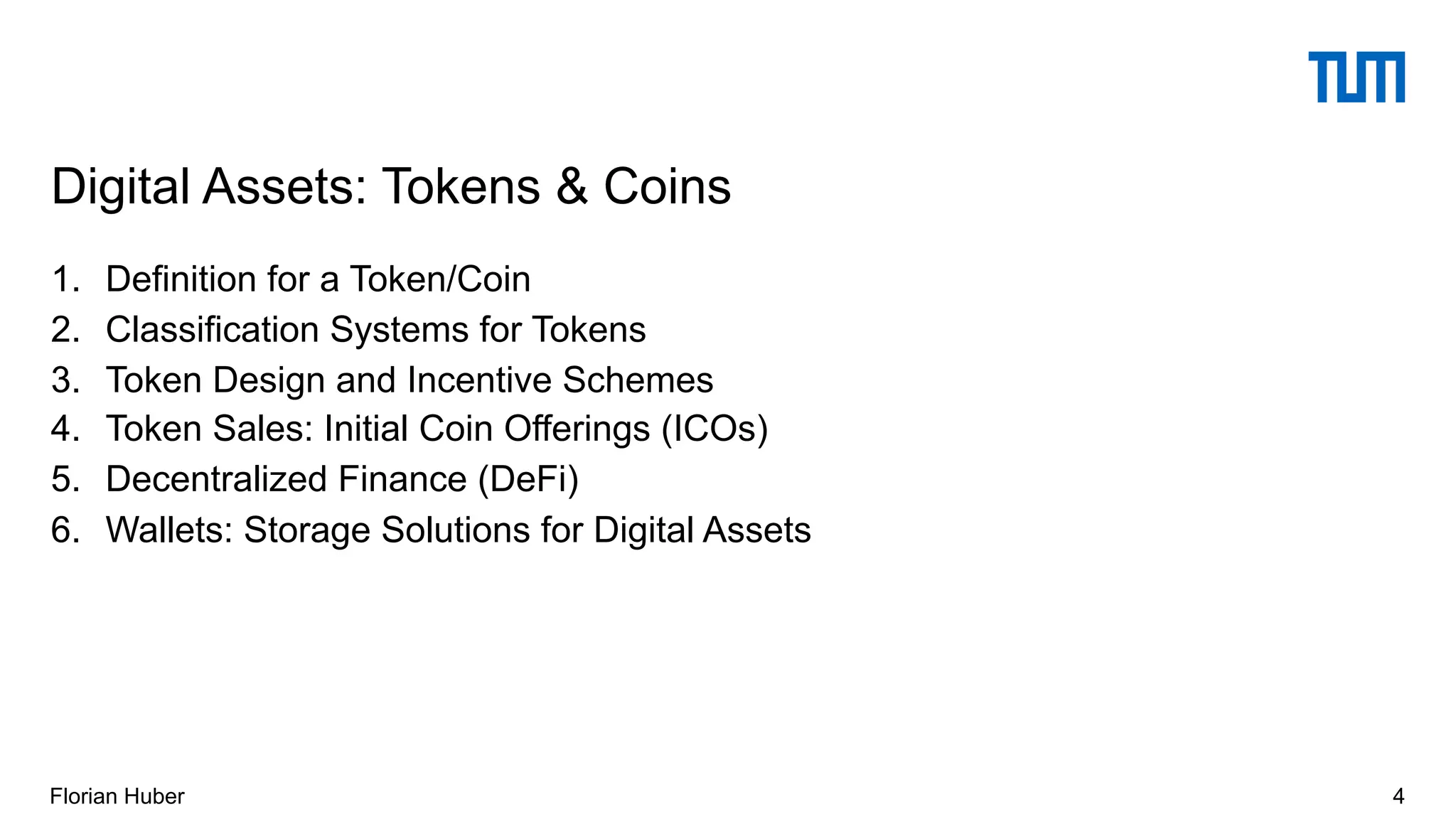
1. Definition for a Token/Coin
2. Classification Systems for Tokens
3. Token Design and Incentive Schemes
4. Token Sales: Initial Coin Offerings (ICOs)
5. Decentralized Finance (DeFi)
6. Wallets: Storage Solutions for Digital Assets
Digital Assets: Tokens & Coins
4Florian Huber
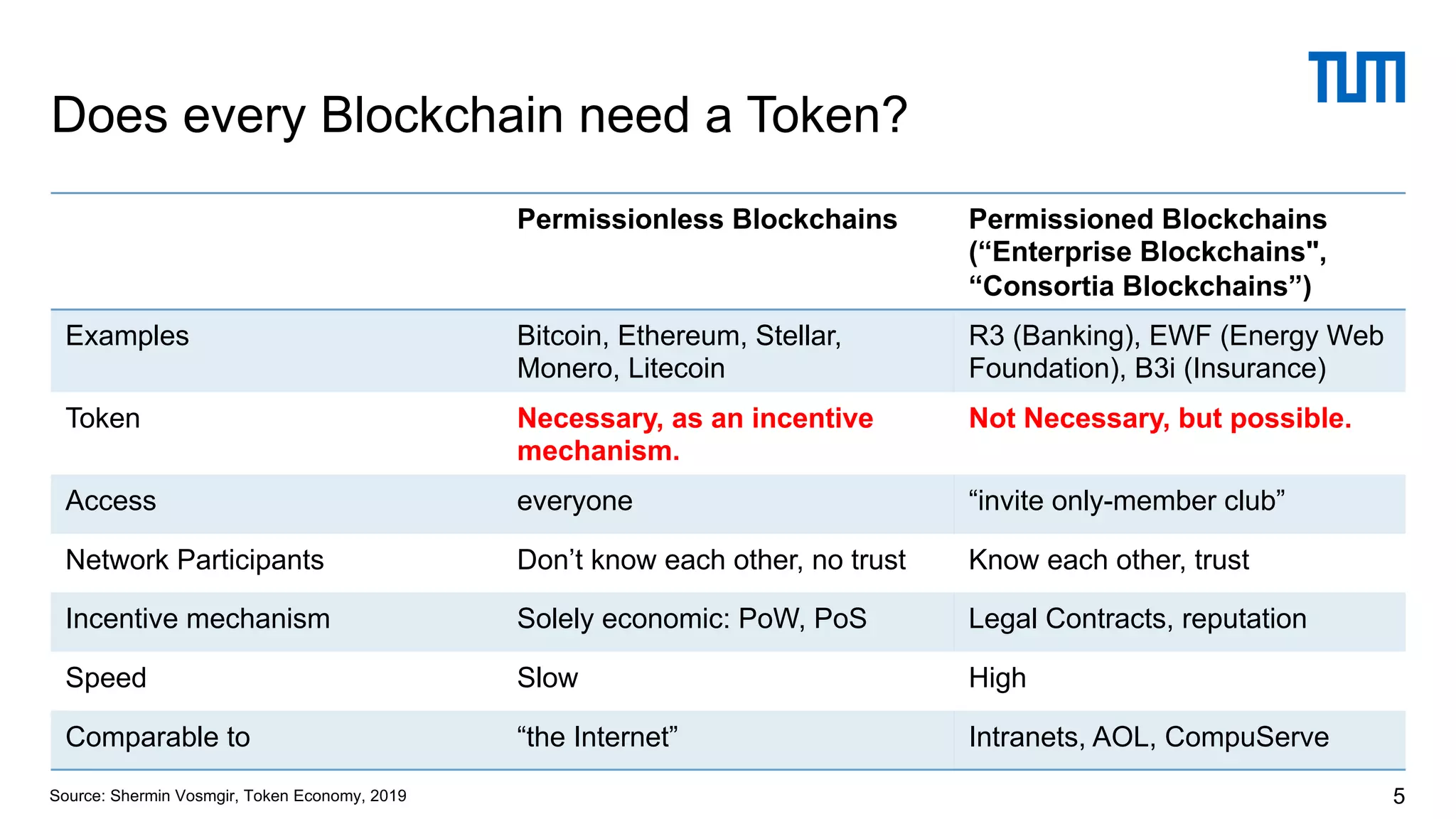
Does every Blockchain need a Token?
5Source: Shermin Vosmgir, Token Economy, 2019
Permissionless Blockchains Permissioned Blockchains
(“Enterprise Blockchains",
“Consortia Blockchains”)
Examples Bitcoin, Ethereum, Stellar,
Monero, Litecoin
R3 (Banking), EWF (Energy Web
Foundation), B3i (Insurance)
Token Necessary, as an incentive
mechanism.
Not Necessary, but possible.
Access everyone “invite only-member club”
Network Participants Don’t know each other, no trust Know each other, trust
Incentive mechanism Solely economic: PoW, PoS Legal Contracts, reputation
Speed Slow High
Comparable to “the Internet” Intranets, AOL, CompuServe
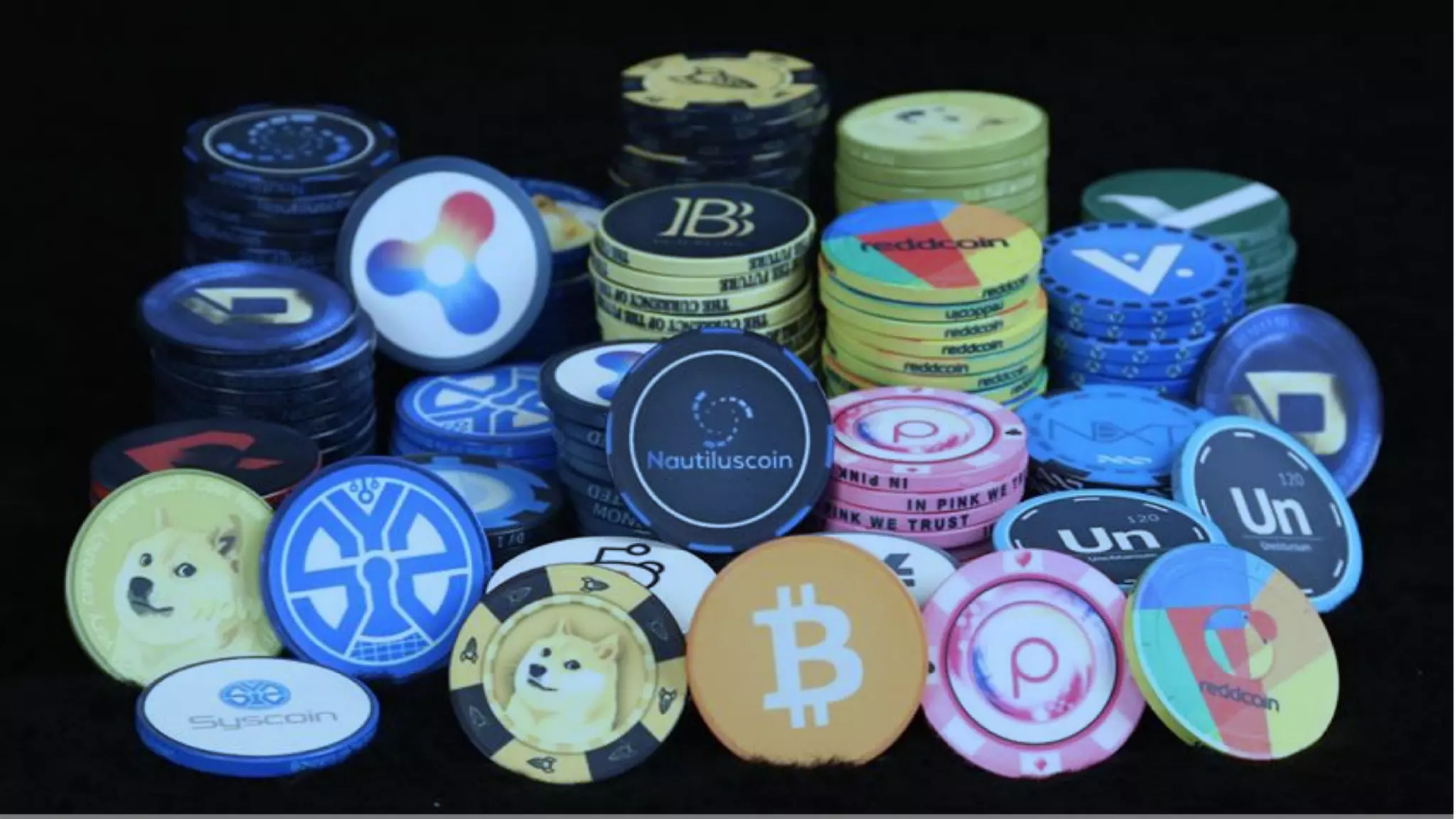
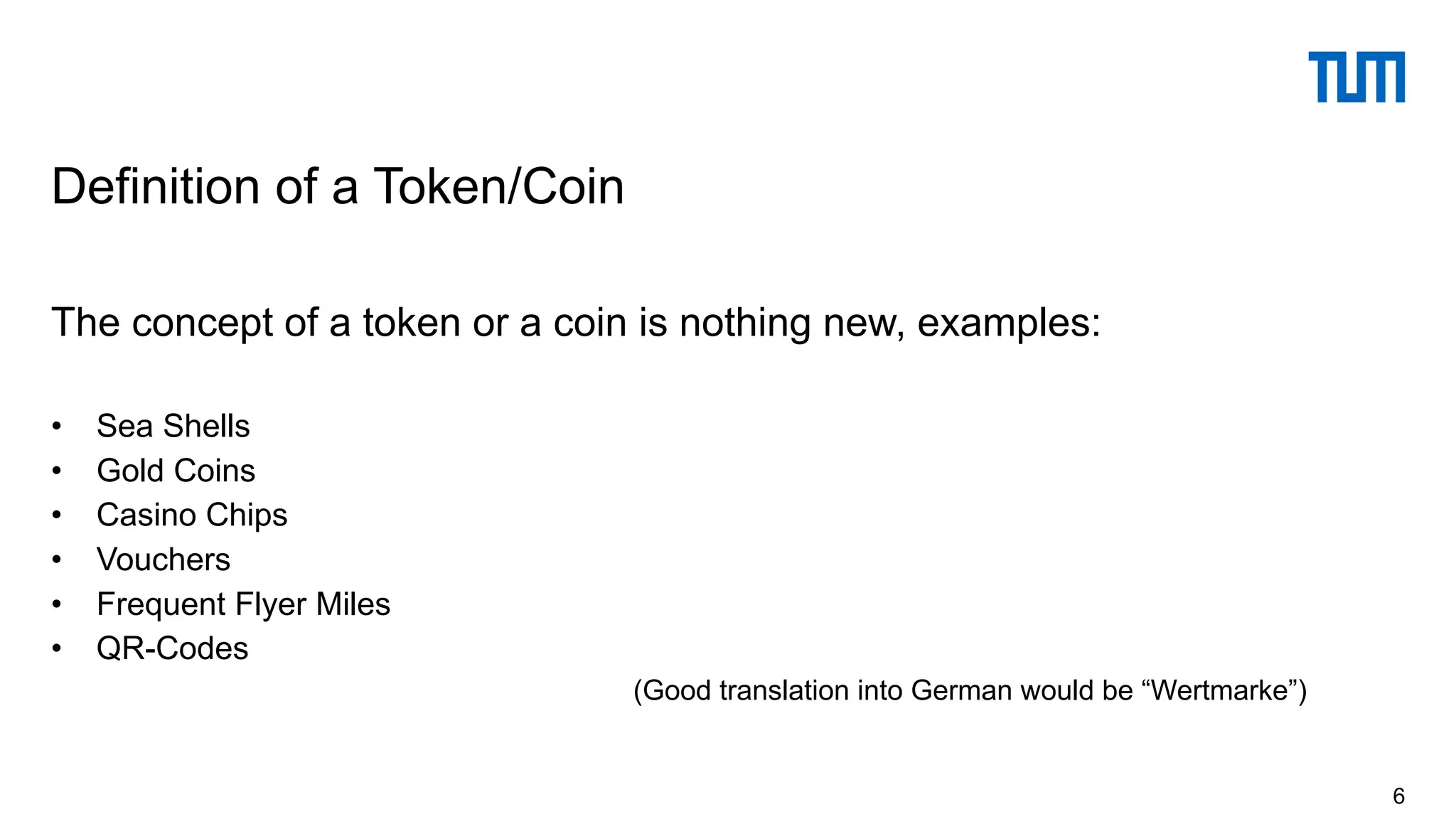
The concept of a token or a coin is nothing new, examples:
• Sea Shells
• Gold Coins
• Casino Chips
• Vouchers
• Frequent Flyer Miles
• QR-Codes
(Good translation into German would be “Wertmarke”)
Definition of a Token/Coin
6
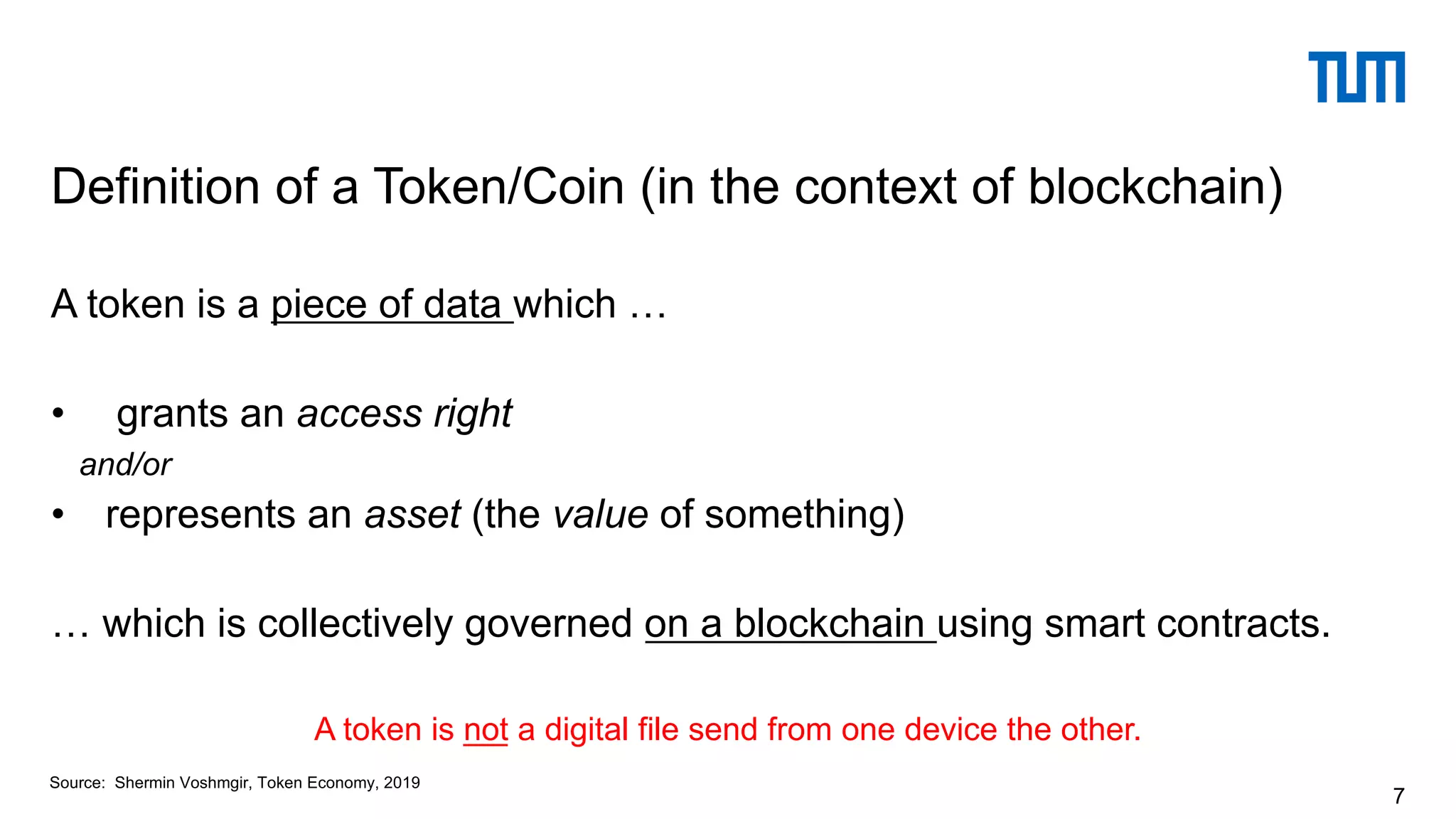
A token is a piece of data which …
• grants an access right
and/or
• represents an asset (the value of something)
… which is collectively governed on a blockchain using smart contracts.
A token is not a digital file send from one device the other.
Definition of a Token/Coin (in the context of blockchain)
7
Source: Shermin Voshmgir, Token Economy, 2019
We’ve talked about Tokens, but what about Coins?!
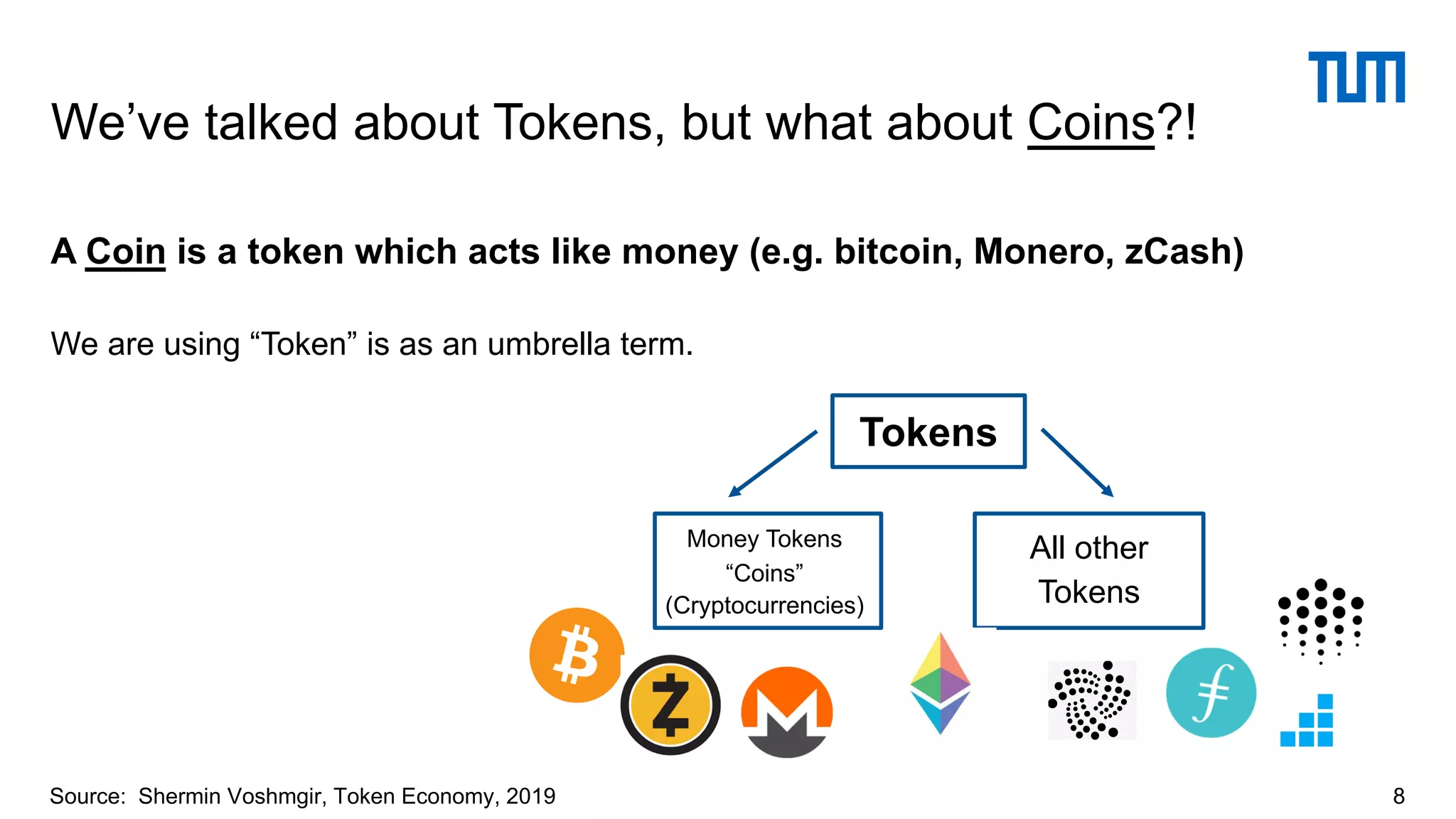
A Coin is a token which acts like money (e.g. bitcoin, Monero, zCash)
We are using “Token” is as an umbrella term.
8Source: Shermin Voshmgir, Token Economy, 2019
Tokens
Money Tokens
“Coins”
(Cryptocurrencies)
All other
Tokens
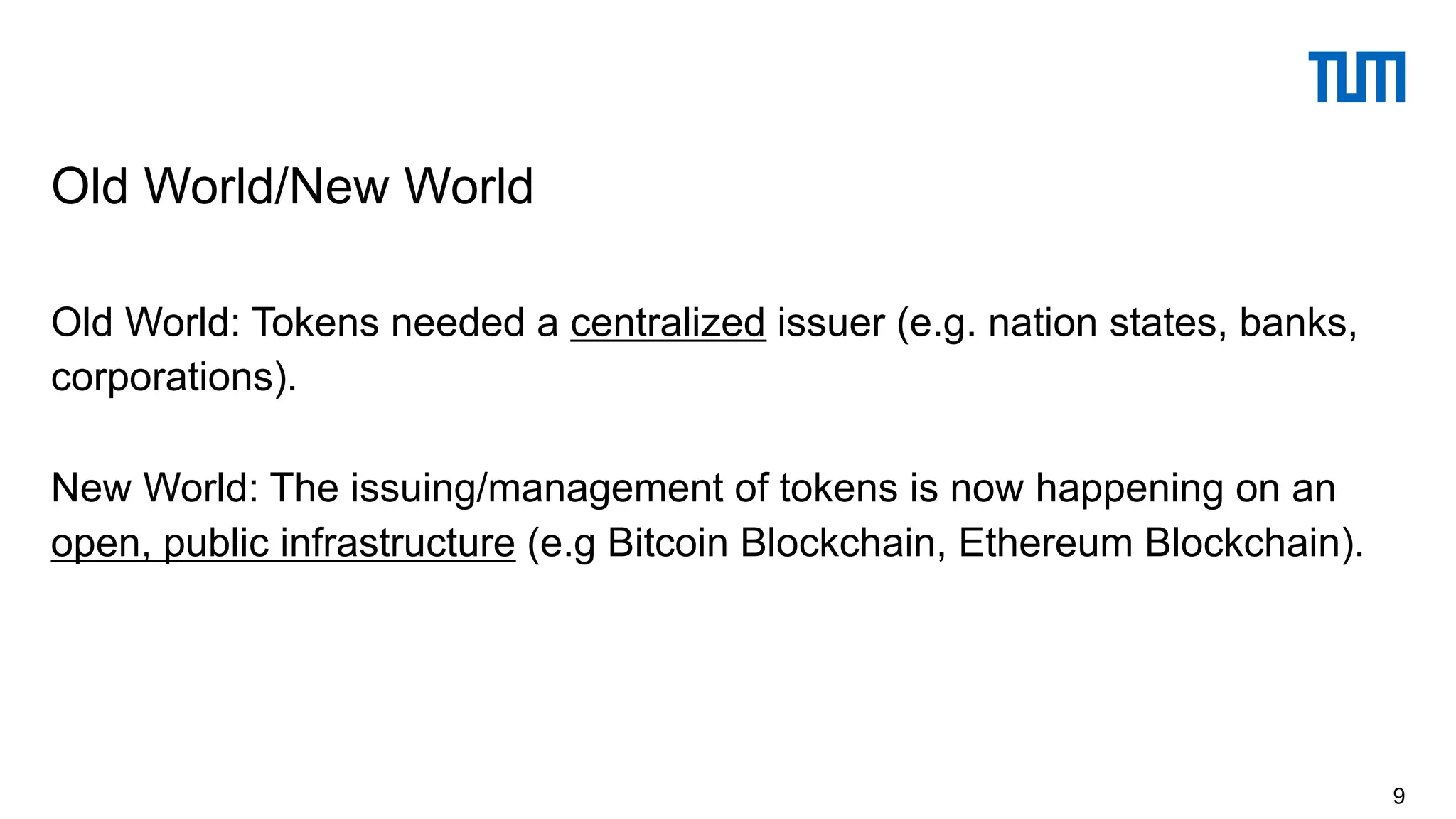
Old World: Tokens needed a centralized issuer (e.g. nation states, banks,
corporations).
New World: The issuing/management of tokens is now happening on an
open, public infrastructure (e.g Bitcoin Blockchain, Ethereum Blockchain).
Old World/New World
9
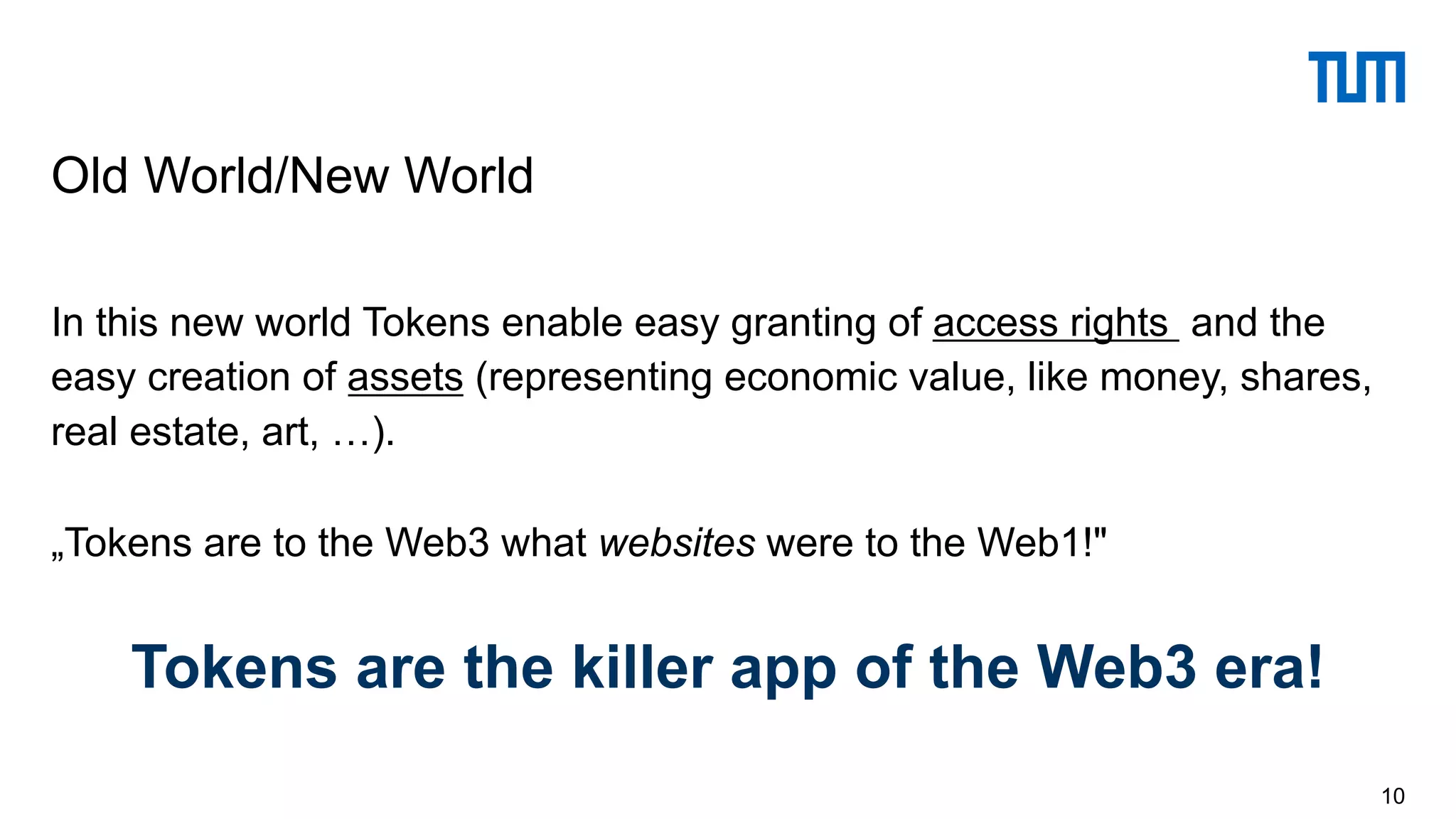
In this new world Tokens enable easy granting of access rights and the
easy creation of assets (representing economic value, like money, shares,
real estate, art, …).
„Tokens are to the Web3 what websites were to the Web1!"
Tokens are the killer app of the Web3 era!
10
Old World/New World
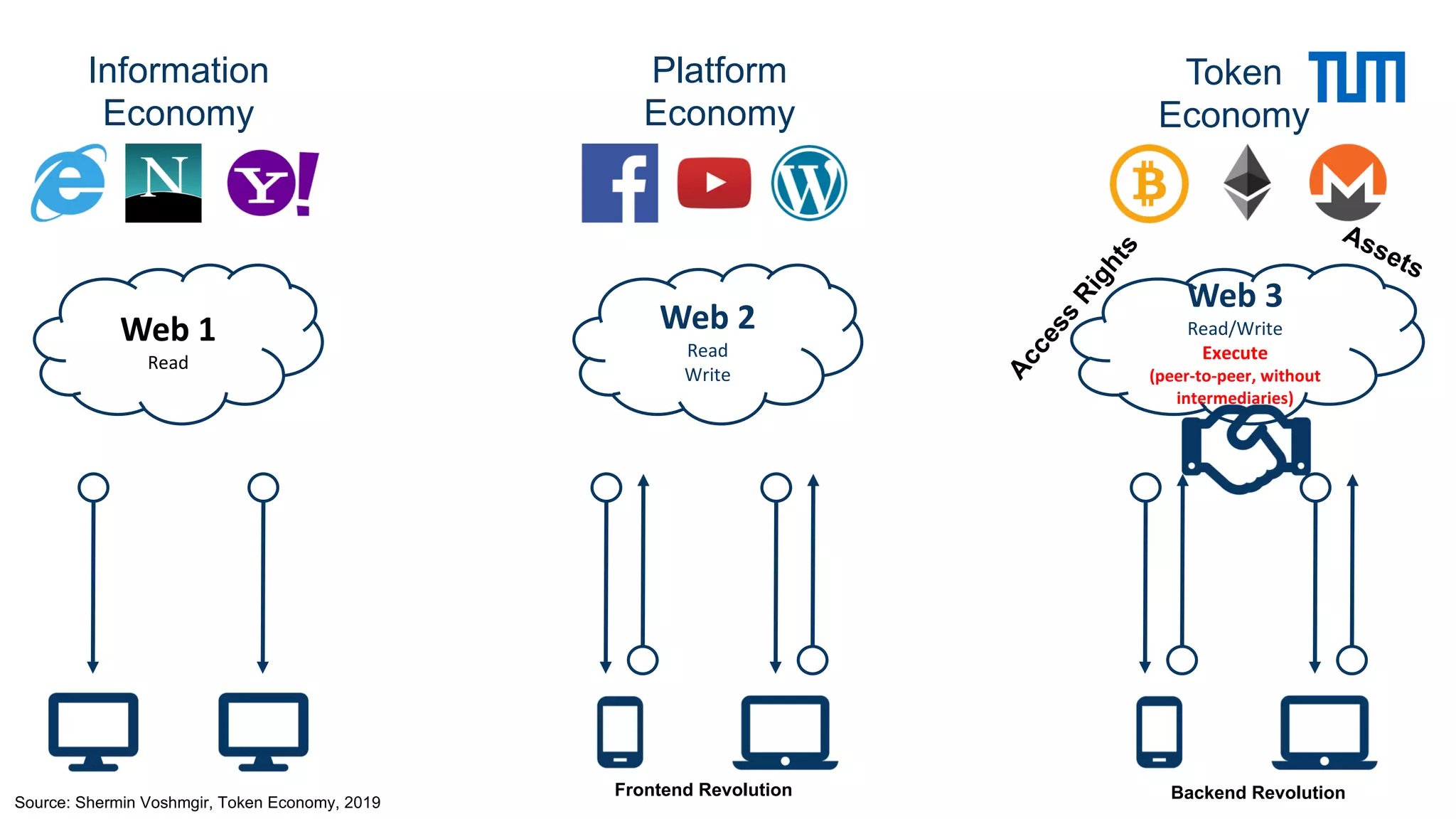
Information
Economy
Web 1
Read
Platform
Economy
Web 2
Read
Write
Token
Economy
Web 3
Read/Write
Execute
(peer-to-peer, without
intermediaries)
Frontend Revolution Backend Revolution
Access
Rights
Assets
Source: Shermin Voshmgir, Token Economy, 2019
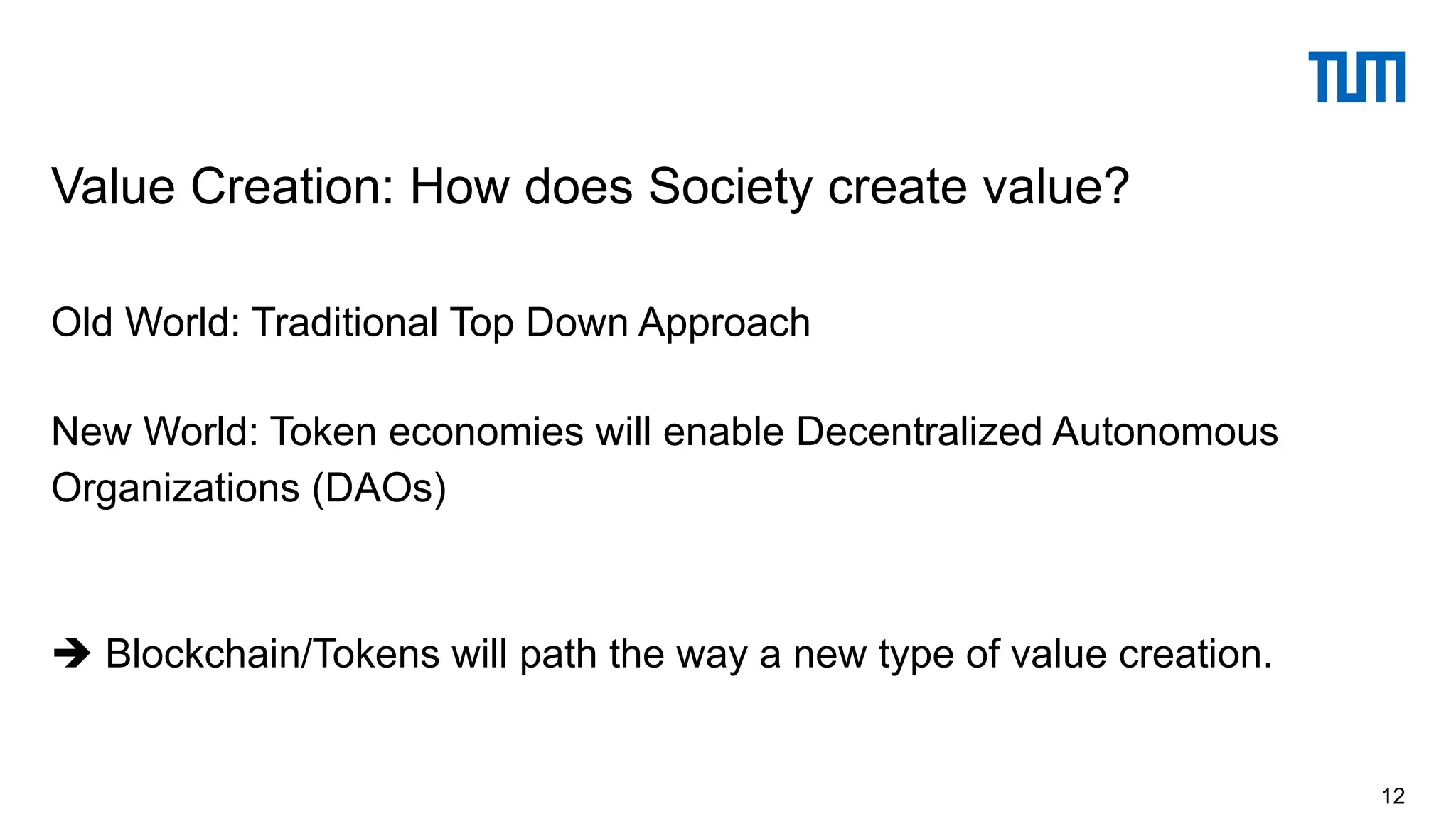
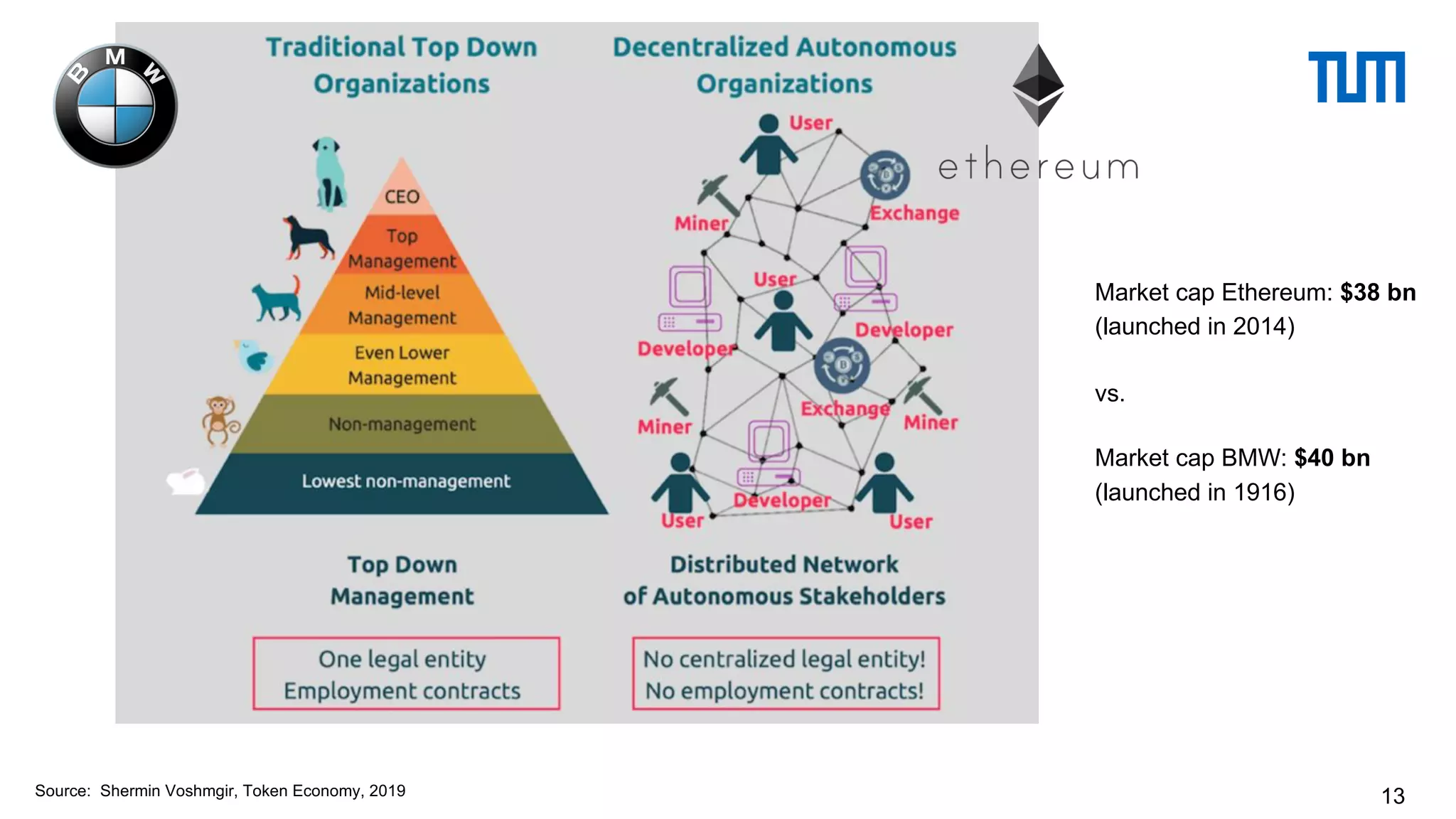
Old World: Traditional Top Down Approach
New World: Token economies will enable Decentralized Autonomous
Organizations (DAOs)
è Blockchain/Tokens will path the way a new type of value creation.
Value Creation: How does Society create value?
12
13
Market cap Ethereum: $38 bn
(launched in 2014)
vs.
Market cap BMW: $40 bn
(launched in 1916)
Source: Shermin Voshmgir, Token Economy, 2019
Legal structure of( a token
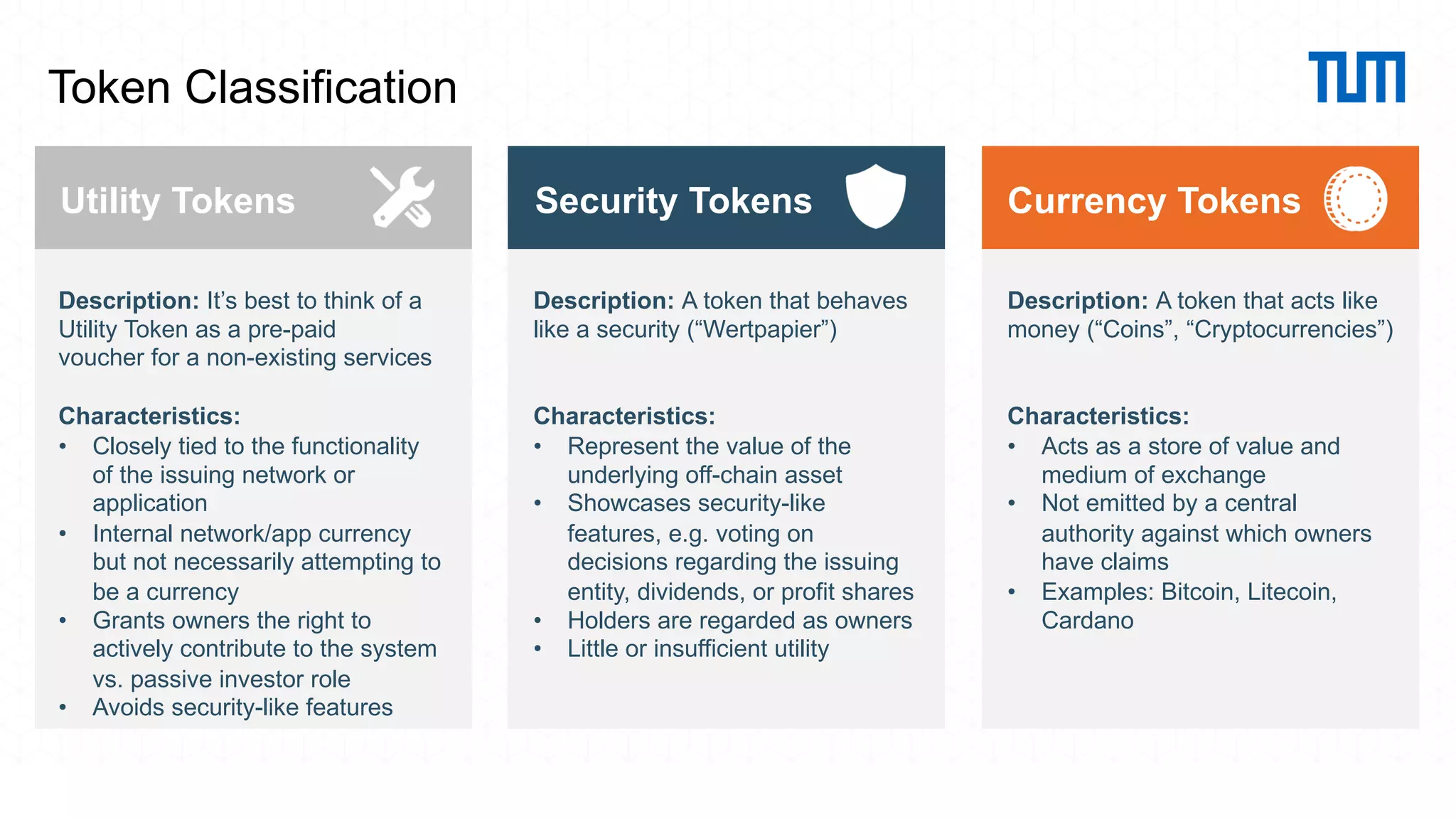
Utility Tokens
Description: It’s best to think of a
Utility Token as a pre-paid
voucher for a non-existing services
Characteristics:
• Closely tied to the functionality
of the issuing network or
application
• Internal network/app currency
but not necessarily attempting to
be a currency
• Grants owners the right to
actively contribute to the system
vs. passive investor role
• Avoids security-like features
Security Tokens Currency Tokens
Description: A token that behaves
like a security (“Wertpapier”)
Characteristics:
• Represent the value of the
underlying off-chain asset
• Showcases security-like
features, e.g. voting on
decisions regarding the issuing
entity, dividends, or profit shares
• Holders are regarded as owners
• Little or insufficient utility
Description: A token that acts like
money (“Coins”, “Cryptocurrencies”)
Characteristics:
• Acts as a store of value and
medium of exchange
• Not emitted by a central
authority against which owners
have claims
• Examples: Bitcoin, Litecoin,
Cardano
Token Classification
Das Grundprinzip ist, Informationen bestmöglich zu transportieren. Dazu muss vor allem die Schrift
einheitlich und für alle im Raum lesbar sein.
Schriftart: Arial
Schriftgrößen: 25 | 18 | 14 | 11
Zeilenabstand: 1,15mm
Die Einstellungen sind in den Textfeldern und Textfeldvorlagen dieses ppt-Masters als Standard eingestellt.
Bei Diagrammen und Tabellen muss die Schriftgröße ggf. angepasst werden. Für Auszeichnungen im
Fließtext kann auch fett markiert werden. Bei großer Distanz bzw. kleinem Präsentationsmedium kann der
Schriftgrad notfalls proportional erhöht werden.
Schrift
15Dr. rer. nat. Erika Mustermann (TUM) | kann beliebig erweitert werden | Infos mit Strich trennen
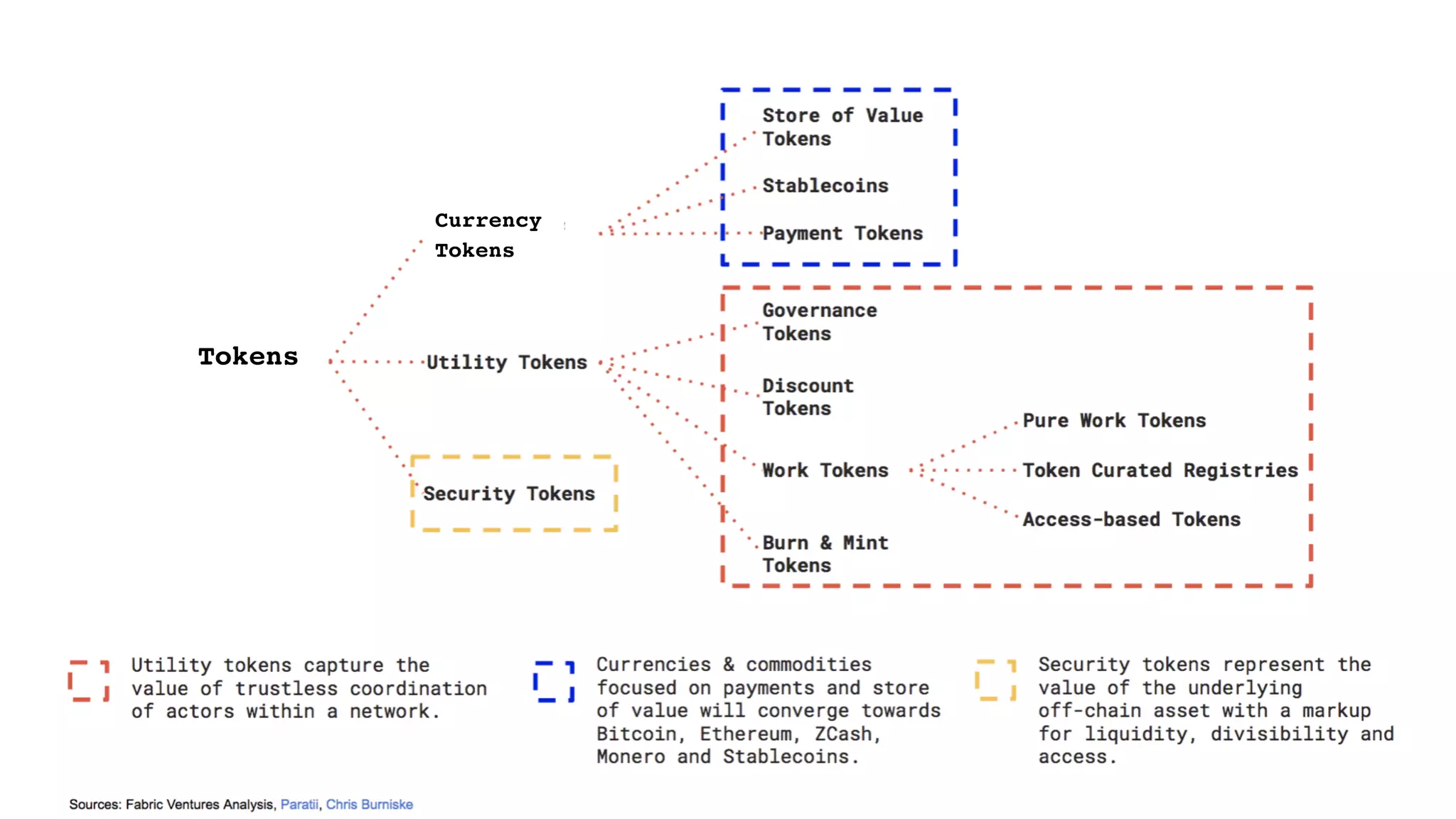
Tokens
Currency
Tokens
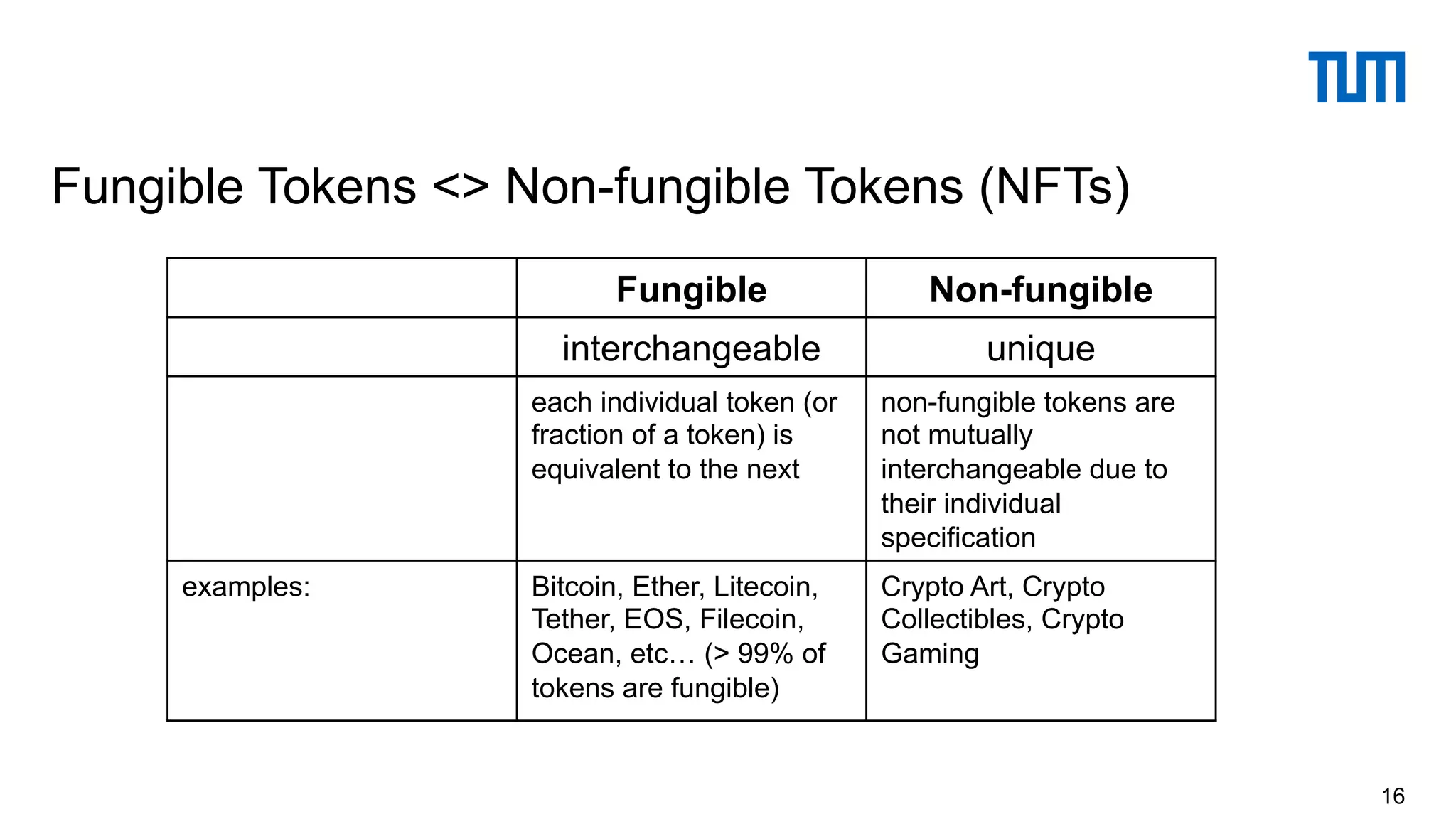
Fungible Tokens <> Non-fungible Tokens (NFTs)
16
Fungible Non-fungible
interchangeable unique
each individual token (or
fraction of a token) is
equivalent to the next
non-fungible tokens are
not mutually
interchangeable due to
their individual
specification
examples: Bitcoin, Ether, Litecoin,
Tether, EOS, Filecoin,
Ocean, etc… (> 99% of
tokens are fungible)
Crypto Art, Crypto
Collectibles, Crypto
Gaming
Fungible Tokens <> Non-fungible Tokens (NFTs)
17
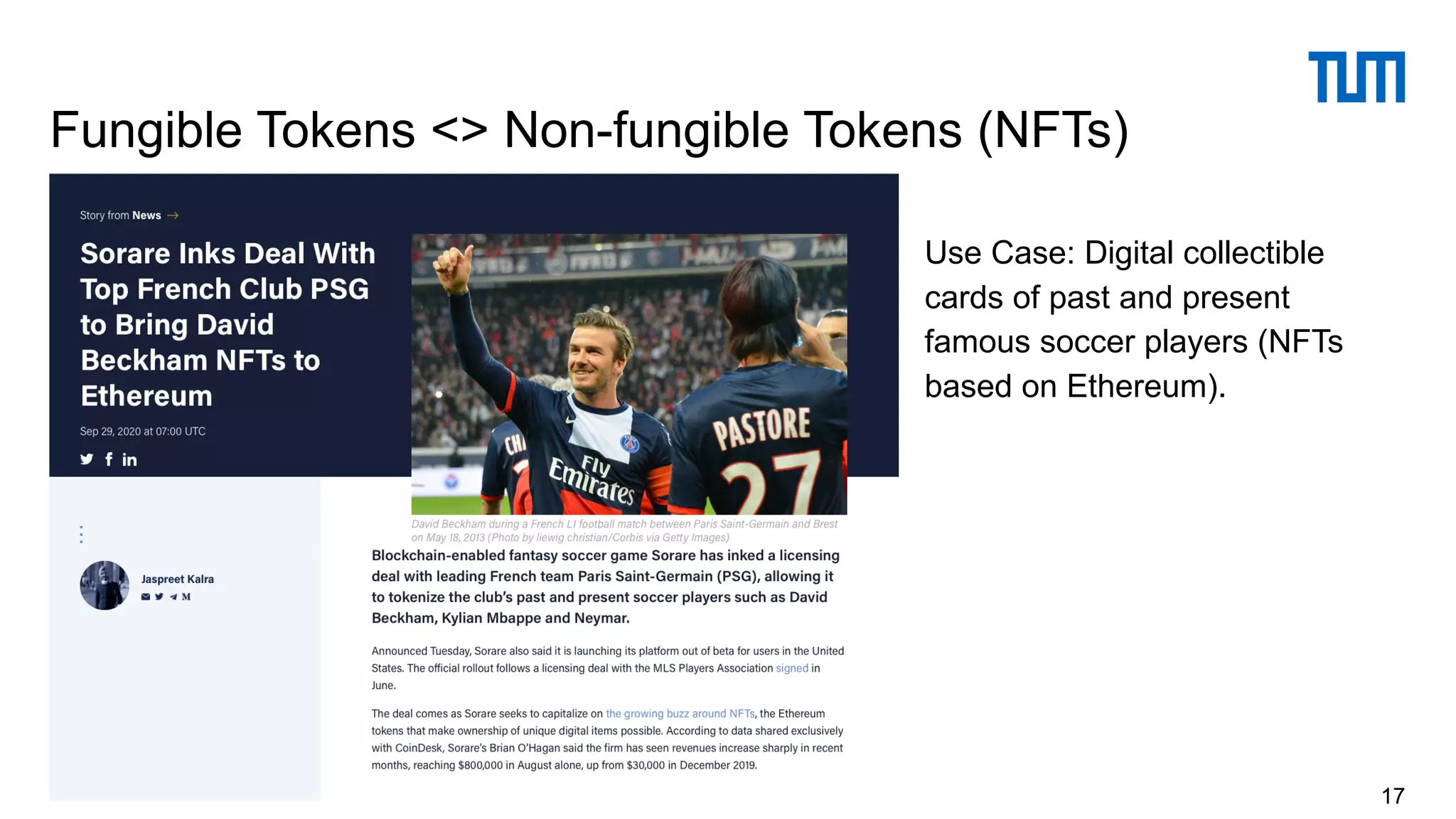
Use Case: Digital collectible
cards of past and present
famous soccer players (NFTs
based on Ethereum).
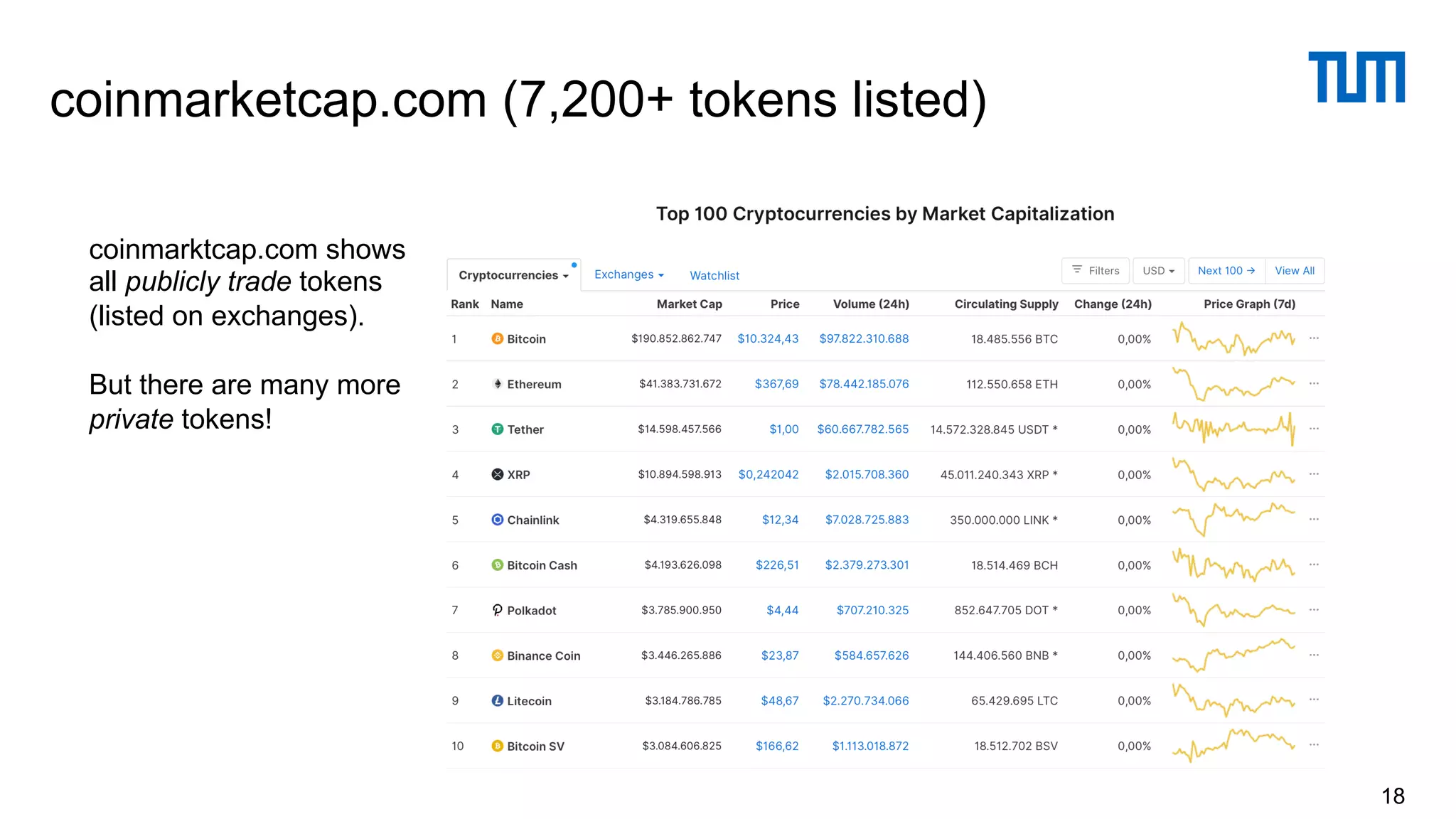
coinmarketcap.com (7,200+ tokens listed)
18
coinmarktcap.com shows
all publicly trade tokens
(listed on exchanges).
But there are many more
private tokens!
Thanks to open, permissionless blockchains, creating a token has become
cheap and easy.
But getting the design of the token right is a challenge!
• Purpose of the token (access right, representation of an asset, or both?)
• Properties of the token (fungible, non-fungible (NFTs) / native tokens, 2nd layer tokens)
• How to connect the blockchain to the physical worlds (“Oracles”)
• Governance Rules / Consensus Mechanism: PoW, PoS, …
• Incentive System: block mining rewards, transaction fees, token price, punishments
Token Engineering / Token Design
19
What is Token Engineering / Token Design?
20Source: https://medium.com/prysmeconomics/the-prysm-group-house-a-framework-for-the-new-economics-of-blockchain-a96edf0fc41a
Token Engineering is about creating mini-economies written in code.
Users come to them to engage in mutually beneficial interactions with others,
and they rely on the platform’s contracts, marketplaces, currencies, and rules
of decision-making/governance to help them do so.
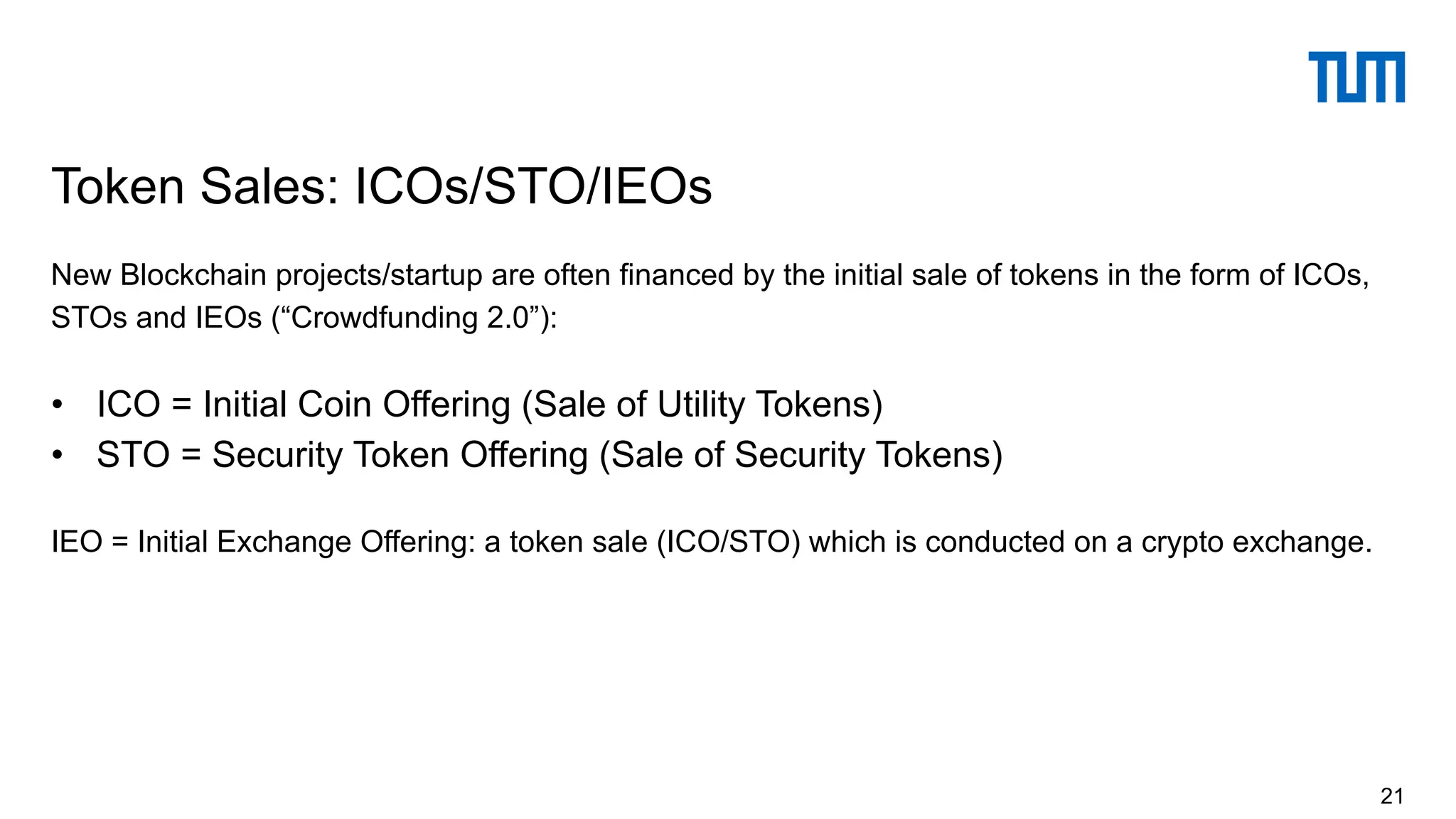
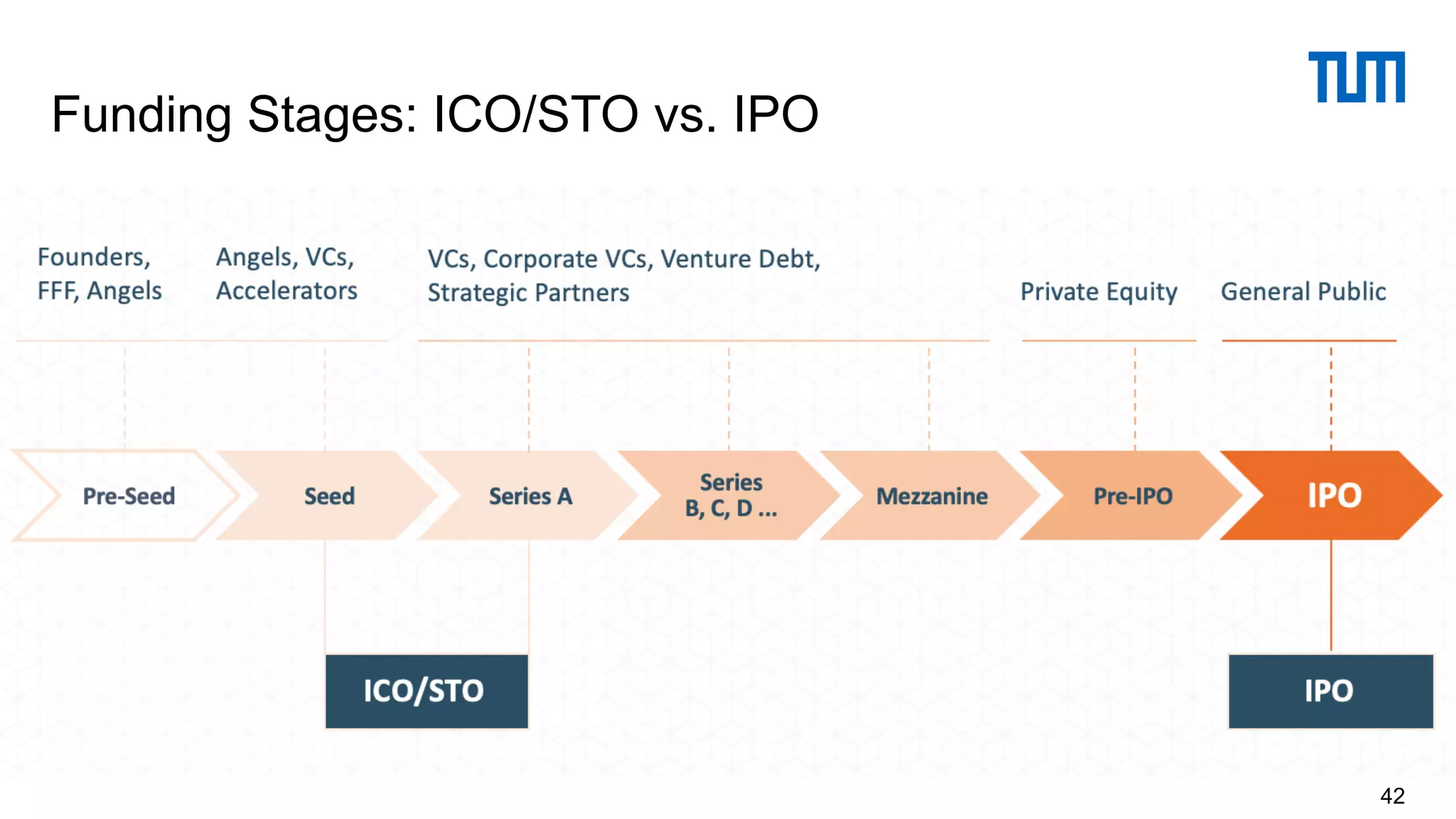
New Blockchain projects/startup are often financed by the initial sale of tokens in the form of ICOs,
STOs and IEOs (“Crowdfunding 2.0”):
• ICO = Initial Coin Offering (Sale of Utility Tokens)
• STO = Security Token Offering (Sale of Security Tokens)
IEO = Initial Exchange Offering: a token sale (ICO/STO) which is conducted on a crypto exchange.
Token Sales: ICOs/STO/IEOs
21
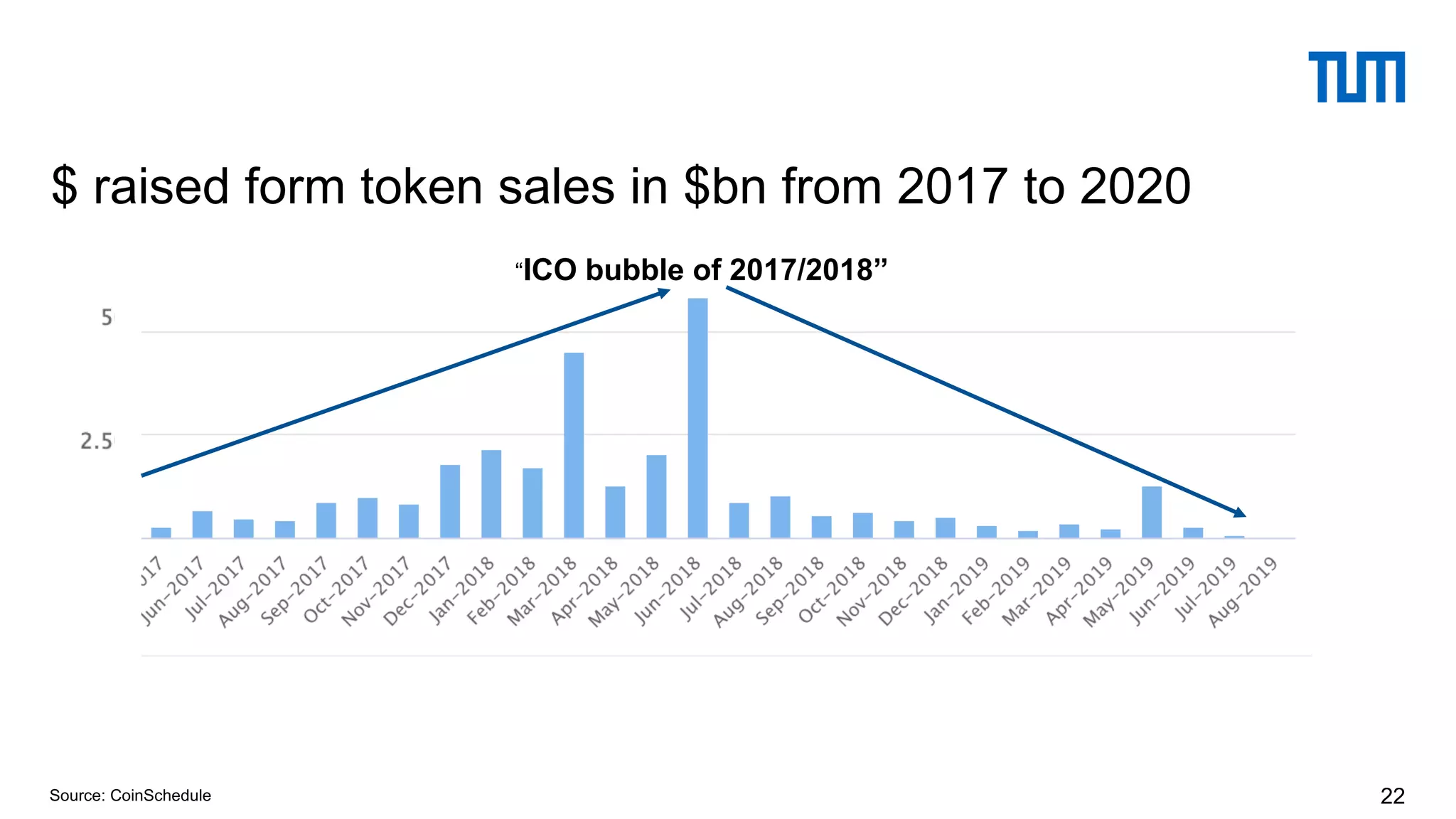
$ raised form token sales in $bn from 2017 to 2020
22Source: CoinSchedule
“ICO bubble of 2017/2018”
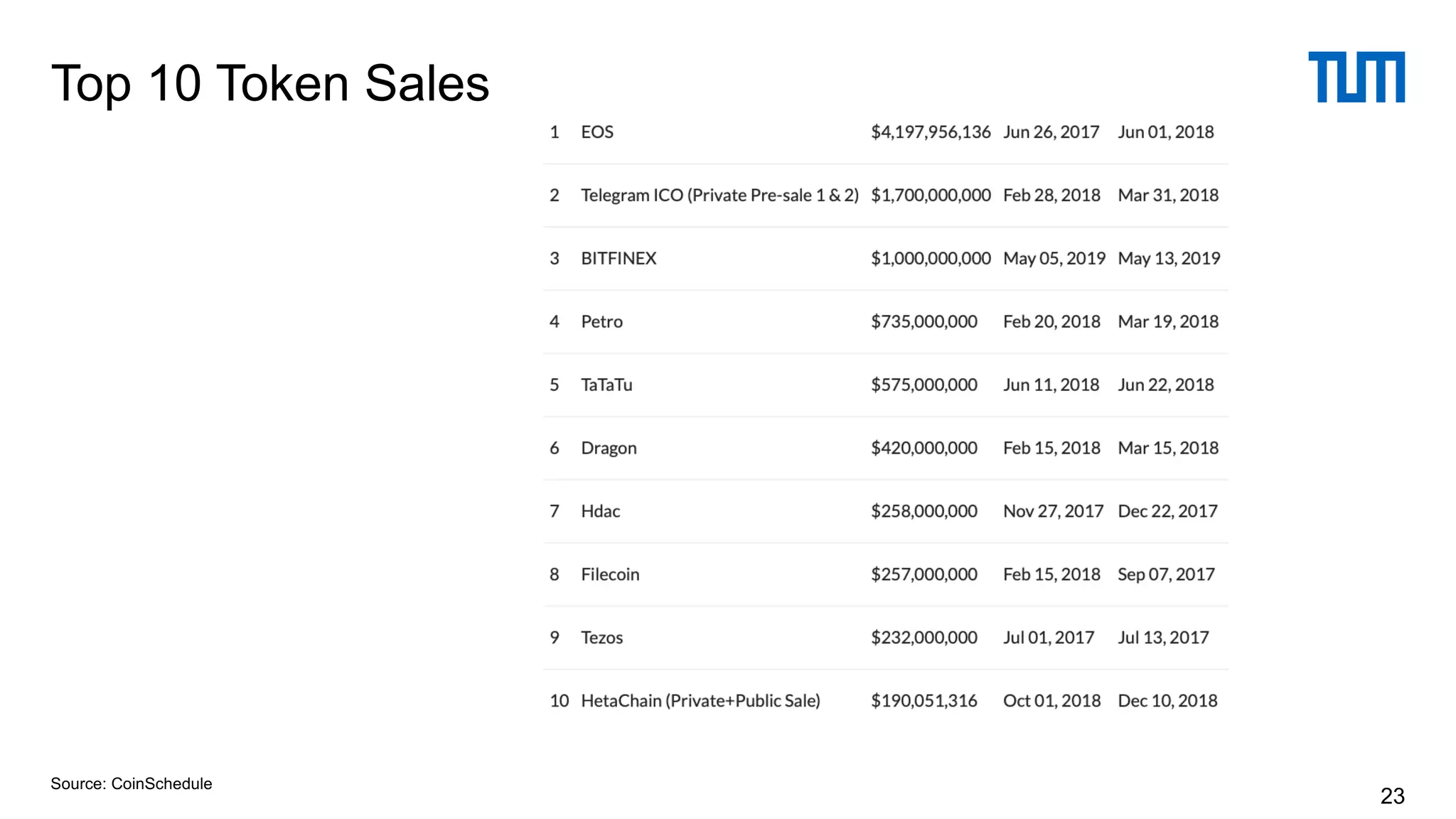
Top 10 Token Sales
23
Source: CoinSchedule
Decentralized Finance (DeFi)
24
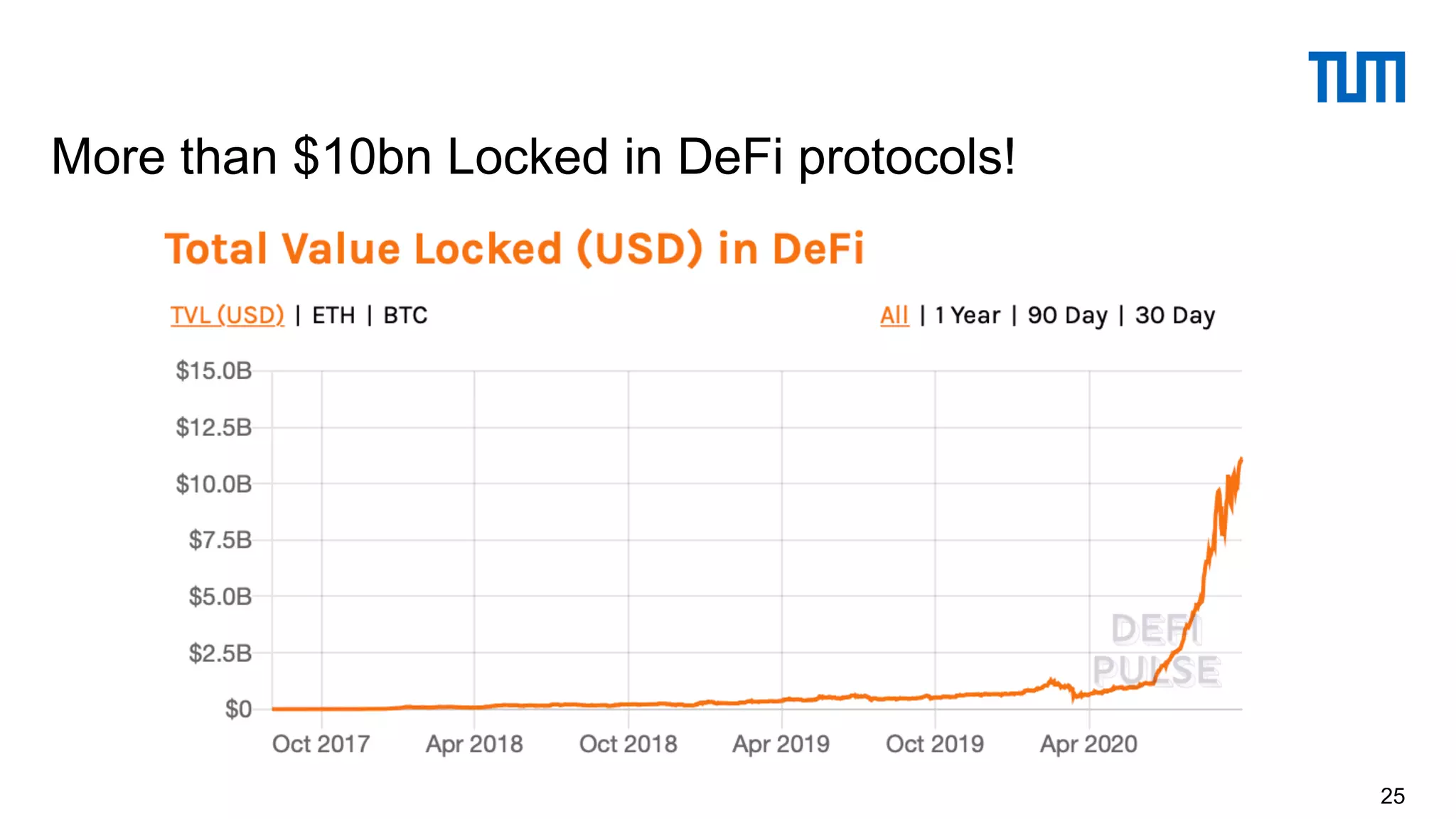
25
More than $10bn Locked in DeFi protocols!
• DeFi is also called: “open finance” or “programmable finance”.
• DeFi is the most important use case of blockchain technology.
• DeFi is financial software built on blockchain (mostly on the Ethereum blockchain). It’s decentralized as
you don’t need intermediaries like banks, brokers or clearing houses to transfer value from A to B.
• The key innovation of DeFi is the automation of backend processes of financial transactions by using
smart contracts. “Don’t trust the people, trust the software” / “Don’t trust, verify”.
• DeFi eliminates the need for intermediaries (”trust brokers”).
What is Decentralized Finance (DeFi)?
26
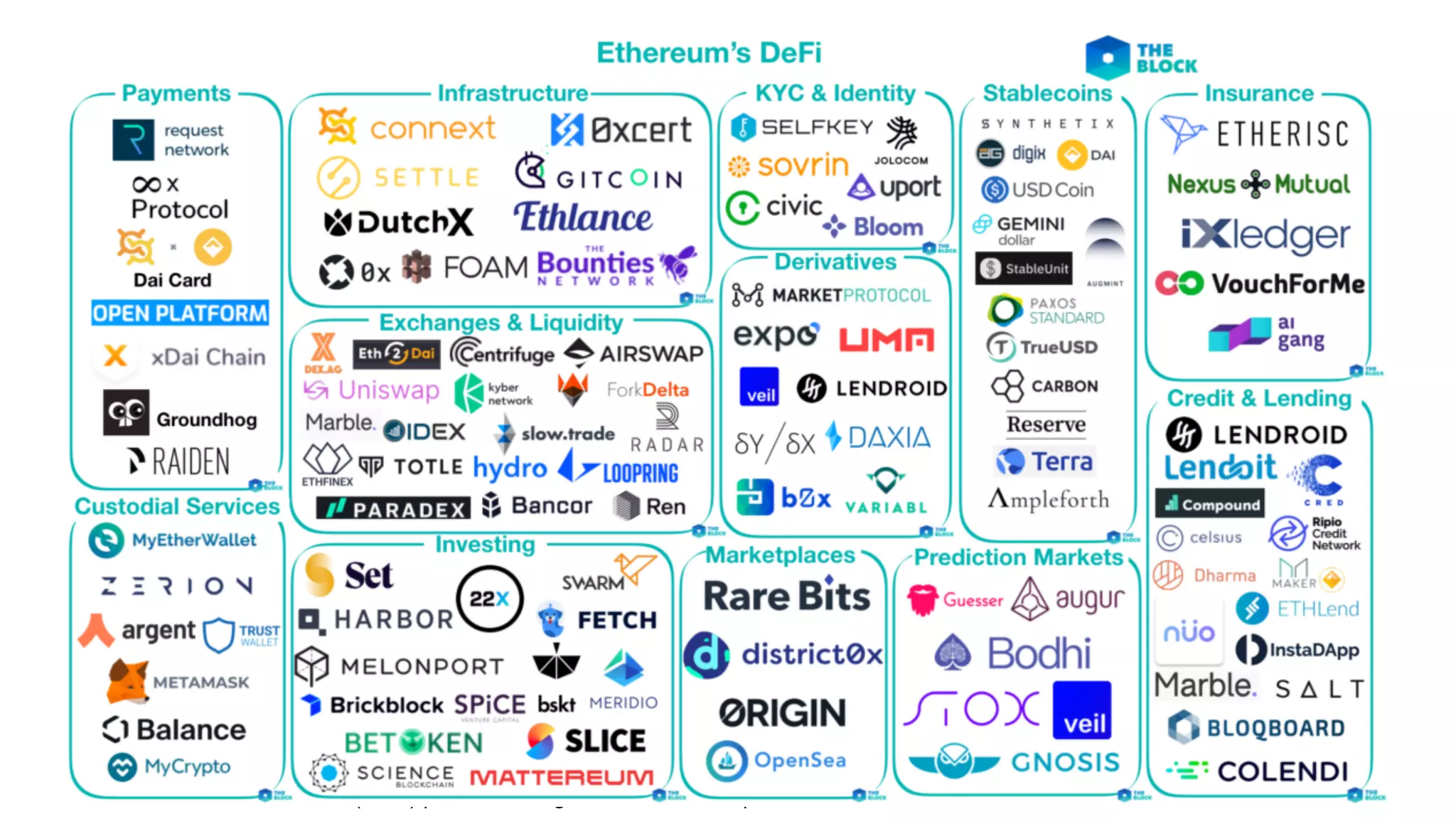
DeFi startups are working on the new building blocks of a new financial system which – step by step – will
replace the existing legacy financial system (time frame: 10 to 20 years).
Examples for DeFi applications:
• Exchances (DEX): Uniswap, Curve, Balancer, Bancor
• Stable Coins: Tether (USDT), DAI, USDC, Facebook Libra
• Credit Markets (lending, borrowing): Compound, Maker, Celsius, Centrifuge
What is Decentralized Finance (DeFi)?
27
28Dr. rer. nat. Erika Mustermann (TUM) | kann beliebig erweitert werden | Infos mit Strich trennen
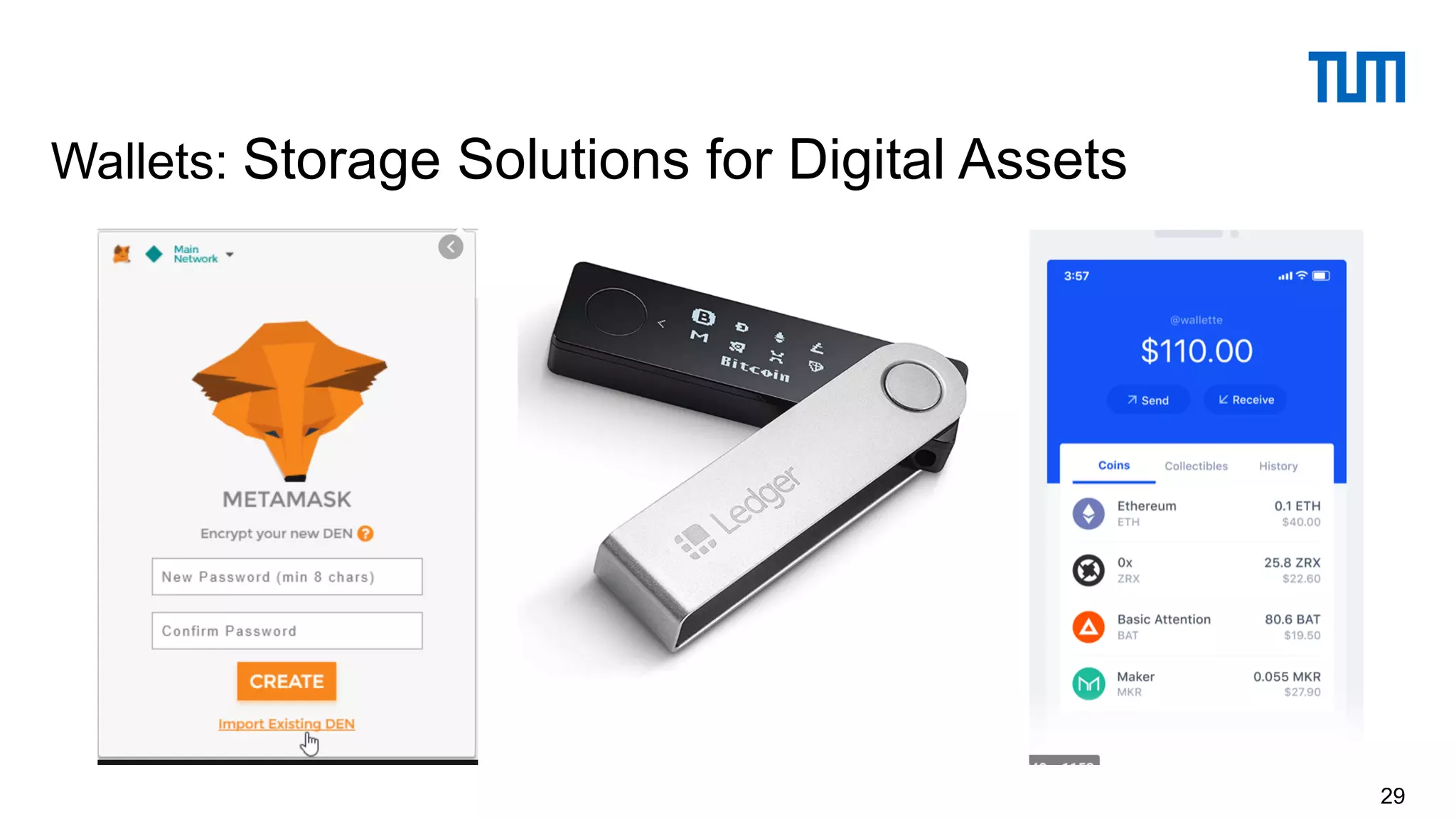
Wallets: Storage Solutions for Digital Assets
29
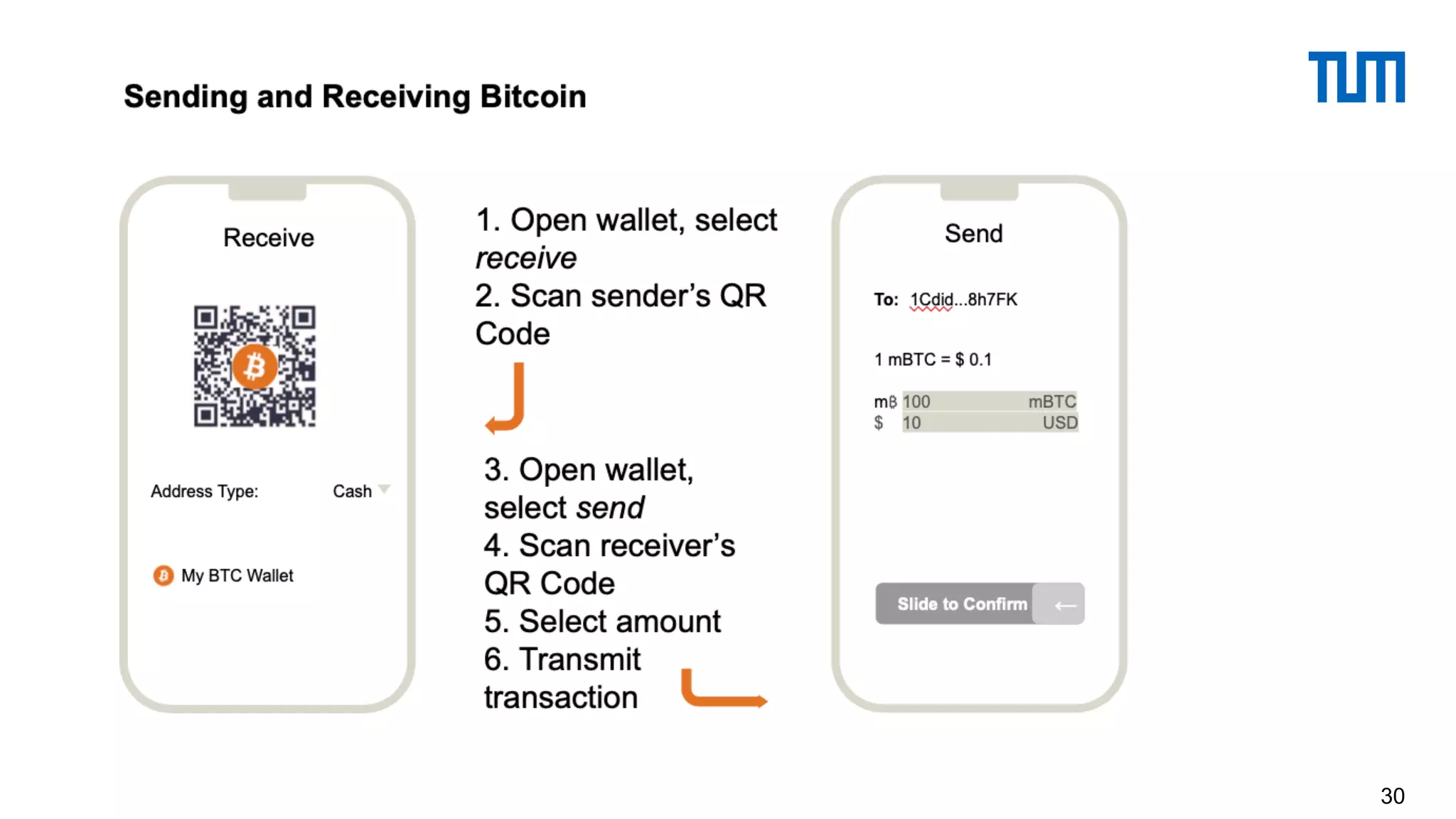
30
Definition: A physical device or software which stores the public/private
keys and can be used to track ownership and to spent/receive tokens.
A blockchain wallet simply acts as a secure key storage, and a
communication tool with the blockchain. It does not contain any tokens.
The tokens are collectively managed on the ledger of the blockchain.
Wallets: Storage Solutions for Digital Assets
31
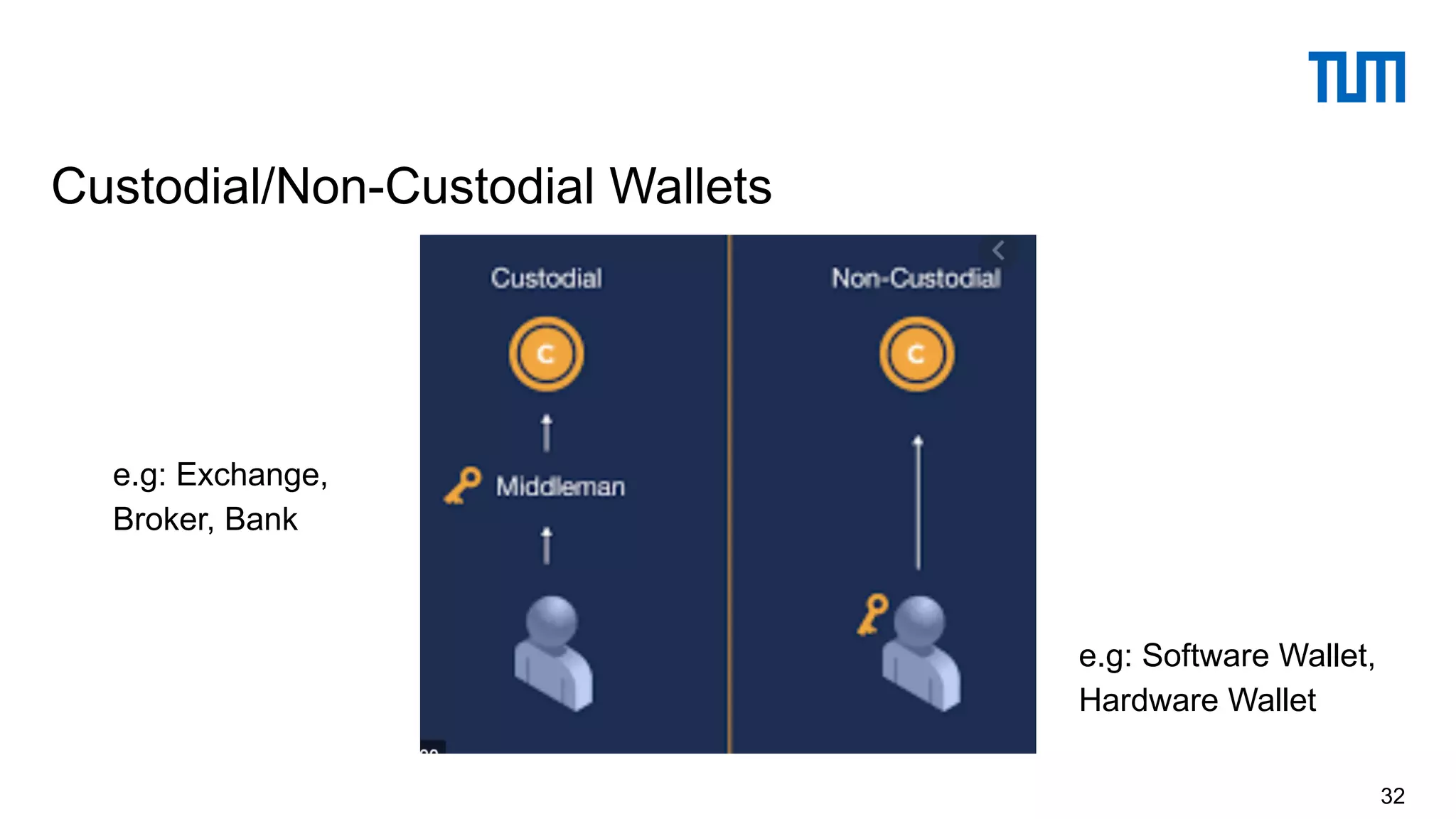
Custodial/Non-Custodial Wallets
32
e.g: Exchange,
Broker, Bank
e.g: Software Wallet,
Hardware Wallet
There are different types of wallets which have specific advantages and disadvantages.
• Desktop Wallets
• Web/Online Wallets
• Mobile Wallets
• Hardware Wallets
• Paper Wallets
• Brain Wallets
Types of Wallets
33
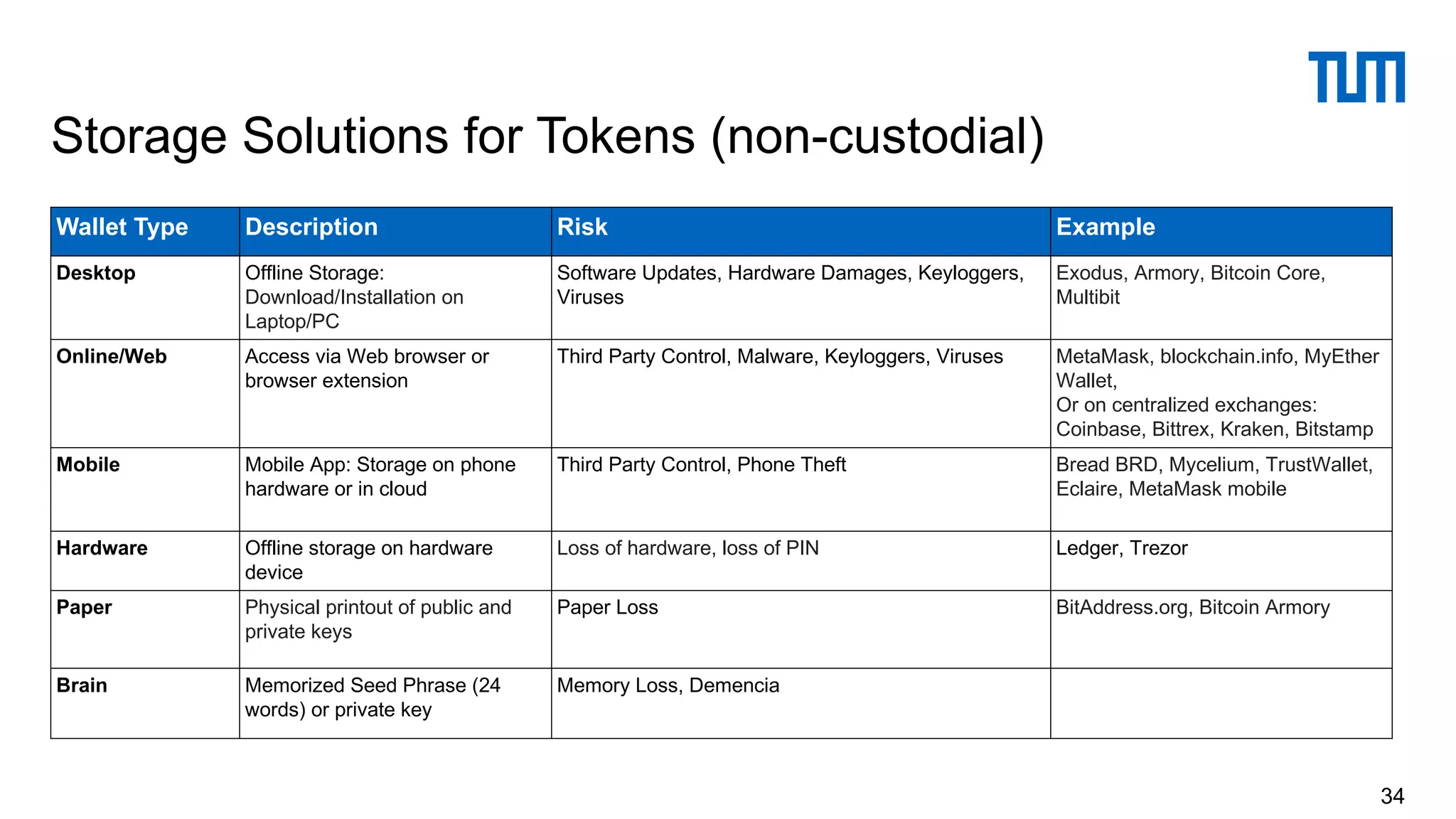
Storage Solutions for Tokens (non-custodial)
34
Wallet Type Description Risk Example
Desktop Offline Storage:
Download/Installation on
Laptop/PC
Software Updates, Hardware Damages, Keyloggers,
Viruses
Exodus, Armory, Bitcoin Core,
Multibit
Online/Web Access via Web browser or
browser extension
Third Party Control, Malware, Keyloggers, Viruses MetaMask, blockchain.info, MyEther
Wallet,
Or on centralized exchanges:
Coinbase, Bittrex, Kraken, Bitstamp
Mobile Mobile App: Storage on phone
hardware or in cloud
Third Party Control, Phone Theft Bread BRD, Mycelium, TrustWallet,
Eclaire, MetaMask mobile
Hardware Offline storage on hardware
device
Loss of hardware, loss of PIN Ledger, Trezor
Paper Physical printout of public and
private keys
Paper Loss BitAddress.org, Bitcoin Armory
Brain Memorized Seed Phrase (24
words) or private key
Memory Loss, Demencia
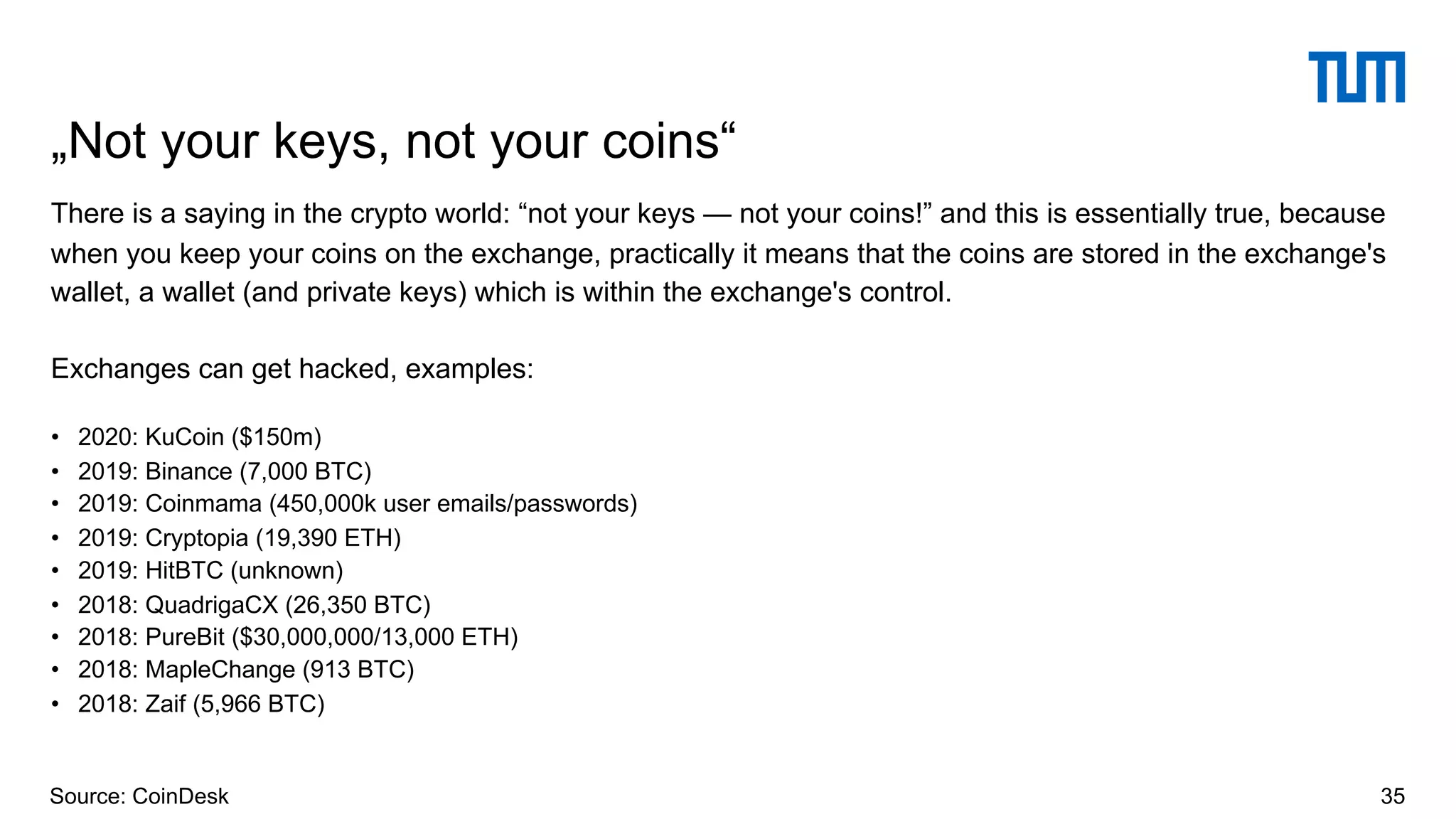
There is a saying in the crypto world: “not your keys — not your coins!” and this is essentially true, because
when you keep your coins on the exchange, practically it means that the coins are stored in the exchange's
wallet, a wallet (and private keys) which is within the exchange's control.
Exchanges can get hacked, examples:
• 2020: KuCoin ($150m)
• 2019: Binance (7,000 BTC)
• 2019: Coinmama (450,000k user emails/passwords)
• 2019: Cryptopia (19,390 ETH)
• 2019: HitBTC (unknown)
• 2018: QuadrigaCX (26,350 BTC)
• 2018: PureBit ($30,000,000/13,000 ETH)
• 2018: MapleChange (913 BTC)
• 2018: Zaif (5,966 BTC)
„Not your keys, not your coins“
35Source: CoinDesk
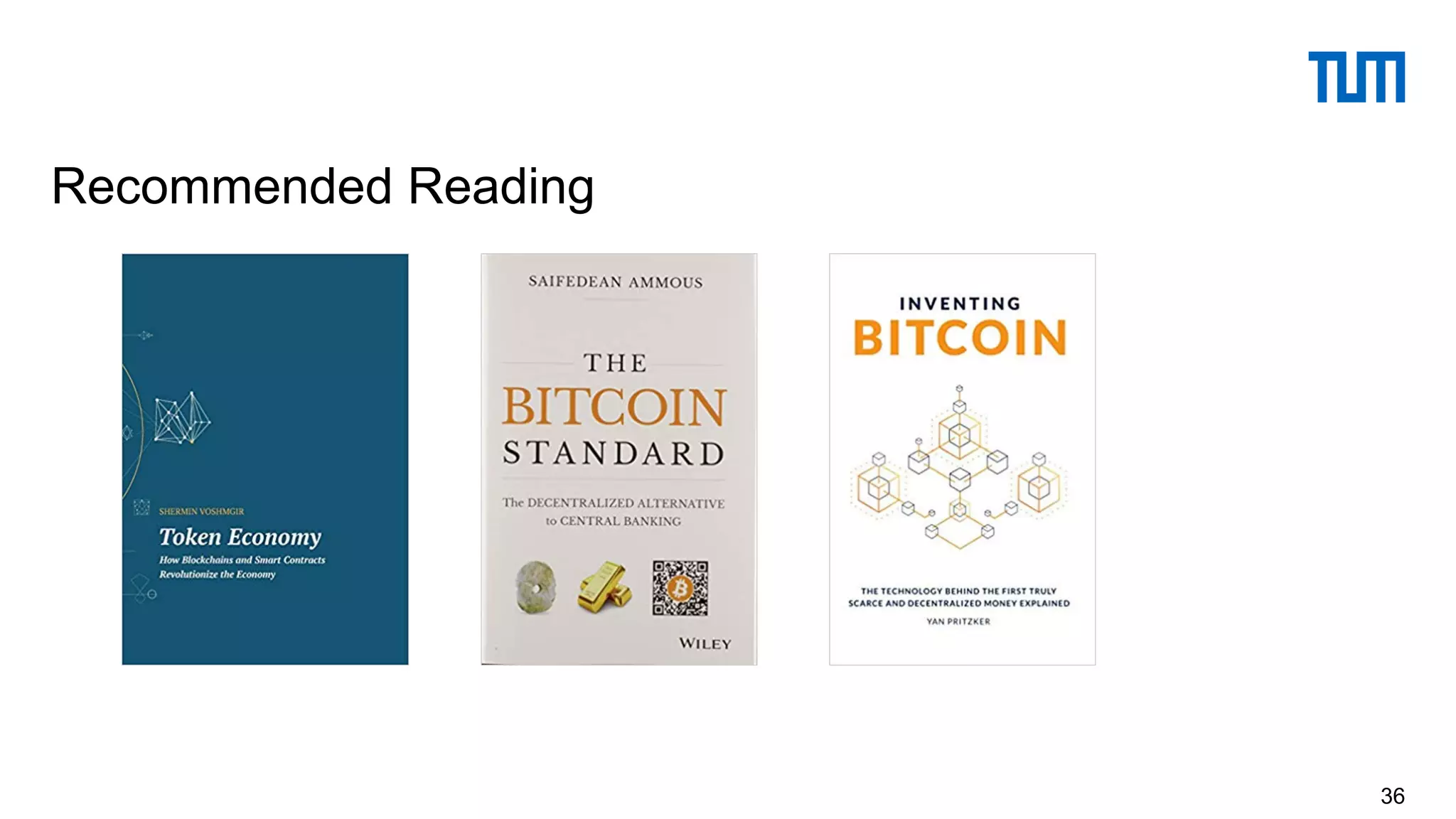
Recommended Reading
36
Thank You!
37
Contact:
Twitter: @florianhuber
LinkedIN: linkedin.com/in/florianhuber/
E-Mail: florian@signatureventures.com
Backup
38
39
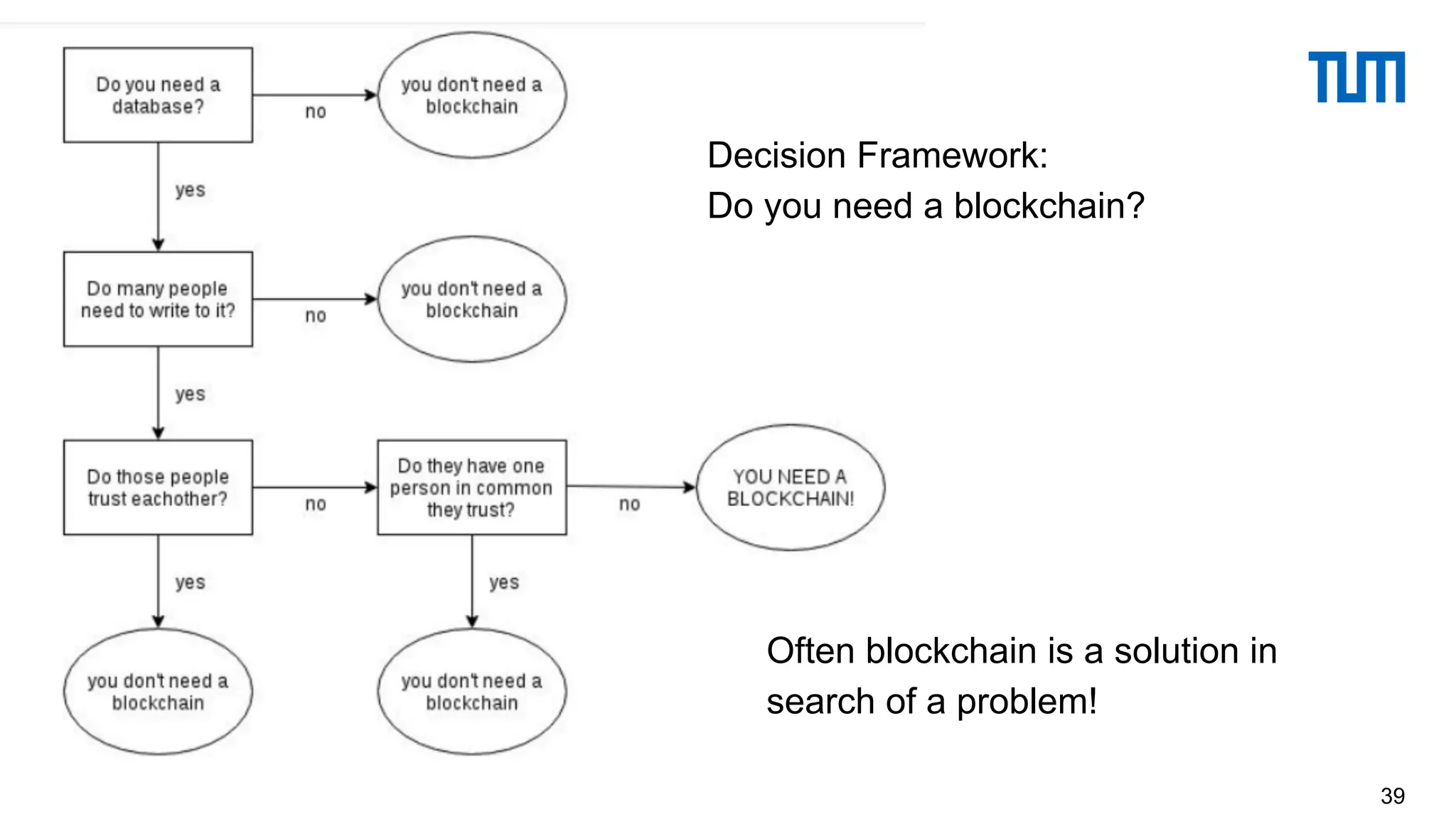
Decision Framework:
Do you need a blockchain?
Often blockchain is a solution in
search of a problem!
• To connect blockchains with the physical world (e.g. price of
commodities, temperature, flight delays, weather conditions) is a big
challenge.
• An oracle is an agent that finds and verifies real world occurrences and
submits this information to a blockchain to be used by smart contracts.
• This agent can be software, hardware (IoT), or human.
Blockchain Oracles
40Source: https://blockchainhub.net/blockchain-oracles/
• The main challenge with oracles is that people need to trust these outside sources of information,
whether they come from a website or a sensor.
• Since oracles are third-party services that are not part of the blockchain consensus mechanism, they are
not subject to the underlying security mechanisms that this public infrastructure provides. One could
replicate “man-in-the-middle attacks” standing between contracts and oracles.
• The robustness assurance of this “second layer” is of utmost importance. Different trusted computing
techniques can be used as a way of solving these issues.
• Oracles are the bottleneck for smart contract security. If oracle security is not adequately provided, it will
be a show stopper for widespread smart contract implementation.
Oracles are the biggest challenge in Token Design
41Source: https://blockchainhub.net/blockchain-oracles/
Funding Stages: ICO/STO vs. IPO
42
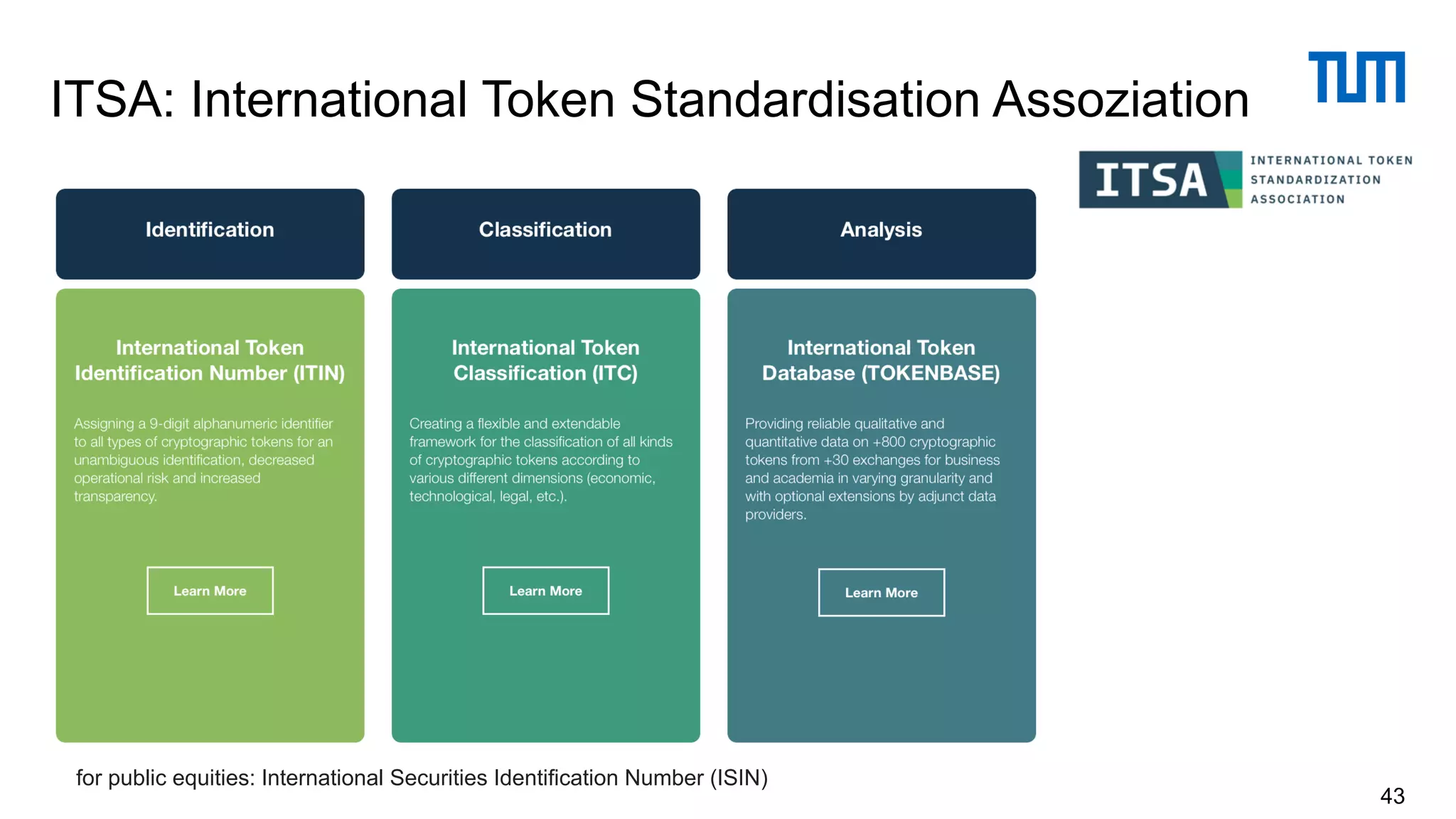
ITSA: International Token Standardisation Assoziation
43
for public equities: International Securities Identification Number (ISIN)

Digital Assets: Tokens & Coins - Lecture for TUM Blockchain Program (Technical University of Munich)

  • 1.
    Digital Assets: Tokens& Coins Florian Huber (Signature Ventures, chainEurope.org) October, 15th 2020
  • 2.
    1. Definition ofToken Outline 2Florian Huber
  • 3.
  • 4.
    1. Definition fora Token/Coin 2. Classification Systems for Tokens 3. Token Design and Incentive Schemes 4. Token Sales: Initial Coin Offerings (ICOs) 5. Decentralized Finance (DeFi) 6. Wallets: Storage Solutions for Digital Assets Digital Assets: Tokens & Coins 4Florian Huber
  • 5.
    Does every Blockchainneed a Token? 5Source: Shermin Vosmgir, Token Economy, 2019 Permissionless Blockchains Permissioned Blockchains (“Enterprise Blockchains", “Consortia Blockchains”) Examples Bitcoin, Ethereum, Stellar, Monero, Litecoin R3 (Banking), EWF (Energy Web Foundation), B3i (Insurance) Token Necessary, as an incentive mechanism. Not Necessary, but possible. Access everyone “invite only-member club” Network Participants Don’t know each other, no trust Know each other, trust Incentive mechanism Solely economic: PoW, PoS Legal Contracts, reputation Speed Slow High Comparable to “the Internet” Intranets, AOL, CompuServe
  • 6.
    The concept ofa token or a coin is nothing new, examples: • Sea Shells • Gold Coins • Casino Chips • Vouchers • Frequent Flyer Miles • QR-Codes (Good translation into German would be “Wertmarke”) Definition of a Token/Coin 6
  • 7.
    A token isa piece of data which … • grants an access right and/or • represents an asset (the value of something) … which is collectively governed on a blockchain using smart contracts. A token is not a digital file send from one device the other. Definition of a Token/Coin (in the context of blockchain) 7 Source: Shermin Voshmgir, Token Economy, 2019
  • 8.
    We’ve talked aboutTokens, but what about Coins?! A Coin is a token which acts like money (e.g. bitcoin, Monero, zCash) We are using “Token” is as an umbrella term. 8Source: Shermin Voshmgir, Token Economy, 2019 Tokens Money Tokens “Coins” (Cryptocurrencies) All other Tokens
  • 9.
    Old World: Tokensneeded a centralized issuer (e.g. nation states, banks, corporations). New World: The issuing/management of tokens is now happening on an open, public infrastructure (e.g Bitcoin Blockchain, Ethereum Blockchain). Old World/New World 9
  • 10.
    In this newworld Tokens enable easy granting of access rights and the easy creation of assets (representing economic value, like money, shares, real estate, art, …). „Tokens are to the Web3 what websites were to the Web1!" Tokens are the killer app of the Web3 era! 10 Old World/New World
  • 11.
    Information Economy Web 1 Read Platform Economy Web 2 Read Write Token Economy Web3 Read/Write Execute (peer-to-peer, without intermediaries) Frontend Revolution Backend Revolution Access Rights Assets Source: Shermin Voshmgir, Token Economy, 2019
  • 12.
    Old World: TraditionalTop Down Approach New World: Token economies will enable Decentralized Autonomous Organizations (DAOs) è Blockchain/Tokens will path the way a new type of value creation. Value Creation: How does Society create value? 12
  • 13.
    13 Market cap Ethereum:$38 bn (launched in 2014) vs. Market cap BMW: $40 bn (launched in 1916) Source: Shermin Voshmgir, Token Economy, 2019
  • 14.
    Legal structure of(a token Utility Tokens Description: It’s best to think of a Utility Token as a pre-paid voucher for a non-existing services Characteristics: • Closely tied to the functionality of the issuing network or application • Internal network/app currency but not necessarily attempting to be a currency • Grants owners the right to actively contribute to the system vs. passive investor role • Avoids security-like features Security Tokens Currency Tokens Description: A token that behaves like a security (“Wertpapier”) Characteristics: • Represent the value of the underlying off-chain asset • Showcases security-like features, e.g. voting on decisions regarding the issuing entity, dividends, or profit shares • Holders are regarded as owners • Little or insufficient utility Description: A token that acts like money (“Coins”, “Cryptocurrencies”) Characteristics: • Acts as a store of value and medium of exchange • Not emitted by a central authority against which owners have claims • Examples: Bitcoin, Litecoin, Cardano Token Classification
  • 15.
    Das Grundprinzip ist,Informationen bestmöglich zu transportieren. Dazu muss vor allem die Schrift einheitlich und für alle im Raum lesbar sein. Schriftart: Arial Schriftgrößen: 25 | 18 | 14 | 11 Zeilenabstand: 1,15mm Die Einstellungen sind in den Textfeldern und Textfeldvorlagen dieses ppt-Masters als Standard eingestellt. Bei Diagrammen und Tabellen muss die Schriftgröße ggf. angepasst werden. Für Auszeichnungen im Fließtext kann auch fett markiert werden. Bei großer Distanz bzw. kleinem Präsentationsmedium kann der Schriftgrad notfalls proportional erhöht werden. Schrift 15Dr. rer. nat. Erika Mustermann (TUM) | kann beliebig erweitert werden | Infos mit Strich trennen Tokens Currency Tokens
  • 16.
    Fungible Tokens <>Non-fungible Tokens (NFTs) 16 Fungible Non-fungible interchangeable unique each individual token (or fraction of a token) is equivalent to the next non-fungible tokens are not mutually interchangeable due to their individual specification examples: Bitcoin, Ether, Litecoin, Tether, EOS, Filecoin, Ocean, etc… (> 99% of tokens are fungible) Crypto Art, Crypto Collectibles, Crypto Gaming
  • 17.
    Fungible Tokens <>Non-fungible Tokens (NFTs) 17 Use Case: Digital collectible cards of past and present famous soccer players (NFTs based on Ethereum).
  • 18.
    coinmarketcap.com (7,200+ tokenslisted) 18 coinmarktcap.com shows all publicly trade tokens (listed on exchanges). But there are many more private tokens!
  • 19.
    Thanks to open,permissionless blockchains, creating a token has become cheap and easy. But getting the design of the token right is a challenge! • Purpose of the token (access right, representation of an asset, or both?) • Properties of the token (fungible, non-fungible (NFTs) / native tokens, 2nd layer tokens) • How to connect the blockchain to the physical worlds (“Oracles”) • Governance Rules / Consensus Mechanism: PoW, PoS, … • Incentive System: block mining rewards, transaction fees, token price, punishments Token Engineering / Token Design 19
  • 20.
    What is TokenEngineering / Token Design? 20Source: https://medium.com/prysmeconomics/the-prysm-group-house-a-framework-for-the-new-economics-of-blockchain-a96edf0fc41a Token Engineering is about creating mini-economies written in code. Users come to them to engage in mutually beneficial interactions with others, and they rely on the platform’s contracts, marketplaces, currencies, and rules of decision-making/governance to help them do so.
  • 21.
    New Blockchain projects/startupare often financed by the initial sale of tokens in the form of ICOs, STOs and IEOs (“Crowdfunding 2.0”): • ICO = Initial Coin Offering (Sale of Utility Tokens) • STO = Security Token Offering (Sale of Security Tokens) IEO = Initial Exchange Offering: a token sale (ICO/STO) which is conducted on a crypto exchange. Token Sales: ICOs/STO/IEOs 21
  • 22.
    $ raised formtoken sales in $bn from 2017 to 2020 22Source: CoinSchedule “ICO bubble of 2017/2018”
  • 23.
    Top 10 TokenSales 23 Source: CoinSchedule
  • 24.
  • 25.
    25 More than $10bnLocked in DeFi protocols!
  • 26.
    • DeFi isalso called: “open finance” or “programmable finance”. • DeFi is the most important use case of blockchain technology. • DeFi is financial software built on blockchain (mostly on the Ethereum blockchain). It’s decentralized as you don’t need intermediaries like banks, brokers or clearing houses to transfer value from A to B. • The key innovation of DeFi is the automation of backend processes of financial transactions by using smart contracts. “Don’t trust the people, trust the software” / “Don’t trust, verify”. • DeFi eliminates the need for intermediaries (”trust brokers”). What is Decentralized Finance (DeFi)? 26
  • 27.
    DeFi startups areworking on the new building blocks of a new financial system which – step by step – will replace the existing legacy financial system (time frame: 10 to 20 years). Examples for DeFi applications: • Exchances (DEX): Uniswap, Curve, Balancer, Bancor • Stable Coins: Tether (USDT), DAI, USDC, Facebook Libra • Credit Markets (lending, borrowing): Compound, Maker, Celsius, Centrifuge What is Decentralized Finance (DeFi)? 27
  • 28.
    28Dr. rer. nat.Erika Mustermann (TUM) | kann beliebig erweitert werden | Infos mit Strich trennen
  • 29.
    Wallets: Storage Solutionsfor Digital Assets 29
  • 30.
  • 31.
    Definition: A physicaldevice or software which stores the public/private keys and can be used to track ownership and to spent/receive tokens. A blockchain wallet simply acts as a secure key storage, and a communication tool with the blockchain. It does not contain any tokens. The tokens are collectively managed on the ledger of the blockchain. Wallets: Storage Solutions for Digital Assets 31
  • 32.
    Custodial/Non-Custodial Wallets 32 e.g: Exchange, Broker,Bank e.g: Software Wallet, Hardware Wallet
  • 33.
    There are differenttypes of wallets which have specific advantages and disadvantages. • Desktop Wallets • Web/Online Wallets • Mobile Wallets • Hardware Wallets • Paper Wallets • Brain Wallets Types of Wallets 33
  • 34.
    Storage Solutions forTokens (non-custodial) 34 Wallet Type Description Risk Example Desktop Offline Storage: Download/Installation on Laptop/PC Software Updates, Hardware Damages, Keyloggers, Viruses Exodus, Armory, Bitcoin Core, Multibit Online/Web Access via Web browser or browser extension Third Party Control, Malware, Keyloggers, Viruses MetaMask, blockchain.info, MyEther Wallet, Or on centralized exchanges: Coinbase, Bittrex, Kraken, Bitstamp Mobile Mobile App: Storage on phone hardware or in cloud Third Party Control, Phone Theft Bread BRD, Mycelium, TrustWallet, Eclaire, MetaMask mobile Hardware Offline storage on hardware device Loss of hardware, loss of PIN Ledger, Trezor Paper Physical printout of public and private keys Paper Loss BitAddress.org, Bitcoin Armory Brain Memorized Seed Phrase (24 words) or private key Memory Loss, Demencia
  • 35.
    There is asaying in the crypto world: “not your keys — not your coins!” and this is essentially true, because when you keep your coins on the exchange, practically it means that the coins are stored in the exchange's wallet, a wallet (and private keys) which is within the exchange's control. Exchanges can get hacked, examples: • 2020: KuCoin ($150m) • 2019: Binance (7,000 BTC) • 2019: Coinmama (450,000k user emails/passwords) • 2019: Cryptopia (19,390 ETH) • 2019: HitBTC (unknown) • 2018: QuadrigaCX (26,350 BTC) • 2018: PureBit ($30,000,000/13,000 ETH) • 2018: MapleChange (913 BTC) • 2018: Zaif (5,966 BTC) „Not your keys, not your coins“ 35Source: CoinDesk
  • 36.
  • 37.
    Thank You! 37 Contact: Twitter: @florianhuber LinkedIN:linkedin.com/in/florianhuber/ E-Mail: florian@signatureventures.com
  • 38.
  • 39.
    39 Decision Framework: Do youneed a blockchain? Often blockchain is a solution in search of a problem!
  • 40.
    • To connectblockchains with the physical world (e.g. price of commodities, temperature, flight delays, weather conditions) is a big challenge. • An oracle is an agent that finds and verifies real world occurrences and submits this information to a blockchain to be used by smart contracts. • This agent can be software, hardware (IoT), or human. Blockchain Oracles 40Source: https://blockchainhub.net/blockchain-oracles/
  • 41.
    • The mainchallenge with oracles is that people need to trust these outside sources of information, whether they come from a website or a sensor. • Since oracles are third-party services that are not part of the blockchain consensus mechanism, they are not subject to the underlying security mechanisms that this public infrastructure provides. One could replicate “man-in-the-middle attacks” standing between contracts and oracles. • The robustness assurance of this “second layer” is of utmost importance. Different trusted computing techniques can be used as a way of solving these issues. • Oracles are the bottleneck for smart contract security. If oracle security is not adequately provided, it will be a show stopper for widespread smart contract implementation. Oracles are the biggest challenge in Token Design 41Source: https://blockchainhub.net/blockchain-oracles/
  • 42.
  • 43.
    ITSA: International TokenStandardisation Assoziation 43 for public equities: International Securities Identification Number (ISIN)