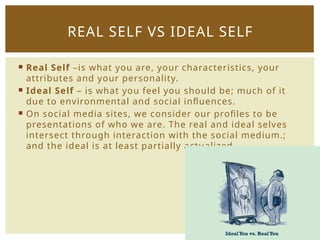
Real Self–is what you are, your characteristics, your
attributes and your personality.
Ideal Self – is what you feel you should be; much of it
due to environmental and social influences.
On social media sites, we consider our profiles to be
presentations of who we are. The real and ideal selves
intersect through interaction with the social medium.;
and the ideal is at least partially actualized.
REAL SELF VS IDEAL SELF
4.
Digital Natives andDigital Immigrants
Digital Natives are those who were born after 1980, who
have access and skills to use digital technologies especially
social media. They live most of their lives online, without
distinguishing between online and offline.
DIGITAL NATIVES AND DIGITAL
IMMIGRANTS
6.
Digital Immigrants –They are those people who were
born prior to 1980; who were not born into the digital
world but have, at some later point in our lives, become
amazed by and adopted many or most aspects of the new
technology. Digital Immigrant teachers think that students
or learners are the same as when they were students and
that similar teaching methods of their teachers will work
for their students now.
DIGITAL IMMIGRANTS
7.
Digital Identity
Digital Identityhas a number of different definitions in the literature.
It can refer to the usernames and digital footprint that individuals
choose and leave behind after using the internet for different
purposes such as banking or purchasing goods.
Digital Identity – is formed by personal profiles, cultural capital and
records – such as videos on YouTube. The digital realm indeed gives
us the power to “determine how we are defined within the socio-
cultural sphere”. While individuals are the product of their unique
personal biography they are not entirely free to choose who they are
because of social situations and interactions. It is “a conscious
construction, it can evolve subconsciously over a period of time, or it
could simply be a reflection of the user in real life” They go on a state
that “ it is worryingly difficult to find the person in among all the
digital artifice”. This is called self-regulated self-presentation.
DIGITAL IDENTITY
9.
Digital Footprint orDigital Shadow – refers to one’s
unique set of traceable digital activities, actions
contributions and communications that are manifested in
the Internet or on digital devices. A positive digital
footprint can enhance a person’s reputation.
DIGITAL FOOTPRINT/DIGITAL
SHADOW
11.
Passive DigitalFootprint – is created when data is
collected without the owner knowing, whereas active
digital footprints are created when personal data is
released deliberately by a user for the purpose of
sharing information about oneself by means of websites
or social media.
Active Digital Footprint – can also be stored in many
ways depending on the situation. In an online
environment, a footprint can be stored by a user being
logged into a site when making a post or change, with
the registered name being connected to the edit.
TWO MAIN CLASSIFICATIONS FOR
DIGITAL FOOTPRINTS: PASSIVE AND
ACTIVE
12.
Impression Management– is a conscious or
subconscious process in which people attempt to
influence the perceptions of other people about
themselves, another person, object or event. It is done
by regulating and controlling information in social
interaction. It was conceptualized by Erving Goffman a
Canadian-American sociologist and writer in 1959., and
this was expanded upon in 1967.
IMPRESSION MANAGEMENT
13.
Implications of theCreating of Digital Self
In an article published in 2012 in Forbes magazine, it was
posited that women are now more active than men across
major social media platforms such as twitter, Pinterest and
Facebook have a stronger attachment to social networking
than do men.
IMPLICATIONS OF THE CREATING OF
DIGITAL SELF
14.
The Digital self,as presented in social media, also places
the people open to the voyeuristic gaze of others in
uncountable small scale private performances that are
socially mediated for public consumption on an often large
scale.
DIGITAL SELF
15.
Facebook andtwitter differ from traditional web
applications as pages are easy to create and edit; are
easily accessible; promote and support mobility; have real
time communication and are free or cost effective.
Social media have the advantage of being real time
applications that offer information in real time.
Digital over Physical
A digital identity has the potential to live forever where in
the physical world we are faced with death. Traditionally
genetic codes are passed on to offspring and offer a family
history that lives forever, or through a lineage. An online
identity is remembered for how it interacted in a particular
time in a digital environment.
BENEFITS OF SOCIAL MEDIA USAGE
16.
Here are someways you can make sure your social media profiles
are helping you network and not hurting your failure.
Follow that college account and that business account you
found in the scavenger hunt. Seeing their posts will inspire you
to follow through on your goals and get you familiar with what
is going on at that campus or in that industry.
Use social media to reach out to organizations that may help
you achieve your college and career pathway goals.
Interact with more people you identified who are supportive of
your goals, spend time with them in person. Social media can
help you network, but make sure its not the only way you
interact with your supporters.
Try to keep everything you share on social media clean and
professional, and keep your publicly shared content minimal.
Always be kind
HOW TO MANAGE SOCIAL MEDIA
PROFILE
17.
Google yourself
Use Facebook Wisely
Take charge of your photos
Don’t overshare
Monitor linking Accounts
Use secondary Email
Think before you click
STEPS TO CREATING A POSITIVE
DIGITAL FOOTPRINT
On asurface level is our thought and on the deeper level,
it is the domain of our beliefs, desires and values and
goals. Our belief comprises our opinions and convictions
about things that we hold as being true without any
concrete proofs.
Values are representation of what we embrace internally
as essential and important in our life. They are by
products of our thoughts that were formed in our early
childhood. The importance of awareness of our mental
self is an essential key for us to have a complete human
experience.
MENTAL SELF
20.
Brain Structure
The brainis the organ in our bodies that most directly
controls our thoughts, emotions, and motivation. People
usually think of the brain as being at the top of the body’s
hierarchy- as the boss, with various other organs
responding to it. The brain has three major regions:
forebrain, midbrain and hindbrain.
BRAIN STRUCTURE
21.
Forebrain – regionof the brain located toward the top and front of the
brain. It comprises the cerebral cortex, the basal ganglia, the limbic system,
the thalamus and the hypothalamus.
Cerebral Cortex – outer layer of t he cerebral hemisphere. It plays a vital
role in our thinking and other mental processes.
Basal Ganglia – are collections of neurons and crucial to motor function.
Dysfunction of the basal ganglia can result in motor deficits.
Limbic System – help us to adapt our behaviors flexibly in response to
our changing environment.
Septum –anger and fear
Amygdala – anger and aggression
Hippocampus – memory formation, shapes like seahorse, essential for flexible
learning and spatial memory.
Thalamus – relays incoming sensory information through groups of
neurons that brain passes through the thalamus.
Hypothalamus – regulates behaviour related to species survival: fighting,
feeding, fleeing and mating. It is also active in regulating emotions and
reactions to stress.
FOREBRAIN
22.
Midbrain – helpsto control eye movement and
coordination. The midbrain more important in non-
mammals where it is the main source of control for visual
and auditory information.
Brainstem – connects the forebrain to the spinal cord. It
compromises the hypothalamus, the thalamus, the
midbrain and the hindbrain.
MIDBRAIN
23.
Hindbrain – compromisesthe medualla oblongata, the
pons, and the cerebellum.
Medulla oblongata – controls heart activity and largely
controls breathing, swallowing and digestion. It is also
the places at which nerves from the left side of the body
cross over to the right side of the brain. It derives its
name from the Latin word for “bridge”.
Pons
Cerebellum
HIND BRAIN
24.
Attention isthe concentration and focusing of mental
effort. Attention is both selective and shifting. For
example, when students take a test, they must be able to
focus their mental effort on certain stimuli (test
questions) while excluding other stimuli.
Memory is the retention of information over time. It is
central to mental life and to information processing. To
successfully learn, students need to hold information
and retrieve it when necessary. There are three
important memory systems namely: sensory memory,
short term memory and long term memory.
ATTENTION AND MEMORY