ASPESS
Amity school of Physical Education and
sports sciences
Sports Psychology and Sociology(PEDU 247)
Presentation on Difference between Professional and Amateur
SUBMITTED BY - SUBMITTED TO
SARTHAK SHARMA A3013821067 Dr. Ajit Kumar
DEEPANSHU SHEORAN A3013821068
YASHASVI A3013821069
1
ASPESS
Difference between Professional and Amateur
2
ASPESS
Amateurs wait to feel inspired.
Professionals stick to a schedule.
• Amateurs only work and practicewhen they feel motivated
to do so.
• They wait for inspiration, or permission from somebody
else, to take action towards their goals—to exercise,to
write more and so on.
• Professionals don’t let their feelingsdictate their actions.
• They intentionally create and stickto a schedulecome rain
or shine.
ASPESS
4
Amateurs strive to achieve.
Professionals strive to improve.
 Just like a recreational runner preparing for a marathon,
Amateurs strive for the achievement of finishing the marathon.
 After the marathon, the recreational runner no longer strives to
improve their running. The achievement has now been
reached, so the incentive to stay consistent with practice is very
little.
 The professional understands that an achievement is simply an
indication of how much they’ve improved.
 They are focused on continuous growth and seek to find new
ways to improve themselves.
ASPESS
5
Amateurs focus on goals.
Professionals focus on habits.
• Amateurs are obsessed with the outcome.
They seek the instant gratification of quick
results and look to ‘sprint’ to success.
• They struggle with ‘resistance’ and
procrastination because of their intense focus
on the end result.
• Professionals treat success like a marathon
and not a sprint. They focus on developing the
habits that will naturally help them to achieve
their goals as a by-product.
ASPESS
6
Amateurs stall after failure.
Professionals grow after failure.
 Amateurs try to avoid failure at all costs. They fear
criticism and worry too much about what people
would think if they failed.
 Amateurs give up when faced with adversity and
tough challenges. They lack the mental toughness to
push forward and succeed.
 Professionals understand that failure is an inevitable
and necessary part of growth.
 They treat failure and criticism like a scientist—
discarding the irrelevant information and using the
relevant feedback to become better at what they do.
ASPESS
7
Amateurs live for opinions.
Professionals live for the truth.
• Amateurs are easily swayed by the opinions
and ‘best practices’ of the majority of people in
their field.
• The basis of an Amateur’s decision-making is
their belief that “I’m right because I believe I
am.”
• Professionals actively question widely held
assumptions about how things should be done.
• A professional’s decision-making process is
based on objectivity, not opinions. This type of
thinking prevents them from making bad
decision.
ASPESS
For example in Boxing
8
ASPESS
9
Many great boxers like Muhammad Ali,
Oscar De La Hoya, Evander Holyfield,
and Sugar Ray Leonard got their start in
amateur (Olympic) boxing. They used
their success in amateur boxing as a
platform for launching
their professional boxing careers and
went on to become household names
that shaped the boxing industry. Despite
the popularity of both amateur boxing
and professional boxing, most boxing
fans don’t know the vast differences
between the two sports.
ASPESS
10
Boxing Style
In amateur boxing,
one needs to have
fast hands and feet to
do well. The amateur
boxing style involves
quick strikes
because the boxer
will be throwing one,
two, or jab, then
move in and out of
range.
For professional
boxing, a boxer looks
for the big shot and
knocks out more often.
The boxers plant their
feet more and throw
powerful shots at their
opponent. An amateur
must land his punch
directly on the closed
glove, but a
professional can hit the
opponent on his back
or the kidneys’ area.
ASPESS
11
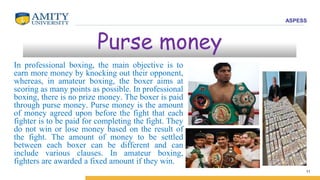
Purse money
In professional boxing, the main objective is to
earn more money by knocking out their opponent,
whereas, in amateur boxing, the boxer aims at
scoring as many points as possible. In professional
boxing, there is no prize money. The boxer is paid
through purse money. Purse money is the amount
of money agreed upon before the fight that each
fighter is to be paid for completing the fight. They
do not win or lose money based on the result of
the fight. The amount of money to be settled
between each boxer can be different and can
include various clauses. In amateur boxing,
fighters are awarded a fixed amount if they win.
ASPESS
.
12
ASPESS
Thank you
13

Differnce b/w professional and amateur.pptx

  • 1.
    ASPESS Amity school ofPhysical Education and sports sciences Sports Psychology and Sociology(PEDU 247) Presentation on Difference between Professional and Amateur SUBMITTED BY - SUBMITTED TO SARTHAK SHARMA A3013821067 Dr. Ajit Kumar DEEPANSHU SHEORAN A3013821068 YASHASVI A3013821069 1
  • 2.
  • 3.
    ASPESS Amateurs wait tofeel inspired. Professionals stick to a schedule. • Amateurs only work and practicewhen they feel motivated to do so. • They wait for inspiration, or permission from somebody else, to take action towards their goals—to exercise,to write more and so on. • Professionals don’t let their feelingsdictate their actions. • They intentionally create and stickto a schedulecome rain or shine.
  • 4.
    ASPESS 4 Amateurs strive toachieve. Professionals strive to improve.  Just like a recreational runner preparing for a marathon, Amateurs strive for the achievement of finishing the marathon.  After the marathon, the recreational runner no longer strives to improve their running. The achievement has now been reached, so the incentive to stay consistent with practice is very little.  The professional understands that an achievement is simply an indication of how much they’ve improved.  They are focused on continuous growth and seek to find new ways to improve themselves.
  • 5.
    ASPESS 5 Amateurs focus ongoals. Professionals focus on habits. • Amateurs are obsessed with the outcome. They seek the instant gratification of quick results and look to ‘sprint’ to success. • They struggle with ‘resistance’ and procrastination because of their intense focus on the end result. • Professionals treat success like a marathon and not a sprint. They focus on developing the habits that will naturally help them to achieve their goals as a by-product.
  • 6.
    ASPESS 6 Amateurs stall afterfailure. Professionals grow after failure.  Amateurs try to avoid failure at all costs. They fear criticism and worry too much about what people would think if they failed.  Amateurs give up when faced with adversity and tough challenges. They lack the mental toughness to push forward and succeed.  Professionals understand that failure is an inevitable and necessary part of growth.  They treat failure and criticism like a scientist— discarding the irrelevant information and using the relevant feedback to become better at what they do.
  • 7.
    ASPESS 7 Amateurs live foropinions. Professionals live for the truth. • Amateurs are easily swayed by the opinions and ‘best practices’ of the majority of people in their field. • The basis of an Amateur’s decision-making is their belief that “I’m right because I believe I am.” • Professionals actively question widely held assumptions about how things should be done. • A professional’s decision-making process is based on objectivity, not opinions. This type of thinking prevents them from making bad decision.
  • 8.
  • 9.
    ASPESS 9 Many great boxerslike Muhammad Ali, Oscar De La Hoya, Evander Holyfield, and Sugar Ray Leonard got their start in amateur (Olympic) boxing. They used their success in amateur boxing as a platform for launching their professional boxing careers and went on to become household names that shaped the boxing industry. Despite the popularity of both amateur boxing and professional boxing, most boxing fans don’t know the vast differences between the two sports.
  • 10.
    ASPESS 10 Boxing Style In amateurboxing, one needs to have fast hands and feet to do well. The amateur boxing style involves quick strikes because the boxer will be throwing one, two, or jab, then move in and out of range. For professional boxing, a boxer looks for the big shot and knocks out more often. The boxers plant their feet more and throw powerful shots at their opponent. An amateur must land his punch directly on the closed glove, but a professional can hit the opponent on his back or the kidneys’ area.
  • 11.
    ASPESS 11 Purse money In professionalboxing, the main objective is to earn more money by knocking out their opponent, whereas, in amateur boxing, the boxer aims at scoring as many points as possible. In professional boxing, there is no prize money. The boxer is paid through purse money. Purse money is the amount of money agreed upon before the fight that each fighter is to be paid for completing the fight. They do not win or lose money based on the result of the fight. The amount of money to be settled between each boxer can be different and can include various clauses. In amateur boxing, fighters are awarded a fixed amount if they win.
  • 12.
  • 13.