Difference between XML and JSON

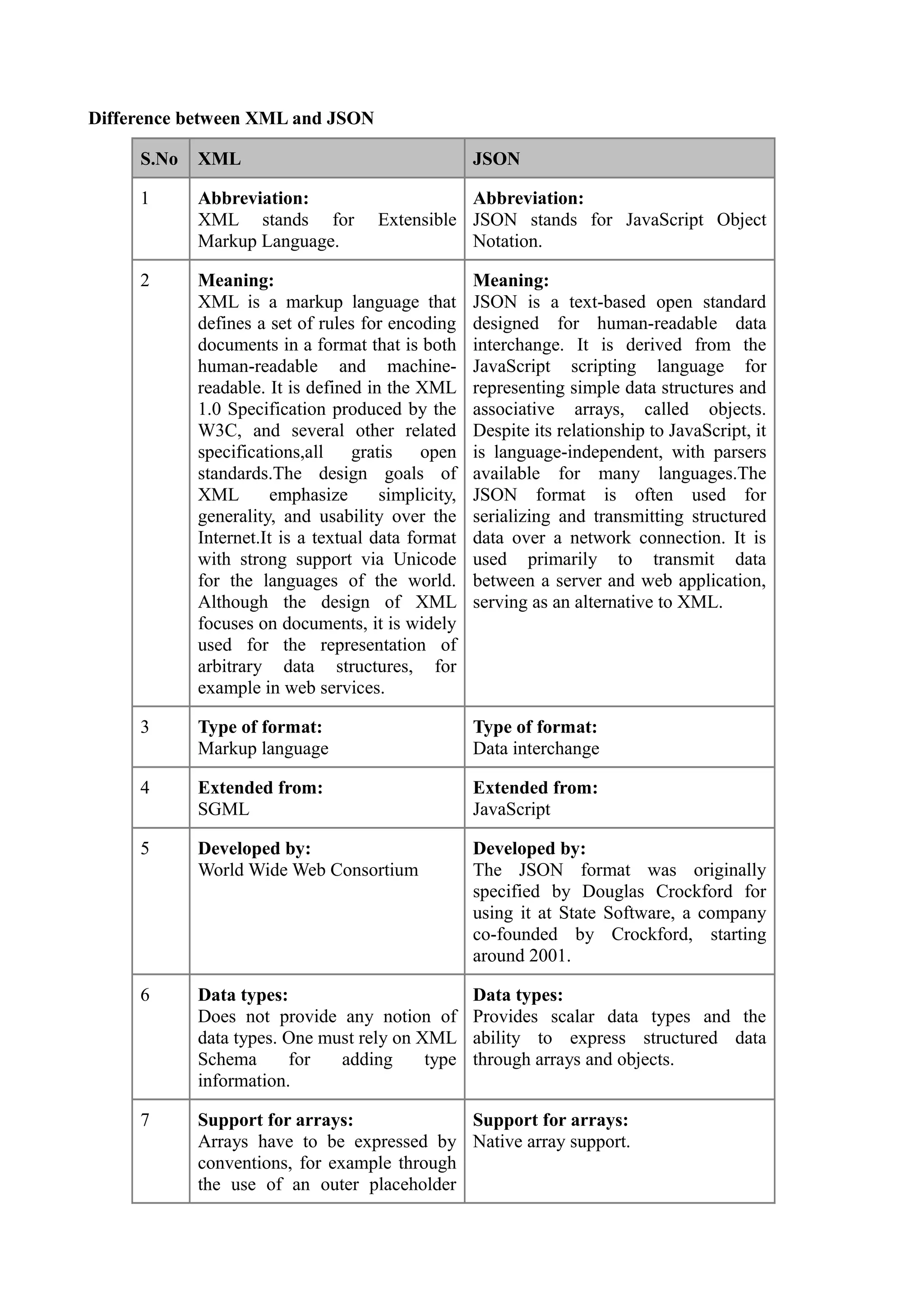
     S.No   XML                                     JSON

     1      Abbreviation:                       Abbreviation:
            XML stands for           Extensible JSON stands for JavaScript Object
            Markup Language.                    Notation.

     2      Meaning:                                Meaning:
            XML is a markup language that           JSON is a text-based open standard
            defines a set of rules for encoding     designed for human-readable data
            documents in a format that is both      interchange. It is derived from the
            human-readable and machine-             JavaScript scripting language for
            readable. It is defined in the XML      representing simple data structures and
            1.0 Specification produced by the       associative arrays, called objects.
            W3C, and several other related          Despite its relationship to JavaScript, it
            specifications,all gratis open          is language-independent, with parsers
            standards.The design goals of           available for many languages.The
            XML        emphasize      simplicity,   JSON format is often used for
            generality, and usability over the      serializing and transmitting structured
            Internet.It is a textual data format    data over a network connection. It is
            with strong support via Unicode         used primarily to transmit data
            for the languages of the world.         between a server and web application,
            Although the design of XML              serving as an alternative to XML.
            focuses on documents, it is widely
            used for the representation of
            arbitrary data structures, for
            example in web services.

     3      Type of format:                         Type of format:
            Markup language                         Data interchange

     4      Extended from:                          Extended from:
            SGML                                    JavaScript

     5      Developed by:                           Developed by:
            World Wide Web Consortium               The JSON format was originally
                                                    specified by Douglas Crockford for
                                                    using it at State Software, a company
                                                    co-founded by Crockford, starting
                                                    around 2001.

     6      Data types:                             Data types:
            Does not provide any notion of          Provides scalar data types and the
            data types. One must rely on XML        ability to express structured data
            Schema      for   adding      type      through arrays and objects.
            information.

     7      Support for arrays:              Support for arrays:
            Arrays have to be expressed by Native array support.
            conventions, for example through
            the use of an outer placeholder
element that models the arrays
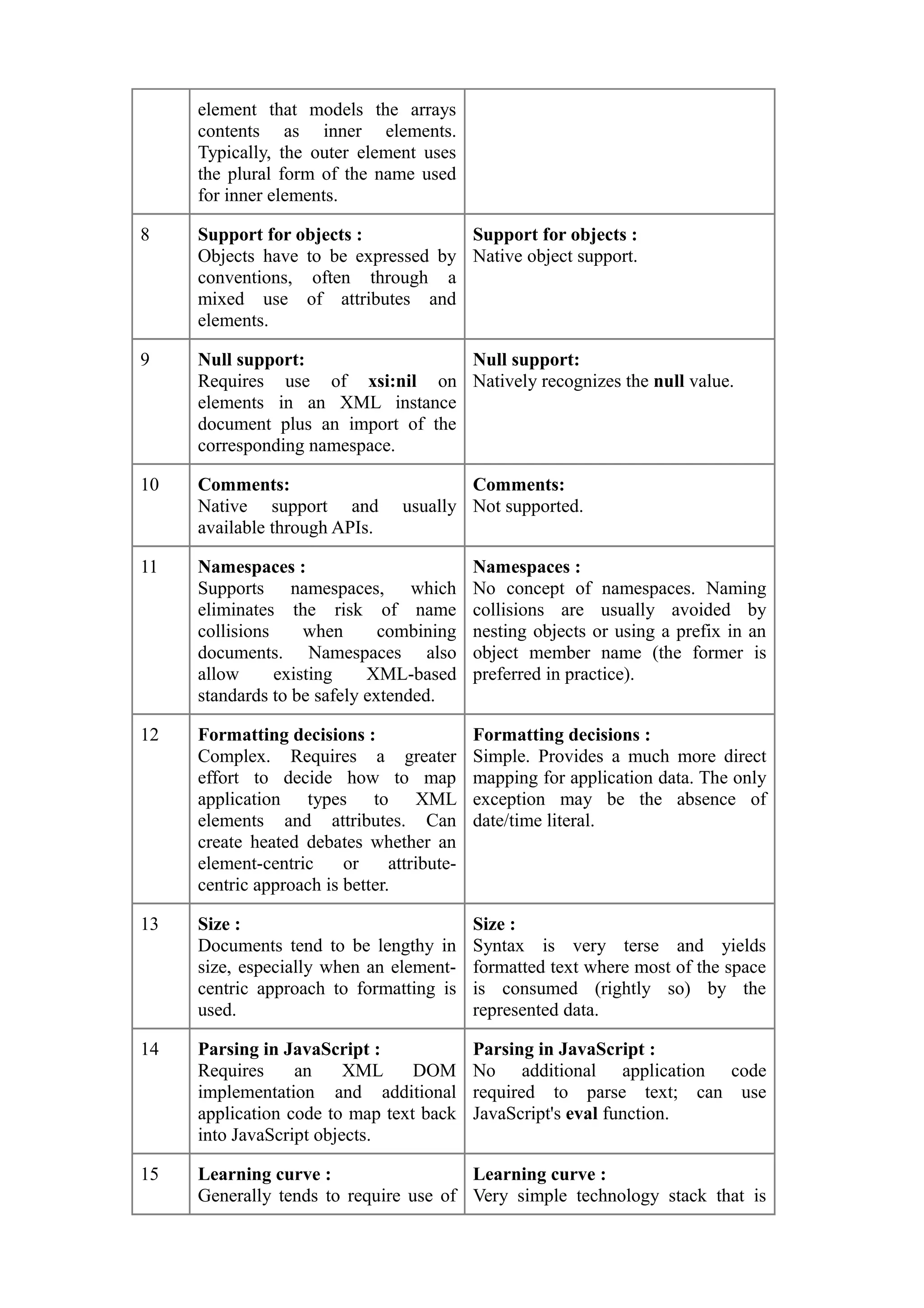
     contents as inner elements.
     Typically, the outer element uses
     the plural form of the name used
     for inner elements.

8    Support for objects :           Support for objects :
     Objects have to be expressed by Native object support.
     conventions, often through a
     mixed use of attributes and
     elements.

9    Null support:                  Null support:
     Requires use of xsi:nil on Natively recognizes the null value.
     elements in an XML instance
     document plus an import of the
     corresponding namespace.

10   Comments:                            Comments:
     Native support and           usually Not supported.
     available through APIs.

11   Namespaces :                            Namespaces :
     Supports namespaces, which              No concept of namespaces. Naming
     eliminates the risk of name             collisions are usually avoided by
     collisions     when      combining      nesting objects or using a prefix in an
     documents. Namespaces also              object member name (the former is
     allow      existing    XML-based        preferred in practice).
     standards to be safely extended.

12   Formatting decisions :                  Formatting decisions :
     Complex. Requires a greater             Simple. Provides a much more direct
     effort to decide how to map             mapping for application data. The only
     application types to XML                exception may be the absence of
     elements and attributes. Can            date/time literal.
     create heated debates whether an
     element-centric     or     attribute-
     centric approach is better.

13   Size :                                  Size :
     Documents tend to be lengthy in         Syntax is very terse and yields
     size, especially when an element-       formatted text where most of the space
     centric approach to formatting is       is consumed (rightly so) by the
     used.                                   represented data.

14   Parsing in JavaScript :                 Parsing in JavaScript :
     Requires     an     XML     DOM         No additional application code
     implementation and additional           required to parse text; can use
     application code to map text back       JavaScript's eval function.
     into JavaScript objects.

15   Learning curve :                  Learning curve :
     Generally tends to require use of Very simple technology stack that is
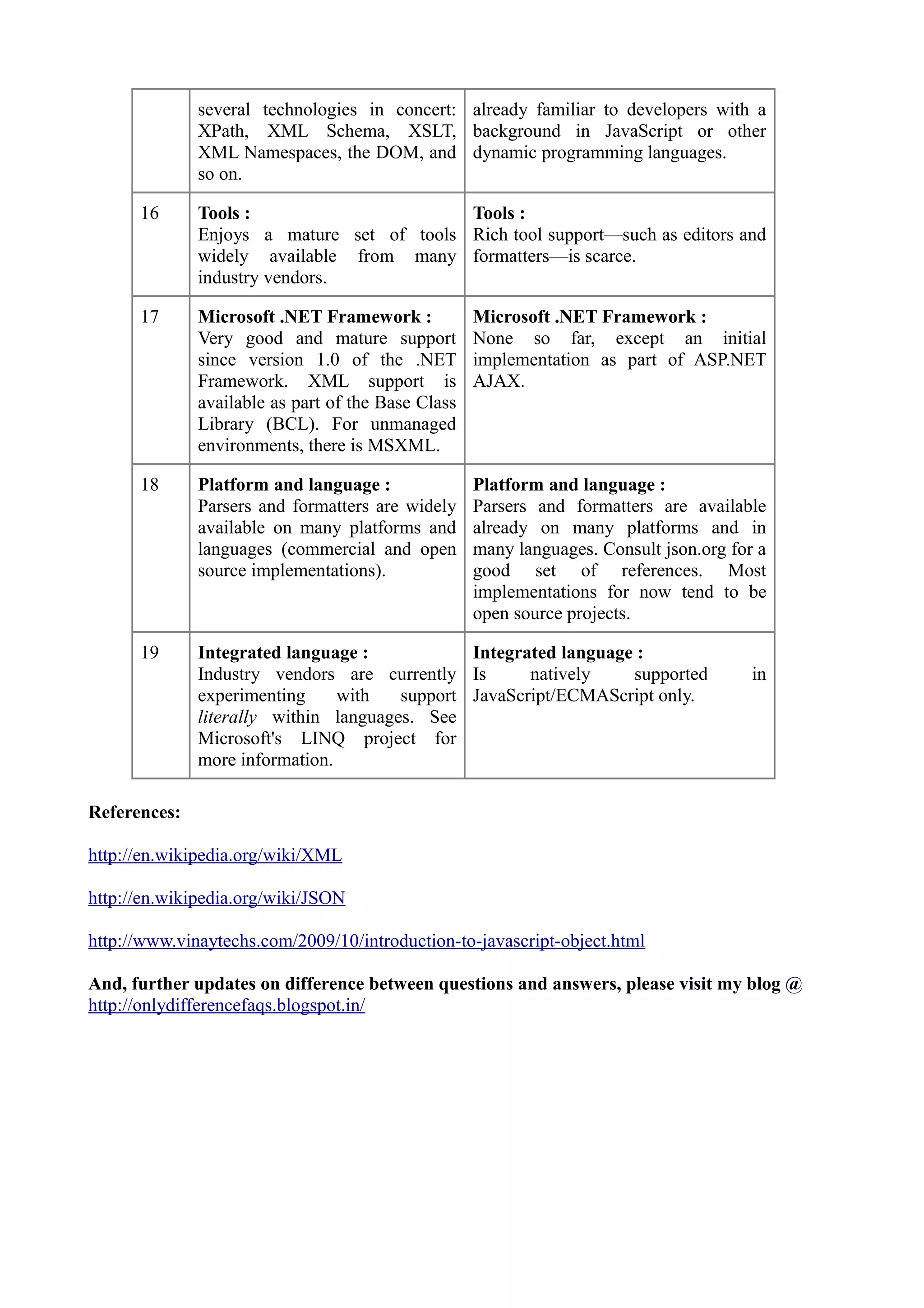
several technologies in concert: already familiar to developers with a
              XPath, XML Schema, XSLT, background in JavaScript or other
              XML Namespaces, the DOM, and dynamic programming languages.
              so on.

      16      Tools :                      Tools :
              Enjoys a mature set of tools Rich tool support—such as editors and
              widely available from many formatters—is scarce.
              industry vendors.

      17      Microsoft .NET Framework :            Microsoft .NET Framework :
              Very good and mature support          None so far, except an initial
              since version 1.0 of the .NET         implementation as part of ASP.NET
              Framework. XML support is             AJAX.
              available as part of the Base Class
              Library (BCL). For unmanaged
              environments, there is MSXML.

      18      Platform and language :               Platform and language :
              Parsers and formatters are widely     Parsers and formatters are available
              available on many platforms and       already on many platforms and in
              languages (commercial and open        many languages. Consult json.org for a
              source implementations).              good set of references. Most
                                                    implementations for now tend to be
                                                    open source projects.

      19      Integrated language :            Integrated language :
              Industry vendors are currently Is       natively    supported             in
              experimenting     with   support JavaScript/ECMAScript only.
              literally within languages. See
              Microsoft's LINQ project for
              more information.

References:

http://en.wikipedia.org/wiki/XML

http://en.wikipedia.org/wiki/JSON

http://www.vinaytechs.com/2009/10/introduction-to-javascript-object.html

And, further updates on difference between questions and answers, please visit my blog @
http://onlydifferencefaqs.blogspot.in/

Difference between xml and json

  • 1.
    Difference between XMLand JSON S.No XML JSON 1 Abbreviation: Abbreviation: XML stands for Extensible JSON stands for JavaScript Object Markup Language. Notation. 2 Meaning: Meaning: XML is a markup language that JSON is a text-based open standard defines a set of rules for encoding designed for human-readable data documents in a format that is both interchange. It is derived from the human-readable and machine- JavaScript scripting language for readable. It is defined in the XML representing simple data structures and 1.0 Specification produced by the associative arrays, called objects. W3C, and several other related Despite its relationship to JavaScript, it specifications,all gratis open is language-independent, with parsers standards.The design goals of available for many languages.The XML emphasize simplicity, JSON format is often used for generality, and usability over the serializing and transmitting structured Internet.It is a textual data format data over a network connection. It is with strong support via Unicode used primarily to transmit data for the languages of the world. between a server and web application, Although the design of XML serving as an alternative to XML. focuses on documents, it is widely used for the representation of arbitrary data structures, for example in web services. 3 Type of format: Type of format: Markup language Data interchange 4 Extended from: Extended from: SGML JavaScript 5 Developed by: Developed by: World Wide Web Consortium The JSON format was originally specified by Douglas Crockford for using it at State Software, a company co-founded by Crockford, starting around 2001. 6 Data types: Data types: Does not provide any notion of Provides scalar data types and the data types. One must rely on XML ability to express structured data Schema for adding type through arrays and objects. information. 7 Support for arrays: Support for arrays: Arrays have to be expressed by Native array support. conventions, for example through the use of an outer placeholder
  • 2.
    element that modelsthe arrays contents as inner elements. Typically, the outer element uses the plural form of the name used for inner elements. 8 Support for objects : Support for objects : Objects have to be expressed by Native object support. conventions, often through a mixed use of attributes and elements. 9 Null support: Null support: Requires use of xsi:nil on Natively recognizes the null value. elements in an XML instance document plus an import of the corresponding namespace. 10 Comments: Comments: Native support and usually Not supported. available through APIs. 11 Namespaces : Namespaces : Supports namespaces, which No concept of namespaces. Naming eliminates the risk of name collisions are usually avoided by collisions when combining nesting objects or using a prefix in an documents. Namespaces also object member name (the former is allow existing XML-based preferred in practice). standards to be safely extended. 12 Formatting decisions : Formatting decisions : Complex. Requires a greater Simple. Provides a much more direct effort to decide how to map mapping for application data. The only application types to XML exception may be the absence of elements and attributes. Can date/time literal. create heated debates whether an element-centric or attribute- centric approach is better. 13 Size : Size : Documents tend to be lengthy in Syntax is very terse and yields size, especially when an element- formatted text where most of the space centric approach to formatting is is consumed (rightly so) by the used. represented data. 14 Parsing in JavaScript : Parsing in JavaScript : Requires an XML DOM No additional application code implementation and additional required to parse text; can use application code to map text back JavaScript's eval function. into JavaScript objects. 15 Learning curve : Learning curve : Generally tends to require use of Very simple technology stack that is
  • 3.
    several technologies inconcert: already familiar to developers with a XPath, XML Schema, XSLT, background in JavaScript or other XML Namespaces, the DOM, and dynamic programming languages. so on. 16 Tools : Tools : Enjoys a mature set of tools Rich tool support—such as editors and widely available from many formatters—is scarce. industry vendors. 17 Microsoft .NET Framework : Microsoft .NET Framework : Very good and mature support None so far, except an initial since version 1.0 of the .NET implementation as part of ASP.NET Framework. XML support is AJAX. available as part of the Base Class Library (BCL). For unmanaged environments, there is MSXML. 18 Platform and language : Platform and language : Parsers and formatters are widely Parsers and formatters are available available on many platforms and already on many platforms and in languages (commercial and open many languages. Consult json.org for a source implementations). good set of references. Most implementations for now tend to be open source projects. 19 Integrated language : Integrated language : Industry vendors are currently Is natively supported in experimenting with support JavaScript/ECMAScript only. literally within languages. See Microsoft's LINQ project for more information. References: http://en.wikipedia.org/wiki/XML http://en.wikipedia.org/wiki/JSON http://www.vinaytechs.com/2009/10/introduction-to-javascript-object.html And, further updates on difference between questions and answers, please visit my blog @ http://onlydifferencefaqs.blogspot.in/