DIFFERENCE BETWEEN
     QUERY STRING & HASH


12年6月14日星期四                1
In JavaScript, the fragment identifier of the current HTML or
   XHTML page can be accessed in the "hash" property
   location.hash


12年6月14日星期四                                                       2
Common


12年6月14日星期四   3
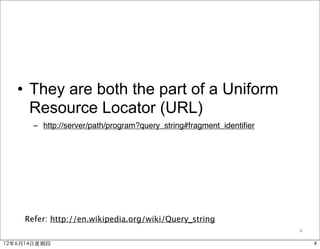
• They are both the part of a Uniform
     Resource Locator (URL)
       – http://server/path/program?query_string#fragment_identifier


     Refer: http://en.wikipedia.org/wiki/Query_string
                                                                      4

12年6月14日星期四                                                               4
Difference


12年6月14日星期四     5
delimiter [difference]


12年6月14日星期四                 6
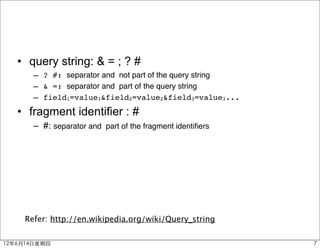
• query string: & = ; ? #
       – ? #: separator and not part of the query string
       – & =: separator and part of the query string
       – field1=value1&field2=value2&field3=value3...
   • fragment identifier : #
       – #: separator and part of the fragment identifiers


     Refer: http://en.wikipedia.org/wiki/Query_string

12年6月14日星期四                                                 7
url encoding[difference]


12年6月14日星期四                   8
depended object [difference]


12年6月14日星期四                       9
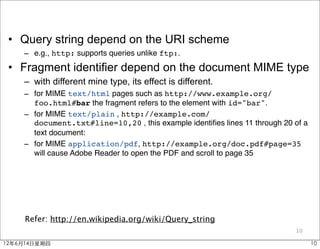
• Query string depend on the URI scheme
    – e.g., http: supports queries unlike ftp:.
 • Fragment identifier depend on the document MIME type
    – with different mine type, its effect is different.
    – for MIME text/html pages such as http://www.example.org/
      foo.html#bar the fragment refers to the element with id="bar".
    – for MIME text/plain , http://example.com/
      document.txt#line=10,20 , this example identifies lines 11 through 20 of a
      text document:
    – for MIME application/pdf, http://example.org/doc.pdf#page=35
      will cause Adobe Reader to open the PDF and scroll to page 35


     Refer: http://en.wikipedia.org/wiki/Query_string
                                                                           10

12年6月14日星期四                                                                       10
evaluated object [difference]


12年6月14日星期四                        11
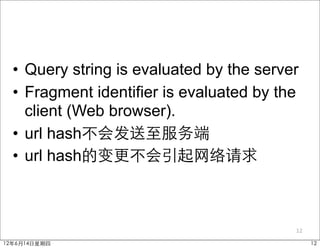
• Query string is evaluated by the server
  • Fragment identifier is evaluated by the
    client (Web browser).
  • url hash不会发送至服务端
  • url hash的变更不会引起网络请求


                                          12

12年6月14日星期四                                    12
use


12年6月14日星期四   13
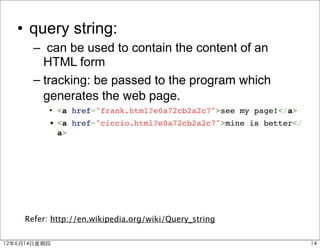
• query string:
       – can be used to contain the content of an
         HTML form
       – tracking: be passed to the program which
         generates the web page.
           • <a href="frank.html?e0a72cb2a2c7">see my page!</a>
           • <a href="ciccio.html?e0a72cb2a2c7">mine is better</
             a>


     Refer: http://en.wikipedia.org/wiki/Query_string

12年6月14日星期四                                                        14
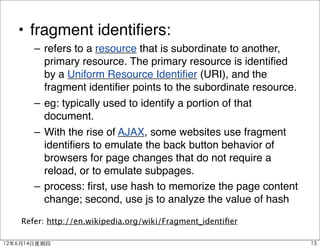
• fragment identifiers:
       – refers to a resource that is subordinate to another,
         primary resource. The primary resource is identified
         by a Uniform Resource Identifier (URI), and the
         fragment identifier points to the subordinate resource.
       – eg: typically used to identify a portion of that
         document.
       – With the rise of AJAX, some websites use fragment
         identifiers to emulate the back button behavior of
         browsers for page changes that do not require a
         reload, or to emulate subpages.
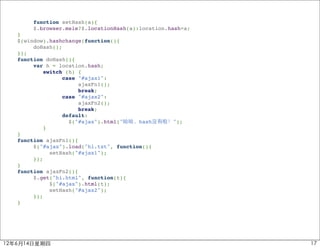
       – process: first, use hash to memorize the page content
         change; second, use js to analyze the value of hash

    Refer: http://en.wikipedia.org/wiki/Fragment_identifier

12年6月14日星期四                                                       15
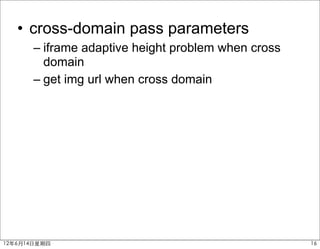
• cross-domain pass parameters
       – iframe adaptive height problem when cross
         domain
       – get img url when cross domain


12年6月14日星期四                                          16
function setHash(a){
   !    $.browser.msie?$.locationHash(a):location.hash=a;
   }
   $(window).hashchange(function(){
   !    doHash();
   });
   function doHash(){
   !    var h = location.hash;
            switch (h) {
                  case "#ajax1":
                       ajaxFn1();
                       break;
                  case "#ajax2":
                       ajaxFn2();
                       break;
                  default:
                    $("#ajax").html("哈哈,hash没有啦!");
            }
   }
   function ajaxFn1(){
   !    $("#ajax").load("hi.txt", function(){
   !    !     setHash("#ajax1");
   !    });
   }
   function ajaxFn2(){
   !    $.get("hi.html", function(t){
   !    !     $("#ajax").html(t);
   !    !     setHash("#ajax2");
   !    });
   }


12年6月14日星期四                                                 17
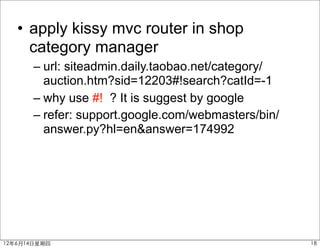
• apply kissy mvc router in shop
     category manager
       – url: siteadmin.daily.taobao.net/category/
         auction.htm?sid=12203#!search?catId=-1
       – why use #! ? It is suggest by google
       – refer: support.google.com/webmasters/bin/
         answer.py?hl=en&answer=174992


12年6月14日星期四                                          18
– examples:
          • kissy, mvc, router
          • Gmail uses a single URL for almost every interface – mail boxes,
            individual mails, search results, settings – the fragment is used to
            make these interfaces directly linkable.[6]
          • Adobe Flash websites can use the fragment part to inform the user
            about the state of the website or web application, and to facilitate
          • deep linking, commonly with the help of the SWFAddress JavaScript
            library.
          • Other websites use the fragment part to pass some extra information
            to scripts running on them – for example, Google Video understands
            permalinks in the format of #01h25m30s to start playing at the
            specified position,[7] and YouTube uses similar code such as
            #t=3m25s.[8] A format of #t=10,20 for a section of media from 10
            to 20 seconds is proposed in the Media Fragments URI 1.0 W3C
            Working Draft.[9]


12年6月14日星期四                                                                        19
does url length has impact on
   page load speed?


12年6月14日星期四                        20
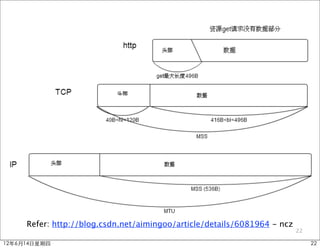
第一等级的优化,70字节
    如何计算的呢?


                  21

12年6月14日星期四            21
Refer: http://blog.csdn.net/aimingoo/article/details/6081964 - ncz
                                                                          22

12年6月14日星期四                                                                    22
what http header include?


                               23

12年6月14日星期四                         23
• http 请求头部信息


12年6月14日星期四        24
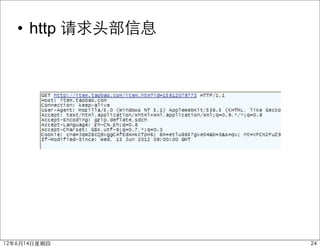
•    资源文件的get请求http头部的最大长度是496字节
   •    http头部包含两大部分:
         ★ 可缺省的: 占 184字节
         ★ 必须的:占496-184 = 312字节, 包含:get , user-agent, cookie
             ‣ 其中cookie可被缓存,所以相当与长度为0字节
             ‣ user-agent的长度在214字节左右
             ‣ 故剩下get部分的长度 = 496-214-78个字节
   •    这么做的效果:当我们总是从浏览器端发出最小化的HTTP请求时,网络总是可以最快速的将请求提
        交到服务器,无需等待多个包并组合。这在慢速网络,以及存在大量丢包的网络中效果将为极为明
        显。简单地说,如果有人在局域网中用迅雷或BT,那么最小化HTTP请求将会使网页的浏览体验提升
        得相当相当明显。


       Refer: http://blog.csdn.net/aimingoo/article/details/6081964 - ncz

12年6月14日星期四                                                                 25
use


12年6月14日星期四   26
• But with 78 bytes url, what we can do is very little. One
     common url is longer than this length.
   • eg: http://assets.daily.taobao.net/apps/taesite/platinum/
     scripts/common/mods/shop/custom-banner/custom-
     banner.js (109 bytes)


12年6月14日星期四                                                      27
difference between query string and hash

  • 1.
    DIFFERENCE BETWEEN QUERY STRING & HASH 12年6月14日星期四 1
  • 2.
    In JavaScript, thefragment identifier of the current HTML or XHTML page can be accessed in the "hash" property location.hash 12年6月14日星期四 2
  • 3.
  • 4.
    • They areboth the part of a Uniform Resource Locator (URL) – http://server/path/program?query_string#fragment_identifier Refer: http://en.wikipedia.org/wiki/Query_string 4 12年6月14日星期四 4
  • 5.
  • 6.
  • 7.
    • query string:& = ; ? # – ? #: separator and not part of the query string – & =: separator and part of the query string – field1=value1&field2=value2&field3=value3... • fragment identifier : # – #: separator and part of the fragment identifiers Refer: http://en.wikipedia.org/wiki/Query_string 12年6月14日星期四 7
  • 8.
  • 9.
  • 10.
    • Query stringdepend on the URI scheme – e.g., http: supports queries unlike ftp:. • Fragment identifier depend on the document MIME type – with different mine type, its effect is different. – for MIME text/html pages such as http://www.example.org/ foo.html#bar the fragment refers to the element with id="bar". – for MIME text/plain , http://example.com/ document.txt#line=10,20 , this example identifies lines 11 through 20 of a text document: – for MIME application/pdf, http://example.org/doc.pdf#page=35 will cause Adobe Reader to open the PDF and scroll to page 35 Refer: http://en.wikipedia.org/wiki/Query_string 10 12年6月14日星期四 10
  • 11.
  • 12.
    • Query stringis evaluated by the server • Fragment identifier is evaluated by the client (Web browser). • url hash不会发送至服务端 • url hash的变更不会引起网络请求 12 12年6月14日星期四 12
  • 13.
  • 14.
    • query string: – can be used to contain the content of an HTML form – tracking: be passed to the program which generates the web page. • <a href="frank.html?e0a72cb2a2c7">see my page!</a> • <a href="ciccio.html?e0a72cb2a2c7">mine is better</ a> Refer: http://en.wikipedia.org/wiki/Query_string 12年6月14日星期四 14
  • 15.
    • fragment identifiers: – refers to a resource that is subordinate to another, primary resource. The primary resource is identified by a Uniform Resource Identifier (URI), and the fragment identifier points to the subordinate resource. – eg: typically used to identify a portion of that document. – With the rise of AJAX, some websites use fragment identifiers to emulate the back button behavior of browsers for page changes that do not require a reload, or to emulate subpages. – process: first, use hash to memorize the page content change; second, use js to analyze the value of hash Refer: http://en.wikipedia.org/wiki/Fragment_identifier 12年6月14日星期四 15
  • 16.
    • cross-domain passparameters – iframe adaptive height problem when cross domain – get img url when cross domain 12年6月14日星期四 16
  • 17.
    function setHash(a){ ! $.browser.msie?$.locationHash(a):location.hash=a; } $(window).hashchange(function(){ ! doHash(); }); function doHash(){ ! var h = location.hash; switch (h) { case "#ajax1": ajaxFn1(); break; case "#ajax2": ajaxFn2(); break; default: $("#ajax").html("哈哈,hash没有啦!"); } } function ajaxFn1(){ ! $("#ajax").load("hi.txt", function(){ ! ! setHash("#ajax1"); ! }); } function ajaxFn2(){ ! $.get("hi.html", function(t){ ! ! $("#ajax").html(t); ! ! setHash("#ajax2"); ! }); } 12年6月14日星期四 17
  • 18.
    • apply kissymvc router in shop category manager – url: siteadmin.daily.taobao.net/category/ auction.htm?sid=12203#!search?catId=-1 – why use #! ? It is suggest by google – refer: support.google.com/webmasters/bin/ answer.py?hl=en&answer=174992 12年6月14日星期四 18
  • 19.
    – examples: • kissy, mvc, router • Gmail uses a single URL for almost every interface – mail boxes, individual mails, search results, settings – the fragment is used to make these interfaces directly linkable.[6] • Adobe Flash websites can use the fragment part to inform the user about the state of the website or web application, and to facilitate • deep linking, commonly with the help of the SWFAddress JavaScript library. • Other websites use the fragment part to pass some extra information to scripts running on them – for example, Google Video understands permalinks in the format of #01h25m30s to start playing at the specified position,[7] and YouTube uses similar code such as #t=3m25s.[8] A format of #t=10,20 for a section of media from 10 to 20 seconds is proposed in the Media Fragments URI 1.0 W3C Working Draft.[9] 12年6月14日星期四 19
  • 20.
    does url lengthhas impact on page load speed? 12年6月14日星期四 20
  • 21.
    第一等级的优化,70字节 如何计算的呢? 21 12年6月14日星期四 21
  • 22.
  • 23.
    what http headerinclude? 23 12年6月14日星期四 23
  • 24.
  • 25.
    资源文件的get请求http头部的最大长度是496字节 • http头部包含两大部分: ★ 可缺省的: 占 184字节 ★ 必须的:占496-184 = 312字节, 包含:get , user-agent, cookie ‣ 其中cookie可被缓存,所以相当与长度为0字节 ‣ user-agent的长度在214字节左右 ‣ 故剩下get部分的长度 = 496-214-78个字节 • 这么做的效果:当我们总是从浏览器端发出最小化的HTTP请求时,网络总是可以最快速的将请求提 交到服务器,无需等待多个包并组合。这在慢速网络,以及存在大量丢包的网络中效果将为极为明 显。简单地说,如果有人在局域网中用迅雷或BT,那么最小化HTTP请求将会使网页的浏览体验提升 得相当相当明显。 Refer: http://blog.csdn.net/aimingoo/article/details/6081964 - ncz 12年6月14日星期四 25
  • 26.
  • 27.
    • But with78 bytes url, what we can do is very little. One common url is longer than this length. • eg: http://assets.daily.taobao.net/apps/taesite/platinum/ scripts/common/mods/shop/custom-banner/custom- banner.js (109 bytes) 12年6月14日星期四 27