Know Difference Between
Microprocessors and
Microcontrollers
http://www.elprocus.com/
Introduction
What is Microprocessor?
A microprocessor is an electronic computer component crafted from miniature
sized transistors & some other circuitry elements on a solitary semi-conductor
IC (integrated circuit) or micro chip. The abbreviated of microprocessor is
µP or uP.
The CPU (central processing unit) is the most renowned micro-processor, but
numerous other constituents in a computer contain them, like- the GPU
(Graphics Processing Unit) on a video card. Microprocessor is a single IC
package in which several functions are integrated.
http://www.elprocus.com/
Types of Microprocessors
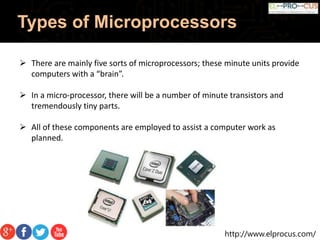
 There are mainly five sorts of microprocessors; these minute units provide
computers with a “brain”.
 In a micro-processor, there will be a number of minute transistors and
tremendously tiny parts.
 All of these components are employed to assist a computer work as
planned.
http://www.elprocus.com/
5 Types of Microcontroller
 Complex Instruction Set Microprocessors
 Reduced Instruction Set Microprocessors
 Superscalar processors
 The Application Specific Integrated Circuit
 Digital Signal Multiprocessors (DSPs)
http://www.elprocus.com/
Complex Instruction Set
Microprocessors
 This type of microprocessor is also known as CISM.
 CISM classify a micro-processor in which each & every order can be executed
together with several other low-level functions.
 These Functions are intended to carry out actions such as.
 Uploading data into memory card, re-calling or downloading data from
memory card or a complex mathematics computation in a single command.
http://www.elprocus.com/
Reduced Instruction Set
Microprocessors
 Known as RISC, this was intended to pace up computer microprocessors.
 These chips are built up under the guideline.
 The microprocessor to do a smaller amount of things within each command.
 This will permit it to complete more commands more rapidly.
http://www.elprocus.com/
Superscalar processors
 This type of processor replica the hardware on the micro-processor.
 It can perform numerous instructions at the same time.
 These replica resources can be committed arithmetic logic units or
multipliers.
 Superscalars comprise of several operational units.
 Superscalar micro-processors carry out more than one command throughout
a single clock cycle
 It concurrently transmitting numerous instructions to superfluous operational
units in the processor.
http://www.elprocus.com/
The Application Specific
Integrated Circuit
 Known as ASIC microprocessor is intended for extremely precise
purposes.
 It comprise- automotive emissions control or Personal Digital
Assistants computers.
 ASICs at times is produced to specification.
http://www.elprocus.com/
Digital Signal
Multiprocessors (DSPs)
 DSPs are unique micro-processors employed to decode & encode video.
 It convert digital or video to analog and vice-versa.
 These operations need a micro-processor to carrying out mathematical
calculations.
 DSP chips are generally employed in SONAR, mobile telephones, RADAR.
 DSP chips are used in home theatre audio gears and cable set-top boxes.
http://www.elprocus.com/
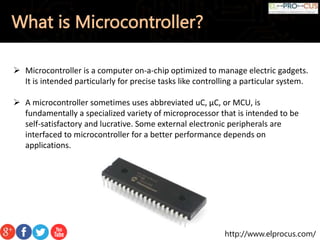
 Microcontroller is a computer on‐a‐chip optimized to manage electric gadgets.
It is intended particularly for precise tasks like controlling a particular system.
 A microcontroller sometimes uses abbreviated uC, µC, or MCU, is
fundamentally a specialized variety of microprocessor that is intended to be
self-satisfactory and lucrative. Some external electronic peripherals are
interfaced to microcontroller for a better performance depends on
applications.
What is Microcontroller?
http://www.elprocus.com/
 Microcontrollers are the 8051, Intel’s 80196, Microchip’s PIC and Motorola’s
68HCxx series.
 Microcontrollers which are normally incorporated in toys, automobiles and
appliances.
 Microprocessor system on a solo microchip:
Illustrations of Microcontrollers
• Memory (both ROM and RAM)
• The CPU core (microprocessor)
• Some parallel digital I/O
http://www.elprocus.com/
Function of Microcontroller
 The microcontroller witnesses the incorporation of a number of helpful
functions into a solitary IC pack. These functions are:-
• The capability to carry out an accumulated set of commands to
perform user described jobs.
• The capability to be proficient to use peripheral memory chips to
both read & write data from and to the memory.
http://www.elprocus.com/
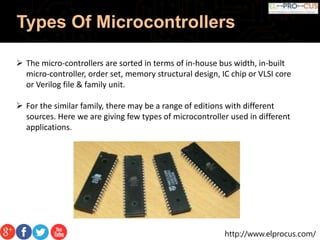
Types Of Microcontrollers
 The micro-controllers are sorted in terms of in-house bus width, in-built
micro-controller, order set, memory structural design, IC chip or VLSI core
or Verilog file & family unit.
 For the similar family, there may be a range of editions with different
sources. Here we are giving few types of microcontroller used in different
applications.
http://www.elprocus.com/
5 Types of Microcontrollers
 8-bit microcontroller.
 6-bit microcontroller.
 32-bit microcontroller.
 Embedded microcontroller.
 External memory micro-controller.
http://www.elprocus.com/
8-bit Microcontroller
 When in-house bus in a MCU is 8-bit bus.
 Then the ALU carries out the logic & arithmetic operations on a byte at an
order.
 The MCU is 8-bit micro-controller.
 The illustrations of 8-bit MCU are- Intel 8031/8051, Motorola MC68HC11 &
PIC1x families.
http://www.elprocus.com/
16-bit Microcontroller
 The 16 bit Microcontroller consists of a 16 bit bus.
 The ALU performs arithmetic and logic operations on the 16 bit
operand.
 It provides greater precision and performance as compared to 8 bit
MCU.
http://www.elprocus.com/
32-bit Microcontroller
 When in-house bus for the data transmitting function in an MCU is 32-bit
bus.
 Then the ALU carries out logic & arithmetic functions on operand words
of 32 bits at the orders.
 The MCU is 32-bit micro-controller.
 These supply better accuracy and performance in comparison to the 16-
bit MCUs.
http://www.elprocus.com/
Embedded Microcontroller
 When a fixed or embedded system includes an MCU.
 Each hardware and software parts in a solo unit.
 The MCU is known as embedded micro-controller.
 Extremely few or no extra peripheral unit or system exists for processing
during the control or making use of the peripheral devices.
 A telephone receiver circuit employs an in-built or embedded micro-
controller.
http://www.elprocus.com/
External Memory
Microcontroller
 When an in-built or embedded system adds an MCU.
 Each of the hardware and software parts present not as a solo component.
 It has all or a piece of the memory component externally interfaced by bringing
into play an interfacing circuit.
 Which is known as the glue circuit.
 The MCU is known as a peripheral or external memory micro-controller.
 Example: A 8031 comprise of a program memory which is interfaced outwardly
to it. The 8051 has both in-house as well as peripheral program memory.
http://www.elprocus.com/
Difference Between Microprocessors
and Microcontrollers
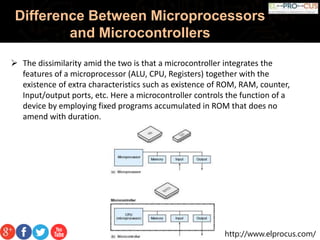
 The dissimilarity amid the two is that a microcontroller integrates the
features of a microprocessor (ALU, CPU, Registers) together with the
existence of extra characteristics such as existence of ROM, RAM, counter,
Input/output ports, etc. Here a microcontroller controls the function of a
device by employing fixed programs accumulated in ROM that does no
amend with duration.
http://www.elprocus.com/
Difference Between Microprocessors
and Microcontrollers
 The major dissimilarity amid a usual microprocessors and microcontrollers
parting.
 There architectural terms is the area of their application.
 Usual microprocessors such as the Pentium family or Intel Core family
processors or alike processors are in computers as a universally functioning
programmable machine.
 In its life span it has to manage numerous different assignments and
programs specified to it.
http://www.elprocus.com/
Difference Between Microprocessors
and Microcontrollers
 A microcontroller of PIC family or 8051 family or any other have noticed
their applications in tiny embedded systems.
 Such as- control system of traffic signals or some sort of robotic system.
 These gadgets manage similar task or similar program all through their
entire life cycle.
 Another difference is that the microcontroller generally has to handle
instantaneous tasks
 On the contrary the micro-processors in a computer system perhaps will not
handle an instantaneous task at all times.
http://www.elprocus.com/

Difference Between Microprocessors and Microcontrollers

  • 1.
  • 2.
    http://www.elprocus.com/ Introduction What is Microprocessor? Amicroprocessor is an electronic computer component crafted from miniature sized transistors & some other circuitry elements on a solitary semi-conductor IC (integrated circuit) or micro chip. The abbreviated of microprocessor is µP or uP. The CPU (central processing unit) is the most renowned micro-processor, but numerous other constituents in a computer contain them, like- the GPU (Graphics Processing Unit) on a video card. Microprocessor is a single IC package in which several functions are integrated.
  • 3.
    http://www.elprocus.com/ Types of Microprocessors There are mainly five sorts of microprocessors; these minute units provide computers with a “brain”.  In a micro-processor, there will be a number of minute transistors and tremendously tiny parts.  All of these components are employed to assist a computer work as planned.
  • 4.
    http://www.elprocus.com/ 5 Types ofMicrocontroller  Complex Instruction Set Microprocessors  Reduced Instruction Set Microprocessors  Superscalar processors  The Application Specific Integrated Circuit  Digital Signal Multiprocessors (DSPs)
  • 5.
    http://www.elprocus.com/ Complex Instruction Set Microprocessors This type of microprocessor is also known as CISM.  CISM classify a micro-processor in which each & every order can be executed together with several other low-level functions.  These Functions are intended to carry out actions such as.  Uploading data into memory card, re-calling or downloading data from memory card or a complex mathematics computation in a single command.
  • 6.
    http://www.elprocus.com/ Reduced Instruction Set Microprocessors Known as RISC, this was intended to pace up computer microprocessors.  These chips are built up under the guideline.  The microprocessor to do a smaller amount of things within each command.  This will permit it to complete more commands more rapidly.
  • 7.
    http://www.elprocus.com/ Superscalar processors  Thistype of processor replica the hardware on the micro-processor.  It can perform numerous instructions at the same time.  These replica resources can be committed arithmetic logic units or multipliers.  Superscalars comprise of several operational units.  Superscalar micro-processors carry out more than one command throughout a single clock cycle  It concurrently transmitting numerous instructions to superfluous operational units in the processor.
  • 8.
    http://www.elprocus.com/ The Application Specific IntegratedCircuit  Known as ASIC microprocessor is intended for extremely precise purposes.  It comprise- automotive emissions control or Personal Digital Assistants computers.  ASICs at times is produced to specification.
  • 9.
    http://www.elprocus.com/ Digital Signal Multiprocessors (DSPs) DSPs are unique micro-processors employed to decode & encode video.  It convert digital or video to analog and vice-versa.  These operations need a micro-processor to carrying out mathematical calculations.  DSP chips are generally employed in SONAR, mobile telephones, RADAR.  DSP chips are used in home theatre audio gears and cable set-top boxes.
  • 10.
    http://www.elprocus.com/  Microcontroller isa computer on‐a‐chip optimized to manage electric gadgets. It is intended particularly for precise tasks like controlling a particular system.  A microcontroller sometimes uses abbreviated uC, µC, or MCU, is fundamentally a specialized variety of microprocessor that is intended to be self-satisfactory and lucrative. Some external electronic peripherals are interfaced to microcontroller for a better performance depends on applications. What is Microcontroller?
  • 11.
    http://www.elprocus.com/  Microcontrollers arethe 8051, Intel’s 80196, Microchip’s PIC and Motorola’s 68HCxx series.  Microcontrollers which are normally incorporated in toys, automobiles and appliances.  Microprocessor system on a solo microchip: Illustrations of Microcontrollers • Memory (both ROM and RAM) • The CPU core (microprocessor) • Some parallel digital I/O
  • 12.
    http://www.elprocus.com/ Function of Microcontroller The microcontroller witnesses the incorporation of a number of helpful functions into a solitary IC pack. These functions are:- • The capability to carry out an accumulated set of commands to perform user described jobs. • The capability to be proficient to use peripheral memory chips to both read & write data from and to the memory.
  • 13.
    http://www.elprocus.com/ Types Of Microcontrollers The micro-controllers are sorted in terms of in-house bus width, in-built micro-controller, order set, memory structural design, IC chip or VLSI core or Verilog file & family unit.  For the similar family, there may be a range of editions with different sources. Here we are giving few types of microcontroller used in different applications.
  • 14.
    http://www.elprocus.com/ 5 Types ofMicrocontrollers  8-bit microcontroller.  6-bit microcontroller.  32-bit microcontroller.  Embedded microcontroller.  External memory micro-controller.
  • 15.
    http://www.elprocus.com/ 8-bit Microcontroller  Whenin-house bus in a MCU is 8-bit bus.  Then the ALU carries out the logic & arithmetic operations on a byte at an order.  The MCU is 8-bit micro-controller.  The illustrations of 8-bit MCU are- Intel 8031/8051, Motorola MC68HC11 & PIC1x families.
  • 16.
    http://www.elprocus.com/ 16-bit Microcontroller  The16 bit Microcontroller consists of a 16 bit bus.  The ALU performs arithmetic and logic operations on the 16 bit operand.  It provides greater precision and performance as compared to 8 bit MCU.
  • 17.
    http://www.elprocus.com/ 32-bit Microcontroller  Whenin-house bus for the data transmitting function in an MCU is 32-bit bus.  Then the ALU carries out logic & arithmetic functions on operand words of 32 bits at the orders.  The MCU is 32-bit micro-controller.  These supply better accuracy and performance in comparison to the 16- bit MCUs.
  • 18.
    http://www.elprocus.com/ Embedded Microcontroller  Whena fixed or embedded system includes an MCU.  Each hardware and software parts in a solo unit.  The MCU is known as embedded micro-controller.  Extremely few or no extra peripheral unit or system exists for processing during the control or making use of the peripheral devices.  A telephone receiver circuit employs an in-built or embedded micro- controller.
  • 19.
    http://www.elprocus.com/ External Memory Microcontroller  Whenan in-built or embedded system adds an MCU.  Each of the hardware and software parts present not as a solo component.  It has all or a piece of the memory component externally interfaced by bringing into play an interfacing circuit.  Which is known as the glue circuit.  The MCU is known as a peripheral or external memory micro-controller.  Example: A 8031 comprise of a program memory which is interfaced outwardly to it. The 8051 has both in-house as well as peripheral program memory.
  • 20.
    http://www.elprocus.com/ Difference Between Microprocessors andMicrocontrollers  The dissimilarity amid the two is that a microcontroller integrates the features of a microprocessor (ALU, CPU, Registers) together with the existence of extra characteristics such as existence of ROM, RAM, counter, Input/output ports, etc. Here a microcontroller controls the function of a device by employing fixed programs accumulated in ROM that does no amend with duration.
  • 21.
    http://www.elprocus.com/ Difference Between Microprocessors andMicrocontrollers  The major dissimilarity amid a usual microprocessors and microcontrollers parting.  There architectural terms is the area of their application.  Usual microprocessors such as the Pentium family or Intel Core family processors or alike processors are in computers as a universally functioning programmable machine.  In its life span it has to manage numerous different assignments and programs specified to it.
  • 22.
    http://www.elprocus.com/ Difference Between Microprocessors andMicrocontrollers  A microcontroller of PIC family or 8051 family or any other have noticed their applications in tiny embedded systems.  Such as- control system of traffic signals or some sort of robotic system.  These gadgets manage similar task or similar program all through their entire life cycle.  Another difference is that the microcontroller generally has to handle instantaneous tasks  On the contrary the micro-processors in a computer system perhaps will not handle an instantaneous task at all times.
  • 23.