Abstract of the Presentation
 What is a Microcontroller
 Difference b/w µprocessor & µcontroller
 Introduction to PIC Microcontrollers
 What makes them useful?
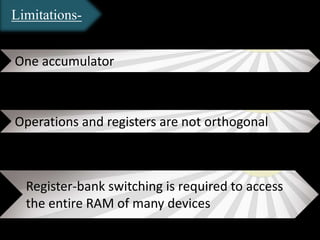
 Limitations of PIC Microcontrollers
 Past Scenario of PIC Microcontrollers
 Present and Future Scenario of PIC µC (Apps)
What is a Microcontroller?
A microcontroller (sometimes abbreviated µC, µC or
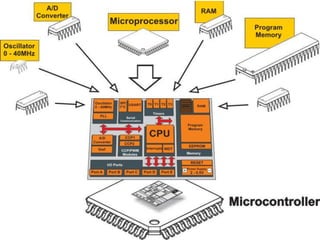
MCU) is a small computer on a single integrated circuit
containing a processor core, memory, and programmable
input/output peripherals. Program memory in the form of
NOR flash or OTP ROM is also often included on chip, as well
as a typically small amount of RAM. Microcontrollers are
designed for embedded applications, in contrast to the
microprocessors used in personal computers or other general
purpose applications.
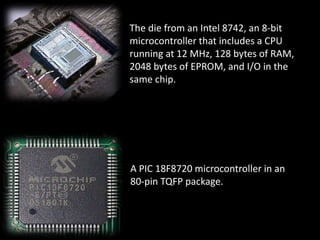
The die from an Intel 8742, an 8-bit
microcontroller that includes a CPU
running at 12 MHz, 128 bytes of RAM,
2048 bytes of EPROM, and I/O in the
same chip.
A PIC 18F8720 microcontroller in an
80-pin TQFP package.
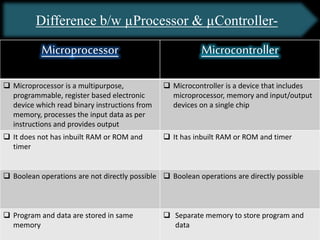
Difference b/w µProcessor & µController-
Microprocessor Microcontroller
 Microprocessor is a multipurpose,
programmable, register based electronic
device which read binary instructions from
memory, processes the input data as per
instructions and provides output
 Microcontroller is a device that includes
microprocessor, memory and input/output
devices on a single chip
 It does not has inbuilt RAM or ROM and
timer
 It has inbuilt RAM or ROM and timer
 Boolean operations are not directly possible  Boolean operations are directly possible
 Program and data are stored in same
memory
 Separate memory to store program and
data
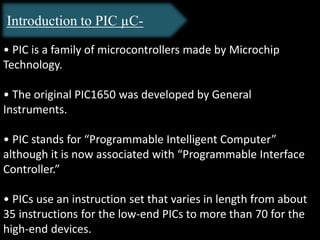
• PIC is a family of microcontrollers made by Microchip
Technology.
• The original PIC1650 was developed by General
Instruments.
• PIC stands for “Programmable Intelligent Computer”
although it is now associated with “Programmable Interface
Controller.”
• PICs use an instruction set that varies in length from about
35 instructions for the low-end PICs to more than 70 for the
high-end devices.
Introduction to PIC µC-
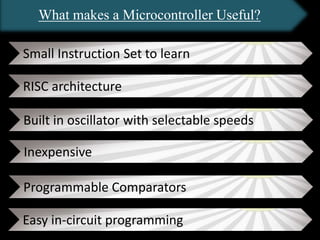
What makes a Microcontroller Useful?
Small Instruction Set to learn
Inexpensive
RISC architecture
Built in oscillator with selectable speeds
Programmable Comparators
Easy in-circuit programming
Limitations-
One accumulator
Operations and registers are not orthogonal
Register-bank switching is required to access
the entire RAM of many devices
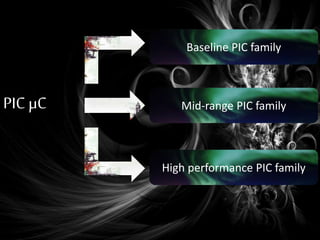
PIC µC
Baseline PIC family
Mid-range PIC family
High performance PIC family
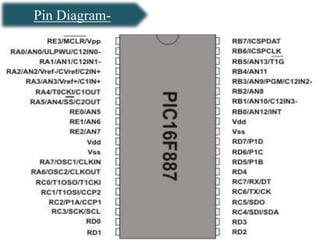
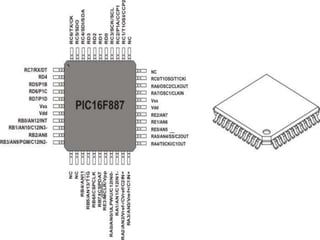
Pin Diagram-
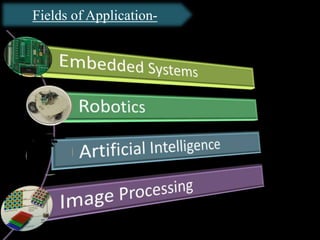
Fields of Application-
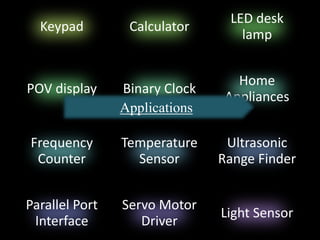
Keypad Calculator
LED desk
lamp
POV display Binary Clock
Home
Appliances
Frequency
Counter
Temperature
Sensor
Ultrasonic
Range Finder
Parallel Port
Interface
Servo Motor
Driver
Light Sensor
Applications
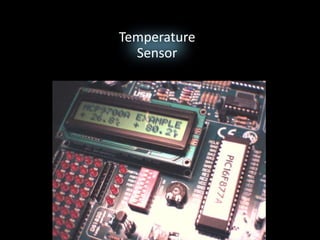
Temperature
Sensor
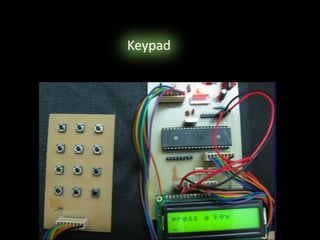
Keypad
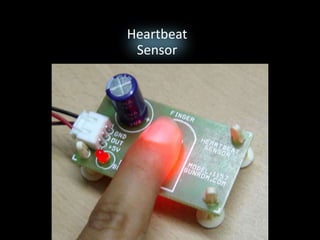
Heartbeat
Sensor
Home Security-
• Security is a prime concern in our day-today life. Everyone
wants to be as much secure as possible.
• An access control for doors forms a vital link in a security
chain.
• The Microcontroller based Home Security System can be
adopted at Home it has various type of Sensors.
• For making an easy and effective home security system we
can use magnetic sensors, Wire Loop sensors, Fire sensors.
• The system is fully controlled by the PIC µ 8951.
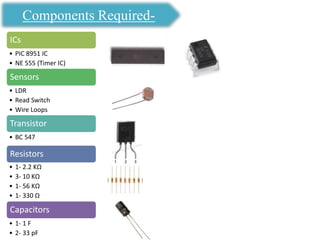
Components Required-
ICs
• PIC 8951 IC
• NE 555 (Timer IC)
Sensors
• LDR
• Read Switch
• Wire Loops
Transistor
• BC 547
Resistors
• 1- 2.2 KΩ
• 3- 10 KΩ
• 1- 56 KΩ
• 1- 330 Ω
Capacitors
• 1- 1 F
• 2- 33 pF
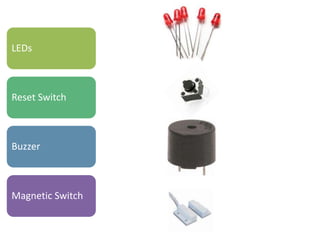
LEDs
Reset Switch
Buzzer
Magnetic Switch
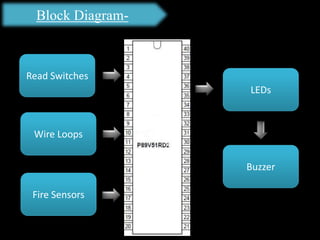
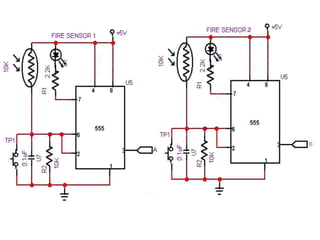
Fire Sensors
Read Switches
Wire Loops
LEDs
Block Diagram-
Buzzer
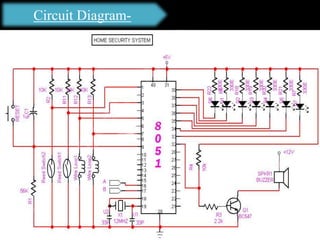
Circuit Diagram-
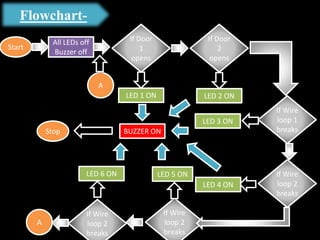
Flowchart-
Start
All LEDs off
Buzzer off
If Door
1
opens
LED 1 ON
If Door
2
opens
LED 2 ON
If Wire
loop 1
breaks
If Wire
loop 2
breaks
LED 3 ON
LED 4 ON
If Wire
loop 2
breaks
If Wire
loop 2
breaks
LED 6 ON LED 5 ON
A
A
BUZZER ONStop
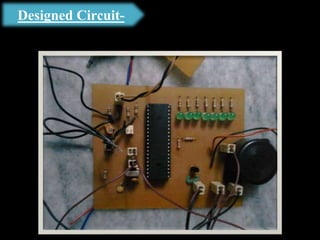
Designed Circuit-
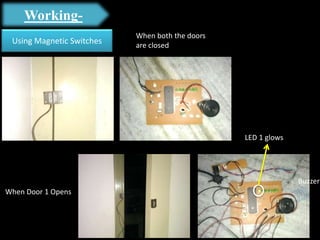
Working-
Using Magnetic Switches
When both the doors
are closed
When Door 1 Opens
LED 1 glows
Buzzer
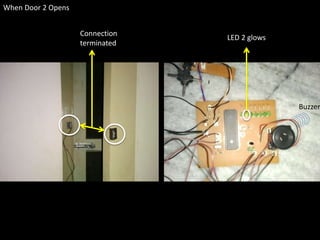
When Door 2 Opens
Buzzer
Connection
terminated
LED 2 glows
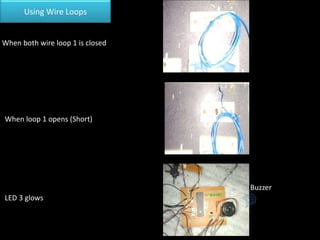
Using Wire Loops
Buzzer
When both wire loop 1 is closed
When loop 1 opens (Short)
LED 3 glows
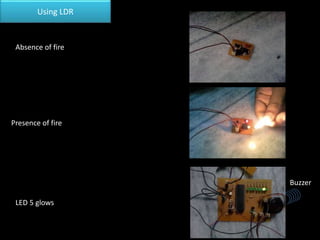
Using LDR
Absence of fire
Presence of fire
LED 5 glows
Buzzer
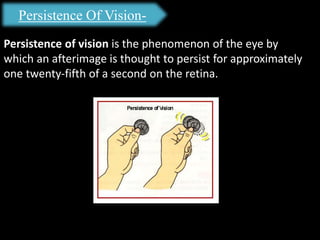
Persistence Of Vision-
Persistence of vision is the phenomenon of the eye by
which an afterimage is thought to persist for approximately
one twenty-fifth of a second on the retina.
This animated cartoon of a
galloping horse is displayed at 12
drawings per second, and the fast
motion is on the edge of being
objectionably jerky.
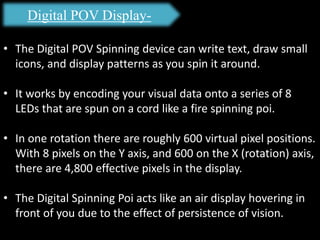
Digital POV Display-
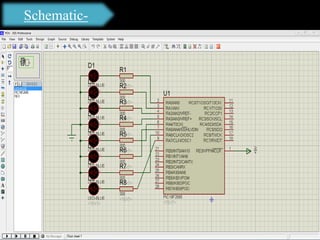
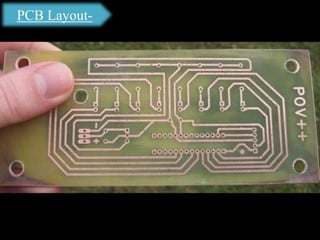
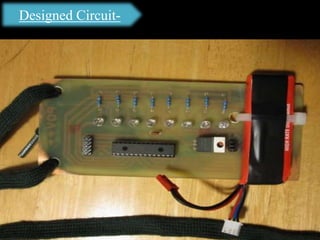
• The Digital POV Spinning device can write text, draw small
icons, and display patterns as you spin it around.
• It works by encoding your visual data onto a series of 8
LEDs that are spun on a cord like a fire spinning poi.
• In one rotation there are roughly 600 virtual pixel positions.
With 8 pixels on the Y axis, and 600 on the X (rotation) axis,
there are 4,800 effective pixels in the display.
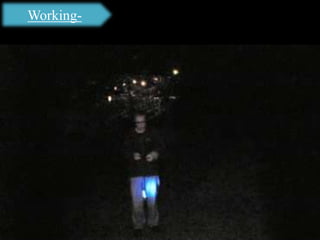
• The Digital Spinning Poi acts like an air display hovering in
front of you due to the effect of persistence of vision.
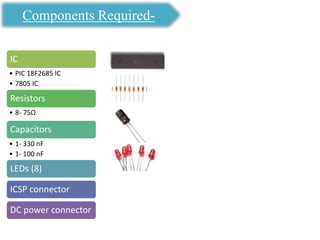
Components Required-
IC
• PIC 18F2685 IC
• 7805 IC
Resistors
• 8- 75Ω
Capacitors
• 1- 330 nF
• 1- 100 nF
LEDs (8)
ICSP connector
DC power connector
Schematic-
PCB Layout-
Designed Circuit-
Working-
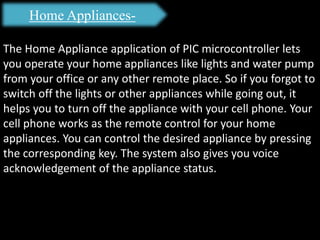
Home Appliances-
The Home Appliance application of PIC microcontroller lets
you operate your home appliances like lights and water pump
from your office or any other remote place. So if you forgot to
switch off the lights or other appliances while going out, it
helps you to turn off the appliance with your cell phone. Your
cell phone works as the remote control for your home
appliances. You can control the desired appliance by pressing
the corresponding key. The system also gives you voice
acknowledgement of the appliance status.
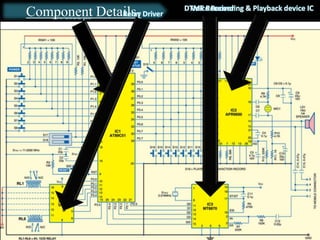
PIC 8951 µC
Voice Recording & Playback device IC
Component Details-Relay Driver
DTMF Receiver
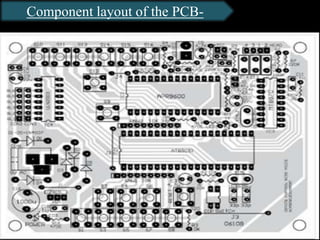
Component layout of the PCB-
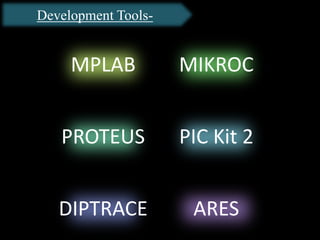
Development Tools-
MPLAB MIKROC
PROTEUS PIC Kit 2
DIPTRACE ARES
References-
>>www.embeddedsystemne
ws.com>> www.wikipidea.com
>> www.google.com
>> www.cnn.com
>>www.engineeersgarage.com>> www.infobarrel.com
>> www.fadooengineers.com
PRESENTED By-
AbdullahSaghir Ahmad

PIC Microcontrollers

  • 2.
    Abstract of thePresentation  What is a Microcontroller  Difference b/w µprocessor & µcontroller  Introduction to PIC Microcontrollers  What makes them useful?  Limitations of PIC Microcontrollers  Past Scenario of PIC Microcontrollers  Present and Future Scenario of PIC µC (Apps)
  • 3.
    What is aMicrocontroller? A microcontroller (sometimes abbreviated µC, µC or MCU) is a small computer on a single integrated circuit containing a processor core, memory, and programmable input/output peripherals. Program memory in the form of NOR flash or OTP ROM is also often included on chip, as well as a typically small amount of RAM. Microcontrollers are designed for embedded applications, in contrast to the microprocessors used in personal computers or other general purpose applications.
  • 5.
    The die froman Intel 8742, an 8-bit microcontroller that includes a CPU running at 12 MHz, 128 bytes of RAM, 2048 bytes of EPROM, and I/O in the same chip. A PIC 18F8720 microcontroller in an 80-pin TQFP package.
  • 6.
    Difference b/w µProcessor& µController- Microprocessor Microcontroller  Microprocessor is a multipurpose, programmable, register based electronic device which read binary instructions from memory, processes the input data as per instructions and provides output  Microcontroller is a device that includes microprocessor, memory and input/output devices on a single chip  It does not has inbuilt RAM or ROM and timer  It has inbuilt RAM or ROM and timer  Boolean operations are not directly possible  Boolean operations are directly possible  Program and data are stored in same memory  Separate memory to store program and data
  • 7.
    • PIC isa family of microcontrollers made by Microchip Technology. • The original PIC1650 was developed by General Instruments. • PIC stands for “Programmable Intelligent Computer” although it is now associated with “Programmable Interface Controller.” • PICs use an instruction set that varies in length from about 35 instructions for the low-end PICs to more than 70 for the high-end devices. Introduction to PIC µC-
  • 8.
    What makes aMicrocontroller Useful? Small Instruction Set to learn Inexpensive RISC architecture Built in oscillator with selectable speeds Programmable Comparators Easy in-circuit programming
  • 9.
    Limitations- One accumulator Operations andregisters are not orthogonal Register-bank switching is required to access the entire RAM of many devices
  • 10.
    PIC µC Baseline PICfamily Mid-range PIC family High performance PIC family
  • 11.
  • 13.
  • 14.
    Keypad Calculator LED desk lamp POVdisplay Binary Clock Home Appliances Frequency Counter Temperature Sensor Ultrasonic Range Finder Parallel Port Interface Servo Motor Driver Light Sensor Applications
  • 15.
  • 16.
  • 17.
  • 18.
    Home Security- • Securityis a prime concern in our day-today life. Everyone wants to be as much secure as possible. • An access control for doors forms a vital link in a security chain. • The Microcontroller based Home Security System can be adopted at Home it has various type of Sensors. • For making an easy and effective home security system we can use magnetic sensors, Wire Loop sensors, Fire sensors. • The system is fully controlled by the PIC µ 8951.
  • 19.
    Components Required- ICs • PIC8951 IC • NE 555 (Timer IC) Sensors • LDR • Read Switch • Wire Loops Transistor • BC 547 Resistors • 1- 2.2 KΩ • 3- 10 KΩ • 1- 56 KΩ • 1- 330 Ω Capacitors • 1- 1 F • 2- 33 pF
  • 20.
  • 21.
    Fire Sensors Read Switches WireLoops LEDs Block Diagram- Buzzer
  • 22.
  • 24.
    Flowchart- Start All LEDs off Buzzeroff If Door 1 opens LED 1 ON If Door 2 opens LED 2 ON If Wire loop 1 breaks If Wire loop 2 breaks LED 3 ON LED 4 ON If Wire loop 2 breaks If Wire loop 2 breaks LED 6 ON LED 5 ON A A BUZZER ONStop
  • 25.
  • 26.
    Working- Using Magnetic Switches Whenboth the doors are closed When Door 1 Opens LED 1 glows Buzzer
  • 27.
    When Door 2Opens Buzzer Connection terminated LED 2 glows
  • 28.
    Using Wire Loops Buzzer Whenboth wire loop 1 is closed When loop 1 opens (Short) LED 3 glows
  • 29.
    Using LDR Absence offire Presence of fire LED 5 glows Buzzer
  • 30.
    Persistence Of Vision- Persistenceof vision is the phenomenon of the eye by which an afterimage is thought to persist for approximately one twenty-fifth of a second on the retina.
  • 31.
    This animated cartoonof a galloping horse is displayed at 12 drawings per second, and the fast motion is on the edge of being objectionably jerky.
  • 32.
    Digital POV Display- •The Digital POV Spinning device can write text, draw small icons, and display patterns as you spin it around. • It works by encoding your visual data onto a series of 8 LEDs that are spun on a cord like a fire spinning poi. • In one rotation there are roughly 600 virtual pixel positions. With 8 pixels on the Y axis, and 600 on the X (rotation) axis, there are 4,800 effective pixels in the display. • The Digital Spinning Poi acts like an air display hovering in front of you due to the effect of persistence of vision.
  • 33.
    Components Required- IC • PIC18F2685 IC • 7805 IC Resistors • 8- 75Ω Capacitors • 1- 330 nF • 1- 100 nF LEDs (8) ICSP connector DC power connector
  • 34.
  • 35.
  • 36.
  • 37.
  • 38.
    Home Appliances- The HomeAppliance application of PIC microcontroller lets you operate your home appliances like lights and water pump from your office or any other remote place. So if you forgot to switch off the lights or other appliances while going out, it helps you to turn off the appliance with your cell phone. Your cell phone works as the remote control for your home appliances. You can control the desired appliance by pressing the corresponding key. The system also gives you voice acknowledgement of the appliance status.
  • 39.
    PIC 8951 µC VoiceRecording & Playback device IC Component Details-Relay Driver DTMF Receiver
  • 40.
  • 41.
  • 42.
    References- >>www.embeddedsystemne ws.com>> www.wikipidea.com >> www.google.com >>www.cnn.com >>www.engineeersgarage.com>> www.infobarrel.com >> www.fadooengineers.com
  • 43.