Difference between Group By and Order By in SQL Server

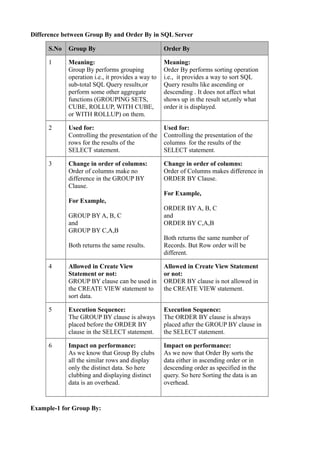
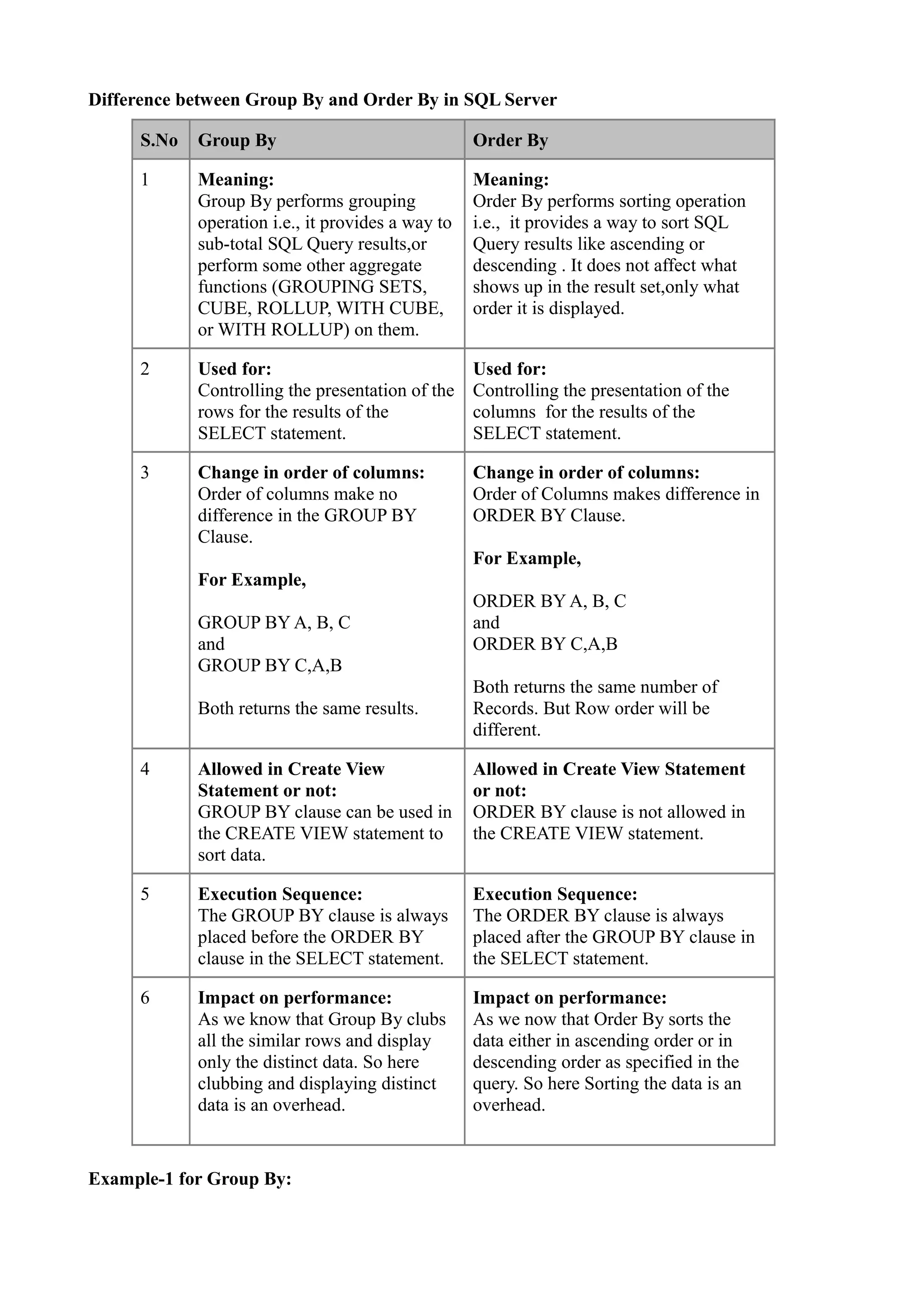
      S.No   Group By                               Order By

      1      Meaning:                               Meaning:
             Group By performs grouping             Order By performs sorting operation
             operation i.e., it provides a way to   i.e., it provides a way to sort SQL
             sub-total SQL Query results,or         Query results like ascending or
             perform some other aggregate           descending . It does not affect what
             functions (GROUPING SETS,              shows up in the result set,only what
             CUBE, ROLLUP, WITH CUBE,               order it is displayed.
             or WITH ROLLUP) on them.

      2      Used for:                              Used for:
             Controlling the presentation of the    Controlling the presentation of the
             rows for the results of the            columns for the results of the
             SELECT statement.                      SELECT statement.

      3      Change in order of columns:            Change in order of columns:
             Order of columns make no               Order of Columns makes difference in
             difference in the GROUP BY             ORDER BY Clause.
             Clause.
                                                    For Example,
             For Example,
                                                    ORDER BY A, B, C
             GROUP BY A, B, C                       and
             and                                    ORDER BY C,A,B
             GROUP BY C,A,B
                                                    Both returns the same number of
             Both returns the same results.         Records. But Row order will be
                                                    different.

      4      Allowed in Create View                 Allowed in Create View Statement
             Statement or not:                      or not:
             GROUP BY clause can be used in         ORDER BY clause is not allowed in
             the CREATE VIEW statement to           the CREATE VIEW statement.
             sort data.

      5      Execution Sequence:                    Execution Sequence:
             The GROUP BY clause is always          The ORDER BY clause is always
             placed before the ORDER BY             placed after the GROUP BY clause in
             clause in the SELECT statement.        the SELECT statement.

      6      Impact on performance:                 Impact on performance:
             As we know that Group By clubs         As we now that Order By sorts the
             all the similar rows and display       data either in ascending order or in
             only the distinct data. So here        descending order as specified in the
             clubbing and displaying distinct       query. So here Sorting the data is an
             data is an overhead.                   overhead.


Example-1 for Group By:
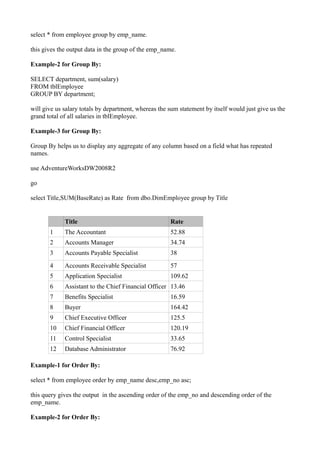
select * from employee group by emp_name.

this gives the output data in the group of the emp_name.

Example-2 for Group By:

SELECT department, sum(salary)
FROM tblEmployee
GROUP BY department;

will give us salary totals by department, whereas the sum statement by itself would just give us the
grand total of all salaries in tblEmployee.

Example-3 for Group By:

Group By helps us to display any aggregate of any column based on a field what has repeated
names.

use AdventureWorksDW2008R2

go

select Title,SUM(BaseRate) as Rate from dbo.DimEmployee group by Title


             Title                                    Rate
       1     The Accountant                           52.88
       2     Accounts Manager                         34.74
       3     Accounts Payable Specialist              38
       4     Accounts Receivable Specialist           57
       5     Application Specialist                   109.62
       6     Assistant to the Chief Financial Officer 13.46
       7     Benefits Specialist                      16.59
       8     Buyer                                    164.42
       9     Chief Executive Officer                  125.5
       10    Chief Financial Officer                  120.19
       11    Control Specialist                       33.65
       12    Database Administrator                   76.92

Example-1 for Order By:

select * from employee order by emp_name desc,emp_no asc;

this query gives the output in the ascending order of the emp_no and descending order of the
emp_name.

Example-2 for Order By:
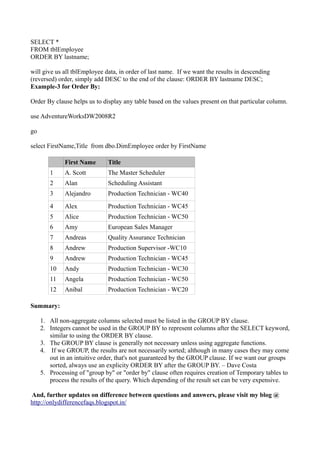
SELECT *
FROM tblEmployee
ORDER BY lastname;

will give us all tblEmployee data, in order of last name. If we want the results in descending
(reversed) order, simply add DESC to the end of the clause: ORDER BY lastname DESC;
Example-3 for Order By:

Order By clause helps us to display any table based on the values present on that particular column.

use AdventureWorksDW2008R2

go

select FirstName,Title from dbo.DimEmployee order by FirstName

              First Name      Title
        1     A. Scott        The Master Scheduler
        2     Alan            Scheduling Assistant
        3     Alejandro       Production Technician - WC40
        4     Alex            Production Technician - WC45
        5     Alice           Production Technician - WC50
        6     Amy             European Sales Manager
        7     Andreas         Quality Assurance Technician
        8     Andrew          Production Supervisor -WC10
        9     Andrew          Production Technician - WC45
        10    Andy            Production Technician - WC30
        11    Angela          Production Technician - WC50
        12    Anibal          Production Technician - WC20

Summary:

     1. All non-aggregate columns selected must be listed in the GROUP BY clause.
     2. Integers cannot be used in the GROUP BY to represent columns after the SELECT keyword,
        similar to using the ORDER BY clause.
     3. The GROUP BY clause is generally not necessary unless using aggregate functions.
     4. If we GROUP, the results are not necessarily sorted; although in many cases they may come
        out in an intuitive order, that's not guaranteed by the GROUP clause. If we want our groups
        sorted, always use an explicity ORDER BY after the GROUP BY. – Dave Costa
     5. Processing of "group by" or "order by" clause often requires creation of Temporary tables to
        process the results of the query. Which depending of the result set can be very expensive.

And, further updates on difference between questions and answers, please visit my blog @
http://onlydifferencefaqs.blogspot.in/

Difference between group by and order by in sql server

  • 1.
    Difference between GroupBy and Order By in SQL Server S.No Group By Order By 1 Meaning: Meaning: Group By performs grouping Order By performs sorting operation operation i.e., it provides a way to i.e., it provides a way to sort SQL sub-total SQL Query results,or Query results like ascending or perform some other aggregate descending . It does not affect what functions (GROUPING SETS, shows up in the result set,only what CUBE, ROLLUP, WITH CUBE, order it is displayed. or WITH ROLLUP) on them. 2 Used for: Used for: Controlling the presentation of the Controlling the presentation of the rows for the results of the columns for the results of the SELECT statement. SELECT statement. 3 Change in order of columns: Change in order of columns: Order of columns make no Order of Columns makes difference in difference in the GROUP BY ORDER BY Clause. Clause. For Example, For Example, ORDER BY A, B, C GROUP BY A, B, C and and ORDER BY C,A,B GROUP BY C,A,B Both returns the same number of Both returns the same results. Records. But Row order will be different. 4 Allowed in Create View Allowed in Create View Statement Statement or not: or not: GROUP BY clause can be used in ORDER BY clause is not allowed in the CREATE VIEW statement to the CREATE VIEW statement. sort data. 5 Execution Sequence: Execution Sequence: The GROUP BY clause is always The ORDER BY clause is always placed before the ORDER BY placed after the GROUP BY clause in clause in the SELECT statement. the SELECT statement. 6 Impact on performance: Impact on performance: As we know that Group By clubs As we now that Order By sorts the all the similar rows and display data either in ascending order or in only the distinct data. So here descending order as specified in the clubbing and displaying distinct query. So here Sorting the data is an data is an overhead. overhead. Example-1 for Group By:
  • 2.
    select * fromemployee group by emp_name. this gives the output data in the group of the emp_name. Example-2 for Group By: SELECT department, sum(salary) FROM tblEmployee GROUP BY department; will give us salary totals by department, whereas the sum statement by itself would just give us the grand total of all salaries in tblEmployee. Example-3 for Group By: Group By helps us to display any aggregate of any column based on a field what has repeated names. use AdventureWorksDW2008R2 go select Title,SUM(BaseRate) as Rate from dbo.DimEmployee group by Title Title Rate 1 The Accountant 52.88 2 Accounts Manager 34.74 3 Accounts Payable Specialist 38 4 Accounts Receivable Specialist 57 5 Application Specialist 109.62 6 Assistant to the Chief Financial Officer 13.46 7 Benefits Specialist 16.59 8 Buyer 164.42 9 Chief Executive Officer 125.5 10 Chief Financial Officer 120.19 11 Control Specialist 33.65 12 Database Administrator 76.92 Example-1 for Order By: select * from employee order by emp_name desc,emp_no asc; this query gives the output in the ascending order of the emp_no and descending order of the emp_name. Example-2 for Order By:
  • 3.
    SELECT * FROM tblEmployee ORDERBY lastname; will give us all tblEmployee data, in order of last name. If we want the results in descending (reversed) order, simply add DESC to the end of the clause: ORDER BY lastname DESC; Example-3 for Order By: Order By clause helps us to display any table based on the values present on that particular column. use AdventureWorksDW2008R2 go select FirstName,Title from dbo.DimEmployee order by FirstName First Name Title 1 A. Scott The Master Scheduler 2 Alan Scheduling Assistant 3 Alejandro Production Technician - WC40 4 Alex Production Technician - WC45 5 Alice Production Technician - WC50 6 Amy European Sales Manager 7 Andreas Quality Assurance Technician 8 Andrew Production Supervisor -WC10 9 Andrew Production Technician - WC45 10 Andy Production Technician - WC30 11 Angela Production Technician - WC50 12 Anibal Production Technician - WC20 Summary: 1. All non-aggregate columns selected must be listed in the GROUP BY clause. 2. Integers cannot be used in the GROUP BY to represent columns after the SELECT keyword, similar to using the ORDER BY clause. 3. The GROUP BY clause is generally not necessary unless using aggregate functions. 4. If we GROUP, the results are not necessarily sorted; although in many cases they may come out in an intuitive order, that's not guaranteed by the GROUP clause. If we want our groups sorted, always use an explicity ORDER BY after the GROUP BY. – Dave Costa 5. Processing of "group by" or "order by" clause often requires creation of Temporary tables to process the results of the query. Which depending of the result set can be very expensive. And, further updates on difference between questions and answers, please visit my blog @ http://onlydifferencefaqs.blogspot.in/