DIFFERENCE BETWEEN ER AND
DIMENTIONAL MODELING
By
Abdul-rehman Aslam
NATIONAL UNIVERSITY OF MODERN LANGUAGES
ISLAMABAD
25, April 2013
3 | P a g e
Assignment
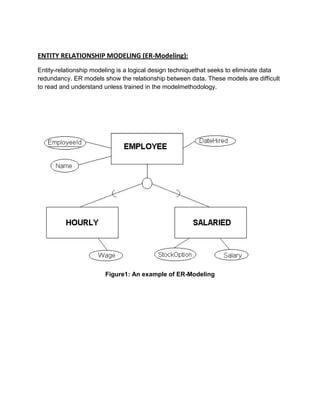
ENTITY RELATIONSHIP MODELING (ER-Modeling):
Entity-relationship modeling is a logical design technique that seeks to eliminate
data redundancy. ER models show the relationship between data. These models
are difficult to read and understand unless trained in the model methodology.
Figure 1: An example of ER-Modeling
4
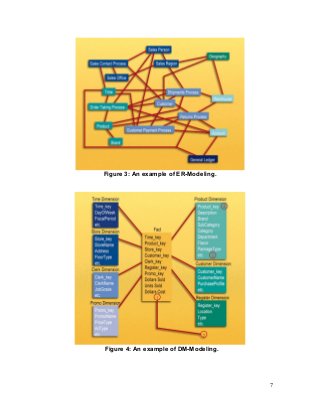
DIMENSIONAL MODELING (DM-Modeling):
DM is a logical design technique that seeks to present the data in a standard,
intuitive framework that allows for high-performance access. It is inherently
dimensional, and it adheres to a discipline that uses the relational model with
some important restrictions. Every dimensional model is composed of one table
with a multipart key, called the fact table, and a set of smaller tables called
dimension tables.
Figure 2: An example of Dimensional-Modeling
5
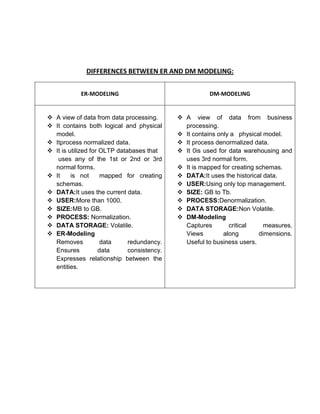
DIFFERENCES BETWEEN ER AND DM MODELING:
ER-MODELING DM-MODELING
 A view of data from data processing.
 It contains both logical and physical
model.
 It process normalized data.
 It is utilized for OLTP databases that
uses any of the 1st or 2nd or 3rd
normal forms.
 It is not mapped for creating
schemas.
 DATA: It uses the current data.
 USER: More than 1000.
 SIZE: MB to GB.
 PROCESS: Normalization.
 DATA STORAGE: Volatile.
 ER-Modeling
Removes data redundancy.
Ensures data consistency.
Expresses relationship between the
entities.
 A view of data from business
processing.
 It contains only a physical model.
 It process denormalized data.
 It 0is used for data warehousing and
uses 3rd normal form.
 It is mapped for creating schemas.
 DATA: It uses the historical data.
 USER: Using only top management.
 SIZE: GB to Tb.
 PROCESS: Denormalization.
 DATA STORAGE: Non Volatile.
 DM-Modeling
Captures critical measures.
Views along dimensions.
Useful to business users.
6
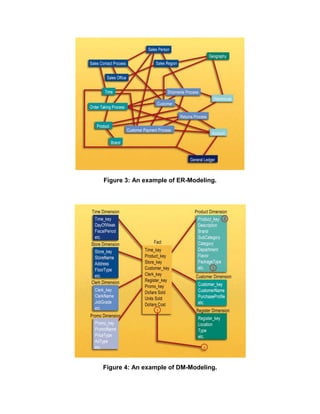
Figure 3: An example of ER-Modeling.
Figure 4: An example of DM-Modeling.
7
Figure 3: An example of ER-Modeling.
Figure 4: An example of DM-Modeling.
7

Difference between ER-Modeling and Dimensional Modeling

  • 1.
    DIFFERENCE BETWEEN ERAND DIMENTIONAL MODELING By Abdul-rehman Aslam NATIONAL UNIVERSITY OF MODERN LANGUAGES ISLAMABAD 25, April 2013 3 | P a g e Assignment
  • 2.
    ENTITY RELATIONSHIP MODELING(ER-Modeling): Entity-relationship modeling is a logical design technique that seeks to eliminate data redundancy. ER models show the relationship between data. These models are difficult to read and understand unless trained in the model methodology. Figure 1: An example of ER-Modeling 4
  • 3.
    DIMENSIONAL MODELING (DM-Modeling): DMis a logical design technique that seeks to present the data in a standard, intuitive framework that allows for high-performance access. It is inherently dimensional, and it adheres to a discipline that uses the relational model with some important restrictions. Every dimensional model is composed of one table with a multipart key, called the fact table, and a set of smaller tables called dimension tables. Figure 2: An example of Dimensional-Modeling 5
  • 4.
    DIFFERENCES BETWEEN ERAND DM MODELING: ER-MODELING DM-MODELING  A view of data from data processing.  It contains both logical and physical model.  It process normalized data.  It is utilized for OLTP databases that uses any of the 1st or 2nd or 3rd normal forms.  It is not mapped for creating schemas.  DATA: It uses the current data.  USER: More than 1000.  SIZE: MB to GB.  PROCESS: Normalization.  DATA STORAGE: Volatile.  ER-Modeling Removes data redundancy. Ensures data consistency. Expresses relationship between the entities.  A view of data from business processing.  It contains only a physical model.  It process denormalized data.  It 0is used for data warehousing and uses 3rd normal form.  It is mapped for creating schemas.  DATA: It uses the historical data.  USER: Using only top management.  SIZE: GB to Tb.  PROCESS: Denormalization.  DATA STORAGE: Non Volatile.  DM-Modeling Captures critical measures. Views along dimensions. Useful to business users. 6
  • 5.
    Figure 3: Anexample of ER-Modeling. Figure 4: An example of DM-Modeling. 7
  • 6.
    Figure 3: Anexample of ER-Modeling. Figure 4: An example of DM-Modeling. 7