2
Didi Contractor:
A Self-TaughtArchitect Who Builds In Mud, Bamboo & Stone
The profession of architecture does not
necessarily need any formal education or degree.
This may seem strange to many present-day
architects but it is a reality. There are many
architects in the world who are/were self-taught
and did not have any formal education in
architecture. Prominent among these are Frank
Lloyd Wright, Louis Sullivan, Le Corbusier, Mies
van der Rohe, Buckminster Fuller, Luis Barragan,
and Tadao Ando. These are the names of just a
few stalwarts who dominated the profession of
architecture but there are many more who are
comparatively lesser known or even not known.
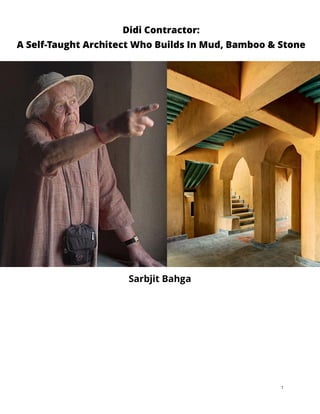
One such name is Didi Contractor who is down-to
-earth, a self-taught architect based in
Dharamsala in Himachal Pradesh, India. Unlike
the millions of formally trained architects, Didi
Contractor has specialised in mud, bamboo and
stone architecture. Now in her late eighties, she
has been actively involved in the so-called
'sustainable architecture' in its true sense for the
last about three decades.
Didi Contractor whose real name is Delia
Kinzinger was born in 1929 in the USA. Her father,
Edmund Kinzinger was a German national and
mother, Alice Fish Kinzinger was an American.
Both of them were renowned painters belonging
to the Bauhaus group in the early 1920s. Delia
Kinzinger had grown-up in Texas, USA, and spent
some time in Europe also.
At the age of 11, she happened to listen to Frank
Lloyd Wright and saw an exhibition of his works
along with her parents. This made a lasting
impression on her mind and developed her
inclination for the profession of architecture. But
her parents never encouraged her to pursue
architecture and resultantly she completed her
graduation in art at the University of Colorado.
Photo: filmfreeway.com
Photo: wonderlustmum.wordpress.com
Photo: filmfreeway.com
3.
3
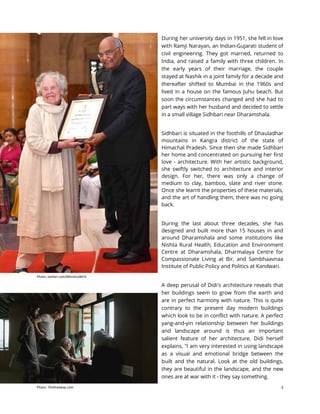
During her universitydays in 1951, she fell in love
with Ramji Narayan, an Indian-Gujarati student of
civil engineering. They got married, returned to
India, and raised a family with three children. In
the early years of their marriage, the couple
stayed at Nashik in a joint family for a decade and
thereafter shifted to Mumbai in the 1960s and
lived in a house on the famous Juhu beach. But
soon the circumstances changed and she had to
part ways with her husband and decided to settle
in a small village Sidhbari near Dharamshala.
Sidhbari is situated in the foothills of Dhauladhar
mountains in Kangra district of the state of
Himachal Pradesh. Since then she made Sidhbari
her home and concentrated on pursuing her first
love - architecture. With her artistic background,
she swiftly switched to architecture and interior
design. For her, there was only a change of
medium to clay, bamboo, slate and river stone.
Once she learnt the properties of these materials,
and the art of handling them, there was no going
back.
During the last about three decades, she has
designed and built more than 15 houses in and
around Dharamshala and some institutions like
Nishta Rural Health, Education and Environment
Centre at Dharamshala, Dharmalaya Centre for
Compassionate Living at Bir, and Sambhaavnaa
Institute of Public Policy and Politics at Kandwari.
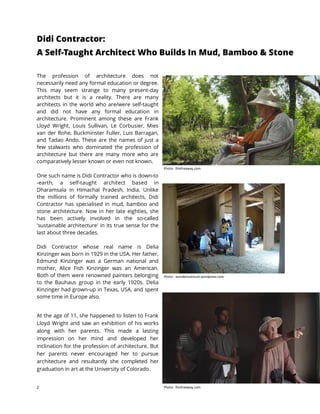
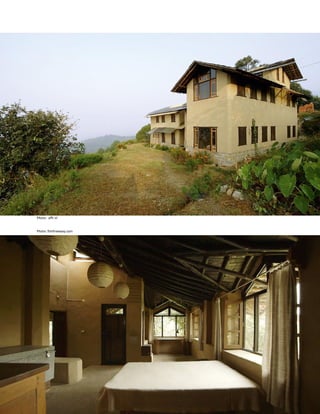
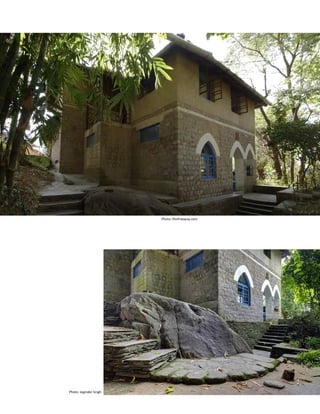
A deep perusal of Didi's architecture reveals that
her buildings seem to grow from the earth and
are in perfect harmony with nature. This is quite
contrary to the present day modern buildings
which look to be in conflict with nature. A perfect
yang-and-yin relationship between her buildings
and landscape around is thus an important
salient feature of her architecture. Didi herself
explains, "I am very interested in using landscape
as a visual and emotional bridge between the
built and the natural. Look at the old buildings,
they are beautiful in the landscape, and the new
ones are at war with it - they say something.
Photo: twitter.com/MinistryWCD
Photo: filmfreeway.com
4.
4
So, we arein conflict with nature, and nature will
be in conflict with us. I imagine a building as
growing, like a plant, within a landscape.
Landscaping is really a key to this thing of
marrying the earth to the building.”
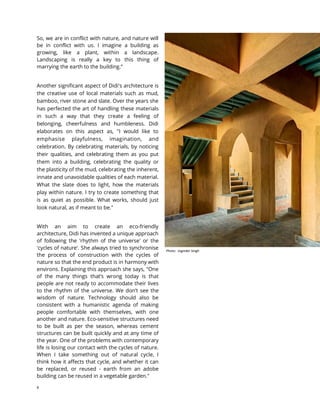
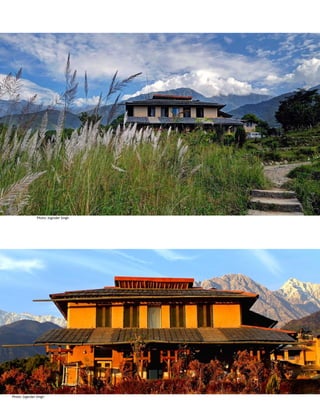
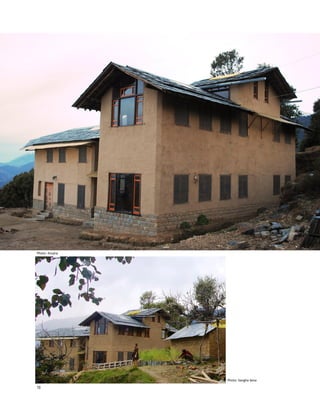
Another significant aspect of Didi's architecture is
the creative use of local materials such as mud,
bamboo, river stone and slate. Over the years she
has perfected the art of handling these materials
in such a way that they create a feeling of
belonging, cheerfulness and humbleness. Didi
elaborates on this aspect as, "I would like to
emphasise playfulness, imagination, and
celebration. By celebrating materials, by noticing
their qualities, and celebrating them as you put
them into a building, celebrating the quality or
the plasticity of the mud, celebrating the inherent,
innate and unavoidable qualities of each material.
What the slate does to light, how the materials
play within nature. I try to create something that
is as quiet as possible. What works, should just
look natural, as if meant to be."
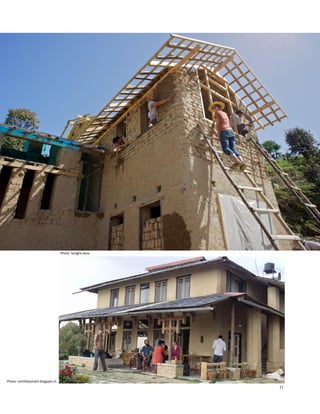
With an aim to create an eco-friendly
architecture, Didi has invented a unique approach
of following the 'rhythm of the universe' or the
'cycles of nature'. She always tried to synchronise
the process of construction with the cycles of
nature so that the end product is in harmony with
environs. Explaining this approach she says, "One
of the many things that’s wrong today is that
people are not ready to accommodate their lives
to the rhythm of the universe. We don’t see the
wisdom of nature. Technology should also be
consistent with a humanistic agenda of making
people comfortable with themselves, with one
another and nature. Eco-sensitive structures need
to be built as per the season, whereas cement
structures can be built quickly and at any time of
the year. One of the problems with contemporary
life is losing our contact with the cycles of nature.
When I take something out of natural cycle, I
think how it affects that cycle, and whether it can
be replaced, or reused - earth from an adobe
building can be reused in a vegetable garden."
Photo: Joginder Singh
5.
5
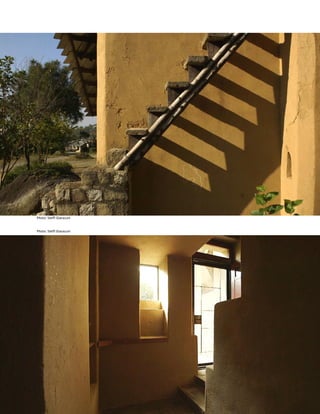
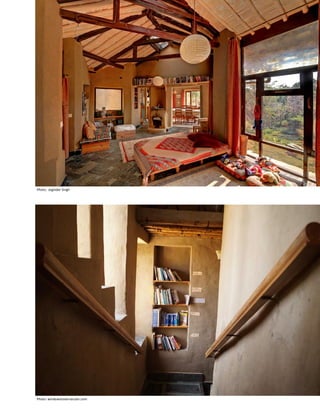
As a matterof choice, Didi is very fascinated by
yet another important element of architectural
design - the 'staircase'. In all her buildings one
finds a very creative use of this element vis-à-vis
its location, direction, and design. She says, "In
stairs, the architect is in control. I enjoy planning
the experience of what you will pass, what you
will have on both sides, and of what you are
coming down or heading up towards. The
staircase is often the key to organising the space
in each design. In the staircases, I feel I am
guiding the emotional entry of a person.”
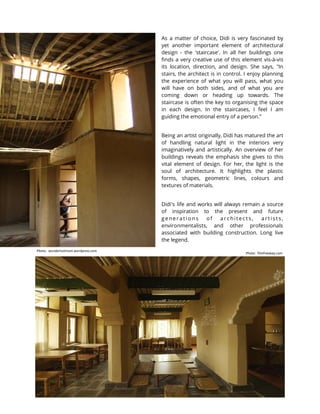
Being an artist originally, Didi has matured the art
of handling natural light in the interiors very
imaginatively and artistically. An overview of her
buildings reveals the emphasis she gives to this
vital element of design. For her, the light is the
soul of architecture. It highlights the plastic
forms, shapes, geometric lines, colours and
textures of materials.
Didi's life and works will always remain a source
of inspiration to the present and future
generations of architects, artists,
environmentalists, and other professionals
associated with building construction. Long live
the legend.
Photo: wonderlustmum.wordpress.com
Photo: filmfreeway.com