
1
Author name
Date
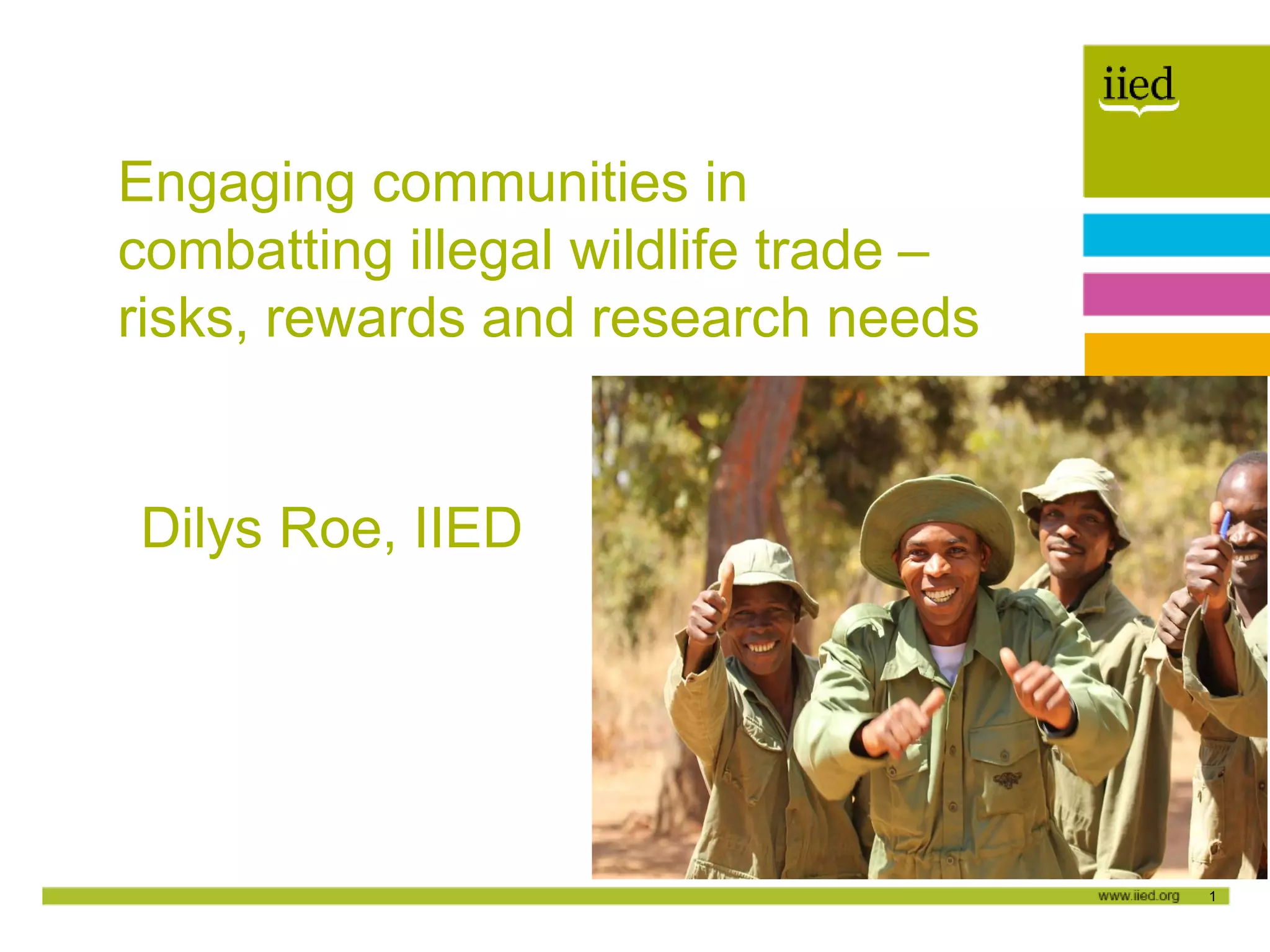
Dilys Roe, IIED
Engaging communities in
combatting illegal wildlife trade –
risks, rewards and research needs
2
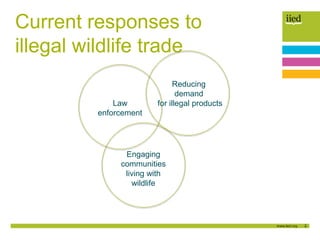
Current responses to
illegal wildlife trade
Law
enforcement
Reducing
demand
for illegal products
Engaging
communities
living with
wildlife
3
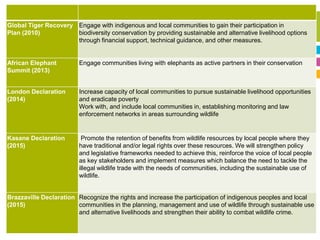
Global Tiger Recovery
Plan (2010)
Engage with indigenous and local communities to gain their participation in
biodiversity conservation by providing sustainable and alternative livelihood options
through financial support, technical guidance, and other measures.
African Elephant
Summit (2013)
Engage communities living with elephants as active partners in their conservation
London Declaration
(2014)
Increase capacity of local communities to pursue sustainable livelihood opportunities
and eradicate poverty
Work with, and include local communities in, establishing monitoring and law
enforcement networks in areas surrounding wildlife
Kasane Declaration
(2015)
Promote the retention of benefits from wildlife resources by local people where they
have traditional and/or legal rights over these resources. We will strengthen policy
and legislative frameworks needed to achieve this, reinforce the voice of local people
as key stakeholders and implement measures which balance the need to tackle the
illegal wildlife trade with the needs of communities, including the sustainable use of
wildlife.
Brazzaville Declaration
(2015)
Recognize the rights and increase the participation of indigenous peoples and local
communities in the planning, management and use of wildlife through sustainable use
and alternative livelihoods and strengthen their ability to combat wildlife crime.
4
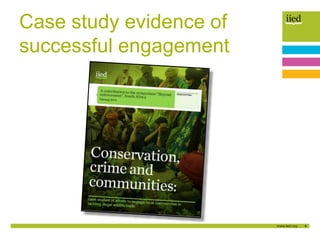
Case study evidence of
successful engagement
5
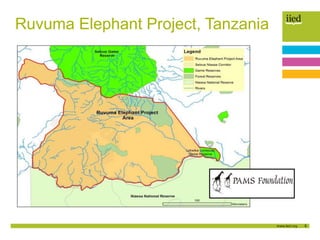
Ruvuma Elephant Project, Tanzania
6
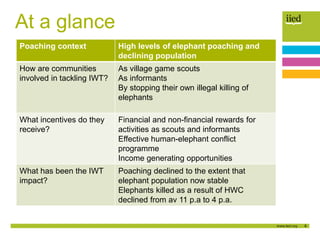
At a glance
Poaching context High levels of elephant poaching and
declining population
How are communities
involved in tackling IWT?
As village game scouts
As informants
By stopping their own illegal killing of
elephants
What incentives do they
receive?
Financial and non-financial rewards for
activities as scouts and informants
Effective human-elephant conflict
programme
Income generating opportunities
What has been the IWT
impact?
Poaching declined to the extent that
elephant population now stable
Elephants killed as a result of HWC
declined from av 11 p.a to 4 p.a.
7
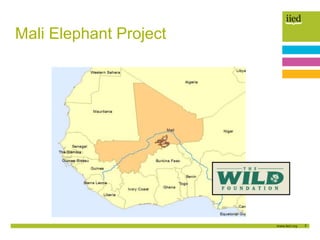
Mali Elephant Project
8
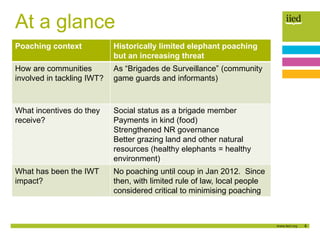
At a glance
Poaching context Historically limited elephant poaching
but an increasing threat
How are communities
involved in tackling IWT?
As “Brigades de Surveillance” (community
game guards and informants)
What incentives do they
receive?
Social status as a brigade member
Payments in kind (food)
Strengthened NR governance
Better grazing land and other natural
resources (healthy elephants = healthy
environment)
What has been the IWT
impact?
No poaching until coup in Jan 2012. Since
then, with limited rule of law, local people
considered critical to minimising poaching
9
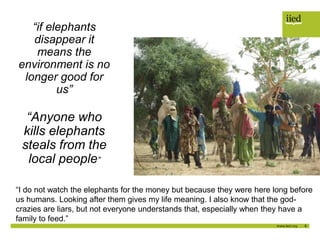
“if elephants
disappear it
means the
environment is no
longer good for
us”
“Anyone who
kills elephants
steals from the
local people”
“I do not watch the elephants for the money but because they were here long before
us humans. Looking after them gives my life meaning. I also know that the god-
crazies are liars, but not everyone understands that, especially when they have a
family to feed.”
10
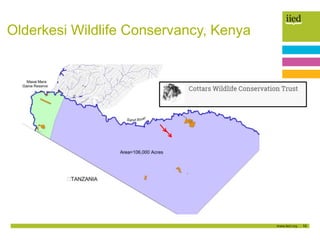
Olderkesi Wildlife Conservancy, Kenya
11
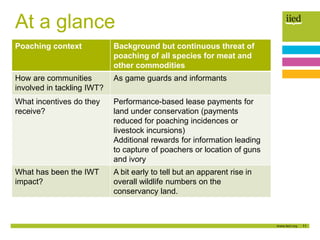
At a glance
Poaching context Background but continuous threat of
poaching of all species for meat and
other commodities
How are communities
involved in tackling IWT?
As game guards and informants
What incentives do they
receive?
Performance-based lease payments for
land under conservation (payments
reduced for poaching incidences or
livestock incursions)
Additional rewards for information leading
to capture of poachers or location of guns
and ivory
What has been the IWT
impact?
A bit early to tell but an apparent rise in
overall wildlife numbers on the
conservancy land.
12
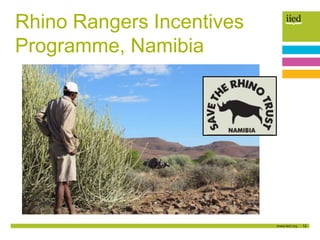
Rhino Rangers Incentives
Programme, Namibia
13
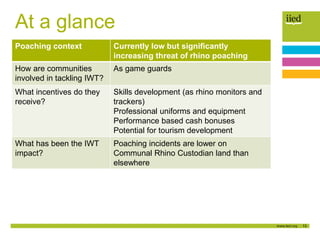
At a glance
Poaching context Currently low but significantly
increasing threat of rhino poaching
How are communities
involved in tackling IWT?
As game guards
What incentives do they
receive?
Skills development (as rhino monitors and
trackers)
Professional uniforms and equipment
Performance based cash bonuses
Potential for tourism development
What has been the IWT
impact?
Poaching incidents are lower on
Communal Rhino Custodian land than
elsewhere
14
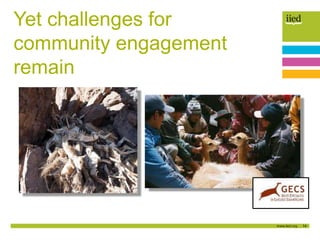
Yet challenges for
community engagement
remain
15
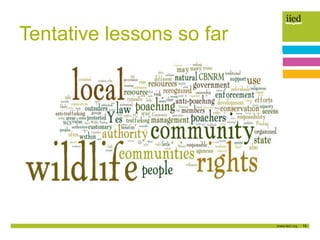
Tentative lessons so far
16
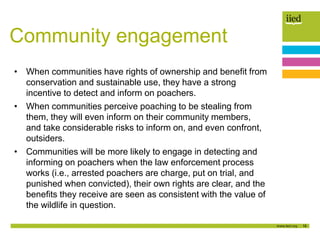
Community engagement
• When communities have rights of ownership and benefit from
conservation and sustainable use, they have a strong
incentive to detect and inform on poachers.
• When communities perceive poaching to be stealing from
them, they will even inform on their community members,
and take considerable risks to inform on, and even confront,
outsiders.
• Communities will be more likely to engage in detecting and
informing on poachers when the law enforcement process
works (i.e., arrested poachers are charge, put on trial, and
punished when convicted), their own rights are clear, and the
benefits they receive are seen as consistent with the value of
the wildlife in question.
17
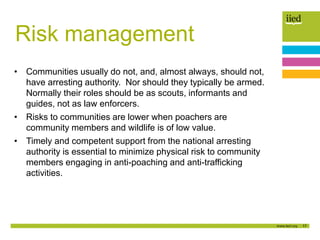
Risk management
• Communities usually do not, and, almost always, should not,
have arresting authority. Nor should they typically be armed.
Normally their roles should be as scouts, informants and
guides, not as law enforcers.
• Risks to communities are lower when poachers are
community members and wildlife is of low value.
• Timely and competent support from the national arresting
authority is essential to minimize physical risk to community
members engaging in anti-poaching and anti-trafficking
activities.
18
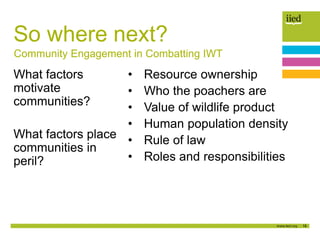
So where next?
What factors
motivate
communities?
What factors place
communities in
peril?
• Resource ownership
• Who the poachers are
• Value of wildlife product
• Human population density
• Rule of law
• Roles and responsibilities
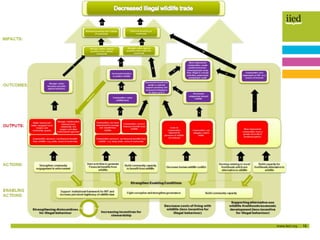
Community Engagement in Combatting IWT
19
20
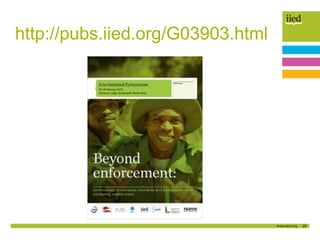
http://pubs.iied.org/G03903.html
21
THANK YOU

Engaging communities in combating illegal wildlife trade - risks rewards and research needs

  • 1.
    1 Author name Date Dilys Roe,IIED Engaging communities in combatting illegal wildlife trade – risks, rewards and research needs
  • 2.
    2 Current responses to illegalwildlife trade Law enforcement Reducing demand for illegal products Engaging communities living with wildlife
  • 3.
    3 Global Tiger Recovery Plan(2010) Engage with indigenous and local communities to gain their participation in biodiversity conservation by providing sustainable and alternative livelihood options through financial support, technical guidance, and other measures. African Elephant Summit (2013) Engage communities living with elephants as active partners in their conservation London Declaration (2014) Increase capacity of local communities to pursue sustainable livelihood opportunities and eradicate poverty Work with, and include local communities in, establishing monitoring and law enforcement networks in areas surrounding wildlife Kasane Declaration (2015) Promote the retention of benefits from wildlife resources by local people where they have traditional and/or legal rights over these resources. We will strengthen policy and legislative frameworks needed to achieve this, reinforce the voice of local people as key stakeholders and implement measures which balance the need to tackle the illegal wildlife trade with the needs of communities, including the sustainable use of wildlife. Brazzaville Declaration (2015) Recognize the rights and increase the participation of indigenous peoples and local communities in the planning, management and use of wildlife through sustainable use and alternative livelihoods and strengthen their ability to combat wildlife crime.
  • 4.
    4 Case study evidenceof successful engagement
  • 5.
  • 6.
    6 At a glance Poachingcontext High levels of elephant poaching and declining population How are communities involved in tackling IWT? As village game scouts As informants By stopping their own illegal killing of elephants What incentives do they receive? Financial and non-financial rewards for activities as scouts and informants Effective human-elephant conflict programme Income generating opportunities What has been the IWT impact? Poaching declined to the extent that elephant population now stable Elephants killed as a result of HWC declined from av 11 p.a to 4 p.a.
  • 7.
  • 8.
    8 At a glance Poachingcontext Historically limited elephant poaching but an increasing threat How are communities involved in tackling IWT? As “Brigades de Surveillance” (community game guards and informants) What incentives do they receive? Social status as a brigade member Payments in kind (food) Strengthened NR governance Better grazing land and other natural resources (healthy elephants = healthy environment) What has been the IWT impact? No poaching until coup in Jan 2012. Since then, with limited rule of law, local people considered critical to minimising poaching
  • 9.
    9 “if elephants disappear it meansthe environment is no longer good for us” “Anyone who kills elephants steals from the local people” “I do not watch the elephants for the money but because they were here long before us humans. Looking after them gives my life meaning. I also know that the god- crazies are liars, but not everyone understands that, especially when they have a family to feed.”
  • 10.
  • 11.
    11 At a glance Poachingcontext Background but continuous threat of poaching of all species for meat and other commodities How are communities involved in tackling IWT? As game guards and informants What incentives do they receive? Performance-based lease payments for land under conservation (payments reduced for poaching incidences or livestock incursions) Additional rewards for information leading to capture of poachers or location of guns and ivory What has been the IWT impact? A bit early to tell but an apparent rise in overall wildlife numbers on the conservancy land.
  • 12.
  • 13.
    13 At a glance Poachingcontext Currently low but significantly increasing threat of rhino poaching How are communities involved in tackling IWT? As game guards What incentives do they receive? Skills development (as rhino monitors and trackers) Professional uniforms and equipment Performance based cash bonuses Potential for tourism development What has been the IWT impact? Poaching incidents are lower on Communal Rhino Custodian land than elsewhere
  • 14.
  • 15.
  • 16.
    16 Community engagement • Whencommunities have rights of ownership and benefit from conservation and sustainable use, they have a strong incentive to detect and inform on poachers. • When communities perceive poaching to be stealing from them, they will even inform on their community members, and take considerable risks to inform on, and even confront, outsiders. • Communities will be more likely to engage in detecting and informing on poachers when the law enforcement process works (i.e., arrested poachers are charge, put on trial, and punished when convicted), their own rights are clear, and the benefits they receive are seen as consistent with the value of the wildlife in question.
  • 17.
    17 Risk management • Communitiesusually do not, and, almost always, should not, have arresting authority. Nor should they typically be armed. Normally their roles should be as scouts, informants and guides, not as law enforcers. • Risks to communities are lower when poachers are community members and wildlife is of low value. • Timely and competent support from the national arresting authority is essential to minimize physical risk to community members engaging in anti-poaching and anti-trafficking activities.
  • 18.
    18 So where next? Whatfactors motivate communities? What factors place communities in peril? • Resource ownership • Who the poachers are • Value of wildlife product • Human population density • Rule of law • Roles and responsibilities Community Engagement in Combatting IWT
  • 19.
  • 20.
  • 21.