These are pharmaceutical agents that are capable of
beingdialyzed.
Capable of diffusing through a dialyzing membrane.
The amount of drug dialyzed determines whether
supplementary dosing is required during or following
dialysis.
Dialyzability of drug determined by several physicochemical
characteristics.
Concentration of drug in plasma – High plasma
concentration of drug undergo high diffusion through dialytic
membrane.
Molecular size – Drugs having large molecular size unable to
diffuse through dialytic membrane.
Protein binding – Protein bound drug have large molecular
size so unable to cross the membrane. Drugs available in free
form in plasma undergo high diffusion through membrane.
Volume of distribution – Large Vd, means low plasma
concentration of drug thus minimally dialysed and vice versa.
Water solubility – Dialysate used for dialysis is aqueous
solution. Drugs with more water solubility will dialyze to
greater extent as compared to the lipid soluble drugs.
Plasma clearance – Type of clearance preferred for drug.
Renal clearance is replaced by dialysate clearance.
Dialysis procedure – HD or PD (Pores of PD membrane
are larger as compared to HD)
Dialysis Membrane - Pore size, surface area, and
geometry are theprimary determinant.
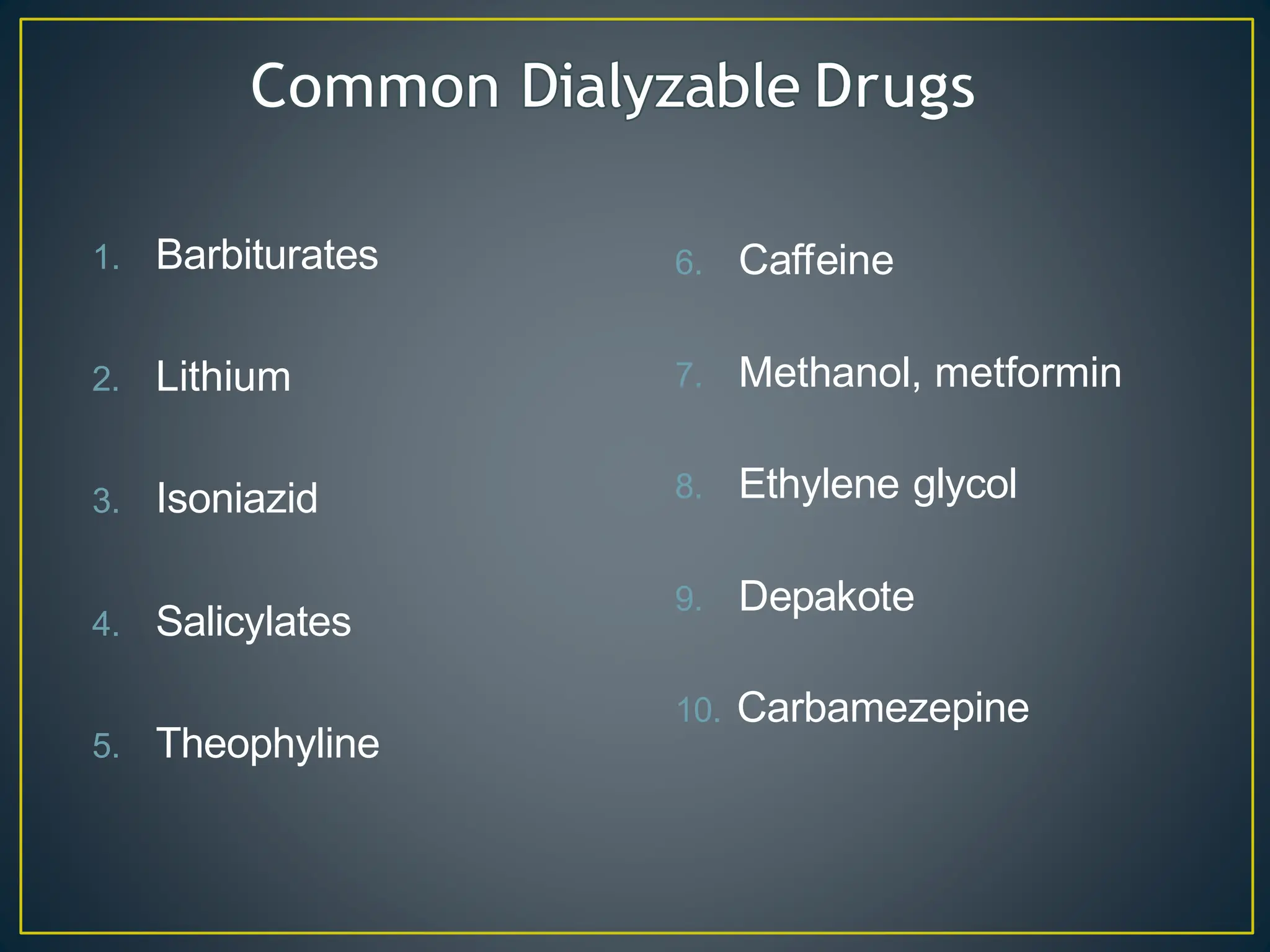
1. Barbiturates
2. Lithium
3. Isoniazid
4. Salicylates
6. Caffeine
7. Methanol, metformin
8. Ethylene glycol
9. Depakote
10. Carbamezepine
5. Theophyline
It’s a medication of barbiturates class, recommended by
WHO for the treatment of all types of epilepsy except
absence epilepsy.
It is on the WHO’s List of Essential Medicines, the most
effective and safe medicines needed in a health system.
Phenobarbitone is absorbed slowly in GIT. Peak blood conc.
(PO) reached in 8-12 hours and peak brain conc. in 10-15
hours.
When administered IV, the onset of action occurs within 5
minutes and maximum effects achieved within 30 minutes.
IM or SC administration results in a slightly slower action.
The major inactive metabolite is the
parahydroxy derivative, which is excreted in the
urine.
The inactive metabolites of the barbiturates are excreted as
conjugates of glucuronic acid.
Dose available 30, 60mg tabs, Phenobarbitone
sodium 200mg/ml inj.
Lithium was used during the 19th century totreat gout.
Salts such as lithium carbonate (Li2CO3), lithium citrate, and
lithium orotate are mood stabilizers.
They are used in the treatment of bipolar disorder.
They counteract both mania anddepression.
It is also sometimes prescribed for preventive treatment of
migraine and cluster headaches.
The mechanism of action is still unknown.
Methanol, also known as methyl alcohol.
A chemical with formula CH3OH (a methyl group linked to
a hydroxyl group).
Methanol acquired the name wood alcohol because it
was once produced by the destructive distillation of wood.
Methanol is absorbed through inhalation or
ingestion.
Methyl alcohol is readily absorbed from GIT and respiratory
tracts.
1. In the first step, oxidation to formaldehyde by
hepatic alcohol dehydrogenase, which is a rate-
limiting process.
2. In the second step, formaldehyde is oxidized by
aldehyde dehydrogenase to formic acid or
formate depending on the pH.
3. In the third step, formic acid is detoxified by a
folate-dependent pathway to carbon dioxide.
• the rate of elimination of drugs excreted by the kidneys is
proportional to the glomerular filtration rate. The serum
creatinine , creatinine clearance is needed to determine
renal function before prescribing many drugs . The
Cockcroft and Gault equation is useful for this purpose, as
shown in the following formula:
• CrCl (ml/min) = (140-age)x (BW in kg)(x0.85if female)
72x Scr(mg/dl)
Antimicrobial and antiprotozoal drugs
Drug Dosage for severe renal failure
Amoxycillin
Half-life
Normal/ESRD
(h)
0.09-2.3/5-20 Maximum 500 mgq 8h
Amoxycillin
Clavulanic acid PO
Maximum 375 mg q12 h
ampicillin
Amoxycillin
0.9-2.3/5-20
Clavulanic
acid1/3-4
0.8-1.5/7-20 250-500 mg q6h
Cefotaxime IV 1/15 1g loading dose then 50% standard
dose
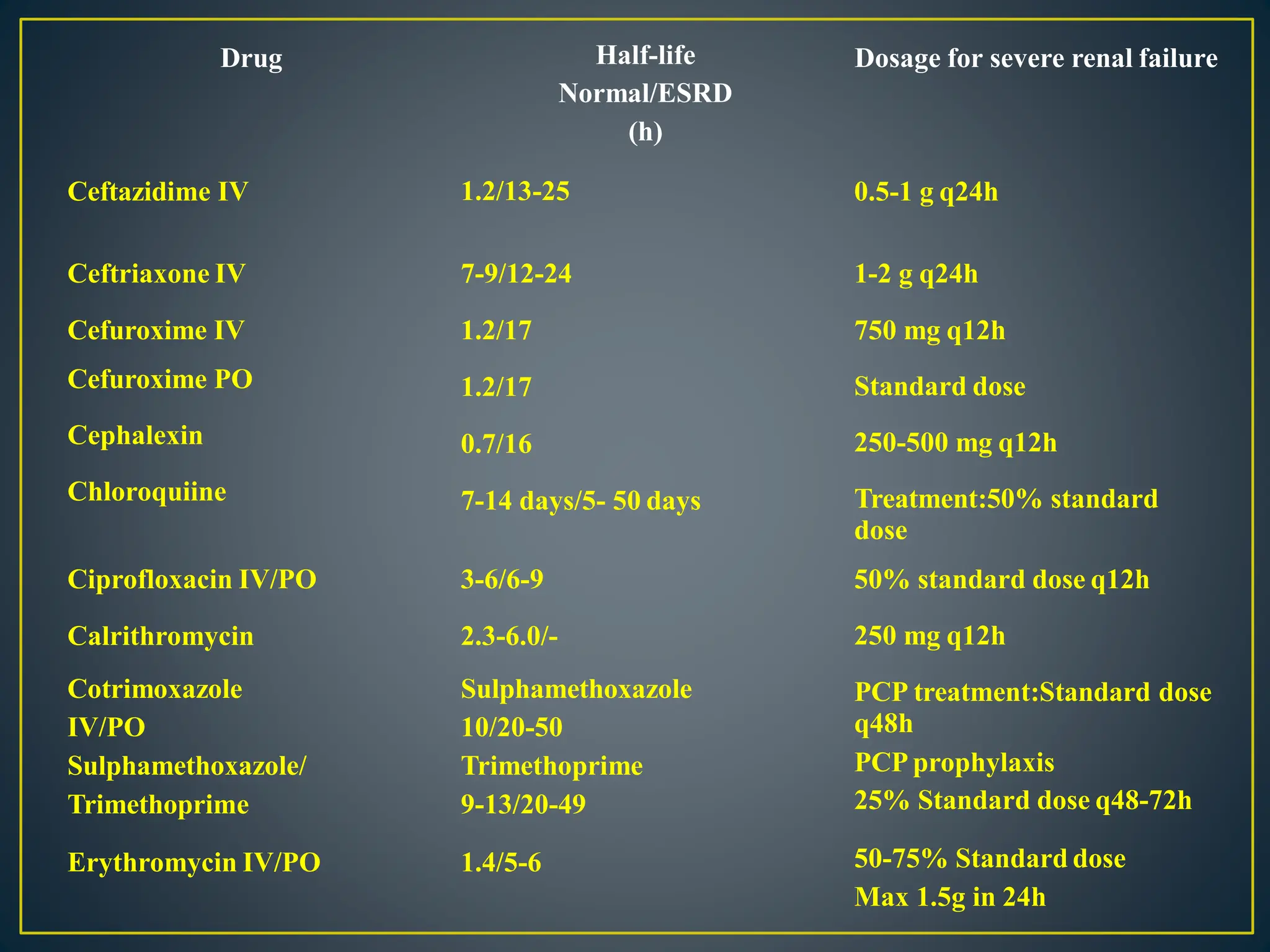
Drug Dosage for severe renal failure
Ceftazidime IV
Half-life
Normal/ESRD
(h)
1.2/13-25 0.5-1 g q24h
1-2 g q24h
750 mg q12h
Standard dose
250-500 mg q12h
Ceftriaxone IV
Cefuroxime IV
Cefuroxime PO
Cephalexin
Chloroquiine
7-9/12-24
1.2/17
1.2/17
0.7/16
7-14 days/5- 50 days Treatment:50% standard
dose
50% standard dose q12h
250 mg q12h
PCP treatment:Standard dose
q48h
PCP prophylaxis
25% Standard dose q48-72h
Ciprofloxacin IV/PO
Calrithromycin
Cotrimoxazole
IV/PO
Sulphamethoxazole/
Trimethoprime
Erythromycin IV/PO
3-6/6-9
2.3-6.0/-
Sulphamethoxazole
10/20-50
Trimethoprime
9-13/20-49
1.4/5-6 50-75% Standard dose
Max 1.5g in 24h
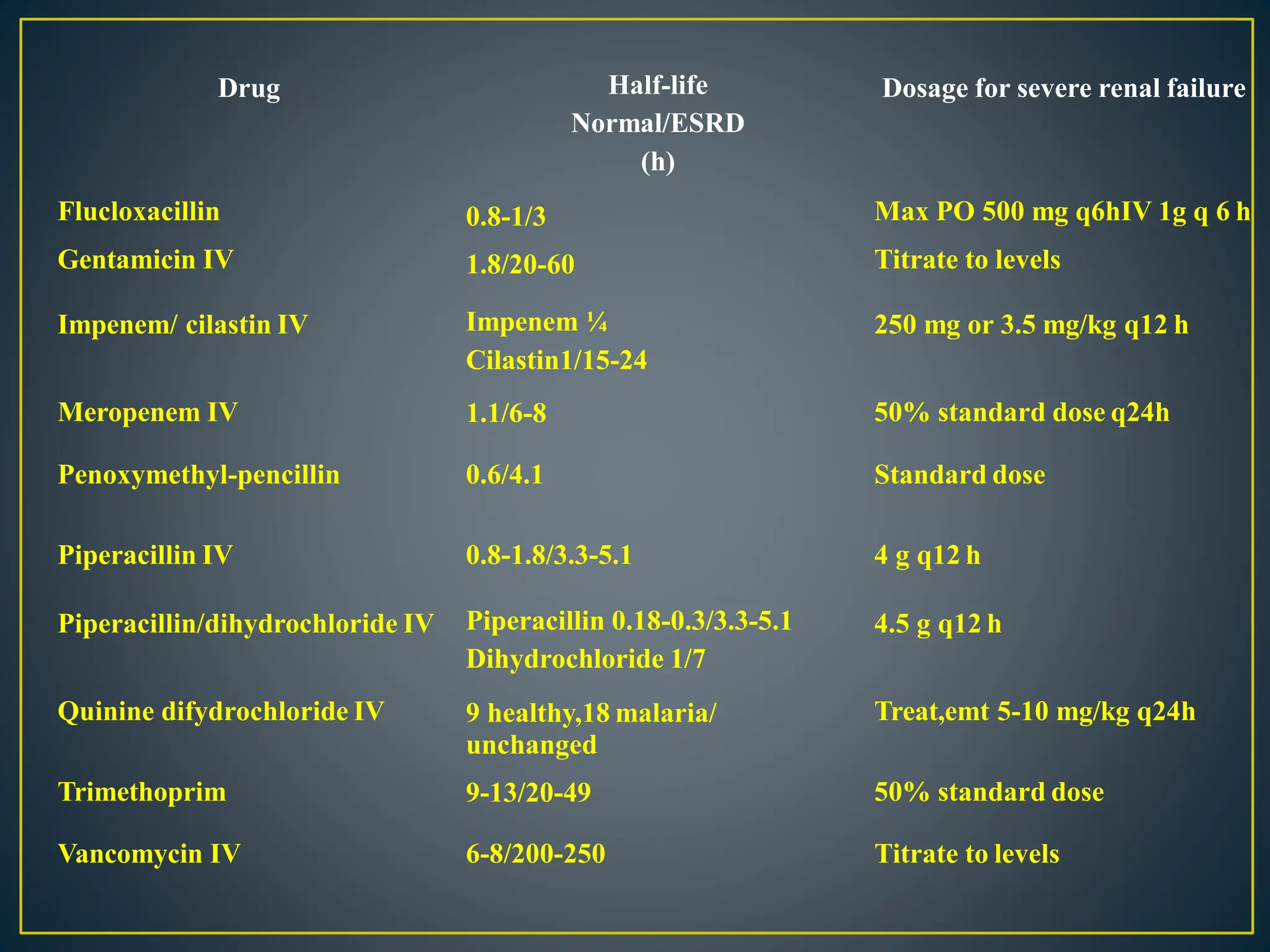
Drug Half-life
Normal/ESRD
(h)
Dosage for severe renal failure
Flucloxacillin
Gentamicin IV
0.8-1/3
1.8/20-60
Max PO 500 mg q6hIV 1g q 6 h
Titrate to levels
Impenem/ cilastin IV 250 mg or 3.5 mg/kg q12 h
Meropenem IV
Impenem ¼
Cilastin1/15-24
1.1/6-8 50% standard dose q24h
Penoxymethyl-pencillin 0.6/4.1 Standard dose
Piperacillin IV 0.8-1.8/3.3-5.1 4 g q12 h
Piperacillin/dihydrochloride IV 4.5 g q12 h
Quinine difydrochloride IV Treat,emt 5-10 mg/kg q24h
Trimethoprim
Piperacillin 0.18-0.3/3.3-5.1
Dihydrochloride 1/7
9 healthy,18 malaria/
unchanged
9-13/20-49 50% standard dose
Vancomycin IV 6-8/200-250 Titrate to levels
Dosing of common drugs in renal patients
Allopurinol-GFR 30 ml/min use
100mg,60ml/min use 200mg,90ml/min use
300mg
Corticosteroids-no need to change the dose
NSAIDs :-most are metabolized in the
liver , aspirin is a good choice in
renal impairment,
In patients with low urine output avoid
sulindac owing to renal stone formation.
Reduce dose of ketoprofen
Penicillamine ,avoid if GFR less than
50ml/min
Cyclosporine, no dose adjustment in renal
insufficiency, however use of Cyclosporine can
worsen renal insufficiency
Gold , if GFR 50-75ml/min use 50% of
usual dose ,if less than 50% avoid gold
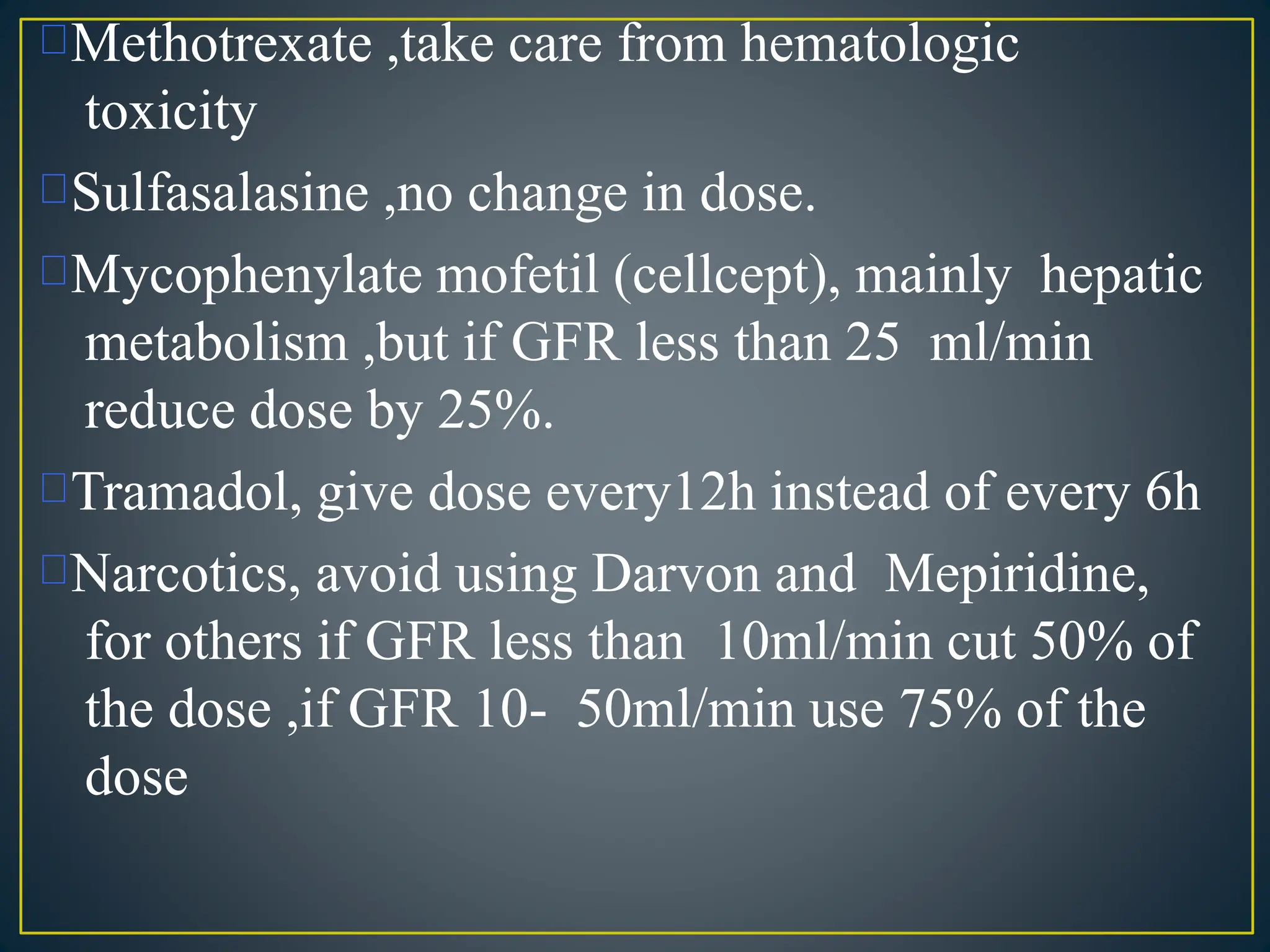
Methotrexate ,take care from hematologic
toxicity
Sulfasalasine ,no change in dose.
Mycophenylate mofetil (cellcept), mainly hepatic
metabolism ,but if GFR less than 25 ml/min
reduce dose by 25%.
Tramadol, give dose every12h instead of every 6h
Narcotics, avoid using Darvon and Mepiridine,
for others if GFR less than 10ml/min cut 50% of
the dose ,if GFR 10- 50ml/min use 75% of the
dose

Dialyzable drugs.pptx FOR THE DIALYSIS TECHNOLOGY

  • 2.
    These are pharmaceuticalagents that are capable of beingdialyzed. Capable of diffusing through a dialyzing membrane. The amount of drug dialyzed determines whether supplementary dosing is required during or following dialysis.
  • 3.
    Dialyzability of drugdetermined by several physicochemical characteristics. Concentration of drug in plasma – High plasma concentration of drug undergo high diffusion through dialytic membrane. Molecular size – Drugs having large molecular size unable to diffuse through dialytic membrane. Protein binding – Protein bound drug have large molecular size so unable to cross the membrane. Drugs available in free form in plasma undergo high diffusion through membrane.
  • 4.
    Volume of distribution– Large Vd, means low plasma concentration of drug thus minimally dialysed and vice versa. Water solubility – Dialysate used for dialysis is aqueous solution. Drugs with more water solubility will dialyze to greater extent as compared to the lipid soluble drugs. Plasma clearance – Type of clearance preferred for drug. Renal clearance is replaced by dialysate clearance. Dialysis procedure – HD or PD (Pores of PD membrane are larger as compared to HD) Dialysis Membrane - Pore size, surface area, and geometry are theprimary determinant.
  • 5.
    1. Barbiturates 2. Lithium 3.Isoniazid 4. Salicylates 6. Caffeine 7. Methanol, metformin 8. Ethylene glycol 9. Depakote 10. Carbamezepine 5. Theophyline
  • 6.
    It’s a medicationof barbiturates class, recommended by WHO for the treatment of all types of epilepsy except absence epilepsy. It is on the WHO’s List of Essential Medicines, the most effective and safe medicines needed in a health system. Phenobarbitone is absorbed slowly in GIT. Peak blood conc. (PO) reached in 8-12 hours and peak brain conc. in 10-15 hours. When administered IV, the onset of action occurs within 5 minutes and maximum effects achieved within 30 minutes. IM or SC administration results in a slightly slower action.
  • 7.
    The major inactivemetabolite is the parahydroxy derivative, which is excreted in the urine. The inactive metabolites of the barbiturates are excreted as conjugates of glucuronic acid. Dose available 30, 60mg tabs, Phenobarbitone sodium 200mg/ml inj.
  • 8.
    Lithium was usedduring the 19th century totreat gout. Salts such as lithium carbonate (Li2CO3), lithium citrate, and lithium orotate are mood stabilizers. They are used in the treatment of bipolar disorder. They counteract both mania anddepression. It is also sometimes prescribed for preventive treatment of migraine and cluster headaches. The mechanism of action is still unknown.
  • 9.
    Methanol, also knownas methyl alcohol. A chemical with formula CH3OH (a methyl group linked to a hydroxyl group). Methanol acquired the name wood alcohol because it was once produced by the destructive distillation of wood. Methanol is absorbed through inhalation or ingestion. Methyl alcohol is readily absorbed from GIT and respiratory tracts.
  • 10.
    1. In thefirst step, oxidation to formaldehyde by hepatic alcohol dehydrogenase, which is a rate- limiting process. 2. In the second step, formaldehyde is oxidized by aldehyde dehydrogenase to formic acid or formate depending on the pH. 3. In the third step, formic acid is detoxified by a folate-dependent pathway to carbon dioxide.
  • 13.
    • the rateof elimination of drugs excreted by the kidneys is proportional to the glomerular filtration rate. The serum creatinine , creatinine clearance is needed to determine renal function before prescribing many drugs . The Cockcroft and Gault equation is useful for this purpose, as shown in the following formula: • CrCl (ml/min) = (140-age)x (BW in kg)(x0.85if female) 72x Scr(mg/dl)
  • 14.
    Antimicrobial and antiprotozoaldrugs Drug Dosage for severe renal failure Amoxycillin Half-life Normal/ESRD (h) 0.09-2.3/5-20 Maximum 500 mgq 8h Amoxycillin Clavulanic acid PO Maximum 375 mg q12 h ampicillin Amoxycillin 0.9-2.3/5-20 Clavulanic acid1/3-4 0.8-1.5/7-20 250-500 mg q6h Cefotaxime IV 1/15 1g loading dose then 50% standard dose
  • 15.
    Drug Dosage forsevere renal failure Ceftazidime IV Half-life Normal/ESRD (h) 1.2/13-25 0.5-1 g q24h 1-2 g q24h 750 mg q12h Standard dose 250-500 mg q12h Ceftriaxone IV Cefuroxime IV Cefuroxime PO Cephalexin Chloroquiine 7-9/12-24 1.2/17 1.2/17 0.7/16 7-14 days/5- 50 days Treatment:50% standard dose 50% standard dose q12h 250 mg q12h PCP treatment:Standard dose q48h PCP prophylaxis 25% Standard dose q48-72h Ciprofloxacin IV/PO Calrithromycin Cotrimoxazole IV/PO Sulphamethoxazole/ Trimethoprime Erythromycin IV/PO 3-6/6-9 2.3-6.0/- Sulphamethoxazole 10/20-50 Trimethoprime 9-13/20-49 1.4/5-6 50-75% Standard dose Max 1.5g in 24h
  • 16.
    Drug Half-life Normal/ESRD (h) Dosage forsevere renal failure Flucloxacillin Gentamicin IV 0.8-1/3 1.8/20-60 Max PO 500 mg q6hIV 1g q 6 h Titrate to levels Impenem/ cilastin IV 250 mg or 3.5 mg/kg q12 h Meropenem IV Impenem ¼ Cilastin1/15-24 1.1/6-8 50% standard dose q24h Penoxymethyl-pencillin 0.6/4.1 Standard dose Piperacillin IV 0.8-1.8/3.3-5.1 4 g q12 h Piperacillin/dihydrochloride IV 4.5 g q12 h Quinine difydrochloride IV Treat,emt 5-10 mg/kg q24h Trimethoprim Piperacillin 0.18-0.3/3.3-5.1 Dihydrochloride 1/7 9 healthy,18 malaria/ unchanged 9-13/20-49 50% standard dose Vancomycin IV 6-8/200-250 Titrate to levels
  • 17.
    Dosing of commondrugs in renal patients Allopurinol-GFR 30 ml/min use 100mg,60ml/min use 200mg,90ml/min use 300mg Corticosteroids-no need to change the dose NSAIDs :-most are metabolized in the liver , aspirin is a good choice in renal impairment,
  • 18.
    In patients withlow urine output avoid sulindac owing to renal stone formation. Reduce dose of ketoprofen Penicillamine ,avoid if GFR less than 50ml/min Cyclosporine, no dose adjustment in renal insufficiency, however use of Cyclosporine can worsen renal insufficiency Gold , if GFR 50-75ml/min use 50% of usual dose ,if less than 50% avoid gold
  • 19.
    Methotrexate ,take carefrom hematologic toxicity Sulfasalasine ,no change in dose. Mycophenylate mofetil (cellcept), mainly hepatic metabolism ,but if GFR less than 25 ml/min reduce dose by 25%. Tramadol, give dose every12h instead of every 6h Narcotics, avoid using Darvon and Mepiridine, for others if GFR less than 10ml/min cut 50% of the dose ,if GFR 10- 50ml/min use 75% of the dose