Introduction to Sutures
•Definition: Sutures are used to approximate tissues and aid in wound
healing.
• Importance: Proper suture selection and technique minimize
complications.
3.
Classification of Sutures
•Absorbable vs. Non-Absorbable Sutures
• 1 Absorbable: Degraded by body enzymes (e.g., Catgut, Vicryl, PDS).
• Non-Absorbable: Requires removal or remains permanently (e.g., Silk,
Nylon, Prolene).
• 2. Monofilament vs. Multifilament Sutures
• Monofilament: Single strand, less friction, lower infection risk.
• Multifilament: Braided, stronger but higher infection risk.
4.
• 3. Naturalvs. Synthetic Sutures
• Natural: Derived from biological sources (e.g., Catgut, Silk)
• Synthetic: Made from polymers, predictable absorption (e.g., PDS,
Vicryl).
5.
Commonly Used Suturesand Their Applications
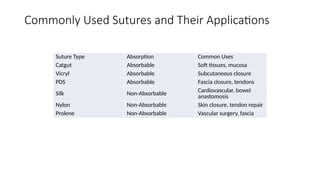
Suture Type Absorption Common Uses
Catgut Absorbable Soft tissues, mucosa
Vicryl Absorbable Subcutaneous closure
PDS Absorbable Fascia closure, tendons
Silk Non-Absorbable
Cardiovascular, bowel
anastomosis
Nylon Non-Absorbable Skin closure, tendon repair
Prolene Non-Absorbable Vascular surgery, fascia
6.
Suture Needle Types
•Tapered Needle: Used for soft tissues (e.g., intestine, blood vessels).
• Cutting Needle: Used for tough tissues (e.g., skin, tendon).
• Conventional Cutting: Triangular with a sharp edge.
• Reverse Cutting: Stronger, less traumatic.
• Blunt Needle: Used in delicate tissues (e.g., liver).
7.
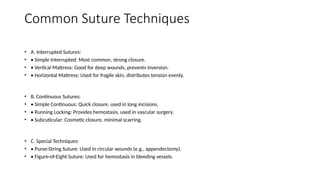
Common Suture Techniques
•A. Interrupted Sutures:
• • Simple Interrupted: Most common, strong closure.
• • Vertical Mattress: Good for deep wounds, prevents inversion.
• • Horizontal Mattress: Used for fragile skin, distributes tension evenly.
• B. Continuous Sutures:
• • Simple Continuous: Quick closure, used in long incisions.
• • Running Locking: Provides hemostasis, used in vascular surgery.
• • Subcuticular: Cosmetic closure, minimal scarring.
• C. Special Techniques:
• • Purse-String Suture: Used in circular wounds (e.g., appendectomy).
• • Figure-of-Eight Suture: Used for hemostasis in bleeding vessels.
8.
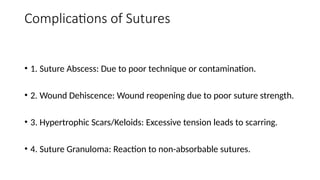
Complications of Sutures
•1. Suture Abscess: Due to poor technique or contamination.
• 2. Wound Dehiscence: Wound reopening due to poor suture strength.
• 3. Hypertrophic Scars/Keloids: Excessive tension leads to scarring.
• 4. Suture Granuloma: Reaction to non-absorbable sutures.
9.
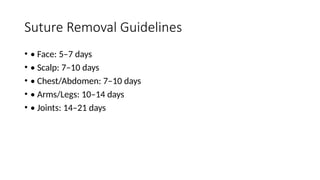
Suture Removal Guidelines
•• Face: 5–7 days
• • Scalp: 7–10 days
• • Chest/Abdomen: 7–10 days
• • Arms/Legs: 10–14 days
• • Joints: 14–21 days