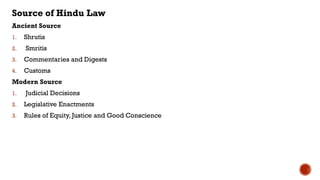
Source of HinduLaw
Ancient Source
1. Shrutis
2. Smritis
3. Commentaries and Digests
4. Customs
Modern Source
1. Judicial Decisions
2. Legislative Enactments
3. Rules of Equity, Justice and Good Conscience
3.
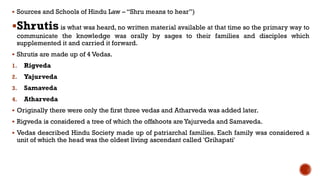
Sources andSchools of Hindu Law – “Shru means to hear”)
Shrutisis what was heard, no written material available at that time so the primary way to
communicate the knowledge was orally by sages to their families and disciples which
supplemented it and carried it forward.
Shrutis are made up of 4 Vedas.
1. Rigveda
2. Yajurveda
3. Samaveda
4. Atharveda
Originally there were only the first three vedas and Atharveda was added later.
Rigveda is considered a tree of which the offshoots are Yajurveda and Samaveda.
Vedas described Hindu Society made up of patriarchal families. Each family was considered a
unit of which the head was the oldest living ascendant called 'Grihapati'
4.
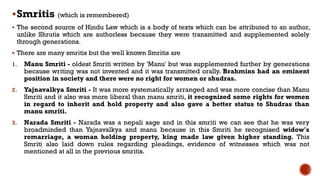
Smritis (which isremembered)
The second source of Hindu Law which is a body of texts which can be attributed to an author,
unlike Shrutis which are authorless because they were transmitted and supplemented solely
through generations.
There are many smritis but the well known Smritis are
1. Manu Smriti - oldest Smriti written by 'Manu' but was supplemented further by generations
because writing was not invented and it was transmitted orally. Brahmins had an eminent
position in society and there were no right for women or shudras.
2. Yajnavalkya Smriti - It was more systematically arranged and was more concise than Manu
Smriti and it also was more liberal than manu smriti, it recognized some rights for women
in regard to inherit and hold property and also gave a better status to Shudras than
manu smriti.
3. Narada Smriti - Narada was a nepali sage and in this smriti we can see that he was very
broadminded than Yajnavalkya and manu because in this Smriti he recognised widow's
remarriage, a woman holding property, king made law given higher standing. This
Smriti also laid down rules regarding pleadings, evidence of witnesses which was not
mentioned at all in the previous smritis.
5.
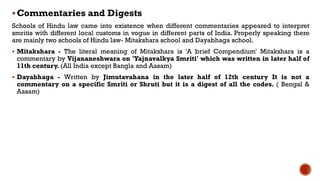
Commentaries and Digests
Schoolsof Hindu law came into existence when different commentaries appeared to interpret
smritis with different local customs in vogue in different parts of India. Properly speaking there
are mainly two schools of Hindu law- Mitakshara school and Dayabhaga school.
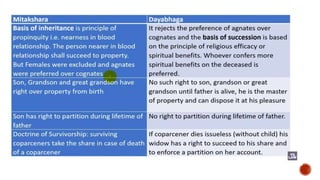
Mitakshara - The literal meaning of Mitakshara is 'A brief Compendium' Mitakshara is a
commentary by Vijananeshwara on 'Yajnavalkya Smriti' which was written in later half of
11th century. (All India except Bangla and Aasam)
Dayabhaga - Written by Jimutavahana in the later half of 12th century It is not a
commentary on a specific Smriti or Shruti but it is a digest of all the codes. ( Bengal &
Aasam)
6.
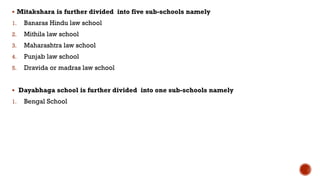
Mitakshara isfurther divided into five sub-schools namely
1. Banaras Hindu law school
2. Mithila law school
3. Maharashtra law school
4. Punjab law school
5. Dravida or madras law school
Dayabhaga school is further divided into one sub-schools namely
1. Bengal School
7.
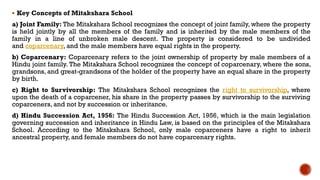
Key Conceptsof Mitakshara School
a) Joint Family: The Mitakshara School recognizes the concept of joint family, where the property
is held jointly by all the members of the family and is inherited by the male members of the
family in a line of unbroken male descent. The property is considered to be undivided
and coparcenary, and the male members have equal rights in the property.
b) Coparcenary: Coparcenary refers to the joint ownership of property by male members of a
Hindu joint family. The Mitakshara School recognizes the concept of coparcenary, where the sons,
grandsons, and great-grandsons of the holder of the property have an equal share in the property
by birth.
c) Right to Survivorship: The Mitakshara School recognizes the right to survivorship, where
upon the death of a coparcener, his share in the property passes by survivorship to the surviving
coparceners, and not by succession or inheritance.
d) Hindu Succession Act, 1956: The Hindu Succession Act, 1956, which is the main legislation
governing succession and inheritance in Hindu Law, is based on the principles of the Mitakshara
School. According to the Mitakshara School, only male coparceners have a right to inherit
ancestral property, and female members do not have coparcenary rights.
8.
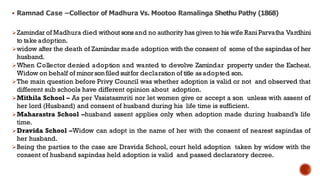
Ramnad Case–Collector of Madhura Vs. Mootoo Ramalinga Shethu Pathy (1868)
Zamindar of Madhura died without sonsand no authority has given to his wife RaniParvatha Vardhini
to take adoption.
widow after the death of Zamindar made adoption with the consent of some of the sapindas of her
husband.
When Collector denied adoption and wanted to devolve Zamindar property under the Escheat.
Widow on behalf of minorsonfiled suitfor declaration of title as adopted son.
The main question before Privy Council was whether adoption is valid or not and observed that
different sub schools have different opinion about adoption.
Mithila School – As per Vasistasmriti nor let women give or accept a son unless with assent of
her lord (Husband) and consent of husband during his life time is sufficient.
Maharastra School –husband assent applies only when adoption made during husband’s life
time.
Dravida School –Widow can adopt in the name of her with the consent of nearest sapindas of
her husband.
Being the parties to the case are Dravida School, court held adoption taken by widow with the
consent of husband sapindas held adoption is valid and passed declaratory decree.
9.
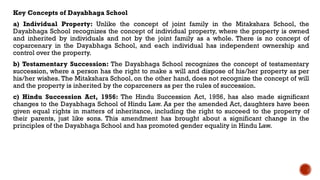
Key Concepts ofDayabhaga School
a) Individual Property: Unlike the concept of joint family in the Mitakshara School, the
Dayabhaga School recognizes the concept of individual property, where the property is owned
and inherited by individuals and not by the joint family as a whole. There is no concept of
coparcenary in the Dayabhaga School, and each individual has independent ownership and
control over the property.
b) Testamentary Succession: The Dayabhaga School recognizes the concept of testamentary
succession, where a person has the right to make a will and dispose of his/her property as per
his/her wishes. The Mitakshara School, on the other hand, does not recognize the concept of will
and the property is inherited by the coparceners as per the rules of succession.
c) Hindu Succession Act, 1956: The Hindu Succession Act, 1956, has also made significant
changes to the Dayabhaga School of Hindu Law. As per the amended Act, daughters have been
given equal rights in matters of inheritance, including the right to succeed to the property of
their parents, just like sons. This amendment has brought about a significant change in the
principles of the Dayabhaga School and has promoted gender equality in Hindu Law.
11.
MIGRATION:
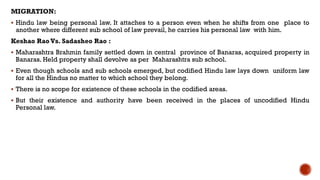
Hindu lawbeing personal law. It attaches to a person even when he shifts from one place to
another where different sub school of law prevail, he carries his personal law with him.
Keshao Rao Vs. Sadasheo Rao :
Maharashtra Brahmin family settled down in central province of Banaras, acquired property in
Banaras. Held property shall devolve as per Maharashtra sub school.
Even though schools and sub schools emerged, but codified Hindu law lays down uniform law
for all the Hindus no matter to which school they belong.
There is no scope for existence of these schools in the codified areas.
But their existence and authority have been received in the places of uncodified Hindu
Personal law.
12.
Muslim law
School ofMuslim Law
Introduction
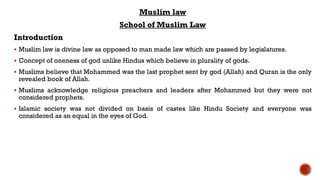
Muslim law is divine law as opposed to man made law which are passed by legislatures.
Concept of oneness of god unlike Hindus which believe in plurality of gods.
Muslims believe that Mohammed was the last prophet sent by god (Allah) and Quran is the only
revealed book of Allah.
Muslims acknowledge religious preachers and leaders after Mohammed but they were not
considered prophets.
Islamic society was not divided on basis of castes like Hindu Society and everyone was
considered as an equal in the eyes of God.
13.
Shia v. Sunniand Schools of Muslim Law
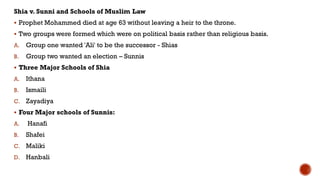
Prophet Mohammed died at age 63 without leaving a heir to the throne.
Two groups were formed which were on political basis rather than religious basis.
A. Group one wanted 'Ali' to be the successor - Shias
B. Group two wanted an election – Sunnis
Three Major Schools of Shia
A. Ithana
B. Ismaili
C. Zayadiya
Four Major schools of Sunnis:
A. Hanafi
B. Shafei
C. Maliki
D. Hanbali
14.
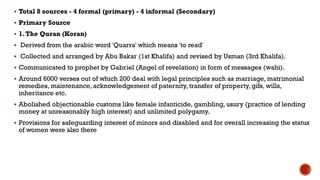
Total 8sources - 4 formal (primary) - 4 informal (Secondary)
Primary Source
1.The Quran (Koran)
Derived from the arabic word 'Quarra' which means 'to read'
Collected and arranged by Abu Bakar (1st Khalifa) and revised by Usman (3rd Khalifa).
Communicated to prophet by Gabriel (Angel of revelation) in form of messages (wahi).
Around 6000 verses out of which 200 deal with legal principles such as marriage, matrimonial
remedies, maintenance, acknowledgement of paternity, transfer of property, gifs, wills,
inheritance etc.
Abolished objectionable customs like female infanticide, gambling, usury (practice of lending
money at unreasonably high interest) and unlimited polygamy.
Provisions for safeguarding interest of minors and disabled and for overall increasing the status
of women were also there
15.
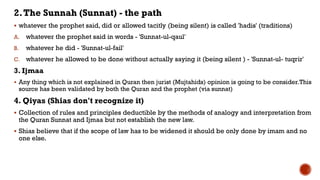
2.The Sunnah (Sunnat)- the path
whatever the prophet said, did or allowed tacitly (being silent) is called 'hadis' (traditions)
A. whatever the prophet said in words - 'Sunnat-ul-qaul'
B. whatever he did - 'Sunnat-ul-fail'
C. whatever he allowed to be done without actually saying it (being silent ) - 'Sunnat-ul- tuqrir'
3. Ijmaa
Any thing which is not explained in Quran then jurist (Mujtahids) opinion is going to be consider.This
source has been validated by both the Quran and the prophet (via sunnat)
4. Qiyas (Shias don't recognize it)
Collection of rules and principles deductible by the methods of analogy and interpretation from
the Quran Sunnat and Ijmaa but not establish the new law.
Shias believe that if the scope of law has to be widened it should be only done by imam and no
one else.
16.
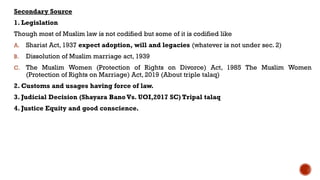
Secondary Source
1. Legislation
Thoughmost of Muslim law is not codified but some of it is codified like
A. Shariat Act, 1937 expect adoption, will and legacies (whatever is not under sec. 2)
B. Dissolution of Muslim marriage act, 1939
C. The Muslim Women (Protection of Rights on Divorce) Act, 1985 The Muslim Women
(Protection of Rights on Marriage) Act, 2019 (About triple talaq)
2. Customs and usages having force of law.
3. Judicial Decision (Shayara Bano Vs. UOI,2017 SC) Tripal talaq
4. Justice Equity and good conscience.
17.
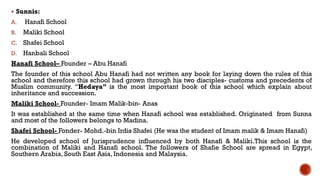
Sunnis:
A. HanafiSchool
B. Maliki School
C. Shafei School
D. Hanbali School
Hanafi School– Founder – Abu Hanafi
The founder of this school Abu Hanafi had not written any book for laying down the rules of this
school and therefore this school had grown through his two disciples- customs and precedents of
Muslim community. “Hedaya” is the most important book of this school which explain about
inheritance and succession.
Maliki School- Founder- Imam Malik-bin- Anas
It was established at the same time when Hanafi school was established. Originated from Sunna
and most of the followers belongs to Madina.
Shafei School- Fonder- Mohd.-bin Irdis Shafei (He was the student of Imam malik & Imam Hanafi)
He developed school of Jurisprudence influenced by both Hanafi & Maliki.This school is the
combination of Maliki and Hanafi school. The followers of Shafie School are spread in Egypt,
Southern Arabia, South East Asia, Indonesia and Malaysia.
18.
Hanbali School- Founder Ahmad bin Hanbal
Ahmed-Ibn-Hanbal established the Hanbali school. He was born in Baghdad. He was a rigid
traditionalist and have utmost importance to the traditions. He considered traditions to be more
important than the other sources.
Schools of Shia
1. Ithana
2. Ismaili
3. Zayadiya
Ithana School -The followers of this school are largest of the Shia school.They are called twelve’s,
means followers of twelve Imams The people who follow the Ithna Asharis school believe that the
last of the Imams disappeared and to be returning as Mehdi(Messiah).
The followers of these schools are mostly found in Iraq and Iran. In India also there is the majority
of the Shia Muslim who follows the principles of the Ithna-Asharis School. They are considered
political quietists. This school is considered as the most dominant school of the shia Muslims. the
ja’fari fiqh of the shias in most cases indistinguishable from one or more of the four sunni
madhahib, except mutah is considered as the lawful marriage.
19.
The Ismailis-According to Ismailis school, The followers of Ismail are know as Ismailyas and
also called as Seveners because they believe that there is only 7 imams not 12 imams.in India
there are two groups, the Khojas or Western Ismailis represents the followers of the present Aga
Khan, who they considered as the 49th Imam in this line of Prophet, and the Bohoras i.e. the
Western Ismailis are divided into Daudis and Sulaymanis.
Zaidiya- The followers of this school are not found in India but are maximum in number in South
Arabia. This school of the shia school is the most dominant among all in Yemen. The followers of
these schools are considered as political activism.



![Schools of Hindu law [mitakshara and dayabhaga] .pptx](https://cdn.slidesharecdn.com/ss_thumbnails/schoolsofhindulawanishajoshi-250922171532-9a5d7eec-thumbnail.jpg?width=640&height=640&fit=bounds)


