Assessing supply & demand
 Forecasting future demand
 Forecasting internal supply
 Forecasting external supply
Job & role analysis
 This is the second stage of the recruitment
and selection process
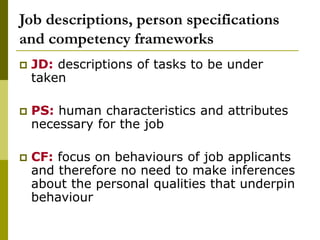
Job descriptions, person specifications
and competency frameworks
 JD: descriptions of tasks to be under
taken
 PS: human characteristics and attributes
necessary for the job
 CF: focus on behaviours of job applicants
and therefore no need to make inferences
about the personal qualities that underpin
behaviour
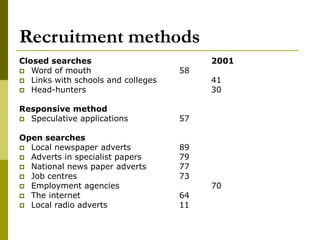
Recruitment methods
Closed searches 2001
 Word of mouth 58
 Links with schools and colleges 41
 Head-hunters 30
Responsive method
 Speculative applications 57
Open searches
 Local newspaper adverts 89
 Adverts in specialist papers 79
 National news paper adverts 77
 Job centres 73
 Employment agencies 70
 The internet 64
 Local radio adverts 11
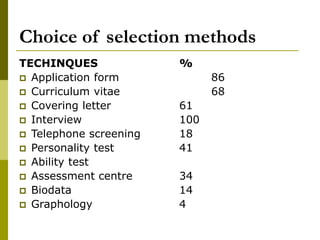
Choice of selection methods
TECHINQUES %
 Application form 86
 Curriculum vitae 68
 Covering letter 61
 Interview 100
 Telephone screening 18
 Personality test 41
 Ability test
 Assessment centre 34
 Biodata 14
 Graphology 4
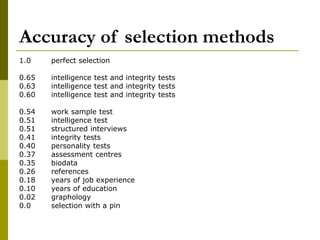
Accuracy of selection methods
1.0 perfect selection
0.65 intelligence test and integrity tests
0.63 intelligence test and integrity tests
0.60 intelligence test and integrity tests
0.54 work sample test
0.51 intelligence test
0.51 structured interviews
0.41 integrity tests
0.40 personality tests
0.37 assessment centres
0.35 biodata
0.26 references
0.18 years of job experience
0.10 years of education
0.02 graphology
0.0 selection with a pin
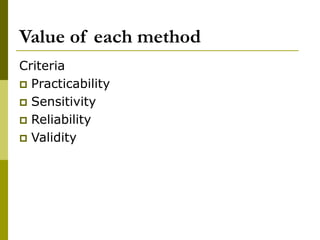
Value of each method
Criteria
 Practicability
 Sensitivity
 Reliability
 Validity
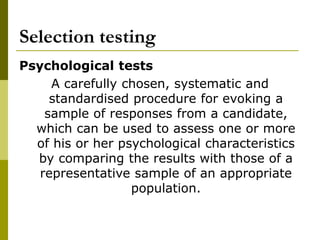
Selection testing
Psychological tests
A carefully chosen, systematic and
standardised procedure for evoking a
sample of responses from a candidate,
which can be used to assess one or more
of his or her psychological characteristics
by comparing the results with those of a
representative sample of an appropriate
population.
Psychometric tests
 First there are tests of achievement that purport
to measure the degree of knowledge and or skill
a person has acquired at the time of the test.
Example – school examinations
 Second, there are test that are designed to
assess the capacity for abstract thinking and
reasoning within a range of different contexts and
medium. Ravens progressive matrices
 Third, the set of tests for special aptitudes or
abilities, such as the assessment of verbal,
numerical or spatial
Psychometric questionnaires /
personality tests
 These are based on trait or type theories
 The most common type are the
 Occupational personality questionnaire
 Myers Briggs Type Indicator
 Californian Psychological Inventory
Differing paradigms of selection
 Social exchange
 Scientific rationality
 Socialisation
 Socially constructed reality, knowledge
and power

dfjyt.ppt

  • 1.
    Assessing supply &demand  Forecasting future demand  Forecasting internal supply  Forecasting external supply
  • 2.
    Job & roleanalysis  This is the second stage of the recruitment and selection process
  • 3.
    Job descriptions, personspecifications and competency frameworks  JD: descriptions of tasks to be under taken  PS: human characteristics and attributes necessary for the job  CF: focus on behaviours of job applicants and therefore no need to make inferences about the personal qualities that underpin behaviour
  • 4.
    Recruitment methods Closed searches2001  Word of mouth 58  Links with schools and colleges 41  Head-hunters 30 Responsive method  Speculative applications 57 Open searches  Local newspaper adverts 89  Adverts in specialist papers 79  National news paper adverts 77  Job centres 73  Employment agencies 70  The internet 64  Local radio adverts 11
  • 5.
    Choice of selectionmethods TECHINQUES %  Application form 86  Curriculum vitae 68  Covering letter 61  Interview 100  Telephone screening 18  Personality test 41  Ability test  Assessment centre 34  Biodata 14  Graphology 4
  • 6.
    Accuracy of selectionmethods 1.0 perfect selection 0.65 intelligence test and integrity tests 0.63 intelligence test and integrity tests 0.60 intelligence test and integrity tests 0.54 work sample test 0.51 intelligence test 0.51 structured interviews 0.41 integrity tests 0.40 personality tests 0.37 assessment centres 0.35 biodata 0.26 references 0.18 years of job experience 0.10 years of education 0.02 graphology 0.0 selection with a pin
  • 7.
    Value of eachmethod Criteria  Practicability  Sensitivity  Reliability  Validity
  • 8.
    Selection testing Psychological tests Acarefully chosen, systematic and standardised procedure for evoking a sample of responses from a candidate, which can be used to assess one or more of his or her psychological characteristics by comparing the results with those of a representative sample of an appropriate population.
  • 9.
    Psychometric tests  Firstthere are tests of achievement that purport to measure the degree of knowledge and or skill a person has acquired at the time of the test. Example – school examinations  Second, there are test that are designed to assess the capacity for abstract thinking and reasoning within a range of different contexts and medium. Ravens progressive matrices  Third, the set of tests for special aptitudes or abilities, such as the assessment of verbal, numerical or spatial
  • 10.
    Psychometric questionnaires / personalitytests  These are based on trait or type theories  The most common type are the  Occupational personality questionnaire  Myers Briggs Type Indicator  Californian Psychological Inventory
  • 11.
    Differing paradigms ofselection  Social exchange  Scientific rationality  Socialisation  Socially constructed reality, knowledge and power