1
Basic Concepts and
Frameworks in Project
Planning and
Management
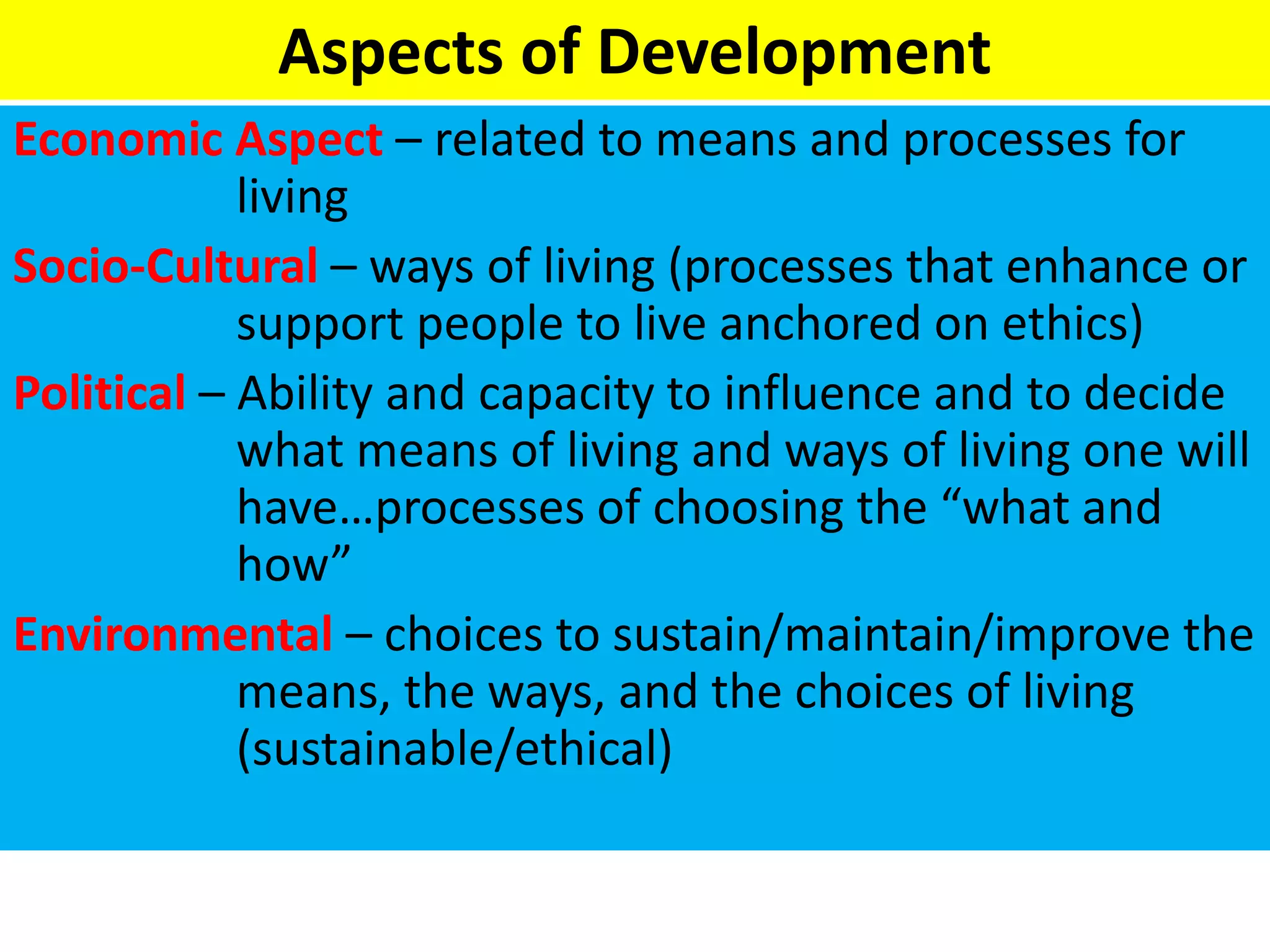
Aspects of Development
Economic Aspect – related to means and processes for
living
Socio-Cultural – ways of living (processes that enhance or
support people to live anchored on ethics)
Political – Ability and capacity to influence and to decide
what means of living and ways of living one will
have…processes of choosing the “what and
how”
Environmental – choices to sustain/maintain/improve the
means, the ways, and the choices of living
(sustainable/ethical)
Basic Concepts
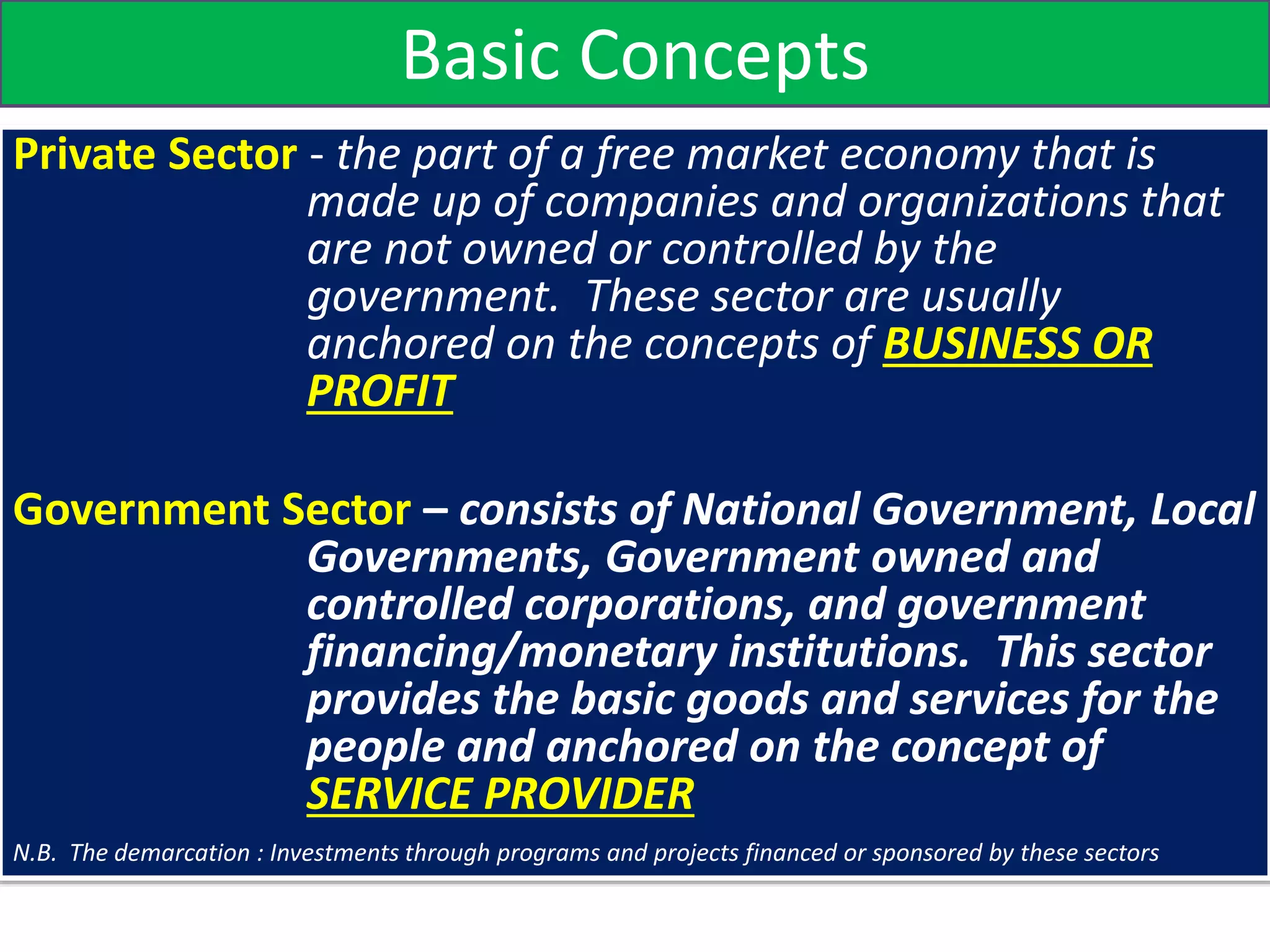
Private Sector - the part of a free market economy that is
made up of companies and organizations that
are not owned or controlled by the
government. These sector are usually
anchored on the concepts of BUSINESS OR
PROFIT
Government Sector – consists of National Government, Local
Governments, Government owned and
controlled corporations, and government
financing/monetary institutions. This sector
provides the basic goods and services for the
people and anchored on the concept of
SERVICE PROVIDER
N.B. The demarcation : Investments through programs and projects financed or sponsored by these sectors
Basic Concepts
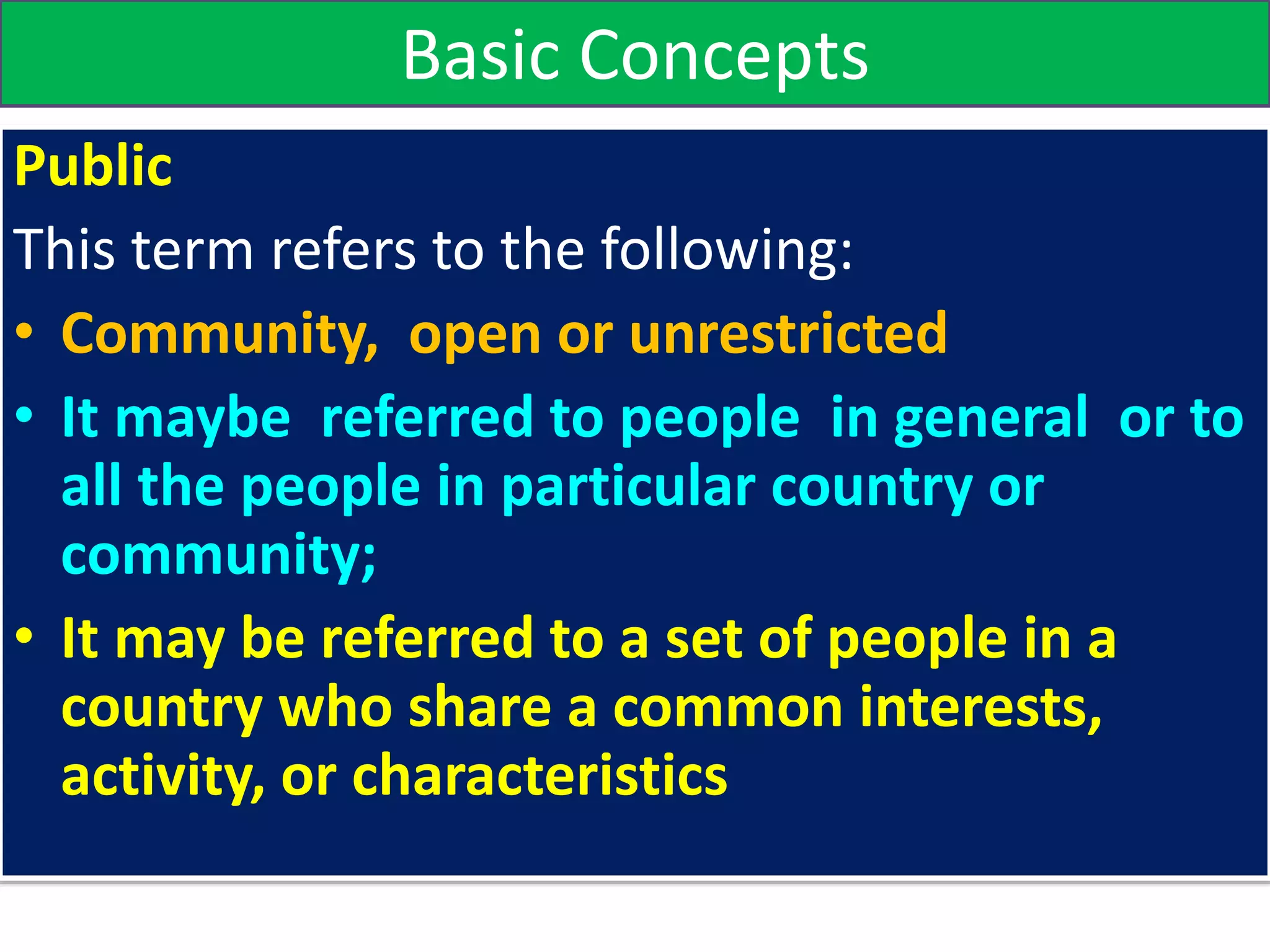
Public
This term refers to the following:
• Community, open or unrestricted
• It maybe referred to people in general or to
all the people in particular country or
community;
• It may be referred to a set of people in a
country who share a common interests,
activity, or characteristics
Basic Concepts
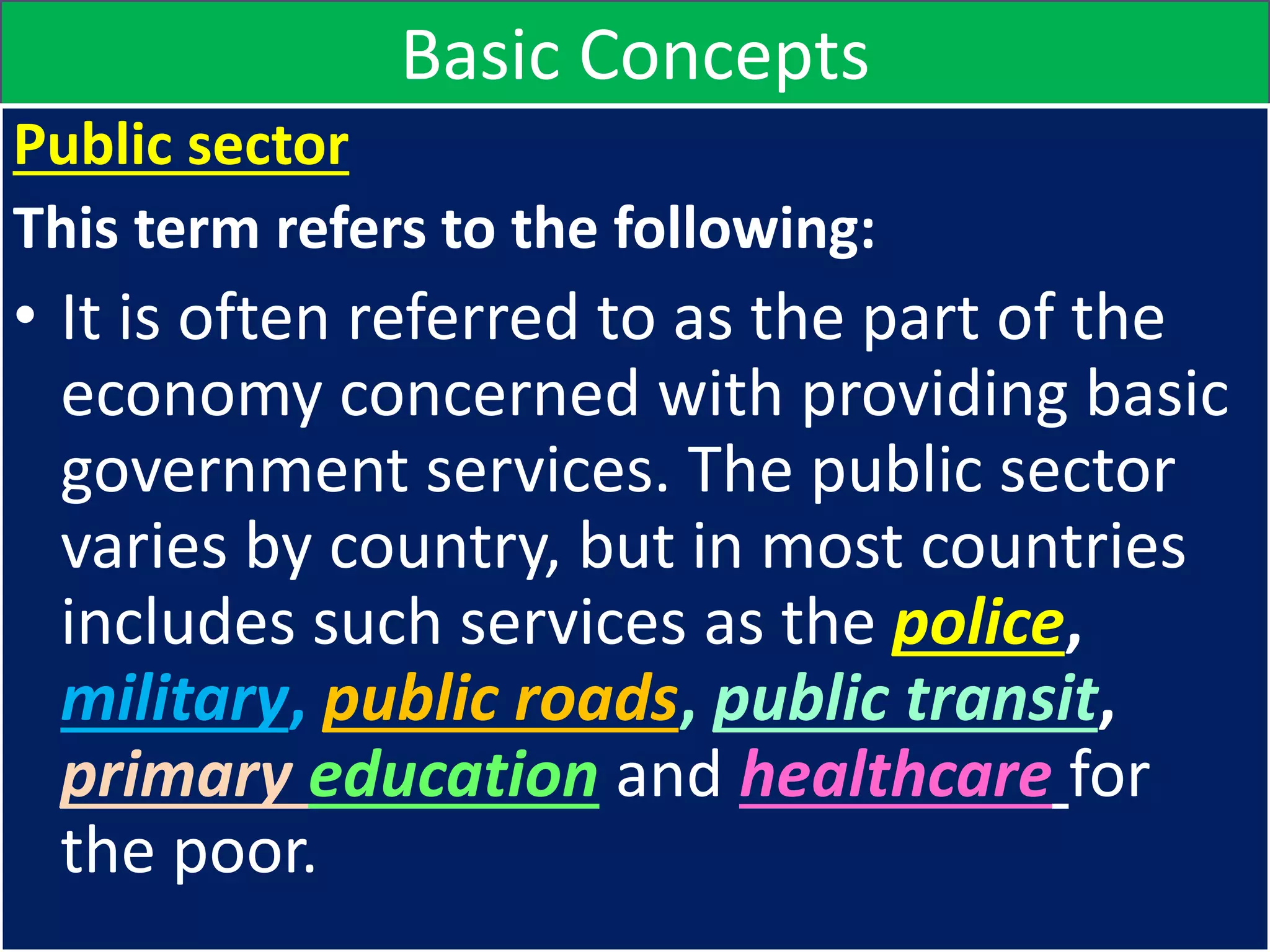
Public sector
This term refers to the following:
• It is often referred to as the part of the
economy concerned with providing basic
government services. The public sector
varies by country, but in most countries
includes such services as the police,
military, public roads, public transit,
primary education and healthcare for
the poor.
Basic Concepts
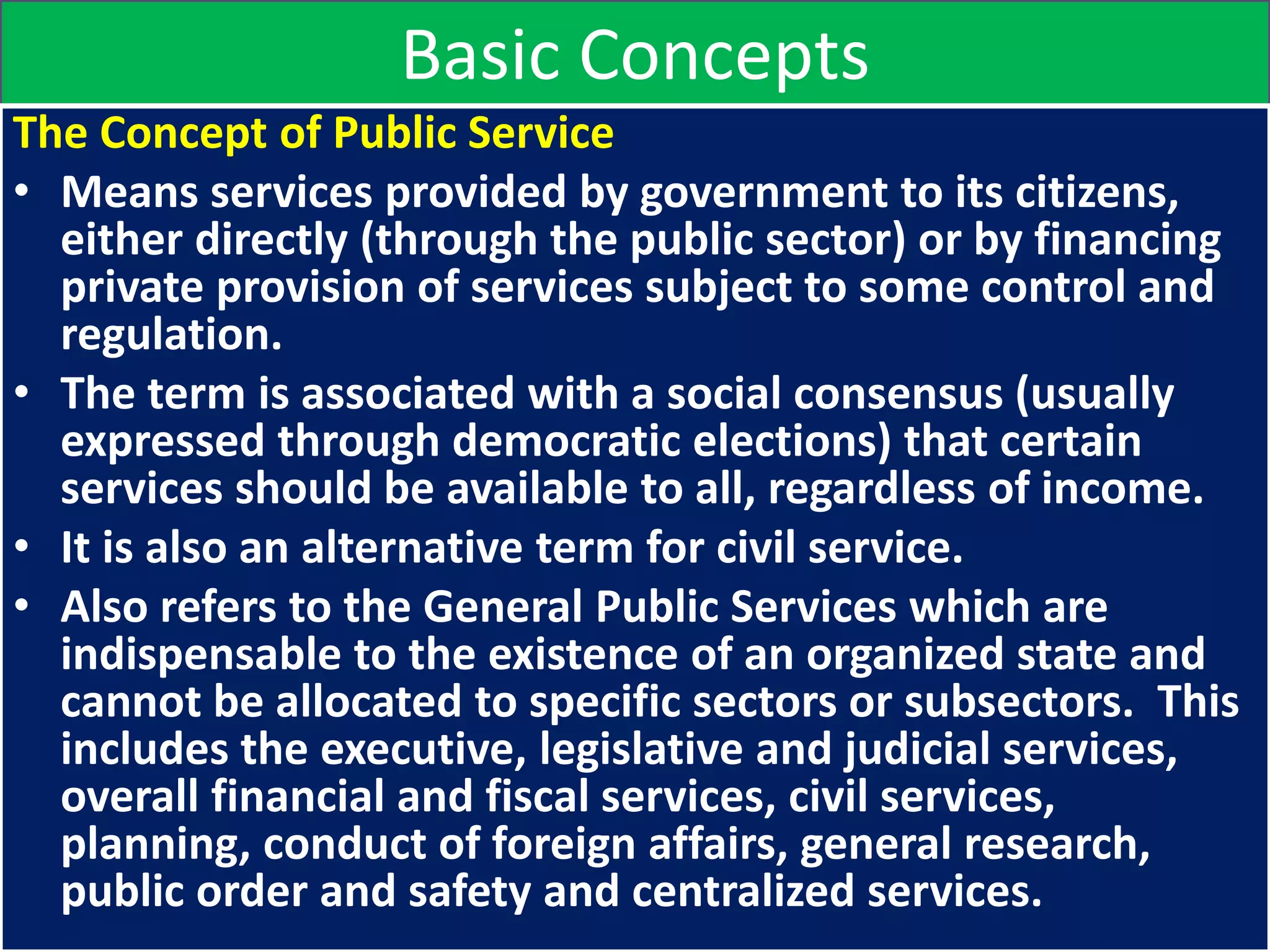
The Concept of Public Service
• Means services provided by government to its citizens,
either directly (through the public sector) or by financing
private provision of services subject to some control and
regulation.
• The term is associated with a social consensus (usually
expressed through democratic elections) that certain
services should be available to all, regardless of income.
• It is also an alternative term for civil service.
• Also refers to the General Public Services which are
indispensable to the existence of an organized state and
cannot be allocated to specific sectors or subsectors. This
includes the executive, legislative and judicial services,
overall financial and fiscal services, civil services,
planning, conduct of foreign affairs, general research,
public order and safety and centralized services.
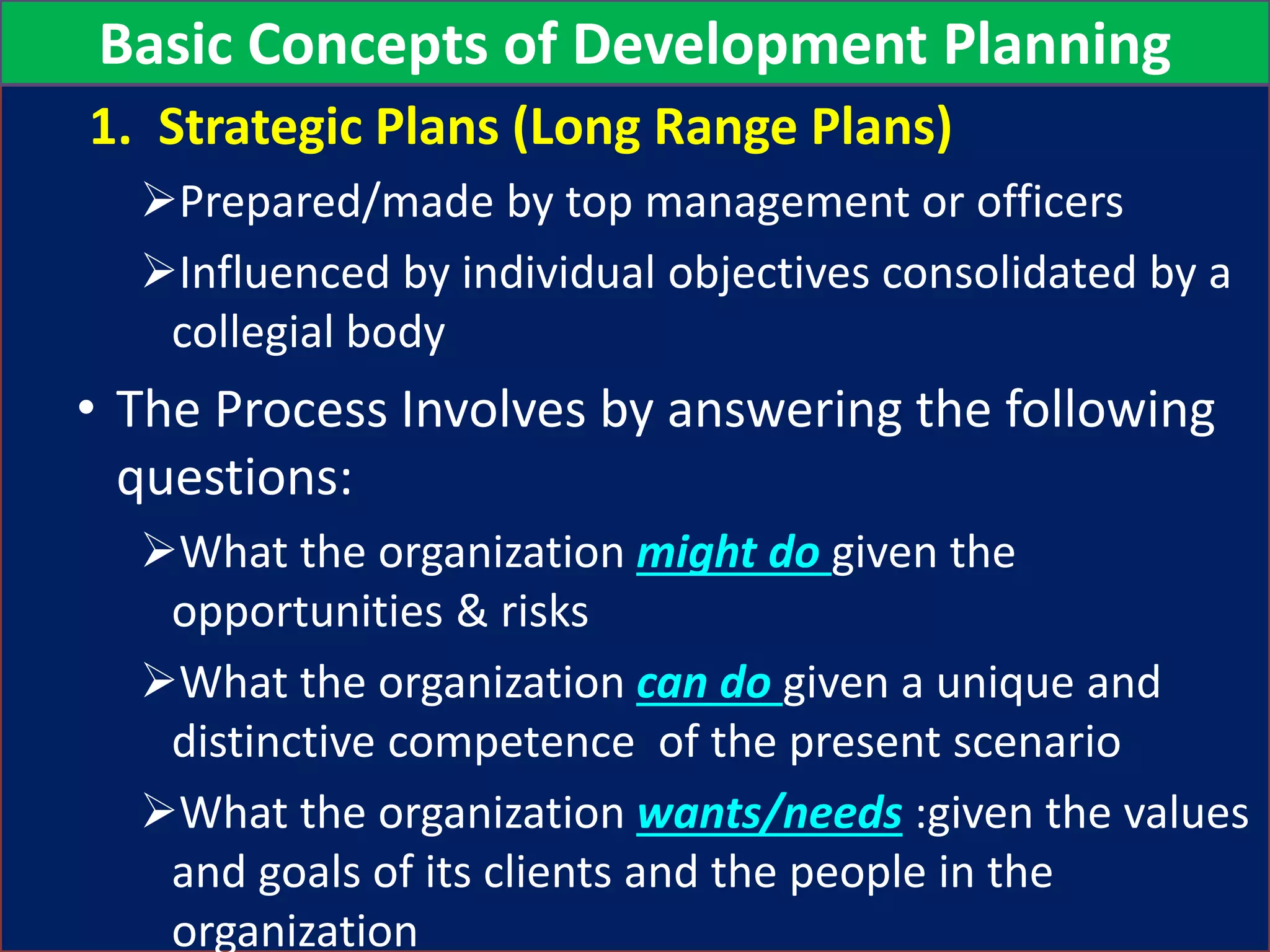
1. Strategic Plans (Long Range Plans)
Prepared/made by top management or officers
Influenced by individual objectives consolidated by a
collegial body
• The Process Involves by answering the following
questions:
What the organization might do given the
opportunities & risks
What the organization can do given a unique and
distinctive competence of the present scenario
What the organization wants/needs :given the values
and goals of its clients and the people in the
organization
Basic Concepts of Development Planning
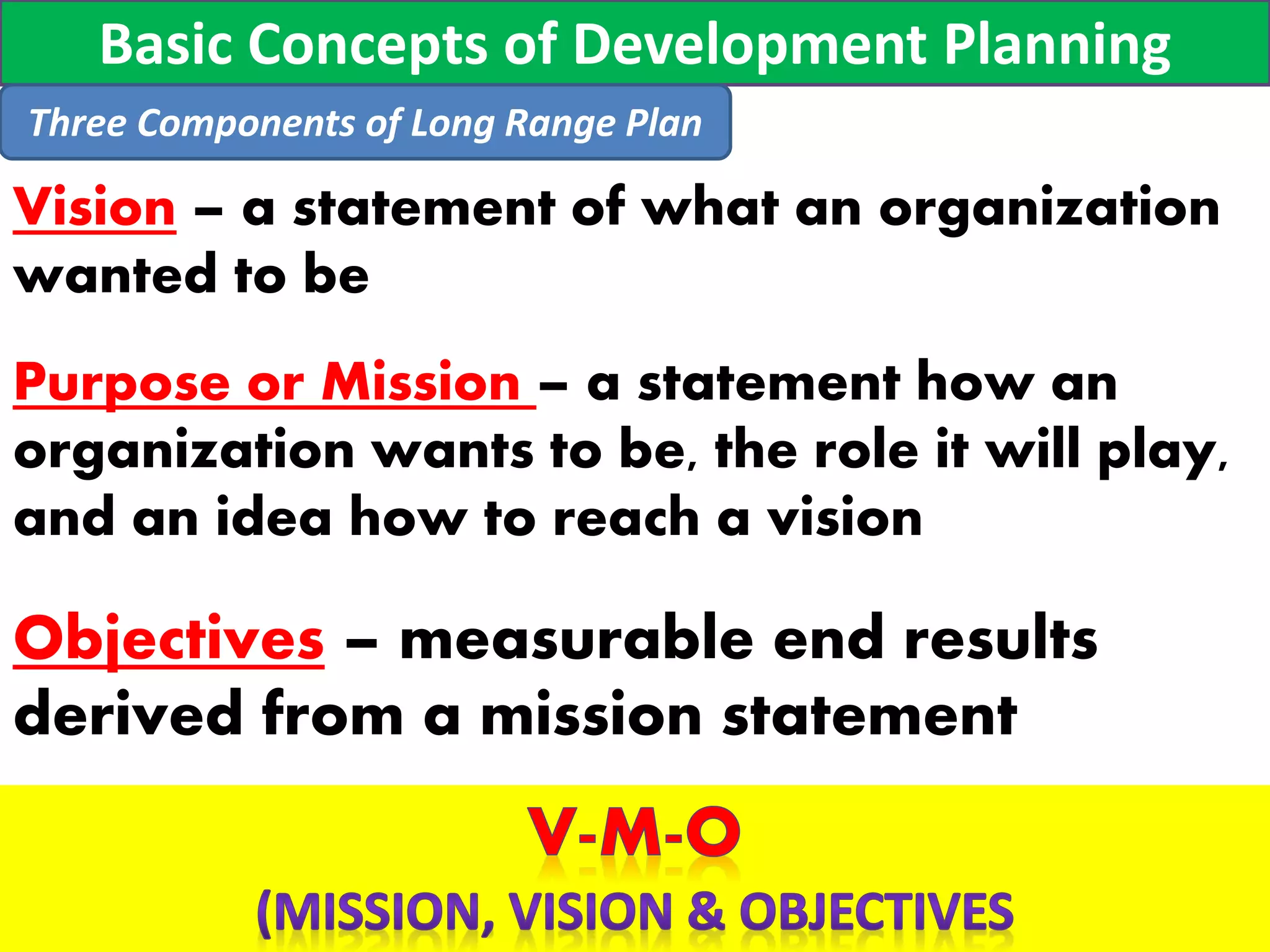
Vision – a statement of what an organization
wanted to be
Purpose or Mission – a statement how an
organization wants to be, the role it will play,
and an idea how to reach a vision
Objectives – measurable end results
derived from a mission statement
Basic Concepts of Development Planning
Three Components of Long Range Plan
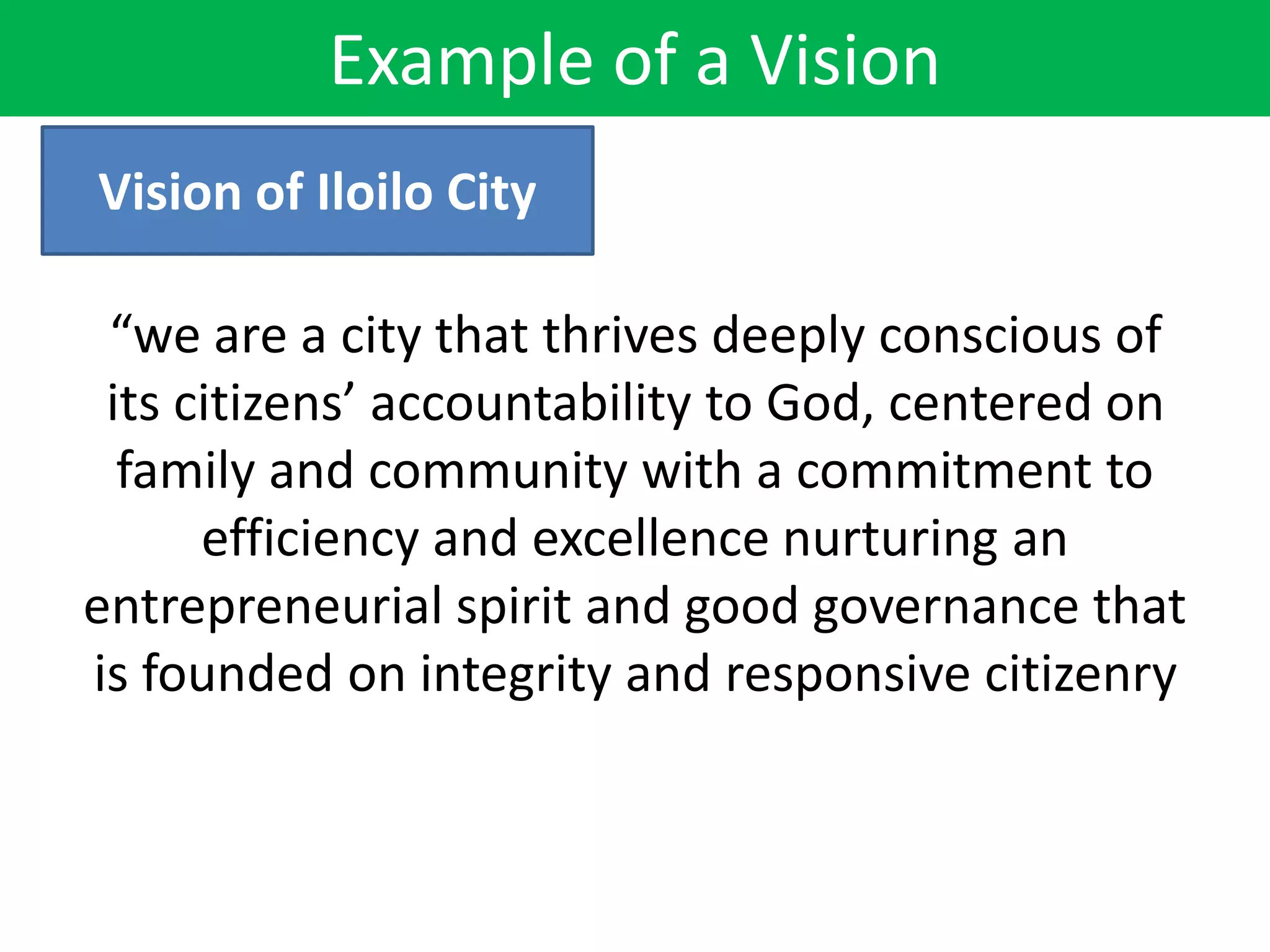
“we are a city that thrives deeply conscious of
its citizens’ accountability to God, centered on
family and community with a commitment to
efficiency and excellence nurturing an
entrepreneurial spirit and good governance that
is founded on integrity and responsive citizenry
Vision of Iloilo City
Example of a Vision
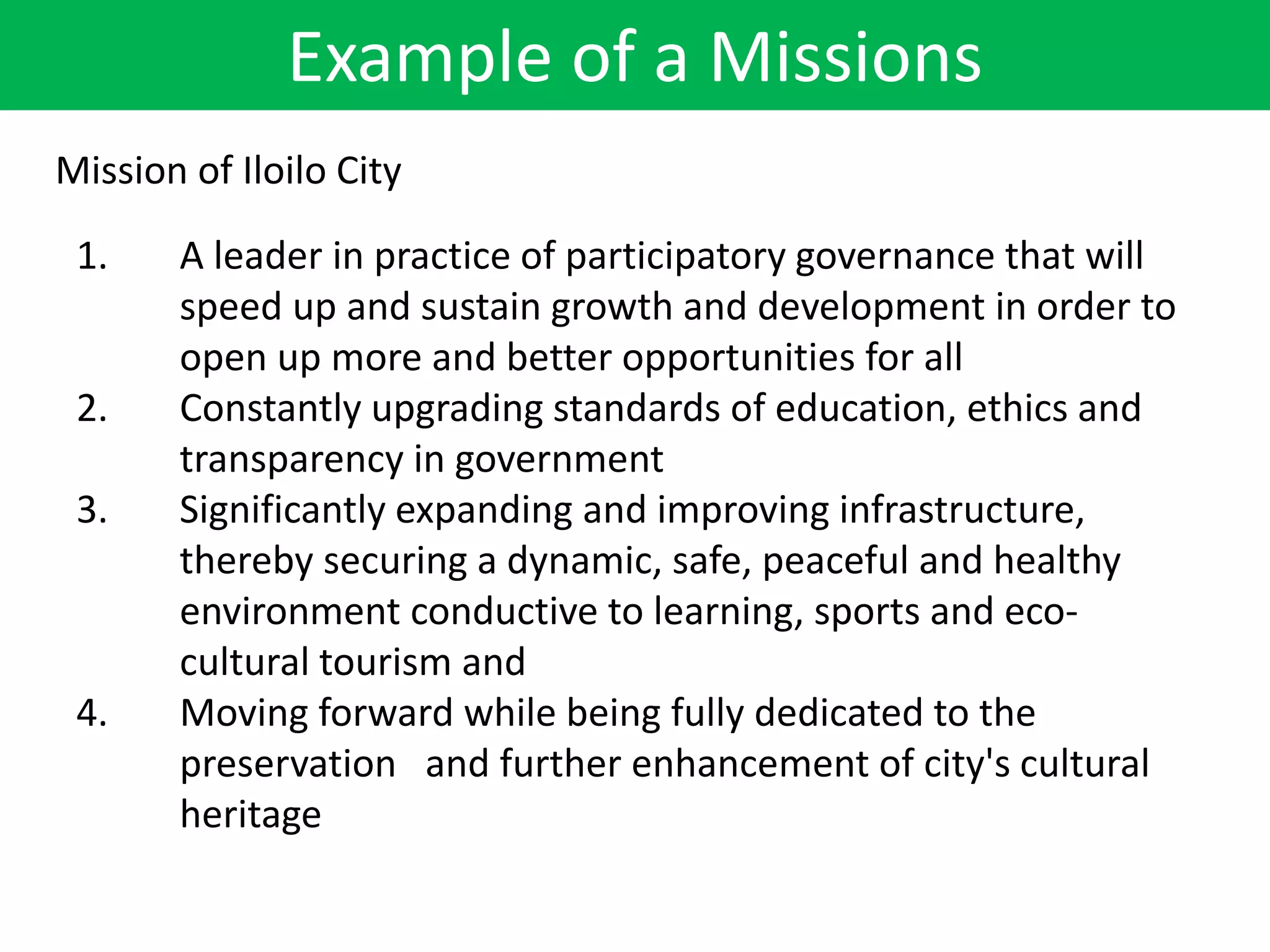
Example of a Missions
1. A leader in practice of participatory governance that will
speed up and sustain growth and development in order to
open up more and better opportunities for all
2. Constantly upgrading standards of education, ethics and
transparency in government
3. Significantly expanding and improving infrastructure,
thereby securing a dynamic, safe, peaceful and healthy
environment conductive to learning, sports and eco-
cultural tourism and
4. Moving forward while being fully dedicated to the
preservation and further enhancement of city's cultural
heritage
Mission of Iloilo City
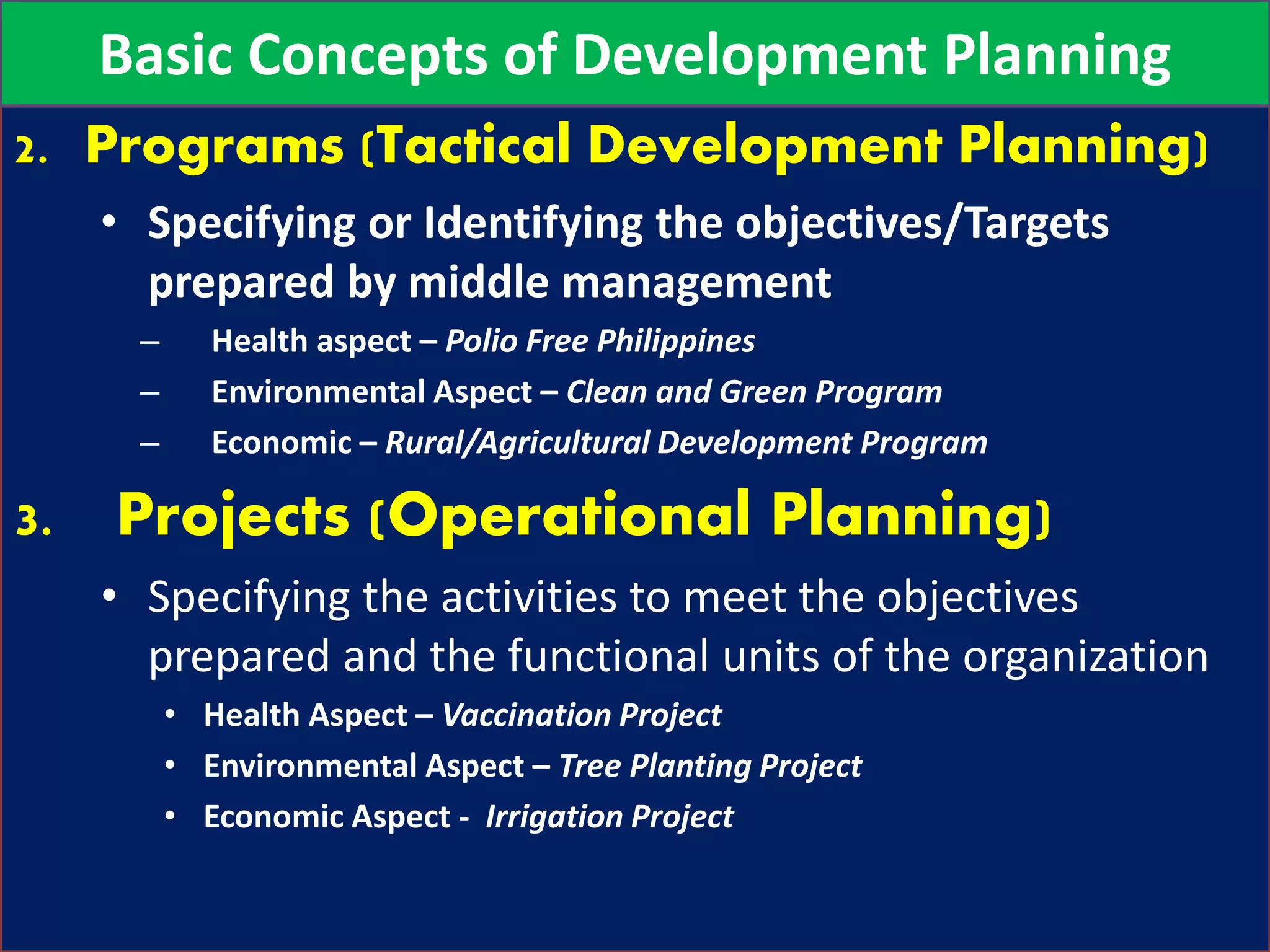
2. Programs (Tactical Development Planning)
• Specifying or Identifying the objectives/Targets
prepared by middle management
– Health aspect – Polio Free Philippines
– Environmental Aspect – Clean and Green Program
– Economic – Rural/Agricultural Development Program
3. Projects (Operational Planning)
• Specifying the activities to meet the objectives
prepared and the functional units of the organization
• Health Aspect – Vaccination Project
• Environmental Aspect – Tree Planting Project
• Economic Aspect - Irrigation Project
Basic Concepts of Development Planning
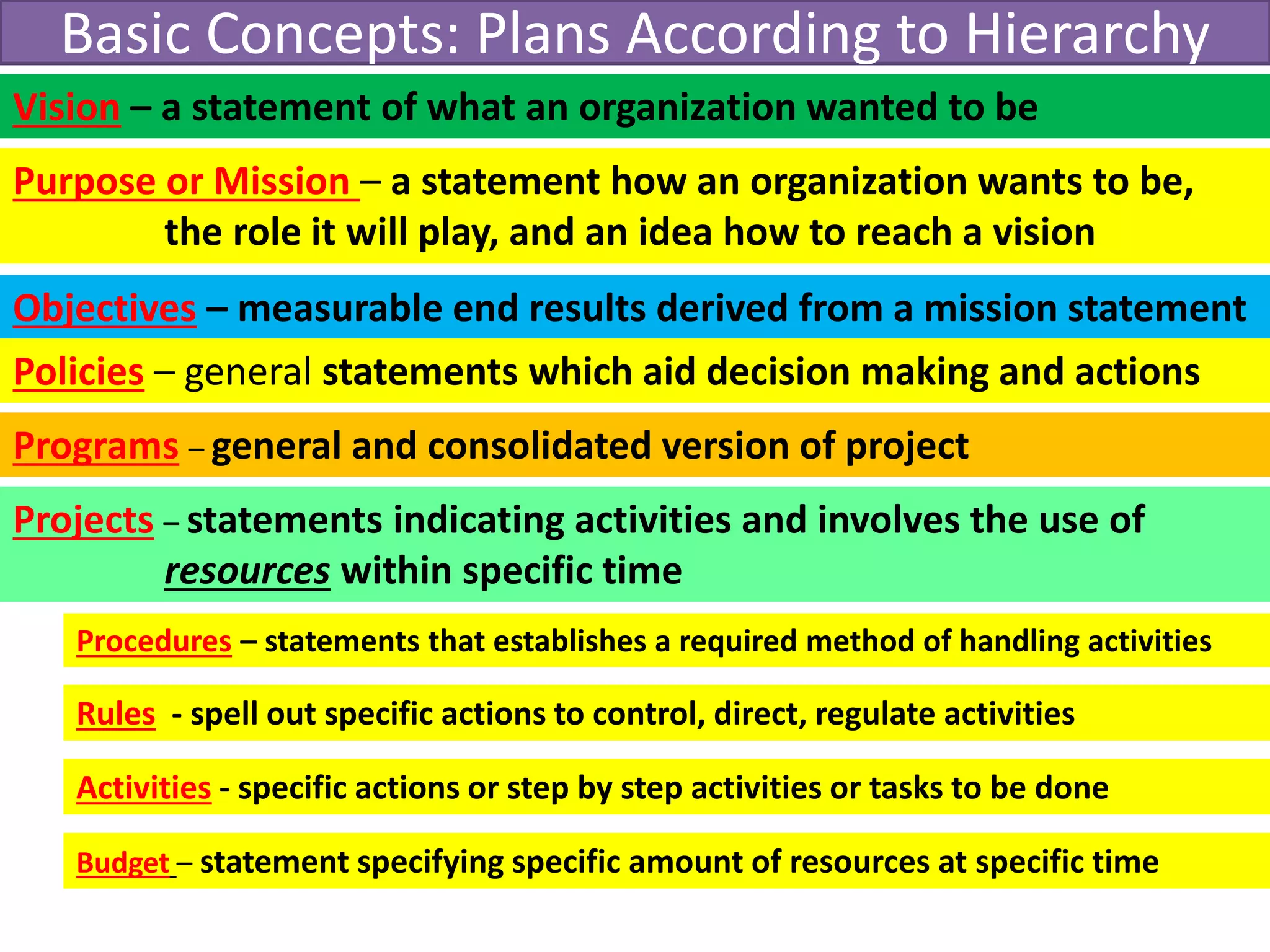
Basic Concepts: Plans According to Hierarchy
Vision – a statement of what an organization wanted to be
Purpose or Mission – a statement how an organization wants to be,
the role it will play, and an idea how to reach a vision
Objectives – measurable end results derived from a mission statement
Programs – general and consolidated version of project
Projects – statements indicating activities and involves the use of
resources within specific time
Policies – general statements which aid decision making and actions
Procedures – statements that establishes a required method of handling activities
Rules - spell out specific actions to control, direct, regulate activities
Budget – statement specifying specific amount of resources at specific time
Activities - specific actions or step by step activities or tasks to be done
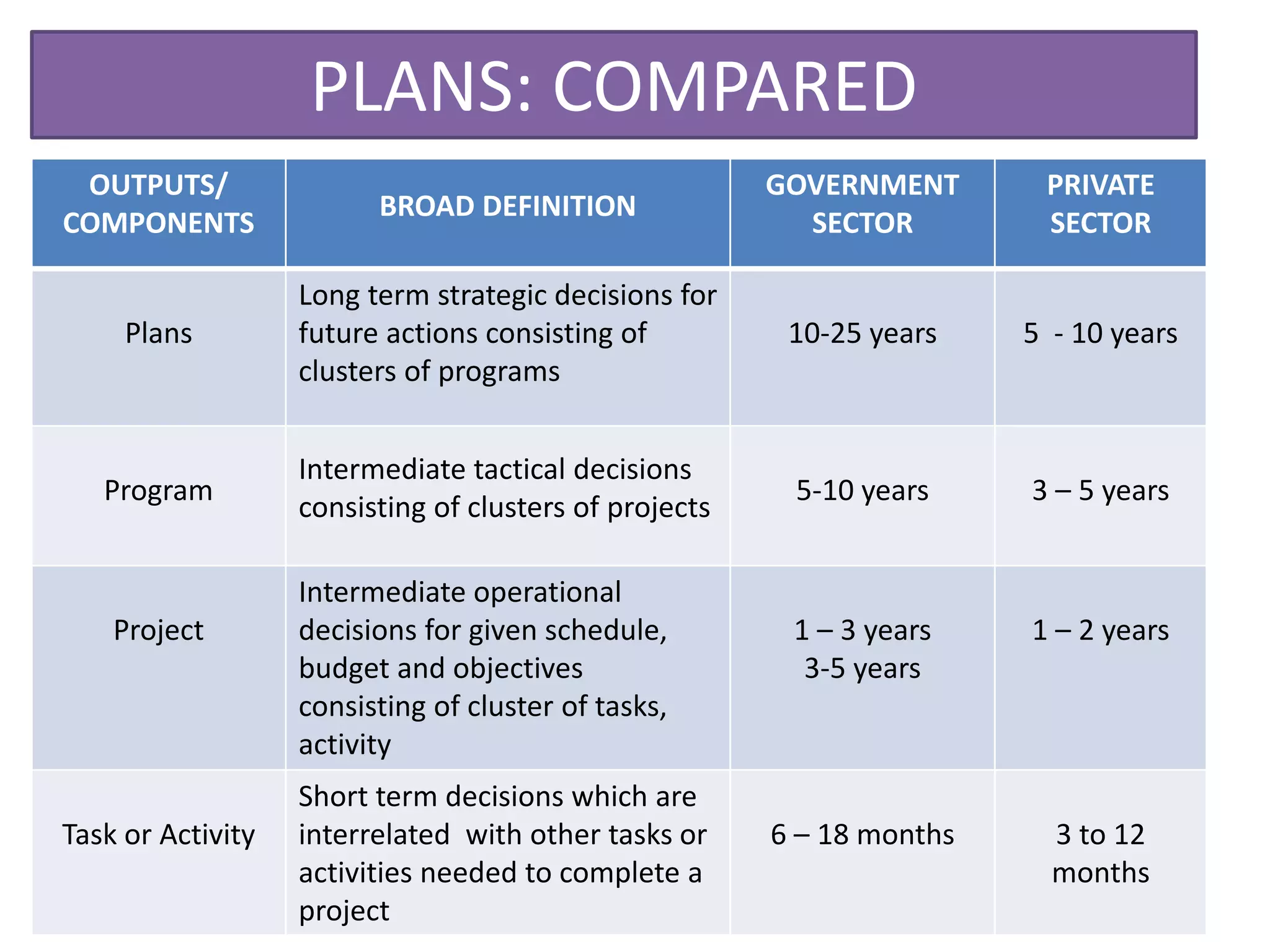
PLANS: COMPARED
OUTPUTS/
COMPONENTS
BROAD DEFINITION
GOVERNMENT
SECTOR
PRIVATE
SECTOR
Plans
Long term strategic decisions for
future actions consisting of
clusters of programs
10-25 years 5 - 10 years
Program
Intermediate tactical decisions
consisting of clusters of projects
5-10 years 3 – 5 years
Project
Intermediate operational
decisions for given schedule,
budget and objectives
consisting of cluster of tasks,
activity
1 – 3 years
3-5 years
1 – 2 years
Task or Activity
Short term decisions which are
interrelated with other tasks or
activities needed to complete a
project
6 – 18 months 3 to 12
months
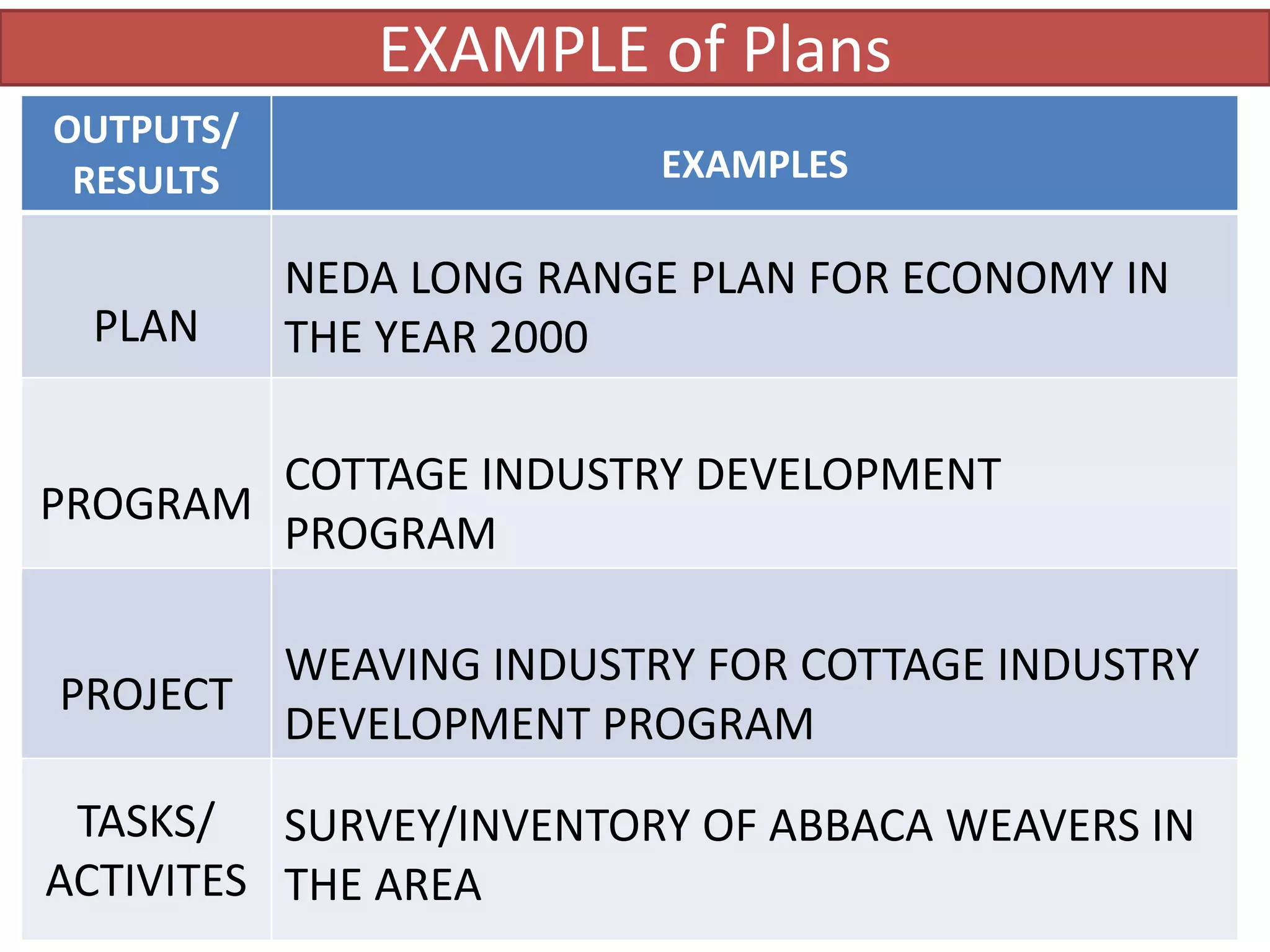
EXAMPLE of Plans
OUTPUTS/
RESULTS EXAMPLES
PLAN
NEDA LONG RANGE PLAN FOR ECONOMY IN
THE YEAR 2000
PROGRAM
COTTAGE INDUSTRY DEVELOPMENT
PROGRAM
PROJECT
WEAVING INDUSTRY FOR COTTAGE INDUSTRY
DEVELOPMENT PROGRAM
TASKS/
ACTIVITES
SURVEY/INVENTORY OF ABBACA WEAVERS IN
THE AREA
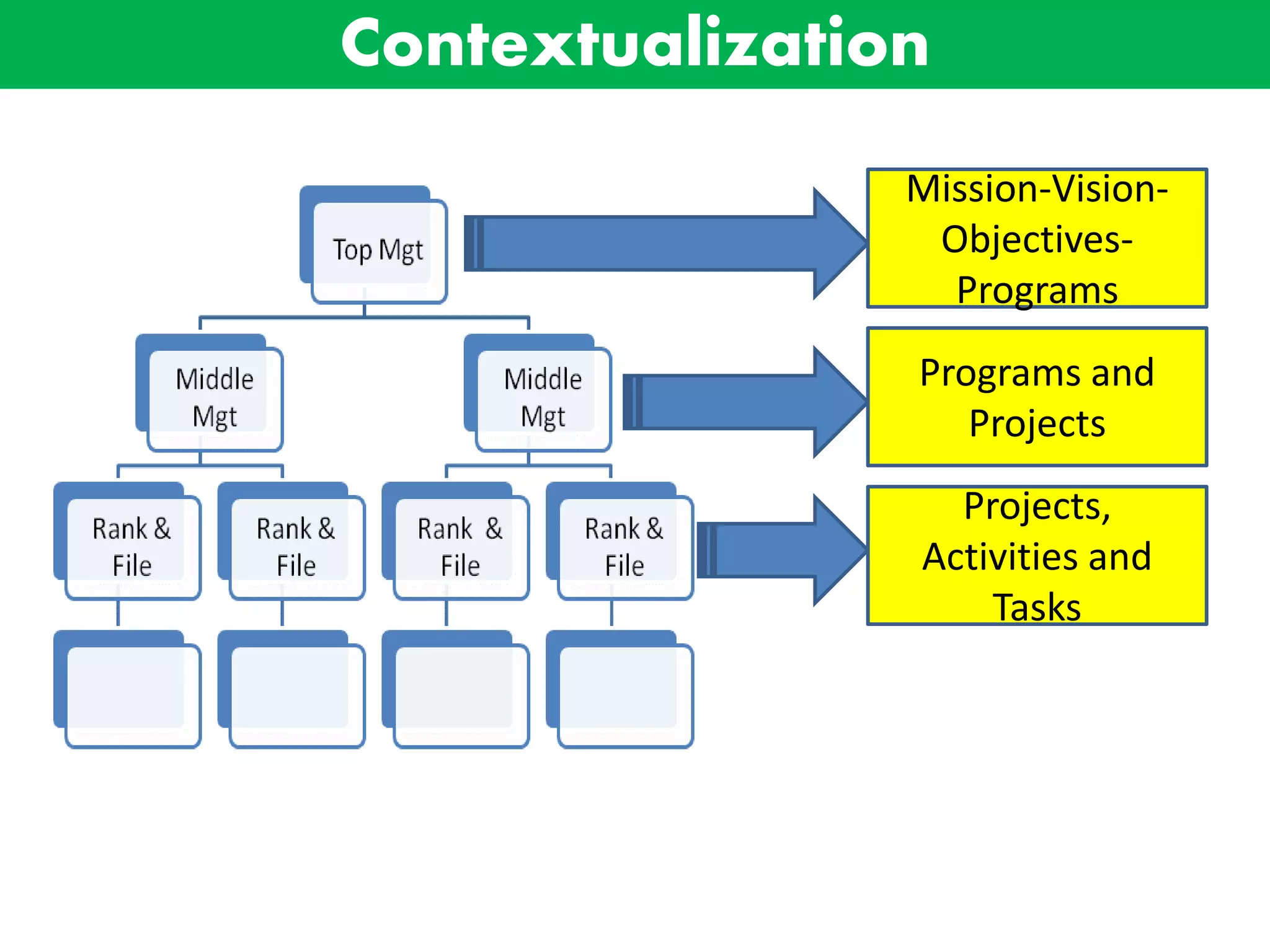
Contextualization
Mission-Vision-
Objectives-
Programs
Programs and
Projects
Projects,
Activities and
Tasks
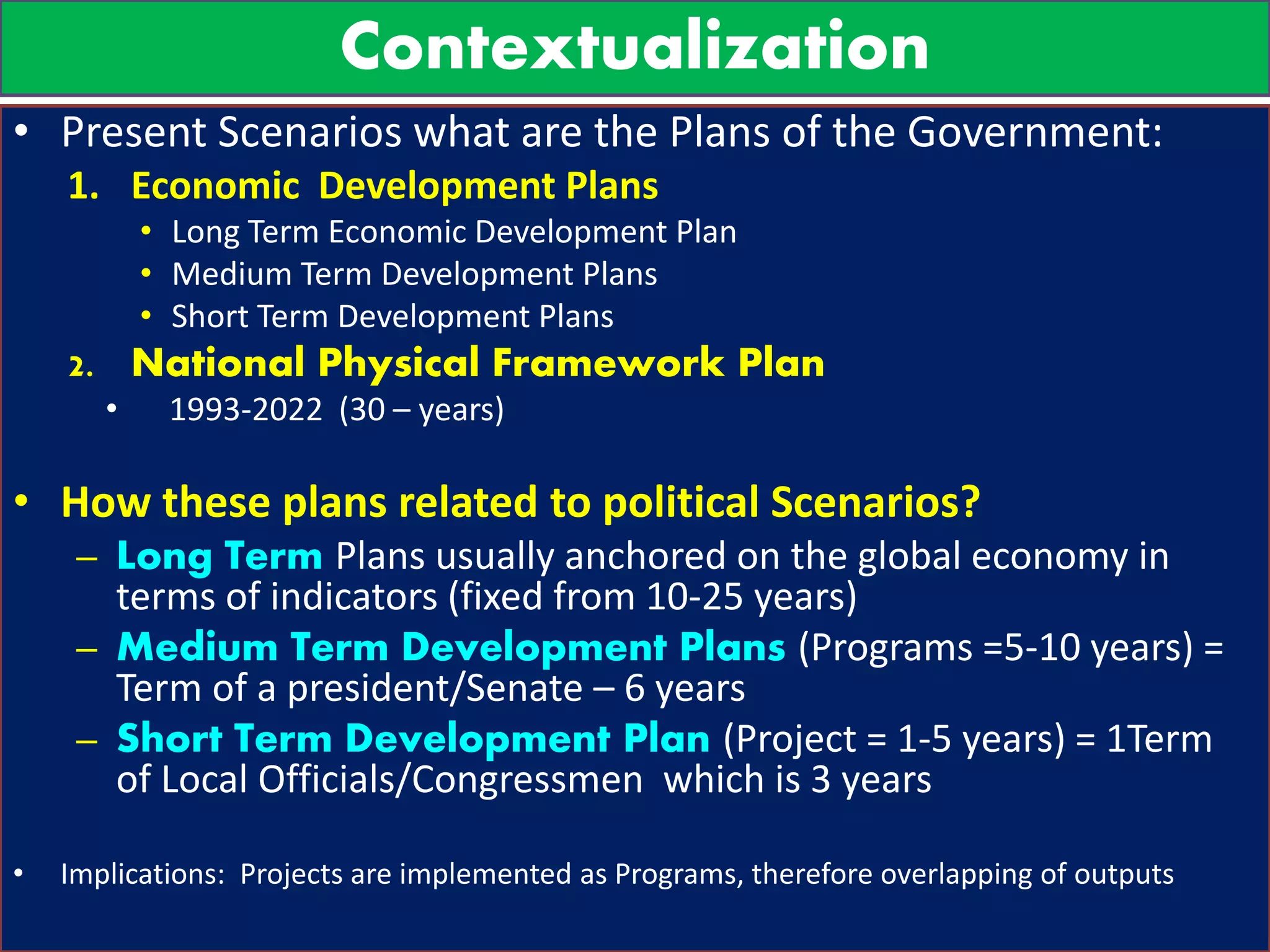
Contextualization
• Present Scenarios what are the Plans of the Government:
1. Economic Development Plans
• Long Term Economic Development Plan
• Medium Term Development Plans
• Short Term Development Plans
2. National Physical Framework Plan
• 1993-2022 (30 – years)
• How these plans related to political Scenarios?
– Long Term Plans usually anchored on the global economy in
terms of indicators (fixed from 10-25 years)
– Medium Term Development Plans (Programs =5-10 years) =
Term of a president/Senate – 6 years
– Short Term Development Plan (Project = 1-5 years) = 1Term
of Local Officials/Congressmen which is 3 years
• Implications: Projects are implemented as Programs, therefore overlapping of outputs
Contextualization
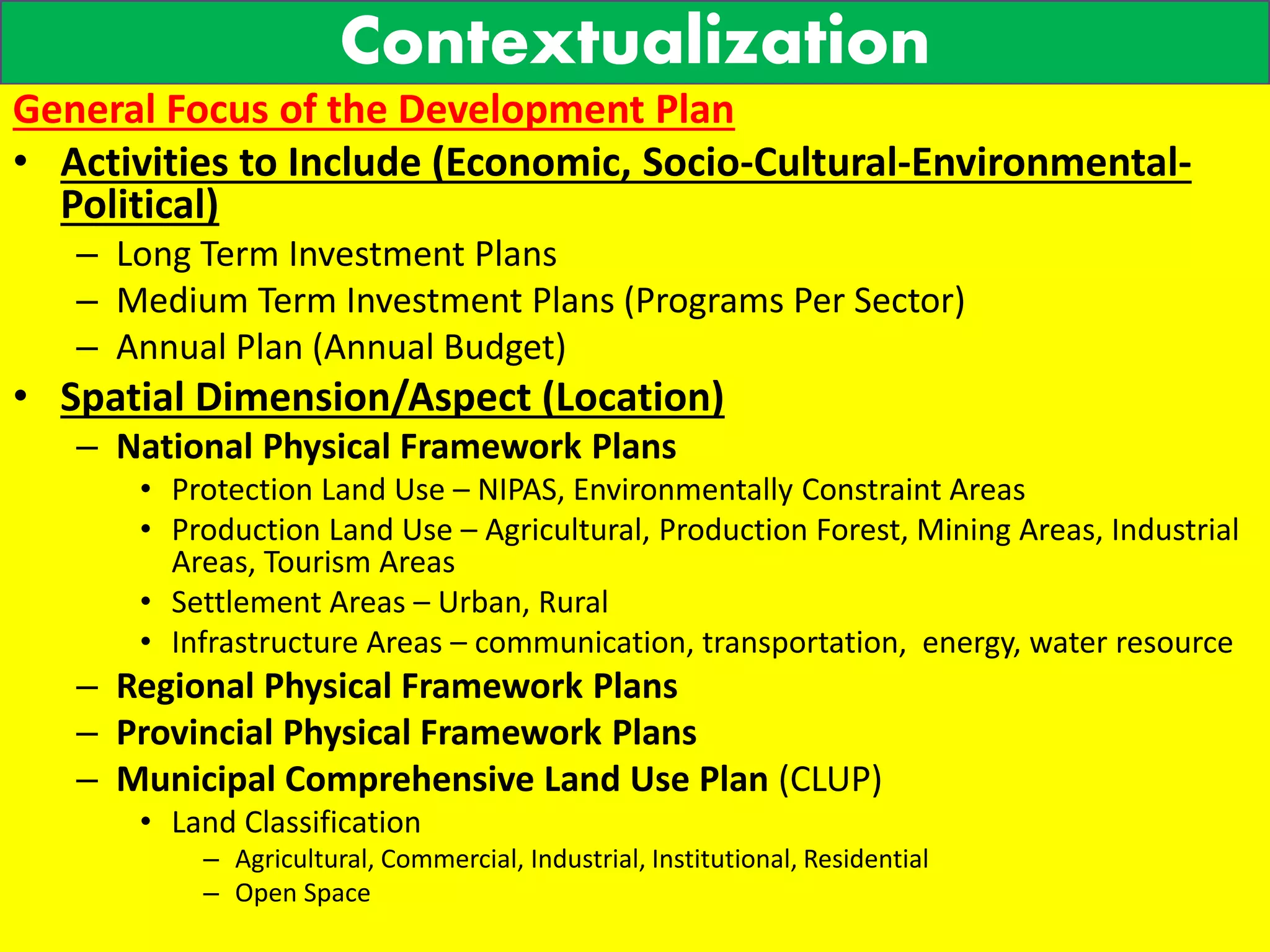
General Focus of the Development Plan
• Activities to Include (Economic, Socio-Cultural-Environmental-
Political)
– Long Term Investment Plans
– Medium Term Investment Plans (Programs Per Sector)
– Annual Plan (Annual Budget)
• Spatial Dimension/Aspect (Location)
– National Physical Framework Plans
• Protection Land Use – NIPAS, Environmentally Constraint Areas
• Production Land Use – Agricultural, Production Forest, Mining Areas, Industrial
Areas, Tourism Areas
• Settlement Areas – Urban, Rural
• Infrastructure Areas – communication, transportation, energy, water resource
– Regional Physical Framework Plans
– Provincial Physical Framework Plans
– Municipal Comprehensive Land Use Plan (CLUP)
• Land Classification
– Agricultural, Commercial, Industrial, Institutional, Residential
– Open Space

Development-and-its-basic-components.pptx

  • 1.
    1 Basic Concepts and Frameworksin Project Planning and Management
  • 2.
    Aspects of Development EconomicAspect – related to means and processes for living Socio-Cultural – ways of living (processes that enhance or support people to live anchored on ethics) Political – Ability and capacity to influence and to decide what means of living and ways of living one will have…processes of choosing the “what and how” Environmental – choices to sustain/maintain/improve the means, the ways, and the choices of living (sustainable/ethical)
  • 3.
    Basic Concepts Private Sector- the part of a free market economy that is made up of companies and organizations that are not owned or controlled by the government. These sector are usually anchored on the concepts of BUSINESS OR PROFIT Government Sector – consists of National Government, Local Governments, Government owned and controlled corporations, and government financing/monetary institutions. This sector provides the basic goods and services for the people and anchored on the concept of SERVICE PROVIDER N.B. The demarcation : Investments through programs and projects financed or sponsored by these sectors
  • 4.
    Basic Concepts Public This termrefers to the following: • Community, open or unrestricted • It maybe referred to people in general or to all the people in particular country or community; • It may be referred to a set of people in a country who share a common interests, activity, or characteristics
  • 5.
    Basic Concepts Public sector Thisterm refers to the following: • It is often referred to as the part of the economy concerned with providing basic government services. The public sector varies by country, but in most countries includes such services as the police, military, public roads, public transit, primary education and healthcare for the poor.
  • 6.
    Basic Concepts The Conceptof Public Service • Means services provided by government to its citizens, either directly (through the public sector) or by financing private provision of services subject to some control and regulation. • The term is associated with a social consensus (usually expressed through democratic elections) that certain services should be available to all, regardless of income. • It is also an alternative term for civil service. • Also refers to the General Public Services which are indispensable to the existence of an organized state and cannot be allocated to specific sectors or subsectors. This includes the executive, legislative and judicial services, overall financial and fiscal services, civil services, planning, conduct of foreign affairs, general research, public order and safety and centralized services.
  • 7.
    1. Strategic Plans(Long Range Plans) Prepared/made by top management or officers Influenced by individual objectives consolidated by a collegial body • The Process Involves by answering the following questions: What the organization might do given the opportunities & risks What the organization can do given a unique and distinctive competence of the present scenario What the organization wants/needs :given the values and goals of its clients and the people in the organization Basic Concepts of Development Planning
  • 8.
    Vision – astatement of what an organization wanted to be Purpose or Mission – a statement how an organization wants to be, the role it will play, and an idea how to reach a vision Objectives – measurable end results derived from a mission statement Basic Concepts of Development Planning Three Components of Long Range Plan
  • 9.
    “we are acity that thrives deeply conscious of its citizens’ accountability to God, centered on family and community with a commitment to efficiency and excellence nurturing an entrepreneurial spirit and good governance that is founded on integrity and responsive citizenry Vision of Iloilo City Example of a Vision
  • 10.
    Example of aMissions 1. A leader in practice of participatory governance that will speed up and sustain growth and development in order to open up more and better opportunities for all 2. Constantly upgrading standards of education, ethics and transparency in government 3. Significantly expanding and improving infrastructure, thereby securing a dynamic, safe, peaceful and healthy environment conductive to learning, sports and eco- cultural tourism and 4. Moving forward while being fully dedicated to the preservation and further enhancement of city's cultural heritage Mission of Iloilo City
  • 11.
    2. Programs (TacticalDevelopment Planning) • Specifying or Identifying the objectives/Targets prepared by middle management – Health aspect – Polio Free Philippines – Environmental Aspect – Clean and Green Program – Economic – Rural/Agricultural Development Program 3. Projects (Operational Planning) • Specifying the activities to meet the objectives prepared and the functional units of the organization • Health Aspect – Vaccination Project • Environmental Aspect – Tree Planting Project • Economic Aspect - Irrigation Project Basic Concepts of Development Planning
  • 12.
    Basic Concepts: PlansAccording to Hierarchy Vision – a statement of what an organization wanted to be Purpose or Mission – a statement how an organization wants to be, the role it will play, and an idea how to reach a vision Objectives – measurable end results derived from a mission statement Programs – general and consolidated version of project Projects – statements indicating activities and involves the use of resources within specific time Policies – general statements which aid decision making and actions Procedures – statements that establishes a required method of handling activities Rules - spell out specific actions to control, direct, regulate activities Budget – statement specifying specific amount of resources at specific time Activities - specific actions or step by step activities or tasks to be done
  • 13.
    PLANS: COMPARED OUTPUTS/ COMPONENTS BROAD DEFINITION GOVERNMENT SECTOR PRIVATE SECTOR Plans Longterm strategic decisions for future actions consisting of clusters of programs 10-25 years 5 - 10 years Program Intermediate tactical decisions consisting of clusters of projects 5-10 years 3 – 5 years Project Intermediate operational decisions for given schedule, budget and objectives consisting of cluster of tasks, activity 1 – 3 years 3-5 years 1 – 2 years Task or Activity Short term decisions which are interrelated with other tasks or activities needed to complete a project 6 – 18 months 3 to 12 months
  • 14.
    EXAMPLE of Plans OUTPUTS/ RESULTSEXAMPLES PLAN NEDA LONG RANGE PLAN FOR ECONOMY IN THE YEAR 2000 PROGRAM COTTAGE INDUSTRY DEVELOPMENT PROGRAM PROJECT WEAVING INDUSTRY FOR COTTAGE INDUSTRY DEVELOPMENT PROGRAM TASKS/ ACTIVITES SURVEY/INVENTORY OF ABBACA WEAVERS IN THE AREA
  • 15.
  • 16.
    Contextualization • Present Scenarioswhat are the Plans of the Government: 1. Economic Development Plans • Long Term Economic Development Plan • Medium Term Development Plans • Short Term Development Plans 2. National Physical Framework Plan • 1993-2022 (30 – years) • How these plans related to political Scenarios? – Long Term Plans usually anchored on the global economy in terms of indicators (fixed from 10-25 years) – Medium Term Development Plans (Programs =5-10 years) = Term of a president/Senate – 6 years – Short Term Development Plan (Project = 1-5 years) = 1Term of Local Officials/Congressmen which is 3 years • Implications: Projects are implemented as Programs, therefore overlapping of outputs
  • 17.
    Contextualization General Focus ofthe Development Plan • Activities to Include (Economic, Socio-Cultural-Environmental- Political) – Long Term Investment Plans – Medium Term Investment Plans (Programs Per Sector) – Annual Plan (Annual Budget) • Spatial Dimension/Aspect (Location) – National Physical Framework Plans • Protection Land Use – NIPAS, Environmentally Constraint Areas • Production Land Use – Agricultural, Production Forest, Mining Areas, Industrial Areas, Tourism Areas • Settlement Areas – Urban, Rural • Infrastructure Areas – communication, transportation, energy, water resource – Regional Physical Framework Plans – Provincial Physical Framework Plans – Municipal Comprehensive Land Use Plan (CLUP) • Land Classification – Agricultural, Commercial, Industrial, Institutional, Residential – Open Space