Designing, Developing and
Delivering MOOC: Special
Reference to SWAYAM
Nisha Singh
Deputy Director,
IUC. IGNOU
International
Telecommunication Union
2
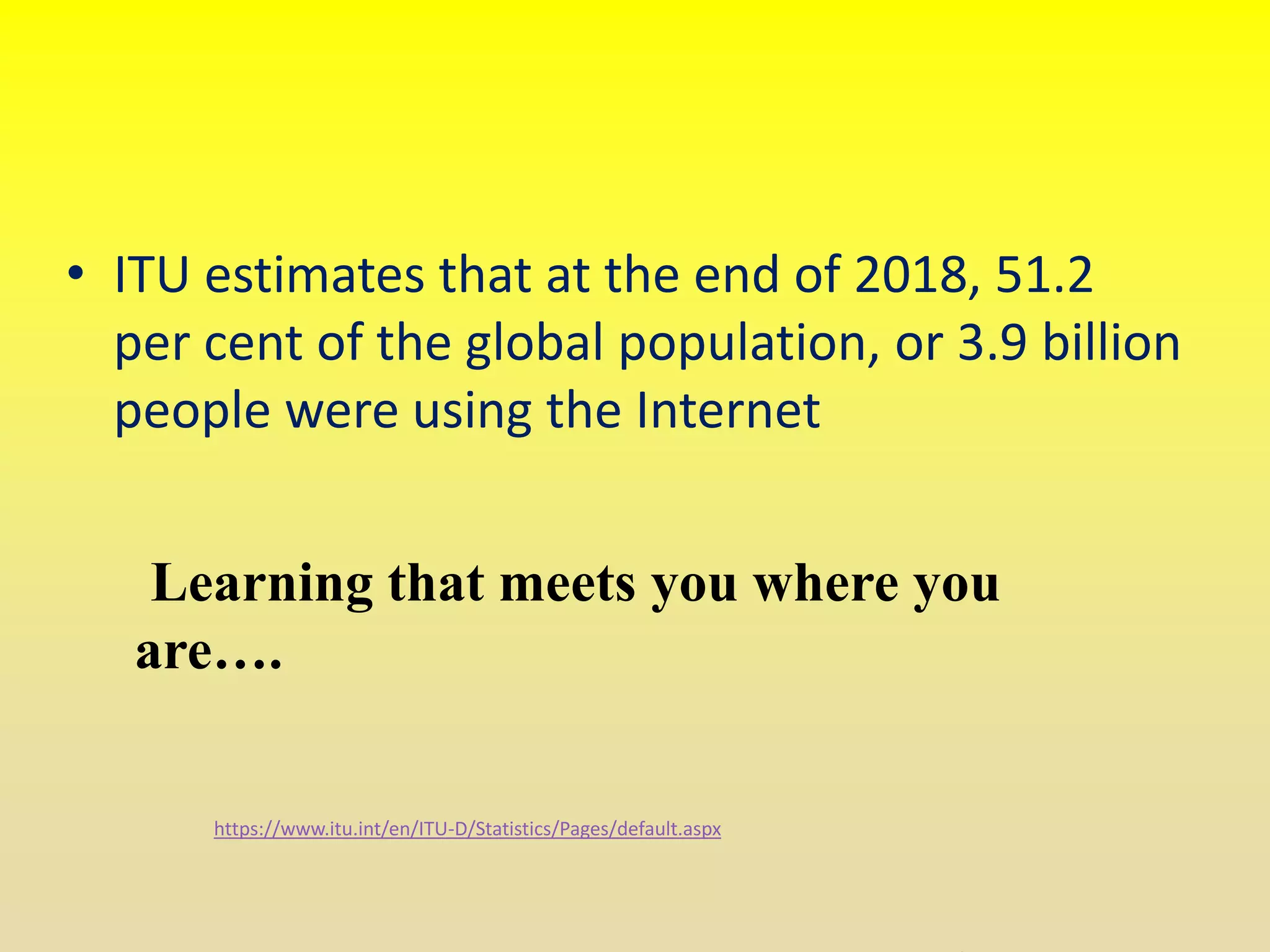
https://www.itu.int/en/ITU-D/Statistics/Pages/default.aspx
Learning that meets you where you
are….
• ITU estimates that at the end of 2018, 51.2
per cent of the global population, or 3.9 billion
people were using the Internet
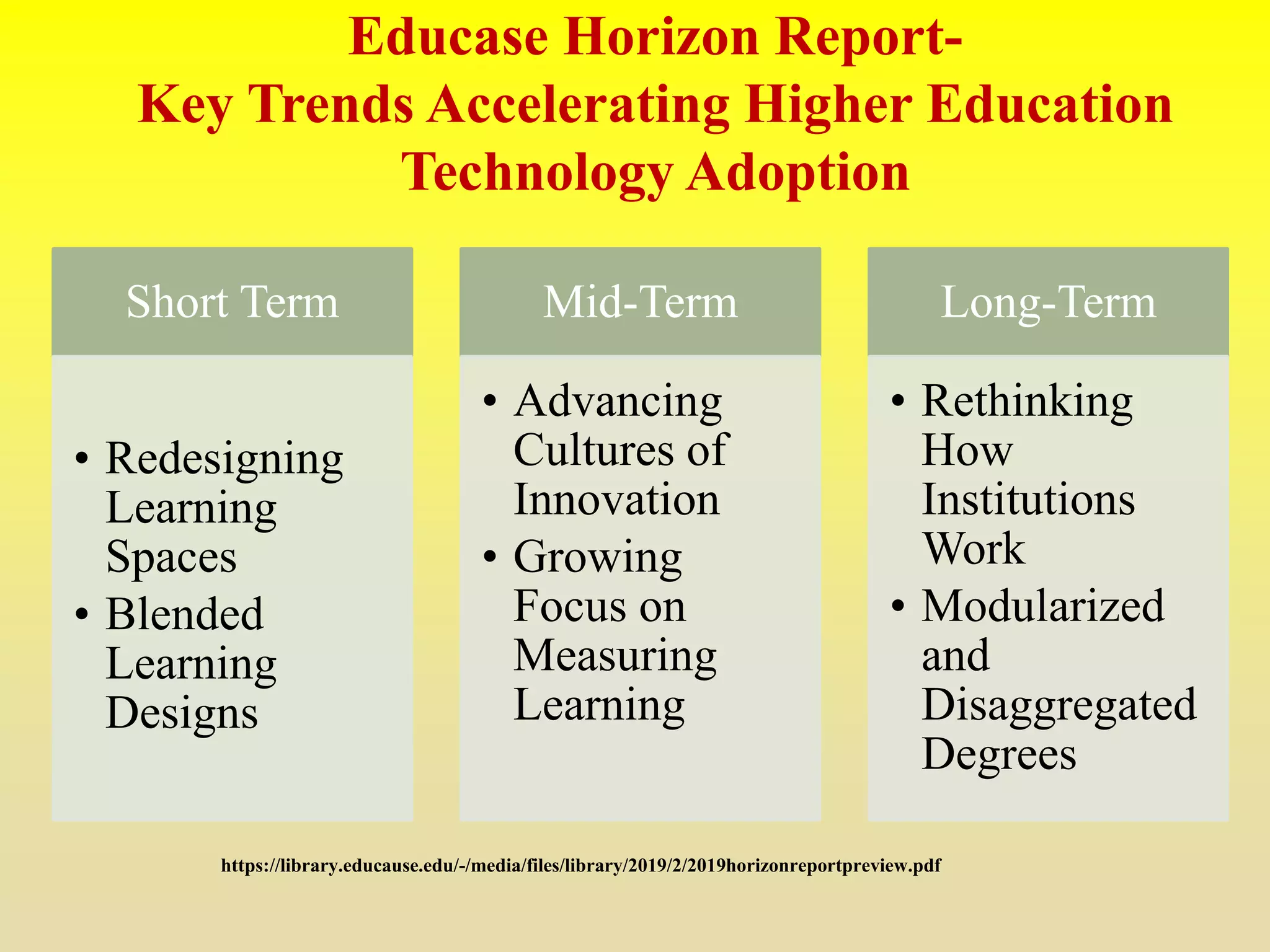
Short Term
• Redesigning
Learning
Spaces
• Blended
Learning
Designs
Mid-Term
• Advancing
Cultures of
Innovation
• Growing
Focus on
Measuring
Learning
Long-Term
• Rethinking
How
Institutions
Work
• Modularized
and
Disaggregated
Degrees
Educase Horizon Report-
Key Trends Accelerating Higher Education
Technology Adoption
https://library.educause.edu/-/media/files/library/2019/2/2019horizonreportpreview.pdf
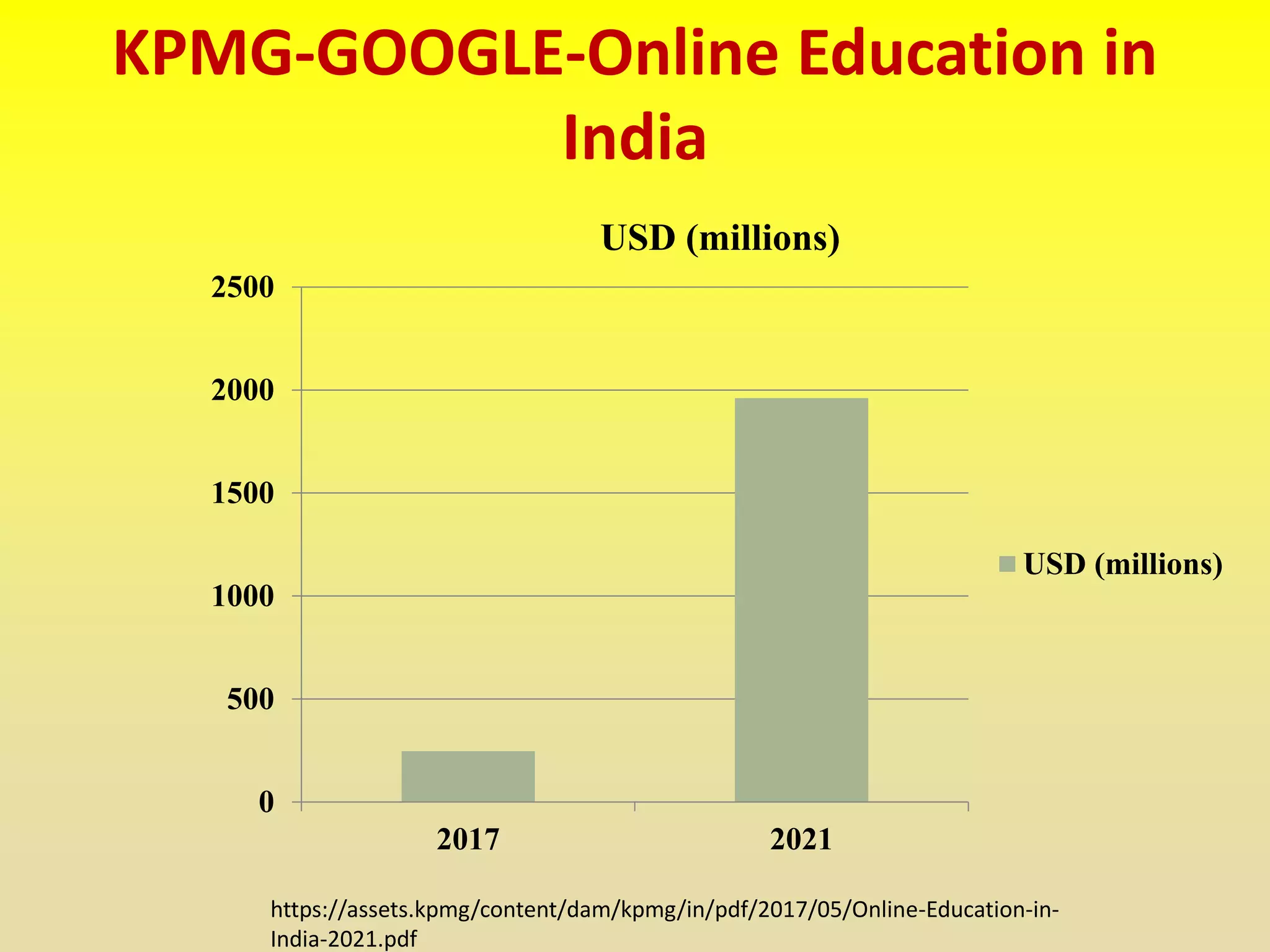
KPMG-GOOGLE-Online Education in
India
0
500
1000
1500
2000
2500
2017 2021
USD (millions)
USD (millions)
https://assets.kpmg/content/dam/kpmg/in/pdf/2017/05/Online-Education-in-
India-2021.pdf
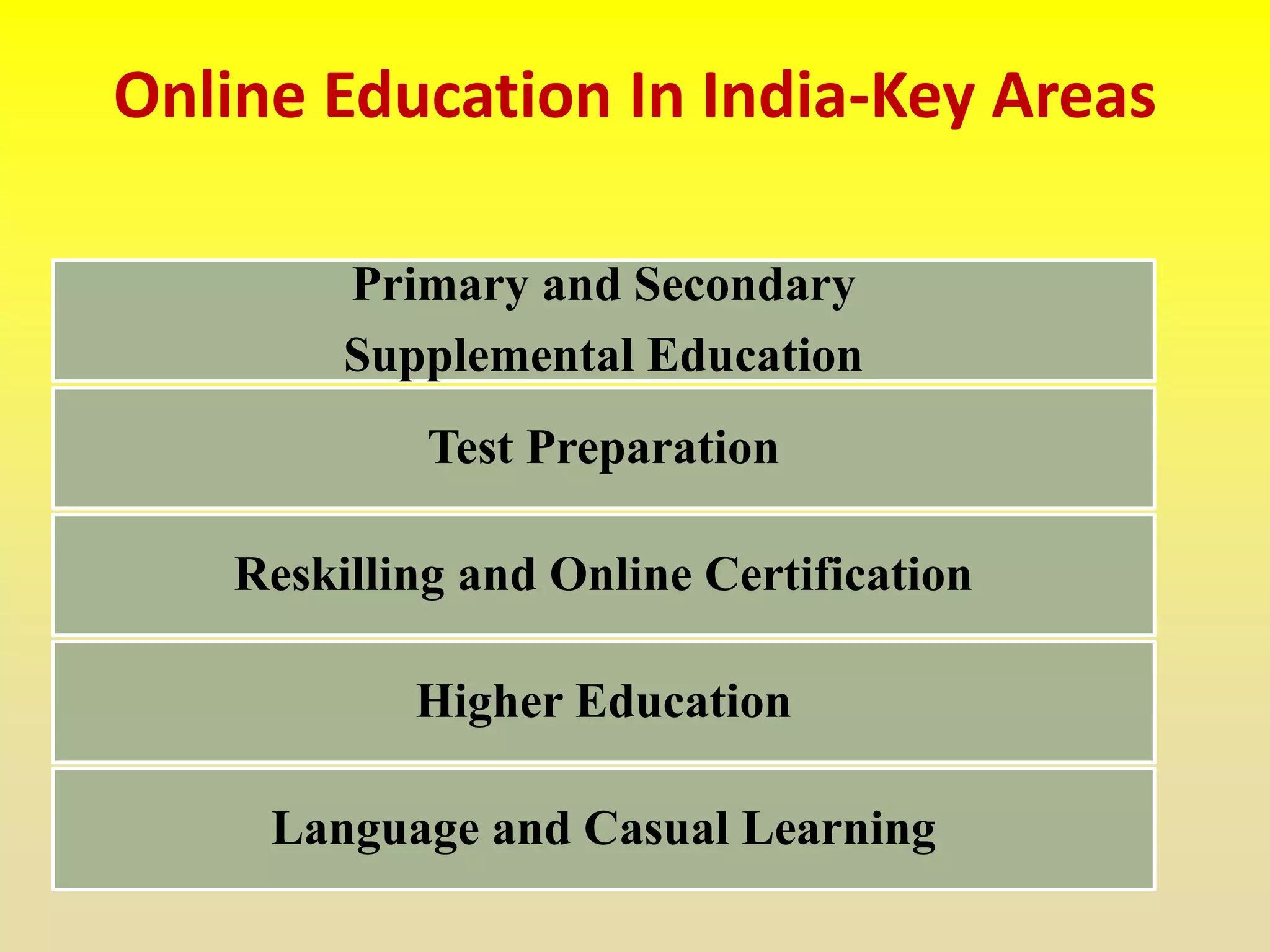
Online Education In India-Key Areas
Primary and Secondary
Supplemental Education
Test Preparation
Reskilling and Online Certification
Higher Education
Language and Casual Learning
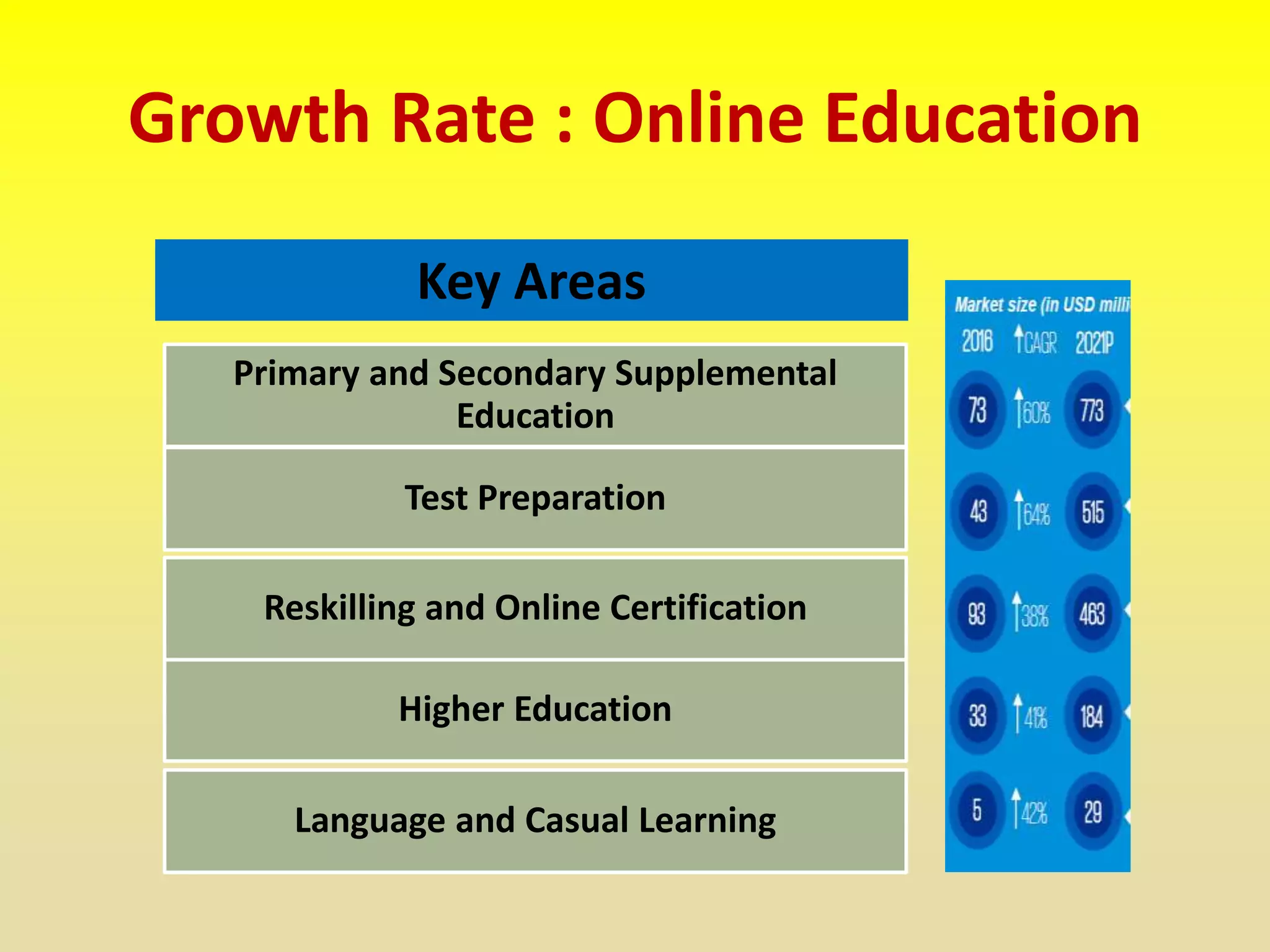
Growth Rate : Online Education
Primary and Secondary Supplemental
Education
Test Preparation
Higher Education
Language and Casual Learning
Reskilling and Online Certification
Key Areas
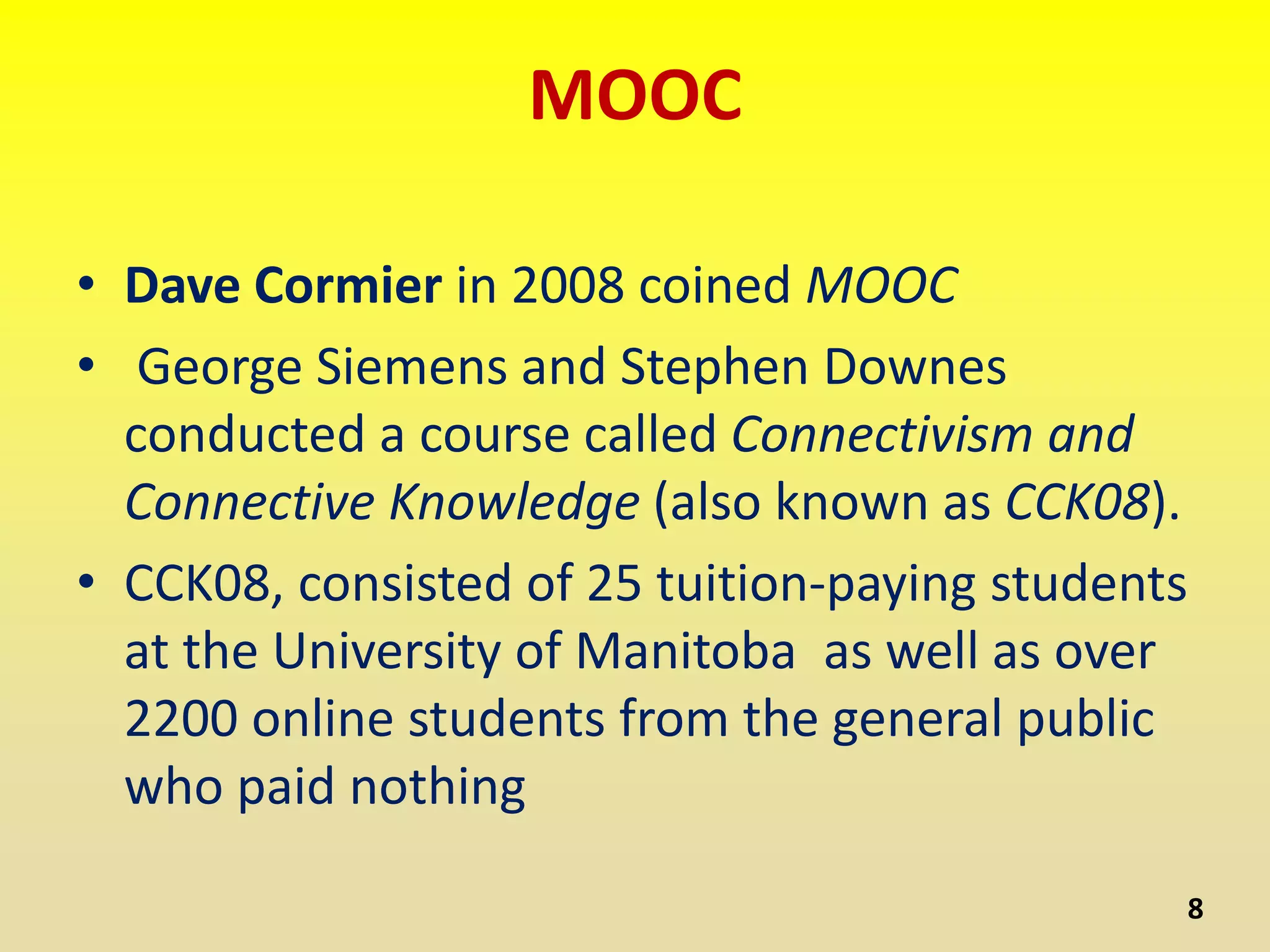
MOOC
• Dave Cormier in 2008 coined MOOC
• George Siemens and Stephen Downes
conducted a course called Connectivism and
Connective Knowledge (also known as CCK08).
• CCK08, consisted of 25 tuition-paying students
at the University of Manitoba as well as over
2200 online students from the general public
who paid nothing
8
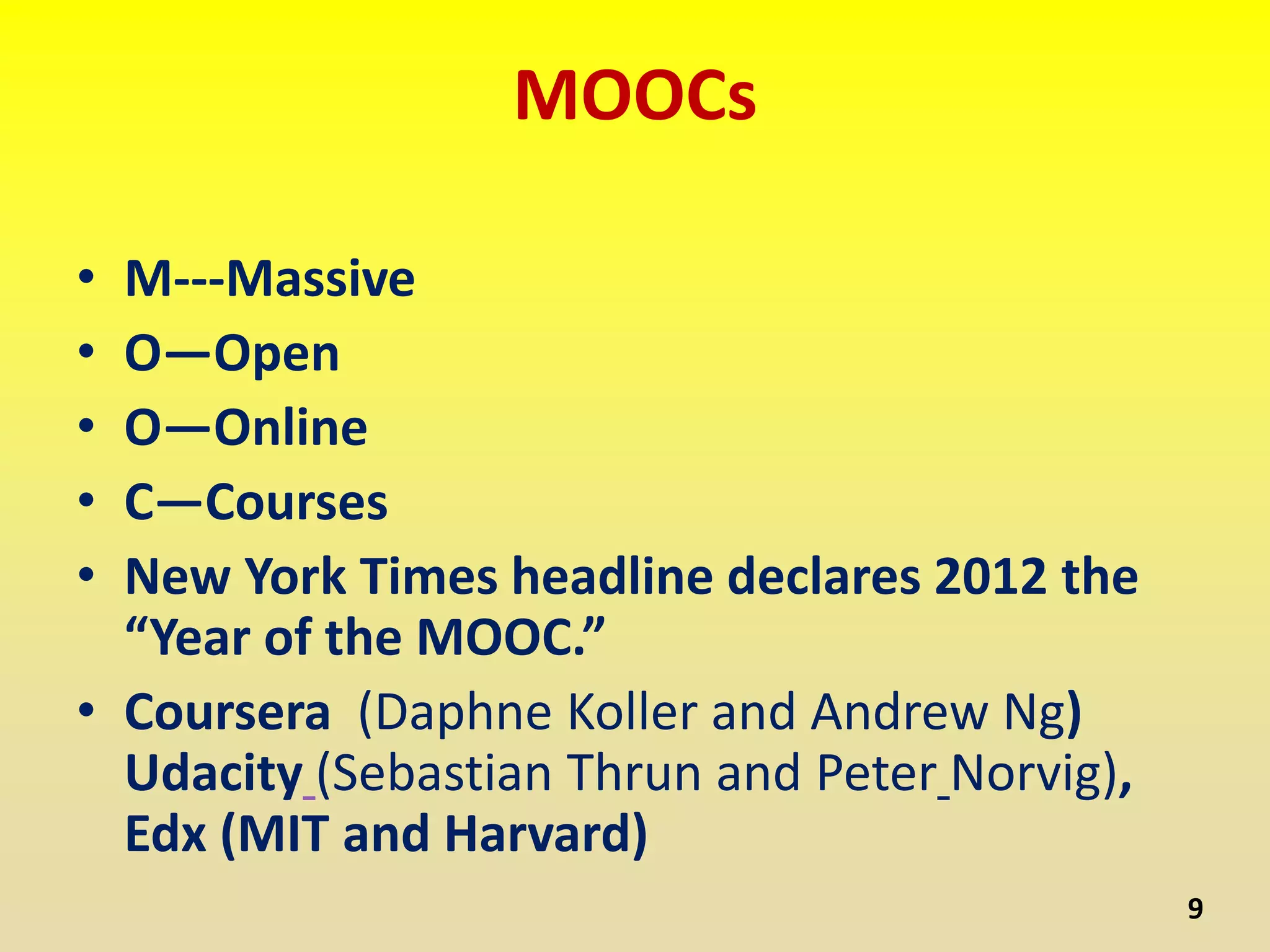
MOOCs
• M---Massive
• O—Open
• O—Online
• C—Courses
• New York Times headline declares 2012 the
“Year of the MOOC.”
• Coursera (Daphne Koller and Andrew Ng)
Udacity (Sebastian Thrun and Peter Norvig),
Edx (MIT and Harvard)
9
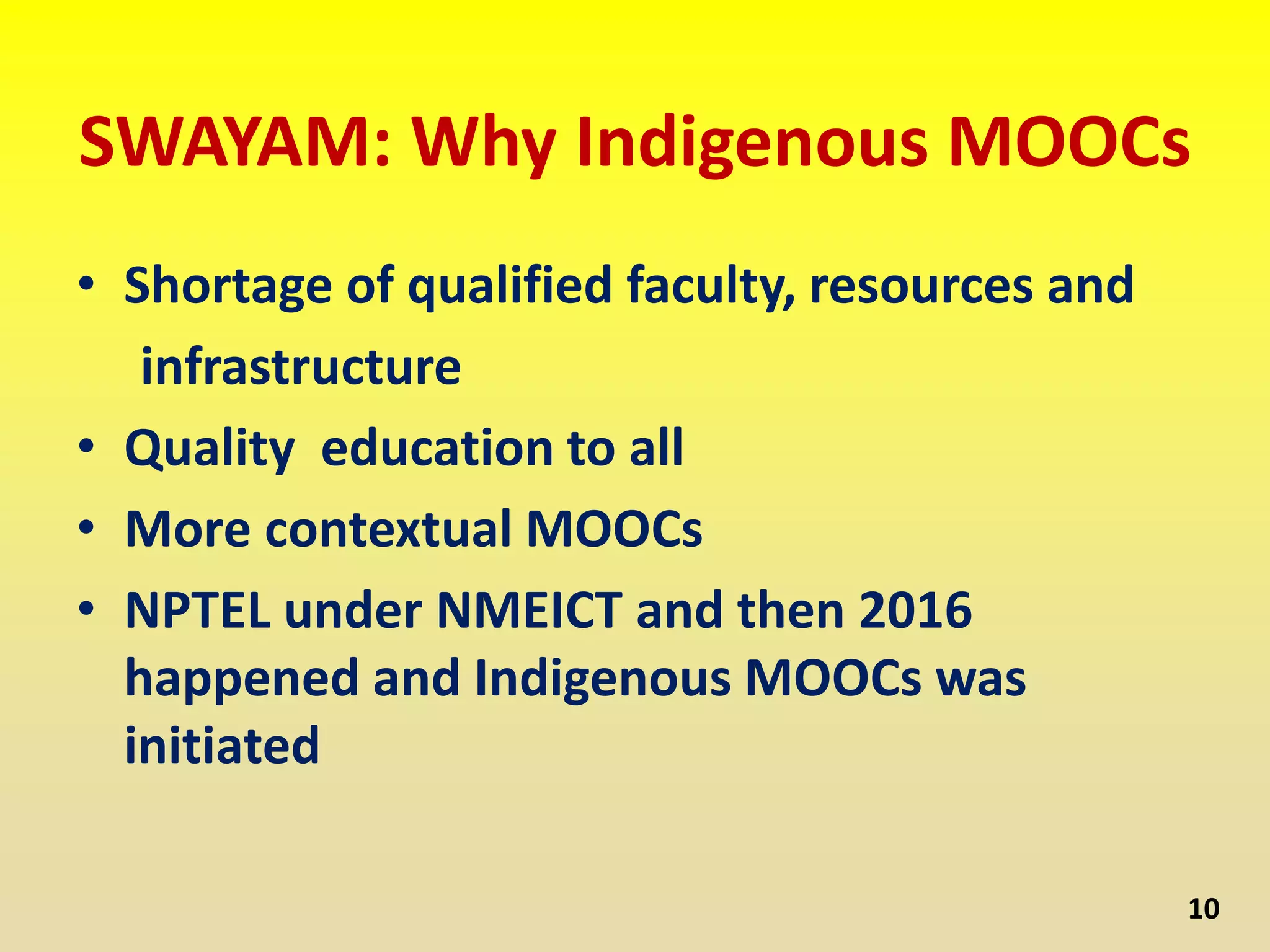
SWAYAM: Why Indigenous MOOCs
• Shortage of qualified faculty, resources and
infrastructure
• Quality education to all
• More contextual MOOCs
• NPTEL under NMEICT and then 2016
happened and Indigenous MOOCs was
initiated
10
• Online Courses need planning and so do
MOOCs
11
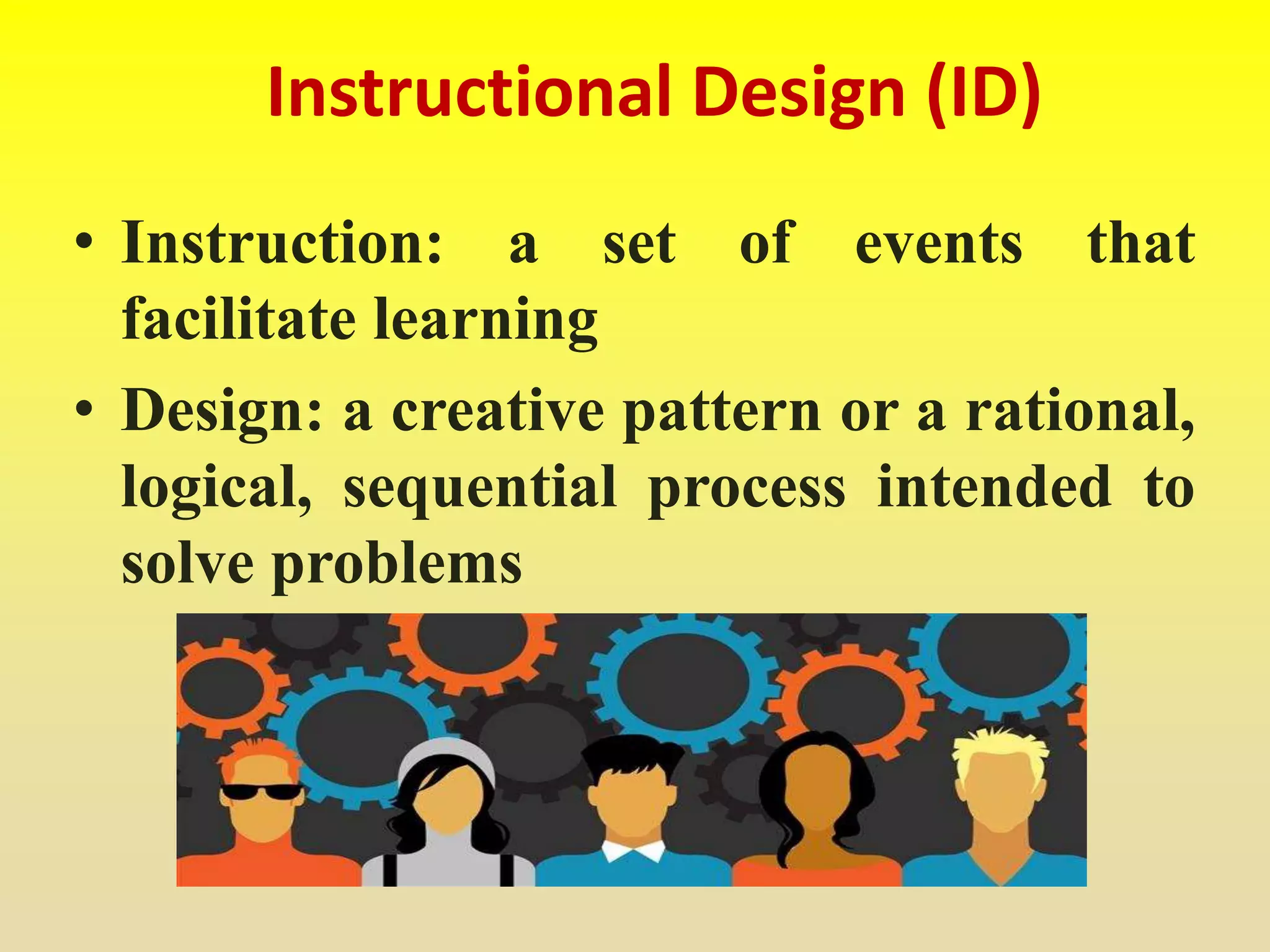
Instructional Design (ID)
• Instruction: a set of events that
facilitate learning
• Design: a creative pattern or a rational,
logical, sequential process intended to
solve problems
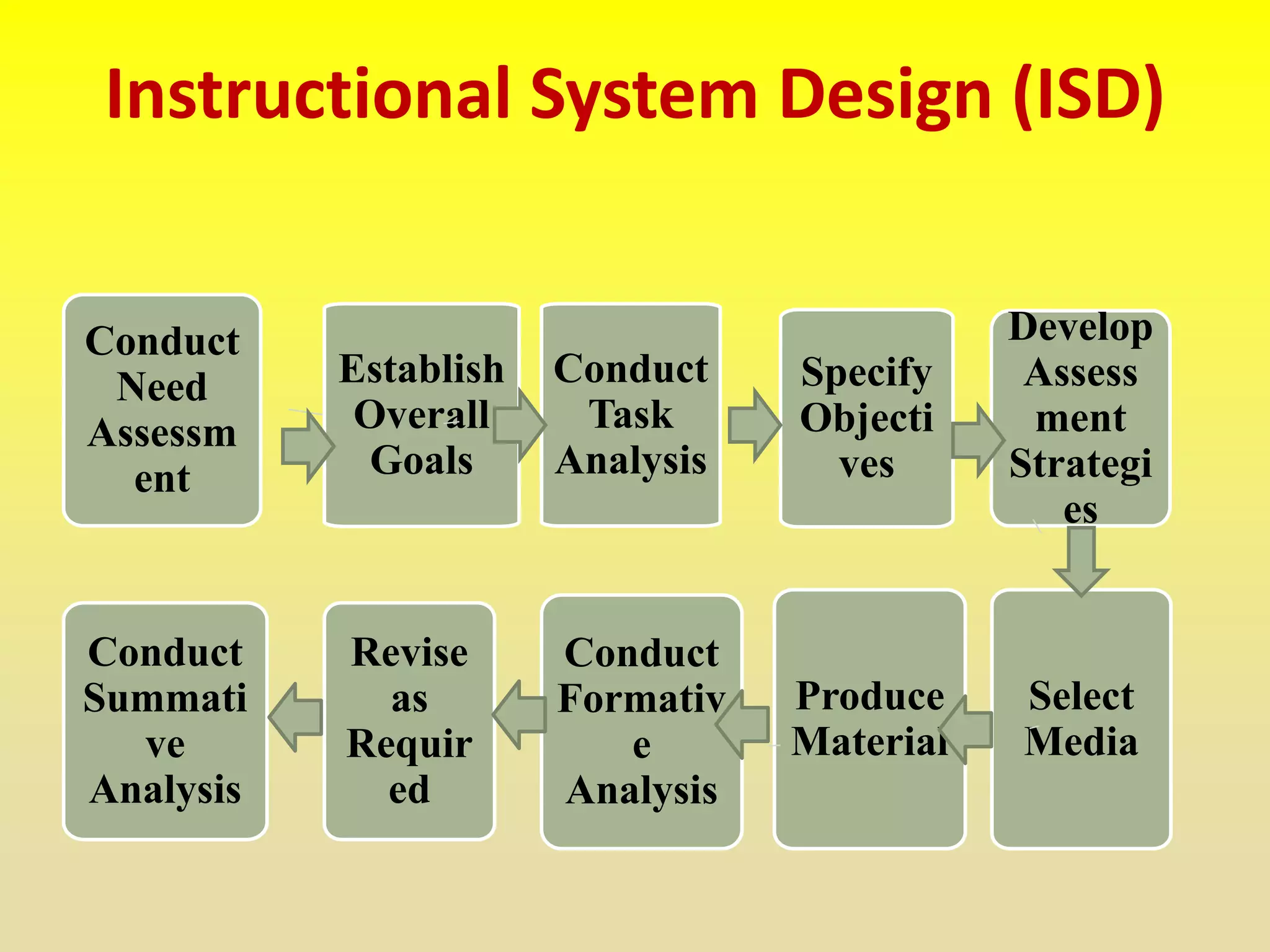
Instructional System Design (ISD)
Conduct
Need
Assessm
ent
Establish
Overall
Goals
Conduct
Task
Analysis
Specify
Objecti
ves
Develop
Assess
ment
Strategi
es
Select
Media
Produce
Material
Conduct
Formativ
e
Analysis
Revise
as
Requir
ed
Conduct
Summati
ve
Analysis
Instructional Design
• … … is the process by which instruction is
improved through the analysis of learning
needs and systematic development of learning
materials. Instructional designers often use
technology and multimedia as tools to
enhance instruction.
(http://www.instructionaldesign.org)
Models of Instructional Design
Many Models are there. Few popular
ones are
• ADDIE
• Dick and Carey Model
• Smith and Ragan Model
• Keller’s ARCS Model for motivation
• 4C/ID Model
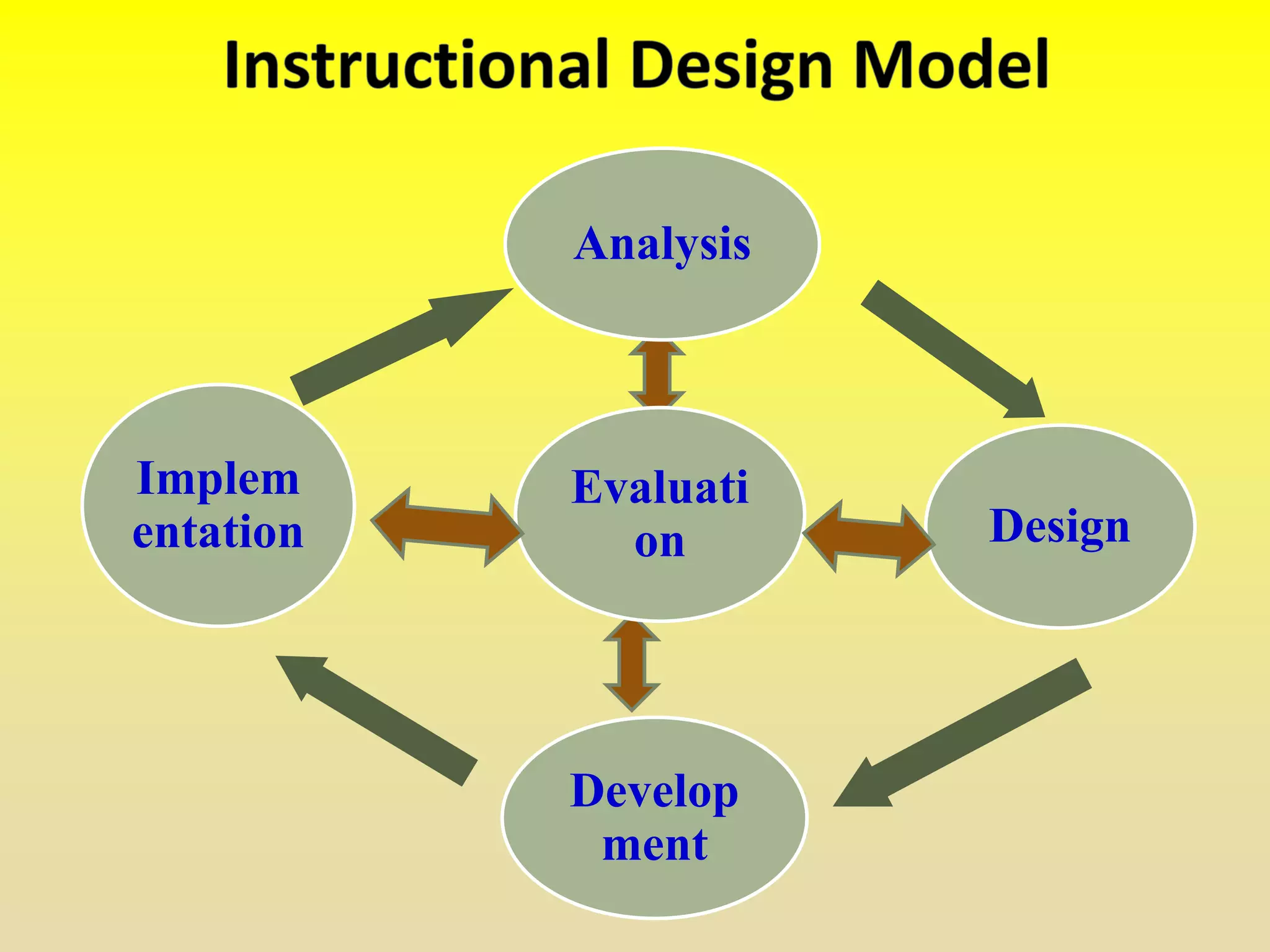
Analysis
Design
Develop
ment
Implem
entation
Evaluati
on
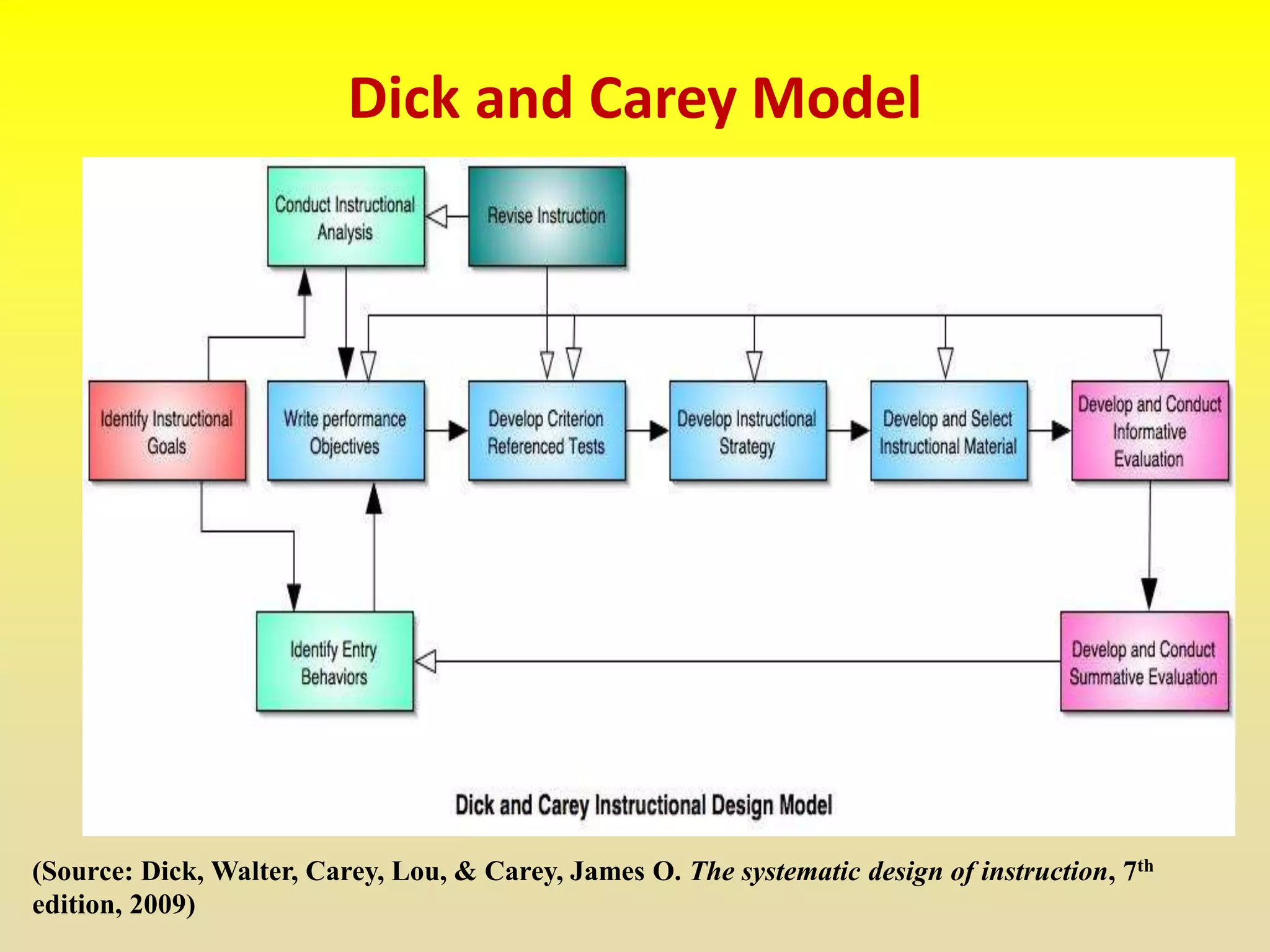
Dick and Carey Model
(Source: Dick, Walter, Carey, Lou, & Carey, James O. The systematic design of instruction, 7th
edition, 2009)
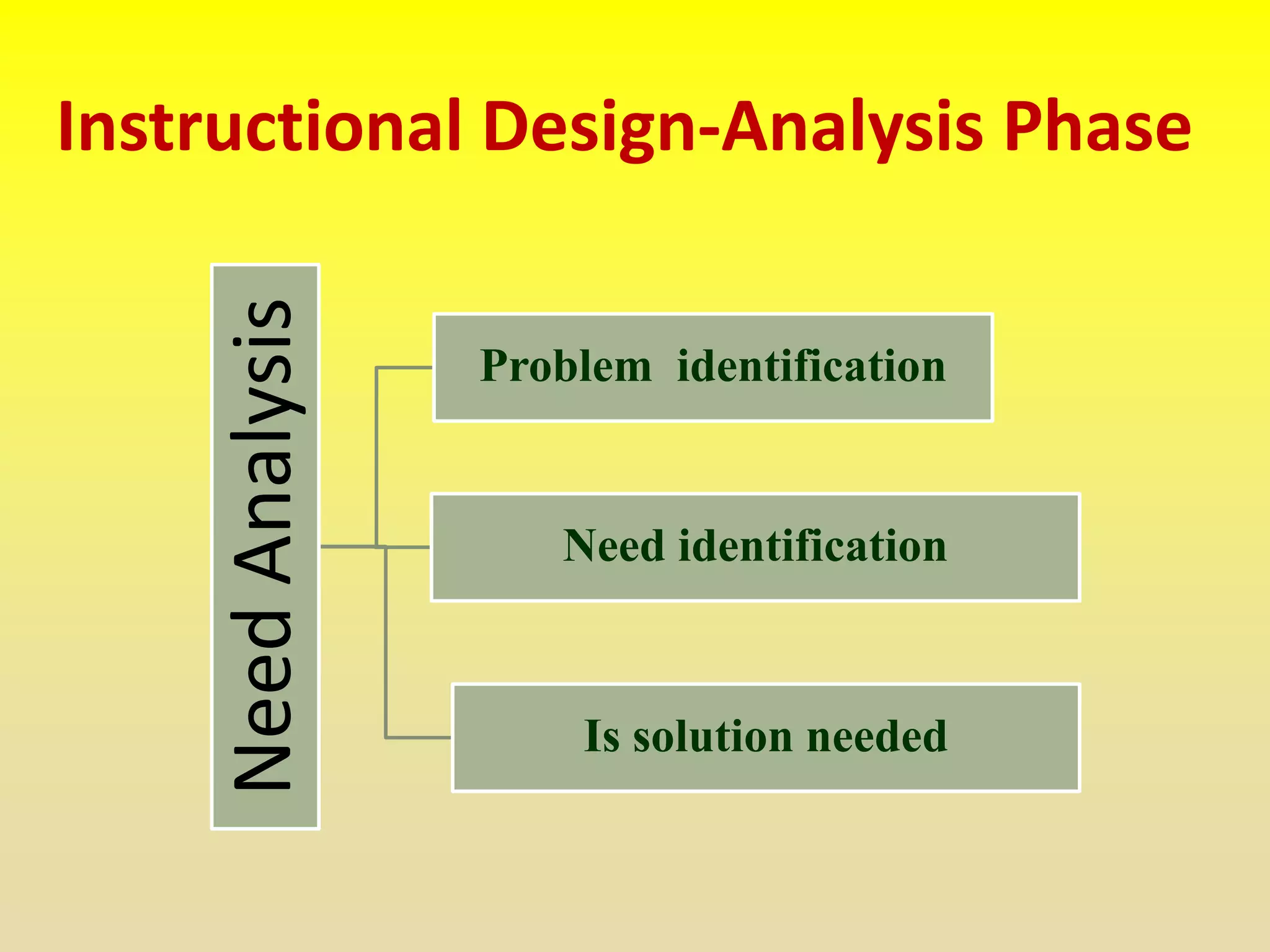
Instructional Design-Analysis Phase
NeedAnalysis
Problem identification
Need identification
Is solution needed
Instructional Design-Analysis Phase
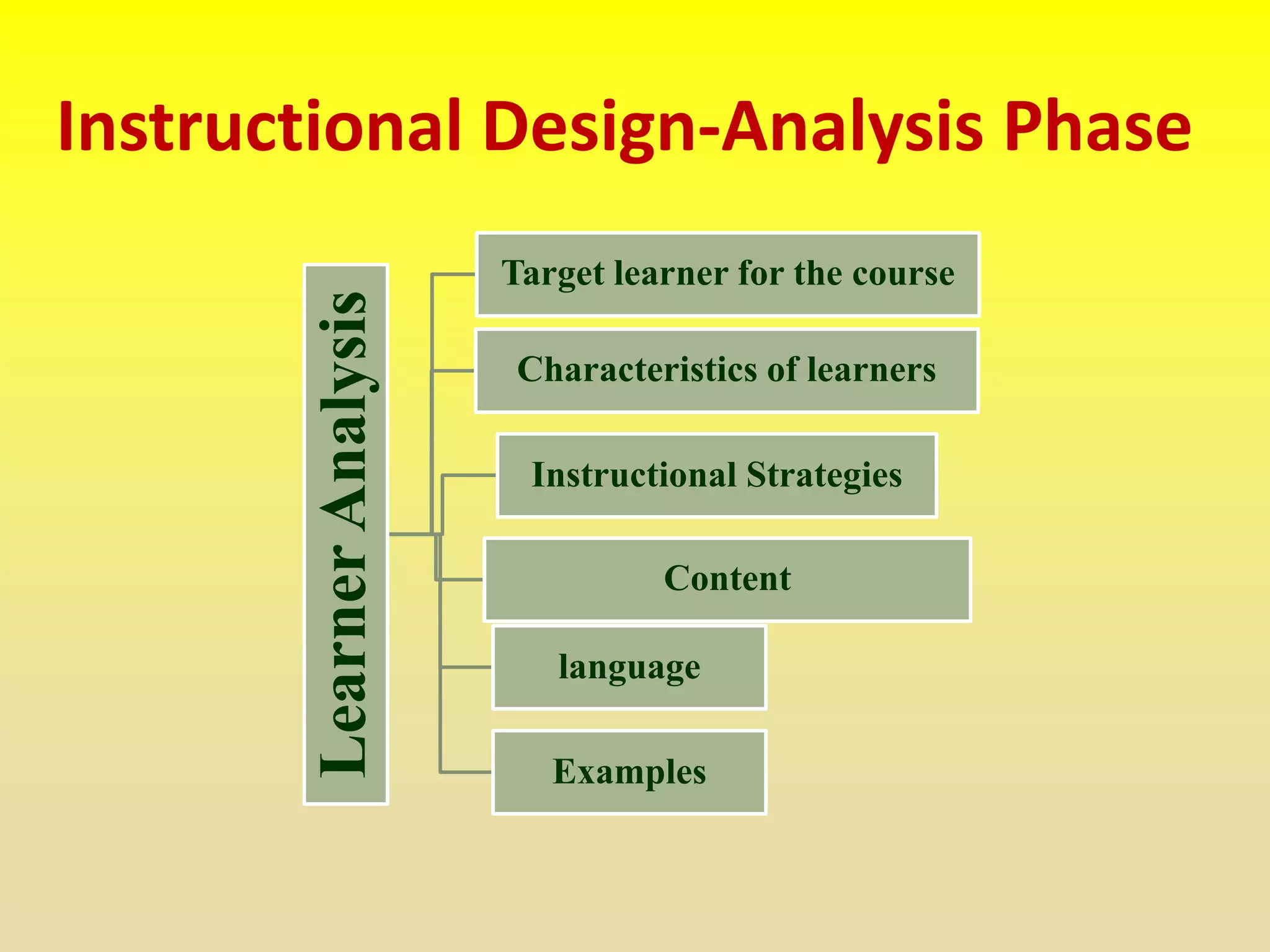
LearnerAnalysis
Target learner for the course
Characteristics of learners
Instructional Strategies
Content
language
Examples
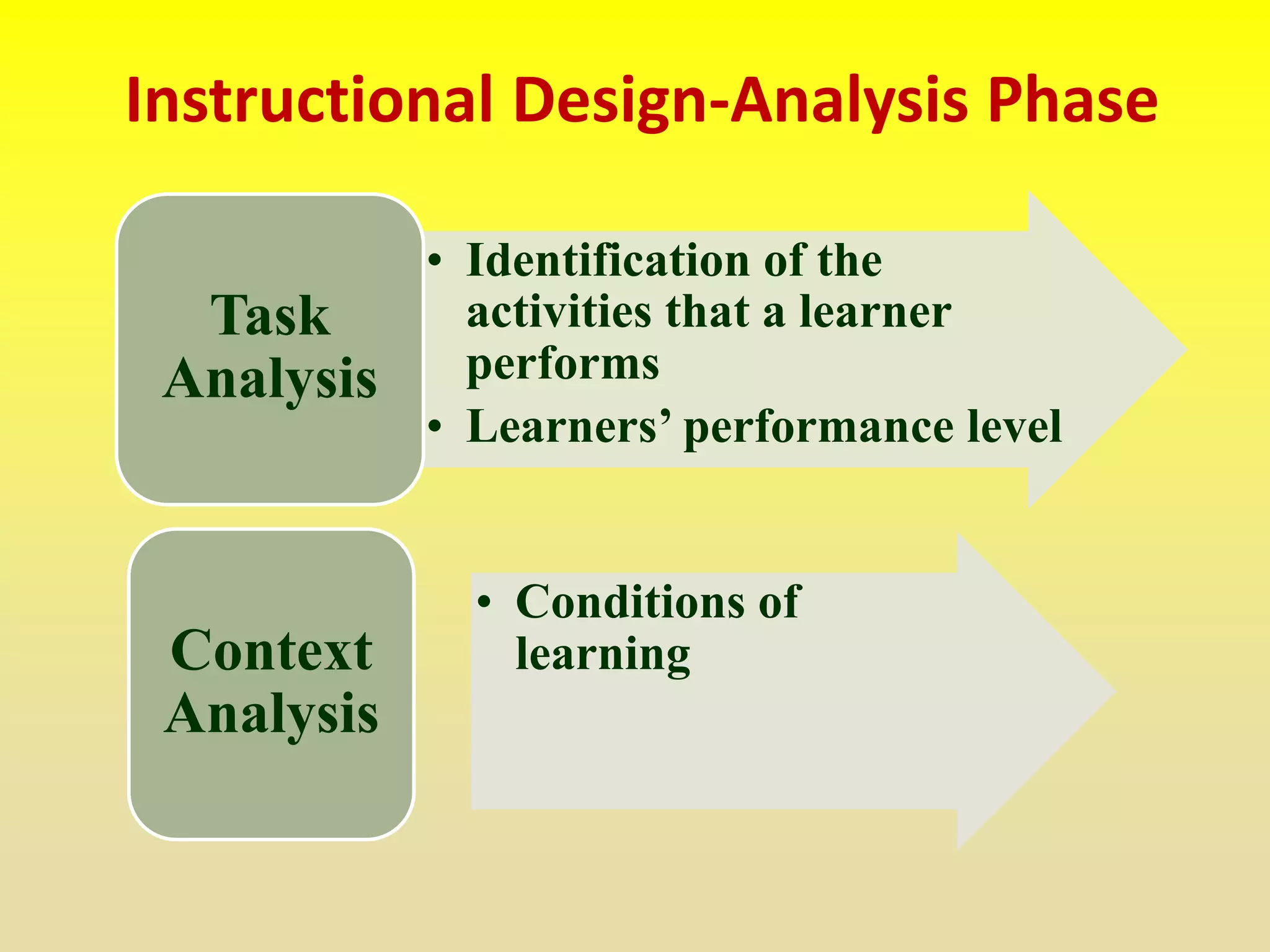
Instructional Design-Analysis Phase
• Identification of the
activities that a learner
performs
• Learners’ performance level
Task
Analysis
• Conditions of
learningContext
Analysis
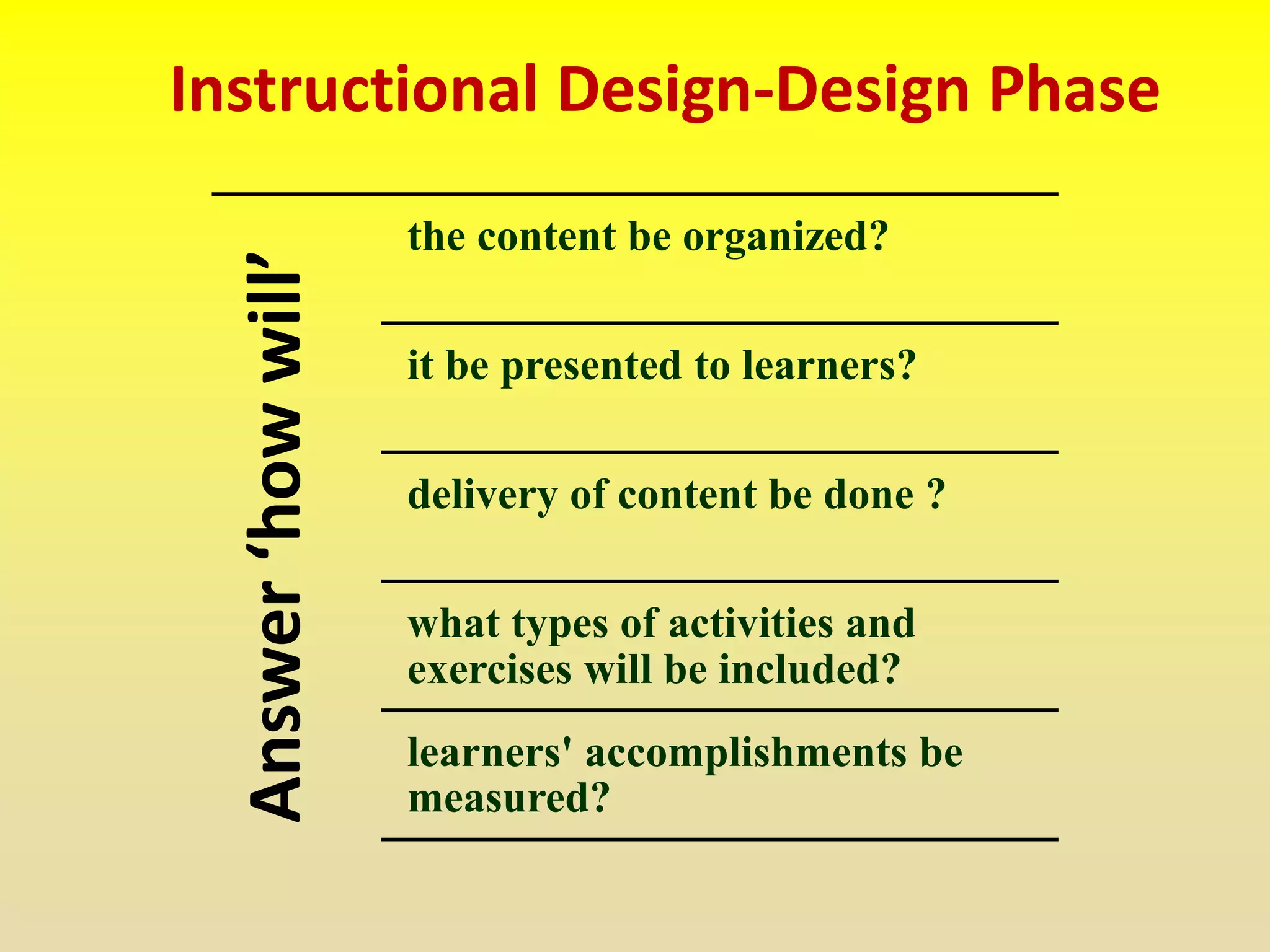
Instructional Design-Design Phase
Answer‘howwill’
the content be organized?
it be presented to learners?
delivery of content be done ?
what types of activities and
exercises will be included?
learners' accomplishments be
measured?
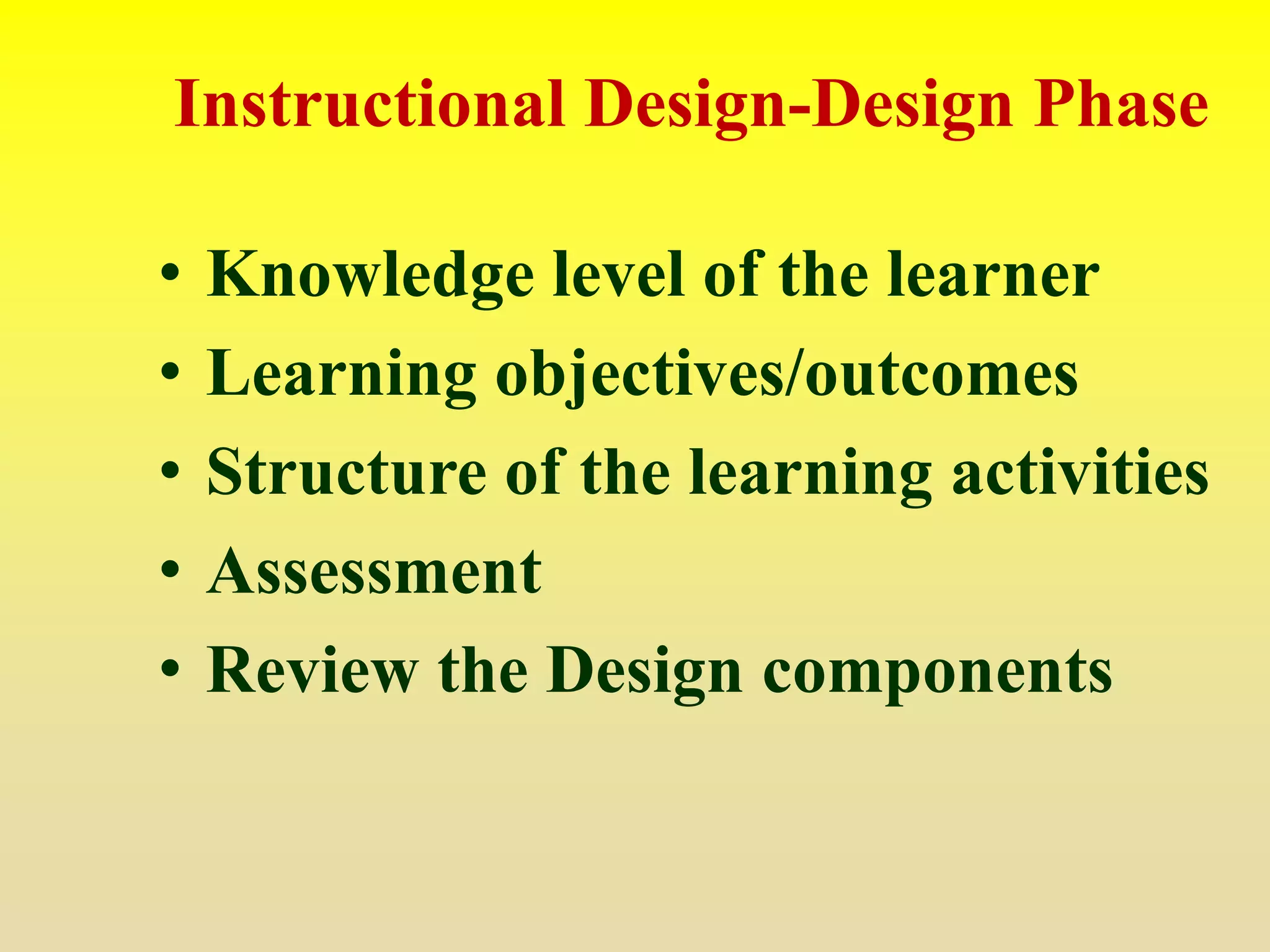
• Knowledge level of the learner
• Learning objectives/outcomes
• Structure of the learning activities
• Assessment
• Review the Design components
Instructional Design-Design Phase
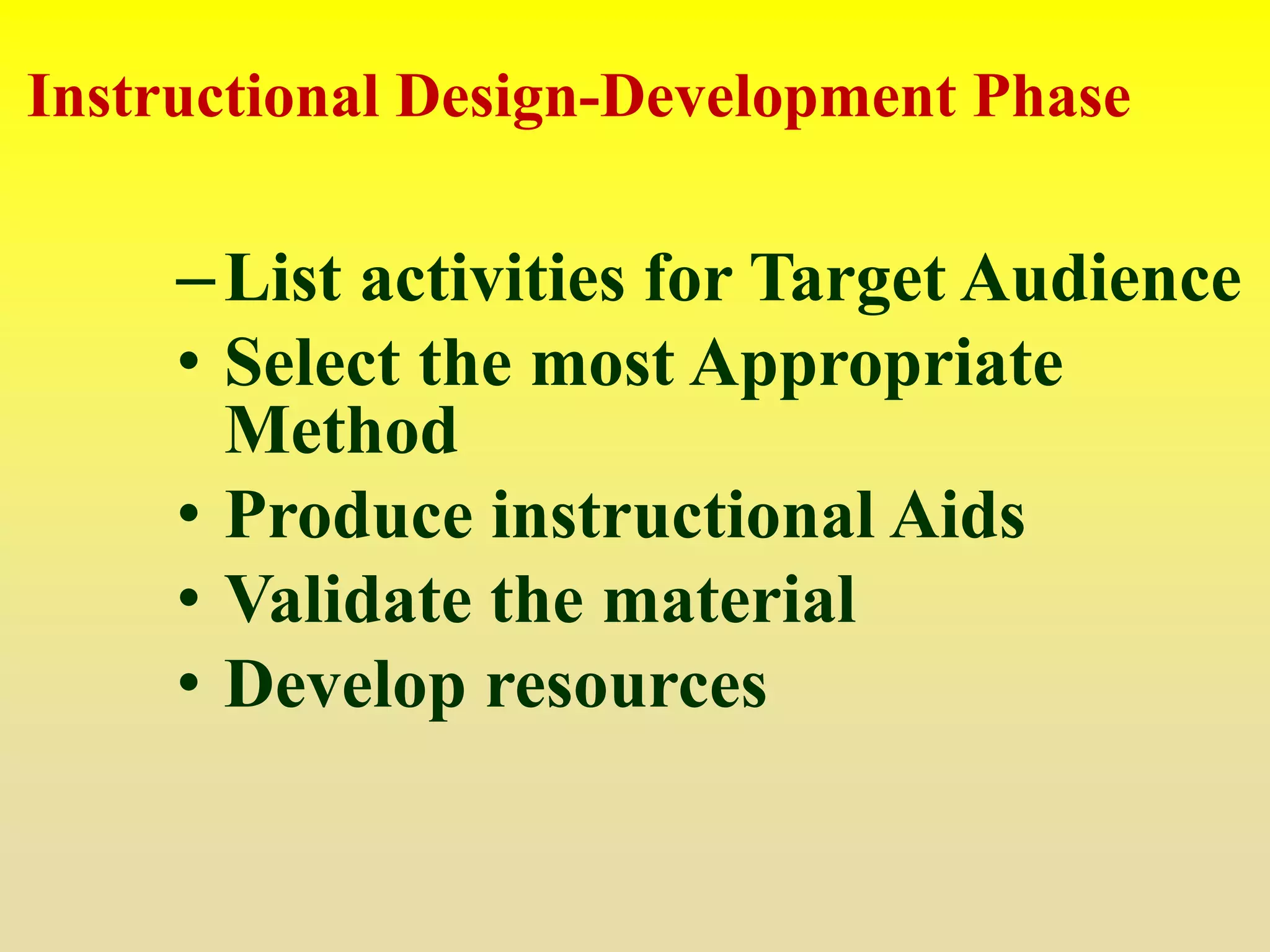
–List activities for Target Audience
• Select the most Appropriate
Method
• Produce instructional Aids
• Validate the material
• Develop resources
Instructional Design-Development Phase
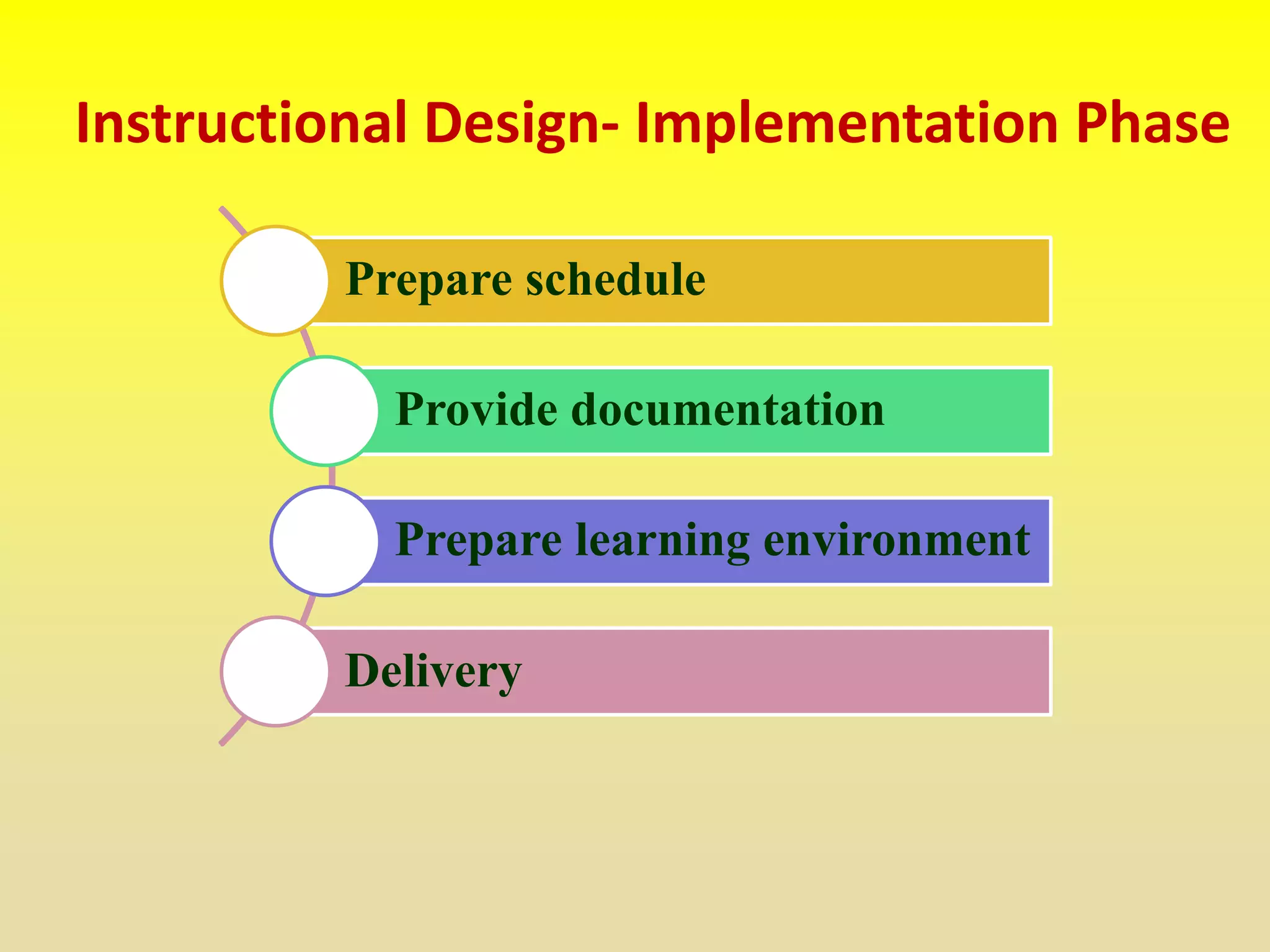
Instructional Design- Implementation Phase
Prepare schedule
Provide documentation
Prepare learning environment
Delivery
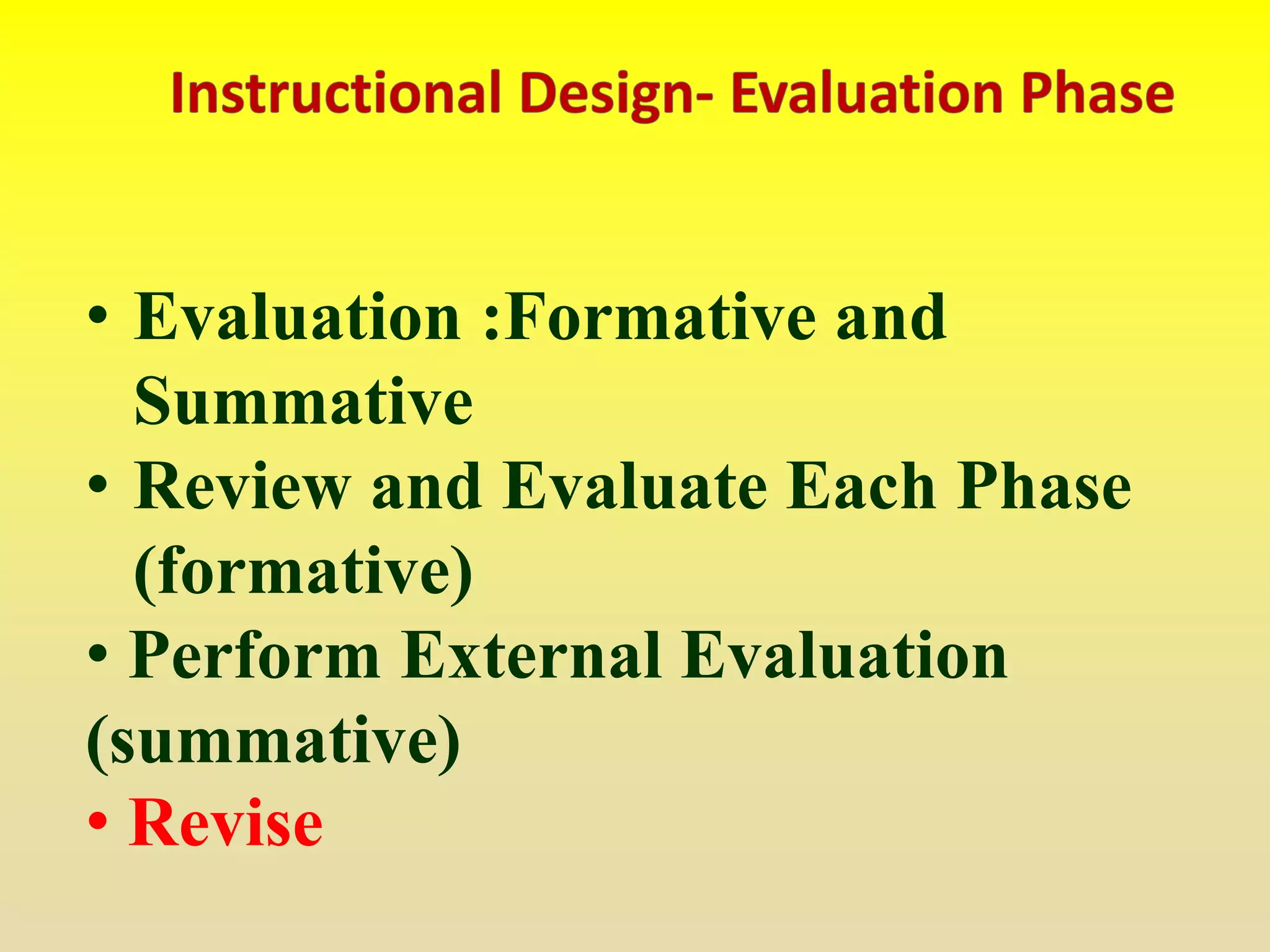
• Evaluation :Formative and
Summative
• Review and Evaluate Each Phase
(formative)
• Perform External Evaluation
(summative)
• Revise
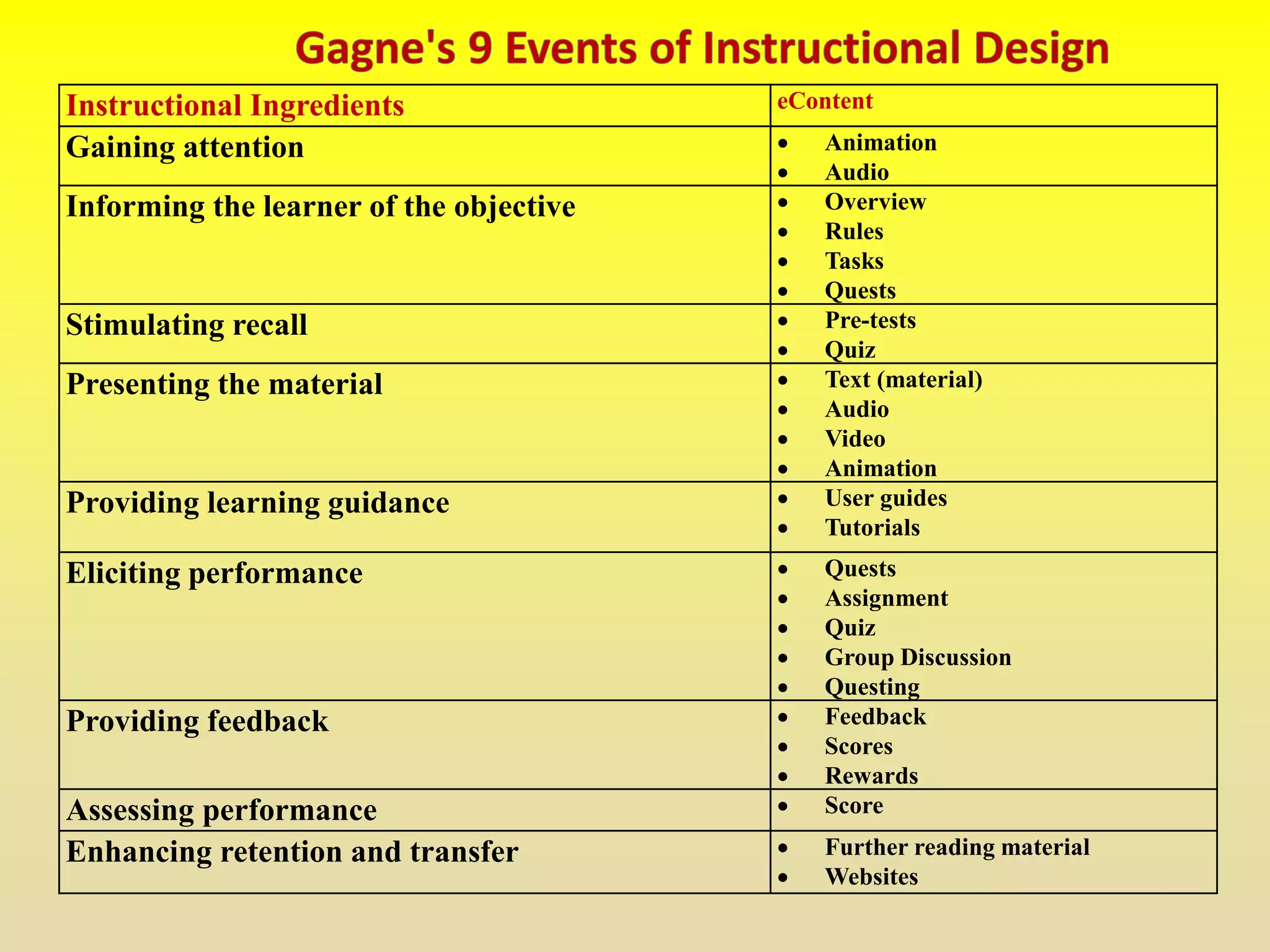
Instructional Ingredients eContent
Gaining attention  Animation
 Audio
Informing the learner of the objective  Overview
 Rules
 Tasks
 Quests
Stimulating recall  Pre-tests
 Quiz
Presenting the material  Text (material)
 Audio
 Video
 Animation
Providing learning guidance  User guides
 Tutorials
Eliciting performance  Quests
 Assignment
 Quiz
 Group Discussion
 Questing
Providing feedback  Feedback
 Scores
 Rewards
Assessing performance  Score
Enhancing retention and transfer  Further reading material
 Websites
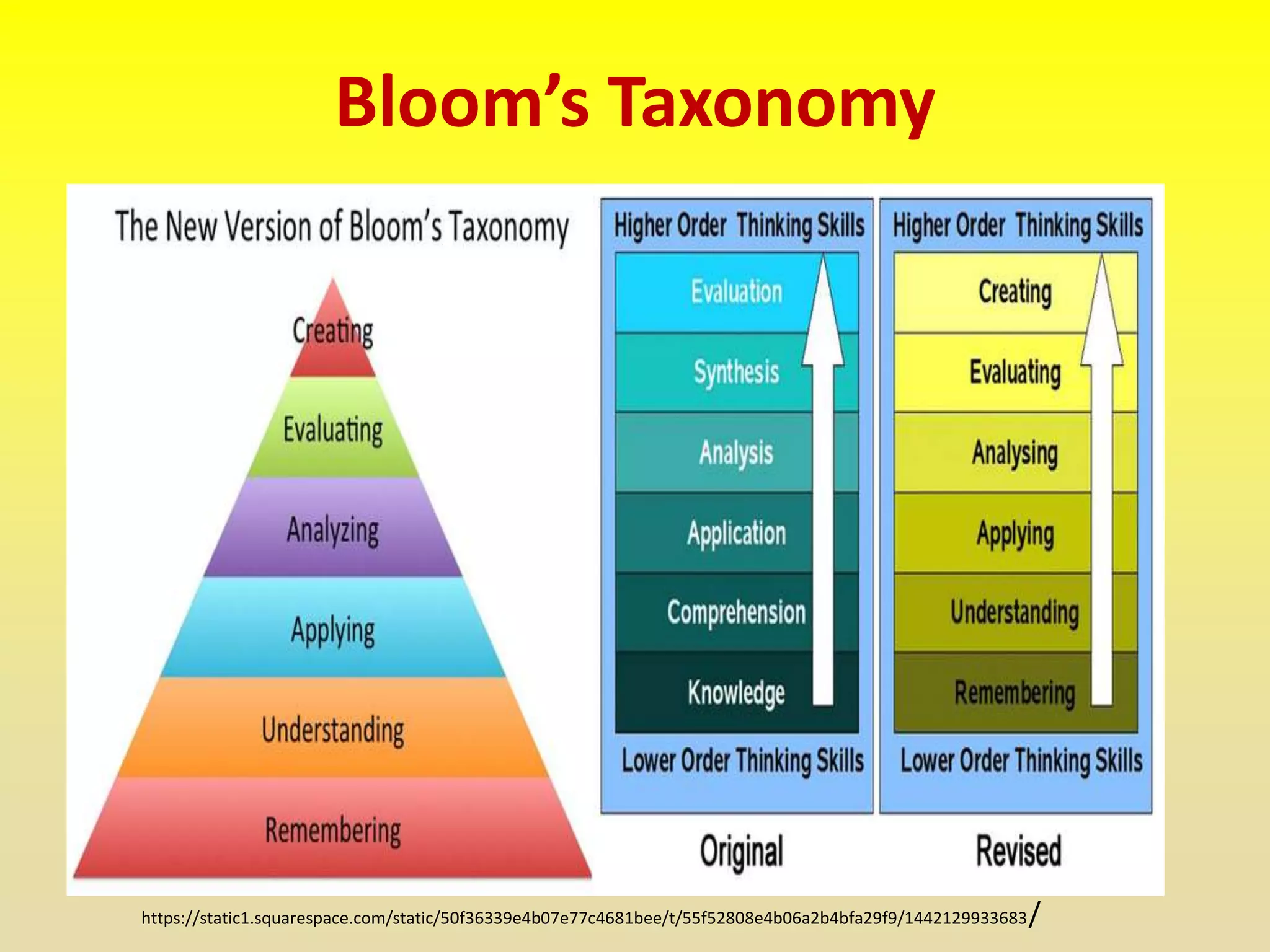
Bloom’s Taxonomy
https://static1.squarespace.com/static/50f36339e4b07e77c4681bee/t/55f52808e4b06a2b4bfa29f9/1442129933683/
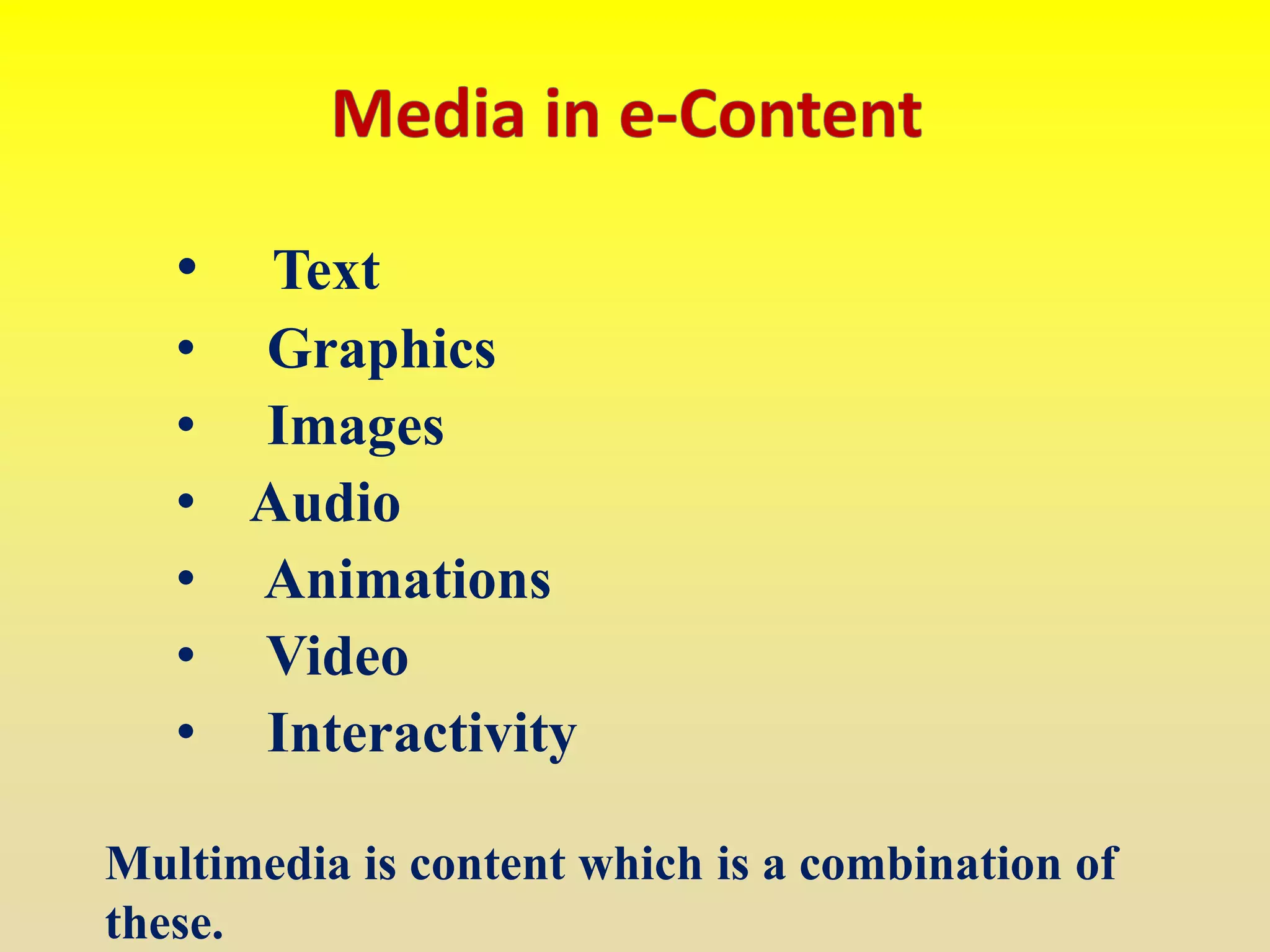
• Text
• Graphics
• Images
• Audio
• Animations
• Video
• Interactivity
Multimedia is content which is a combination of
these.
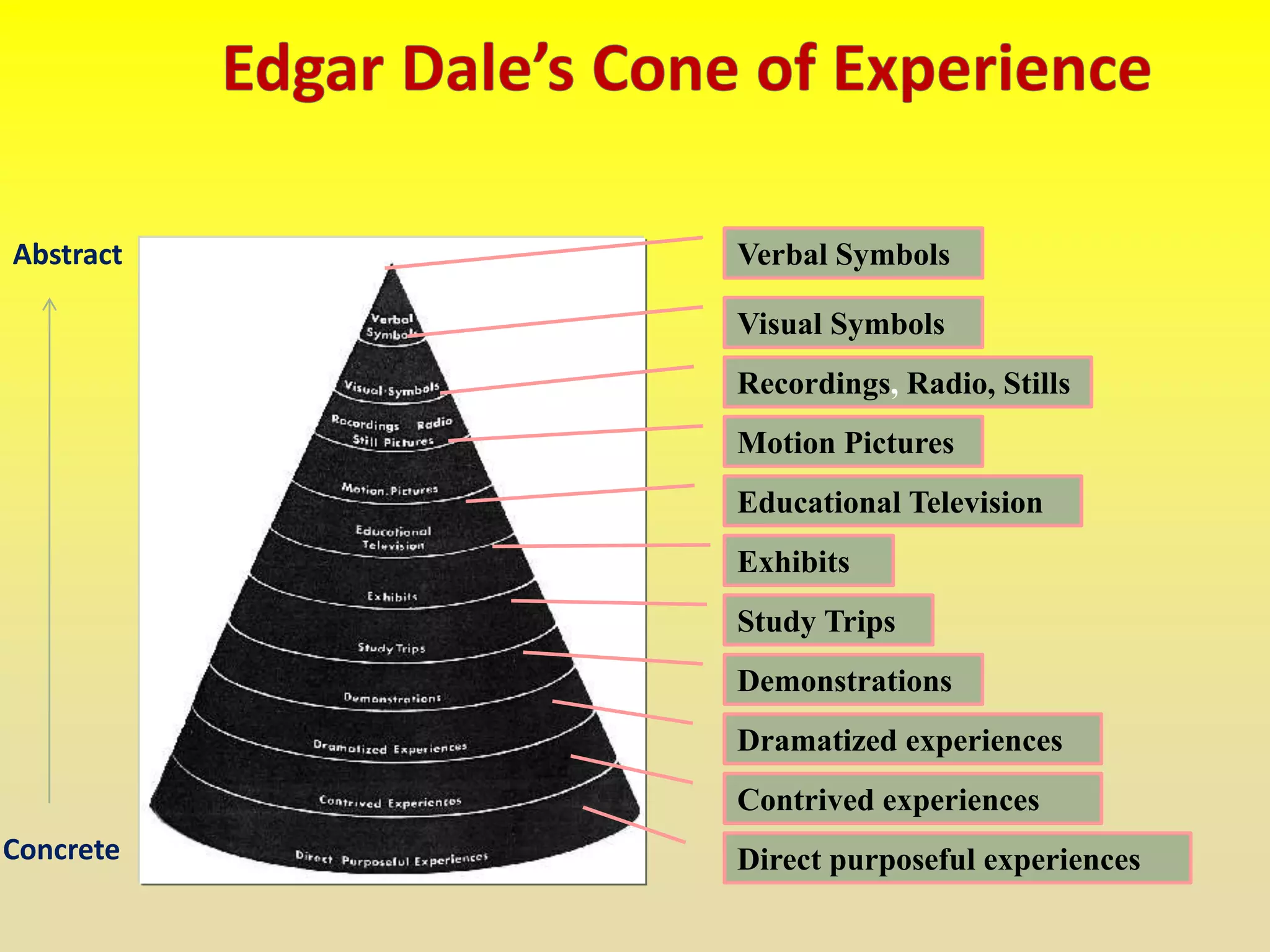
Verbal Symbols
Visual Symbols
Recordings, Radio, Stills
Motion Pictures
Educational Television
Exhibits
Study Trips
Demonstrations
Dramatized experiences
Contrived experiences
Direct purposeful experiencesConcrete
Abstract
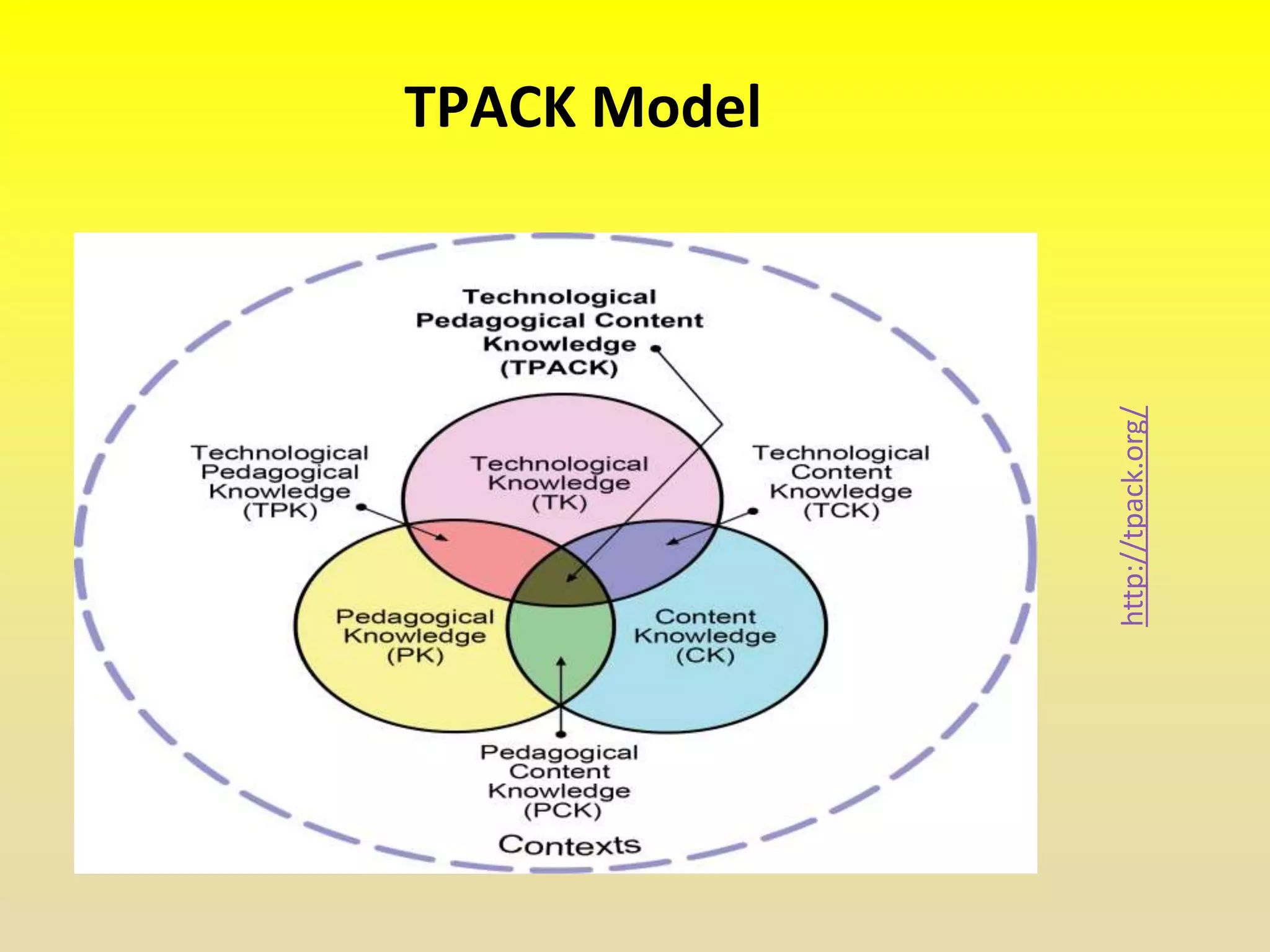
http://tpack.org/
TPACK Model
TPACK Model
✢ Pedagogical Content Knowledge
(PCK),
✢ Technological Content
Knowledge (TCK),
✢ Technological Pedagogical
Knowledge (TPK),
and
✢ Technological Pedagogical
Content Knowledge (TPACK).
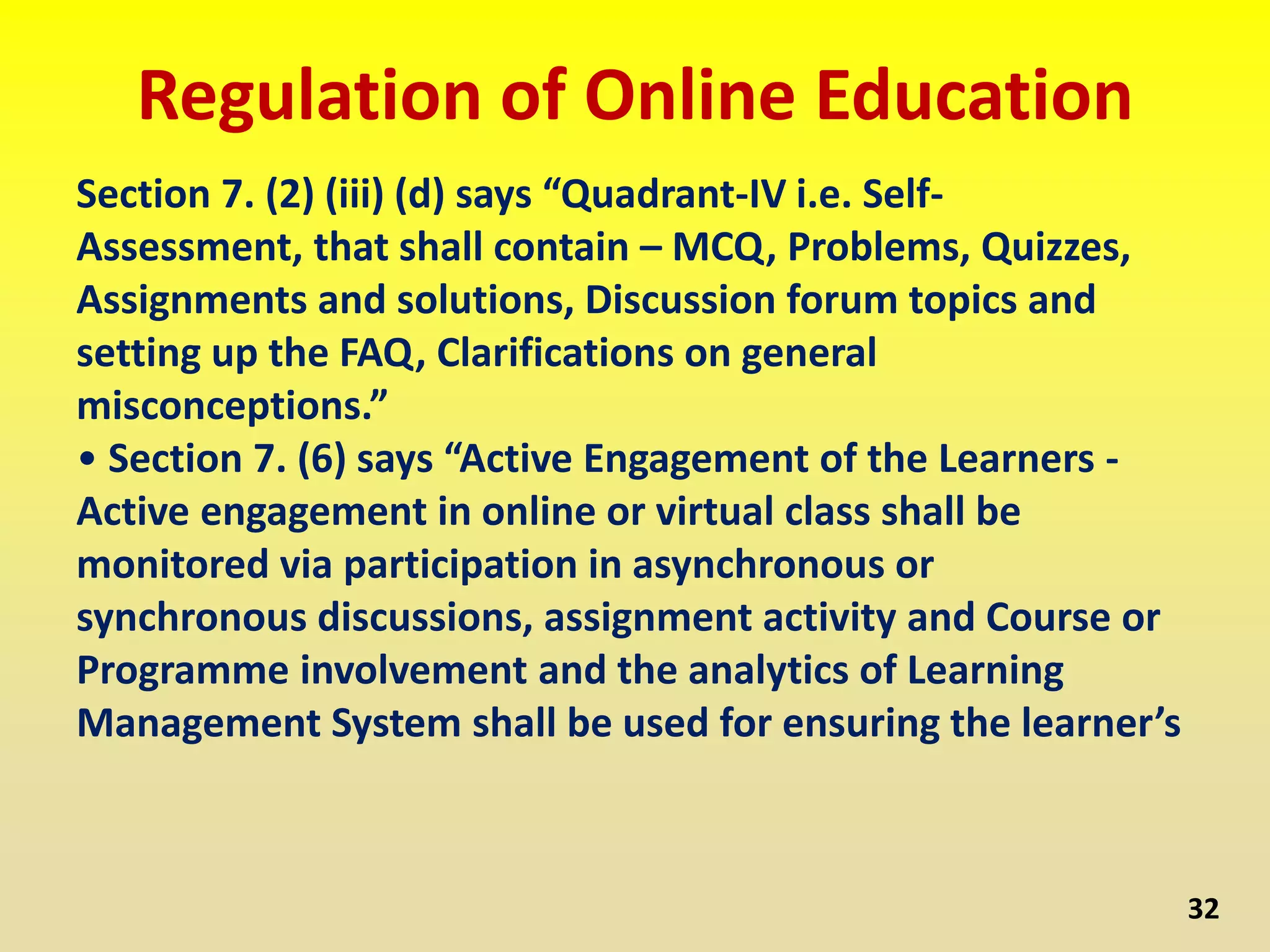
Regulation of Online Education
Section 7. (2) (iii) (d) says “Quadrant-IV i.e. Self-
Assessment, that shall contain – MCQ, Problems, Quizzes,
Assignments and solutions, Discussion forum topics and
setting up the FAQ, Clarifications on general
misconceptions.”
• Section 7. (6) says “Active Engagement of the Learners -
Active engagement in online or virtual class shall be
monitored via participation in asynchronous or
synchronous discussions, assignment activity and Course or
Programme involvement and the analytics of Learning
Management System shall be used for ensuring the learner’s
32
SWAYAM
Study Webs
of
Active Learning
for
Young Aspiring Minds
33
32 DTH educational TV channels : “SWAYAM Prabha”
Initiative by Government of India
Launched on 15 August 2016
President of India on July 9, 2017Dedicated to the nation.
SWAYAM
34
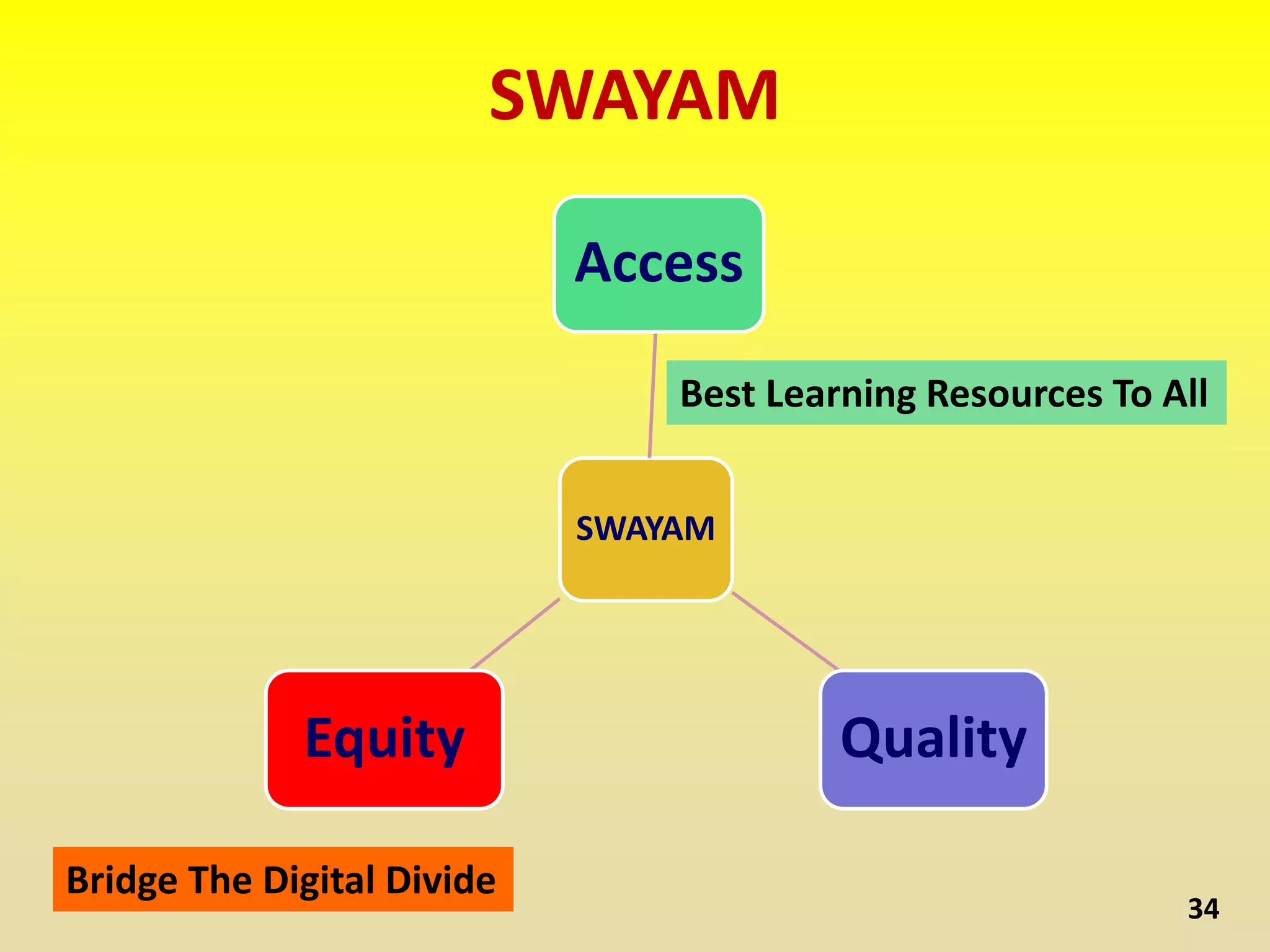
SWAYAM
Access
QualityEquity
Bridge The Digital Divide
Best Learning Resources To All
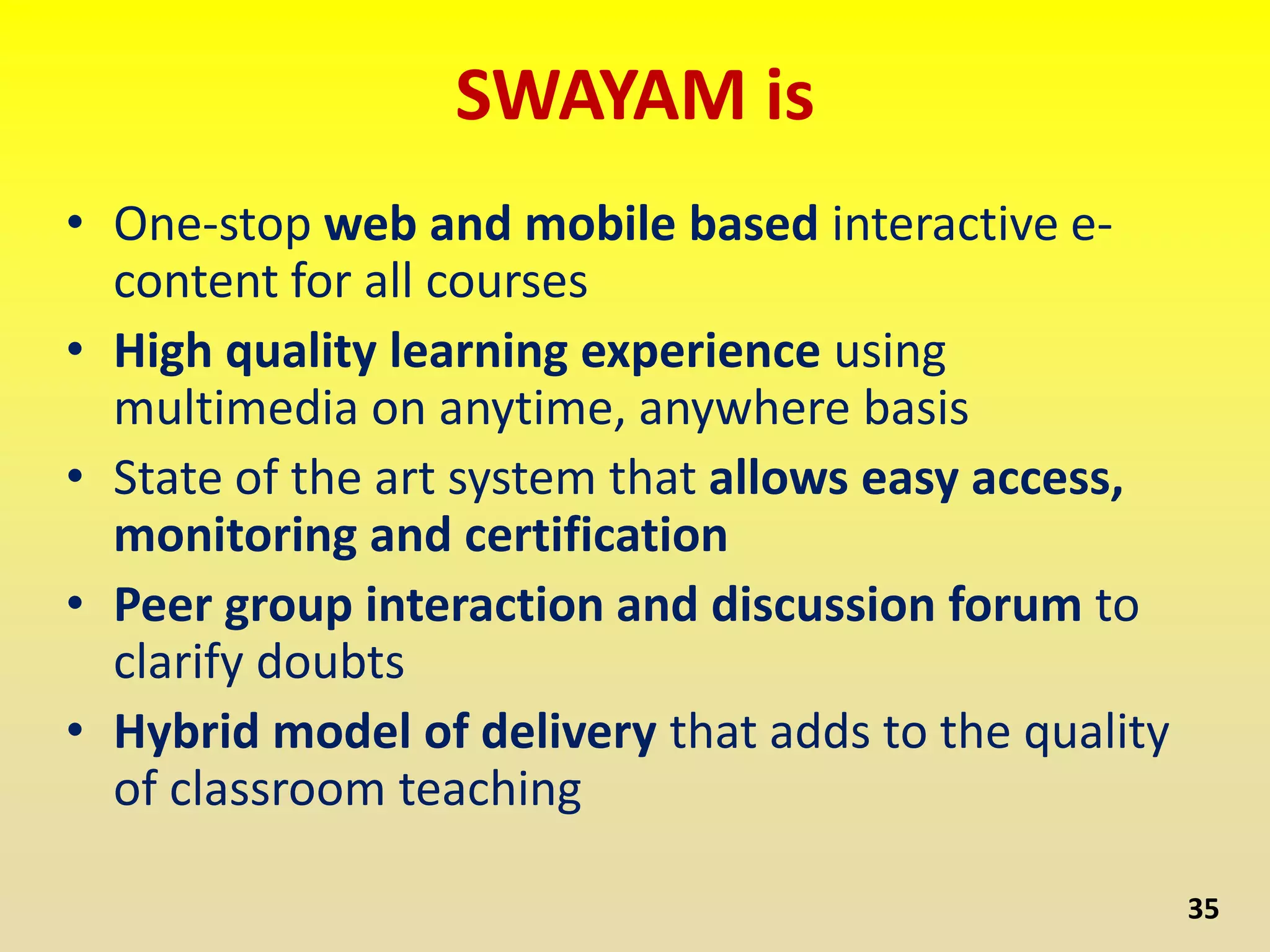
SWAYAM is
• One-stop web and mobile based interactive e-
content for all courses
• High quality learning experience using
multimedia on anytime, anywhere basis
• State of the art system that allows easy access,
monitoring and certification
• Peer group interaction and discussion forum to
clarify doubts
• Hybrid model of delivery that adds to the quality
of classroom teaching
35
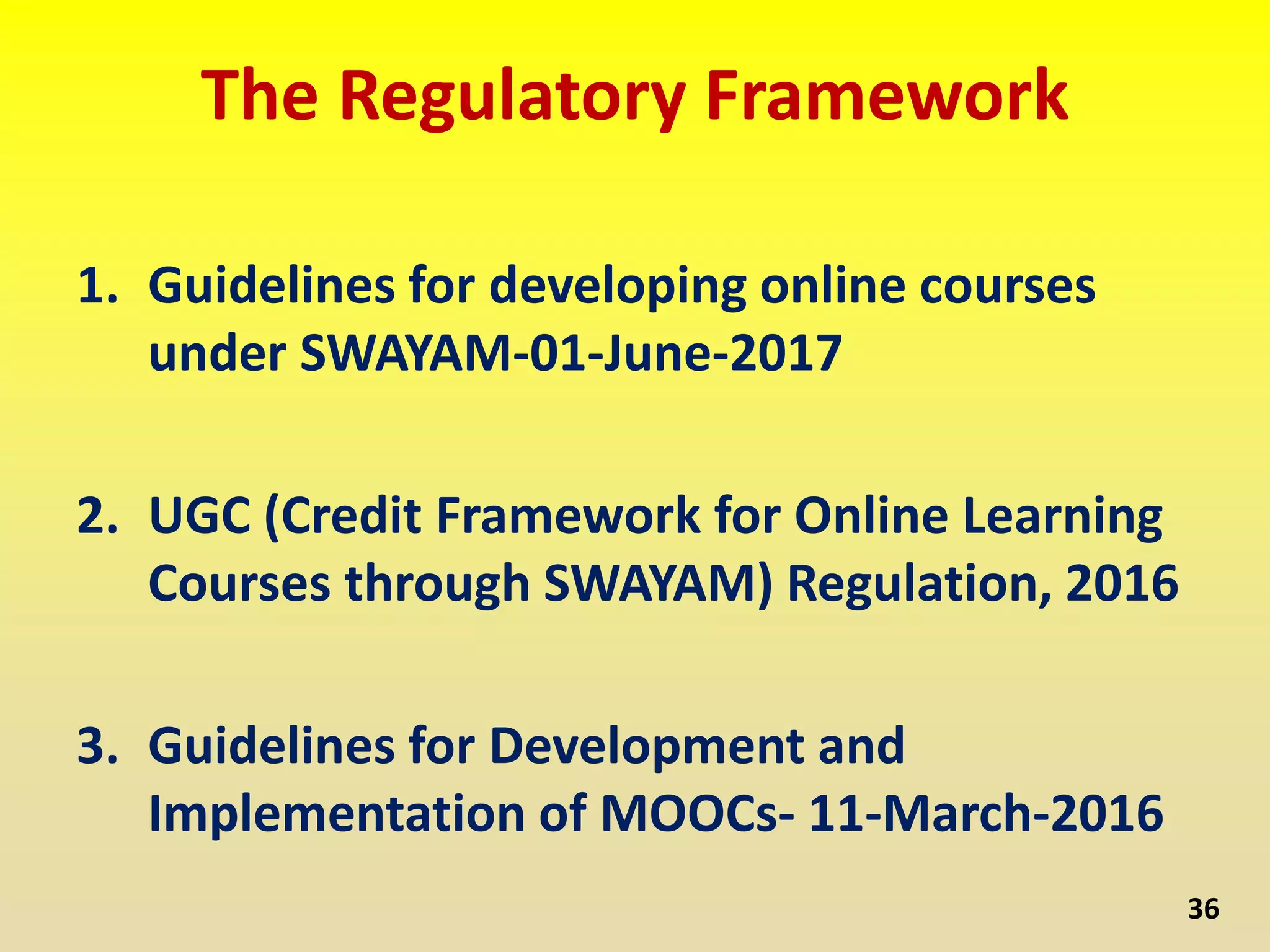
The Regulatory Framework
1. Guidelines for developing online courses
under SWAYAM-01-June-2017
2. UGC (Credit Framework for Online Learning
Courses through SWAYAM) Regulation, 2016
3. Guidelines for Development and
Implementation of MOOCs- 11-March-2016
36
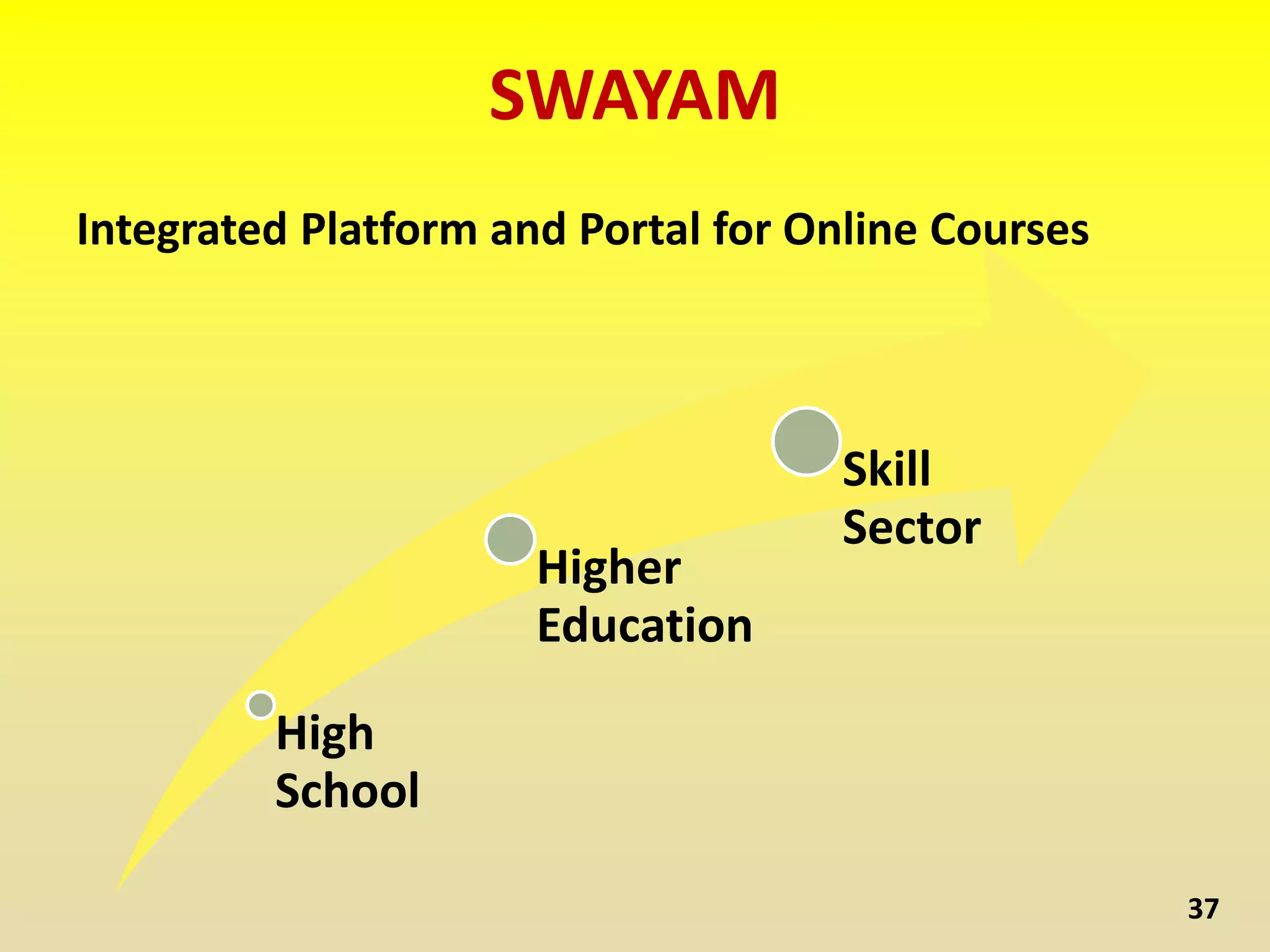
SWAYAM
High
School
Higher
Education
Skill
Sector
37
Integrated Platform and Portal for Online Courses
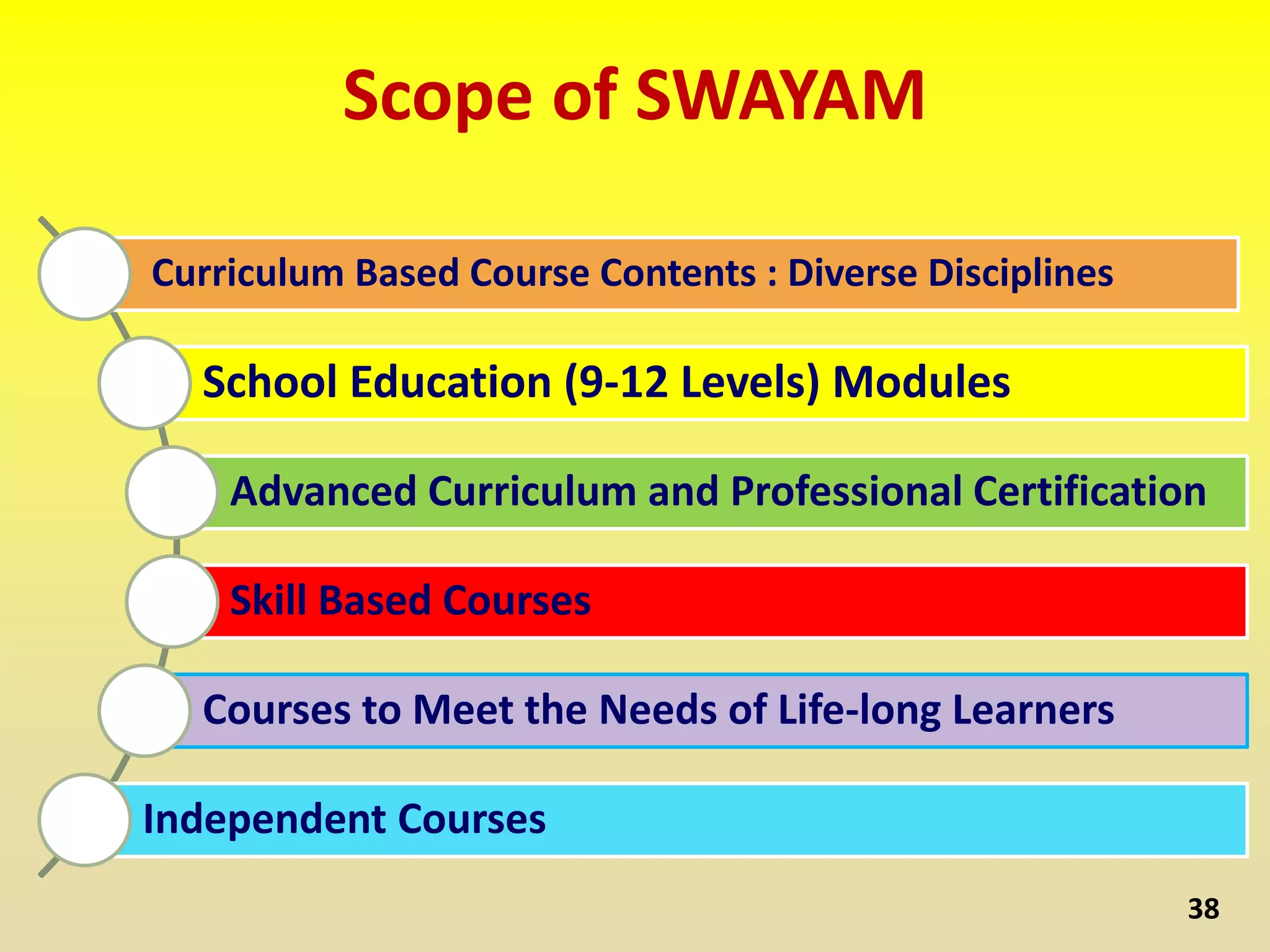
Scope of SWAYAM
Curriculum Based Course Contents : Diverse Disciplines
School Education (9-12 Levels) Modules
Advanced Curriculum and Professional Certification
Skill Based Courses
Courses to Meet the Needs of Life-long Learners
Independent Courses
38
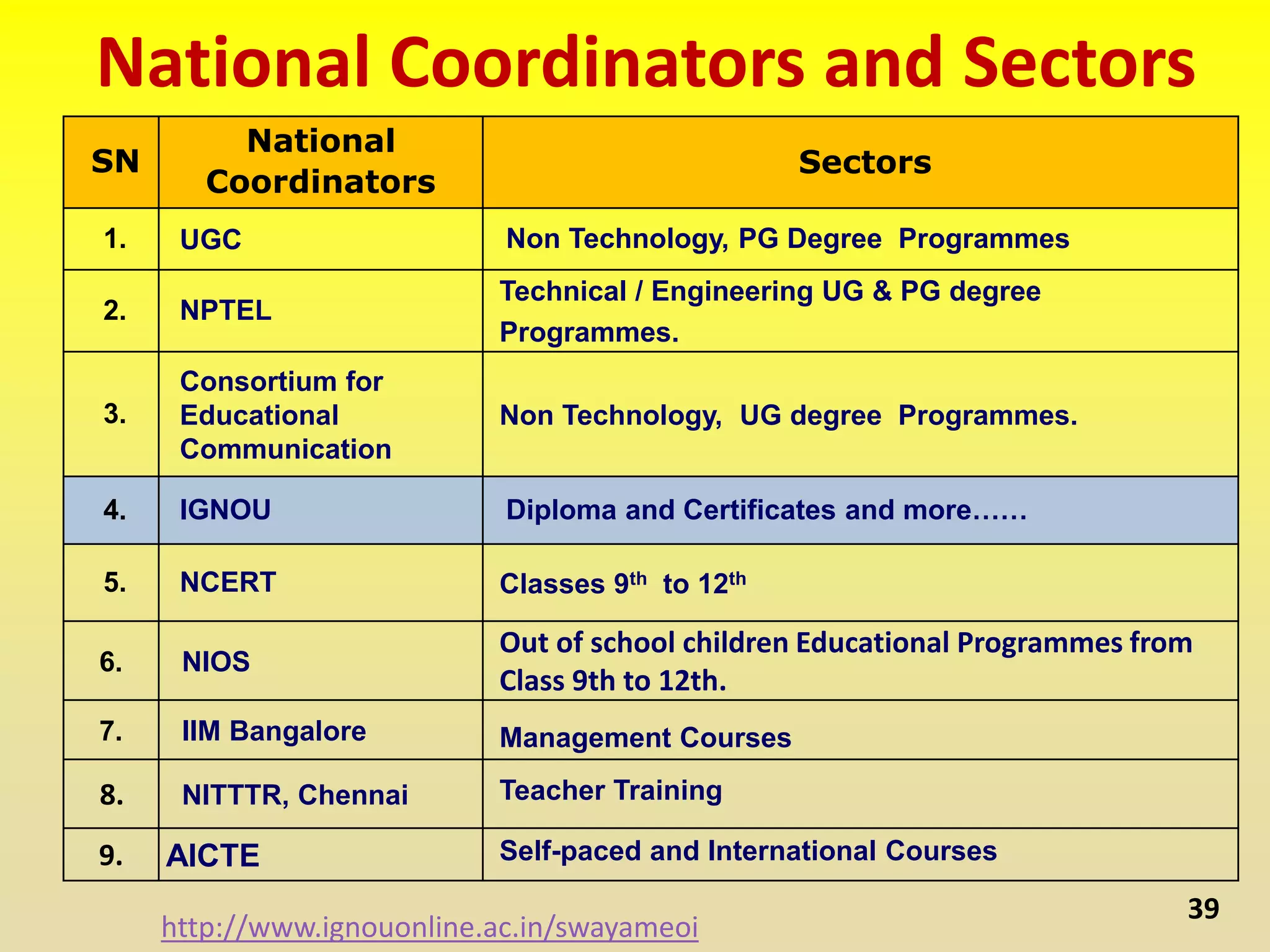
National Coordinators and Sectors
39
SN
National
Coordinators
Sectors
1. UGC Non Technology, PG Degree Programmes
2. NPTEL
Technical / Engineering UG & PG degree
Programmes.
3.
Consortium for
Educational
Communication
Non Technology, UG degree Programmes.
4. IGNOU Diploma and Certificates and more……
5. NCERT Classes 9th to 12th
6. NIOS
Out of school children Educational Programmes from
Class 9th to 12th.
7. IIM Bangalore Management Courses
8. NITTTR, Chennai Teacher Training
9. AICTE Self-paced and International Courses
http://www.ignouonline.ac.in/swayameoi
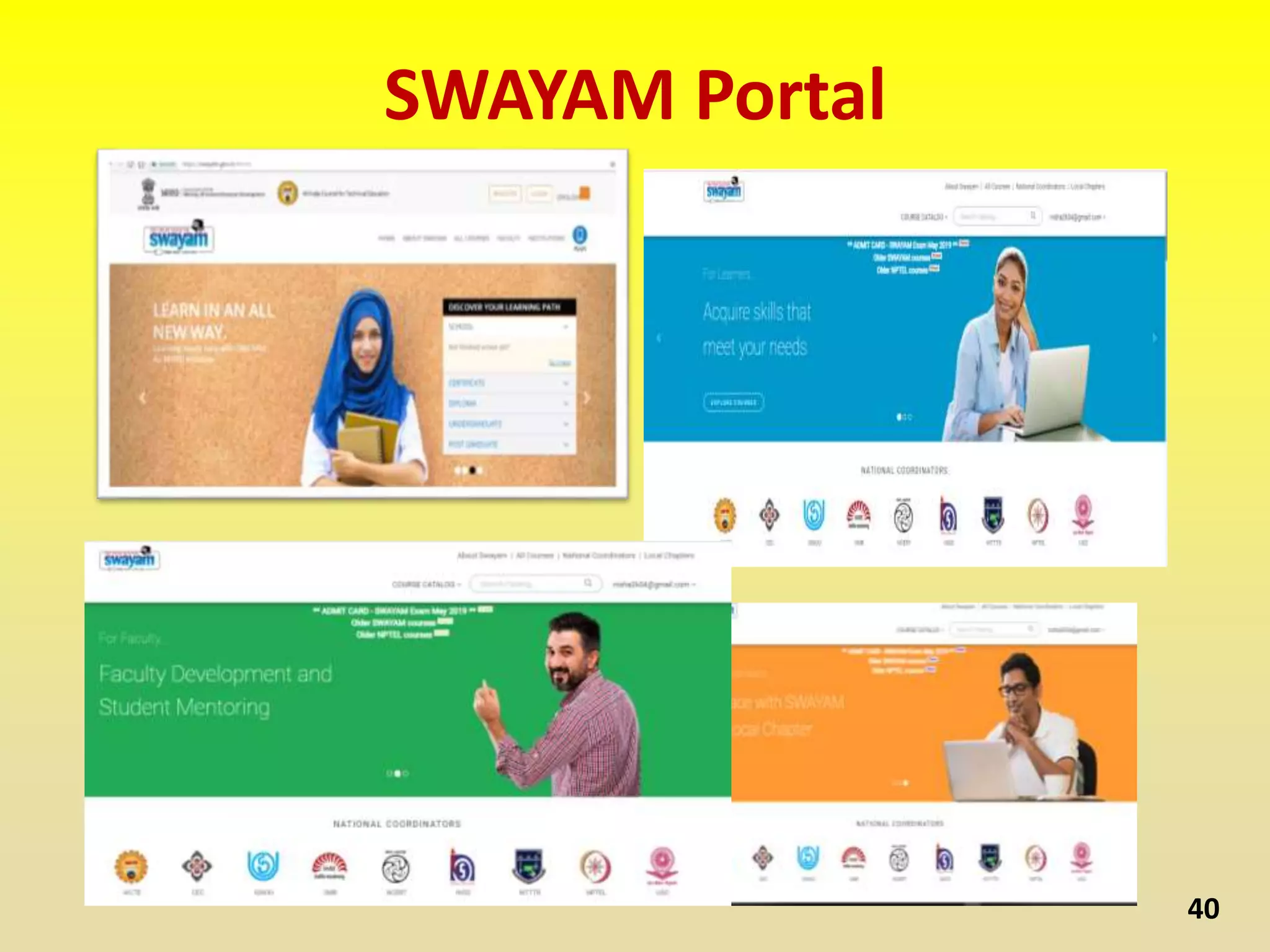
SWAYAM Portal
40
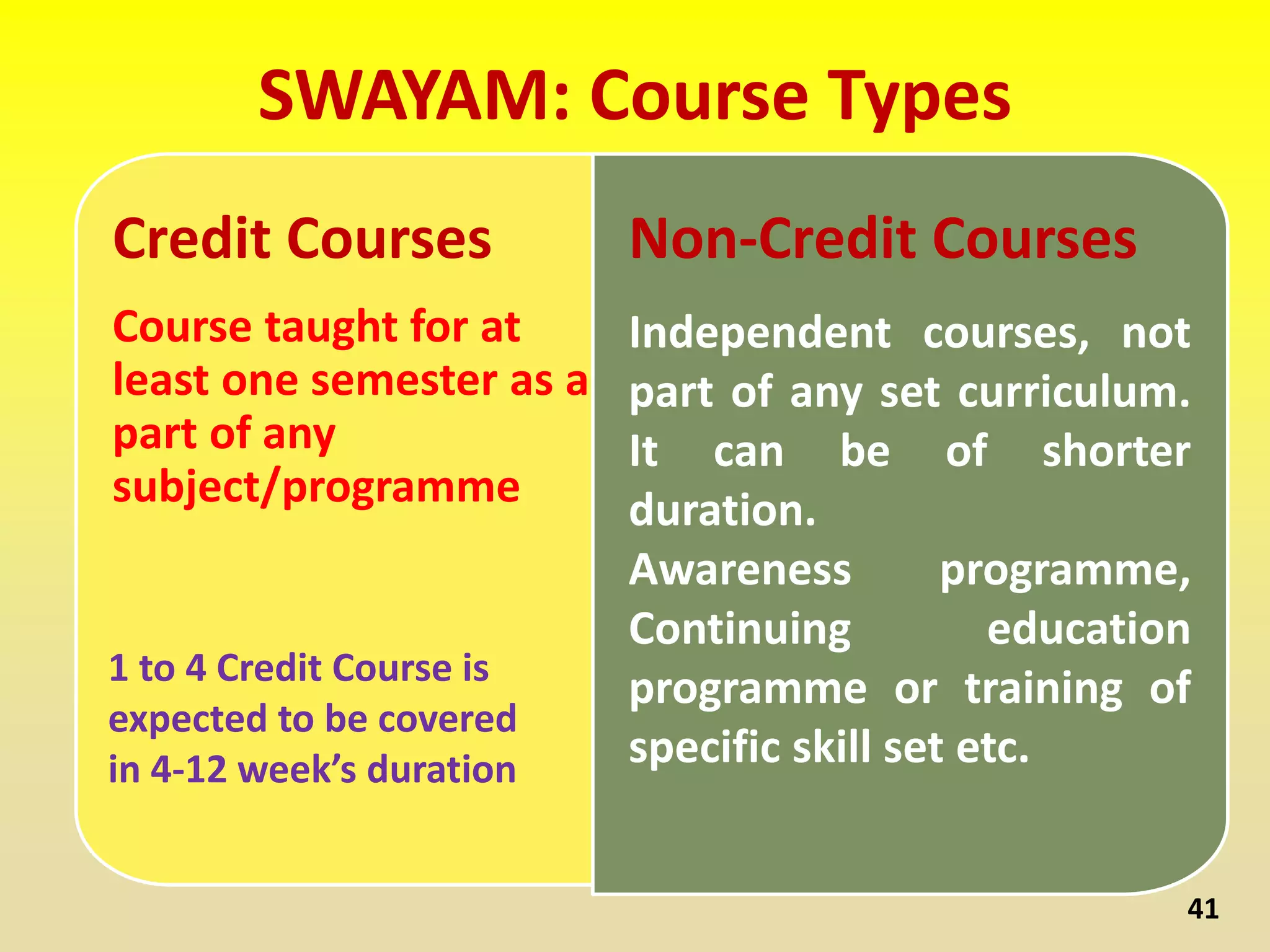
SWAYAM: Course Types
Credit Courses
Course taught for at
least one semester as a
part of any
subject/programme
Non-Credit Courses
Independent courses, not
part of any set curriculum.
It can be of shorter
duration.
Awareness programme,
Continuing education
programme or training of
specific skill set etc.
41
1 to 4 Credit Course is
expected to be covered
in 4-12 week’s duration
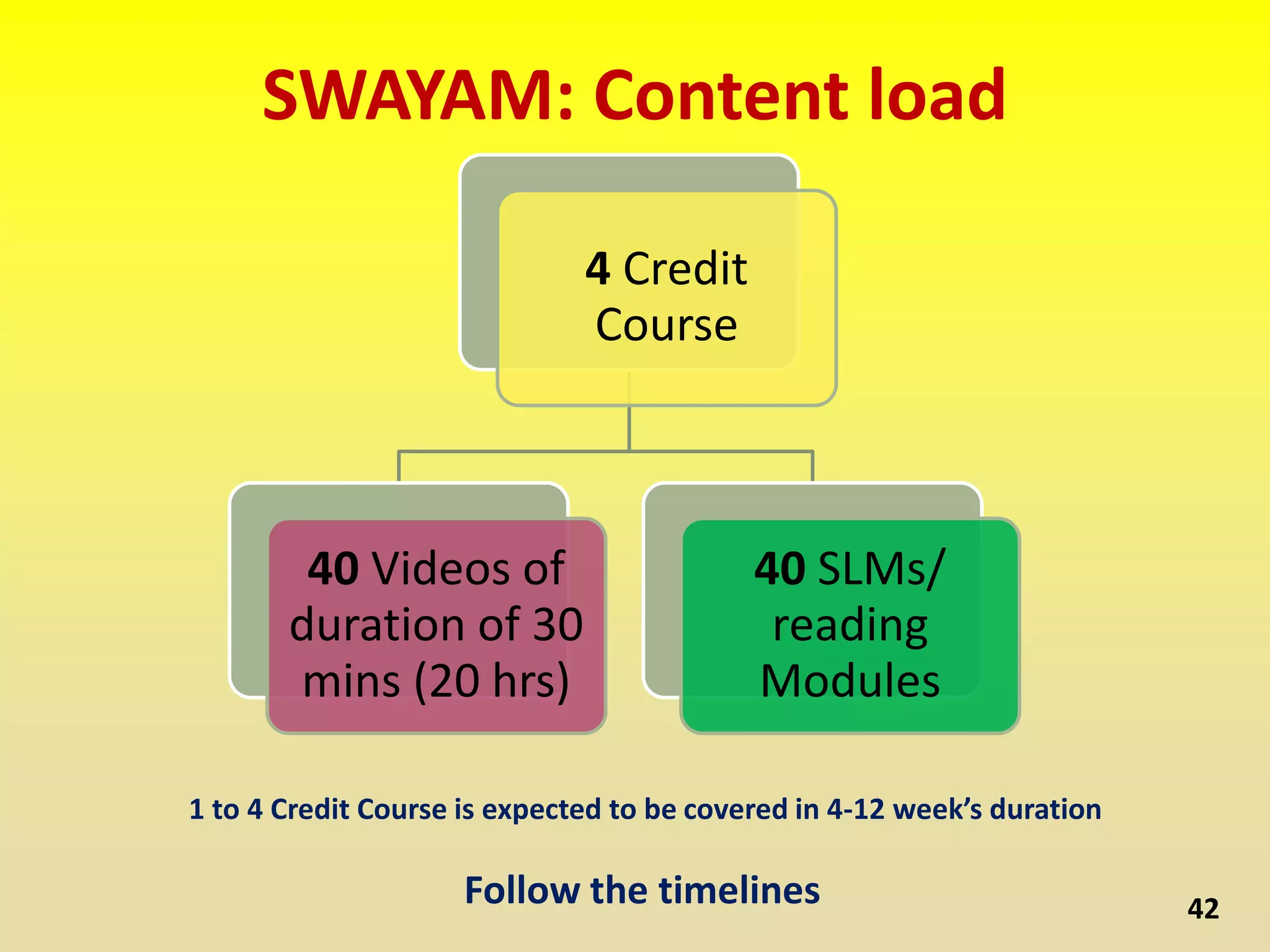
SWAYAM: Content load
42
1 to 4 Credit Course is expected to be covered in 4-12 week’s duration
Follow the timelines
4 Credit
Course
40 Videos of
duration of 30
mins (20 hrs)
40 SLMs/
reading
Modules
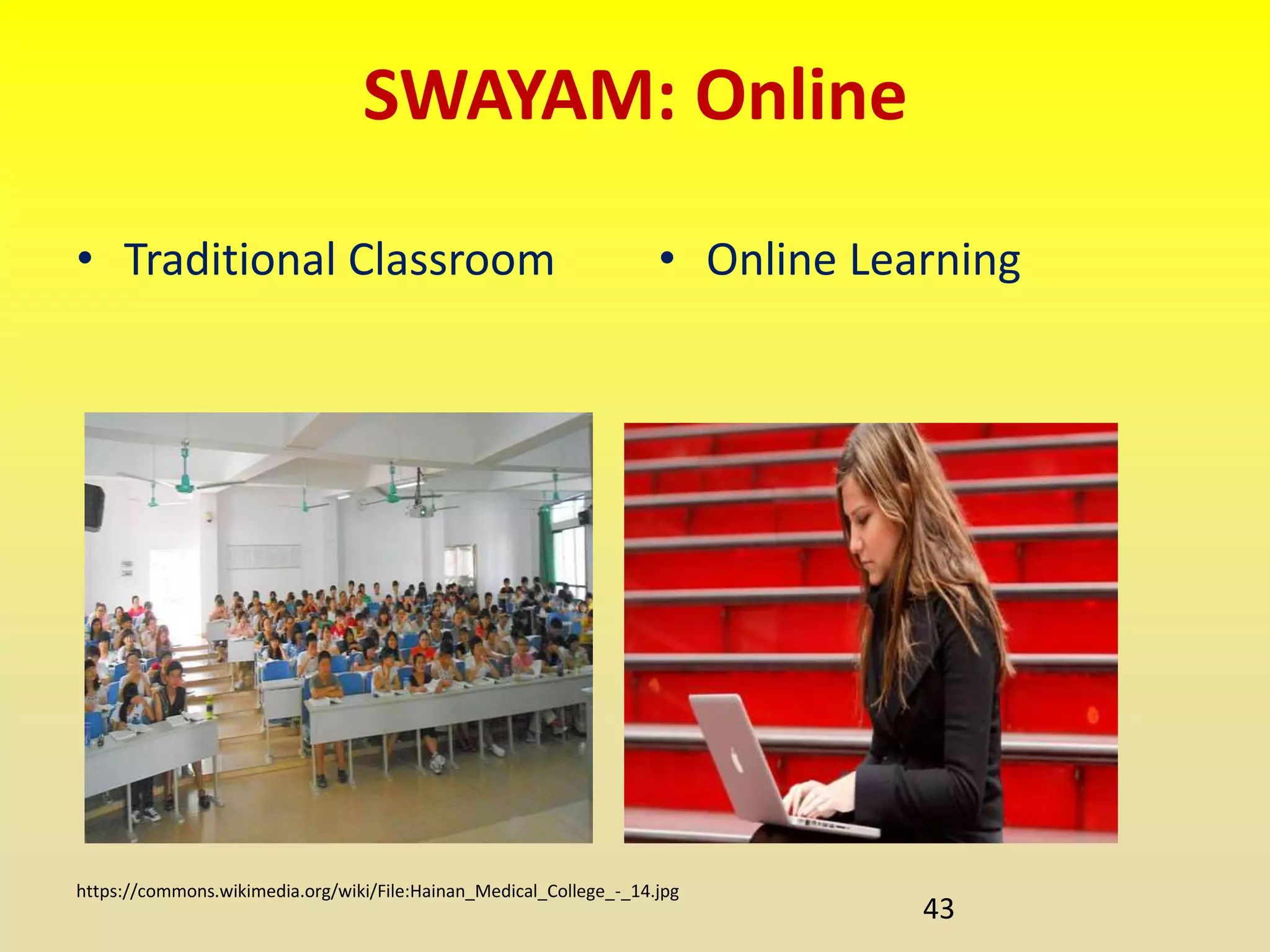
SWAYAM: Online
• Traditional Classroom • Online Learning
43
https://commons.wikimedia.org/wiki/File:Hainan_Medical_College_-_14.jpg
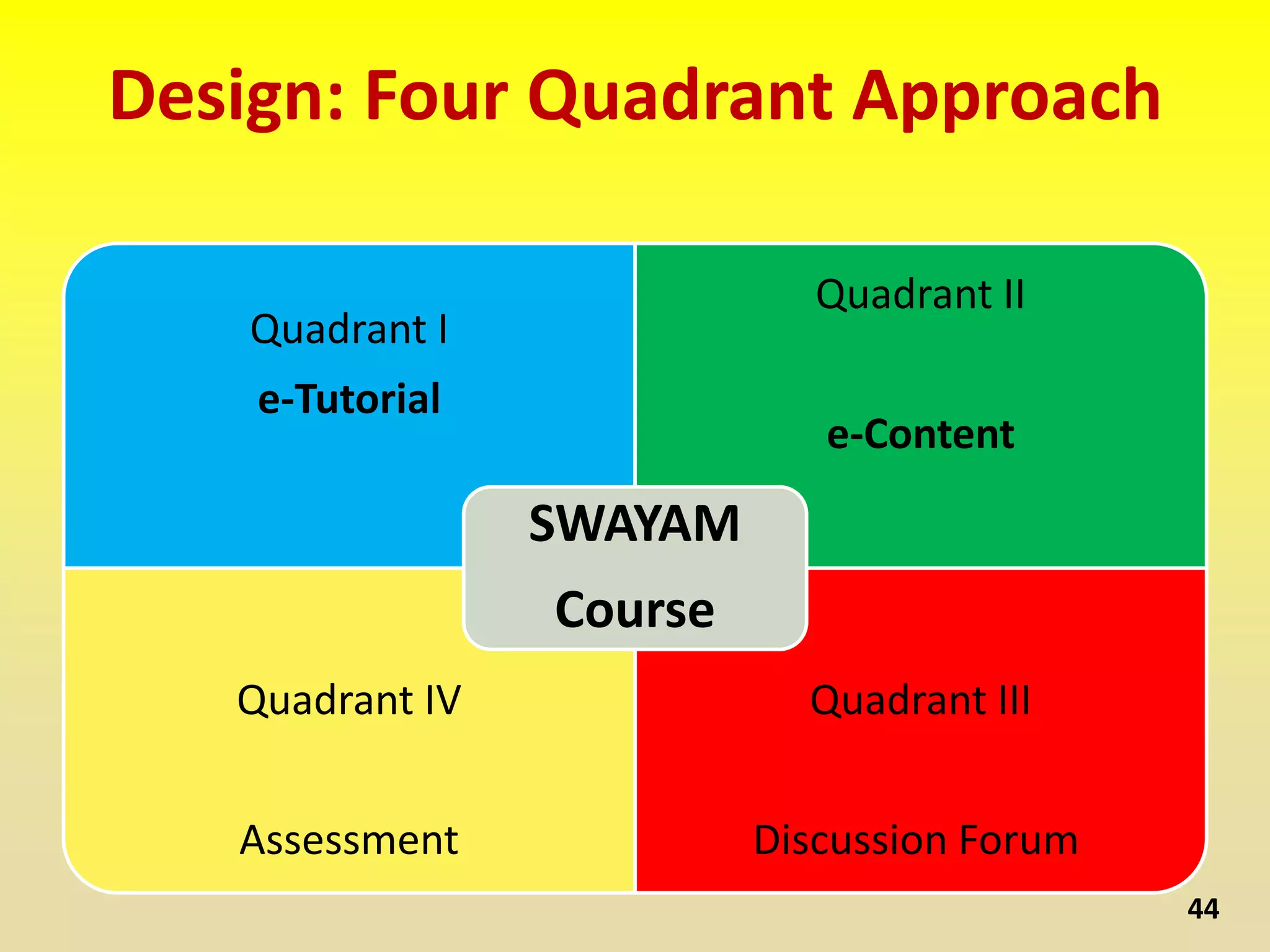
Design: Four Quadrant Approach
Quadrant I
e-Tutorial
Quadrant II
e-Content
Quadrant IV
Assessment
Quadrant III
Discussion Forum
SWAYAM
Course
44
Design: Four Quadrant Approach
SWAYAM
Course
45
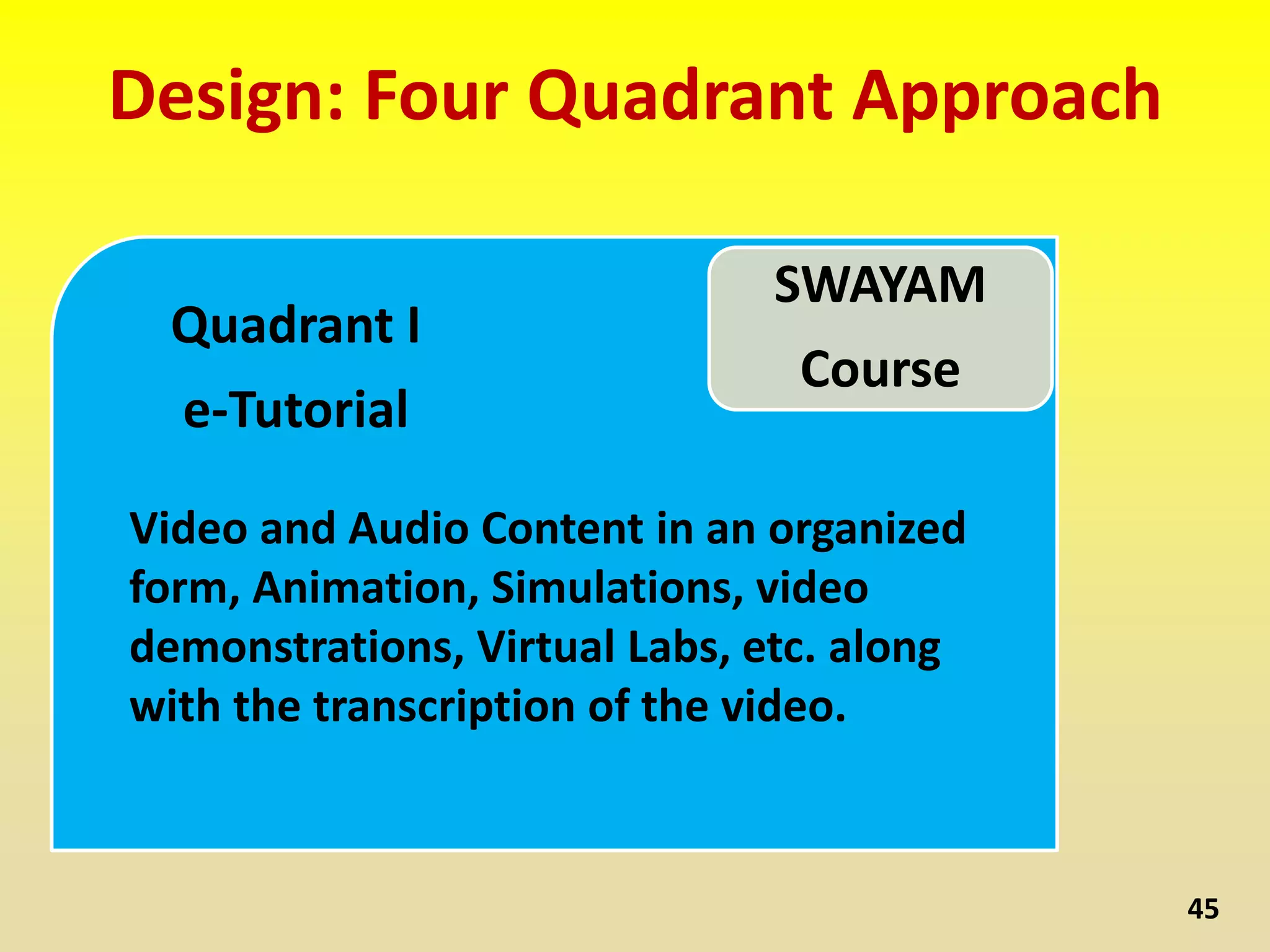
Video and Audio Content in an organized
form, Animation, Simulations, video
demonstrations, Virtual Labs, etc. along
with the transcription of the video.
Quadrant I
e-Tutorial
Design: Four Quadrant Approach
SWAYAM
Course
46
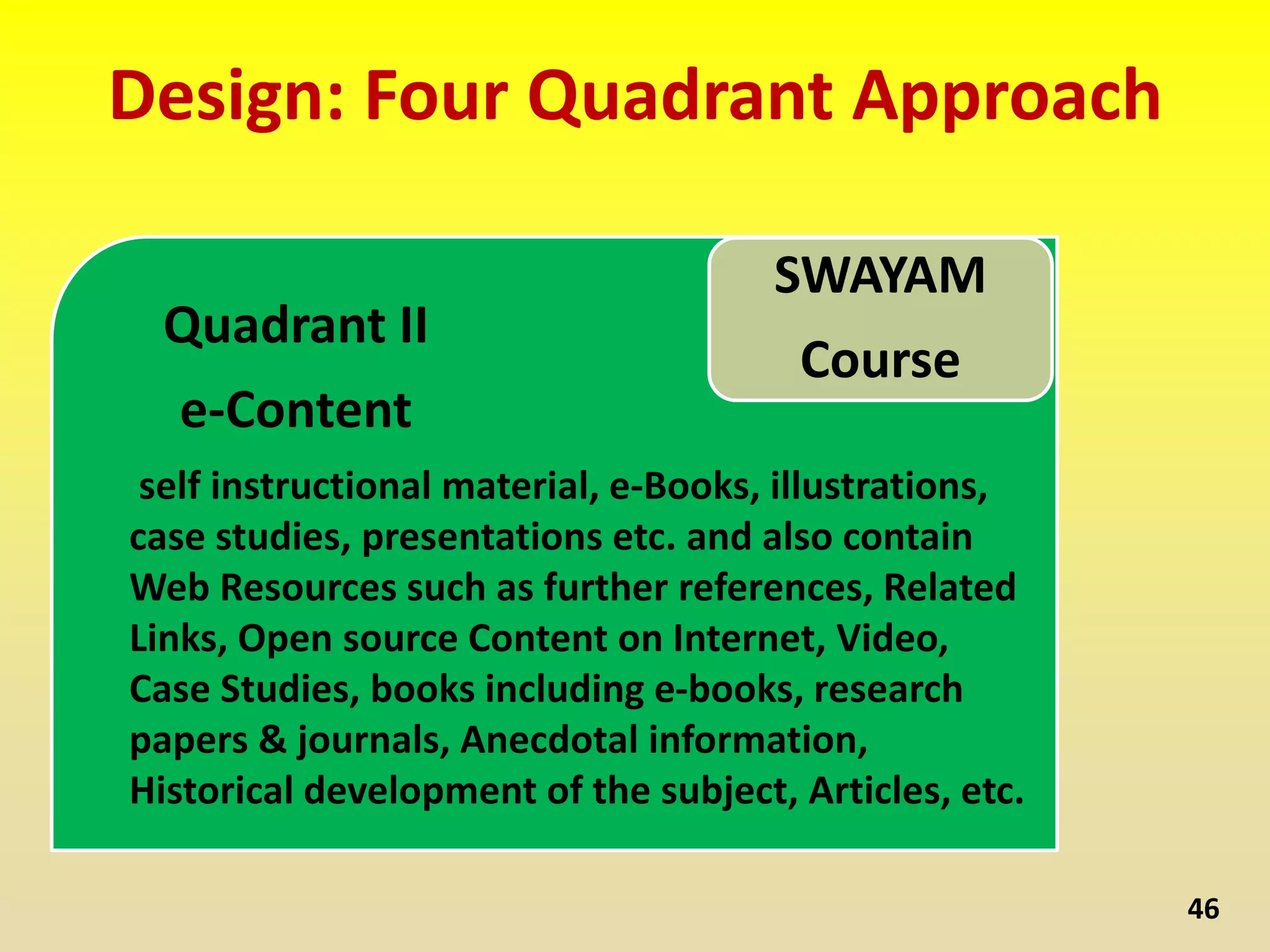
self instructional material, e-Books, illustrations,
case studies, presentations etc. and also contain
Web Resources such as further references, Related
Links, Open source Content on Internet, Video,
Case Studies, books including e-books, research
papers & journals, Anecdotal information,
Historical development of the subject, Articles, etc.
Quadrant II
e-Content
Design: Four Quadrant Approach
SWAYAM
Course
47
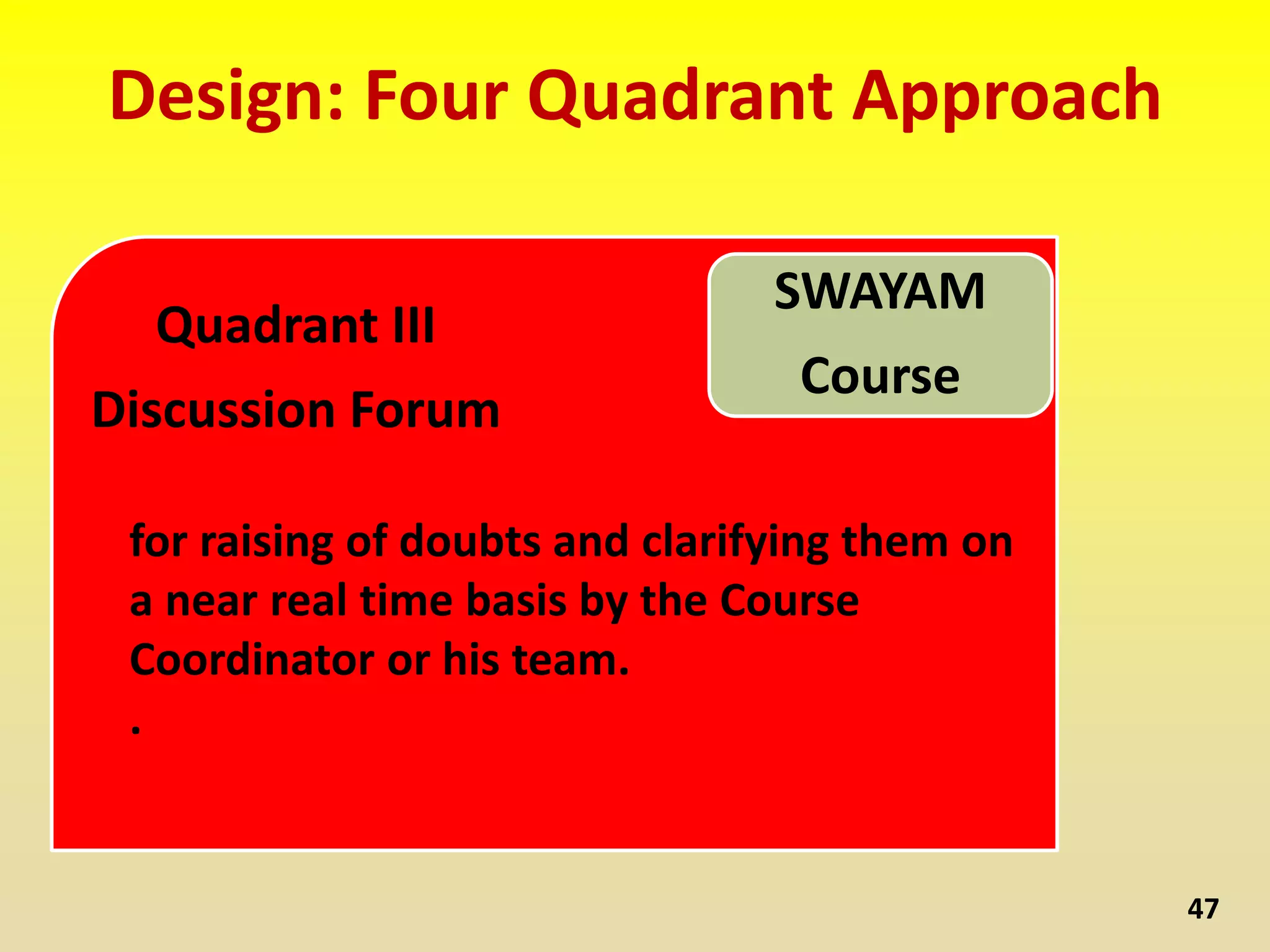
for raising of doubts and clarifying them on
a near real time basis by the Course
Coordinator or his team.
.
Quadrant III
Discussion Forum
Design: Four Quadrant Approach
SWAYAM
Course
48
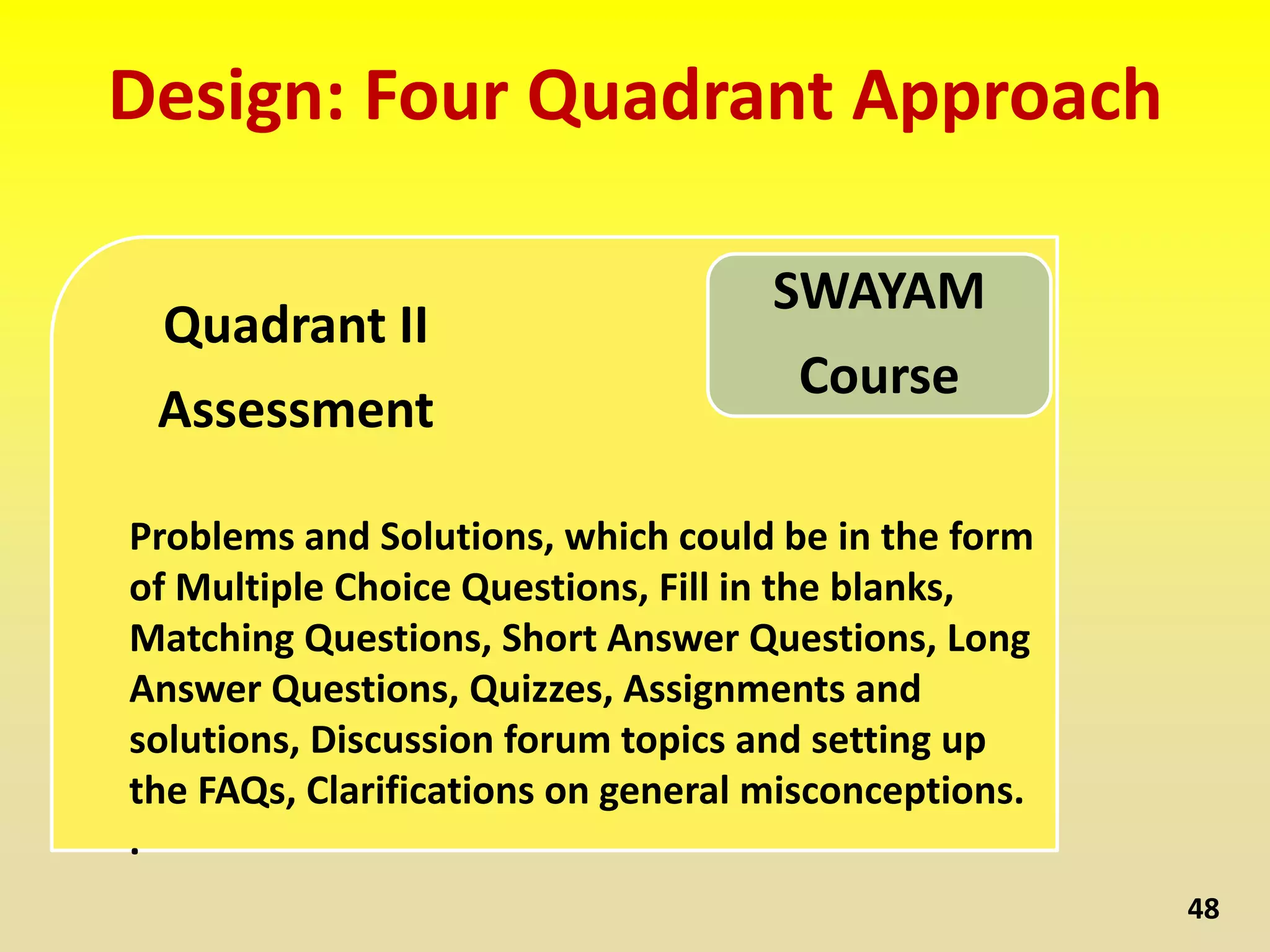
Problems and Solutions, which could be in the form
of Multiple Choice Questions, Fill in the blanks,
Matching Questions, Short Answer Questions, Long
Answer Questions, Quizzes, Assignments and
solutions, Discussion forum topics and setting up
the FAQs, Clarifications on general misconceptions.
.
Quadrant II
Assessment
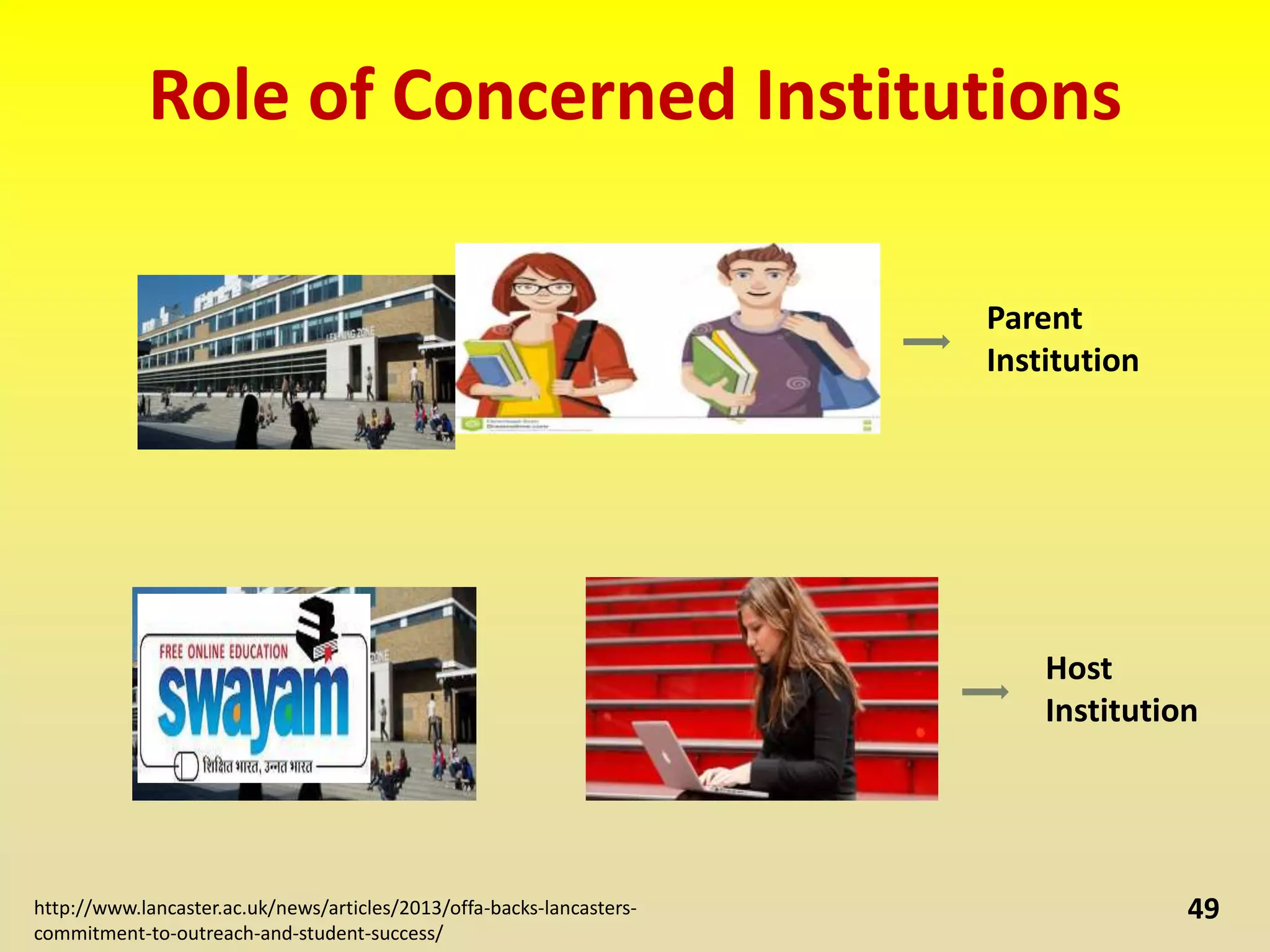
Role of Concerned Institutions
49http://www.lancaster.ac.uk/news/articles/2013/offa-backs-lancasters-
commitment-to-outreach-and-student-success/
Parent
Institution
Host
Institution
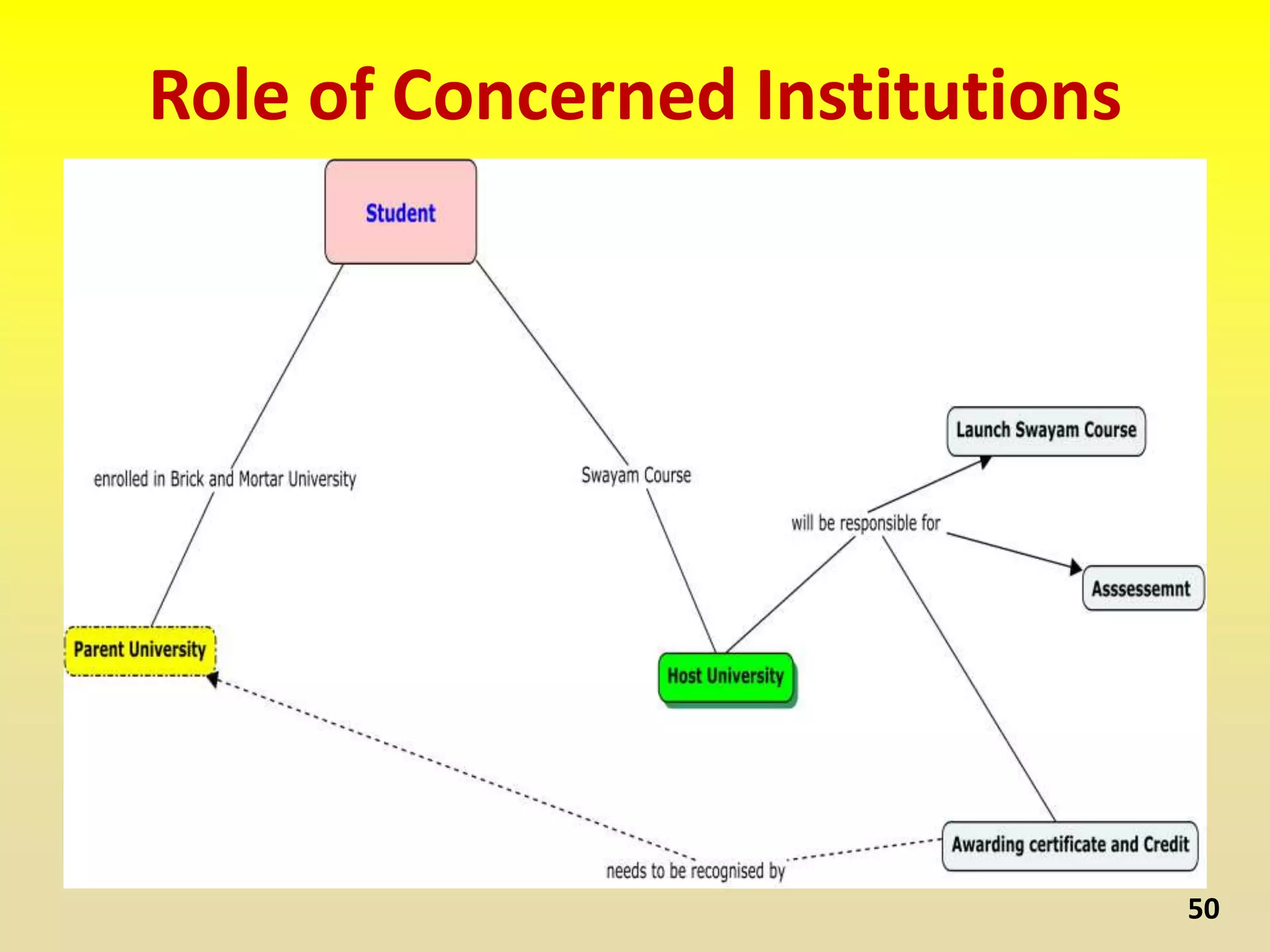
Role of Concerned Institutions
50
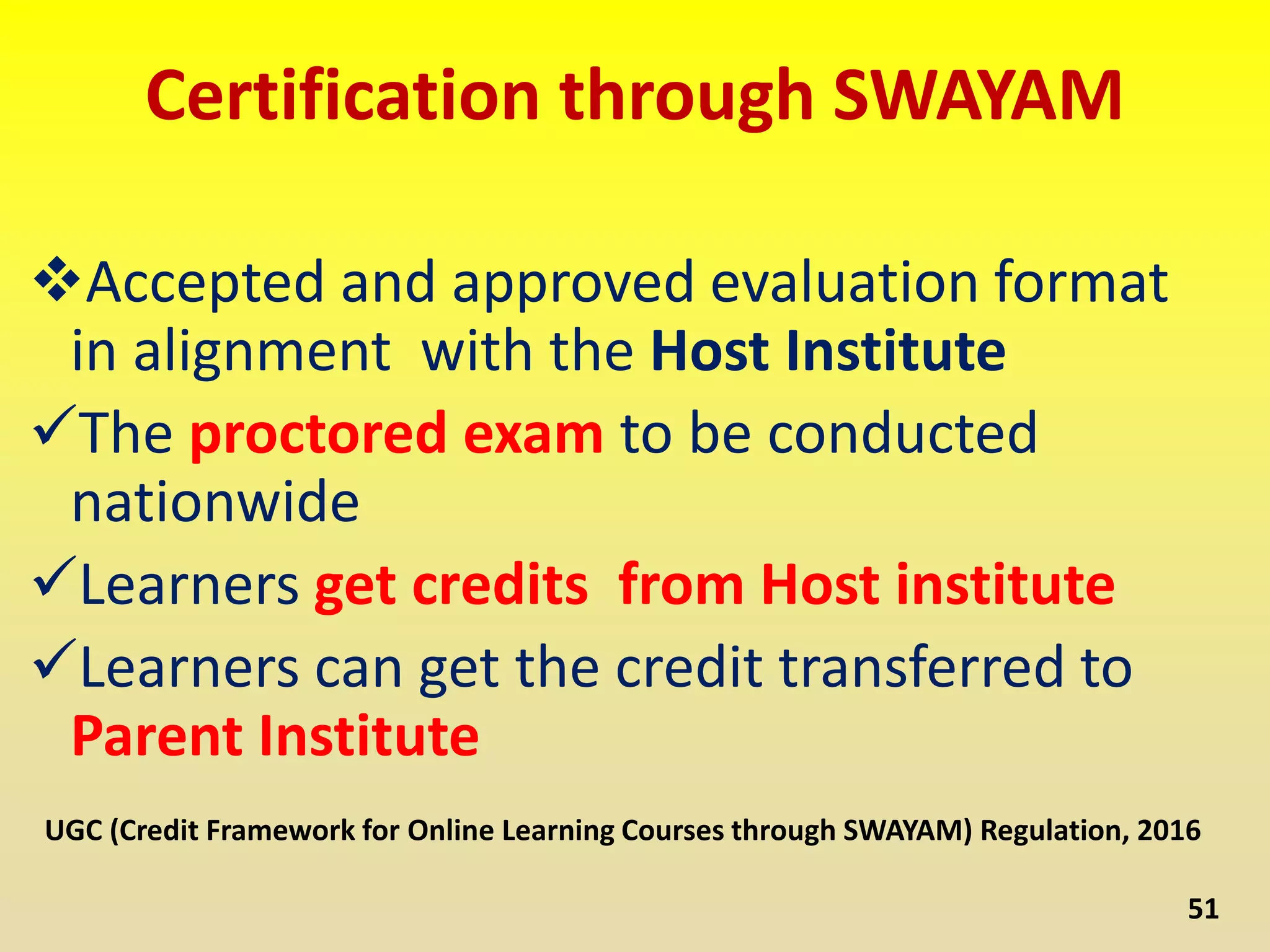
Certification through SWAYAM
Accepted and approved evaluation format
in alignment with the Host Institute
The proctored exam to be conducted
nationwide
Learners get credits from Host institute
Learners can get the credit transferred to
Parent Institute
51
UGC (Credit Framework for Online Learning Courses through SWAYAM) Regulation, 2016
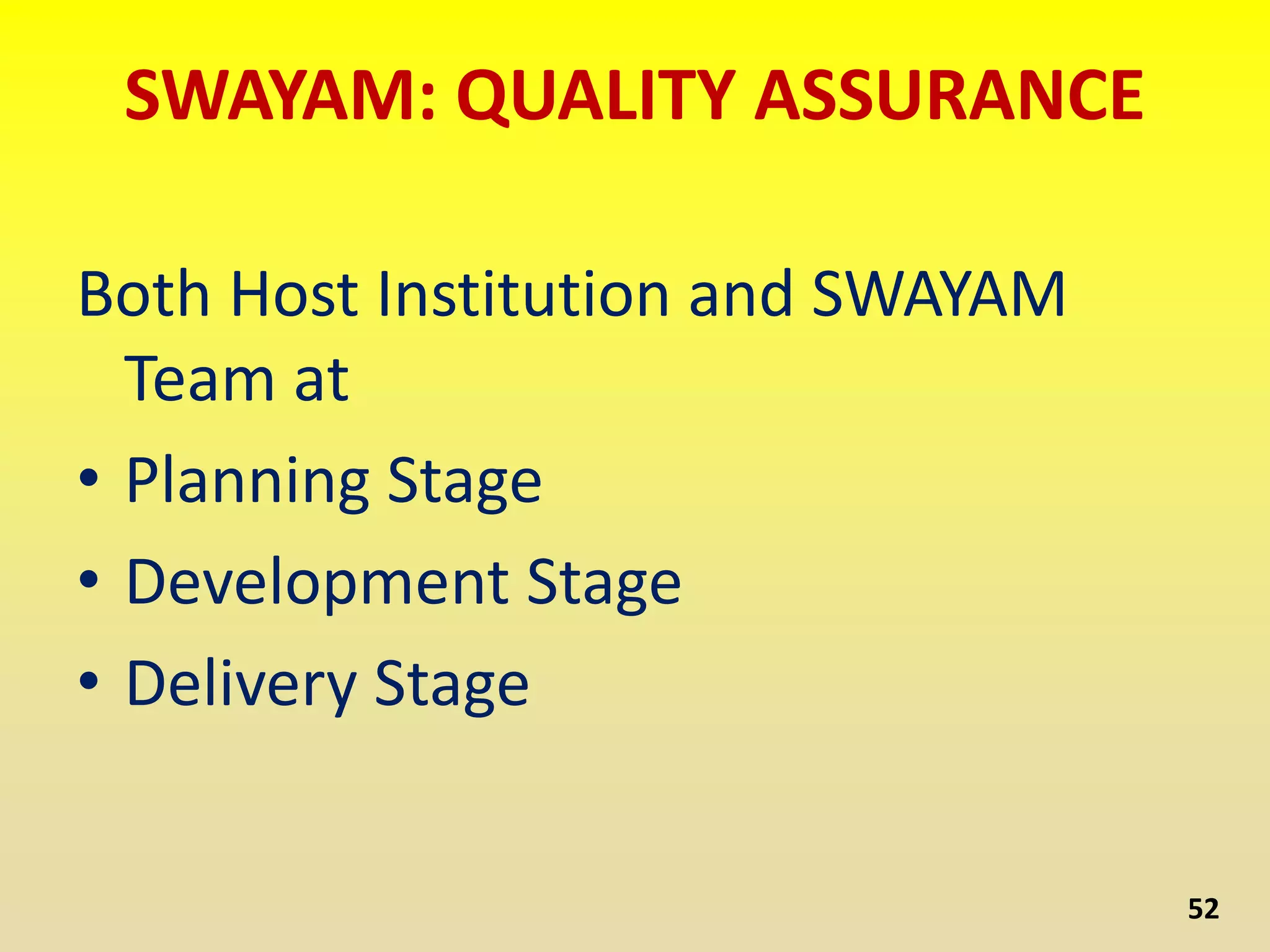
SWAYAM: QUALITY ASSURANCE
Both Host Institution and SWAYAM
Team at
• Planning Stage
• Development Stage
• Delivery Stage
52
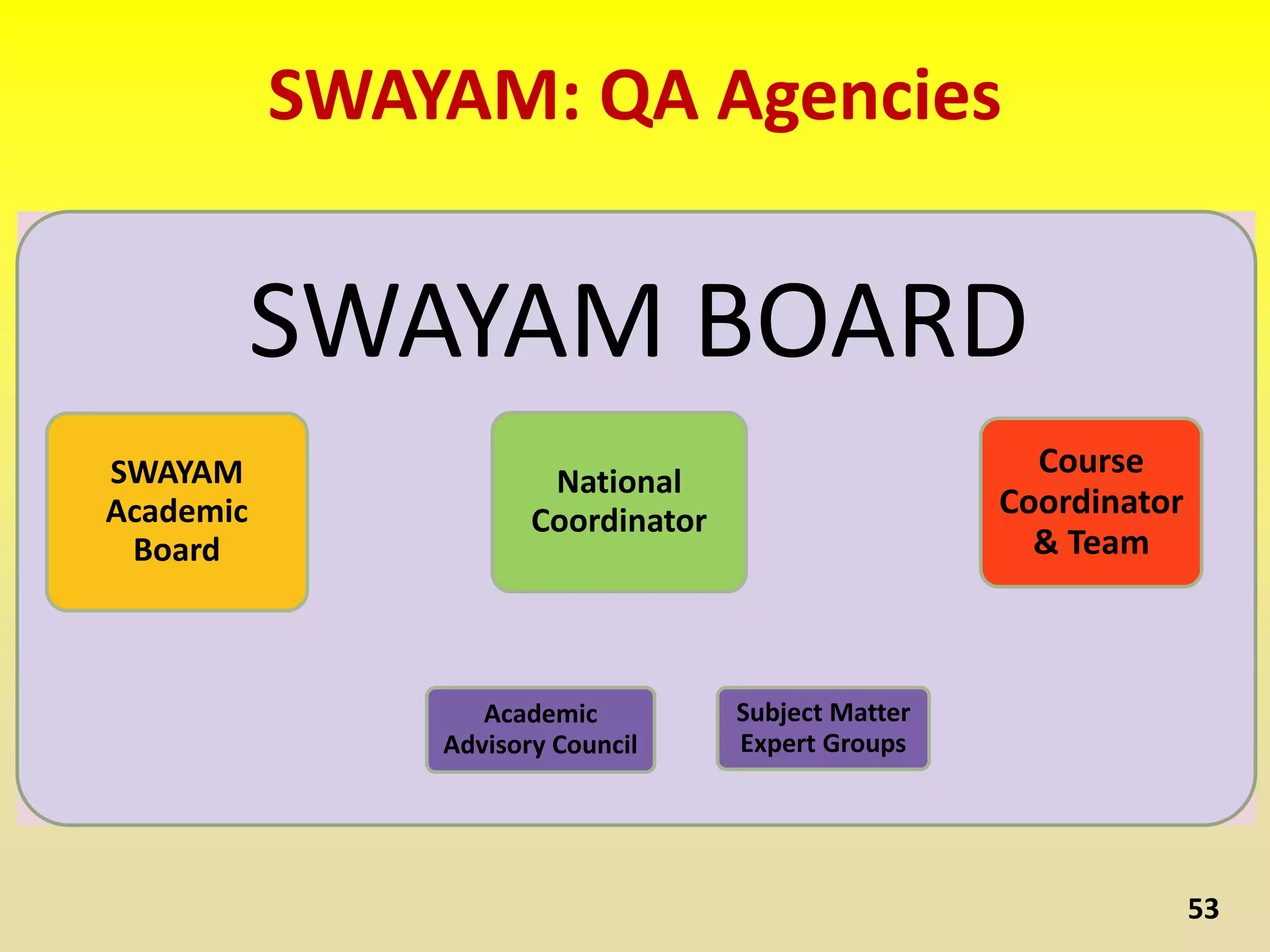
SWAYAM: QA Agencies
53
SWAYAM BOARD
SWAYAM
Academic
Board
National
Coordinator
Academic
Advisory Council
Subject Matter
Expert Groups
Course
Coordinator
& Team
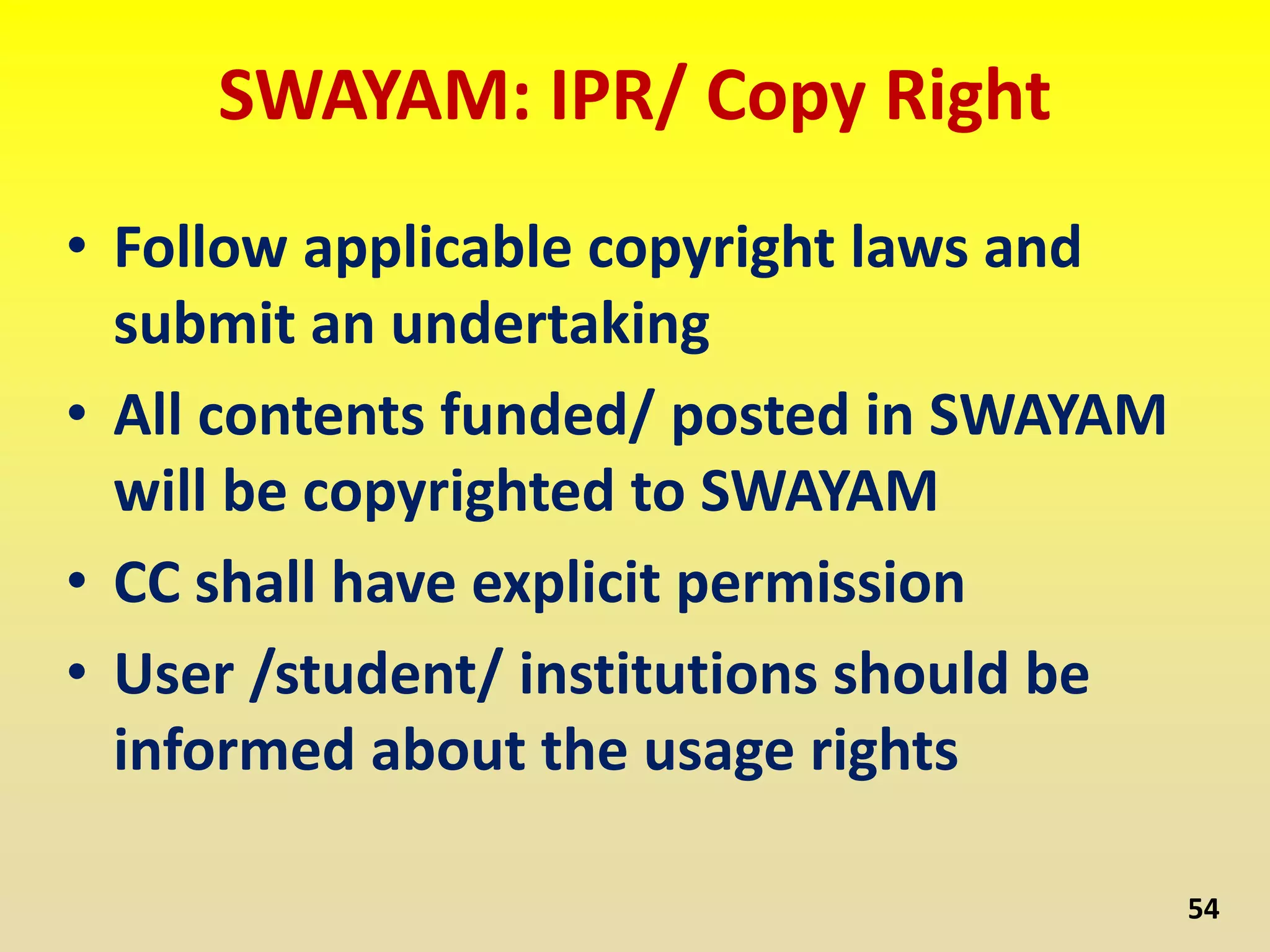
SWAYAM: IPR/ Copy Right
• Follow applicable copyright laws and
submit an undertaking
• All contents funded/ posted in SWAYAM
will be copyrighted to SWAYAM
• CC shall have explicit permission
• User /student/ institutions should be
informed about the usage rights
54
SWAYAM Where to START
55
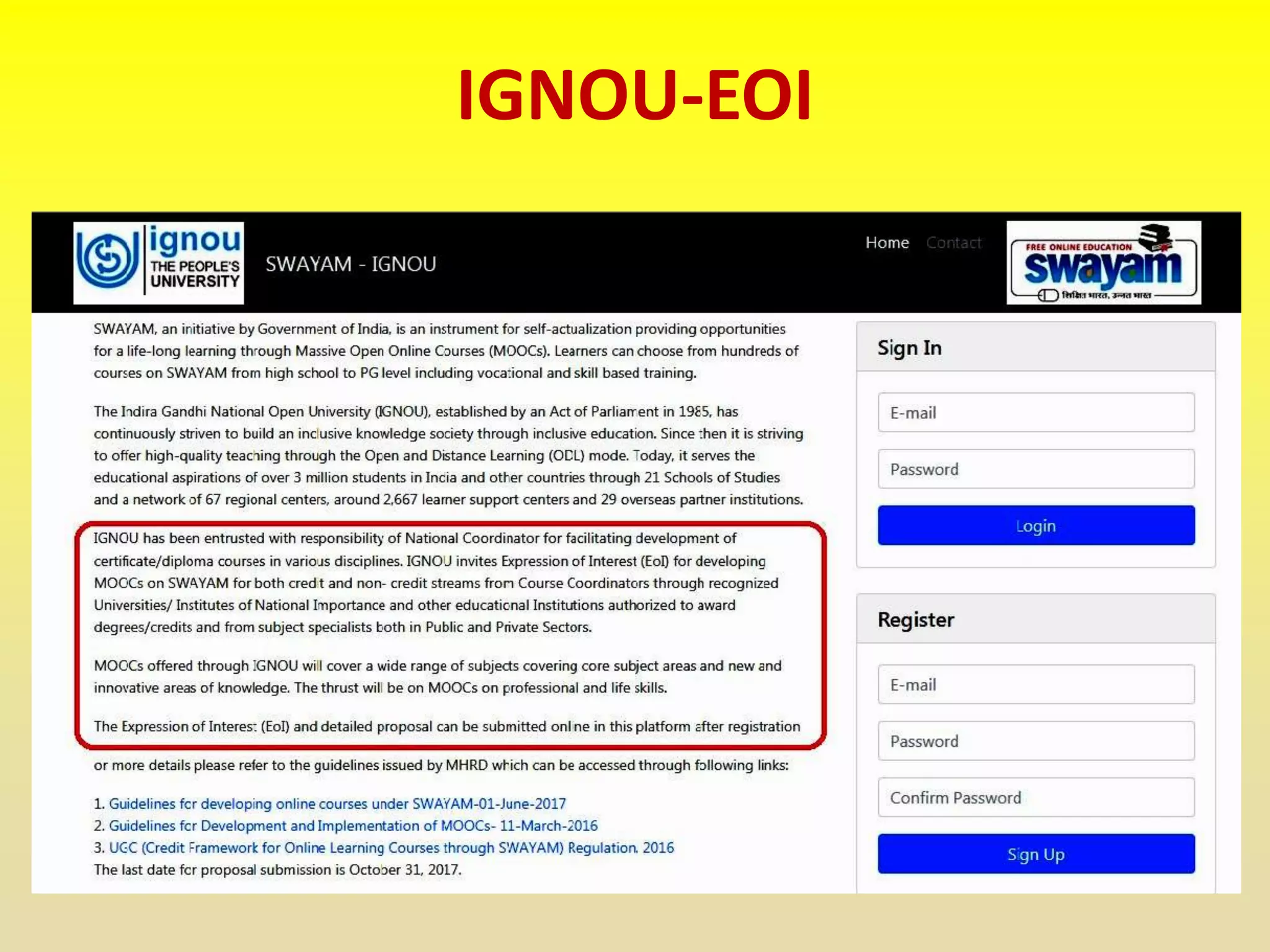
Proposal for SWAYAM
• Announcement of Expression of Interest
(EoI) by National Coordinator (NC)
• The EoI shall be submitted in the proposal
form provided by NC
– IGNOU
– UGC
• Guidelines to the Course Coordinators(CC)
IGNOU-EOI
Host University/ Institution
• University/ Institution, willing to offer
the course, agree/ready to conduct
assessment and award
credit/certification
• Credit course needs to be cleared
(Approved) by the Competent Authority
of the Host Institution
Host University/ Institution
While submitting the EoI, the Course Coordinator
shall submit an undertaking from the Host
University/ Institution conveying its willingness to
• offer the course for credit,
• conduct examination, assessment, evaluation,
• issue certificates and
• transfer the credits to the students of the Parent
University/Institution
About The Course
Course Title
Overview
– In 100 words along with pedagogy
– About the course and its broad objectives
– Teaching Leaning Strategies-i.e. learning through
videos, discussion groups, reading material etc.
Medium of Instruction
Course Duration (in weeks)
About The Course
Is it a
New Course
or
Repurposed
from Existing Programme
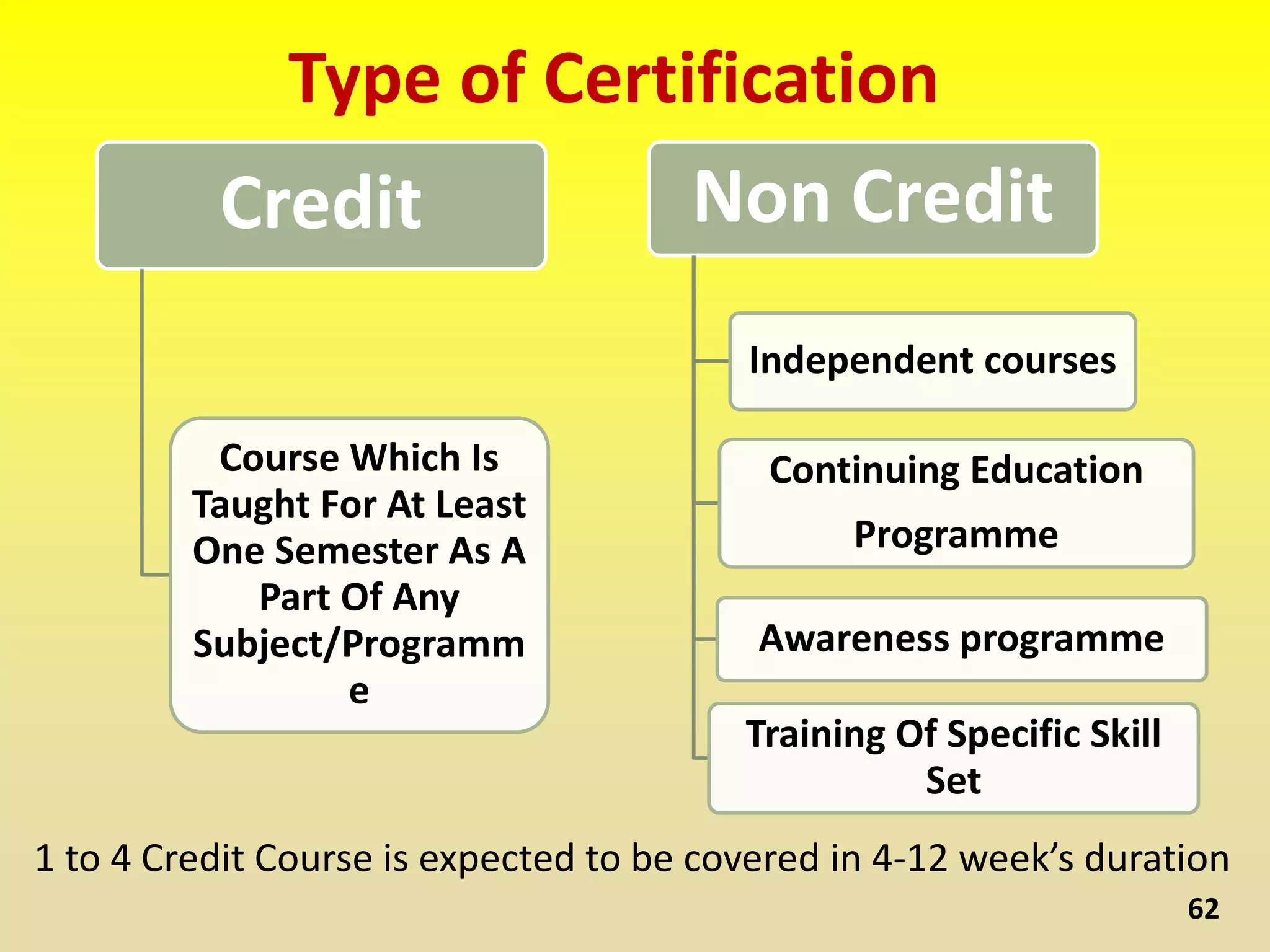
Type of Certification
62
1 to 4 Credit Course is expected to be covered in 4-12 week’s duration
Credit
Course Which Is
Taught For At Least
One Semester As A
Part Of Any
Subject/Programm
e
Non Credit
Independent courses
Continuing Education
Programme
Awareness programme
Training Of Specific Skill
Set
Objectives of the Course
Explain the broad objectives of
the course including the
expected learning outcomes
Learning Outcomes (LO)
Specified Learning Outcomes for
each
• Topic
• Theme
• Module
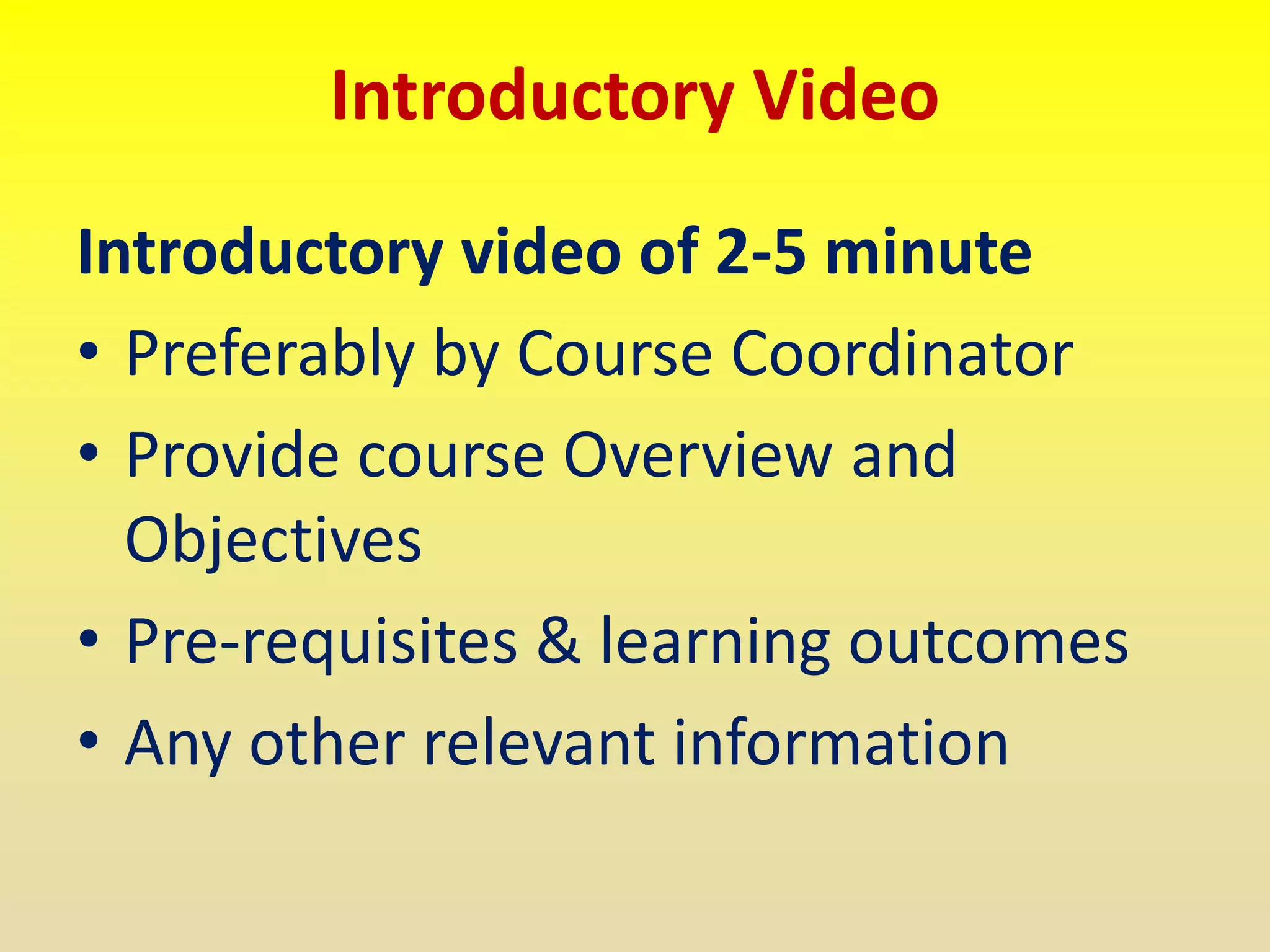
Introductory Video
Introductory video of 2-5 minute
• Preferably by Course Coordinator
• Provide course Overview and
Objectives
• Pre-requisites & learning outcomes
• Any other relevant information
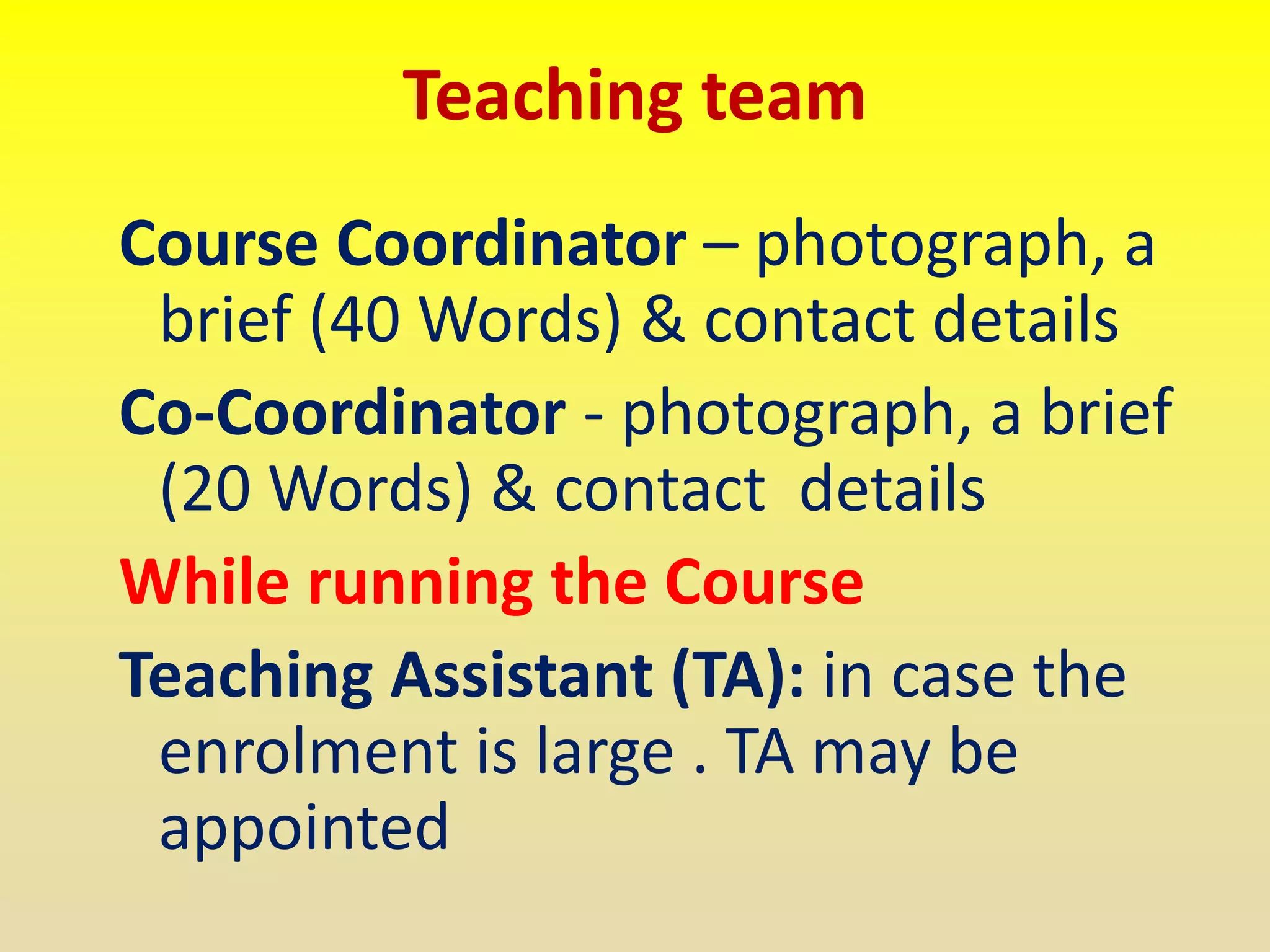
Teaching team
Course Coordinator – photograph, a
brief (40 Words) & contact details
Co-Coordinator - photograph, a brief
(20 Words) & contact details
While running the Course
Teaching Assistant (TA): in case the
enrolment is large . TA may be
appointed
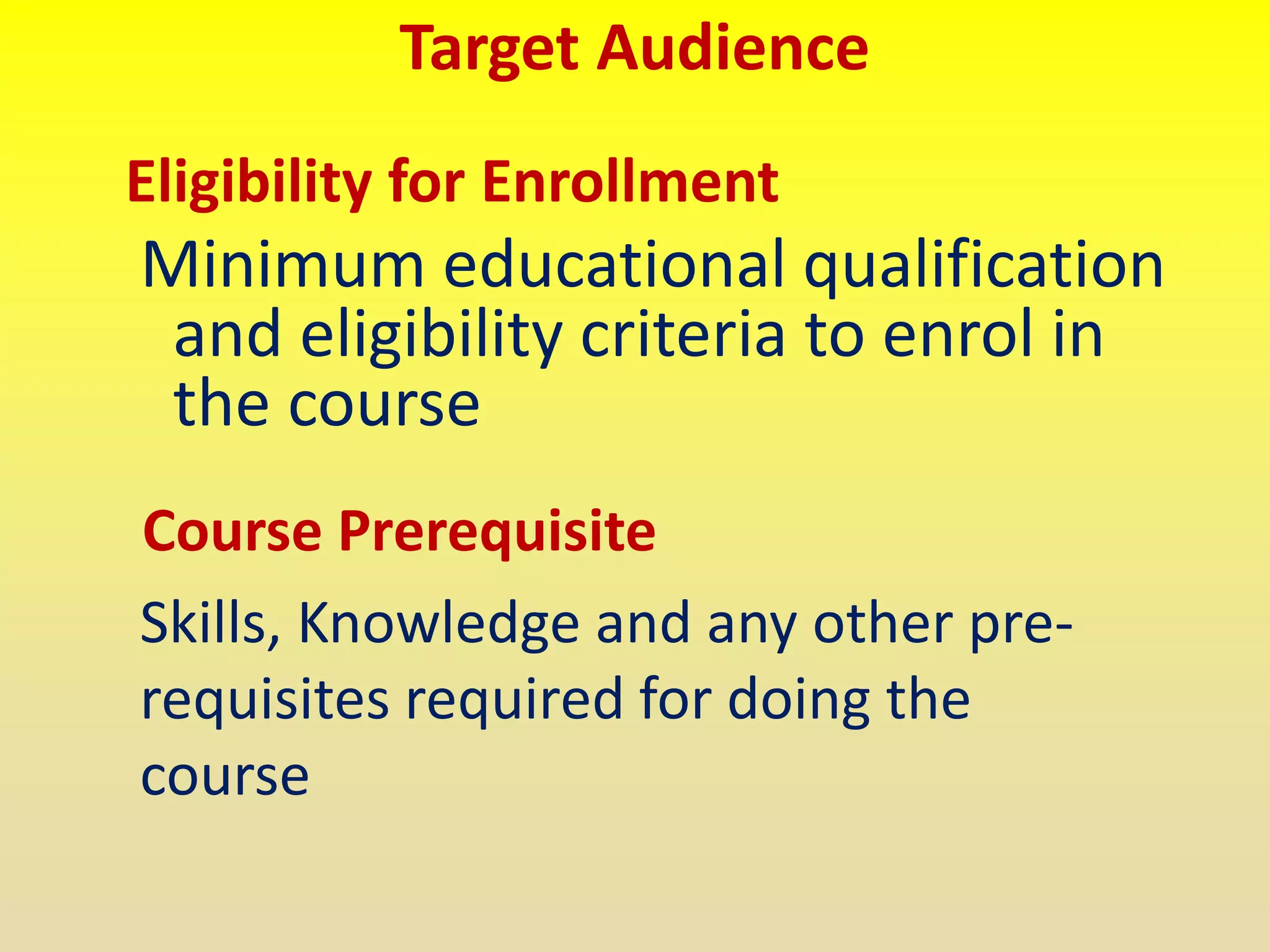
Target Audience
Eligibility for Enrollment
Minimum educational qualification
and eligibility criteria to enrol in
the course
Course Prerequisite
Skills, Knowledge and any other pre-
requisites required for doing the
course
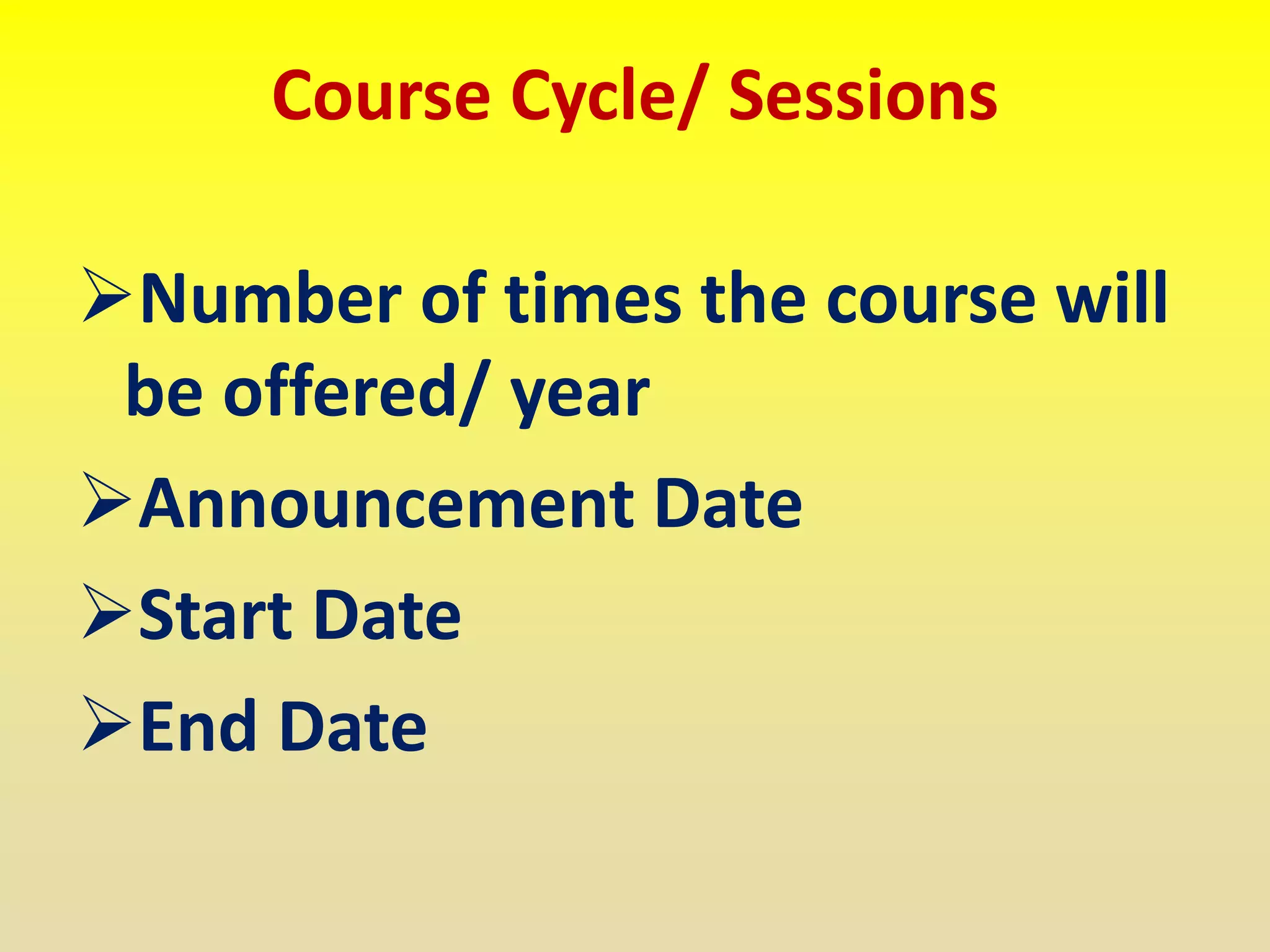
Course Cycle/ Sessions
Number of times the course will
be offered/ year
Announcement Date
Start Date
End Date
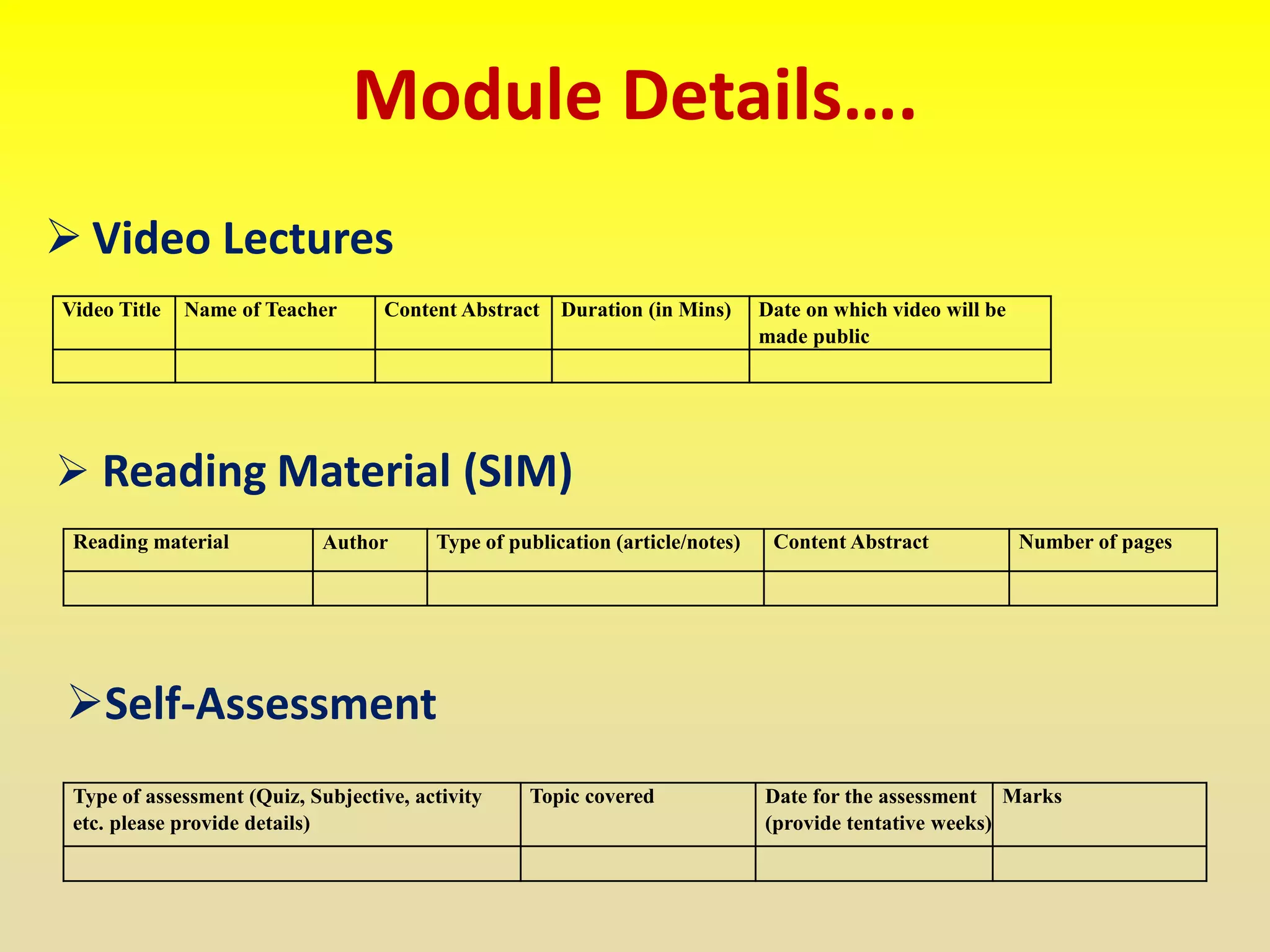
Module Details….
 Video Lectures
Video Title Name of Teacher Content Abstract Duration (in Mins) Date on which video will be
made public
 Reading Material (SIM)
Reading material Author Type of publication (article/notes) Content Abstract Number of pages
Self-Assessment
Type of assessment (Quiz, Subjective, activity
etc. please provide details)
Topic covered Date for the assessment
(provide tentative weeks)
Marks
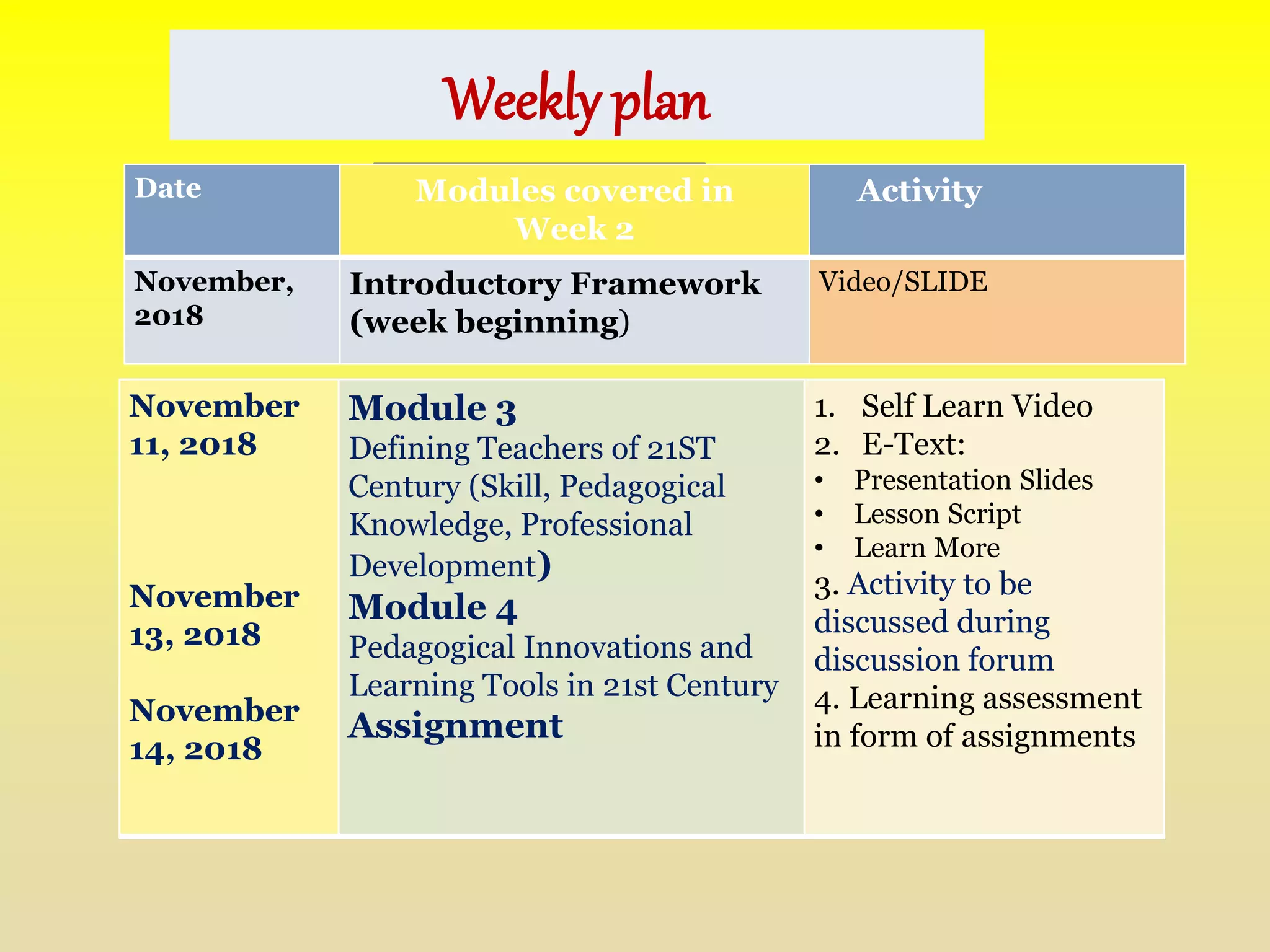
Weekly plan
Week 1Date Modules covered in
Week 2
Activity
November,
2018
Introductory Framework
(week beginning)
Video/SLIDE
November
11, 2018
November
13, 2018
November
14, 2018
Module 3
Defining Teachers of 21ST
Century (Skill, Pedagogical
Knowledge, Professional
Development)
Module 4
Pedagogical Innovations and
Learning Tools in 21st Century
Assignment
1. Self Learn Video
2. E-Text:
• Presentation Slides
• Lesson Script
• Learn More
3. Activity to be
discussed during
discussion forum
4. Learning assessment
in form of assignments
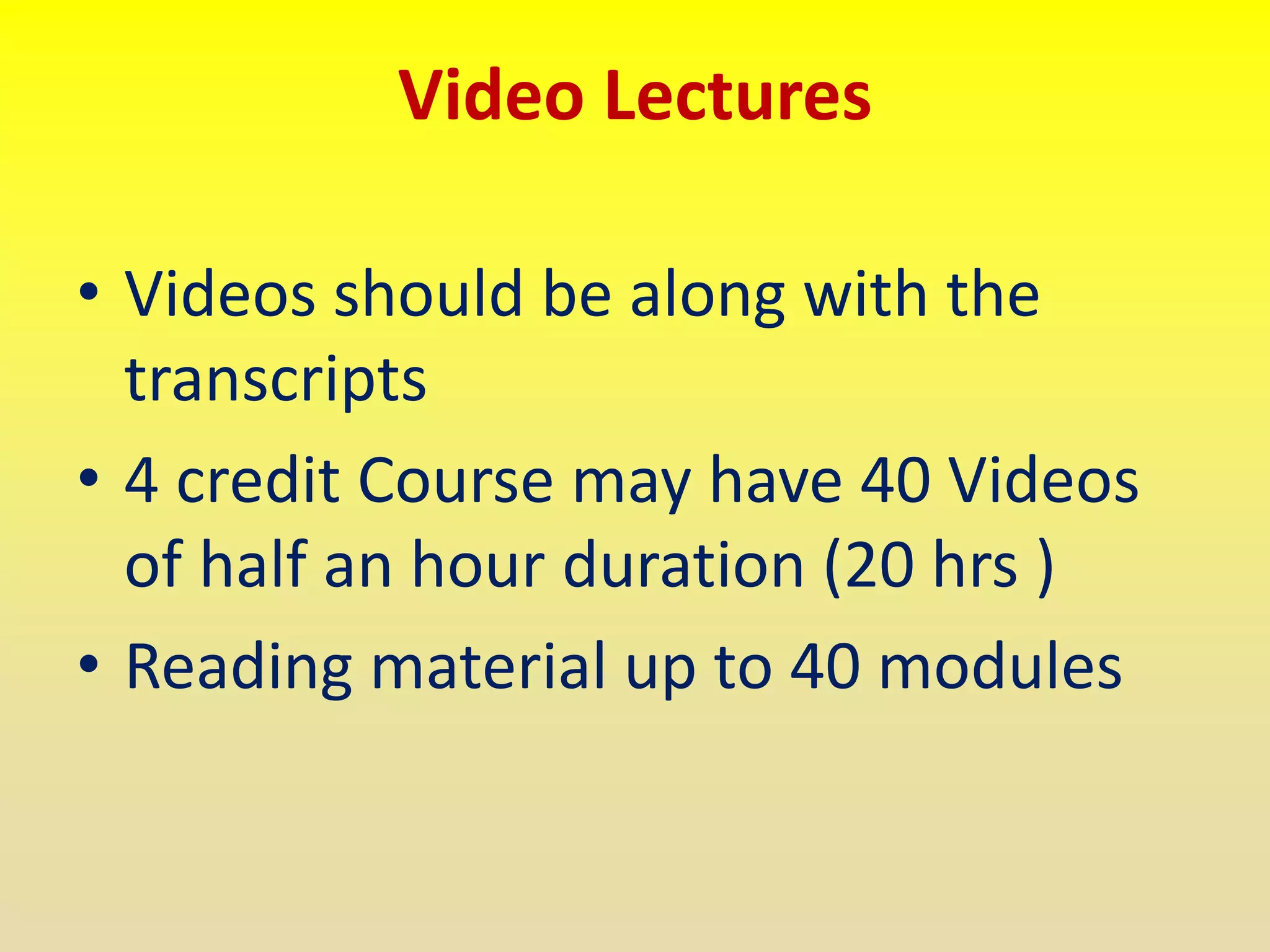
Video Lectures
• Videos should be along with the
transcripts
• 4 credit Course may have 40 Videos
of half an hour duration (20 hrs )
• Reading material up to 40 modules
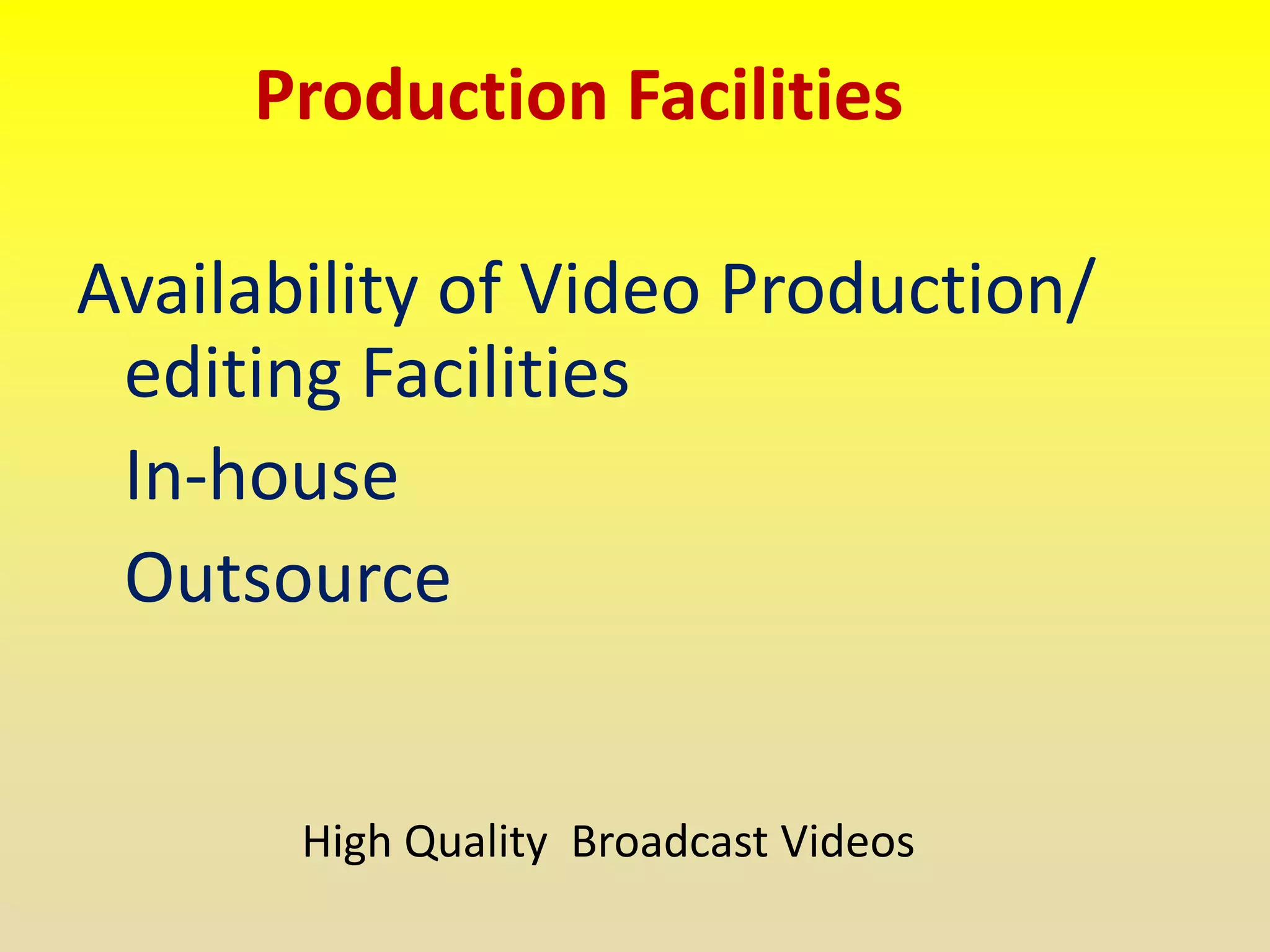
Production Facilities
Availability of Video Production/
editing Facilities
In-house
Outsource
High Quality Broadcast Videos
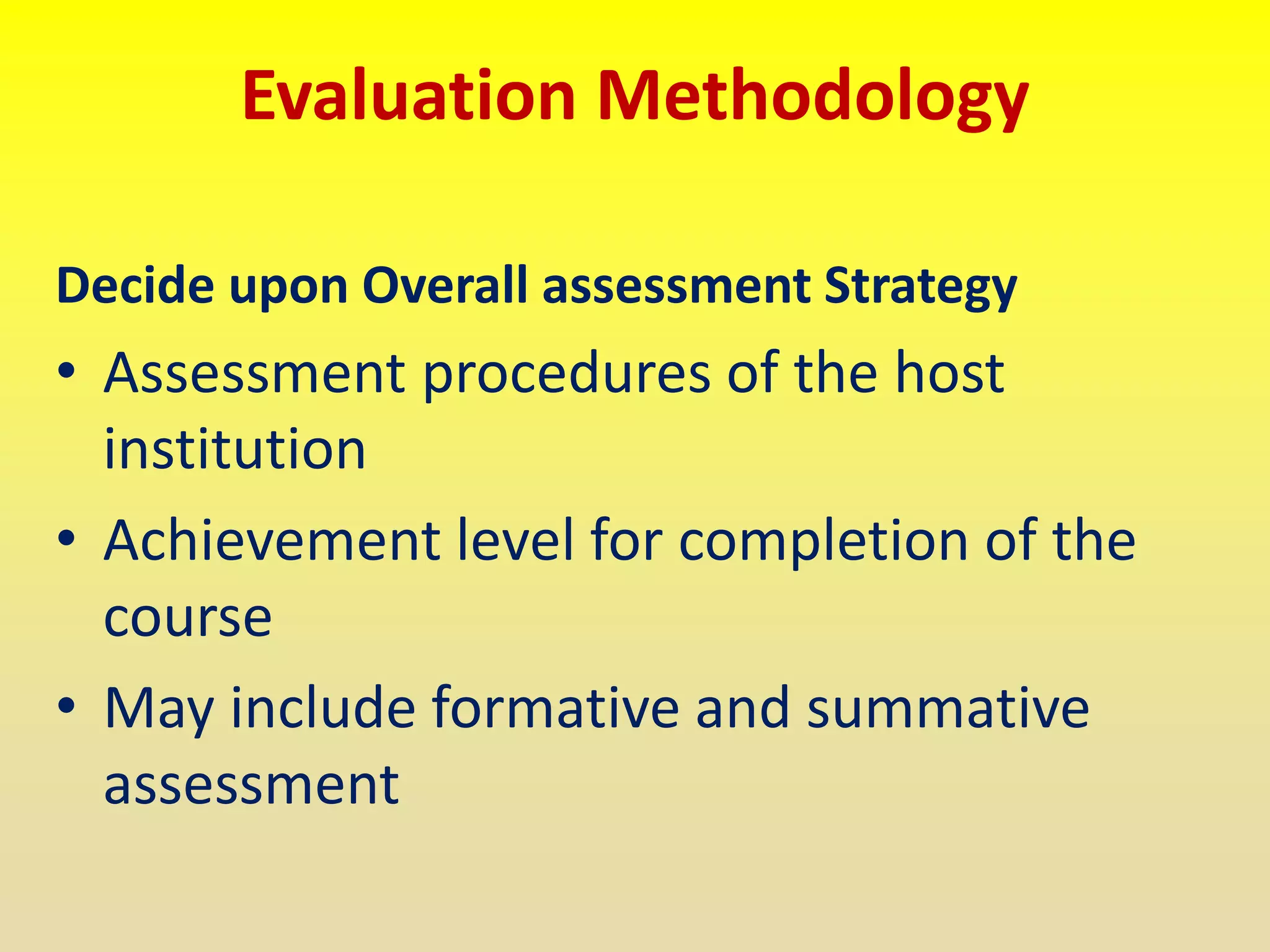
Evaluation Methodology
Decide upon Overall assessment Strategy
• Assessment procedures of the host
institution
• Achievement level for completion of the
course
• May include formative and summative
assessment
Names of Reviewers
• SMEs identified by the CC to
ensure the overall quality of
the course
74
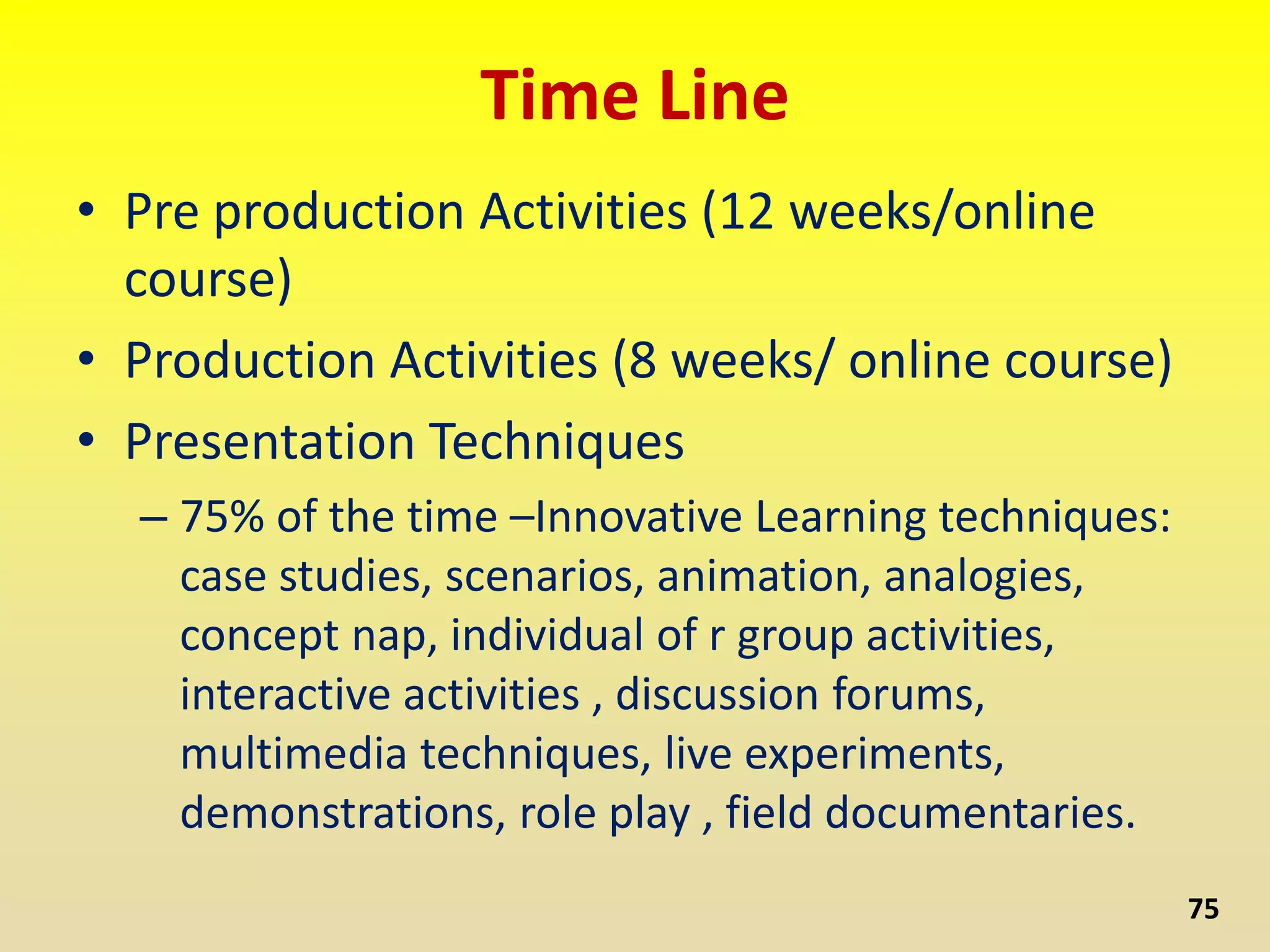
Time Line
• Pre production Activities (12 weeks/online
course)
• Production Activities (8 weeks/ online course)
• Presentation Techniques
– 75% of the time –Innovative Learning techniques:
case studies, scenarios, animation, analogies,
concept nap, individual of r group activities,
interactive activities , discussion forums,
multimedia techniques, live experiments,
demonstrations, role play , field documentaries.
75
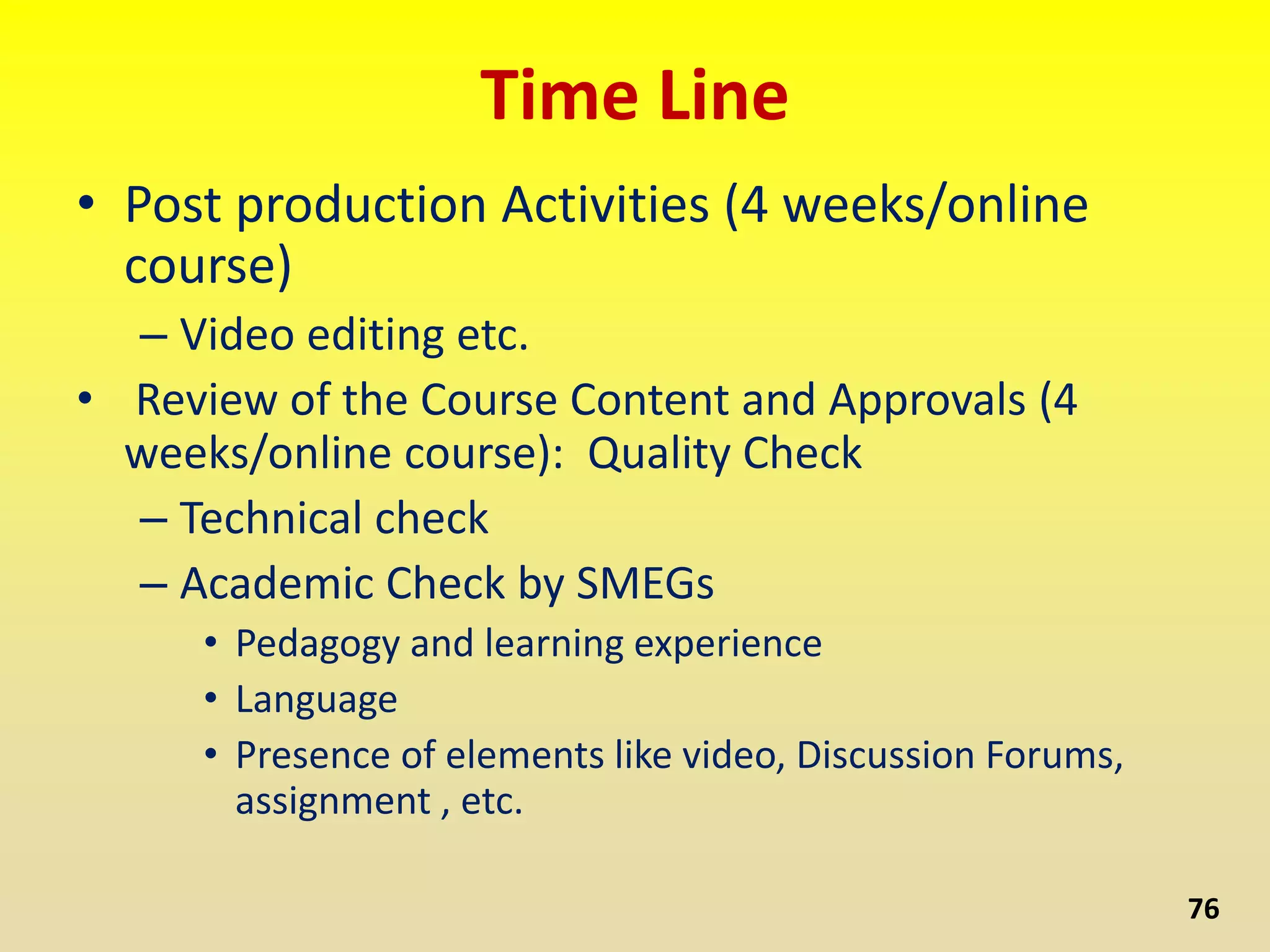
Time Line
• Post production Activities (4 weeks/online
course)
– Video editing etc.
• Review of the Course Content and Approvals (4
weeks/online course): Quality Check
– Technical check
– Academic Check by SMEGs
• Pedagogy and learning experience
• Language
• Presence of elements like video, Discussion Forums,
assignment , etc.
76
References
1. Guidelines for developing online courses under SWAYAM-01-June-
2017
2. Guidelines for Development and Implementation of MOOCs- 11-
March-2016
3. UGC (Credit Framework for Online Learning Courses through
SWAYAM) Regulation, 2016
4. https://swayam.gov.in/
5. https://www.swayamprabha.gov.in/
6. https://www.slideshare.net/AshishKumar70/introduction-to-
swayam-moocs?qid=e4ff253d-f1ab-46d2-87d2-
28a3e6e3a648&v=&b=&from_search=1
78
Thank you
79

Development of MOOCs with special reference to SWAYAM

  • 1.
    Designing, Developing and DeliveringMOOC: Special Reference to SWAYAM Nisha Singh Deputy Director, IUC. IGNOU
  • 2.
  • 3.
    https://www.itu.int/en/ITU-D/Statistics/Pages/default.aspx Learning that meetsyou where you are…. • ITU estimates that at the end of 2018, 51.2 per cent of the global population, or 3.9 billion people were using the Internet
  • 4.
    Short Term • Redesigning Learning Spaces •Blended Learning Designs Mid-Term • Advancing Cultures of Innovation • Growing Focus on Measuring Learning Long-Term • Rethinking How Institutions Work • Modularized and Disaggregated Degrees Educase Horizon Report- Key Trends Accelerating Higher Education Technology Adoption https://library.educause.edu/-/media/files/library/2019/2/2019horizonreportpreview.pdf
  • 5.
    KPMG-GOOGLE-Online Education in India 0 500 1000 1500 2000 2500 20172021 USD (millions) USD (millions) https://assets.kpmg/content/dam/kpmg/in/pdf/2017/05/Online-Education-in- India-2021.pdf
  • 6.
    Online Education InIndia-Key Areas Primary and Secondary Supplemental Education Test Preparation Reskilling and Online Certification Higher Education Language and Casual Learning
  • 7.
    Growth Rate :Online Education Primary and Secondary Supplemental Education Test Preparation Higher Education Language and Casual Learning Reskilling and Online Certification Key Areas
  • 8.
    MOOC • Dave Cormierin 2008 coined MOOC • George Siemens and Stephen Downes conducted a course called Connectivism and Connective Knowledge (also known as CCK08). • CCK08, consisted of 25 tuition-paying students at the University of Manitoba as well as over 2200 online students from the general public who paid nothing 8
  • 9.
    MOOCs • M---Massive • O—Open •O—Online • C—Courses • New York Times headline declares 2012 the “Year of the MOOC.” • Coursera (Daphne Koller and Andrew Ng) Udacity (Sebastian Thrun and Peter Norvig), Edx (MIT and Harvard) 9
  • 10.
    SWAYAM: Why IndigenousMOOCs • Shortage of qualified faculty, resources and infrastructure • Quality education to all • More contextual MOOCs • NPTEL under NMEICT and then 2016 happened and Indigenous MOOCs was initiated 10
  • 11.
    • Online Coursesneed planning and so do MOOCs 11
  • 12.
    Instructional Design (ID) •Instruction: a set of events that facilitate learning • Design: a creative pattern or a rational, logical, sequential process intended to solve problems
  • 13.
    Instructional System Design(ISD) Conduct Need Assessm ent Establish Overall Goals Conduct Task Analysis Specify Objecti ves Develop Assess ment Strategi es Select Media Produce Material Conduct Formativ e Analysis Revise as Requir ed Conduct Summati ve Analysis
  • 14.
    Instructional Design • …… is the process by which instruction is improved through the analysis of learning needs and systematic development of learning materials. Instructional designers often use technology and multimedia as tools to enhance instruction. (http://www.instructionaldesign.org)
  • 15.
    Models of InstructionalDesign Many Models are there. Few popular ones are • ADDIE • Dick and Carey Model • Smith and Ragan Model • Keller’s ARCS Model for motivation • 4C/ID Model
  • 16.
  • 17.
    Dick and CareyModel (Source: Dick, Walter, Carey, Lou, & Carey, James O. The systematic design of instruction, 7th edition, 2009)
  • 18.
    Instructional Design-Analysis Phase NeedAnalysis Problemidentification Need identification Is solution needed
  • 19.
    Instructional Design-Analysis Phase LearnerAnalysis Targetlearner for the course Characteristics of learners Instructional Strategies Content language Examples
  • 20.
    Instructional Design-Analysis Phase •Identification of the activities that a learner performs • Learners’ performance level Task Analysis • Conditions of learningContext Analysis
  • 21.
    Instructional Design-Design Phase Answer‘howwill’ thecontent be organized? it be presented to learners? delivery of content be done ? what types of activities and exercises will be included? learners' accomplishments be measured?
  • 22.
    • Knowledge levelof the learner • Learning objectives/outcomes • Structure of the learning activities • Assessment • Review the Design components Instructional Design-Design Phase
  • 23.
    –List activities forTarget Audience • Select the most Appropriate Method • Produce instructional Aids • Validate the material • Develop resources Instructional Design-Development Phase
  • 24.
    Instructional Design- ImplementationPhase Prepare schedule Provide documentation Prepare learning environment Delivery
  • 25.
    • Evaluation :Formativeand Summative • Review and Evaluate Each Phase (formative) • Perform External Evaluation (summative) • Revise
  • 26.
    Instructional Ingredients eContent Gainingattention  Animation  Audio Informing the learner of the objective  Overview  Rules  Tasks  Quests Stimulating recall  Pre-tests  Quiz Presenting the material  Text (material)  Audio  Video  Animation Providing learning guidance  User guides  Tutorials Eliciting performance  Quests  Assignment  Quiz  Group Discussion  Questing Providing feedback  Feedback  Scores  Rewards Assessing performance  Score Enhancing retention and transfer  Further reading material  Websites
  • 27.
  • 28.
    • Text • Graphics •Images • Audio • Animations • Video • Interactivity Multimedia is content which is a combination of these.
  • 29.
    Verbal Symbols Visual Symbols Recordings,Radio, Stills Motion Pictures Educational Television Exhibits Study Trips Demonstrations Dramatized experiences Contrived experiences Direct purposeful experiencesConcrete Abstract
  • 30.
  • 31.
    TPACK Model ✢ PedagogicalContent Knowledge (PCK), ✢ Technological Content Knowledge (TCK), ✢ Technological Pedagogical Knowledge (TPK), and ✢ Technological Pedagogical Content Knowledge (TPACK).
  • 32.
    Regulation of OnlineEducation Section 7. (2) (iii) (d) says “Quadrant-IV i.e. Self- Assessment, that shall contain – MCQ, Problems, Quizzes, Assignments and solutions, Discussion forum topics and setting up the FAQ, Clarifications on general misconceptions.” • Section 7. (6) says “Active Engagement of the Learners - Active engagement in online or virtual class shall be monitored via participation in asynchronous or synchronous discussions, assignment activity and Course or Programme involvement and the analytics of Learning Management System shall be used for ensuring the learner’s 32
  • 33.
    SWAYAM Study Webs of Active Learning for YoungAspiring Minds 33 32 DTH educational TV channels : “SWAYAM Prabha” Initiative by Government of India Launched on 15 August 2016 President of India on July 9, 2017Dedicated to the nation.
  • 34.
    SWAYAM 34 SWAYAM Access QualityEquity Bridge The DigitalDivide Best Learning Resources To All
  • 35.
    SWAYAM is • One-stopweb and mobile based interactive e- content for all courses • High quality learning experience using multimedia on anytime, anywhere basis • State of the art system that allows easy access, monitoring and certification • Peer group interaction and discussion forum to clarify doubts • Hybrid model of delivery that adds to the quality of classroom teaching 35
  • 36.
    The Regulatory Framework 1.Guidelines for developing online courses under SWAYAM-01-June-2017 2. UGC (Credit Framework for Online Learning Courses through SWAYAM) Regulation, 2016 3. Guidelines for Development and Implementation of MOOCs- 11-March-2016 36
  • 37.
  • 38.
    Scope of SWAYAM CurriculumBased Course Contents : Diverse Disciplines School Education (9-12 Levels) Modules Advanced Curriculum and Professional Certification Skill Based Courses Courses to Meet the Needs of Life-long Learners Independent Courses 38
  • 39.
    National Coordinators andSectors 39 SN National Coordinators Sectors 1. UGC Non Technology, PG Degree Programmes 2. NPTEL Technical / Engineering UG & PG degree Programmes. 3. Consortium for Educational Communication Non Technology, UG degree Programmes. 4. IGNOU Diploma and Certificates and more…… 5. NCERT Classes 9th to 12th 6. NIOS Out of school children Educational Programmes from Class 9th to 12th. 7. IIM Bangalore Management Courses 8. NITTTR, Chennai Teacher Training 9. AICTE Self-paced and International Courses http://www.ignouonline.ac.in/swayameoi
  • 40.
  • 41.
    SWAYAM: Course Types CreditCourses Course taught for at least one semester as a part of any subject/programme Non-Credit Courses Independent courses, not part of any set curriculum. It can be of shorter duration. Awareness programme, Continuing education programme or training of specific skill set etc. 41 1 to 4 Credit Course is expected to be covered in 4-12 week’s duration
  • 42.
    SWAYAM: Content load 42 1to 4 Credit Course is expected to be covered in 4-12 week’s duration Follow the timelines 4 Credit Course 40 Videos of duration of 30 mins (20 hrs) 40 SLMs/ reading Modules
  • 43.
    SWAYAM: Online • TraditionalClassroom • Online Learning 43 https://commons.wikimedia.org/wiki/File:Hainan_Medical_College_-_14.jpg
  • 44.
    Design: Four QuadrantApproach Quadrant I e-Tutorial Quadrant II e-Content Quadrant IV Assessment Quadrant III Discussion Forum SWAYAM Course 44
  • 45.
    Design: Four QuadrantApproach SWAYAM Course 45 Video and Audio Content in an organized form, Animation, Simulations, video demonstrations, Virtual Labs, etc. along with the transcription of the video. Quadrant I e-Tutorial
  • 46.
    Design: Four QuadrantApproach SWAYAM Course 46 self instructional material, e-Books, illustrations, case studies, presentations etc. and also contain Web Resources such as further references, Related Links, Open source Content on Internet, Video, Case Studies, books including e-books, research papers & journals, Anecdotal information, Historical development of the subject, Articles, etc. Quadrant II e-Content
  • 47.
    Design: Four QuadrantApproach SWAYAM Course 47 for raising of doubts and clarifying them on a near real time basis by the Course Coordinator or his team. . Quadrant III Discussion Forum
  • 48.
    Design: Four QuadrantApproach SWAYAM Course 48 Problems and Solutions, which could be in the form of Multiple Choice Questions, Fill in the blanks, Matching Questions, Short Answer Questions, Long Answer Questions, Quizzes, Assignments and solutions, Discussion forum topics and setting up the FAQs, Clarifications on general misconceptions. . Quadrant II Assessment
  • 49.
    Role of ConcernedInstitutions 49http://www.lancaster.ac.uk/news/articles/2013/offa-backs-lancasters- commitment-to-outreach-and-student-success/ Parent Institution Host Institution
  • 50.
    Role of ConcernedInstitutions 50
  • 51.
    Certification through SWAYAM Acceptedand approved evaluation format in alignment with the Host Institute The proctored exam to be conducted nationwide Learners get credits from Host institute Learners can get the credit transferred to Parent Institute 51 UGC (Credit Framework for Online Learning Courses through SWAYAM) Regulation, 2016
  • 52.
    SWAYAM: QUALITY ASSURANCE BothHost Institution and SWAYAM Team at • Planning Stage • Development Stage • Delivery Stage 52
  • 53.
    SWAYAM: QA Agencies 53 SWAYAMBOARD SWAYAM Academic Board National Coordinator Academic Advisory Council Subject Matter Expert Groups Course Coordinator & Team
  • 54.
    SWAYAM: IPR/ CopyRight • Follow applicable copyright laws and submit an undertaking • All contents funded/ posted in SWAYAM will be copyrighted to SWAYAM • CC shall have explicit permission • User /student/ institutions should be informed about the usage rights 54
  • 55.
  • 56.
    Proposal for SWAYAM •Announcement of Expression of Interest (EoI) by National Coordinator (NC) • The EoI shall be submitted in the proposal form provided by NC – IGNOU – UGC • Guidelines to the Course Coordinators(CC)
  • 57.
  • 58.
    Host University/ Institution •University/ Institution, willing to offer the course, agree/ready to conduct assessment and award credit/certification • Credit course needs to be cleared (Approved) by the Competent Authority of the Host Institution
  • 59.
    Host University/ Institution Whilesubmitting the EoI, the Course Coordinator shall submit an undertaking from the Host University/ Institution conveying its willingness to • offer the course for credit, • conduct examination, assessment, evaluation, • issue certificates and • transfer the credits to the students of the Parent University/Institution
  • 60.
    About The Course CourseTitle Overview – In 100 words along with pedagogy – About the course and its broad objectives – Teaching Leaning Strategies-i.e. learning through videos, discussion groups, reading material etc. Medium of Instruction Course Duration (in weeks)
  • 61.
    About The Course Isit a New Course or Repurposed from Existing Programme
  • 62.
    Type of Certification 62 1to 4 Credit Course is expected to be covered in 4-12 week’s duration Credit Course Which Is Taught For At Least One Semester As A Part Of Any Subject/Programm e Non Credit Independent courses Continuing Education Programme Awareness programme Training Of Specific Skill Set
  • 63.
    Objectives of theCourse Explain the broad objectives of the course including the expected learning outcomes
  • 64.
    Learning Outcomes (LO) SpecifiedLearning Outcomes for each • Topic • Theme • Module
  • 65.
    Introductory Video Introductory videoof 2-5 minute • Preferably by Course Coordinator • Provide course Overview and Objectives • Pre-requisites & learning outcomes • Any other relevant information
  • 66.
    Teaching team Course Coordinator– photograph, a brief (40 Words) & contact details Co-Coordinator - photograph, a brief (20 Words) & contact details While running the Course Teaching Assistant (TA): in case the enrolment is large . TA may be appointed
  • 67.
    Target Audience Eligibility forEnrollment Minimum educational qualification and eligibility criteria to enrol in the course Course Prerequisite Skills, Knowledge and any other pre- requisites required for doing the course
  • 68.
    Course Cycle/ Sessions Numberof times the course will be offered/ year Announcement Date Start Date End Date
  • 69.
    Module Details….  VideoLectures Video Title Name of Teacher Content Abstract Duration (in Mins) Date on which video will be made public  Reading Material (SIM) Reading material Author Type of publication (article/notes) Content Abstract Number of pages Self-Assessment Type of assessment (Quiz, Subjective, activity etc. please provide details) Topic covered Date for the assessment (provide tentative weeks) Marks
  • 70.
    Weekly plan Week 1DateModules covered in Week 2 Activity November, 2018 Introductory Framework (week beginning) Video/SLIDE November 11, 2018 November 13, 2018 November 14, 2018 Module 3 Defining Teachers of 21ST Century (Skill, Pedagogical Knowledge, Professional Development) Module 4 Pedagogical Innovations and Learning Tools in 21st Century Assignment 1. Self Learn Video 2. E-Text: • Presentation Slides • Lesson Script • Learn More 3. Activity to be discussed during discussion forum 4. Learning assessment in form of assignments
  • 71.
    Video Lectures • Videosshould be along with the transcripts • 4 credit Course may have 40 Videos of half an hour duration (20 hrs ) • Reading material up to 40 modules
  • 72.
    Production Facilities Availability ofVideo Production/ editing Facilities In-house Outsource High Quality Broadcast Videos
  • 73.
    Evaluation Methodology Decide uponOverall assessment Strategy • Assessment procedures of the host institution • Achievement level for completion of the course • May include formative and summative assessment
  • 74.
    Names of Reviewers •SMEs identified by the CC to ensure the overall quality of the course 74
  • 75.
    Time Line • Preproduction Activities (12 weeks/online course) • Production Activities (8 weeks/ online course) • Presentation Techniques – 75% of the time –Innovative Learning techniques: case studies, scenarios, animation, analogies, concept nap, individual of r group activities, interactive activities , discussion forums, multimedia techniques, live experiments, demonstrations, role play , field documentaries. 75
  • 76.
    Time Line • Postproduction Activities (4 weeks/online course) – Video editing etc. • Review of the Course Content and Approvals (4 weeks/online course): Quality Check – Technical check – Academic Check by SMEGs • Pedagogy and learning experience • Language • Presence of elements like video, Discussion Forums, assignment , etc. 76
  • 77.
    References 1. Guidelines fordeveloping online courses under SWAYAM-01-June- 2017 2. Guidelines for Development and Implementation of MOOCs- 11- March-2016 3. UGC (Credit Framework for Online Learning Courses through SWAYAM) Regulation, 2016 4. https://swayam.gov.in/ 5. https://www.swayamprabha.gov.in/ 6. https://www.slideshare.net/AshishKumar70/introduction-to- swayam-moocs?qid=e4ff253d-f1ab-46d2-87d2- 28a3e6e3a648&v=&b=&from_search=1 78
  • 78.