Open Educational Resources (OER)
Nisha Singh
Deputy Director, IUC, IGNOU
What is OER
Open Educational Resources (OER) are ‘materials
offered freely and openly to use and adapt for teaching,
learning, development and research’.
- The Commonwealth of Learning (COL)
http://www.col.org/resources/crsMaterials/Pages/OCW-OER.aspx
Open Educational Resources are teaching,
learning or research materials that are in
the public domain or released with an
intellectual property license that allows
for free use, adaptation, and distribution.
-UNESCO
Open Educational Resources (OER) are teaching and
learning materials that you may freely use and reuse at no
cost, and without needing to ask permission. Unlike
copyrighted resources, OER have been authored or created
by an individual or organization that chooses to retain few,
if any, ownership rights.
-OER Commons
https://www.oercommons.org/about
Characteristics of OER
OER
Freedom
• Access
• Copy
• Use
• Adapt
• Share
License
• Attribution
• Share-Alike
• Non-Commercial
• No-Derivation
The 5 Rs of OER: http://opencontent.org/definition/
OER could be ……
• Activities & Labs
• Assessments
• Audio Lectures
• Case Study
• Curriculum Standards
• Discussion Forums
• Full Course
• Games
• Homework & Assignments
• Images & Illustrations
• Interactive Text
• Lecture Notes
• Lesson Plans
• Readings
• Resource Review
• Simulations
• Syllabi
• Teaching & Learning Strategies
• Textbooks
• Training Materials
• Unit of Study
• Video Lectures
Any materials associated with teaching and learning!
Some OER initiatives in India
• NPTEL
• NROER
• Project Oscar-IIIT-B
• Open Educational Resources for Schools (OER4S)-Homi
Bhabha Center for Science Education
• NIOS-OER
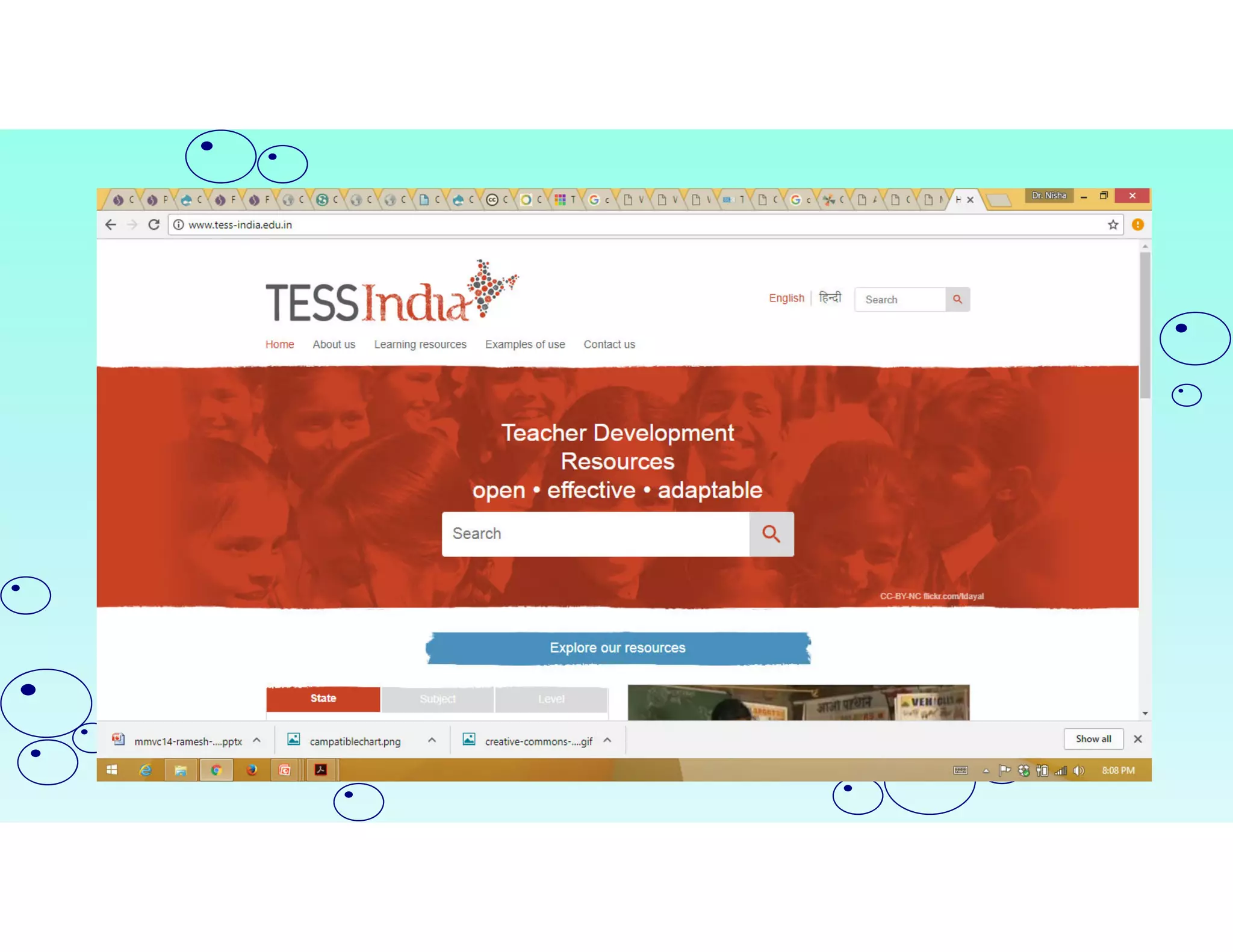
• TESS-India
National Programme on Technology Enhanced Learning
(NPTEL)
National Repository of OERs
Copyright and OER
Copyright and OER
• exclusive rights, given to creators and authors to
protect their original works
• an incentive for creativity to authors and creators
as well as a means of financial compensation for
their intellectual property
Copyright and OER
• copyright is automatic and ‘all rights reserved’
• copyright holder has the exclusive right for a
certain period of time, after which time the work
enters the public domain.
Creative Commons
http://creativecommons.org/license
• Most developed alternative Licensing approach :
Larry Lassig
• User friendly licenses for digital materials
Creative Commons licenses
• CC licenses are not an alternative to copyright. They
enable creators to distribute their content to a wide
audience and specify the manner in which the work
can be used while still maintaining their copyright.
• CC aims to make copyright content more ‘active’ by
ensuring that content can be redeveloped easily.
Creative Commons licenses
• All CC licenses have common features:
– help creators/licensors retain copyright while allowing others to
copy, distribute, and make some uses of their work — at least non-
commercially.
– ensure licensors get the credit for their work.
– work around the world and last as long as applicable copyright
lasts (because they are built on copyright).
• These common features serve as the baseline, on top of which
licensors can choose to grant additional permissions when deciding
how they want their work to be used.
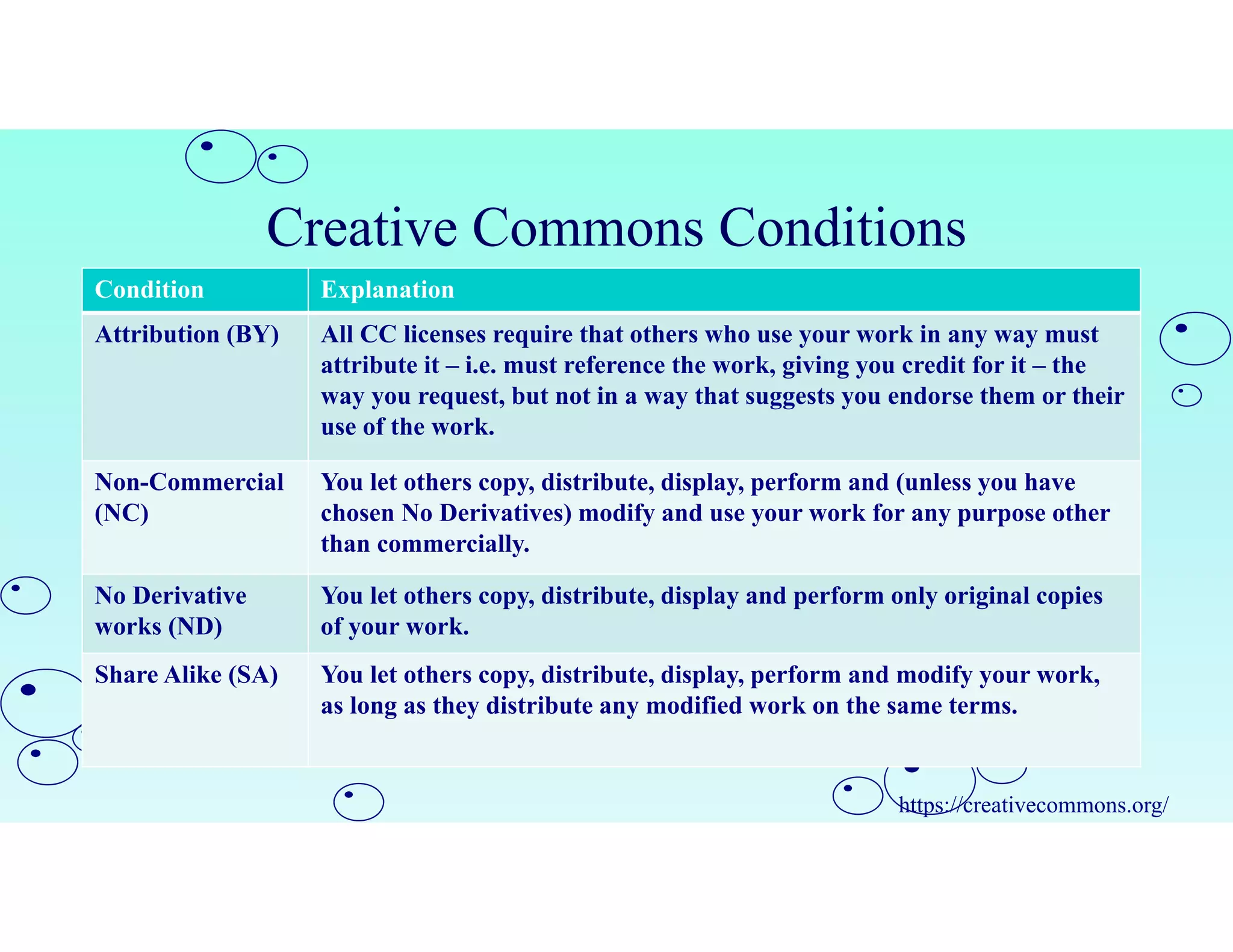
Creative Commons Conditions
Condition Explanation
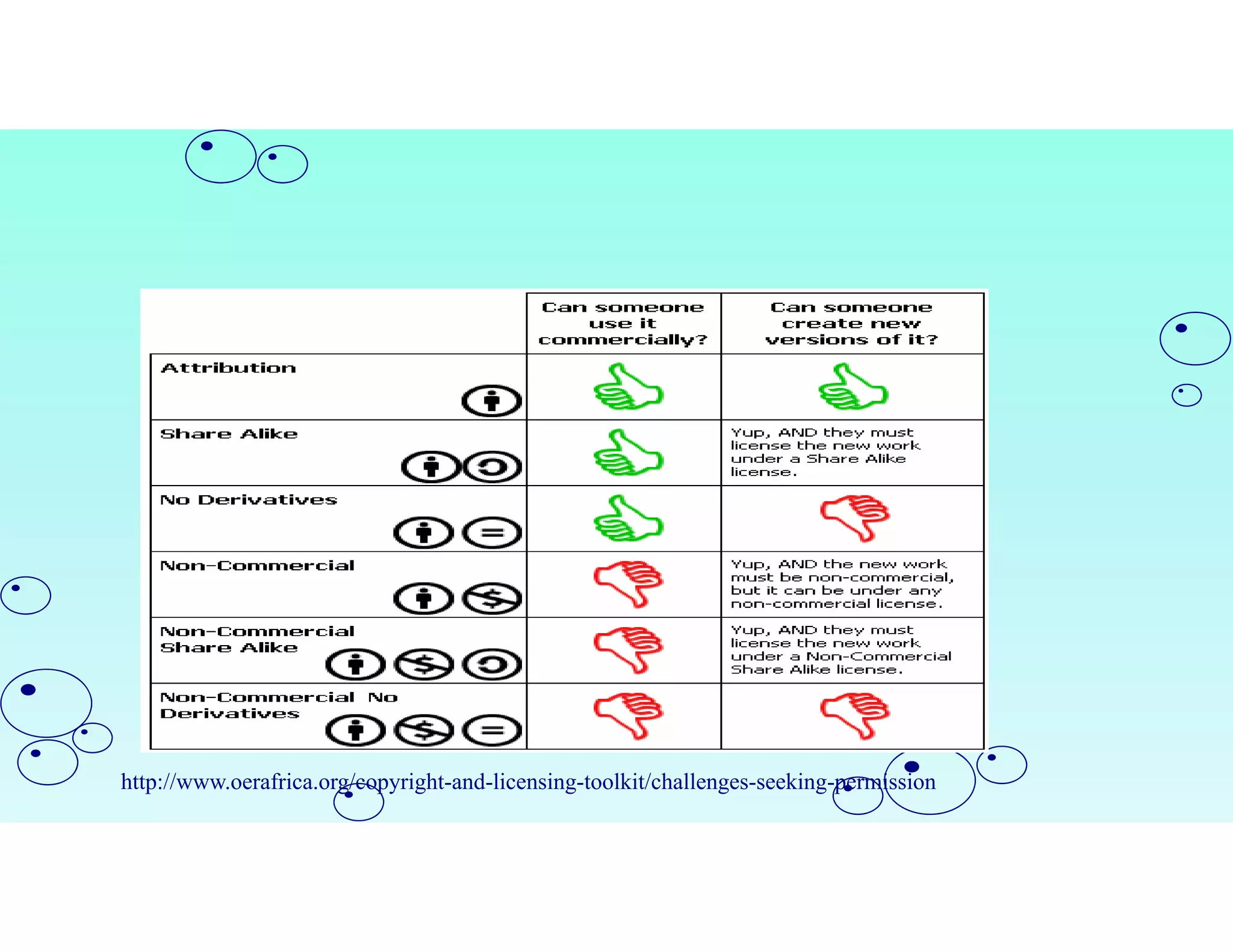
Attribution (BY) All CC licenses require that others who use your work in any way must
attribute it – i.e. must reference the work, giving you credit for it – the
way you request, but not in a way that suggests you endorse them or their
use of the work.
Non-Commercial
(NC)
You let others copy, distribute, display, perform and (unless you have
chosen No Derivatives) modify and use your work for any purpose other
than commercially.
No Derivative
works (ND)
You let others copy, distribute, display and perform only original copies
of your work.
Share Alike (SA) You let others copy, distribute, display, perform and modify your work,
as long as they distribute any modified work on the same terms.
https://creativecommons.org/
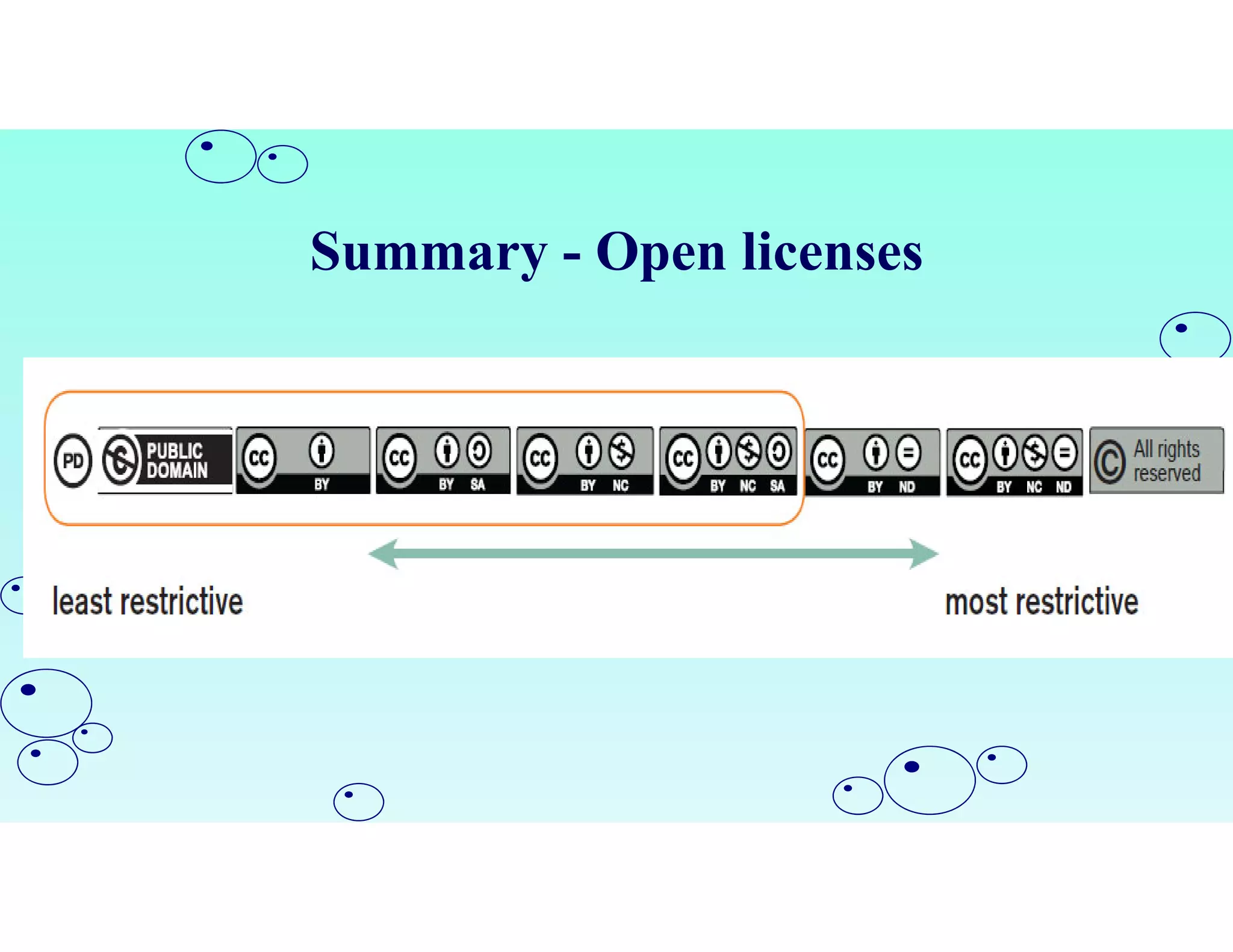
Six Creative Commons licenses
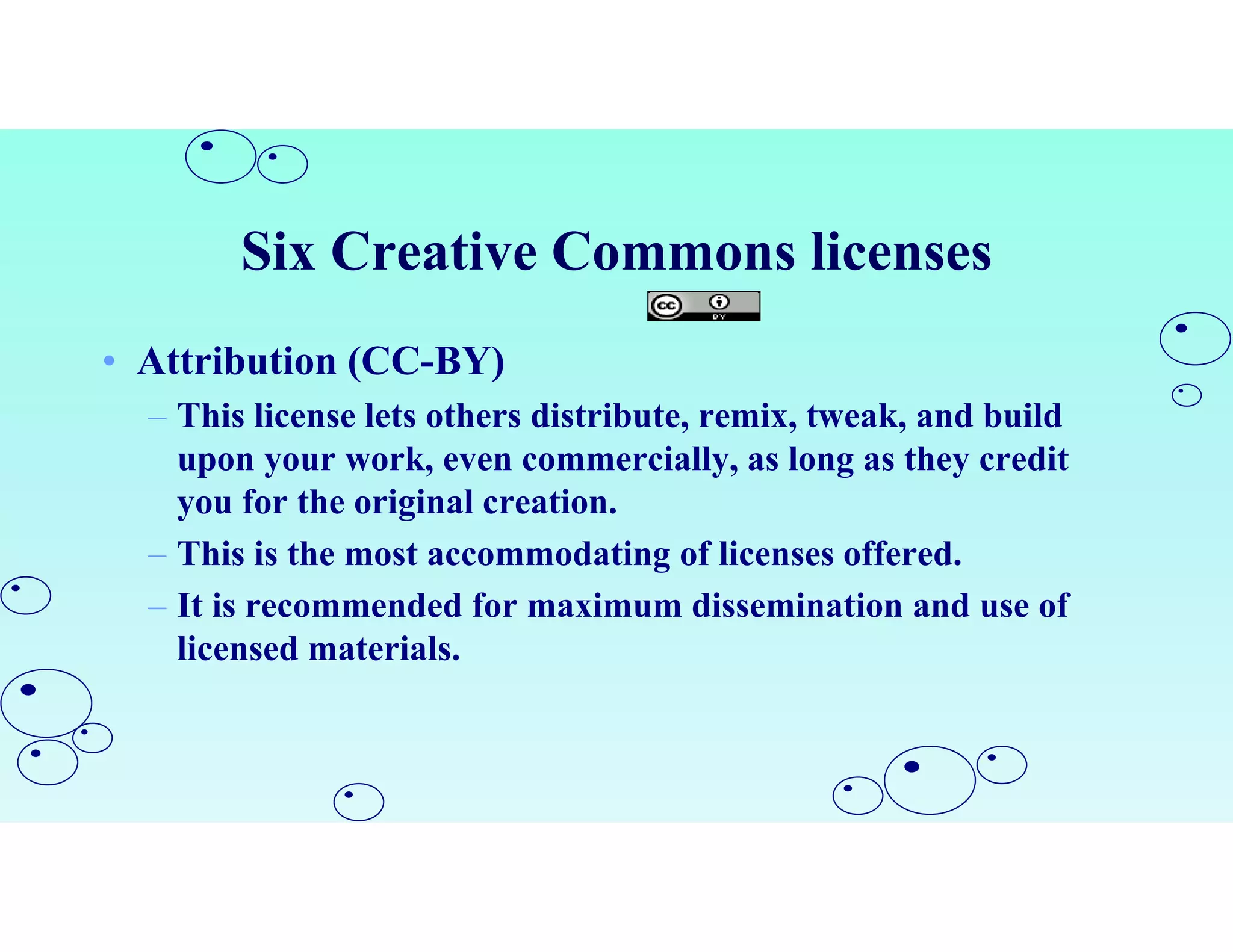
• Attribution (CC-BY)
– This license lets others distribute, remix, tweak, and build
upon your work, even commercially, as long as they credit
you for the original creation.
– This is the most accommodating of licenses offered.
– It is recommended for maximum dissemination and use of
licensed materials.
Creative Commons licenses (continued)
• Attribution-ShareAlike (CC BY-SA)
– This license lets others remix, tweak, and build upon your work even for
commercial purposes, as long as they credit you and license their new creations
under the identical terms.
– Often compared to “copyleft” free and open source software licenses.
– All new works based on yours will carry the same license, so any derivatives
will also allow commercial use. This is the license used by Wikipedia.
Creative Commons licenses (continued)
• Attribution-No-Derivatives (CC BY-ND) allows for
redistribution, commercial and non-commercial, as long
as it is passed along unchanged and in whole, with
credit to you.
• Attribution-Non-Commercial (CC BY-NC) lets
others remix, tweak, and build upon your work non-
commercially, and although their new works must also
acknowledge you and be non-commercial, they don’t
have to license their derivative works on the same terms.
Creative Commons licenses (continued)
• Attribution-Non-Commercial-ShareAlike
(CC BY-NC-SA)
– This license lets others remix, tweak, and build upon your work
non-commercially, as long as they credit you and license their new
creations under the identical terms.
Creative Commons licenses (continued)
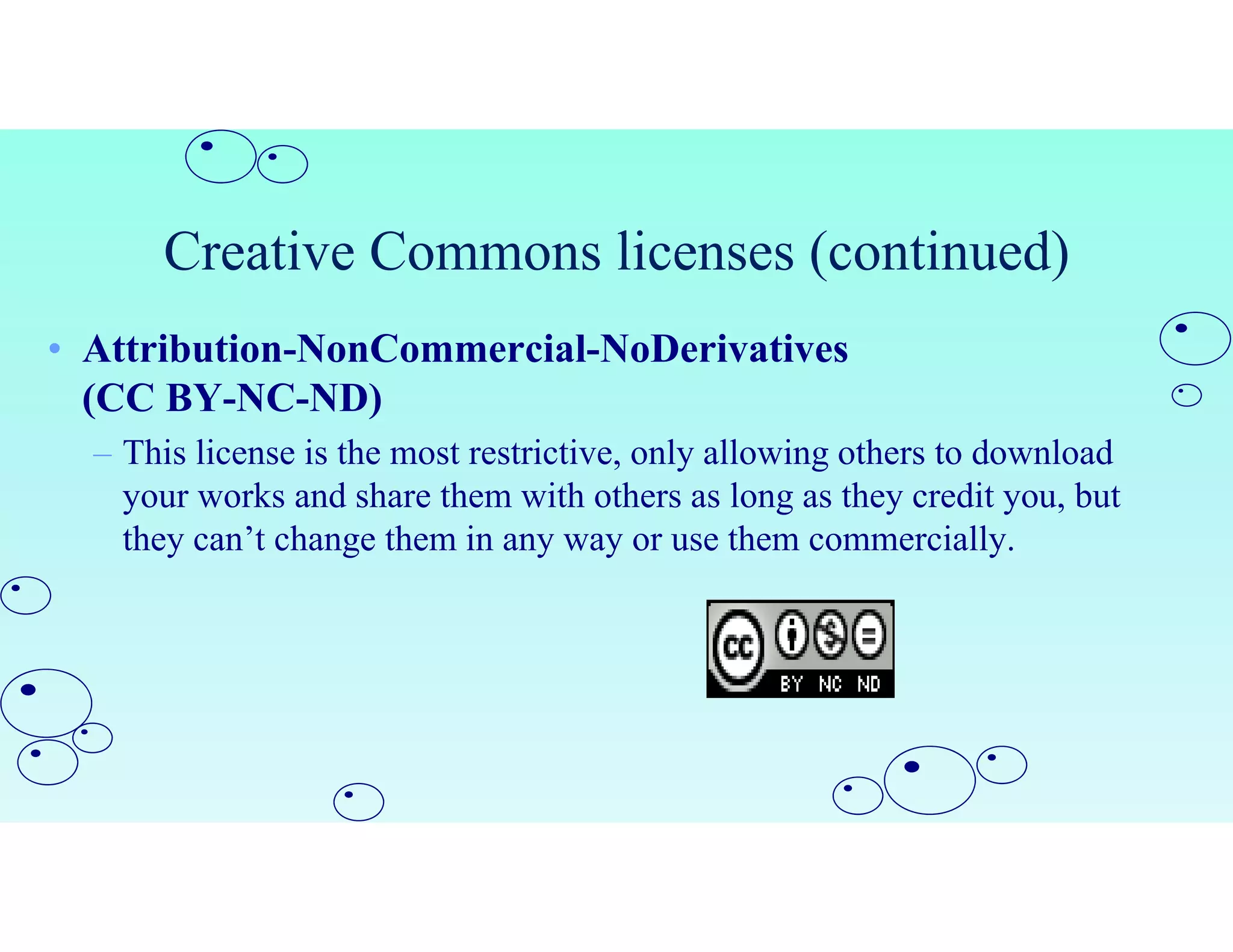
• Attribution-NonCommercial-NoDerivatives
(CC BY-NC-ND)
– This license is the most restrictive, only allowing others to download
your works and share them with others as long as they credit you, but
they can’t change them in any way or use them commercially.
Creative Commons Public Domain Tool
• CC’s public domain tool enable authors and copyright owners
who want to dedicate their works to the worldwide public
domain to do so.
– The CC0 tool (“No Rights Reserved”) allows licensors to waive all
rights and place a work in the public domain.
– The Public Domain mark identifies a work that is free of known
copyright restrictions. It is not recommend for works that are restricted
by copyright laws in one or more jurisdictions.
Summary - Open licenses
http://www.oerafrica.org/copyright-and-licensing-toolkit/challenges-seeking-permission
Issues while considering CC Licensing
• No registration required to license your work
• clearly spell out rights in terms of the materials that third parties produce,
including the possibility of subsequent use and reuse by third parties.
• If your work contains third-party (i.e. not created by you) content (e.g. images,
text, charts) and you wish to distribute your work widely as an OER – whether in
person, or electronically or online – then you must undergo copyright clearance
to obtain permission for third-party content.
Searching and Creating Open Educational
Resources
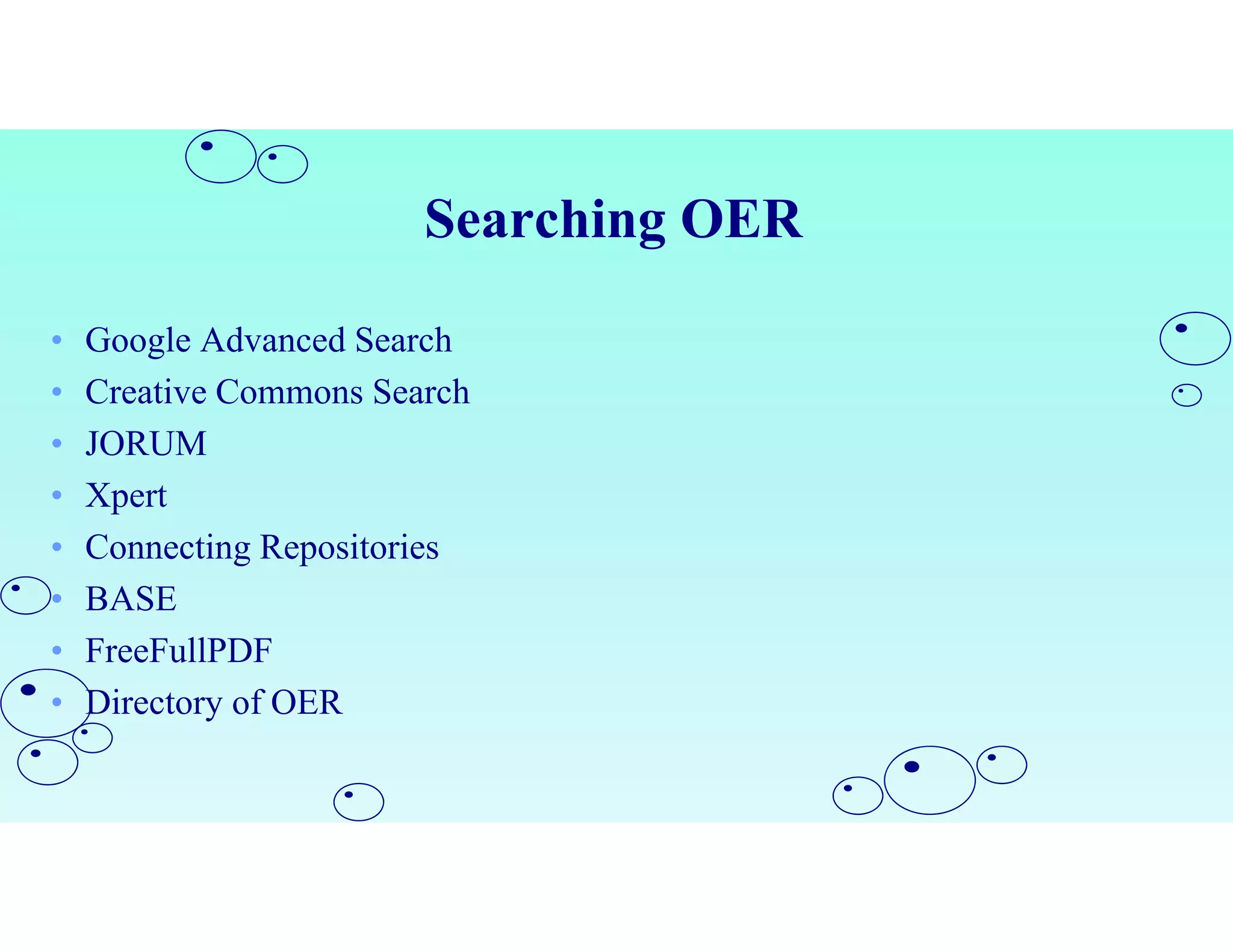
Searching OER
• Google Advanced Search
• Creative Commons Search
• JORUM
• Xpert
• Connecting Repositories
• BASE
• FreeFullPDF
• Directory of OER
Searching OER
• Google Advanced Search
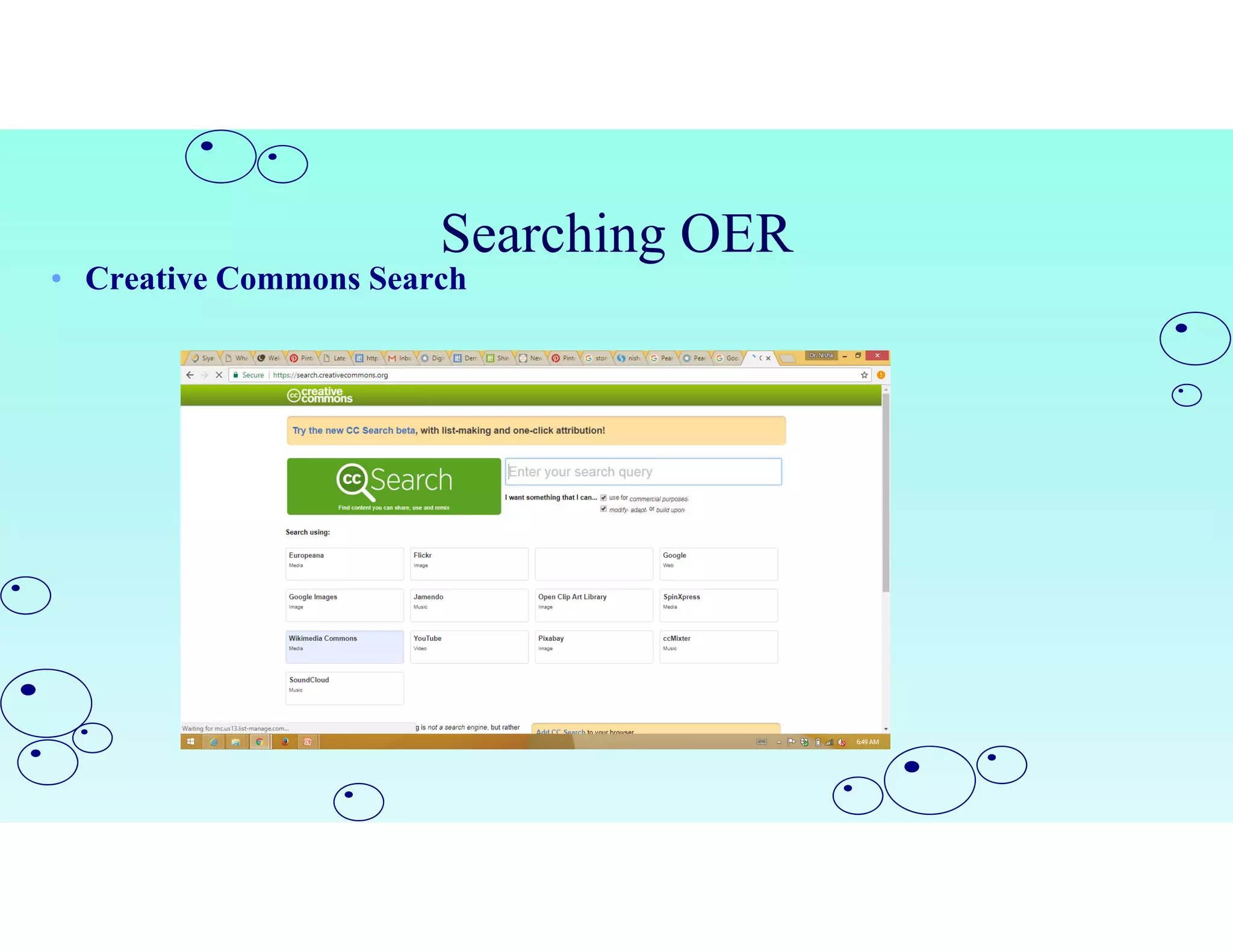
Searching OER
• Creative Commons Search
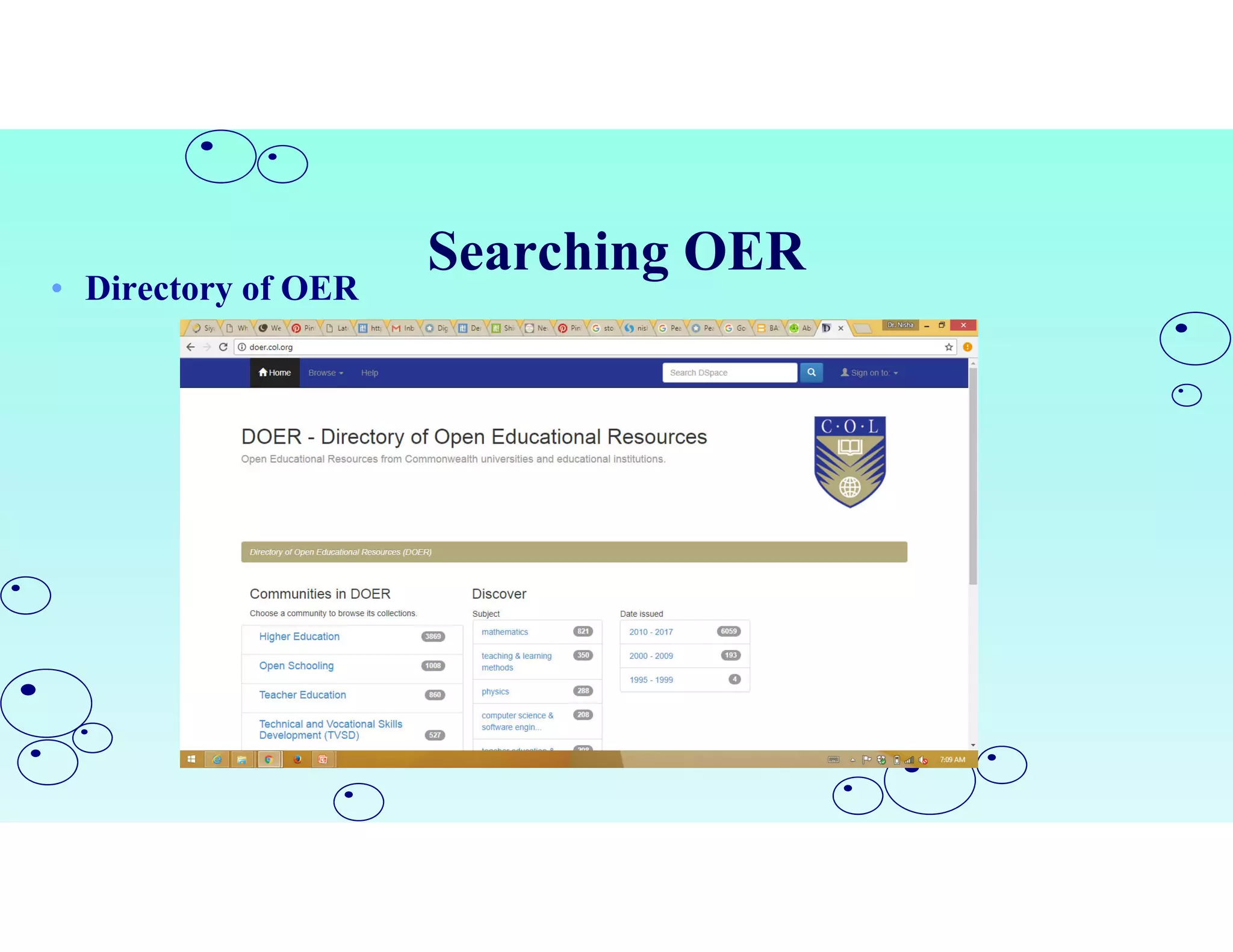
Searching OER
• Directory of OER
Searching OER
• NROER
Major OER Platforms
• Wiki Educator
• OER Commons
• College Open textbooks
• CK-12
• Siyavula
• MERLOT
• OpenLearn
• OpenStax CNX (earlier
Connexions)
• Saylor Academy
• BC Open Textbooks
• Open Course Library
• NPTEL
• Text
• Graphics
• Images
• Audio
• Animations
• Video
Types of OER:
OER may be any one or combination of any of these
Creating Open Educational Resources
• eXe - eLearning XHTML editor (eXe)
• An authoring environment
• eXe has been developed as an offline authoring tool
• Can develop multimedia OER
Mind/Concept Mapping – Free Mind and C-Map
Can be used to make Image /Graphic type of OER.
Oermooc

Oermooc

  • 1.
    Open Educational Resources(OER) Nisha Singh Deputy Director, IUC, IGNOU
  • 2.
  • 3.
    Open Educational Resources(OER) are ‘materials offered freely and openly to use and adapt for teaching, learning, development and research’. - The Commonwealth of Learning (COL) http://www.col.org/resources/crsMaterials/Pages/OCW-OER.aspx
  • 4.
    Open Educational Resourcesare teaching, learning or research materials that are in the public domain or released with an intellectual property license that allows for free use, adaptation, and distribution. -UNESCO
  • 5.
    Open Educational Resources(OER) are teaching and learning materials that you may freely use and reuse at no cost, and without needing to ask permission. Unlike copyrighted resources, OER have been authored or created by an individual or organization that chooses to retain few, if any, ownership rights. -OER Commons https://www.oercommons.org/about
  • 6.
  • 7.
    OER Freedom • Access • Copy •Use • Adapt • Share License • Attribution • Share-Alike • Non-Commercial • No-Derivation
  • 8.
    The 5 Rsof OER: http://opencontent.org/definition/
  • 10.
    OER could be…… • Activities & Labs • Assessments • Audio Lectures • Case Study • Curriculum Standards • Discussion Forums • Full Course • Games • Homework & Assignments • Images & Illustrations • Interactive Text • Lecture Notes • Lesson Plans • Readings • Resource Review • Simulations • Syllabi • Teaching & Learning Strategies • Textbooks • Training Materials • Unit of Study • Video Lectures Any materials associated with teaching and learning!
  • 12.
    Some OER initiativesin India • NPTEL • NROER • Project Oscar-IIIT-B • Open Educational Resources for Schools (OER4S)-Homi Bhabha Center for Science Education • NIOS-OER • TESS-India
  • 13.
    National Programme onTechnology Enhanced Learning (NPTEL)
  • 14.
  • 16.
  • 17.
    Copyright and OER •exclusive rights, given to creators and authors to protect their original works • an incentive for creativity to authors and creators as well as a means of financial compensation for their intellectual property
  • 18.
    Copyright and OER •copyright is automatic and ‘all rights reserved’ • copyright holder has the exclusive right for a certain period of time, after which time the work enters the public domain.
  • 19.
    Creative Commons http://creativecommons.org/license • Mostdeveloped alternative Licensing approach : Larry Lassig • User friendly licenses for digital materials
  • 20.
    Creative Commons licenses •CC licenses are not an alternative to copyright. They enable creators to distribute their content to a wide audience and specify the manner in which the work can be used while still maintaining their copyright. • CC aims to make copyright content more ‘active’ by ensuring that content can be redeveloped easily.
  • 21.
    Creative Commons licenses •All CC licenses have common features: – help creators/licensors retain copyright while allowing others to copy, distribute, and make some uses of their work — at least non- commercially. – ensure licensors get the credit for their work. – work around the world and last as long as applicable copyright lasts (because they are built on copyright). • These common features serve as the baseline, on top of which licensors can choose to grant additional permissions when deciding how they want their work to be used.
  • 22.
    Creative Commons Conditions ConditionExplanation Attribution (BY) All CC licenses require that others who use your work in any way must attribute it – i.e. must reference the work, giving you credit for it – the way you request, but not in a way that suggests you endorse them or their use of the work. Non-Commercial (NC) You let others copy, distribute, display, perform and (unless you have chosen No Derivatives) modify and use your work for any purpose other than commercially. No Derivative works (ND) You let others copy, distribute, display and perform only original copies of your work. Share Alike (SA) You let others copy, distribute, display, perform and modify your work, as long as they distribute any modified work on the same terms. https://creativecommons.org/
  • 23.
    Six Creative Commonslicenses • Attribution (CC-BY) – This license lets others distribute, remix, tweak, and build upon your work, even commercially, as long as they credit you for the original creation. – This is the most accommodating of licenses offered. – It is recommended for maximum dissemination and use of licensed materials.
  • 24.
    Creative Commons licenses(continued) • Attribution-ShareAlike (CC BY-SA) – This license lets others remix, tweak, and build upon your work even for commercial purposes, as long as they credit you and license their new creations under the identical terms. – Often compared to “copyleft” free and open source software licenses. – All new works based on yours will carry the same license, so any derivatives will also allow commercial use. This is the license used by Wikipedia.
  • 25.
    Creative Commons licenses(continued) • Attribution-No-Derivatives (CC BY-ND) allows for redistribution, commercial and non-commercial, as long as it is passed along unchanged and in whole, with credit to you. • Attribution-Non-Commercial (CC BY-NC) lets others remix, tweak, and build upon your work non- commercially, and although their new works must also acknowledge you and be non-commercial, they don’t have to license their derivative works on the same terms.
  • 26.
    Creative Commons licenses(continued) • Attribution-Non-Commercial-ShareAlike (CC BY-NC-SA) – This license lets others remix, tweak, and build upon your work non-commercially, as long as they credit you and license their new creations under the identical terms.
  • 27.
    Creative Commons licenses(continued) • Attribution-NonCommercial-NoDerivatives (CC BY-NC-ND) – This license is the most restrictive, only allowing others to download your works and share them with others as long as they credit you, but they can’t change them in any way or use them commercially.
  • 28.
    Creative Commons PublicDomain Tool • CC’s public domain tool enable authors and copyright owners who want to dedicate their works to the worldwide public domain to do so. – The CC0 tool (“No Rights Reserved”) allows licensors to waive all rights and place a work in the public domain. – The Public Domain mark identifies a work that is free of known copyright restrictions. It is not recommend for works that are restricted by copyright laws in one or more jurisdictions.
  • 29.
  • 30.
  • 31.
  • 32.
    Issues while consideringCC Licensing • No registration required to license your work • clearly spell out rights in terms of the materials that third parties produce, including the possibility of subsequent use and reuse by third parties. • If your work contains third-party (i.e. not created by you) content (e.g. images, text, charts) and you wish to distribute your work widely as an OER – whether in person, or electronically or online – then you must undergo copyright clearance to obtain permission for third-party content.
  • 33.
    Searching and CreatingOpen Educational Resources
  • 34.
    Searching OER • GoogleAdvanced Search • Creative Commons Search • JORUM • Xpert • Connecting Repositories • BASE • FreeFullPDF • Directory of OER
  • 35.
    Searching OER • GoogleAdvanced Search
  • 36.
  • 37.
  • 38.
  • 39.
    Major OER Platforms •Wiki Educator • OER Commons • College Open textbooks • CK-12 • Siyavula • MERLOT • OpenLearn • OpenStax CNX (earlier Connexions) • Saylor Academy • BC Open Textbooks • Open Course Library • NPTEL
  • 40.
    • Text • Graphics •Images • Audio • Animations • Video Types of OER: OER may be any one or combination of any of these
  • 41.
  • 42.
    • eXe -eLearning XHTML editor (eXe) • An authoring environment • eXe has been developed as an offline authoring tool • Can develop multimedia OER
  • 43.
    Mind/Concept Mapping –Free Mind and C-Map Can be used to make Image /Graphic type of OER.