DEVELOPMENT
COMMUNICATION
PRESENTED BY :
KAJAL SINGH
WHAT IS DEVELOPMENT
COMMUNICATION?
• Its an approach to communication which provides communities with
information they can use in bettering their lives, which aims at
making public programmes and policies real and sustainable.
• The term Development Communication was coined in 1972 by Nora
C. Quebral and was defined as:
“The art and science of human communication applied to the speedy
transformation of a country from poverty to a dynamic state of
economic growth and makes possible greater economic and social
equality and larger fulfillment of human potential.”
• As per CFA (Communication Foundation for
Asia),for achieving Development :
Communication goals 5 I’s are important:
• Inform
• Instruct
• Inspire
• Insist
• Involve
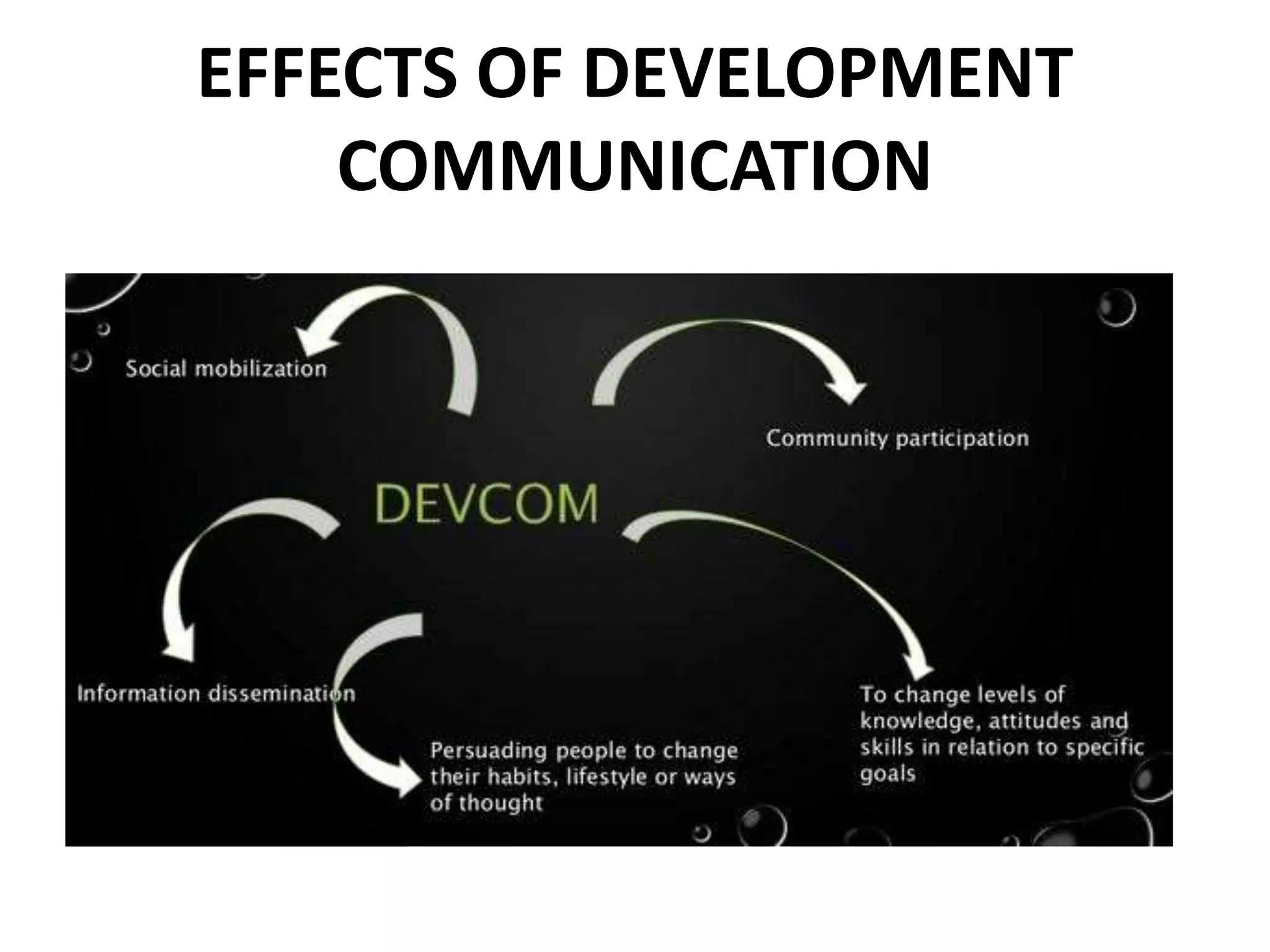
EFFECTS OF DEVELOPMENT
COMMUNICATION
ISSUES WHICH REQUIRE IMPORTANCE :
• Population
• Illiteracy
• Corruption
• Inefficiency
• Fatalism
• Poverty
• Disease
• Nutrition & Child Care
• Shelter & Clothing
• Transportation & Communication
• Sanitation
• Water Supply
Development communication is envisaged as a response to
particular historical, social, and economic factors that
characterize freedom of access to information and citizen
participation.
This includes socio-economic problems such as –
•high levels of poverty and unemployment
•low standards of living
•poor access to basic services
•remote settlement patterns
•lack of access to technology, education & skills and
infrastructure
•lack of information
•poor health services
APPROACHES TO DEVELOPMENT
COMMUNICATION
• Diffusion/extension approach : The main focus of this approach is
the adoption of technological and social innovations through
diffusion of new ideas, services and products.
• Mass Media approach : A well defined developed mass media and
interpersonal communication infrastructure is necessary for
development communication. It is necessary that these
infrastructures should be accessible to the people, both physically
and socially.
• Development support communication approach : development
support communication system will continuously emphasis the
appropriate motivation for the ongoing support to sectoral
development programmes.
KEY ISSUES ABOUT DEVELOPMENT
COMMUNICATION
• Communications” and “communication” are not the same
thing communication.
• There is a sharp difference between everyday
communication and professional communication
• There is a significant difference between development
communication and other types of communication.
• The main scope and functions of development
communication are not exclusively about communicating
information and messages, but they also involve engaging
stakeholders and assessing the situation.
• Development communication initiatives can never
be successful unless proper communication
research is conducted before deciding on the
strategy.
• To be effective in their work, development
communication specialists need to have a specific
and in depth knowledge of the theory and practical
applications of the discipline.
• Development communication support can only be
as effective as the project itself.
Examples
• Established in 2009, Global South Development
Magazine has been a recent example of
development communication in practice
• A social marketing project in Bolivia in the 1980s
tried to get women in the Cochabamba Valley to
use soybeans in their cooking. This was an
attempt to deal with chronic malnourishment
among children.
Development communication

Development communication

  • 1.
  • 2.
    WHAT IS DEVELOPMENT COMMUNICATION? •Its an approach to communication which provides communities with information they can use in bettering their lives, which aims at making public programmes and policies real and sustainable. • The term Development Communication was coined in 1972 by Nora C. Quebral and was defined as: “The art and science of human communication applied to the speedy transformation of a country from poverty to a dynamic state of economic growth and makes possible greater economic and social equality and larger fulfillment of human potential.”
  • 3.
    • As perCFA (Communication Foundation for Asia),for achieving Development : Communication goals 5 I’s are important: • Inform • Instruct • Inspire • Insist • Involve
  • 4.
  • 5.
    ISSUES WHICH REQUIREIMPORTANCE : • Population • Illiteracy • Corruption • Inefficiency • Fatalism • Poverty • Disease • Nutrition & Child Care • Shelter & Clothing • Transportation & Communication • Sanitation • Water Supply
  • 6.
    Development communication isenvisaged as a response to particular historical, social, and economic factors that characterize freedom of access to information and citizen participation. This includes socio-economic problems such as – •high levels of poverty and unemployment •low standards of living •poor access to basic services •remote settlement patterns •lack of access to technology, education & skills and infrastructure •lack of information •poor health services
  • 7.
    APPROACHES TO DEVELOPMENT COMMUNICATION •Diffusion/extension approach : The main focus of this approach is the adoption of technological and social innovations through diffusion of new ideas, services and products. • Mass Media approach : A well defined developed mass media and interpersonal communication infrastructure is necessary for development communication. It is necessary that these infrastructures should be accessible to the people, both physically and socially. • Development support communication approach : development support communication system will continuously emphasis the appropriate motivation for the ongoing support to sectoral development programmes.
  • 8.
    KEY ISSUES ABOUTDEVELOPMENT COMMUNICATION • Communications” and “communication” are not the same thing communication. • There is a sharp difference between everyday communication and professional communication • There is a significant difference between development communication and other types of communication. • The main scope and functions of development communication are not exclusively about communicating information and messages, but they also involve engaging stakeholders and assessing the situation.
  • 9.
    • Development communicationinitiatives can never be successful unless proper communication research is conducted before deciding on the strategy. • To be effective in their work, development communication specialists need to have a specific and in depth knowledge of the theory and practical applications of the discipline. • Development communication support can only be as effective as the project itself.
  • 10.
    Examples • Established in2009, Global South Development Magazine has been a recent example of development communication in practice • A social marketing project in Bolivia in the 1980s tried to get women in the Cochabamba Valley to use soybeans in their cooking. This was an attempt to deal with chronic malnourishment among children.