Developer s Guide to Microsoft Enterprise Library C Edition Alex Homer
Developer s Guide to Microsoft Enterprise Library C Edition Alex Homer
Developer s Guide to Microsoft Enterprise Library C Edition Alex Homer
Developer s Guide to Microsoft Enterprise Library C Edition Alex Homer
Developer s Guide to Microsoft Enterprise Library C Edition Alex Homer
1.
Download the fullversion and explore a variety of ebooks
or textbooks at https://ebookultra.com
Developer s Guide to Microsoft Enterprise Library
C Edition Alex Homer
_____ Tap the link below to start your download _____
https://ebookultra.com/download/developer-s-guide-to-
microsoft-enterprise-library-c-edition-alex-homer/
Find ebooks or textbooks at ebookultra.com today!
2.
We believe theseproducts will be a great fit for you. Click
the link to download now, or visit ebookultra.com
to discover even more!
C net Web Developer s Guide 1st Edition Saurabh Nandu
https://ebookultra.com/download/c-net-web-developer-s-guide-1st-
edition-saurabh-nandu/
The Little Book on CoffeeScript The JavaScript Developer s
Guide to Building Better Web Apps 1st Edition Alex Maccaw
https://ebookultra.com/download/the-little-book-on-coffeescript-the-
javascript-developer-s-guide-to-building-better-web-apps-1st-edition-
alex-maccaw/
Applications Code Markup A Guide to the Microsoft Windows
Presentation Foundation Pro Developer 1st Edition Charles
Petzold
https://ebookultra.com/download/applications-code-markup-a-guide-to-
the-microsoft-windows-presentation-foundation-pro-developer-1st-
edition-charles-petzold/
Developer s Guide to Web Application Security 1st Edition
Michael Cross
https://ebookultra.com/download/developer-s-guide-to-web-application-
security-1st-edition-michael-cross/
3.
The NET Developers Guide to Windows Security 1st Edition
Keith Brown
https://ebookultra.com/download/the-net-developer-s-guide-to-windows-
security-1st-edition-keith-brown/
The Ruby Developer s Guide 1st Edition Syngress
https://ebookultra.com/download/the-ruby-developer-s-guide-1st-
edition-syngress/
Professional Microsoft Robotics Developer Studio Wrox
Programmer to Programmer 1st Edition Kyle Johns
https://ebookultra.com/download/professional-microsoft-robotics-
developer-studio-wrox-programmer-to-programmer-1st-edition-kyle-johns/
Sun Certification Training Guide 310 080 Java 2 Enterprise
Edition J2EE Web Component Developer Alain Trottier
https://ebookultra.com/download/sun-certification-training-
guide-310-080-java-2-enterprise-edition-j2ee-web-component-developer-
alain-trottier/
Microsoft SharePoint 2010 Developer Reference 1st Edition
Paolo Pialorsi
https://ebookultra.com/download/microsoft-sharepoint-2010-developer-
reference-1st-edition-paolo-pialorsi/
5.
Developer s Guideto Microsoft Enterprise Library C
Edition Alex Homer Digital Instant Download
Author(s): Alex Homer, Nicolas Botto
ISBN(s): 9780735645233, 073564523X
Edition: Kindle
File Details: PDF, 3.35 MB
Year: 2010
Language: english
6.
D E VE LO P E R S ’ S GU I D E TO
M I C R O S O F T
®
EN T E R P R I S E
LI B R A RY
Alex Homer
with
Nicolas Botto
Bob Brumfield
Grigori Melnik
Erik Renaud
Fernando Simonazzi
Chris Tavares
Solutions for
Enterprise Development
C# Edition
Contents
preface xv
About ThisGuide xv
What Does This Guide Cover? xv
What This Guide Does Not Cover xvi
How Will This Guide Help You? xvii
What Do You Need to Get Started? xvii
the team who brought you this guide xix
The Enterprise Library 5.0 Development Team xix
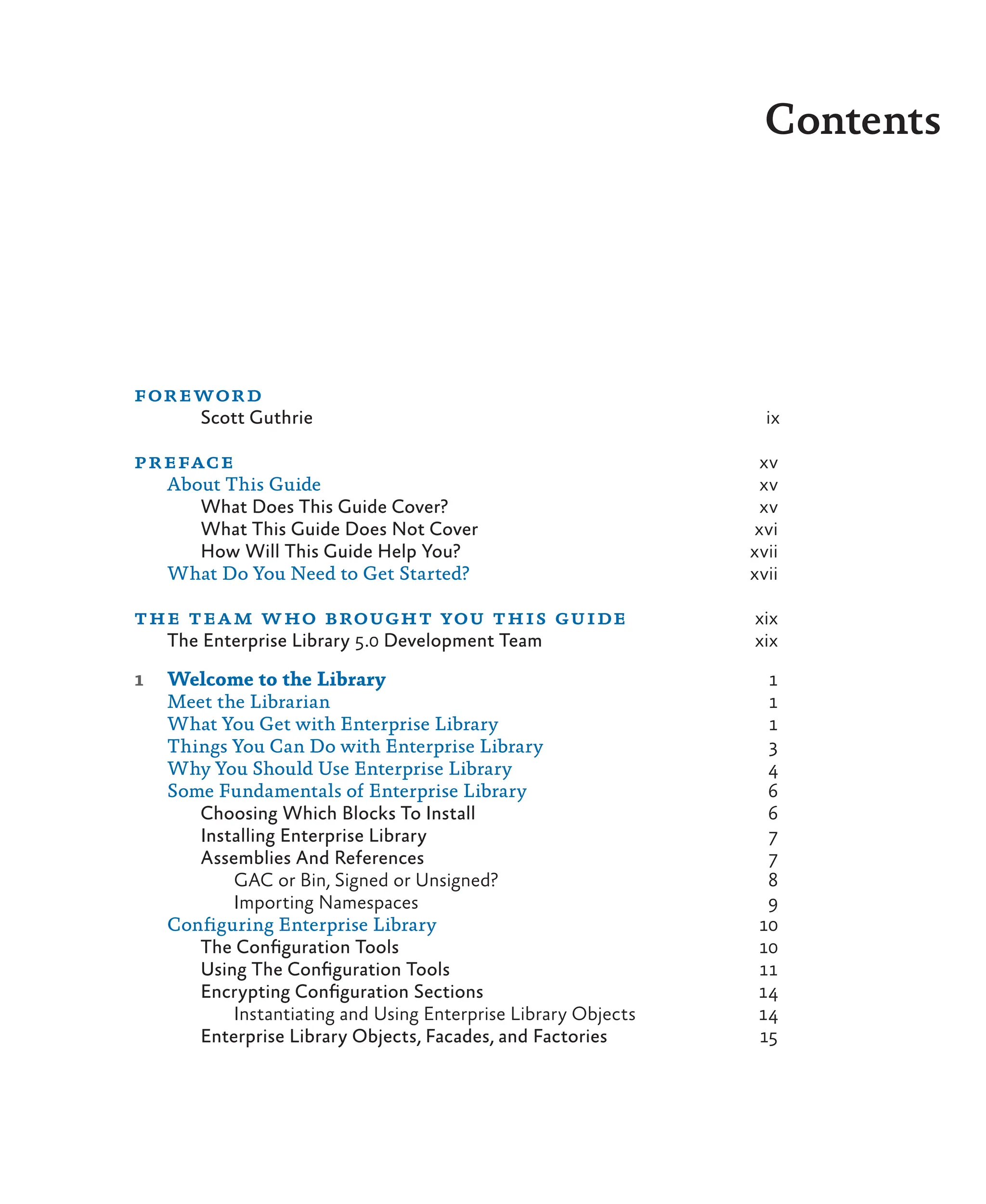
1 Welcome to the Library 1
Meet the Librarian 1
What You Get with Enterprise Library 1
Things You Can Do with Enterprise Library 3
Why You Should Use Enterprise Library 4
Some Fundamentals of Enterprise Library 6
Choosing Which Blocks To Install 6
Installing Enterprise Library 7
Assemblies And References 7
GAC or Bin, Signed or Unsigned? 8
Importing Namespaces 9
Configuring Enterprise Library 10
The Configuration Tools 10
Using The Configuration Tools 11
Encrypting Configuration Sections 14
Instantiating and Using Enterprise Library Objects 14
Enterprise Library Objects, Facades, and Factories 15
foreword
Scott Guthrie ix
12.
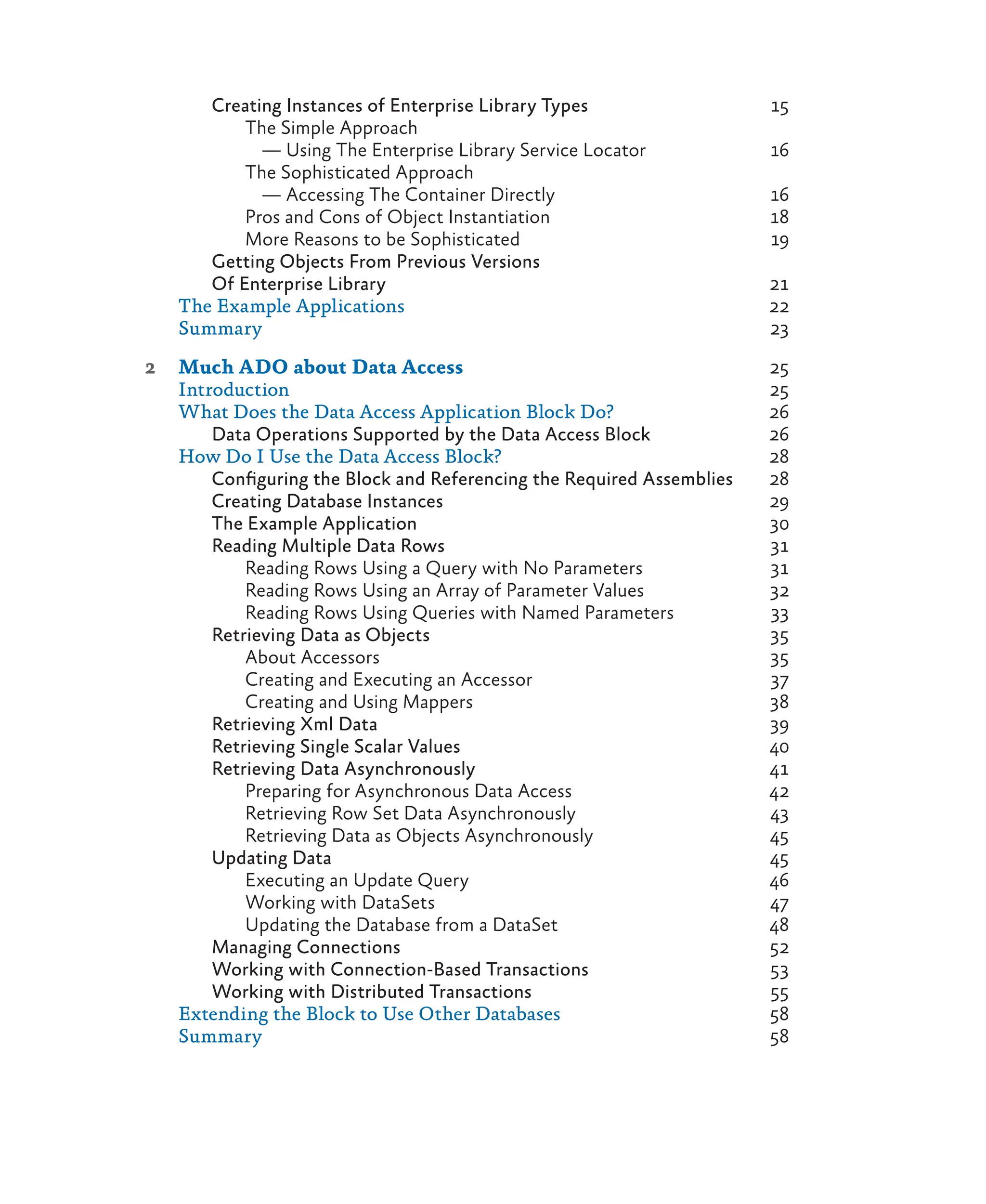
Creating Instances ofEnterprise Library Types 15
The Simple Approach
— Using The Enterprise Library Service Locator 16
The Sophisticated Approach
— Accessing The Container Directly 16
Pros and Cons of Object Instantiation 18
More Reasons to be Sophisticated 19
Getting Objects From Previous Versions
Of Enterprise Library 21
The Example Applications 22
Summary 23
2 Much ADO about Data Access 25
Introduction 25
What Does the Data Access Application Block Do? 26
Data Operations Supported by the Data Access Block 26
How Do I Use the Data Access Block? 28
Configuring the Block and Referencing the Required Assemblies 28
Creating Database Instances 29
The Example Application 30
Reading Multiple Data Rows 31
Reading Rows Using a Query with No Parameters 31
Reading Rows Using an Array of Parameter Values 32
Reading Rows Using Queries with Named Parameters 33
Retrieving Data as Objects 35
About Accessors 35
Creating and Executing an Accessor 37
Creating and Using Mappers 38
Retrieving Xml Data 39
Retrieving Single Scalar Values 40
Retrieving Data Asynchronously 41
Preparing for Asynchronous Data Access 42
Retrieving Row Set Data Asynchronously 43
Retrieving Data as Objects Asynchronously 45
Updating Data 45
Executing an Update Query 46
Working with DataSets 47
Updating the Database from a DataSet 48
Managing Connections 52
Working with Connection-Based Transactions 53
Working with Distributed Transactions 55
Extending the Block to Use Other Databases 58
Summary 58
13.
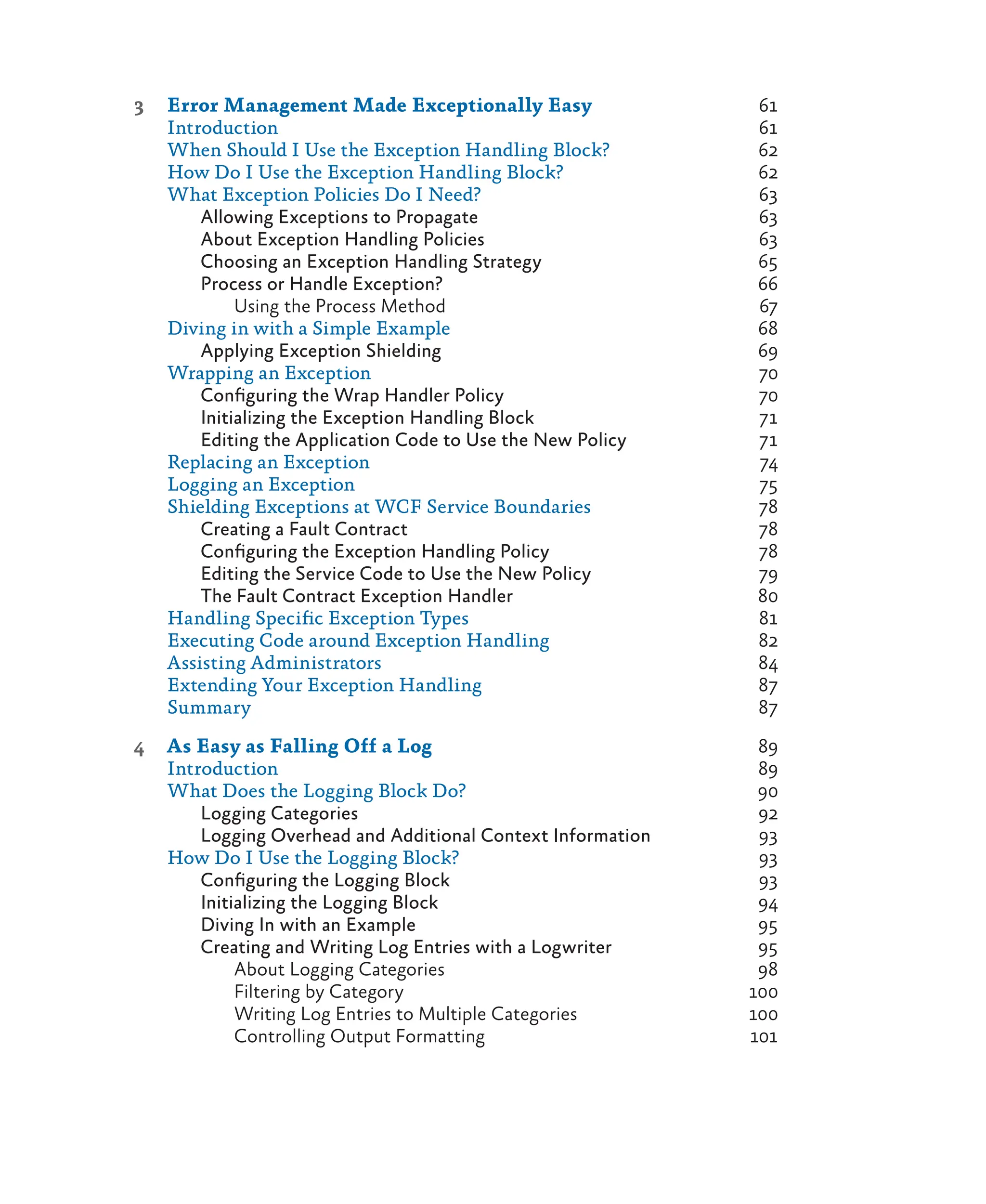
3 Error ManagementMade Exceptionally Easy 61
Introduction 61
When Should I Use the Exception Handling Block? 62
How Do I Use the Exception Handling Block? 62
What Exception Policies Do I Need? 63
Allowing Exceptions to Propagate 63
About Exception Handling Policies 63
Choosing an Exception Handling Strategy 65
Process or Handle Exception? 66
Using the Process Method 67
Diving in with a Simple Example 68
Applying Exception Shielding 69
Wrapping an Exception 70
Configuring the Wrap Handler Policy 70
Initializing the Exception Handling Block 71
Editing the Application Code to Use the New Policy 71
Replacing an Exception 74
Logging an Exception 75
Shielding Exceptions at WCF Service Boundaries 78
Creating a Fault Contract 78
Configuring the Exception Handling Policy 78
Editing the Service Code to Use the New Policy 79
The Fault Contract Exception Handler 80
Handling Specific Exception Types 81
Executing Code around Exception Handling 82
Assisting Administrators 84
Extending Your Exception Handling 87
Summary 87
4 As Easy as Falling Off a Log 89
Introduction 89
What Does the Logging Block Do? 90
Logging Categories 92
Logging Overhead and Additional Context Information 93
How Do I Use the Logging Block? 93
Configuring the Logging Block 93
Initializing the Logging Block 94
Diving In with an Example 95
Creating and Writing Log Entries with a Logwriter 95
About Logging Categories 98
Filtering by Category 100
Writing Log Entries to Multiple Categories 100
Controlling Output Formatting 101
14.
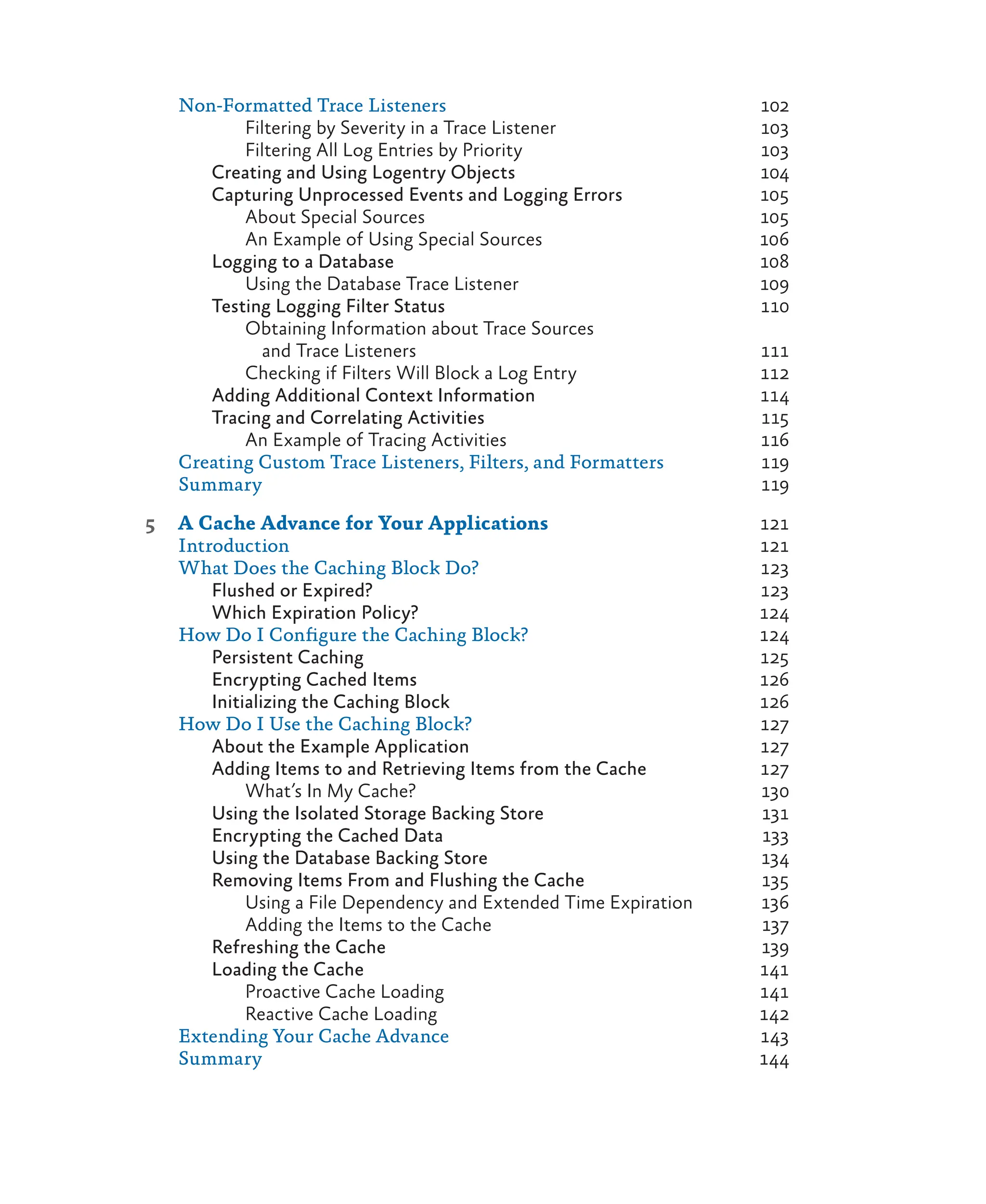
Non-Formatted Trace Listeners102
Filtering by Severity in a Trace Listener 103
Filtering All Log Entries by Priority 103
Creating and Using Logentry Objects 104
Capturing Unprocessed Events and Logging Errors 105
About Special Sources 105
An Example of Using Special Sources 106
Logging to a Database 108
Using the Database Trace Listener 109
Testing Logging Filter Status 110
Obtaining Information about Trace Sources
and Trace Listeners 111
Checking if Filters Will Block a Log Entry 112
Adding Additional Context Information 114
Tracing and Correlating Activities 115
An Example of Tracing Activities 116
Creating Custom Trace Listeners, Filters, and Formatters 119
Summary 119
5 A Cache Advance for Your Applications 121
Introduction 121
What Does the Caching Block Do? 123
Flushed or Expired? 123
Which Expiration Policy? 124
How Do I Configure the Caching Block? 124
Persistent Caching 125
Encrypting Cached Items 126
Initializing the Caching Block 126
How Do I Use the Caching Block? 127
About the Example Application 127
Adding Items to and Retrieving Items from the Cache 127
What’s In My Cache? 130
Using the Isolated Storage Backing Store 131
Encrypting the Cached Data 133
Using the Database Backing Store 134
Removing Items From and Flushing the Cache 135
Using a File Dependency and Extended Time Expiration 136
Adding the Items to the Cache 137
Refreshing the Cache 139
Loading the Cache 141
Proactive Cache Loading 141
Reactive Cache Loading 142
Extending Your Cache Advance 143
Summary 144
15.
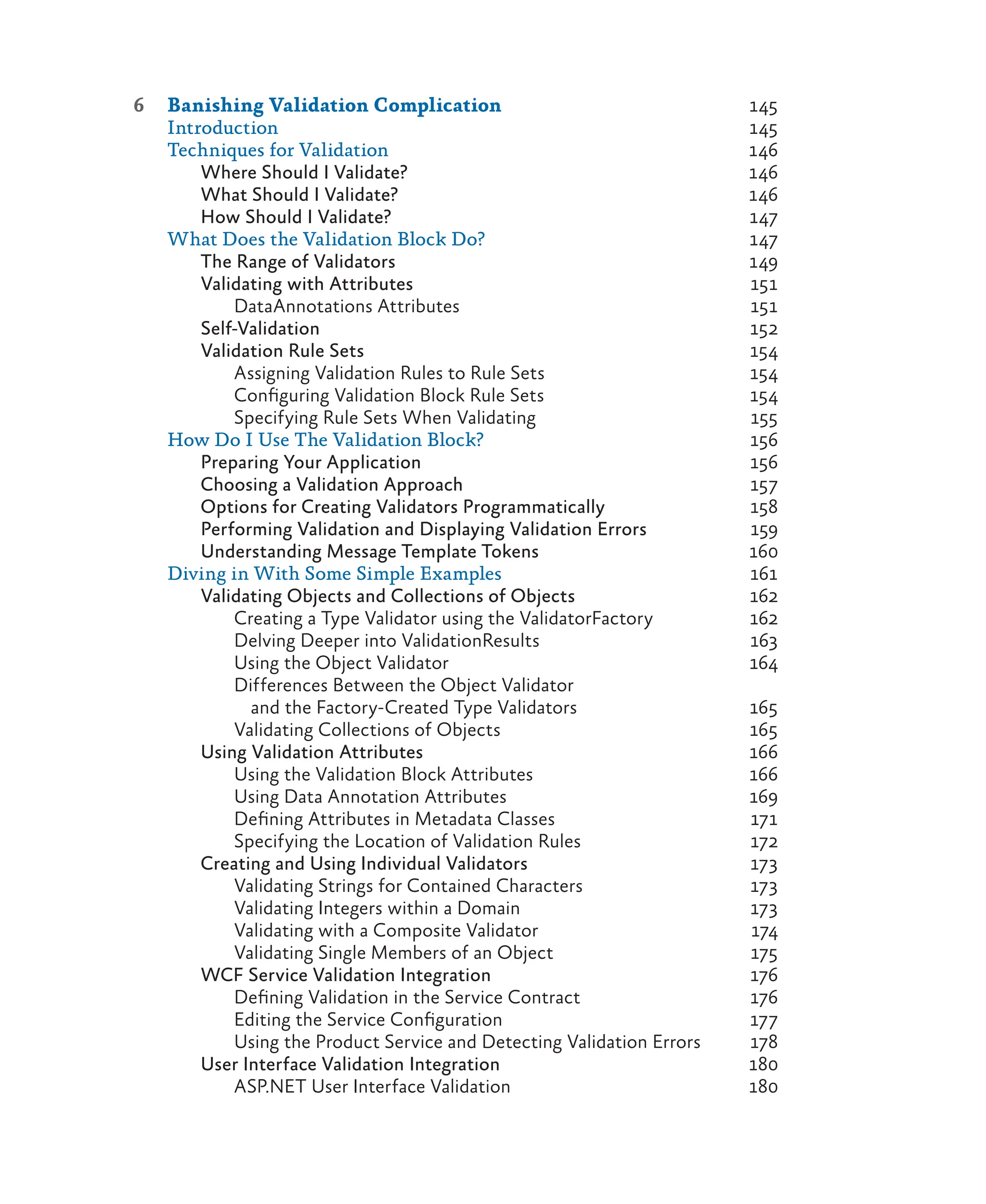
6 Banishing ValidationComplication 145
Introduction 145
Techniques for Validation 146
Where Should I Validate? 146
What Should I Validate? 146
How Should I Validate? 147
What Does the Validation Block Do? 147
The Range of Validators 149
Validating with Attributes 151
DataAnnotations Attributes 151
Self-Validation 152
Validation Rule Sets 154
Assigning Validation Rules to Rule Sets 154
Configuring Validation Block Rule Sets 154
Specifying Rule Sets When Validating 155
How Do I Use The Validation Block? 156
Preparing Your Application 156
Choosing a Validation Approach 157
Options for Creating Validators Programmatically 158
Performing Validation and Displaying Validation Errors 159
Understanding Message Template Tokens 160
Diving in With Some Simple Examples 161
Validating Objects and Collections of Objects 162
Creating a Type Validator using the ValidatorFactory 162
Delving Deeper into ValidationResults 163
Using the Object Validator 164
Differences Between the Object Validator
and the Factory-Created Type Validators 165
Validating Collections of Objects 165
Using Validation Attributes 166
Using the Validation Block Attributes 166
Using Data Annotation Attributes 169
Defining Attributes in Metadata Classes 171
Specifying the Location of Validation Rules 172
Creating and Using Individual Validators 173
Validating Strings for Contained Characters 173
Validating Integers within a Domain 173
Validating with a Composite Validator 174
Validating Single Members of an Object 175
WCF Service Validation Integration 176
Defining Validation in the Service Contract 176
Editing the Service Configuration 177
Using the Product Service and Detecting Validation Errors 178
User Interface Validation Integration 180
ASP.NET User Interface Validation 180
16.
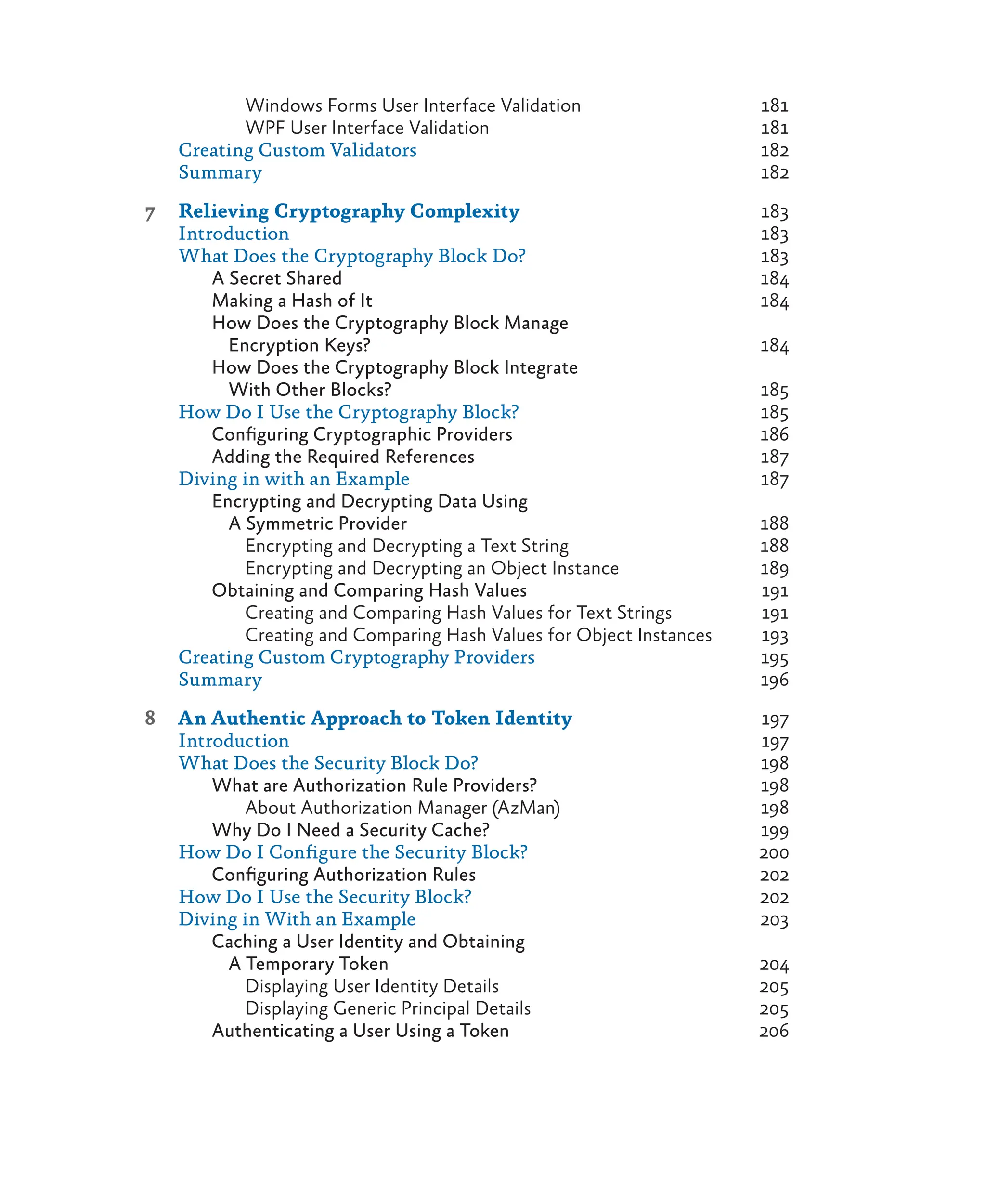
Windows Forms UserInterface Validation 181
WPF User Interface Validation 181
Creating Custom Validators 182
Summary 182
7 Relieving Cryptography Complexity 183
Introduction 183
What Does the Cryptography Block Do? 183
A Secret Shared 184
Making a Hash of It 184
How Does the Cryptography Block Manage
Encryption Keys? 184
How Does the Cryptography Block Integrate
With Other Blocks? 185
How Do I Use the Cryptography Block? 185
Configuring Cryptographic Providers 186
Adding the Required References 187
Diving in with an Example 187
Encrypting and Decrypting Data Using
A Symmetric Provider 188
Encrypting and Decrypting a Text String 188
Encrypting and Decrypting an Object Instance 189
Obtaining and Comparing Hash Values 191
Creating and Comparing Hash Values for Text Strings 191
Creating and Comparing Hash Values for Object Instances 193
Creating Custom Cryptography Providers 195
Summary 196
8 An Authentic Approach to Token Identity 197
Introduction 197
What Does the Security Block Do? 198
What are Authorization Rule Providers? 198
About Authorization Manager (AzMan) 198
Why Do I Need a Security Cache? 199
How Do I Configure the Security Block? 200
Configuring Authorization Rules 202
How Do I Use the Security Block? 202
Diving in With an Example 203
Caching a User Identity and Obtaining
A Temporary Token 204
Displaying User Identity Details 205
Displaying Generic Principal Details 205
Authenticating a User Using a Token 206
17.
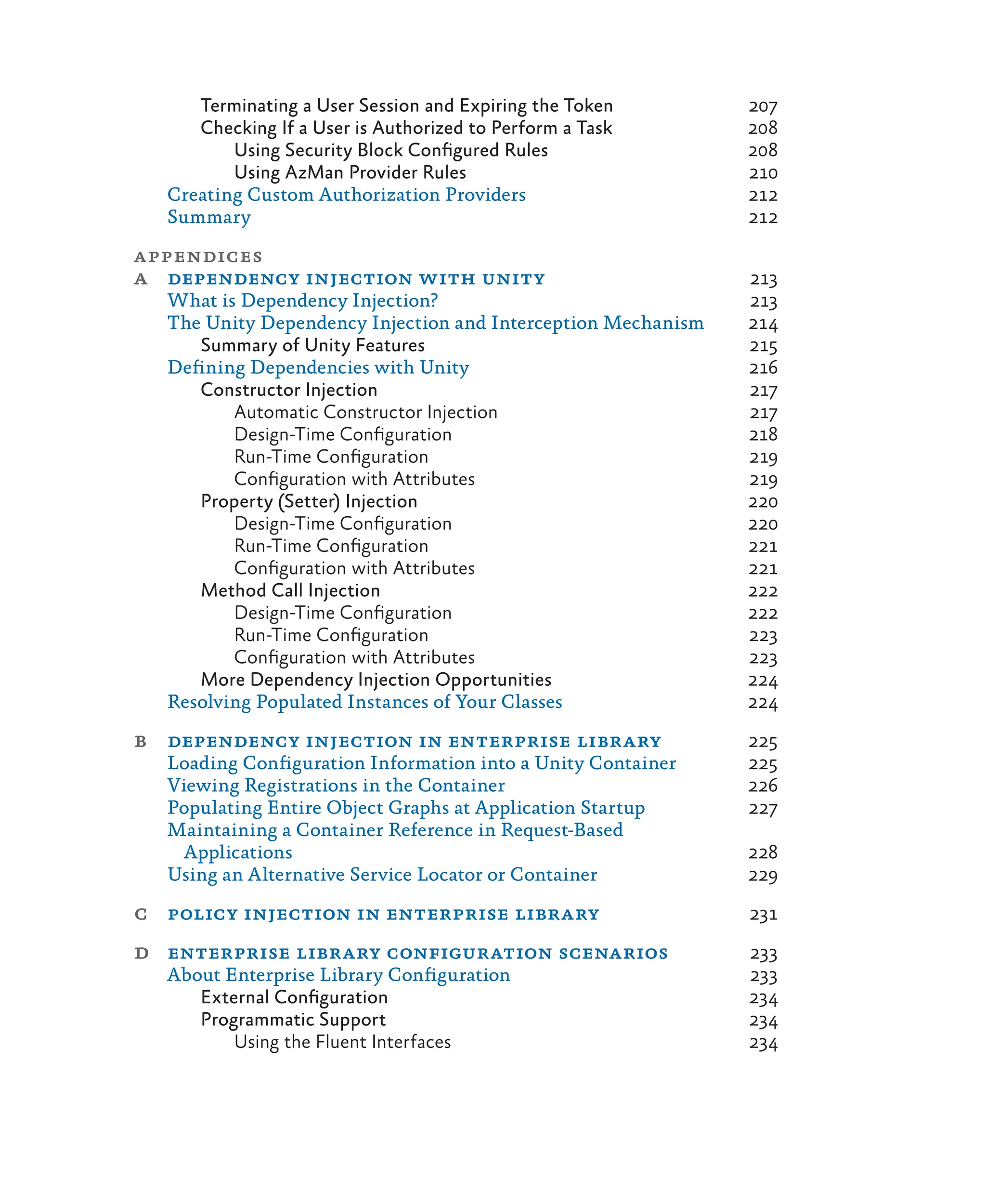
Terminating a UserSession and Expiring the Token 207
Checking If a User is Authorized to Perform a Task 208
Using Security Block Configured Rules 208
Using AzMan Provider Rules 210
Creating Custom Authorization Providers 212
Summary 212
appendices
a dependency injection with unity 213
What is Dependency Injection? 213
The Unity Dependency Injection and Interception Mechanism 214
Summary of Unity Features 215
Defining Dependencies with Unity 216
Constructor Injection 217
Automatic Constructor Injection 217
Design-Time Configuration 218
Run-Time Configuration 219
Configuration with Attributes 219
Property (Setter) Injection 220
Design-Time Configuration 220
Run-Time Configuration 221
Configuration with Attributes 221
Method Call Injection 222
Design-Time Configuration 222
Run-Time Configuration 223
Configuration with Attributes 223
More Dependency Injection Opportunities 224
Resolving Populated Instances of Your Classes 224
b dependency injection in enterprise library 225
Loading Configuration Information into a Unity Container 225
Viewing Registrations in the Container 226
Populating Entire Object Graphs at Application Startup 227
Maintaining a Container Reference in Request-Based
Applications 228
Using an Alternative Service Locator or Container 229
c policy injection in enterprise library 231
d enterprise library configuration scenarios 233
About Enterprise Library Configuration 233
External Configuration 234
Programmatic Support 234
Using the Fluent Interfaces 234
18.
Scenarios for AdvancedConfiguration 235
scenario 1: Using The Default Application
Configuration File 235
scenario 2: Using A Non-Default Configuration Store 235
scenario 3: Sharing The Same Configuration
Between Multiple Applications 236
scenario 4: Managing And Enforcing Configuration
For Multiple Applications 236
scenario 5: Sharing Configuration Sections
Across Multiple Applications 237
scenario 6: Applying a Common Configuration
Structure for Applications 238
Deployment Environments 239
e encrypting configuration files 241
index 243
19.
xiii
Foreword
You are holdingin your hands a book that will make your life as an enterprise developer a
whole lot easier.
It’s a guide on Microsoft Enterprise Library and it’s meant to guide you through how
to apply .NET for enterprise development. Enterprise Library, developed by the patterns
& practices group, is a collection of reusable components, each addressing a specific cross
cutting concern—be it system logging, or data validation, or exception management.
Many of these can be taken advantage of easily. These components are architecture
agnostic and can be applied in a multitude of different contexts.
The book walks you through functional blocks of the Enterprise Library, which
include data access, caching, cryptography, exception handling, logging, security, and
validation. It contains a large collection of exercises, tricks and tips.
Developing robust, reusable, and maintainable application requires knowledge of
design patterns, software architectures and solid coding skills. We can help you develop
those skills with Enterprise Library since it encapsulates proven and recommended prac-
tices of developing enterprise applications on the .NET platform. Though this guide does
not go into the depth of discussions of architecture and patterns, it provides a solid basis
for you to discover and implement these patterns from a reusable set of components.
That’s why I also encourage you to check out the Enterprise Library source code and
read it.
This guide is not meant to be a complete reference on Enterprise Library. For that,
you should go to MSDN. Instead, the guide covers most commonly used scenarios and
illustrates how Enterprise Library can be applied in implementing those. The powerful
message manifesting from the guide is the importance of code reuse. In today’s world of
complex large software systems, high-quality pluggable components are a must. After all,
who can afford to write and then maintain dozens of different frameworks in a system—
all to accomplish the same thing? Enterprise Library allows you to take advantage of the
proven code complements to manage a wide range of task and leaves you free to concen-
trate on the core business logic and other “working parts” of your application.
Another important emphasis that the guide makes is on software designs, which are
easy to configure, testable and maintainable. Enterprise Library has a flexible configura-
tion subsystem driven from either external config files, or programmatically, or both.
Leading by example, Enterprise Library itself is designed in a loosely-coupled manner. It
20.
promotes key designprinciples of the separation of concerns, single responsibility prin-
ciple, principle of least knowledge and the DRY principle (Don’t Repeat Yourself). Having
said this, don’t expect this particular guide to be a comprehensive reference on design
patterns. It is not. It provides just enough to demonstrate how key patterns are used with
Enterprise Library. Once you see and understand them, try to extrapolate them to other
problems, contexts, scenarios.
The authors succeeded in writing a book that is targeted at both those who are sea-
soned Enterprise Library developers and who would like to learn about the improvements
in version 5.0, and those, who are brand new to Enterprise Library. Hopefully, for the
first group, it will help orientate you and also get a quick refresher of some of the key
concepts. For the second group, the book may lower your learning curve and get you
going with Enterprise Library quickly.
Lastly, don’t just read this book. It is meant to be a practical tutorial. And learning
comes only through practice. Experience Enterprise Library. Build something with it.
Apply the concepts learnt in practice. And don’t forget to share your experience.
In conclusion, I am excited about both the release of Enterprise Library 5.0 and this
book. Especially, since they ship and support some of our great new releases—Visual
Studio 2010, .NET Framework 4.0 and Silverlight 4, which together will make you, the
developer, ever more productive.
Scott Guthrie
Corporate Vice-President
Microsoft .NET Developer Platform
Redmond, Washington
If we comparea group of Latin words, such as opera virorum
omnium bonorum veterum, with a corresponding group in a few
other languages of a less flexional type: OE. ealra godra ealdra
manna weorc; Danish alle gode gamle mænds værker; Modern
English all good old men’s works, we perceive by analyzing the ideas
expressed by the several words that the Romans said really: ‘work,’
plural, nominative or accusative + ‘man,’ plural, masculine, genitive
+ ‘all,’ plural, genitive + ‘good,’ plural, masculine, genitive + ‘old,’
plural, masculine, genitive. Leaving opera out of consideration, we
find that plural number is expressed four times, genitive case also
four times, and masculine gender twice;[86] in Old English the signs
of number and case are found four times each, while there is no
indication of gender; in Danish the plural number is marked four
times and the case once. And finally, in Modern English, we find
each idea expressed once only; and as nothing is lost in clearness,
this method, as being the easiest and shortest, must be considered
the best. Mathematically the different ways of rendering the same
thing might be represented by the formulas: anx + bnx + cnx = (an
+ bn + cn)x = (a + b + c)nx.
This unusual faculty of ‘parenthesizing’ causes Danish, and to a still
greater degree English, to stand outside the definition of the Aryan
family of languages given by the earlier school of linguists, according
to which the Aryan substantive and adjective can never be without a
sign indicating case. Schleicher (NV 526) says: “The radical
difference between Magyar and Indo-Germanic (Aryan) words is
brought out distinctly by the fact that the postpositions belonging to
co-ordinated nouns can be dispensed with in all the nouns except
the last of the series, e.g. a jó embernek, ‘dem guten menschen’ (a
for az, demonstrative pronoun, article; jó, good; ember, man, -nek, -
nak, postposition with pretty much the same meaning as the dative
case), for az-nak (annak) jó-nak ember-nek, as if in Greek you
should say το ἀγαθο ἀνθρώπῳ. An attributive adjective preceding its
noun always has the form of the pure stem, the sign of plurality and
the postposition indicating case not being added to it. Magyars say,
for instance, Hunyady Mátyás magyar király-nak (to the Hungarian
23.
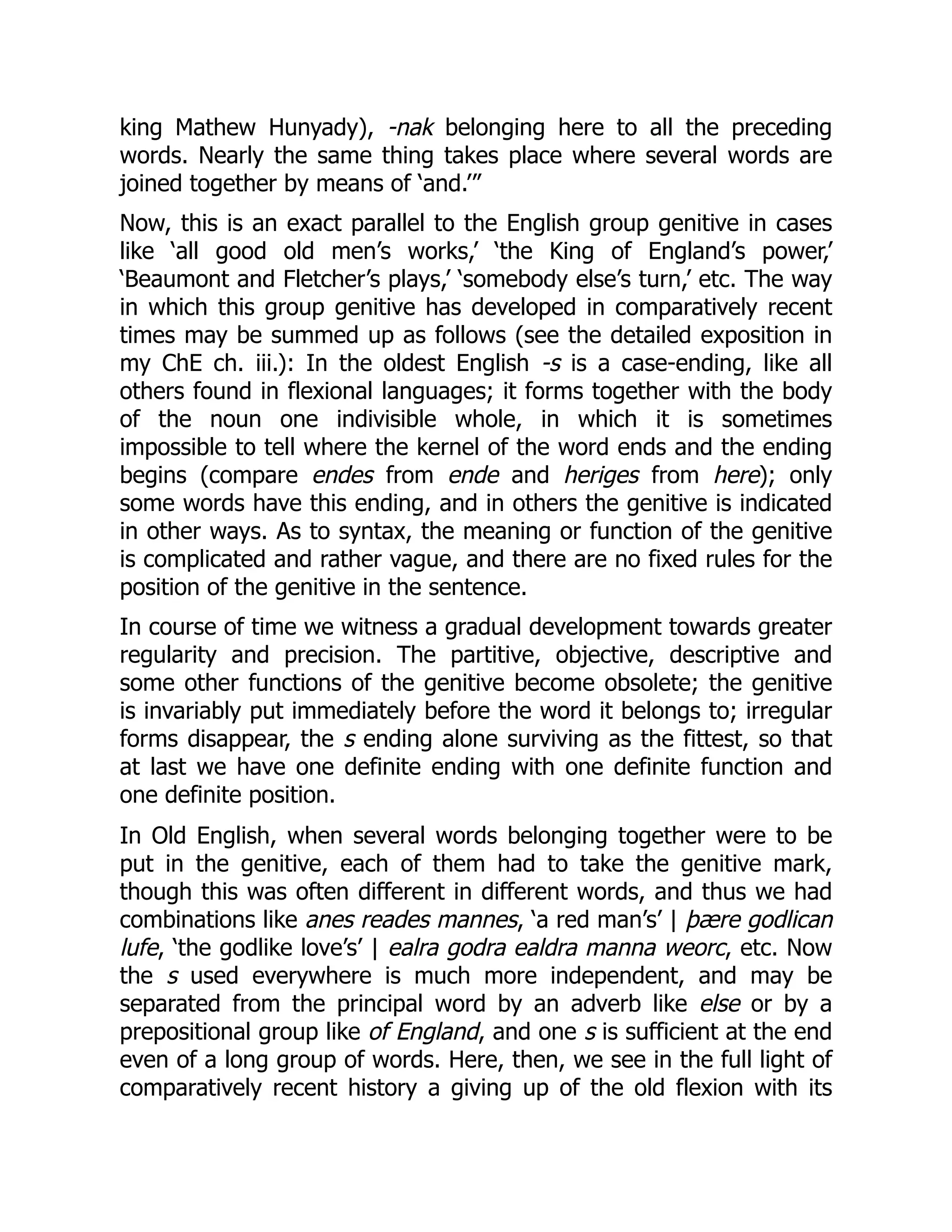
king Mathew Hunyady),-nak belonging here to all the preceding
words. Nearly the same thing takes place where several words are
joined together by means of ‘and.’”
Now, this is an exact parallel to the English group genitive in cases
like ‘all good old men’s works,’ ‘the King of England’s power,’
‘Beaumont and Fletcher’s plays,’ ‘somebody else’s turn,’ etc. The way
in which this group genitive has developed in comparatively recent
times may be summed up as follows (see the detailed exposition in
my ChE ch. iii.): In the oldest English -s is a case-ending, like all
others found in flexional languages; it forms together with the body
of the noun one indivisible whole, in which it is sometimes
impossible to tell where the kernel of the word ends and the ending
begins (compare endes from ende and heriges from here); only
some words have this ending, and in others the genitive is indicated
in other ways. As to syntax, the meaning or function of the genitive
is complicated and rather vague, and there are no fixed rules for the
position of the genitive in the sentence.
In course of time we witness a gradual development towards greater
regularity and precision. The partitive, objective, descriptive and
some other functions of the genitive become obsolete; the genitive
is invariably put immediately before the word it belongs to; irregular
forms disappear, the s ending alone surviving as the fittest, so that
at last we have one definite ending with one definite function and
one definite position.
In Old English, when several words belonging together were to be
put in the genitive, each of them had to take the genitive mark,
though this was often different in different words, and thus we had
combinations like anes reades mannes, ‘a red man’s’ | þære godlican
lufe, ‘the godlike love’s’ | ealra godra ealdra manna weorc, etc. Now
the s used everywhere is much more independent, and may be
separated from the principal word by an adverb like else or by a
prepositional group like of England, and one s is sufficient at the end
even of a long group of words. Here, then, we see in the full light of
comparatively recent history a giving up of the old flexion with its
24.
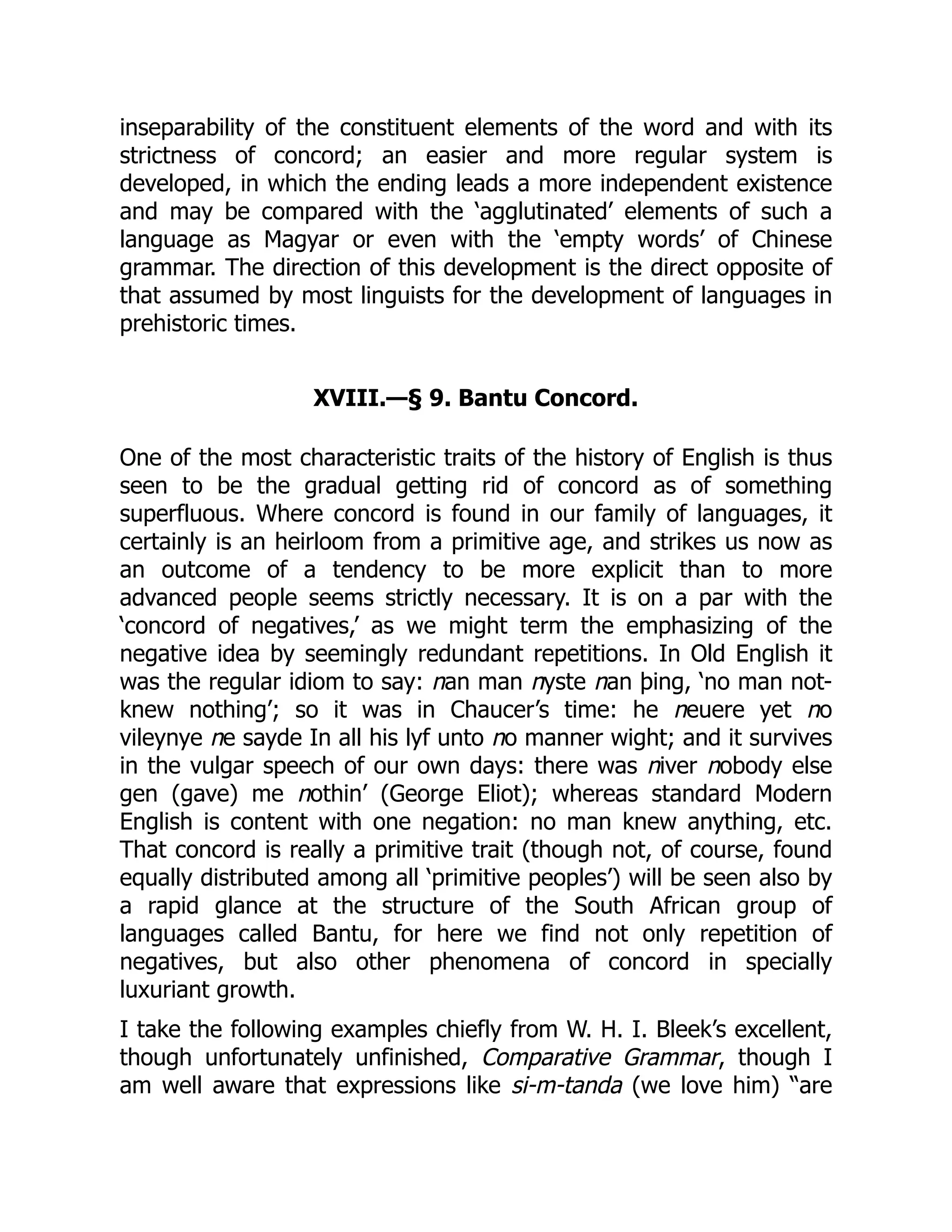
inseparability of theconstituent elements of the word and with its
strictness of concord; an easier and more regular system is
developed, in which the ending leads a more independent existence
and may be compared with the ‘agglutinated’ elements of such a
language as Magyar or even with the ‘empty words’ of Chinese
grammar. The direction of this development is the direct opposite of
that assumed by most linguists for the development of languages in
prehistoric times.
XVIII.—§ 9. Bantu Concord.
One of the most characteristic traits of the history of English is thus
seen to be the gradual getting rid of concord as of something
superfluous. Where concord is found in our family of languages, it
certainly is an heirloom from a primitive age, and strikes us now as
an outcome of a tendency to be more explicit than to more
advanced people seems strictly necessary. It is on a par with the
‘concord of negatives,’ as we might term the emphasizing of the
negative idea by seemingly redundant repetitions. In Old English it
was the regular idiom to say: nan man nyste nan þing, ‘no man not-
knew nothing’; so it was in Chaucer’s time: he neuere yet no
vileynye ne sayde In all his lyf unto no manner wight; and it survives
in the vulgar speech of our own days: there was niver nobody else
gen (gave) me nothin’ (George Eliot); whereas standard Modern
English is content with one negation: no man knew anything, etc.
That concord is really a primitive trait (though not, of course, found
equally distributed among all ‘primitive peoples’) will be seen also by
a rapid glance at the structure of the South African group of
languages called Bantu, for here we find not only repetition of
negatives, but also other phenomena of concord in specially
luxuriant growth.
I take the following examples chiefly from W. H. I. Bleek’s excellent,
though unfortunately unfinished, Comparative Grammar, though I
am well aware that expressions like si-m-tanda (we love him) “are
25.
never used bynatives with this meaning without being determined
by some other expression” (Torrend, p. 7). The Zulu word for ‘man’
is umuntu; every word in the same or a following sentence having
any reference to that word must begin with something to remind
you of the beginning of umuntu. This will be, according to fixed
rules, either mu or u, or w or m. In the following sentence, the
meaning of which is ‘our handsome man (or woman) appears, we
love him (or her),’ these reminders (as I shall term them) are printed
in italics:
umuntuwetuomuchle uyabonakala,simtanda (1)
man ours handsome appears, we love.
If, instead of the singular, we take the corresponding plural abantu,
‘men, people’ (whence the generic name of Bantu), the sentence
looks quite different:
abantu betu abachle bayabonakala, sibatanda (2).
In the same way, if we successively take as our starting-point ilizwe,
‘country,’ the corresponding plural amazwe, ‘countries,’ isizwe,
‘nation,’ izizwe, ‘nations,’ intombi, ‘girl,’ izintombi, ‘girls,’ we get:
ilizwe letu elichle liyabonakala, silitanda (5)
amazwe etu amachle ayabonakala, siwatanda (6)
isizwe setu esichle siyabonakala, sisitanda (7)
izizwe zetu ezichle ziyabonakala, sizitanda (8)
intombi yetu enchle iyabonakala, siyitanda (9)
izintombizetu ezinchle ziyabonakala, sizitanda (10)
(girls) our handsome appear, we love.[87]
In other words, every substantive belongs to one of several classes,
of which some have a singular and others a plural meaning; each of
these classes has its own prefix, by means of which the concord of
the parts of a sentence is indicated. (An inhabitant of the country of
Uganda is called muganda, pl. baganda or waganda; the language
spoken there is luganda.)
26.
It will benoticed that adjectives such as ‘handsome’ or ‘ours’ take
different shapes according to the word to which they refer; in the
Zulu Lord’s Prayer ‘thy’ is found in the following forms: lako
(referring to igama, ‘name,’ for iligama, 5), bako, (ubukumkani,
‘kingdom,’ 14), yako (intando, ‘will,’ 9). So also the genitive case of
the same noun has a great many different forms, for the genitive
relation is expressed by the reminder of the governing word + the
‘relative particle’ a (which is combined with the following sound);
take, for instance, inkosi, ‘chief, king’:
umuntu wenkosi, ‘the king’s man’ (1; we for w + a + i).
abantu benkosi, ‘the king’s men’ (2).
ilizwe lenkosi, ‘the king’s country’ (5).
amazwe enkosi, ‘the king’s countries’ (6).
isizwe senkosi, ‘the king’s nation’ (7).
ukutanda kwenkosi, ‘the king’s love’ (15).
Livingstone says that these apparently redundant repetitions “impart
energy and perspicuity to each member of a proposition, and
prevent the possibility of a mistake as to the antecedent.” These
prefixes are necessary to the Bantu languages; still, Bleek is right as
against Livingstone in speaking of the repetitions as cumbersome,
just as the endings of Latin multorum virorum antiquorum are
cumbersome, however indispensable they may have been to the
contemporaries of Cicero.
These African phenomena have been mentioned here chiefly to
show to what lengths concord may go in the speech of some
primitive peoples. The prevalent opinion is that each of these
prefixes (umu, aba, ili, etc.) was originally an independent word, and
that thus words like umuntu, ilizwe, were at first compounds like E.
steamship, where it would evidently be possible to imagine a
reference to this word by means of a repeated ship (our ship, which
ship is a great ship, the ship appears, we love the ship); but at any
rate the Zulus extend this principle to cases that would be parallel to
an imagined repetition of friendship by means of the same ship, or
to referring to steamer by means of the ending er (Bleek 107). Bleek
27.
and others havetried to find out by an analysis of the words making
up the different classes what may have been the original meaning of
the class-prefix, but very often the connecting tie is extremely loose,
and in many cases it seems that a word might with equal right have
belonged to another class than the one to which it actually belongs.
The connexion also frequently seems to be a derived rather than an
original one, and much in this class-division is just as arbitrary as the
reference of Aryan nouns to each of the three genders. In several of
the classes the words have a definite numerical value, so that they
go together in pairs as corresponding singular and plural nouns; but
the existence of a certain number of exceptions shows that these
numerical values cannot originally have been associated with the
class prefixes, but must be due to an extension by analogy (Bleek
140 ff.). The starting-point may have been substantives standing to
each other in the relation of ‘person’ to ‘people,’ ‘soldier’ to ‘army,’
‘tree’ to ‘forest,’ etc. The prefixes of such words as the latter of each
of these pairs will easily acquire a certain sense of plurality, no
matter what they may have meant originally, and then they will lend
themselves to forming a kind of plural in other nouns, being either
put instead of the prefix belonging properly to the noun (amazwe,
‘countries,’ 6; ilizwe, ‘country,’ 5), or placed before it (ma-luto,
‘spoons,’ 6, luto, ‘spoon,’ 11).
In some of the languages “the forms of some of the prefixes have
been so strongly contracted as almost to defy identification.” (Bleek
234). All the prefixes probably at first had fuller forms than appear
now. Bleek noticed that the ma- prefix never, except in some
degraded languages, had a corresponding ma- as particle, but, on
the contrary, is followed in the sentence by ga-, ya-, or a-, and mu-
(3) generally has a corresponding particle gu-. Now, Sir Harry
Johnston (The Uganda Protectorate, 1902, 2. 891) has found that on
Mount Eldon and in Kavirondo there are some very archaic forms of
Bantu languages, in which gumu- and gama- are the commonly used
forms of the mu- and ma- prefixes, as well as baba- and bubu- for
ordinary ba-, bu-; he infers that the original forms of mu-, ma- were
ngumu-, ngama-. I am not so sure that he is right when he says that
28.
these prefixes wereoriginally “words which had a separate meaning
of their own, either as directives or demonstrative pronouns, as
indications of sex, weakness, littleness or greatness, and so on”—for,
as we shall see in a subsequent chapter, such grammatical
instruments may have been at first inseparable parts of long words—
parts which had no meaning of their own—and have acquired some
more or less vague grammatical meaning through being extended
gradually to other words with which they had originally nothing to
do. The actual irregularity in their distribution certainly seems to
point in that direction.
XVIII.—§ 10. Word Order Again.
Mention has already been made here and there of word order and
its relation to the great question of simplification of grammatical
structure; but it will be well in this place to return to the subject in a
more comprehensive way. The theory of word order has long been
the Cinderella of linguistic science: how many even of the best and
fullest grammars are wholly, or almost wholly, silent about it! And
yet it presents a great many problems of high importance and of the
greatest interest, not only in those languages in which word order
has been extensively utilized for grammatical purposes, such as
English and Chinese, but in other languages as well.
In historical times we see a gradual evolution of strict rules for word
order, while our general impression of the older stages of our
languages is that words were often placed more or less at random.
This is what we should naturally expect from primitive man, whose
thoughts and words are most likely to have come to him rushing
helter-skelter, in wild confusion. One cannot, of course, apply so
strong an expression to languages such as Sanskrit, Greek or Gothic;
still, compared with our modern languages, it cannot be denied that
there is in them much more of what from one point of view is
disorder, and from another freedom.
29.
This is especiallythe case with regard to the mutual position of the
subject of a sentence and its verb. In the earliest times, sometimes
one of them comes first, and sometimes the other. Then there is a
growing tendency to place the subject first, and as this position is
found not only in most European languages but also in Chinese and
other languages of far-away, the phenomenon must be founded in
the very nature of human thought, though its non-prevalence in
most of the older Aryan languages goes far to show that this
particular order is only natural to developed human thought.
Survivals of the earlier state of things are found here and there;
thus, in German ballad style: “Kam ein schlanker bursch gegangen.”
But it is well worth noticing that such an arrangement is generally
avoided, in German as well as in the other modern languages of
Western Europe, and in those cases where there is some reason for
placing the verb before the subject, the speaker still, as it were,
satisfies his grammatical instinct by putting a kind of sham subject
before the verb, as in E. there comes a time when ..., Dan. der
kommer en tid da ..., G. es kommt eine zeit wo ..., Fr. il arrive un
temps où....
In Keltic the habitual word order placed the verb first, but little by
little the tendency prevailed to introduce most sentences by a
periphrasis, as in ‘(it) is the man that comes,’ and as that came to
mean merely ‘the man comes,’ the word order Subject-Verb was thus
brought about circuitously.
Before this particular word order, Subject-Verb, was firmly
established in modern Gothonic languages, an exception obtained
wherever the sentence began with some other word than the
subject; this might be some important member of the proposition
that was placed first for the sake of emphasis, or it might be some
unimportant little adverb, but the rule was that the verb should at
any rate have the second place, as being felt to be in some way the
middle or central part of the whole, and the subject had then to be
content to be placed after the verb. This was the rule in Middle
English and in Old French, and it is still strictly followed in German
30.
and Danish: Gesternkam das schiff | Pigen gav jeg kagen, ikke
drengen. Traces of the practice are still found in English in
parenthetic sentences to indicate who is the speaker (‘Oh, yes,’ said
he), and after a somewhat long subjunct, if there is no object
(‘About this time died the gentle Queen Elizabeth’), where this word
order is little more than a stylistic trick to avoid the abrupt effect of
ending the sentence with an isolated verb like died. Otherwise the
order Subject-Verb is almost universal in English.
XVIII.—§ 11. Compromises.
The inverted order, Verb-Subject, is used extensively in many
languages to express questions, wishes and invitations. But, as
already stated, this order was not originally peculiar to such
sentences. A question was expressed, no matter how the words
were arranged, by pronouncing the whole sentence, or the most
important part of it, in a peculiar rising tone. This manner of
indicating questions is, of course, still kept up in modern speech,
and is often the only thing to show that a question is meant (‘John?’
| ‘John is here?’). But although there was thus a natural manner of
expressing questions, and although the inverted word order was
used in other sorts of sentences as well, yet in course of time there
came to be a connexion between the two things, so that putting the
verb before the subject was felt as implying a question. The rising
tone then came to be less necessary, and is much less marked in
inverted sentences like ‘Is John here?’ than in sentences with the
usual word order: ‘John is here?’
Now, after this method of indicating questions had become
comparatively fixed, and after the habit of thinking of the subject
first had become all but universal, these two principles entered into
conflict, the result of which has been, in English, Danish and French,
the establishment in some cases of various kinds of compromise, in
which the interrogatory word order has formally carried the day,
while really the verb, that is to say the verb which means something,
31.
is placed afterits subject. In English, this is attained by means of the
auxiliary do: instead of Shakespeare’s “Came he not home to-night?”
(Ro. ii. 4. 2) we now say, “Did he not (or, Didn’t he) come home to-
night?” and so in all cases where a similar arrangement is not
already brought about by the presence of some other auxiliary, ‘Will
he come?’, ‘Can he come?’, etc. Where we have an interrogatory
pronoun as a subject, no auxiliary is required, because the natural
front position of the pronoun maintains the order Subject-Verb (Who
came? | What happened?). But if the pronoun is not the subject, do
is required to establish the balance between the two principles
(Who(m) did you see? | What does he say?).
In Danish, the verb mon, used in the old language to indicate a
weak necessity or a vague futurity, fulfils to a certain extent the
same office as the English do; up to the eighteenth century mon was
really an auxiliary verb, followed by the infinitive: ‘Mon han
komme?’; but now the construction has changed, the indicative is
used with mon: ‘Mon han kommer?’, and mon is no longer a verb,
but an interrogatory adverb, which serves the purpose of placing the
subject before the verb, besides making the question more indefinite
and vague: ‘Kommer han?’ means ‘Does he come?’ or ‘Will he
come?’ but ‘Mon han kommer?’ means ‘Does he come (Will he
come), do you think?’
French, finally, has developed two distinct forms of compromise
between the conflicting principles, for in ‘Est-ce que Pierre bat Jean?’
est-ce represents the interrogatory and Pierre bat the usual word
order, and in ‘Pierre bat-il Jean?’ the real subject is placed before
and the sham subject after the verb. Here also, as in Danish, the
ultimate result is the creation of ‘empty words,’ or interrogatory
adverbs: est-ce-que in every respect except in spelling is one word
(note that it does not change with the tense of the main verb), and
thus is a sentence prefix to introduce questions; and in popular
speech we find another empty word, namely ti (see, among other
scholars, G. Paris, Mélanges ling. 276). The origin of this ti is very
curious. While the t of Latin amat, etc., coming after a vowel,
disappeared at a very early period of the French language, and so
32.
produced il aime,etc., the same t was kept in Old French wherever a
consonant protected it,[88] and so gave the forms est, sont, fait
(from fact, for facit), font, chantent, etc. From est-il, fait-il, etc., the t
was then by analogy reintroduced in aime-t-il, instead of the earlier
aime il. Now, towards the end of the Middle Ages, French final
consonants were as a rule dropped in speech, except when followed
immediately by a word beginning with a vowel. Consequently, while t
is mute in sentences like ‘Ton frère dit | Tes frères disent,’ it is
sounded in the corresponding questions, ‘Ton frère dit-il? Tes frères
disent-ils?’ As the final consonants of il and ils are also generally
dropped, even by educated speakers, the difference between
interrogatory and declarative sentences in the spoken language
depends solely on the addition of ti to the verb: written phonetically,
the pairs will be:
[tɔ̃ frɛ·r di—tɔ̃ frɛ·r di ti]
[te frɛ·r di·z—te frɛ·r di·z ti].
Now, popular instinct seizes upon this ti as a convenient sign of
interrogative sentences, and, forgetting its origin, uses it even with a
feminine subject, turning ‘Ta sœur di(t)’ into the question ‘Ta sœur di
ti?’, and in the first person: ‘Je di ti?’ ‘Nous dison ti?’ ‘Je vous fais-ti
tort?’ (Maupassant). In novels this is often written as if it were the
adverb y: C’est-y pas vrai? | Je suis t’y bête! | C’est-y vous le
monsieur de l’Académie qui va avoir cent ans? (Daudet). I have
dwelt on this point because, besides showing the interest of many
problems of word order, it also throws some light on the sometimes
unexpected ways by which languages must often travel to arrive at
new expressions for grammatical categories.
It was mentioned above that the inverted order, Verb-Subject, is
used extensively, not only in questions, but also to express wishes
and invitations. Here, too, we find in English compromises with the
usual order, Subject-Verb. For, apart from such formulas as ‘Long live
the King!’ a wish is generally expressed by means of may, which is
placed first, while the real verb comes after the subject: ‘May she be
happy!’, and instead of the old ‘Go we!’ we have now ‘Let us go!’
33.
with us, thevirtual subject, placed before the real verb. When a
pronoun is wanted with an imperative, it used to be placed after the
verb, as in Shakespeare: ‘Stand thou forth’ and ‘Fear not thou,’ or in
the Bible: ‘Turn ye unto him,’ but now the usual order has prevailed:
‘You try!’ ‘You take that seat, and somebody fetch a few more
chairs!’ But if the auxiliary do is used, we have the compromise
order: ‘Don’t you stir!’
XVIII.—§ 12. Order Beneficial?
I have here selected one point, the place of the subject, to illustrate
the growing regularity in word order; but the same tendency is
manifested in other fields as well: the place of the object (or of two
objects, if we have an indirect besides a direct object), the place of
the adjunct adjective, the place of a subordinate adverb, which by
coming regularly before a certain case may become a preposition
‘governing’ that case, etc. It cannot be denied that the tendency
towards a more regular word order is universal, and in accordance
with the general trend of this inquiry we must next ask the question:
Is this tendency a beneficial one? Does the more regular word order
found in recent stages of our languages constitute a progress in
linguistic structure? Or should it be deplored because it hinders
freedom of movement?
In answering this question we must first of all beware of letting our
judgment be run away with by the word ‘freedom.’ Because freedom
is desirable elsewhere, it does not follow that it should be the best
thing in this domain; just as above we did not allow ourselves to be
imposed on by the phrase ‘wealth of forms,’ so here we must be on
our guard against the word ‘free’: what if we turned the question in
another way: Which is preferable, order or disorder? It may be true
that, viewed exclusively from the standpoint of the speaker, freedom
would seem to be a great advantage, as it is a restraint to him to be
obliged to follow strict rules; but an orderly arrangement is decidedly
in the interest of the hearer, as it very considerably facilitates his
34.
understanding of whatis said; it is therefore, though indirectly, in
the interest of the speaker too, because he naturally speaks for the
purpose of being understood. Besides, he is soon in his turn to
become the hearer: as no one is exclusively hearer or speaker, there
can be no real conflict of interest between the two.
If it be urged in favour of a free word order that we owe a certain
regard to the interests of poets, it must be taken into consideration,
first, that we cannot all of us be poets, and that a regard to all those
of us who resemble Molière’s M. Jourdain in speaking prose without
being aware of it is perhaps, after all, more important than a regard
for those very few who are in the enviable position of writing
readable verse; secondly, that a statistical investigation would, no
doubt, give as its result that those poets who make the most
extensive use of inversions are not among the greatest of their craft;
and, finally, that so many methods are found of neutralizing the
restraint of word order, in the shape of particles, passive voice,
different constructions of sentences, etc., that no artist in language
need despair.
So far, we have scarcely done more than clear the ground before
answering our question. And now we must recognize that there are
some rules of word order which cannot be called beneficial in any
way; they are like certain rules of etiquette, in so far as one can see
no reason for their existence, and yet one is obliged to bow to them.
Historians may, in some cases, be able to account for their origin
and show that they had a raison d’être at some remote period; but
the circumstances that called them into existence then have passed
away, and they are now felt to be restraints with no concurrent
advantage to reconcile us to their observance. Among rules of this
class we may reckon those for placing the French pronouns now
before, and now after, the verb, now with the dative and now with
the accusative first, ‘elle me le donne | elle le lui donne | donnez-le
moi | ne me le donnez pas.’ And, again, the rules for placing the
verb, object, etc., in German subordinate clauses otherwise than in
main sentences. That the latter rules are defective and are inferior to
the English rules, which are the same for the two kinds of sentences,
35.
was pointed outbefore, when we examined Johannson’s German
sentences (p. 341), but here we may state that the real, innermost
reason for condemning them is their inconsistency: the same rule
does not apply in all cases. It seems possible to establish the
important principle that the more consistent a rule for word order is,
the more useful it is in the economy of speech, not only as
facilitating the understanding of what is said, but also as rendering
possible certain thoroughgoing changes in linguistic structure.
XVIII.—§ 13. Word Order and Simplification.
This, then, is the conclusion I arrive at, that as simplification of
grammatical structure, abolition of case distinctions, and so forth,
always go hand in hand with the development of a fixed word order,
this cannot be accidental, but there must exist a relation of cause
and effect between the two phenomena. Which, then, is the prius or
cause? To my mind undoubtedly the fixed word order, so that the
grammatical simplification is the posterius or effect. It is, however,
by no means uncommon to find a half-latent conception in people’s
minds that the flexional endings were first lost ‘by phonetic decay,’ or
‘through the blind operation of sound laws,’ and that then a fixed
word order had to step in to make up for the loss of the previous
forms of expression. But if this were true we should have to imagine
an intervening period in which the mutual relations of words were
indicated in neither way; a period, in fact, in which speech was
unintelligible and consequently practically useless. The theory is
therefore untenable. It follows that a fixed word order must have
come in first: it would come quite gradually as a natural
consequence of greater mental development and general maturity,
when the speaker’s ideas no longer came into his mind helter-skelter,
but in orderly sequence. If before the establishment of some sort of
fixed word order any tendency to slur certain final consonants or
vowels of grammatical importance had manifested itself, it could not
have become universal, as it would have been constantly checked by
the necessity that speech should be intelligible, and that therefore
36.
those marks whichshowed the relation of different words should not
be obliterated. But when once each word was placed at the exact
spot where it properly belonged, then there was no longer anything
to forbid the endings being weakened by assimilation, etc., or being
finally dropped altogether.
To bring out my view I have been obliged in the preceding
paragraph to use expressions that should not be taken too literally; I
have spoken as if the changes referred to were made ‘in the lump,’
that is, as if the word order was first settled in every respect, and
after that the endings began to be dropped. The real facts are, of
course, much more complicated, changes of one kind being
interwoven with changes of the other in such a way as to render it
difficult, if not impossible, in any particular case to discover which
was the prius and which the posterius. We are not able to lay our
finger on one spot and say: Here final m or n was dropped, because
it was now rendered superfluous as a case-sign on account of the
accusative being invariably placed after the verb, or for some other
such reason. Nevertheless, the essential truth of my hypothesis
seems to me unimpeachable. Look at Latin final s. Cicero (Orat. 48.
161) expressly tells us, what is corroborated by a good many
inscriptions, that there existed a strong tendency to drop final s; but
the tendency did not prevail. The reason seems obvious; take a page
of Latin prose and try the effect of striking out all final s’s, and you
will find that it will be extremely difficult to determine the meaning
of many passages; a consonant playing so important a part in the
endings of nouns and verbs could not be left out without loss in a
language possessing so much freedom in regard to word position as
Latin. Consequently it was kept, but in course of time word position
became more and more subject to laws; and when, centuries later,
after the splitting up of Latin into the Romanic languages, the
tendency to slur over final s knocked once more at the door, it met
no longer with the same resistance: final s disappeared, first in
Italian and Rumanian, then in French, where it was kept till about
the end of the Middle Ages, and it is now beginning to sound a
37.
retreat in Spanish;see on Andalusian Fr. Wulff, Un Chapitre de
Phonétique Andalouse, 1889.
The main line of development in historical times has, I take it, been
the following: first, a period in which words were placed somewhere
or other according to the fancy of the moment, but many of them
provided with signs that would show their mutual relations; next, a
period with retention of these signs, combined with a growing
regularity in word order, and at the same time in many connexions a
more copious employment of prepositions; then an increasing
indistinctness and finally complete dropping of the endings, word
order (and prepositions) being now sufficient to indicate the
relations at first shown by endings and similar means.
Viewed in this light, the transition from freedom in word position to
greater strictness must be considered a beneficial change, since it
has enabled the speakers to do away with more circumstantial and
clumsy linguistic means. Schiller says:
Jeden anderen meister erkennt man an dem, was er ausspricht;
Was er weise verschweigt, zeigt mir den meister des stils.
(Every other master is known by what he says, but the master of
style by what he is wisely silent on.) What style is to the individual,
the general laws of language are to the nation, and we must award
the palm to that language which makes it possible “to be wisely
silent” about things which in other languages have to be expressed
in a troublesome way, and which have often to be expressed over
and over again (virorum omnium bonorum veterum, ealra godra
ealdra manna). Could any linguistic expedient be more worthy of the
genus homo sapiens than using for different purposes, with different
significations, two sentences like ‘John beats Henry’ and ‘Henry
beats John,’ or the four Danish ones, ‘Jens slaar Henrik—Henrik slaar
Jens—slaar Jens Henrik?—slaar Henrik Jens?’ (John beats Henry—H.
beats J.—does J. beat H.?—does H. beat J.?), or the Chinese use of
či in different places (Ch. XIX § 3)? Cannot this be compared with
38.
the ingenious Arabicsystem of numeration, in which 234 means
something entirely different from 324, or 423, or 432, and the ideas
of “tens” and “hundreds” are elegantly suggested by the order of the
characters, not, as in the Roman system, ponderously expressed?
Now, it should not be forgotten that this system, “where more is
meant than meets the ear,” is not only more convenient, but also
clearer than flexions, as actually found in existing languages, for
word order in those languages which utilize it grammatically is used
much more consistently than any endings have ever been in the old
Aryan languages. It is not true, as Johannson would have us believe,
that the dispensing with old flexional endings was too dearly bought,
as it brought about increasing possibilities of misunderstandings; for
in the evolution of languages the discarding of old flexions goes
hand in hand with the development of simpler and more regular
expedients that are rather less liable than the old ones to produce
misunderstandings. Johannson writes: “In contrast to Jespersen I do
not consider that the masterly expression is the one which is ‘wisely
silent,’ and consequently leaves the meaning to be partly guessed at,
but the one which is able to impart the meaning of the speaker or
writer clearly and perfectly”—but here he seems rather wide of the
mark. For, just as in reading the arithmetical symbol 234 we are
perfectly sure that two hundred and thirty-four is meant, and not
three hundred and forty-two, so in reading and hearing ‘The boy
hates the girl’ we cannot have the least doubt who hates whom.
After all, there is less guesswork in the grammatical understanding
of English than of Latin; cf. the examples given above, Ch. XVIII § 4,
p. 343.
The tendency towards a fixed word order is therefore a progressive
one, directly as well as indirectly. The substitution of word order for
flexions means a victory of spiritual over material agencies.
XVIII.—§ 14. Summary.
39.
We may heresum up the results of our comparison of the main
features of the grammatical structures of ancient and modern
languages belonging to our family of speech. We have found certain
traits common to the old stages and certain others characteristic of
recent ones, and have thus been enabled to establish some definite
tendencies of development and to find out the general direction of
change; and we have shown reasons for the conviction that this
development has on the whole and in the main been a beneficial
one, thus justifying us in speaking about ‘progress in language.’ The
points in which the superiority of the modern languages manifested
itself were the following:
(1) The forms are generally shorter, thus involving less muscular
exertion and requiring less time for their enunciation.
(2) There are not so many of them to burden the memory.
(3) Their formation is much more regular.
(4) Their syntactic use also presents fewer irregularities.
(5) Their more analytic and abstract character facilitates expression
by rendering possible a great many combinations and constructions
which were formerly impossible or unidiomatic.
(6) The clumsy repetitions known under the name of concord have
become superfluous.
(7) A clear and unambiguous understanding is secured through a
regular word order.
These several advantages have not been won all at once, and
languages differ very much in the velocity with which they have
been moving in the direction indicated; thus High German is in many
respects behindhand as compared with Low German; European
Dutch as compared with African Dutch; Swedish as compared with
Danish; and all of them as compared with English; further, among
the Romanic languages we see considerable variations in this
respect. What is maintained is chiefly that there is a general
tendency for languages to develop along the lines here indicated,
40.
and that thisdevelopment may truly, from the anthropocentric point
of view, which is the only justifiable one, be termed a progressive
evolution.
But is this tendency really general, or even universal, in the world of
languages? It will easily be seen that my examples have in the main
been taken from comparatively few languages, those with which I
myself and presumably most of my readers are most familiar, all of
them belonging to the Gothonic and Romanic branches of the Aryan
family. Would the same theory hold good with regard to other
languages? Without pretending to an intimate knowledge of the
history of many languages, I yet dare assert that my conclusions are
confirmed by all those languages whose history is accessible to us.
Colloquial Irish and Gaelic have in many ways a simpler grammatical
structure than the Oldest Irish. Russian has got rid of some of the
complications of Old Slavonic, and the same is true, even in a much
higher degree, of some of the other Slavonic languages; thus,
Bulgarian has greatly simplified its nominal and Serbian its verbal
flexions. The grammar of spoken Modern Greek is much less
complicated than that of the language of Homer or of Demosthenes.
The structure of Modern Persian is nearly as simple as English,
though that of Old Persian was highly complicated. In India we
witness a constant simplification of grammar from Sanskrit through
Prakrit and Pali to the modern languages, Hindi, Hindostani (Urdu),
Bengali, etc. Outside the Aryan world we see the same movement:
Hebrew is simpler and more regular than Assyrian, and spoken
Arabic than the old classical language, Koptic than Old Egyptian. Of
most of the other languages we are not in possession of written
records from very early times; still, we may affirm that in Turkish
there has been an evolution, though rather a slow one, of a similar
kind; and, as we shall see in a later chapter, Chinese seems to have
moved in the same direction, though the nature of its writing makes
the task of penetrating into its history a matter of extreme difficulty.
A comparative study of the numerous Bantu languages spoken all
over South Africa justifies us in thinking that their evolution has been
along the same lines: in some of them the prefixes characterizing
41.
various classes ofnouns have been reduced in number and in extent
(cf. above, § 9). Of one of them we have a grammar two hundred
years old, by Brusciotto à Vetralla (re-edited by H. Grattan Guinness,
London, 1882). A comparison of his description with the language
now spoken in the same region (Mpongwe) shows that the class
signs have dwindled down considerably and the number of the
classes has been reduced from 16 to 10. In short, though we can
only prove it with regard to a minority of the multitudinous
languages spoken on the globe, this minority embraces all the
languages known to us for so long a period that we can talk of their
history, and we may, therefore, confidently maintain that what may
be briefly termed the tendency towards grammatical simplification is
a universal fact of linguistic history.
That this simplification is progressive, i.e. beneficial, was overlooked
by the older generation of linguistic thinkers, because they saw a
kosmos, a beautiful and well-arranged world, in the old languages,
and missed in the modern ones several things that they had been
accustomed to regard with veneration. To some extent they were
right: every language, when studied in the right spirit, presents so
many beautiful points in its systematic structure that it may be called
a ‘kosmos.’ But it is not in every way a kosmos; like everything
human, it presents fine and less fine features, and a comparative
valuation, such as the one here attempted, should take both into
consideration. There is undoubtedly an exquisite beauty in the old
Greek language, and the ancient Hellenes, with their artistic
temperament, knew how to turn that beauty to the best account in
their literary productions; but there is no less beauty in many
modern languages—though its appraisement is a matter of taste,
and as such evades scientific inquiry. But the æsthetic point of view
is not the decisive one: language is of the utmost importance to the
whole practical and spiritual life of mankind, and therefore has to be
estimated by such tests as those applied above; if that is done, we
cannot be blind to the fact that modern languages as wholes are
more practical than ancient ones, and that the latter present so
many more anomalies and irregularities than our present-day
42.
languages that wemay feel inclined, if not to apply to them
Shakespeare’s line, “Misshapen chaos of well-seeming forms,” yet to
think that the development has been from something nearer chaos
to something nearer kosmos.
43.
CHAPTER XIX
ORIGIN OFGRAMMATICAL ELEMENTS
§ 1. The Old Theory. § 2. Roots. § 3. Structure of Chinese.
§ 4. History of Chinese. § 5. Recent Investigations. § 6.
Roots Again. § 7. The Agglutination Theory. § 8.
Coalescence. § 9. Flexional Endings. § 10. Validity of the
Theory. § 11. Irregularity Original. § 12. Coalescence
Theory dropped. § 13. Secretion. § 14. Extension of
Suffixes. § 15. Tainting of Suffixes. § 16. The Classifying
Instinct. § 17. Character of Suffixes. § 18. Brugmann’s
Theory of Gender. § 19. Final Considerations.
XIX.—§ 1. The Old Theory.
What has been given in the last two chapters to clear up the
problem “Decay or progress?” has been based, as will readily be
noticed, exclusively on easily controllable facts of linguistic history.
So far, then, it has been very smooth sailing. But now we must
venture out into the open sea of prehistoric speculations. Our
voyage will be the safer if we never lose sight of land and have a
reliable compass tested in known waters.
In our historical survey of linguistic science we have already seen
that the prevalent theory concerning the prehistoric development of
our speech is this: an originally isolating language, consisting of
nothing but formless roots, passed through an agglutinating stage,
in which formal elements had been developed, although these and
the roots were mutually independent, to the third and highest stage
found in flexional languages, in which formal elements penetrated
the roots and made inseparable unities with them. We shall now
examine the basis of this theory.
44.
In the beginningwas the root. This is “the result of strict and careful
induction from the facts recorded in the dialects of the different
members of the family” (Whitney L 260). “The firm foundation of the
theory of roots lies in its logical necessity as an inference from the
doctrine of the historical growth of grammatical apparatus” (Whitney
G 200). “An instrumentality cannot but have had rude and simple
beginnings, such as, in language, the so-called roots ... such
imperfect hints of expression as we call roots” (Whitney, Views of L.
338). These are really three different statements: induction from the
facts, a logical inference from the doctrine about grammatical
apparatus (i.e. the usually accepted doctrine, but on what is that
built up except on the root theory?), and the a priori argument that
an ‘instrumentality’ must have simple beginnings. Even granted that
these three arguments given at different times, each of them in turn
as the sole argument, must be taken as supplementing each other,
the three-legged stool on which the root theory is thus made to sit is
a very shaky one, for none of the three legs is very solid, as we shall
soon have occasion to see.
XIX.—§ 2. Roots.
In the beginning was the root—but what was it like? Bopp took over
the conception of root from the Indian grammarians, and like them
was convinced that roots were all monosyllabic, and that view was
accepted by his followers. These latter at times attributed other
phonetic qualities to these roots, e.g. that they always had a short
vowel (Curtius C 22). I quote from a very recent treatise (Wood,
“Indo-European Root-formation,” Journal of Germ. Philol. 1. 291): “I
range myself with those who believe that IE. roots were
monosyllabic ... these roots began, for the most part, with a vowel.
The vowels certainly were the first utterances,[89] and though we
cannot make the beginning of IE. speech coeval with that of human
speech, we may at least assume that language, at that time, was in
a very primitive state.”
45.
The number ofthese roots was not very great (Curtius, l.c.; Wood
294). This seems a natural enough conclusion when we picture the
earliest speech as the most meagre thing possible.
These few short monosyllabic roots were real words—this is a
necessary assumption if we are to imagine a root stage as a real
language, and it is often expressly stated; Curtius, for instance,
insists that roots are real and independent words (C 22, K 132); cf.
also Whitney, who says that the root VAK “had also once an
independent status, that it was a word” (L 255). We shall see
afterwards that there is another possible conception of what a ‘root’
is; but let us here grant that it is a real word. The question whether
a language is possible which contains nothing but such root words
was always answered affirmatively by a reference to Chinese—and it
will therefore be well here to give a short sketch of the chief
structural features of that language.
XIX.—§ 3. Structure of Chinese.
Each word consists of one syllable, neither more nor less. Each of
these monosyllables has one of four or five distinct musical tones
(not indicated here). The parts of speech are not distinguished: ta
means, according to circumstances, great, much, magnitude,
enlarge. Grammatical relations, such as number, person, tense, case,
etc., are not expressed by endings and similar expedients; the word
in itself is invariable. If a substantive is to be taken as plural, this as
a rule must be gathered from the context; and it is only when there
is any danger of misunderstanding, or when the notion of plurality is
to be emphasized, that separate words are added, e.g. ki ‘some,’ šu
‘number.’ The most important part of Chinese grammar is that
dealing with word order: ta kuok means ‘great state(s),’ but kuok ta
‘the state is great,’ or, if placed before some other word which can
serve as a verb, ‘the greatness (size) of the state’; tsï niu ‘boys and
girls,’ but niu tsï ‘girl (female child),’ etc. Besides words properly so
called, or as Chinese grammarians call them ‘full words,’ there are
46.
several ‘empty words’serving for grammatical purposes, often in a
wonderfully clever and ingenious way. Thus či has besides other
functions that of indicating a genitive relation more distinctly than
would be indicated by the mere position of the words; min (people)
lik (power) is of itself sufficient to signify ‘the power of the people,’
but the same notion is expressed more explicitly by min či lik. The
same expedient is used to indicate different sorts of connexion: if či
is placed after the subject of a sentence it makes it a genitive,
thereby changing the sentence into a kind of subordinate clause:
wang pao min = ‘the king protects the people’; but if you say wang
či pao min yeu (is like) fu (father) či pao tsï, the whole may be
rendered, by means of the English verbal noun, ‘the king’s protecting
the people is like the father’s protecting his child.’ Further, it is
possible to change a whole sentence into a genitive; for instance,
wang pao min či tao (manner) k’o (can) kien (see, be seen), ‘the
manner in which the king protects (the manner of the king’s
protecting) his people is to be seen’; and in yet other positions či can
be used to join a word-group consisting of a subject and verb, or of
verb and object, as an adjunct (attribute) to a noun; we have
participles to express the same modification of the idea: wang pao či
min ‘the people protected by the king’; pao min či wang ‘a king
protecting the people.’ Observe here the ingenious method of
distinguishing the active and passive voices by strictly adhering to
the natural order and placing the subject before and the object after
the verb. If we put i before, and ku after, a single word, it means ‘on
account of, because of’ (cf. E. for ...’s sake); if we place a whole
sentence between these ‘brackets,’ as we might term them, they are
a sort of conjunction, and must be translated ‘because.’[90]
XIX.—§ 4. History of Chinese.
These few examples will give some faint idea of the Chinese
language, and—if the whole older generation of scholars is to be
trusted—at the same time of the primeval structure of our own
language in the root-stage. But is it absolutely certain that Chinese
47.
Welcome to ourwebsite – the ideal destination for book lovers and
knowledge seekers. With a mission to inspire endlessly, we offer a
vast collection of books, ranging from classic literary works to
specialized publications, self-development books, and children's
literature. Each book is a new journey of discovery, expanding
knowledge and enriching the soul of the reade
Our website is not just a platform for buying books, but a bridge
connecting readers to the timeless values of culture and wisdom. With
an elegant, user-friendly interface and an intelligent search system,
we are committed to providing a quick and convenient shopping
experience. Additionally, our special promotions and home delivery
services ensure that you save time and fully enjoy the joy of reading.
Let us accompany you on the journey of exploring knowledge and
personal growth!
ebookultra.com












![If we compare a group of Latin words, such as opera virorum
omnium bonorum veterum, with a corresponding group in a few
other languages of a less flexional type: OE. ealra godra ealdra
manna weorc; Danish alle gode gamle mænds værker; Modern
English all good old men’s works, we perceive by analyzing the ideas
expressed by the several words that the Romans said really: ‘work,’
plural, nominative or accusative + ‘man,’ plural, masculine, genitive
+ ‘all,’ plural, genitive + ‘good,’ plural, masculine, genitive + ‘old,’
plural, masculine, genitive. Leaving opera out of consideration, we
find that plural number is expressed four times, genitive case also
four times, and masculine gender twice;[86] in Old English the signs
of number and case are found four times each, while there is no
indication of gender; in Danish the plural number is marked four
times and the case once. And finally, in Modern English, we find
each idea expressed once only; and as nothing is lost in clearness,
this method, as being the easiest and shortest, must be considered
the best. Mathematically the different ways of rendering the same
thing might be represented by the formulas: anx + bnx + cnx = (an
+ bn + cn)x = (a + b + c)nx.
This unusual faculty of ‘parenthesizing’ causes Danish, and to a still
greater degree English, to stand outside the definition of the Aryan
family of languages given by the earlier school of linguists, according
to which the Aryan substantive and adjective can never be without a
sign indicating case. Schleicher (NV 526) says: “The radical
difference between Magyar and Indo-Germanic (Aryan) words is
brought out distinctly by the fact that the postpositions belonging to
co-ordinated nouns can be dispensed with in all the nouns except
the last of the series, e.g. a jó embernek, ‘dem guten menschen’ (a
for az, demonstrative pronoun, article; jó, good; ember, man, -nek, -
nak, postposition with pretty much the same meaning as the dative
case), for az-nak (annak) jó-nak ember-nek, as if in Greek you
should say το ἀγαθο ἀνθρώπῳ. An attributive adjective preceding its
noun always has the form of the pure stem, the sign of plurality and
the postposition indicating case not being added to it. Magyars say,
for instance, Hunyady Mátyás magyar király-nak (to the Hungarian](https://image.slidesharecdn.com/40201-250410075923-8bd89199/75/Developer-s-Guide-to-Microsoft-Enterprise-Library-C-Edition-Alex-Homer-22-2048.jpg)
![never used by natives with this meaning without being determined
by some other expression” (Torrend, p. 7). The Zulu word for ‘man’
is umuntu; every word in the same or a following sentence having
any reference to that word must begin with something to remind
you of the beginning of umuntu. This will be, according to fixed
rules, either mu or u, or w or m. In the following sentence, the
meaning of which is ‘our handsome man (or woman) appears, we
love him (or her),’ these reminders (as I shall term them) are printed
in italics:
umuntuwetuomuchle uyabonakala,simtanda (1)
man ours handsome appears, we love.
If, instead of the singular, we take the corresponding plural abantu,
‘men, people’ (whence the generic name of Bantu), the sentence
looks quite different:
abantu betu abachle bayabonakala, sibatanda (2).
In the same way, if we successively take as our starting-point ilizwe,
‘country,’ the corresponding plural amazwe, ‘countries,’ isizwe,
‘nation,’ izizwe, ‘nations,’ intombi, ‘girl,’ izintombi, ‘girls,’ we get:
ilizwe letu elichle liyabonakala, silitanda (5)
amazwe etu amachle ayabonakala, siwatanda (6)
isizwe setu esichle siyabonakala, sisitanda (7)
izizwe zetu ezichle ziyabonakala, sizitanda (8)
intombi yetu enchle iyabonakala, siyitanda (9)
izintombizetu ezinchle ziyabonakala, sizitanda (10)
(girls) our handsome appear, we love.[87]
In other words, every substantive belongs to one of several classes,
of which some have a singular and others a plural meaning; each of
these classes has its own prefix, by means of which the concord of
the parts of a sentence is indicated. (An inhabitant of the country of
Uganda is called muganda, pl. baganda or waganda; the language
spoken there is luganda.)](https://image.slidesharecdn.com/40201-250410075923-8bd89199/75/Developer-s-Guide-to-Microsoft-Enterprise-Library-C-Edition-Alex-Homer-25-2048.jpg)
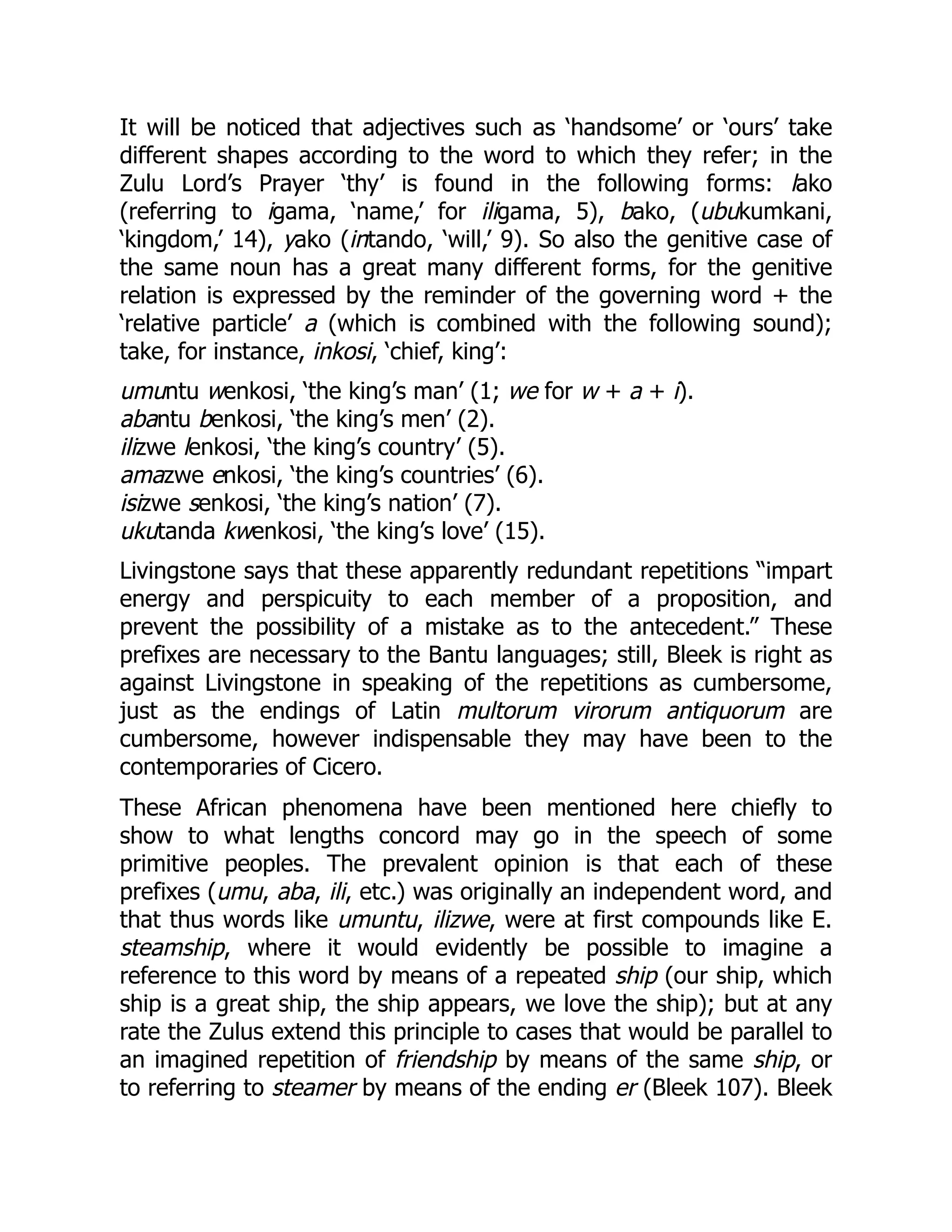
![produced il aime, etc., the same t was kept in Old French wherever a
consonant protected it,[88] and so gave the forms est, sont, fait
(from fact, for facit), font, chantent, etc. From est-il, fait-il, etc., the t
was then by analogy reintroduced in aime-t-il, instead of the earlier
aime il. Now, towards the end of the Middle Ages, French final
consonants were as a rule dropped in speech, except when followed
immediately by a word beginning with a vowel. Consequently, while t
is mute in sentences like ‘Ton frère dit | Tes frères disent,’ it is
sounded in the corresponding questions, ‘Ton frère dit-il? Tes frères
disent-ils?’ As the final consonants of il and ils are also generally
dropped, even by educated speakers, the difference between
interrogatory and declarative sentences in the spoken language
depends solely on the addition of ti to the verb: written phonetically,
the pairs will be:
[tɔ̃ frɛ·r di—tɔ̃ frɛ·r di ti]
[te frɛ·r di·z—te frɛ·r di·z ti].
Now, popular instinct seizes upon this ti as a convenient sign of
interrogative sentences, and, forgetting its origin, uses it even with a
feminine subject, turning ‘Ta sœur di(t)’ into the question ‘Ta sœur di
ti?’, and in the first person: ‘Je di ti?’ ‘Nous dison ti?’ ‘Je vous fais-ti
tort?’ (Maupassant). In novels this is often written as if it were the
adverb y: C’est-y pas vrai? | Je suis t’y bête! | C’est-y vous le
monsieur de l’Académie qui va avoir cent ans? (Daudet). I have
dwelt on this point because, besides showing the interest of many
problems of word order, it also throws some light on the sometimes
unexpected ways by which languages must often travel to arrive at
new expressions for grammatical categories.
It was mentioned above that the inverted order, Verb-Subject, is
used extensively, not only in questions, but also to express wishes
and invitations. Here, too, we find in English compromises with the
usual order, Subject-Verb. For, apart from such formulas as ‘Long live
the King!’ a wish is generally expressed by means of may, which is
placed first, while the real verb comes after the subject: ‘May she be
happy!’, and instead of the old ‘Go we!’ we have now ‘Let us go!’](https://image.slidesharecdn.com/40201-250410075923-8bd89199/75/Developer-s-Guide-to-Microsoft-Enterprise-Library-C-Edition-Alex-Homer-32-2048.jpg)

![In the beginning was the root. This is “the result of strict and careful
induction from the facts recorded in the dialects of the different
members of the family” (Whitney L 260). “The firm foundation of the
theory of roots lies in its logical necessity as an inference from the
doctrine of the historical growth of grammatical apparatus” (Whitney
G 200). “An instrumentality cannot but have had rude and simple
beginnings, such as, in language, the so-called roots ... such
imperfect hints of expression as we call roots” (Whitney, Views of L.
338). These are really three different statements: induction from the
facts, a logical inference from the doctrine about grammatical
apparatus (i.e. the usually accepted doctrine, but on what is that
built up except on the root theory?), and the a priori argument that
an ‘instrumentality’ must have simple beginnings. Even granted that
these three arguments given at different times, each of them in turn
as the sole argument, must be taken as supplementing each other,
the three-legged stool on which the root theory is thus made to sit is
a very shaky one, for none of the three legs is very solid, as we shall
soon have occasion to see.
XIX.—§ 2. Roots.
In the beginning was the root—but what was it like? Bopp took over
the conception of root from the Indian grammarians, and like them
was convinced that roots were all monosyllabic, and that view was
accepted by his followers. These latter at times attributed other
phonetic qualities to these roots, e.g. that they always had a short
vowel (Curtius C 22). I quote from a very recent treatise (Wood,
“Indo-European Root-formation,” Journal of Germ. Philol. 1. 291): “I
range myself with those who believe that IE. roots were
monosyllabic ... these roots began, for the most part, with a vowel.
The vowels certainly were the first utterances,[89] and though we
cannot make the beginning of IE. speech coeval with that of human
speech, we may at least assume that language, at that time, was in
a very primitive state.”](https://image.slidesharecdn.com/40201-250410075923-8bd89199/75/Developer-s-Guide-to-Microsoft-Enterprise-Library-C-Edition-Alex-Homer-44-2048.jpg)
![several ‘empty words’ serving for grammatical purposes, often in a
wonderfully clever and ingenious way. Thus či has besides other
functions that of indicating a genitive relation more distinctly than
would be indicated by the mere position of the words; min (people)
lik (power) is of itself sufficient to signify ‘the power of the people,’
but the same notion is expressed more explicitly by min či lik. The
same expedient is used to indicate different sorts of connexion: if či
is placed after the subject of a sentence it makes it a genitive,
thereby changing the sentence into a kind of subordinate clause:
wang pao min = ‘the king protects the people’; but if you say wang
či pao min yeu (is like) fu (father) či pao tsï, the whole may be
rendered, by means of the English verbal noun, ‘the king’s protecting
the people is like the father’s protecting his child.’ Further, it is
possible to change a whole sentence into a genitive; for instance,
wang pao min či tao (manner) k’o (can) kien (see, be seen), ‘the
manner in which the king protects (the manner of the king’s
protecting) his people is to be seen’; and in yet other positions či can
be used to join a word-group consisting of a subject and verb, or of
verb and object, as an adjunct (attribute) to a noun; we have
participles to express the same modification of the idea: wang pao či
min ‘the people protected by the king’; pao min či wang ‘a king
protecting the people.’ Observe here the ingenious method of
distinguishing the active and passive voices by strictly adhering to
the natural order and placing the subject before and the object after
the verb. If we put i before, and ku after, a single word, it means ‘on
account of, because of’ (cf. E. for ...’s sake); if we place a whole
sentence between these ‘brackets,’ as we might term them, they are
a sort of conjunction, and must be translated ‘because.’[90]
XIX.—§ 4. History of Chinese.
These few examples will give some faint idea of the Chinese
language, and—if the whole older generation of scholars is to be
trusted—at the same time of the primeval structure of our own
language in the root-stage. But is it absolutely certain that Chinese](https://image.slidesharecdn.com/40201-250410075923-8bd89199/75/Developer-s-Guide-to-Microsoft-Enterprise-Library-C-Edition-Alex-Homer-46-2048.jpg)