• 16 questions, because Olympics, and 4, and 4x4. :P
• Infinite bounce format
• Pounce: (1.5xdirect/-1xdirect) points
• Direct: If answered, +10/0
If passed/not answered within time, -1
• Part points awarded on discretion of the quizmaster –
that would be the fat one in front of you.
• That’s about it.
This is Richard Norris Williams II (Jan 29th, 1891 – June 2nd,
1968), an American lawn tennis player who captained the
team through several Davis Cup titles and won the US Open
twice as a doubles player.
He has a reputation for being a fierce fighter, having been
through many ordeals in order to reach the levels that he did
in sport, ultimately even getting inducted into the International
Hall of Fame.
As a bright young player, he was involved in a serious
‘accident’, which resulted in the doctors telling him that he’d
need to get his legs amputated for fear of gangrene. To this,
he simply replied, “I’m going to need those legs”, and refused
to go through the amputation
He went on to win his first US Open Championship that year,
an Olympic gold at the 1924 Antwerp Games, and his first
Davis Cup win with Karl Behr.
However, his name holds more renown in history for a unique
feat that he accomplished, along with Karl Behr.
WHAT WAS THIS FEAT?
He was a survivor of the Titanic.
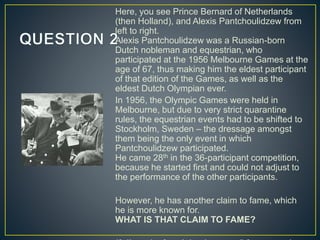
Here, you see Prince Bernard of Netherlands
(then Holland), and Alexis Pantchoulidzew from
left to right.
Alexis Pantchoulidzew was a Russian-born
Dutch nobleman and equestrian, who
participated at the 1956 Melbourne Games at the
age of 67, thus making him the eldest participant
of that edition of the Games, as well as the
eldest Dutch Olympian ever.
In 1956, the Olympic Games were held in
Melbourne, but due to very strict quarantine
rules, the equestrian events had to be shifted to
Stockholm, Sweden – the dressage amongst
them being the only event in which
Pantchoulidzew participated.
He came 28th in the 36-participant competition,
because he started first and could not adjust to
the performance of the other participants.
However, he has another claim to fame, which
he is more known for.
WHAT IS THAT CLAIM TO FAME?
“I vividly remember the 1968 Winter Olympic Olympics in Grenoble,
France. My mom woke my younger brothers and me up at 4 in the
morning to watch Jerry, the one-man ski team from ______. Jerry had
been a waiter with my older brothers at the Chart House in San Diego
and a fantastic skier. Any way, there we were, all cuddled up on the
couch, waiting to see Jerry on his downhill run. We watched Jean
Claude Killy, a couple of Americans and then when Jerry was about to
race, ABC cut to a commercial! The network thought that an ______
skier was of no interest to the American viewers. Well, my mother
gets up and goes to the phone in the kitchen. She calls the local ABC
station and wants to know who is responsible for scheduling that
commercial break. After several more calls, my mother finally gets
hold of someone in NYC.
By the time she gets back to the living room and the commercials are
over, the sportscasters on that mountainside in France are
announcing that they will now replay the run of _______ skier, Jerry,
for his fans in San Diego!”
CONNECT
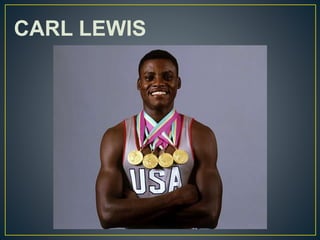
CARL LEWIS
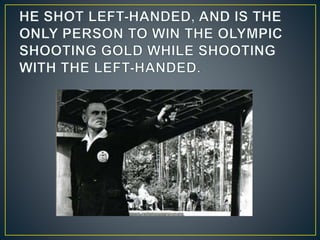
Karoly Takacs was a sharp shooter and an Army man. He
was considered amongst the best in the world. But
disaster struck in 1938.
Despite the setback, he taught himself to shoot again and
was considered a favourite for the 1940 London Games.
However, the Olympic Games were suspended for the
duration of the Second World War.
He finally managed to win the gold in the 1948 London
games and then repeated the feat in 1952 to become the
first man to defend a shooting gold.
In what way was he different from other shooters?
101-year old Hal Haig Prieste, an Olympic athlete and bronze
medal winner in the 1920 Antwerp Games, was being interviewed in
1997 at a US Olympic Committee dinner. The interviewer happened
to mention something that had been lost at the same Olympic
Games, since the previous 77 years. Hal shocked the world with his
reply: “Oh, I can help you with that. It’s in my suitcase.”
He later revealed that he had been dared by his compatriot and
fellow diver, Duke Kahanamoku to go and steal that particular item,
and since 1920, it had remained at the bottom of the suitcase.
Hal returned the item to the IOC, and has been issued with a
plaque, thanking him for returning the ‘lost’ item.
What is that particular item? And whose career almost ended very
prematurely for attempting the same thing in 1964 at the Tokyo
Games? (part points)
“I had just turned 17 years of age and I thought that was good,
because I was not a boy anymore, and wrote that I was
Chinese because I thought they might think that I was wise,
but I decided not to put my name or address in the letter I
case they thought it was a dumb idea. It was the Wednesday
night when I wrote my letter, and the Saturday was to be AB.
The office for the Organizing Committee was in Little Londsale
Street, so I dropped my letter into their letter box late at night,
making sure no one saw me.
By Saturday morning, I had not heard or read about any
changes to the AB, so I went to the movies that afternoon.
When I came out, there was a crowd of people watching the
television in a shop window, so I went over to see what they
were watching – in those days, very little people owned a set
– I saw the AB, and _______________________.”
What is AB? What was the idea?
AB – Closing Ceremony
The boy’s idea was to make the athletes intermingle with
each other and form one big nation, going around the track,
laughing and waving to the crowd, unlike the Opening
Ceremony, where athletes of each country come
separately.
What does this map represent?
What did this map standardize in the world of the
Olympics?
This was the route of the Marathon event of the 1908 London
Games.
This distance is now the standard for the Olympic Marathon (26
miles, 385 yards)
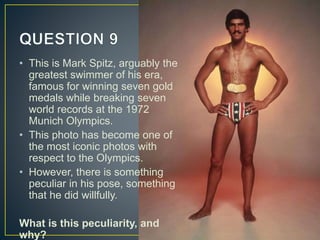
• This is Mark Spitz, arguably the
greatest swimmer of his era,
famous for winning seven gold
medals while breaking seven
world records at the 1972
Munich Olympics.
• This photo has become one of
the most iconic photos with
respect to the Olympics.
• However, there is something
peculiar in his pose, something
that he did willfully.
What is this peculiarity, and
why?
Hiding the Speedo logo, to avoid
being branded as homosexual
2002, Salt Lake City Winter Olympics. What happened
here?
The most relaxed win of all time.
In the 1900 Paris Games, world record holder and Jewish-born Myer
Prinstein was the favorite to win the long jump event, having cleared the field
in the preliminaries with a jump of 23 feet, 6.5 inches. His principal rival was
Alvin Kraenzlin.
Both these athletes reached a mutual agreement to not compete in the finals
that were scheduled to be held on Sunday, the 14th of July, due to a certain
‘restriction’.
However, on the day of the final, Kraenzlin competed and won the gold with
a jump of 23 feet, 6.75 inches – just barely better than Prinstein’s
preliminaries timing.
A furious Prinstein challenged Kraenzlin to a jump-off the very next day for
the gold. When Kraenzlin refused to do this, Prinstein attacked him with his
fists.
Prinstein went on to win golds in the triple jump. 60m-dash, 110m-hurdles
and 200m-hurdles, making him the first Olympian to win four golds in a
single edition of the Games.
Because the finals were scheduled on a Sunday, and
Kraenzlin was an American Christian, hence making
Sunday a Sabbath day for him, which meant that he could
not compete in any sport by religion.
Myer Prinstein, honoring that fact, had proposed that they
both not compete in the finals.
This was a widespread problem for Americans throughout
the tournament, and today, no events are scheduled on
Sundays in the Olympics, and if they are, no Americans are
slotted to compete on that day.
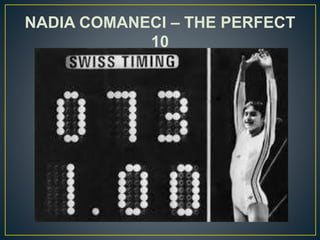
This is Nelli Kim, a Soviet Union gymnast
who competed at the 1976 Montreal
Games.
Her name has been penned down in
history books for achieving a feat that only
24 people had done before, all in the 1924
Antwerp Games, and 23 of them in one
event.
However, her name does not exist in
folklore because of the exploits of another
woman in the same Games, who
performed a similar feat, just twenty
minutes before Nelli did.
Since then, 40 other people have
managed to recreate this feat, although
they cannot do so now.
What was her feat? Who beat her to it?
NADIA COMANECI – THE PERFECT
10
1972 Munich Olympics, Men’s Basketball finals, USA vs.
USSR.
Who won, and what exactly happened?
SHIT HAPPENED.
In the 1988 Seoul Olympics, Canadian sailor Lawrence Lemieux
was running the 5th of 7 total races to determine the medalists in
the Finn class and was in 2nd place.
The wind suddenly picked up speed, and capsized a nearby
dinghy of the Singapore team competing in the 470.
Subsequently, Lemieux deviated from the course to assist in
rescuing them.
He re-joined the heat at 22nd place after rescuing them.
However, due to his actions, the International Yacht Racing
Union decided to reinstate Lemieux’s position when he went off-
course, rewarding him with a 2nd place finish in the race.
At the medal awards ceremony, the President of the International
Olympic Committee awarded Lemieux the X Medal for
Sportsmanship, one of the noblest honours that can be
bestowed upon an Olympic athlete.
Id X (name of honour).
PIERRE DE COUBERTIN,
FOUNDER OF THE MODERN
OLYMPIC GAMES
“I Have Changed” is a very controversial book
that was released by an elite athlete,
immortalized by his own deeds and the
controversies that got created around him.
Published in 1972, it shed light on the Games
that changed his life, and brought to light the
plight of ‘his people’ in the US, with special
focus on their role in the field of sports.
“I realized now that militancy in the best
sense of the word was the only answer where
the black man was concerned, that any black
man who wasn't a militant in 1970 was either
blind or a coward.” – Excerpt from the book
Identify the elite athlete who, along with
paul Neimark, co-authored the book.
Also name the Games that catapulted him to
fame – and was responsible for higlighting
the issue that he speaks of here.
Urban dictionary defines X as:
“Doing something completely unexpected and being completely
amazing, coming out of nowhere, with great excellence involved.”
The word X was formed as a result of the exploits of Y, who won
gold in the long jump event at the 1968 Olympics. When his
teammates and coach told him that he had broken the world record
by nearly 2 feet, his legs gave way and an astonished and
overwhelmed Y suffered a brief cataplexy attack brought on by the
emotional shock, and collapsed onto his knees, his body unable to
support himself, his hands covering his face. In one of the most
enduring images of the Modern Olympics, his competitors then
helped him to his feet. The defending Olympic champion till that
time, Lynn Davies told Y, “You have destroyed this event.”
Give X and Y, don’t ask for part points here.
Devank Tyagi (19-01-2016)

Devank Tyagi (19-01-2016)

  • 2.
    • 16 questions,because Olympics, and 4, and 4x4. :P • Infinite bounce format • Pounce: (1.5xdirect/-1xdirect) points • Direct: If answered, +10/0 If passed/not answered within time, -1 • Part points awarded on discretion of the quizmaster – that would be the fat one in front of you. • That’s about it.
  • 3.
    This is RichardNorris Williams II (Jan 29th, 1891 – June 2nd, 1968), an American lawn tennis player who captained the team through several Davis Cup titles and won the US Open twice as a doubles player. He has a reputation for being a fierce fighter, having been through many ordeals in order to reach the levels that he did in sport, ultimately even getting inducted into the International Hall of Fame. As a bright young player, he was involved in a serious ‘accident’, which resulted in the doctors telling him that he’d need to get his legs amputated for fear of gangrene. To this, he simply replied, “I’m going to need those legs”, and refused to go through the amputation He went on to win his first US Open Championship that year, an Olympic gold at the 1924 Antwerp Games, and his first Davis Cup win with Karl Behr. However, his name holds more renown in history for a unique feat that he accomplished, along with Karl Behr. WHAT WAS THIS FEAT?
  • 4.
    He was asurvivor of the Titanic.

  • 5.
    Here, you seePrince Bernard of Netherlands (then Holland), and Alexis Pantchoulidzew from left to right. Alexis Pantchoulidzew was a Russian-born Dutch nobleman and equestrian, who participated at the 1956 Melbourne Games at the age of 67, thus making him the eldest participant of that edition of the Games, as well as the eldest Dutch Olympian ever. In 1956, the Olympic Games were held in Melbourne, but due to very strict quarantine rules, the equestrian events had to be shifted to Stockholm, Sweden – the dressage amongst them being the only event in which Pantchoulidzew participated. He came 28th in the 36-participant competition, because he started first and could not adjust to the performance of the other participants. However, he has another claim to fame, which he is more known for. WHAT IS THAT CLAIM TO FAME?
  • 7.
    “I vividly rememberthe 1968 Winter Olympic Olympics in Grenoble, France. My mom woke my younger brothers and me up at 4 in the morning to watch Jerry, the one-man ski team from ______. Jerry had been a waiter with my older brothers at the Chart House in San Diego and a fantastic skier. Any way, there we were, all cuddled up on the couch, waiting to see Jerry on his downhill run. We watched Jean Claude Killy, a couple of Americans and then when Jerry was about to race, ABC cut to a commercial! The network thought that an ______ skier was of no interest to the American viewers. Well, my mother gets up and goes to the phone in the kitchen. She calls the local ABC station and wants to know who is responsible for scheduling that commercial break. After several more calls, my mother finally gets hold of someone in NYC. By the time she gets back to the living room and the commercials are over, the sportscasters on that mountainside in France are announcing that they will now replay the run of _______ skier, Jerry, for his fans in San Diego!”
  • 9.
  • 10.
  • 11.
    Karoly Takacs wasa sharp shooter and an Army man. He was considered amongst the best in the world. But disaster struck in 1938. Despite the setback, he taught himself to shoot again and was considered a favourite for the 1940 London Games. However, the Olympic Games were suspended for the duration of the Second World War. He finally managed to win the gold in the 1948 London games and then repeated the feat in 1952 to become the first man to defend a shooting gold. In what way was he different from other shooters?
  • 13.
    101-year old HalHaig Prieste, an Olympic athlete and bronze medal winner in the 1920 Antwerp Games, was being interviewed in 1997 at a US Olympic Committee dinner. The interviewer happened to mention something that had been lost at the same Olympic Games, since the previous 77 years. Hal shocked the world with his reply: “Oh, I can help you with that. It’s in my suitcase.” He later revealed that he had been dared by his compatriot and fellow diver, Duke Kahanamoku to go and steal that particular item, and since 1920, it had remained at the bottom of the suitcase. Hal returned the item to the IOC, and has been issued with a plaque, thanking him for returning the ‘lost’ item. What is that particular item? And whose career almost ended very prematurely for attempting the same thing in 1964 at the Tokyo Games? (part points)
  • 15.
    “I had justturned 17 years of age and I thought that was good, because I was not a boy anymore, and wrote that I was Chinese because I thought they might think that I was wise, but I decided not to put my name or address in the letter I case they thought it was a dumb idea. It was the Wednesday night when I wrote my letter, and the Saturday was to be AB. The office for the Organizing Committee was in Little Londsale Street, so I dropped my letter into their letter box late at night, making sure no one saw me. By Saturday morning, I had not heard or read about any changes to the AB, so I went to the movies that afternoon. When I came out, there was a crowd of people watching the television in a shop window, so I went over to see what they were watching – in those days, very little people owned a set – I saw the AB, and _______________________.” What is AB? What was the idea?
  • 16.
    AB – ClosingCeremony The boy’s idea was to make the athletes intermingle with each other and form one big nation, going around the track, laughing and waving to the crowd, unlike the Opening Ceremony, where athletes of each country come separately.
  • 17.
    What does thismap represent? What did this map standardize in the world of the Olympics?
  • 18.
    This was theroute of the Marathon event of the 1908 London Games. This distance is now the standard for the Olympic Marathon (26 miles, 385 yards)
  • 19.
    • This isMark Spitz, arguably the greatest swimmer of his era, famous for winning seven gold medals while breaking seven world records at the 1972 Munich Olympics. • This photo has become one of the most iconic photos with respect to the Olympics. • However, there is something peculiar in his pose, something that he did willfully. What is this peculiarity, and why?
  • 20.
    Hiding the Speedologo, to avoid being branded as homosexual
  • 21.
    2002, Salt LakeCity Winter Olympics. What happened here?
  • 22.
    The most relaxedwin of all time.
  • 23.
    In the 1900Paris Games, world record holder and Jewish-born Myer Prinstein was the favorite to win the long jump event, having cleared the field in the preliminaries with a jump of 23 feet, 6.5 inches. His principal rival was Alvin Kraenzlin. Both these athletes reached a mutual agreement to not compete in the finals that were scheduled to be held on Sunday, the 14th of July, due to a certain ‘restriction’. However, on the day of the final, Kraenzlin competed and won the gold with a jump of 23 feet, 6.75 inches – just barely better than Prinstein’s preliminaries timing. A furious Prinstein challenged Kraenzlin to a jump-off the very next day for the gold. When Kraenzlin refused to do this, Prinstein attacked him with his fists. Prinstein went on to win golds in the triple jump. 60m-dash, 110m-hurdles and 200m-hurdles, making him the first Olympian to win four golds in a single edition of the Games.
  • 24.
    Because the finalswere scheduled on a Sunday, and Kraenzlin was an American Christian, hence making Sunday a Sabbath day for him, which meant that he could not compete in any sport by religion. Myer Prinstein, honoring that fact, had proposed that they both not compete in the finals. This was a widespread problem for Americans throughout the tournament, and today, no events are scheduled on Sundays in the Olympics, and if they are, no Americans are slotted to compete on that day.
  • 25.
    This is NelliKim, a Soviet Union gymnast who competed at the 1976 Montreal Games. Her name has been penned down in history books for achieving a feat that only 24 people had done before, all in the 1924 Antwerp Games, and 23 of them in one event. However, her name does not exist in folklore because of the exploits of another woman in the same Games, who performed a similar feat, just twenty minutes before Nelli did. Since then, 40 other people have managed to recreate this feat, although they cannot do so now. What was her feat? Who beat her to it?
  • 26.
    NADIA COMANECI –THE PERFECT 10
  • 27.
    1972 Munich Olympics,Men’s Basketball finals, USA vs. USSR. Who won, and what exactly happened?
  • 28.
  • 29.
    In the 1988Seoul Olympics, Canadian sailor Lawrence Lemieux was running the 5th of 7 total races to determine the medalists in the Finn class and was in 2nd place. The wind suddenly picked up speed, and capsized a nearby dinghy of the Singapore team competing in the 470. Subsequently, Lemieux deviated from the course to assist in rescuing them. He re-joined the heat at 22nd place after rescuing them. However, due to his actions, the International Yacht Racing Union decided to reinstate Lemieux’s position when he went off- course, rewarding him with a 2nd place finish in the race. At the medal awards ceremony, the President of the International Olympic Committee awarded Lemieux the X Medal for Sportsmanship, one of the noblest honours that can be bestowed upon an Olympic athlete. Id X (name of honour).
  • 30.
    PIERRE DE COUBERTIN, FOUNDEROF THE MODERN OLYMPIC GAMES
  • 31.
    “I Have Changed”is a very controversial book that was released by an elite athlete, immortalized by his own deeds and the controversies that got created around him. Published in 1972, it shed light on the Games that changed his life, and brought to light the plight of ‘his people’ in the US, with special focus on their role in the field of sports. “I realized now that militancy in the best sense of the word was the only answer where the black man was concerned, that any black man who wasn't a militant in 1970 was either blind or a coward.” – Excerpt from the book Identify the elite athlete who, along with paul Neimark, co-authored the book. Also name the Games that catapulted him to fame – and was responsible for higlighting the issue that he speaks of here.
  • 33.
    Urban dictionary definesX as: “Doing something completely unexpected and being completely amazing, coming out of nowhere, with great excellence involved.” The word X was formed as a result of the exploits of Y, who won gold in the long jump event at the 1968 Olympics. When his teammates and coach told him that he had broken the world record by nearly 2 feet, his legs gave way and an astonished and overwhelmed Y suffered a brief cataplexy attack brought on by the emotional shock, and collapsed onto his knees, his body unable to support himself, his hands covering his face. In one of the most enduring images of the Modern Olympics, his competitors then helped him to his feet. The defending Olympic champion till that time, Lynn Davies told Y, “You have destroyed this event.” Give X and Y, don’t ask for part points here.