Communities and Development Presentation by Steve Schmida, SSG Advisors
Today’s Objectives Increase understanding of the different actors, principles and approaches to community development Introduce the concept of community partnership methodology Identify emerging trends in development in West Africa
My background Worked for NGOs overseas for 10+ years Supported and implemented some 600 community development projects Advise USAID, State and corporate clients in 30+ countries in Africa, Asia, Latin America and Eurasia.
What is Community Development? Community development , often abbreviated as CD, and informally called  community building , is a broad term applied to the practices and  academic disciplines  of civic leaders, activists, involved citizens and professionals to improve various aspects of local communities. Community development seeks to empower individuals and groups of people by providing these groups with the skills they need to effect change in their own communities. These skills are often concentrated around building  political power  through the formation of large social groups working for a common agenda. Community developers must understand both how to work with individuals and how to affect communities' positions within the context of larger  social institutions .
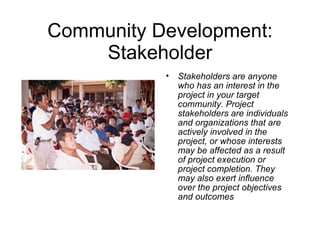
Community Development: Stakeholder Stakeholders are anyone who has an interest in the project in your target community. Project stakeholders are individuals and organizations that are actively involved in the project, or whose interests may be affected as a result of project execution or project completion. They may also exert influence over the project   objectives and outcomes
USG Stakeholders USAID + Contractors and Grantees State - Especially ECA and PD MCC, PEPFAR, OPIC
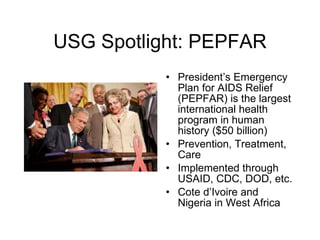
USG Spotlight: PEPFAR President’s Emergency Plan for AIDS Relief (PEPFAR) is the largest international health program in human history ($50 billion) Prevention, Treatment, Care Implemented through USAID, CDC, DOD, etc. Cote d’Ivoire and Nigeria in West Africa
International and Regional Organizations UN, World Bank, Regional Development Banks Publicly-funded Very slow and bureaucratic May be very skeptical of USG intentions
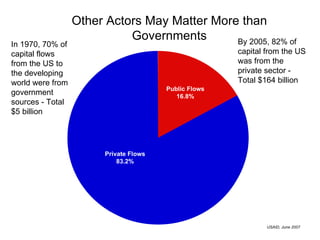
USAID, June 2007 Other Actors May Matter More than Governments In 1970, 70% of capital flows from the US to the developing world were from government sources - Total $5 billion By 2005, 82% of capital from the US was from the private sector - Total $164 billion Public Flows 71% Private Flows  83.2%  Private Flows  83.2%  Public Flows 16.8%
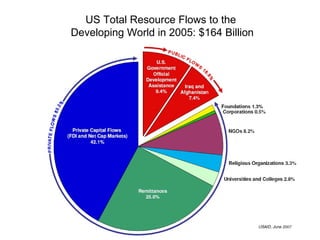
US Total Resource Flows to the  Developing World in 2005: $164 Billion
Foundations Foundations - Typically make grants to local or international organizations using endowment funds. Mostly American. Tend to think in longer time horizons than USG. Often will be cautious about working with USG - sometimes history goes back 50+ years.
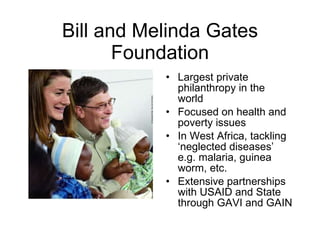
Bill and Melinda Gates Foundation Largest private philanthropy in the world Focused on health and poverty issues In West Africa, tackling ‘neglected diseases’ e.g. malaria, guinea worm, etc. Extensive partnerships with USAID and State through GAVI and GAIN
International Non-Governmental Organizations Non-governmental organization  ( NGO ) is a term that has become widely accepted for referring to a legally constituted, non- governmental  organization created by natural or legal persons with no participation or representation of any government. In the cases in which NGOs are funded totally or partially by governments, the NGO maintains its non-governmental status therefore it excludes government representatives from membership in the organization.  Mission-driven Deliver humanitarian relief, work to improve health, environment, economics, human rights. May have very long-term presence in W. Africa 30+ years CARE, MSF, OxFam, Human Rights Watch Can be very large: $500 million+ May have USG and private support
Host Country NGOs Provide services Advocate for reform Monitor government and military activity Promote free press, human rights, etc May have an ethnic or regional dimension
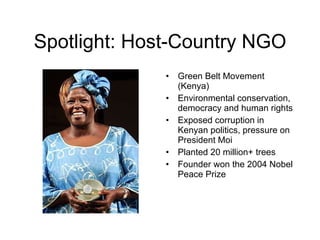
Spotlight: Host-Country NGO Green Belt Movement (Kenya) Environmental conservation, democracy and human rights Exposed corruption in Kenyan politics, pressure on President Moi Planted 20 million+ trees Founder won the 2004 Nobel Peace Prize
Corporate Sector Multinational Companies (MNCs) are heavily invested in mining/oil/gas and agri-business (cocoa/coffee) in West Africa. More recently financial services and telecommunications firms - Vodaphone, MTN, Orange. May have very strong interest in communities adjacent to their facilities and assets
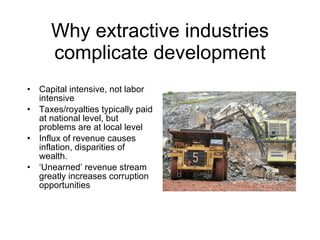
Why extractive industries complicate development Capital intensive, not labor intensive Taxes/royalties typically paid at national level, but problems are at local level Influx of revenue causes inflation, disparities of wealth. ‘ Unearned’ revenue stream greatly increases corruption opportunities
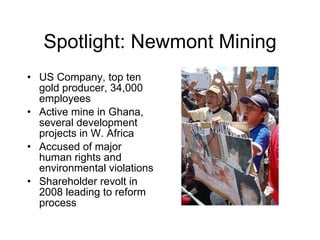
Spotlight: Newmont Mining US Company, top ten gold producer, 34,000 employees Active mine in Ghana, several development projects in W. Africa Accused of major human rights and environmental violations Shareholder revolt in 2008 leading to reform process
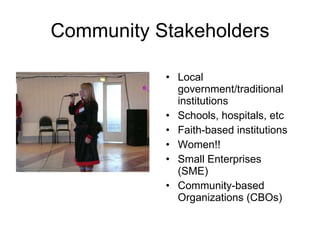
Community Stakeholders Local government/traditional institutions Schools, hospitals, etc Faith-based institutions Women!! Small Enterprises (SME) Community-based Organizations (CBOs)
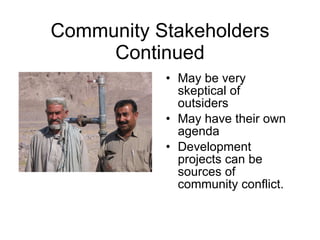
Community Stakeholders Continued May be very skeptical of outsiders May have their own agenda Development projects can be sources of community conflict.
Community Partnerships: Bringing Stakeholders to a Common Agenda
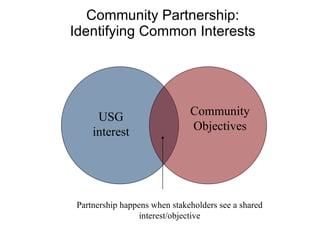
Community Partnership: Identifying Common Interests USG interest Community Objectives Partnership happens when stakeholders see a shared interest/objective
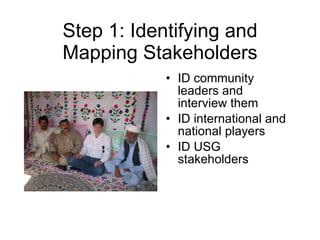
Step 1: Identifying and Mapping Stakeholders ID community leaders and interview them ID international and national players ID USG stakeholders
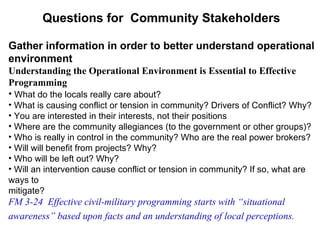
Gather information in order to better understand operational environment Understanding the Operational Environment is Essential to Effective Programming  What do the locals really care about? What is causing conflict or tension in community? Drivers of Conflict? Why? You are interested in their interests, not their positions Where are the community allegiances (to the government or other groups)? Who is really in control in the community? Who are the real power brokers? Will will benefit from projects? Why?  Who will be left out? Why? Will an intervention cause conflict or tension in community? If so, what are ways to  mitigate? FM 3-24  Effective civil-military programming starts with “situational awareness” based upon facts and an understanding of local perceptions.  Questions for  Community Stakeholders
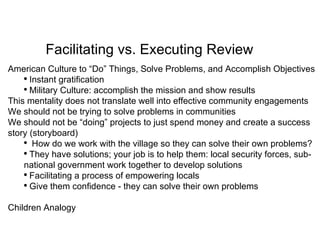
American Culture to “Do” Things, Solve Problems, and Accomplish Objectives  Instant gratification Military Culture: accomplish the mission and show results This mentality does not translate well into effective community engagements We should not be trying to solve problems in communities We should not be “doing” projects to just spend money and create a success story (storyboard) How do we work with the village so they can solve their own problems? They have solutions; your job is to help them: local security forces, sub-national government work together to develop solutions Facilitating a process of empowering locals Give them confidence - they can solve their own problems Children Analogy Facilitating vs. Executing Review
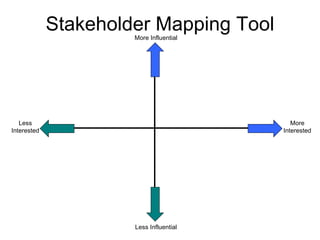
Stakeholder Mapping Tool More Influential Less Influential More Interested Less Interested
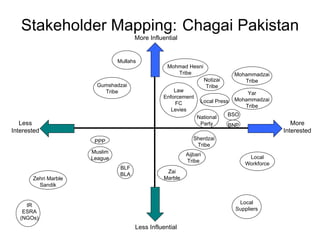
Stakeholder Mapping:   Chagai Pakistan More Influential Less Influential More Interested Less Interested Notizai Tribe Mohammadzai Tribe PPP BLF BLA Gumshadzai Tribe Mohmad Hesni Tribe Yar Mohammadzai Tribe Sherdzai Tribe Aijbari Tribe BNP National Party Muslim League Mullahs BSO Zai Marble Zehri Marble Sandik IR ESRA (NGOs)‏ Local Workforce Local Suppliers Law Enforcement FC Levies Local Press
Your Turn See Handout Take 10 minutes to map out possible stakeholders Be prepared to talk for 5 minutes

Community Engagement

  • 1.
    Communities and DevelopmentPresentation by Steve Schmida, SSG Advisors
  • 2.
    Today’s Objectives Increaseunderstanding of the different actors, principles and approaches to community development Introduce the concept of community partnership methodology Identify emerging trends in development in West Africa
  • 3.
    My background Workedfor NGOs overseas for 10+ years Supported and implemented some 600 community development projects Advise USAID, State and corporate clients in 30+ countries in Africa, Asia, Latin America and Eurasia.
  • 4.
    What is CommunityDevelopment? Community development , often abbreviated as CD, and informally called community building , is a broad term applied to the practices and academic disciplines of civic leaders, activists, involved citizens and professionals to improve various aspects of local communities. Community development seeks to empower individuals and groups of people by providing these groups with the skills they need to effect change in their own communities. These skills are often concentrated around building political power through the formation of large social groups working for a common agenda. Community developers must understand both how to work with individuals and how to affect communities' positions within the context of larger social institutions .
  • 5.
    Community Development: StakeholderStakeholders are anyone who has an interest in the project in your target community. Project stakeholders are individuals and organizations that are actively involved in the project, or whose interests may be affected as a result of project execution or project completion. They may also exert influence over the project objectives and outcomes
  • 6.
    USG Stakeholders USAID+ Contractors and Grantees State - Especially ECA and PD MCC, PEPFAR, OPIC
  • 7.
    USG Spotlight: PEPFARPresident’s Emergency Plan for AIDS Relief (PEPFAR) is the largest international health program in human history ($50 billion) Prevention, Treatment, Care Implemented through USAID, CDC, DOD, etc. Cote d’Ivoire and Nigeria in West Africa
  • 8.
    International and RegionalOrganizations UN, World Bank, Regional Development Banks Publicly-funded Very slow and bureaucratic May be very skeptical of USG intentions
  • 9.
    USAID, June 2007Other Actors May Matter More than Governments In 1970, 70% of capital flows from the US to the developing world were from government sources - Total $5 billion By 2005, 82% of capital from the US was from the private sector - Total $164 billion Public Flows 71% Private Flows 83.2% Private Flows 83.2% Public Flows 16.8%
  • 10.
    US Total ResourceFlows to the Developing World in 2005: $164 Billion
  • 11.
    Foundations Foundations -Typically make grants to local or international organizations using endowment funds. Mostly American. Tend to think in longer time horizons than USG. Often will be cautious about working with USG - sometimes history goes back 50+ years.
  • 12.
    Bill and MelindaGates Foundation Largest private philanthropy in the world Focused on health and poverty issues In West Africa, tackling ‘neglected diseases’ e.g. malaria, guinea worm, etc. Extensive partnerships with USAID and State through GAVI and GAIN
  • 13.
    International Non-Governmental OrganizationsNon-governmental organization ( NGO ) is a term that has become widely accepted for referring to a legally constituted, non- governmental organization created by natural or legal persons with no participation or representation of any government. In the cases in which NGOs are funded totally or partially by governments, the NGO maintains its non-governmental status therefore it excludes government representatives from membership in the organization. Mission-driven Deliver humanitarian relief, work to improve health, environment, economics, human rights. May have very long-term presence in W. Africa 30+ years CARE, MSF, OxFam, Human Rights Watch Can be very large: $500 million+ May have USG and private support
  • 14.
    Host Country NGOsProvide services Advocate for reform Monitor government and military activity Promote free press, human rights, etc May have an ethnic or regional dimension
  • 15.
    Spotlight: Host-Country NGOGreen Belt Movement (Kenya) Environmental conservation, democracy and human rights Exposed corruption in Kenyan politics, pressure on President Moi Planted 20 million+ trees Founder won the 2004 Nobel Peace Prize
  • 16.
    Corporate Sector MultinationalCompanies (MNCs) are heavily invested in mining/oil/gas and agri-business (cocoa/coffee) in West Africa. More recently financial services and telecommunications firms - Vodaphone, MTN, Orange. May have very strong interest in communities adjacent to their facilities and assets
  • 17.
    Why extractive industriescomplicate development Capital intensive, not labor intensive Taxes/royalties typically paid at national level, but problems are at local level Influx of revenue causes inflation, disparities of wealth. ‘ Unearned’ revenue stream greatly increases corruption opportunities
  • 18.
    Spotlight: Newmont MiningUS Company, top ten gold producer, 34,000 employees Active mine in Ghana, several development projects in W. Africa Accused of major human rights and environmental violations Shareholder revolt in 2008 leading to reform process
  • 19.
    Community Stakeholders Localgovernment/traditional institutions Schools, hospitals, etc Faith-based institutions Women!! Small Enterprises (SME) Community-based Organizations (CBOs)
  • 20.
    Community Stakeholders ContinuedMay be very skeptical of outsiders May have their own agenda Development projects can be sources of community conflict.
  • 21.
    Community Partnerships: BringingStakeholders to a Common Agenda
  • 22.
    Community Partnership: IdentifyingCommon Interests USG interest Community Objectives Partnership happens when stakeholders see a shared interest/objective
  • 23.
    Step 1: Identifyingand Mapping Stakeholders ID community leaders and interview them ID international and national players ID USG stakeholders
  • 24.
    Gather information inorder to better understand operational environment Understanding the Operational Environment is Essential to Effective Programming What do the locals really care about? What is causing conflict or tension in community? Drivers of Conflict? Why? You are interested in their interests, not their positions Where are the community allegiances (to the government or other groups)? Who is really in control in the community? Who are the real power brokers? Will will benefit from projects? Why? Who will be left out? Why? Will an intervention cause conflict or tension in community? If so, what are ways to mitigate? FM 3-24 Effective civil-military programming starts with “situational awareness” based upon facts and an understanding of local perceptions. Questions for Community Stakeholders
  • 25.
    American Culture to“Do” Things, Solve Problems, and Accomplish Objectives Instant gratification Military Culture: accomplish the mission and show results This mentality does not translate well into effective community engagements We should not be trying to solve problems in communities We should not be “doing” projects to just spend money and create a success story (storyboard) How do we work with the village so they can solve their own problems? They have solutions; your job is to help them: local security forces, sub-national government work together to develop solutions Facilitating a process of empowering locals Give them confidence - they can solve their own problems Children Analogy Facilitating vs. Executing Review
  • 26.
    Stakeholder Mapping ToolMore Influential Less Influential More Interested Less Interested
  • 27.
    Stakeholder Mapping: Chagai Pakistan More Influential Less Influential More Interested Less Interested Notizai Tribe Mohammadzai Tribe PPP BLF BLA Gumshadzai Tribe Mohmad Hesni Tribe Yar Mohammadzai Tribe Sherdzai Tribe Aijbari Tribe BNP National Party Muslim League Mullahs BSO Zai Marble Zehri Marble Sandik IR ESRA (NGOs)‏ Local Workforce Local Suppliers Law Enforcement FC Levies Local Press
  • 28.
    Your Turn SeeHandout Take 10 minutes to map out possible stakeholders Be prepared to talk for 5 minutes