Design Registration Process
Prepared by – Stephen Masters
Date – May 2019
What is Design Registration
– Design registration is a process aimed at ensuring that specific items of Plant (as per the Regulations) are designed
and verified to appropriate technical standards prior to being supplied.
– Once a design is registered, any number of Plant units can be supplied as long as they comply with the design that
was registered.
– Once Design Registration has been completed, Plant Registration can be sought.
Page 2
What Requires Design Registration?
Work Health and Safety Regulation 2011, 1st May 2019 - Schedule 5 - Registration of plant and plant designs
– Section 1.8 - Amusement devices classified by section 2.1 of AS3533.1:2009 (Amusement rides and devices—Design and construction), except devices and structures stated
in section 2(2).
– Section 2(2) The following devices and structures are excluded from section 1.8—
– (a) an amusement ride or device classified as class 1 under section 2.1 of AS 3533.1:2009 (Amusement rides and devices—Design and construction);
– (b) playground structures;
– (c) water slides where water facilitates patrons to slide easily, predominantly under gravity, along a static structure;
– (d) wave generators where patrons do not come into contact with the parts of machinery used for generating water waves;
– (e) inflatable devices, other than inflatable devices (continuously blown) with a platform height of 3 metres or more.
amusement device means plant operated for hire or reward that provides entertainment, sightseeing or amusement through movement of the equipment, or part of the equipment,
or when passengers or other users travel or move on, around or along the equipment, but does not include—
– (a) a miniature train and railway system owned and operated by a model railway society, club or association;
– (b) a ride or device that is used as a form of transport and that is, in relation to its use for that purpose, regulated under another Act
– (c) a boat or flotation device …
– (d) any plant specifically designed for a sporting, professional stunt, theatrical or acrobatic purpose or activity
– (e) a coin-operated or token-operated device that …
Page 3
Who is involved in Design Registration?
– Applicant, ride owner or authorised representative
– Designer, generally ride supplier/manufacturer
– Design Verifier, the verifier must be a competent person and must not have been involved in the production of
the design or engaged by the design company at the time the design was developed**
A competent person for design verification, under section 252 of the Regulation, means a person who has the skills,
qualifications, competence and experience to design the plant or verify the design.
(An example of someone who meets these criteria is a suitably qualified and experienced professional engineer (RPEQ))
Page 4
Design Verifiers Role
Verification is a process where a review of the design documentation for a particular model of plant is completed. This is done to
determine if the design complies with the technical design standard specified for the plant. It should include a review of:
– design calculations
– detailed design drawings including material specifications and manufacturing requirements
– circuit diagrams
– visual examination
– testing of the plant
Some items of plant will require competent persons from different engineering disciplines to be involved in the review (e.g. a crane
may require a structural engineer, a mechanical engineer and an electrical engineer to review the different aspects of the design)
Source: https://www.worksafe.qld.gov.au/licensing-and-registrations/plant-design-registration/design-verification
Page 5
When to start the Design Verification Process
– As early as possible (possibly before you purchase the ride)
– Design Verification is often thought of as a back-ended process, however, everything that is done during the design and
specification phase, must be verified.
– It is quicker, cheaper and easier to fix a design error before the plant leaves the design studio/engineering office than when it is
being assembled in Australia.
Recommendations:
– Before you finalise the purchase contract, establish a design verification process.
– Have your design verification Professional Engineer(s) / Competent Person(s) selected and ready to assist.
– Design Verifier can discuss/review/comment on the proposed concept design and device specifications before the designers
progress to detailed design
– Design Verifier to have periodic updates and reviews of the designers work
Key Requirement:
– The Design Verifier cannot instruct the designer to make changes, just highlight issues that need additional clarification/resolution
Page 6
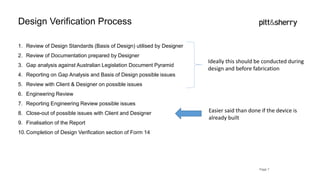
Design Verification Process
1. Review of Design Standards (Basis of Design) utilised by Designer
2. Review of Documentation prepared by Designer
3. Gap analysis against Australian Legislation Document Pyramid
4. Reporting on Gap Analysis and Basis of Design possible issues
5. Review with Client & Designer on possible issues
6. Engineering Review
7. Reporting Engineering Review possible issues
8. Close-out of possible issues with Client and Designer
9. Finalisation of the Report
10.Completion of Design Verification section of Form 14
Page 7
Ideally this should be conducted during
design and before fabrication
Easier said than done if the device is
already built
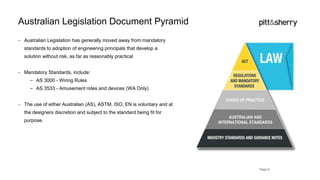
Australian Legislation Document Pyramid
– Australian Legislation has generally moved away from mandatory
standards to adoption of engineering principals that develop a
solution without risk, as far as reasonably practical
– Mandatory Standards, include:
– AS 3000 - Wiring Rules
– AS 3533 - Amusement rides and devices (WA Only)
– The use of either Australian (AS), ASTM, ISO, EN is voluntary and at
the designers discretion and subject to the standard being fit for
purpose.
Page 8
Common Issues identified during Design Verification
– Missing Documentation as specified in Act and Legislation
– Mandatory Design Standard Non-Compliances
– AS 3000 - Wiring Rules
– AS 3533 - Amusement rides and devices (WA Only)
– Code of Practice Non-Compliances
– Safe Design of Structures (Fabrication, Erection, Operation, Maintenance, Disassembly and Demolition)
– Confined Space
– Electrical Safety
– How to manage work health and safety risks
– Managing risks of plant in the workplace
– Managing the risk of falls at workplaces
– Inadequate Risk Assessments & Reliance on Standards as method for managing risk
– Inappropriate use of International Standards
– Not suitable for Australian environmental conditions (Wind / Temperature)
– Control system design, calculation and component specification / selection deficiencies
Page 9

Design registration-process

  • 1.
    Design Registration Process Preparedby – Stephen Masters Date – May 2019
  • 2.
    What is DesignRegistration – Design registration is a process aimed at ensuring that specific items of Plant (as per the Regulations) are designed and verified to appropriate technical standards prior to being supplied. – Once a design is registered, any number of Plant units can be supplied as long as they comply with the design that was registered. – Once Design Registration has been completed, Plant Registration can be sought. Page 2
  • 3.
    What Requires DesignRegistration? Work Health and Safety Regulation 2011, 1st May 2019 - Schedule 5 - Registration of plant and plant designs – Section 1.8 - Amusement devices classified by section 2.1 of AS3533.1:2009 (Amusement rides and devices—Design and construction), except devices and structures stated in section 2(2). – Section 2(2) The following devices and structures are excluded from section 1.8— – (a) an amusement ride or device classified as class 1 under section 2.1 of AS 3533.1:2009 (Amusement rides and devices—Design and construction); – (b) playground structures; – (c) water slides where water facilitates patrons to slide easily, predominantly under gravity, along a static structure; – (d) wave generators where patrons do not come into contact with the parts of machinery used for generating water waves; – (e) inflatable devices, other than inflatable devices (continuously blown) with a platform height of 3 metres or more. amusement device means plant operated for hire or reward that provides entertainment, sightseeing or amusement through movement of the equipment, or part of the equipment, or when passengers or other users travel or move on, around or along the equipment, but does not include— – (a) a miniature train and railway system owned and operated by a model railway society, club or association; – (b) a ride or device that is used as a form of transport and that is, in relation to its use for that purpose, regulated under another Act – (c) a boat or flotation device … – (d) any plant specifically designed for a sporting, professional stunt, theatrical or acrobatic purpose or activity – (e) a coin-operated or token-operated device that … Page 3
  • 4.
    Who is involvedin Design Registration? – Applicant, ride owner or authorised representative – Designer, generally ride supplier/manufacturer – Design Verifier, the verifier must be a competent person and must not have been involved in the production of the design or engaged by the design company at the time the design was developed** A competent person for design verification, under section 252 of the Regulation, means a person who has the skills, qualifications, competence and experience to design the plant or verify the design. (An example of someone who meets these criteria is a suitably qualified and experienced professional engineer (RPEQ)) Page 4
  • 5.
    Design Verifiers Role Verificationis a process where a review of the design documentation for a particular model of plant is completed. This is done to determine if the design complies with the technical design standard specified for the plant. It should include a review of: – design calculations – detailed design drawings including material specifications and manufacturing requirements – circuit diagrams – visual examination – testing of the plant Some items of plant will require competent persons from different engineering disciplines to be involved in the review (e.g. a crane may require a structural engineer, a mechanical engineer and an electrical engineer to review the different aspects of the design) Source: https://www.worksafe.qld.gov.au/licensing-and-registrations/plant-design-registration/design-verification Page 5
  • 6.
    When to startthe Design Verification Process – As early as possible (possibly before you purchase the ride) – Design Verification is often thought of as a back-ended process, however, everything that is done during the design and specification phase, must be verified. – It is quicker, cheaper and easier to fix a design error before the plant leaves the design studio/engineering office than when it is being assembled in Australia. Recommendations: – Before you finalise the purchase contract, establish a design verification process. – Have your design verification Professional Engineer(s) / Competent Person(s) selected and ready to assist. – Design Verifier can discuss/review/comment on the proposed concept design and device specifications before the designers progress to detailed design – Design Verifier to have periodic updates and reviews of the designers work Key Requirement: – The Design Verifier cannot instruct the designer to make changes, just highlight issues that need additional clarification/resolution Page 6
  • 7.
    Design Verification Process 1.Review of Design Standards (Basis of Design) utilised by Designer 2. Review of Documentation prepared by Designer 3. Gap analysis against Australian Legislation Document Pyramid 4. Reporting on Gap Analysis and Basis of Design possible issues 5. Review with Client & Designer on possible issues 6. Engineering Review 7. Reporting Engineering Review possible issues 8. Close-out of possible issues with Client and Designer 9. Finalisation of the Report 10.Completion of Design Verification section of Form 14 Page 7 Ideally this should be conducted during design and before fabrication Easier said than done if the device is already built
  • 8.
    Australian Legislation DocumentPyramid – Australian Legislation has generally moved away from mandatory standards to adoption of engineering principals that develop a solution without risk, as far as reasonably practical – Mandatory Standards, include: – AS 3000 - Wiring Rules – AS 3533 - Amusement rides and devices (WA Only) – The use of either Australian (AS), ASTM, ISO, EN is voluntary and at the designers discretion and subject to the standard being fit for purpose. Page 8
  • 9.
    Common Issues identifiedduring Design Verification – Missing Documentation as specified in Act and Legislation – Mandatory Design Standard Non-Compliances – AS 3000 - Wiring Rules – AS 3533 - Amusement rides and devices (WA Only) – Code of Practice Non-Compliances – Safe Design of Structures (Fabrication, Erection, Operation, Maintenance, Disassembly and Demolition) – Confined Space – Electrical Safety – How to manage work health and safety risks – Managing risks of plant in the workplace – Managing the risk of falls at workplaces – Inadequate Risk Assessments & Reliance on Standards as method for managing risk – Inappropriate use of International Standards – Not suitable for Australian environmental conditions (Wind / Temperature) – Control system design, calculation and component specification / selection deficiencies Page 9