Design | Expose APIs with CQR
Quick Recap
Modeling Process
● Identification
○ Who (peoples, entities )use it ?
○ When they are going to do ?
○ External or internal ?
● Break into steps
● Definition
● Validation
○ Test
○ Document
● Creation
○ Find resources
○ Relation between resources
Verbs and Nouns
If you want to dining out at nice places that you have to call ahead to reserve a
table
What are the problem ?
Principles :)
Principles
● Separation of concerns
● Reusable components
● DRY
● KISS
● SOLID
● …
BTW, everything comes at a price !
Complexity comes to table
● Scalability
● Availability
● Security
● Performance
● …
● ....
● Representation(the same data using multiple models, ...)
Representation
Most important part of a business is the state of the data.
● Decisions
● Roadmap
● Application functionality
● User experience
● ….
Taking care of state ? How ?
Event Sourcing
● Capture all changes to an application state as a sequence of events
The fundamental idea of Event Sourcing is that of ensuring every
change to the state of an application is captured in an event object, and
that these event objects are themselves stored in the sequence they
were applied for the same lifetime as the application state itself.
https://martinfowler.com/eaaDev/EventSourcing.html
Event sourcing Pros (continued)
● Bypass the O-R impedance mismatch
● Easy way to undo things
● Debuggability and traceability
a. Every change to state is traceable
b. You know how the system got into the current state
c. Metadata like "who did that" and "when did it happen"
● After-the-fact data analysis of Event Streams
● Awesome for writing data
https://en.wikipedia.org/wiki/Object-relational_impedance_mismatch
Event sourcing Cons (continued)
● Takes getting used to
● Much less framework/community/vendor support
● Awkward queries (solved by CQRS) (terrible for reading)
Should I be doing Event Sourcing?
● you're building rich object-oriented domain models (e.g. DDD)
● you have a lot of behaviour that isn't CRUD
● accountability/debuggability is critical
● you need version control/undo for data (e. G. Wikis, Google Docs)
● your business derives value or competitive advantage from event data
● your domain is inherently event driven (e. G. football game tracking)
● you're building a scalable system based on the CQRS pattern
CQRS (Command Query Responsibility Segregation)
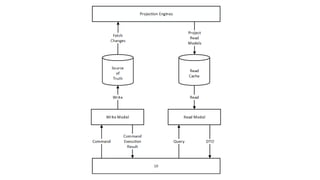
Segregate operations that read data from operations that update data by using
separate interfaces. This can maximize performance, scalability, and security.
If the problem is having multiple and disparate views, we can exclude them from
the Domain Model and start treating them as a purely infrastructural concern
https://docs.microsoft.com/en-us/azure/architecture/patterns/cqrs
Pros
● Your system should display its entities in different representation models.
● You have to support different querying models (search, graph, documents, etc.).
● The difference between writes and reads differs greatly, and you want to scale
them independently.
Cons
● Eventual consistency (make persistence transactional)
● Still complex fellow
● Complex Monitoring and infrastructure
Concepts
● Event Stream
● Event Store
● Snapshot Store
● Projection
● Service Bus
Example

Design | expose ap is with cqr

  • 1.
    Design | ExposeAPIs with CQR Quick Recap
  • 2.
    Modeling Process ● Identification ○Who (peoples, entities )use it ? ○ When they are going to do ? ○ External or internal ? ● Break into steps ● Definition ● Validation ○ Test ○ Document ● Creation ○ Find resources ○ Relation between resources
  • 3.
    Verbs and Nouns Ifyou want to dining out at nice places that you have to call ahead to reserve a table
  • 4.
    What are theproblem ? Principles :)
  • 5.
    Principles ● Separation ofconcerns ● Reusable components ● DRY ● KISS ● SOLID ● … BTW, everything comes at a price !
  • 6.
    Complexity comes totable ● Scalability ● Availability ● Security ● Performance ● … ● .... ● Representation(the same data using multiple models, ...)
  • 7.
    Representation Most important partof a business is the state of the data. ● Decisions ● Roadmap ● Application functionality ● User experience ● ….
  • 8.
    Taking care ofstate ? How ?
  • 9.
    Event Sourcing ● Captureall changes to an application state as a sequence of events The fundamental idea of Event Sourcing is that of ensuring every change to the state of an application is captured in an event object, and that these event objects are themselves stored in the sequence they were applied for the same lifetime as the application state itself. https://martinfowler.com/eaaDev/EventSourcing.html
  • 10.
    Event sourcing Pros(continued) ● Bypass the O-R impedance mismatch ● Easy way to undo things ● Debuggability and traceability a. Every change to state is traceable b. You know how the system got into the current state c. Metadata like "who did that" and "when did it happen" ● After-the-fact data analysis of Event Streams ● Awesome for writing data https://en.wikipedia.org/wiki/Object-relational_impedance_mismatch
  • 11.
    Event sourcing Cons(continued) ● Takes getting used to ● Much less framework/community/vendor support ● Awkward queries (solved by CQRS) (terrible for reading)
  • 12.
    Should I bedoing Event Sourcing? ● you're building rich object-oriented domain models (e.g. DDD) ● you have a lot of behaviour that isn't CRUD ● accountability/debuggability is critical ● you need version control/undo for data (e. G. Wikis, Google Docs) ● your business derives value or competitive advantage from event data ● your domain is inherently event driven (e. G. football game tracking) ● you're building a scalable system based on the CQRS pattern
  • 13.
    CQRS (Command QueryResponsibility Segregation) Segregate operations that read data from operations that update data by using separate interfaces. This can maximize performance, scalability, and security. If the problem is having multiple and disparate views, we can exclude them from the Domain Model and start treating them as a purely infrastructural concern https://docs.microsoft.com/en-us/azure/architecture/patterns/cqrs
  • 15.
    Pros ● Your systemshould display its entities in different representation models. ● You have to support different querying models (search, graph, documents, etc.). ● The difference between writes and reads differs greatly, and you want to scale them independently. Cons ● Eventual consistency (make persistence transactional) ● Still complex fellow ● Complex Monitoring and infrastructure
  • 17.
    Concepts ● Event Stream ●Event Store ● Snapshot Store ● Projection ● Service Bus
  • 18.