


DESIGN AND LAYOUT IN INDIA
Submitted by:
1) Jay Khaniya
2) Nitin Ghadge
3) Hetal Ramani
4) Sangita Jadav
Submitted to: Dr. Rajiv Kumar
Department of Genetics and
Plant Breeding, JAU, Junagadh
PGS 503: Intellectual Property and It’s
Management in Agriculture
History of Industrial Design
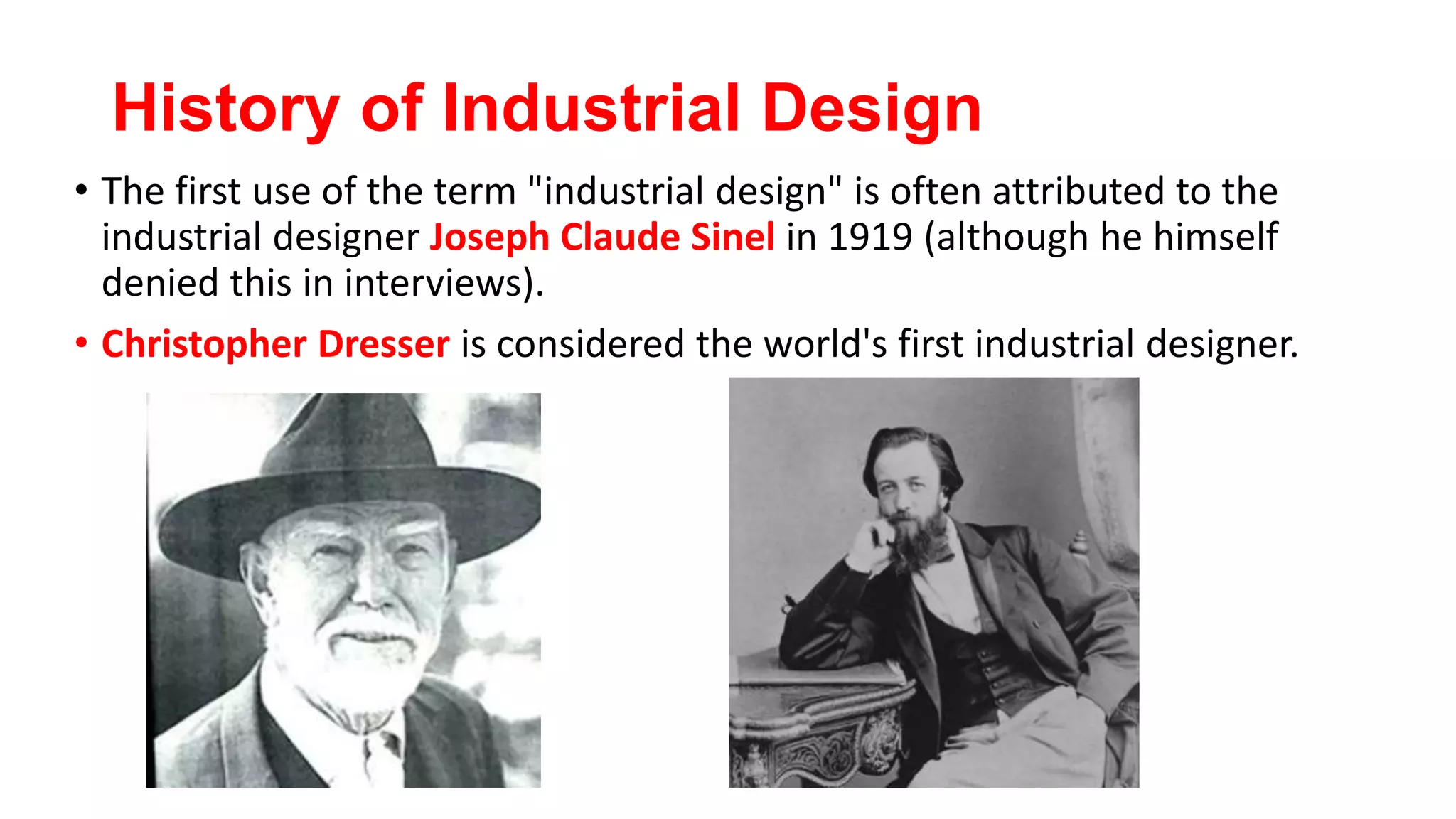
• The first use of the term "industrial design" is often attributed to the
industrial designer Joseph Claude Sinel in 1919 (although he himself
denied this in interviews).
• Christopher Dresser is considered the world's first industrial designer.
What is Design?
A Design refers to the features of shape, configuration, pattern,
ornamentation or composition of lines or colors applied to any article,
whether in two or three dimensional (or both) forms.
This may be applied by any industrial process or means (manual, mechanical
or chemical) separately or by a combined process, which in the finished article
appeals to and judged solely by the eye.
• Design does not include any mode or principle of construction or anything
which is mere mechanical device.
• It also does not include any trade mark or any artistic work.
• An industrial design registration protects the ornamental or aesthetic aspect
of an article.
• Designs may consist of three-dimensional features, such as the shape or
surface of an article, or of two dimensional features, such as patterns, lines or
color.
• Designs are applied to a wide variety of products of different industries like
handicrafts, medical instruments, watches, jewelry, house wares, electrical
appliances, vehicles and architectural structures.
• An industrial design is primarily for aesthetic features.
• A design makes a product attractive and appealing for the consumers
Design law in India
• The essential purpose of design law it to promote and protect the design element
of industrial production.
• It is also intended to promote innovative activity in the field of industries.
• The Designs Act, 2000 and the Designs Rules, 2001 presently govern the design
law in India.
• The Act came into force on 25th May 2000 while the Rules came into effect on 11th
May 2001.
• The object of the Designs Act to protect new or original designs so created to be
applied or applicable to particular article to be manufactured by Industrial Process
or means.
• Sometimes purchase of articles for use is influenced not only by their practical
efficiency but also by their appearance.
Need for registration of Design
• A registered proprietor of the design is entitled to a better protection of his
intellectual property.
• He can sue for infringement, if his right is infringed by any person.
• He can license or sell his design as legal property for a consideration or
royalty. Registration initially confers this right for ten years from the date of
registration.
• It is renewable for a further period of five years.
• If the fee for extension is not paid for the further period of registration
within the period of initial registration, this right will cease.
• There is provision for the restoration of a lapsed design if the application for
restoration is filed within one year from the date of cessation in the
prescribed manner.
Essential requirements for registration of Design
A design should –
• Be new or original
• Not be disclosed to the public anywhere by publication in tangible form or by
use or in any other way prior to the filling date, or where applicable, the
priority date of the application for registration.
• Be significantly distinguishable from known Designs or combination of known
designs.
• Not comprise or contain scandalous or obscene matter.
• Not be a mere mechanical contrivance.
• Be applied to an article and should appeal to the eye.
• Not be contrary to public order or morality.
Exclusion from scope of Design
Designs that are primarily literary or artistic in character are not protected under the Designs
Act. These will include:
• Books, jackets, calendars, certificates, forms-and other documents, dressmaking patterns,
greeting cards, leaflets, maps and plan cards, postcards, stamps, medals.
• Labels, tokens, cards, cartoons.
• Any principle or mode of construction of an article.
• Mere mechanical contrivance.
• Buildings and structures.
• Parts of articles not manufactured and sold separately.
• Variations commonly used in the trade.
• Mere workshop alterations of components of an assembly.
• Mere change in size of article.
• Flags, emblems or signs of any country.
• Layout designs of integrated circuits.
Who can apply for registration?
• Any person or the legal representative or the assignee can apply separately
or jointly for the registration of a design.
• The term "person" includes firm, partnership and a body corporate. An
application may also be filed through an agent in which case a power of
attorney is required to be filed.
• An Application for registration of design may be prepared either by the
applicant or with the professional help of attorneys.
Register of Design
• The Register of Designs is a document maintained by the Patent Office, Kolkata
as a statutory requirement.
• It contains the design number, date of filing and reciprocity date (if any), name
and address of proprietor and such other matters as would affect the validity
of proprietorship of the design such as notifications of assignments and of
transmissions of registered designs, etc. and it is open for public inspection on
payment of prescribed fee and extract from register may also be obtained on
request with the prescribed fee.
Procedure for submission of application of registration
• Any person who desires to register a design is required to submit the following documents to the
Design Wing of the Patent Office at "Intellectual Property Office", CP-2, Sector V, Salt Lake, Kolkata
- 700 091 or any of the Branch Offices of the Patent Office at Delhi, Mumbai and Chennai.
• I. Application duly filed in on the prescribed form (Form-I) along with the prescribed fees, stating
name in full, address, nationality, name of the article, class number, address for service in India.
The application should also be signed either by the applicant or by his authorized agent.
• II. Representation (in quadruplicate of size 33 cm x 20.5 cm with a suitable margin) of the article.
Drawings  sketches should clearly show the features of the design from different views and state
the view (e.g. front or Side).
• III. A statement of novelty and disclaimer (if any) in respect of mechanical action, trademark, work,
letter, numerals should be endorsed on each representation sheet which should be duly signed and
dated.
• IV. Power of attorney (if necessary).
• V. Priority documents (if any) in case of convention application claimed under Section 44 of the
Designs Act, 2000.
Piracy of registered design
During the existence of copyright over any design, other persons are
prohibited from using the design except or with the permission of
the proprietor, his licensee or assignee. The following activities are
considered to be infringement.
• To apply the design or any fraudulent imitation of it to any article
for sale;
• To import for sale any article to which the design or fraudulent or
obvious imitation of it, has been applied;
• To publish or to expose for sale knowing that the design or any
fraudulent or obvious imitation of it has been applied to it
Semiconductor Integrated Circuits Layout-Design
(SICLD) Act, 2000
The Semiconductor Integrated Circuits Layout-Design Act, 2000 was passed to fulfill
India’s obligations as a TRIPS signatory. It provides protection for semiconductor Integrated
Circuit layout designs. The main purpose of the Act is to provide for routes and mechanism for
protection of IPR in Chip Layout Designs created and matters related to it.
The important provisions of the Act are –
• Defines layout-designs of integrated circuits which can be registered under the Act;
• Duration of registration of layout-designs;
• Rights conferred by registration;
• Infringement of layout-designs;
• Procedure for assignment and transmission of registered layout- design;
• Treatment of Royalties;
• Penalties;
• Provision for agents;
• Reciprocity provision with other recognized countries.
Criteria for registration of Chip Layout Design
A Layout design that is:
• Original
• Not commercially exploited anywhere in India or convention /reciprocal
country
• Inherently distinctive
• Inherently capable of being capable of being distinguishable from any other
registered layout design
Duration of registration
• A period of 10 years counted from the date of filing an application for
registration or from the date of first commercial exploitation
anywhere in India or in any convention country or country specified
by Government of India whichever is earlier.
Person entitled to protection of Layout-Designs
Any person who -
• Is a creator of a layout design and desires to register it;
• is an Indian national or national of country outside India which
accords to citizens of India similar privileges as granted to its own
citizens in respect of registration and protection of layout-designs
and;
• Has principal place of business in India or if he does not carry out
business in India, has place of service in India.
Steps for registration of a layout-design
• Filing of application by the creator of the layout-design at the SICLD Registry.
• The Registrar may accept, refuse the application or accept with some
modifications.
• The accepted applications shall be advertised within 14 days of acceptance.
• Any opposition to the advertisement can be filed within 3 months from the
date of advertisement.
• The counter-statement to the notice of opposition, if any, to be filed within 2
months from the date of receipt of copy of notice of opposition from the
Registrar.
• A copy of the counter statement provided to the opposing party.
• The Registrar may take hearing with the parities.
• The Registrar will decide on the originality of the layout-design and grant or
reject the application for registration based on the conclusions reached by him.
• Aggrieved party can appeal to Appellate Board or in its absence Civil Court for
relief on any ruling of the Registrar.
Prohibition from registration
A layout-design is prohibited from registration if -
I. It is not original.
II. It has been commercially exploited in India or in a convention country.
III. It is not inherently distinctive. Also, those which are not capable of being
distinguishable from any other registered layout-design cannot be
registered.
Penalties
• Infringing the rights of a registered proprietor of a layout-design is a
considered a criminal offence.
• The infringer is punishable with imprisonment for a term that may extend to
three (3) years or fine which shall not be less than Rs. 50,000/- but which
may extend to Rs. 10.0 lakhs or with both.
• It is a criminal offence to falsely represent a layout-design as registered.
• If a person does so, he can be punished with imprisonment for a term that
may extend to 6 months or with fine, which may extend to Rs. 50,000/- or
with both.
Bibliography
• https://en.wikipedia.org/wiki/Industrial_design_right
• http://www.ipindia.nic.in/designs.htm
• http://ipo.guernseyregistry.com/article/4970/What-are-Design-Rights-
• http://docs.manupatra.in/newsline/.../EADBC6CD-281A-4624-880F-
8AB66E262126.pdf
• www.pfc.org.in/faqcond.pdf
• http://www.mondaq.com/india/x/28601/technology/Semiconductor+Integrat
ed+Circuits+Layout+Design+In+Indian+IP+Regime
Design and layout of India

Design and layout of India

  • 2.
    DESIGN AND LAYOUTIN INDIA Submitted by: 1) Jay Khaniya 2) Nitin Ghadge 3) Hetal Ramani 4) Sangita Jadav Submitted to: Dr. Rajiv Kumar Department of Genetics and Plant Breeding, JAU, Junagadh PGS 503: Intellectual Property and It’s Management in Agriculture
  • 3.
    History of IndustrialDesign • The first use of the term "industrial design" is often attributed to the industrial designer Joseph Claude Sinel in 1919 (although he himself denied this in interviews). • Christopher Dresser is considered the world's first industrial designer.
  • 5.
    What is Design? ADesign refers to the features of shape, configuration, pattern, ornamentation or composition of lines or colors applied to any article, whether in two or three dimensional (or both) forms. This may be applied by any industrial process or means (manual, mechanical or chemical) separately or by a combined process, which in the finished article appeals to and judged solely by the eye. • Design does not include any mode or principle of construction or anything which is mere mechanical device. • It also does not include any trade mark or any artistic work.
  • 6.
    • An industrialdesign registration protects the ornamental or aesthetic aspect of an article. • Designs may consist of three-dimensional features, such as the shape or surface of an article, or of two dimensional features, such as patterns, lines or color. • Designs are applied to a wide variety of products of different industries like handicrafts, medical instruments, watches, jewelry, house wares, electrical appliances, vehicles and architectural structures. • An industrial design is primarily for aesthetic features. • A design makes a product attractive and appealing for the consumers
  • 7.
    Design law inIndia • The essential purpose of design law it to promote and protect the design element of industrial production. • It is also intended to promote innovative activity in the field of industries. • The Designs Act, 2000 and the Designs Rules, 2001 presently govern the design law in India. • The Act came into force on 25th May 2000 while the Rules came into effect on 11th May 2001. • The object of the Designs Act to protect new or original designs so created to be applied or applicable to particular article to be manufactured by Industrial Process or means. • Sometimes purchase of articles for use is influenced not only by their practical efficiency but also by their appearance.
  • 8.
    Need for registrationof Design • A registered proprietor of the design is entitled to a better protection of his intellectual property. • He can sue for infringement, if his right is infringed by any person. • He can license or sell his design as legal property for a consideration or royalty. Registration initially confers this right for ten years from the date of registration. • It is renewable for a further period of five years. • If the fee for extension is not paid for the further period of registration within the period of initial registration, this right will cease. • There is provision for the restoration of a lapsed design if the application for restoration is filed within one year from the date of cessation in the prescribed manner.
  • 9.
    Essential requirements forregistration of Design A design should – • Be new or original • Not be disclosed to the public anywhere by publication in tangible form or by use or in any other way prior to the filling date, or where applicable, the priority date of the application for registration. • Be significantly distinguishable from known Designs or combination of known designs. • Not comprise or contain scandalous or obscene matter. • Not be a mere mechanical contrivance. • Be applied to an article and should appeal to the eye. • Not be contrary to public order or morality.
  • 10.
    Exclusion from scopeof Design Designs that are primarily literary or artistic in character are not protected under the Designs Act. These will include: • Books, jackets, calendars, certificates, forms-and other documents, dressmaking patterns, greeting cards, leaflets, maps and plan cards, postcards, stamps, medals. • Labels, tokens, cards, cartoons. • Any principle or mode of construction of an article. • Mere mechanical contrivance. • Buildings and structures. • Parts of articles not manufactured and sold separately. • Variations commonly used in the trade. • Mere workshop alterations of components of an assembly. • Mere change in size of article. • Flags, emblems or signs of any country. • Layout designs of integrated circuits.
  • 11.
    Who can applyfor registration? • Any person or the legal representative or the assignee can apply separately or jointly for the registration of a design. • The term "person" includes firm, partnership and a body corporate. An application may also be filed through an agent in which case a power of attorney is required to be filed. • An Application for registration of design may be prepared either by the applicant or with the professional help of attorneys.
  • 12.
    Register of Design •The Register of Designs is a document maintained by the Patent Office, Kolkata as a statutory requirement. • It contains the design number, date of filing and reciprocity date (if any), name and address of proprietor and such other matters as would affect the validity of proprietorship of the design such as notifications of assignments and of transmissions of registered designs, etc. and it is open for public inspection on payment of prescribed fee and extract from register may also be obtained on request with the prescribed fee.
  • 13.
    Procedure for submissionof application of registration • Any person who desires to register a design is required to submit the following documents to the Design Wing of the Patent Office at "Intellectual Property Office", CP-2, Sector V, Salt Lake, Kolkata - 700 091 or any of the Branch Offices of the Patent Office at Delhi, Mumbai and Chennai. • I. Application duly filed in on the prescribed form (Form-I) along with the prescribed fees, stating name in full, address, nationality, name of the article, class number, address for service in India. The application should also be signed either by the applicant or by his authorized agent. • II. Representation (in quadruplicate of size 33 cm x 20.5 cm with a suitable margin) of the article. Drawings sketches should clearly show the features of the design from different views and state the view (e.g. front or Side). • III. A statement of novelty and disclaimer (if any) in respect of mechanical action, trademark, work, letter, numerals should be endorsed on each representation sheet which should be duly signed and dated. • IV. Power of attorney (if necessary). • V. Priority documents (if any) in case of convention application claimed under Section 44 of the Designs Act, 2000.
  • 14.
    Piracy of registereddesign During the existence of copyright over any design, other persons are prohibited from using the design except or with the permission of the proprietor, his licensee or assignee. The following activities are considered to be infringement. • To apply the design or any fraudulent imitation of it to any article for sale; • To import for sale any article to which the design or fraudulent or obvious imitation of it, has been applied; • To publish or to expose for sale knowing that the design or any fraudulent or obvious imitation of it has been applied to it
  • 15.
    Semiconductor Integrated CircuitsLayout-Design (SICLD) Act, 2000 The Semiconductor Integrated Circuits Layout-Design Act, 2000 was passed to fulfill India’s obligations as a TRIPS signatory. It provides protection for semiconductor Integrated Circuit layout designs. The main purpose of the Act is to provide for routes and mechanism for protection of IPR in Chip Layout Designs created and matters related to it. The important provisions of the Act are – • Defines layout-designs of integrated circuits which can be registered under the Act; • Duration of registration of layout-designs; • Rights conferred by registration; • Infringement of layout-designs; • Procedure for assignment and transmission of registered layout- design; • Treatment of Royalties; • Penalties; • Provision for agents; • Reciprocity provision with other recognized countries.
  • 16.
    Criteria for registrationof Chip Layout Design A Layout design that is: • Original • Not commercially exploited anywhere in India or convention /reciprocal country • Inherently distinctive • Inherently capable of being capable of being distinguishable from any other registered layout design
  • 17.
    Duration of registration •A period of 10 years counted from the date of filing an application for registration or from the date of first commercial exploitation anywhere in India or in any convention country or country specified by Government of India whichever is earlier.
  • 19.
    Person entitled toprotection of Layout-Designs Any person who - • Is a creator of a layout design and desires to register it; • is an Indian national or national of country outside India which accords to citizens of India similar privileges as granted to its own citizens in respect of registration and protection of layout-designs and; • Has principal place of business in India or if he does not carry out business in India, has place of service in India.
  • 20.
    Steps for registrationof a layout-design • Filing of application by the creator of the layout-design at the SICLD Registry. • The Registrar may accept, refuse the application or accept with some modifications. • The accepted applications shall be advertised within 14 days of acceptance. • Any opposition to the advertisement can be filed within 3 months from the date of advertisement. • The counter-statement to the notice of opposition, if any, to be filed within 2 months from the date of receipt of copy of notice of opposition from the Registrar. • A copy of the counter statement provided to the opposing party. • The Registrar may take hearing with the parities. • The Registrar will decide on the originality of the layout-design and grant or reject the application for registration based on the conclusions reached by him. • Aggrieved party can appeal to Appellate Board or in its absence Civil Court for relief on any ruling of the Registrar.
  • 21.
    Prohibition from registration Alayout-design is prohibited from registration if - I. It is not original. II. It has been commercially exploited in India or in a convention country. III. It is not inherently distinctive. Also, those which are not capable of being distinguishable from any other registered layout-design cannot be registered.
  • 22.
    Penalties • Infringing therights of a registered proprietor of a layout-design is a considered a criminal offence. • The infringer is punishable with imprisonment for a term that may extend to three (3) years or fine which shall not be less than Rs. 50,000/- but which may extend to Rs. 10.0 lakhs or with both. • It is a criminal offence to falsely represent a layout-design as registered. • If a person does so, he can be punished with imprisonment for a term that may extend to 6 months or with fine, which may extend to Rs. 50,000/- or with both.
  • 23.
    Bibliography • https://en.wikipedia.org/wiki/Industrial_design_right • http://www.ipindia.nic.in/designs.htm •http://ipo.guernseyregistry.com/article/4970/What-are-Design-Rights- • http://docs.manupatra.in/newsline/.../EADBC6CD-281A-4624-880F- 8AB66E262126.pdf • www.pfc.org.in/faqcond.pdf • http://www.mondaq.com/india/x/28601/technology/Semiconductor+Integrat ed+Circuits+Layout+Design+In+Indian+IP+Regime