Runout
Repeat
Aaron Browne Sebright
Spring 2016
Capstone Studio Minor
Table of Contents
3. Observations
5. Problem
11. Developement and Refinement
13. Brand + Image Board
15. Final Design Representation
19. Use Case Scenario
21. Implementation
25. Reflection
7. How Might We?
9. Ideation
23. Next Steps
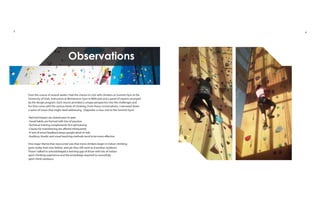
Over the course of several weeks I had the chance to visit with climbers at Summit Gym at the
University of Utah, instructors at Momentum Gym in Millcreek and a panel of experts arranged
by the design program. Each source provided a unique perspective into the challenges and
fun that come with the various kinds of climbing. From those conversations, I narrowed down
a series of issues that might need addressing. (Opposite: a class visit to the Summit Gym)
-Bad techniques are shared peer to peer
-Good habits are formed with lots of practice
-Technical training complements first aid training
-Classes for transitioning are offered infrequently
-A lack of event feedback keeps people aloof of risks
-Auditory, kinetic and visual teaching methods tend to be more effective
One major theme that reoccurred was that more climbers begin in indoor climbing
gyms today than ever before, and yet they still want to transition outdoors.
Those I talked to acknowledged a learning gap of those with lots of indoor
sport climbing experience and the knowledge required to sucessfully
sport climb outdoors.
Observations
3 4
There is so much I need to
read up on.
I need to look at all my
options again.
Trip preparationAcquisitionResearch Climb Take down Reset
Research
AcquiresgearChecksoutgear
Startsplanning
trip
Finishesplanning
trip
Packgear
Load
gearTravelto
clim
bing
site
PackgearUnloadscar
ApproachPutson
gear
W
arm
up
exercises
Setsup
top
rope
and
belaysystem
Beginsclim
bing
Reachestop
Descends
Takesoff
gear
Re-packgearand
inventory
Reverse
approach
Reload
car
Go
hom
eUnload
carUnpackbag
/second
inventory
Replenish
equipm
ent
Visitsoutdoorshops
Visitsonline
retailer’sw
ebsite
Talksto
friends
Talksto
gym
staff
Confidence in climbing Emotion throughout trip
Pain point:
Trip planning becomes
overwhelming
Pain point:
Realization at cost of gear
Pain point:
Anxiety about
preparedness
Highlight:
Finally acquiring gear
Highlight:
First climb of the day Highlight:
Rest and
reassurance in
climbing ability
Pain point:
Uncertainty about new setting
I feel much better now that
I have everything.
I can finally relax for a
moment before everything
gets crazy again.
I should double check that
I have all the right gear.
Will I need this? I should
pack extra just in case.
Wishing she had a more
experienced climber to
come along.
Feeling apprehensive.
Feeling good about the
first climb.
This is a lot less predictable
than what I’ve done in the
gym.
Feeling satisfied.
I need to make sure I
remember what I wished
I had.
I want to double check
that I repacked all my gear.
Feeling relieved.
Feeling ready to practice
more technique in the
gym.
I’m ready to go and get
those other items I’ll need.
Problem
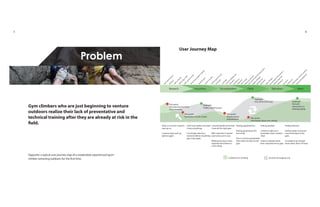
Opposite: a typical user journey map of a moderately experienced sport
climber venturing outdoors for the first time.
Gym climbers who are just beginning to venture
outdoors realize their lack of preventative and
technical training after they are already at risk in the
field.
User Journey Map
5 6
How Might We?
SamComputer Programmer
“Climbing outdoors is going to be
a lot different than what I do in the
gym. I want to be prepared before I
get there.”
Age 32
Sam is a California native who Recently moved to Utah County after
accepting a new job at Adobe.
1 1098765432
1 1098765432
Goals:
-Stay safe
-Talk to experts who know the sport
-Don’t let the preparation consume
free time
-Have fun with friends
Concerns:
-Inexperience
-Not knowing the terrain
-No technique classes available
before the trip
1 1098765432
JordanCollege Student
Age 21
“I’m a pretty confident climber.
My friends do this all the time,
and I doubt I’ll need much
preparation.”
1 1098765432
1 1098765432
Goals:
-Don’t break the bank on gear
-Having a good time with
friends
-Minimize stress while on break
Concerns:
-Remote location of climbs
-Cost of personal equipment
-Reliability of friend’s knowledge
1 1098765432
Years of climbing experience:
Confidence in climbing outdoors:
Willingness to prepare:
Years of climbing experience:
Confidence in climbing outdoors:
Willingness to prepare:
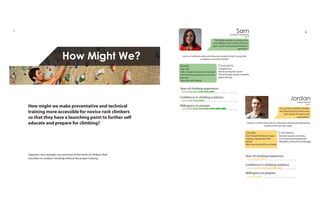
Opposite: two example user personas of the kinds of climbers that
transition to outdoor climbing without the proper training.
How might we make preventative and technical
training more accessible for novice rock climbers
so that they have a launching point to further self
educate and prepare for climbing? Jordan is a Utah native who is a third year mechanical engineering
student in the Salt Lake valley.
7 8
Ideation
As I hashed out as many possible ideas that could introduce preventative and technical
training to novice sport climbers, I began to notice three major trends. First, technical products
that worked to maximize the traditional first aid kit and similar products. Second, experience
and interactive solutions that were significantly more involved with more users coming
together to deliver the experience. And third, tools of communication to convey to climbers
series of lessons, techniques or etiquette typically in a written format.
After an initial exploration of tools of communication, the clear choice was experiential
solutions. The later path offered more opportunity to engage the playful and social nature of
climbers, as well as opening a venue to share accurate climbing techniques.
Of the initial ideas, climbers I spoke to responded most positively to the solutions
that were interactive and game-like. Prior to the mid term reviews, I had
conversations with instructors who said falling technique may be an
avenue of particular interest to explore.
Technical Aid Products
Experience/
Interactive Solutions
Tools of
Communication
109
Development
and Refinement
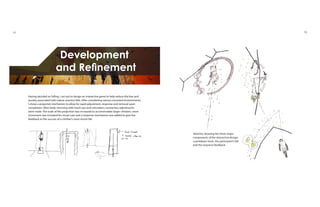
Having decided on falling, I set out to design an interactive game to help reduce the fear and
anxiety associated with indoor practice falls. After considering various mounted environments,
I chose a projected mechanism to allow for rapid adjustment, response and removal upon
completion. After body storming with mock-ups and volunteers, several key adjustments
were made. The scale of the projection was increased to accommodate larger climbers, more
movement was included for visual cues and a response mechanism was added to give live
feedback to the success of a climber’s most recent fall.
Sketches showing the three major
components of the interactive design:
countdown timer, the participant’s fall
and the response feedback.
11 12
Brand and Image
In order to accommodate the large upfront cost of the design’s
installation (computer, software, high quality projector) it made sense
to align with a brand that already specialized in climbing education
and one that did so through an interactive experience. The natural
choice was Access Fund’s Rock Project Tour-- a two day event that tours
half a dozen cities each year in order to promote crag stewardship
and good climbing technique. Each tour gives significant curriculum
leeway to local climbing instructors and encourages fun, and
competitive climbing in order to teach best practices.
Rock Project Tour uses reds, oranges, greens and yellows in its
branding along with a distinctive 45 degree cut to its photos. After
exploring project light onto multi-colored surfaces, it was clear that
the projects needed to be sharp, bold and high contrast.
(Opposite: a series of images used to convey the mood and design of
the final product).
13 14
Final Representation
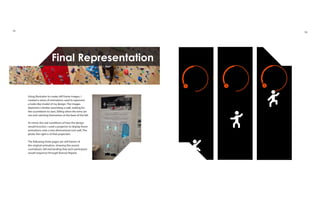
Using illustrator to create still frame images, I
created a series of animations used to represent
a looks-like model of my design. The images
depicted a climber assending a wall, waiting for
the countdown to start, falling when the time ran
out and catching themselves at the base of the fall.
To mimic the real conditions of how the design
would function, I used a projector to display these
animations onto a two dimensional rock wall. The
photo the right is of that projection.
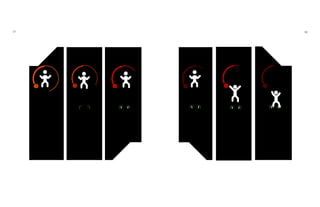
The following three pages are still frames of
the original animation, showing the ascent,
countdown, fall and landing that each participant
would sequence through Runout Repeat.
15 16
17 18
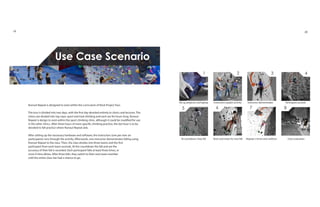
1 2 3 4
5 6 7 8
Set up projector and laptop Instructors explain activity Instructor demonstrates Participant ascends
At countdown, they fall Rests and resets for next fall Repeats 3 times and swithces Class evaluation
Use Case Scenario
Runout Repeat is designed to exist within the curriculum of Rock Project Tour.
The tour is divided into two days, with the first day devoted entirely to clinics and lectures. The
clinics are divided into top rope, sport and trad climbing and each are for hours long. Runout
Repeat is design to exist within the sport climbing clinic, although it could be modified for use
in the other clinics. After three hours of more specific climbing practice, the last hour is to be
devoted to fall practice where Runout Repeat aids.
After setting up the necessary hardware and software, the instructors (one per ever six
participants) runs through the activity. Afterwards, one instructor demonstrates falling using
Runout Repeat to the class. Then, the class divides into three teams and the first
participant from each team ascends. At the countdown the fall and are the
accuracy of their fall is recorded. Each participant falls at least three times, or
more if time allows. After three falls, they switch to their next team member
until the entire class has had a chance to go.
19 20
Implementation
The structured nature of Rock Project Tour allows for Runout Repeat to be scaled significantly
without any significant modifications. Several important points on implementation are
included below:
-Runout Repeat is included in Saturday’s Sport Climbing session
-Up to 25 participants per session
-2 to 4 designated instructors
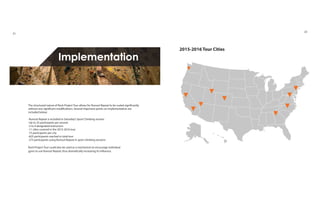
-11 cities covered in the 2015-2016 tour
-75 participants per city
-825 participants reached in total tour
-275 participants using Runout Repeat in sport climbing sessions
Rock Project Tour could also be used as a mechanism to encourage individual
gyms to use Runout Repeat, thus dramatically increasing its influence.
2015-2016 Tour Cities
21
22
Next Steps
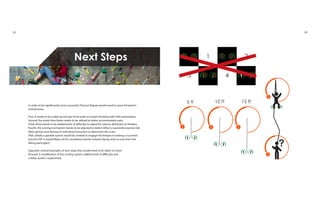
5 ft 10 ft 15 ft
?
2
3 4
1
In order to be significantly more successful, Runout Repeat would need to move forward in
several areas.
First, it needs to be scaled up full size to be used on actual climbing walls with participants.
Second, the event time frame needs to be refined to better accommodate users.
Third, there needs to be added levels of difficulty to adjust for various skill levels of climbers.
Fourth, the scoring mechanism needs to be adjusted to better reflect a successful practice fall,
likely giving more leeway to individual instructors to determine the score.
Fifth, ideally a parallel system would be created to engage the belayer in making a sucessful
practice fall. It would likely not be countdown based, instead relying only on cues from the
falling participant.
Opposite: several examples of next steps that would need to be taken to move
forward. A modification of the scoring system, added levels of difficulty and
a belay system, respectively.
23 24
Reflection
Overall, I was happy with my overall presentation. I was worried that I was cramming too much
information into my posters and minimizing the important parts. Having my projection took
up quite a bit of space, but I think it was definitely key in explaining my project. I outlined what
I wanted to say before hand and I think that help guide my oral presentation. The audience
seemed to receive the presentation well. They really liked the brand alignment and the idea of
augmented climbing. They emphasised how helpful the animation was in understanding the
key concepts.
Like my midterm review, I would have liked to have shown some of my prototypes that lead up
to my final design. Although, like my final my prototypes were animations and especially the
first few iterations wouldn’t have made any sense as still frame images. If the jurors
asked about them, I had them ready to go on my flash drive to display, but that
didn’t happen. I also realized when making my poster the week prior that I
hadn’t documented my body storming sessions with photos and I didn’t
have a good way to represent my testing phase.
Some of the major critiques were that jurors weren’t sure where I was pushing climbers to
take risk and where I was keeping them in their comfort zone. In my mind, Runout Repeat was
an obvious transition from comfort to taking risk, but I think I need to be more exact in how
that risk is taken and by what degree. Another comment was how this project would look if
it didn’t use projections, ergo after the project moves on. While I think that is likely important
big picture, it is somewhat outside the scope of my project. There was a few comments about
expanding this to include highlighting the route to ascend to the start position and to include
the belayer. I think both of those are definitely worth exploring. Some of the comments that
were inquiring about scope of the project seemed to assume that this was a relatively stand
alone activity even in the larger picture. Something I would have liked to clarify is exactly what
the time frame looks like for this activity and how it is integrated into a whole curriculum of
stewardship and safety training. Some of the positive feedback probably stemmed from it
being a fairly unique play on preventative aid and training. I was worried that it was getting to
be on the fringes of aid design, but the jurors reacted pretty positively to the concept overall.
From this project, I’ve learned the paramount need to really understand the needs, wants and
culture of the user. I think that more than anything was surprising to me. This project has been
vastly different from my typical view of designing for the masses. Personal preference plays a
huge roll in how I design, and user culture is extremely important to get any of these designs
off the ground. This project has also taught me what successful research looks like. It also
taught me how specific, in depth and important it is to have accurate research behind you to
inform your moves when iterating. Compared to other design studios I’ve taken, this project
has given me a sense of scale about how much work goes into the first problem statement all
the way to implementation. It was a bit overwhelming when I realized probably a week or so
after spring break how much work would need to be done, but it definitely gave me a better 	
idea of all the moving parts that come together to get a design produced.
25 26
DES 4010 - Process Book 1.03

DES 4010 - Process Book 1.03

  • 1.
  • 2.
    Table of Contents 3.Observations 5. Problem 11. Developement and Refinement 13. Brand + Image Board 15. Final Design Representation 19. Use Case Scenario 21. Implementation 25. Reflection 7. How Might We? 9. Ideation 23. Next Steps
  • 3.
    Over the courseof several weeks I had the chance to visit with climbers at Summit Gym at the University of Utah, instructors at Momentum Gym in Millcreek and a panel of experts arranged by the design program. Each source provided a unique perspective into the challenges and fun that come with the various kinds of climbing. From those conversations, I narrowed down a series of issues that might need addressing. (Opposite: a class visit to the Summit Gym) -Bad techniques are shared peer to peer -Good habits are formed with lots of practice -Technical training complements first aid training -Classes for transitioning are offered infrequently -A lack of event feedback keeps people aloof of risks -Auditory, kinetic and visual teaching methods tend to be more effective One major theme that reoccurred was that more climbers begin in indoor climbing gyms today than ever before, and yet they still want to transition outdoors. Those I talked to acknowledged a learning gap of those with lots of indoor sport climbing experience and the knowledge required to sucessfully sport climb outdoors. Observations 3 4
  • 4.
    There is somuch I need to read up on. I need to look at all my options again. Trip preparationAcquisitionResearch Climb Take down Reset Research AcquiresgearChecksoutgear Startsplanning trip Finishesplanning trip Packgear Load gearTravelto clim bing site PackgearUnloadscar ApproachPutson gear W arm up exercises Setsup top rope and belaysystem Beginsclim bing Reachestop Descends Takesoff gear Re-packgearand inventory Reverse approach Reload car Go hom eUnload carUnpackbag /second inventory Replenish equipm ent Visitsoutdoorshops Visitsonline retailer’sw ebsite Talksto friends Talksto gym staff Confidence in climbing Emotion throughout trip Pain point: Trip planning becomes overwhelming Pain point: Realization at cost of gear Pain point: Anxiety about preparedness Highlight: Finally acquiring gear Highlight: First climb of the day Highlight: Rest and reassurance in climbing ability Pain point: Uncertainty about new setting I feel much better now that I have everything. I can finally relax for a moment before everything gets crazy again. I should double check that I have all the right gear. Will I need this? I should pack extra just in case. Wishing she had a more experienced climber to come along. Feeling apprehensive. Feeling good about the first climb. This is a lot less predictable than what I’ve done in the gym. Feeling satisfied. I need to make sure I remember what I wished I had. I want to double check that I repacked all my gear. Feeling relieved. Feeling ready to practice more technique in the gym. I’m ready to go and get those other items I’ll need. Problem Opposite: a typical user journey map of a moderately experienced sport climber venturing outdoors for the first time. Gym climbers who are just beginning to venture outdoors realize their lack of preventative and technical training after they are already at risk in the field. User Journey Map 5 6
  • 5.
    How Might We? SamComputerProgrammer “Climbing outdoors is going to be a lot different than what I do in the gym. I want to be prepared before I get there.” Age 32 Sam is a California native who Recently moved to Utah County after accepting a new job at Adobe. 1 1098765432 1 1098765432 Goals: -Stay safe -Talk to experts who know the sport -Don’t let the preparation consume free time -Have fun with friends Concerns: -Inexperience -Not knowing the terrain -No technique classes available before the trip 1 1098765432 JordanCollege Student Age 21 “I’m a pretty confident climber. My friends do this all the time, and I doubt I’ll need much preparation.” 1 1098765432 1 1098765432 Goals: -Don’t break the bank on gear -Having a good time with friends -Minimize stress while on break Concerns: -Remote location of climbs -Cost of personal equipment -Reliability of friend’s knowledge 1 1098765432 Years of climbing experience: Confidence in climbing outdoors: Willingness to prepare: Years of climbing experience: Confidence in climbing outdoors: Willingness to prepare: Opposite: two example user personas of the kinds of climbers that transition to outdoor climbing without the proper training. How might we make preventative and technical training more accessible for novice rock climbers so that they have a launching point to further self educate and prepare for climbing? Jordan is a Utah native who is a third year mechanical engineering student in the Salt Lake valley. 7 8
  • 6.
    Ideation As I hashedout as many possible ideas that could introduce preventative and technical training to novice sport climbers, I began to notice three major trends. First, technical products that worked to maximize the traditional first aid kit and similar products. Second, experience and interactive solutions that were significantly more involved with more users coming together to deliver the experience. And third, tools of communication to convey to climbers series of lessons, techniques or etiquette typically in a written format. After an initial exploration of tools of communication, the clear choice was experiential solutions. The later path offered more opportunity to engage the playful and social nature of climbers, as well as opening a venue to share accurate climbing techniques. Of the initial ideas, climbers I spoke to responded most positively to the solutions that were interactive and game-like. Prior to the mid term reviews, I had conversations with instructors who said falling technique may be an avenue of particular interest to explore. Technical Aid Products Experience/ Interactive Solutions Tools of Communication 109
  • 7.
    Development and Refinement Having decidedon falling, I set out to design an interactive game to help reduce the fear and anxiety associated with indoor practice falls. After considering various mounted environments, I chose a projected mechanism to allow for rapid adjustment, response and removal upon completion. After body storming with mock-ups and volunteers, several key adjustments were made. The scale of the projection was increased to accommodate larger climbers, more movement was included for visual cues and a response mechanism was added to give live feedback to the success of a climber’s most recent fall. Sketches showing the three major components of the interactive design: countdown timer, the participant’s fall and the response feedback. 11 12
  • 8.
    Brand and Image Inorder to accommodate the large upfront cost of the design’s installation (computer, software, high quality projector) it made sense to align with a brand that already specialized in climbing education and one that did so through an interactive experience. The natural choice was Access Fund’s Rock Project Tour-- a two day event that tours half a dozen cities each year in order to promote crag stewardship and good climbing technique. Each tour gives significant curriculum leeway to local climbing instructors and encourages fun, and competitive climbing in order to teach best practices. Rock Project Tour uses reds, oranges, greens and yellows in its branding along with a distinctive 45 degree cut to its photos. After exploring project light onto multi-colored surfaces, it was clear that the projects needed to be sharp, bold and high contrast. (Opposite: a series of images used to convey the mood and design of the final product). 13 14
  • 9.
    Final Representation Using illustratorto create still frame images, I created a series of animations used to represent a looks-like model of my design. The images depicted a climber assending a wall, waiting for the countdown to start, falling when the time ran out and catching themselves at the base of the fall. To mimic the real conditions of how the design would function, I used a projector to display these animations onto a two dimensional rock wall. The photo the right is of that projection. The following three pages are still frames of the original animation, showing the ascent, countdown, fall and landing that each participant would sequence through Runout Repeat. 15 16
  • 10.
  • 11.
    1 2 34 5 6 7 8 Set up projector and laptop Instructors explain activity Instructor demonstrates Participant ascends At countdown, they fall Rests and resets for next fall Repeats 3 times and swithces Class evaluation Use Case Scenario Runout Repeat is designed to exist within the curriculum of Rock Project Tour. The tour is divided into two days, with the first day devoted entirely to clinics and lectures. The clinics are divided into top rope, sport and trad climbing and each are for hours long. Runout Repeat is design to exist within the sport climbing clinic, although it could be modified for use in the other clinics. After three hours of more specific climbing practice, the last hour is to be devoted to fall practice where Runout Repeat aids. After setting up the necessary hardware and software, the instructors (one per ever six participants) runs through the activity. Afterwards, one instructor demonstrates falling using Runout Repeat to the class. Then, the class divides into three teams and the first participant from each team ascends. At the countdown the fall and are the accuracy of their fall is recorded. Each participant falls at least three times, or more if time allows. After three falls, they switch to their next team member until the entire class has had a chance to go. 19 20
  • 12.
    Implementation The structured natureof Rock Project Tour allows for Runout Repeat to be scaled significantly without any significant modifications. Several important points on implementation are included below: -Runout Repeat is included in Saturday’s Sport Climbing session -Up to 25 participants per session -2 to 4 designated instructors -11 cities covered in the 2015-2016 tour -75 participants per city -825 participants reached in total tour -275 participants using Runout Repeat in sport climbing sessions Rock Project Tour could also be used as a mechanism to encourage individual gyms to use Runout Repeat, thus dramatically increasing its influence. 2015-2016 Tour Cities 21 22
  • 13.
    Next Steps 5 ft10 ft 15 ft ? 2 3 4 1 In order to be significantly more successful, Runout Repeat would need to move forward in several areas. First, it needs to be scaled up full size to be used on actual climbing walls with participants. Second, the event time frame needs to be refined to better accommodate users. Third, there needs to be added levels of difficulty to adjust for various skill levels of climbers. Fourth, the scoring mechanism needs to be adjusted to better reflect a successful practice fall, likely giving more leeway to individual instructors to determine the score. Fifth, ideally a parallel system would be created to engage the belayer in making a sucessful practice fall. It would likely not be countdown based, instead relying only on cues from the falling participant. Opposite: several examples of next steps that would need to be taken to move forward. A modification of the scoring system, added levels of difficulty and a belay system, respectively. 23 24
  • 14.
    Reflection Overall, I washappy with my overall presentation. I was worried that I was cramming too much information into my posters and minimizing the important parts. Having my projection took up quite a bit of space, but I think it was definitely key in explaining my project. I outlined what I wanted to say before hand and I think that help guide my oral presentation. The audience seemed to receive the presentation well. They really liked the brand alignment and the idea of augmented climbing. They emphasised how helpful the animation was in understanding the key concepts. Like my midterm review, I would have liked to have shown some of my prototypes that lead up to my final design. Although, like my final my prototypes were animations and especially the first few iterations wouldn’t have made any sense as still frame images. If the jurors asked about them, I had them ready to go on my flash drive to display, but that didn’t happen. I also realized when making my poster the week prior that I hadn’t documented my body storming sessions with photos and I didn’t have a good way to represent my testing phase. Some of the major critiques were that jurors weren’t sure where I was pushing climbers to take risk and where I was keeping them in their comfort zone. In my mind, Runout Repeat was an obvious transition from comfort to taking risk, but I think I need to be more exact in how that risk is taken and by what degree. Another comment was how this project would look if it didn’t use projections, ergo after the project moves on. While I think that is likely important big picture, it is somewhat outside the scope of my project. There was a few comments about expanding this to include highlighting the route to ascend to the start position and to include the belayer. I think both of those are definitely worth exploring. Some of the comments that were inquiring about scope of the project seemed to assume that this was a relatively stand alone activity even in the larger picture. Something I would have liked to clarify is exactly what the time frame looks like for this activity and how it is integrated into a whole curriculum of stewardship and safety training. Some of the positive feedback probably stemmed from it being a fairly unique play on preventative aid and training. I was worried that it was getting to be on the fringes of aid design, but the jurors reacted pretty positively to the concept overall. From this project, I’ve learned the paramount need to really understand the needs, wants and culture of the user. I think that more than anything was surprising to me. This project has been vastly different from my typical view of designing for the masses. Personal preference plays a huge roll in how I design, and user culture is extremely important to get any of these designs off the ground. This project has also taught me what successful research looks like. It also taught me how specific, in depth and important it is to have accurate research behind you to inform your moves when iterating. Compared to other design studios I’ve taken, this project has given me a sense of scale about how much work goes into the first problem statement all the way to implementation. It was a bit overwhelming when I realized probably a week or so after spring break how much work would need to be done, but it definitely gave me a better idea of all the moving parts that come together to get a design produced. 25 26