



Depository System
By- Abdul Khalique
MBA 2nd Year
What is Depository?
• A depository holds securities of investors in
electronic form.
• A system in which securities of an investor are held
by depository on behalf, and at the request, of an
investor in an electronic form.
• This system is also known as Scrip Less Trading
System or Paper-Less Trading System.
Need for Depository
• Before introduction of Depository system, the
problems faced by investors and corporate in
handling large volume of paper were as follows:
• Fake Certificates.
• Loss of certificates in transit.
• Delays in transfer
• Long settlement cycles.
• Mismatch of signatures
At present 10 Stock Exchanges are
connected to the Depositories:
• NSE
• BSE
• Kolkata Stock Exchange.
• Delhi SE
• Ludhiana SE
• Bangalore SE
• Over the counter exchange of India.
• Inter connected SE
• Ahmedabad SE.
Features of Depository System
• In the depository system, securities are held in depository
accounts, which is more or less similar to holding funds in
bank accounts.
• Transfer of ownership of securities is done through
simple account transfers.
• This method does away with all the risks and hassles
normally associated with paperwork.
• Consequently, the cost of transacting in a depository
environment is considerably lower as compared to
transacting in certificates.
Depository System in India
At present two Depositories are registered with SEBI.
• NSDL (National Securities Depository Limited) - It was
registered by the SEBI on June 7, 1996 as India’s first
Depository to facilitate trading and settlement of
securities in the demat form. It is promoted by IDBI,
UTI, NSE.
• CDSL (Central Depository Services (India) Limited) - It
commenced its operations during Feb 1999 and was
promoted by Stock Exchange, Mumbai in association with
Bank
Constituents of Depository System
There are basically four participant:
• The Depository Participants
• The Depository
• The Issuing Company
• The Beneficial Owner
Depository Participant:
• A Depository Participant (DP) is an agent of the
depository through which it interfaces with an
investor.
• A DP can offer depository services only after it gets
proper registration from SEBI.
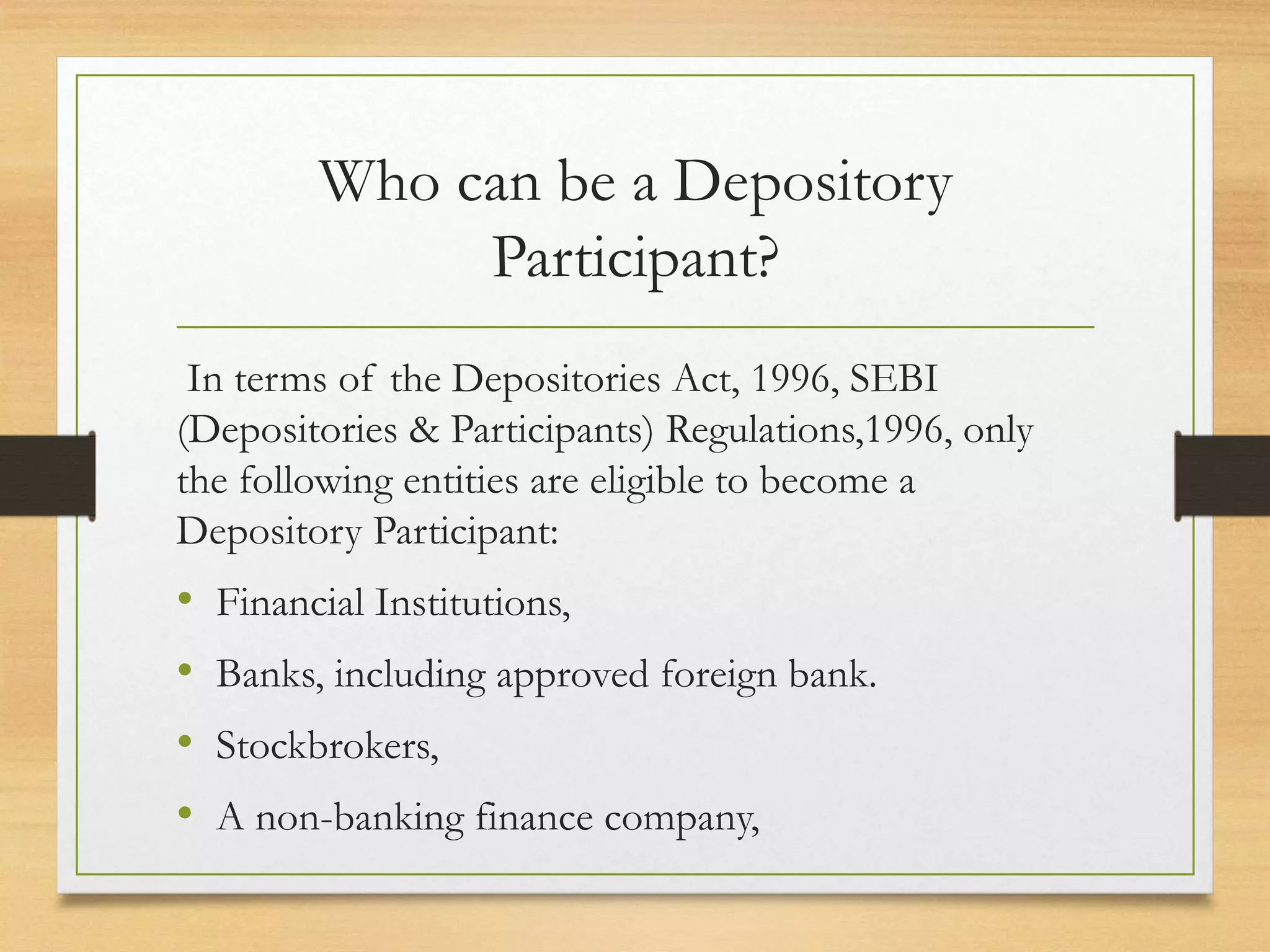
Who can be a Depository
Participant?
In terms of the Depositories Act, 1996, SEBI
(Depositories & Participants) Regulations,1996, only
the following entities are eligible to become a
Depository Participant:
• Financial Institutions,
• Banks, including approved foreign bank.
• Stockbrokers,
• A non-banking finance company,
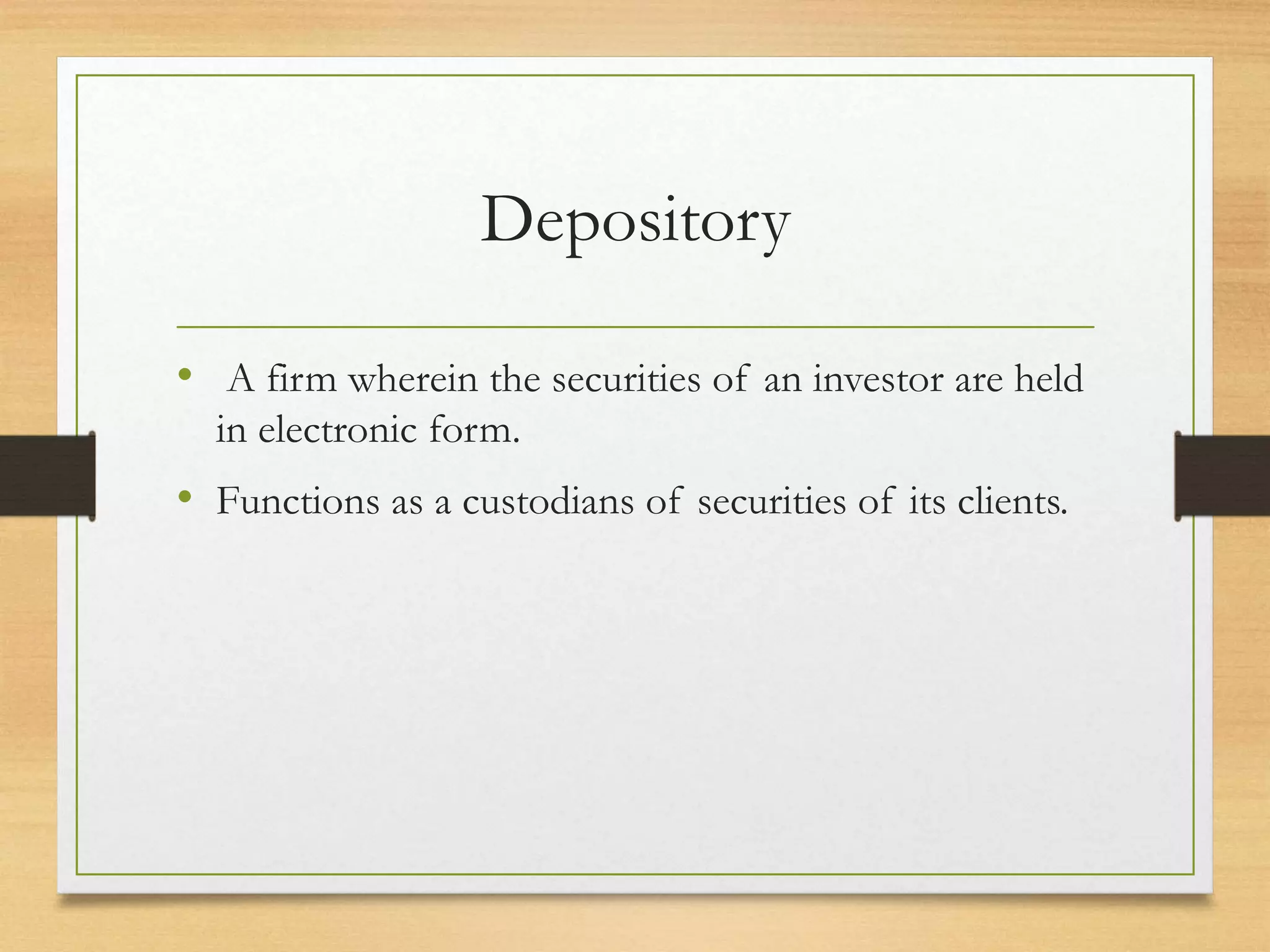
Depository
• A firm wherein the securities of an investor are held
in electronic form.
• Functions as a custodians of securities of its clients.
Issuer
• The company which issues security.
• Agreement by issuer
Beneficial Owner
• A person whose name is recorded as such with a
depository.
• Real owner of the securities.
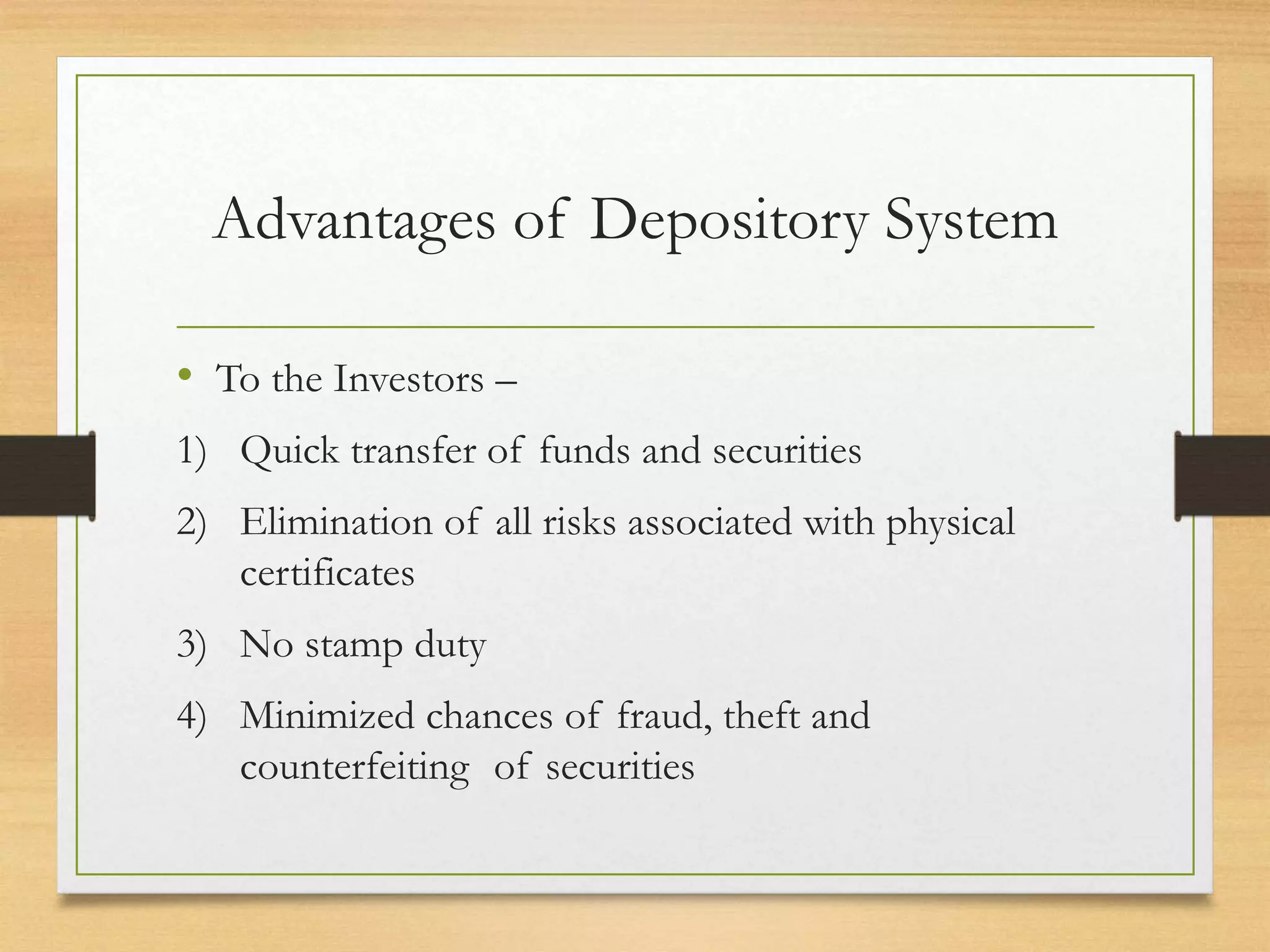
Advantages of Depository System
• To the Investors –
1) Quick transfer of funds and securities
2) Elimination of all risks associated with physical
certificates
3) No stamp duty
4) Minimized chances of fraud, theft and
counterfeiting of securities
Cont…
5) Provides insurance cover
6) Statement of accounts
7) Direct disbursement of non-cash benefits
8) Faster settlement cycle
9) Reduction in brokerage
Cont…
• To the Company:
1) Information about the beneficiary owners and their
holdings.
2) Easy to declare dividends, bonus, etc.
3) Reduction in investors complaints
4) No delays in sending notices and annual reports
Depository system

Depository system

  • 1.
    Depository System By- AbdulKhalique MBA 2nd Year
  • 2.
    What is Depository? •A depository holds securities of investors in electronic form. • A system in which securities of an investor are held by depository on behalf, and at the request, of an investor in an electronic form. • This system is also known as Scrip Less Trading System or Paper-Less Trading System.
  • 3.
    Need for Depository •Before introduction of Depository system, the problems faced by investors and corporate in handling large volume of paper were as follows: • Fake Certificates. • Loss of certificates in transit. • Delays in transfer • Long settlement cycles. • Mismatch of signatures
  • 4.
    At present 10Stock Exchanges are connected to the Depositories: • NSE • BSE • Kolkata Stock Exchange. • Delhi SE • Ludhiana SE • Bangalore SE • Over the counter exchange of India. • Inter connected SE • Ahmedabad SE.
  • 5.
    Features of DepositorySystem • In the depository system, securities are held in depository accounts, which is more or less similar to holding funds in bank accounts. • Transfer of ownership of securities is done through simple account transfers. • This method does away with all the risks and hassles normally associated with paperwork. • Consequently, the cost of transacting in a depository environment is considerably lower as compared to transacting in certificates.
  • 6.
    Depository System inIndia At present two Depositories are registered with SEBI. • NSDL (National Securities Depository Limited) - It was registered by the SEBI on June 7, 1996 as India’s first Depository to facilitate trading and settlement of securities in the demat form. It is promoted by IDBI, UTI, NSE. • CDSL (Central Depository Services (India) Limited) - It commenced its operations during Feb 1999 and was promoted by Stock Exchange, Mumbai in association with Bank
  • 7.
    Constituents of DepositorySystem There are basically four participant: • The Depository Participants • The Depository • The Issuing Company • The Beneficial Owner
  • 8.
    Depository Participant: • ADepository Participant (DP) is an agent of the depository through which it interfaces with an investor. • A DP can offer depository services only after it gets proper registration from SEBI.
  • 9.
    Who can bea Depository Participant? In terms of the Depositories Act, 1996, SEBI (Depositories & Participants) Regulations,1996, only the following entities are eligible to become a Depository Participant: • Financial Institutions, • Banks, including approved foreign bank. • Stockbrokers, • A non-banking finance company,
  • 10.
    Depository • A firmwherein the securities of an investor are held in electronic form. • Functions as a custodians of securities of its clients.
  • 11.
    Issuer • The companywhich issues security. • Agreement by issuer
  • 12.
    Beneficial Owner • Aperson whose name is recorded as such with a depository. • Real owner of the securities.
  • 13.
    Advantages of DepositorySystem • To the Investors – 1) Quick transfer of funds and securities 2) Elimination of all risks associated with physical certificates 3) No stamp duty 4) Minimized chances of fraud, theft and counterfeiting of securities
  • 14.
    Cont… 5) Provides insurancecover 6) Statement of accounts 7) Direct disbursement of non-cash benefits 8) Faster settlement cycle 9) Reduction in brokerage
  • 15.
    Cont… • To theCompany: 1) Information about the beneficiary owners and their holdings. 2) Easy to declare dividends, bonus, etc. 3) Reduction in investors complaints 4) No delays in sending notices and annual reports