Deming’s PDCA
and Constant Learning
Deming’s Message
“The cause of inefficiency and poor quality is the
system, not the employees and it is
management’s responsibility to correct the
system in order to achieve desired results.”
Message to Japanese Management
1. Production must be seen as a system
encompassing customers and suppliers in a win-
win situation.
– Customer is the most important part of the system
– Suppliers are partners
2. Quality is made in the boardroom – never blame
the workers.
Message to Japanese Management
3. Improving a process creates a chain reaction.
4. Continuous learning and improvement follow the
PCDA (Shewhart) cycle.
5. There is a need for trust and cooperation between
companies.
PDCA
PDCA
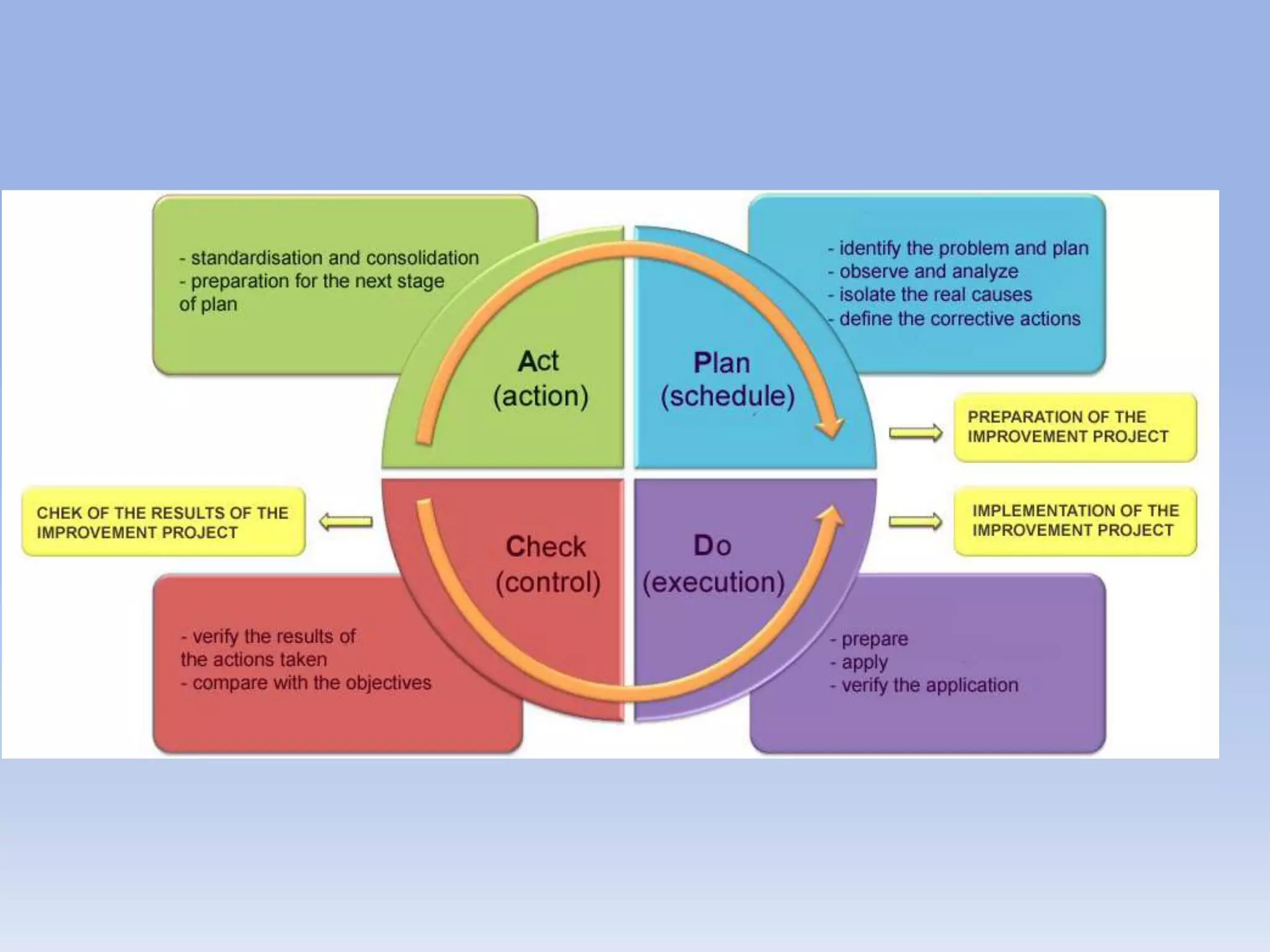
• Plan – Do- Check – Act
• a.k.a Deming Wheel
• “problem faced” to “problem solved”
• originally by Shewhart but promoted by
Deming
• used to coordinate continuous improvement
When to use PDCA
• As a model for continuous improvement.
• When starting a new improvement project.
• When developing a new or improved design of
a process, product or service.
When to use PDCA
• When defining a repetitive work process.
• When planning data collection and analysis in
order to verify and prioritize problems or root
causes.
• When implementing any change.
PDCA Guide Questions
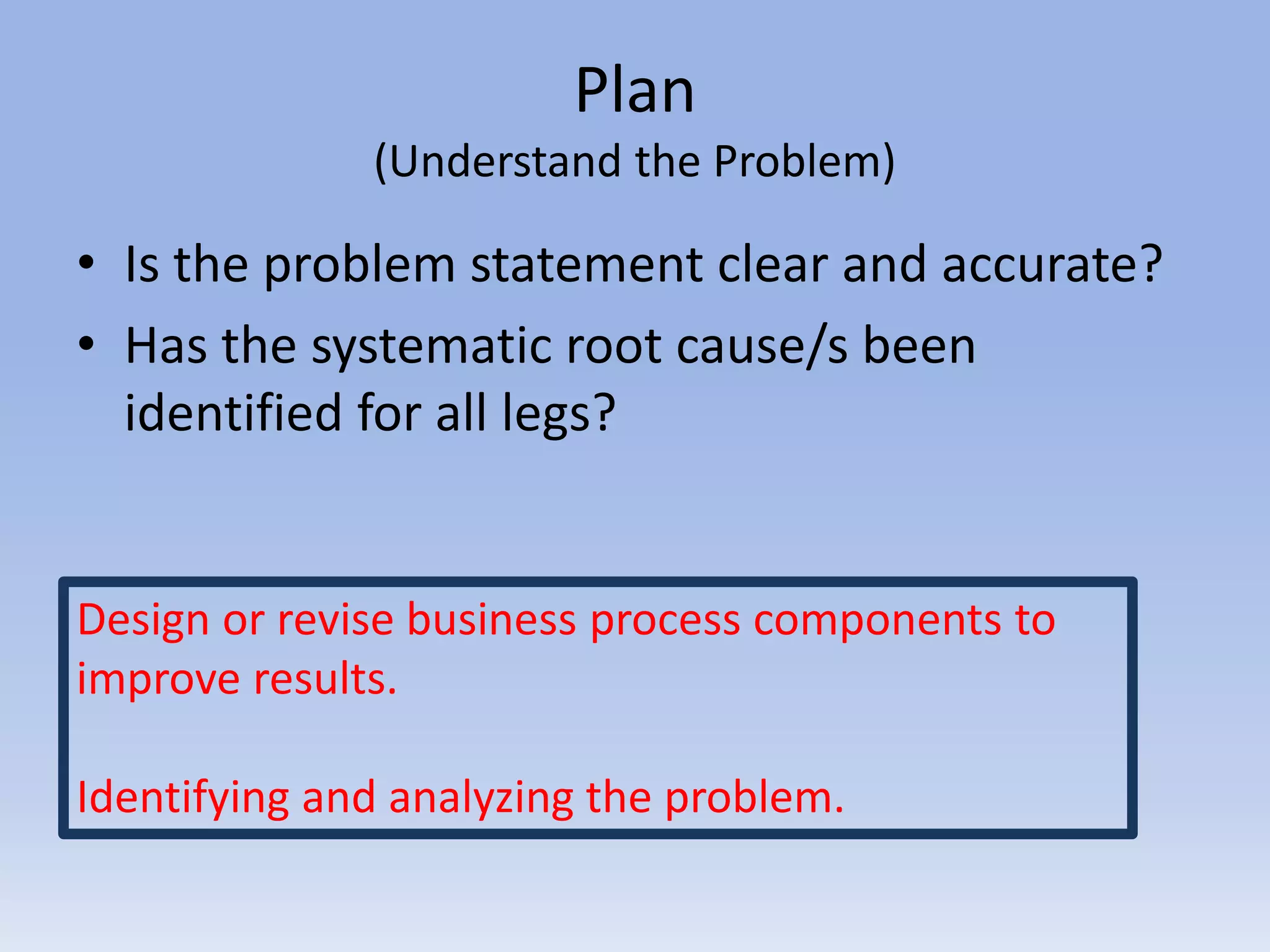
Plan
(Understand the Problem)
• Is the problem statement clear and accurate?
• Has the systematic root cause/s been
identified for all legs?
Design or revise business process components to
improve results.
Identifying and analyzing the problem.
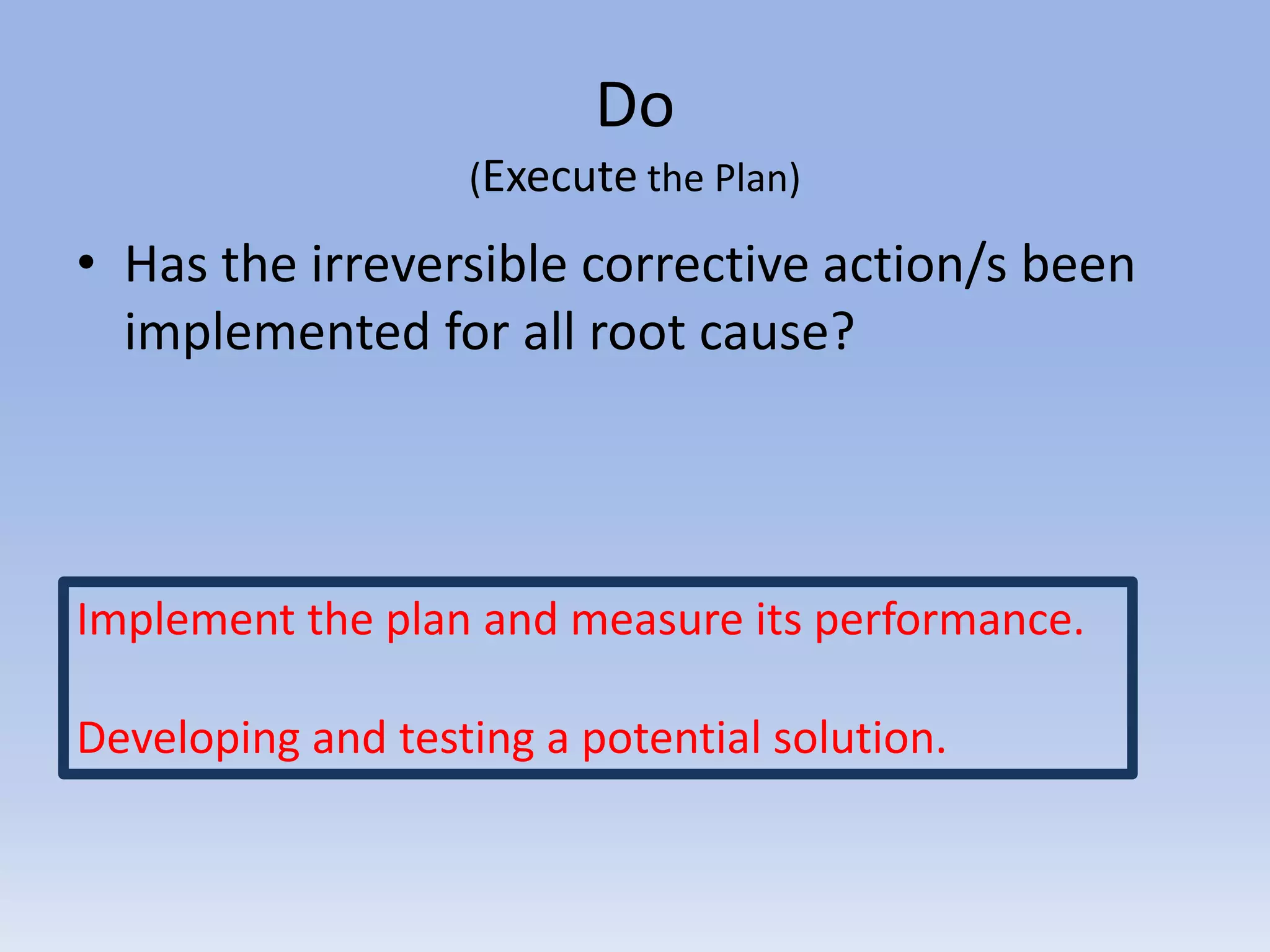
Do
(Execute the Plan)
• Has the irreversible corrective action/s been
implemented for all root cause?
Implement the plan and measure its performance.
Developing and testing a potential solution.
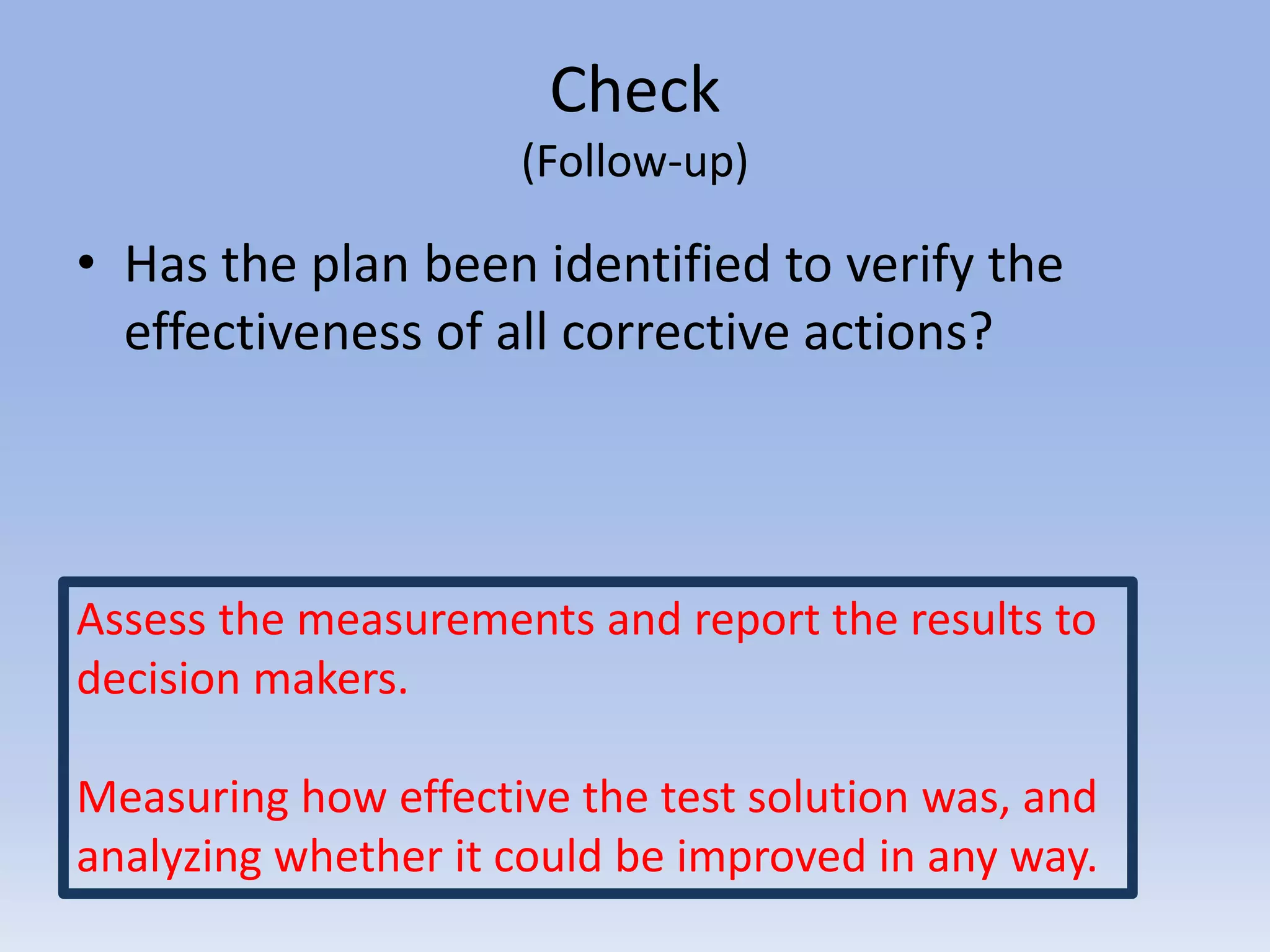
Check
(Follow-up)
• Has the plan been identified to verify the
effectiveness of all corrective actions?
Assess the measurements and report the results to
decision makers.
Measuring how effective the test solution was, and
analyzing whether it could be improved in any way.
Act
(Standardize)
• Has the plan identified been standardized to
take all lessons learned across products,
processes, plants, functional areas, etc?
Decide on changes needed to improve the process.
Implementing the improved solution fully.
CONSTANT LEARNING
Before Hiring
• rigorous pre-employment screening
Before Working
• rigorous pre-work training
Retrain on the Job
• Define the job
• Setting an appointment
• Feedback
• Learning style
• Communication
video
ACTIVITY
• In groups of 4, you will be given a scenario and
apply Deming’s PDCA and Constant Learning
through simulation.
• 30 minutes = preparation
– Social Services
– Medical Clinic
ASSIGNMENT
• STUDY well on Deming’s 14 Principles for
Management

Deming’s PDCA and Constant Learning

  • 1.
  • 2.
    Deming’s Message “The causeof inefficiency and poor quality is the system, not the employees and it is management’s responsibility to correct the system in order to achieve desired results.”
  • 3.
    Message to JapaneseManagement 1. Production must be seen as a system encompassing customers and suppliers in a win- win situation. – Customer is the most important part of the system – Suppliers are partners 2. Quality is made in the boardroom – never blame the workers.
  • 4.
    Message to JapaneseManagement 3. Improving a process creates a chain reaction. 4. Continuous learning and improvement follow the PCDA (Shewhart) cycle. 5. There is a need for trust and cooperation between companies.
  • 5.
  • 6.
    PDCA • Plan –Do- Check – Act • a.k.a Deming Wheel • “problem faced” to “problem solved” • originally by Shewhart but promoted by Deming • used to coordinate continuous improvement
  • 7.
    When to usePDCA • As a model for continuous improvement. • When starting a new improvement project. • When developing a new or improved design of a process, product or service.
  • 8.
    When to usePDCA • When defining a repetitive work process. • When planning data collection and analysis in order to verify and prioritize problems or root causes. • When implementing any change.
  • 10.
  • 11.
    Plan (Understand the Problem) •Is the problem statement clear and accurate? • Has the systematic root cause/s been identified for all legs? Design or revise business process components to improve results. Identifying and analyzing the problem.
  • 12.
    Do (Execute the Plan) •Has the irreversible corrective action/s been implemented for all root cause? Implement the plan and measure its performance. Developing and testing a potential solution.
  • 13.
    Check (Follow-up) • Has theplan been identified to verify the effectiveness of all corrective actions? Assess the measurements and report the results to decision makers. Measuring how effective the test solution was, and analyzing whether it could be improved in any way.
  • 14.
    Act (Standardize) • Has theplan identified been standardized to take all lessons learned across products, processes, plants, functional areas, etc? Decide on changes needed to improve the process. Implementing the improved solution fully.
  • 15.
  • 16.
    Before Hiring • rigorouspre-employment screening
  • 17.
    Before Working • rigorouspre-work training
  • 18.
    Retrain on theJob • Define the job • Setting an appointment • Feedback • Learning style • Communication
  • 19.
  • 20.
    ACTIVITY • In groupsof 4, you will be given a scenario and apply Deming’s PDCA and Constant Learning through simulation. • 30 minutes = preparation – Social Services – Medical Clinic
  • 21.
    ASSIGNMENT • STUDY wellon Deming’s 14 Principles for Management