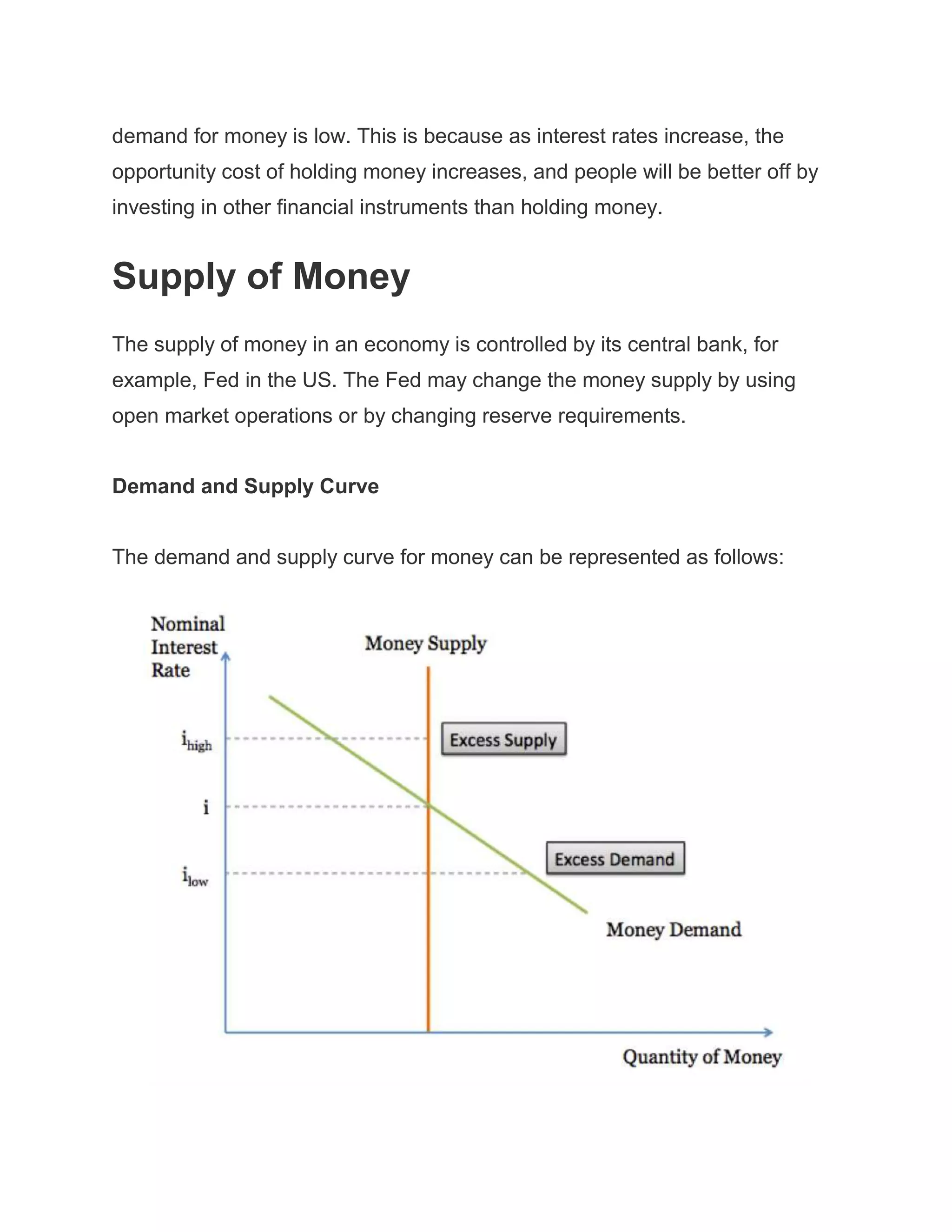
The demand for money refers to the total amount of wealth held by households and companies and is affected by factors like income, interest rates, inflation, and uncertainty. There are three primary reasons for holding money: transactions, precautionary needs, and speculative motives. The demand for money and interest rates have an inverse relationship, as higher interest rates increase the opportunity cost of holding money. A central bank like the Federal Reserve controls the money supply through open market operations and reserve requirements and can influence interest rates by adjusting the money supply. The money demand curve slopes downward as demand increases with lower interest rates, while the money supply curve is completely inelastic. The equilibrium interest rate is determined by the intersection of the money demand and supply curves.