Women @ Work 2023
A Global Outlook
© 2023. For information, contact Deloitte Touche Tohmatsu Limited. 2
A letter from Michele Parmelee
and Emma Codd
Now in its third year, Deloitte’s Women @ Work: A Global Outlook report explores the
experiences of 5,000 working women across 10 countries.
Our 2022 report painted a deeply concerning picture: a significant number of women reported
experiencing burnout, non-inclusive behaviors in a workplace context, and challenges while
hybrid working. This perhaps explains why our 2023 report finds that more women left their
employer in the past 12 months than in 2020 and 2021 combined.
However, this year’s report offers some glimpses of improvement. Rates of burnout have
dropped. Non-inclusive behaviors have declined. And women are reporting more positive
experiences with hybrid work.
While this is encouraging news, an overwhelming number of women around the world still face
these challenges. And our data shows that other factors have worsened. The number of
women who feel unable to switch off from work has increased, indicating an ever-growing
“always on” culture. And the number of women who feel comfortable disclosing mental health
concerns to their employer has decreased—despite more than a third of women rating their
mental health as poor/very poor.
This year’s research also shed light on the stigma that continues to exist around women’s
health. One in five respondents revealed they experience health challenges related to
menstruation or menopause. A startling number of these women work through any symptoms,
pain, or discomfort, and, for those who do take time off work, many don’t feel comfortable
disclosing these challenges as the reason.
Women want more flexibility—not only around where they work, but when they work—but
they still aren’t getting it. Lack of flexibility was one of the top-cited reasons for women who
chose to leave their employer in the past 12 months. And many don’t feel able to ask for
flexible working arrangements, with an overwhelming majority of women feeling that doing
so would affect their career progression. Meanwhile, women continue to have a significant
workload at home, with the majority of women bearing the most responsibility for household
tasks.
Our 2023 research shows that despite some improvements over the past year, many women
are still not getting what they want or need from their employers. They are clear on what will
make a difference in helping them thrive at work—and it’s equally clear what actions they
will take if they don’t receive this. We hope that this report provides employers with rich
and valuable insights into the experiences of working women and enables them to take
much-needed action to truly embed gender equality in the workplace.
Michele Parmelee
Deputy CEO and Chief People
& Purpose Officer
Deloitte Global
Emma Codd
Global Inclusion Leader
Deloitte Global
© 2023. For information, contact Deloitte Touche Tohmatsu Limited. 3
Executive summary
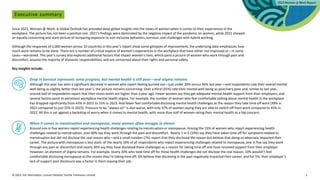
Since 2021, Women @ Work: A Global Outlook has provided deep global insights into the views of women when it comes to their experiences in the
workplace. The picture has not been a positive one: 2021’s findings were dominated by the negative impact of the pandemic on women, while 2022 showed
an equally concerning and stark picture of increasing exposure to non-inclusive behaviors, burnout, and challenges with hybrid working.
Although the responses of 5,000 women across 10 countries in this year’s report show some glimpses of improvement, the underlying data emphasizes how
much work remains to be done. There are a number of critical aspects of women’s experiences in the workplace that have either not improved or—in some
cases—worsened. This year’s survey also explores additional factors that impact women’s lives, which paint a picture of women who work through pain and
discomfort, assume the majority of domestic responsibilities, and are concerned about their rights and personal safety.
Key insights include:
Drop in burnout represents some progress, but mental health is still poor—and stigma remains
Although this year has seen a significant decrease in women who report feeling burned out—just under 30% versus 46% last year—and respondents rate their overall mental
well-being as slightly better than last year’s, the picture remains concerning. Over a third (35%) rate their mental well-being as poor/very poor and, similar to last year,
around half of respondents report that their stress levels are higher than a year ago. Fewer women say they get adequate mental health support from their employers, and
several factors point to persistent workplace mental health stigma. For example, the number of women who feel comfortable talking about mental health in the workplace
has dropped significantly from 43% in 2022 to 25% in 2023. And fewer feel comfortable disclosing mental health challenges as the reason they take time off work (39% in
2022 compared to just 25% in 2023). Pressure to be “always on” is also worse, with only 37% of women saying they are able to switch off from work compared to 45% in
2022. All this is set against a backdrop of worry when it comes to mental health, with more than half of women rating their mental health as a top concern.
When it comes to menstruation and menopause, many women often struggle in silence
Around one in five women report experiencing health challenges relating to menstruation or menopause. Among the 15% of women who report experiencing health
challenges related to menstruation, over 40% say they work through the pain and discomfort. Nearly 1 in 5 (19%) say they have taken time off for symptoms related to
menstruation but did not disclose the real reason why—and a small number (7%) report that they disclosed the reason but believe that doing so adversely impacted their
career. The picture with menopause is less stark: of the nearly 10% of all respondents who report experiencing challenges related to menopause, one in five say they work
through any pain or discomfort and nearly 30% say they have disclosed these challenges as a reason for taking time off and have received support from their employer.
However, an element of stigma remains. For example, nearly 20% who took time off for these health challenges did not disclose the real reason, 10% wouldn’t feel
comfortable disclosing menopause as the reason they’re taking time off, 6% believe that disclosing in the past negatively impacted their career, and for 5%, their employer’s
lack of support post disclosure was a factor in them leaving their job.
© 2023. For information, contact Deloitte Touche Tohmatsu Limited. 4
Executive summary
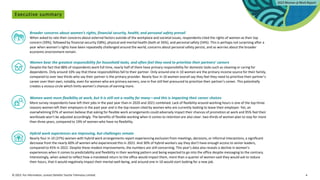
Broader concerns about women’s rights, financial security, health, and personal safety prevail
When asked to rate their concerns about external factors outside of the workplace and societal issues, respondents cited the rights of women as their top
concern (59%), followed by financial security (58%), physical and mental health (both at 56%), and personal safety (54%). This is perhaps not surprising after a
year when women’s rights have been repeatedly challenged around the world, concerns about personal safety persist, and as worries about the broader
economic environment remain.
Women bear the greatest responsibility for household tasks, and often feel they need to prioritize their partners’ careers
Despite the fact that 88% of respondents work full time, nearly half of them have primary responsibility for domestic tasks such as cleaning or caring for
dependents. Only around 10% say that these responsibilities fall to their partner. Only around one in 10 women are the primary income source for their family,
compared to over two thirds who say their partner is the primary provider. Nearly four in 10 women overall say they feel they need to prioritize their partner’s
career over their own; notably, even for women who are primary earners, one in five still feel pressured to prioritize their partner’s career. This potentially
creates a vicious circle which limits women’s chances of earning more.
Women want more flexibility at work, but it is still not a reality for many—and this is impacting their career choices
More survey respondents have left their jobs in the past year than in 2020 and 2021 combined. Lack of flexibility around working hours is one of the top three
reasons women left their employers in the past year and is the top reason cited by women who are currently looking to leave their employer. Yet, an
overwhelming 97% of women believe that asking for flexible work arrangements could adversely impact their chances of promotion at work and 95% feel their
workloads won’t be adjusted accordingly. The benefits of flexible working when it comes to retention are also clear: two-thirds of women plan to stay for more
than three years, compared to 19% of women who have no flexibility.
Hybrid work experiences are improving, but challenges remain
Nearly four in 10 (37%) women with hybrid work arrangements report experiencing exclusion from meetings, decisions, or informal interactions, a significant
decrease from the nearly 60% of women who experienced this in 2022. And 30% of hybrid workers say they don’t have enough access to senior leaders,
compared to 45% in 2022. Despite these modest improvements, the numbers are still concerning. This year’s data also reveals a decline in women’s
experiences when it comes to predictability and flexibility in their working pattern and being expected to go into the office despite messaging to the contrary.
Interestingly, when asked to reflect how a mandated return to the office would impact them, more than a quarter of women said they would ask to reduce
their hours, that it would negatively impact their mental well-being, and around one in 10 would start looking for a new job.
© 2023. For information, contact Deloitte Touche Tohmatsu Limited. 5
Executive summary
Women are still experiencing non-inclusive behaviors—and many are still not reporting them to their employers
Forty-four percent of respondents reported experiencing harassment and/or microaggressions in the workplace over the past year. While this is a significant
decrease from the 59% who reported this in 2022 (and 52% in 2021), it remains that nearly half of women have experienced this behavior. Similar to last year,
the majority of behaviors experienced were microaggressions, but this year reporting of these behaviors has increased, with 44% reporting the experience to
their employer—a notable increase from 23% in 2022. However, among those who experienced harassment, there has been a decrease in reporting those
experiences to their employers, with only 59% reporting it to their employer versus 66% in 2022. The top reason women gave for not reporting non-inclusive
behaviors to their employer was that they didn’t feel the behavior was serious enough to report.
Women in under-represented groups still face more challenges in the workplace
Similar to the previous two reports, the 2023 research found that women in under-represented groups face more significant challenges than the overall sample
when it comes to mental health, non-inclusive behaviors, work/life balance, and burnout. For example, while they are more concerned about their mental health,
they are less likely to feel that they will get adequate support from their employer, to take time off from work for mental health reasons, or to feel comfortable
disclosing mental health as a reason for taking time off work. When it comes to non-inclusive behaviors, more than half (54%) report experiencing microaggressions
in the workplace, compared with 39% of the overall sample, and 13% report experiencing harassment, compared with 9% of the overall sample. These experiences
may help explain why our research also found that women in under-represented groups feel less favorably about their employer: nearly half of these respondents
say they would not recommend their employer to others.
Gender Equality Leaders remain few and far between
The proportion of women who work for Gender Equality Leaders—organizations that, according to the responses of the women surveyed, foster inclusive cultures
that support them and promote mental well-being—remains at 5%, the same as last year. Women who work for Gender Equality Leaders continue to report more
positive mental health, are more likely to recommend their employer to others, have a working pattern that they are happy with, and are less likely to experience
non-inclusive behaviors. They are also less likely to work through symptoms relating to menstruation and menopause. These women all plan to stay longer with their
employer—none of the women surveyed who work for Gender Equality Leaders were looking for a new role and nearly 70% plan to stay with their current employer
for three years or more.
© 2023. For information, contact Deloitte Touche Tohmatsu Limited. 6
Table of contents
1. Amid glimpses of progress, women’s mental health is still poor—
and stigma remains
2. When it comes to women’s health, many are suffering in silence
3. Factors outside of the workplace also take a toll
4. Women are seeking more flexibility and making career choices
accordingly
5. Hybrid working is getting better—for some
6. Non-inclusive behaviors remain but are declining—and more
women are reporting microaggressions to their employers
7. The Gender Equality Leaders are benefiting from doing it right
1
Amid glimpses of progress,
women’s mental health is still
poor—and stigma remains
© 2023. For information, contact Deloitte Touche Tohmatsu Limited. 8
Signs of progress
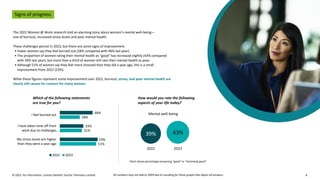
The 2022 Women @ Work research told an alarming story about women’s mental well-being—
one of burnout, increased stress levels and poor mental health.
These challenges persist in 2023, but there are some signs of improvement.
• Fewer women say they feel burned out (28% compared with 46% last year).
• The proportion of women rating their mental health as "good" has increased slightly (43% compared
with 39% last year), but more than a third of women still rate their mental health as poor.
• Although 51% of women say they feel more stressed than they did a year ago, this is a small
improvement from 2022 (53%).
While these figures represent some improvement over 2022, burnout, stress, and poor mental health are
clearly still causes for concern for many women.
Which of the following statements
are true for you?
51%
31%
28%
53%
33%
46%
My stress levels are higher
than they were a year ago
I have taken time off from
work due to challenges…
I feel burned out
2022 2023
How would you rate the following
aspects of your life today?
Mental well-being
39%
2022
43%
2023
Chart shows percentage answering "good" or “extremely good”
All numbers may not add to 100% due to rounding for those graphs that depict all answers.
© 2023. For information, contact Deloitte Touche Tohmatsu Limited. 9
Mental and physical health still a concern
and women are struggling to switch off
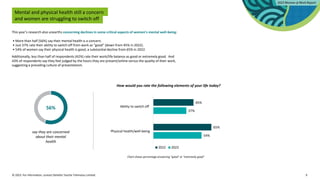
This year’s research also unearths concerning declines in some critical aspects of women’s mental well-being:
• More than half (56%) say their mental health is a concern.
• Just 37% rate their ability to switch off from work as “good” (down from 45% in 2022).
• 54% of women say their physical health is good, a substantial decline from 65% in 2022.
Additionally, less than half of respondents (42%) rate their work/life balance as good or extremely good. And
43% of respondents say they feel judged by the hours they are present/online versus the quality of their work,
suggesting a prevailing culture of presenteeism.
56%
say they are concerned
about their mental
health
How would you rate the following elements of your life today?
54%
37%
65%
45%
Physical health/well-being
Ability to switch off
2022 2023
Chart shows percentage answering "good" or “extremely good”
© 2023. For information, contact Deloitte Touche Tohmatsu Limited. 10
Fewer women feel comfortable discussing or
disclosing their mental health at work
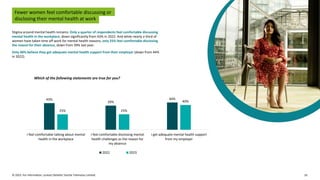
Stigma around mental health remains: Only a quarter of respondents feel comfortable discussing
mental health in the workplace, down significantly from 43% in 2022. And while nearly a third of
women have taken time off work for mental health reasons, only 25% feel comfortable disclosing
the reason for their absence, down from 39% last year.
Only 40% believe they get adequate mental health support from their employer (down from 44%
in 2022).
Which of the following statements are true for you?
43%
39%
44%
25% 25%
40%
I feel comfortable talking about mental
health in the workplace
I feel comfortable disclosing mental
health challenges as the reason for
my absence
I get adequate mental health support
from my employer
2022 2023
© 2023. For information, contact Deloitte Touche Tohmatsu Limited. 11
Women in ethnic minority groups are
facing higher levels of burnout
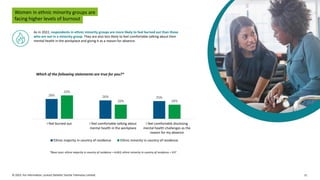
As in 2022, respondents in ethnic minority groups are more likely to feel burned out than those
who are not in a minority group. They are also less likely to feel comfortable talking about their
mental health in the workplace and giving it as a reason for absence.
Which of the following statements are true for you?*
28% 26% 25%
33%
20% 20%
I feel burned out I feel comfortable talking about
mental health in the workplace
I feel comfortable disclosing
mental health challenges as the
reason for my absence
Ethnic majority in country of residence Ethnic minority in country of residence
*Base sizes: ethnic majority in country of residence = 4,663; ethnic minority in country of residence = 337
2
When it comes to women’s
health, many are suffering
in silence
© 2023. For information, contact Deloitte Touche Tohmatsu Limited. 13
Women who experience challenges related to their
menstrual health often work through their symptoms
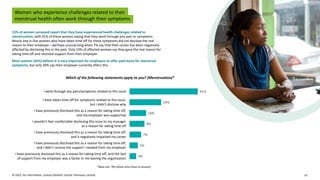
15% of women surveyed report that they have experienced health challenges related to
menstruation, with 41% of these women saying that they work through any pain or symptoms.
Nearly one in five women who have taken time off for these symptoms did not disclose the real
reason to their employer—perhaps unsurprising when 7% say that their career has been negatively
affected by disclosing this in the past. Only 10% of affected women say they gave the real reason for
taking time off and received support from their employer.
Most women (56%) believe it is very important for employers to offer paid leave for menstrual
symptoms, but only 30% say their employer currently offers this.
Which of the following statements apply to you? (Menstruation)*
4%
5%
7%
9%
10%
19%
41%
I have previously disclosed this as a reason for taking time off, and the lack
of support from my employer was a factor in me leaving the organization
I have previously disclosed this as a reason for taking time off,
and I didn’t receive the support I needed from my employer
I have previously disclosed this as a reason for taking time off,
and it negatively impacted my career
I wouldn't feel comfortable disclosing this issue to my manager
as a reason for taking time off
I have previously disclosed this as a reason for taking time off,
and my employer was supportive
I have taken time off for symptoms related to this issue,
but I didn't disclose why
I work through any pain/symptoms related to this issue
*Base size: 765 (those who chose to answer)
© 2023. For information, contact Deloitte Touche Tohmatsu Limited. 14
Challenges related to menopause—is stigma declining?
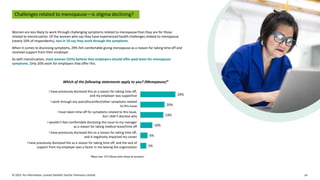
Women are less likely to work through challenging symptoms related to menopause than they are for those
related to menstruation. Of the women who say they have experienced health challenges related to menopause
(nearly 10% of respondents), two in 10 say they work through the symptoms.
When it comes to disclosing symptoms, 29% felt comfortable giving menopause as a reason for taking time off and
received support from their employer.
As with menstruation, most women (52%) believe that employers should offer paid leave for menopause
symptoms. Only 20% work for employers that offer this.
Which of the following statements apply to you? (Menopause)*
5%
6%
10%
19%
20%
29%
I have previously disclosed this as a reason for taking time off, and the lack of
support from my employer was a factor in me leaving the organization
I have previously disclosed this as a reason for taking time off,
and it negatively impacted my career
I wouldn't feel comfortable disclosing this issue to my manager
as a reason for taking medical leave/time off
I have taken time off for symptoms related to this issue,
but I didn't disclose why
I work through any pain/discomfort/other symptoms related
to this issue
I have previously disclosed this as a reason for taking time off,
and my employer was supportive
*Base size: 377 (those who chose to answer)
3
Factors outside of the
workplace also take a toll
© 2023. For information, contact Deloitte Touche Tohmatsu Limited. 16
Outside of the workplace, women’s rights, finances, health,
and personal safety are top concerns
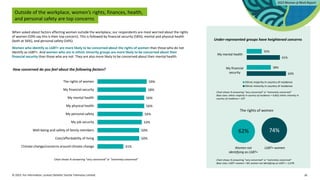
When asked about factors affecting women outside the workplace, our respondents are most worried about the rights
of women (59% say this is their top concern). This is followed by financial security (58%), mental and physical health
(both at 56%), and personal safety (54%).
Women who identify as LGBT+ are more likely to be concerned about the rights of women than those who do not
identify as LGBT+. And women who are in ethnic minority groups are more likely to be concerned about their
financial security than those who are not. They are also more likely to be concerned about their mental health.
How concerned do you feel about the following factors?
31%
50%
50%
53%
54%
56%
56%
58%
59%
Climate change/concerns around climate change
Cost/affordability of living
Well-being and safety of family members
My job security
My personal safety
My physical health
My mental health
My financial security
The rights of women
Chart shows % answering "very concerned" or “extremely concerned”
Under-represented groups have heightened concerns
63%
61%
58%
55%
My financial
security
My mental health
Ethnic majority in country of residence
Ethnic minority in country of residence
Chart shows % answering "very concerned" or “extremely concerned”
Base sizes: ethnic majority in country of residence = 4,663; ethnic minority in
country of residence = 337
The rights of women
62%
Women not
identifying as LGBT+
74%
LGBT+ women
Chart shows % answering "very concerned" or “extremely concerned”
Base sizes: LGBT+ women = 84; women not identifying as LGBT+ = 3,478
© 2023. For information, contact Deloitte Touche Tohmatsu Limited. 17
At home, women do most of the domestic work
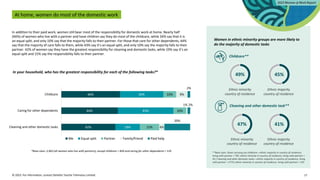
In addition to their paid work, women still bear most of the responsibility for domestic work at home. Nearly half
(46%) of women who live with a partner and have children say they do most of the childcare, while 34% say that it is
an equal split, and only 10% say that the majority falls to their partner. For those that care for other dependents, 44%
say that the majority of care falls to them, while 43% say it’s an equal split, and only 10% say the majority falls to their
partner. 42% of women say they have the greatest responsibility for cleaning and domestic tasks, while 19% say it’s an
equal split and 15% say the responsibility falls to their partner.
In your household, who has the greatest responsibility for each of the following tasks?*
42%
44%
46%
19%
43%
34%
15%
10%
10%
4%
1%
9%
20%
2%
2%
Cleaning and other domestic tasks
Caring for other dependents
Childcare
Me Equal split Partner Family/friend Paid help
*Base sizes: 2,963 (all women who live with partners), except childcare = 826 and caring for other dependents = 124
Women in ethnic minority groups are more likely to
do the majority of domestic tasks
Childcare**
49%
Ethnic minority
country of residence
45%
Ethnic majority
country of residence
Cleaning and other domestic task**
47%
Ethnic minority
country of residence
41%
Ethnic majority
country of residence
**Base sizes: those carrying out childcare—ethnic majority in country of residence,
living with partner = 781; ethnic minority in country of residence, living with partner =
45 / cleaning and other domestic tasks—ethnic majority in country of residence, living
with partner = 2772; ethnic minority in country of residence, living with partner = 191
© 2023. For information, contact Deloitte Touche Tohmatsu Limited. 18
Women are rarely the primary earners in a shared household,
and many feel the need to prioritize their partner’s career over their own
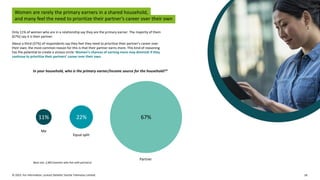
Only 11% of women who are in a relationship say they are the primary earner. The majority of them
(67%) say it is their partner.
About a third (37%) of respondents say they feel they need to prioritize their partner’s career over
their own; the most common reason for this is that their partner earns more. This kind of reasoning
has the potential to create a vicious circle: Women’s chances of earning more may diminish if they
continue to prioritize their partners’ career over their own.
In your household, who is the primary earner/income source for the household?*
11%
Me
22%
Equal split
67%
Partner
Base size: 2,963 (women who live with partners)
4
Women are seeking more
flexibility and making career
choices accordingly
© 2023. For information, contact Deloitte Touche Tohmatsu Limited. 20
Lack of flexibility in working hours is driving women to quit
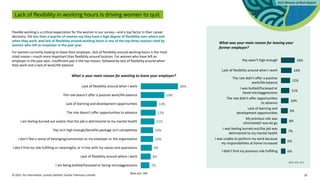
Flexible working is a critical expectation for the women in our survey—and a top factor in their career
decisions. Yet less than a quarter of women say they have a high degree of flexibility over where and
when they work, and lack of flexibility around working hours is one of the top three reasons cited by
women who left an employer in the past year.
For women currently looking to leave their employer, lack of flexibility around working hours is the most
cited reason—much more important than flexibility around location. For women who have left an
employer in the past year, insufficient pay is the top reason, followed by lack of flexibility around when
they work and a lack of work/life balance.
What is your main reason for wanting to leave your employer?
7%
8%
9%
10%
10%
11%
12%
13%
19%
30%
I am being bullied/harassed or facing microaggressions
Lack of flexibility around where I work
I don't find my role fulfilling or meaningful, or in line with my values and aspirations
I don't feel a sense of belonging/connection to my employer or the organization
Pay isn't high enough/benefits package isn't competitive
I am feeling burned out and/or that the job is detrimental to my mental health
The role doesn't offer opportunities to advance
Lack of learning and development opportunities
The role doesn't offer a positive work/life balance
Lack of flexibility around when I work
Base size: 260
What was your main reason for leaving your
former employer?
6%
6%
7%
8%
9%
10%
11%
12%
14%
18%
I didn't find my previous role fulfilling
I was unable to perform my work because
my responsibilities at home increased
I was feeling burned out/the job was
detrimental to my mental health
My previous role was
eliminated/I was let go
Lack of learning and
development opportunities
The role didn't offer opportunities
to advance
I was bullied/harassed or
faced microaggressions
The role didn't offer a positive
work/life balance
Lack of flexibility around when I work
Pay wasn't high enough
Base size: 912
© 2023. For information, contact Deloitte Touche Tohmatsu Limited. 21
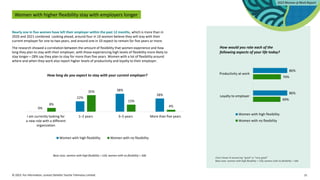
Women with higher flexibility stay with employers longer
Nearly one in five women have left their employer within the past 12 months, which is more than in
2020 and 2021 combined. Looking ahead, around four in 10 women believe they will stay with their
current employer for one to two years, and around one in 10 expect to remain for five years or more.
The research showed a correlation between the amount of flexibility that women experience and how
long they plan to stay with their employer, with those experiencing high levels of flexibility more likely to
stay longer—28% say they plan to stay for more than five years. Women with a lot of flexibility around
where and when they work also report higher levels of productivity and loyalty to their employer.
How long do you expect to stay with your current employer?
0%
22%
38%
28%
8%
35%
15%
4%
I am currently looking for
a new role with a different
organization
1–2 years 3–5 years More than five years
Women with high flexibility Women with no flexibility
Base sizes: women with high flexibility = 526; women with no flexibility = 506
How would you rate each of the
following aspects of your life today?
69%
70%
86%
86%
Loyalty to employer
Productivity at work
Women with high flexibility
Women with no flexibility
Chart shows % answering "good" or “very good”
Base sizes: women with high flexibility = 526; women with no flexibility = 506
© 2023. For information, contact Deloitte Touche Tohmatsu Limited. 22
Flexible working and positive work/life balance
seem out of reach
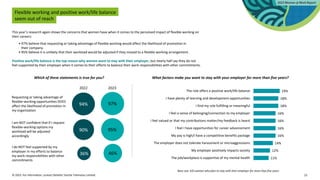
This year’s research again shows the concerns that women have when it comes to the perceived impact of flexible working on
their careers:
• 97% believe that requesting or taking advantage of flexible working would affect the likelihood of promotion in
their company.
• 95% believe it is unlikely that their workload would be adjusted if they moved to a flexible working arrangement.
Positive work/life balance is the top reason why women want to stay with their employer, but nearly half say they do not
feel supported by their employer when it comes to their efforts to balance their work responsibilities with other commitments.
Which of these statements is true for you?
2022 2023
Requesting or taking advantage of
flexible-working opportunities DOES
affect the likelihood of promotion in
my organization
94% 97%
I am NOT confident that if I request
flexible-working options my
workload will be adjusted
accordingly
90% 95%
I do NOT feel supported by my
employer in my efforts to balance
my work responsibilities with other
commitments
36% 46%
What factors make you want to stay with your employer for more than five years?
11%
12%
14%
16%
16%
16%
16%
18%
18%
19%
The job/workplace is supportive of my mental health
My employer positively impacts society
The employer does not tolerate harassment or microaggressions
My pay is high/I have a competitive benefits package
I feel I have opportunities for career advancement
I feel valued or that my contributions matter/my feedback is heard
I feel a sense of belonging/connection to my employer
I find my role fulfilling or meaningful
I have plenty of learning and development opportunities
The role offers a positive work/life balance
Base size: 435 women who plan to stay with their employer for more than five years
5
Hybrid working is getting
better—for some
© 2023. For information, contact Deloitte Touche Tohmatsu Limited. 24
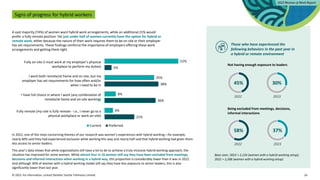
Signs of progress for hybrid workers
A vast majority (74%) of women want hybrid work arrangements, while an additional 21% would
prefer a fully remote position. Yet just under half of women currently have the option for hybrid or
remote work, either because the nature of their work requires them to be on site or their employer
has set requirements. These findings reinforce the importance of employers offering these work
arrangements and getting them right.
21%
36%
38%
5%
6%
8%
35%
52%
Fully remote (my role is fully remote - i.e., I never go to a
physical workplace or work on-site)
I have full choice in where I work (any combination of
remote/at home and on-site working)
I work both remote/at home and on site, but my
employer has set requirements for how often and/or
when I need to be in
Fully on-site (I must work at my employer's physical
workplace to perform my duties)
Current Preferred
In 2022, one of the most concerning themes of our research was women’s experiences with hybrid working—for example,
nearly 60% said they had experienced exclusion while working this way and nearly half said that hybrid working had given them
less access to senior leaders.
This year’s data shows that while organizations still have a lot to do to achieve a truly inclusive hybrid working approach, the
situation has improved for some women. While almost four in 10 women still say they have been excluded from meetings,
decisions and informal interactions when working in a hybrid way, this proportion is considerably lower than it was in 2022.
And although 30% of women with a hybrid working model still say they have less exposure to senior leaders, this is also
significantly lower than last year.
Those who have experienced the
following behaviors in the past year in
a hybrid or remote environment
Not having enough exposure to leaders
45%
2022
30%
2023
Being excluded from meetings, decisions,
informal interactions
58%
2022
37%
2023
Base sizes: 2023 = 2,126 (women with a hybrid working setup);
2022 = 2,208 (women with a hybrid working setup)
© 2023. For information, contact Deloitte Touche Tohmatsu Limited. 25
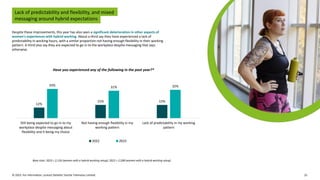
Lack of predictability and flexibility, and mixed
messaging around hybrid expectations
Despite these improvements, this year has also seen a significant deterioration in other aspects of
women's experiences with hybrid working. About a third say they have experienced a lack of
predictability in working hours, with a similar proportion not having enough flexibility in their working
pattern. A third also say they are expected to go in to the workplace despite messaging that says
otherwise.
Have you experienced any of the following in the past year?*
12%
15% 15%
33% 31% 32%
Still being expected to go in to my
workplace despite messaging about
flexibility and it being my choice
Not having enough flexibility in my
working pattern
Lack of predictability in my working
pattern
2022 2023
Base sizes: 2023 = 2,126 (women with a hybrid working setup); 2022 = 2,208 (women with a hybrid working setup)
6
Non-inclusive behaviors remain
but are declining—and more
women are reporting
microaggressions to their
employers
© 2023. For information, contact Deloitte Touche Tohmatsu Limited. 27
Non-inclusive behaviors have fallen, but LGBT+ women are much
more likely to experience them
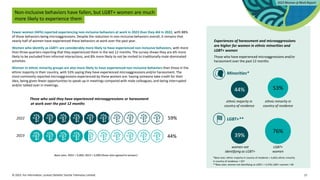
Fewer women (44%) reported experiencing non-inclusive behaviors at work in 2023 than they did in 2022, with 88%
of those behaviors being microaggressions. Despite the reduction in non-inclusive behaviors overall, it remains that
nearly half of women have experienced these behaviors at work over the past year.
Women who identify as LGBT+ are considerably more likely to have experienced non-inclusive behaviors, with more
than three-quarters reporting that they experienced them in the last 12 months. The survey shows they are 6% more
likely to be excluded from informal interactions, and 8% more likely to not be invited to traditionally male-dominated
activities.
Women in ethnic minority groups are also more likely to have experienced non-inclusive behaviors than those in the
ethnic majority in their country, with 53% saying they have experienced microaggressions and/or harassment. The
most commonly reported microaggressions experienced by these women are: having someone take credit for their
idea, being given fewer opportunities to speak up in meetings compared with male colleagues, and being interrupted
and/or talked over in meetings.
Those who said they have experienced microaggressions or harassment
at work over the past 12 months
2022 59%
2023 44%
Base sizes: 2022 = 5,000; 2023 = 5,000 (those who agreed to answer)
Experiences of harassment and microaggressions
are higher for women in ethnic minorities and
LGBT+ women
Those who have experienced microaggressions and/or
harassment over the past 12 months
Minorities*
44%
ethnic majority in
country of residence
53%
ethnic minority in
country of residence
LGBT+**
39%
women not
identifying as LGBT+
76%
LGBT+
women
*Base sizes: ethnic majority in country of residence = 4,663; ethnic minority
in country of residence = 337
**Base sizes: women not identifying as LGBT+ = 3,478; LGBT+ women = 84
© 2023. For information, contact Deloitte Touche Tohmatsu Limited. 28
More women are reporting microaggressions
to their employers
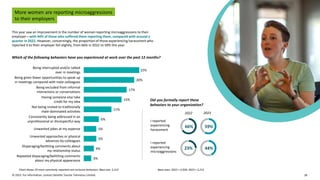
This year saw an improvement in the number of women reporting microaggressions to their
employer—with 44% of those who suffered them reporting them, compared with around a
quarter in 2022. However, concerningly, the proportion of those experiencing harassment who
reported it to their employer fell slightly, from 66% in 2022 to 59% this year.
Which of the following behaviors have you experienced at work over the past 12 months?
3%
4%
5%
5%
6%
11%
15%
17%
20%
22%
Repeated disparaging/belittling comments
about my physical appearance
Disparaging/belittling comments about
my relationship status
Unwanted approaches or physical
advances by colleagues
Unwanted jokes at my expense
Consistently being addressed in an
unprofessional or disrespectful way
Not being invited to traditionally
male-dominated activities
Having someone else take
credit for my idea
Being excluded from informal
interactions or conversations
Being given fewer opportunities to speak up
in meetings compared with male colleagues
Being interrupted and/or talked
over in meetings
Chart shows 10 most commonly reported non-inclusive behaviors. Base size: 2,212
Did you formally report these
behaviors to your organization?
2022 2023
I reported
experiencing
harassment
66% 59%
I reported
experiencing
microaggressions
23% 44%
Base sizes: 2022 = 2,939; 2023 = 2,212
© 2023. For information, contact Deloitte Touche Tohmatsu Limited. 29
Many feel that the harassment or microaggressions they
experienced weren't serious enough to report
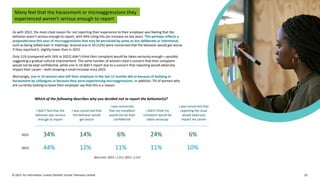
As with 2022, the most cited reason for not reporting their experience to their employer was feeling that the
behavior wasn’t serious enough to report, with 44% citing this (an increase on last year). This perhaps reflects a
preponderance this year of microaggressions that may be perceived by some as less deliberate or intentional,
such as being talked over in meetings. Around one in 10 (12%) were concerned that the behavior would get worse
if they reported it, slightly lower than in 2022.
Only 11% (compared with 24% in 2022) didn’t think their complaint would be taken seriously enough—possibly
suggesting a gradual cultural improvement. The same number of women cited a concern that their complaint
would not be kept confidential, while one in 10 didn’t report due to a concern that reporting would adversely
impact their career—both showing a small increase since 2022.
Worryingly, one in 10 women who left their employer in the last 12 months did so because of bullying or
harassment by colleagues or because they were experiencing microaggressions. In addition, 7% of women who
are currently looking to leave their employer say that this is a reason.
Which of the following describes why you decided not to report the behavior(s)?
2022
2023
I didn't feel that the
behavior was serious
enough to report
34%
44%
I was concerned that
the behavior would
get worse
14%
12%
I was concerned
that my complaint
would not be kept
confidential
6%
11%
I didn't think my
complaint would be
taken seriously
24%
11%
I was concerned that
reporting the issue
would adversely
impact my career
6%
10%
Base sizes: 2023 = 1,311; 2022 = 2,213
7
The Gender Equality
Leaders are benefiting
from doing it right
© 2023. For information, contact Deloitte Touche Tohmatsu Limited. 31
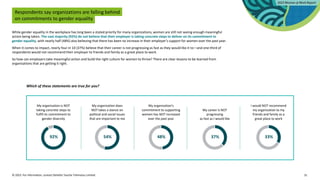
Respondents say organizations are falling behind
on commitments to gender equality
While gender equality in the workplace has long been a stated priority for many organizations, women are still not seeing enough meaningful
action being taken. The vast majority (92%) do not believe that their employer is taking concrete steps to deliver on its commitment to
gender equality, with nearly half (48%) also believing that there has been no increase in their employer’s support for women over the past year.
When it comes to impact, nearly four in 10 (37%) believe that their career is not progressing as fast as they would like it to—and one-third of
respondents would not recommend their employer to friends and family as a great place to work.
So how can employers take meaningful action and build the right culture for women to thrive? There are clear lessons to be learned from
organizations that are getting it right.
Which of these statements are true for you?
My organization is NOT
taking concrete steps to
fulfill its commitment to
gender diversity
92%
My organization does
NOT takes a stance on
political and social issues
that are important to me
54%
My organization's
commitment to supporting
women has NOT increased
over the past year
48%
My career is NOT
progressing
as fast as I would like
37%
I would NOT recommend
my organization to my
friends and family as a
great place to work
33%
© 2023. For information, contact Deloitte Touche Tohmatsu Limited. 32
Women who work for Gender Equality Leaders report
far higher levels of well-being and job satisfaction
As in the 2021 and 2022 research, we identified a group of organizations we call the Gender Equality Leaders. Women
who work for Gender Equality Leader organizations agree with the following:
Additionally, as in the past two years, our research also identified a group of “lagging” organizations. Women who
work for these organizations disagree with all of the above statements.
Though the proportion of women who work for Gender Equality Leaders and Gender Equality Lagging Organizations
remains the same as last year, once again the data demonstrates that women who work for Gender Equality Leaders
report far higher levels of well-being and job satisfaction.
I feel confident to report when I encounter non-inclusive behaviors and
microaggressions, without concern about career impact or reprisal
I feel supported by my employer in my efforts to balance my work responsibilities
with other commitments
My career is progressing as quickly as I would like
Gender Equality Leaders and Lagging Organizations
5%
24%
72%
Gender Equality Leaders
Gender Equality Lagging Organizations
Rest of sample
Base size: Gender Equality Leaders = 225; Gender Equality Lagging
Organizations = 1189
© 2023. For information, contact Deloitte Touche Tohmatsu Limited. 33
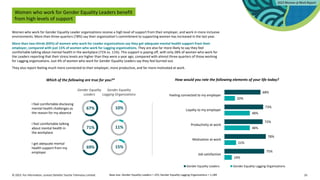
Women who work for Gender Equality Leaders benefit
from high levels of support
Women who work for Gender Equality Leader organizations receive a high level of support from their employer, and work in more inclusive
environments. More than three-quarters (78%) say their organization’s commitment to supporting women has increased in the last year.
More than two-thirds (69%) of women who work for Leader organizations say they get adequate mental health support from their
employer, compared with just 15% of women who work for Lagging organizations. They are also far more likely to say they feel
comfortable talking about mental health in the workplace (71% vs. 11%). This support is paying off, with only 28% of women who work for
the Leaders reporting that their stress levels are higher than they were a year ago, compared with almost three-quarters of those working
for Lagging organizations. Just 4% of women who work for Gender Equality Leaders say they feel burned out.
They also report feeling much more connected to their employer, more productive, and far more motivated at work.
Which of the following are true for you?*
Gender Equality
Leaders
Gender Equality
Lagging Organizations
I feel comfortable disclosing
mental health challenges as
the reason for my absence
67% 10%
I feel comfortable talking
about mental health in
the workplace
71% 11%
I get adequate mental
health support from my
employer
69% 15%
How would you rate the following elements of your life today?
14%
22%
48%
48%
20%
75%
78%
72%
73%
68%
Job satisfaction
Motivation at work
Productivity at work
Loyalty to my employer
Feeling connected to my employer
Gender Equality Leaders Gender Equality Lagging Organizations
Base size: Gender Equality Leaders = 225; Gender Equality Lagging Organizations = 1,189
© 2023. For information, contact Deloitte Touche Tohmatsu Limited. 34
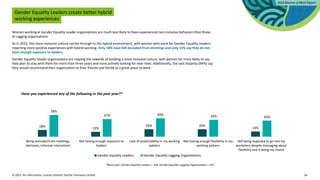
Gender Equality Leaders create better hybrid
working experiences
Women working at Gender Equality Leader organizations are much less likely to have experienced non-inclusive behaviors than those
at Lagging organizations.
As in 2022, this more inclusive culture carries through to the hybrid environment, with women who work for Gender Equality Leaders
reporting more positive experiences with hybrid working. Only 18% have felt excluded from meetings and only 13% say they do not
have enough exposure to leaders.
Gender Equality Leader organizations are reaping the rewards of building a more inclusive culture, with women far more likely to say
they plan to stay with them for more than three years and none actively looking for new roles. Additionally, the vast majority (94%) say
they would recommend their organization to their friends and family as a great place to work.
Have you experienced any of the following in the past year?*
18%
13%
20% 20%
14%
58%
47% 49% 45% 43%
Being excluded from meetings,
decisions, informal interactions
Not having enough exposure to
leaders
Lack of predictability in my working
pattern
Not having enough flexibility in my
working pattern
Still being expected to go into my
workplace despite messaging about
flexibility and it being my choice
Gender Equality Leaders Gender Equality Lagging Organizations
*Base sizes: Gender Equality Leaders = 164; Gender Equality Lagging Organizations = 235
© 2023. For information, contact Deloitte Touche Tohmatsu Limited. 35
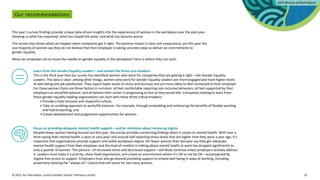
Our recommendations
This year’s survey findings provide unique data-driven insights into the experiences of women in the workplace over the past year,
showing us what has improved, what has stayed the same, and what has become worse.
The survey also shows what can happen when companies get it right. The positive impact is clear and unequivocal, yet this year the
vast majority of women say they do not believe that their employer is taking concrete steps to deliver on commitments to
gender equality.
What can employers do to move the needle on gender equality in the workplace? Here is where they can start:
Learn from the Gender Equality Leaders—and embed the three core enablers
This is the third year that our survey has identified women who work for companies that are getting it right—the Gender Equality
Leaders. The data is clear: among other things, women who work for Gender Equality Leaders are more engaged and have higher levels
of well-being and job satisfaction. They report lower levels of stress and burnout and are more likely to feel connected to their employer.
For these women there are three factors in common: all feel comfortable reporting non-inclusive behaviors; all feel supported by their
employers on work/life balance; and all believe their career is progressing as fast as they would like. Companies looking to learn from
these gender equality leading organizations can start with these three critical enablers:
• Provide a fully inclusive and respectful culture;
• Take an enabling approach to work/life balance—for example, through embedding and embracing the benefits of flexible working
and hybrid working; and
• Create development and progression opportunities for women.
Focus on providing adequate mental health support—and be relentless about removing stigma
Despite fewer women feeling burned out this year, the survey provides concerning findings when it comes to mental health. With over a
third saying their mental health is poor or very poor and around half reporting stress levels that are higher than they were a year ago, it’s
important that organizations provide support and tackle workplace stigma. Yet fewer women than last year say they get adequate
mental health support from their employer and the level of comfort in talking about mental health at work has dropped significantly to
only a quarter of women. This picture—of increased stress and decreased support—will likely continue unless employers actively address
it. Leaders must make it a priority, share lived experiences, and create an environment where it’s OK to not be OK—accompanied by
stigma-free access to support. Employers must also go beyond providing support to embed well-being in ways of working, including
proactively tackling the ”always on” culture that still exists for too many women.
© 2023. For information, contact Deloitte Touche Tohmatsu Limited. 36
Our recommendations
Fully commit to flexible working—and enable it for all through a supportive culture
Once again, our survey identified challenges when it comes to flexible working, indicating a lack of meaningful progress over the past three
years. The impact is clear: lack of flexibility is one of the top three reasons women left their employers over the past year (with more
women having changed jobs during this time than in 2020 and 2021 combined); and it is the top driver for those women who are currently
looking to change employers. While many companies undoubtedly have policies on flexible working, women who want to use them still do
not see a way of doing so without risk, with almost all women believing that even asking for flexible working will adversely impact
their career.
To attract and retain women, companies need to act urgently—not only by providing appropriate flexible working policies, but by creating
environments in which people feel empowered and trusted to work in the way that best works for them. Employers should educate
managers and leaders on the benefits of enabling flexibility and the ways that this can be done, as well as allay any concerns that women
may have when it comes to career impact. And these policies should be available to all, as flexibility is important to many people regardless
of gender.
Understand the impact of women’s health—talk about it and take steps to address it
With a quarter of respondents experiencing challenges when it comes to menstrual health or menopause, women’s health is something that
organizations cannot ignore. The impact of these health challenges is significant, as is the stigma that clearly remains in the workplace.
This year’s findings highlight not only the importance of employers adopting policies to support women when they experience challenges
and symptoms related to menstrual health and menopause, but also the need to recognize its impact and remove the stigma that exists.
This includes enabling managers to understand symptoms and be able to have a discussion when appropriate, as well as encouraging people
to be open about their experiences without fear of penalty or being judged.
© 2023. For information, contact Deloitte Touche Tohmatsu Limited. 37
Our recommendations
Continue to address non-inclusive behaviors—and make it count
While fewer of this year’s respondents report experiencing non-inclusive behaviors, 44% of women experienced such behaviors at work
over the past year—most of which were microaggressions. More than half didn’t report these experiences to their employers, and with the
most cited reason for this was being that respondents felt that the behavior wasn’t serious enough to report. Thus, while some progress
has been made, employers still have work to do. This means leading from the top, implementing reporting procedures that make it simple
and easy to report non-inclusive behaviors of any type, educating on non-inclusive behaviors and their impact, and—importantly—instilling
confidence in women that the right action will be taken should they make a report.
Understand intersectionality and its impact—and address it
The experiences of LGBT+ women and women in an ethnic minority are worse than the overall respondent base when it comes to a
number of the challenging issues highlighted in this report. For example, when it comes to mental health these women are less likely to
feel comfortable about taking time off or to feel they will get adequate support at work. Women in an ethnic minority are also more likely
to feel burned out. In addition, both LGBT+ women and women in an ethnic minority are significantly more likely to experience
microaggressions at work than the overall respondent base. This worrying trend may help explain why nearly half of these women say they
would not recommend their employer to friends or family.
To address this concerning trend, employers need to be aware of and address the impact of intersectionality. They should start by seeking
to better understand the make-up of their organization, including the intersections of different identities. Organizations need a clear plan
and actions agreed on by senior leadership. This may include introducing new policies and processes, or flexing existing ones, alongside a
focus on interventions that enable an inclusive culture for all.
© 2023. For information, contact Deloitte Touche Tohmatsu Limited. 38
Methodology
We surveyed 5,000 women across 10 countries and sectors between October 2022 and January 2023.
Countries surveyed: Australia, Brazil, Canada, China, Germany, India, Japan, South Africa, the United Kingdom, and the United States.
Ethnicity
54% 12%
2%
31%
White or caucasian Black, African, or Afro-Caribbean
Hispanic, Latinx, or of Spanish origin Asian
Other
1%
Age
15% 30% 45% 10%
18-25 26-38 39-54 55-64
Seniority
10% 15% 25% 50%
C-suite and Board Senior management Middle management Non-managerial
LGBT+* **
98%
Heterosexual/straight
1%
Gay/Lesbian
1%
Bisexual
*Note that gender identities and sexual orientations not shown received less than a 1% response rate.
**Respondents were able to opt out of answering a question about their sexuality. The base size for this question was 3,567
Employment Status
12% 88%
Employed part time Employed full time
Percentage of hybrid, fully remote, and fully in-person workers
43% 6% 52%
Hybrid Fully remote Fully in-person
Sector of organization
10%
Banking, financial services,
and insurance
10%
Business services (including
professional services and law)
30% Consumer (including retail,
real estate, hospitality)
30%
Energy, transport,
and industrials
10%
Health care and
life sciences
10%
Technology, media,
or telecom
Organization’s total global annual revenue
10%
25%
16%
35%
15%
Less than $250 million $250m – $500 million $501m – $999 million $1bn – $5 billion More than $5 billion
Deloitte refers to one or more of Deloitte Touche Tohmatsu Limited (“DTTL”), its global network of member firms, and their related entities(collectively, the “Deloitte organization”).
DTTL (also referred to as “Deloitte Global”) and each of its member firms and related entities are legally separate and independent entities, which cannot obligate or bind each other in
respect of third parties. DTTL and each DTTL member firm and related entity is liable only for its own acts and omissions, and not those of each other. DTTL does not provide services
to clients. Please see www.deloitte.com/about to learn more.
Deloitte provides industry-leading audit and assurance, tax and legal, consulting, financial advisory, and risk advisory services to nearly 90% of the Fortune Global 500® and thousands of
private companies. Our professionals deliver measurable and lasting results that help reinforce public trust in capital markets, enable clients to transform and thrive, and lead the way
toward a stronger economy, a more equitable society and a sustainable world. Building on its 175-plus year history, Deloitte spans more than 150 countries and territories. Learn how
Deloitte's approximately 415,000 people worldwide make an impact that matters at www.deloitte.com.
This communication contains general information only, and none of Deloitte Touche Tohmatsu Limited (“DTTL”), its global network of member firms or their related entities
(collectively, the “Deloitte organization”) is, by means of this communication, rendering professional advice or services. Before making any decision or taking any action that may affect
your finances or your business, you should consult a qualified professional adviser.
No representations, warranties or undertakings (express or implied) are given as to the accuracy or completeness of the information in this communication, and none of DTTL, its
member firms, related entities, personnel or agents shall be liable or responsible for any loss or damage whatsoever arising directly or indirectly in connection with any person
relying on this communication. DTTL and each of its member firms, and their related entities, are legally separate and independent entities.
© 2023. For information, contact Deloitte Global

deloitte-women-at-work-2023-a-global-outlook.pdf

  • 1.
    Women @ Work2023 A Global Outlook
  • 2.
    © 2023. Forinformation, contact Deloitte Touche Tohmatsu Limited. 2 A letter from Michele Parmelee and Emma Codd Now in its third year, Deloitte’s Women @ Work: A Global Outlook report explores the experiences of 5,000 working women across 10 countries. Our 2022 report painted a deeply concerning picture: a significant number of women reported experiencing burnout, non-inclusive behaviors in a workplace context, and challenges while hybrid working. This perhaps explains why our 2023 report finds that more women left their employer in the past 12 months than in 2020 and 2021 combined. However, this year’s report offers some glimpses of improvement. Rates of burnout have dropped. Non-inclusive behaviors have declined. And women are reporting more positive experiences with hybrid work. While this is encouraging news, an overwhelming number of women around the world still face these challenges. And our data shows that other factors have worsened. The number of women who feel unable to switch off from work has increased, indicating an ever-growing “always on” culture. And the number of women who feel comfortable disclosing mental health concerns to their employer has decreased—despite more than a third of women rating their mental health as poor/very poor. This year’s research also shed light on the stigma that continues to exist around women’s health. One in five respondents revealed they experience health challenges related to menstruation or menopause. A startling number of these women work through any symptoms, pain, or discomfort, and, for those who do take time off work, many don’t feel comfortable disclosing these challenges as the reason. Women want more flexibility—not only around where they work, but when they work—but they still aren’t getting it. Lack of flexibility was one of the top-cited reasons for women who chose to leave their employer in the past 12 months. And many don’t feel able to ask for flexible working arrangements, with an overwhelming majority of women feeling that doing so would affect their career progression. Meanwhile, women continue to have a significant workload at home, with the majority of women bearing the most responsibility for household tasks. Our 2023 research shows that despite some improvements over the past year, many women are still not getting what they want or need from their employers. They are clear on what will make a difference in helping them thrive at work—and it’s equally clear what actions they will take if they don’t receive this. We hope that this report provides employers with rich and valuable insights into the experiences of working women and enables them to take much-needed action to truly embed gender equality in the workplace. Michele Parmelee Deputy CEO and Chief People & Purpose Officer Deloitte Global Emma Codd Global Inclusion Leader Deloitte Global
  • 3.
    © 2023. Forinformation, contact Deloitte Touche Tohmatsu Limited. 3 Executive summary Since 2021, Women @ Work: A Global Outlook has provided deep global insights into the views of women when it comes to their experiences in the workplace. The picture has not been a positive one: 2021’s findings were dominated by the negative impact of the pandemic on women, while 2022 showed an equally concerning and stark picture of increasing exposure to non-inclusive behaviors, burnout, and challenges with hybrid working. Although the responses of 5,000 women across 10 countries in this year’s report show some glimpses of improvement, the underlying data emphasizes how much work remains to be done. There are a number of critical aspects of women’s experiences in the workplace that have either not improved or—in some cases—worsened. This year’s survey also explores additional factors that impact women’s lives, which paint a picture of women who work through pain and discomfort, assume the majority of domestic responsibilities, and are concerned about their rights and personal safety. Key insights include: Drop in burnout represents some progress, but mental health is still poor—and stigma remains Although this year has seen a significant decrease in women who report feeling burned out—just under 30% versus 46% last year—and respondents rate their overall mental well-being as slightly better than last year’s, the picture remains concerning. Over a third (35%) rate their mental well-being as poor/very poor and, similar to last year, around half of respondents report that their stress levels are higher than a year ago. Fewer women say they get adequate mental health support from their employers, and several factors point to persistent workplace mental health stigma. For example, the number of women who feel comfortable talking about mental health in the workplace has dropped significantly from 43% in 2022 to 25% in 2023. And fewer feel comfortable disclosing mental health challenges as the reason they take time off work (39% in 2022 compared to just 25% in 2023). Pressure to be “always on” is also worse, with only 37% of women saying they are able to switch off from work compared to 45% in 2022. All this is set against a backdrop of worry when it comes to mental health, with more than half of women rating their mental health as a top concern. When it comes to menstruation and menopause, many women often struggle in silence Around one in five women report experiencing health challenges relating to menstruation or menopause. Among the 15% of women who report experiencing health challenges related to menstruation, over 40% say they work through the pain and discomfort. Nearly 1 in 5 (19%) say they have taken time off for symptoms related to menstruation but did not disclose the real reason why—and a small number (7%) report that they disclosed the reason but believe that doing so adversely impacted their career. The picture with menopause is less stark: of the nearly 10% of all respondents who report experiencing challenges related to menopause, one in five say they work through any pain or discomfort and nearly 30% say they have disclosed these challenges as a reason for taking time off and have received support from their employer. However, an element of stigma remains. For example, nearly 20% who took time off for these health challenges did not disclose the real reason, 10% wouldn’t feel comfortable disclosing menopause as the reason they’re taking time off, 6% believe that disclosing in the past negatively impacted their career, and for 5%, their employer’s lack of support post disclosure was a factor in them leaving their job.
  • 4.
    © 2023. Forinformation, contact Deloitte Touche Tohmatsu Limited. 4 Executive summary Broader concerns about women’s rights, financial security, health, and personal safety prevail When asked to rate their concerns about external factors outside of the workplace and societal issues, respondents cited the rights of women as their top concern (59%), followed by financial security (58%), physical and mental health (both at 56%), and personal safety (54%). This is perhaps not surprising after a year when women’s rights have been repeatedly challenged around the world, concerns about personal safety persist, and as worries about the broader economic environment remain. Women bear the greatest responsibility for household tasks, and often feel they need to prioritize their partners’ careers Despite the fact that 88% of respondents work full time, nearly half of them have primary responsibility for domestic tasks such as cleaning or caring for dependents. Only around 10% say that these responsibilities fall to their partner. Only around one in 10 women are the primary income source for their family, compared to over two thirds who say their partner is the primary provider. Nearly four in 10 women overall say they feel they need to prioritize their partner’s career over their own; notably, even for women who are primary earners, one in five still feel pressured to prioritize their partner’s career. This potentially creates a vicious circle which limits women’s chances of earning more. Women want more flexibility at work, but it is still not a reality for many—and this is impacting their career choices More survey respondents have left their jobs in the past year than in 2020 and 2021 combined. Lack of flexibility around working hours is one of the top three reasons women left their employers in the past year and is the top reason cited by women who are currently looking to leave their employer. Yet, an overwhelming 97% of women believe that asking for flexible work arrangements could adversely impact their chances of promotion at work and 95% feel their workloads won’t be adjusted accordingly. The benefits of flexible working when it comes to retention are also clear: two-thirds of women plan to stay for more than three years, compared to 19% of women who have no flexibility. Hybrid work experiences are improving, but challenges remain Nearly four in 10 (37%) women with hybrid work arrangements report experiencing exclusion from meetings, decisions, or informal interactions, a significant decrease from the nearly 60% of women who experienced this in 2022. And 30% of hybrid workers say they don’t have enough access to senior leaders, compared to 45% in 2022. Despite these modest improvements, the numbers are still concerning. This year’s data also reveals a decline in women’s experiences when it comes to predictability and flexibility in their working pattern and being expected to go into the office despite messaging to the contrary. Interestingly, when asked to reflect how a mandated return to the office would impact them, more than a quarter of women said they would ask to reduce their hours, that it would negatively impact their mental well-being, and around one in 10 would start looking for a new job.
  • 5.
    © 2023. Forinformation, contact Deloitte Touche Tohmatsu Limited. 5 Executive summary Women are still experiencing non-inclusive behaviors—and many are still not reporting them to their employers Forty-four percent of respondents reported experiencing harassment and/or microaggressions in the workplace over the past year. While this is a significant decrease from the 59% who reported this in 2022 (and 52% in 2021), it remains that nearly half of women have experienced this behavior. Similar to last year, the majority of behaviors experienced were microaggressions, but this year reporting of these behaviors has increased, with 44% reporting the experience to their employer—a notable increase from 23% in 2022. However, among those who experienced harassment, there has been a decrease in reporting those experiences to their employers, with only 59% reporting it to their employer versus 66% in 2022. The top reason women gave for not reporting non-inclusive behaviors to their employer was that they didn’t feel the behavior was serious enough to report. Women in under-represented groups still face more challenges in the workplace Similar to the previous two reports, the 2023 research found that women in under-represented groups face more significant challenges than the overall sample when it comes to mental health, non-inclusive behaviors, work/life balance, and burnout. For example, while they are more concerned about their mental health, they are less likely to feel that they will get adequate support from their employer, to take time off from work for mental health reasons, or to feel comfortable disclosing mental health as a reason for taking time off work. When it comes to non-inclusive behaviors, more than half (54%) report experiencing microaggressions in the workplace, compared with 39% of the overall sample, and 13% report experiencing harassment, compared with 9% of the overall sample. These experiences may help explain why our research also found that women in under-represented groups feel less favorably about their employer: nearly half of these respondents say they would not recommend their employer to others. Gender Equality Leaders remain few and far between The proportion of women who work for Gender Equality Leaders—organizations that, according to the responses of the women surveyed, foster inclusive cultures that support them and promote mental well-being—remains at 5%, the same as last year. Women who work for Gender Equality Leaders continue to report more positive mental health, are more likely to recommend their employer to others, have a working pattern that they are happy with, and are less likely to experience non-inclusive behaviors. They are also less likely to work through symptoms relating to menstruation and menopause. These women all plan to stay longer with their employer—none of the women surveyed who work for Gender Equality Leaders were looking for a new role and nearly 70% plan to stay with their current employer for three years or more.
  • 6.
    © 2023. Forinformation, contact Deloitte Touche Tohmatsu Limited. 6 Table of contents 1. Amid glimpses of progress, women’s mental health is still poor— and stigma remains 2. When it comes to women’s health, many are suffering in silence 3. Factors outside of the workplace also take a toll 4. Women are seeking more flexibility and making career choices accordingly 5. Hybrid working is getting better—for some 6. Non-inclusive behaviors remain but are declining—and more women are reporting microaggressions to their employers 7. The Gender Equality Leaders are benefiting from doing it right
  • 7.
    1 Amid glimpses ofprogress, women’s mental health is still poor—and stigma remains
  • 8.
    © 2023. Forinformation, contact Deloitte Touche Tohmatsu Limited. 8 Signs of progress The 2022 Women @ Work research told an alarming story about women’s mental well-being— one of burnout, increased stress levels and poor mental health. These challenges persist in 2023, but there are some signs of improvement. • Fewer women say they feel burned out (28% compared with 46% last year). • The proportion of women rating their mental health as "good" has increased slightly (43% compared with 39% last year), but more than a third of women still rate their mental health as poor. • Although 51% of women say they feel more stressed than they did a year ago, this is a small improvement from 2022 (53%). While these figures represent some improvement over 2022, burnout, stress, and poor mental health are clearly still causes for concern for many women. Which of the following statements are true for you? 51% 31% 28% 53% 33% 46% My stress levels are higher than they were a year ago I have taken time off from work due to challenges… I feel burned out 2022 2023 How would you rate the following aspects of your life today? Mental well-being 39% 2022 43% 2023 Chart shows percentage answering "good" or “extremely good” All numbers may not add to 100% due to rounding for those graphs that depict all answers.
  • 9.
    © 2023. Forinformation, contact Deloitte Touche Tohmatsu Limited. 9 Mental and physical health still a concern and women are struggling to switch off This year’s research also unearths concerning declines in some critical aspects of women’s mental well-being: • More than half (56%) say their mental health is a concern. • Just 37% rate their ability to switch off from work as “good” (down from 45% in 2022). • 54% of women say their physical health is good, a substantial decline from 65% in 2022. Additionally, less than half of respondents (42%) rate their work/life balance as good or extremely good. And 43% of respondents say they feel judged by the hours they are present/online versus the quality of their work, suggesting a prevailing culture of presenteeism. 56% say they are concerned about their mental health How would you rate the following elements of your life today? 54% 37% 65% 45% Physical health/well-being Ability to switch off 2022 2023 Chart shows percentage answering "good" or “extremely good”
  • 10.
    © 2023. Forinformation, contact Deloitte Touche Tohmatsu Limited. 10 Fewer women feel comfortable discussing or disclosing their mental health at work Stigma around mental health remains: Only a quarter of respondents feel comfortable discussing mental health in the workplace, down significantly from 43% in 2022. And while nearly a third of women have taken time off work for mental health reasons, only 25% feel comfortable disclosing the reason for their absence, down from 39% last year. Only 40% believe they get adequate mental health support from their employer (down from 44% in 2022). Which of the following statements are true for you? 43% 39% 44% 25% 25% 40% I feel comfortable talking about mental health in the workplace I feel comfortable disclosing mental health challenges as the reason for my absence I get adequate mental health support from my employer 2022 2023
  • 11.
    © 2023. Forinformation, contact Deloitte Touche Tohmatsu Limited. 11 Women in ethnic minority groups are facing higher levels of burnout As in 2022, respondents in ethnic minority groups are more likely to feel burned out than those who are not in a minority group. They are also less likely to feel comfortable talking about their mental health in the workplace and giving it as a reason for absence. Which of the following statements are true for you?* 28% 26% 25% 33% 20% 20% I feel burned out I feel comfortable talking about mental health in the workplace I feel comfortable disclosing mental health challenges as the reason for my absence Ethnic majority in country of residence Ethnic minority in country of residence *Base sizes: ethnic majority in country of residence = 4,663; ethnic minority in country of residence = 337
  • 12.
    2 When it comesto women’s health, many are suffering in silence
  • 13.
    © 2023. Forinformation, contact Deloitte Touche Tohmatsu Limited. 13 Women who experience challenges related to their menstrual health often work through their symptoms 15% of women surveyed report that they have experienced health challenges related to menstruation, with 41% of these women saying that they work through any pain or symptoms. Nearly one in five women who have taken time off for these symptoms did not disclose the real reason to their employer—perhaps unsurprising when 7% say that their career has been negatively affected by disclosing this in the past. Only 10% of affected women say they gave the real reason for taking time off and received support from their employer. Most women (56%) believe it is very important for employers to offer paid leave for menstrual symptoms, but only 30% say their employer currently offers this. Which of the following statements apply to you? (Menstruation)* 4% 5% 7% 9% 10% 19% 41% I have previously disclosed this as a reason for taking time off, and the lack of support from my employer was a factor in me leaving the organization I have previously disclosed this as a reason for taking time off, and I didn’t receive the support I needed from my employer I have previously disclosed this as a reason for taking time off, and it negatively impacted my career I wouldn't feel comfortable disclosing this issue to my manager as a reason for taking time off I have previously disclosed this as a reason for taking time off, and my employer was supportive I have taken time off for symptoms related to this issue, but I didn't disclose why I work through any pain/symptoms related to this issue *Base size: 765 (those who chose to answer)
  • 14.
    © 2023. Forinformation, contact Deloitte Touche Tohmatsu Limited. 14 Challenges related to menopause—is stigma declining? Women are less likely to work through challenging symptoms related to menopause than they are for those related to menstruation. Of the women who say they have experienced health challenges related to menopause (nearly 10% of respondents), two in 10 say they work through the symptoms. When it comes to disclosing symptoms, 29% felt comfortable giving menopause as a reason for taking time off and received support from their employer. As with menstruation, most women (52%) believe that employers should offer paid leave for menopause symptoms. Only 20% work for employers that offer this. Which of the following statements apply to you? (Menopause)* 5% 6% 10% 19% 20% 29% I have previously disclosed this as a reason for taking time off, and the lack of support from my employer was a factor in me leaving the organization I have previously disclosed this as a reason for taking time off, and it negatively impacted my career I wouldn't feel comfortable disclosing this issue to my manager as a reason for taking medical leave/time off I have taken time off for symptoms related to this issue, but I didn't disclose why I work through any pain/discomfort/other symptoms related to this issue I have previously disclosed this as a reason for taking time off, and my employer was supportive *Base size: 377 (those who chose to answer)
  • 15.
    3 Factors outside ofthe workplace also take a toll
  • 16.
    © 2023. Forinformation, contact Deloitte Touche Tohmatsu Limited. 16 Outside of the workplace, women’s rights, finances, health, and personal safety are top concerns When asked about factors affecting women outside the workplace, our respondents are most worried about the rights of women (59% say this is their top concern). This is followed by financial security (58%), mental and physical health (both at 56%), and personal safety (54%). Women who identify as LGBT+ are more likely to be concerned about the rights of women than those who do not identify as LGBT+. And women who are in ethnic minority groups are more likely to be concerned about their financial security than those who are not. They are also more likely to be concerned about their mental health. How concerned do you feel about the following factors? 31% 50% 50% 53% 54% 56% 56% 58% 59% Climate change/concerns around climate change Cost/affordability of living Well-being and safety of family members My job security My personal safety My physical health My mental health My financial security The rights of women Chart shows % answering "very concerned" or “extremely concerned” Under-represented groups have heightened concerns 63% 61% 58% 55% My financial security My mental health Ethnic majority in country of residence Ethnic minority in country of residence Chart shows % answering "very concerned" or “extremely concerned” Base sizes: ethnic majority in country of residence = 4,663; ethnic minority in country of residence = 337 The rights of women 62% Women not identifying as LGBT+ 74% LGBT+ women Chart shows % answering "very concerned" or “extremely concerned” Base sizes: LGBT+ women = 84; women not identifying as LGBT+ = 3,478
  • 17.
    © 2023. Forinformation, contact Deloitte Touche Tohmatsu Limited. 17 At home, women do most of the domestic work In addition to their paid work, women still bear most of the responsibility for domestic work at home. Nearly half (46%) of women who live with a partner and have children say they do most of the childcare, while 34% say that it is an equal split, and only 10% say that the majority falls to their partner. For those that care for other dependents, 44% say that the majority of care falls to them, while 43% say it’s an equal split, and only 10% say the majority falls to their partner. 42% of women say they have the greatest responsibility for cleaning and domestic tasks, while 19% say it’s an equal split and 15% say the responsibility falls to their partner. In your household, who has the greatest responsibility for each of the following tasks?* 42% 44% 46% 19% 43% 34% 15% 10% 10% 4% 1% 9% 20% 2% 2% Cleaning and other domestic tasks Caring for other dependents Childcare Me Equal split Partner Family/friend Paid help *Base sizes: 2,963 (all women who live with partners), except childcare = 826 and caring for other dependents = 124 Women in ethnic minority groups are more likely to do the majority of domestic tasks Childcare** 49% Ethnic minority country of residence 45% Ethnic majority country of residence Cleaning and other domestic task** 47% Ethnic minority country of residence 41% Ethnic majority country of residence **Base sizes: those carrying out childcare—ethnic majority in country of residence, living with partner = 781; ethnic minority in country of residence, living with partner = 45 / cleaning and other domestic tasks—ethnic majority in country of residence, living with partner = 2772; ethnic minority in country of residence, living with partner = 191
  • 18.
    © 2023. Forinformation, contact Deloitte Touche Tohmatsu Limited. 18 Women are rarely the primary earners in a shared household, and many feel the need to prioritize their partner’s career over their own Only 11% of women who are in a relationship say they are the primary earner. The majority of them (67%) say it is their partner. About a third (37%) of respondents say they feel they need to prioritize their partner’s career over their own; the most common reason for this is that their partner earns more. This kind of reasoning has the potential to create a vicious circle: Women’s chances of earning more may diminish if they continue to prioritize their partners’ career over their own. In your household, who is the primary earner/income source for the household?* 11% Me 22% Equal split 67% Partner Base size: 2,963 (women who live with partners)
  • 19.
    4 Women are seekingmore flexibility and making career choices accordingly
  • 20.
    © 2023. Forinformation, contact Deloitte Touche Tohmatsu Limited. 20 Lack of flexibility in working hours is driving women to quit Flexible working is a critical expectation for the women in our survey—and a top factor in their career decisions. Yet less than a quarter of women say they have a high degree of flexibility over where and when they work, and lack of flexibility around working hours is one of the top three reasons cited by women who left an employer in the past year. For women currently looking to leave their employer, lack of flexibility around working hours is the most cited reason—much more important than flexibility around location. For women who have left an employer in the past year, insufficient pay is the top reason, followed by lack of flexibility around when they work and a lack of work/life balance. What is your main reason for wanting to leave your employer? 7% 8% 9% 10% 10% 11% 12% 13% 19% 30% I am being bullied/harassed or facing microaggressions Lack of flexibility around where I work I don't find my role fulfilling or meaningful, or in line with my values and aspirations I don't feel a sense of belonging/connection to my employer or the organization Pay isn't high enough/benefits package isn't competitive I am feeling burned out and/or that the job is detrimental to my mental health The role doesn't offer opportunities to advance Lack of learning and development opportunities The role doesn't offer a positive work/life balance Lack of flexibility around when I work Base size: 260 What was your main reason for leaving your former employer? 6% 6% 7% 8% 9% 10% 11% 12% 14% 18% I didn't find my previous role fulfilling I was unable to perform my work because my responsibilities at home increased I was feeling burned out/the job was detrimental to my mental health My previous role was eliminated/I was let go Lack of learning and development opportunities The role didn't offer opportunities to advance I was bullied/harassed or faced microaggressions The role didn't offer a positive work/life balance Lack of flexibility around when I work Pay wasn't high enough Base size: 912
  • 21.
    © 2023. Forinformation, contact Deloitte Touche Tohmatsu Limited. 21 Women with higher flexibility stay with employers longer Nearly one in five women have left their employer within the past 12 months, which is more than in 2020 and 2021 combined. Looking ahead, around four in 10 women believe they will stay with their current employer for one to two years, and around one in 10 expect to remain for five years or more. The research showed a correlation between the amount of flexibility that women experience and how long they plan to stay with their employer, with those experiencing high levels of flexibility more likely to stay longer—28% say they plan to stay for more than five years. Women with a lot of flexibility around where and when they work also report higher levels of productivity and loyalty to their employer. How long do you expect to stay with your current employer? 0% 22% 38% 28% 8% 35% 15% 4% I am currently looking for a new role with a different organization 1–2 years 3–5 years More than five years Women with high flexibility Women with no flexibility Base sizes: women with high flexibility = 526; women with no flexibility = 506 How would you rate each of the following aspects of your life today? 69% 70% 86% 86% Loyalty to employer Productivity at work Women with high flexibility Women with no flexibility Chart shows % answering "good" or “very good” Base sizes: women with high flexibility = 526; women with no flexibility = 506
  • 22.
    © 2023. Forinformation, contact Deloitte Touche Tohmatsu Limited. 22 Flexible working and positive work/life balance seem out of reach This year’s research again shows the concerns that women have when it comes to the perceived impact of flexible working on their careers: • 97% believe that requesting or taking advantage of flexible working would affect the likelihood of promotion in their company. • 95% believe it is unlikely that their workload would be adjusted if they moved to a flexible working arrangement. Positive work/life balance is the top reason why women want to stay with their employer, but nearly half say they do not feel supported by their employer when it comes to their efforts to balance their work responsibilities with other commitments. Which of these statements is true for you? 2022 2023 Requesting or taking advantage of flexible-working opportunities DOES affect the likelihood of promotion in my organization 94% 97% I am NOT confident that if I request flexible-working options my workload will be adjusted accordingly 90% 95% I do NOT feel supported by my employer in my efforts to balance my work responsibilities with other commitments 36% 46% What factors make you want to stay with your employer for more than five years? 11% 12% 14% 16% 16% 16% 16% 18% 18% 19% The job/workplace is supportive of my mental health My employer positively impacts society The employer does not tolerate harassment or microaggressions My pay is high/I have a competitive benefits package I feel I have opportunities for career advancement I feel valued or that my contributions matter/my feedback is heard I feel a sense of belonging/connection to my employer I find my role fulfilling or meaningful I have plenty of learning and development opportunities The role offers a positive work/life balance Base size: 435 women who plan to stay with their employer for more than five years
  • 23.
    5 Hybrid working isgetting better—for some
  • 24.
    © 2023. Forinformation, contact Deloitte Touche Tohmatsu Limited. 24 Signs of progress for hybrid workers A vast majority (74%) of women want hybrid work arrangements, while an additional 21% would prefer a fully remote position. Yet just under half of women currently have the option for hybrid or remote work, either because the nature of their work requires them to be on site or their employer has set requirements. These findings reinforce the importance of employers offering these work arrangements and getting them right. 21% 36% 38% 5% 6% 8% 35% 52% Fully remote (my role is fully remote - i.e., I never go to a physical workplace or work on-site) I have full choice in where I work (any combination of remote/at home and on-site working) I work both remote/at home and on site, but my employer has set requirements for how often and/or when I need to be in Fully on-site (I must work at my employer's physical workplace to perform my duties) Current Preferred In 2022, one of the most concerning themes of our research was women’s experiences with hybrid working—for example, nearly 60% said they had experienced exclusion while working this way and nearly half said that hybrid working had given them less access to senior leaders. This year’s data shows that while organizations still have a lot to do to achieve a truly inclusive hybrid working approach, the situation has improved for some women. While almost four in 10 women still say they have been excluded from meetings, decisions and informal interactions when working in a hybrid way, this proportion is considerably lower than it was in 2022. And although 30% of women with a hybrid working model still say they have less exposure to senior leaders, this is also significantly lower than last year. Those who have experienced the following behaviors in the past year in a hybrid or remote environment Not having enough exposure to leaders 45% 2022 30% 2023 Being excluded from meetings, decisions, informal interactions 58% 2022 37% 2023 Base sizes: 2023 = 2,126 (women with a hybrid working setup); 2022 = 2,208 (women with a hybrid working setup)
  • 25.
    © 2023. Forinformation, contact Deloitte Touche Tohmatsu Limited. 25 Lack of predictability and flexibility, and mixed messaging around hybrid expectations Despite these improvements, this year has also seen a significant deterioration in other aspects of women's experiences with hybrid working. About a third say they have experienced a lack of predictability in working hours, with a similar proportion not having enough flexibility in their working pattern. A third also say they are expected to go in to the workplace despite messaging that says otherwise. Have you experienced any of the following in the past year?* 12% 15% 15% 33% 31% 32% Still being expected to go in to my workplace despite messaging about flexibility and it being my choice Not having enough flexibility in my working pattern Lack of predictability in my working pattern 2022 2023 Base sizes: 2023 = 2,126 (women with a hybrid working setup); 2022 = 2,208 (women with a hybrid working setup)
  • 26.
    6 Non-inclusive behaviors remain butare declining—and more women are reporting microaggressions to their employers
  • 27.
    © 2023. Forinformation, contact Deloitte Touche Tohmatsu Limited. 27 Non-inclusive behaviors have fallen, but LGBT+ women are much more likely to experience them Fewer women (44%) reported experiencing non-inclusive behaviors at work in 2023 than they did in 2022, with 88% of those behaviors being microaggressions. Despite the reduction in non-inclusive behaviors overall, it remains that nearly half of women have experienced these behaviors at work over the past year. Women who identify as LGBT+ are considerably more likely to have experienced non-inclusive behaviors, with more than three-quarters reporting that they experienced them in the last 12 months. The survey shows they are 6% more likely to be excluded from informal interactions, and 8% more likely to not be invited to traditionally male-dominated activities. Women in ethnic minority groups are also more likely to have experienced non-inclusive behaviors than those in the ethnic majority in their country, with 53% saying they have experienced microaggressions and/or harassment. The most commonly reported microaggressions experienced by these women are: having someone take credit for their idea, being given fewer opportunities to speak up in meetings compared with male colleagues, and being interrupted and/or talked over in meetings. Those who said they have experienced microaggressions or harassment at work over the past 12 months 2022 59% 2023 44% Base sizes: 2022 = 5,000; 2023 = 5,000 (those who agreed to answer) Experiences of harassment and microaggressions are higher for women in ethnic minorities and LGBT+ women Those who have experienced microaggressions and/or harassment over the past 12 months Minorities* 44% ethnic majority in country of residence 53% ethnic minority in country of residence LGBT+** 39% women not identifying as LGBT+ 76% LGBT+ women *Base sizes: ethnic majority in country of residence = 4,663; ethnic minority in country of residence = 337 **Base sizes: women not identifying as LGBT+ = 3,478; LGBT+ women = 84
  • 28.
    © 2023. Forinformation, contact Deloitte Touche Tohmatsu Limited. 28 More women are reporting microaggressions to their employers This year saw an improvement in the number of women reporting microaggressions to their employer—with 44% of those who suffered them reporting them, compared with around a quarter in 2022. However, concerningly, the proportion of those experiencing harassment who reported it to their employer fell slightly, from 66% in 2022 to 59% this year. Which of the following behaviors have you experienced at work over the past 12 months? 3% 4% 5% 5% 6% 11% 15% 17% 20% 22% Repeated disparaging/belittling comments about my physical appearance Disparaging/belittling comments about my relationship status Unwanted approaches or physical advances by colleagues Unwanted jokes at my expense Consistently being addressed in an unprofessional or disrespectful way Not being invited to traditionally male-dominated activities Having someone else take credit for my idea Being excluded from informal interactions or conversations Being given fewer opportunities to speak up in meetings compared with male colleagues Being interrupted and/or talked over in meetings Chart shows 10 most commonly reported non-inclusive behaviors. Base size: 2,212 Did you formally report these behaviors to your organization? 2022 2023 I reported experiencing harassment 66% 59% I reported experiencing microaggressions 23% 44% Base sizes: 2022 = 2,939; 2023 = 2,212
  • 29.
    © 2023. Forinformation, contact Deloitte Touche Tohmatsu Limited. 29 Many feel that the harassment or microaggressions they experienced weren't serious enough to report As with 2022, the most cited reason for not reporting their experience to their employer was feeling that the behavior wasn’t serious enough to report, with 44% citing this (an increase on last year). This perhaps reflects a preponderance this year of microaggressions that may be perceived by some as less deliberate or intentional, such as being talked over in meetings. Around one in 10 (12%) were concerned that the behavior would get worse if they reported it, slightly lower than in 2022. Only 11% (compared with 24% in 2022) didn’t think their complaint would be taken seriously enough—possibly suggesting a gradual cultural improvement. The same number of women cited a concern that their complaint would not be kept confidential, while one in 10 didn’t report due to a concern that reporting would adversely impact their career—both showing a small increase since 2022. Worryingly, one in 10 women who left their employer in the last 12 months did so because of bullying or harassment by colleagues or because they were experiencing microaggressions. In addition, 7% of women who are currently looking to leave their employer say that this is a reason. Which of the following describes why you decided not to report the behavior(s)? 2022 2023 I didn't feel that the behavior was serious enough to report 34% 44% I was concerned that the behavior would get worse 14% 12% I was concerned that my complaint would not be kept confidential 6% 11% I didn't think my complaint would be taken seriously 24% 11% I was concerned that reporting the issue would adversely impact my career 6% 10% Base sizes: 2023 = 1,311; 2022 = 2,213
  • 30.
    7 The Gender Equality Leadersare benefiting from doing it right
  • 31.
    © 2023. Forinformation, contact Deloitte Touche Tohmatsu Limited. 31 Respondents say organizations are falling behind on commitments to gender equality While gender equality in the workplace has long been a stated priority for many organizations, women are still not seeing enough meaningful action being taken. The vast majority (92%) do not believe that their employer is taking concrete steps to deliver on its commitment to gender equality, with nearly half (48%) also believing that there has been no increase in their employer’s support for women over the past year. When it comes to impact, nearly four in 10 (37%) believe that their career is not progressing as fast as they would like it to—and one-third of respondents would not recommend their employer to friends and family as a great place to work. So how can employers take meaningful action and build the right culture for women to thrive? There are clear lessons to be learned from organizations that are getting it right. Which of these statements are true for you? My organization is NOT taking concrete steps to fulfill its commitment to gender diversity 92% My organization does NOT takes a stance on political and social issues that are important to me 54% My organization's commitment to supporting women has NOT increased over the past year 48% My career is NOT progressing as fast as I would like 37% I would NOT recommend my organization to my friends and family as a great place to work 33%
  • 32.
    © 2023. Forinformation, contact Deloitte Touche Tohmatsu Limited. 32 Women who work for Gender Equality Leaders report far higher levels of well-being and job satisfaction As in the 2021 and 2022 research, we identified a group of organizations we call the Gender Equality Leaders. Women who work for Gender Equality Leader organizations agree with the following: Additionally, as in the past two years, our research also identified a group of “lagging” organizations. Women who work for these organizations disagree with all of the above statements. Though the proportion of women who work for Gender Equality Leaders and Gender Equality Lagging Organizations remains the same as last year, once again the data demonstrates that women who work for Gender Equality Leaders report far higher levels of well-being and job satisfaction. I feel confident to report when I encounter non-inclusive behaviors and microaggressions, without concern about career impact or reprisal I feel supported by my employer in my efforts to balance my work responsibilities with other commitments My career is progressing as quickly as I would like Gender Equality Leaders and Lagging Organizations 5% 24% 72% Gender Equality Leaders Gender Equality Lagging Organizations Rest of sample Base size: Gender Equality Leaders = 225; Gender Equality Lagging Organizations = 1189
  • 33.
    © 2023. Forinformation, contact Deloitte Touche Tohmatsu Limited. 33 Women who work for Gender Equality Leaders benefit from high levels of support Women who work for Gender Equality Leader organizations receive a high level of support from their employer, and work in more inclusive environments. More than three-quarters (78%) say their organization’s commitment to supporting women has increased in the last year. More than two-thirds (69%) of women who work for Leader organizations say they get adequate mental health support from their employer, compared with just 15% of women who work for Lagging organizations. They are also far more likely to say they feel comfortable talking about mental health in the workplace (71% vs. 11%). This support is paying off, with only 28% of women who work for the Leaders reporting that their stress levels are higher than they were a year ago, compared with almost three-quarters of those working for Lagging organizations. Just 4% of women who work for Gender Equality Leaders say they feel burned out. They also report feeling much more connected to their employer, more productive, and far more motivated at work. Which of the following are true for you?* Gender Equality Leaders Gender Equality Lagging Organizations I feel comfortable disclosing mental health challenges as the reason for my absence 67% 10% I feel comfortable talking about mental health in the workplace 71% 11% I get adequate mental health support from my employer 69% 15% How would you rate the following elements of your life today? 14% 22% 48% 48% 20% 75% 78% 72% 73% 68% Job satisfaction Motivation at work Productivity at work Loyalty to my employer Feeling connected to my employer Gender Equality Leaders Gender Equality Lagging Organizations Base size: Gender Equality Leaders = 225; Gender Equality Lagging Organizations = 1,189
  • 34.
    © 2023. Forinformation, contact Deloitte Touche Tohmatsu Limited. 34 Gender Equality Leaders create better hybrid working experiences Women working at Gender Equality Leader organizations are much less likely to have experienced non-inclusive behaviors than those at Lagging organizations. As in 2022, this more inclusive culture carries through to the hybrid environment, with women who work for Gender Equality Leaders reporting more positive experiences with hybrid working. Only 18% have felt excluded from meetings and only 13% say they do not have enough exposure to leaders. Gender Equality Leader organizations are reaping the rewards of building a more inclusive culture, with women far more likely to say they plan to stay with them for more than three years and none actively looking for new roles. Additionally, the vast majority (94%) say they would recommend their organization to their friends and family as a great place to work. Have you experienced any of the following in the past year?* 18% 13% 20% 20% 14% 58% 47% 49% 45% 43% Being excluded from meetings, decisions, informal interactions Not having enough exposure to leaders Lack of predictability in my working pattern Not having enough flexibility in my working pattern Still being expected to go into my workplace despite messaging about flexibility and it being my choice Gender Equality Leaders Gender Equality Lagging Organizations *Base sizes: Gender Equality Leaders = 164; Gender Equality Lagging Organizations = 235
  • 35.
    © 2023. Forinformation, contact Deloitte Touche Tohmatsu Limited. 35 Our recommendations This year’s survey findings provide unique data-driven insights into the experiences of women in the workplace over the past year, showing us what has improved, what has stayed the same, and what has become worse. The survey also shows what can happen when companies get it right. The positive impact is clear and unequivocal, yet this year the vast majority of women say they do not believe that their employer is taking concrete steps to deliver on commitments to gender equality. What can employers do to move the needle on gender equality in the workplace? Here is where they can start: Learn from the Gender Equality Leaders—and embed the three core enablers This is the third year that our survey has identified women who work for companies that are getting it right—the Gender Equality Leaders. The data is clear: among other things, women who work for Gender Equality Leaders are more engaged and have higher levels of well-being and job satisfaction. They report lower levels of stress and burnout and are more likely to feel connected to their employer. For these women there are three factors in common: all feel comfortable reporting non-inclusive behaviors; all feel supported by their employers on work/life balance; and all believe their career is progressing as fast as they would like. Companies looking to learn from these gender equality leading organizations can start with these three critical enablers: • Provide a fully inclusive and respectful culture; • Take an enabling approach to work/life balance—for example, through embedding and embracing the benefits of flexible working and hybrid working; and • Create development and progression opportunities for women. Focus on providing adequate mental health support—and be relentless about removing stigma Despite fewer women feeling burned out this year, the survey provides concerning findings when it comes to mental health. With over a third saying their mental health is poor or very poor and around half reporting stress levels that are higher than they were a year ago, it’s important that organizations provide support and tackle workplace stigma. Yet fewer women than last year say they get adequate mental health support from their employer and the level of comfort in talking about mental health at work has dropped significantly to only a quarter of women. This picture—of increased stress and decreased support—will likely continue unless employers actively address it. Leaders must make it a priority, share lived experiences, and create an environment where it’s OK to not be OK—accompanied by stigma-free access to support. Employers must also go beyond providing support to embed well-being in ways of working, including proactively tackling the ”always on” culture that still exists for too many women.
  • 36.
    © 2023. Forinformation, contact Deloitte Touche Tohmatsu Limited. 36 Our recommendations Fully commit to flexible working—and enable it for all through a supportive culture Once again, our survey identified challenges when it comes to flexible working, indicating a lack of meaningful progress over the past three years. The impact is clear: lack of flexibility is one of the top three reasons women left their employers over the past year (with more women having changed jobs during this time than in 2020 and 2021 combined); and it is the top driver for those women who are currently looking to change employers. While many companies undoubtedly have policies on flexible working, women who want to use them still do not see a way of doing so without risk, with almost all women believing that even asking for flexible working will adversely impact their career. To attract and retain women, companies need to act urgently—not only by providing appropriate flexible working policies, but by creating environments in which people feel empowered and trusted to work in the way that best works for them. Employers should educate managers and leaders on the benefits of enabling flexibility and the ways that this can be done, as well as allay any concerns that women may have when it comes to career impact. And these policies should be available to all, as flexibility is important to many people regardless of gender. Understand the impact of women’s health—talk about it and take steps to address it With a quarter of respondents experiencing challenges when it comes to menstrual health or menopause, women’s health is something that organizations cannot ignore. The impact of these health challenges is significant, as is the stigma that clearly remains in the workplace. This year’s findings highlight not only the importance of employers adopting policies to support women when they experience challenges and symptoms related to menstrual health and menopause, but also the need to recognize its impact and remove the stigma that exists. This includes enabling managers to understand symptoms and be able to have a discussion when appropriate, as well as encouraging people to be open about their experiences without fear of penalty or being judged.
  • 37.
    © 2023. Forinformation, contact Deloitte Touche Tohmatsu Limited. 37 Our recommendations Continue to address non-inclusive behaviors—and make it count While fewer of this year’s respondents report experiencing non-inclusive behaviors, 44% of women experienced such behaviors at work over the past year—most of which were microaggressions. More than half didn’t report these experiences to their employers, and with the most cited reason for this was being that respondents felt that the behavior wasn’t serious enough to report. Thus, while some progress has been made, employers still have work to do. This means leading from the top, implementing reporting procedures that make it simple and easy to report non-inclusive behaviors of any type, educating on non-inclusive behaviors and their impact, and—importantly—instilling confidence in women that the right action will be taken should they make a report. Understand intersectionality and its impact—and address it The experiences of LGBT+ women and women in an ethnic minority are worse than the overall respondent base when it comes to a number of the challenging issues highlighted in this report. For example, when it comes to mental health these women are less likely to feel comfortable about taking time off or to feel they will get adequate support at work. Women in an ethnic minority are also more likely to feel burned out. In addition, both LGBT+ women and women in an ethnic minority are significantly more likely to experience microaggressions at work than the overall respondent base. This worrying trend may help explain why nearly half of these women say they would not recommend their employer to friends or family. To address this concerning trend, employers need to be aware of and address the impact of intersectionality. They should start by seeking to better understand the make-up of their organization, including the intersections of different identities. Organizations need a clear plan and actions agreed on by senior leadership. This may include introducing new policies and processes, or flexing existing ones, alongside a focus on interventions that enable an inclusive culture for all.
  • 38.
    © 2023. Forinformation, contact Deloitte Touche Tohmatsu Limited. 38 Methodology We surveyed 5,000 women across 10 countries and sectors between October 2022 and January 2023. Countries surveyed: Australia, Brazil, Canada, China, Germany, India, Japan, South Africa, the United Kingdom, and the United States. Ethnicity 54% 12% 2% 31% White or caucasian Black, African, or Afro-Caribbean Hispanic, Latinx, or of Spanish origin Asian Other 1% Age 15% 30% 45% 10% 18-25 26-38 39-54 55-64 Seniority 10% 15% 25% 50% C-suite and Board Senior management Middle management Non-managerial LGBT+* ** 98% Heterosexual/straight 1% Gay/Lesbian 1% Bisexual *Note that gender identities and sexual orientations not shown received less than a 1% response rate. **Respondents were able to opt out of answering a question about their sexuality. The base size for this question was 3,567 Employment Status 12% 88% Employed part time Employed full time Percentage of hybrid, fully remote, and fully in-person workers 43% 6% 52% Hybrid Fully remote Fully in-person Sector of organization 10% Banking, financial services, and insurance 10% Business services (including professional services and law) 30% Consumer (including retail, real estate, hospitality) 30% Energy, transport, and industrials 10% Health care and life sciences 10% Technology, media, or telecom Organization’s total global annual revenue 10% 25% 16% 35% 15% Less than $250 million $250m – $500 million $501m – $999 million $1bn – $5 billion More than $5 billion
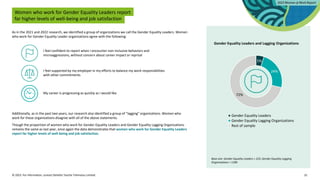
  • 39.
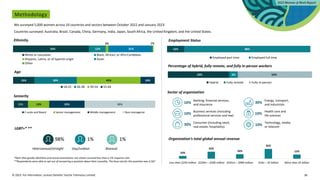
    Deloitte refers toone or more of Deloitte Touche Tohmatsu Limited (“DTTL”), its global network of member firms, and their related entities(collectively, the “Deloitte organization”). DTTL (also referred to as “Deloitte Global”) and each of its member firms and related entities are legally separate and independent entities, which cannot obligate or bind each other in respect of third parties. DTTL and each DTTL member firm and related entity is liable only for its own acts and omissions, and not those of each other. DTTL does not provide services to clients. Please see www.deloitte.com/about to learn more. Deloitte provides industry-leading audit and assurance, tax and legal, consulting, financial advisory, and risk advisory services to nearly 90% of the Fortune Global 500® and thousands of private companies. Our professionals deliver measurable and lasting results that help reinforce public trust in capital markets, enable clients to transform and thrive, and lead the way toward a stronger economy, a more equitable society and a sustainable world. Building on its 175-plus year history, Deloitte spans more than 150 countries and territories. Learn how Deloitte's approximately 415,000 people worldwide make an impact that matters at www.deloitte.com. This communication contains general information only, and none of Deloitte Touche Tohmatsu Limited (“DTTL”), its global network of member firms or their related entities (collectively, the “Deloitte organization”) is, by means of this communication, rendering professional advice or services. Before making any decision or taking any action that may affect your finances or your business, you should consult a qualified professional adviser. No representations, warranties or undertakings (express or implied) are given as to the accuracy or completeness of the information in this communication, and none of DTTL, its member firms, related entities, personnel or agents shall be liable or responsible for any loss or damage whatsoever arising directly or indirectly in connection with any person relying on this communication. DTTL and each of its member firms, and their related entities, are legally separate and independent entities. © 2023. For information, contact Deloitte Global