The Medical Home:
Disruptive Innovation for a New
Primary Care Model
The National Medical Home Summit
March 2, 2009
Philadelphia PA
Paul H. Keckley, Ph.D.
Executive Director
The Deloitte Center for Health Solutions
Washington, DC
1
BIOTECH
INNOVATORS
ADMINISTRATORS/WATCHDOGS
SERVICE PROVIDERS
Physicians
HCIT
Pharma
Device
Hospitals
Outpatient
Facilities
Insurers
Regulators
Long Term
Care
BioTech
Professional
Societies/
Special Interests
Accrediting
Agencies
Disease
Management
Employers
CAM
Media
Academic
Medicine
CONSUMERS
Allied Health
Professionals
Framework: Four major roles in developed systems
2
Disruptive innovation: better, cheaper
According to Clayton Christensen, Harvard Business Professor and
author of The Innovator’s Dilemma and The Innovator’s Solution, a
disruptive innovation is a technology, process, or business
model that brings to a market a much more affordable product or
service that is much simpler to use. It enables more consumers
in that market to afford and/or have the skill to use the product or
service. The change caused by such an innovation is so big that
it eventually replaces, or disrupts, the established approach to
providing that product or service.
Health care exists along a spectrum: from judgment/specialist-based
medicine to a simpler rules-based medicine. Most health care today is
concentrated at the specialist end of the spectrum, creating a
situation that not only excludes many who need the care but also
resists any downward pressure on costs. “The opportunity for
change lies in the simplicity and diagnostic power of rules-based
medicine”
Providing solutions patients want and see as better alternatives
is the driver for disruption to occur.
3
Retail Medicine
• 1,300 operating 12/08, increasing to
5,000 by 2011
• Strong consumer satisfaction:
driven by convenience (not
substitutionary care)
• Unique business model:
incremental revenues from front
store sales, et al
• Sticky issues:
—Scope of practice constraints
—Competition & program
scalability
4
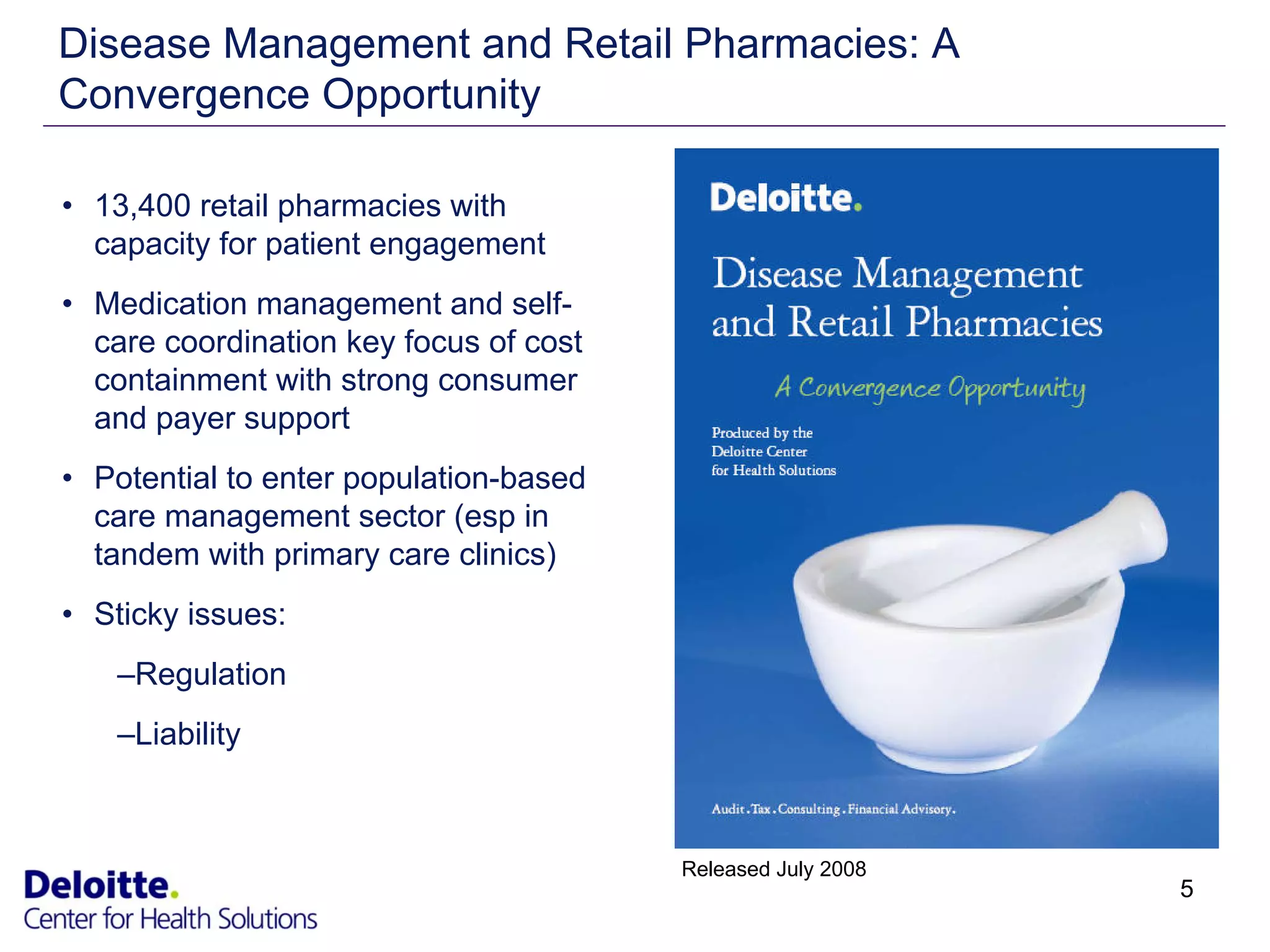
Disease Management and Retail Pharmacies: A
Convergence Opportunity
• 13,400 retail pharmacies with
capacity for patient engagement
• Medication management and self-
care coordination key focus of cost
containment with strong consumer
and payer support
• Potential to enter population-based
care management sector (esp in
tandem with primary care clinics)
• Sticky issues:
–Regulation
–Liability
Released July 2008
5
Connected Care: Technology-enabled Care at Home
• Use of technology for diagnostics
and monitoring
• Two targeted applications: chronic
patients in established treatment
programs, post-acute coordination
• Strong support across all consumer
segments & payers
• Sticky issues:
–Liability
–Privacy
–Payments
Released March 2008
6
2009 Survey of Health Care Consumers
• Six distinct segments of consumer
market: 53% lean “traditional, 19%
prefer innovations, 28% don’t engage
• Strong support for transparency (price
and quality), use of technology by
providers, and “universal care”
• Use of alternative providers, disruptive
innovative channels growing and
significant
• “Trusted source” up for grabs
• Sticky issues:
—Lack of knowledge
—Lack of consensus re: reform
7
The public view: “The system is confusing…”
How Well Do You Think You Understand
How the U.S. Health Care System Works?
3%
4%
9%
10%
17%
14%
17%
16%
7%
4%
1 2 3 4 5 6 7 8 9 10
Not at all Completely
27%
Source: 2009 Survey of US Health Consumers
Only 3 in 10 consumers feel they know how the U.S. health care system
works.
8
The public view: “And it wastes a lot of money…”
What Percentage of All U.S. Health Care
Dollars Spent Are Wasted?
4%
2%
6%
15%
13%
10%
22%
8% 9%
6% 5%
2%
0% 1-9% 10-
19%
20-
29%
30-
39%
40-
49%
50-
59%
60-
69%
70-
79%
80-
89%
90-
99%
100%
52%
Source: 2009 Survey of US Health Consumers
52% of Americans feel that at least half of health costs are wasted.
9
The public view: “The system isn’t working very well…”
How Would You Grade the Overall
Performance of the U.S. Health Care System?
2%
18%
43%
25%
13%
A B C D F
Excellent Failing
38%
20%
Source: 2009 Survey of US Health Consumers
Only 1 in 5 consumers give the U.S. health care system an above-average
report card grade; those grading the system “F” outnumber those giving it
an “A” by 6 to 1.
10
Consumers views of health reform: medical court system,
employer mandate, mental health coverage, expanded
scope of practice for nurses popular
Reform
U.S.
Favor Oppose
Improve health insurance / care for military 77% 5%
Expand teaching programs in U.S. schools of medicine to increase
the supply of PCPs
74% 5%
Establish special court system to address medical malpractice
issues
54% 12%
Require every employer to provide health insurance for their
employees
53% 17%
Pass state laws to allow consumers to purchase drugs directly from
Canada
49% 15%
Increased federal funding for mental / behavioral health services 49% 17%
Allow nurses to diagnose problems and administer care for
uncomplicated conditions
47% 21%
Increase government funding and incentives to support adoption of
EMRs by providers / plans
41% 21%
Allow FDA to compile information about individuals who take Rx
medications to monitor
41% 24%
EMR use, performance-based payment popular; increased
taxes for uninsured coverage unpopular
Reform
U.S.
Favor Oppose
Pay doctors and hospitals based on clinical results and outcomes
rather than number of patients served or services provided
39% 21%
Require holistic and non-traditional methods of care to be taught in U.S.
medical schools
38% 20%
Require every American to have health insurance via purchase /
employer / government
37% 25%
Establish national program that provides financial incentives for
doctors who follow scientifically-proven approaches to treatment
33% 23%
Assign every American to a PCP who will assist in coordinating care
and referring to specialty
27% 38%
Have federal government assume responsibility for and control over
Medicaid
26% 31%
Increase taxes to help provide health insurance coverage for the
uninsured
25% 43%
* *
* Statistically significantly different from the U.S. average (p < .05)
The Medical Home
• Four basic models
• Primary care paid for coordinating
care, managing population-based
outcomes and costs
• Pilots projects underway by most
major plans, Medicare
• Tricky issues:
—Scope of practice and liability
for PCPs, mid-levels
—Compensation and risk
sharing
—Metrics: process vs outcomes
Released January 2008
13
Traditional Primary Care vs. Medical Home
Primary Care Practice Medical Home
Primary Provider Primary Care Physician PCP with health coaches
Provider
Accountability
Limited incentives for quality Increased incentives
through transparency
Physician’s Role Trusted source Trusted source
supplemented by others;
member of a collaborative
health care delivery team
Care Fragmented Integrated, whole person
oriented,
anywhere/anytime
Care coordination Disintermediated to disease
management industry
Responsible and
reimbursed
Primary Incentive Visits & procedures (volume) Patient adherence to self-
care regimen
Decision Support Limited, largely physician-
patient relationship
Customized, internet and
personal coaching, EMR &
EBM guided
14
Economic Impact: Costs
Incremental Cost Assumption
EMR with Registry
Functionality and Knowledge
Management Tools for
Clinicians
$80-120K initial investment, $5-
20K ongoing maintenance per
medical home
EBM and Clinical Decision
Support Guided Practice –
300,000,000 US Population / 1-
2,000 patients per medical
home * incremental costs
Physician Revenue for care
coordination
$100-115 K per PCP $50-100 per patient in panel
Health Coach $78K + 56% load Load for benefits, coaching
tools, etc
Data Manager $65K / 3 FTE 1/3 FTE per medical home
Panel size 1-2K, depending on prevalence
and intensity of chronic care
management requirements
Physician Incentive $150-400K $500/patient in panel, inclusive
of clinical performance bonus,
current state $350-600K vs.
future state $.5-1MM
15
Consumerism
Focus: CDHPs,
Transparency, PHRs,
Incentives, Value
Comparative Effectiveness/
Evidence – based Medicine
Focus: (1) Personalized medicine, (2) comparative
effectiveness; episode based payments to acute
organizations
2
Healthcare Information Technology
Focus: (1) e-prescribing, ( (2) care coordination (3)
administrative cost reduction
1
3
4
Decreased errors
Decreased care gaps
Reduced malpractice
premiums
Improved efficiency
3 – 7 NMEs per year
Center for comparative
effectiveness
Knowledge management
Prepare for tort reform
New medical homes
Reimbursement realignment
Primary care workforce
MD led clinical care
coordination
Four programmatic areas bend the curve to reduce cost and
improve care
Primary Care 2.0
Focus: Primary Care 2.0 New
“Medical Home”)
For each of these, current
legislative groundwork has
been laid, and current reform
proposals by Baucus,
Wyden-Bennett,
and Obama are aligned
All can be implemented
within context of continued
private markets for providers
and plans
Respond to transparency & PC 2.0
– Connected care
– Rx reimportation
– Medical tourism
PHR (Shared Decision Making)
Incentives
– Experience rating & differential premiums
– Healthy behavior rewards
Complementary/Alternative Medicine
16
Long term: Health reform in two stages
Stage One:2009-2011
Stimulus Package Inclusions
• Focus will be expansion of benefits to
newly unemployed, executive orders that
extend coverage (SCHIP 2/2/09) and
jobs related programs
• In additon, certain programs that buoy
states against expected increases in
Medicaid enrollment
• A few campaign promises: EX. HCIT
Stage Two: 2010-2016
Systemic Reforms—Long Term
• Insurance market reforms
• Individual mandate + employer pay or
play + FEHP2
• Comparative effectiveness
• Episode based payments
• Medical Home
• Expansion of role: FDA, CDC
• Medicare eligibility
• Federalization of Medicaid
17
During Stage One and into Stage Two, the banking system correction under the
Fed Reserve Board, US Dept of Treasury will be a key parallel process:
deployment of $700+B TARP funds, mortgage market stability focus
Potential Savings
Metric
Acute 10% fewer hospital admissions;
20% fewer ER visits;
10% less absenteeism
Diagnostic 20% fewer tests
Therapeutic Prescriptions should increase with more patient adherence, but
overall medical costs should decrease ~30%1
1. www.dartmouthatlas.org/atlases/2006_Chronic_Care_Atlas.pdf
18
Breakeven Scenario
• Medical cost drivers:
– Health coaching and increased effectiveness in
patient enrollment in disease management programs.
– Health coach can manage 250 disease management
patients on average
– 150K new medical homes (300 million US population
/ 2K panel size) with total system cost = 150K x cost
drivers
– Future medical cost trend 8%, non medical cost trend
4%
• 4 years to breakeven
19
Key Questions
• Is the current model of the medical home better-
cheaper?
• Is the primary goal of the medical home to
recruit physicians to primary care or manage
population-based care?
• How can/should the medical home fit within the
context of health reform and transformational
change in the industry?
20
For more information
Paul H. Keckley, Ph.D.
Executive Director
Deloitte Center for Health Solutions
555 12th Street N.W.
Washington, DC 20004
Phone 202 220 2150
Fax 202 379 2429
Email pkeckley@deloitte.com
Web http://www.deloitte.com/centerforhealthsolutions
21

Deloitte innovacion health

  • 1.
    The Medical Home: DisruptiveInnovation for a New Primary Care Model The National Medical Home Summit March 2, 2009 Philadelphia PA Paul H. Keckley, Ph.D. Executive Director The Deloitte Center for Health Solutions Washington, DC 1
  • 2.
    BIOTECH INNOVATORS ADMINISTRATORS/WATCHDOGS SERVICE PROVIDERS Physicians HCIT Pharma Device Hospitals Outpatient Facilities Insurers Regulators Long Term Care BioTech Professional Societies/ SpecialInterests Accrediting Agencies Disease Management Employers CAM Media Academic Medicine CONSUMERS Allied Health Professionals Framework: Four major roles in developed systems 2
  • 3.
    Disruptive innovation: better,cheaper According to Clayton Christensen, Harvard Business Professor and author of The Innovator’s Dilemma and The Innovator’s Solution, a disruptive innovation is a technology, process, or business model that brings to a market a much more affordable product or service that is much simpler to use. It enables more consumers in that market to afford and/or have the skill to use the product or service. The change caused by such an innovation is so big that it eventually replaces, or disrupts, the established approach to providing that product or service. Health care exists along a spectrum: from judgment/specialist-based medicine to a simpler rules-based medicine. Most health care today is concentrated at the specialist end of the spectrum, creating a situation that not only excludes many who need the care but also resists any downward pressure on costs. “The opportunity for change lies in the simplicity and diagnostic power of rules-based medicine” Providing solutions patients want and see as better alternatives is the driver for disruption to occur. 3
  • 4.
    Retail Medicine • 1,300operating 12/08, increasing to 5,000 by 2011 • Strong consumer satisfaction: driven by convenience (not substitutionary care) • Unique business model: incremental revenues from front store sales, et al • Sticky issues: —Scope of practice constraints —Competition & program scalability 4
  • 5.
    Disease Management andRetail Pharmacies: A Convergence Opportunity • 13,400 retail pharmacies with capacity for patient engagement • Medication management and self- care coordination key focus of cost containment with strong consumer and payer support • Potential to enter population-based care management sector (esp in tandem with primary care clinics) • Sticky issues: –Regulation –Liability Released July 2008 5
  • 6.
    Connected Care: Technology-enabledCare at Home • Use of technology for diagnostics and monitoring • Two targeted applications: chronic patients in established treatment programs, post-acute coordination • Strong support across all consumer segments & payers • Sticky issues: –Liability –Privacy –Payments Released March 2008 6
  • 7.
    2009 Survey ofHealth Care Consumers • Six distinct segments of consumer market: 53% lean “traditional, 19% prefer innovations, 28% don’t engage • Strong support for transparency (price and quality), use of technology by providers, and “universal care” • Use of alternative providers, disruptive innovative channels growing and significant • “Trusted source” up for grabs • Sticky issues: —Lack of knowledge —Lack of consensus re: reform 7
  • 8.
    The public view:“The system is confusing…” How Well Do You Think You Understand How the U.S. Health Care System Works? 3% 4% 9% 10% 17% 14% 17% 16% 7% 4% 1 2 3 4 5 6 7 8 9 10 Not at all Completely 27% Source: 2009 Survey of US Health Consumers Only 3 in 10 consumers feel they know how the U.S. health care system works. 8
  • 9.
    The public view:“And it wastes a lot of money…” What Percentage of All U.S. Health Care Dollars Spent Are Wasted? 4% 2% 6% 15% 13% 10% 22% 8% 9% 6% 5% 2% 0% 1-9% 10- 19% 20- 29% 30- 39% 40- 49% 50- 59% 60- 69% 70- 79% 80- 89% 90- 99% 100% 52% Source: 2009 Survey of US Health Consumers 52% of Americans feel that at least half of health costs are wasted. 9
  • 10.
    The public view:“The system isn’t working very well…” How Would You Grade the Overall Performance of the U.S. Health Care System? 2% 18% 43% 25% 13% A B C D F Excellent Failing 38% 20% Source: 2009 Survey of US Health Consumers Only 1 in 5 consumers give the U.S. health care system an above-average report card grade; those grading the system “F” outnumber those giving it an “A” by 6 to 1. 10
  • 11.
    Consumers views ofhealth reform: medical court system, employer mandate, mental health coverage, expanded scope of practice for nurses popular Reform U.S. Favor Oppose Improve health insurance / care for military 77% 5% Expand teaching programs in U.S. schools of medicine to increase the supply of PCPs 74% 5% Establish special court system to address medical malpractice issues 54% 12% Require every employer to provide health insurance for their employees 53% 17% Pass state laws to allow consumers to purchase drugs directly from Canada 49% 15% Increased federal funding for mental / behavioral health services 49% 17% Allow nurses to diagnose problems and administer care for uncomplicated conditions 47% 21% Increase government funding and incentives to support adoption of EMRs by providers / plans 41% 21% Allow FDA to compile information about individuals who take Rx medications to monitor 41% 24%
  • 12.
    EMR use, performance-basedpayment popular; increased taxes for uninsured coverage unpopular Reform U.S. Favor Oppose Pay doctors and hospitals based on clinical results and outcomes rather than number of patients served or services provided 39% 21% Require holistic and non-traditional methods of care to be taught in U.S. medical schools 38% 20% Require every American to have health insurance via purchase / employer / government 37% 25% Establish national program that provides financial incentives for doctors who follow scientifically-proven approaches to treatment 33% 23% Assign every American to a PCP who will assist in coordinating care and referring to specialty 27% 38% Have federal government assume responsibility for and control over Medicaid 26% 31% Increase taxes to help provide health insurance coverage for the uninsured 25% 43% * * * Statistically significantly different from the U.S. average (p < .05)
  • 13.
    The Medical Home •Four basic models • Primary care paid for coordinating care, managing population-based outcomes and costs • Pilots projects underway by most major plans, Medicare • Tricky issues: —Scope of practice and liability for PCPs, mid-levels —Compensation and risk sharing —Metrics: process vs outcomes Released January 2008 13
  • 14.
    Traditional Primary Carevs. Medical Home Primary Care Practice Medical Home Primary Provider Primary Care Physician PCP with health coaches Provider Accountability Limited incentives for quality Increased incentives through transparency Physician’s Role Trusted source Trusted source supplemented by others; member of a collaborative health care delivery team Care Fragmented Integrated, whole person oriented, anywhere/anytime Care coordination Disintermediated to disease management industry Responsible and reimbursed Primary Incentive Visits & procedures (volume) Patient adherence to self- care regimen Decision Support Limited, largely physician- patient relationship Customized, internet and personal coaching, EMR & EBM guided 14
  • 15.
    Economic Impact: Costs IncrementalCost Assumption EMR with Registry Functionality and Knowledge Management Tools for Clinicians $80-120K initial investment, $5- 20K ongoing maintenance per medical home EBM and Clinical Decision Support Guided Practice – 300,000,000 US Population / 1- 2,000 patients per medical home * incremental costs Physician Revenue for care coordination $100-115 K per PCP $50-100 per patient in panel Health Coach $78K + 56% load Load for benefits, coaching tools, etc Data Manager $65K / 3 FTE 1/3 FTE per medical home Panel size 1-2K, depending on prevalence and intensity of chronic care management requirements Physician Incentive $150-400K $500/patient in panel, inclusive of clinical performance bonus, current state $350-600K vs. future state $.5-1MM 15
  • 16.
    Consumerism Focus: CDHPs, Transparency, PHRs, Incentives,Value Comparative Effectiveness/ Evidence – based Medicine Focus: (1) Personalized medicine, (2) comparative effectiveness; episode based payments to acute organizations 2 Healthcare Information Technology Focus: (1) e-prescribing, ( (2) care coordination (3) administrative cost reduction 1 3 4 Decreased errors Decreased care gaps Reduced malpractice premiums Improved efficiency 3 – 7 NMEs per year Center for comparative effectiveness Knowledge management Prepare for tort reform New medical homes Reimbursement realignment Primary care workforce MD led clinical care coordination Four programmatic areas bend the curve to reduce cost and improve care Primary Care 2.0 Focus: Primary Care 2.0 New “Medical Home”) For each of these, current legislative groundwork has been laid, and current reform proposals by Baucus, Wyden-Bennett, and Obama are aligned All can be implemented within context of continued private markets for providers and plans Respond to transparency & PC 2.0 – Connected care – Rx reimportation – Medical tourism PHR (Shared Decision Making) Incentives – Experience rating & differential premiums – Healthy behavior rewards Complementary/Alternative Medicine 16
  • 17.
    Long term: Healthreform in two stages Stage One:2009-2011 Stimulus Package Inclusions • Focus will be expansion of benefits to newly unemployed, executive orders that extend coverage (SCHIP 2/2/09) and jobs related programs • In additon, certain programs that buoy states against expected increases in Medicaid enrollment • A few campaign promises: EX. HCIT Stage Two: 2010-2016 Systemic Reforms—Long Term • Insurance market reforms • Individual mandate + employer pay or play + FEHP2 • Comparative effectiveness • Episode based payments • Medical Home • Expansion of role: FDA, CDC • Medicare eligibility • Federalization of Medicaid 17 During Stage One and into Stage Two, the banking system correction under the Fed Reserve Board, US Dept of Treasury will be a key parallel process: deployment of $700+B TARP funds, mortgage market stability focus
  • 18.
    Potential Savings Metric Acute 10%fewer hospital admissions; 20% fewer ER visits; 10% less absenteeism Diagnostic 20% fewer tests Therapeutic Prescriptions should increase with more patient adherence, but overall medical costs should decrease ~30%1 1. www.dartmouthatlas.org/atlases/2006_Chronic_Care_Atlas.pdf 18
  • 19.
    Breakeven Scenario • Medicalcost drivers: – Health coaching and increased effectiveness in patient enrollment in disease management programs. – Health coach can manage 250 disease management patients on average – 150K new medical homes (300 million US population / 2K panel size) with total system cost = 150K x cost drivers – Future medical cost trend 8%, non medical cost trend 4% • 4 years to breakeven 19
  • 20.
    Key Questions • Isthe current model of the medical home better- cheaper? • Is the primary goal of the medical home to recruit physicians to primary care or manage population-based care? • How can/should the medical home fit within the context of health reform and transformational change in the industry? 20
  • 21.
    For more information PaulH. Keckley, Ph.D. Executive Director Deloitte Center for Health Solutions 555 12th Street N.W. Washington, DC 20004 Phone 202 220 2150 Fax 202 379 2429 Email pkeckley@deloitte.com Web http://www.deloitte.com/centerforhealthsolutions 21