Patron-Client Relationship
PATRON Provides
resources or support.
E.g. Financial Support
CLIENT Relies on
the resources given
by the patron in which
they lack, giving them
loyalty or prestige in
return
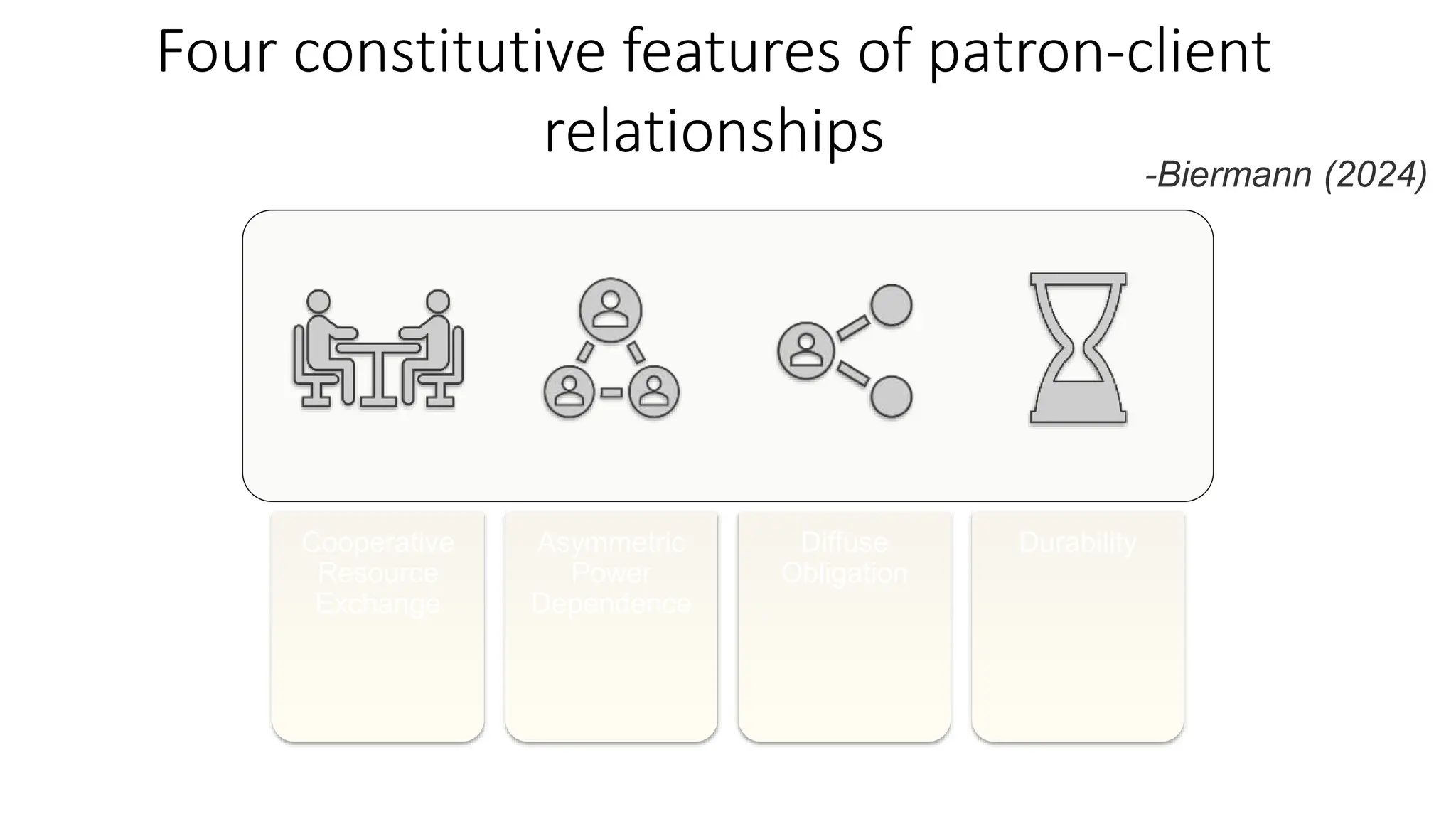
Four constitutive features of patron-client
relationships
-Biermann (2024)
Cooperative
Resource
Exchange
Asymmetric
Power
Dependence
Diffuse
Obligation
Durability
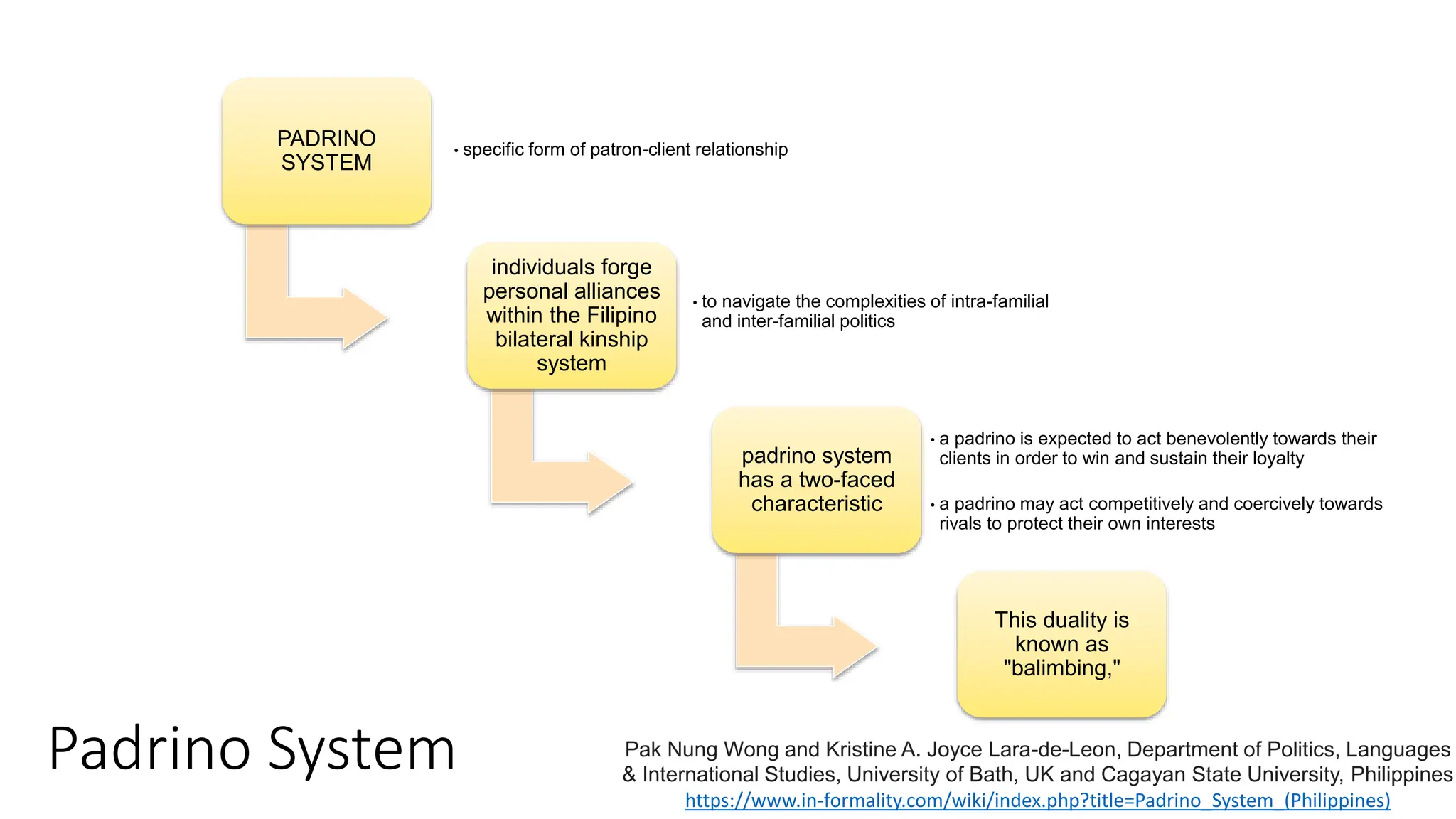
Padrino System
PADRINO
SYSTEM
• specific form of patron-client relationship
individuals forge
personal alliances
within the Filipino
bilateral kinship
system
• to navigate the complexities of intra-familial
and inter-familial politics
padrino system
has a two-faced
characteristic
• a padrino is expected to act benevolently towards their
clients in order to win and sustain their loyalty
• a padrino may act competitively and coercively towards
rivals to protect their own interests
This duality is
known as
"balimbing,"
Pak Nung Wong and Kristine A. Joyce Lara-de-Leon, Department of Politics, Languages
& International Studies, University of Bath, UK and Cagayan State University, Philippines
https://www.in-formality.com/wiki/index.php?title=Padrino_System_(Philippines)

definition of Patron-Client Relationship

  • 1.
    Patron-Client Relationship PATRON Provides resourcesor support. E.g. Financial Support CLIENT Relies on the resources given by the patron in which they lack, giving them loyalty or prestige in return
  • 2.
    Four constitutive featuresof patron-client relationships -Biermann (2024) Cooperative Resource Exchange Asymmetric Power Dependence Diffuse Obligation Durability
  • 3.
    Padrino System PADRINO SYSTEM • specificform of patron-client relationship individuals forge personal alliances within the Filipino bilateral kinship system • to navigate the complexities of intra-familial and inter-familial politics padrino system has a two-faced characteristic • a padrino is expected to act benevolently towards their clients in order to win and sustain their loyalty • a padrino may act competitively and coercively towards rivals to protect their own interests This duality is known as "balimbing," Pak Nung Wong and Kristine A. Joyce Lara-de-Leon, Department of Politics, Languages & International Studies, University of Bath, UK and Cagayan State University, Philippines https://www.in-formality.com/wiki/index.php?title=Padrino_System_(Philippines)

Editor's Notes

  • #2 The patron-client relationship is a type of partnership where one party, known as the patron, provides resources or support to another party, known as the client. This relationship is characterized by a power asymmetry, where the patron holds a higher position and possesses superior resources compared to the client. The client, in turn, relies on the patron for these resources, which they may lack. The resources exchanged between the patron and client can be tangible, such as financial support, or intangible, such as loyalty or prestige. The relationship is based on a cooperative resource exchange, where both parties value and maintain the partnership. However, it is important to note that the patron-client relationship can degenerate into a pure dependency relationship if it loses its cooperative nature.
  • #3 Biermann (2024) identifies four characteristics of patron-client relationships based on a review of studies in many disciplines: 1.Cooperative Resource Exchange: Patron-client relationships involve a cooperative partnership where both parties value and exchange resources. This cooperative character distinguishes them from conflictual relationships. The resources exchanged can be tangible, such as financial support, or intangible, such as loyalty or prestige. 2.Asymmetric Power Dependence: Patron-client relationships are characterized by a hierarchical power dynamic. The patron holds a higher position and possesses superior resources compared to the client. This power asymmetry creates a dependency relationship, where the client relies on the patron for resources they lack. 3.Diffuse Obligation: Patron-client relationships are based on a sense of obligation between the parties. These relationships are essentially informal and differ from formal contractual obligations. The patron is expected to act benevolently towards the client, and there is an element of long-term credit and obligations involved. 4.Durability: Patron-client relationships are enduring and long-lasting. They are not short-term cooperation but involve an iterative resource exchange over time. This durability sets them apart from temporary partnerships. The relationship is built on a strong element of unconditionality and can involve deferred payments and long-term obligations.
  • #4 The padrino system is a specific form of patron-client relationship that is prevalent in the Philippines. It combines elements of the Malayo-Polynesian datu-ship, Chinese ring-leadership, and Spanish patronage, forming a unique and hybridized practice in present-day Philippine politics and business. In the padrino system, individuals forge personal alliances within the Filipino bilateral kinship system to navigate the complexities of intra-familial and inter-familial politics. It highlights the importance of the Filipino idea of 'family' in political decision-making. The padrino system has a two-faced characteristic. On one hand, a padrino is expected to act benevolently towards their clients in order to win and sustain their loyalty. On the other hand, a padrino may act competitively and coercively towards rivals to protect their own interests. This duality is known as "balimbing," which refers to the ability to change allegiances and form flexible tactical alliances with rivals. The padrino system has implications for the study of Philippine society, politics, and foreign relations. It plays a key role in explaining the rise and endurance of political dynasties and the brokering of state sovereignty into the frontiers through local power-holders. Additionally, the balimbing aspect of the padrino system is crucial in understanding the Philippines' approach to international relations, as it allows for strategic hedging between competing patrons such as China and the United States. The padrino system in the Philippines is a complex social phenomenon deeply rooted in Filipino culture. It involves a network of influential individuals who act as patrons or godfathers, providing assistance and support to others in exchange for loyalty and favors. This system is characterized by Catholicized ritual kinship and the Tagalog ethics of "debt of gratitude" (utang na loob). The padrino system plays a significant role in various aspects of Filipino society, including governance, community building, conflict resolution, and social interactions. The padrino system has been observed to influence governance practices, particularly in local communities, where padrinos wield power and influence over decision-making processes. It also impacts social relationships by creating networks of reciprocity based on mutual obligations and indebtedness. Additionally, the padrino system can sometimes subvert official laws and regulations, as seen in cases like the post-disaster housing project for Typhoon Ondoy victims, where cultural values such as "palakasan," "sakop," and the padrino system influenced the distribution of housing units.