The effect of marketing strategies on small and medium enterprises performance in Bahir
Dar city
By:
Mulualem Adugna
Bahir Dar Institute Of Technology
Industrial Engineering Department
Advisor: Yibeltal Nigussie. (Asst. Prof.)
Outline
Background of the study
Statement of the Problem
Objective Of the study
Conceptual Framework
Methodology
Results
Conclusion
Recommendation
Background of the study
Search
Many businesses are making an effort to employ marketing as
part of their competitive strategy. According to a
straightforward definition of the marketing concept, its goal is
to use persuasion, information sharing, and a variety of other
strategies to influence consumers' purchasing decisions in
order to prove its marketability.
Small and medium enterprises are the vehicle of economic
growth and development globally.
Statement of the problem
Search
Every enterprise’s major reason for existence is to make a profit.
Firms, therefore, face the challenge of knowing the appropriate type
of strategies, which they could use for their product/service. Thus,
conducting such research seems essential in the light of the fact that
different problems centered in this sector.
Even though there have been several research papers on the topic
(The influence of marketing strategies on performance, in the setting
of SMEs), it is challenging to generalize the study's findings in the
context of Ethiopian SMEs without empirical testing.
Objective
Examining the impact of marketing tactics on the results of Small and
Medium Enterprises in Ethiopia is the major goal of the study.
The specific objective of this study are
To examine the effect of STP strategies on the performance of the SMEs;
Search
To investigate how product strategies affect SMEs' performance;
to research how SMEs' success is impacted by price strategies;
To examine the effect of promotion strategies on the performance of the SMEs;
To examine the effect of place strategies on the performance of the SMEs;
To examine the effect of customer orientation strategies on the performance of the
SMEs;
To examine the effect of relationship marketing strategies on the performance of the
SMEs;
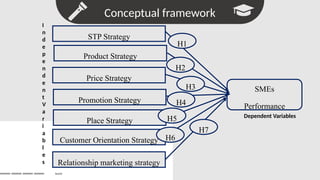
Conceptual framework
Search
STP Strategy
Product Strategy
Price Strategy
Promotion Strategy
Place Strategy
Customer Orientation Strategy
Relationship marketing strategy
SMEs
Performance
H1
H2
H3
H4
H5
H6
H7
Dependent Variables
I
n
d
e
p
e
n
d
e
n
t
V
a
r
i
a
b
l
e
s
Methodology
Search
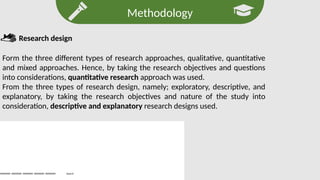
Research design
Form the three different types of research approaches, qualitative, quantitative
and mixed approaches. Hence, by taking the research objectives and questions
into considerations, quantitative research approach was used.
From the three types of research design, namely; exploratory, descriptive, and
explanatory, by taking the research objectives and nature of the study into
consideration, descriptive and explanatory research designs used.
Continued
Search
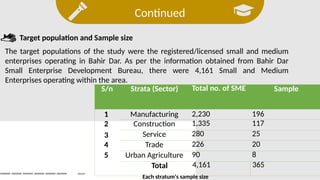
Target population and Sample size
The target populations of the study were the registered/licensed small and medium
enterprises operating in Bahir Dar. As per the information obtained from Bahir Dar
Small Enterprise Development Bureau, there were 4,161 Small and Medium
Enterprises operating within the area.
S/n Strata (Sector) Total no. of SME Sample
1 Manufacturing 2,230 196
2 Construction 1,335 117
3 Service 280 25
4 Trade 226 20
5 Urban Agriculture 90 8
Total
Each stratum's sample size
365
4,161
Continued
Search
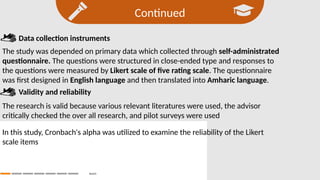
Data collection instruments
The study was depended on primary data which collected through self-administrated
questionnaire. The questions were structured in close-ended type and responses to
the questions were measured by Likert scale of five rating scale. The questionnaire
was first designed in English language and then translated into Amharic language.
Validity and reliability
The research is valid because various relevant literatures were used, the advisor
critically checked the over all research, and pilot surveys were used
In this study, Cronbach's alpha was utilized to examine the reliability of the Likert
scale items
Continued
Search
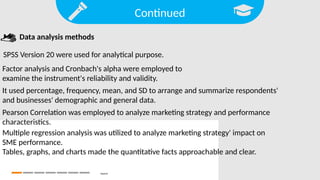
SPSS Version 20 were used for analytical purpose.
Data analysis methods
Factor analysis and Cronbach's alpha were employed to
examine the instrument's reliability and validity.
It used percentage, frequency, mean, and SD to arrange and summarize respondents'
and businesses' demographic and general data.
Pearson Correlation was employed to analyze marketing strategy and performance
characteristics.
Multiple regression analysis was utilized to analyze marketing strategy' impact on
SME performance.
Tables, graphs, and charts made the quantitative facts approachable and clear.
Continued
Search
Ethical consideration
This study followed the general standards of research ethics by asking
respondents to contribute information voluntarily, communicating the study's
objective beforehand, and guaranteeing confidentiality. Also, the questionnaire
was clarified to meet the sector. Only willing participants received
questionnaires.
Result
Search
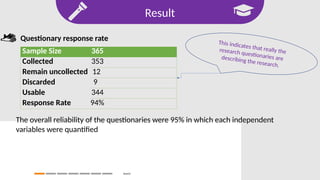
Questionary response rate
Sample Size 365
Collected 353
Remain uncollected 12
Discarded 9
Usable 344
Response Rate 94%
This indicates that really the
research questionaries are
describing the research.
The overall reliability of the questionaries were 95% in which each independent
variables were quantified
Continued
Search
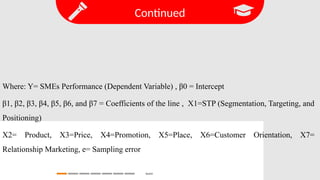
Where: Y= SMEs Performance (Dependent Variable) , β0 = Intercept
β1, β2, β3, β4, β5, β6, and β7 = Coefficients of the line , X1=STP (Segmentation, Targeting, and
Positioning)
X2= Product, X3=Price, X4=Promotion, X5=Place, X6=Customer Orientation, X7=
Relationship Marketing, e= Sampling error
Continued
Search
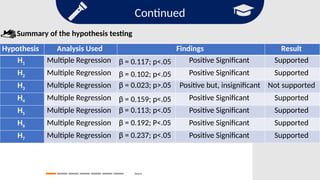
Hypothesis Analysis Used Findings Result
H1 Multiple Regression β = 0.117; p<.05 Positive Significant Supported
H2 Multiple Regression β = 0.102; p<.05 Positive Significant Supported
H3 Multiple Regression β = 0.023; p>.05 Positive but, insignificant Not supported
H4 Multiple Regression β = 0.159; p<.05 Positive Significant Supported
H5 Multiple Regression β = 0.113; p<.05 Positive Significant Supported
H6 Multiple Regression β = 0.192; P<.05 Positive Significant Supported
H7 Multiple Regression β = 0.237; p<.05 Positive Significant Supported
Summary of the hypothesis testing
Continued
Search
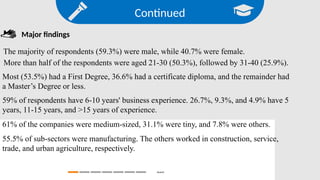
Major findings
The majority of respondents (59.3%) were male, while 40.7% were female.
More than half of the respondents were aged 21-30 (50.3%), followed by 31-40 (25.9%).
Most (53.5%) had a First Degree, 36.6% had a certificate diploma, and the remainder had
a Master’s Degree or less.
59% of respondents have 6-10 years' business experience. 26.7%, 9.3%, and 4.9% have 5
years, 11-15 years, and >15 years of experience.
61% of the companies were medium-sized, 31.1% were tiny, and 7.8% were others.
55.5% of sub-sectors were manufacturing. The others worked in construction, service,
trade, and urban agriculture, respectively.
Continued
Search
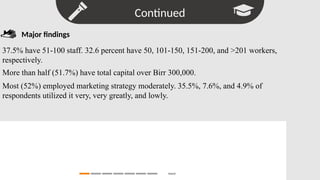
Major findings
37.5% have 51-100 staff. 32.6 percent have 50, 101-150, 151-200, and >201 workers,
respectively.
More than half (51.7%) have total capital over Birr 300,000.
Most (52%) employed marketing strategy moderately. 35.5%, 7.6%, and 4.9% of
respondents utilized it very, very greatly, and lowly.
Conclusion
Search
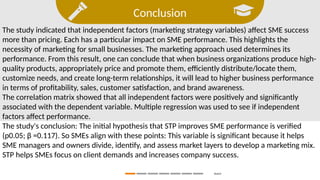
The study indicated that independent factors (marketing strategy variables) affect SME success
more than pricing. Each has a particular impact on SME performance. This highlights the
necessity of marketing for small businesses. The marketing approach used determines its
performance. From this result, one can conclude that when business organizations produce high-
quality products, appropriately price and promote them, efficiently distribute/locate them,
customize needs, and create long-term relationships, it will lead to higher business performance
in terms of profitability, sales, customer satisfaction, and brand awareness.
The correlation matrix showed that all independent factors were positively and significantly
associated with the dependent variable. Multiple regression was used to see if independent
factors affect performance.
The study's conclusion: The initial hypothesis that STP improves SME performance is verified
(p0.05; β =0.117). So SMEs align with these points: This variable is significant because it helps
SME managers and owners divide, identify, and assess market layers to develop a marketing mix.
STP helps SMEs focus on client demands and increases company success.
Continued
Search
The second hypothesis that product strategy positively affects SME performance is verified since its
P-value is (Pvalue 0.05; β=0.102). This study indicates that product strategy affects SME profitability,
sales, customer happiness, and market expansion. Before buying, people analyze quality, features,
design, and styles rationally or emotionally. When features and client demands are met, repeat
purchases and word-of-mouth are likely. So, product strategy positively affects SME performance.
The third hypothesis that price strategy positively affects SME performance is rejected since its P-
value is >0.05 (β=0.023). This suggests pricing affects performance, but not much. Most SMEs spend
time learning about their competitors' pricing and inflation. Although they utilize rivals' pricing as a
baseline, they also consider customer advantages, customer relationships, and favorable feedback
when determining rates.
The fourth hypothesis is validated since the P-value of the price strategy is (Pvalue <0.05; β=0.159).
Promotion strategy affects performance because it increases awareness, interest, and trial.
Entrepreneurs aren't skeptical of mass promotion, such as media advertising, at this level due to
interpersonal links and networks that boost word of mouth. Heavy product promotion costs may be
to blame.
Continued
Search
The fifth hypothesis is verified since the location strategy's P-value is (P-value <0.05; β=0.113).
Another aspect affecting SME effectiveness is location. This implies the business's location,
accessibility, and distribution channel are important.
The sixth hypothesis that customer orientation approach positively affects SME performance is
verified since its P-value is (P-value 0.01; =0.192). Customer orientation converts marketing into
a competitive weapon by transforming organizational values, attitudes, assumptions, and
premises towards a two-way connection between customer and enterprise. Any organization,
but especially small and medium-sized businesses, must comprehend the marketplace and
establish suitable product and service strategies to fulfill client wants and desires.
The regression coefficient of the seventh hypothesis shows that relationship marketing
improves performance (P-Value <0.01 and β=0.237). Also confirmed is H7. According to H7,
developing long-lasting relationships helps SMEs secure long-lasting consumers, increase sales,
profitability, brand recognition, and customer satisfaction.
Recommendation
Search
SMEs should divide, target, and position their markets to better serve their consumers.
SMEs should consider product strategy. SMEs must develop quality products to compete
with major companies.
SMEs should successfully convey their products and/or services to the public
SMEs should improve site accessibility and convenience and offer different distribution choices.
SMEs should cherish and respect customers' opinions, provide loyal customers presents, and
take comments seriously.
Even though the price strategy has a negligible influence in this scenario, SMEs should
determine their rates and charge reasonable prices while communicating with consumers
clearly.
Essential and effective training for the operators to do the product and the customers to use
the product.
Defense ppt for thesis industrial Engineering

Defense ppt for thesis industrial Engineering

  • 1.
    The effect ofmarketing strategies on small and medium enterprises performance in Bahir Dar city By: Mulualem Adugna Bahir Dar Institute Of Technology Industrial Engineering Department Advisor: Yibeltal Nigussie. (Asst. Prof.)
  • 2.
    Outline Background of thestudy Statement of the Problem Objective Of the study Conceptual Framework Methodology Results Conclusion Recommendation
  • 3.
    Background of thestudy Search Many businesses are making an effort to employ marketing as part of their competitive strategy. According to a straightforward definition of the marketing concept, its goal is to use persuasion, information sharing, and a variety of other strategies to influence consumers' purchasing decisions in order to prove its marketability. Small and medium enterprises are the vehicle of economic growth and development globally.
  • 4.
    Statement of theproblem Search Every enterprise’s major reason for existence is to make a profit. Firms, therefore, face the challenge of knowing the appropriate type of strategies, which they could use for their product/service. Thus, conducting such research seems essential in the light of the fact that different problems centered in this sector. Even though there have been several research papers on the topic (The influence of marketing strategies on performance, in the setting of SMEs), it is challenging to generalize the study's findings in the context of Ethiopian SMEs without empirical testing.
  • 5.
    Objective Examining the impactof marketing tactics on the results of Small and Medium Enterprises in Ethiopia is the major goal of the study. The specific objective of this study are To examine the effect of STP strategies on the performance of the SMEs; Search To investigate how product strategies affect SMEs' performance; to research how SMEs' success is impacted by price strategies; To examine the effect of promotion strategies on the performance of the SMEs; To examine the effect of place strategies on the performance of the SMEs; To examine the effect of customer orientation strategies on the performance of the SMEs; To examine the effect of relationship marketing strategies on the performance of the SMEs;
  • 6.
    Conceptual framework Search STP Strategy ProductStrategy Price Strategy Promotion Strategy Place Strategy Customer Orientation Strategy Relationship marketing strategy SMEs Performance H1 H2 H3 H4 H5 H6 H7 Dependent Variables I n d e p e n d e n t V a r i a b l e s
  • 7.
    Methodology Search Research design Form thethree different types of research approaches, qualitative, quantitative and mixed approaches. Hence, by taking the research objectives and questions into considerations, quantitative research approach was used. From the three types of research design, namely; exploratory, descriptive, and explanatory, by taking the research objectives and nature of the study into consideration, descriptive and explanatory research designs used.
  • 8.
    Continued Search Target population andSample size The target populations of the study were the registered/licensed small and medium enterprises operating in Bahir Dar. As per the information obtained from Bahir Dar Small Enterprise Development Bureau, there were 4,161 Small and Medium Enterprises operating within the area. S/n Strata (Sector) Total no. of SME Sample 1 Manufacturing 2,230 196 2 Construction 1,335 117 3 Service 280 25 4 Trade 226 20 5 Urban Agriculture 90 8 Total Each stratum's sample size 365 4,161
  • 9.
    Continued Search Data collection instruments Thestudy was depended on primary data which collected through self-administrated questionnaire. The questions were structured in close-ended type and responses to the questions were measured by Likert scale of five rating scale. The questionnaire was first designed in English language and then translated into Amharic language. Validity and reliability The research is valid because various relevant literatures were used, the advisor critically checked the over all research, and pilot surveys were used In this study, Cronbach's alpha was utilized to examine the reliability of the Likert scale items
  • 10.
    Continued Search SPSS Version 20were used for analytical purpose. Data analysis methods Factor analysis and Cronbach's alpha were employed to examine the instrument's reliability and validity. It used percentage, frequency, mean, and SD to arrange and summarize respondents' and businesses' demographic and general data. Pearson Correlation was employed to analyze marketing strategy and performance characteristics. Multiple regression analysis was utilized to analyze marketing strategy' impact on SME performance. Tables, graphs, and charts made the quantitative facts approachable and clear.
  • 11.
    Continued Search Ethical consideration This studyfollowed the general standards of research ethics by asking respondents to contribute information voluntarily, communicating the study's objective beforehand, and guaranteeing confidentiality. Also, the questionnaire was clarified to meet the sector. Only willing participants received questionnaires.
  • 12.
    Result Search Questionary response rate SampleSize 365 Collected 353 Remain uncollected 12 Discarded 9 Usable 344 Response Rate 94% This indicates that really the research questionaries are describing the research. The overall reliability of the questionaries were 95% in which each independent variables were quantified
  • 13.
    Continued Search Where: Y= SMEsPerformance (Dependent Variable) , β0 = Intercept β1, β2, β3, β4, β5, β6, and β7 = Coefficients of the line , X1=STP (Segmentation, Targeting, and Positioning) X2= Product, X3=Price, X4=Promotion, X5=Place, X6=Customer Orientation, X7= Relationship Marketing, e= Sampling error
  • 14.
    Continued Search Hypothesis Analysis UsedFindings Result H1 Multiple Regression β = 0.117; p<.05 Positive Significant Supported H2 Multiple Regression β = 0.102; p<.05 Positive Significant Supported H3 Multiple Regression β = 0.023; p>.05 Positive but, insignificant Not supported H4 Multiple Regression β = 0.159; p<.05 Positive Significant Supported H5 Multiple Regression β = 0.113; p<.05 Positive Significant Supported H6 Multiple Regression β = 0.192; P<.05 Positive Significant Supported H7 Multiple Regression β = 0.237; p<.05 Positive Significant Supported Summary of the hypothesis testing
  • 15.
    Continued Search Major findings The majorityof respondents (59.3%) were male, while 40.7% were female. More than half of the respondents were aged 21-30 (50.3%), followed by 31-40 (25.9%). Most (53.5%) had a First Degree, 36.6% had a certificate diploma, and the remainder had a Master’s Degree or less. 59% of respondents have 6-10 years' business experience. 26.7%, 9.3%, and 4.9% have 5 years, 11-15 years, and >15 years of experience. 61% of the companies were medium-sized, 31.1% were tiny, and 7.8% were others. 55.5% of sub-sectors were manufacturing. The others worked in construction, service, trade, and urban agriculture, respectively.
  • 16.
    Continued Search Major findings 37.5% have51-100 staff. 32.6 percent have 50, 101-150, 151-200, and >201 workers, respectively. More than half (51.7%) have total capital over Birr 300,000. Most (52%) employed marketing strategy moderately. 35.5%, 7.6%, and 4.9% of respondents utilized it very, very greatly, and lowly.
  • 17.
    Conclusion Search The study indicatedthat independent factors (marketing strategy variables) affect SME success more than pricing. Each has a particular impact on SME performance. This highlights the necessity of marketing for small businesses. The marketing approach used determines its performance. From this result, one can conclude that when business organizations produce high- quality products, appropriately price and promote them, efficiently distribute/locate them, customize needs, and create long-term relationships, it will lead to higher business performance in terms of profitability, sales, customer satisfaction, and brand awareness. The correlation matrix showed that all independent factors were positively and significantly associated with the dependent variable. Multiple regression was used to see if independent factors affect performance. The study's conclusion: The initial hypothesis that STP improves SME performance is verified (p0.05; β =0.117). So SMEs align with these points: This variable is significant because it helps SME managers and owners divide, identify, and assess market layers to develop a marketing mix. STP helps SMEs focus on client demands and increases company success.
  • 18.
    Continued Search The second hypothesisthat product strategy positively affects SME performance is verified since its P-value is (Pvalue 0.05; β=0.102). This study indicates that product strategy affects SME profitability, sales, customer happiness, and market expansion. Before buying, people analyze quality, features, design, and styles rationally or emotionally. When features and client demands are met, repeat purchases and word-of-mouth are likely. So, product strategy positively affects SME performance. The third hypothesis that price strategy positively affects SME performance is rejected since its P- value is >0.05 (β=0.023). This suggests pricing affects performance, but not much. Most SMEs spend time learning about their competitors' pricing and inflation. Although they utilize rivals' pricing as a baseline, they also consider customer advantages, customer relationships, and favorable feedback when determining rates. The fourth hypothesis is validated since the P-value of the price strategy is (Pvalue <0.05; β=0.159). Promotion strategy affects performance because it increases awareness, interest, and trial. Entrepreneurs aren't skeptical of mass promotion, such as media advertising, at this level due to interpersonal links and networks that boost word of mouth. Heavy product promotion costs may be to blame.
  • 19.
    Continued Search The fifth hypothesisis verified since the location strategy's P-value is (P-value <0.05; β=0.113). Another aspect affecting SME effectiveness is location. This implies the business's location, accessibility, and distribution channel are important. The sixth hypothesis that customer orientation approach positively affects SME performance is verified since its P-value is (P-value 0.01; =0.192). Customer orientation converts marketing into a competitive weapon by transforming organizational values, attitudes, assumptions, and premises towards a two-way connection between customer and enterprise. Any organization, but especially small and medium-sized businesses, must comprehend the marketplace and establish suitable product and service strategies to fulfill client wants and desires. The regression coefficient of the seventh hypothesis shows that relationship marketing improves performance (P-Value <0.01 and β=0.237). Also confirmed is H7. According to H7, developing long-lasting relationships helps SMEs secure long-lasting consumers, increase sales, profitability, brand recognition, and customer satisfaction.
  • 20.
    Recommendation Search SMEs should divide,target, and position their markets to better serve their consumers. SMEs should consider product strategy. SMEs must develop quality products to compete with major companies. SMEs should successfully convey their products and/or services to the public SMEs should improve site accessibility and convenience and offer different distribution choices. SMEs should cherish and respect customers' opinions, provide loyal customers presents, and take comments seriously. Even though the price strategy has a negligible influence in this scenario, SMEs should determine their rates and charge reasonable prices while communicating with consumers clearly. Essential and effective training for the operators to do the product and the customers to use the product.