Netaji Subhash engineeringcollege
NAME : Israr Ahmad
CLASS ROLL NO : 40
UNIVERSITY ROLL NO : 10901621040
REGISTRATION NO : 211090101610042
TITLE : Deep learning and its connection with
artificial neural networks
2.
Deep Learning andNeural
Networks
Deep learning is a powerful subset of machine learning that leverages artificial neural networks to identify complex
patterns in data. Its remarkable capabilities have led to breakthroughs in various fields, including image recognition,
natural language processing, and autonomous systems. This presentation delves into the relationship between deep
learning and neural networks, offering valuable insights for those interested in artificial intelligence and machine
learning.
3.
Transforms fields
like visionand
speech.
Powerful
Approach
Trains large
networks on vast
data.
Neural
Networks
Overview of Deep Learning
Revolutionary
Impact
Mimics human
learning from
experience.
4.
4
1
2
3
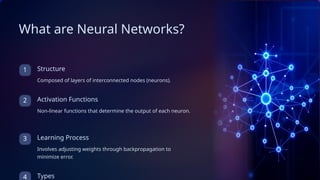
Non-linear functions thatdetermine the output of each neuron.
Involves adjusting weights through backpropagation to
minimize error.
Activation Functions
Learning Process
Composed of layers of interconnected nodes (neurons).
Structure
Types
What are Neural Networks?
5.
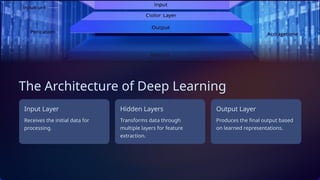
Transforms data through
multiplelayers for feature
extraction.
Receives the initial data for
processing.
The Architecture of Deep Learning
Output Layer
Hidden Layers
Input Layer
Produces the final output based
on learned representations.
6.
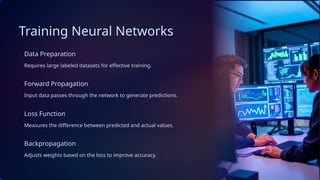
Adjusts weights basedon the loss to improve accuracy.
Requires large labeled datasets for effective training.
Input data passes through the network to generate predictions.
Training Neural Networks
Backpropagation
Measures the difference between predicted and actual values.
Forward Propagation
Loss Function
Data Preparation
7.
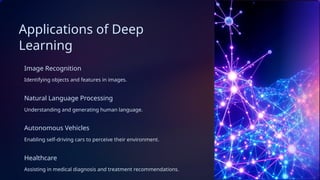
Natural Language Processing
ImageRecognition
Enabling self-driving cars to perceive their environment.
Assisting in medical diagnosis and treatment recommendations.
Applications of Deep
Learning
Healthcare
Understanding and generating human language.
Autonomous Vehicles
Identifying objects and features in images.
8.
1
2
4
3
Risk of themodel performing well on training data but poorly
on unseen data.
Overfitting
Data Requirements
Requires large amounts of labeled data for training.
Demands significant processing power and memory.
Computational Resources
Challenges in Deep Learning
Interpretability
9.
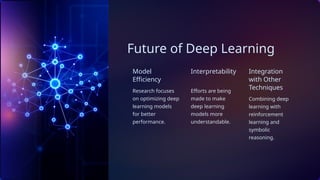
Efforts are being
madeto make
deep learning
models more
understandable.
Future of Deep Learning
Research focuses
on optimizing deep
learning models
for better
performance.
Interpretability
Model
Efficiency
Combining deep
learning with
reinforcement
learning and
symbolic
reasoning.
Integration
with Other
Techniques
10.
3
2
1
Continuous evolution inthe
field.
Conclusion
Staying Informed Future Developments
Crucial for leveraging AI
technologies.
Essential for harnessing deep
learning potential.
Importance of
Understanding