Alan Dix
@alanjohndix
https://alandix.com/academic/talks/PIM-seminar-2024/
Deconstructing and
Reconstructing PIM
2nd edition
coming soon
plus AI for HCI
AI for Social Justice
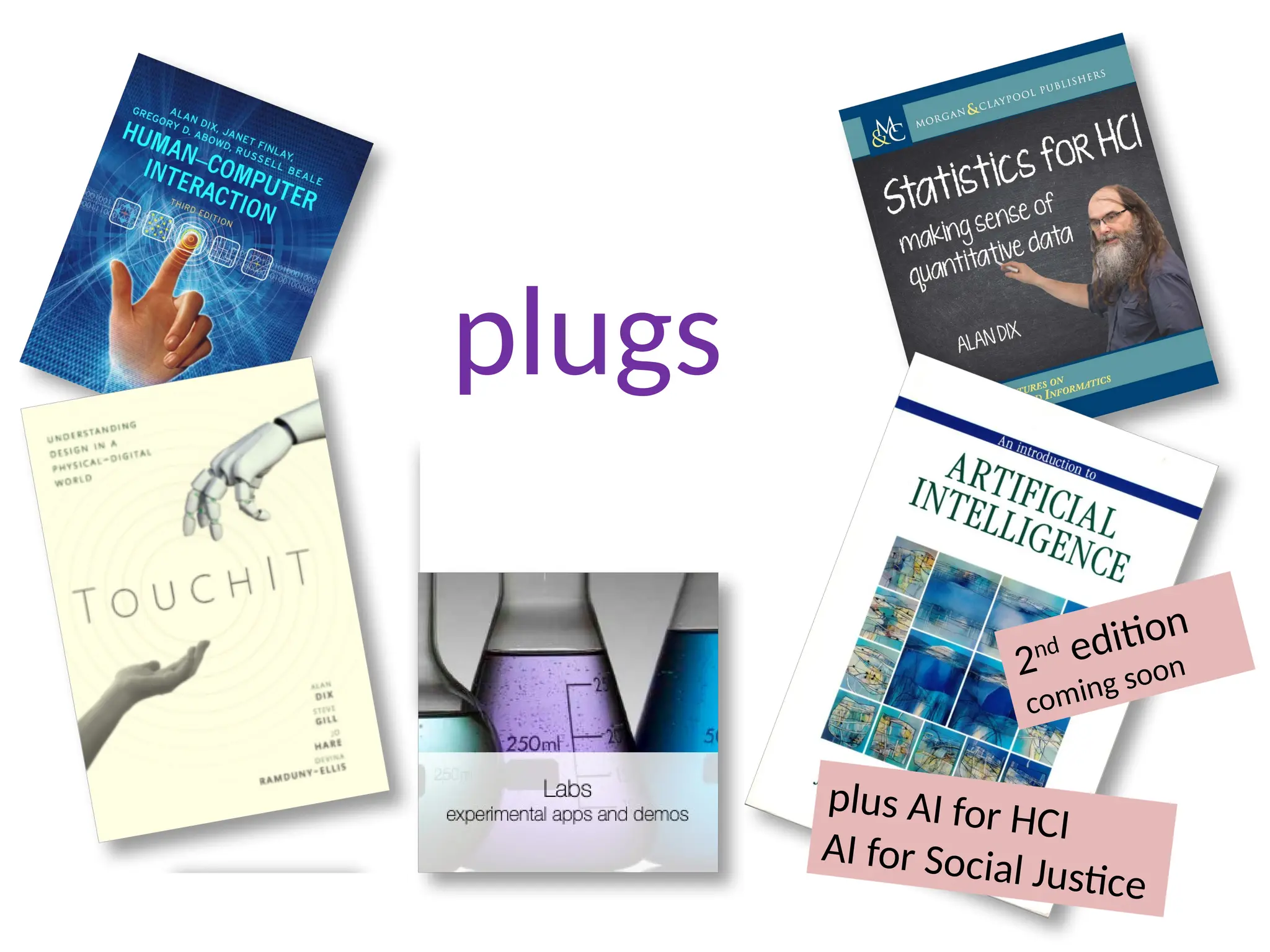
plugs
promise of PIM
PIM research
– does it make a difference?
– ideas and concepts trickle through (Klujn et al., 2015)
e.g. threading MONA => gmail
tech innovation start-ups
– loads of apps!
personal knowledge management, personal productivity tools
(Cockburn & Thimbleby. 1993; Cockburn, 1994)
plan …
analysis
– deconstruct Personal Information Management
– examine some interesting and popular apps
synthesis
– technology and features
– human context
deconstructing PIM
deconstructing PIM
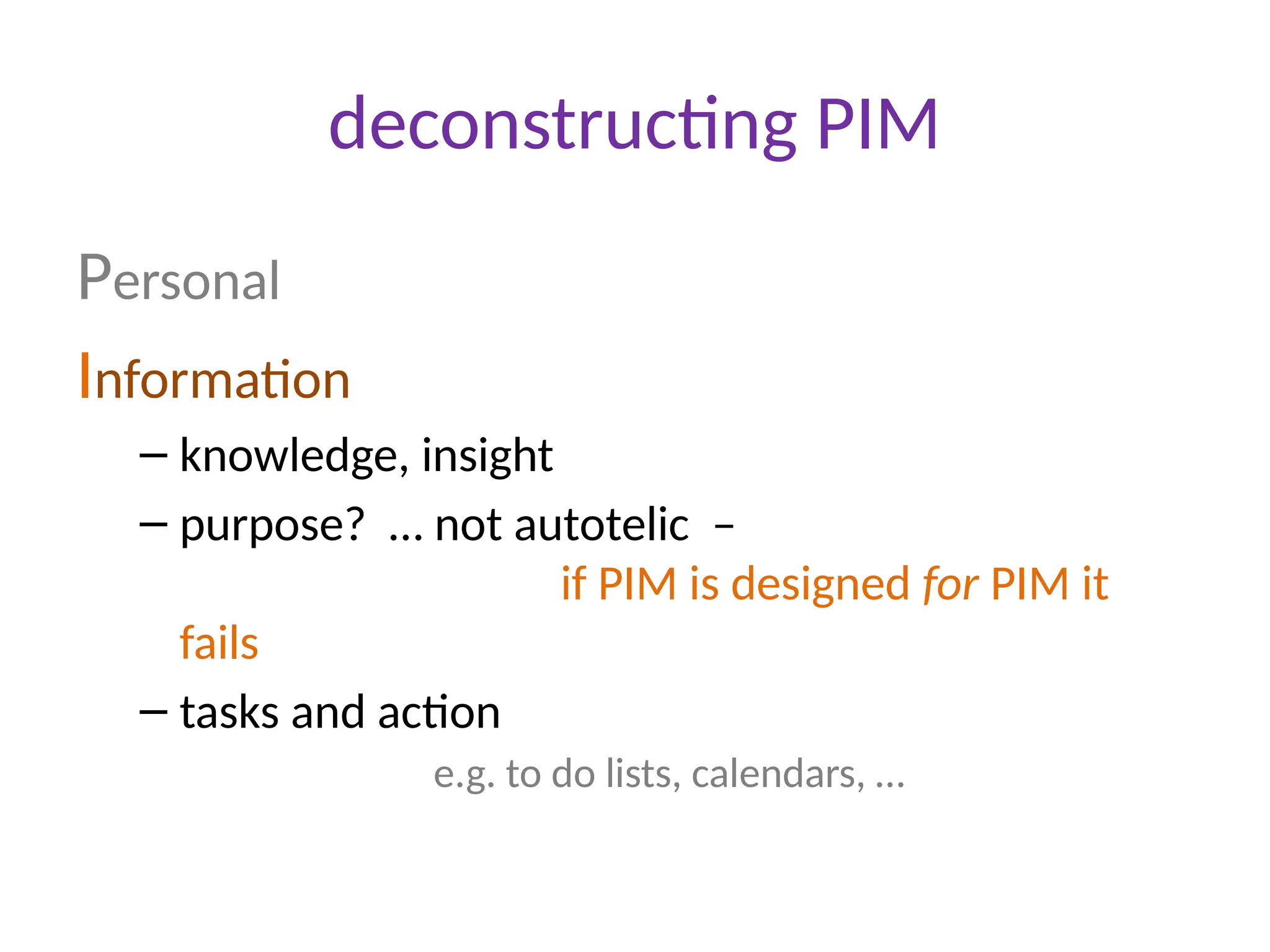
Personal
Information
Management
deconstructing PIM
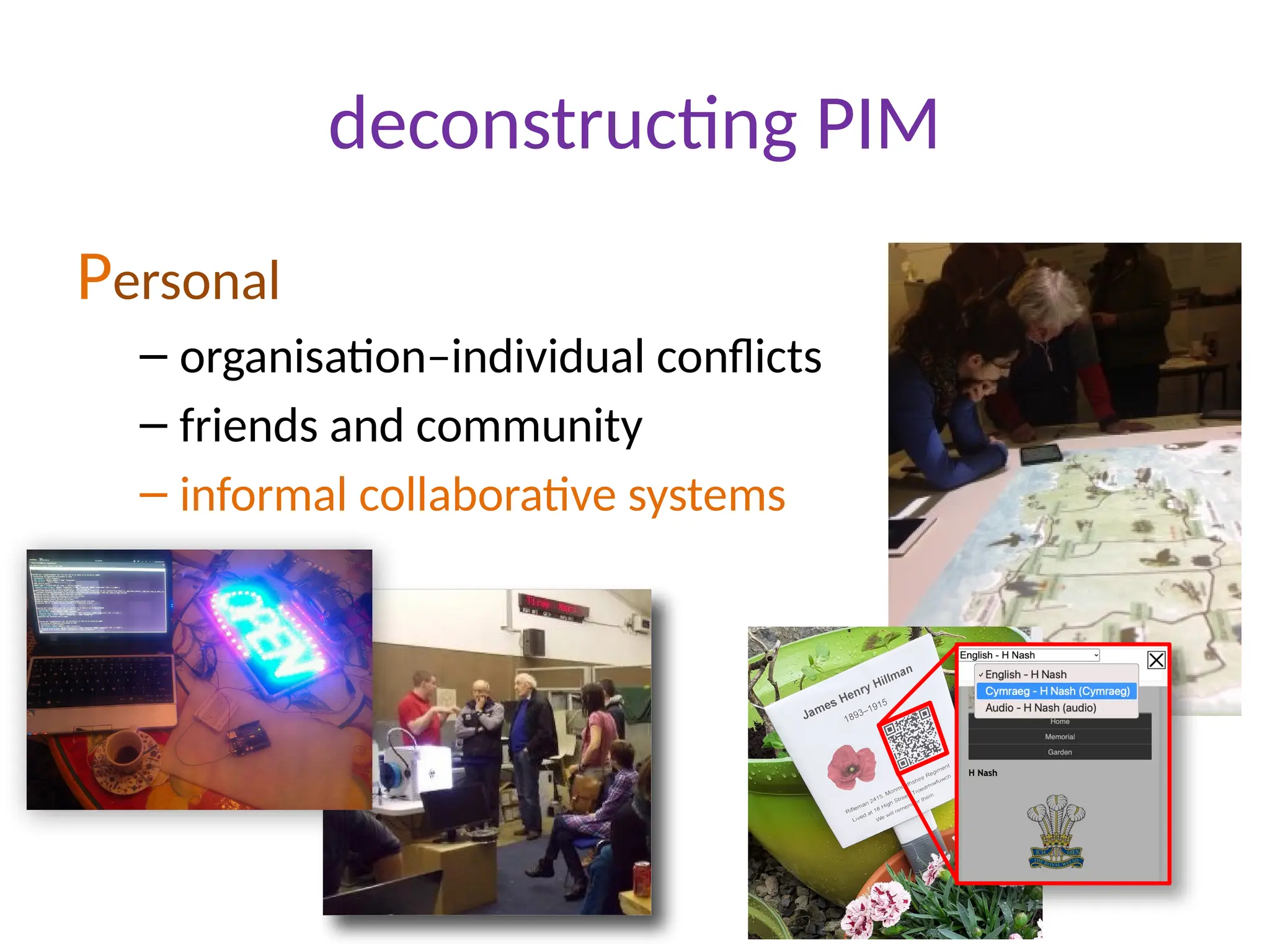
Personal
– organisation–individual conflicts
– friends and community
– informal collaborative systems
deconstructing PIM
Personal
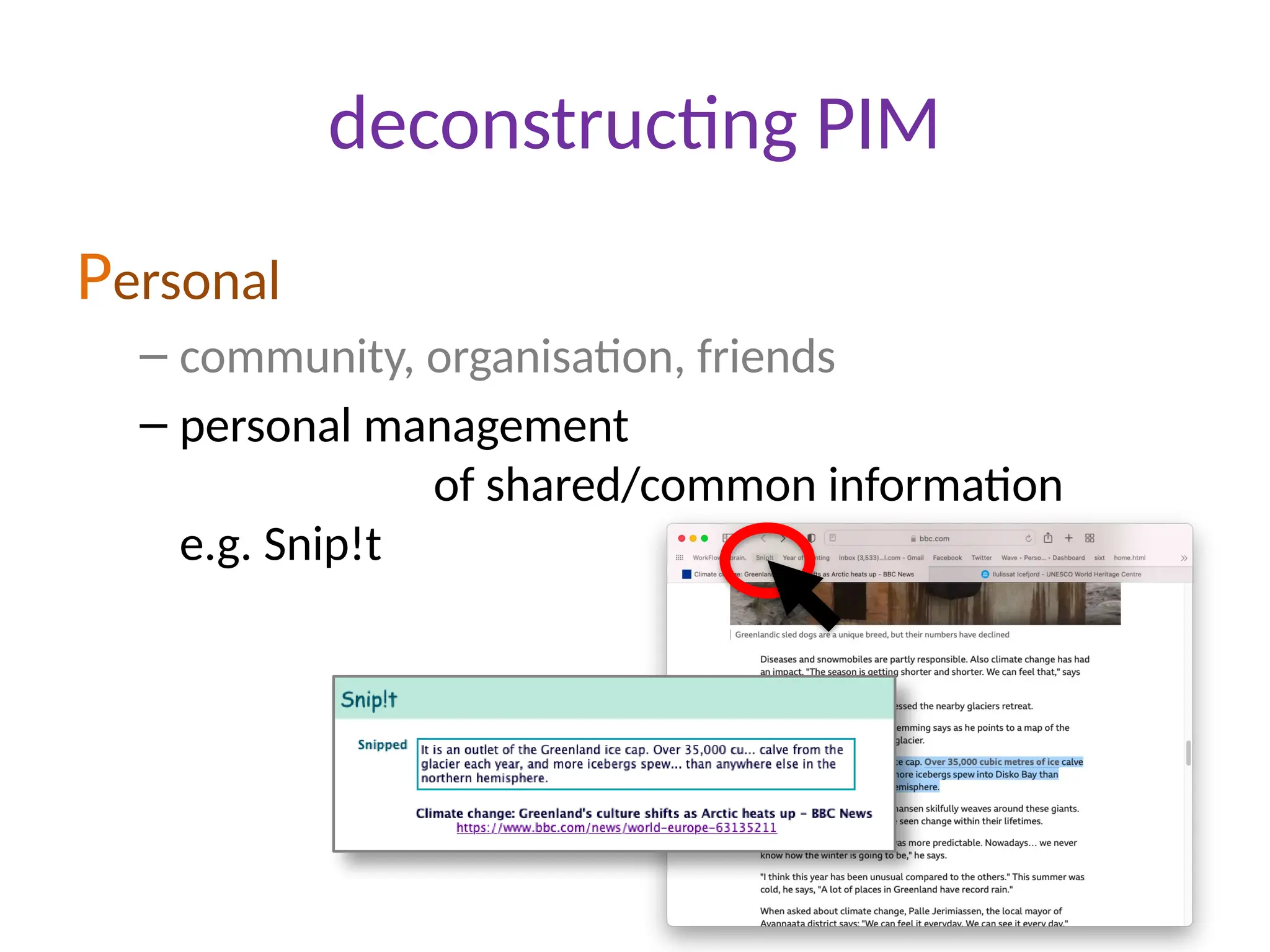
– community, organisation, friends
– personal management
of shared/common information
e.g. Snip!t
deconstructing PIM
Personal
Information
– knowledge, insight
– purpose? … not autotelic –
if PIM is designed for PIM it
fails
– tasks and action
e.g. to do lists, calendars, …
deconstructing PIM
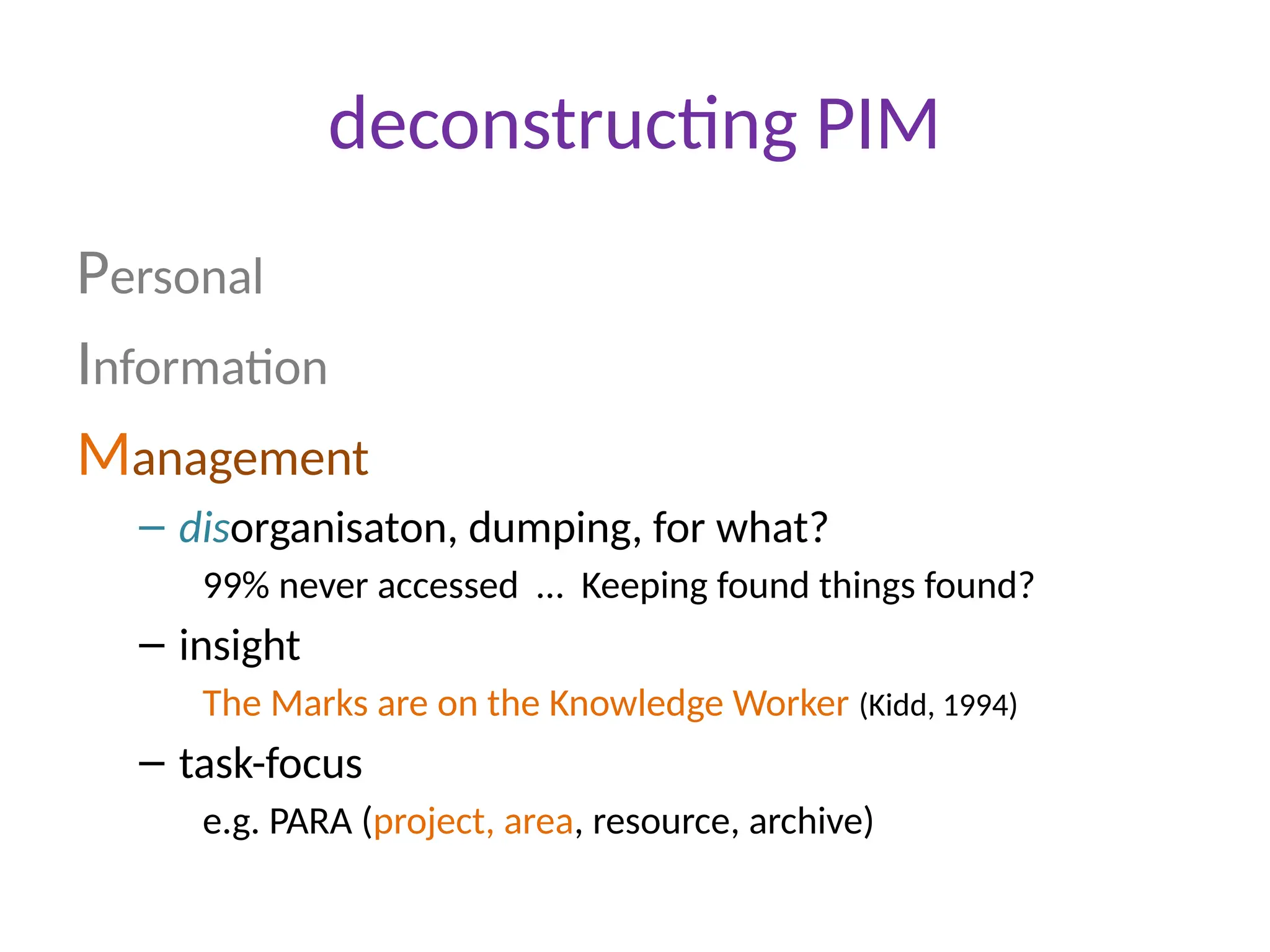
Personal
Information
Management
– disorganisaton, dumping, for what?
99% never accessed … Keeping found things found?
– insight
The Marks are on the Knowledge Worker (Kidd, 1994)
– task-focus
e.g. PARA (project, area, resource, archive)
deconstructing PIM
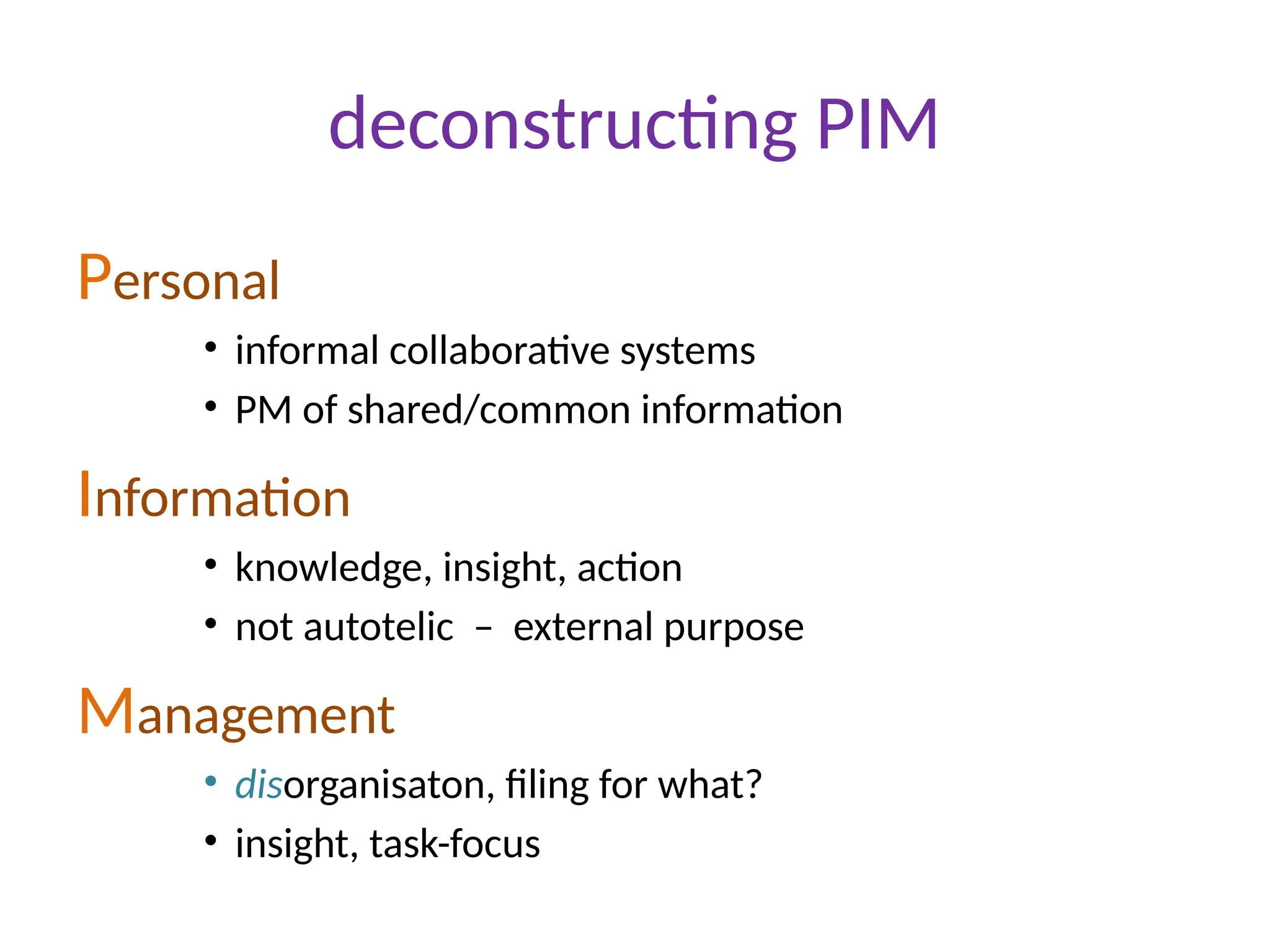
Personal
• informal collaborative systems
• PM of shared/common information
Information
• knowledge, insight, action
• not autotelic – external purpose
Management
• disorganisaton, filing for what?
• insight, task-focus
PIM in practice
PIM in practice
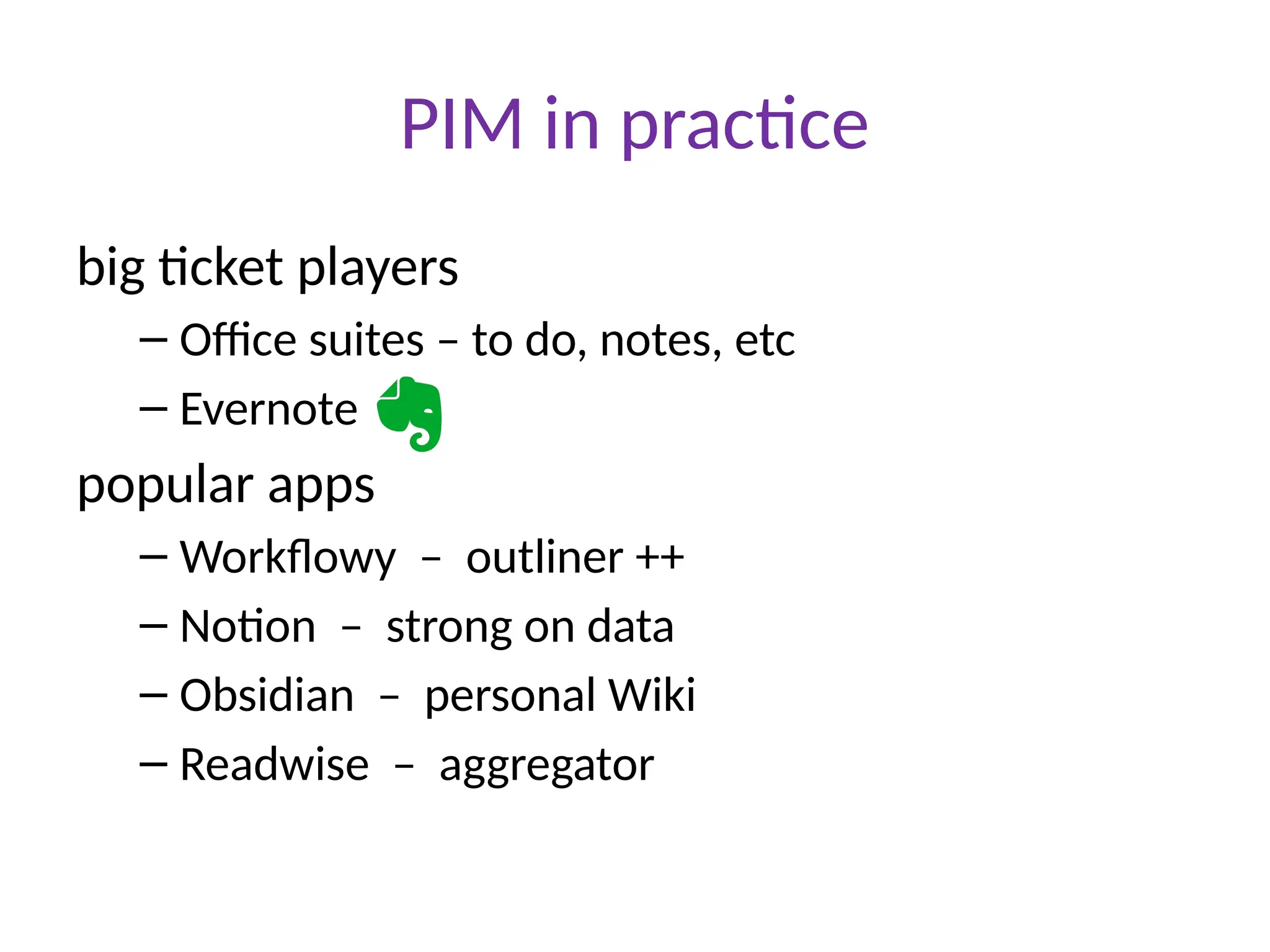
big ticket players
– Office suites – to do, notes, etc
– Evernote
popular apps
– Workflowy – outliner ++
– Notion – strong on data
– Obsidian – personal Wiki
– Readwise – aggregator
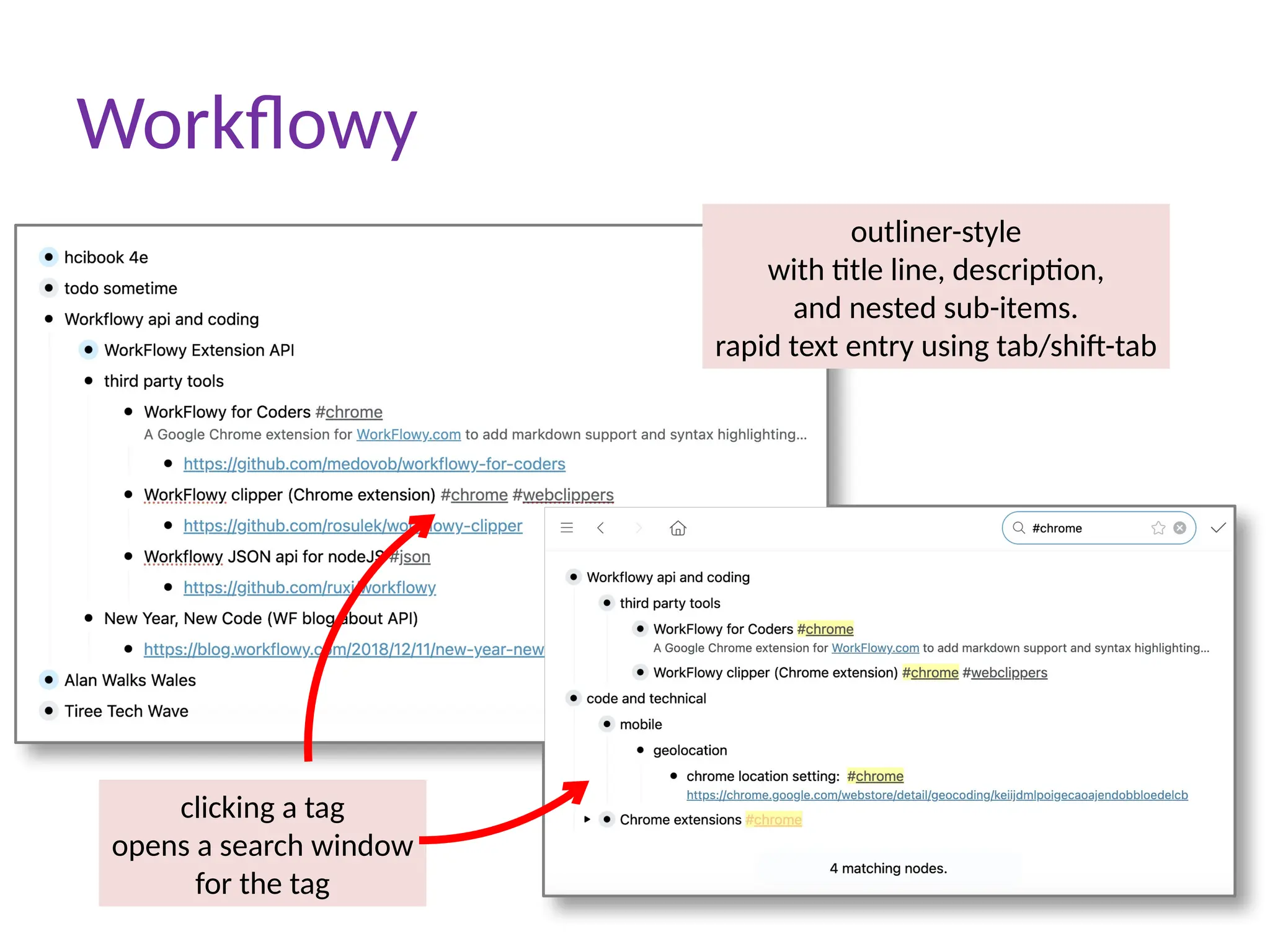
clicking a tag
opens a search window
for the tag
outliner-style
with title line, description,
and nested sub-items.
rapid text entry using tab/shift-tab
Workflowy
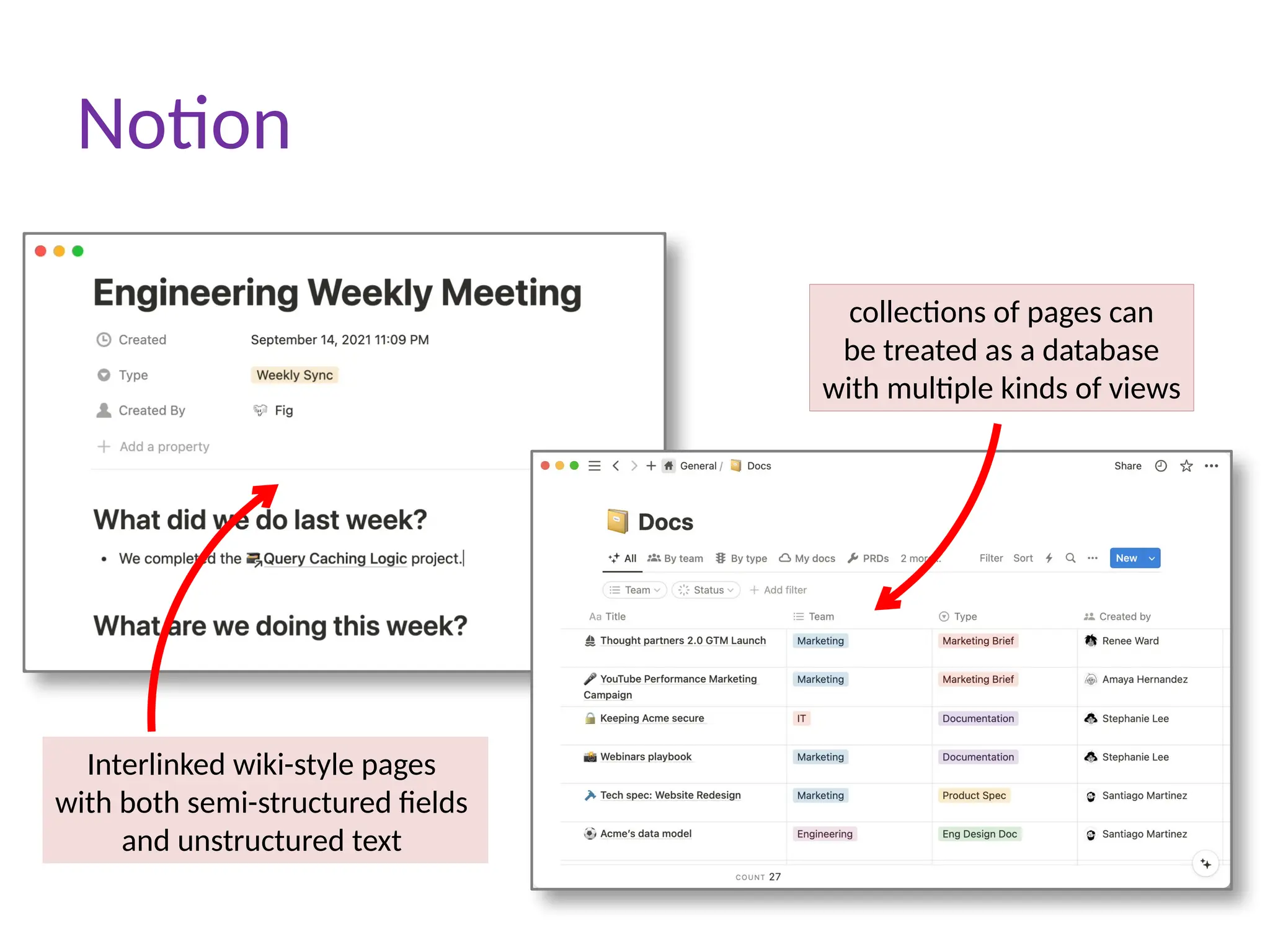
Interlinked wiki-style pages
with both semi-structured fields
and unstructured text
collections of pages can
be treated as a database
with multiple kinds of views
Notion
note-taking interface
allowing external URLs, rich formatting
and internal wiki-style links
using [[notation]]
beneath the surface
markdown files
Obsidian
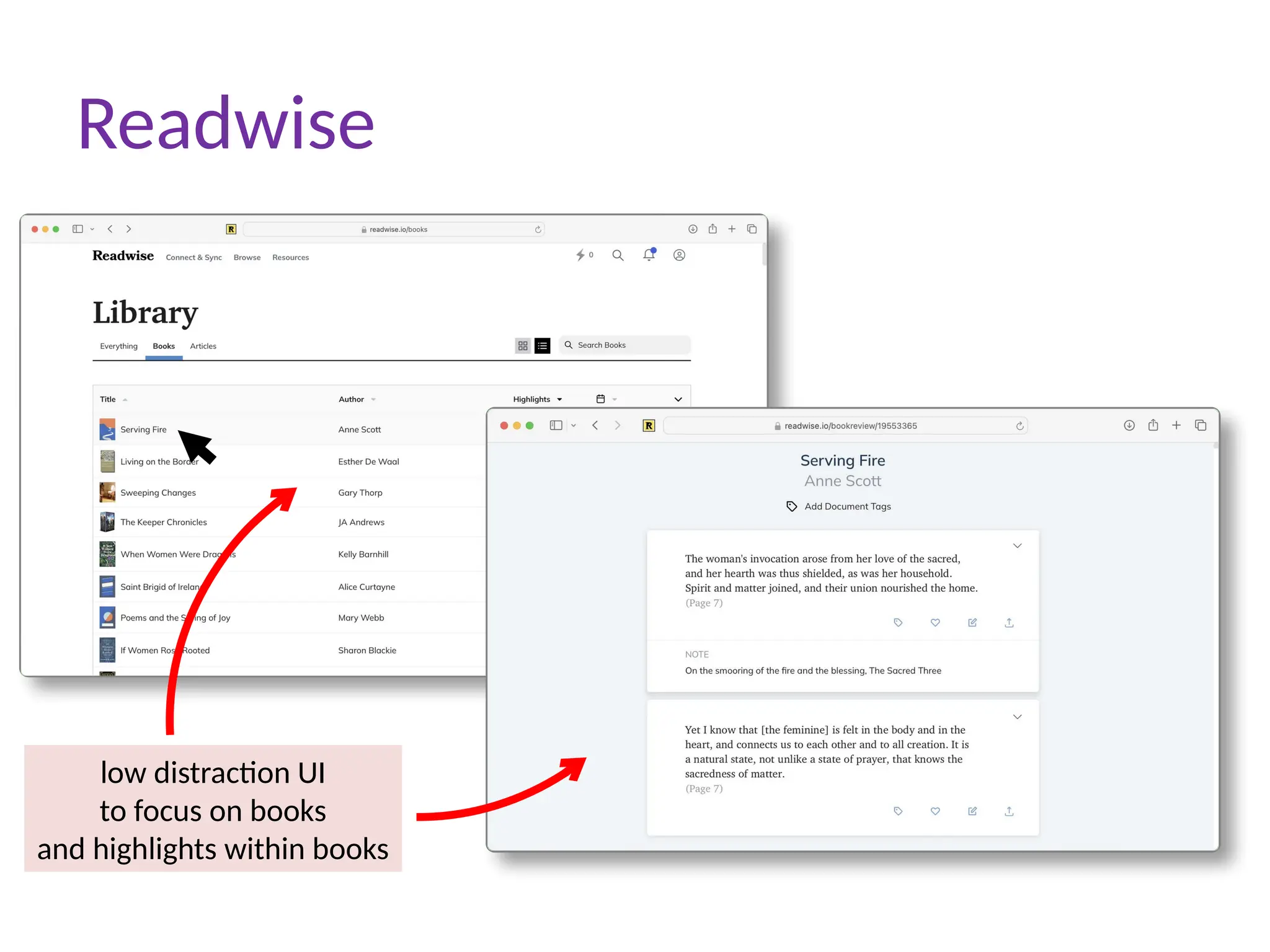
low distraction UI
to focus on books
and highlights within books
Readwise
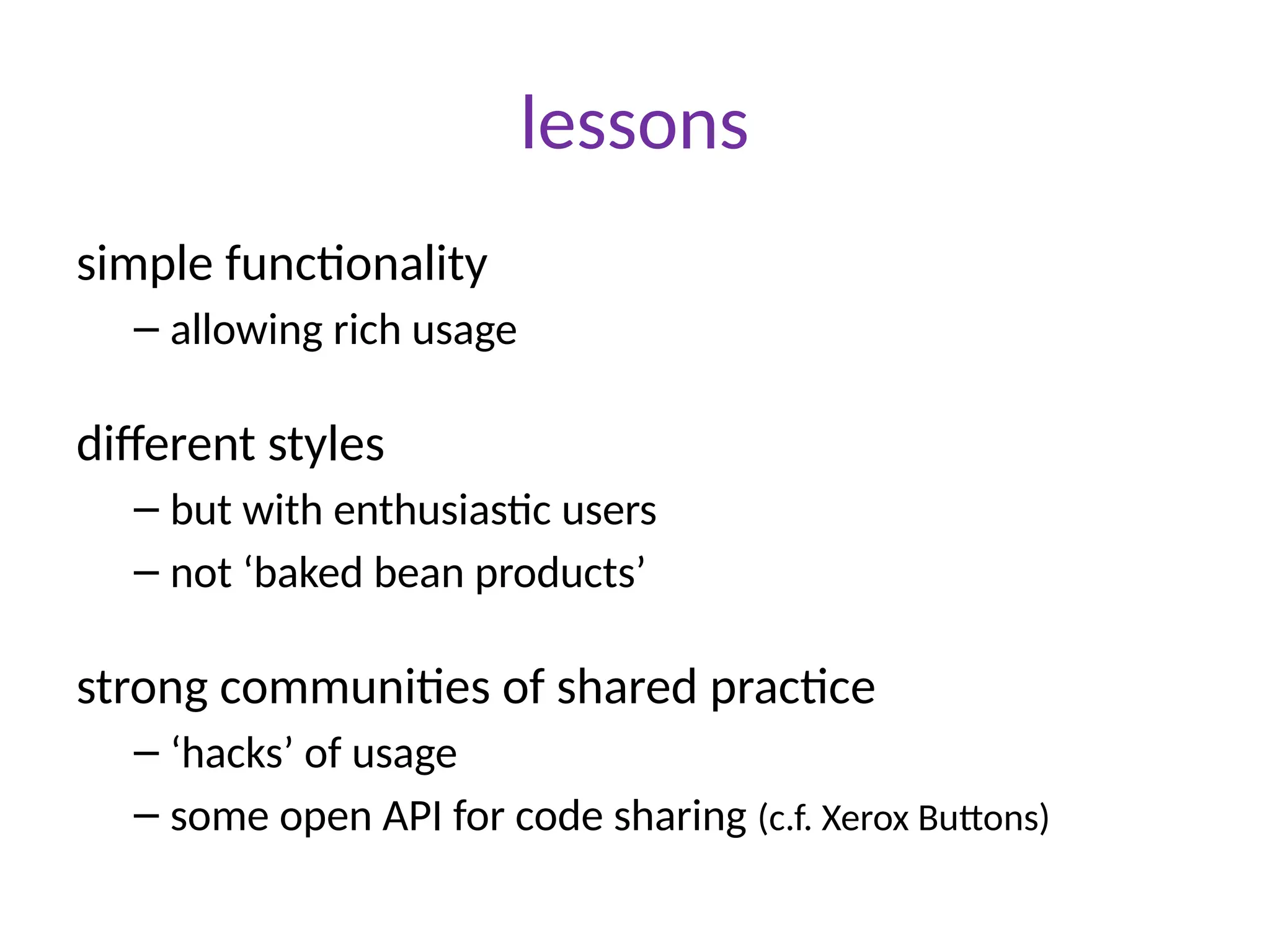
lessons
simple functionality
– allowing rich usage
different styles
– but with enthusiastic users
– not ‘baked bean products’
strong communities of shared practice
– ‘hacks’ of usage
– some open API for code sharing (c.f. Xerox Buttons)
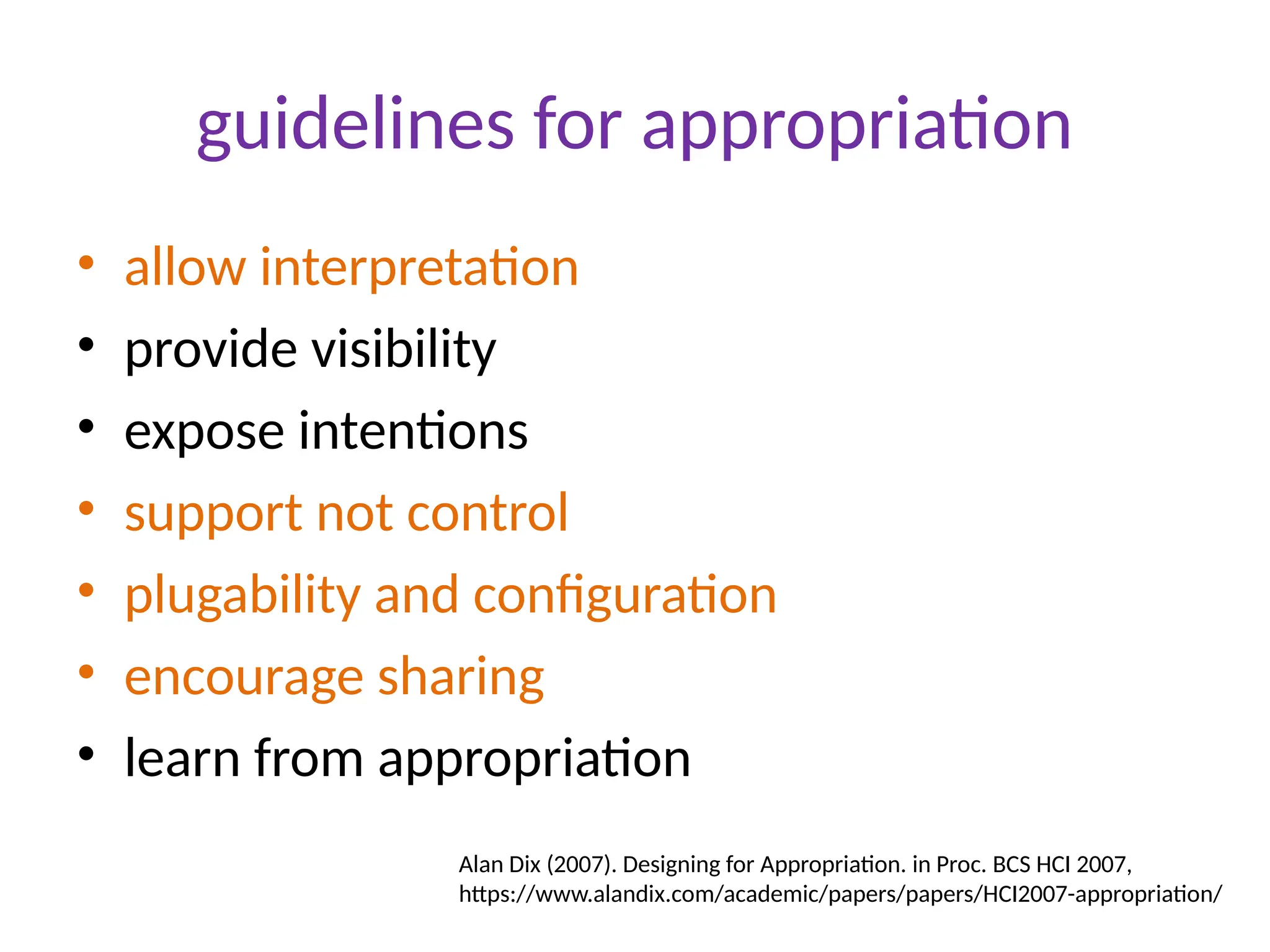
guidelines for appropriation
• allow interpretation
• provide visibility
• expose intentions
• support not control
• plugability and configuration
• encourage sharing
• learn from appropriation
Alan Dix (2007). Designing for Appropriation. in Proc. BCS HCI 2007,
https://www.alandix.com/academic/papers/papers/HCI2007-appropriation/
using technology
using technology
• fragmentation and synchronisation
– media
– applications
– devices
– people
using technology
• fragmentation and synchronisation
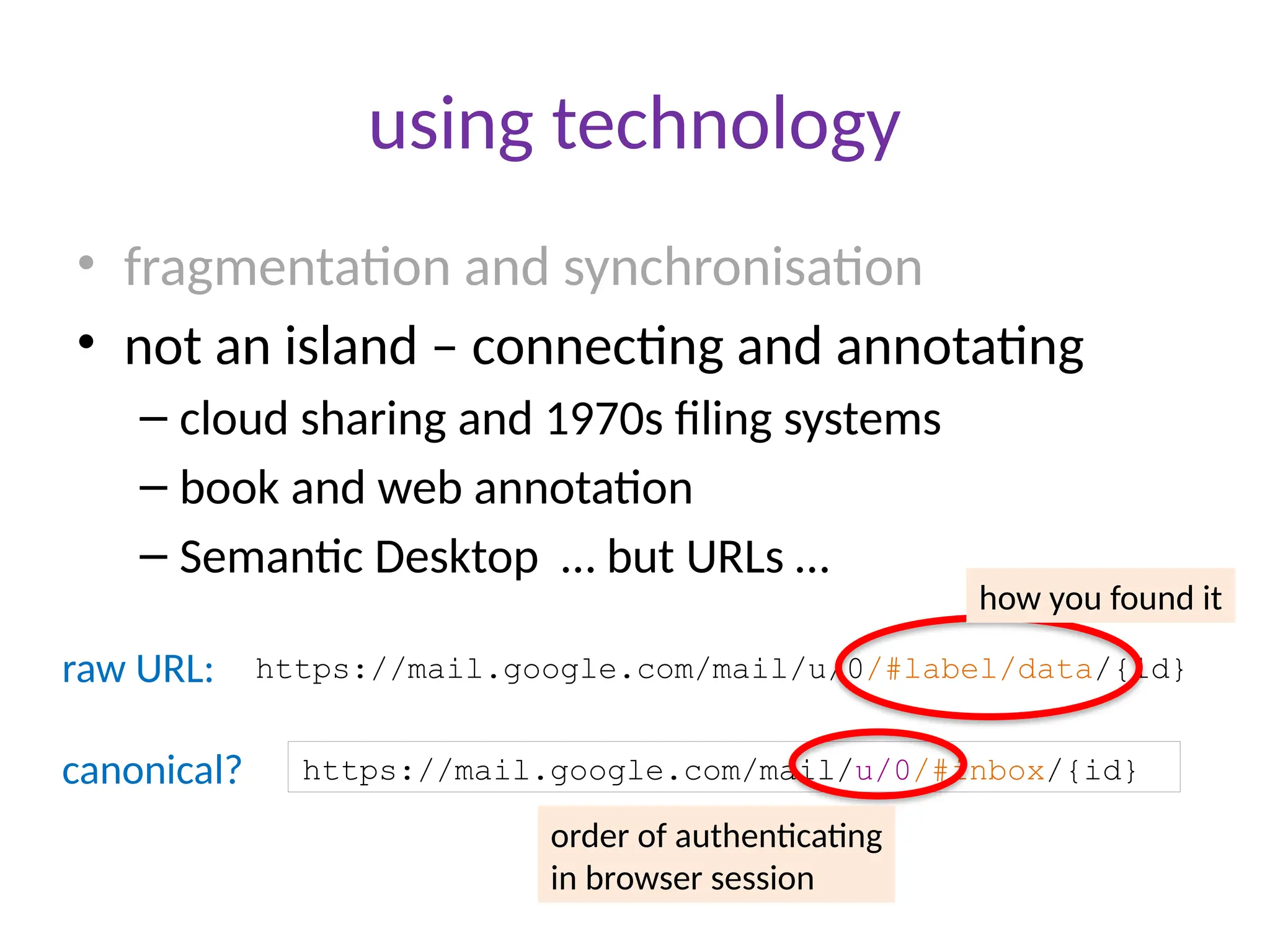
• not an island – connecting and annotating
– cloud sharing and 1970s filing systems
– book and web annotation
– Semantic Desktop … but URLs …
https://mail.google.com/mail/u/0/#label/data/{id}
raw URL:
https://mail.google.com/mail/u/0/#inbox/{id}
canonical?
how you found it
order of authenticating
in browser session
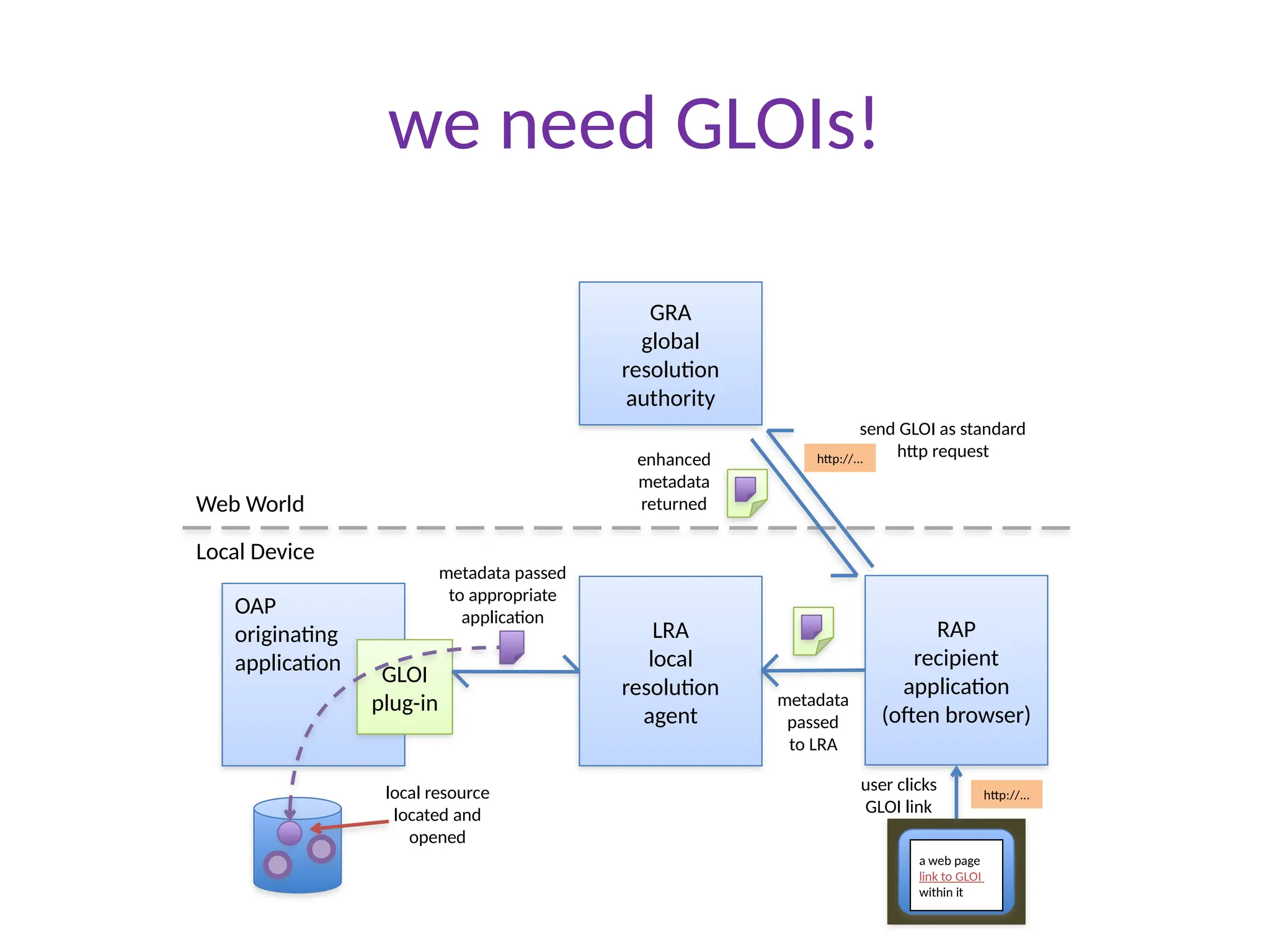
GLOI
plug-in
OAP
originating
application
LRA
local
resolution
agent
GRA
global
resolution
authority
metadata passed
to appropriate
application
send GLOI as standard
http request
http://...
local resource
located and
opened
Web World
Local Device
RAP
recipient
application
(often browser)
a web page
link to GLOI
within it
enhanced
metadata
returned
http://...
user clicks
GLOI link
metadata
passed
to LRA
we need GLOIs!
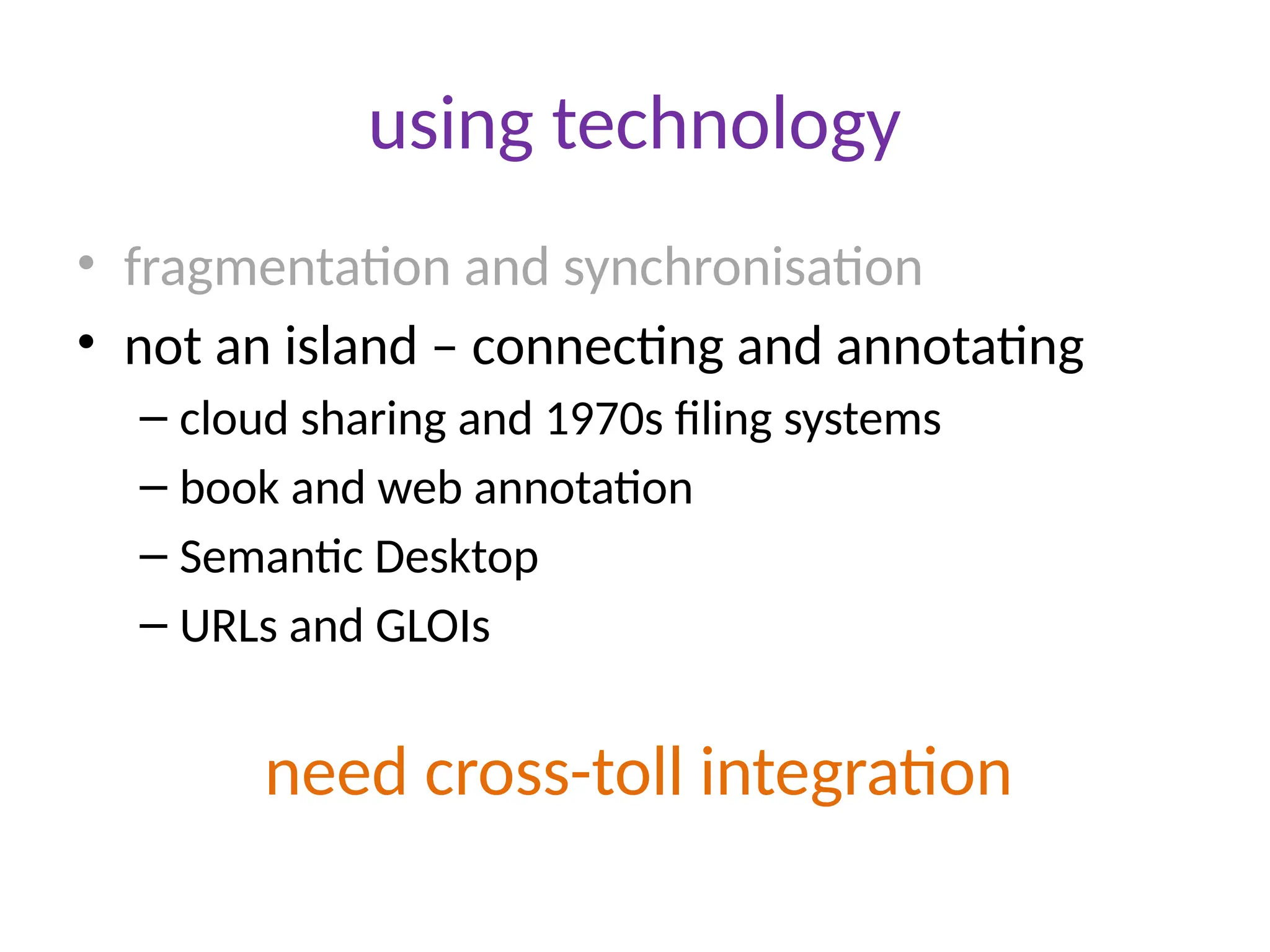
using technology
• fragmentation and synchronisation
• not an island – connecting and annotating
– cloud sharing and 1970s filing systems
– book and web annotation
– Semantic Desktop
– URLs and GLOIs
need cross-toll integration
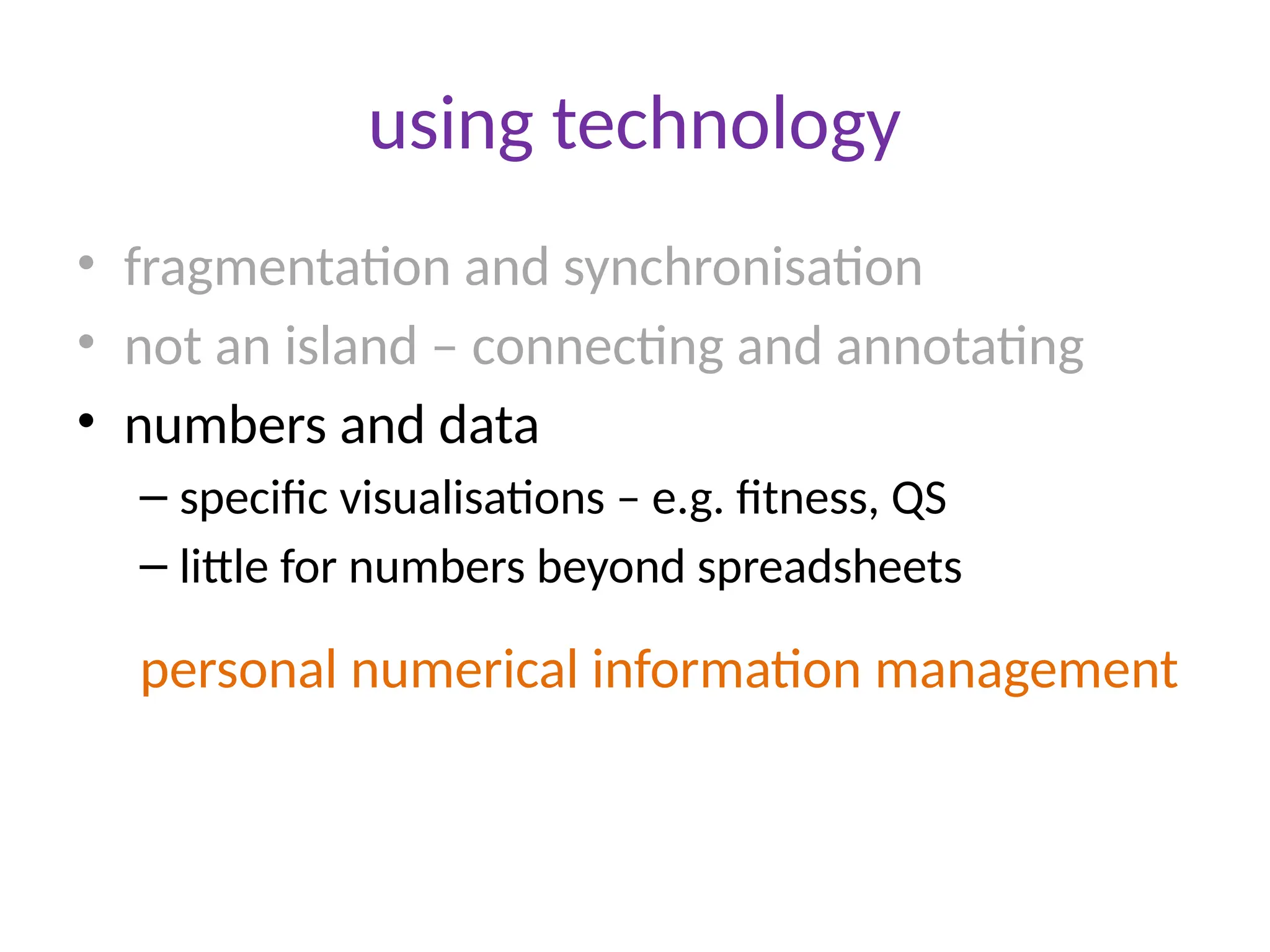
using technology
• fragmentation and synchronisation
• not an island – connecting and annotating
• numbers and data
– specific visualisations – e.g. fitness, QS
– little for numbers beyond spreadsheets
personal numerical information management
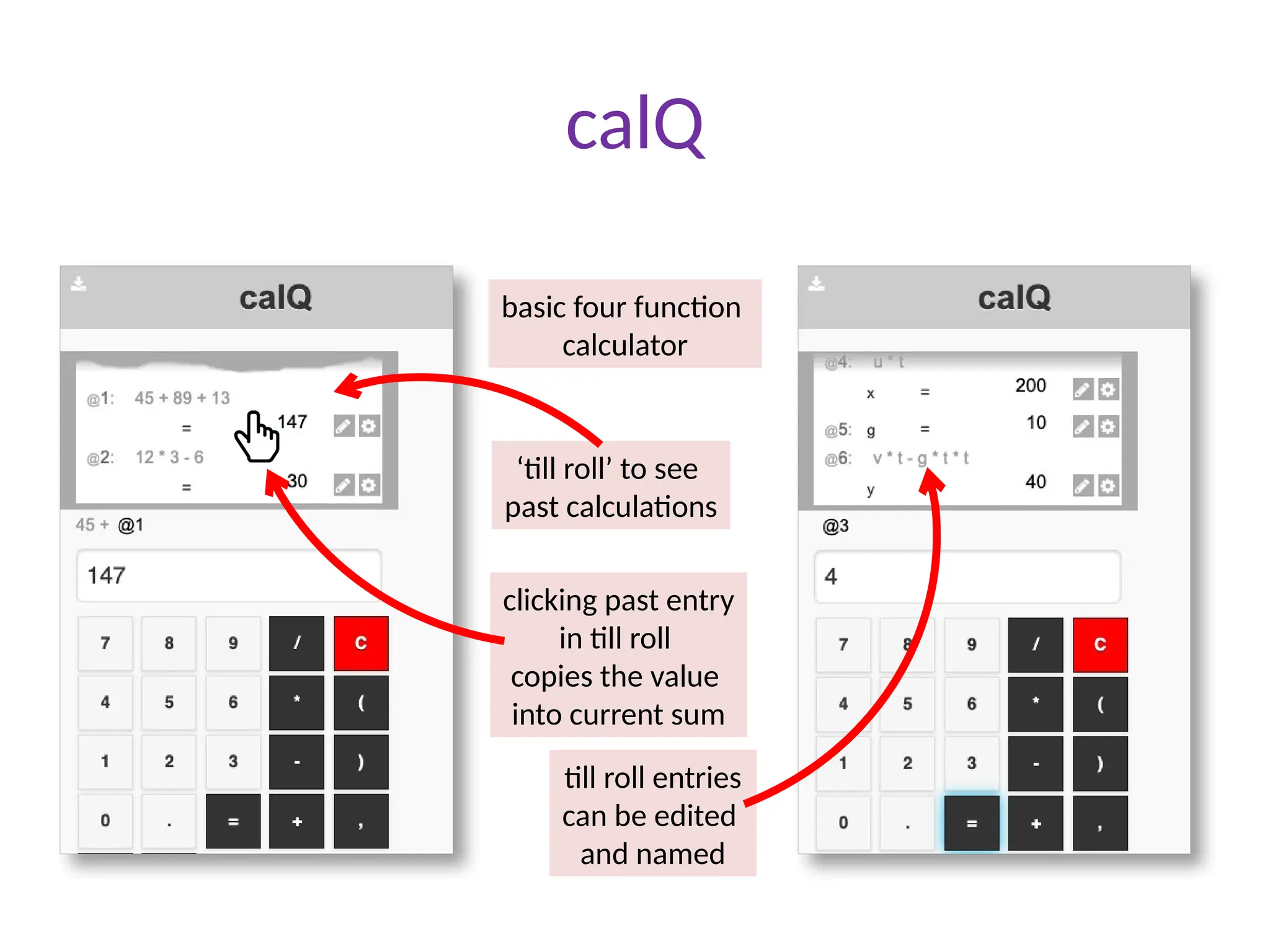
‘till roll’ to see
past calculations
basic four function
calculator
clicking past entry
in till roll
copies the value
into current sum
till roll entries
can be edited
and named
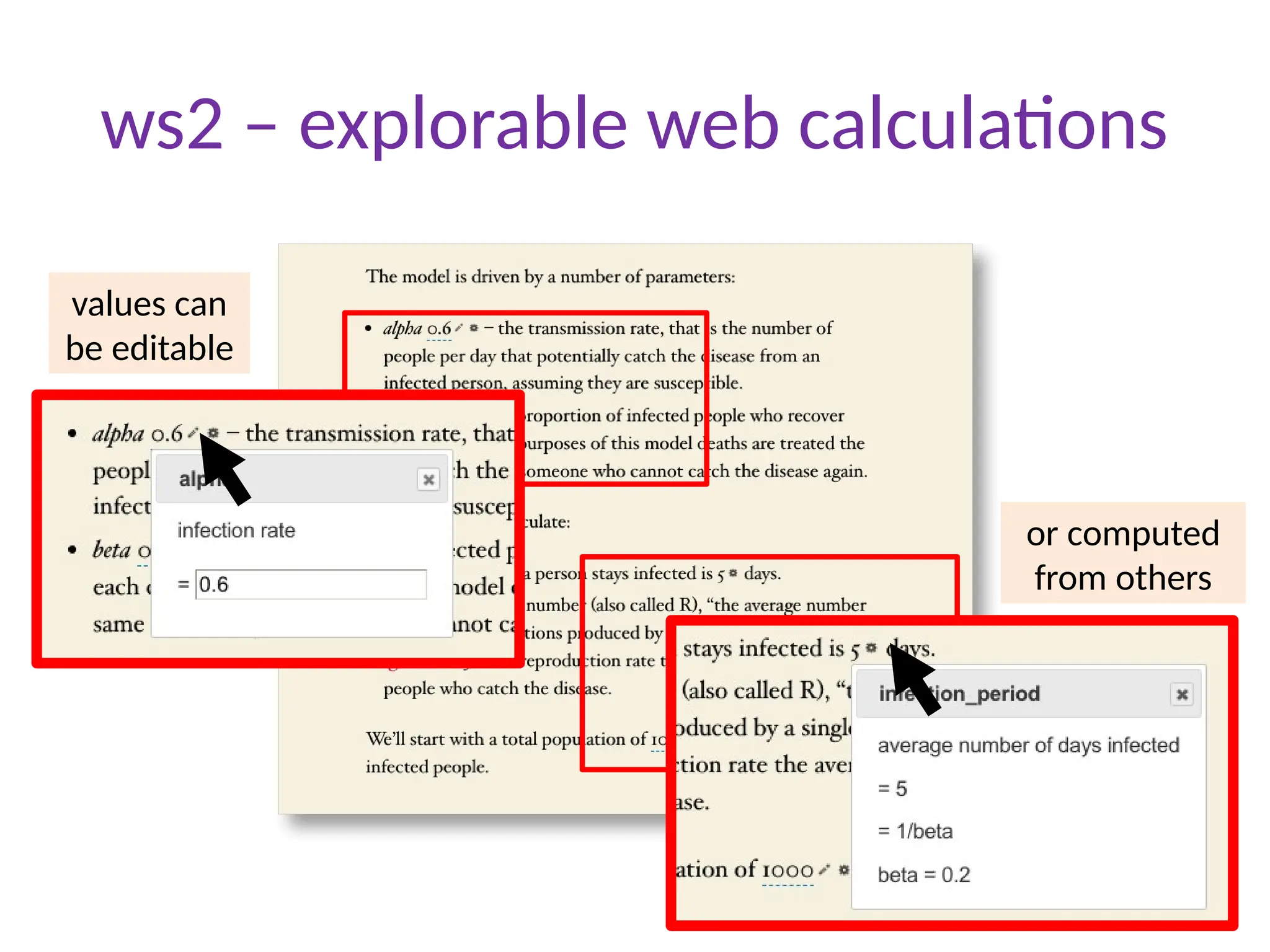
calQ
values can
be editable
or computed
from others
ws2 – explorable web calculations
using technology
• fragmentation and synchronisation
• not an island – connecting and annotating
• numbers and data
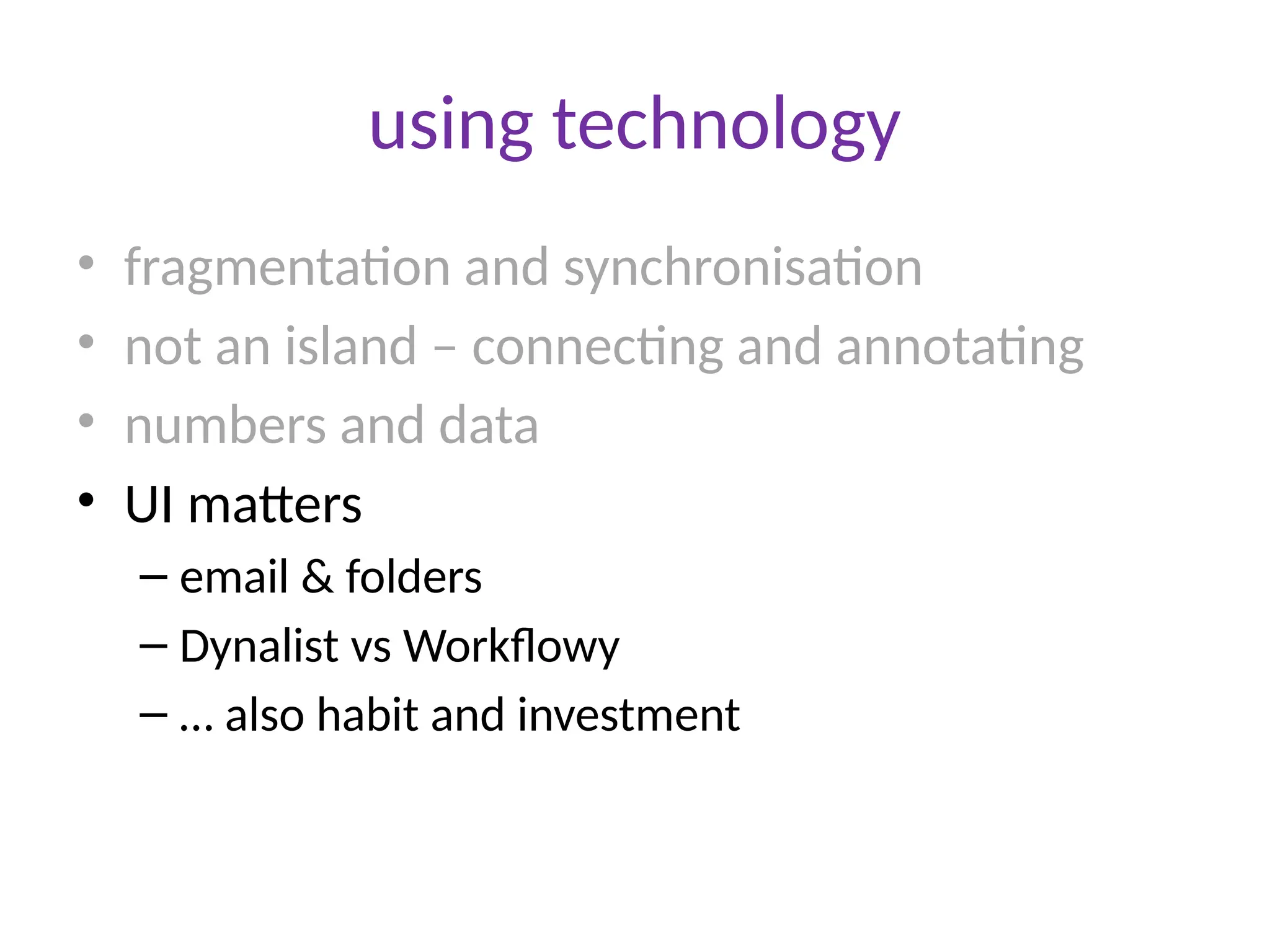
• UI matters
– email & folders
– Dynalist vs Workflowy
– … also habit and investment
using technology
• fragmentation and synchronisation
• not an island – connecting and annotating
• numbers and data
• UI matters
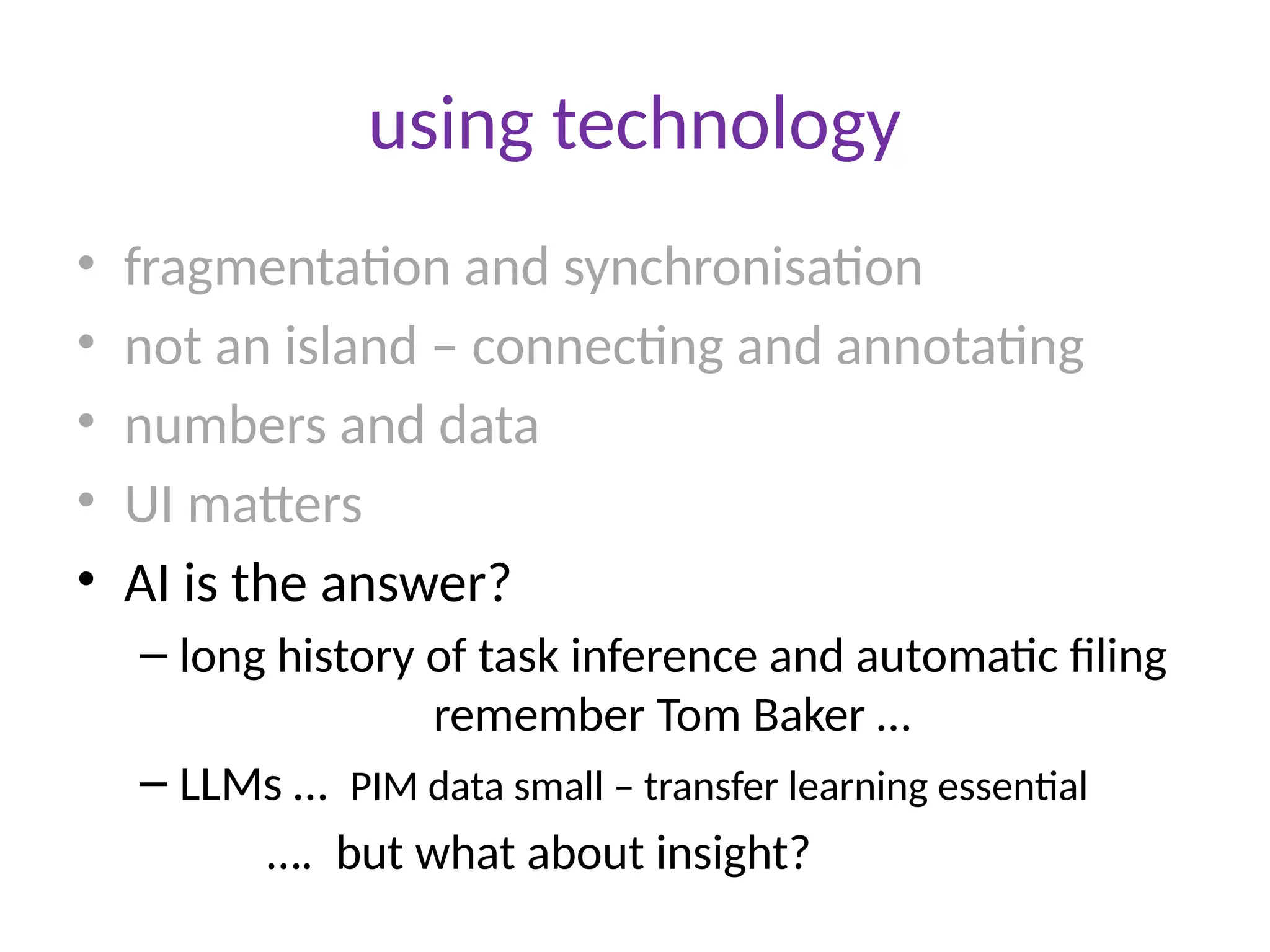
• AI is the answer?
– long history of task inference and automatic filing
remember Tom Baker …
– LLMs … PIM data small – transfer learning essential
…. but what about insight?
using technology
• fragmentation and synchronisation
• not an island – connecting and annotating
• numbers and data
• UI matters
• AI is the answer?
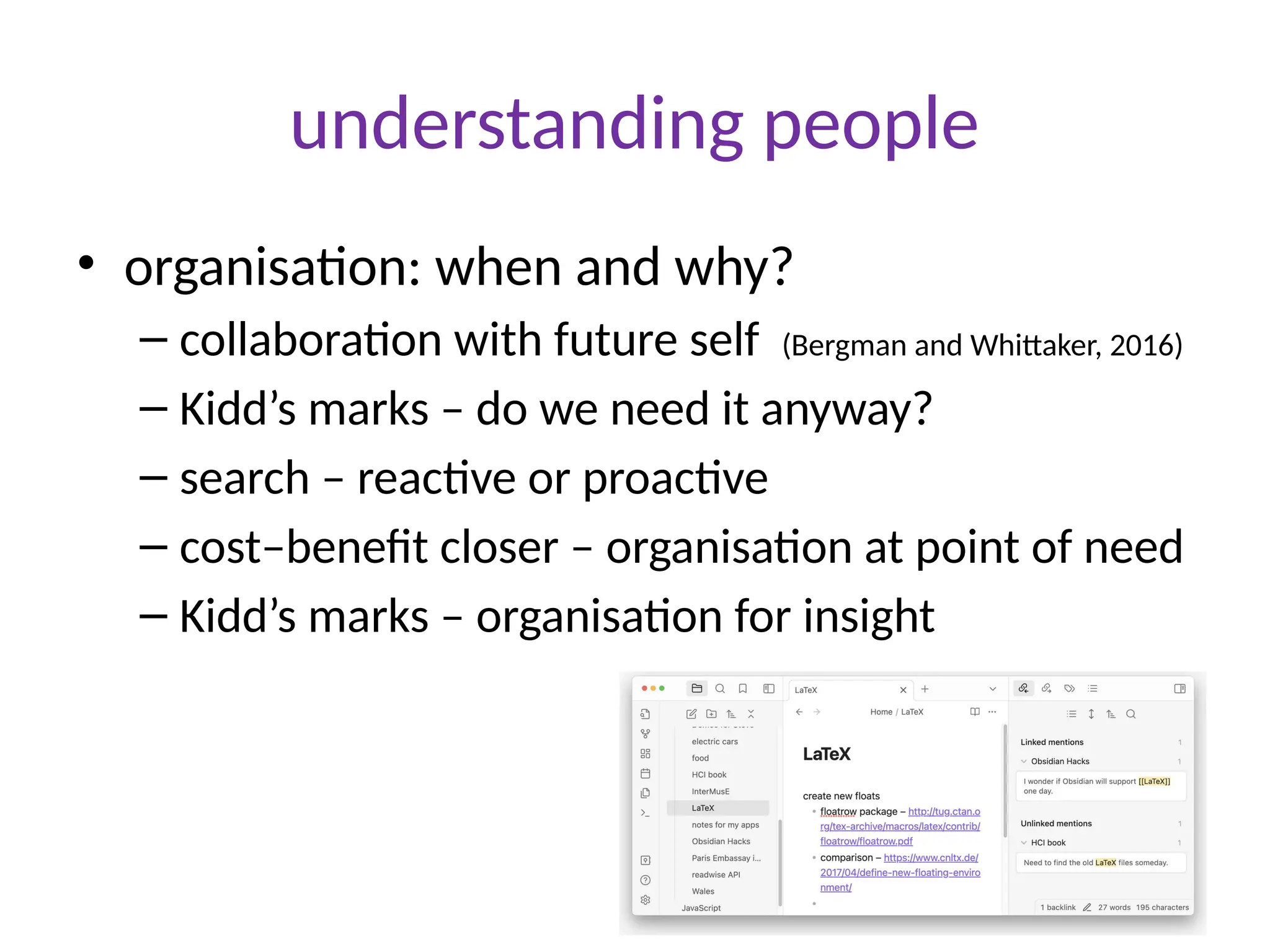
understanding people
• organisation: when and why?
– collaboration with future self (Bergman and Whittaker, 2016)
– Kidd’s marks – do we need it anyway?
– search – reactive or proactive
direct hyperlinks
from other pages,
entered as [[LaTeX]]
in the markdown
free text mentions
understanding people
• organisation: when and why?
– collaboration with future self (Bergman and Whittaker, 2016)
– Kidd’s marks – do we need it anyway?
– search – reactive or proactive
– cost–benefit closer – organisation at point of need
– Kidd’s marks – organisation for insight
understanding people
• organisation: when and why?
• communities and appropriation
– support not control
– pluggability and configuration
– encourage sharing
understanding people
• organisation: when and why?
• communities and appropriation
• people are different
– different practices similar efficiency (Kaye et al. 2006)
– ontologies: generic, egocentric, idiosyncratic
– cognitive differences – hard to comprehend
… including HCI researchers!
– different solutions for different people
… but how do they collaborate?
understanding people
• organisation: when and why?
• communities and appropriation
• people are different
• emotion management
– GTD – The art of stress-free productivity
– to-do list – not-done list – done list
– magick and quests, gamification
understanding people
• organisation: when and why?
• communities and appropriation
• people are different
• emotion management
take aways …
• informal collaborative systems
• purpose & task-centred
• fragmentation and integration
– GLOIs, cross-tool infrastructure
• appropriation by design
• emotion matters
… designing for solitude
Deconstructing and
Reconstructing PIM
Alan Dix
https://alandix.com/academic/talks/PIM-seminar-2024/

Deconstructing and reconstructing PIM (Personal Information Management)

  • 1.
  • 2.
    2nd edition coming soon plusAI for HCI AI for Social Justice plugs
  • 4.
    promise of PIM PIMresearch – does it make a difference? – ideas and concepts trickle through (Klujn et al., 2015) e.g. threading MONA => gmail tech innovation start-ups – loads of apps! personal knowledge management, personal productivity tools (Cockburn & Thimbleby. 1993; Cockburn, 1994)
  • 5.
    plan … analysis – deconstructPersonal Information Management – examine some interesting and popular apps synthesis – technology and features – human context
  • 7.
  • 8.
  • 9.
    deconstructing PIM Personal – organisation–individualconflicts – friends and community – informal collaborative systems
  • 10.
    deconstructing PIM Personal – community,organisation, friends – personal management of shared/common information e.g. Snip!t
  • 11.
    deconstructing PIM Personal Information – knowledge,insight – purpose? … not autotelic – if PIM is designed for PIM it fails – tasks and action e.g. to do lists, calendars, …
  • 12.
    deconstructing PIM Personal Information Management – disorganisaton,dumping, for what? 99% never accessed … Keeping found things found? – insight The Marks are on the Knowledge Worker (Kidd, 1994) – task-focus e.g. PARA (project, area, resource, archive)
  • 13.
    deconstructing PIM Personal • informalcollaborative systems • PM of shared/common information Information • knowledge, insight, action • not autotelic – external purpose Management • disorganisaton, filing for what? • insight, task-focus
  • 15.
  • 16.
    PIM in practice bigticket players – Office suites – to do, notes, etc – Evernote popular apps – Workflowy – outliner ++ – Notion – strong on data – Obsidian – personal Wiki – Readwise – aggregator
  • 17.
    clicking a tag opensa search window for the tag outliner-style with title line, description, and nested sub-items. rapid text entry using tab/shift-tab Workflowy
  • 18.
    Interlinked wiki-style pages withboth semi-structured fields and unstructured text collections of pages can be treated as a database with multiple kinds of views Notion
  • 19.
    note-taking interface allowing externalURLs, rich formatting and internal wiki-style links using [[notation]] beneath the surface markdown files Obsidian
  • 20.
    low distraction UI tofocus on books and highlights within books Readwise
  • 21.
    lessons simple functionality – allowingrich usage different styles – but with enthusiastic users – not ‘baked bean products’ strong communities of shared practice – ‘hacks’ of usage – some open API for code sharing (c.f. Xerox Buttons)
  • 22.
    guidelines for appropriation •allow interpretation • provide visibility • expose intentions • support not control • plugability and configuration • encourage sharing • learn from appropriation Alan Dix (2007). Designing for Appropriation. in Proc. BCS HCI 2007, https://www.alandix.com/academic/papers/papers/HCI2007-appropriation/
  • 24.
  • 25.
    using technology • fragmentationand synchronisation – media – applications – devices – people
  • 26.
    using technology • fragmentationand synchronisation • not an island – connecting and annotating – cloud sharing and 1970s filing systems – book and web annotation – Semantic Desktop … but URLs … https://mail.google.com/mail/u/0/#label/data/{id} raw URL: https://mail.google.com/mail/u/0/#inbox/{id} canonical? how you found it order of authenticating in browser session
  • 27.
    GLOI plug-in OAP originating application LRA local resolution agent GRA global resolution authority metadata passed to appropriate application sendGLOI as standard http request http://... local resource located and opened Web World Local Device RAP recipient application (often browser) a web page link to GLOI within it enhanced metadata returned http://... user clicks GLOI link metadata passed to LRA we need GLOIs!
  • 28.
    using technology • fragmentationand synchronisation • not an island – connecting and annotating – cloud sharing and 1970s filing systems – book and web annotation – Semantic Desktop – URLs and GLOIs need cross-toll integration
  • 29.
    using technology • fragmentationand synchronisation • not an island – connecting and annotating • numbers and data – specific visualisations – e.g. fitness, QS – little for numbers beyond spreadsheets personal numerical information management
  • 30.
    ‘till roll’ tosee past calculations basic four function calculator clicking past entry in till roll copies the value into current sum till roll entries can be edited and named calQ
  • 31.
    values can be editable orcomputed from others ws2 – explorable web calculations
  • 32.
    using technology • fragmentationand synchronisation • not an island – connecting and annotating • numbers and data • UI matters – email & folders – Dynalist vs Workflowy – … also habit and investment
  • 33.
    using technology • fragmentationand synchronisation • not an island – connecting and annotating • numbers and data • UI matters • AI is the answer? – long history of task inference and automatic filing remember Tom Baker … – LLMs … PIM data small – transfer learning essential …. but what about insight?
  • 34.
    using technology • fragmentationand synchronisation • not an island – connecting and annotating • numbers and data • UI matters • AI is the answer?
  • 36.
  • 37.
    understanding people • organisation:when and why? – collaboration with future self (Bergman and Whittaker, 2016) – Kidd’s marks – do we need it anyway? – search – reactive or proactive direct hyperlinks from other pages, entered as [[LaTeX]] in the markdown free text mentions
  • 38.
    understanding people • organisation:when and why? – collaboration with future self (Bergman and Whittaker, 2016) – Kidd’s marks – do we need it anyway? – search – reactive or proactive – cost–benefit closer – organisation at point of need – Kidd’s marks – organisation for insight
  • 39.
    understanding people • organisation:when and why? • communities and appropriation – support not control – pluggability and configuration – encourage sharing
  • 40.
    understanding people • organisation:when and why? • communities and appropriation • people are different – different practices similar efficiency (Kaye et al. 2006) – ontologies: generic, egocentric, idiosyncratic – cognitive differences – hard to comprehend … including HCI researchers! – different solutions for different people … but how do they collaborate?
  • 41.
    understanding people • organisation:when and why? • communities and appropriation • people are different • emotion management – GTD – The art of stress-free productivity – to-do list – not-done list – done list – magick and quests, gamification
  • 42.
    understanding people • organisation:when and why? • communities and appropriation • people are different • emotion management
  • 44.
    take aways … •informal collaborative systems • purpose & task-centred • fragmentation and integration – GLOIs, cross-tool infrastructure • appropriation by design • emotion matters … designing for solitude
  • 45.
    Deconstructing and Reconstructing PIM AlanDix https://alandix.com/academic/talks/PIM-seminar-2024/

Editor's Notes

  • #18 https://www.notion.so/help/create-links-and-backlinks https://www.notion.so/help/what-is-a-database