
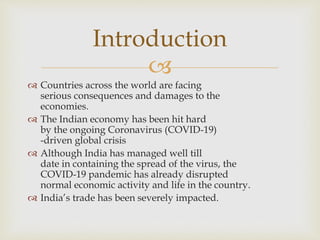
 Countries across the world are facing
serious consequences and damages to the
economies.
 The Indian economy has been hit hard
by the ongoing Coronavirus (COVID-19)
-driven global crisis
 Although India has managed well till
date in containing the spread of the virus, the
COVID-19 pandemic has already disrupted
normal economic activity and life in the country.
 India’s trade has been severely impacted.
Introduction

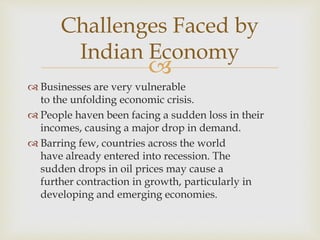
 Businesses are very vulnerable
to the unfolding economic crisis.
 People haven been facing a sudden loss in their
incomes, causing a major drop in demand.
 Barring few, countries across the world
have already entered into recession. The
sudden drops in oil prices may cause a
further contraction in growth, particularly in
developing and emerging economies.
Challenges Faced by
Indian Economy

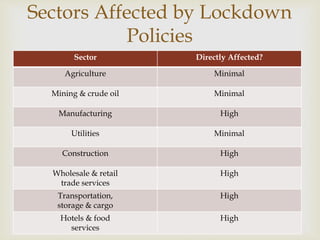
Sector Directly Affected?
Agriculture Minimal
Mining & crude oil Minimal
Manufacturing High
Utilities Minimal
Construction High
Wholesale & retail
trade services
High
Transportation,
storage & cargo
High
Hotels & food
services
High
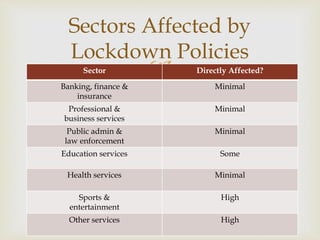
Sectors Affected by Lockdown
Policies

Sector Directly Affected?
Banking, finance &
insurance
Minimal
Professional &
business services
Minimal
Public admin &
law enforcement
Minimal
Education services Some
Health services Minimal
Sports &
entertainment
High
Other services High
Sectors Affected by
Lockdown Policies

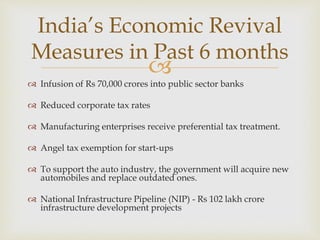
 Infusion of Rs 70,000 crores into public sector banks
 Reduced corporate tax rates
 Manufacturing enterprises receive preferential tax treatment.
 Angel tax exemption for start-ups
 To support the auto industry, the government will acquire new
automobiles and replace outdated ones.
 National Infrastructure Pipeline (NIP) - Rs 102 lakh crore
infrastructure development projects
India’s Economic Revival
Measures in Past 6 months

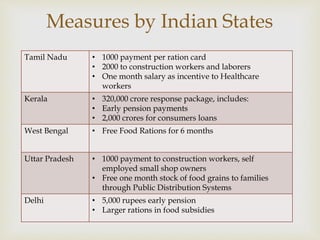
Tamil Nadu • 1000 payment per ration card
• 2000 to construction workers and laborers
• One month salary as incentive to Healthcare
workers
Kerala • 320,000 crore response package, includes:
• Early pension payments
• 2,000 crores for consumers loans
West Bengal • Free Food Rations for 6 months
Uttar Pradesh • 1000 payment to construction workers, self
employed small shop owners
• Free one month stock of food grains to families
through Public Distribution Systems
Delhi • 5,000 rupees early pension
• Larger rations in food subsidies
Measures by Indian States

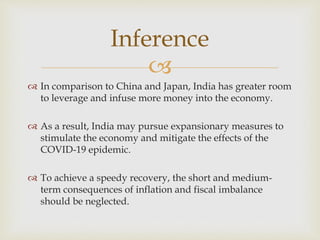
 In comparison to China and Japan, India has greater room
to leverage and infuse more money into the economy.
 As a result, India may pursue expansionary measures to
stimulate the economy and mitigate the effects of the
COVID-19 epidemic.
 To achieve a speedy recovery, the short and medium-
term consequences of inflation and fiscal imbalance
should be neglected.
Inference

 The COVID-19 event demonstrates that having a
Worldwide Value Chain for critical products can
have a negative influence on production and supply
in a global crisis situation.
 As a result, the manufacturing process for vital items
should be entirely established domestically.
Observations and
Learnings

COVID-19 has given India the opportunity to position itself as a
global leader. The government has also taken the necessary steps
in this direction, as evidenced by the following measures:
 The South Asian Association for Regional Cooperation
(SAARC) COVID-19 Emergency Fund was announced on
March 15 during a speech by Honorable Prime Minister
Narendra Modi to a summit of SAARC Leaders.
 India, on its part, had announced an initial commitment of $10
million.
 India has also helped Iran and Italy by donating humanitarian
supplies, testing tools, and other items.
India’s Leadership Role

 The global impact of the COVID-19 epidemic has
been felt throughout industries.
 Private consumption, investment, and foreign trade
are the three primary contributions to GDP in India.
 Economic hazards are being used by the global and
Indian economies to try to reduce health concerns.
 Till date India has managed to control the damage
due to COVID-19. However, the path to economic
recovery is steep given its already existing lower
growth situation
Conclusion

Covid Invasion Slides.pptx

  • 2.
      Countries acrossthe world are facing serious consequences and damages to the economies.  The Indian economy has been hit hard by the ongoing Coronavirus (COVID-19) -driven global crisis  Although India has managed well till date in containing the spread of the virus, the COVID-19 pandemic has already disrupted normal economic activity and life in the country.  India’s trade has been severely impacted. Introduction
  • 3.
      Businesses arevery vulnerable to the unfolding economic crisis.  People haven been facing a sudden loss in their incomes, causing a major drop in demand.  Barring few, countries across the world have already entered into recession. The sudden drops in oil prices may cause a further contraction in growth, particularly in developing and emerging economies. Challenges Faced by Indian Economy
  • 4.
     Sector Directly Affected? AgricultureMinimal Mining & crude oil Minimal Manufacturing High Utilities Minimal Construction High Wholesale & retail trade services High Transportation, storage & cargo High Hotels & food services High Sectors Affected by Lockdown Policies
  • 5.
     Sector Directly Affected? Banking,finance & insurance Minimal Professional & business services Minimal Public admin & law enforcement Minimal Education services Some Health services Minimal Sports & entertainment High Other services High Sectors Affected by Lockdown Policies
  • 6.
      Infusion ofRs 70,000 crores into public sector banks  Reduced corporate tax rates  Manufacturing enterprises receive preferential tax treatment.  Angel tax exemption for start-ups  To support the auto industry, the government will acquire new automobiles and replace outdated ones.  National Infrastructure Pipeline (NIP) - Rs 102 lakh crore infrastructure development projects India’s Economic Revival Measures in Past 6 months
  • 7.
     Tamil Nadu •1000 payment per ration card • 2000 to construction workers and laborers • One month salary as incentive to Healthcare workers Kerala • 320,000 crore response package, includes: • Early pension payments • 2,000 crores for consumers loans West Bengal • Free Food Rations for 6 months Uttar Pradesh • 1000 payment to construction workers, self employed small shop owners • Free one month stock of food grains to families through Public Distribution Systems Delhi • 5,000 rupees early pension • Larger rations in food subsidies Measures by Indian States
  • 8.
      In comparisonto China and Japan, India has greater room to leverage and infuse more money into the economy.  As a result, India may pursue expansionary measures to stimulate the economy and mitigate the effects of the COVID-19 epidemic.  To achieve a speedy recovery, the short and medium- term consequences of inflation and fiscal imbalance should be neglected. Inference
  • 9.
      The COVID-19event demonstrates that having a Worldwide Value Chain for critical products can have a negative influence on production and supply in a global crisis situation.  As a result, the manufacturing process for vital items should be entirely established domestically. Observations and Learnings
  • 10.
     COVID-19 has givenIndia the opportunity to position itself as a global leader. The government has also taken the necessary steps in this direction, as evidenced by the following measures:  The South Asian Association for Regional Cooperation (SAARC) COVID-19 Emergency Fund was announced on March 15 during a speech by Honorable Prime Minister Narendra Modi to a summit of SAARC Leaders.  India, on its part, had announced an initial commitment of $10 million.  India has also helped Iran and Italy by donating humanitarian supplies, testing tools, and other items. India’s Leadership Role
  • 11.
      The globalimpact of the COVID-19 epidemic has been felt throughout industries.  Private consumption, investment, and foreign trade are the three primary contributions to GDP in India.  Economic hazards are being used by the global and Indian economies to try to reduce health concerns.  Till date India has managed to control the damage due to COVID-19. However, the path to economic recovery is steep given its already existing lower growth situation Conclusion