Download to read offline
![© 2023, IRJET | Impact Factor value: 8.226 | ISO 9001:2008 Certified Journal | Page 133
DECENTRALIZED VOTING SYSTEM USING BLOCKCHAIN
Shrutika Gawali1, Deepika Khadgade2, Shrutika Kolhe3, Nikita Vyavhare4, Prof. Madhuri B.
Babar5
J D College of Engineering and Management, Nagpur
Dr. Babasaheb Ambedkar Technological University, Lonere, India
---------------------------------------------------------------------***---------------------------------------------------------------------
Abstract - This design proposes the design and
development of a decentralized voting system using
blockchain technology and face recognition. The end is to
produce a secure, transparent, and accessible voting process
that ensures the integrity and delicacy of election results
while icing the insulation of pickers. The system will use
blockchain technology to produce a decentralized and
tamper- substantiation census of votes, and face recognition
technology to insure that each vote is cast by an eligible
name. The designaims tocontributetotheongoingsweatsto
develop farther secure and accessible voting systems that
enhance popular processes andcovertheintegrityofchoices.
Key Words: Blockchain, Decentralized, E-voting, Voter
Privacy, Face Recognition
1. INTRODUCTION
Voting schemes have evolved from counting hands in
early days to systems that include paper, punch card,
mechanical switch andoptical-scanma-chines.Anelectronic
voting system which is used presently give some
characteristic different from the traditional voting fashion,
and also it provides bettered features of voting system over
traditional voting systemanalogousasdelicacy,convenience,
strictness, insulation, verifiably and mobility. But Electronic
voting systems suffers from various downsides analogousas
time- consuming, consumes large volume of paper work, no
direct part forthe advancedofficers,damagetomachinesdue
to lack of attention, mass update does not allow stoners to
contemporize and edit multitudinous item simultaneously
etc. therefore, by administering a decentralized Blockchain
predicated garçon terrainwecanhelpdataloss.Blockchainis
a distributed census technology that allows secure and
transparent record- keeping of deals across a network of
computers. The technology was first introduced in 2008 by
an anonymous person or group of people under the alias
Satoshi Nakamoto in a white paper named" Bitcoin A Peer-
to- Peer Electronic Cash System." At its core, a blockchainisa
database that's maintained by a network of bumps that
collectively validate and record deals in a decentralized and
secure manner. SHA- 256 a fixed- size 256- bit (32- byte)
hash value. It's one of the most considerably used hash
functions in the world and is used in various operations,
including digital signatures, word storage, and blockchain
technology. SHA- 256 takes an input communication of
arbitrary length and produces a fixed- size affair, which is a
unique digital point of the input communication. The affair,
also known as the hash value, is generated using a series of
fine operations that can't be re- clued, making it nearly
impossible to gain the original input communication from
the hash value.
1.1 Blockchain
Blockchain isa distributedledgertechnologythat al-lows
secureandtransparentrecord-keepingoftransactionsacross
a network of computers. The technology wasfirstintroduced
in 2008 by an anonymous person or group of people under
the pseudonym Satoshi Nakamoto in a white paper titled
"Bitcoin: A Peer-to-PeerElectronicCashSystem."Atitscore,a
blockchain is a database that is main-tainted by a network of
nodes that collectively validate and record transactions in a
decentralized and secure manner.
1.2 SHA – 256 Algorithm
SHA-256 (Secure Hash Algorithm 256-bit) is a
cryptographic hash function that generates a fixed- size 256-
bit (32-byte) hash value. It is one of the most widely used
hash functions in the world and is used in various
applications, including digital signatures, password storage,
and blockchain technology.
SHA-256 takes an input message of arbitrary length and
produces a fixed-size output, which is a unique digital
fingerprint of the input message. The output, also known as
the hash value, is generated using a series of mathematical
operations that cannot be re- versed, making it practically
impossible to obtain the original input message from the
hash value.
2. LITERATURE SURVEY
Ehab Zaghloul focuses on voter privacy through secure
multiparty computation performed by parties of differing
allegiances. In the security and privacy analysis, it shows
that the proposed schemeissecureagainstpotential security
threats and provides voter anonymity. The purpose of [2]
study is to examine and assess current research on
electronic voting system based on blockchains. The idea of
blockchain and its applications areintroducedfirst,followed
International Research Journal of Engineering and Technology (IRJET) e-ISSN: 2395-0056
Volume: 10 Issue: 05 | May 2023 www.irjet.net p-ISSN: 2395-0072](https://image.slidesharecdn.com/irjet-v10i519-230626063626-8e7095aa/85/DECENTRALIZED-VOTING-SYSTEM-USING-BLOCKCHAIN-1-320.jpg)
![© 2023, IRJET | Impact Factor value: 8.226 | ISO 9001:2008 Certified Journal | Page 133
DECENTRALIZED VOTING SYSTEM USING BLOCKCHAIN
Shrutika Gawali1, Deepika Khadgade2, Shrutika Kolhe3, Nikita Vyavhare4, Prof. Madhuri B.
Babar5
J D College of Engineering and Management, Nagpur
Dr. Babasaheb Ambedkar Technological University, Lonere, India
---------------------------------------------------------------------***---------------------------------------------------------------------
Abstract - This design proposes the design and
development of a decentralized voting system using
blockchain technology and face recognition. The end is to
produce a secure, transparent, and accessible voting process
that ensures the integrity and delicacy of election results
while icing the insulation of pickers. The system will use
blockchain technology to produce a decentralized and
tamper- substantiation census of votes, and face recognition
technology to insure that each vote is cast by an eligible
name. The designaims tocontributetotheongoingsweatsto
develop farther secure and accessible voting systems that
enhance popular processes andcovertheintegrityofchoices.
Key Words: Blockchain, Decentralized, E-voting, Voter
Privacy, Face Recognition
1. INTRODUCTION
Voting schemes have evolved from counting hands in
early days to systems that include paper, punch card,
mechanical switch andoptical-scanma-chines.Anelectronic
voting system which is used presently give some
characteristic different from the traditional voting fashion,
and also it provides bettered features of voting system over
traditional voting systemanalogousasdelicacy,convenience,
strictness, insulation, verifiably and mobility. But Electronic
voting systems suffers from various downsides analogousas
time- consuming, consumes large volume of paper work, no
direct part forthe advancedofficers,damagetomachinesdue
to lack of attention, mass update does not allow stoners to
contemporize and edit multitudinous item simultaneously
etc. therefore, by administering a decentralized Blockchain
predicated garçon terrainwecanhelpdataloss.Blockchainis
a distributed census technology that allows secure and
transparent record- keeping of deals across a network of
computers. The technology was first introduced in 2008 by
an anonymous person or group of people under the alias
Satoshi Nakamoto in a white paper named" Bitcoin A Peer-
to- Peer Electronic Cash System." At its core, a blockchainisa
database that's maintained by a network of bumps that
collectively validate and record deals in a decentralized and
secure manner. SHA- 256 a fixed- size 256- bit (32- byte)
hash value. It's one of the most considerably used hash
functions in the world and is used in various operations,
including digital signatures, word storage, and blockchain
technology. SHA- 256 takes an input communication of
arbitrary length and produces a fixed- size affair, which is a
unique digital point of the input communication. The affair,
also known as the hash value, is generated using a series of
fine operations that can't be re- clued, making it nearly
impossible to gain the original input communication from
the hash value.
1.1 Blockchain
Blockchain isa distributedledgertechnologythat al-lows
secureandtransparentrecord-keepingoftransactionsacross
a network of computers. The technology wasfirstintroduced
in 2008 by an anonymous person or group of people under
the pseudonym Satoshi Nakamoto in a white paper titled
"Bitcoin: A Peer-to-PeerElectronicCashSystem."Atitscore,a
blockchain is a database that is main-tainted by a network of
nodes that collectively validate and record transactions in a
decentralized and secure manner.
1.2 SHA – 256 Algorithm
SHA-256 (Secure Hash Algorithm 256-bit) is a
cryptographic hash function that generates a fixed- size 256-
bit (32-byte) hash value. It is one of the most widely used
hash functions in the world and is used in various
applications, including digital signatures, password storage,
and blockchain technology.
SHA-256 takes an input message of arbitrary length and
produces a fixed-size output, which is a unique digital
fingerprint of the input message. The output, also known as
the hash value, is generated using a series of mathematical
operations that cannot be re- versed, making it practically
impossible to obtain the original input message from the
hash value.
2. LITERATURE SURVEY
Ehab Zaghloul focuses on voter privacy through secure
multiparty computation performed by parties of differing
allegiances. In the security and privacy analysis, it shows
that the proposed schemeissecureagainstpotential security
threats and provides voter anonymity. The purpose of [2]
study is to examine and assess current research on
electronic voting system based on blockchains. The idea of
blockchain and its applications areintroducedfirst,followed
International Research Journal of Engineering and Technology (IRJET) e-ISSN: 2395-0056
Volume: 10 Issue: 05 | May 2023 www.irjet.net p-ISSN: 2395-0072](https://image.slidesharecdn.com/irjet-v10i519-230626063626-8e7095aa/75/DECENTRALIZED-VOTING-SYSTEM-USING-BLOCKCHAIN-1-2048.jpg)
![International Research Journal of Engineering and Technology (IRJET) e-ISSN: 2395-0056
Volume: 10 Issue: 05 | May 2023 www.irjet.net p-ISSN: 2395-0072
© 2023, IRJET | Impact Factor value: 8.226 | ISO 9001:2008 Certified Journal | Page 134
by a discussion of existing electronic Voting System. The
article addresses recent blockchain based electronic voting
system research. In the research paper [3] The proposed
blockchain architecture shows how Blockchain using Smart
contracts and hyper ledger Fabric will be utilized to handle
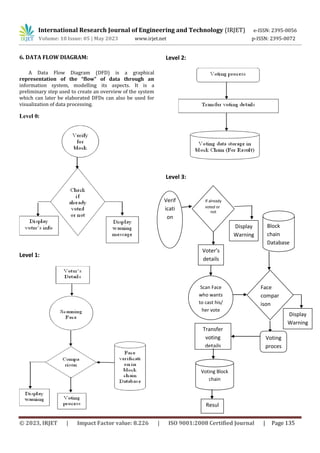
e-voting system security concerns. The diagrams and flow
charts of paper further break down into the defined
proposed process intimately, which makes it a possible
reality to beat the protection limitations and adoption
obstacles related to the electronic legal system.[4]Sofurther
study, tells that the benefits of blockchain such as
cryptographic foundations and transparency to achieve an
effective solution to e-voting. Also, due to the encryption
mechanism, it is not possible forany person to gain accessto
all the votes without first taking control of the entire service
network.
3. PROPOSED SYSTEM:
The proposed system is the Biometric online voting
system with biometric pointusingAadharcard.Itdetermines
the particular name by his/ her point whether he she is a
valid name or not. It allows particular name to cast the vote
online.
The polling process continues until the voting time ends
and modernize the database in the garçon. Biometric online
voting system uses Aadhar card to recoup the complete
details about the name. And the votes are stored in a
blockchain garçon and viewed to the public this insure a
secure terrain.
4. METHODOLOGY:
The methodology for assessing the result of a
decentralized voting system using blockchain and face
recognition technology would involve several ways.
1. Design and Development The first step would be to
design and develop the decentralized voting system using
blockchain and face recognition technology. This would
involve concluding applicable blockchain technology,
developing the face recognition system, and integratingboth
technologies to produce a secure,transparent,andaccessible
voting process.
2. Testing and Evaluation The coming step would be to
test the system and estimate its performance. This would
involve conducting birdman tests with many pickers to
ensure the system is working correctly and to identify any
issues that need to be addressed. The system's performance
would be estimated predicated on several factors, analogous
as security, delicacy, vacuity, and insulation.
3. Data Collection and AnalysisThesystem'sperformance
data would be collected and anatomized to estimate the
result of the decentralized voting system. The data would be
anatomized using statistical and data visualization ways to
identify patterns, trends, and perceptively that can help
meliorate the system's performance.
4. ComparisonwithTraditional VotingSystemsTheresult
of the decentralized voting system would be compared with
the traditional voting systems to estimate its effectiveness.
The comparison would involve assaying the delicacy,
security, vacuity, and cost- effectiveness of the decentralized
system compared to traditional systems.
5. Feedback and improvement the final step would be to
gather feedback from pickers, election officers, and other
stakeholders toidentifyareasforimprovement.Thefeedback
would be used to upgrade the system's design and
development,makingitmoreeffective,secure,andaccessible.
5. SYSTEM ARCHITECTURE:
Admin
Add
Election
Publish
Result
Verify User
Registe
r
Vote for Candidate
Trained Image
Upload
image
User
Result
Register Vote
Face Verification](https://image.slidesharecdn.com/irjet-v10i519-230626063626-8e7095aa/85/DECENTRALIZED-VOTING-SYSTEM-USING-BLOCKCHAIN-2-320.jpg)
![International Research Journal of Engineering and Technology (IRJET) e-ISSN: 2395-0056
Volume: 10 Issue: 05 | May 2023 www.irjet.net p-ISSN: 2395-0072
© 2023, IRJET | Impact Factor value: 8.226 | ISO 9001:2008 Certified Journal | Page 137
isn't without its challenges. Technical, cost, and scalability
enterprises must be addressed to ensure the technology is a
feasible and extensively espoused result for secure and
accessible voting. Sequestration enterprises associatedwith
the use of face recognition technology must also be
addressed to cover the obscurity of choosers and help abuse
of particular data. Overall, the result of enforcing a
decentralized advancing system using blockchain and face
recognition technology wouldbea moresecure,transparent,
and accessible voting process that promotes trust in the
popular system and ensures accurate and fair election
results.
10. SUMMARY:
A decentralized voting system using blockchain by face
recognition is a promisingsolutionforenhancingthesecurity
and transparency of the voting process. This system utilizes
facial recognition technology to ensure the accuracy of a
decentralized voting system using blockchain by face
recognition is a promisingsolutionforenhancingthesecurity
and transparency of the voting process. This system utilizes
facial recognition technology to ensure the accuracy of voter
identification, while blockchain technology provides a
tamper-proofandimmutableledgerofallvotingtransactions.
The use of the SHA-256 algorithm further enhances the
security and integrity of the system. Overall, this technology
has the potential to increase voter participation, enhance
election security, and improve the trust and legitimacy of the
democratic process.
11. CONCLUSIONS
In conclusion, a decentralized voting system using
blockchain by face recognition has the potential to
revolutionize the voting process by providing a secure,
transparent, and tamper-proof system. The integration of
facial recognition technology can help fraud, to prevent
fraudulent voting and ensure the accuracy of voter
identification, while blockchain technology can pro-vide a
decentralized and immutable ledger of all trans-actions. The
use of the SHA-256 algorithm can further enhance the
security and integrity of the system by creating unique
digital fingerprints of voter information, votes, and blocks.
However,therearestill several challenges thatneedtobe
addressed to ensure the widespread adoption of such a
system, including concerns about the accuracy and bias of
facial recognition technology,theneedforsecureandreliable
hardware, and the potential for cyber-attacks on the
blockchain network. Additionally, legal and regulatory
frameworks will need to be developed to addressissuessuch
as voter privacy, data protection, and transparency.
Despite these challenges, a decentralized voting system
using blockchain by face recognition has the potential to
increase voter participation, enhance election security, and
improve the overall trust and legitimacy of the democratic
process. Further research and development in this area can
help to overcome the remaining obstacles and bring about a
new era of secure and transparent voting systems. The
remaining obstacles and bring about a new era of secure and
transparent voting systems.
12. REFERENCES
[1] D-BAME: Distributed Blockchain-Based Anonymous
Mobile Electronic Voting Ehab Zaghloul, Tong-tong Li,
Senior Member, IEEE, and Jian Ren, Senior Member,
IEEE INTERNET OF THINGS JOURNAL, VOL. 8, NO. 22,
NOVEMBER 15, 2021
[2] Blockchain Based Online Voting System Using RSA
Algorithm Kingsle Edwin, Hepzibah Christinal and
Abraham Chandy, EasyChair: Institute of Tech-nology
and Sciences, Coimbatore, India February 1, 2022
[3] Securing theElectoral E-VotingSystemUsingBlockchain
Technology Taiwo Adekeye Data Science 5andArtificial
Intelligence Bournemouth University Bournemouth,
United Kingdom, uploaded by Taiwo Adekeye on 13
January 2022.
[4] Secure Voting System using Blockchain Method Manav
Tiwari, Utkarsh Thaokar, Sahil Sangwan, Shubham
Gupta, Department of Information Technology, Sinhgad
Institute of Technology, Lonavala, India. International
Journal of Research in Engineering, Science and
Management, Volume 5, Issue 1, January 2022.
[5] Data Management, Analytics and Innovation Pro-
ceedings of ICDMAI 2019, Volume 1, Advances in
Intelligent Systems and Computing Volume1042,Series
Editor: Janusz Kacprzyk, Systems Research Institute,
Polish Academy of Sciences, Warsaw, Poland
[6] Chaintegrity: blockchain-enabled large-scale e-voting
system with robustness and universal verifiability,
Shufan Zhang · Lili Wang · Hu Xiong © Springer-Verlag
GmbH
[7] Using Blockchain Data Security Management for E-
Voting Systems Erick Febriyanto, Triyono,Nina Rahayu,
Kelvin Pangaribuan, Po Abas Sunarya The 8th
International Conference on Cyber and IT Service
Management (CITSM 2020) On Virtual, October 23-24,
2020
[8] ElectionBlock: An Electronic Voting System using
Blockchain and Fingerprint Authentication Mohamed
Ibrahim, Kajan Ravindran, Hyon Lee, Omair Farooqui,
Qusay H, Mahmoud 2021 IEEE 18th Inter-national
Conference on Software Architecture Com-panion
(ICSAC)](https://image.slidesharecdn.com/irjet-v10i519-230626063626-8e7095aa/85/DECENTRALIZED-VOTING-SYSTEM-USING-BLOCKCHAIN-5-320.jpg)
![International Research Journal of Engineering and Technology (IRJET) e-ISSN: 2395-0056
Volume: 10 Issue: 05 | May 2023 www.irjet.net p-ISSN: 2395-0072
© 2023, IRJET | Impact Factor value: 8.226 | ISO 9001:2008 Certified Journal | Page 138
[9] Digital Voting: A Blockchain-based E-Voting Sys-tem
using Biohash and Smart Contract Syada Tasmia Alvi,
Mohammed Nasir Uddin, Linta Islam EEE Xplore Part
Number: CFP20P17- ART; ISBN: 978-1-7281-5821-1
[10] Decentralized E-voting system based on Smart
Contract by using Blockchain TechnologyAliMansour
Al-madani, Dr. Ashok T. Gaikwad, Vivek Mahale, Zeyad
A.T. Ahmed
[11]The Future of Electronic Voting System Using
Blockchain Md. Razu Ahmed, F.M. Javed Mehedi
Shamrat, Md. Asraf Ali, Md. Rajib Mia, Mst. Arifa Khatun
INTERNATIONAL JOURNAL OF SCIEN-TIFIC &
TECHNOLOGY RESEARCH VOLUME 9, ISSUE 02,
FEBRUARY 2020 ISSN 2277-8616](https://image.slidesharecdn.com/irjet-v10i519-230626063626-8e7095aa/85/DECENTRALIZED-VOTING-SYSTEM-USING-BLOCKCHAIN-6-320.jpg)

This document proposes a decentralized voting system using blockchain technology and face recognition to provide a secure, transparent and accessible voting process. The system would use blockchain to create an immutable record of votes and face recognition to verify voter identity. It describes how the system would utilize blockchain and SHA-256 algorithms to securely store and transmit voting data. The document outlines the proposed system architecture, data flow, implementation considerations and concludes the technology has potential to increase voter participation and trust in the democratic process, while further addressing challenges around facial recognition, scalability and privacy.


