Download free for 30 days
Sign in
Upload
Language (EN)
Support
Business
Mobile
Social Media
Marketing
Technology
Art & Photos
Career
Design
Education
Presentations & Public Speaking
Government & Nonprofit
Healthcare
Internet
Law
Leadership & Management
Automotive
Engineering
Software
Recruiting & HR
Retail
Sales
Services
Science
Small Business & Entrepreneurship
Food
Environment
Economy & Finance
Data & Analytics
Investor Relations
Sports
Spiritual
News & Politics
Travel
Self Improvement
Real Estate
Entertainment & Humor
Health & Medicine
Devices & Hardware
Lifestyle
Change Language
Language
English
Español
Português
Français
Deutsche
Cancel
Save
Submit search
EN
Uploaded by
IRJET Journal
347 views
Enhanced heart disease prediction using SKNDGR ensemble Machine Learning Model
https://www.irjet.net/archives/V11/i2/IRJET-V11I201.pdf
Engineering
◦
Read more
0
Save
Share
Embed
Embed presentation
Download
Download to read offline
1
/ 10
2
/ 10
3
/ 10
4
/ 10
5
/ 10
6
/ 10
7
/ 10
8
/ 10
9
/ 10
10
/ 10
More Related Content
PDF
238_heartdisease (1).pdf
by
ArpitGupta563794
PDF
algorithms-16-00088-v2hghjjnjnhhhnnjhj.pdf
by
Ajaykumar966781
PDF
Heart disease classification using optimized Machine learning algorithms.pdf
by
abdulkareemmerhej
PDF
Heart Disease Prediction using Machine Learning
by
IRJET Journal
PDF
Accurate Prediction of Heart Disease Using Machine Learning-A Case Study on t...
by
Nikhil Sanjay Suryawanshi
PDF
A Comparative Analysis of Heart Disease Prediction System Using Machine Learn...
by
IRJET Journal
PDF
HEART DISEASE PREDICTION RANDOM FOREST ALGORITHMS
by
IRJET Journal
PDF
EVALUATING THE ACCURACY OF CLASSIFICATION ALGORITHMS FOR DETECTING HEART DIS...
by
mlaij
238_heartdisease (1).pdf
by
ArpitGupta563794
algorithms-16-00088-v2hghjjnjnhhhnnjhj.pdf
by
Ajaykumar966781
Heart disease classification using optimized Machine learning algorithms.pdf
by
abdulkareemmerhej
Heart Disease Prediction using Machine Learning
by
IRJET Journal
Accurate Prediction of Heart Disease Using Machine Learning-A Case Study on t...
by
Nikhil Sanjay Suryawanshi
A Comparative Analysis of Heart Disease Prediction System Using Machine Learn...
by
IRJET Journal
HEART DISEASE PREDICTION RANDOM FOREST ALGORITHMS
by
IRJET Journal
EVALUATING THE ACCURACY OF CLASSIFICATION ALGORITHMS FOR DETECTING HEART DIS...
by
mlaij
Similar to Enhanced heart disease prediction using SKNDGR ensemble Machine Learning Model
PDF
EVALUATING THE ACCURACY OF CLASSIFICATION ALGORITHMS FOR DETECTING HEART DISE...
by
mlaij
PDF
IRJET- Cardiovascular Disease Prediction using Machine Learning Techniques
by
IRJET Journal
PDF
PREDICTING THE RISK OF HAVING HEART DISEASE USING MACHINE LEARNING TECHNIQUES
by
IRJET Journal
PDF
Heart Disease Prediction using Machine Learning Algorithm
by
ijtsrd
PDF
Prediction of Heart Disease Using Machine Learning and Deep Learning Techniques.
by
IRJET Journal
PPTX
Heart disease prediction using machine learning algorithm
by
AKSHARAMAHESHWARAM
PPTX
Heart Disease prediction using machine learning
by
UshaaRani1
PDF
Heart disease classification using Random Forest
by
IRJET Journal
PDF
Heart Disease Prediction using Machine Learning Algorithms
by
IRJET Journal
PPTX
PPT.pptx
by
CHANDRAJEETJHA4
PDF
Prediction of Heart Disease using Machine Learning Algorithms: A Survey
by
rahulmonikasharma
PDF
Comparative Analysis of Heart Disease Prediction Models: Unveiling the Most A...
by
IRJET Journal
PPTX
Project PPT(N) for a good buiness development ND BITCOIN.pptx
by
sm077249
PDF
E-Healthcare monitoring System for diagnosis of Heart Disease using Machine L...
by
IRJET Journal
PDF
Diagnosis of Cardiac Disease Utilizing Machine Learning Techniques and Dense ...
by
BASMAJUMAASALEHALMOH
PDF
Heart Disease Prediction Using Multi Feature and Hybrid Approach
by
IRJET Journal
PPTX
Effective Feature Engineering Technique for Heart Disease Prediction.pptx
by
sagarpatole15
PDF
Predicting Heart Disease Using Machine Learning Algorithms.
by
IRJET Journal
PDF
Heart Disease Prediction Using Random Forest Algorithm
by
IRJET Journal
PDF
A STUDY OF THE LITERATURE ON CARDIOVASCULAR DISEASE PREDICTION METHODS
by
IRJET Journal
EVALUATING THE ACCURACY OF CLASSIFICATION ALGORITHMS FOR DETECTING HEART DISE...
by
mlaij
IRJET- Cardiovascular Disease Prediction using Machine Learning Techniques
by
IRJET Journal
PREDICTING THE RISK OF HAVING HEART DISEASE USING MACHINE LEARNING TECHNIQUES
by
IRJET Journal
Heart Disease Prediction using Machine Learning Algorithm
by
ijtsrd
Prediction of Heart Disease Using Machine Learning and Deep Learning Techniques.
by
IRJET Journal
Heart disease prediction using machine learning algorithm
by
AKSHARAMAHESHWARAM
Heart Disease prediction using machine learning
by
UshaaRani1
Heart disease classification using Random Forest
by
IRJET Journal
Heart Disease Prediction using Machine Learning Algorithms
by
IRJET Journal
PPT.pptx
by
CHANDRAJEETJHA4
Prediction of Heart Disease using Machine Learning Algorithms: A Survey
by
rahulmonikasharma
Comparative Analysis of Heart Disease Prediction Models: Unveiling the Most A...
by
IRJET Journal
Project PPT(N) for a good buiness development ND BITCOIN.pptx
by
sm077249
E-Healthcare monitoring System for diagnosis of Heart Disease using Machine L...
by
IRJET Journal
Diagnosis of Cardiac Disease Utilizing Machine Learning Techniques and Dense ...
by
BASMAJUMAASALEHALMOH
Heart Disease Prediction Using Multi Feature and Hybrid Approach
by
IRJET Journal
Effective Feature Engineering Technique for Heart Disease Prediction.pptx
by
sagarpatole15
Predicting Heart Disease Using Machine Learning Algorithms.
by
IRJET Journal
Heart Disease Prediction Using Random Forest Algorithm
by
IRJET Journal
A STUDY OF THE LITERATURE ON CARDIOVASCULAR DISEASE PREDICTION METHODS
by
IRJET Journal
More from IRJET Journal
PDF
Utilizing Biomedical Waste for Sustainable Brick Manufacturing: A Novel Appro...
by
IRJET Journal
PDF
Kiona – A Smart Society Automation Project
by
IRJET Journal
PDF
DESIGN AND DEVELOPMENT OF BATTERY THERMAL MANAGEMENT SYSTEM USING PHASE CHANG...
by
IRJET Journal
PDF
Invest in Innovation: Empowering Ideas through Blockchain Based Crowdfunding
by
IRJET Journal
PDF
SPACE WATCH YOUR REAL-TIME SPACE INFORMATION HUB
by
IRJET Journal
PDF
A Review on Influence of Fluid Viscous Damper on The Behaviour of Multi-store...
by
IRJET Journal
PDF
Wireless Arduino Control via Mobile: Eliminating the Need for a Dedicated Wir...
by
IRJET Journal
PDF
Explainable AI(XAI) using LIME and Disease Detection in Mango Leaf by Transfe...
by
IRJET Journal
PDF
BRAIN TUMOUR DETECTION AND CLASSIFICATION
by
IRJET Journal
PDF
The Project Manager as an ambassador of the contract. The case of NEC4 ECC co...
by
IRJET Journal
PDF
"Enhanced Heat Transfer Performance in Shell and Tube Heat Exchangers: A CFD ...
by
IRJET Journal
PDF
Advancements in CFD Analysis of Shell and Tube Heat Exchangers with Nanofluid...
by
IRJET Journal
PDF
Breast Cancer Detection using Computer Vision
by
IRJET Journal
PDF
Auto-Charging E-Vehicle with its battery Management.
by
IRJET Journal
PDF
Analysis of high energy charge particle in the Heliosphere
by
IRJET Journal
PDF
A Novel System for Recommending Agricultural Crops Using Machine Learning App...
by
IRJET Journal
PDF
Auto-Charging E-Vehicle with its battery Management.
by
IRJET Journal
PDF
Analysis of high energy charge particle in the Heliosphere
by
IRJET Journal
PDF
Wireless Arduino Control via Mobile: Eliminating the Need for a Dedicated Wir...
by
IRJET Journal
PDF
FIR filter-based Sample Rate Convertors and its use in NR PRACH
by
IRJET Journal
Utilizing Biomedical Waste for Sustainable Brick Manufacturing: A Novel Appro...
by
IRJET Journal
Kiona – A Smart Society Automation Project
by
IRJET Journal
DESIGN AND DEVELOPMENT OF BATTERY THERMAL MANAGEMENT SYSTEM USING PHASE CHANG...
by
IRJET Journal
Invest in Innovation: Empowering Ideas through Blockchain Based Crowdfunding
by
IRJET Journal
SPACE WATCH YOUR REAL-TIME SPACE INFORMATION HUB
by
IRJET Journal
A Review on Influence of Fluid Viscous Damper on The Behaviour of Multi-store...
by
IRJET Journal
Wireless Arduino Control via Mobile: Eliminating the Need for a Dedicated Wir...
by
IRJET Journal
Explainable AI(XAI) using LIME and Disease Detection in Mango Leaf by Transfe...
by
IRJET Journal
BRAIN TUMOUR DETECTION AND CLASSIFICATION
by
IRJET Journal
The Project Manager as an ambassador of the contract. The case of NEC4 ECC co...
by
IRJET Journal
"Enhanced Heat Transfer Performance in Shell and Tube Heat Exchangers: A CFD ...
by
IRJET Journal
Advancements in CFD Analysis of Shell and Tube Heat Exchangers with Nanofluid...
by
IRJET Journal
Breast Cancer Detection using Computer Vision
by
IRJET Journal
Auto-Charging E-Vehicle with its battery Management.
by
IRJET Journal
Analysis of high energy charge particle in the Heliosphere
by
IRJET Journal
A Novel System for Recommending Agricultural Crops Using Machine Learning App...
by
IRJET Journal
Auto-Charging E-Vehicle with its battery Management.
by
IRJET Journal
Analysis of high energy charge particle in the Heliosphere
by
IRJET Journal
Wireless Arduino Control via Mobile: Eliminating the Need for a Dedicated Wir...
by
IRJET Journal
FIR filter-based Sample Rate Convertors and its use in NR PRACH
by
IRJET Journal
Recently uploaded
PPTX
MECCA Empire – Hotel Shuttle System for the 2026 FIFA World Cup
by
ay2432
PPTX
Cloud vs On-Premises CMMS — Which Maintenance Platform Is Better for Your Plant?
by
MaintWiz Technologies Private Limited
PDF
Hazim Gaber - A Lean Six Sigma Black Belt
by
Hazim Gaber
PPTX
UnrealGameplayAbilitySystemPresentation.pptx
by
BenHowenstein
PPTX
firewall Selection in production life pptx
by
ssuserb1479b
PPTX
ISO 14224 Compliance & CMMS Software — A Comprehensive Guide for Reliable Mai...
by
MaintWiz Technologies Private Limited
PPT
63490613-Boiler-Tube-Leakage-analysis-symptoms-causes.ppt
by
allahdittashafi
PDF
Basic Engineering mechanical handwriting notes
by
ShubhUpadhyay7
PPTX
The Importance of Maintenance Budgets — Maximize Reliability & Control Costs ...
by
MaintWiz Technologies Private Limited
PPTX
How to Select the Right CMMS Software for Your Organization — A Complete Buye...
by
MaintWiz Technologies Private Limited
PPTX
TPM Metrics & Measurement: Drive Performance Excellence with TPM | MaintWiz
by
MaintWiz Technologies Private Limited
PDF
Best Architecture in Kovilpatti - Amar Dexign Scape.pdf
by
Amar Dexign scape
PDF
Narrows Planning Collective Transportation Capstone.pdf
by
cj2392
PDF
Advanced Intrusion Detection and Classification using Transfer Learning with ...
by
IJCNCJournal
PDF
Human computer Interface ppt aUNIT 3.pdf
by
Osmania University
PPTX
Assessment 4 SRS Presentation - Final (2).pptx
by
ayush445302
PPTX
Plant Performance Strategies: Enhanced Reliability & Operational Efficiency w...
by
MaintWiz Technologies Private Limited
PDF
BE-Python-Lab.pdf taught in msrit bangalore
by
qsirius12
PPTX
Preventive Maintenance Program for Compressors – Complete Guide
by
MaintWiz Technologies Private Limited
PPTX
Natural Gas fundamentals and GRU for associated gas trap.pptx
by
engineerhassan
MECCA Empire – Hotel Shuttle System for the 2026 FIFA World Cup
by
ay2432
Cloud vs On-Premises CMMS — Which Maintenance Platform Is Better for Your Plant?
by
MaintWiz Technologies Private Limited
Hazim Gaber - A Lean Six Sigma Black Belt
by
Hazim Gaber
UnrealGameplayAbilitySystemPresentation.pptx
by
BenHowenstein
firewall Selection in production life pptx
by
ssuserb1479b
ISO 14224 Compliance & CMMS Software — A Comprehensive Guide for Reliable Mai...
by
MaintWiz Technologies Private Limited
63490613-Boiler-Tube-Leakage-analysis-symptoms-causes.ppt
by
allahdittashafi
Basic Engineering mechanical handwriting notes
by
ShubhUpadhyay7
The Importance of Maintenance Budgets — Maximize Reliability & Control Costs ...
by
MaintWiz Technologies Private Limited
How to Select the Right CMMS Software for Your Organization — A Complete Buye...
by
MaintWiz Technologies Private Limited
TPM Metrics & Measurement: Drive Performance Excellence with TPM | MaintWiz
by
MaintWiz Technologies Private Limited
Best Architecture in Kovilpatti - Amar Dexign Scape.pdf
by
Amar Dexign scape
Narrows Planning Collective Transportation Capstone.pdf
by
cj2392
Advanced Intrusion Detection and Classification using Transfer Learning with ...
by
IJCNCJournal
Human computer Interface ppt aUNIT 3.pdf
by
Osmania University
Assessment 4 SRS Presentation - Final (2).pptx
by
ayush445302
Plant Performance Strategies: Enhanced Reliability & Operational Efficiency w...
by
MaintWiz Technologies Private Limited
BE-Python-Lab.pdf taught in msrit bangalore
by
qsirius12
Preventive Maintenance Program for Compressors – Complete Guide
by
MaintWiz Technologies Private Limited
Natural Gas fundamentals and GRU for associated gas trap.pptx
by
engineerhassan
Enhanced heart disease prediction using SKNDGR ensemble Machine Learning Model
1.
International Research Journal
of Engineering and Technology (IRJET) e-ISSN: 2395-0056 Volume: 11 Issue: 02 | Feb 2024 www.irjet.net p-ISSN: 2395-0072 © 2024, IRJET | Impact Factor value: 8.226 | ISO 9001:2008 Certified Journal | Page 1 Enhanced heart disease prediction using SKNDGR ensemble Machine Learning Model Basil Jacob 1 1Basil Jacob, School of Computer Science and Engineering, Vellore Institute of Technology, Vellore – 632014, Tamil Nadu, India ---------------------------------------------------------------------***--------------------------------------------------------------------- Abstract – Cardiovascular disease (CVD) stands as a formidable global health challenge, exerting a significant impact on worldwide morbidity and mortality rates. Traditional monitoring methods often prove inadequate in capturing the intricate and dynamic nature of cardiovascular health, impeding healthcare professionals' ability to discern subtle patterns preceding cardiac events. This study seeks to revolutionize heart disease monitoring by leveraging the prowess of well-established machine learning algorithms, includingSupportVectorMachine(SVM), K-NearestNeighbors (KNN), Naive Bayes, Decision Tree, Gradient Boosting, and Random Forest. Diverging from conventional single-model approaches, our work embraces ensemble learning, synergizing the strengths of standalone models—SVM, KNN, Naive Bayes, Decision Tree—with ensemble models like Gradient Boosting and Random Forest. Through the amalgamation of these models, we introduceanovelensemble learning approach, named the SKNDGRmodel, whichachieves an outstanding accuracy of 99.19%, surpassing the performance of all other models. This exceptional outcome is attributed to the model's capacity to establish diverse, robust, and non-linear decision boundaries, necessitating minimal hyperparameter tuning and ensuring computational efficiency. The research holds the promise of swift heart disease detection, facilitating timely treatment interventions, and showcases advantages such as high performance, accuracy rates, flexibility, and an elevated success rate. The proposed model provides a high degree ofprecisionandrecall, enabling researchers to obtain the mostaccurateresultswhen diagnosing patients suffering from heart disease. Key Words: Cardiovascular disease, Machine Learning Algorithms, Ensemble learning, SKNDGR, Hyperparameter Tuning, Computational efficiency 1. INTRODUCTION In the relentless fight against cardiovasculardiseases(CVD), where the lives of over half a billion individuals hang in the balance worldwide, the urgency is glaringly apparent. The World Health Federation's2023reportpaintsa grim picture, revealing 20.5 million CVD-related deaths in 2021—nearly one-third of all global fatalities—an alarming surgefromthe estimated 121 million CVD deaths. This ominous trend, fueled by unhealthy lifestyles, heightened stress levels, and environmental factors, emphasizes the critical necessity for prompt and accurate diagnostic solutions to enable timely interventions. Recognizing this imperative, the quest for a diagnostic system rooted in machine learning classifiers becomes paramount. In the intricate tapestry of healthcare,precisionbecomesthe linchpin between life and death. Here, data preprocessing and standardization emerge as silent architects, akin to a skilled detective organizing clues to solve a complex case. Healthcare professionals depend on the seamless harmony of standardized data, unlocking crucial insightsforinformed decisions in the pursuit of optimal patient care. Some commonly used standardization techniques, including StandardScaler (SS) and Min-Max Scaler, are effective in rescaling numerical features. However, they do not handle missing feature values directly, and it's necessarytoaddress missing values through imputation or other methods before applying these standardization techniques. Achieving peak performance in machine learning models demands the strategicutilizationof balanceddatasetsduring both training and testing phases. Furthermore, refining predictive capabilities hinges on the incorporation of relevant features, underscoring the critical importance of optimizing model performance through data balancing and meticulous feature selection. In this high-stakes landscape, the development of advanced diagnostic tools powered by machine learning classifiers stands as a beacon of hope, promising to revolutionize the battle against CVD and reshape the future of global healthcare. In standard practice, doctors often prescribe multiple tests, creating delays in timely disease notification. This underscores the need for an approach enabling swift and timely predictions. Machine learning, a subset of artificial intelligence, operates on the premise that systems can learn from data, identify patterns, and make decisions with minimal human intervention. For heart disease prediction, researchers normally use the existing machine learning algorithms such as SVM,KNN,DecisionTree,RandomForest, Naïve Bayes, Logistic regression and so on. However, it is quite difficult to get predictions with a high degree of accuracy with these models functioning alone. Our research work aims to utilize the combined power of these models and generate a new model that returns results with a high degree of precision and accuracy.
2.
International Research Journal
of Engineering and Technology (IRJET) e-ISSN: 2395-0056 Volume: 11 Issue: 02 | Feb 2024 www.irjet.net p-ISSN: 2395-0072 © 2024, IRJET | Impact Factor value: 8.226 | ISO 9001:2008 Certified Journal | Page 2 In this paper, we proposed a machine learning classification model which combines the prediction capabilities of each of the following individual algorithms: SVM, KNN, NaïveBayes, Decision Tree, Gradient Boosting and Random Forest to create a single powerful ensemble model capable of producing results with a high degree of accuracy and precision. Our work has been organizedasfollows:Section2, a literature review of the various papers that work on machine learning classification for heart diseases. Section 3 Proposed methodology followed for our study. Section 4 Evaluation Metricsusedtocomparethemodelsused.Section 5, Discusses the result obtained. Section 6, concludes the paper and Section 7, provides suggestions for future work. 2. LITERATURE SURVEY This paper [1] proposes a heart disease prediction system using the Random Forest algorithm, emphasizing its efficiency in classification and regression. The application processes input from a CSV file, employs an ensemble of decision trees for accurate predictions, and facilitates early detection of heart conditions. Users can input their health data to assess the likelihood of heart disease, enabling informed decisions on whether to consult a doctor. Ibomoiye Domor Mienye et al. [2] have introduced an improved machine learning method for heart disease risk prediction. The approach utilizes mean-based dataset partitioning, employing classification and regression tree (CART) models. A homogeneous ensemble is formed using an accuracy-based weighted aging classifier ensemble. Experimental results on the Cleveland and Framingham datasets yield impressive classification accuracies of 93% and 91%, respectively, outperforming other algorithms and recent scholarly works. Comparative evaluations with k- nearest neighbor (KNN), logistic regression (LR), linear discriminant analysis (LDA), support vector machine(SVM), CART, gradient boosting, and random forest highlight the superior performance of the proposed method. This study establishes the proposed approach as an advanced and effective tool for heart disease risk prediction. In this paper [3], the researchers conducted a rigorous comparative analysis of four prominent machine learning algorithms—k-nearest neighbor, decision tree, linear regression, andsupportvectormachine(SVM)—utilizing the UCI repository dataset. The primary focus was to ascertain the algorithm exhibiting the highest test accuracy, a pivotal metric evaluated through a detailed examination facilitated by a confusion matrix. Notably, the study's conclusive findings underscored the exceptional performance of the k- nearest neighbor (knn) algorithm, boasting an impressive accuracy score of 87%. M. Nikhil Kumar et al. [4] have introduced a novel model enhancing Decision Tree accuracy in identifying heart disease patients, leveraging various Decision Tree algorithms. Utilizing the Waikato Environment for Knowledge Analysis (WEKA), the study preprocesses UCI repository data and underscores WEKA's pivotal role in machine learning. Focusing on decision tree classifiers, particularly J48, Logistic Model Tree, and Random Forest algorithms, the research employs reduced error pruning, confident factor, and seed parameters for heart disease diagnosis. Experimental results reveal J48 as the optimal classifier, achieving 56.76% accuracy and 0.04 seconds to build, outperforming LMT and Random Forest. Min Chen et al. [5] in this study employ cutting-edge machine learning techniques for disease prediction,utilizing K-Nearest Neighbor (KNN) and Convolutional Neural Network (CNN) algorithms. They address incomplete data challenges through a latent factor model and propose the Convolutional Neural Network-based Multimodal Disease Risk Prediction (CNN-MDRP) algorithm. Remarkably, the CNN-MDRP achieves an impressive 94.8% prediction accuracy, outperforming benchmarks and demonstrating superior convergence speed compared to CNN-based unimodal predictions. This research, led by the authors, represents a significant leap in disease risk assessment, emphasizing both accuracy and efficiency in predictive modeling. This research [6] compares the efficacy of Support Vector Machine (SVM) classifier and Linear Regression (LR) model in detecting heart disease using a dataset from the UCI machine learning repository. Thestudy,witha samplesizeof 60, demonstrates that SVM achieves a 90.43% accuracy, outperforming LR with 78.56%. The results indicate the significance (p=0.021) and emphasize SVM's superior accuracy for heart disease detection. This study [7] proposes a comprehensive disease prediction model based on patient symptoms, employing K-Nearest Neighbor (KNN) and Convolutional Neural Network (CNN) algorithms for accurate predictions. The model utilizes a dataset of disease symptoms, incorporatinglivinghabitsand checkup information for precision. The CNN algorithm achieves an accuracy of 84.5%, surpassing KNN, with lower time and memory requirements. Post-prediction,thesystem assesses the risk associated with general diseases, categorizing them into lower or higher risk levels. This research highlights the effectiveness of CNN in enhancing accuracy and efficiency in general disease prediction. This study [8] introduces the use of the Multi-layer Perceptron Neural Network with Back-propagation as a training algorithm to propose an innovative diagnostic system for heart disease prediction. Leveraging 14 significant attributes based on medical literature,thesystem surpasses alternative approaches, effectively predicting heart disease risk levels. Notably, the prediction system achieves a superior accuracy of 93.39% for 5 neurons in the hidden layer, with a swift runtime of 3.86 seconds.
3.
International Research Journal
of Engineering and Technology (IRJET) e-ISSN: 2395-0056 Volume: 11 Issue: 02 | Feb 2024 www.irjet.net p-ISSN: 2395-0072 © 2024, IRJET | Impact Factor value: 8.226 | ISO 9001:2008 Certified Journal | Page 3 Comparative analyses against various classification techniques, including Decision Tree, Logistic Regression, Naive Bayes, Random Forest, Support Vector Machine, Generalized Linear Model,GradientBoostedTrees,andDeep Learning, highlight the superior efficiency and accuracy of the proposed system in heart disease prediction. The authors [9] have employed an ensemble approachusing the Cleveland dataset, combining Majority Vote withMP, RF, BN, and NB. Through attribute selection, they achieved a peak accuracy of 85.48%, recommending this method for heart disease prediction. Chunyan Guo et al. [10] made a substantial contribution to the field by employinganRecursion enhancedrandomforest with an improved linear model (RFRF-ILM). The integration of innovative feature combinations and categorization methods showcased their dedication to enhancing performance and accuracy. This study [11] focuses on the application of the Random Forest data mining algorithm for predicting heart disease. The implementation resulted in a notable classification accuracy of 86.9%, coupled with a diagnosis rate of 93.3% utilizing the Random Forest algorithm. In this paper [12], the authors have compared five machine learning algorithms—Random Forest classification,Support Vector Machine, AdaBoost Classifier, Logistic Regression, and Decision Tree Classifier—to identify the most accurate model. The Random Forest Classifier outperformed others with an accuracy of 85.22%. While alternative algorithms achieved accuracy levels above 50%, Random Forest emerged as the superior choice. This study lays the groundwork for further research in optimizing accuracy models. Nadia Rubaiyat et al. [13] of this study, haveappliedLogistic Regression, Random Forest Classifier, and k-Nearest Neighbor algorithms to a dataset of 310 patients, revealing Random Forest as the most accurate at 89%. The study asserts that Random Forest surpasses the other models and suggests its potential in medical fields. However, due to the limited dataset, further processing and a larger population are needed for robust conclusions. Aditi Gavhane et al. [14] propose developing an application for predicting heart disease vulnerability based on fundamental symptoms like age, sex, and pulse rate. Advocating for the implementation of neural networks due to their established accuracy and reliability, the authors position them as a central component of the proposed system. The presented method demonstrates promising results, achieving precision and recall scores of 0.91 and 0.89, respectively. The authors [15] have explored diverse classifiers and the impact of data processing on predicting heart disease. Findings highlight Logistic Regression (86%) and Naïve Bayes (79%) as effective with high-dimensional datasets, while Decision Tree (70%) and Random Forest (84%) excel with smaller dimensional datasets. Notably, Random Forest outperforms the Decision TreeClassifierduetoitsoptimized learning algorithm. These insights underscore the critical role of data processing in achieving accurate predictions for heart disease. This research [16] work, explores the impact of feature selection methods, specifically Correlation Based Feature Selection (CBFS) and Principal Component Analysis (PCA), when combined with eight classifier models. Performance metrics, including Accuracy, Precision, Recall, F1 Measure, and ROC, guide the assessment to identify the most effective classifier. The study reveals that the CBFS with MLP Classifier model stands out with the highestperformancefor the FHS dataset. Among the eight generated models, CBFS- MLP proves superior to the standalone MLP classifier, showcasing enhanced accuracy. This research [17] paper predicts heart disease probability, with K-nearest neighbor yielding the highest accuracy. The study discusses and compares algorithms used for heart disease prediction, applying four classificationtechniques— K-nearest neighbor, Naive Bayes, decision tree, and random forest. Notably, K-nearest neighbor, Naïve Bayes, and random forest show the best results, with the highest accuracy (90.789%)achievedbyK-nearest neighbors(k =7). This research [18] focuses on predicting cardiovascular heart diseases using patient medical attributes. Utilizing a UCI repository dataset, the study employs 14 attributes, including gender, age, chest pain, and fasting sugar levels, and applies Logistic Regression, KNN, and Random Forest Classifier. The results demonstrate enhanced heart disease prediction with Logistic Regression and KNN, achieving an average accuracy of 87.5%, surpassing prior modelsat85%. Notably, KNN stands out with the highest accuracy among the three algorithms at 88.52%,highlightingits effectiveness in this context. This paper [19] introduces a innovative approach, NNDT (Neural Network and Decision Tree), leveraging Neural Network for model training and Decision Tree for testing classification, aiming to enhance heart disease prediction. Comparative analysis with Naïve Bayes, Support Vector Machine, Neural Network, Voted Perceptron, and Decision Tree algorithms demonstrates superior accuracy and performance. The proposed model achieves remarkable precision and recall scores of 99.2 and 98.4, surpassing the average scores of around 84 in other methods. This study provides a novel perspective forresearcherstoanalyzeheart disease data, contributing to more effective predictions and better maintenance of human health.
4.
International Research Journal
of Engineering and Technology (IRJET) e-ISSN: 2395-0056 Volume: 11 Issue: 02 | Feb 2024 www.irjet.net p-ISSN: 2395-0072 © 2024, IRJET | Impact Factor value: 8.226 | ISO 9001:2008 Certified Journal | Page 4 In this research [20], the authors scrutinized a Kaggle dataset encompassingvital attributeslinkedtoheartdisease, such as age, gender, blood pressure, and cholesterol. Evaluation of machine learning techniques, including Support Vector Machines (SVM),K-NearestNeighbor(KNN), and Decision Trees (DT), revealed suboptimal performance and accuracy when dealing with extensive datasets. To overcome this limitation, the study aimed at elevating prediction accuracy through the implementation of an Artificial Neural Network (ANN) using TensorFlow Keras. The outcome was striking, with the artificial neural network achieving an impressive accuracy of 85.24%. In conclusion, the reviewed papers underscore remarkable advancements in heart disease classification through established machine learning architectures. Analyzing the performance metrics across these studies reveals the potential for further efficiency gains by leveraging the predictive capabilities of individual methods through strategic combinations. 3. PROPOSED METHODOLOGY In our research on heart disease prediction, we systematically processed the dataset [21] through standardization and feature selection techniques to distill key aspects. The dataset underwent a strategic partitioning using the `train_test_split` function, with 70% allocated for training and the remaining 30% for temporary data. This temporary data was further divided into a 40% validation set and a 60% testing set, all under a fixed random state of 42 for consistency. This meticulous approach ensures an effective evaluation of machine learning models,providinga solid foundation for learning, tuning, and assessing performance with reproducible results. The innovative SKNDGR (SVM, KNN, Naive Bayes, Decision Tree, Gradient Boosting, Random Forest) model was employed in the subsequent classification phase to predict heart disease based on the refined features. The model's effectivenesswas comprehensivelyevaluated, comparingitsperformancewith existing methods using diverse metrics. This systematic pipeline ensures robust training,validation,andassessment, contributing to the reliability and reproducibility of our research outcomes. 3.1 Data Source Our investigation relies on a rich and meticulously curated heart disease prediction dataset sourcedfromKaggle,dating back to 1988 and spanning four distinctive databases: Cleveland, Hungary, Switzerland, and Long Beach V. Although the dataset boasts a comprehensive 76 attributes, encapsulating crucial factors for predicting heart disease, our focus hones in on a strategically chosen subset of 14 attributes meticulously detailed in Table 1. This dataset, comprising a total of 1025 patient records, demonstrates an equitable distribution, with 51.3% reflecting cases of heart disease and 48.7% without. For the meticulous training of our predictive model, we harness the power of the initial 13 attributes, while the last attribute functions as the pivotal target variable, definingthe predictedclass.Thisfinelytuned subset not only propels the training phase but also undergoes rigorous evaluation against a dedicated test dataset, ensuring the robustness of our model. This comprehensive dataset offers a diverse array of patient characteristics and health indicators, providing a robust foundation for our heart disease prediction model. Table -1: Input Parameters The below flow diagram illustrates the workflow followed for the creation of our model: Sl No Attribute Name Attribute Description 1 age Age in years 2 sex 1 for Male, 0 for Female 3 cp Chest pain Type (values 0,1,2,3) 4 trestbps Resting blood pressure (in mm Hg on admission to the hospital) 5 chol serum cholestoral in mg/dl 6 fbs fasting blood sugar (1 = True, 0 = False) 7 restecg Resting electrocardiographic results (values 0,1,2) 8 thalach Maximum heart rate achieved 9 exang exercise induced angina (1 = yes, 0 = no) 10 oldpeak ST depression induced by exercise relative to rest 11 slope The slope of the peak exercise ST segment (values 0,1,2) 12 ca Number of major vessels colored by flourosopy (values 0,1,2,3) 13 thal Defect type (0 = normal; 1 = fixed defect; 2 = reversable defect)
5.
International Research Journal
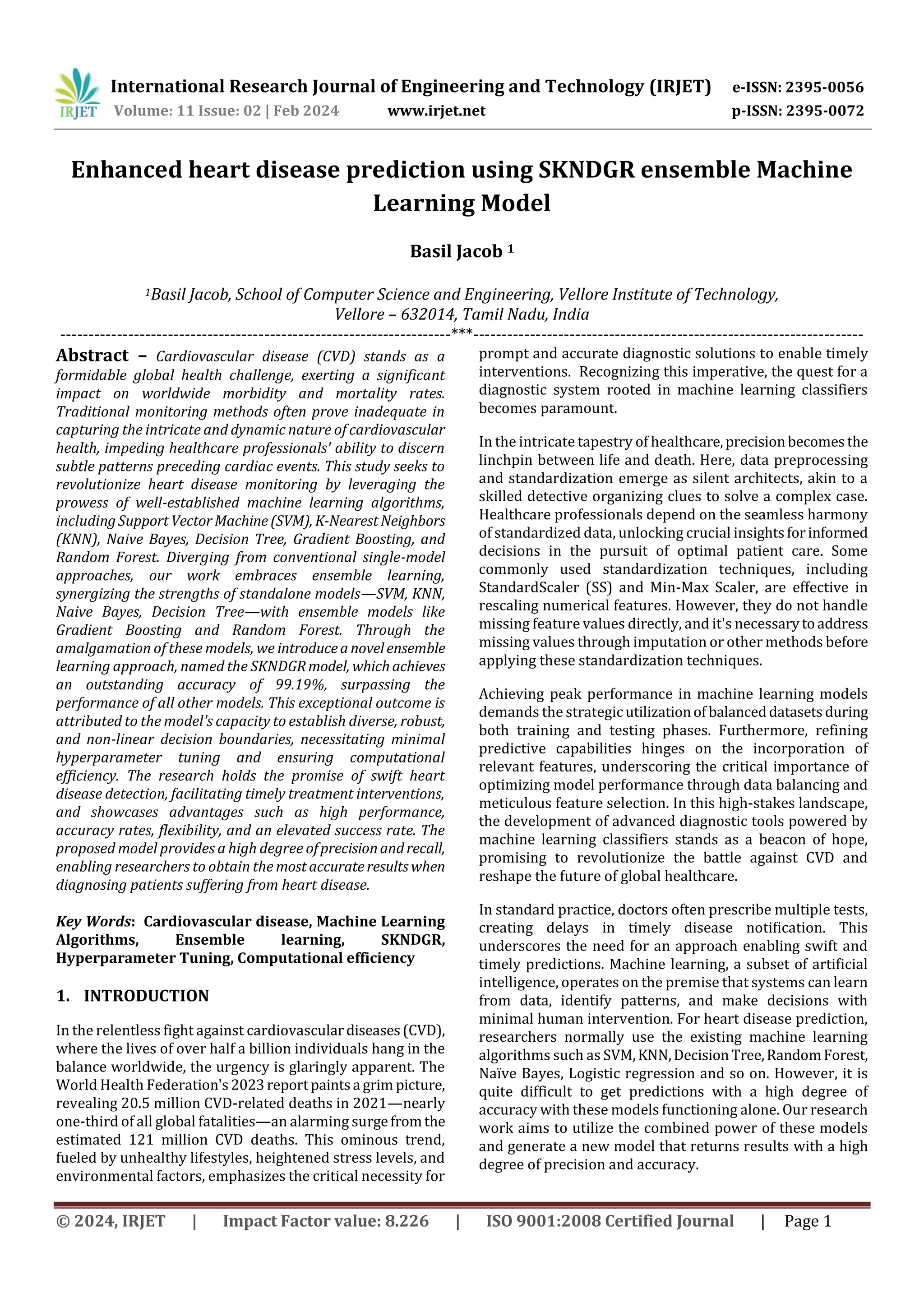
of Engineering and Technology (IRJET) e-ISSN: 2395-0056 Volume: 11 Issue: 02 | Feb 2024 www.irjet.net p-ISSN: 2395-0072 © 2024, IRJET | Impact Factor value: 8.226 | ISO 9001:2008 Certified Journal | Page 5 Fig -1: Workflow Diagram 3.2 Data Preprocessing Data preprocessing constitutes a pivotal phase in classification problems, exerting a profound impact on the efficacy and dependability of machine learning models. The inherent quality of input data directly shapes a model's aptitude for pattern recognition and accuratepredictions.In our research, we meticulously address data preprocessing through a two-step approach: Standardization and Feature Selection. 3.2.1 Standardization This essential step involvestransformingfeaturestoensurea mean of 0 and a standard deviation of 1. This process is indispensable, particularly in machine learning models reliant on distance-based metrics, as it mitigates the undue influence of features with larger scales. To achieve this, we employ the StandardScaler() class from the scikit-learn Python library, ensuring a consistent and standardized representation of our data. 3.2.2 Feature Selection A crucial aspect of our data preprocessing strategy is feature selection, yielding manifold benefits such as dimensionality reduction, improved modelinterpretability,andthepotential for enhanced performance by focusing on salient features. Leveraging the SelectKBest() class from scikit-learn, we identify and retain the top 10 features out of the 13 trainable features in ourdataset.Theseselectedfeatures,includingage, sex, cp, chol, thalach, exang, oldpeak, slope, ca, and thal, are deemed pivotal for our classification task. This judicious filtering ensures that our model is trained on the most pertinent and discriminative aspects of the dataset,fostering a more robust and insightful learning process. 3.3 Algorithm Implementation The below are the machine learning and ensemble learning algorithms used for our study: 3.3.1 Support Vector Machine (SVM) The Support Vector Machine (SVM) is a supervised classification algorithm deeply rooted in the principles of structural risk minimization (SRM), a concept pioneered by Vladimir Vapnik (Cortes&Vapnik,1995).Initiallytailoredfor binary classification tasks, SVM has undergone a transformative evolution, emerging as a versatile tool extensively applied in multiclassification scenarios. At its core, the algorithm endeavors to identify an optimal hyperplane within an N-dimensional space, strategically maximizing the margin between the closest points ofdistinct classes in the feature space. The adaptability of this hyperplane's dimensionality to the number of features underscores SVM's effectiveness in segregating data points into different classes while minimizing the expected generalization error. In our implementation, we initialize an SVM classifier with default parameters and proceed to train the model on the designated training set, paving the way for subsequent predictive analyses. 3.3.2 K-Nearest Neighbors (K-NN) The K-nearest neighbors (K-NN) algorithm, a fundamental component of supervised classification in machine learning, distinguishes itself through its versatility and broad applicability. Recognized for its simplicity and ease of implementation, K-NN excelswithoutrequiringassumptions about the underlying data distribution. Itscapacity to handle both numerical and categorical data renders it a flexible choice for a diverse range of datasets in classification and regression tasks. Operating as a non-parametric method, K- NN harnesses data point similarity for predictions, showcasing resilience to outliers compared to alternative algorithms. The algorithm identifies the K nearest neighbors to a given data point using a distance metric, such as Euclidean distance, and determines the point's classification or value through the majority vote or average of the K neighbors. In the realm of scientific research, K-NN emerges as a potent and accessible tool for data analysis and prediction. For our study, we initialized our training model with an initial value of k set to 15. 3.3.3 Naïve Bayes Naive Bayes, a powerful family of probabilistic classifiers, thrives on the simplicity of Bayes' theorem, assuming strong independence between features. This seemingly naive
6.
International Research Journal
of Engineering and Technology (IRJET) e-ISSN: 2395-0056 Volume: 11 Issue: 02 | Feb 2024 www.irjet.net p-ISSN: 2395-0072 © 2024, IRJET | Impact Factor value: 8.226 | ISO 9001:2008 Certified Journal | Page 6 approach conceals robust predictive capabilities, surpassing even sophisticated methods and shining in large datasets. Particularly effective in classification problems, Naive Bayes emerges asadynamic,reliabletoolsimplifyingcomplexityfor impactful results. Our code employs the Gaussian Naive Bayes classifier, poised to make predictions on new, unseen data,leveraging insights gleaned fromthetrainingset.Bayes' theorem offers a method for calculating the posterior probability, P(c|x), using the probabilities P(c), P(x) and P(x|c). Fig -2: Bayes Theorem Formula P(c∣x) represents the posterior probability of a class (target) given a predictor (attribute). P(c) is the prior probability of the class. P(x∣c) is the likelihood, indicating the probability of the predictor given the class. P(x) is the prior probability of the predictor. 3.3.4 Decision Tree A decision tree embodies a flowchart-like tree structure where each internal node signifies a feature, branches represent rules, and leaf nodes depict the algorithm's outcomes. As a versatile supervised machine-learning algorithm, it adeptly handles both classification and regression problems, showcasing its robustness. Notably powerful on its own, the decisiontreealsoplaysapivotalrole in Random Forest, contributing to its strength. In our implementation, the Decision Tree classifier is employed, with the parameter random_state=42 set for reproducibility, ensuring consistent and replicable results across multiple executions. Root Node 1. Represents the topmost node in the tree. 2. Symbolizes the entire dataset. 3. Initiates the decision-making process. Decision/Internal Node 1. Represents a node that involves a choice based on an input feature. 2. Branches off to connect with leaf nodes or other internal nodes. Leaf/Terminal Node 1. Represents a node without any child nodes. 2. Indicates the end of a branch. 3. Provides class labels or numerical values. 3.3.5 Gradient Boosting Gradient Boosting is a widely utilized boosting algorithm in machine learning, tailored for both classification and regression tasks. Operating as an ensemble learningmethod, it sequentially trains models, with each new iteration dedicated to rectifying the errors of its predecessor.Through the amalgamation of numerous weak learners, Gradient Boosting amalgamates theircollectivestrength,resultingina robust and powerful learner that enhances predictive performance. In our implementation, the boosting model is trained on the training set, and the random_state parameter of the Gradient Boosting classifier is set to 42 for consistent and reproducible results. 3.3.6 Random Forest The Random Forest Algorithm, a stalwart in the realm of supervised machine learning, garners widespread recognition for its effectiveness in handling both Classification and Regression tasks. Like a flourishing forest teeming with diverse trees, the strength of a Random Forest lies in its profusion of constituent trees. The algorithm's predictive accuracy and problem-solving prowess are intricately linked to the abundance of trees it encompasses. Functioning as a classifier, the Random Forest houses numerous decision trees, each operating on distinct subsets of the dataset.Throughanastuteaggregationoftheiroutputs, the algorithm systematically elevates overall predictive accuracy. Anchored in the principles of ensemble learning, this approach entails the fusion of multiple classifiers to adeptly navigate complex problems and enhance the overall performance of the model. 3.3.7 SKNDGR Proposed Model Our proposed novel SKNDGR model, integrates the earlier mentioned machine learning algorithms and ensemble methods as its core components, utilizing a soft voting mechanism as seen in Figure 3. This forward-thinking ensemble strategy is intricately crafted to enhance overall
7.
International Research Journal
of Engineering and Technology (IRJET) e-ISSN: 2395-0056 Volume: 11 Issue: 02 | Feb 2024 www.irjet.net p-ISSN: 2395-0072 © 2024, IRJET | Impact Factor value: 8.226 | ISO 9001:2008 Certified Journal | Page 7 model accuracy by synthesizing nuanced insights from a diverse array of state-of-the-art algorithms. Through meticulous evaluations of individual and ensemble accuracies, we present a comprehensive assessment of the model's capabilities on the test set, highlighting its unparalleled performance in cutting-edge data analysis and prediction. Fig -3: SKNDGR Model Architecture 3.3.8 Hyperparameter Tuning In our code, hyperparameter tuning is performed for four different machinelearningmodels—SupportVectorMachine (SVM), K-Nearest Neighbors (KNN), Decision Tree, and Gradient Boosting—on validation data using the GridSearchCV method. For each model, a grid of hyperparameters is specified, and the model is trained with various combinations of these hyperparameters usingcross- validation (cv=5). The hyperparameters with the best performance are determined based on the cross-validated results, and the respective models are re-instantiated with these optimal hyperparameters. This iterative process ensures that the models are fine-tuned to achieve the best performance on the validation set,enhancingtheirpredictive capabilities forsubsequent evaluation on unseendata.These fine tune models later served as the base of our proposed SKNDGR model.Fine-tuninghyperparametersinNaiveBayes is limited by its inherent simplicity and strong assumption of feature independence, with few parameters and robustness being key factors. Similarly, hyperparameter tuning in Random Forest may not yield substantial gains due to its built-in robustness against overfitting,aggregationofdiverse tree predictions, and the algorithm's responsiveness to default settings. Our implementation abstains from fine- tuning both Naive Bayes and Random Forest, as their performance relies more on inherent characteristics and quality of features than intricate parameter adjustments, avoiding unnecessary computational expenses. 4. EVALUATION METRICS In our proposed work, the training data is employed to generate the model, the validation data is used for fine- tuning, and the test data evaluates its performance. In the medical field, the evaluation of models emphasizes primary criteriaforthoroughassessments,encompassingfactorssuch as: 4.1 Accuracy Accuracy is a fundamental metric in machine learning that gauges the proportion of correctly predicted instances outof the total. It is calculated as the ratio of correct predictions to the overall predictions. While accuracy provides a straightforward interpretation and is suitable for balanced datasets, it has limitations. In imbalanced datasets, accuracy can be misleading asa model might achieve high accuracyby predicting the majority class,while performingpoorlyonthe minority class. Additionally, accuracy doesn't consider the costs associated with different types of misclassifications. In such cases, other metrics like precision, recall, F1 score, or AUC may offer a more comprehensive evaluation of model performance. Accuracy = (True Positive + True Negative)/(TruePositive+ True Negative + False Positive + False Negative) 4.2 Precision Precision, akey machinelearningmetric,gaugestheaccuracy of positive predictions by calculating the ratio of true positives to the sum of true positives and false positives. It reflects a model's ability to avoid false positives, crucial in fields like medical diagnoses or fraud detection.However,for a thorough evaluation, precision should be considered alongside metrics like recall and the F1 score, particularly in scenarios with imbalanced datasets. Precision = True Positive / (True Positive + False Positive) 4.3 Recall Recall is a measureassessing a model'scapacitytodetectand encompass all pertinent instances of a specific target class in a given dataset. The calculation involves determining the ratio of true positives to the sum of true positives and false negatives. Essentially, recall gaugesthemodel'seffectiveness in not overlookingpositiveinstances,emphasizingsensitivity or the fraction of actual positiveinstancescorrectlyidentified by the model. Recall = True Positive / (True Positive + False Negative) 4.4 F1 Score The F1 score in machine learning is a single metric that combines both precision and recall. It is calculated as the
8.
International Research Journal
of Engineering and Technology (IRJET) e-ISSN: 2395-0056 Volume: 11 Issue: 02 | Feb 2024 www.irjet.net p-ISSN: 2395-0072 © 2024, IRJET | Impact Factor value: 8.226 | ISO 9001:2008 Certified Journal | Page 8 harmonic mean of precision and recall, providing a balanced measure of a model's performance, especially in situations with imbalanced class distribution. 4.5 ROC-AUC (Receiver Operating Characteristic - Area Under the Curve) The AUC (Area Under the Curve) value in machinelearningis a metric that quantifies the performance of a binary classification model based on its Receiver Operating Characteristic (ROC) curve.Specifically,itrepresentsthearea under the ROC curve, which illustrates the trade-off between true positive rate and false positive rate across different threshold values. A higher AUC value indicates better model discrimination, with 1.0 being perfect, 0.5 indicating random performance, and lower values suggesting poorer discrimination. 5. RESULTS AND DISCUSSION The core objective of this research is to achieve a highly precise prediction of heart disease in patients.Torealizethis, the SKNDGR architecture was implemented leveraging the powerful sklearn machine learning library. This choice was driven by the accessibility of freely available inbuilt classes, facilitating seamless integration for researchers, ensuring efficient and rapid implementation and analysis. The robust trainingand testing procedureswereexecutedonaWindows 10 system equipped with an Intel Core i7 9th generationCPU and 8 GB RAM, ensuring a solid foundation for the experimentation and evaluation phases. In Table 2, wemeticulously present the performancemetrics of the deployed classification algorithms, elucidating crucial indicators such as accuracy, precision, recall, and the F1 score. Within the diverse array of machine learning models applied to classification, SVMand KNN exhibitcommendable accuracy rates,standing at 85.48%and87.90%,respectively. Notably, despite Decision Tree and Naïve Bayes registering lower overall accuracy, the former boasts a remarkable precision score of 91.23%, in close proximity totheprecision scores of SVM (91.67%) and KNN (93.44%). Venturing into the realm of ensemble learning, Random Forest unequivocally outshines Gradient Boosting, securing an accuracy pinnacle of 98.39%coupled with flawlessprecision at 100%. This exceptional performance extends to the F1 score domain, where Random Forest claims the highest accolade, positioning it as theepitomeofreliabilitywithinthe existingliterature.OurproposedSKNDGRmodelconsistently outperforms its counterparts across accuracy, precision, recall, and the F1 score spectrum. A precision value of 1 accentuatestheSKNDGRmodel'sprowessinminimizingfalse positives, an imperative consideration in scenarios where precision is paramount. The elevated recall and F1 score further fortify the model's efficacy in discerning positive instances accurately. In light of these compelling results, the SKNDGR model emerges as the paragon of reliability and robustness for the given classification task, charting a transformative course in the landscape of classification methodologies. Table -2: Performance Metrics of different methods Figure 4 vividly illustrates the comparative performance of various machine learning algorithms, shedding light on the noteworthy contributions of the proposed SKNDGR in this study. While the random forest algorithm exhibits a commendable accuracy of 98.39%, the proposed method stands out with an impressive accuracy of 99.19%. This improvement positions SKNDGR as a notable contender, showcasing its potential to enhance machine learning accuracy. The observed advancements underscore the significance of SKNDGR in contributing to the ongoing progress in the field of machine learning. Fig -4: Test Accuracy Comparison of different methods Figure5 illustrates theAreaUndertheCurve(AUC)valuesfor the various proposed algorithms. The ROC curve encapsulates the interplay between true positive and false Classification algorithm Accuracy Precision Recall F1 Score SVM 0.8548 0.9167 0.8088 0.8594 KNN 0.8790 0.9344 0.8382 0.8837 Naïve Bayes 0.8145 0.8261 0.8382 0.8321 Decision Tree 0.8306 0.9123 0.7647 0.8319 Gradient Boosting 0.8145 0.8358 0.8235 0.8296 Random Forest 0.9839 1 0.9706 0.9851 SKNDGR Model 0.9919 1 0.9853 0.9926
9.
International Research Journal
of Engineering and Technology (IRJET) e-ISSN: 2395-0056 Volume: 11 Issue: 02 | Feb 2024 www.irjet.net p-ISSN: 2395-0072 © 2024, IRJET | Impact Factor value: 8.226 | ISO 9001:2008 Certified Journal | Page 9 positive rates, offering a visual depiction of each model's discriminatory prowess. Notably, our novel SKNDGR model outshinesall existing methods, as evidenced by its trajectory closely hugging the upper-left corner of the graph. This positioning signifies superior overall performance, underscoring the SKNDGR model's ability to achieve high true positive rates while keeping false positive rates to a minimum. The clear distinction in the AUC values further emphasizes the efficacy of the SKNDGR model, solidifying its standing as a leading solution within the evaluated algorithms. Fig -5: ROC curve of different methods Figure 6 illustrates a confusion matrix, offering a concise summary of a classification model's performance by enumerating true positive, true negative, false positive, and falsenegativepredictions.Theproposedmodeldemonstrates highly accurate classification for the given instances. Fig -6: Confusion Matrix of proposed method 6. CONCLUSION Heart diseases is very common among the elderly people and those exposed to a stressful environment. The early diagnosis and treatment can help avoid the patient from reaching critical or fatal conditions. The proposed machine learning approach enables quicker andaccuratediagnosis of the patient’s medical condition.Here,wehaveusedtheheart disease dataset to test the performance of the existing state of the art machine learning architectures. We found that the Random Forest algorithm performedthe bestindependently from all the exiting machine learning algorithms. Our novel ensemble model combining the strength of all the individual models resulted in the best performance with an accuracy and F1 score of 99.19 % and 99.26% respectively. 7. FUTURE WORK In the future, exploring the use of Artificial Neural Networks for handling classification problems is a promising avenue. Artificial Neural Networks (ANNs), especially deep neural networks, present distinct advantages over traditional machine learning models. They excel in capturing intricate, non-linear relationships in large datasets, automatically learning relevant features without the need for manual engineering. This makes ANNs highly effective for complex tasks and scenarios with abundant data, where traditional models might struggle. While traditional machine learning models may be more interpretable and computationally efficient in certain situations, the superior ability of ANNs to handle complexity and large-scale data makes them a compelling choice for a wide range of applications. REFERENCES [1] M.Snehith Raja, M.Anurag, Ch.Prachetan Reddy and NageswaraRao Sirisala, "MACHINE LEARNING BASED HEART DISEASE PREDICTION SYSTEM", in 2021 IEEE International Conference on Computer Communication and Informatics, 2021, pp. 1-5,doi: 10.1109/ICCCI50826.2021.9402653 [2] Ibomoiye Domor Mienye, Yanxia Sun and Zenghui Wang, "An Improved Ensemble Learning Approach for the Prediction of Heart Disease Risk", in Elsevier Informatics in Medicine Unlocked, vol.20, 2020, pp. 1-12, doi: https://doi.org/10.1016/j.imu.2020.100402 [3] Archana Singh and Rakesh Kumar, "Heart Disease Prediction Using Machine Learning Algorithms", in 2020 International Conference on Electrical and Electronics Engineering, 2020, pp. 1-6, doi: 10.1109/ICE348803.2020.9122958 [4] M. Nikhil Kumar, K. V. S. Koushik and K. Deepak, "Prediction of Heart Diseases Using Data Mining and Machine Learning Algorithms and Tools", in International
10.
International Research Journal
of Engineering and Technology (IRJET) e-ISSN: 2395-0056 Volume: 11 Issue: 02 | Feb 2024 www.irjet.net p-ISSN: 2395-0072 © 2024, IRJET | Impact Factor value: 8.226 | ISO 9001:2008 Certified Journal | Page 10 Journal of Scientific Research in Computer Science, Engineering and Information Technology,vol.3,2018,pp. 1- 12, doi: 10.13140/RG.2.2.28488.83203 [5] Min Chen, Yixue Hao, Kai Hwang, LuWang,andLin Wang, "Disease Prediction by Machine Learning overBigData from Healthcare Communities", in IEEE Access, vol. 5, 2017, pp. 8869 - 8879, doi: 10.1109/ACCESS.2017.2694446 [6] B. Manoj Kumar and P S. Uma Priyadarsini, "Efficient Prediction of Heart Disease using SVM Classification Algorithm and Compare its Performance with Linear Regression in Terms of Accuracy", in JOURNAL OF PHARMACEUTICAL NEGATIVE RESULTS, 2022, pp. 1-8, doi: https://doi.org/10.47750/pnr.2022.13.S04.171 [7] Dhiraj Dahiwade, Gajanan Patle and Ektaa Meshram, "Designing Disease Prediction Model Using Machine Learning Approach", in 2019 3rd International Conference on Computing Methodologies andCommunication,2019, pp. 1-5 , doi: 10.1109/ICCMC.2019.8819782 [8] K. Subhadra and Vikas B, "Neural Network Based Intelligent System for Predicting Heart Disease", in International Journal of Innovative Technology and Exploring Engineering, vol. 8, 2019, pp. 1-4 [9] C. Beulah Christalin Latha and S. Carolin Jeeva, "Improving the accuracy of prediction of heart disease risk based on ensemble classification techniques", in Elsevier Informatics in Medicine Unlocked, vol. 16, 2019, pp. 1-17, doi: 10.1016/j.imu.2019.100203 [10] Chunyan Guo, Jiabing Zhang, Yang Liu, Yaying Xie, Zhiqiang Han and Jianshe Yu, "Recursion Enhanced Random Forest With anImprovedLinearModel (RERF-ILM)forHeart Disease Detection on the Internet of Medical Things Platform", in IEEE Access, vol. 8, 2020, pp. 59247 - 59256, doi: 10.1109/ACCESS.2020.2981159 [11] Arpit Gupta, Ankush Shahu, Masud Ansari, Nilalohit Khadke and Ashwini Urade, "Heart disease classification using Random Forest", in International Research Journal of Engineering and Technology, vol.10, 2023, pp. 1-5 [12] Sai Bhavan Gubbala, "Heart Disease Prediction Using Machine Learning Techniques", in International Research Journal of Engineering and Technology, vol. 9, 2022, pp. 1-5 [13] Nadia Rubaiyat, Anika Islam Apsara,AbdullahAl Farabe and Ifaz Ishtiak, "Classification and prediction of Orthopedic disease based on lumber and pelvic state of patients", in 2019 IEEE International Conference on Electrical,Computer and Communication Technologies, 2019, pp. 1-4, doi: 10.1109/ICECCT.2019.8869540 [14] Aditi Gavhane, Gouthami Kokkula, Isha Pandya and Kailas Devadkar, "Prediction ofHeartDiseaseUsingMachine Learning", in 2018 Second International Conference on Electronics, Communication and Aerospace Technology, 2018, pp. 1-4, doi: 10.1109/ICECA.2018.8474922 [15] Ching-seh Mike Wu, Mustafa Badshah and Vishwa Bhagwat, "Heart Disease Prediction Using Data Mining Techniques", in ACM Proceedings of the 2019 2nd International Conference on Data Science and Information Technology, 2019, pp. 7-11, doi: https://doi.org/10.1145/3352411.3352413 [16] Ambily Merlin Kuruvilla and N.V Balaji, "Heart disease prediction system using CorrelationBasedFeatureSelection with Multilayer Perceptron approach", in IOP Conference Series, Annual International Conference on Emerging Research Areas on "COMPUTING & COMMUNICATION SYSTEMS FOR A FOURTH INDUSTRIAL REVOLUTION" (AICERA 2020) 14th-16th December 2020, Kanjirapally, India, vol. 1085, 2021, pp. 1-6, doi: 10.1088/1757- 899X/1085/1/012028 [17] Devansh Shah, Samir Patel and Santosh Kumar Bharti, "Heart Disease Prediction using Machine Learning Techniques", in Springer Advances in Computational Approaches for Artificial Intelligence, Image Processing, IoT and Cloud Applications, vol. 1, 2020, pp. 1-6, doi: https://doi.org/10.1007/s42979-020-00365-y [18] Harshit Jindal, Sarthak Agrawal, RishabhKhera,Rachna Jain and Preeti Nagrath, "Heart disease prediction using machine learning algorithms", in IOP Conference Series: 1st International Conference on Computational Research and Data Analytics (ICCRDA 2020) 24th October 2020, Rajpura, India, vol. 1022, pp. 1-10, doi: 10.1088/1757- 899X/1022/1/012072 [19] Mohammad Ali Hassani, Ran Tao, Marjan Kamyab and Mohammad Hadi Mohammadi, "An Approach of Predicting Heart Disease Using a Hybrid Neural Network and Decision Tree", in ACM Proceedings of the 5th International Conference on Big Data and Computing,2020,pp.84-89,doi: https://doi.org/10.1145/3404687.3404704 [20] Syed Nawaz Pasha,DadiRamesh,SallauddinMohmmad, A. Harshavardhan and Shabana, "Cardiovascular disease prediction using deep learning techniques", IOP Conference Series: International ConferenceonRecentAdvancementsin Engineering and Management (ICRAEM-2020)9-10October 2020, Warangal, India, vol. 981, 2020, pp. 1-6, doi: 10.1088/1757-899X/981/2/022006 [21]https://www.kaggle.com/datasets/johnsmith88/heart- disease-dataset
Download
![International Research Journal of Engineering and Technology (IRJET) e-ISSN: 2395-0056
Volume: 11 Issue: 02 | Feb 2024 www.irjet.net p-ISSN: 2395-0072
© 2024, IRJET | Impact Factor value: 8.226 | ISO 9001:2008 Certified Journal | Page 2
In this paper, we proposed a machine learning classification
model which combines the prediction capabilities of each of
the following individual algorithms: SVM, KNN, NaïveBayes,
Decision Tree, Gradient Boosting and Random Forest to
create a single powerful ensemble model capable of
producing results with a high degree of accuracy and
precision. Our work has been organizedasfollows:Section2,
a literature review of the various papers that work on
machine learning classification for heart diseases. Section 3
Proposed methodology followed for our study. Section 4
Evaluation Metricsusedtocomparethemodelsused.Section
5, Discusses the result obtained. Section 6, concludes the
paper and Section 7, provides suggestions for future work.
2. LITERATURE SURVEY
This paper [1] proposes a heart disease prediction system
using the Random Forest algorithm, emphasizing its
efficiency in classification and regression. The application
processes input from a CSV file, employs an ensemble of
decision trees for accurate predictions, and facilitates early
detection of heart conditions. Users can input their health
data to assess the likelihood of heart disease, enabling
informed decisions on whether to consult a doctor.
Ibomoiye Domor Mienye et al. [2] have introduced an
improved machine learning method for heart disease risk
prediction. The approach utilizes mean-based dataset
partitioning, employing classification and regression tree
(CART) models. A homogeneous ensemble is formed using
an accuracy-based weighted aging classifier ensemble.
Experimental results on the Cleveland and Framingham
datasets yield impressive classification accuracies of 93%
and 91%, respectively, outperforming other algorithms and
recent scholarly works. Comparative evaluations with k-
nearest neighbor (KNN), logistic regression (LR), linear
discriminant analysis (LDA), support vector machine(SVM),
CART, gradient boosting, and random forest highlight the
superior performance of the proposed method. This study
establishes the proposed approach as an advanced and
effective tool for heart disease risk prediction.
In this paper [3], the researchers conducted a rigorous
comparative analysis of four prominent machine learning
algorithms—k-nearest neighbor, decision tree, linear
regression, andsupportvectormachine(SVM)—utilizing the
UCI repository dataset. The primary focus was to ascertain
the algorithm exhibiting the highest test accuracy, a pivotal
metric evaluated through a detailed examination facilitated
by a confusion matrix. Notably, the study's conclusive
findings underscored the exceptional performance of the k-
nearest neighbor (knn) algorithm, boasting an impressive
accuracy score of 87%.
M. Nikhil Kumar et al. [4] have introduced a novel model
enhancing Decision Tree accuracy in identifying heart
disease patients, leveraging various Decision Tree
algorithms. Utilizing the Waikato Environment for
Knowledge Analysis (WEKA), the study preprocesses UCI
repository data and underscores WEKA's pivotal role in
machine learning. Focusing on decision tree classifiers,
particularly J48, Logistic Model Tree, and Random Forest
algorithms, the research employs reduced error pruning,
confident factor, and seed parameters for heart disease
diagnosis. Experimental results reveal J48 as the optimal
classifier, achieving 56.76% accuracy and 0.04 seconds to
build, outperforming LMT and Random Forest.
Min Chen et al. [5] in this study employ cutting-edge
machine learning techniques for disease prediction,utilizing
K-Nearest Neighbor (KNN) and Convolutional Neural
Network (CNN) algorithms. They address incomplete data
challenges through a latent factor model and propose the
Convolutional Neural Network-based Multimodal Disease
Risk Prediction (CNN-MDRP) algorithm. Remarkably, the
CNN-MDRP achieves an impressive 94.8% prediction
accuracy, outperforming benchmarks and demonstrating
superior convergence speed compared to CNN-based
unimodal predictions. This research, led by the authors,
represents a significant leap in disease risk assessment,
emphasizing both accuracy and efficiency in predictive
modeling.
This research [6] compares the efficacy of Support Vector
Machine (SVM) classifier and Linear Regression (LR) model
in detecting heart disease using a dataset from the UCI
machine learning repository. Thestudy,witha samplesizeof
60, demonstrates that SVM achieves a 90.43% accuracy,
outperforming LR with 78.56%. The results indicate the
significance (p=0.021) and emphasize SVM's superior
accuracy for heart disease detection.
This study [7] proposes a comprehensive disease prediction
model based on patient symptoms, employing K-Nearest
Neighbor (KNN) and Convolutional Neural Network (CNN)
algorithms for accurate predictions. The model utilizes a
dataset of disease symptoms, incorporatinglivinghabitsand
checkup information for precision. The CNN algorithm
achieves an accuracy of 84.5%, surpassing KNN, with lower
time and memory requirements. Post-prediction,thesystem
assesses the risk associated with general diseases,
categorizing them into lower or higher risk levels. This
research highlights the effectiveness of CNN in enhancing
accuracy and efficiency in general disease prediction.
This study [8] introduces the use of the Multi-layer
Perceptron Neural Network with Back-propagation as a
training algorithm to propose an innovative diagnostic
system for heart disease prediction. Leveraging 14
significant attributes based on medical literature,thesystem
surpasses alternative approaches, effectively predicting
heart disease risk levels. Notably, the prediction system
achieves a superior accuracy of 93.39% for 5 neurons in the
hidden layer, with a swift runtime of 3.86 seconds.](https://image.slidesharecdn.com/irjet-v11i201-250529103637-cb1ec7f3/75/Enhanced-heart-disease-prediction-using-SKNDGR-ensemble-Machine-Learning-Model-2-2048.jpg)
![International Research Journal of Engineering and Technology (IRJET) e-ISSN: 2395-0056
Volume: 11 Issue: 02 | Feb 2024 www.irjet.net p-ISSN: 2395-0072
© 2024, IRJET | Impact Factor value: 8.226 | ISO 9001:2008 Certified Journal | Page 3
Comparative analyses against various classification
techniques, including Decision Tree, Logistic Regression,
Naive Bayes, Random Forest, Support Vector Machine,
Generalized Linear Model,GradientBoostedTrees,andDeep
Learning, highlight the superior efficiency and accuracy of
the proposed system in heart disease prediction.
The authors [9] have employed an ensemble approachusing
the Cleveland dataset, combining Majority Vote withMP, RF,
BN, and NB. Through attribute selection, they achieved a
peak accuracy of 85.48%, recommending this method for
heart disease prediction.
Chunyan Guo et al. [10] made a substantial contribution to
the field by employinganRecursion enhancedrandomforest
with an improved linear model (RFRF-ILM). The integration
of innovative feature combinations and categorization
methods showcased their dedication to enhancing
performance and accuracy.
This study [11] focuses on the application of the Random
Forest data mining algorithm for predicting heart disease.
The implementation resulted in a notable classification
accuracy of 86.9%, coupled with a diagnosis rate of 93.3%
utilizing the Random Forest algorithm.
In this paper [12], the authors have compared five machine
learning algorithms—Random Forest classification,Support
Vector Machine, AdaBoost Classifier, Logistic Regression,
and Decision Tree Classifier—to identify the most accurate
model. The Random Forest Classifier outperformed others
with an accuracy of 85.22%. While alternative algorithms
achieved accuracy levels above 50%, Random Forest
emerged as the superior choice. This study lays the
groundwork for further research in optimizing accuracy
models.
Nadia Rubaiyat et al. [13] of this study, haveappliedLogistic
Regression, Random Forest Classifier, and k-Nearest
Neighbor algorithms to a dataset of 310 patients, revealing
Random Forest as the most accurate at 89%. The study
asserts that Random Forest surpasses the other models and
suggests its potential in medical fields. However, due to the
limited dataset, further processing and a larger population
are needed for robust conclusions.
Aditi Gavhane et al. [14] propose developing an application
for predicting heart disease vulnerability based on
fundamental symptoms like age, sex, and pulse rate.
Advocating for the implementation of neural networks due
to their established accuracy and reliability, the authors
position them as a central component of the proposed
system. The presented method demonstrates promising
results, achieving precision and recall scores of 0.91 and
0.89, respectively.
The authors [15] have explored diverse classifiers and the
impact of data processing on predicting heart disease.
Findings highlight Logistic Regression (86%) and Naïve
Bayes (79%) as effective with high-dimensional datasets,
while Decision Tree (70%) and Random Forest (84%) excel
with smaller dimensional datasets. Notably, Random Forest
outperforms the Decision TreeClassifierduetoitsoptimized
learning algorithm. These insights underscore the critical
role of data processing in achieving accurate predictions for
heart disease.
This research [16] work, explores the impact of feature
selection methods, specifically Correlation Based Feature
Selection (CBFS) and Principal Component Analysis (PCA),
when combined with eight classifier models. Performance
metrics, including Accuracy, Precision, Recall, F1 Measure,
and ROC, guide the assessment to identify the most effective
classifier. The study reveals that the CBFS with MLP
Classifier model stands out with the highestperformancefor
the FHS dataset. Among the eight generated models, CBFS-
MLP proves superior to the standalone MLP classifier,
showcasing enhanced accuracy.
This research [17] paper predicts heart disease probability,
with K-nearest neighbor yielding the highest accuracy. The
study discusses and compares algorithms used for heart
disease prediction, applying four classificationtechniques—
K-nearest neighbor, Naive Bayes, decision tree, and random
forest. Notably, K-nearest neighbor, Naïve Bayes, and
random forest show the best results, with the highest
accuracy (90.789%)achievedbyK-nearest neighbors(k =7).
This research [18] focuses on predicting cardiovascular
heart diseases using patient medical attributes. Utilizing a
UCI repository dataset, the study employs 14 attributes,
including gender, age, chest pain, and fasting sugar levels,
and applies Logistic Regression, KNN, and Random Forest
Classifier. The results demonstrate enhanced heart disease
prediction with Logistic Regression and KNN, achieving an
average accuracy of 87.5%, surpassing prior modelsat85%.
Notably, KNN stands out with the highest accuracy among
the three algorithms at 88.52%,highlightingits effectiveness
in this context.
This paper [19] introduces a innovative approach, NNDT
(Neural Network and Decision Tree), leveraging Neural
Network for model training and Decision Tree for testing
classification, aiming to enhance heart disease prediction.
Comparative analysis with Naïve Bayes, Support Vector
Machine, Neural Network, Voted Perceptron, and Decision
Tree algorithms demonstrates superior accuracy and
performance. The proposed model achieves remarkable
precision and recall scores of 99.2 and 98.4, surpassing the
average scores of around 84 in other methods. This study
provides a novel perspective forresearcherstoanalyzeheart
disease data, contributing to more effective predictions and
better maintenance of human health.](https://image.slidesharecdn.com/irjet-v11i201-250529103637-cb1ec7f3/75/Enhanced-heart-disease-prediction-using-SKNDGR-ensemble-Machine-Learning-Model-3-2048.jpg)
![International Research Journal of Engineering and Technology (IRJET) e-ISSN: 2395-0056
Volume: 11 Issue: 02 | Feb 2024 www.irjet.net p-ISSN: 2395-0072
© 2024, IRJET | Impact Factor value: 8.226 | ISO 9001:2008 Certified Journal | Page 4
In this research [20], the authors scrutinized a Kaggle
dataset encompassingvital attributeslinkedtoheartdisease,
such as age, gender, blood pressure, and cholesterol.
Evaluation of machine learning techniques, including
Support Vector Machines (SVM),K-NearestNeighbor(KNN),
and Decision Trees (DT), revealed suboptimal performance
and accuracy when dealing with extensive datasets. To
overcome this limitation, the study aimed at elevating
prediction accuracy through the implementation of an
Artificial Neural Network (ANN) using TensorFlow Keras.
The outcome was striking, with the artificial neural network
achieving an impressive accuracy of 85.24%.
In conclusion, the reviewed papers underscore remarkable
advancements in heart disease classification through
established machine learning architectures. Analyzing the
performance metrics across these studies reveals the
potential for further efficiency gains by leveraging the
predictive capabilities of individual methods through
strategic combinations.
3. PROPOSED METHODOLOGY
In our research on heart disease prediction, we
systematically processed the dataset [21] through
standardization and feature selection techniques to distill
key aspects. The dataset underwent a strategic partitioning
using the `train_test_split` function, with 70% allocated for
training and the remaining 30% for temporary data. This
temporary data was further divided into a 40% validation
set and a 60% testing set, all under a fixed random state of
42 for consistency. This meticulous approach ensures an
effective evaluation of machine learning models,providinga
solid foundation for learning, tuning, and assessing
performance with reproducible results. The innovative
SKNDGR (SVM, KNN, Naive Bayes, Decision Tree, Gradient
Boosting, Random Forest) model was employed in the
subsequent classification phase to predict heart disease
based on the refined features. The model's effectivenesswas
comprehensivelyevaluated, comparingitsperformancewith
existing methods using diverse metrics. This systematic
pipeline ensures robust training,validation,andassessment,
contributing to the reliability and reproducibility of our
research outcomes.
3.1 Data Source
Our investigation relies on a rich and meticulously curated
heart disease prediction dataset sourcedfromKaggle,dating
back to 1988 and spanning four distinctive databases:
Cleveland, Hungary, Switzerland, and Long Beach V.
Although the dataset boasts a comprehensive 76 attributes,
encapsulating crucial factors for predicting heart disease,
our focus hones in on a strategically chosen subset of 14
attributes meticulously detailed in Table 1. This dataset,
comprising a total of 1025 patient records, demonstrates an
equitable distribution, with 51.3% reflecting cases of heart
disease and 48.7% without. For the meticulous training of
our predictive model, we harness the power of the initial 13
attributes, while the last attribute functions as the pivotal
target variable, definingthe predictedclass.Thisfinelytuned
subset not only propels the training phase but also
undergoes rigorous evaluation against a dedicated test
dataset, ensuring the robustness of our model. This
comprehensive dataset offers a diverse array of patient
characteristics and health indicators, providing a robust
foundation for our heart disease prediction model.
Table -1: Input Parameters
The below flow diagram illustrates the workflow followed
for the creation of our model:
Sl No Attribute Name Attribute Description
1 age Age in years
2 sex 1 for Male, 0 for Female
3 cp Chest pain Type (values 0,1,2,3)
4 trestbps Resting blood pressure (in mm Hg
on admission to the hospital)
5 chol serum cholestoral in mg/dl
6 fbs fasting blood sugar (1 = True, 0 =
False)
7 restecg Resting electrocardiographic
results (values 0,1,2)
8 thalach Maximum heart rate achieved
9 exang exercise induced angina (1 = yes, 0
= no)
10 oldpeak ST depression induced by exercise
relative to rest
11 slope The slope of the peak exercise ST
segment (values 0,1,2)
12 ca Number of major vessels colored
by flourosopy (values 0,1,2,3)
13 thal Defect type (0 = normal; 1 = fixed
defect; 2 = reversable defect)](https://image.slidesharecdn.com/irjet-v11i201-250529103637-cb1ec7f3/75/Enhanced-heart-disease-prediction-using-SKNDGR-ensemble-Machine-Learning-Model-4-2048.jpg)
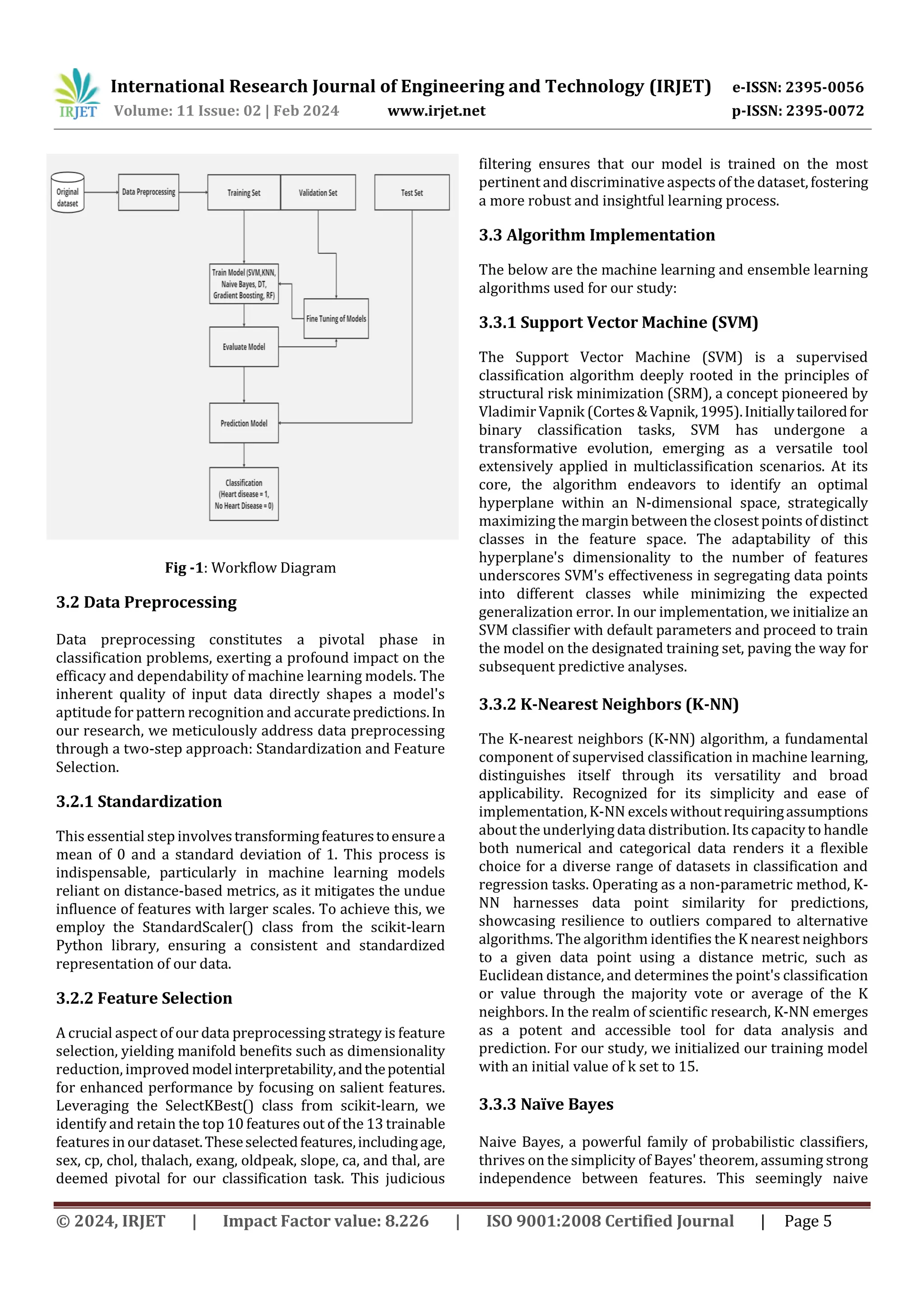
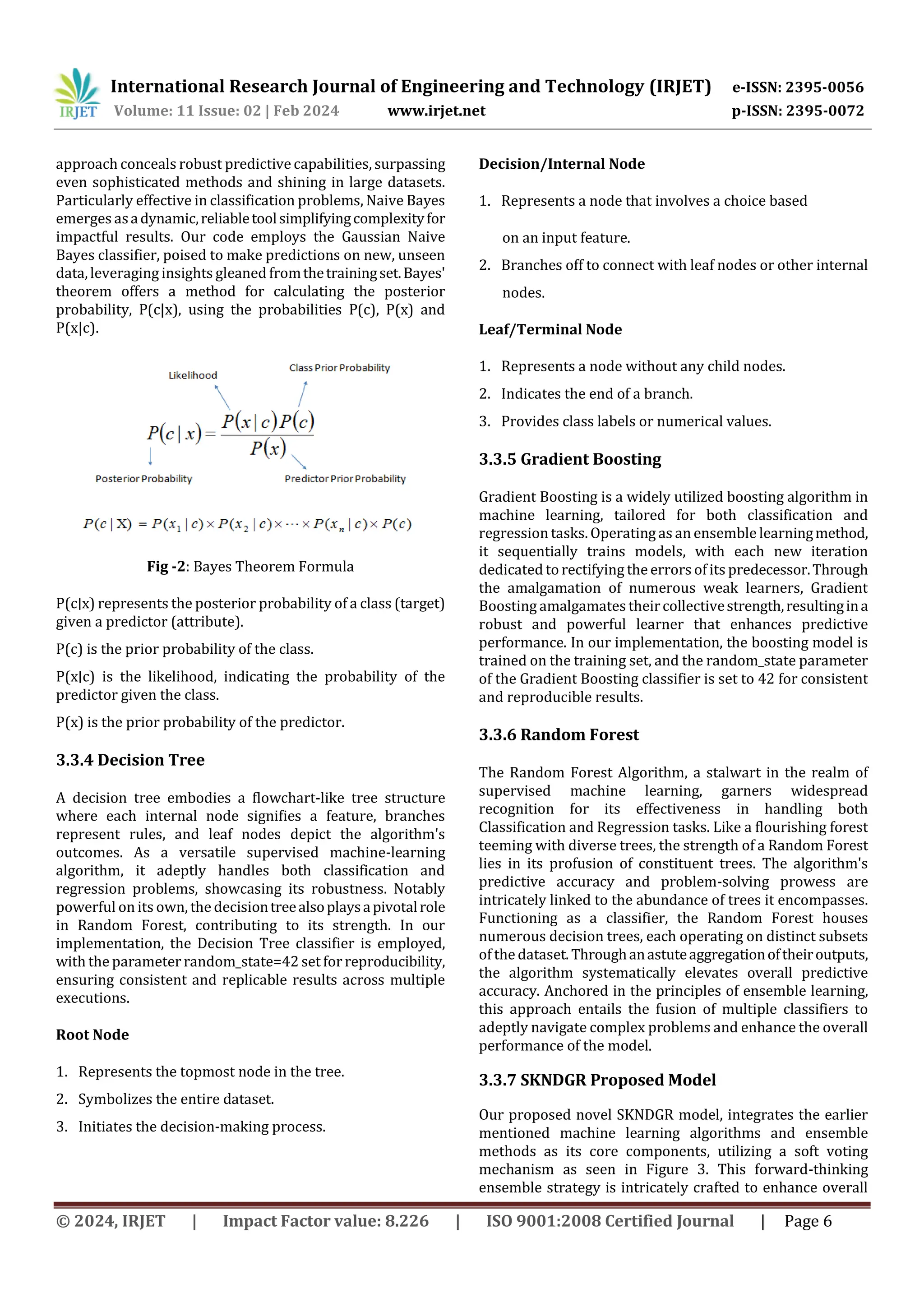
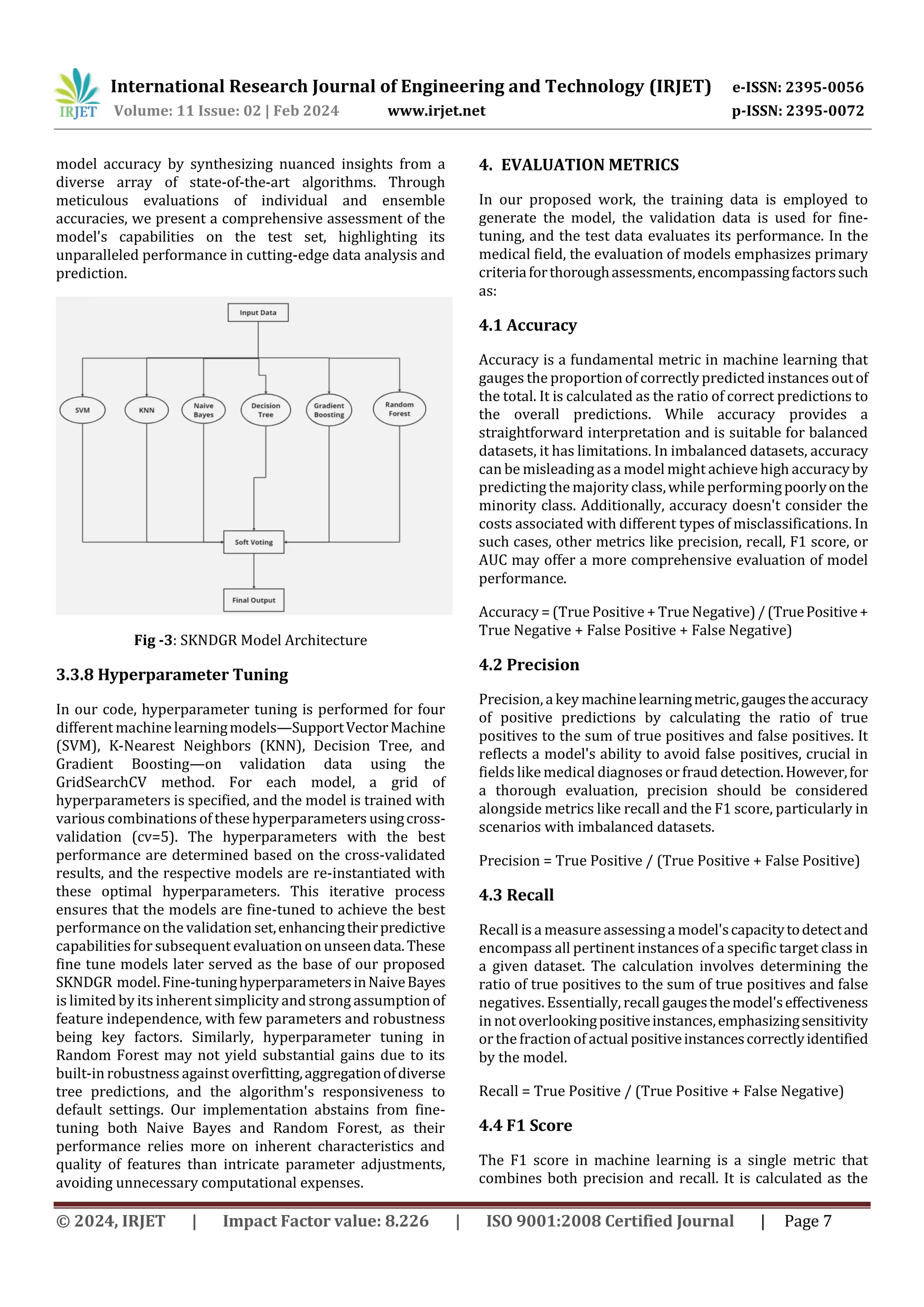
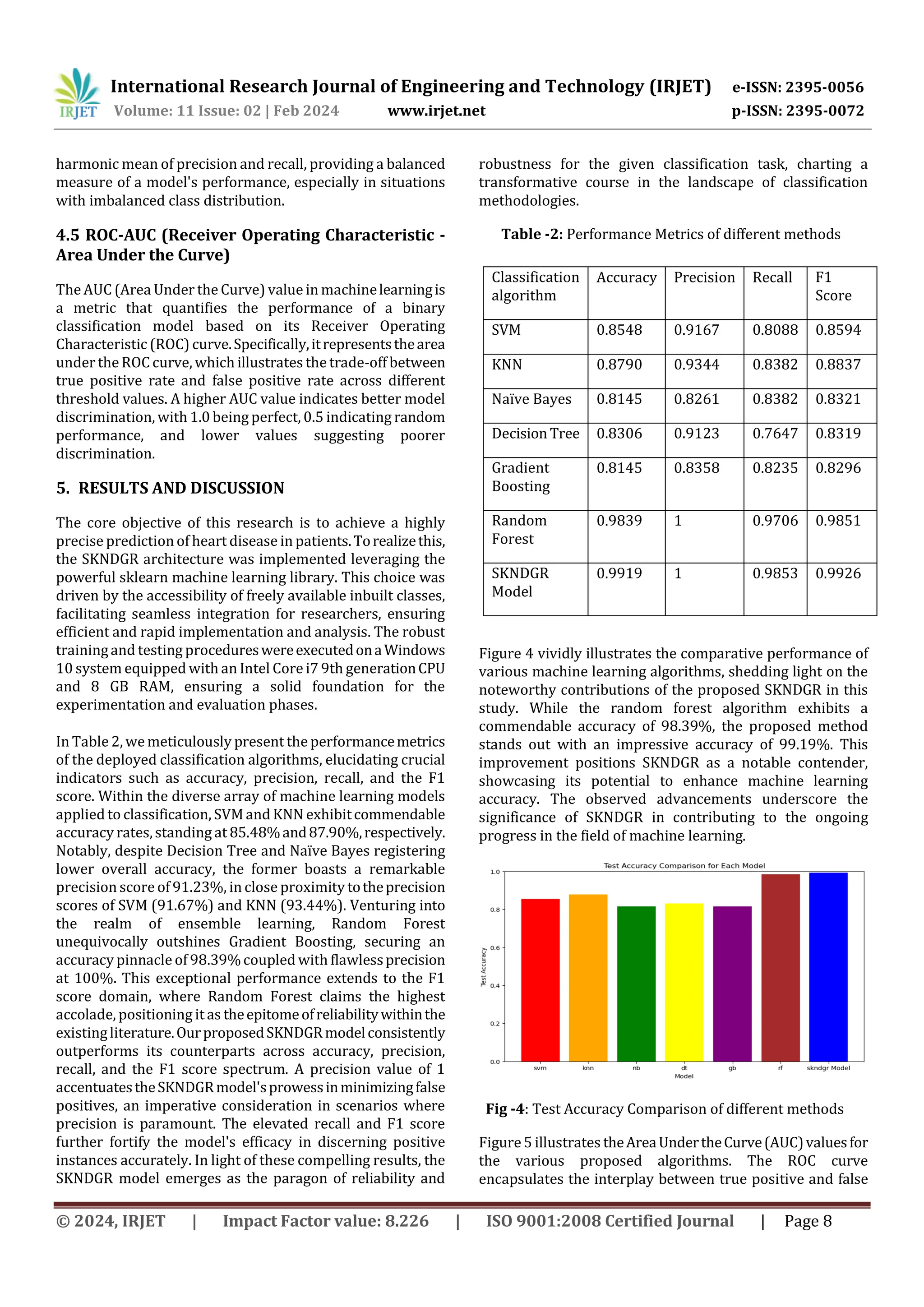
![International Research Journal of Engineering and Technology (IRJET) e-ISSN: 2395-0056
Volume: 11 Issue: 02 | Feb 2024 www.irjet.net p-ISSN: 2395-0072
© 2024, IRJET | Impact Factor value: 8.226 | ISO 9001:2008 Certified Journal | Page 9
positive rates, offering a visual depiction of each model's
discriminatory prowess. Notably, our novel SKNDGR model
outshinesall existing methods, as evidenced by its trajectory
closely hugging the upper-left corner of the graph. This
positioning signifies superior overall performance,
underscoring the SKNDGR model's ability to achieve high
true positive rates while keeping false positive rates to a
minimum. The clear distinction in the AUC values further
emphasizes the efficacy of the SKNDGR model, solidifying its
standing as a leading solution within the evaluated
algorithms.
Fig -5: ROC curve of different methods
Figure 6 illustrates a confusion matrix, offering a concise
summary of a classification model's performance by
enumerating true positive, true negative, false positive, and
falsenegativepredictions.Theproposedmodeldemonstrates
highly accurate classification for the given instances.
Fig -6: Confusion Matrix of proposed method
6. CONCLUSION
Heart diseases is very common among the elderly people
and those exposed to a stressful environment. The early
diagnosis and treatment can help avoid the patient from
reaching critical or fatal conditions. The proposed machine
learning approach enables quicker andaccuratediagnosis of
the patient’s medical condition.Here,wehaveusedtheheart
disease dataset to test the performance of the existing state
of the art machine learning architectures. We found that the
Random Forest algorithm performedthe bestindependently
from all the exiting machine learning algorithms. Our novel
ensemble model combining the strength of all the individual
models resulted in the best performance with an accuracy
and F1 score of 99.19 % and 99.26% respectively.
7. FUTURE WORK
In the future, exploring the use of Artificial Neural Networks
for handling classification problems is a promising avenue.
Artificial Neural Networks (ANNs), especially deep neural
networks, present distinct advantages over traditional
machine learning models. They excel in capturing intricate,
non-linear relationships in large datasets, automatically
learning relevant features without the need for manual
engineering. This makes ANNs highly effective for complex
tasks and scenarios with abundant data, where traditional
models might struggle. While traditional machine learning
models may be more interpretable and computationally
efficient in certain situations, the superior ability of ANNs to
handle complexity and large-scale data makes them a
compelling choice for a wide range of applications.
REFERENCES
[1] M.Snehith Raja, M.Anurag, Ch.Prachetan Reddy and
NageswaraRao Sirisala, "MACHINE LEARNING BASED
HEART DISEASE PREDICTION SYSTEM", in 2021 IEEE
International Conference on Computer Communication and
Informatics, 2021, pp. 1-5,doi:
10.1109/ICCCI50826.2021.9402653
[2] Ibomoiye Domor Mienye, Yanxia Sun and Zenghui Wang,
"An Improved Ensemble Learning Approach for the
Prediction of Heart Disease Risk", in Elsevier Informatics in
Medicine Unlocked, vol.20, 2020, pp. 1-12, doi:
https://doi.org/10.1016/j.imu.2020.100402
[3] Archana Singh and Rakesh Kumar, "Heart Disease
Prediction Using Machine Learning Algorithms", in 2020
International Conference on Electrical and Electronics
Engineering, 2020, pp. 1-6, doi:
10.1109/ICE348803.2020.9122958
[4] M. Nikhil Kumar, K. V. S. Koushik and K. Deepak,
"Prediction of Heart Diseases Using Data Mining and
Machine Learning Algorithms and Tools", in International](https://image.slidesharecdn.com/irjet-v11i201-250529103637-cb1ec7f3/75/Enhanced-heart-disease-prediction-using-SKNDGR-ensemble-Machine-Learning-Model-9-2048.jpg)
![International Research Journal of Engineering and Technology (IRJET) e-ISSN: 2395-0056
Volume: 11 Issue: 02 | Feb 2024 www.irjet.net p-ISSN: 2395-0072
© 2024, IRJET | Impact Factor value: 8.226 | ISO 9001:2008 Certified Journal | Page 10
Journal of Scientific Research in Computer Science,
Engineering and Information Technology,vol.3,2018,pp. 1-
12, doi: 10.13140/RG.2.2.28488.83203
[5] Min Chen, Yixue Hao, Kai Hwang, LuWang,andLin Wang,
"Disease Prediction by Machine Learning overBigData from
Healthcare Communities", in IEEE Access, vol. 5, 2017, pp.
8869 - 8879, doi: 10.1109/ACCESS.2017.2694446
[6] B. Manoj Kumar and P S. Uma Priyadarsini, "Efficient
Prediction of Heart Disease using SVM Classification
Algorithm and Compare its Performance with Linear
Regression in Terms of Accuracy", in JOURNAL OF
PHARMACEUTICAL NEGATIVE RESULTS, 2022, pp. 1-8, doi:
https://doi.org/10.47750/pnr.2022.13.S04.171
[7] Dhiraj Dahiwade, Gajanan Patle and Ektaa Meshram,
"Designing Disease Prediction Model Using Machine
Learning Approach", in 2019 3rd International Conference
on Computing Methodologies andCommunication,2019, pp.
1-5 , doi: 10.1109/ICCMC.2019.8819782
[8] K. Subhadra and Vikas B, "Neural Network Based
Intelligent System for Predicting Heart Disease", in
International Journal of Innovative Technology and
Exploring Engineering, vol. 8, 2019, pp. 1-4
[9] C. Beulah Christalin Latha and S. Carolin Jeeva,
"Improving the accuracy of prediction of heart disease risk
based on ensemble classification techniques", in Elsevier
Informatics in Medicine Unlocked, vol. 16, 2019, pp. 1-17,
doi: 10.1016/j.imu.2019.100203
[10] Chunyan Guo, Jiabing Zhang, Yang Liu, Yaying Xie,
Zhiqiang Han and Jianshe Yu, "Recursion Enhanced Random
Forest With anImprovedLinearModel (RERF-ILM)forHeart
Disease Detection on the Internet of Medical Things
Platform", in IEEE Access, vol. 8, 2020, pp. 59247 - 59256,
doi: 10.1109/ACCESS.2020.2981159
[11] Arpit Gupta, Ankush Shahu, Masud Ansari, Nilalohit
Khadke and Ashwini Urade, "Heart disease classification
using Random Forest", in International Research Journal of
Engineering and Technology, vol.10, 2023, pp. 1-5
[12] Sai Bhavan Gubbala, "Heart Disease Prediction Using
Machine Learning Techniques", in International Research
Journal of Engineering and Technology, vol. 9, 2022, pp. 1-5
[13] Nadia Rubaiyat, Anika Islam Apsara,AbdullahAl Farabe
and Ifaz Ishtiak, "Classification and prediction of Orthopedic
disease based on lumber and pelvic state of patients", in
2019 IEEE International Conference on Electrical,Computer
and Communication Technologies, 2019, pp. 1-4, doi:
10.1109/ICECCT.2019.8869540
[14] Aditi Gavhane, Gouthami Kokkula, Isha Pandya and
Kailas Devadkar, "Prediction ofHeartDiseaseUsingMachine
Learning", in 2018 Second International Conference on
Electronics, Communication and Aerospace Technology,
2018, pp. 1-4, doi: 10.1109/ICECA.2018.8474922
[15] Ching-seh Mike Wu, Mustafa Badshah and Vishwa
Bhagwat, "Heart Disease Prediction Using Data Mining
Techniques", in ACM Proceedings of the 2019 2nd
International Conference on Data Science and Information
Technology, 2019, pp. 7-11, doi:
https://doi.org/10.1145/3352411.3352413
[16] Ambily Merlin Kuruvilla and N.V Balaji, "Heart disease
prediction system using CorrelationBasedFeatureSelection
with Multilayer Perceptron approach", in IOP Conference
Series, Annual International Conference on Emerging
Research Areas on "COMPUTING & COMMUNICATION
SYSTEMS FOR A FOURTH INDUSTRIAL REVOLUTION"
(AICERA 2020) 14th-16th December 2020, Kanjirapally,
India, vol. 1085, 2021, pp. 1-6, doi: 10.1088/1757-
899X/1085/1/012028
[17] Devansh Shah, Samir Patel and Santosh Kumar Bharti,
"Heart Disease Prediction using Machine Learning
Techniques", in Springer Advances in Computational
Approaches for Artificial Intelligence, Image Processing, IoT
and Cloud Applications, vol. 1, 2020, pp. 1-6, doi:
https://doi.org/10.1007/s42979-020-00365-y
[18] Harshit Jindal, Sarthak Agrawal, RishabhKhera,Rachna
Jain and Preeti Nagrath, "Heart disease prediction using
machine learning algorithms", in IOP Conference Series: 1st
International Conference on Computational Research and
Data Analytics (ICCRDA 2020) 24th October 2020, Rajpura,
India, vol. 1022, pp. 1-10, doi: 10.1088/1757-
899X/1022/1/012072
[19] Mohammad Ali Hassani, Ran Tao, Marjan Kamyab and
Mohammad Hadi Mohammadi, "An Approach of Predicting
Heart Disease Using a Hybrid Neural Network and Decision
Tree", in ACM Proceedings of the 5th International
Conference on Big Data and Computing,2020,pp.84-89,doi:
https://doi.org/10.1145/3404687.3404704
[20] Syed Nawaz Pasha,DadiRamesh,SallauddinMohmmad,
A. Harshavardhan and Shabana, "Cardiovascular disease
prediction using deep learning techniques", IOP Conference
Series: International ConferenceonRecentAdvancementsin
Engineering and Management (ICRAEM-2020)9-10October
2020, Warangal, India, vol. 981, 2020, pp. 1-6, doi:
10.1088/1757-899X/981/2/022006
[21]https://www.kaggle.com/datasets/johnsmith88/heart-
disease-dataset](https://image.slidesharecdn.com/irjet-v11i201-250529103637-cb1ec7f3/75/Enhanced-heart-disease-prediction-using-SKNDGR-ensemble-Machine-Learning-Model-10-2048.jpg)


