December 2015 Edition
This Monthly Tax Update (MTU) summarises the
changes and announcements in the most recent
months in the following areas:
 Legislation
 Court Case decisions
 Authority Announcements
1
Table of Contents
1. About us 2
1.1 Introduction 2
1.2 Disclaimer clause 3
1.3 Tax Matrix news and developments 4
1.3.1 Law Society & Tax Matrix hosted Minister of Finance 4
1.3.2 Tax Matrix introduces internship programme 5
1.3.3 Seminar on 2016 Tax Changes and Book Launch 6
1.3.4 Tax Matrix 2016 Module based Courses calendar 6
2. Legislation 7
2.1 Acts 7
2.1.1 Finance Act 7
2.1.2 Appropriation Act 11
2.2 Statutory instruments 12
2.2.1 Statutory Instrument 130, 131 & 135 of 2015 12
2.2.2 Measures to curb unnecessary imports- SI 132 of 2015 12
2.3 Bill Watch 14
2.3.1 Special Economic Zones Bill – The EPZ Act with a new heading 14
3. Court cases & Appeals 15
3.1 Court cases 15
3.1.1 Care International- An employee causes a loss to the entity but loss
also aggravated by the entity’s fault
15
3.1.2 Goba T – ruling on returning resident duty rebate on motor vehicle
case
19
3.2 Appeals 25
3.2.1 Can Chicken Slice strip Zimra’s powers -Garnish order and pay now
argue later rules being challenged in the ConCourt?
25
4. Interpretations & Announcements 28
4.1Tax Matrix Analysis of existing or new law 28
4.1.1 Are your independent contractors real independent contractors? 28
4.2 Announcements 31
4.2.1 Zimbabwe- China Sign Double Taxation Agreement 31
4.2.2 Zimra ushers in new electronic tax devices 31
2
1. About us
1.1 Introduction
Tax Matrix (Pvt) Ltd has the honour to publish its December 2015 Monthly Tax Update (MTU). The
MTU complements our tax training programmes and newsletters. It disseminates information about tax
developments happening locally and internationally. In the MTU, Tax Matrix (Pvt) Ltd analyses the tax
developments to ensure that you, as our most valued client, are kept abreast of changes in the tax world.
In this issue we provide update on the Finance Act no. 2 of 2015 gazzetted on the 31st
of December 2015
as well as various statutory instruments and Bills published in November and December 2015.
Just so you know what is happening in the courts, we have also analysed two recent tax cases and a
recent appeal in the Constitutional court. The purpose of this is to ensure you are made aware of court
outcomes which can have an impact on your business or practice.
Tax Matrix (Pvt) Ltd also identifies and examines all relevant publications and ZIMRA’s interpretation
of these decisions as well as the institutional application of new legislation or rulings. The updates are
accompanied by an insightful commentary pointing out the key takeaway points from the material.
Aside to what our regular Newsletters provide, MTUs are meant to help you:
 Identify new tax planning opportunities.
 Keep you updated with all changes in the tax world.
 Keep you aware of current ZIMRA interpretations.
 Recognise pitfalls many professionals miss.
 Minimise compliance errors and offer practical and effective tax solutions.
It is our sincere hope that this MTU will bring value to the business community, Zimra and the academia
and should stand out as a useful tool in shaping the Zimbabwean tax system.
3
1.2 Disclaimer
The information contained in this MTU is for general guidance only and is not intended as a substitute
for specific advice in considering the tax effects of particular transactions. Whilst a lot of care has been
taken in the compilation of the information and opinions contained in this publication, no liability is
accepted for the consequences of any inaccuracies contained in this guide. The information does not
constitutes at legal advice nor can it be relied on in any dispute with the tax authorities and shall not
constitute any legal or tax opinion in this or any jurisdiction.
The analysis contained in this MTU is based on the current legal framework which is subject to change
and the company assumes no obligation to update or otherwise revise the materials contained in this or
any of its MTUs. In making their considerations, recipients or people with access to the MTU are advised
to make their own independent assessments, and, in this regard, to consult the company or their own
professional advisors before taking any action. The information and opinions contained in this MTU is
valid as at the date of uploading on the website, preparation or compilation, any of its contents may be
subject to change without notice.
The information contained and opinions contained in this MTU are for the purpose of general
information (“the purpose”) and for no other purpose. The company disclaims any responsibility for the
use of the information contained herein for a different purpose or context.
The information contained and opinions contained herein must not be copied, published, reproduced or
distributed in whole or in part to others at any time by the recipients. Tax Matrix (Pvt) Ltd retains all
intellectual copyright information contained and opinions contained in this MTU. Recipients should
seek the written permission of the company before distributing copies of information and opinions
contained in the MTU to third parties.
4
1.3 Tax Matrix news and developments
1.4.1 Law Society & Tax Matrix hosted Minister of Finance
On 2 December 2015 Tax Matrix and Law Society of Zimbabwe co-hosted a post budget breakfast
briefing to law society members at Pandhari Lodge, Harare. The occasion was graced by The
Honourable Minister of Finance and Economic Development, Mr Patrick Chinamasa.
1.4.1.1 The Honourable Minister’s speech
In his keynote speech the Minister covered the following aspects:
Re-engagement of international creditors
 The Dec 2014 and June 2015 IMF staff monitored assessments were successful and the 3rd
and
last one is in December 2015 whose report would be out in February 2016.
 If this last assessment is successful and planned $1.8b debt clearance goes through by mid-2016,
new money is expected in the form of cheaper lines of credit for the private sector.
 USA also supports the debt clearance and re-engagement programme
Property rights
 Tradable 99 year leases
 EU agreed to fund remapping of boundaries
 Good first and important steps for land property rights.
Indigenization
 The policy is still under discussion
 51/49% recommended for the mining sector with government paying nothing because the
resources belongs to Zimbabweans.
 Outside the resources sector 51/49 model does not apply and the issue is under consideration
 It’s not an overnight resolution
 Other African countries are still sitting on the land time bomb
 Banking sector already given permission for 100% foreign ownership
Transfer pricing
 Government working on the fiscal policy for the mining sector so as to increase government
revenue and harnessing transfer pricing with this sector
1.4.1.2 Tax Matrix speech
Besides the budget presentation, Tax Matrix spoke on the amended transfer pricing legislation
regarding its effect on international companies as well as local group companies and other taxpayers
engaged in non-arm’s length transactions. The transfer pricing legislation which now follows the
international best practice through the adoption of OECD transfer pricing guidelines requires
companies and individuals involved in associate transactions to draft transfer pricing policies and
keep contemporaneous records to support their transfer prices. Tax Matrix also called upon the
Honourable Minister to come up with tax practice (interpretation) notes to create certainty and equity
in the application of the tax law, as opposed to current adhoc clarifications on certain matters by the
Zimbabwe Revenue Authority which is subject to the Commissioner General’s discretion.
5
1.4.2 Tax Matrix introduces internship programme
Tax Matrix is currently recruiting interns for its “Giving theory a meaning” internship programme
offered to A level graduates seeking to pursue professional courses such as ACCA (Association of
Chartered Certified Accountants) , ICAZ (Institute of Chartered Accountants of Zimbabwe) , CIMA
(Chartered Institute of Management Accountants), ICSAZ (Institute of Chartered Secretaries and
Administrators). In order to perform effectively as qualified accountants, students need to develop
their skills in the workplace as well as passing the exams. At Matrix Academy we would like to play
our part in ensuring that students studying towards such professional qualifications obtain relevant,
supervised practical experience while studying for their respective qualifications.
Employers expect students and members to show high levels of knowledge and ability in the
workplace, and behave ethically. Relevant practical experience enables trainees to confirm the quality
of their workplace performance.
It is with this in mind that Matrix Academy has developed a “Three in One” programme to bridge the
gap between the theoretical and practical aspects of their training. Our “Three in One” programme
allows students to be competitive in the job market and also to be entrepreneurs. The programme has
duration of 36 months and offers the following distinctive competitive features:
 3 year internship contract with longer term opportunities based on performance
 Structured programme of principles, practice and application of tax and consulting skills
 Leading to a Matrix Academy In-house Tax Certificate
 A learning experience with a practical edge
 Exposure to clients and tax experts
 Full Coaching support
For more information kindly follow the link: http://taxmatrix.co.zw/products-services/matrix-
academy/interns-learning-practice/
6
1.4.3 Seminar on 2016 Tax Changes and Book Launch
Tax Matrix (Pvt) Ltd is pleased to invite you or any of your nominated person (s) to our tax seminar
on “2016 Tax Changes and Book Launch” where our presenters will discuss the new provisions
enacted through the Finance Act no.2 of 2015 which was gazetted on 31 December 2015. The
discussion will be centered on the new legislation on “Transfer Pricing”.
The seminar will be accompanied by the launch of our new book « Employment Tax and Related
Matters ». This book is the culmination of 1 year of research focused on addressing current topics
affecting employers and investors. The book written by Marvellous Tapera & Alex Majachani – The
authors of Unpacking Tax Law & Practice in Zimbabwe creates synergies between employment tax
issues and other legislation affecting employees and employers. Investors and business people will
find the book to be very helpful and authors are confident that the book will aid them to make prudent
decisions regarding employment and other related matters. Professionals will also find this book to be
useful in their endeavours to provide good tax advice to their clients. The book comes on the heels of
Unpacking Tax Law & Practice in Zimbabwe which has gained popularity within the market as the
only book which addresses Zimbabwe tax matters from a practical point of view. We will also
showcase a revised copy of the Unpacking Tax Law & Practice in Zimbabwe
When?
Wednesday 17th
of February 2016
Time 08.30hours – 13.00hours
Who should attend?
Human resources, Payroll administrators, Business people, finance directors, controllers, managers,
accountants, auditors, risk managers, tax advisors, lawyers and anyone with interest in tax.
CPD Hours: 4 hours
Venue
Rainbow Towers Hotel
Investment
US$150 per delegate, to cover teas, lunch and a copy of Employment Tax and Related Matters book
Bookings
For details and bookings contact Samantha on: + 263 4 740222 / 741334 OR + 263 775911383
/0772421238T
1.4.4 Tax Matrix 2016 Module based Courses calendar
Tax Matrix is pleased to inform you that with effect from the 4th
of March 2016 it will be running
module based courses for finance, HR, procurement staff, tax advisors and any one with interest in the
subject of tax. Join our sessions every Friday (Learning Fridays) starting the 4th
of March as we
demystify the subject of taxation. This is a worthwhile investment. Kindly follow the link to obtain
further details: http://taxmatrix.co.zw/products-services/matrix-academy/module-based-courses/
7
2. Legislation
2.1 Acts
2.1.1 Finance Act
The Finance Bill was passed into law by the House of Assembly i.e. into Finance Act (no 2) of 2015 on
31st
December 2015 with most of its proposals adopted and with few additions. The Finance Act (no 2))
of 2015 is effective 1 January 2016 unless otherwise stated its contents also take effect from that date.
2.1.1.1 Finance Act measures
 Tobacco levy (s 22A of the Finance Act) - Tobacco Levy for the seller of auction and contract
tobacco reduced from 1.50 cents to 0.75 cents. The proposal in the Finance Bill to reduce the buyer’s
levy to the same level was not adopted- it remains at 1.50 cents.
2.1.1.2 Income Tax Act measures
 Withholding tax on contracts (s 80 of the Income Tax Act) - Changes to law on withholding tax on
local contracts (10% withholding tax on tenders)-A statutory body, quasi-governmental institution or
registered taxpayer is empowered to recover from the supplier the withholding tax it paid to ZIMRA
as a result of failing to deduct the withholding tax from the supplier who did not furnish a tax
clearance. It has 24 months from the date the withholding tax was due to be paid to ZIMRA to
recover the amount from the supplier (payee). The right of recovery does not however extend to
penalties and interest paid by the payer to ZIMRA. This measure applies to tax payments made since
1 February 2009.
 Exemption of ZAMCO (Para 1 (f) of the 3rd
Schedule to the Income Tax Act)- Receipts and accruals
of the wholly owned company of Reserve Bank of Zimbabwe i.e. Zimbabwe Asset Management
Corporation (Private) Limited (ZAMCO) are to be exempt from income tax (new- was not in the
Finance Bill)
 Exemption of retrenchment package (Para 4(p) of the 3rd
Schedule to the Income tax act)-The
qualification for exemption of retrenchment package no longer depends on the approval by the
Minister of Labour & Social Welfare- taxpayers no longer required to seek the Minister’s approval to
qualify for exemption of retrenchment package (this was not in the bill or budget statement).
 Exemption of pension commutation (Para 6(h1) of the 3rd
Schedule to the Income Tax Act)- Pension
commutation of a pension or annuity which is payable from the Consolidated Revenue Fund or a
pension fund, other than a retirement annuity fund, if the pension or annuity itself would not have
been subject to income tax treated as gross income. To exempt 1/3 of the commutation (up to a third
of US$60,000) or US$10,000 whichever is greater of this amount. This measure is to apply to
members who are retrenched before attaining the prescribed age of 55 years. The exemption only
apply to the first US$60,000 granted in year of assessment (this underlined part is new- was not in
the Finance Bill)
 Exemption of interest on long term deposits (Para 10 (r ) of the 3rd
Schedule to the Income Tax Act)-
Interest on fixed deposit held for more than 12 months is exempt from Resident Tax on Interest. This
should be read to together with s 22 of the Finance Act which provides a withholding tax rate of 15%
on interest from a financial institution accruing to a resident and reduced rate of 5% if the deposit is
earned on fixed-term deposit with tenure of at least 90 days. NB – there is referencing error in the
Finance Act no 2 of 2015 on this matter which refers to para 10(r)of the 3rd
Schedule to the Income
Tax Act when this paragraph is already in existence.
8
 Transfer Pricing (s 98 B as read with 35th
Schedule to the Income Tax Act)- On 1 January 2014
legislation on transfer pricing was introduced which targeted associate transactions which meant to
counter base erosion and profit shifting arrangements arising from business transactions between
related parties based on arm’s length principle. The legislation however lacked sufficient guidance
on reporting procedures for taxpayers engaged in transactions with related parties. The Finance Act
(2) of 2015 introduced transfer pricing methods “guidelines” structured along the lines of OECD as
follows:
 Comparable Uncontrolled Price Method - This method compares the price for property or
services transferred in a controlled transaction to the price charged for property or services
transferred in a comparable uncontrolled transaction in comparable circumstances.
 The Resale Price Method - The method is based on the price at which a product that has been
purchased from an associated enterprise is sold to an independent enterprise. The resale price
is reduced by the resale price margin. What is left after subtracting the resale price margin
can be regarded, after adjustment for other costs associated with the purchase of the product
(e.g. custom duties), as an arm’s length price of the original transfer of property between the
associated enterprises.
 Cost Plus Method -The method applies the costs incurred by the supplier of property (or
services) in a controlled transaction. An appropriate cost plus mark-up is then added to the
direct or indirect costs, to make an appropriate profit in light of the functions performed
(taking into account assets used and risks assumed) and the market conditions. What is
arrived at after adding the cost plus mark up to the above costs may be regarded as an arm’s
length price of the original controlled transaction.
 The Transactional Net Margin Method -The method examines the net profit margin relative
to an appropriate base (e.g. costs, sales, assets etc) that a taxpayer realizes from a controlled
transaction.
 The Transactional Profit Split Method - The transactional profit split method consisting of
allocating to each associated person participating in a controlled transaction the portion of
common profit (or loss) derived from such transaction that an independent person would
expect to earn from engaging in a comparable uncontrolled transaction.
 NB look forward to full and detailed analysis on Transfer Pricing in our January 2016
edition of MTU
2.1.1.3 Stamp duties Act measures
 The underpayment of Stamp Duty by insurance companies for the period between the 1st
of February
2009 to the 30th
July, 2015 is condoned and thus not required to remit the shortfall to the ZIMRA.
The effect of condoning is that the stamp duty on insurance policies is reduced in retrospect from
US$0.05 to US$0.01 for every dollar worth of premium payable on policies of insurance, with effect
from 1 February, 2009 to 30 July, 2015. However going forward the stamp duty remains at US$0.05
for every dollar worth of premium payable on policies of insurance. The rates are fixed in section 25
of the Finance Act.
2.1.1.4 VAT Act measures
 Short term insurance (s 11 (a)) - VAT to be levied on commission on “the supply of short term
insurance by insurance agents or brokers.
9
 Round robin for VAT on unbeneficiated hides (backed to 1 January 2014)- The Finance Act no
2 of 2015 puts as effective date on export tax on unbeneficiated hides back to 1 January 2014.
This date had been put through Finance Act, 2014 (no. 1 of 2014), however, the Finance Act 2 of
2014, clause 10 amended section 12 of the VAT Act to suspend the levying of unbeneficiated
export tax on hides and to be re-introduced 1 January 2015. So the new provision invalidates the
Finance Act no 2 of 2014 by taking the effective date back to 1 January 2014 (see SI 16 on our
website for details, under publications).
 Effective date for VAT on unbeneficiated platinum- The date of application of VAT on
exportation of unbeneficiated platinum moved to 1 January 2017. This is moving forward the
date from the initial effective date of 1 January 2015.
2.1.1.5 Revenue Authority Act measures
 Offsetting of tax refunds against tax liabilities (s 34 D of the Revenue Authority Act) -
administrative measure to ensure refunds due to the taxpayer are off set against any liability of that
taxpayer to the Commissioner General for outstanding tax on any other tax head. This is to allow
offsetting of VAT, PAYE, Income tax, etc refunds against, VAT, PAYE, Income tax, Capital gains
tax liabilities, etc. Thus, the law applies on refunds due to the tax taxpayer against tax liability
outstanding on:
 Betting and Totalizator Control Act [Chapter 10:02]
 Capital Gains Tax Act [Chapter 23:01]
 Customs and Excise Act [Chapter 23:02]
 Income Tax Act [Chapter 23:06]
 Income Tax (Transitional Period Provisions) Act [Chapter 23:07]
 Stamp Duties Act [Chapter 23:09]
 Tax Reserve Certificates Act [Chapter 23:10]
 Value Added Tax Act [Chapter 23:12]
NB – there is referencing error in the Finance Act no 2 of 2015 on this matter which refers to s 34D of
the Revenue Authority Act when this section is already in existence.
10
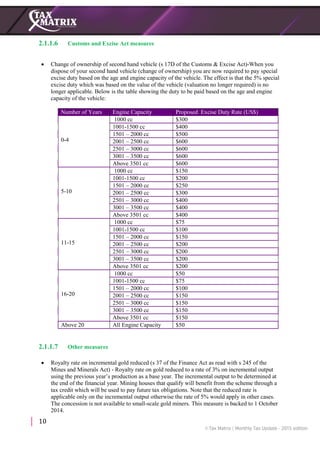
2.1.1.6 Customs and Excise Act measures
 Change of ownership of second hand vehicle (s 17D of the Customs & Excise Act)-When you
dispose of your second hand vehicle (change of ownership) you are now required to pay special
excise duty based on the age and engine capacity of the vehicle. The effect is that the 5% special
excise duty which was based on the value of the vehicle (valuation no longer required) is no
longer applicable. Below is the table showing the duty to be paid based on the age and engine
capacity of the vehicle:
Number of Years Engine Capacity Proposed Excise Duty Rate (US$)
0-4
1000 cc $300
1001-1500 cc $400
1501 – 2000 cc $500
2001 – 2500 cc $600
2501 – 3000 cc $600
3001 – 3500 cc $600
Above 3501 cc $600
5-10
1000 cc $150
1001-1500 cc $200
1501 – 2000 cc $250
2001 – 2500 cc $300
2501 – 3000 cc $400
3001 – 3500 cc $400
Above 3501 cc $400
11-15
1000 cc $75
1001-1500 cc $100
1501 – 2000 cc $150
2001 – 2500 cc $200
2501 – 3000 cc $200
3001 – 3500 cc $200
Above 3501 cc $200
16-20
1000 cc $50
1001-1500 cc $75
1501 – 2000 cc $100
2001 – 2500 cc $150
2501 – 3000 cc $150
3001 – 3500 cc $150
Above 3501 cc $150
Above 20 All Engine Capacity $50
2.1.1.7 Other measures
 Royalty rate on incremental gold reduced (s 37 of the Finance Act as read with s 245 of the
Mines and Minerals Act) - Royalty rate on gold reduced to a rate of 3% on incremental output
using the previous year’s production as a base year. The incremental output to be determined at
the end of the financial year. Mining houses that qualify will benefit from the scheme through a
tax credit which will be used to pay future tax obligations. Note that the reduced rate is
applicable only on the incremental output otherwise the rate of 5% would apply in other cases.
The concession is not available to small-scale gold miners. This measure is backed to 1 October
2014.
11
 Exemption from paying royalties on minerals extracted for experiments(s 249 of the Mines and
Minerals Act) - A miner who extracts or treats ore from his location for experimental or similar
purpose is exempt from paying royalties on such ore or mineral so applied for this purposes,
subject to an approval from the Secretary of Mines.
 Exemption from paying royalties on diamonds or precious stones (s 249 of the Mines and
Minerals Act)- The Minister of Mines in consultation with minister of Finance shall waive the
payment of royalty, export tax and all fees and MMCZ commission on the export of rough
diamonds or other unbeneficiated precious stones up to a limit of 10000 carats of rough
diamonds or precious stoner per month to a miner who enters into an agreement with Minister of
Mines to train or fund the training of Zimbabwean citizens ( locally or abroad) on the diamond or
precious stones cutting, polishing, grading, valuation and beneficiation and has or is to establish
any or a combination of the following:
 A significant local jewellery fabrication plant
 One or more local jewellery retail outlets, or
 A laboratory for the certification of cut and polished diamonds or precious stones in
Zimbabwe
The miner should satisfy the Minister of Mines that he has resources to implement the above
activities.
2.1.2 Appropriation Act
The Honourable Minister of Finance and Economic Development, Mr Patrick Chinamasa announced the
2016 annual budget on the 26th
of November 2015 and subsequently issued an Appropriation Bill which
sets out how the Minister plans to expend the public funds. The parliament then approved the bill and
this gave birth to the Appropriation (2016) Act 2015. Subject to section 17 (5) of the Public Finance
Management Act [Chapter 22:19], The Appropriation (2016) Act 2015 sets out the manner in which the
Minister of finance intends to use the public funds in the Consolidated Revenue Fund in 2016.
The Expenditure is to be funded using Funds contained in the Consolidated Revenue Fund and this fund
will have sums of money not Exceeding in aggregate US$ 3 398 128 000.There are 41 votes in total.
Tax Matrix has the pleasure to share with the breakdown of the Appropriation (2016) Act 2015, which
shows that top 10 major votes accounts for 89% of the expenditure, whereas 31 votes are allocated 11 %
of the total expenditure.
Expenditure US$ % of the Total
Expenditure
Primary and Secondary Education 810 431 000 23.8%
Home Affairs 395 372 000 11.6%
Defense 358 065 000 10.5%
Heath and Child Care 330 789 000 9.7%
Higher and Tertiary Education, Science and Technology
Development
307 645 000 9.1%
Finance and Economic Development 215 269 000 6.3%
Office of the President and the Cabinet 179 936 000 5.3%
Public Service Labour and Social Welfare 174 235 000 5.1%
Agriculture, Mechanisation and irrigation development 145 091 000 4.3%
Justice Legal and Parliamentary Affairs 108 762 000 3.2%
Note that if in respect of any financial year it is found that the amount appropriated by the
Appropriation Act to any purpose is insufficient or that a need has arisen for expenditure for a purpose
12
to which no amount has been appropriated by that Act, a supplementary estimate showing the sums
required shall be laid before Parliament and a supplementary appropriation bill issued.
2.2 Statutory instruments
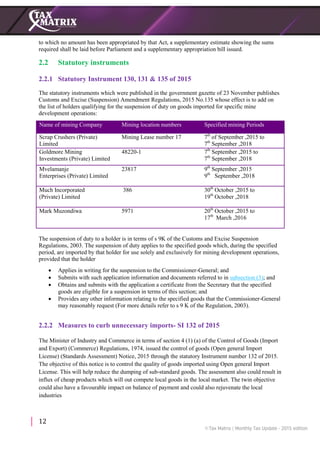
2.2.1 Statutory Instrument 130, 131 & 135 of 2015
The statutory instruments which were published in the government gazette of 23 November publishes
Customs and Excise (Suspension) Amendment Regulations, 2015 No.135 whose effect is to add on
the list of holders qualifying for the suspension of duty on goods imported for specific mine
development operations:
Name of mining Company Mining location numbers Specified mining Periods
Scrap Crushers (Private)
Limited
Mining Lease number 17 7th
of September ,2015 to
7th
September ,2018
Goldmore Mining
Investments (Private) Limited
48220-1 7th
September ,2015 to
7th
September ,2018
Mvelamanje
Enterprises (Private) Limited
23817 9th
September ,2015
9th
September ,2018
Much Incorporated
(Private) Limited
386 30th
October ,2015 to
19th
October ,2018
Mark Muzondiwa 5971 20th
October ,2015 to
17th
March ,2016
The suspension of duty to a holder is in terms of s 9K of the Customs and Excise Suspension
Regulations, 2003. The suspension of duty applies to the specified goods which, during the specified
period, are imported by that holder for use solely and exclusively for mining development operations,
provided that the holder
 Applies in writing for the suspension to the Commissioner-General; and
 Submits with such application information and documents referred to in subsection (3); and
 Obtains and submits with the application a certificate from the Secretary that the specified
goods are eligible for a suspension in terms of this section; and
 Provides any other information relating to the specified goods that the Commissioner-General
may reasonably request (For more details refer to s 9 K of the Regulation, 2003).
2.2.2 Measures to curb unnecessary imports- SI 132 of 2015
The Minister of Industry and Commerce in terms of section 4 (1) (a) of the Control of Goods (Import
and Export) (Commerce) Regulations, 1974, issued the control of goods (Open general Import
License) (Standards Assessment) Notice, 2015 through the statutory Instrument number 132 of 2015.
The objective of this notice is to control the quality of goods imported using Open general Import
License. This will help reduce the dumping of sub-standard goods. The assessment also could result in
influx of cheap products which will out compete local goods in the local market. The twin objective
could also have a favourable impact on balance of payment and could also rejuvenate the local
industries
13
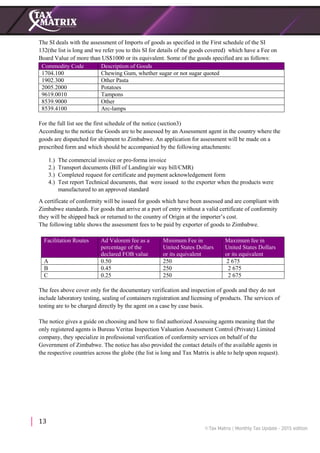
The SI deals with the assessment of Imports of goods as specified in the First schedule of the SI
132(the list is long and we refer you to this SI for details of the goods covered) which have a Fee on
Board Value of more than US$1000 or its equivalent. Some of the goods specified are as follows:
Commodity Code Description of Goods
1704.100 Chewing Gum, whether sugar or not sugar quoted
1902.300 Other Pasta
2005.2000 Potatoes
9619.0010 Tampons
8539.9000 Other
8539.4100 Arc-lamps
For the full list see the first schedule of the notice (section3)
According to the notice the Goods are to be assessed by an Assessment agent in the country where the
goods are dispatched for shipment to Zimbabwe. An application for assessment will be made on a
prescribed form and which should be accompanied by the following attachments:
1.) The commercial invoice or pro-forma invoice
2.) Transport documents (Bill of Landing/air way bill/CMR)
3.) Completed request for certificate and payment acknowledgement form
4.) Test report Technical documents, that were issued to the exporter when the products were
manufactured to an approved standard
A certificate of conformity will be issued for goods which have been assessed and are compliant with
Zimbabwe standards. For goods that arrive at a port of entry without a valid certificate of conformity
they will be shipped back or returned to the country of Origin at the importer’s cost.
The following table shows the assessment fees to be paid by exporter of goods to Zimbabwe.
Facilitation Routes Ad Valorem fee as a
percentage of the
declared FOB value
Minimum Fee in
United States Dollars
or its equivalent
Maximum fee in
United States Dollars
or its equivalent
A 0.50 250 2 675
B 0.45 250 2 675
C 0.25 250 2 675
The fees above cover only for the documentary verification and inspection of goods and they do not
include laboratory testing, sealing of containers registration and licensing of products. The services of
testing are to be charged directly by the agent on a case by case basis.
The notice gives a guide on choosing and how to find authorized Assessing agents meaning that the
only registered agents is Bureau Veritas Inspection Valuation Assessment Control (Private) Limited
company, they specialize in professional verification of conformity services on behalf of the
Government of Zimbabwe. The notice has also provided the contact details of the available agents in
the respective countries across the globe (the list is long and Tax Matrix is able to help upon request).
14
2.2.3 Bill watch
2.2.3.1 Special Economic Zones Bill – The repealed EPZ Act (chapter 14; 07)
“clothed under a new head”
The Special Economic Zones Bill, 2015 the published in government gazette of 23 November 2015
it’s a re-bound of the Export processing Zone Act. The EPZ Act (chapter 14:07 was repealed in 2006
with the introduction of the Zimbabwe Investment Authority Act [14:30] which came into effect on 1
January 2007. The Special Economic Zones Bill when passed into law seeks to address exports,
foreign currency generation and value addition, focusing on import substitution. Virtually there are no
major changes compared the repealed EPZ Act, with the following being some of the notable
changes:
 Consideration for investment licence (s 25) widened to include the extent of importation
substitution of the project, transfer of technology in managerial and other skills, extent of
linkages of the project within the domestic economy, valuation and beneficiation of local raw
material, promotion industrialisation of the domestic economy.
 Power to visit premises and inspect documents- authority powers increased to include making
copies or take extracts of documents inspected. Also, a person who hinders or obstructs the
authority when conducting inspection or examination is liable to a fine (amount however not
specified).
 Certain goods not to be taken into or stored in special economic zones- addition of goods not
to be taken into the zone are such other goods as may be prescribed. Also the term dangerous
explosive is shortened to read explosive.
 Banking activities (s 41)- the SEZ Act does not provide for establishment a representative
office of a foreign bank or an independent activity not registered under the Banking Act
(chapter 24:01).
 Restriction on borrowing and payment of employees (s 42) - movements funds requires prior
declaration to RBZ. Not allowed to borrow within the customs territory for functions or
purposes which is not working capital.
 SEZ offers the investor property rights, except the compulsory acquisition authorised in terms
of s 71 of the Constitution of ZIMBABWE Amendment (No. 20) Act 1 of 2013, no
improvement compared to the EPZ Act.
 SEZ Section 58, Special Grants- This section in the Special Economic Zones Act (new Act)
gives the minister of Mines the power to prescribe General Fiscal and non – Fiscal incentives
to licensed investors operating in a Special Economic Zones, under the approval of the
Minister of finance.
 Other changes are minor- otherwise this is re-bound of the EPZ Act.
15
3. Court cases & Appeals
3.1 Court cases
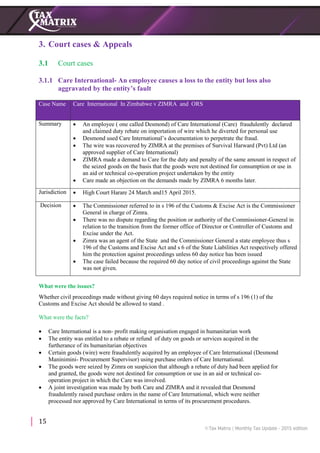
3.1.1 Care International- An employee causes a loss to the entity but loss also
aggravated by the entity’s fault
Case Name Care International In Zimbabwe v ZIMRA and ORS
Summary  An employee ( one called Desmond) of Care International (Care) fraudulently declared
and claimed duty rebate on importation of wire which he diverted for personal use
 Desmond used Care International’s documentation to perpetrate the fraud.
 The wire was recovered by ZIMRA at the premises of Survival Harward (Pvt) Ltd (an
approved supplier of Care International)
 ZIMRA made a demand to Care for the duty and penalty of the same amount in respect of
the seized goods on the basis that the goods were not destined for consumption or use in
an aid or technical co-operation project undertaken by the entity
 Care made an objection on the demands made by ZIMRA 6 months later.
Jurisdiction  High Court Harare 24 March and15 April 2015.
Decision  The Commissioner referred to in s 196 of the Customs & Excise Act is the Commissioner
General in charge of Zimra.
 There was no dispute regarding the position or authority of the Commissioner-General in
relation to the transition from the former office of Director or Controller of Customs and
Excise under the Act.
 Zimra was an agent of the State and the Commissioner General a state employee thus s
196 of the Customs and Excise Act and s 6 of the State Liabilities Act respectively offered
him the protection against proceedings unless 60 day notice has been issued
 The case failed because the required 60 day notice of civil proceedings against the State
was not given.
What were the issues?
Whether civil proceedings made without giving 60 days required notice in terms of s 196 (1) of the
Customs and Excise Act should be allowed to stand .
What were the facts?
 Care International is a non- profit making organisation engaged in humanitarian work
 The entity was entitled to a rebate or refund of duty on goods or services acquired in the
furtherance of its humanitarian objectives
 Certain goods (wire) were fraudulently acquired by an employee of Care International (Desmond
Maninimini- Procurement Supervisor) using purchase orders of Care International.
 The goods were seized by Zimra on suspicion that although a rebate of duty had been applied for
and granted, the goods were not destined for consumption or use in an aid or technical co-
operation project in which the Care was involved.
 A joint investigation was made by both Care and ZIMRA and it revealed that Desmond
fraudulently raised purchase orders in the name of Care International, which were neither
processed nor approved by Care International in terms of its procurement procedures.
16
 Zimbabwe Revenue Authority (ZIMRA) seized the goods from the premises of Survival Harward
(Pvt) Ltd the 3rd Respondent (an approved supplier of Care International )
 The goods had been acquired without paying duty yet destined for personal consumption
 Following the Investigations ZIMRA wrote to Care International demanding duty totalling
US$219,438 and a penalty of the same amount.
 Six months after Care International filled an application for an order setting aside the Zimra’s
decision, but did not give notice of its intention to file a civil claim.
 ZIMRA argued that Care International had failed to give 60 days’ notice of the proceedings, as
required by s 196(1) of the Customs and Excise Act [Chapter 23:02], which provides that “No
civil proceedings shall be instituted against the State, the Commissioner or an officer for anything
done or omitted to be done by the Commissioner or an officer under this Act or any other law
relating to customs and excise until 60 days’ notice has been given in terms of the State Liabilities
Act [Chapter 8:14]
 On that basis Zimra wanted the application of Care International to fail
What are the competing arguments?
Taxpayer
 That Zimra’s decision directing it to pay duty in the sum of US$219 437.62 and a penalty of the
same amount be and is hereby set aside.
 That it’s cost of application to be borne by the Zimra and other respondents “jointly and severally
one paying the other to be absolved”.
The Commissioner
 That the application by Care was premature and irregular before the courts because it failed to
comply with the mandatory provisions of section 196(1) of the Customs Act, which requires that
before instituting proceedings against the ZIMRA one shall first give sixty days’ notice of its
intention to institute civil proceedings
 That Care should have first exhausted domestic remedies (this supposedly suing Desmond for the
loss) and that it was approaching the courts with date hands
What was the Legislation or the judicial precedence considered.
Legislation considered
Customs and Excise Act [Chapter 23:02];
Customs and Excise (General) Regulations 2001 SI 54/2001sec 122
State Liabilities Act [Chapter 8:14], s 6, s 7
Customs and Excise Act [Chapter 23:02], s 2, s 196(1)
Revenue Authority Act [Chapter 23:11], s 3, s 4, s 38, s 39
Value Added Tax Act [Chapter 23:12];
Income Tax Act [Chapter 23:06];
Cases considered
Bethy Dube v ZIMRA 14-HB-002
Puwayi Chiutsi v Commissioner of Police and ZIMRA and Anor 05-HH-065
Ronald Machacha v ZIMRA 11-HB-186
Tasmine P/L v ZIMRA 09-HB-115
All dealing with application s 196 of the Customs & Excise Act
What is the Court`s reasoning and decision?
17
 That point raised by Zimra regarding the 60 day notice is crucial because, all the other points can
only be dealt with if Care is properly before the court.
 That Care has not given any notice to ZIMRA as required by s 196 of the Customs and Excise Act
as read with the State Liabilities Act [Chapter 8:14] (we outline the provisions below)
 That over the years the approach of the court is that failure to give this notice renders the
application fatally defective and the present case is no exception and it should be dismissed.
 That no court of law has the discretion to dispense with strict compliance with the provisions of a
statute and that the present application is invalid for want of compliance with s196 (1) of the Act.
 That it cannot be denied that Zimra as an agent of the State, and continues to carry out the
functions of the former department of Customs and Excise and that the law protecting the former
officers and the former department of Customs and Excise is still in our statutes and this
protection is retained also for the benefit of Zimra and its officers.
 That Care was given the endorsement on the official Notice of Seizure issued on 27 September
2012 which it chose to ignore (extract of the endorsement is restated by us below) and such
endorsement on the seizure notice cannot be taken lightly and requires the law to be obeyed.
 That in Puwayi, supra, Bhunu J said:-
“Apart from the need to exhaust domestic remedies before approaching the courts section
196 precludes the applicant from approaching the courts before observing laid down
procedures …… As the laid down 60 days period has not yet expired this application is
ill-conceived and premature. The section is mandatory and admits of no exception
because it constitutes a prohibition without making provision for any exception”.
 That there is no valid application before the court and accordingly the rest of the other issues
raised by the respondents cannot be delved into and that the court is estopped from going any
further and therefore the points raised by Zimra are upheld
 That the application is not properly before the court and is therefore dismissed with costs.
Survival Harward (Pvt) Ltd points and court reasoning and decision
Survival Harward’s points in limine were that it has no authority to act on behalf of Care, that he has
not given the court proof of such authority nor has it made the necessary averment that could clothe it
with authority. Accordingly the application is improperly before Court.
The court’s reasoning and decision were as follows regarding these points:
 That Survival Harward has wrongfully been made a party to these proceedings as no specific and
substantive relief is being sought from it and has been inconvenienced and made to suffer
unnecessary costs.
 That Care’s application is an abuse of Court process and should be dismissed with costs.
 That just like in the case against Zimra, Care has no valid application before the court, against
Survival Harward.
What is the Impact of the decision on your business or practice?
 The case also exposes Care and its lawyers. We extract from the case the endorsement on the
official Notice of Seizure issued to the Care on 27 September 2012 which reads as follows:-
“If you wish, you may, within three months from the date of this notice, make your own written
representations to the Port Manager of the Port shown on this notice, for the release of the goods.
Additionally or alternatively you may, within three months from the date of this notice and subject to
the submission of written notification 60 days beforehand in terms of the provisions of section 196 of
the Act, institute proceedings for the recovery of the goods from the Commissioner or for the payment
of compensation in respect of any dangerous or perishable goods which have been disposed of by the
Commissioner. If the Commissioner does not release the goods following representations made by you
or if you do not institute proceedings within the period specified, any goods declared to be forfeited
will become the property of the State without compensation”.
18
 Care International did not take heed of the above so important piece of information and what
happened next, was disastrous. It made an error with its eyes wide open. Care is no exception also
Zimplats and S Pvt Limited cases revealed similar gaps. S Pvt Limited case was reported by us in
September 2015 MTU. We report Zimplast case in January 2016 (wait in anticipation). Information
should not be taken for granted. Also, it is trite of law that ignorance of law has no defence. Better
articulation and analysis of matters by those in business and those tasked with delivering value to
the shareholders or stakeholders is expected. Tax Matrix is freely distributing information after it
has interpreted it for you a feat that has never happened in this country all what you need is to have
a culture of reading. “Our information is not cyber bullying, but is to serve you in case of any
conflict with Zimra”.
 Sections 6 and 7 of the State Liabilities Act [Chapter 8:14] provide as follows:-
“6. Notice to be given of intention to institute proceedings against State and officials in respect of certain
claims.
(1) Subject to this Act, no legal proceedings in respect of any claim for:–
(a) Money, whether arising out of contract, Delict or otherwise; or
(b) the delivery or release of any goods;
(c) and whether or not joined with or made as an alternative to any other claim, shall be instituted
against:–
(i) the State; or
(ii) the President, a Vice-President or any Minister or Deputy Minister in his official capacity or;
(iii) any officer or employee of the State in his official capacity;
unless notice in writing of the intention to bring the claim has been served in accordance with
subsection (2) at least sixty days before the institution of the proceedings.
Certain claims are exempted from application of section six i.e. as follows:
 a claim in which the debt concerned has been admitted to the claimant, expressly and in writing; o
 a counter-claim; or
 a claim which the court or a judge or magistrate, on application, has determined to be urgent; or
 A claim in respect of which the defendant has waived, expressly and in writing, the notice required by
section six”.
 But not claims made under s 196 of the Customs Act
 Whereas. Section 196 of the Customs and Excise Act (“the Act”) as amended by Act No. 17 of
1999 provides as follows:-
“196 Notice of action to be given to officer
No civil proceedings shall be instituted against the State, the Commissioner or an officer for anything
done or omitted to be done by the Commissioner or an officer under this Act or any other law relating
to customs and excise until sixty days after notice has been given in term of the State Liabilities Act
[Chapter 8:15].
Subject to subsection (12) of section one hundred and ninety-three, any proceedings referred to in
subsection (1) shall be brought within eight months after the cause thereof arose, and if the plaintiff
discontinues the action or if judgment is given against him, the defendant shall receive as costs full
indemnity for all expenses incurrent by him in or in respect of the action and shall have such remedy
for the same as any defendant has in other cases where costs are given by law”.
 Also, s 38 and 39 of the Revenue and Authority Act are important for the transition of taxes
departments and Customs department into now Zimra, with regard to the posts and roles of the
employees of the departments by particular those of the Commissioner of Taxes and Directors of
Customs which now vested in the Commissioner General of Zimra.
19
3.1.2 Goba T – ruling on returning resident duty rebate on motor vehicle case
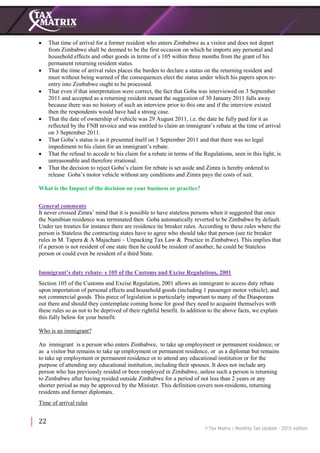
Case Name GOBA. NT (Appellant) v ZIMRA & Commissioner of Customs (Respondents)
Summary  Goba approached Zimra’s offices to make representations and claim the motor
vehicle under the immigrants’ rebate scheme. He was denied the rebate on the basis
that he was no longer a returning resident at the time of importing the vehicle.
 The case dwell on the “time of arrival” for a retuning resident for a purpose of
qualifying for a returning resident duty rebate
 Goba had been staying in Namibia with his father who was employed there and
returned to Zimbabwe first time in January 2011, before returning back to Namibia
in August 2011and returned for good to Zimbabwe in September 2011.
 Goba sought review of the decision of the Customs dismissing his claim under the
immigrant rebate on the grounds of gross irrationality in his assessment of the
evidence before him and misdirection at law in the second respondent’s application
of s 105 of the Customs and Excise (General) Regulations, SI 154 of 2001.
Jurisdiction  High Court 18 February 2015
Decision  That the decision by Zimra of rejecting Goba’s claim for immigrants’ rebate be and
is hereby set aside
 That Zimra be and is hereby ordered to release the applicant’s motor vehicle
without any conditions.
 That the ZIMRA pays the costs of suit.
What were the issues?
 Whether the Time of arrival of a returning resident is determined automatically on the first
instance the returning resident arrives in the country or when he declares his status of being a
returning resident.
 Whether Goba’s time of arrival for the purposes of s 105 of the Regulations was 30 January 2011
or 3 September 2011.
What were the facts?
 Goba N T was a Zimbabwean citizen who had been resident in Namibia since 1998 together
with his father who was employed by the Namibian government and enjoyed permission to
remain in Namibia by virtue of being part of the family.
 His father’s employment contract terminated on 31 December 2010 and when the contract
expired, the Namibian government extended the temporary residence permit for his family
Goba included, for the purposes of winding up their affairs.
 Goba finally left Namibia on 3 September 2011, but he had returned to Zimbabwe on a visit
in January 2011, until he returned to Namibia late in August 2011.
 In August 2011 he bought a car before he returned to Zimbabwe in September 2011.
 When he entered Zimbabwe he was admitted as a returning resident coming back to resume
permanent residence and his passport was endorsed as such.
 When the vehicle arrived in November 2011 Zimra detained it, demanding duty and other
charges on the basis that he was no longer a returning resident and therefore disqualified from
claiming duty rebate for returning residents.
 Zimra argued that Gobat’s “time of arrival” in terms of s 105(1) (b) of the Customs and
Excise (General) Regulations 2001 (SI 154 of 2001) was 30 January 2011.
20
What are the competing arguments?
Taxpayer
 That the respondents (Zimra and Customs) cannot, after granting him the returning resident status,
turn around and claim that he was illegally staying elsewhere so as to disqualify him of the rebate.
 That by endorsing “RR” in his passport on 3 September 2011 this denotes that the respondents
accepted him as a permanent returning resident on that date.
 That the decision by the Commissioner of Customs denying the claim for rebate was gross
irrationality.
The Commissioner Zimra and Customs
 That Goba came back as a returning resident and was accepted as such by Zimbabwe immigration
authorities and not as a visitor when he came on 30 January 2011 and hence his lengthy stay in
Zimbabwe from that date until he returned to Namibia on 22 August 2011 and was accepted as a
“visitor” in Namibia and given until 5 September 2011 to remain there.
 That if he had been a visitor in Zimbabwe, his passport would have been so endorsed and he
would have been allowed up to a maximum of 30 days but his passport did not bear such
endorsement.
 That Goba came back to Zimbabwe on 30th
of January 2011 because his residence permit in
Namibia had expired and was not “legally resident” in Namibia after that date and that his father’s
work permit expired on 30 December 2010, that became the date on which his residence permit
expired in that country
 That the fact that Goba re-entered Namibia on the 22nd
of August 2011 on a ‘visitor’ permit
underlines the fact that he was no longer a legal resident of Namibia and his time of arrival he
remains a fugitive of January 2011 which was ‘the first occasion’ he returned to Zimbabwe after
the expiry of the fathers contract of employment which was tied to the appellants resident permit.
 That after the expiry of the permanent resident permit in Namibia, Goba naturally reverted to his
Zimbabwe permanent resident status and this occurred on the 30th
of January 2011, when
immigration correctly endorsed the “RR” in his passport
 That section 105(1) (b) of the Customs and Excise (General) Regulations in SI 154 of 2001
defines ‘time of arrival’ for a returning resident as the first occasion on which he returns to
Zimbabwe after the expiry of such contract or if he has been on an extended absence for any other
reason, the first occasion on which he returns to Zimbabwe.
What was the legislation or Judicial precedents considered
Legislation Considered
Customs and Excise (General) Regulations, 2001 (the Regulations)
Cases considered
Affretair (Pvt) Ltd v M K Airlines (Pvt) Ltd 1996 (2) ZLR 15
Council of Civil Service Unions (CCSU) & Ors v Minister for the Civil Service [1984] 3 All ER 935
(HL)
Metsola v Chairman of the PSC & Anor 1989 (3) ZLR 147.
Patriotic Front-ZAPU v Minister of Justice, Legal & Parliamentary Affairs 1985 (1) ZLR 305 (SC)
R (Bhatt Murphy) v Secretary of State for the Home Department [2008] EWCA Civ 755d
What is the Court`s reasoning and decision?
 That final date of return could only be ascertained from the returning resident himself and the
immigration official should ask a returning resident whether he has come back for good or not.
21
 That if this is done the person would naturally indicates this and can then be interviewed for the
purpose of determining whether he wishes to exercise his right the rebate there or at some later
stage when his household goods arrive in the country.
 That the general expectation is that the immigration official will ask the returning resident
whether he has come back for good or not and interview the person whether he wishes to exercise
the right to the rebate there and then or at some later stage when his household goods arrive in
the country
 That even if Goba had gone back to Namibia as a visitor in August 2011, that would not detract
him from his status in Zimbabwe on 3 September 2011 when he was interviewed and accepted as
a returning resident.
 That Goba was resident in Namibia by virtue of him staying with his parents and was absent in
Zimbabwe for an extended period as contemplated by para (b) (iii) of s 105 of the Regulations.
 That his status in another jurisdiction was not relevant for the purpose of determining whether
Goba met the criteria set out in s 105 of the Regulations
 That the court cannot be asked to consider Goba`s status in Namibia in order to establish
applicable regulations in Zimbabwe and that Goba’s passport was endorsed “Acc R/R” upon his
return to Zimbabwe on 3 September 2011.
 That the rebate was meant to encourage migration back into Zimbabwe by benefitting qualifying
immigrants and that to give an interpretation that fettered or oppressed that class of people would
be to frustrate the object, purpose and intention of the legislature.
 That 30 January 2011 cannot be date of Goba’s date of return because the respondents did not
establish then whether, by his return on the date, Goba wished to be treated as harbouring intent to
settle permanently or only wished to visit and that had this been established Goba’s passport
would have carried the endorsement one way or the other.
 That the fact that Goba was not accepted as a visitor does not imply that he was accepted as a
returning resident.
 That even if there was an endorsement the phrase “the first occasion on which he returns to
Zimbabwe” meant that when a Zimbabwean citizen abroad returns to the country by reason of
say a vacation, holiday bereavement etc i.e. once he sets foot into the country and this would
imply forfeiture of his returning resident`s rebate, which cannot be said to be the intended object
of the Regulations (underlined words represent our own emphasis).
 That the right to benefit from the provisions of the Regulations has created a substantive
legitimate expectation for permanent returning residents to enjoy the associated benefits which
flow from the Regulations.
 That a denial of a legitimate expectation in a given case amounts to denial of a right guaranteed
and that this is discriminatory, unfair or biased, gross abuse of power or violation of principles of
natural justice.
 That it is irrational, and therefore unreasonable, irregular and unfair to deprive Goba a right which
accrued to him as a returning resident under the circumstances and that authorities administering
the regulations must do so rationally, fairly, non-arbitrarily and in an unbiased manner.
 That in R (Bhatt Murphy) v Secretary of State for the Home Department [2008] EWCA Civ 755
LORD JUSTICE LAWS expressed how, arising from the doctrine of legitimate expectation, an
abuse of power may be established:-
“… The power of public authorities to change policy is constrained by the legal duty to be fair (and
other constraints which the law imposes). A change of policy which would otherwise be legally
unexceptionable may be held unfair by reason of prior action, or inaction, by the authority. If it has
distinctly promised to consult those affected or potentially affected, then ordinarily it must consult (the
paradigm case of procedural expectation). If it has distinctly promised to preserve existing policy for a
specific person or group who would be substantially affected by the change, then ordinarily it must
keep its promise (substantive expectation). If, without any promise, it has established a policy distinctly
and substantially affecting a specific person or group who in the circumstances was in reason entitled
to rely on its continuance and did so, then ordinarily it must consult before effecting any change (the
secondary case of procedural expectation). To do otherwise, in any of these instances, would be to act
so unfairly as to perpetrate an abuse of power.”
22
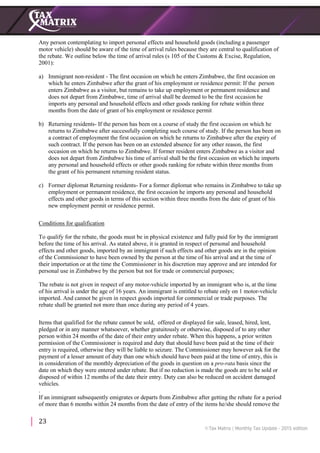
 That time of arrival for a former resident who enters Zimbabwe as a visitor and does not depart
from Zimbabwe shall be deemed to be the first occasion on which he imports any personal and
household effects and other goods in terms of s 105 within three months from the grant of his
permanent returning resident status.
 That the time of arrival rules places the burden to declare a status on the returning resident and
must without being warned of the consequences elect the status under which his papers upon re-
entry into Zimbabwe ought to be processed.
 That even if that interpretation were correct, the fact that Goba was interviewed on 3 September
2011 and accepted as a returning resident meant the suggestion of 30 January 2011 falls away
because there was no history of such an interview prior to this one and if the interview existed
then the respondents would have had a strong case.
 That the date of ownership of vehicle was 29 August 2011, i.e. the date he fully paid for it as
reflected by the FNB invoice and was entitled to claim an immigrant’s rebate at the time of arrival
on 3 September 2011.
 That Goba’s status is as it presented itself on 3 September 2011 and that there was no legal
impediment to his claim for an immigrant’s rebate.
 That the refusal to accede to his claim for a rebate in terms of the Regulations, seen in this light, is
unreasonable and therefore irrational.
 That the decision to reject Goba’s claim for rebate is set aside and Zimra is hereby ordered to
release Goba’s motor vehicle without any conditions and Zimra pays the costs of suit.
What is the Impact of the decision on your business or practice?
General comments
It never crossed Zimra’ mind that it is possible to have stateless persons when it suggested that once
the Namibian residence was terminated then Goba automatically reverted to be Zimbabwe by default.
Under tax treaties for instance there are residence tie breaker rules. According to these rules where the
person is Stateless the contracting states have to agree who should take that person (see tie breaker
rules in M. Tapera & A Majachani – Unpacking Tax Law & Practice in Zimbabwe). This implies that
if a person is not resident of one state then he could be resident of another, he could be Stateless
person or could even be resident of a third State.
Immigrant’s duty rebate- s 105 of the Customs and Excise Regulations, 2001
Section 105 of the Customs and Excise Regulation, 2001 allows an immigrant to access duty rebate
upon importation of personal effects and household goods (including 1 passenger motor vehicle), and
not commercial goods. This piece of legislation is particularly important to many of the Diasporans
out there and should they contemplate coming home for good they need to acquaint themselves with
these rules so as not to be deprived of their rightful benefit. In addition to the above facts, we explain
this fully below for your benefit:
Who is an immigrant?
An immigrant is a person who enters Zimbabwe, to take up employment or permanent residence; or
as a visitor but remains to take up employment or permanent residence, or as a diplomat but remains
to take up employment or permanent residence or to attend any educational institution or for the
purpose of attending any educational institution, including their spouses. It does not include any
person who has previously resided or been employed in Zimbabwe, unless such a person is returning
to Zimbabwe after having resided outside Zimbabwe for a period of not less than 2 years or any
shorter period as may be approved by the Minister. This definition covers non-residents, returning
residents and former diplomats.
Time of arrival rules
23
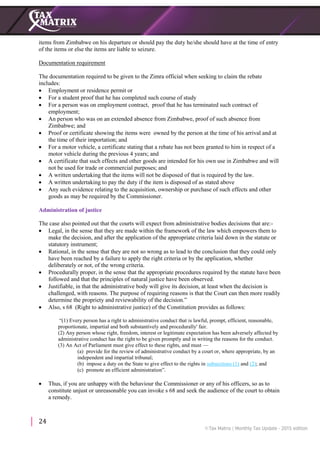
Any person contemplating to import personal effects and household goods (including a passenger
motor vehicle) should be aware of the time of arrival rules because they are central to qualification of
the rebate. We outline below the time of arrival rules (s 105 of the Customs & Excise, Regulation,
2001):
a) Immigrant non-resident - The first occasion on which he enters Zimbabwe, the first occasion on
which he enters Zimbabwe after the grant of his employment or residence permit: If the person
enters Zimbabwe as a visitor, but remains to take up employment or permanent residence and
does not depart from Zimbabwe, time of arrival shall be deemed to be the first occasion he
imports any personal and household effects and other goods ranking for rebate within three
months from the date of grant of his employment or residence permit
b) Returning residents- If the person has been on a course of study the first occasion on which he
returns to Zimbabwe after successfully completing such course of study. If the person has been on
a contract of employment the first occasion on which he returns to Zimbabwe after the expiry of
such contract. If the person has been on an extended absence for any other reason, the first
occasion on which he returns to Zimbabwe. If former resident enters Zimbabwe as a visitor and
does not depart from Zimbabwe his time of arrival shall be the first occasion on which he imports
any personal and household effects or other goods ranking for rebate within three months from
the grant of his permanent returning resident status.
c) Former diplomat Returning residents- For a former diplomat who remains in Zimbabwe to take up
employment or permanent residence, the first occasion he imports any personal and household
effects and other goods in terms of this section within three months from the date of grant of his
new employment permit or residence permit.
Conditions for qualification
To qualify for the rebate, the goods must be in physical existence and fully paid for by the immigrant
before the time of his arrival. As stated above, it is granted in respect of personal and household
effects and other goods, imported by an immigrant if such effects and other goods are in the opinion
of the Commissioner to have been owned by the person at the time of his arrival and at the time of
their importation or at the time the Commissioner in his discretion may approve and are intended for
personal use in Zimbabwe by the person but not for trade or commercial purposes;
The rebate is not given in respect of any motor-vehicle imported by an immigrant who is, at the time
of his arrival is under the age of 16 years. An immigrant is entitled to rebate only on 1 motor-vehicle
imported. And cannot be given in respect goods imported for commercial or trade purposes. The
rebate shall be granted not more than once during any period of 4 years.
Items that qualified for the rebate cannot be sold, offered or displayed for sale, leased, hired, lent,
pledged or in any manner whatsoever, whether gratuitously or otherwise, disposed of to any other
person within 24 months of the date of their entry under rebate. When this happens, a prior written
permission of the Commissioner is required and duty that should have been paid at the time of their
entry is required, otherwise they will be liable to seizure. The Commissioner may however ask for the
payment of a lesser amount of duty than one which should have been paid at the time of entry, this is
in consideration of the monthly depreciation of the goods in question on a pro-rata basis since the
date on which they were entered under rebate. But if no reduction is made the goods are to be sold or
disposed of within 12 months of the date their entry. Duty can also be reduced on accident damaged
vehicles.
.
If an immigrant subsequently emigrates or departs from Zimbabwe after getting the rebate for a period
of more than 6 months within 24 months from the date of entry of the items he/she should remove the
24
items from Zimbabwe on his departure or should pay the duty he/she should have at the time of entry
of the items or else the items are liable to seizure.
Documentation requirement
The documentation required to be given to the Zimra official when seeking to claim the rebate
includes:
 Employment or residence permit or
 For a student proof that he has completed such course of study
 For a person was on employment contract, proof that he has terminated such contract of
employment;
 An person who was on an extended absence from Zimbabwe, proof of such absence from
Zimbabwe; and
 Proof or certificate showing the items were owned by the person at the time of his arrival and at
the time of their importation; and
 For a motor vehicle, a certificate stating that a rebate has not been granted to him in respect of a
motor vehicle during the previous 4 years; and
 A certificate that such effects and other goods are intended for his own use in Zimbabwe and will
not be used for trade or commercial purposes; and
 A written undertaking that the items will not be disposed of that is required by the law.
 A written undertaking to pay the duty if the item is disposed of as stated above
 Any such evidence relating to the acquisition, ownership or purchase of such effects and other
goods as may be required by the Commissioner.
Administration of justice
The case also pointed out that the courts will expect from administrative bodies decisions that are:-
 Legal, in the sense that they are made within the framework of the law which empowers them to
make the decision, and after the application of the appropriate criteria laid down in the statute or
statutory instrument;
 Rational, in the sense that they are not so wrong as to lead to the conclusion that they could only
have been reached by a failure to apply the right criteria or by the application, whether
deliberately or not, of the wrong criteria.
 Procedurally proper, in the sense that the appropriate procedures required by the statute have been
followed and that the principles of natural justice have been observed.
 Justifiable, in that the administrative body will give its decision, at least when the decision is
challenged, with reasons. The purpose of requiring reasons is that the Court can then more readily
determine the propriety and reviewability of the decision.”
 Also, s 68 (Right to administrative justice) of the Constitution provides as follows:
“(1) Every person has a right to administrative conduct that is lawful, prompt, efficient, reasonable,
proportionate, impartial and both substantively and procedurally' fair.
(2) Any person whose right, freedom, interest or legitimate expectation has been adversely affected by
administrative conduct has the right to be given promptly and in writing the reasons for the conduct.
(3) An Act of Parliament must give effect to these rights, and must —
(a) provide for the review of administrative conduct by a court or, where appropriate, by an
independent and impartial tribunal;
(b) impose a duty on the State to give effect to the rights in subsections (1) and (2); and
(c) promote an efficient administration”.
 Thus, if you are unhappy with the behaviour the Commissioner or any of his officers, so as to
constitute unjust or unreasonable you can invoke s 68 and seek the audience of the court to obtain
a remedy.
25
3.2 Appeal
3.2.1 Can Chicken Slice strip Zimra’s powers -Garnish order and pay now argue
later rule being challenged in the ConCourt by Chicken Slice?
Packers International (Private) Limited owners of Chicken Slice, Pizza Slice and Creamy Slice has
filed an application to the Constitutional Court (ConCourt) after it was compelled to settle a contested
hefty $24 million debt in tax arrears by the Zimbabwe Revenue Authority (Zimra).
The company is challenging the constitutional status of s 48 Value Added Tax Act which allows
Zimra to unilaterally access banks accounts of clients or intercept monies of clients from debtors to
recover VAT debts. A similar provision in the Income Tax Act is s 58. Packers is arguing that Zimra
should approach the courts first to get a garnishee order before raiding tax defaulter’s bank
accounts. It alleges that s 48 denies the firms right to equality before the law and equal protection of
the law as enshrined under s 56 (1) of the Constitution of Zimbabwe, an advantage that is not
available to businesses. Further, Zimra has the right and power to access one’s bank account and take
money ‘owed to it’, while such a right does not extend to taxpayers when dealing with their creditors,
stating that applicant and respondents are not equal before the law .
Section 48 of the VAT Act reads as follows:
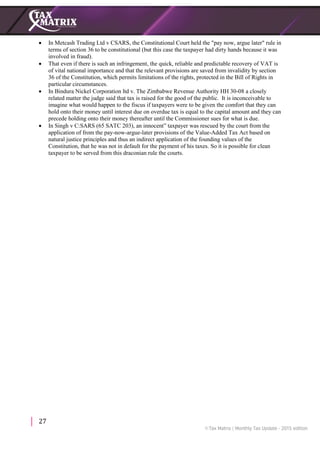
(1) For the purpose of subsection (2) a person” includes a bank, building society or savings bank; and
a partnership; and any officer in the Public Service or any prescribed person in relation to a prescribed
service.
(2) The Commissioner may, if he thinks it necessary, declare any person to be the agent of any other
person, and the person so declared an agent shall be the agent of such other person for the purposes of
this Act, and, notwithstanding anything to the contrary contained in any other law, may be required to
pay any amount of tax, additional tax, penalty, or interest due from any moneys in any current account,
deposit account, fixed deposit account or savings account or any other moneys—
(a) including pensions, salary, wages or any other remuneration, which may be held by him for, or due
by him to, the person whose agent he has been declared to be; or
(b) That the person so declared an agent receives as an intermediary from the other person.
Packers International is also challenging the constitutionality of the “pay now, argue later” rule (s 36
of the VAT Act). The section forces taxpayers to pay tax pending a challenge of the figures owing in
a court of law. Packers want sections 36 and 48 removed from the statute books, claiming that they
violate the constitution i.e. they violate the right to administrative justice.
Section 36 of the VAT Act Payment of tax pending appeal reads as follows:
“The obligation to pay and the right to receive and recover any tax, additional tax, penalty or interest chargeable
under this Act shall not, unless the Commissioner so directs, be suspended by any appeal or pending the
decision of a court of law, but if any assessment is altered on appeal or in conformity with any such decision or
a decision by the Commissioner to concede the appeal to the Fiscal Appeal Court or such court of law, a due
adjustment shall be made, amounts paid in excess being refunded with interest at the prescribed rate (but subject
to section forty-six) and calculated from the date proved to the satisfaction of the Commissioner to be the date
on which such excess was received, and amounts short-paid being recoverable with penalty and interest
calculated as provided in subsection (1) of section thirty-nine”.
Packers lodged the appeal following its objection to Zimra was rejected. While lodging an appeal with
the Fiscal Appeal Court, Zimra placed a garnish order on its bank account held by FBC.
In 2014, Packers International won a High Court case that ordered Zimra to remove a garnish order
that they had imposed on the former’s bank accounts, to wait 7 days to impose a new order and to
26
desist from “unlawfully interfere with applicant’s business operations and its day to day activities,
including the placing of its officers or agents at applicant’s business premises.”
What is the impact to your business or practice?
If Packers succeeded in its appeal this will be a landmark win to be celebrated not only in Zimbabwe,
but in a number of jurisdictions because of similarity in the legislation in many jurisdictions. Whether
s 48 should be scraped to allow equality at law between Zimra and other citizens, it’s a matter to be
decided by the courts but Tax Matrix is legally incapable of giving a correct comment. Equally
applying is the scrapping of s 36. It is prima facie that these sections violate a taxpayer’s right of
access to courts and the right not to be arbitrarily deprived of one’s property. We outline below
previous precedents home and aboard regarding on the two matters and odds seems to be against
taxpayers:
Section 48 of the VAT
 Section 71 of the Constitution states that no person may be compulsorily deprived of their
property except when the deprivation is in terms of a law of general application, or is
necessary in the interests of defence, public safety, public order, public morality, public health or
town and country planning or in order to develop or use that or any other property for a purpose
beneficial to the community. There is no doubt tax deprives a person of his property, but it is
permitted by the same Constitution but the person whose property is being acquired is however
entitled to notice. Also, the rule of natural justice must be considered and prior notice should be
given to the taxpayer (decision of the court in Ferucci and Others v C: SARS and Another).
 See the case of Mpande Foodliner CC v C: SARS and Others (63 SATC 46), where the court
stressed on the requirement for notice. It held generally that the denial of the audi alteram partem
rule before issuing the agency notices, infringed the right to just administrative action (but the
taxpayer was in good standing and had properly laid out his grounds, also the decision was
referred to the “lone voice” in the case Smartphone SP (Pty) Ltd v Absa Bank Ltd and Another (66
SATC 241))
 True, Zimra is the only entity with power to dispense judgment on his own behalf and this is on
the basis of statutory authority
 Held in Hindry v Nedcor Bank Ltd and Another, appointment of agent is constitutional. It does
not violate the right of the taxpayer not to be arbitrarily deprived of his property and that the
provision was extrajudicial and summary in nature. On requirement for notification before a
garnish order can be effected- the court held that there was no need for a prior hearing as the
taxpayer knew from the correspondence that SARS wanted the money repaid
 Held in Contract Support Services (Pty) Ltd And Others v C:SARS and Others (61 SATC 338),
“not all administrative acts require the application of the audi alteram partem rule before they are
effective, especially where a prior hearing would defeat the very purpose of the notice or render
the proposed act nugatory”. This was in reference to requirement of prior before garnish order can
be effected
 The court justified the government’s power to create liability on the basis of “the need of the
government promptly to secure its revenues (Canadian Tax Journal /Revue Fiscale Canadienne
(2002) vol. 50, no 5.”)
 The case of The Queen v. Lambert, [1974] 1 FC 693, at 705 (TD) (reported in Canadian Tax
Journal) held that that no notice or registration of garnish order is required before it can be
effected (see also Sorenson v. MNR, 82 DTC 6246 (FCA))
Section 36 of the VAT
 True also that s36 is meant to disarm and discourage taxpayers from appealing. It is a draconian
provision and does not afford taxpayers the opportunity to challenge the assessment in a court
before making the tax payment to Zimra.
27
 In Metcash Trading Ltd v CSARS, the Constitutional Court held the "pay now, argue later" rule in
terms of section 36 to be constitutional (but this case the taxpayer had dirty hands because it was
involved in fraud).
 That even if there is such an infringement, the quick, reliable and predictable recovery of VAT is
of vital national importance and that the relevant provisions are saved from invalidity by section
36 of the Constitution, which permits limitations of the rights, protected in the Bill of Rights in
particular circumstances.
 In Bindura Nickel Corporation ltd v. The Zimbabwe Revenue Authority HH 30-08 a closely
related matter the judge said that tax is raised for the good of the public. It is inconceivable to
imagine what would happen to the fiscus if taxpayers were to be given the comfort that they can
hold onto their money until interest due on overdue tax is equal to the capital amount and they can
precede holding onto their money thereafter until the Commissioner sues for what is due.
 In Singh v C:SARS (65 SATC 203), an innocent” taxpayer was rescued by the court from the
application of from the pay-now-argue-later provisions of the Value-Added Tax Act based on
natural justice principles and thus an indirect application of the founding values of the
Constitution, that he was not in default for the payment of his taxes. So it is possible for clean
taxpayer to be served from this draconian rule the courts.
28
4. Interpretations & Announcements
4.1 Tax Matrix Analysis of existing or new law
4.1.1 Are your independent contractors real independent contractors?
Independent contractors enjoy fiscal advantages compared to employees. They can deduct expenses
incurred in earning their income and at the rate of tax applicable on their income is less onerous
compared to that on employees. For an employer this means there is a cost saving in using independent
contractors. However, matters of concern are that it is difficult to justify an independent contractor
arrangement. Justification should be in terms of the Income Tax Act, Labour Act and Common law (the
courts) and we discuss this below:
The Applicable law
The Income Tax Act
The 13th schedule of the Act provides that an employer–employee relationship is one which is comprised
of three elements i.e. there should be an employer who pays remuneration to an employee. An employee
is an individual to whom remuneration is paid or payable at an annual rate of US$3,600 (Para 1 of the
13th
Schedule to the Act).
Whereas “remuneration” is defined as any amount of income which is paid or payable to any person by
way of any salary, leave pay, allowance, wage, overtime pay, bonus, gratuity, commission , fee,
emolument, pension, superannuation allowance, retiring allowance, stipend, etc., whether in cash or
otherwise and whether or not in respect of services rendered. It does not include amounts paid or
payable to a person who is conducts any trade independent of the person by whom such amount is paid
or payable.
The Act is however inconclusive, but provides guidance for consideration on whether an individual is
carrying on a trade on a continuous basis for purposes of being classified as an independent contractor.
A trade is defined in s 2 of the Income Tax Act as including:
“any profession, trade, business, activity, calling, occupation or venture, including the letting of any property,
carried on, engaged in or followed for the purposes of producing income ….. or anything done for the purpose
of producing such income”
Labour Act
Section 2 of the Labour Act (Chapter 28:01), defines an ‘employee’ as:
“Any person who performs work or services for another person for remuneration or reward on such terms
and conditions as agreed upon by the parties or as provided for in this Act (words underlined own
emphasis), and includes a person performing work or services for another person—
(a) in circumstances where, even if the person performing the work or services supplies his own
tools or works under flexible conditions of service, the hirer provides the substantial investment
in or assumes the substantial risk of the undertaking; or
(b) In any other circumstances that more closely resemble the relationship between an employee
and employer than that between an independent contractor and hirer of services”
The control element and the resemblance of the arrangement elements play a crucial role in determining
whether or not an arrangement is that of employee. If you contemplate to putting away an employee-
employer relationships and to replace it with that of independent contractor consider whether there are no
29
similar arrangements within the market termed employer-employee arrangement i.e. the general practice
for such type of arrangement. Also, your ability to exert control on the other party so as to be virtually
called the master implies the relationship is that of an employer-employer.
The common law – position of the courts
The courts often apply the following criteria as tie breaker rules:
The supervision and control test
This test rests on the assumption that an ‘employee’ is one subject to the command and control of the
employer as to the manner in which the work is done. The employer would prescribe not only what
should be done and how it should be done but also when and where it should be done. However, when
used on its own, it cannot adequately assist in areas where the work done by certain persons such as
doctors, scientists, and pilots cannot normally be controlled. Nevertheless the greater the degree of
supervision and control to be exercised by the payer over the payee the stronger the probability will be
that it is a contract between a master and his servant.
The Organisation test
The test is based on the inquiry of whether the person is part and parcel of the organization, that is, the
extent to which the person (worker) is integrated (made a part) into the company of the employer. The
test is often considered vague for certainty. However, when an independent contractor parades the
company’s (contractee) brand and unhappy clients can contact the contractee directly, that independent
contractor is an employee.
The Financial risk
According to this test, the courts will look at the financial dependence of the person and risk associated
with that person’s venture. The person faces financial risk, opportunity to profit or possibility of loss and
responsibility for costs. Also, if a person sold all his/her time to his payer he financial depends on that
payer and is an employee.
The multiple or dominant impression test
The multiple or dominant impression test is based on balance of probabilities. It looks at the points for
and against a person being treated as an employee. If the various indications point to an employee status
the person will be deemed to be an employee. The factors that are considered under the dominant
impression test are, inter alia:
• The right to supervision and control
• How dependent the person is on employer in the performance of duties
• Whether the person can perform work for other people at will
• Whether the person is obliged to perform his or her duties personally
• Whether the worker provides his own tools or equipment
• Whether the employer has the right to discipline the person.
When all the above factors are considered together they create a dominant impression which shows that a
person is a worker or not (Smit v Workmen’s Compensation Commissioner 1979 (1) SA 51 (A)).
Although the courts have submitted the dominant impression is centred on supervision and control
indicium, in the case of Smit, supra held that:
“The fact remains that the presence of such right of supervision and control is not the sole
indicium’s but merely one of the indicia, albeit an important one, and there may also be other
important indicia to be considered depending upon the provisions of the contract in question as a
whole”
30
Conclusion: - employee vs contractor
The various factors stated above point to the direction that one has to justify beyond reasonable doubt
that an arrangement is not an employee-employer relationship. The Income Tax Act places the burden of
proof on the taxpayer in terms of section 63 of the Income Act on matters like these.
Consequences of misclassification
The classification as either employee or independent has tax consequences. Zimra could deem this as a
scheme of tax avoidance and seek to charge 100% penalty and interest on the under paid taxes.
Structuring the arrangement
An arrangement can be improved by carefully structuring, (note that this not a guaranteed it will not be
attached by Zimra) - the following some of the tips.
 Engage only independent contractors who are Zimra registered, if not ensure they have registered for
taxes with Zimra. Also, have file copies of all relevant documentation, such as its business license,
certificate of incorporation, professional indemnity insurance certificate, tax clearance (ITF263) or
other evidence of compliance with tax and reporting regulations of these contractors.
 The contract drafting should avoid terms that signify there is control and supervision over the
contractors. Avoid words of employment, such as “supervise” and “report to,” to discipline, to
delegate and avoid providing any “employee benefits” to the independent contractor, including such
seemingly innocuous perks as an invitation to staff-only events.
 Always ask the independent contractor to submit invoices for payment. It should also be borne in
mind that certain amounts are specifically inapplicable to non-employees, for instance leave pay, sick
pay; also share options affect employees (including directors) and not independent contractors.
 The contractor should have a separate invoicing arrangement i.e. contractor should invoice directly to
the client not for clients to receive invoices in the name of the company (the contractee).
 The contractor should be hired based on work to be done and remuneration should be linked to that
work and also avoid contracts which are open ended with regard to duration.
 The data base of clients serviced by the contractor should be held by the contractor- not by you
 Ensure the arrangement is practised by other businesses in the same industry although this alone does
not legalise the arrangement for tax purposes- your compatriots could also be breaking the law.
31
4.2 Announcements
4.2.1 Zimbabwe- China Sign Double Taxation Agreement
A Chinese delegation from the State Administration of Tax led by Commissioner General Mr. Li Jun
was in the country recently to finalise the double taxation agreement between Zimbabwe and China.
It is hoped that the initialisation of the double taxation agreement would enhance business between
Zimbabwe and China and with the Look East Policy, there is expected improved trade and co-
operation between Zimbabwe and China as a result of the signing of this agreement.
Tax Matrix has no news yet on the renewed Zimbabwe- South Africa DTA – this awaited the
Presidential assent before made into law. The Zimbabwe-China will also follow the same route.
4.2.2 Zimra ushers in new electronic tax devices- invoice management system
Zimra introduced a new tax management system that captures real time financial and statistical data
from traders to advise Government accordingly on policies relating to tax issues. This is part of the e-
government initiatives being implemented under the auspices of the Office of the President and
Cabinet. The system allows ZIMRA to detect in real time, firms that under-declare their business
transactions to either evade or pay less tax and advise Government on policies relating to tax issues
and to take appropriate measures to deal with the malpractice. It is hoped the system will eliminate
fiscal fraud by ensuring timely transfer of fiscal data to the tax authorities. The system covers all tax
heads and all kinds of trade statistics. The system is linked with the Zimra server and Zimra are able
to detect any cheating or devices that would have been switched off the device automatically.
Zimra implemented a dry run of the system during the recent International Conference on Aids and
STIs in Africa where all authorised taxis were mounted with new tax management devices. The
system is to be implemented across all and diverse businesses, including informal traders. It is hoped
the new system will reduce tax evasion through tracking of the economic activities and improve
revenue inflows to the fiscus.

December 2015 MTU

  • 1.
    December 2015 Edition ThisMonthly Tax Update (MTU) summarises the changes and announcements in the most recent months in the following areas:  Legislation  Court Case decisions  Authority Announcements
  • 2.
    1 Table of Contents 1.About us 2 1.1 Introduction 2 1.2 Disclaimer clause 3 1.3 Tax Matrix news and developments 4 1.3.1 Law Society & Tax Matrix hosted Minister of Finance 4 1.3.2 Tax Matrix introduces internship programme 5 1.3.3 Seminar on 2016 Tax Changes and Book Launch 6 1.3.4 Tax Matrix 2016 Module based Courses calendar 6 2. Legislation 7 2.1 Acts 7 2.1.1 Finance Act 7 2.1.2 Appropriation Act 11 2.2 Statutory instruments 12 2.2.1 Statutory Instrument 130, 131 & 135 of 2015 12 2.2.2 Measures to curb unnecessary imports- SI 132 of 2015 12 2.3 Bill Watch 14 2.3.1 Special Economic Zones Bill – The EPZ Act with a new heading 14 3. Court cases & Appeals 15 3.1 Court cases 15 3.1.1 Care International- An employee causes a loss to the entity but loss also aggravated by the entity’s fault 15 3.1.2 Goba T – ruling on returning resident duty rebate on motor vehicle case 19 3.2 Appeals 25 3.2.1 Can Chicken Slice strip Zimra’s powers -Garnish order and pay now argue later rules being challenged in the ConCourt? 25 4. Interpretations & Announcements 28 4.1Tax Matrix Analysis of existing or new law 28 4.1.1 Are your independent contractors real independent contractors? 28 4.2 Announcements 31 4.2.1 Zimbabwe- China Sign Double Taxation Agreement 31 4.2.2 Zimra ushers in new electronic tax devices 31
  • 3.
    2 1. About us 1.1Introduction Tax Matrix (Pvt) Ltd has the honour to publish its December 2015 Monthly Tax Update (MTU). The MTU complements our tax training programmes and newsletters. It disseminates information about tax developments happening locally and internationally. In the MTU, Tax Matrix (Pvt) Ltd analyses the tax developments to ensure that you, as our most valued client, are kept abreast of changes in the tax world. In this issue we provide update on the Finance Act no. 2 of 2015 gazzetted on the 31st of December 2015 as well as various statutory instruments and Bills published in November and December 2015. Just so you know what is happening in the courts, we have also analysed two recent tax cases and a recent appeal in the Constitutional court. The purpose of this is to ensure you are made aware of court outcomes which can have an impact on your business or practice. Tax Matrix (Pvt) Ltd also identifies and examines all relevant publications and ZIMRA’s interpretation of these decisions as well as the institutional application of new legislation or rulings. The updates are accompanied by an insightful commentary pointing out the key takeaway points from the material. Aside to what our regular Newsletters provide, MTUs are meant to help you:  Identify new tax planning opportunities.  Keep you updated with all changes in the tax world.  Keep you aware of current ZIMRA interpretations.  Recognise pitfalls many professionals miss.  Minimise compliance errors and offer practical and effective tax solutions. It is our sincere hope that this MTU will bring value to the business community, Zimra and the academia and should stand out as a useful tool in shaping the Zimbabwean tax system.
  • 4.
    3 1.2 Disclaimer The informationcontained in this MTU is for general guidance only and is not intended as a substitute for specific advice in considering the tax effects of particular transactions. Whilst a lot of care has been taken in the compilation of the information and opinions contained in this publication, no liability is accepted for the consequences of any inaccuracies contained in this guide. The information does not constitutes at legal advice nor can it be relied on in any dispute with the tax authorities and shall not constitute any legal or tax opinion in this or any jurisdiction. The analysis contained in this MTU is based on the current legal framework which is subject to change and the company assumes no obligation to update or otherwise revise the materials contained in this or any of its MTUs. In making their considerations, recipients or people with access to the MTU are advised to make their own independent assessments, and, in this regard, to consult the company or their own professional advisors before taking any action. The information and opinions contained in this MTU is valid as at the date of uploading on the website, preparation or compilation, any of its contents may be subject to change without notice. The information contained and opinions contained in this MTU are for the purpose of general information (“the purpose”) and for no other purpose. The company disclaims any responsibility for the use of the information contained herein for a different purpose or context. The information contained and opinions contained herein must not be copied, published, reproduced or distributed in whole or in part to others at any time by the recipients. Tax Matrix (Pvt) Ltd retains all intellectual copyright information contained and opinions contained in this MTU. Recipients should seek the written permission of the company before distributing copies of information and opinions contained in the MTU to third parties.
  • 5.
    4 1.3 Tax Matrixnews and developments 1.4.1 Law Society & Tax Matrix hosted Minister of Finance On 2 December 2015 Tax Matrix and Law Society of Zimbabwe co-hosted a post budget breakfast briefing to law society members at Pandhari Lodge, Harare. The occasion was graced by The Honourable Minister of Finance and Economic Development, Mr Patrick Chinamasa. 1.4.1.1 The Honourable Minister’s speech In his keynote speech the Minister covered the following aspects: Re-engagement of international creditors  The Dec 2014 and June 2015 IMF staff monitored assessments were successful and the 3rd and last one is in December 2015 whose report would be out in February 2016.  If this last assessment is successful and planned $1.8b debt clearance goes through by mid-2016, new money is expected in the form of cheaper lines of credit for the private sector.  USA also supports the debt clearance and re-engagement programme Property rights  Tradable 99 year leases  EU agreed to fund remapping of boundaries  Good first and important steps for land property rights. Indigenization  The policy is still under discussion  51/49% recommended for the mining sector with government paying nothing because the resources belongs to Zimbabweans.  Outside the resources sector 51/49 model does not apply and the issue is under consideration  It’s not an overnight resolution  Other African countries are still sitting on the land time bomb  Banking sector already given permission for 100% foreign ownership Transfer pricing  Government working on the fiscal policy for the mining sector so as to increase government revenue and harnessing transfer pricing with this sector 1.4.1.2 Tax Matrix speech Besides the budget presentation, Tax Matrix spoke on the amended transfer pricing legislation regarding its effect on international companies as well as local group companies and other taxpayers engaged in non-arm’s length transactions. The transfer pricing legislation which now follows the international best practice through the adoption of OECD transfer pricing guidelines requires companies and individuals involved in associate transactions to draft transfer pricing policies and keep contemporaneous records to support their transfer prices. Tax Matrix also called upon the Honourable Minister to come up with tax practice (interpretation) notes to create certainty and equity in the application of the tax law, as opposed to current adhoc clarifications on certain matters by the Zimbabwe Revenue Authority which is subject to the Commissioner General’s discretion.
  • 6.
    5 1.4.2 Tax Matrixintroduces internship programme Tax Matrix is currently recruiting interns for its “Giving theory a meaning” internship programme offered to A level graduates seeking to pursue professional courses such as ACCA (Association of Chartered Certified Accountants) , ICAZ (Institute of Chartered Accountants of Zimbabwe) , CIMA (Chartered Institute of Management Accountants), ICSAZ (Institute of Chartered Secretaries and Administrators). In order to perform effectively as qualified accountants, students need to develop their skills in the workplace as well as passing the exams. At Matrix Academy we would like to play our part in ensuring that students studying towards such professional qualifications obtain relevant, supervised practical experience while studying for their respective qualifications. Employers expect students and members to show high levels of knowledge and ability in the workplace, and behave ethically. Relevant practical experience enables trainees to confirm the quality of their workplace performance. It is with this in mind that Matrix Academy has developed a “Three in One” programme to bridge the gap between the theoretical and practical aspects of their training. Our “Three in One” programme allows students to be competitive in the job market and also to be entrepreneurs. The programme has duration of 36 months and offers the following distinctive competitive features:  3 year internship contract with longer term opportunities based on performance  Structured programme of principles, practice and application of tax and consulting skills  Leading to a Matrix Academy In-house Tax Certificate  A learning experience with a practical edge  Exposure to clients and tax experts  Full Coaching support For more information kindly follow the link: http://taxmatrix.co.zw/products-services/matrix- academy/interns-learning-practice/
  • 7.
    6 1.4.3 Seminar on2016 Tax Changes and Book Launch Tax Matrix (Pvt) Ltd is pleased to invite you or any of your nominated person (s) to our tax seminar on “2016 Tax Changes and Book Launch” where our presenters will discuss the new provisions enacted through the Finance Act no.2 of 2015 which was gazetted on 31 December 2015. The discussion will be centered on the new legislation on “Transfer Pricing”. The seminar will be accompanied by the launch of our new book « Employment Tax and Related Matters ». This book is the culmination of 1 year of research focused on addressing current topics affecting employers and investors. The book written by Marvellous Tapera & Alex Majachani – The authors of Unpacking Tax Law & Practice in Zimbabwe creates synergies between employment tax issues and other legislation affecting employees and employers. Investors and business people will find the book to be very helpful and authors are confident that the book will aid them to make prudent decisions regarding employment and other related matters. Professionals will also find this book to be useful in their endeavours to provide good tax advice to their clients. The book comes on the heels of Unpacking Tax Law & Practice in Zimbabwe which has gained popularity within the market as the only book which addresses Zimbabwe tax matters from a practical point of view. We will also showcase a revised copy of the Unpacking Tax Law & Practice in Zimbabwe When? Wednesday 17th of February 2016 Time 08.30hours – 13.00hours Who should attend? Human resources, Payroll administrators, Business people, finance directors, controllers, managers, accountants, auditors, risk managers, tax advisors, lawyers and anyone with interest in tax. CPD Hours: 4 hours Venue Rainbow Towers Hotel Investment US$150 per delegate, to cover teas, lunch and a copy of Employment Tax and Related Matters book Bookings For details and bookings contact Samantha on: + 263 4 740222 / 741334 OR + 263 775911383 /0772421238T 1.4.4 Tax Matrix 2016 Module based Courses calendar Tax Matrix is pleased to inform you that with effect from the 4th of March 2016 it will be running module based courses for finance, HR, procurement staff, tax advisors and any one with interest in the subject of tax. Join our sessions every Friday (Learning Fridays) starting the 4th of March as we demystify the subject of taxation. This is a worthwhile investment. Kindly follow the link to obtain further details: http://taxmatrix.co.zw/products-services/matrix-academy/module-based-courses/
  • 8.
    7 2. Legislation 2.1 Acts 2.1.1Finance Act The Finance Bill was passed into law by the House of Assembly i.e. into Finance Act (no 2) of 2015 on 31st December 2015 with most of its proposals adopted and with few additions. The Finance Act (no 2)) of 2015 is effective 1 January 2016 unless otherwise stated its contents also take effect from that date. 2.1.1.1 Finance Act measures  Tobacco levy (s 22A of the Finance Act) - Tobacco Levy for the seller of auction and contract tobacco reduced from 1.50 cents to 0.75 cents. The proposal in the Finance Bill to reduce the buyer’s levy to the same level was not adopted- it remains at 1.50 cents. 2.1.1.2 Income Tax Act measures  Withholding tax on contracts (s 80 of the Income Tax Act) - Changes to law on withholding tax on local contracts (10% withholding tax on tenders)-A statutory body, quasi-governmental institution or registered taxpayer is empowered to recover from the supplier the withholding tax it paid to ZIMRA as a result of failing to deduct the withholding tax from the supplier who did not furnish a tax clearance. It has 24 months from the date the withholding tax was due to be paid to ZIMRA to recover the amount from the supplier (payee). The right of recovery does not however extend to penalties and interest paid by the payer to ZIMRA. This measure applies to tax payments made since 1 February 2009.  Exemption of ZAMCO (Para 1 (f) of the 3rd Schedule to the Income Tax Act)- Receipts and accruals of the wholly owned company of Reserve Bank of Zimbabwe i.e. Zimbabwe Asset Management Corporation (Private) Limited (ZAMCO) are to be exempt from income tax (new- was not in the Finance Bill)  Exemption of retrenchment package (Para 4(p) of the 3rd Schedule to the Income tax act)-The qualification for exemption of retrenchment package no longer depends on the approval by the Minister of Labour & Social Welfare- taxpayers no longer required to seek the Minister’s approval to qualify for exemption of retrenchment package (this was not in the bill or budget statement).  Exemption of pension commutation (Para 6(h1) of the 3rd Schedule to the Income Tax Act)- Pension commutation of a pension or annuity which is payable from the Consolidated Revenue Fund or a pension fund, other than a retirement annuity fund, if the pension or annuity itself would not have been subject to income tax treated as gross income. To exempt 1/3 of the commutation (up to a third of US$60,000) or US$10,000 whichever is greater of this amount. This measure is to apply to members who are retrenched before attaining the prescribed age of 55 years. The exemption only apply to the first US$60,000 granted in year of assessment (this underlined part is new- was not in the Finance Bill)  Exemption of interest on long term deposits (Para 10 (r ) of the 3rd Schedule to the Income Tax Act)- Interest on fixed deposit held for more than 12 months is exempt from Resident Tax on Interest. This should be read to together with s 22 of the Finance Act which provides a withholding tax rate of 15% on interest from a financial institution accruing to a resident and reduced rate of 5% if the deposit is earned on fixed-term deposit with tenure of at least 90 days. NB – there is referencing error in the Finance Act no 2 of 2015 on this matter which refers to para 10(r)of the 3rd Schedule to the Income Tax Act when this paragraph is already in existence.
  • 9.
    8  Transfer Pricing(s 98 B as read with 35th Schedule to the Income Tax Act)- On 1 January 2014 legislation on transfer pricing was introduced which targeted associate transactions which meant to counter base erosion and profit shifting arrangements arising from business transactions between related parties based on arm’s length principle. The legislation however lacked sufficient guidance on reporting procedures for taxpayers engaged in transactions with related parties. The Finance Act (2) of 2015 introduced transfer pricing methods “guidelines” structured along the lines of OECD as follows:  Comparable Uncontrolled Price Method - This method compares the price for property or services transferred in a controlled transaction to the price charged for property or services transferred in a comparable uncontrolled transaction in comparable circumstances.  The Resale Price Method - The method is based on the price at which a product that has been purchased from an associated enterprise is sold to an independent enterprise. The resale price is reduced by the resale price margin. What is left after subtracting the resale price margin can be regarded, after adjustment for other costs associated with the purchase of the product (e.g. custom duties), as an arm’s length price of the original transfer of property between the associated enterprises.  Cost Plus Method -The method applies the costs incurred by the supplier of property (or services) in a controlled transaction. An appropriate cost plus mark-up is then added to the direct or indirect costs, to make an appropriate profit in light of the functions performed (taking into account assets used and risks assumed) and the market conditions. What is arrived at after adding the cost plus mark up to the above costs may be regarded as an arm’s length price of the original controlled transaction.  The Transactional Net Margin Method -The method examines the net profit margin relative to an appropriate base (e.g. costs, sales, assets etc) that a taxpayer realizes from a controlled transaction.  The Transactional Profit Split Method - The transactional profit split method consisting of allocating to each associated person participating in a controlled transaction the portion of common profit (or loss) derived from such transaction that an independent person would expect to earn from engaging in a comparable uncontrolled transaction.  NB look forward to full and detailed analysis on Transfer Pricing in our January 2016 edition of MTU 2.1.1.3 Stamp duties Act measures  The underpayment of Stamp Duty by insurance companies for the period between the 1st of February 2009 to the 30th July, 2015 is condoned and thus not required to remit the shortfall to the ZIMRA. The effect of condoning is that the stamp duty on insurance policies is reduced in retrospect from US$0.05 to US$0.01 for every dollar worth of premium payable on policies of insurance, with effect from 1 February, 2009 to 30 July, 2015. However going forward the stamp duty remains at US$0.05 for every dollar worth of premium payable on policies of insurance. The rates are fixed in section 25 of the Finance Act. 2.1.1.4 VAT Act measures  Short term insurance (s 11 (a)) - VAT to be levied on commission on “the supply of short term insurance by insurance agents or brokers.
  • 10.
    9  Round robinfor VAT on unbeneficiated hides (backed to 1 January 2014)- The Finance Act no 2 of 2015 puts as effective date on export tax on unbeneficiated hides back to 1 January 2014. This date had been put through Finance Act, 2014 (no. 1 of 2014), however, the Finance Act 2 of 2014, clause 10 amended section 12 of the VAT Act to suspend the levying of unbeneficiated export tax on hides and to be re-introduced 1 January 2015. So the new provision invalidates the Finance Act no 2 of 2014 by taking the effective date back to 1 January 2014 (see SI 16 on our website for details, under publications).  Effective date for VAT on unbeneficiated platinum- The date of application of VAT on exportation of unbeneficiated platinum moved to 1 January 2017. This is moving forward the date from the initial effective date of 1 January 2015. 2.1.1.5 Revenue Authority Act measures  Offsetting of tax refunds against tax liabilities (s 34 D of the Revenue Authority Act) - administrative measure to ensure refunds due to the taxpayer are off set against any liability of that taxpayer to the Commissioner General for outstanding tax on any other tax head. This is to allow offsetting of VAT, PAYE, Income tax, etc refunds against, VAT, PAYE, Income tax, Capital gains tax liabilities, etc. Thus, the law applies on refunds due to the tax taxpayer against tax liability outstanding on:  Betting and Totalizator Control Act [Chapter 10:02]  Capital Gains Tax Act [Chapter 23:01]  Customs and Excise Act [Chapter 23:02]  Income Tax Act [Chapter 23:06]  Income Tax (Transitional Period Provisions) Act [Chapter 23:07]  Stamp Duties Act [Chapter 23:09]  Tax Reserve Certificates Act [Chapter 23:10]  Value Added Tax Act [Chapter 23:12] NB – there is referencing error in the Finance Act no 2 of 2015 on this matter which refers to s 34D of the Revenue Authority Act when this section is already in existence.
  • 11.
    10 2.1.1.6 Customs andExcise Act measures  Change of ownership of second hand vehicle (s 17D of the Customs & Excise Act)-When you dispose of your second hand vehicle (change of ownership) you are now required to pay special excise duty based on the age and engine capacity of the vehicle. The effect is that the 5% special excise duty which was based on the value of the vehicle (valuation no longer required) is no longer applicable. Below is the table showing the duty to be paid based on the age and engine capacity of the vehicle: Number of Years Engine Capacity Proposed Excise Duty Rate (US$) 0-4 1000 cc $300 1001-1500 cc $400 1501 – 2000 cc $500 2001 – 2500 cc $600 2501 – 3000 cc $600 3001 – 3500 cc $600 Above 3501 cc $600 5-10 1000 cc $150 1001-1500 cc $200 1501 – 2000 cc $250 2001 – 2500 cc $300 2501 – 3000 cc $400 3001 – 3500 cc $400 Above 3501 cc $400 11-15 1000 cc $75 1001-1500 cc $100 1501 – 2000 cc $150 2001 – 2500 cc $200 2501 – 3000 cc $200 3001 – 3500 cc $200 Above 3501 cc $200 16-20 1000 cc $50 1001-1500 cc $75 1501 – 2000 cc $100 2001 – 2500 cc $150 2501 – 3000 cc $150 3001 – 3500 cc $150 Above 3501 cc $150 Above 20 All Engine Capacity $50 2.1.1.7 Other measures  Royalty rate on incremental gold reduced (s 37 of the Finance Act as read with s 245 of the Mines and Minerals Act) - Royalty rate on gold reduced to a rate of 3% on incremental output using the previous year’s production as a base year. The incremental output to be determined at the end of the financial year. Mining houses that qualify will benefit from the scheme through a tax credit which will be used to pay future tax obligations. Note that the reduced rate is applicable only on the incremental output otherwise the rate of 5% would apply in other cases. The concession is not available to small-scale gold miners. This measure is backed to 1 October 2014.
  • 12.
    11  Exemption frompaying royalties on minerals extracted for experiments(s 249 of the Mines and Minerals Act) - A miner who extracts or treats ore from his location for experimental or similar purpose is exempt from paying royalties on such ore or mineral so applied for this purposes, subject to an approval from the Secretary of Mines.  Exemption from paying royalties on diamonds or precious stones (s 249 of the Mines and Minerals Act)- The Minister of Mines in consultation with minister of Finance shall waive the payment of royalty, export tax and all fees and MMCZ commission on the export of rough diamonds or other unbeneficiated precious stones up to a limit of 10000 carats of rough diamonds or precious stoner per month to a miner who enters into an agreement with Minister of Mines to train or fund the training of Zimbabwean citizens ( locally or abroad) on the diamond or precious stones cutting, polishing, grading, valuation and beneficiation and has or is to establish any or a combination of the following:  A significant local jewellery fabrication plant  One or more local jewellery retail outlets, or  A laboratory for the certification of cut and polished diamonds or precious stones in Zimbabwe The miner should satisfy the Minister of Mines that he has resources to implement the above activities. 2.1.2 Appropriation Act The Honourable Minister of Finance and Economic Development, Mr Patrick Chinamasa announced the 2016 annual budget on the 26th of November 2015 and subsequently issued an Appropriation Bill which sets out how the Minister plans to expend the public funds. The parliament then approved the bill and this gave birth to the Appropriation (2016) Act 2015. Subject to section 17 (5) of the Public Finance Management Act [Chapter 22:19], The Appropriation (2016) Act 2015 sets out the manner in which the Minister of finance intends to use the public funds in the Consolidated Revenue Fund in 2016. The Expenditure is to be funded using Funds contained in the Consolidated Revenue Fund and this fund will have sums of money not Exceeding in aggregate US$ 3 398 128 000.There are 41 votes in total. Tax Matrix has the pleasure to share with the breakdown of the Appropriation (2016) Act 2015, which shows that top 10 major votes accounts for 89% of the expenditure, whereas 31 votes are allocated 11 % of the total expenditure. Expenditure US$ % of the Total Expenditure Primary and Secondary Education 810 431 000 23.8% Home Affairs 395 372 000 11.6% Defense 358 065 000 10.5% Heath and Child Care 330 789 000 9.7% Higher and Tertiary Education, Science and Technology Development 307 645 000 9.1% Finance and Economic Development 215 269 000 6.3% Office of the President and the Cabinet 179 936 000 5.3% Public Service Labour and Social Welfare 174 235 000 5.1% Agriculture, Mechanisation and irrigation development 145 091 000 4.3% Justice Legal and Parliamentary Affairs 108 762 000 3.2% Note that if in respect of any financial year it is found that the amount appropriated by the Appropriation Act to any purpose is insufficient or that a need has arisen for expenditure for a purpose
  • 13.
    12 to which noamount has been appropriated by that Act, a supplementary estimate showing the sums required shall be laid before Parliament and a supplementary appropriation bill issued. 2.2 Statutory instruments 2.2.1 Statutory Instrument 130, 131 & 135 of 2015 The statutory instruments which were published in the government gazette of 23 November publishes Customs and Excise (Suspension) Amendment Regulations, 2015 No.135 whose effect is to add on the list of holders qualifying for the suspension of duty on goods imported for specific mine development operations: Name of mining Company Mining location numbers Specified mining Periods Scrap Crushers (Private) Limited Mining Lease number 17 7th of September ,2015 to 7th September ,2018 Goldmore Mining Investments (Private) Limited 48220-1 7th September ,2015 to 7th September ,2018 Mvelamanje Enterprises (Private) Limited 23817 9th September ,2015 9th September ,2018 Much Incorporated (Private) Limited 386 30th October ,2015 to 19th October ,2018 Mark Muzondiwa 5971 20th October ,2015 to 17th March ,2016 The suspension of duty to a holder is in terms of s 9K of the Customs and Excise Suspension Regulations, 2003. The suspension of duty applies to the specified goods which, during the specified period, are imported by that holder for use solely and exclusively for mining development operations, provided that the holder  Applies in writing for the suspension to the Commissioner-General; and  Submits with such application information and documents referred to in subsection (3); and  Obtains and submits with the application a certificate from the Secretary that the specified goods are eligible for a suspension in terms of this section; and  Provides any other information relating to the specified goods that the Commissioner-General may reasonably request (For more details refer to s 9 K of the Regulation, 2003). 2.2.2 Measures to curb unnecessary imports- SI 132 of 2015 The Minister of Industry and Commerce in terms of section 4 (1) (a) of the Control of Goods (Import and Export) (Commerce) Regulations, 1974, issued the control of goods (Open general Import License) (Standards Assessment) Notice, 2015 through the statutory Instrument number 132 of 2015. The objective of this notice is to control the quality of goods imported using Open general Import License. This will help reduce the dumping of sub-standard goods. The assessment also could result in influx of cheap products which will out compete local goods in the local market. The twin objective could also have a favourable impact on balance of payment and could also rejuvenate the local industries
  • 14.
    13 The SI dealswith the assessment of Imports of goods as specified in the First schedule of the SI 132(the list is long and we refer you to this SI for details of the goods covered) which have a Fee on Board Value of more than US$1000 or its equivalent. Some of the goods specified are as follows: Commodity Code Description of Goods 1704.100 Chewing Gum, whether sugar or not sugar quoted 1902.300 Other Pasta 2005.2000 Potatoes 9619.0010 Tampons 8539.9000 Other 8539.4100 Arc-lamps For the full list see the first schedule of the notice (section3) According to the notice the Goods are to be assessed by an Assessment agent in the country where the goods are dispatched for shipment to Zimbabwe. An application for assessment will be made on a prescribed form and which should be accompanied by the following attachments: 1.) The commercial invoice or pro-forma invoice 2.) Transport documents (Bill of Landing/air way bill/CMR) 3.) Completed request for certificate and payment acknowledgement form 4.) Test report Technical documents, that were issued to the exporter when the products were manufactured to an approved standard A certificate of conformity will be issued for goods which have been assessed and are compliant with Zimbabwe standards. For goods that arrive at a port of entry without a valid certificate of conformity they will be shipped back or returned to the country of Origin at the importer’s cost. The following table shows the assessment fees to be paid by exporter of goods to Zimbabwe. Facilitation Routes Ad Valorem fee as a percentage of the declared FOB value Minimum Fee in United States Dollars or its equivalent Maximum fee in United States Dollars or its equivalent A 0.50 250 2 675 B 0.45 250 2 675 C 0.25 250 2 675 The fees above cover only for the documentary verification and inspection of goods and they do not include laboratory testing, sealing of containers registration and licensing of products. The services of testing are to be charged directly by the agent on a case by case basis. The notice gives a guide on choosing and how to find authorized Assessing agents meaning that the only registered agents is Bureau Veritas Inspection Valuation Assessment Control (Private) Limited company, they specialize in professional verification of conformity services on behalf of the Government of Zimbabwe. The notice has also provided the contact details of the available agents in the respective countries across the globe (the list is long and Tax Matrix is able to help upon request).
  • 15.
    14 2.2.3 Bill watch 2.2.3.1Special Economic Zones Bill – The repealed EPZ Act (chapter 14; 07) “clothed under a new head” The Special Economic Zones Bill, 2015 the published in government gazette of 23 November 2015 it’s a re-bound of the Export processing Zone Act. The EPZ Act (chapter 14:07 was repealed in 2006 with the introduction of the Zimbabwe Investment Authority Act [14:30] which came into effect on 1 January 2007. The Special Economic Zones Bill when passed into law seeks to address exports, foreign currency generation and value addition, focusing on import substitution. Virtually there are no major changes compared the repealed EPZ Act, with the following being some of the notable changes:  Consideration for investment licence (s 25) widened to include the extent of importation substitution of the project, transfer of technology in managerial and other skills, extent of linkages of the project within the domestic economy, valuation and beneficiation of local raw material, promotion industrialisation of the domestic economy.  Power to visit premises and inspect documents- authority powers increased to include making copies or take extracts of documents inspected. Also, a person who hinders or obstructs the authority when conducting inspection or examination is liable to a fine (amount however not specified).  Certain goods not to be taken into or stored in special economic zones- addition of goods not to be taken into the zone are such other goods as may be prescribed. Also the term dangerous explosive is shortened to read explosive.  Banking activities (s 41)- the SEZ Act does not provide for establishment a representative office of a foreign bank or an independent activity not registered under the Banking Act (chapter 24:01).  Restriction on borrowing and payment of employees (s 42) - movements funds requires prior declaration to RBZ. Not allowed to borrow within the customs territory for functions or purposes which is not working capital.  SEZ offers the investor property rights, except the compulsory acquisition authorised in terms of s 71 of the Constitution of ZIMBABWE Amendment (No. 20) Act 1 of 2013, no improvement compared to the EPZ Act.  SEZ Section 58, Special Grants- This section in the Special Economic Zones Act (new Act) gives the minister of Mines the power to prescribe General Fiscal and non – Fiscal incentives to licensed investors operating in a Special Economic Zones, under the approval of the Minister of finance.  Other changes are minor- otherwise this is re-bound of the EPZ Act.
  • 16.
    15 3. Court cases& Appeals 3.1 Court cases 3.1.1 Care International- An employee causes a loss to the entity but loss also aggravated by the entity’s fault Case Name Care International In Zimbabwe v ZIMRA and ORS Summary  An employee ( one called Desmond) of Care International (Care) fraudulently declared and claimed duty rebate on importation of wire which he diverted for personal use  Desmond used Care International’s documentation to perpetrate the fraud.  The wire was recovered by ZIMRA at the premises of Survival Harward (Pvt) Ltd (an approved supplier of Care International)  ZIMRA made a demand to Care for the duty and penalty of the same amount in respect of the seized goods on the basis that the goods were not destined for consumption or use in an aid or technical co-operation project undertaken by the entity  Care made an objection on the demands made by ZIMRA 6 months later. Jurisdiction  High Court Harare 24 March and15 April 2015. Decision  The Commissioner referred to in s 196 of the Customs & Excise Act is the Commissioner General in charge of Zimra.  There was no dispute regarding the position or authority of the Commissioner-General in relation to the transition from the former office of Director or Controller of Customs and Excise under the Act.  Zimra was an agent of the State and the Commissioner General a state employee thus s 196 of the Customs and Excise Act and s 6 of the State Liabilities Act respectively offered him the protection against proceedings unless 60 day notice has been issued  The case failed because the required 60 day notice of civil proceedings against the State was not given. What were the issues? Whether civil proceedings made without giving 60 days required notice in terms of s 196 (1) of the Customs and Excise Act should be allowed to stand . What were the facts?  Care International is a non- profit making organisation engaged in humanitarian work  The entity was entitled to a rebate or refund of duty on goods or services acquired in the furtherance of its humanitarian objectives  Certain goods (wire) were fraudulently acquired by an employee of Care International (Desmond Maninimini- Procurement Supervisor) using purchase orders of Care International.  The goods were seized by Zimra on suspicion that although a rebate of duty had been applied for and granted, the goods were not destined for consumption or use in an aid or technical co- operation project in which the Care was involved.  A joint investigation was made by both Care and ZIMRA and it revealed that Desmond fraudulently raised purchase orders in the name of Care International, which were neither processed nor approved by Care International in terms of its procurement procedures.
  • 17.
    16  Zimbabwe RevenueAuthority (ZIMRA) seized the goods from the premises of Survival Harward (Pvt) Ltd the 3rd Respondent (an approved supplier of Care International )  The goods had been acquired without paying duty yet destined for personal consumption  Following the Investigations ZIMRA wrote to Care International demanding duty totalling US$219,438 and a penalty of the same amount.  Six months after Care International filled an application for an order setting aside the Zimra’s decision, but did not give notice of its intention to file a civil claim.  ZIMRA argued that Care International had failed to give 60 days’ notice of the proceedings, as required by s 196(1) of the Customs and Excise Act [Chapter 23:02], which provides that “No civil proceedings shall be instituted against the State, the Commissioner or an officer for anything done or omitted to be done by the Commissioner or an officer under this Act or any other law relating to customs and excise until 60 days’ notice has been given in terms of the State Liabilities Act [Chapter 8:14]  On that basis Zimra wanted the application of Care International to fail What are the competing arguments? Taxpayer  That Zimra’s decision directing it to pay duty in the sum of US$219 437.62 and a penalty of the same amount be and is hereby set aside.  That it’s cost of application to be borne by the Zimra and other respondents “jointly and severally one paying the other to be absolved”. The Commissioner  That the application by Care was premature and irregular before the courts because it failed to comply with the mandatory provisions of section 196(1) of the Customs Act, which requires that before instituting proceedings against the ZIMRA one shall first give sixty days’ notice of its intention to institute civil proceedings  That Care should have first exhausted domestic remedies (this supposedly suing Desmond for the loss) and that it was approaching the courts with date hands What was the Legislation or the judicial precedence considered. Legislation considered Customs and Excise Act [Chapter 23:02]; Customs and Excise (General) Regulations 2001 SI 54/2001sec 122 State Liabilities Act [Chapter 8:14], s 6, s 7 Customs and Excise Act [Chapter 23:02], s 2, s 196(1) Revenue Authority Act [Chapter 23:11], s 3, s 4, s 38, s 39 Value Added Tax Act [Chapter 23:12]; Income Tax Act [Chapter 23:06]; Cases considered Bethy Dube v ZIMRA 14-HB-002 Puwayi Chiutsi v Commissioner of Police and ZIMRA and Anor 05-HH-065 Ronald Machacha v ZIMRA 11-HB-186 Tasmine P/L v ZIMRA 09-HB-115 All dealing with application s 196 of the Customs & Excise Act What is the Court`s reasoning and decision?
  • 18.
    17  That pointraised by Zimra regarding the 60 day notice is crucial because, all the other points can only be dealt with if Care is properly before the court.  That Care has not given any notice to ZIMRA as required by s 196 of the Customs and Excise Act as read with the State Liabilities Act [Chapter 8:14] (we outline the provisions below)  That over the years the approach of the court is that failure to give this notice renders the application fatally defective and the present case is no exception and it should be dismissed.  That no court of law has the discretion to dispense with strict compliance with the provisions of a statute and that the present application is invalid for want of compliance with s196 (1) of the Act.  That it cannot be denied that Zimra as an agent of the State, and continues to carry out the functions of the former department of Customs and Excise and that the law protecting the former officers and the former department of Customs and Excise is still in our statutes and this protection is retained also for the benefit of Zimra and its officers.  That Care was given the endorsement on the official Notice of Seizure issued on 27 September 2012 which it chose to ignore (extract of the endorsement is restated by us below) and such endorsement on the seizure notice cannot be taken lightly and requires the law to be obeyed.  That in Puwayi, supra, Bhunu J said:- “Apart from the need to exhaust domestic remedies before approaching the courts section 196 precludes the applicant from approaching the courts before observing laid down procedures …… As the laid down 60 days period has not yet expired this application is ill-conceived and premature. The section is mandatory and admits of no exception because it constitutes a prohibition without making provision for any exception”.  That there is no valid application before the court and accordingly the rest of the other issues raised by the respondents cannot be delved into and that the court is estopped from going any further and therefore the points raised by Zimra are upheld  That the application is not properly before the court and is therefore dismissed with costs. Survival Harward (Pvt) Ltd points and court reasoning and decision Survival Harward’s points in limine were that it has no authority to act on behalf of Care, that he has not given the court proof of such authority nor has it made the necessary averment that could clothe it with authority. Accordingly the application is improperly before Court. The court’s reasoning and decision were as follows regarding these points:  That Survival Harward has wrongfully been made a party to these proceedings as no specific and substantive relief is being sought from it and has been inconvenienced and made to suffer unnecessary costs.  That Care’s application is an abuse of Court process and should be dismissed with costs.  That just like in the case against Zimra, Care has no valid application before the court, against Survival Harward. What is the Impact of the decision on your business or practice?  The case also exposes Care and its lawyers. We extract from the case the endorsement on the official Notice of Seizure issued to the Care on 27 September 2012 which reads as follows:- “If you wish, you may, within three months from the date of this notice, make your own written representations to the Port Manager of the Port shown on this notice, for the release of the goods. Additionally or alternatively you may, within three months from the date of this notice and subject to the submission of written notification 60 days beforehand in terms of the provisions of section 196 of the Act, institute proceedings for the recovery of the goods from the Commissioner or for the payment of compensation in respect of any dangerous or perishable goods which have been disposed of by the Commissioner. If the Commissioner does not release the goods following representations made by you or if you do not institute proceedings within the period specified, any goods declared to be forfeited will become the property of the State without compensation”.
  • 19.
    18  Care Internationaldid not take heed of the above so important piece of information and what happened next, was disastrous. It made an error with its eyes wide open. Care is no exception also Zimplats and S Pvt Limited cases revealed similar gaps. S Pvt Limited case was reported by us in September 2015 MTU. We report Zimplast case in January 2016 (wait in anticipation). Information should not be taken for granted. Also, it is trite of law that ignorance of law has no defence. Better articulation and analysis of matters by those in business and those tasked with delivering value to the shareholders or stakeholders is expected. Tax Matrix is freely distributing information after it has interpreted it for you a feat that has never happened in this country all what you need is to have a culture of reading. “Our information is not cyber bullying, but is to serve you in case of any conflict with Zimra”.  Sections 6 and 7 of the State Liabilities Act [Chapter 8:14] provide as follows:- “6. Notice to be given of intention to institute proceedings against State and officials in respect of certain claims. (1) Subject to this Act, no legal proceedings in respect of any claim for:– (a) Money, whether arising out of contract, Delict or otherwise; or (b) the delivery or release of any goods; (c) and whether or not joined with or made as an alternative to any other claim, shall be instituted against:– (i) the State; or (ii) the President, a Vice-President or any Minister or Deputy Minister in his official capacity or; (iii) any officer or employee of the State in his official capacity; unless notice in writing of the intention to bring the claim has been served in accordance with subsection (2) at least sixty days before the institution of the proceedings. Certain claims are exempted from application of section six i.e. as follows:  a claim in which the debt concerned has been admitted to the claimant, expressly and in writing; o  a counter-claim; or  a claim which the court or a judge or magistrate, on application, has determined to be urgent; or  A claim in respect of which the defendant has waived, expressly and in writing, the notice required by section six”.  But not claims made under s 196 of the Customs Act  Whereas. Section 196 of the Customs and Excise Act (“the Act”) as amended by Act No. 17 of 1999 provides as follows:- “196 Notice of action to be given to officer No civil proceedings shall be instituted against the State, the Commissioner or an officer for anything done or omitted to be done by the Commissioner or an officer under this Act or any other law relating to customs and excise until sixty days after notice has been given in term of the State Liabilities Act [Chapter 8:15]. Subject to subsection (12) of section one hundred and ninety-three, any proceedings referred to in subsection (1) shall be brought within eight months after the cause thereof arose, and if the plaintiff discontinues the action or if judgment is given against him, the defendant shall receive as costs full indemnity for all expenses incurrent by him in or in respect of the action and shall have such remedy for the same as any defendant has in other cases where costs are given by law”.  Also, s 38 and 39 of the Revenue and Authority Act are important for the transition of taxes departments and Customs department into now Zimra, with regard to the posts and roles of the employees of the departments by particular those of the Commissioner of Taxes and Directors of Customs which now vested in the Commissioner General of Zimra.
  • 20.
    19 3.1.2 Goba T– ruling on returning resident duty rebate on motor vehicle case Case Name GOBA. NT (Appellant) v ZIMRA & Commissioner of Customs (Respondents) Summary  Goba approached Zimra’s offices to make representations and claim the motor vehicle under the immigrants’ rebate scheme. He was denied the rebate on the basis that he was no longer a returning resident at the time of importing the vehicle.  The case dwell on the “time of arrival” for a retuning resident for a purpose of qualifying for a returning resident duty rebate  Goba had been staying in Namibia with his father who was employed there and returned to Zimbabwe first time in January 2011, before returning back to Namibia in August 2011and returned for good to Zimbabwe in September 2011.  Goba sought review of the decision of the Customs dismissing his claim under the immigrant rebate on the grounds of gross irrationality in his assessment of the evidence before him and misdirection at law in the second respondent’s application of s 105 of the Customs and Excise (General) Regulations, SI 154 of 2001. Jurisdiction  High Court 18 February 2015 Decision  That the decision by Zimra of rejecting Goba’s claim for immigrants’ rebate be and is hereby set aside  That Zimra be and is hereby ordered to release the applicant’s motor vehicle without any conditions.  That the ZIMRA pays the costs of suit. What were the issues?  Whether the Time of arrival of a returning resident is determined automatically on the first instance the returning resident arrives in the country or when he declares his status of being a returning resident.  Whether Goba’s time of arrival for the purposes of s 105 of the Regulations was 30 January 2011 or 3 September 2011. What were the facts?  Goba N T was a Zimbabwean citizen who had been resident in Namibia since 1998 together with his father who was employed by the Namibian government and enjoyed permission to remain in Namibia by virtue of being part of the family.  His father’s employment contract terminated on 31 December 2010 and when the contract expired, the Namibian government extended the temporary residence permit for his family Goba included, for the purposes of winding up their affairs.  Goba finally left Namibia on 3 September 2011, but he had returned to Zimbabwe on a visit in January 2011, until he returned to Namibia late in August 2011.  In August 2011 he bought a car before he returned to Zimbabwe in September 2011.  When he entered Zimbabwe he was admitted as a returning resident coming back to resume permanent residence and his passport was endorsed as such.  When the vehicle arrived in November 2011 Zimra detained it, demanding duty and other charges on the basis that he was no longer a returning resident and therefore disqualified from claiming duty rebate for returning residents.  Zimra argued that Gobat’s “time of arrival” in terms of s 105(1) (b) of the Customs and Excise (General) Regulations 2001 (SI 154 of 2001) was 30 January 2011.
  • 21.
    20 What are thecompeting arguments? Taxpayer  That the respondents (Zimra and Customs) cannot, after granting him the returning resident status, turn around and claim that he was illegally staying elsewhere so as to disqualify him of the rebate.  That by endorsing “RR” in his passport on 3 September 2011 this denotes that the respondents accepted him as a permanent returning resident on that date.  That the decision by the Commissioner of Customs denying the claim for rebate was gross irrationality. The Commissioner Zimra and Customs  That Goba came back as a returning resident and was accepted as such by Zimbabwe immigration authorities and not as a visitor when he came on 30 January 2011 and hence his lengthy stay in Zimbabwe from that date until he returned to Namibia on 22 August 2011 and was accepted as a “visitor” in Namibia and given until 5 September 2011 to remain there.  That if he had been a visitor in Zimbabwe, his passport would have been so endorsed and he would have been allowed up to a maximum of 30 days but his passport did not bear such endorsement.  That Goba came back to Zimbabwe on 30th of January 2011 because his residence permit in Namibia had expired and was not “legally resident” in Namibia after that date and that his father’s work permit expired on 30 December 2010, that became the date on which his residence permit expired in that country  That the fact that Goba re-entered Namibia on the 22nd of August 2011 on a ‘visitor’ permit underlines the fact that he was no longer a legal resident of Namibia and his time of arrival he remains a fugitive of January 2011 which was ‘the first occasion’ he returned to Zimbabwe after the expiry of the fathers contract of employment which was tied to the appellants resident permit.  That after the expiry of the permanent resident permit in Namibia, Goba naturally reverted to his Zimbabwe permanent resident status and this occurred on the 30th of January 2011, when immigration correctly endorsed the “RR” in his passport  That section 105(1) (b) of the Customs and Excise (General) Regulations in SI 154 of 2001 defines ‘time of arrival’ for a returning resident as the first occasion on which he returns to Zimbabwe after the expiry of such contract or if he has been on an extended absence for any other reason, the first occasion on which he returns to Zimbabwe. What was the legislation or Judicial precedents considered Legislation Considered Customs and Excise (General) Regulations, 2001 (the Regulations) Cases considered Affretair (Pvt) Ltd v M K Airlines (Pvt) Ltd 1996 (2) ZLR 15 Council of Civil Service Unions (CCSU) & Ors v Minister for the Civil Service [1984] 3 All ER 935 (HL) Metsola v Chairman of the PSC & Anor 1989 (3) ZLR 147. Patriotic Front-ZAPU v Minister of Justice, Legal & Parliamentary Affairs 1985 (1) ZLR 305 (SC) R (Bhatt Murphy) v Secretary of State for the Home Department [2008] EWCA Civ 755d What is the Court`s reasoning and decision?  That final date of return could only be ascertained from the returning resident himself and the immigration official should ask a returning resident whether he has come back for good or not.
  • 22.
    21  That ifthis is done the person would naturally indicates this and can then be interviewed for the purpose of determining whether he wishes to exercise his right the rebate there or at some later stage when his household goods arrive in the country.  That the general expectation is that the immigration official will ask the returning resident whether he has come back for good or not and interview the person whether he wishes to exercise the right to the rebate there and then or at some later stage when his household goods arrive in the country  That even if Goba had gone back to Namibia as a visitor in August 2011, that would not detract him from his status in Zimbabwe on 3 September 2011 when he was interviewed and accepted as a returning resident.  That Goba was resident in Namibia by virtue of him staying with his parents and was absent in Zimbabwe for an extended period as contemplated by para (b) (iii) of s 105 of the Regulations.  That his status in another jurisdiction was not relevant for the purpose of determining whether Goba met the criteria set out in s 105 of the Regulations  That the court cannot be asked to consider Goba`s status in Namibia in order to establish applicable regulations in Zimbabwe and that Goba’s passport was endorsed “Acc R/R” upon his return to Zimbabwe on 3 September 2011.  That the rebate was meant to encourage migration back into Zimbabwe by benefitting qualifying immigrants and that to give an interpretation that fettered or oppressed that class of people would be to frustrate the object, purpose and intention of the legislature.  That 30 January 2011 cannot be date of Goba’s date of return because the respondents did not establish then whether, by his return on the date, Goba wished to be treated as harbouring intent to settle permanently or only wished to visit and that had this been established Goba’s passport would have carried the endorsement one way or the other.  That the fact that Goba was not accepted as a visitor does not imply that he was accepted as a returning resident.  That even if there was an endorsement the phrase “the first occasion on which he returns to Zimbabwe” meant that when a Zimbabwean citizen abroad returns to the country by reason of say a vacation, holiday bereavement etc i.e. once he sets foot into the country and this would imply forfeiture of his returning resident`s rebate, which cannot be said to be the intended object of the Regulations (underlined words represent our own emphasis).  That the right to benefit from the provisions of the Regulations has created a substantive legitimate expectation for permanent returning residents to enjoy the associated benefits which flow from the Regulations.  That a denial of a legitimate expectation in a given case amounts to denial of a right guaranteed and that this is discriminatory, unfair or biased, gross abuse of power or violation of principles of natural justice.  That it is irrational, and therefore unreasonable, irregular and unfair to deprive Goba a right which accrued to him as a returning resident under the circumstances and that authorities administering the regulations must do so rationally, fairly, non-arbitrarily and in an unbiased manner.  That in R (Bhatt Murphy) v Secretary of State for the Home Department [2008] EWCA Civ 755 LORD JUSTICE LAWS expressed how, arising from the doctrine of legitimate expectation, an abuse of power may be established:- “… The power of public authorities to change policy is constrained by the legal duty to be fair (and other constraints which the law imposes). A change of policy which would otherwise be legally unexceptionable may be held unfair by reason of prior action, or inaction, by the authority. If it has distinctly promised to consult those affected or potentially affected, then ordinarily it must consult (the paradigm case of procedural expectation). If it has distinctly promised to preserve existing policy for a specific person or group who would be substantially affected by the change, then ordinarily it must keep its promise (substantive expectation). If, without any promise, it has established a policy distinctly and substantially affecting a specific person or group who in the circumstances was in reason entitled to rely on its continuance and did so, then ordinarily it must consult before effecting any change (the secondary case of procedural expectation). To do otherwise, in any of these instances, would be to act so unfairly as to perpetrate an abuse of power.”
  • 23.
    22  That timeof arrival for a former resident who enters Zimbabwe as a visitor and does not depart from Zimbabwe shall be deemed to be the first occasion on which he imports any personal and household effects and other goods in terms of s 105 within three months from the grant of his permanent returning resident status.  That the time of arrival rules places the burden to declare a status on the returning resident and must without being warned of the consequences elect the status under which his papers upon re- entry into Zimbabwe ought to be processed.  That even if that interpretation were correct, the fact that Goba was interviewed on 3 September 2011 and accepted as a returning resident meant the suggestion of 30 January 2011 falls away because there was no history of such an interview prior to this one and if the interview existed then the respondents would have had a strong case.  That the date of ownership of vehicle was 29 August 2011, i.e. the date he fully paid for it as reflected by the FNB invoice and was entitled to claim an immigrant’s rebate at the time of arrival on 3 September 2011.  That Goba’s status is as it presented itself on 3 September 2011 and that there was no legal impediment to his claim for an immigrant’s rebate.  That the refusal to accede to his claim for a rebate in terms of the Regulations, seen in this light, is unreasonable and therefore irrational.  That the decision to reject Goba’s claim for rebate is set aside and Zimra is hereby ordered to release Goba’s motor vehicle without any conditions and Zimra pays the costs of suit. What is the Impact of the decision on your business or practice? General comments It never crossed Zimra’ mind that it is possible to have stateless persons when it suggested that once the Namibian residence was terminated then Goba automatically reverted to be Zimbabwe by default. Under tax treaties for instance there are residence tie breaker rules. According to these rules where the person is Stateless the contracting states have to agree who should take that person (see tie breaker rules in M. Tapera & A Majachani – Unpacking Tax Law & Practice in Zimbabwe). This implies that if a person is not resident of one state then he could be resident of another, he could be Stateless person or could even be resident of a third State. Immigrant’s duty rebate- s 105 of the Customs and Excise Regulations, 2001 Section 105 of the Customs and Excise Regulation, 2001 allows an immigrant to access duty rebate upon importation of personal effects and household goods (including 1 passenger motor vehicle), and not commercial goods. This piece of legislation is particularly important to many of the Diasporans out there and should they contemplate coming home for good they need to acquaint themselves with these rules so as not to be deprived of their rightful benefit. In addition to the above facts, we explain this fully below for your benefit: Who is an immigrant? An immigrant is a person who enters Zimbabwe, to take up employment or permanent residence; or as a visitor but remains to take up employment or permanent residence, or as a diplomat but remains to take up employment or permanent residence or to attend any educational institution or for the purpose of attending any educational institution, including their spouses. It does not include any person who has previously resided or been employed in Zimbabwe, unless such a person is returning to Zimbabwe after having resided outside Zimbabwe for a period of not less than 2 years or any shorter period as may be approved by the Minister. This definition covers non-residents, returning residents and former diplomats. Time of arrival rules
  • 24.
    23 Any person contemplatingto import personal effects and household goods (including a passenger motor vehicle) should be aware of the time of arrival rules because they are central to qualification of the rebate. We outline below the time of arrival rules (s 105 of the Customs & Excise, Regulation, 2001): a) Immigrant non-resident - The first occasion on which he enters Zimbabwe, the first occasion on which he enters Zimbabwe after the grant of his employment or residence permit: If the person enters Zimbabwe as a visitor, but remains to take up employment or permanent residence and does not depart from Zimbabwe, time of arrival shall be deemed to be the first occasion he imports any personal and household effects and other goods ranking for rebate within three months from the date of grant of his employment or residence permit b) Returning residents- If the person has been on a course of study the first occasion on which he returns to Zimbabwe after successfully completing such course of study. If the person has been on a contract of employment the first occasion on which he returns to Zimbabwe after the expiry of such contract. If the person has been on an extended absence for any other reason, the first occasion on which he returns to Zimbabwe. If former resident enters Zimbabwe as a visitor and does not depart from Zimbabwe his time of arrival shall be the first occasion on which he imports any personal and household effects or other goods ranking for rebate within three months from the grant of his permanent returning resident status. c) Former diplomat Returning residents- For a former diplomat who remains in Zimbabwe to take up employment or permanent residence, the first occasion he imports any personal and household effects and other goods in terms of this section within three months from the date of grant of his new employment permit or residence permit. Conditions for qualification To qualify for the rebate, the goods must be in physical existence and fully paid for by the immigrant before the time of his arrival. As stated above, it is granted in respect of personal and household effects and other goods, imported by an immigrant if such effects and other goods are in the opinion of the Commissioner to have been owned by the person at the time of his arrival and at the time of their importation or at the time the Commissioner in his discretion may approve and are intended for personal use in Zimbabwe by the person but not for trade or commercial purposes; The rebate is not given in respect of any motor-vehicle imported by an immigrant who is, at the time of his arrival is under the age of 16 years. An immigrant is entitled to rebate only on 1 motor-vehicle imported. And cannot be given in respect goods imported for commercial or trade purposes. The rebate shall be granted not more than once during any period of 4 years. Items that qualified for the rebate cannot be sold, offered or displayed for sale, leased, hired, lent, pledged or in any manner whatsoever, whether gratuitously or otherwise, disposed of to any other person within 24 months of the date of their entry under rebate. When this happens, a prior written permission of the Commissioner is required and duty that should have been paid at the time of their entry is required, otherwise they will be liable to seizure. The Commissioner may however ask for the payment of a lesser amount of duty than one which should have been paid at the time of entry, this is in consideration of the monthly depreciation of the goods in question on a pro-rata basis since the date on which they were entered under rebate. But if no reduction is made the goods are to be sold or disposed of within 12 months of the date their entry. Duty can also be reduced on accident damaged vehicles. . If an immigrant subsequently emigrates or departs from Zimbabwe after getting the rebate for a period of more than 6 months within 24 months from the date of entry of the items he/she should remove the
  • 25.
    24 items from Zimbabweon his departure or should pay the duty he/she should have at the time of entry of the items or else the items are liable to seizure. Documentation requirement The documentation required to be given to the Zimra official when seeking to claim the rebate includes:  Employment or residence permit or  For a student proof that he has completed such course of study  For a person was on employment contract, proof that he has terminated such contract of employment;  An person who was on an extended absence from Zimbabwe, proof of such absence from Zimbabwe; and  Proof or certificate showing the items were owned by the person at the time of his arrival and at the time of their importation; and  For a motor vehicle, a certificate stating that a rebate has not been granted to him in respect of a motor vehicle during the previous 4 years; and  A certificate that such effects and other goods are intended for his own use in Zimbabwe and will not be used for trade or commercial purposes; and  A written undertaking that the items will not be disposed of that is required by the law.  A written undertaking to pay the duty if the item is disposed of as stated above  Any such evidence relating to the acquisition, ownership or purchase of such effects and other goods as may be required by the Commissioner. Administration of justice The case also pointed out that the courts will expect from administrative bodies decisions that are:-  Legal, in the sense that they are made within the framework of the law which empowers them to make the decision, and after the application of the appropriate criteria laid down in the statute or statutory instrument;  Rational, in the sense that they are not so wrong as to lead to the conclusion that they could only have been reached by a failure to apply the right criteria or by the application, whether deliberately or not, of the wrong criteria.  Procedurally proper, in the sense that the appropriate procedures required by the statute have been followed and that the principles of natural justice have been observed.  Justifiable, in that the administrative body will give its decision, at least when the decision is challenged, with reasons. The purpose of requiring reasons is that the Court can then more readily determine the propriety and reviewability of the decision.”  Also, s 68 (Right to administrative justice) of the Constitution provides as follows: “(1) Every person has a right to administrative conduct that is lawful, prompt, efficient, reasonable, proportionate, impartial and both substantively and procedurally' fair. (2) Any person whose right, freedom, interest or legitimate expectation has been adversely affected by administrative conduct has the right to be given promptly and in writing the reasons for the conduct. (3) An Act of Parliament must give effect to these rights, and must — (a) provide for the review of administrative conduct by a court or, where appropriate, by an independent and impartial tribunal; (b) impose a duty on the State to give effect to the rights in subsections (1) and (2); and (c) promote an efficient administration”.  Thus, if you are unhappy with the behaviour the Commissioner or any of his officers, so as to constitute unjust or unreasonable you can invoke s 68 and seek the audience of the court to obtain a remedy.
  • 26.
    25 3.2 Appeal 3.2.1 CanChicken Slice strip Zimra’s powers -Garnish order and pay now argue later rule being challenged in the ConCourt by Chicken Slice? Packers International (Private) Limited owners of Chicken Slice, Pizza Slice and Creamy Slice has filed an application to the Constitutional Court (ConCourt) after it was compelled to settle a contested hefty $24 million debt in tax arrears by the Zimbabwe Revenue Authority (Zimra). The company is challenging the constitutional status of s 48 Value Added Tax Act which allows Zimra to unilaterally access banks accounts of clients or intercept monies of clients from debtors to recover VAT debts. A similar provision in the Income Tax Act is s 58. Packers is arguing that Zimra should approach the courts first to get a garnishee order before raiding tax defaulter’s bank accounts. It alleges that s 48 denies the firms right to equality before the law and equal protection of the law as enshrined under s 56 (1) of the Constitution of Zimbabwe, an advantage that is not available to businesses. Further, Zimra has the right and power to access one’s bank account and take money ‘owed to it’, while such a right does not extend to taxpayers when dealing with their creditors, stating that applicant and respondents are not equal before the law . Section 48 of the VAT Act reads as follows: (1) For the purpose of subsection (2) a person” includes a bank, building society or savings bank; and a partnership; and any officer in the Public Service or any prescribed person in relation to a prescribed service. (2) The Commissioner may, if he thinks it necessary, declare any person to be the agent of any other person, and the person so declared an agent shall be the agent of such other person for the purposes of this Act, and, notwithstanding anything to the contrary contained in any other law, may be required to pay any amount of tax, additional tax, penalty, or interest due from any moneys in any current account, deposit account, fixed deposit account or savings account or any other moneys— (a) including pensions, salary, wages or any other remuneration, which may be held by him for, or due by him to, the person whose agent he has been declared to be; or (b) That the person so declared an agent receives as an intermediary from the other person. Packers International is also challenging the constitutionality of the “pay now, argue later” rule (s 36 of the VAT Act). The section forces taxpayers to pay tax pending a challenge of the figures owing in a court of law. Packers want sections 36 and 48 removed from the statute books, claiming that they violate the constitution i.e. they violate the right to administrative justice. Section 36 of the VAT Act Payment of tax pending appeal reads as follows: “The obligation to pay and the right to receive and recover any tax, additional tax, penalty or interest chargeable under this Act shall not, unless the Commissioner so directs, be suspended by any appeal or pending the decision of a court of law, but if any assessment is altered on appeal or in conformity with any such decision or a decision by the Commissioner to concede the appeal to the Fiscal Appeal Court or such court of law, a due adjustment shall be made, amounts paid in excess being refunded with interest at the prescribed rate (but subject to section forty-six) and calculated from the date proved to the satisfaction of the Commissioner to be the date on which such excess was received, and amounts short-paid being recoverable with penalty and interest calculated as provided in subsection (1) of section thirty-nine”. Packers lodged the appeal following its objection to Zimra was rejected. While lodging an appeal with the Fiscal Appeal Court, Zimra placed a garnish order on its bank account held by FBC. In 2014, Packers International won a High Court case that ordered Zimra to remove a garnish order that they had imposed on the former’s bank accounts, to wait 7 days to impose a new order and to
  • 27.
    26 desist from “unlawfullyinterfere with applicant’s business operations and its day to day activities, including the placing of its officers or agents at applicant’s business premises.” What is the impact to your business or practice? If Packers succeeded in its appeal this will be a landmark win to be celebrated not only in Zimbabwe, but in a number of jurisdictions because of similarity in the legislation in many jurisdictions. Whether s 48 should be scraped to allow equality at law between Zimra and other citizens, it’s a matter to be decided by the courts but Tax Matrix is legally incapable of giving a correct comment. Equally applying is the scrapping of s 36. It is prima facie that these sections violate a taxpayer’s right of access to courts and the right not to be arbitrarily deprived of one’s property. We outline below previous precedents home and aboard regarding on the two matters and odds seems to be against taxpayers: Section 48 of the VAT  Section 71 of the Constitution states that no person may be compulsorily deprived of their property except when the deprivation is in terms of a law of general application, or is necessary in the interests of defence, public safety, public order, public morality, public health or town and country planning or in order to develop or use that or any other property for a purpose beneficial to the community. There is no doubt tax deprives a person of his property, but it is permitted by the same Constitution but the person whose property is being acquired is however entitled to notice. Also, the rule of natural justice must be considered and prior notice should be given to the taxpayer (decision of the court in Ferucci and Others v C: SARS and Another).  See the case of Mpande Foodliner CC v C: SARS and Others (63 SATC 46), where the court stressed on the requirement for notice. It held generally that the denial of the audi alteram partem rule before issuing the agency notices, infringed the right to just administrative action (but the taxpayer was in good standing and had properly laid out his grounds, also the decision was referred to the “lone voice” in the case Smartphone SP (Pty) Ltd v Absa Bank Ltd and Another (66 SATC 241))  True, Zimra is the only entity with power to dispense judgment on his own behalf and this is on the basis of statutory authority  Held in Hindry v Nedcor Bank Ltd and Another, appointment of agent is constitutional. It does not violate the right of the taxpayer not to be arbitrarily deprived of his property and that the provision was extrajudicial and summary in nature. On requirement for notification before a garnish order can be effected- the court held that there was no need for a prior hearing as the taxpayer knew from the correspondence that SARS wanted the money repaid  Held in Contract Support Services (Pty) Ltd And Others v C:SARS and Others (61 SATC 338), “not all administrative acts require the application of the audi alteram partem rule before they are effective, especially where a prior hearing would defeat the very purpose of the notice or render the proposed act nugatory”. This was in reference to requirement of prior before garnish order can be effected  The court justified the government’s power to create liability on the basis of “the need of the government promptly to secure its revenues (Canadian Tax Journal /Revue Fiscale Canadienne (2002) vol. 50, no 5.”)  The case of The Queen v. Lambert, [1974] 1 FC 693, at 705 (TD) (reported in Canadian Tax Journal) held that that no notice or registration of garnish order is required before it can be effected (see also Sorenson v. MNR, 82 DTC 6246 (FCA)) Section 36 of the VAT  True also that s36 is meant to disarm and discourage taxpayers from appealing. It is a draconian provision and does not afford taxpayers the opportunity to challenge the assessment in a court before making the tax payment to Zimra.
  • 28.
    27  In MetcashTrading Ltd v CSARS, the Constitutional Court held the "pay now, argue later" rule in terms of section 36 to be constitutional (but this case the taxpayer had dirty hands because it was involved in fraud).  That even if there is such an infringement, the quick, reliable and predictable recovery of VAT is of vital national importance and that the relevant provisions are saved from invalidity by section 36 of the Constitution, which permits limitations of the rights, protected in the Bill of Rights in particular circumstances.  In Bindura Nickel Corporation ltd v. The Zimbabwe Revenue Authority HH 30-08 a closely related matter the judge said that tax is raised for the good of the public. It is inconceivable to imagine what would happen to the fiscus if taxpayers were to be given the comfort that they can hold onto their money until interest due on overdue tax is equal to the capital amount and they can precede holding onto their money thereafter until the Commissioner sues for what is due.  In Singh v C:SARS (65 SATC 203), an innocent” taxpayer was rescued by the court from the application of from the pay-now-argue-later provisions of the Value-Added Tax Act based on natural justice principles and thus an indirect application of the founding values of the Constitution, that he was not in default for the payment of his taxes. So it is possible for clean taxpayer to be served from this draconian rule the courts.
  • 29.
    28 4. Interpretations &Announcements 4.1 Tax Matrix Analysis of existing or new law 4.1.1 Are your independent contractors real independent contractors? Independent contractors enjoy fiscal advantages compared to employees. They can deduct expenses incurred in earning their income and at the rate of tax applicable on their income is less onerous compared to that on employees. For an employer this means there is a cost saving in using independent contractors. However, matters of concern are that it is difficult to justify an independent contractor arrangement. Justification should be in terms of the Income Tax Act, Labour Act and Common law (the courts) and we discuss this below: The Applicable law The Income Tax Act The 13th schedule of the Act provides that an employer–employee relationship is one which is comprised of three elements i.e. there should be an employer who pays remuneration to an employee. An employee is an individual to whom remuneration is paid or payable at an annual rate of US$3,600 (Para 1 of the 13th Schedule to the Act). Whereas “remuneration” is defined as any amount of income which is paid or payable to any person by way of any salary, leave pay, allowance, wage, overtime pay, bonus, gratuity, commission , fee, emolument, pension, superannuation allowance, retiring allowance, stipend, etc., whether in cash or otherwise and whether or not in respect of services rendered. It does not include amounts paid or payable to a person who is conducts any trade independent of the person by whom such amount is paid or payable. The Act is however inconclusive, but provides guidance for consideration on whether an individual is carrying on a trade on a continuous basis for purposes of being classified as an independent contractor. A trade is defined in s 2 of the Income Tax Act as including: “any profession, trade, business, activity, calling, occupation or venture, including the letting of any property, carried on, engaged in or followed for the purposes of producing income ….. or anything done for the purpose of producing such income” Labour Act Section 2 of the Labour Act (Chapter 28:01), defines an ‘employee’ as: “Any person who performs work or services for another person for remuneration or reward on such terms and conditions as agreed upon by the parties or as provided for in this Act (words underlined own emphasis), and includes a person performing work or services for another person— (a) in circumstances where, even if the person performing the work or services supplies his own tools or works under flexible conditions of service, the hirer provides the substantial investment in or assumes the substantial risk of the undertaking; or (b) In any other circumstances that more closely resemble the relationship between an employee and employer than that between an independent contractor and hirer of services” The control element and the resemblance of the arrangement elements play a crucial role in determining whether or not an arrangement is that of employee. If you contemplate to putting away an employee- employer relationships and to replace it with that of independent contractor consider whether there are no
  • 30.
    29 similar arrangements withinthe market termed employer-employee arrangement i.e. the general practice for such type of arrangement. Also, your ability to exert control on the other party so as to be virtually called the master implies the relationship is that of an employer-employer. The common law – position of the courts The courts often apply the following criteria as tie breaker rules: The supervision and control test This test rests on the assumption that an ‘employee’ is one subject to the command and control of the employer as to the manner in which the work is done. The employer would prescribe not only what should be done and how it should be done but also when and where it should be done. However, when used on its own, it cannot adequately assist in areas where the work done by certain persons such as doctors, scientists, and pilots cannot normally be controlled. Nevertheless the greater the degree of supervision and control to be exercised by the payer over the payee the stronger the probability will be that it is a contract between a master and his servant. The Organisation test The test is based on the inquiry of whether the person is part and parcel of the organization, that is, the extent to which the person (worker) is integrated (made a part) into the company of the employer. The test is often considered vague for certainty. However, when an independent contractor parades the company’s (contractee) brand and unhappy clients can contact the contractee directly, that independent contractor is an employee. The Financial risk According to this test, the courts will look at the financial dependence of the person and risk associated with that person’s venture. The person faces financial risk, opportunity to profit or possibility of loss and responsibility for costs. Also, if a person sold all his/her time to his payer he financial depends on that payer and is an employee. The multiple or dominant impression test The multiple or dominant impression test is based on balance of probabilities. It looks at the points for and against a person being treated as an employee. If the various indications point to an employee status the person will be deemed to be an employee. The factors that are considered under the dominant impression test are, inter alia: • The right to supervision and control • How dependent the person is on employer in the performance of duties • Whether the person can perform work for other people at will • Whether the person is obliged to perform his or her duties personally • Whether the worker provides his own tools or equipment • Whether the employer has the right to discipline the person. When all the above factors are considered together they create a dominant impression which shows that a person is a worker or not (Smit v Workmen’s Compensation Commissioner 1979 (1) SA 51 (A)). Although the courts have submitted the dominant impression is centred on supervision and control indicium, in the case of Smit, supra held that: “The fact remains that the presence of such right of supervision and control is not the sole indicium’s but merely one of the indicia, albeit an important one, and there may also be other important indicia to be considered depending upon the provisions of the contract in question as a whole”
  • 31.
    30 Conclusion: - employeevs contractor The various factors stated above point to the direction that one has to justify beyond reasonable doubt that an arrangement is not an employee-employer relationship. The Income Tax Act places the burden of proof on the taxpayer in terms of section 63 of the Income Act on matters like these. Consequences of misclassification The classification as either employee or independent has tax consequences. Zimra could deem this as a scheme of tax avoidance and seek to charge 100% penalty and interest on the under paid taxes. Structuring the arrangement An arrangement can be improved by carefully structuring, (note that this not a guaranteed it will not be attached by Zimra) - the following some of the tips.  Engage only independent contractors who are Zimra registered, if not ensure they have registered for taxes with Zimra. Also, have file copies of all relevant documentation, such as its business license, certificate of incorporation, professional indemnity insurance certificate, tax clearance (ITF263) or other evidence of compliance with tax and reporting regulations of these contractors.  The contract drafting should avoid terms that signify there is control and supervision over the contractors. Avoid words of employment, such as “supervise” and “report to,” to discipline, to delegate and avoid providing any “employee benefits” to the independent contractor, including such seemingly innocuous perks as an invitation to staff-only events.  Always ask the independent contractor to submit invoices for payment. It should also be borne in mind that certain amounts are specifically inapplicable to non-employees, for instance leave pay, sick pay; also share options affect employees (including directors) and not independent contractors.  The contractor should have a separate invoicing arrangement i.e. contractor should invoice directly to the client not for clients to receive invoices in the name of the company (the contractee).  The contractor should be hired based on work to be done and remuneration should be linked to that work and also avoid contracts which are open ended with regard to duration.  The data base of clients serviced by the contractor should be held by the contractor- not by you  Ensure the arrangement is practised by other businesses in the same industry although this alone does not legalise the arrangement for tax purposes- your compatriots could also be breaking the law.
  • 32.
    31 4.2 Announcements 4.2.1 Zimbabwe-China Sign Double Taxation Agreement A Chinese delegation from the State Administration of Tax led by Commissioner General Mr. Li Jun was in the country recently to finalise the double taxation agreement between Zimbabwe and China. It is hoped that the initialisation of the double taxation agreement would enhance business between Zimbabwe and China and with the Look East Policy, there is expected improved trade and co- operation between Zimbabwe and China as a result of the signing of this agreement. Tax Matrix has no news yet on the renewed Zimbabwe- South Africa DTA – this awaited the Presidential assent before made into law. The Zimbabwe-China will also follow the same route. 4.2.2 Zimra ushers in new electronic tax devices- invoice management system Zimra introduced a new tax management system that captures real time financial and statistical data from traders to advise Government accordingly on policies relating to tax issues. This is part of the e- government initiatives being implemented under the auspices of the Office of the President and Cabinet. The system allows ZIMRA to detect in real time, firms that under-declare their business transactions to either evade or pay less tax and advise Government on policies relating to tax issues and to take appropriate measures to deal with the malpractice. It is hoped the system will eliminate fiscal fraud by ensuring timely transfer of fiscal data to the tax authorities. The system covers all tax heads and all kinds of trade statistics. The system is linked with the Zimra server and Zimra are able to detect any cheating or devices that would have been switched off the device automatically. Zimra implemented a dry run of the system during the recent International Conference on Aids and STIs in Africa where all authorised taxis were mounted with new tax management devices. The system is to be implemented across all and diverse businesses, including informal traders. It is hoped the new system will reduce tax evasion through tracking of the economic activities and improve revenue inflows to the fiscus.