Members:
1cl Salamat
1cl Saballero
1cl Tataro
1cl Venus
1cl Reyes
1cl Pumaren
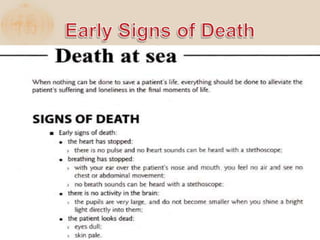
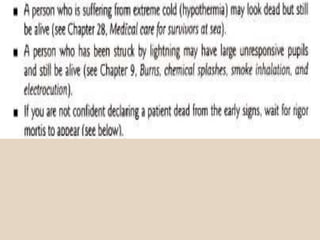
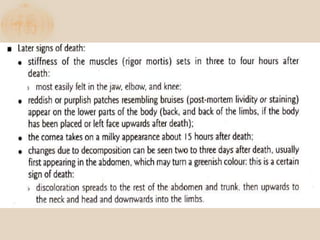
to discuss the ways to determine if a person is
dead.
-to understand the proper procedure of
handling deceased person onboard.
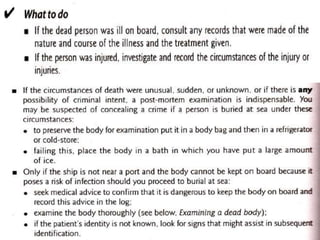
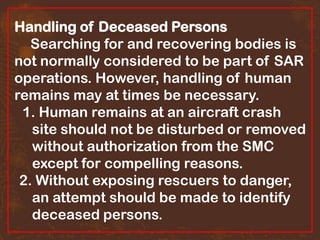
Handling of Deceased Persons
Searching for and recovering bodies is
not normally considered to be part of SAR
operations. However, handling of human
remains may at times be necessary.
1. Human remains at an aircraft crash
site should not be disturbed or removed
without authorization from the SMC
except for compelling reasons.
2. Without exposing rescuers to danger,
an attempt should be made to identify
deceased persons.
3. All articles removed from or found near
each body must be kept separate,
preferably in a container so labelled that
it can be correlated later with the body.
4. All these articles should be handed
over to the proper authority as soon as
possible.
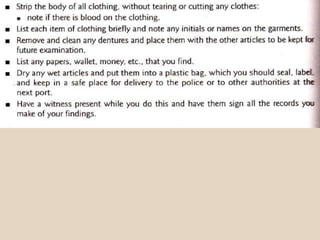
When human remains are recovered
during a SAR operation, or when a death
occurs on board a SAR facility.
1. A waybill should be made out for each
deceased person.
2. A waybill should contain the full name
and age of the deceased (if known), as
well as the place, date, time, and cause
of death (if possible).
3. This waybill should be made out in the
national language of the SAR facility
and, wherever possible, in English.
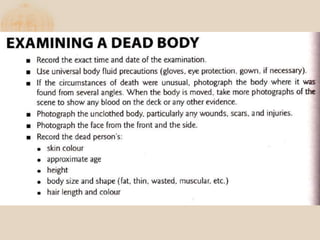
Considerations for the transport of
human remains include:
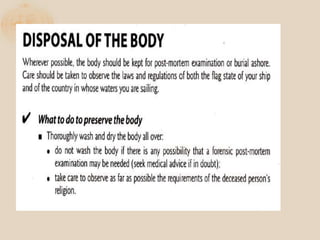
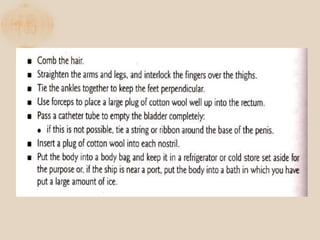
1. on vessels, body bags or sailcloth for
human remains should be carried
2. If human remains are kept on board for
any length of time, they should be
properly wrapped and put in a suitable
place on the vessel.
3. SAR aircraft do not normally transport
human remains (However, SAR aircraft
may have to carry human remains if no
other means are readily available.)
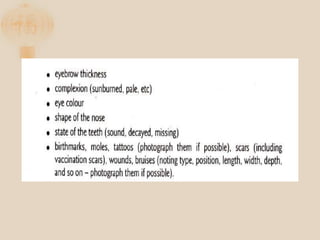
4. immediately after return to a base
specified by the RCC, the remains must
be handed over to the appropriate
authorities, accompanied by the waybill
5. if it is known or suspected that a
deceased person had an infectious
disease, all material and objects which
have been in direct contact with the
deceased person must be cleaned and
disinfected or destroyed.

Deceased handling

  • 1.
    Members: 1cl Salamat 1cl Saballero 1clTataro 1cl Venus 1cl Reyes 1cl Pumaren
  • 2.
    to discuss theways to determine if a person is dead. -to understand the proper procedure of handling deceased person onboard.
  • 17.
    Handling of DeceasedPersons Searching for and recovering bodies is not normally considered to be part of SAR operations. However, handling of human remains may at times be necessary. 1. Human remains at an aircraft crash site should not be disturbed or removed without authorization from the SMC except for compelling reasons. 2. Without exposing rescuers to danger, an attempt should be made to identify deceased persons.
  • 18.
    3. All articlesremoved from or found near each body must be kept separate, preferably in a container so labelled that it can be correlated later with the body. 4. All these articles should be handed over to the proper authority as soon as possible.
  • 19.
    When human remainsare recovered during a SAR operation, or when a death occurs on board a SAR facility. 1. A waybill should be made out for each deceased person. 2. A waybill should contain the full name and age of the deceased (if known), as well as the place, date, time, and cause of death (if possible). 3. This waybill should be made out in the national language of the SAR facility and, wherever possible, in English.
  • 20.
    Considerations for thetransport of human remains include: 1. on vessels, body bags or sailcloth for human remains should be carried 2. If human remains are kept on board for any length of time, they should be properly wrapped and put in a suitable place on the vessel. 3. SAR aircraft do not normally transport human remains (However, SAR aircraft may have to carry human remains if no other means are readily available.)
  • 21.
    4. immediately afterreturn to a base specified by the RCC, the remains must be handed over to the appropriate authorities, accompanied by the waybill 5. if it is known or suspected that a deceased person had an infectious disease, all material and objects which have been in direct contact with the deceased person must be cleaned and disinfected or destroyed.