Angelo Corsaro, PhD
Chief Technology Officer
ADLINK Technologies Inc.
angelo.corsaro@adlinktech.com
DDS in Action
Part-II
CopyrightPrismTech,2015
Recap
CopyrightPrismTech,2015
What is it?
CopyrightPrismTech,2015
DDS is a standard technology for
ubiquitous, interoperable, secure,
platform independent, and real-
time data sharing across network
connected devices
DDS in 131
characters
CopyrightPrismTech,2015
Who is using it?
CopyrightPrismTech,2015
Part II
CopyrightPrismTech,2015
Dynamic Discovery
CopyrightPrismTech,2015
Applications can
autonomously and
asynchronously read and
write data enjoying spatial
and temporal decoupling
Virtualised
Data Space
DDS Global Data Space
...
Data
Writer
Data
Writer
Data
Writer
Data
Reader
Data
Reader
Data
Reader
Data
Reader
Data
Writer
TopicA
QoS
TopicB
QoS
TopicC
QoS
TopicD
QoS
CopyrightPrismTech,2015
DDS Dynamic discoveries is
responsible for (1)
uncovering DDS
applications, (2) matching
interests and (3) setting up
data path between
matching readers and
writers
Dynamic Discovery
DDS Global Data Space
...
Data
Writer
Data
Writer
Data
Writer
Data
Reader
Data
Reader
Data
Reader
Data
Reader
Data
Writer
TopicA
QoS
TopicB
QoS
TopicC
QoS
TopicD
QoS
CopyrightPrismTech,2015
Built-in dynamic
discovery isolates
applications from
network topology
and connectivity
details
Dynamic Discovery
DDS Global Data Space
...
Data
Writer
Data
Writer
Data
Writer
Data
Reader
Data
Reader
Data
Reader
Data
Reader
Data
Writer
TopicA
QoS
TopicB
QoS
TopicC
QoS
TopicD
QoS
CopyrightPrismTech,2015
Lab 1: Wireshark
CopyrightPrismTech,2015
Decomposing DDS
Information Organisation
Domain
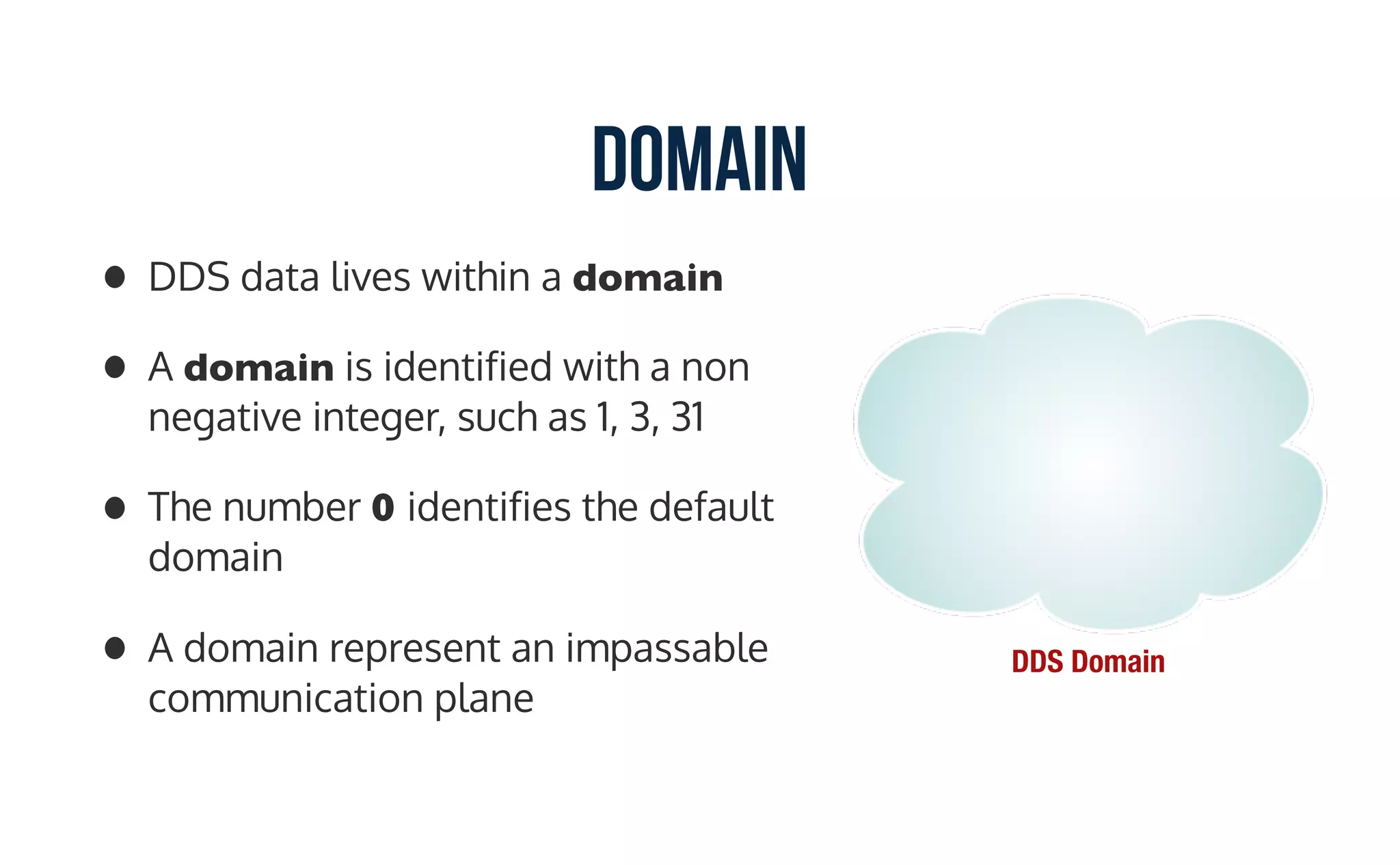
• DDS data lives within a domain
• A domain is identified with a non
negative integer, such as 1, 3, 31
• The number 0 identifies the default
domain
• A domain represent an impassable
communication plane
DDS Domain
Partitions
• Partitions are the mechanism provided by DDS to
organise information within a domain
• Access to partitions is controlled through QoS
Policies
• Partitions are defined as strings:
• “system:telemetry”	
• “system:log”	
• “data:row-2:col-3”	
• Partitions addressed by name or regular
expressions:
• ”system:telemetry”	
• “data:row-2:col-*”
Partition
s
Information Definition
Topic
• A Topic defines a domain-wide information’s class
• A Topic is defined by means of a (name, type, qos)
tuple, where
• name: identifies the topic within the domain
• type: is the programming language type
associated with the topic. Types are extensible
and evolvable
• qos: is a collection of policies that express the
non-functional properties of this topic, e.g.
reliability, persistence, etc.
Topic
Type
Name
QoS
Topic and Instances
• As explained in the previous slide a topic defines a class/type of information
• Topics can be defined as Singleton or can have multiple Instances
• Topic Instances are identified by means of the topic key
• A Topic Key is identified by a tuple of attributes -- like in databases
• Remarks:
• A Singleton topic has a single domain-wide instance
• A “regular” Topic can have as many instances as the number of different key
values, e.g., if the key is an 8-bit character then the topic can have 256 different instances
Example
Active Floor
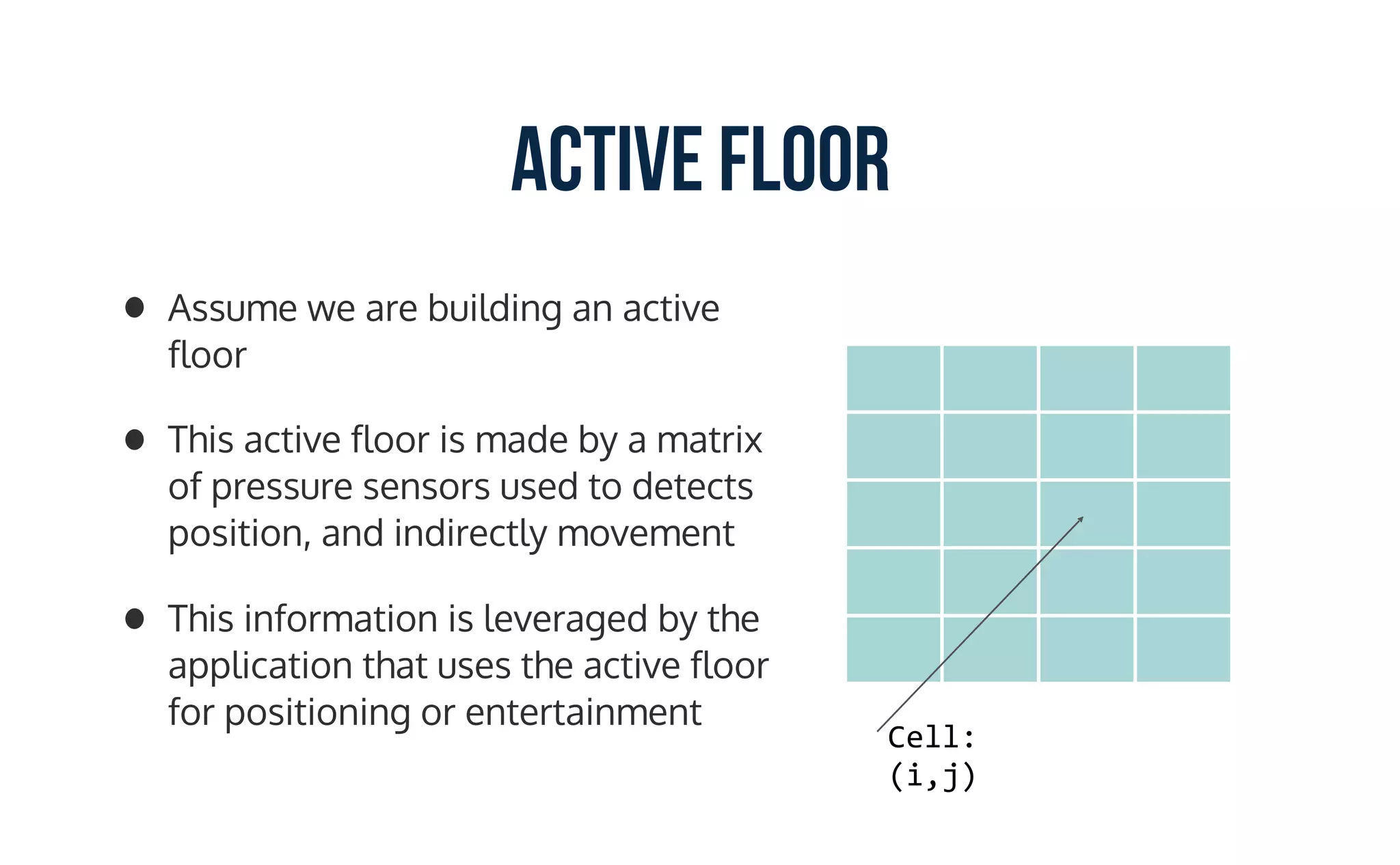
• Assume we are building an active
floor
• This active floor is made by a matrix
of pressure sensors used to detects
position, and indirectly movement
• This information is leveraged by the
application that uses the active floor
for positioning or entertainment
Cell:	
(i,j)
Active Floor
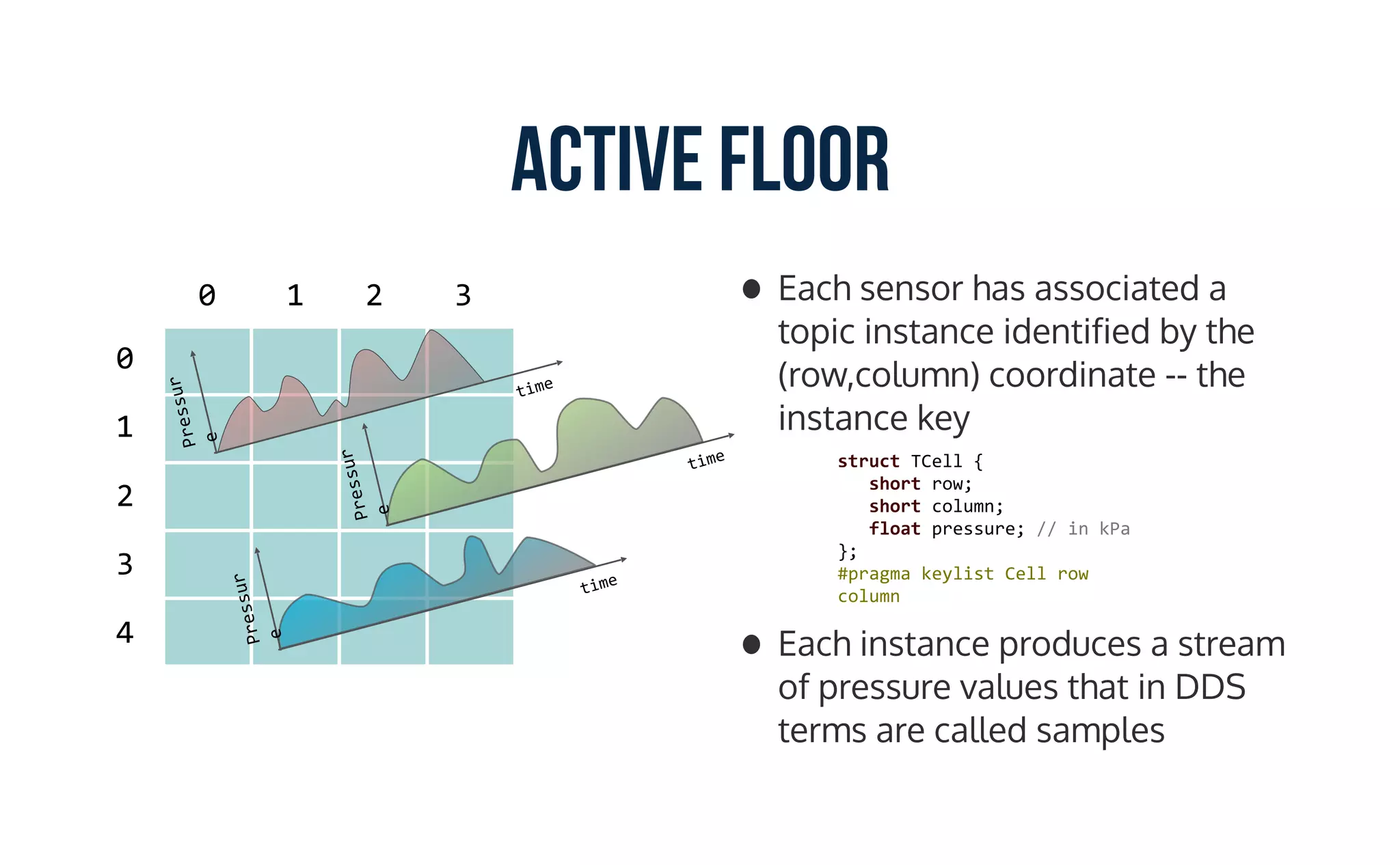
• The generic active cell can be modelled
with a topic that has an instance for
each value of (i,j). The topic type can be
defined as:
• Each cell is now distinguishable and
associated with a topic instance Cell:	
(i,j)
struct	TCell	{	
			short	row;		
			short	column;	
			float	pressure;	//	in	kPa	
};	
#pragma	keylist	TCell	row	column
Active Floor
• How can we know when something is on the
cell?
• The detection can be based on the difference
between the atmospheric pressure, say P0,
and the pressure sensed by the cell
• We can model this as a Singleton Topic
ReferencePressure defined by the type:
Cell:	
(i,j)
struct	TReferencePressure	{	
			float	pressure;	//	in	kPa	
			float	precision;		
};	
#pragma	keylist	
TReferencePressure
Active Floor
• Each sensor has associated a
topic instance identified by the
(row,column) coordinate -- the
instance key
• Each instance produces a stream
of pressure values that in DDS
terms are called samples
0 1 2 3
0
1
2
3
4
Pressur
e
time
Pressur
e
time
Pressur
e
time
struct	TCell	{	
			short	row;	
			short	column;	
			float	pressure;	//	in	kPa	
};	
#pragma	keylist	Cell	row	
column
Exercise
• What if we want to extend our
model to deal with floors on
different levels?
• How would you extend the
data model?
• How would you use partitions?
1 2 3
Pressur
e
time
Pressur
e
time
Pressur
e
time
CopyrightPrismTech,2015
Producing Information
Data Writer
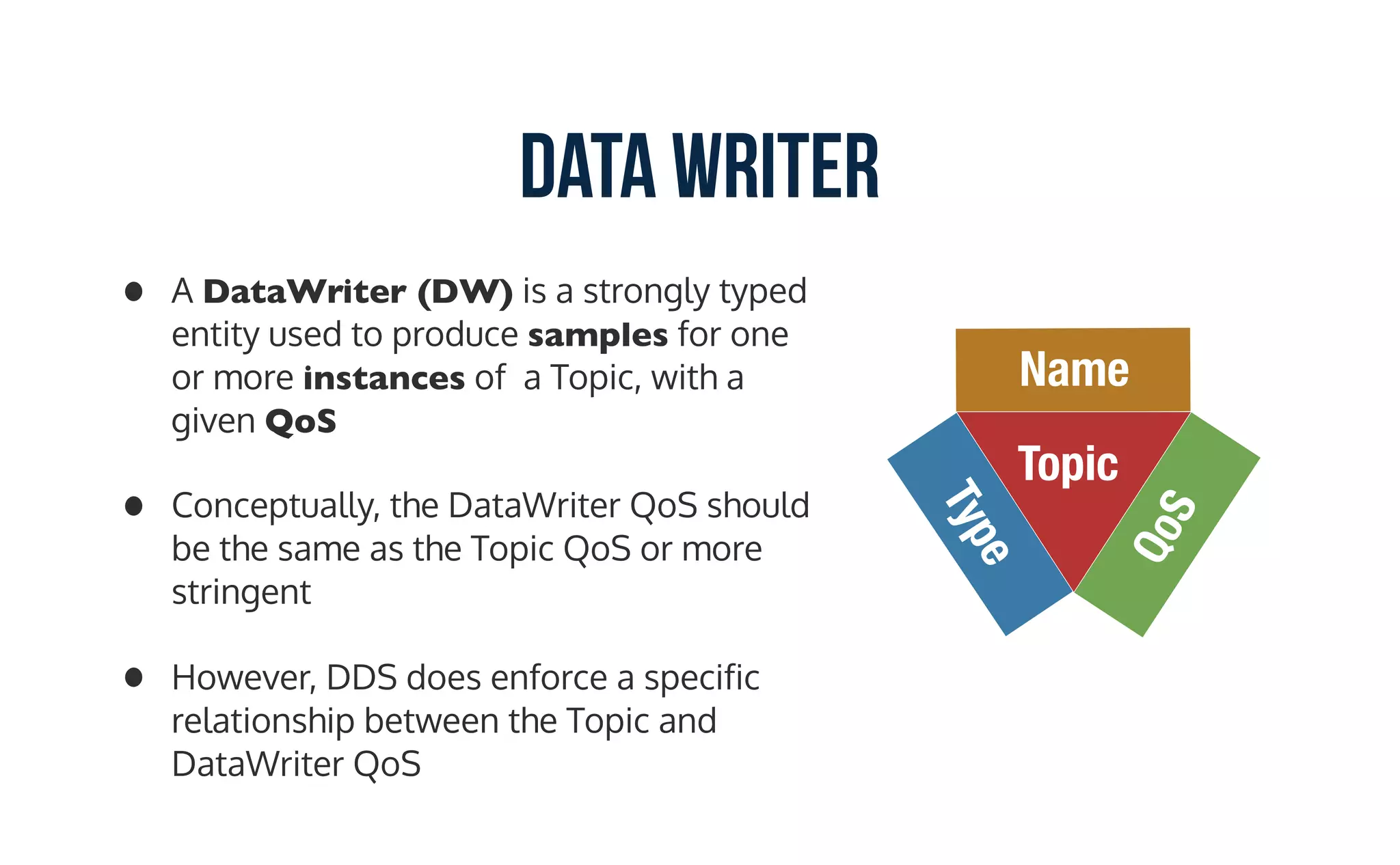
• A DataWriter (DW) is a strongly typed
entity used to produce samples for one
or more instances of a Topic, with a
given QoS
• Conceptually, the DataWriter QoS should
be the same as the Topic QoS or more
stringent
• However, DDS does enforce a specific
relationship between the Topic and
DataWriter QoS
Topic
Type
Name
QoS
Data Writer
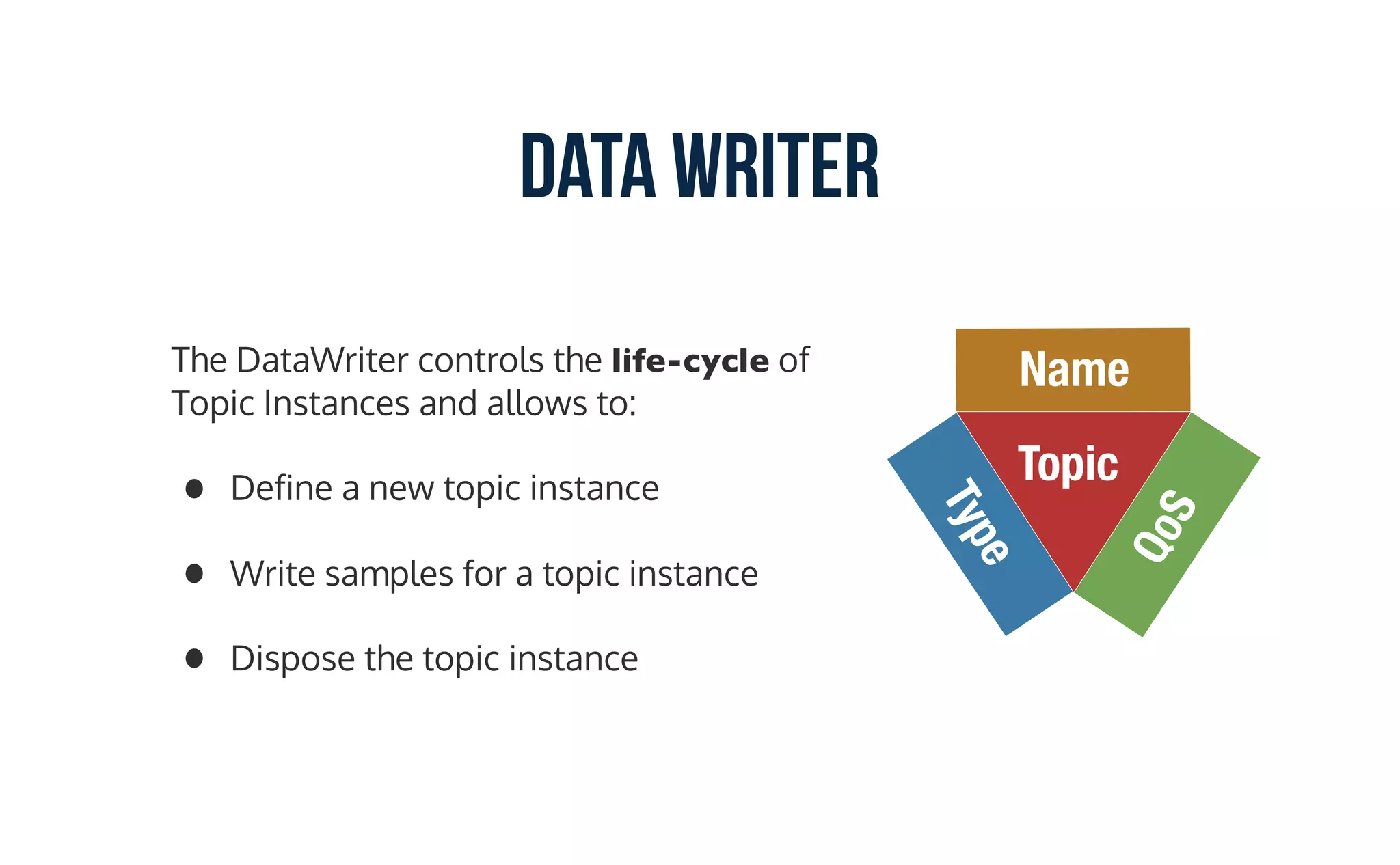
The DataWriter controls the life-cycle of
Topic Instances and allows to:
• Define a new topic instance
• Write samples for a topic instance
• Dispose the topic instance
Topic
Type
Name
QoS
The DataWriter controls the life-cycle of
Topic Instances and allows to:
• Define a new topic instance
• Write samples for a topic instance
• Dispose the topic instance
Topic
Type
Name
QoS
Data Writer
Writer Cache
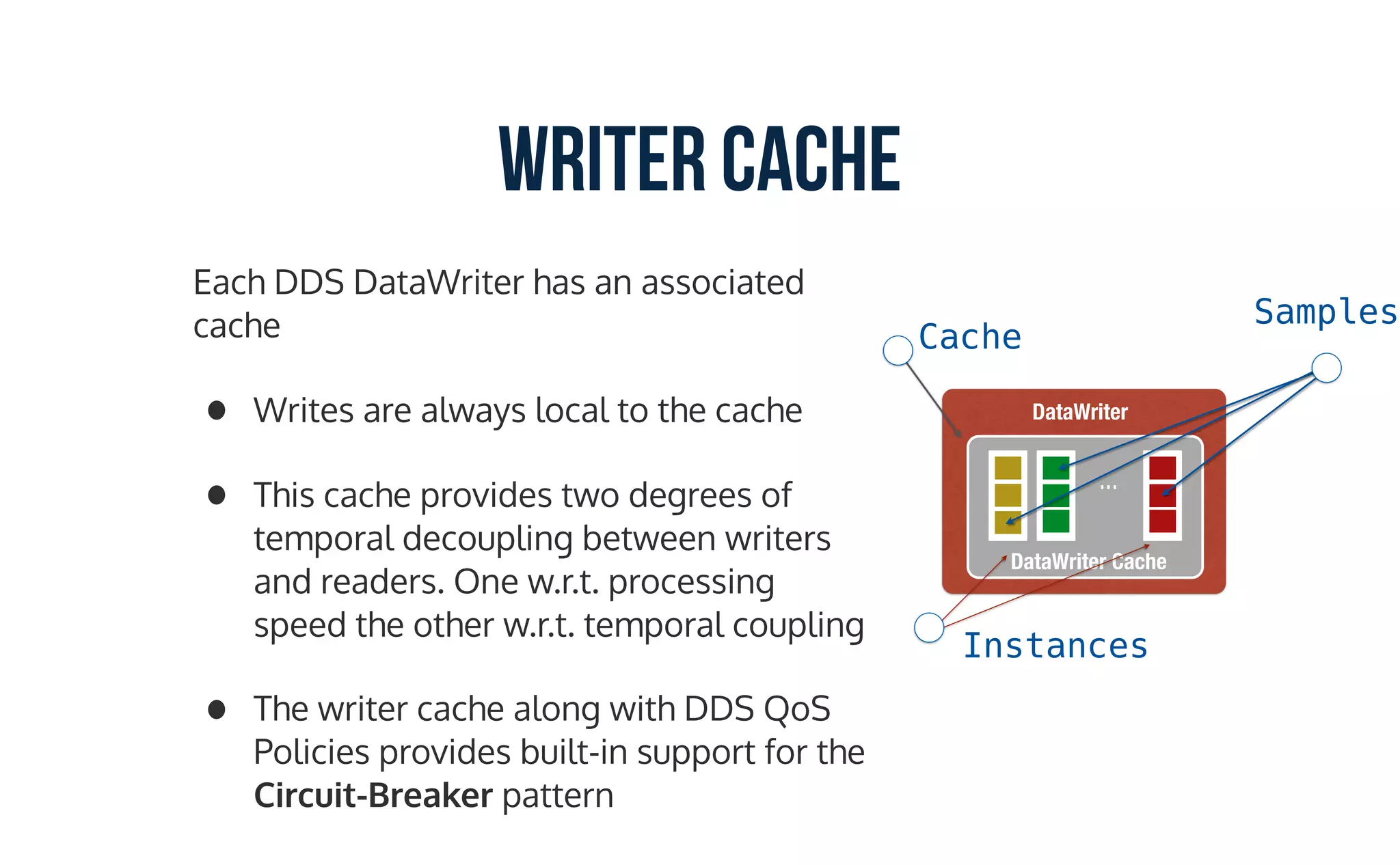
Each DDS DataWriter has an associated
cache
• Writes are always local to the cache
• This cache provides two degrees of
temporal decoupling between writers
and readers. One w.r.t. processing
speed the other w.r.t. temporal coupling
• The writer cache along with DDS QoS
Policies provides built-in support for the
Circuit-Breaker pattern
DataWriter Cache
DataWriter
...
Samples
Instances
Cache
CopyrightPrismTech,2015
Consuming Information
Data Reader
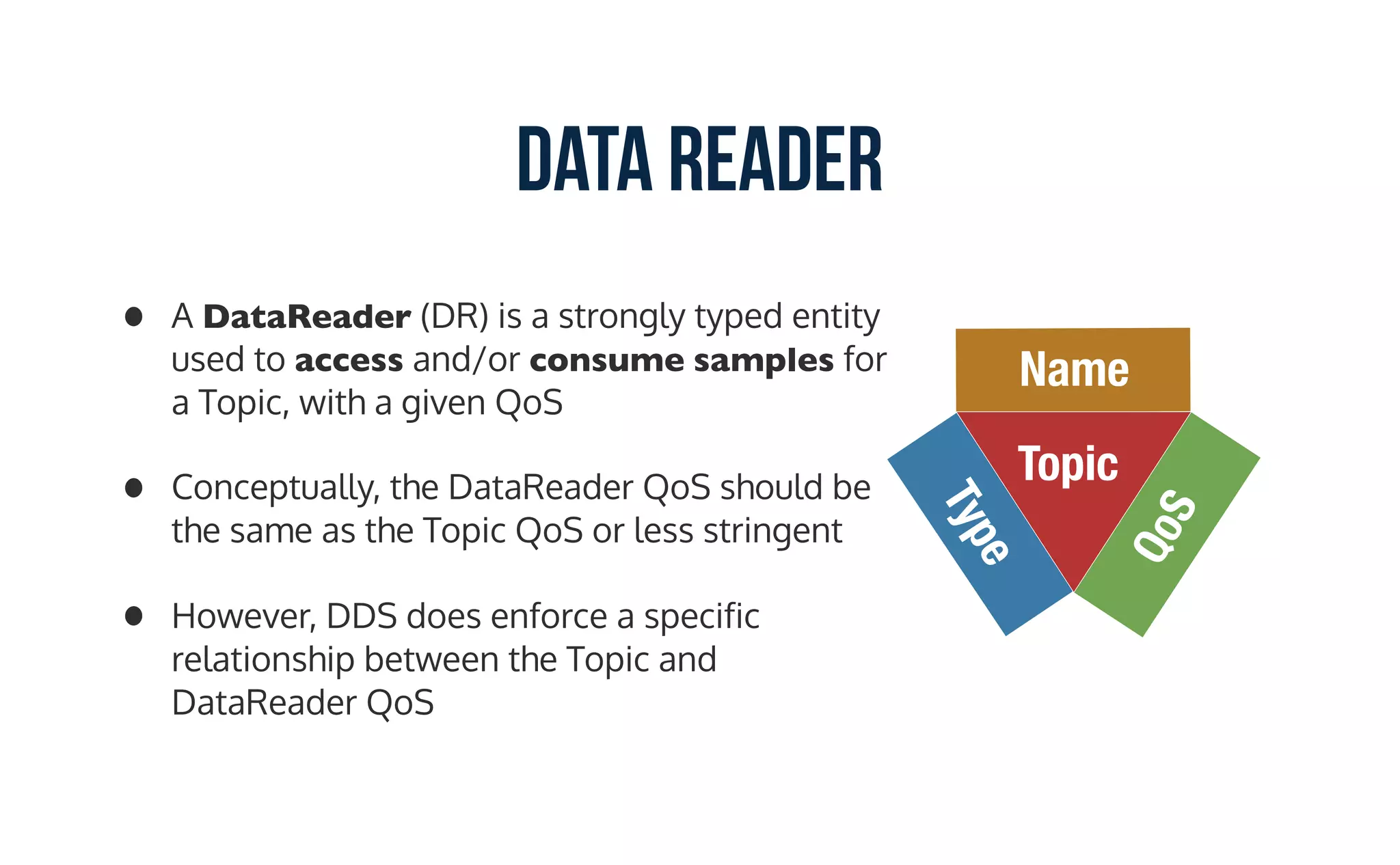
• A DataReader (DR) is a strongly typed entity
used to access and/or consume samples for
a Topic, with a given QoS
• Conceptually, the DataReader QoS should be
the same as the Topic QoS or less stringent
• However, DDS does enforce a specific
relationship between the Topic and
DataReader QoS
Topic
Type
Name
QoS
Reader Cache
The Reader Cache stores
the last n∊𝜨∞ samples
for each relevant
instance
Where: 𝜨∞
=𝜨 ∪ {∞}
DataReader Cache
DataReader
...
Samples
Instances
Cache
Data Reader
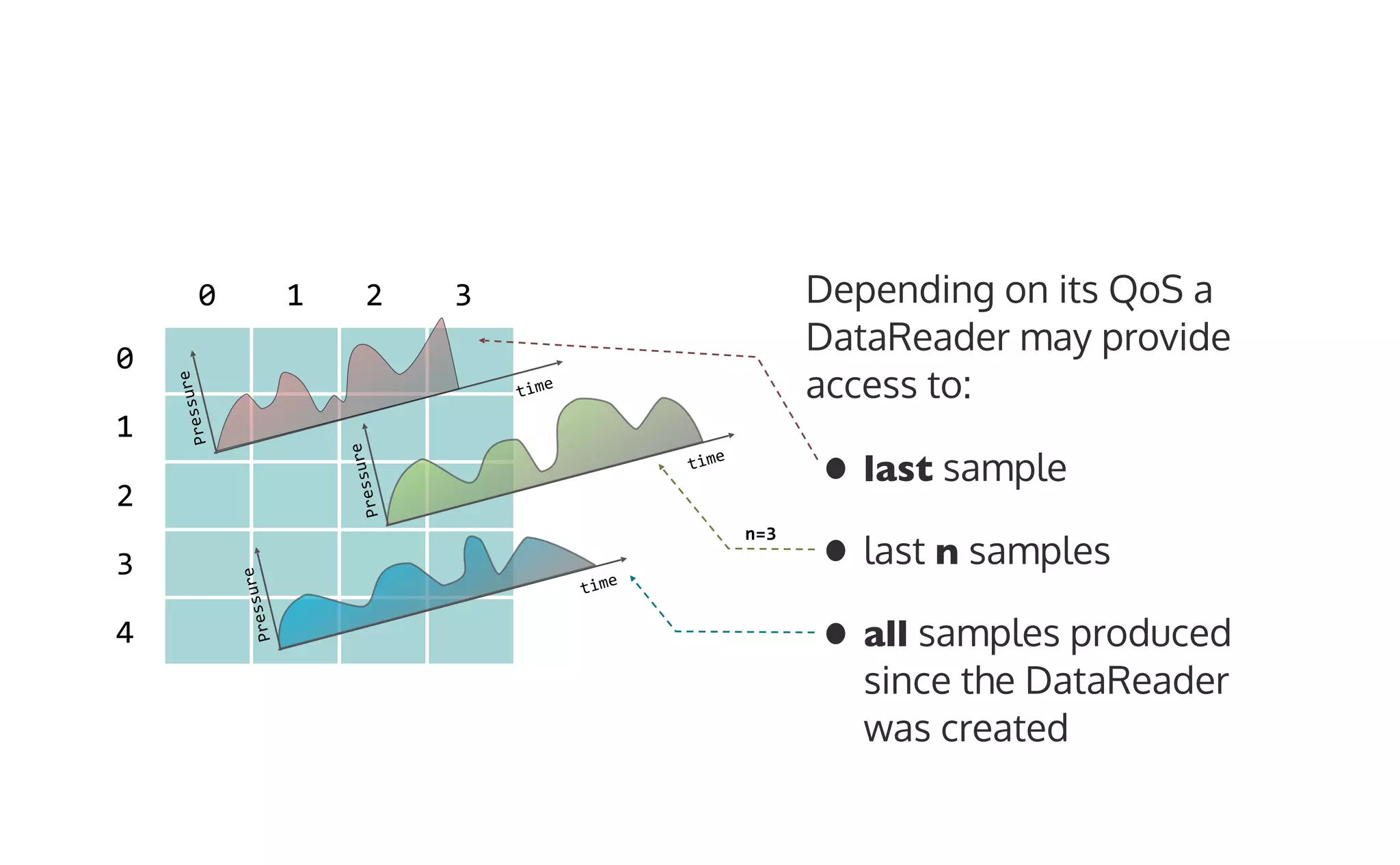
Depending on its QoS a
DataReader may provide
access to:
• last sample
• last n samples
• all samples produced
since the DataReader
was created
0 1 2 3
0
1
2
3
4
Pressure
time
Pressure
time
Pressure
time
0 1 2 3
0
1
2
3
4
Pressure
time
Pressure
time
Pressure
time
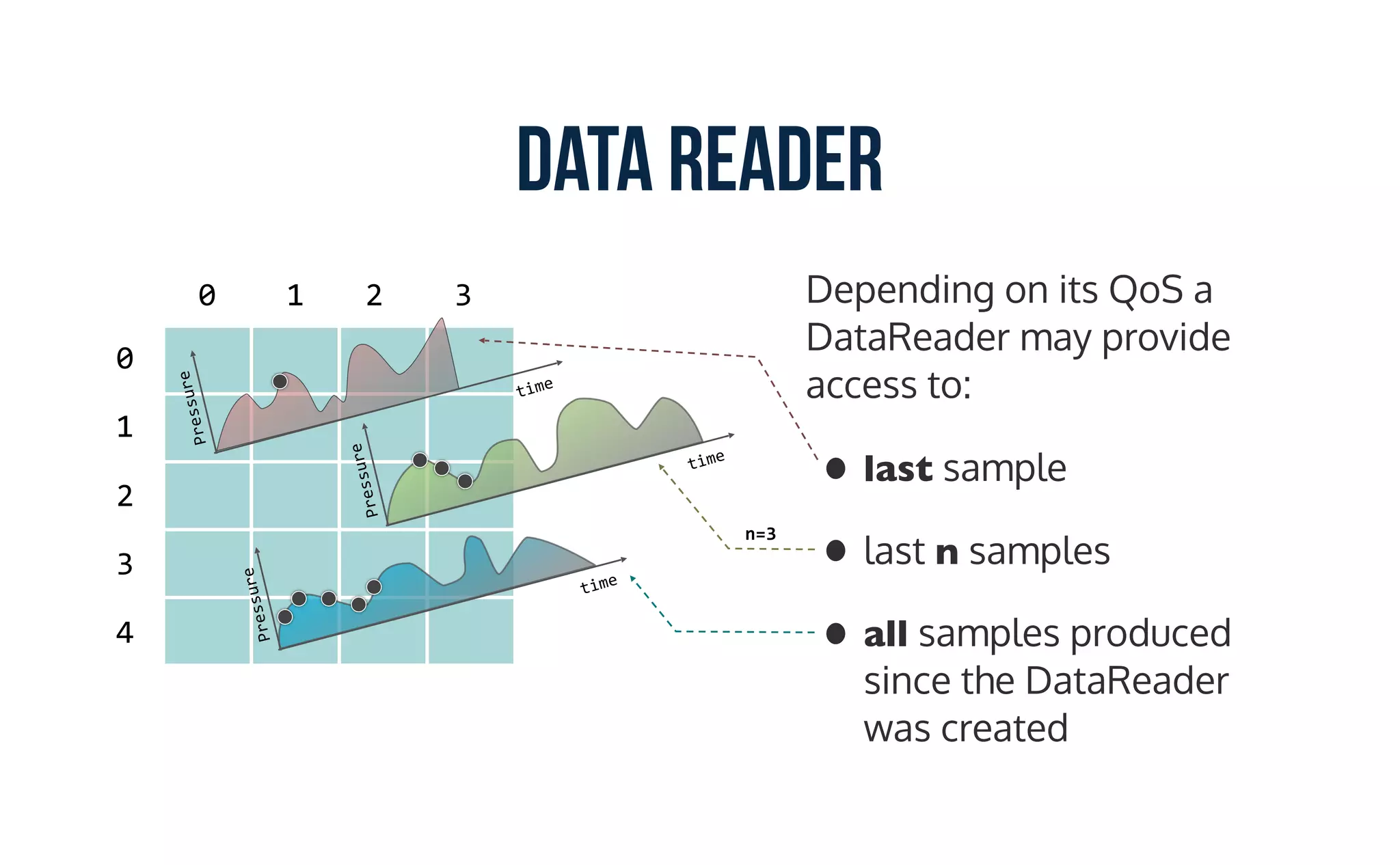
Depending on its QoS a
DataReader may provide
access to:
• last sample
• last n samples
• all samples produced
since the DataReader
was created
n=3
3
0 1 2 3
0
1
2
3
4
Pressure
time
Pressure
time
Pressure
time
Data Reader
Depending on its QoS a
DataReader may provide
access to:
• last sample
• last n samples
• all samples produced
since the DataReader
was created
n=3
Data Reader
Depending on its QoS a
DataReader may provide
access to:
• last sample
• last n samples
• all samples produced
since the DataReader
was created
n=
3
0 1 2 3
0
1
2
3
4
Pressure
time
Pressure
time
Pressure
time
Data Reader
Depending on its QoS a
DataReader may provide
access to:
• last sample
• last n samples
• all samples produced
since the DataReader
was created
n=3
0 1 2 3
0
1
2
3
4
Pressure
time
Pressure
time
Pressure
time
Data Reader
Depending on its QoS a
DataReader may provide
access to:
• last sample
• last n samples
• all samples produced
since the DataReader
was created
0 1 2 3
0
1
2
3
4
n=3
Pressure
time
Pressure
time
Pressure
time
Data Reader
Depending on its QoS a
DataReader may provide
access to:
• last sample
• last n samples
• all samples produced
since the DataReader
was created
0 1 2 3
0
1
2
3
4
n=3
Pressure
time
Pressure
time
Pressure
time
Data Reader
Depending on its QoS a
DataReader may provide
access to:
• last sample
• last n samples
• all samples produced
since the DataReader
was created
0 1 2 3
0
1
2
3
4
n=3
Pressure
time
Pressure
time
Pressure
time
Data Reader
• Samples are stored in the DataReader
Cache
• Samples can be read or taken from the
cache
• Samples taken are evicted from the
cache
• Samples read remain in the cache
and are simply market as read
• The cache content can be selected
based on content or state. More on this
later...
0 1 2 3
0
1
2
3
4
Pressure
time
Pressure
time
Pressure
time
Data Selection
Reading Data
• The action of reading
samples for a Reader
Cache is non-destructive.
• Samples are not
removed from the cache
DataReader Cache
DataReader
...
DataReader Cache
DataReader
...read
Taking Data
• The action of taking
samples for a Reader
Cache is destructive.
• Samples are removed
from the cache
DataReader Cache
DataReader
...
DataReader Cache
DataReader
...take
Samples Selector
• Samples can be
selected using
composable content
and status predicates DataReader Cache
DataReader
...
Content Filtering
• Filters allow to control
what gets into a
DataReader cache
• Filters are expressed as
SQL where clauses or as
Java/C/JavaScript
predicates
DataReader Cache
DataReader
...
Filter
Application
Network
Content Filters
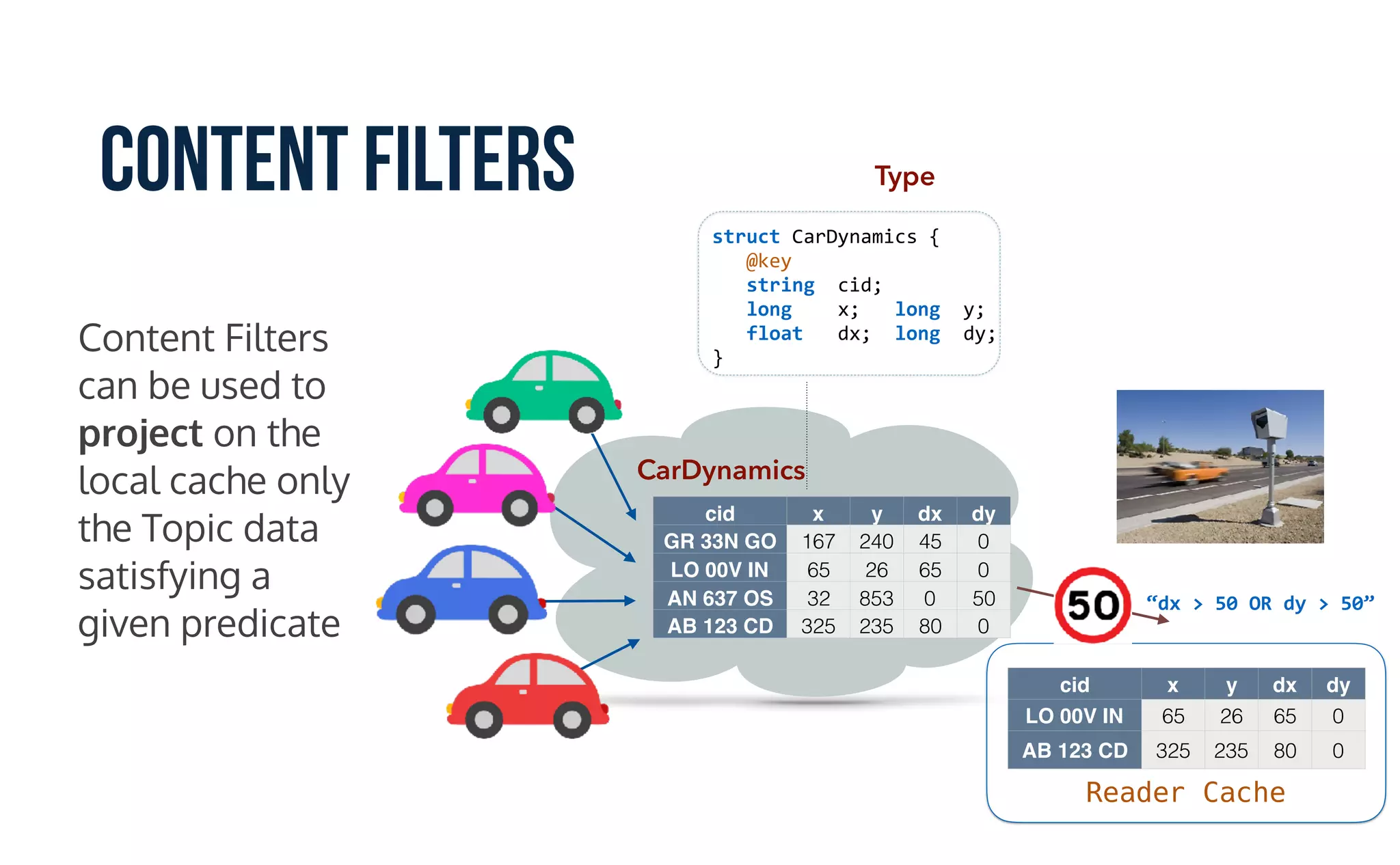
Content Filters
can be used to
project on the
local cache only
the Topic data
satisfying a
given predicate
struct	CarDynamics	{	
			@key	
			string		cid;	
			long				x;			long		y;	
			float			dx;		long		dy;	
}
cid x y dx dy
GR 33N GO 167 240 45 0
LO 00V IN 65 26 65 0
AN 637 OS 32 853 0 50
AB 123 CD 325 235 80 0
“dx	>	50	OR	dy	>	50”
Type
CarDynamics
cid x y dx dy
LO 00V IN 65 26 65 0
AB 123 CD 325 235 80 0
Reader Cache
Content-Based Selection
• Queries allow to control
what gets out of a
DataReader Cache
• Queries are expressed
as SQL where clauses or
as Java/C/JavaScript
predicates
DataReader Cache
DataReader
...
Query
DataReader Cache
DataReader
...
Application
Network
Queries
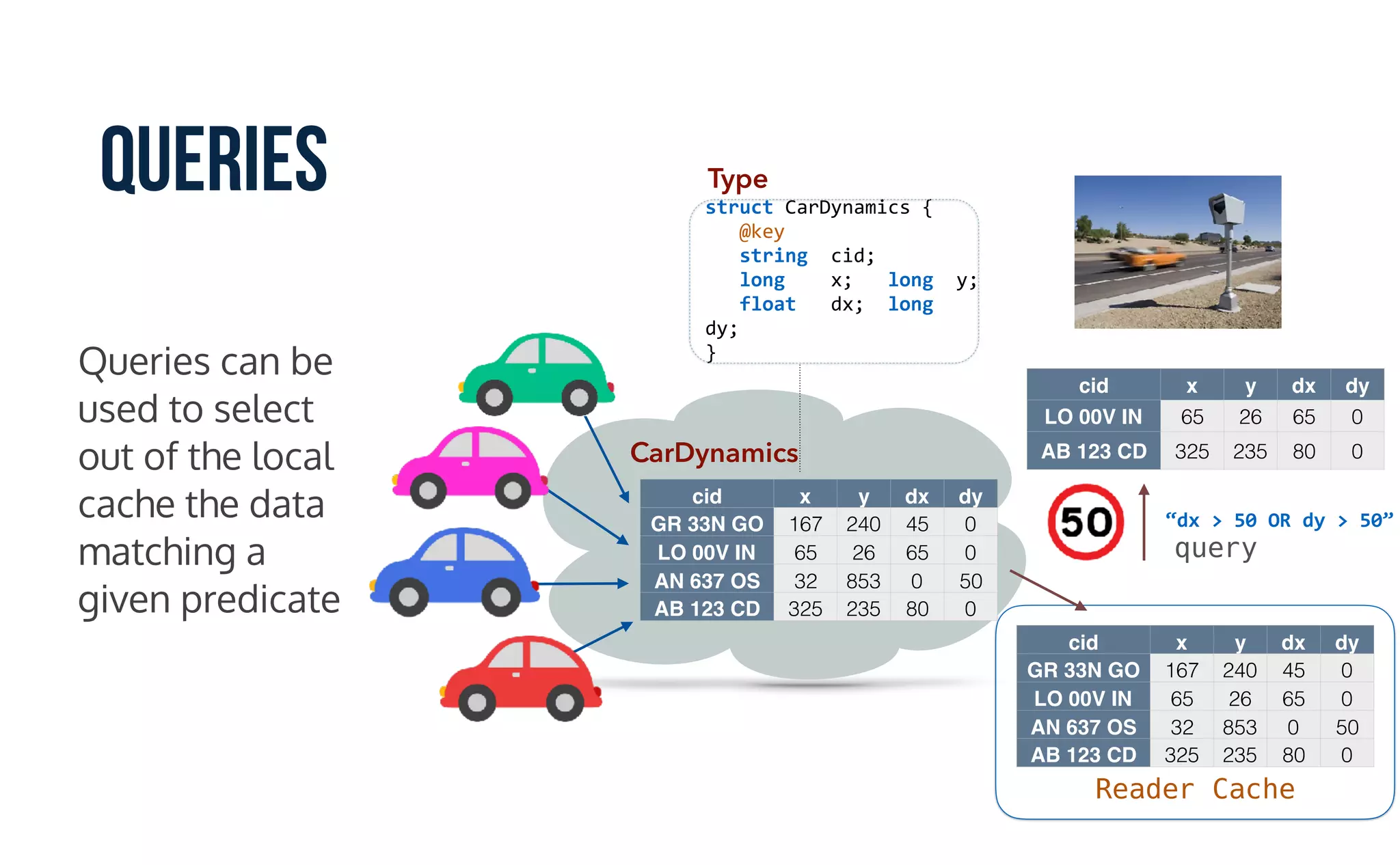
Queries can be
used to select
out of the local
cache the data
matching a
given predicate
Reader Cache
struct	CarDynamics	{	
			@key	
			string		cid;	
			long				x;			long		y;	
			float			dx;		long		
dy;	
}
cid x y dx dy
GR 33N GO 167 240 45 0
LO 00V IN 65 26 65 0
AN 637 OS 32 853 0 50
AB 123 CD 325 235 80 0
“dx	>	50	OR	dy	>	50”
Type
CarDynamics
cid x y dx dy
GR 33N GO 167 240 45 0
LO 00V IN 65 26 65 0
AN 637 OS 32 853 0 50
AB 123 CD 325 235 80 0
cid x y dx dy
LO 00V IN 65 26 65 0
AB 123 CD 325 235 80 0
query
Copyright	2013,	PrismTech	–		All	Rights	Reserved.
Sample, Instance, and View State
• The samples included in the DataReader cache have associated some meta-
information which, among other things, describes the status of the sample and its
associated stream/instance
• The Sample State (READ, NOT_READ) allows to distinguish between new
samples and samples that have already been read
• The View State (NEW, NOT_NEW) allows to distinguish a new instance from an
existing one
• The Instance State (ALIVE, NOT_ALIVE_DISPOSED, NOT_ALIVE_NO_WRITERS)
allows to track the life-cycle transitions of the instance to which a sample belongs
State-Based Selection
• State based selection
allows to control what
gets out of a
DataReader Cache
• State base selectors
predicate on samples
meta-information DataReader Cache
DataReader
...
State Selector
DataReader Cache
DataReader
...
Application
Network
CopyrightPrismTech,2015
Interaction Models
Copyright	2013,	PrismTech	–		All	Rights	Reserved.
Interaction Models
Polling
•The application proactively polls for data availability as well as special events, such as
a deadline being missed, etc. Notice that all DDS API calls, exclusion made for wait
operations, are non-blocking
Synchronous Notification
•The application synchronously waits for some conditions to be verified, e.g., data
availability, instance lifecycle change, etc.
Asynchronous Notification
•The application registers the interest to be asynchronously notified when specific
condition are satisfied, e.g. data available, a publication matched, etc.
Copyright	2013,	PrismTech	–		All	Rights	Reserved.
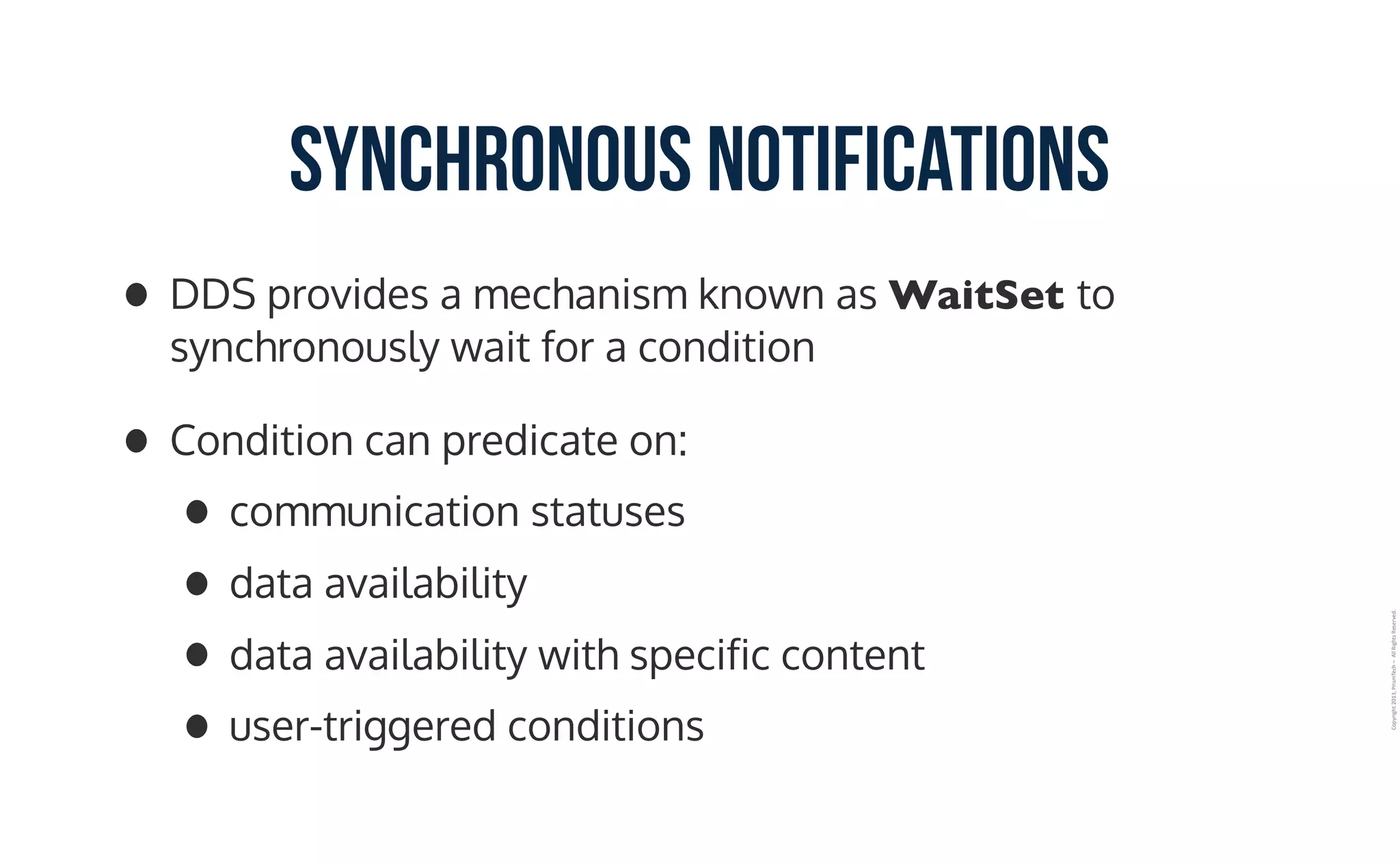
Synchronous Notifications
• DDS provides a mechanism known as WaitSet to
synchronously wait for a condition
• Condition can predicate on:
• communication statuses
• data availability
• data availability with specific content
• user-triggered conditions
Copyright	2013,	PrismTech	–		All	Rights	Reserved.
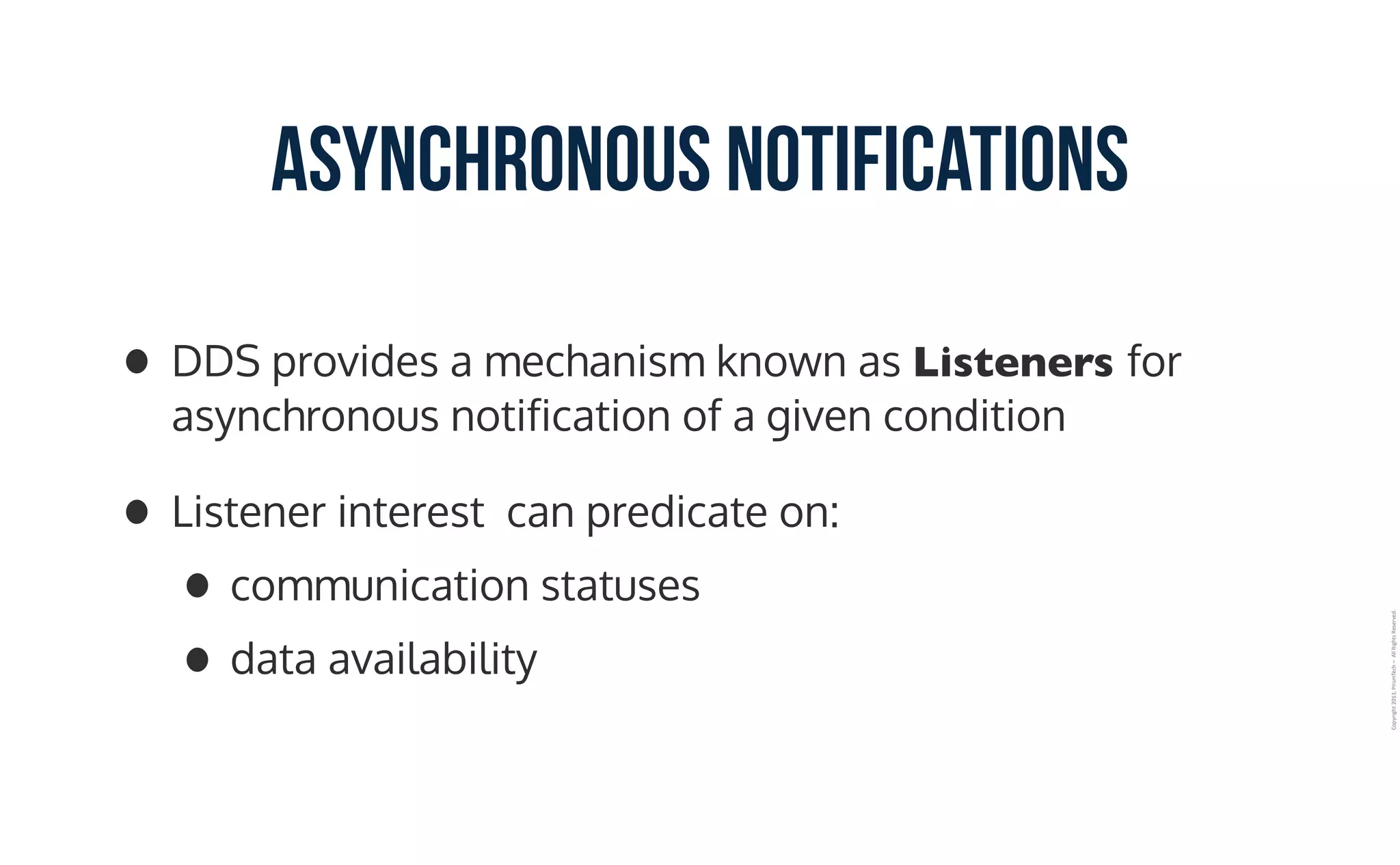
Asynchronous Notifications
• DDS provides a mechanism known as Listeners for
asynchronous notification of a given condition
• Listener interest can predicate on:
• communication statuses
• data availability
CopyrightPrismTech,2015
Putting it all together
CopyrightPrismTech,2015
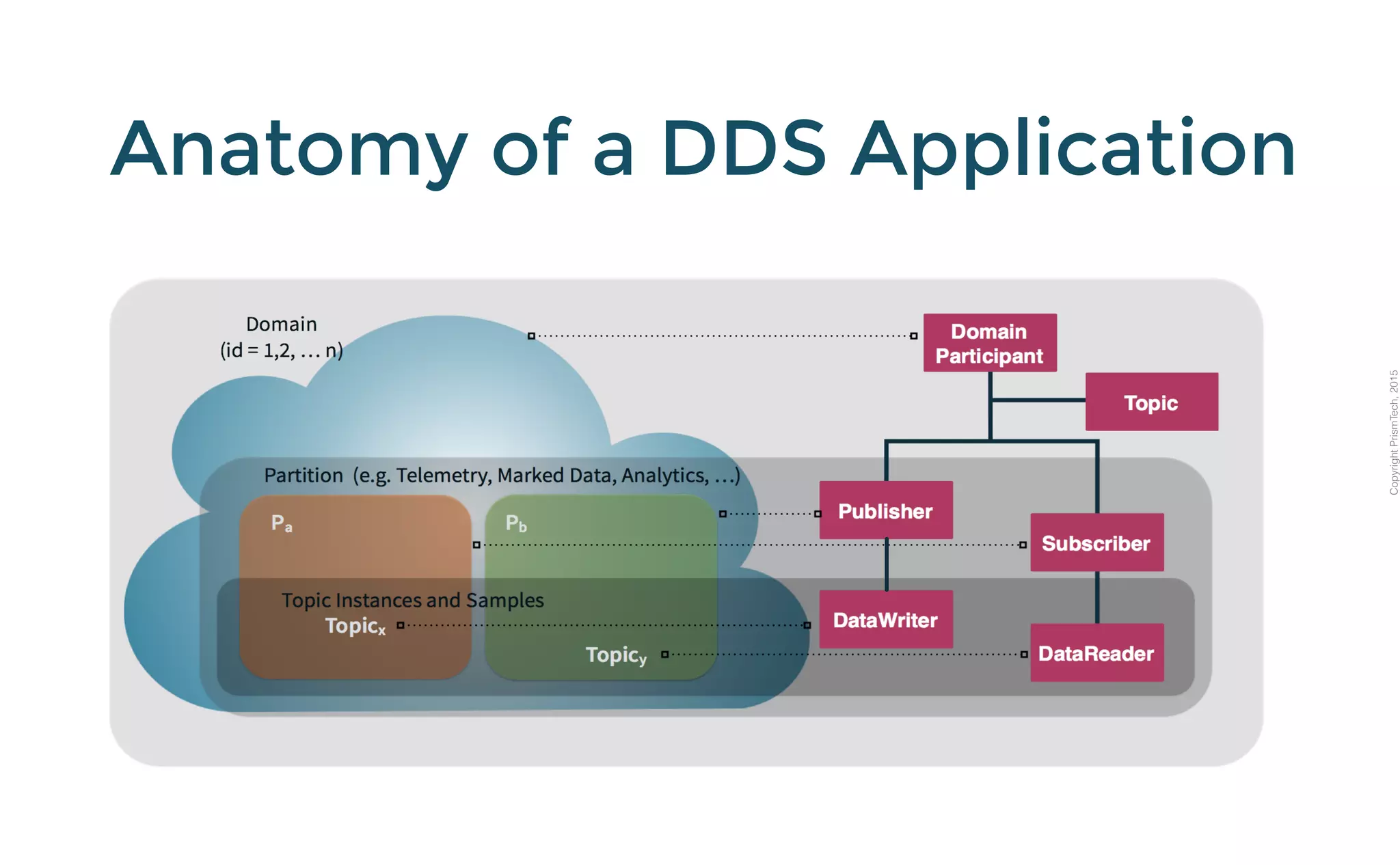
Anatomy of a DDS Application
CopyrightPrismTech,2015
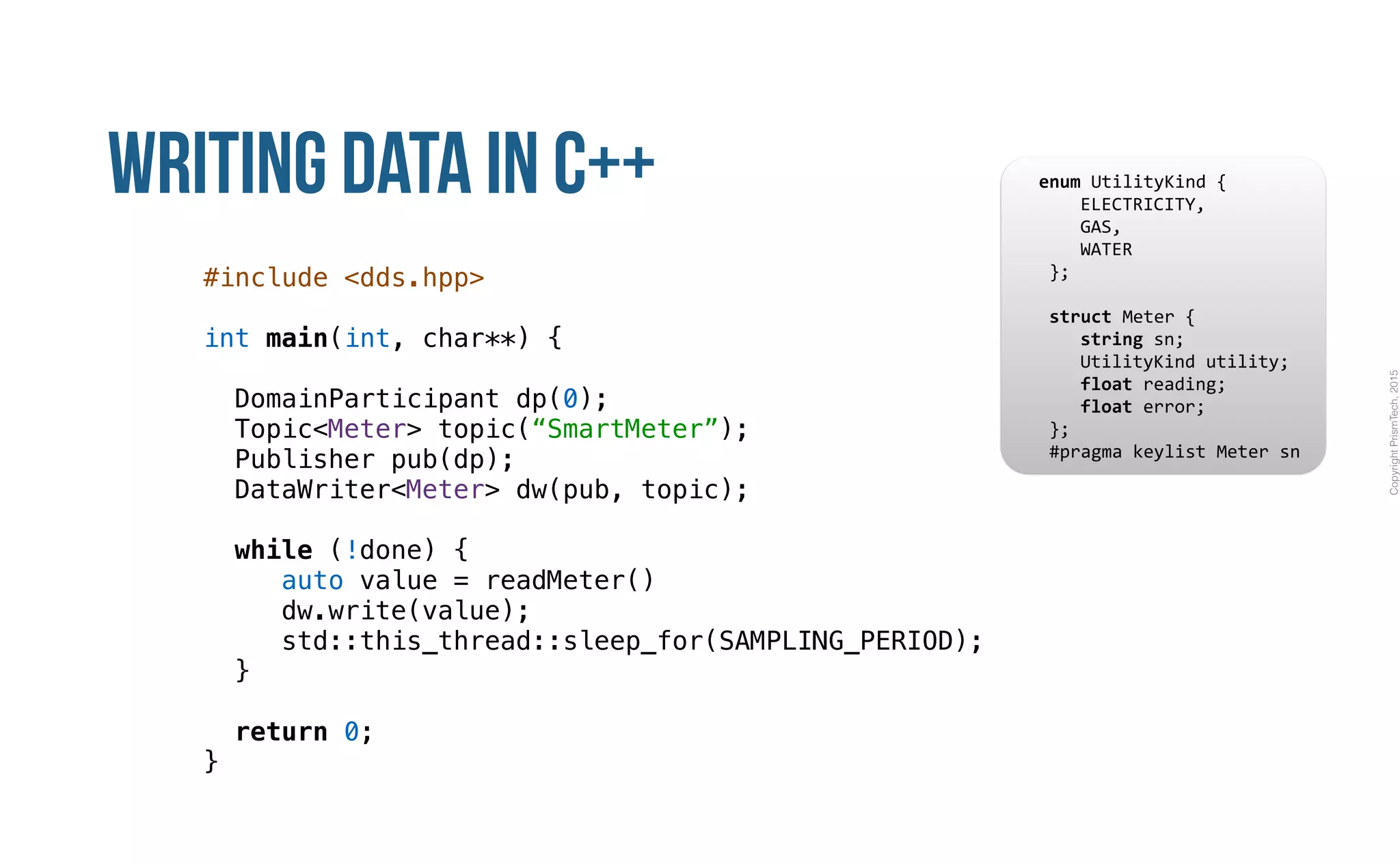
Writing Data in C++
#include <dds.hpp>
int main(int, char**) {
DomainParticipant dp(0);
Topic<Meter> topic(“SmartMeter”);
Publisher pub(dp);
DataWriter<Meter> dw(pub, topic);
while (!done) {
auto value = readMeter()
dw.write(value);
std::this_thread::sleep_for(SAMPLING_PERIOD);
}
return 0;
}
					enum	UtilityKind	{	
	 				ELECTRICITY,	
	 				GAS,	
	 				WATER	
						};	
							
						struct	Meter	{	
	 				string	sn;	
	 				UtilityKind	utility;	
	 				float	reading;	
	 				float	error;	
						};													
						#pragma	keylist	Meter	sn
CopyrightPrismTech,2015
Reading Data in C++
#include <dds.hpp>
int main(int, char**) {
DomainParticipant dp(0);
Topic<Meter> topic(”SmartMeter”);
Subscriber sub(dp);
DataReader<Meter> dr(dp, topic);
LambdaDataReaderListener<DataReader<Meter>> lst;
lst.data_available = [](DataReader<Meter>& dr) {
auto samples = data.read();
std::for_each(samples.begin(), samples.end(), [](Sample<Meter>& sample) {
std::cout << sample.data() << std::endl;
}
}
dr.listener(lst);
// Print incoming data up to when the user does a Ctrl-C
std::this_thread::join();
return 0;
}
					enum	UtilityKind	{	
	 				ELECTRICITY,	
	 				GAS,	
	 				WATER	
						};	
							
						struct	Meter	{	
	 				string	sn;	
	 				UtilityKind	utility;	
	 				float	reading;	
	 				float	error;	
						};													
						#pragma	keylist	Meter	sn
CopyrightPrismTech,2015
Writing Data in Scala
import dds._

import dds.prelude._

import dds.config.DefaultEntities._

object SmartMeter {


def main(args: Array[String]): Unit = {

val topic = Topic[Meter](“SmartMeter”)

val dw = DataWriter[Meter](topic)
while (!done) {
val meter = readMeter()

dw.write(meter)
Thread.sleep(SAMPLING_PERIOD)
}

}

}
					enum	UtilityKind	{	
	 				ELECTRICITY,	
	 				GAS,	
	 				WATER	
						};	
							
						struct	Meter	{	
	 				string	sn;	
	 				UtilityKind	utility;	
	 				float	reading;	
	 				float	error;	
						};													
						#pragma	keylist	Meter	sn
CopyrightPrismTech,2015
Reading Data in Scala
import dds._

import dds.prelude._

import dds.config.DefaultEntities._

object SmartMeterLog {

def main(args: Array[String]): Unit = {

val topic = Topic[Meter](“SmartMeter”)

val dr = DataReader[Meter](topic)

dr listen {

case DataAvailable(_) => dr.read.foreach(println)

}

}

}
					enum	UtilityKind	{	
	 				ELECTRICITY,	
	 				GAS,	
	 				WATER	
						};	
							
						struct	Meter	{	
	 				string	sn;	
	 				UtilityKind	utility;	
	 				float	reading;	
	 				float	error;	
						};													
						#pragma	keylist	Meter	sn
CopyrightPrismTech,2015
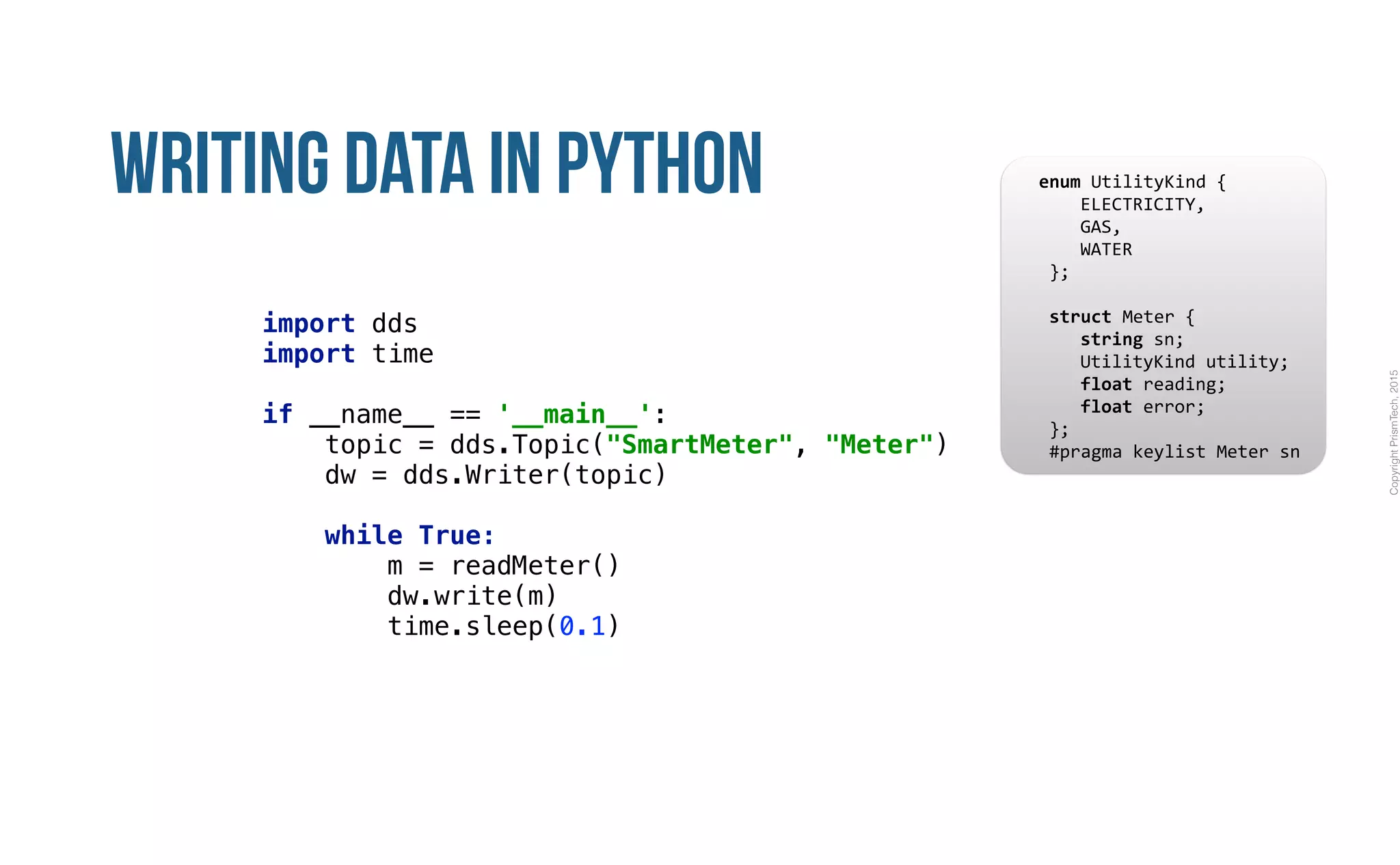
Writing Data in Python
import dds
import time


if __name__ == '__main__':

topic = dds.Topic("SmartMeter", "Meter")

dw = dds.Writer(topic)


while True:

m = readMeter()

dw.write(m)

time.sleep(0.1)
					enum	UtilityKind	{	
	 				ELECTRICITY,	
	 				GAS,	
	 				WATER	
						};	
							
						struct	Meter	{	
	 				string	sn;	
	 				UtilityKind	utility;	
	 				float	reading;	
	 				float	error;	
						};													
						#pragma	keylist	Meter	sn
CopyrightPrismTech,2015
Reading Data in Python
import dds

import sys


def readData(dr): 

samples = dds.range(dr.read())

for s in samples:

sys.stdout.write(str(s.getData()))


if __name__ == '__main__':

t = dds.Topic("SmartMeter", "Meter")

dr = dds.Reader(t)

dr.onDataAvailable = readData
					enum	UtilityKind	{	
	 				ELECTRICITY,	
	 				GAS,	
	 				WATER	
						};	
							
						struct	Meter	{	
	 				string	sn;	
	 				UtilityKind	utility;	
	 				float	reading;	
	 				float	error;	
						};													
						#pragma	keylist	Meter	sn
CopyrightPrismTech,2015
Lab2: Code Walkthrough
CopyrightPrismTech,2015
Performance
Latency
Vortex DDS latency
can be as low as ~30
usec
This is the lowest
among DDS
implementations
several times better
than what can be
obtained with MQTT,
AMQP, OPC-UA
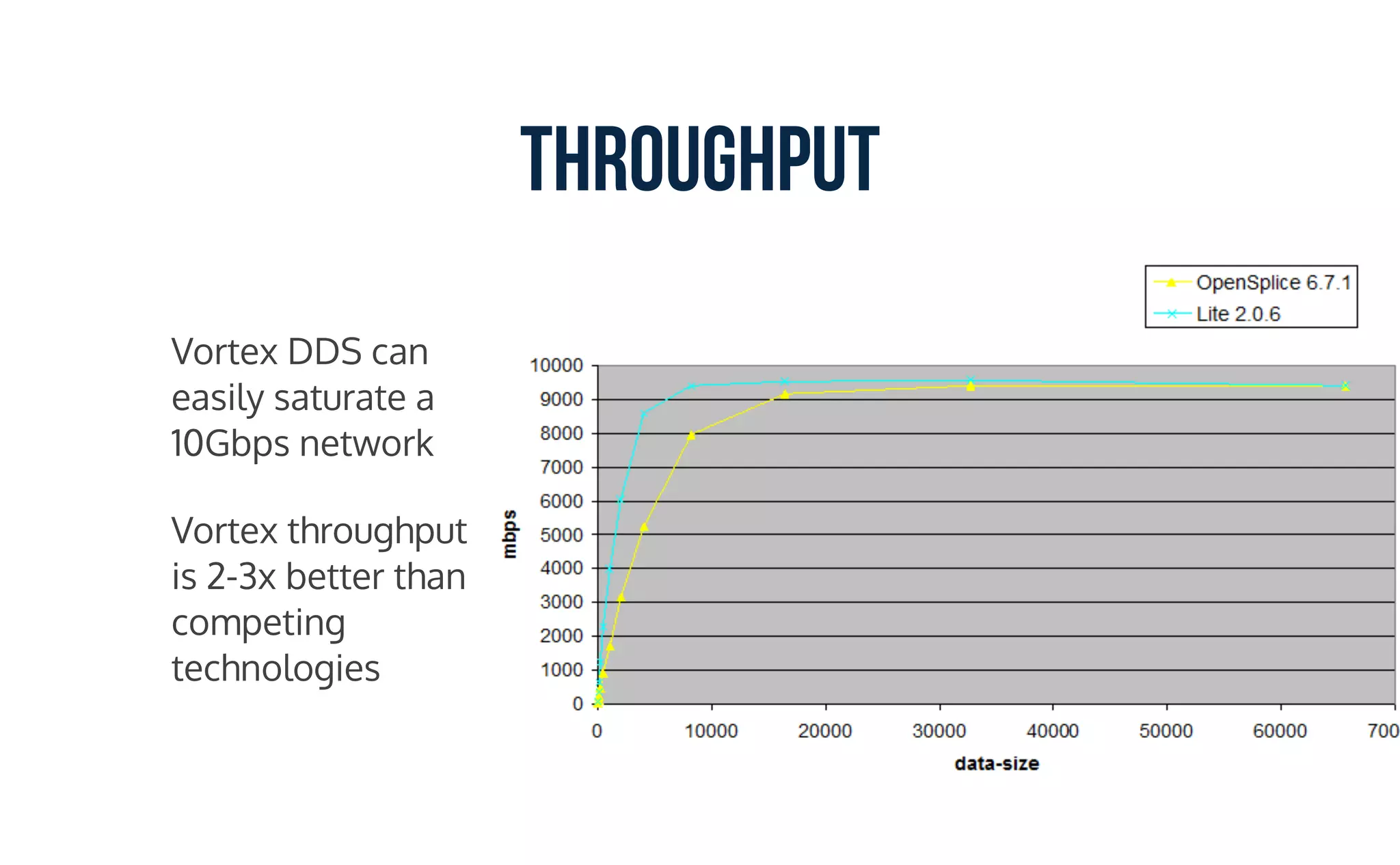
Throughput
Vortex DDS can
easily saturate a
10Gbps network
Vortex throughput
is 2-3x better than
competing
technologies
CopyrightPrismTech,2015
Lab3: Performance Eval.
CopyrightPrismTech,2015
Concluding Remarks
CopyrightPrismTech,2015
DDS provides a very high level abstractions to architect and
implement distributed systems
DDS has built-in support for several patterns that are essential to
keep systems working at scale, such as circuit-breakers and
temporal decoupling
DDS can address the most challenging environment w.r.t.
volumes, latencies and scale
Wrapping Up
DDS In Action Part II

DDS In Action Part II

  • 1.
    Angelo Corsaro, PhD ChiefTechnology Officer ADLINK Technologies Inc. angelo.corsaro@adlinktech.com DDS in Action Part-II
  • 2.
  • 3.
  • 4.
    CopyrightPrismTech,2015 DDS is astandard technology for ubiquitous, interoperable, secure, platform independent, and real- time data sharing across network connected devices DDS in 131 characters
  • 5.
  • 6.
  • 7.
  • 8.
  • 9.
    CopyrightPrismTech,2015 Applications can autonomously and asynchronouslyread and write data enjoying spatial and temporal decoupling Virtualised Data Space DDS Global Data Space ... Data Writer Data Writer Data Writer Data Reader Data Reader Data Reader Data Reader Data Writer TopicA QoS TopicB QoS TopicC QoS TopicD QoS
  • 10.
    CopyrightPrismTech,2015 DDS Dynamic discoveriesis responsible for (1) uncovering DDS applications, (2) matching interests and (3) setting up data path between matching readers and writers Dynamic Discovery DDS Global Data Space ... Data Writer Data Writer Data Writer Data Reader Data Reader Data Reader Data Reader Data Writer TopicA QoS TopicB QoS TopicC QoS TopicD QoS
  • 11.
    CopyrightPrismTech,2015 Built-in dynamic discovery isolates applicationsfrom network topology and connectivity details Dynamic Discovery DDS Global Data Space ... Data Writer Data Writer Data Writer Data Reader Data Reader Data Reader Data Reader Data Writer TopicA QoS TopicB QoS TopicC QoS TopicD QoS
  • 12.
  • 13.
  • 14.
  • 15.
    Domain • DDS datalives within a domain • A domain is identified with a non negative integer, such as 1, 3, 31 • The number 0 identifies the default domain • A domain represent an impassable communication plane DDS Domain
  • 16.
    Partitions • Partitions arethe mechanism provided by DDS to organise information within a domain • Access to partitions is controlled through QoS Policies • Partitions are defined as strings: • “system:telemetry” • “system:log” • “data:row-2:col-3” • Partitions addressed by name or regular expressions: • ”system:telemetry” • “data:row-2:col-*” Partition s
  • 17.
  • 18.
    Topic • A Topicdefines a domain-wide information’s class • A Topic is defined by means of a (name, type, qos) tuple, where • name: identifies the topic within the domain • type: is the programming language type associated with the topic. Types are extensible and evolvable • qos: is a collection of policies that express the non-functional properties of this topic, e.g. reliability, persistence, etc. Topic Type Name QoS
  • 19.
    Topic and Instances •As explained in the previous slide a topic defines a class/type of information • Topics can be defined as Singleton or can have multiple Instances • Topic Instances are identified by means of the topic key • A Topic Key is identified by a tuple of attributes -- like in databases • Remarks: • A Singleton topic has a single domain-wide instance • A “regular” Topic can have as many instances as the number of different key values, e.g., if the key is an 8-bit character then the topic can have 256 different instances
  • 20.
  • 21.
    Active Floor • Assumewe are building an active floor • This active floor is made by a matrix of pressure sensors used to detects position, and indirectly movement • This information is leveraged by the application that uses the active floor for positioning or entertainment Cell: (i,j)
  • 22.
    Active Floor • Thegeneric active cell can be modelled with a topic that has an instance for each value of (i,j). The topic type can be defined as: • Each cell is now distinguishable and associated with a topic instance Cell: (i,j) struct TCell { short row; short column; float pressure; // in kPa }; #pragma keylist TCell row column
  • 23.
    Active Floor • Howcan we know when something is on the cell? • The detection can be based on the difference between the atmospheric pressure, say P0, and the pressure sensed by the cell • We can model this as a Singleton Topic ReferencePressure defined by the type: Cell: (i,j) struct TReferencePressure { float pressure; // in kPa float precision; }; #pragma keylist TReferencePressure
  • 24.
    Active Floor • Eachsensor has associated a topic instance identified by the (row,column) coordinate -- the instance key • Each instance produces a stream of pressure values that in DDS terms are called samples 0 1 2 3 0 1 2 3 4 Pressur e time Pressur e time Pressur e time struct TCell { short row; short column; float pressure; // in kPa }; #pragma keylist Cell row column
  • 25.
    Exercise • What ifwe want to extend our model to deal with floors on different levels? • How would you extend the data model? • How would you use partitions? 1 2 3 Pressur e time Pressur e time Pressur e time
  • 26.
  • 27.
    Data Writer • ADataWriter (DW) is a strongly typed entity used to produce samples for one or more instances of a Topic, with a given QoS • Conceptually, the DataWriter QoS should be the same as the Topic QoS or more stringent • However, DDS does enforce a specific relationship between the Topic and DataWriter QoS Topic Type Name QoS
  • 28.
    Data Writer The DataWritercontrols the life-cycle of Topic Instances and allows to: • Define a new topic instance • Write samples for a topic instance • Dispose the topic instance Topic Type Name QoS
  • 29.
    The DataWriter controlsthe life-cycle of Topic Instances and allows to: • Define a new topic instance • Write samples for a topic instance • Dispose the topic instance Topic Type Name QoS Data Writer
  • 30.
    Writer Cache Each DDSDataWriter has an associated cache • Writes are always local to the cache • This cache provides two degrees of temporal decoupling between writers and readers. One w.r.t. processing speed the other w.r.t. temporal coupling • The writer cache along with DDS QoS Policies provides built-in support for the Circuit-Breaker pattern DataWriter Cache DataWriter ... Samples Instances Cache
  • 31.
  • 32.
    Data Reader • ADataReader (DR) is a strongly typed entity used to access and/or consume samples for a Topic, with a given QoS • Conceptually, the DataReader QoS should be the same as the Topic QoS or less stringent • However, DDS does enforce a specific relationship between the Topic and DataReader QoS Topic Type Name QoS
  • 33.
    Reader Cache The ReaderCache stores the last n∊𝜨∞ samples for each relevant instance Where: 𝜨∞ =𝜨 ∪ {∞} DataReader Cache DataReader ... Samples Instances Cache
  • 34.
    Data Reader Depending onits QoS a DataReader may provide access to: • last sample • last n samples • all samples produced since the DataReader was created 0 1 2 3 0 1 2 3 4 Pressure time Pressure time Pressure time
  • 35.
    0 1 23 0 1 2 3 4 Pressure time Pressure time Pressure time Depending on its QoS a DataReader may provide access to: • last sample • last n samples • all samples produced since the DataReader was created n=3 3
  • 36.
    0 1 23 0 1 2 3 4 Pressure time Pressure time Pressure time Data Reader Depending on its QoS a DataReader may provide access to: • last sample • last n samples • all samples produced since the DataReader was created n=3
  • 37.
    Data Reader Depending onits QoS a DataReader may provide access to: • last sample • last n samples • all samples produced since the DataReader was created n= 3 0 1 2 3 0 1 2 3 4 Pressure time Pressure time Pressure time
  • 38.
    Data Reader Depending onits QoS a DataReader may provide access to: • last sample • last n samples • all samples produced since the DataReader was created n=3 0 1 2 3 0 1 2 3 4 Pressure time Pressure time Pressure time
  • 39.
    Data Reader Depending onits QoS a DataReader may provide access to: • last sample • last n samples • all samples produced since the DataReader was created 0 1 2 3 0 1 2 3 4 n=3 Pressure time Pressure time Pressure time
  • 40.
    Data Reader Depending onits QoS a DataReader may provide access to: • last sample • last n samples • all samples produced since the DataReader was created 0 1 2 3 0 1 2 3 4 n=3 Pressure time Pressure time Pressure time
  • 41.
    Data Reader Depending onits QoS a DataReader may provide access to: • last sample • last n samples • all samples produced since the DataReader was created 0 1 2 3 0 1 2 3 4 n=3 Pressure time Pressure time Pressure time
  • 42.
    Data Reader • Samplesare stored in the DataReader Cache • Samples can be read or taken from the cache • Samples taken are evicted from the cache • Samples read remain in the cache and are simply market as read • The cache content can be selected based on content or state. More on this later... 0 1 2 3 0 1 2 3 4 Pressure time Pressure time Pressure time
  • 43.
  • 44.
    Reading Data • Theaction of reading samples for a Reader Cache is non-destructive. • Samples are not removed from the cache DataReader Cache DataReader ... DataReader Cache DataReader ...read
  • 45.
    Taking Data • Theaction of taking samples for a Reader Cache is destructive. • Samples are removed from the cache DataReader Cache DataReader ... DataReader Cache DataReader ...take
  • 46.
    Samples Selector • Samplescan be selected using composable content and status predicates DataReader Cache DataReader ...
  • 47.
    Content Filtering • Filtersallow to control what gets into a DataReader cache • Filters are expressed as SQL where clauses or as Java/C/JavaScript predicates DataReader Cache DataReader ... Filter Application Network
  • 48.
    Content Filters Content Filters canbe used to project on the local cache only the Topic data satisfying a given predicate struct CarDynamics { @key string cid; long x; long y; float dx; long dy; } cid x y dx dy GR 33N GO 167 240 45 0 LO 00V IN 65 26 65 0 AN 637 OS 32 853 0 50 AB 123 CD 325 235 80 0 “dx > 50 OR dy > 50” Type CarDynamics cid x y dx dy LO 00V IN 65 26 65 0 AB 123 CD 325 235 80 0 Reader Cache
  • 49.
    Content-Based Selection • Queriesallow to control what gets out of a DataReader Cache • Queries are expressed as SQL where clauses or as Java/C/JavaScript predicates DataReader Cache DataReader ... Query DataReader Cache DataReader ... Application Network
  • 50.
    Queries Queries can be usedto select out of the local cache the data matching a given predicate Reader Cache struct CarDynamics { @key string cid; long x; long y; float dx; long dy; } cid x y dx dy GR 33N GO 167 240 45 0 LO 00V IN 65 26 65 0 AN 637 OS 32 853 0 50 AB 123 CD 325 235 80 0 “dx > 50 OR dy > 50” Type CarDynamics cid x y dx dy GR 33N GO 167 240 45 0 LO 00V IN 65 26 65 0 AN 637 OS 32 853 0 50 AB 123 CD 325 235 80 0 cid x y dx dy LO 00V IN 65 26 65 0 AB 123 CD 325 235 80 0 query
  • 51.
    Copyright 2013, PrismTech – All Rights Reserved. Sample, Instance, andView State • The samples included in the DataReader cache have associated some meta- information which, among other things, describes the status of the sample and its associated stream/instance • The Sample State (READ, NOT_READ) allows to distinguish between new samples and samples that have already been read • The View State (NEW, NOT_NEW) allows to distinguish a new instance from an existing one • The Instance State (ALIVE, NOT_ALIVE_DISPOSED, NOT_ALIVE_NO_WRITERS) allows to track the life-cycle transitions of the instance to which a sample belongs
  • 52.
    State-Based Selection • Statebased selection allows to control what gets out of a DataReader Cache • State base selectors predicate on samples meta-information DataReader Cache DataReader ... State Selector DataReader Cache DataReader ... Application Network
  • 53.
  • 54.
    Copyright 2013, PrismTech – All Rights Reserved. Interaction Models Polling •The applicationproactively polls for data availability as well as special events, such as a deadline being missed, etc. Notice that all DDS API calls, exclusion made for wait operations, are non-blocking Synchronous Notification •The application synchronously waits for some conditions to be verified, e.g., data availability, instance lifecycle change, etc. Asynchronous Notification •The application registers the interest to be asynchronously notified when specific condition are satisfied, e.g. data available, a publication matched, etc.
  • 55.
    Copyright 2013, PrismTech – All Rights Reserved. Synchronous Notifications • DDSprovides a mechanism known as WaitSet to synchronously wait for a condition • Condition can predicate on: • communication statuses • data availability • data availability with specific content • user-triggered conditions
  • 56.
    Copyright 2013, PrismTech – All Rights Reserved. Asynchronous Notifications • DDSprovides a mechanism known as Listeners for asynchronous notification of a given condition • Listener interest can predicate on: • communication statuses • data availability
  • 57.
  • 58.
  • 59.
    CopyrightPrismTech,2015 Writing Data inC++ #include <dds.hpp> int main(int, char**) { DomainParticipant dp(0); Topic<Meter> topic(“SmartMeter”); Publisher pub(dp); DataWriter<Meter> dw(pub, topic); while (!done) { auto value = readMeter() dw.write(value); std::this_thread::sleep_for(SAMPLING_PERIOD); } return 0; } enum UtilityKind { ELECTRICITY, GAS, WATER }; struct Meter { string sn; UtilityKind utility; float reading; float error; }; #pragma keylist Meter sn
  • 60.
    CopyrightPrismTech,2015 Reading Data inC++ #include <dds.hpp> int main(int, char**) { DomainParticipant dp(0); Topic<Meter> topic(”SmartMeter”); Subscriber sub(dp); DataReader<Meter> dr(dp, topic); LambdaDataReaderListener<DataReader<Meter>> lst; lst.data_available = [](DataReader<Meter>& dr) { auto samples = data.read(); std::for_each(samples.begin(), samples.end(), [](Sample<Meter>& sample) { std::cout << sample.data() << std::endl; } } dr.listener(lst); // Print incoming data up to when the user does a Ctrl-C std::this_thread::join(); return 0; } enum UtilityKind { ELECTRICITY, GAS, WATER }; struct Meter { string sn; UtilityKind utility; float reading; float error; }; #pragma keylist Meter sn
  • 61.
    CopyrightPrismTech,2015 Writing Data inScala import dds._
 import dds.prelude._
 import dds.config.DefaultEntities._
 object SmartMeter {
 
 def main(args: Array[String]): Unit = {
 val topic = Topic[Meter](“SmartMeter”)
 val dw = DataWriter[Meter](topic) while (!done) { val meter = readMeter()
 dw.write(meter) Thread.sleep(SAMPLING_PERIOD) }
 }
 } enum UtilityKind { ELECTRICITY, GAS, WATER }; struct Meter { string sn; UtilityKind utility; float reading; float error; }; #pragma keylist Meter sn
  • 62.
    CopyrightPrismTech,2015 Reading Data inScala import dds._
 import dds.prelude._
 import dds.config.DefaultEntities._
 object SmartMeterLog {
 def main(args: Array[String]): Unit = {
 val topic = Topic[Meter](“SmartMeter”)
 val dr = DataReader[Meter](topic)
 dr listen {
 case DataAvailable(_) => dr.read.foreach(println)
 }
 }
 } enum UtilityKind { ELECTRICITY, GAS, WATER }; struct Meter { string sn; UtilityKind utility; float reading; float error; }; #pragma keylist Meter sn
  • 63.
    CopyrightPrismTech,2015 Writing Data inPython import dds import time
 
 if __name__ == '__main__':
 topic = dds.Topic("SmartMeter", "Meter")
 dw = dds.Writer(topic)
 
 while True:
 m = readMeter()
 dw.write(m)
 time.sleep(0.1) enum UtilityKind { ELECTRICITY, GAS, WATER }; struct Meter { string sn; UtilityKind utility; float reading; float error; }; #pragma keylist Meter sn
  • 64.
    CopyrightPrismTech,2015 Reading Data inPython import dds
 import sys
 
 def readData(dr): 
 samples = dds.range(dr.read())
 for s in samples:
 sys.stdout.write(str(s.getData()))
 
 if __name__ == '__main__':
 t = dds.Topic("SmartMeter", "Meter")
 dr = dds.Reader(t)
 dr.onDataAvailable = readData enum UtilityKind { ELECTRICITY, GAS, WATER }; struct Meter { string sn; UtilityKind utility; float reading; float error; }; #pragma keylist Meter sn
  • 65.
  • 66.
  • 67.
    Latency Vortex DDS latency canbe as low as ~30 usec This is the lowest among DDS implementations several times better than what can be obtained with MQTT, AMQP, OPC-UA
  • 68.
    Throughput Vortex DDS can easilysaturate a 10Gbps network Vortex throughput is 2-3x better than competing technologies
  • 69.
  • 70.
  • 71.
    CopyrightPrismTech,2015 DDS provides avery high level abstractions to architect and implement distributed systems DDS has built-in support for several patterns that are essential to keep systems working at scale, such as circuit-breakers and temporal decoupling DDS can address the most challenging environment w.r.t. volumes, latencies and scale Wrapping Up