Data Decentralisation
Efficiency, Privacy and Fair Monetisation
Angelo Corsaro, PhD


Chief Technology Officer


ADLINK Technologies Inc.
The Cloud or The Internet?
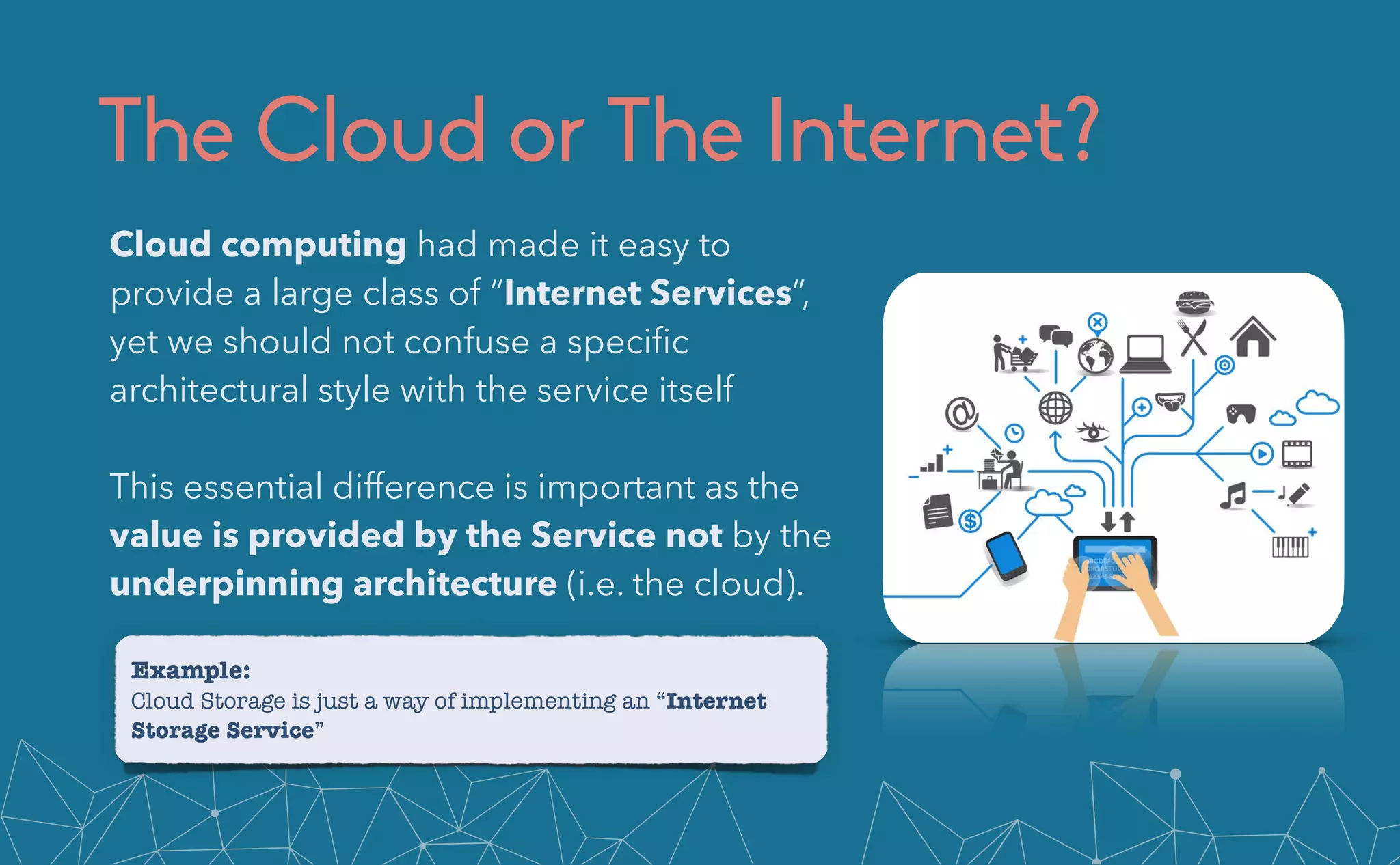
Cloud computing had made it easy to
provide a large class of “Internet Services”,
yet we should not confuse a speci
fi
c
architectural style with the service itself


This essential difference is important as the
value is provided by the Service not by the
underpinning architecture (i.e. the cloud).
Example:


Cloud Storage is just a way of implementing an “Internet
Storage Service”
Cloud Computing Challenges
The privacy abuses revealed by
Snowden have been heavily
covered by the press


What is not so much known, is
that today the vast majority of
servers powering clouds suffer
from MDS and are as a
consequence inherently insecure.
[Security and Privacy]
Cloud Computing Challenges
As a consequence of centralisation Cloud vendors
have the lion share on data monetisation
opportunities.


This leads to an extremely biased market in which a
few control too much


If individuals have full ownership and control over
their digital footprint they have higher chance to
monetise it — if desired.
[Monetisation]
Example:


Your browsing history, your electrical consumption, your
running data, etc., is (often) owned, controlled and
monetised by third parties.
Cloud Computing Challenges
Cloud computing poses major
energetic challenges not simply
because of data-center but more
importantly for the traf
fi
c it generates.
All data gets in and out of a remote
data center — that consumes energy
[Energy Consumption]
The Austerity Dilemma
Whilst there there a growing
community advocating data austerity,
the solution is not simply is being
conscious on our use of precious
resources — such energie — but we
need to realise that the current
architectures, infrastructures and
technologies where not designed for
addressing the data age
The solution relies combining innovation to improve the
ef
fi
ciency of data distribution technologies with the
sensibilisation of European on the value of parsimony
[Energy Consumption]
Challenges Cloud Computing in Europe
© H-CLOUD Consortium 2020-2022 Page 8 of 93
processing, ensuring, for example, compliance with GDPR, is a central element to enable data
spaces as envisioned in EUSD.
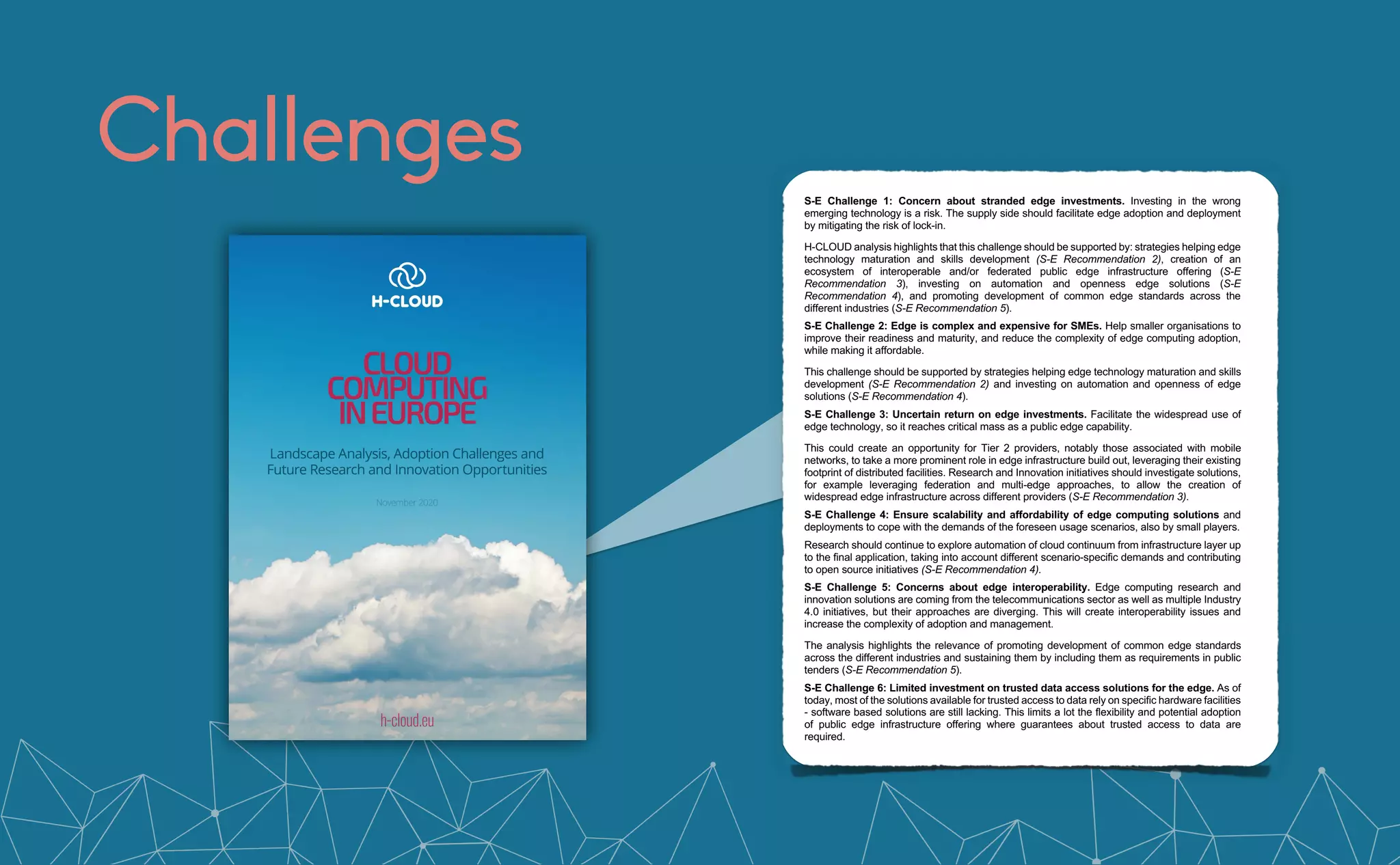
Key challenges for edge computing:
S-E Challenge 1: Concern about stranded edge investments. Investing in the wrong
emerging technology is a risk. The supply side should facilitate edge adoption and deployment
by mitigating the risk of lock-in.
H-CLOUD analysis highlights that this challenge should be supported by: strategies helping edge
technology maturation and skills development (S-E Recommendation 2), creation of an
ecosystem of interoperable and/or federated public edge infrastructure offering (S-E
Recommendation 3), investing on automation and openness edge solutions (S-E
Recommendation 4), and promoting development of common edge standards across the
different industries (S-E Recommendation 5).
S-E Challenge 2: Edge is complex and expensive for SMEs. Help smaller organisations to
improve their readiness and maturity, and reduce the complexity of edge computing adoption,
while making it affordable.
This challenge should be supported by strategies helping edge technology maturation and skills
development (S-E Recommendation 2) and investing on automation and openness of edge
solutions (S-E Recommendation 4).
S-E Challenge 3: Uncertain return on edge investments. Facilitate the widespread use of
edge technology, so it reaches critical mass as a public edge capability.
This could create an opportunity for Tier 2 providers, notably those associated with mobile
networks, to take a more prominent role in edge infrastructure build out, leveraging their existing
footprint of distributed facilities. Research and Innovation initiatives should investigate solutions,
for example leveraging federation and multi-edge approaches, to allow the creation of
widespread edge infrastructure across different providers (S-E Recommendation 3).
S-E Challenge 4: Ensure scalability and affordability of edge computing solutions and
deployments to cope with the demands of the foreseen usage scenarios, also by small players.
Research should continue to explore automation of cloud continuum from infrastructure layer up
to the final application, taking into account different scenario-specific demands and contributing
to open source initiatives (S-E Recommendation 4).
S-E Challenge 5: Concerns about edge interoperability. Edge computing research and
innovation solutions are coming from the telecommunications sector as well as multiple Industry
4.0 initiatives, but their approaches are diverging. This will create interoperability issues and
increase the complexity of adoption and management.
The analysis highlights the relevance of promoting development of common edge standards
across the different industries and sustaining them by including them as requirements in public
tenders (S-E Recommendation 5).
S-E Challenge 6: Limited investment on trusted data access solutions for the edge. As of
today, most of the solutions available for trusted access to data rely on specific hardware facilities
- software based solutions are still lacking. This limits a lot the flexibility and potential adoption
of public edge infrastructure offering where guarantees about trusted access to data are
required.
Research should explore open reference solutions for trusted computing at the edge supporting
multi tenants in isolation and compatible with the different EU privacy and security regulations
(S-E Recommendation 6).
Back to Distributed Systems
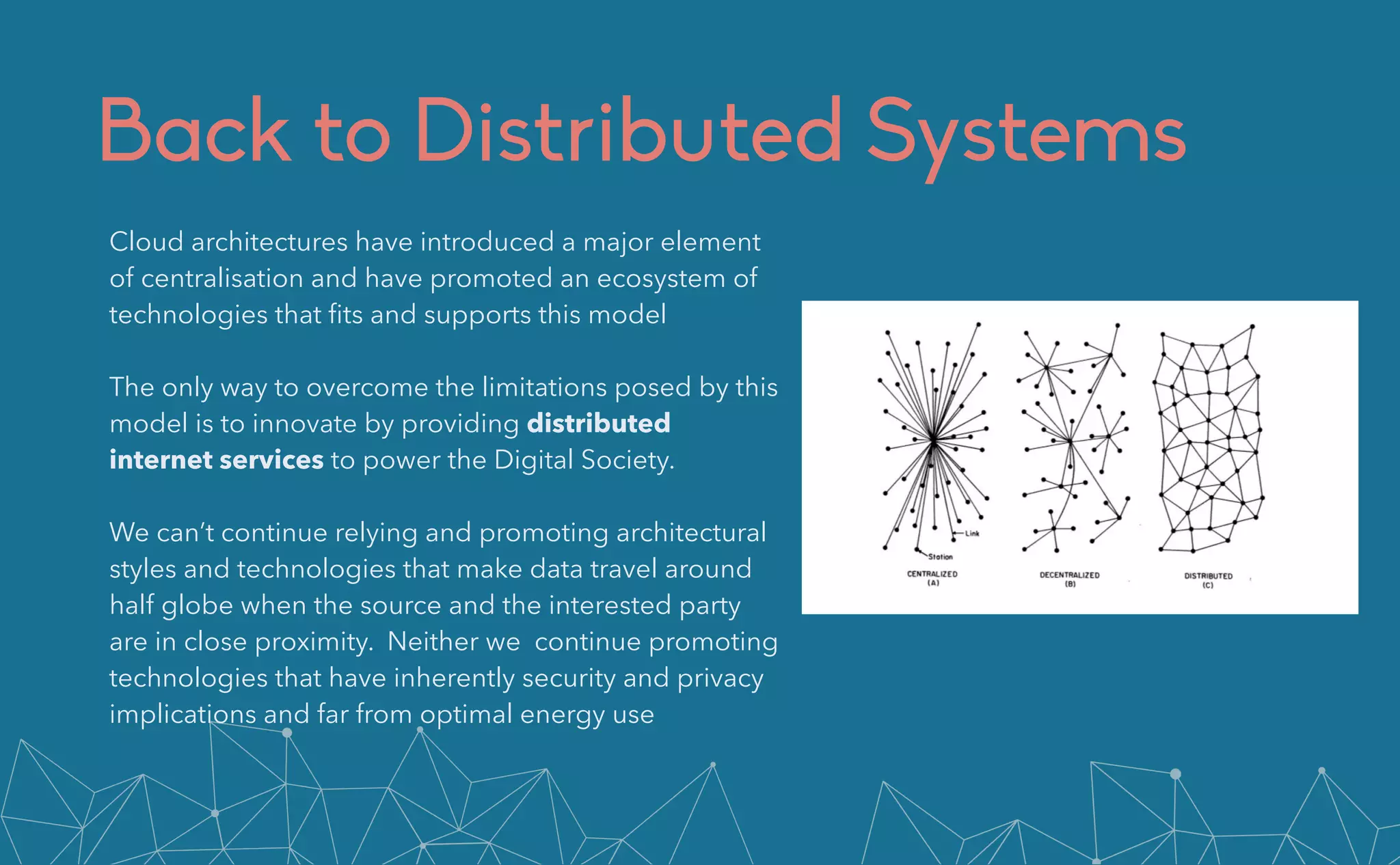
Cloud architectures have introduced a major element
of centralisation and have promoted an ecosystem of
technologies that
fi
ts and supports this model


The only way to overcome the limitations posed by this
model is to innovate by providing distributed
internet services to power the Digital Society.


We can’t continue relying and promoting architectural
styles and technologies that make data travel around
half globe when the source and the interested party
are in close proximity. Neither we continue promoting
technologies that have inherently security and privacy
implications and far from optimal energy use
Technology Stack
We have established the
Edge Native Working
Group in Eclipse to incubate
technologies to address the
aforementioned problems


Two key projects in this
context are zenoh which
implements a data plane for
the edge and fogOS which
de
fi
nes the control and
management plane
[Open Infrastructure]
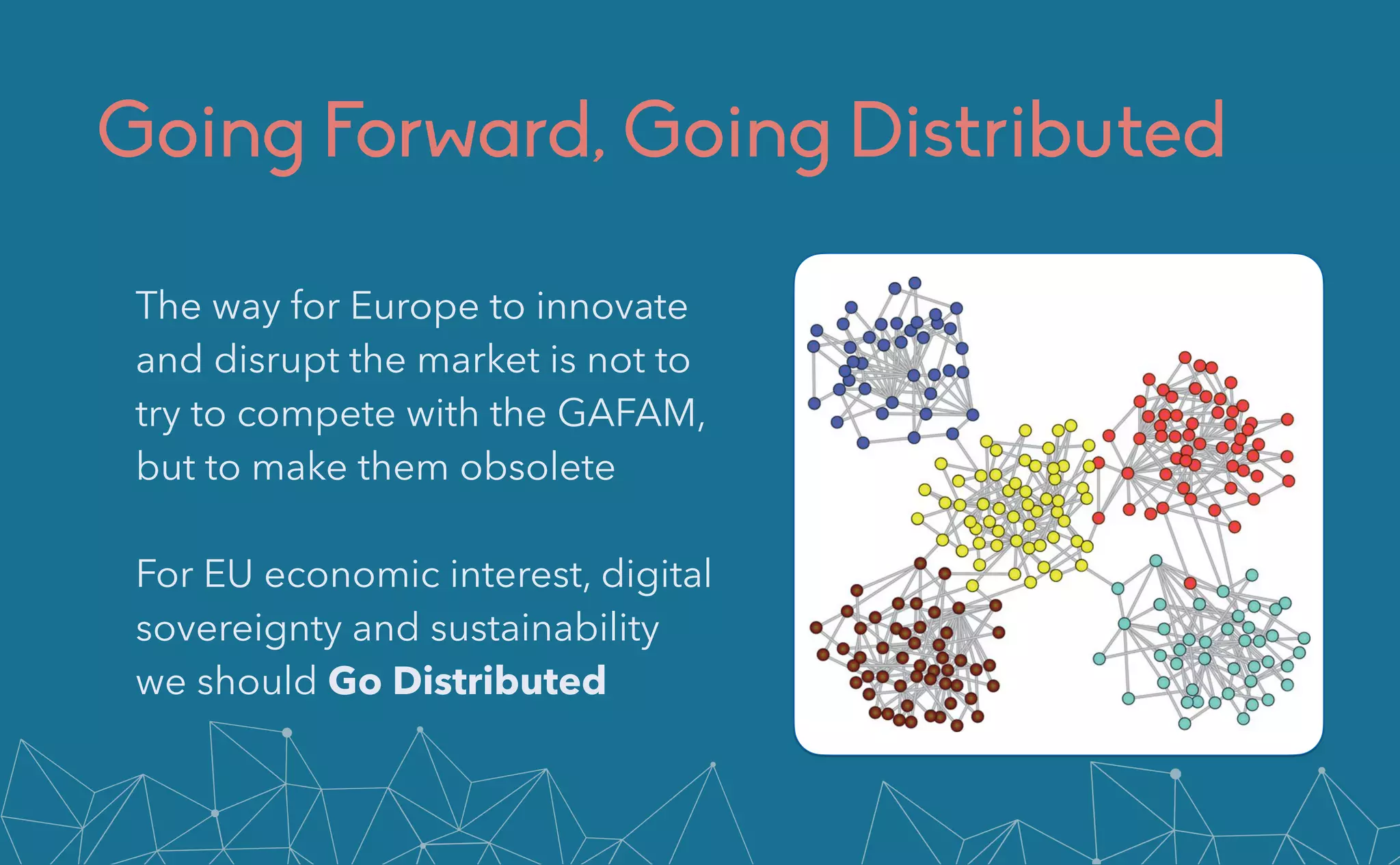
Going Forward, Going Distributed
The way for Europe to innovate
and disrupt the market is not to
try to compete with the GAFAM,
but to make them obsolete

For EU economic interest, digital
sovereignty and sustainability
we should Go Distributed
References
• https://mdsattacks.com


• https://zombieloadattack.com


• https://theshiftproject.org/


• https://www.aceee.org/
fi
les/proceedings/2012/data/papers/0193-000409.pdf


• https://fortune.com/2019/09/18/internet-cloud-server-data-center-energy-
consumption-renewable-coal/


• https://edgenative.eclipse.org


• http://zenoh.io


• http://fog05.io

Data Decentralisation: Efficiency, Privacy and Fair Monetisation

  • 1.
    Data Decentralisation Efficiency, Privacyand Fair Monetisation Angelo Corsaro, PhD Chief Technology Officer ADLINK Technologies Inc.
  • 2.
    The Cloud orThe Internet? Cloud computing had made it easy to provide a large class of “Internet Services”, yet we should not confuse a speci fi c architectural style with the service itself This essential difference is important as the value is provided by the Service not by the underpinning architecture (i.e. the cloud). Example: Cloud Storage is just a way of implementing an “Internet Storage Service”
  • 3.
    Cloud Computing Challenges Theprivacy abuses revealed by Snowden have been heavily covered by the press What is not so much known, is that today the vast majority of servers powering clouds suffer from MDS and are as a consequence inherently insecure. [Security and Privacy]
  • 4.
    Cloud Computing Challenges Asa consequence of centralisation Cloud vendors have the lion share on data monetisation opportunities. This leads to an extremely biased market in which a few control too much If individuals have full ownership and control over their digital footprint they have higher chance to monetise it — if desired. [Monetisation] Example: Your browsing history, your electrical consumption, your running data, etc., is (often) owned, controlled and monetised by third parties.
  • 5.
    Cloud Computing Challenges Cloudcomputing poses major energetic challenges not simply because of data-center but more importantly for the traf fi c it generates. All data gets in and out of a remote data center — that consumes energy [Energy Consumption]
  • 6.
    The Austerity Dilemma Whilstthere there a growing community advocating data austerity, the solution is not simply is being conscious on our use of precious resources — such energie — but we need to realise that the current architectures, infrastructures and technologies where not designed for addressing the data age The solution relies combining innovation to improve the ef fi ciency of data distribution technologies with the sensibilisation of European on the value of parsimony [Energy Consumption]
  • 7.
    Challenges Cloud Computingin Europe © H-CLOUD Consortium 2020-2022 Page 8 of 93 processing, ensuring, for example, compliance with GDPR, is a central element to enable data spaces as envisioned in EUSD. Key challenges for edge computing: S-E Challenge 1: Concern about stranded edge investments. Investing in the wrong emerging technology is a risk. The supply side should facilitate edge adoption and deployment by mitigating the risk of lock-in. H-CLOUD analysis highlights that this challenge should be supported by: strategies helping edge technology maturation and skills development (S-E Recommendation 2), creation of an ecosystem of interoperable and/or federated public edge infrastructure offering (S-E Recommendation 3), investing on automation and openness edge solutions (S-E Recommendation 4), and promoting development of common edge standards across the different industries (S-E Recommendation 5). S-E Challenge 2: Edge is complex and expensive for SMEs. Help smaller organisations to improve their readiness and maturity, and reduce the complexity of edge computing adoption, while making it affordable. This challenge should be supported by strategies helping edge technology maturation and skills development (S-E Recommendation 2) and investing on automation and openness of edge solutions (S-E Recommendation 4). S-E Challenge 3: Uncertain return on edge investments. Facilitate the widespread use of edge technology, so it reaches critical mass as a public edge capability. This could create an opportunity for Tier 2 providers, notably those associated with mobile networks, to take a more prominent role in edge infrastructure build out, leveraging their existing footprint of distributed facilities. Research and Innovation initiatives should investigate solutions, for example leveraging federation and multi-edge approaches, to allow the creation of widespread edge infrastructure across different providers (S-E Recommendation 3). S-E Challenge 4: Ensure scalability and affordability of edge computing solutions and deployments to cope with the demands of the foreseen usage scenarios, also by small players. Research should continue to explore automation of cloud continuum from infrastructure layer up to the final application, taking into account different scenario-specific demands and contributing to open source initiatives (S-E Recommendation 4). S-E Challenge 5: Concerns about edge interoperability. Edge computing research and innovation solutions are coming from the telecommunications sector as well as multiple Industry 4.0 initiatives, but their approaches are diverging. This will create interoperability issues and increase the complexity of adoption and management. The analysis highlights the relevance of promoting development of common edge standards across the different industries and sustaining them by including them as requirements in public tenders (S-E Recommendation 5). S-E Challenge 6: Limited investment on trusted data access solutions for the edge. As of today, most of the solutions available for trusted access to data rely on specific hardware facilities - software based solutions are still lacking. This limits a lot the flexibility and potential adoption of public edge infrastructure offering where guarantees about trusted access to data are required. Research should explore open reference solutions for trusted computing at the edge supporting multi tenants in isolation and compatible with the different EU privacy and security regulations (S-E Recommendation 6).
  • 8.
    Back to DistributedSystems Cloud architectures have introduced a major element of centralisation and have promoted an ecosystem of technologies that fi ts and supports this model The only way to overcome the limitations posed by this model is to innovate by providing distributed internet services to power the Digital Society. We can’t continue relying and promoting architectural styles and technologies that make data travel around half globe when the source and the interested party are in close proximity. Neither we continue promoting technologies that have inherently security and privacy implications and far from optimal energy use
  • 9.
    Technology Stack We haveestablished the Edge Native Working Group in Eclipse to incubate technologies to address the aforementioned problems Two key projects in this context are zenoh which implements a data plane for the edge and fogOS which de fi nes the control and management plane [Open Infrastructure]
  • 10.
    Going Forward, GoingDistributed The way for Europe to innovate and disrupt the market is not to try to compete with the GAFAM, but to make them obsolete For EU economic interest, digital sovereignty and sustainability we should Go Distributed
  • 11.
    References • https://mdsattacks.com • https://zombieloadattack.com •https://theshiftproject.org/ • https://www.aceee.org/ fi les/proceedings/2012/data/papers/0193-000409.pdf • https://fortune.com/2019/09/18/internet-cloud-server-data-center-energy- consumption-renewable-coal/ • https://edgenative.eclipse.org • http://zenoh.io • http://fog05.io