©Silberschatz, Korth and Sudarshan
15.1
Database System Concepts - 6th
Edition
Deadlocks
Deadlocks
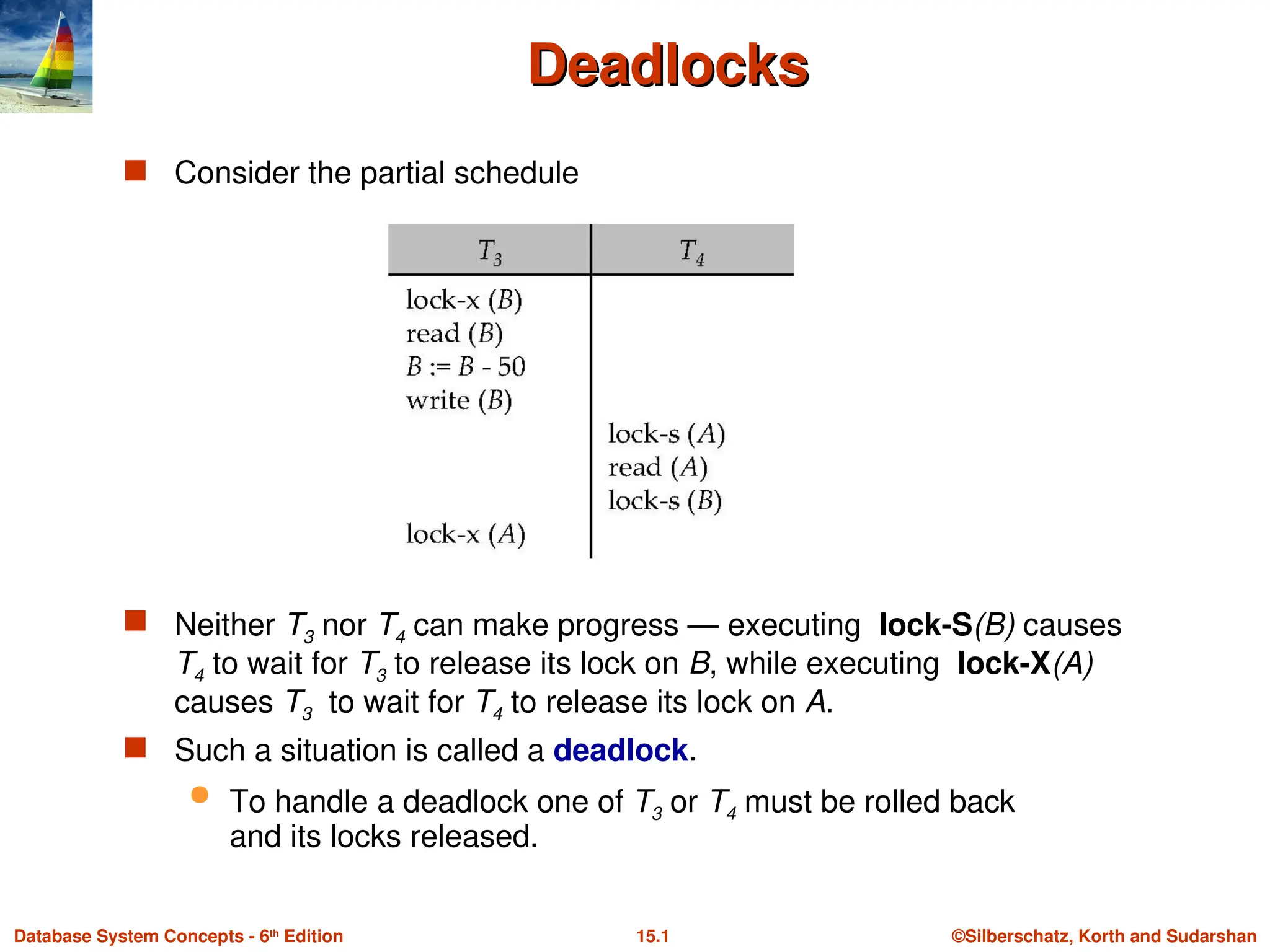
 Consider the partial schedule
 Neither T3 nor T4 can make progress — executing lock-S(B) causes
T4 to wait for T3 to release its lock on B, while executing lock-X(A)
causes T3 to wait for T4 to release its lock on A.
 Such a situation is called a deadlock.
 To handle a deadlock one of T3 or T4 must be rolled back
and its locks released.
©Silberschatz, Korth and Sudarshan
15.2
Database System Concepts - 6th
Edition
Deadlocks (Cont.)
Deadlocks (Cont.)
 Two-phase locking does not ensure freedom from deadlocks.
 In addition to deadlocks, there is a possibility of starvation.
 Starvation occurs if the concurrency control manager is badly
designed. For example:
 A transaction may be waiting for an X-lock on an item,
while a sequence of other transactions request and are
granted an S-lock on the same item.
 The same transaction is repeatedly rolled back due to
deadlocks.
 Concurrency control manager can be designed to prevent
starvation.
©Silberschatz, Korth and Sudarshan
15.3
Database System Concepts - 6th
Edition
Deadlocks (Cont.)
Deadlocks (Cont.)
 The potential for deadlock exists in most locking protocols.
Deadlocks are a necessary evil.
 When a deadlock occurs there is a possibility of cascading roll-
backs.
 Cascading roll-back is possible under two-phase locking. To
avoid this, follow a modified protocol called strict two-phase
locking -- a transaction must hold all its exclusive locks till it
commits/aborts.
 Rigorous two-phase locking is even stricter. Here, all locks
are held till commit/abort. In this protocol transactions can be
serialized in the order in which they commit.
©Silberschatz, Korth and Sudarshan
15.4
Database System Concepts - 6th
Edition
Deadlock Handling
Deadlock Handling
 System is deadlocked if there is a set of transactions such that
every transaction in the set is waiting for another transaction in
the set.
 Deadlock prevention protocols ensure that the system will never
enter into a deadlock state. Some prevention strategies :
 Require that each transaction locks all its data items
before it begins execution (predeclaration).
 Impose partial ordering of all data items and require that a
transaction can lock data items only in the order specified
by the partial order.
©Silberschatz, Korth and Sudarshan
15.5
Database System Concepts - 6th
Edition
More Deadlock Prevention Strategies
 Following schemes use transaction timestamps for the sake of
deadlock prevention alone.
 wait-die scheme — non-preemptive
 older transaction may wait for younger one to release data item.
(older means smaller timestamp) Younger transactions never
Younger transactions never wait for older ones; they are rolled
back instead.
 a transaction may die several times before acquiring needed data
item
 wound-wait scheme — preemptive
 older transaction wounds (forces rollback) of younger transaction
instead of waiting for it. Younger transactions may wait for older
ones.
 may be fewer rollbacks than wait-die scheme.
©Silberschatz, Korth and Sudarshan
15.6
Database System Concepts - 6th
Edition
Deadlock prevention (Cont.)
 Both in wait-die and in wound-wait schemes, a rolled back
transactions is restarted with its original timestamp. Older transactions
thus have precedence over newer ones, and starvation is hence
avoided.
 Timeout-Based Schemes:
 a transaction waits for a lock only for a specified amount of time. If
the lock has not been granted within that time, the transaction is
rolled back and restarted,
 Thus, deadlocks are not possible
 simple to implement; but starvation is possible. Also difficult to
determine good value of the timeout interval.
©Silberschatz, Korth and Sudarshan
15.7
Database System Concepts - 6th
Edition
Deadlock Detection
Deadlock Detection
 Deadlocks can be described as a wait-for graph, which consists of a
pair G = (V,E),
 V is a set of vertices (all the transactions in the system)
 E is a set of edges; each element is an ordered pair Ti Tj.
 If Ti  Tj is in E, then there is a directed edge from Ti to Tj, implying
that Ti is waiting for Tj to release a data item.
 When Ti requests a data item currently being held by Tj, then the edge
Ti  Tj is inserted in the wait-for graph. This edge is removed only
when Tj is no longer holding a data item needed by Ti.
 The system is in a deadlock state if and only if the wait-for graph has a
cycle. Must invoke a deadlock-detection algorithm periodically to look
for cycles.
©Silberschatz, Korth and Sudarshan
15.8
Database System Concepts - 6th
Edition
Deadlock Detection (Cont.)
Wait-for graph without a cycle Wait-for graph with a cycle
©Silberschatz, Korth and Sudarshan
15.9
Database System Concepts - 6th
Edition
Concurrency in Index Structures
 Indices are unlike other database items in that their only job is to help in
accessing data.
 Index-structures are typically accessed very often, much more than
other database items.
 Treating index-structures like other database items, e.g. by 2-phase
locking of index nodes can lead to low concurrency.
 There are several index concurrency protocols where locks on internal
nodes are released early, and not in a two-phase fashion.
 It is acceptable to have nonserializable concurrent access to an
index as long as the accuracy of the index is maintained.
 In particular, the exact values read in an internal node of a
B+
-tree are irrelevant so long as we land up in the correct leaf
node.
©Silberschatz, Korth and Sudarshan
15.10
Database System Concepts - 6th
Edition
Concurrency in Index Structures (Cont.)
 Example of index concurrency protocol:
 Use crabbing instead of two-phase locking on the nodes of the B+
-tree, as
follows. During search/insertion/deletion:
 First lock the root node in shared mode.
 After locking all required children of a node in shared mode, release the
lock on the node.
 During insertion/deletion, upgrade leaf node locks to exclusive mode.
 When splitting or coalescing requires changes to a parent, lock the parent in
exclusive mode.
 Above protocol can cause excessive deadlocks
 Searches coming down the tree deadlock with updates going up the tree
 Can abort and restart search, without affecting transaction
 Better protocols are available; see Section 16.9 for one such protocol, the B-link
tree protocol
 Intuition: release lock on parent before acquiring lock on child
 And deal with changes that may have happened between lock release
and acquire
©Silberschatz, Korth and Sudarshan
15.11
Database System Concepts - 6th
Edition
Weak Levels of Consistency
 Degree-two consistency: differs from two-phase locking in that S-locks
may be released at any time, and locks may be acquired at any time
 X-locks must be held till end of transaction
 Serializability is not guaranteed, programmer must ensure that no
erroneous database state will occur]
 Cursor stability:
 For reads, each tuple is locked, read, and lock is immediately
released
 X-locks are held till end of transaction
 Special case of degree-two consistency
©Silberschatz, Korth and Sudarshan
15.12
Database System Concepts - 6th
Edition
Weak Levels of Consistency in SQL
 SQL allows non-serializable executions
 Serializable: is the default
 Repeatable read: allows only committed records to be read, and
repeating a read should return the same value (so read locks should
be retained)
 However, the phantom phenomenon need not be prevented
– T1 may see some records inserted by T2, but may not see
others inserted by T2
 Read committed: same as degree two consistency, but most
systems implement it as cursor-stability
 Read uncommitted: allows even uncommitted data to be read
 In many database systems, read committed is the default consistency
level
 has to be explicitly changed to serializable when required
 set isolation level serializable

database management system in deadlock.ppt

  • 1.
    ©Silberschatz, Korth andSudarshan 15.1 Database System Concepts - 6th Edition Deadlocks Deadlocks  Consider the partial schedule  Neither T3 nor T4 can make progress — executing lock-S(B) causes T4 to wait for T3 to release its lock on B, while executing lock-X(A) causes T3 to wait for T4 to release its lock on A.  Such a situation is called a deadlock.  To handle a deadlock one of T3 or T4 must be rolled back and its locks released.
  • 2.
    ©Silberschatz, Korth andSudarshan 15.2 Database System Concepts - 6th Edition Deadlocks (Cont.) Deadlocks (Cont.)  Two-phase locking does not ensure freedom from deadlocks.  In addition to deadlocks, there is a possibility of starvation.  Starvation occurs if the concurrency control manager is badly designed. For example:  A transaction may be waiting for an X-lock on an item, while a sequence of other transactions request and are granted an S-lock on the same item.  The same transaction is repeatedly rolled back due to deadlocks.  Concurrency control manager can be designed to prevent starvation.
  • 3.
    ©Silberschatz, Korth andSudarshan 15.3 Database System Concepts - 6th Edition Deadlocks (Cont.) Deadlocks (Cont.)  The potential for deadlock exists in most locking protocols. Deadlocks are a necessary evil.  When a deadlock occurs there is a possibility of cascading roll- backs.  Cascading roll-back is possible under two-phase locking. To avoid this, follow a modified protocol called strict two-phase locking -- a transaction must hold all its exclusive locks till it commits/aborts.  Rigorous two-phase locking is even stricter. Here, all locks are held till commit/abort. In this protocol transactions can be serialized in the order in which they commit.
  • 4.
    ©Silberschatz, Korth andSudarshan 15.4 Database System Concepts - 6th Edition Deadlock Handling Deadlock Handling  System is deadlocked if there is a set of transactions such that every transaction in the set is waiting for another transaction in the set.  Deadlock prevention protocols ensure that the system will never enter into a deadlock state. Some prevention strategies :  Require that each transaction locks all its data items before it begins execution (predeclaration).  Impose partial ordering of all data items and require that a transaction can lock data items only in the order specified by the partial order.
  • 5.
    ©Silberschatz, Korth andSudarshan 15.5 Database System Concepts - 6th Edition More Deadlock Prevention Strategies More Deadlock Prevention Strategies  Following schemes use transaction timestamps for the sake of deadlock prevention alone.  wait-die scheme — non-preemptive  older transaction may wait for younger one to release data item. (older means smaller timestamp) Younger transactions never Younger transactions never wait for older ones; they are rolled back instead.  a transaction may die several times before acquiring needed data item  wound-wait scheme — preemptive  older transaction wounds (forces rollback) of younger transaction instead of waiting for it. Younger transactions may wait for older ones.  may be fewer rollbacks than wait-die scheme.
  • 6.
    ©Silberschatz, Korth andSudarshan 15.6 Database System Concepts - 6th Edition Deadlock prevention (Cont.) Deadlock prevention (Cont.)  Both in wait-die and in wound-wait schemes, a rolled back transactions is restarted with its original timestamp. Older transactions thus have precedence over newer ones, and starvation is hence avoided.  Timeout-Based Schemes:  a transaction waits for a lock only for a specified amount of time. If the lock has not been granted within that time, the transaction is rolled back and restarted,  Thus, deadlocks are not possible  simple to implement; but starvation is possible. Also difficult to determine good value of the timeout interval.
  • 7.
    ©Silberschatz, Korth andSudarshan 15.7 Database System Concepts - 6th Edition Deadlock Detection Deadlock Detection  Deadlocks can be described as a wait-for graph, which consists of a pair G = (V,E),  V is a set of vertices (all the transactions in the system)  E is a set of edges; each element is an ordered pair Ti Tj.  If Ti  Tj is in E, then there is a directed edge from Ti to Tj, implying that Ti is waiting for Tj to release a data item.  When Ti requests a data item currently being held by Tj, then the edge Ti  Tj is inserted in the wait-for graph. This edge is removed only when Tj is no longer holding a data item needed by Ti.  The system is in a deadlock state if and only if the wait-for graph has a cycle. Must invoke a deadlock-detection algorithm periodically to look for cycles.
  • 8.
    ©Silberschatz, Korth andSudarshan 15.8 Database System Concepts - 6th Edition Deadlock Detection (Cont.) Deadlock Detection (Cont.) Wait-for graph without a cycle Wait-for graph with a cycle
  • 9.
    ©Silberschatz, Korth andSudarshan 15.9 Database System Concepts - 6th Edition Concurrency in Index Structures Concurrency in Index Structures  Indices are unlike other database items in that their only job is to help in accessing data.  Index-structures are typically accessed very often, much more than other database items.  Treating index-structures like other database items, e.g. by 2-phase locking of index nodes can lead to low concurrency.  There are several index concurrency protocols where locks on internal nodes are released early, and not in a two-phase fashion.  It is acceptable to have nonserializable concurrent access to an index as long as the accuracy of the index is maintained.  In particular, the exact values read in an internal node of a B+ -tree are irrelevant so long as we land up in the correct leaf node.
  • 10.
    ©Silberschatz, Korth andSudarshan 15.10 Database System Concepts - 6th Edition Concurrency in Index Structures (Cont.) Concurrency in Index Structures (Cont.)  Example of index concurrency protocol:  Use crabbing instead of two-phase locking on the nodes of the B+ -tree, as follows. During search/insertion/deletion:  First lock the root node in shared mode.  After locking all required children of a node in shared mode, release the lock on the node.  During insertion/deletion, upgrade leaf node locks to exclusive mode.  When splitting or coalescing requires changes to a parent, lock the parent in exclusive mode.  Above protocol can cause excessive deadlocks  Searches coming down the tree deadlock with updates going up the tree  Can abort and restart search, without affecting transaction  Better protocols are available; see Section 16.9 for one such protocol, the B-link tree protocol  Intuition: release lock on parent before acquiring lock on child  And deal with changes that may have happened between lock release and acquire
  • 11.
    ©Silberschatz, Korth andSudarshan 15.11 Database System Concepts - 6th Edition Weak Levels of Consistency Weak Levels of Consistency  Degree-two consistency: differs from two-phase locking in that S-locks may be released at any time, and locks may be acquired at any time  X-locks must be held till end of transaction  Serializability is not guaranteed, programmer must ensure that no erroneous database state will occur]  Cursor stability:  For reads, each tuple is locked, read, and lock is immediately released  X-locks are held till end of transaction  Special case of degree-two consistency
  • 12.
    ©Silberschatz, Korth andSudarshan 15.12 Database System Concepts - 6th Edition Weak Levels of Consistency in SQL Weak Levels of Consistency in SQL  SQL allows non-serializable executions  Serializable: is the default  Repeatable read: allows only committed records to be read, and repeating a read should return the same value (so read locks should be retained)  However, the phantom phenomenon need not be prevented – T1 may see some records inserted by T2, but may not see others inserted by T2  Read committed: same as degree two consistency, but most systems implement it as cursor-stability  Read uncommitted: allows even uncommitted data to be read  In many database systems, read committed is the default consistency level  has to be explicitly changed to serializable when required  set isolation level serializable